GAS CHROMATOGRAPHY
Gas chromatography is a technique used for
separation of volatile substances, or substances that
can be made volatile, from one another in a gaseous
mixture at high temperatures. A sample containing
the materials to be separated is injected into the gas
chromatograph. A mobile phase (carrier gas) moves
through a column that contains a wall coated or
granular solid coated stationary phase. As the carrier
gas flows through the column, the components of the
sample come in contact with the stationary phase. The
different components of the sample have different
affinities for the stationary phase, which results in
differential migration of solutes, thus leading to
separation
Gas chromatography can be used for both qualitative
and quantitative analysis. Comparison of retention
times can be used to identify materials in the sample
by comparing retention times of peaks in a sample to
retention times for standards. The same limitations
for qualitative analysis
There are two types of Gas chromatography
Gas - Solid Chromatography (GSC)
Gas - Liquid Chromatography (GLC)
Gas - Solid Chromatography (GSC)
The stationary phase, in this case, is a solid like silica or
alumina. It is the affinity of solutes towards adsorption
onto the stationary phase which determines, in part, the
retention time. The mobile phase is, of course, a suitable
carrier gas. This gas chromatographic technique is most
useful for the separation and analysis of gases like CH4,
CO2, CO, ... etc.
Gas - Liquid Chromatography (GLC)
The stationary phase is a liquid with very low
volatility while the mobile phase is a suitable
carrier gas. GLC is the most widely used
technique for separation of volatile species. The
presence of a wide variety of stationary phases
with contrasting selectivities and easy column
preparation add to the assets of GLC or simply
GC.
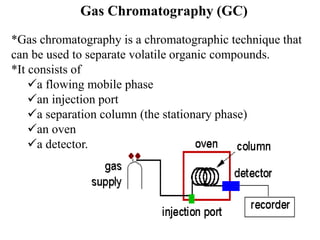
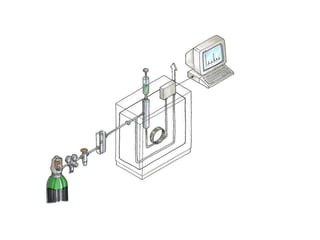
Gas Chromatography (GC)
*Gas chromatography is a chromatographic technique that
can be used to separate volatile organic compounds.
*It consists of
a flowing mobile phase
an injection port
a separation column (the stationary phase)
an oven
a detector.
The organic compounds are separated due to
differences in their partitioning behavior between
the mobile gas phase and the stationary phase in
the column.
Principle
Mobile phases are generally inert gases such as
helium, argon, or nitrogen.
The injection port consists of a rubber septum
through which a syringe needle is inserted to inject
the sample.
The injection port is maintained at a higher
temperature than the boiling point of the least
volatile component in the sample mixture.
Since the partitioning behavior is dependent on
temperature, the separation column is usually
contained in a thermostat-controlled oven.
Separating components with a wide range of boiling
points is accomplished by starting at a low oven
temperature and increasing the temperature over time
to elute the high-boiling point components.
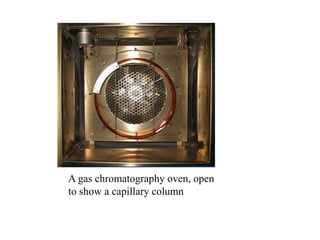
A gas chromatography oven, open
to show a capillary column
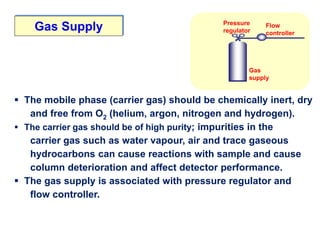
 The mobile phase (carrier gas) should be chemically inert, dry
and free from O2 (helium, argon, nitrogen and hydrogen).
 The carrier gas should be of high purity; impurities in the
carrier gas such as water vapour, air and trace gaseous
hydrocarbons can cause reactions with sample and cause
column deterioration and affect detector performance.
 The gas supply is associated with pressure regulator and
flow controller.
Gas Supply
Gas
supply
Pressure
regulator
Flow
controller
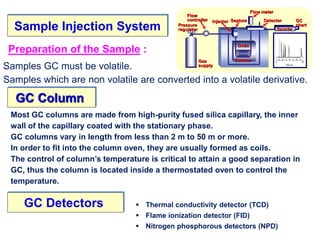
Sample Injection System
Flow meter
Gas
supply
Pressure
regulator
Flow
controller Septum Detector
Oven
Column
Injector
Recorder

GC
chart
Samples GC must be volatile.
Samples which are non volatile are converted into a volatile derivative.
Preparation of the Sample :
GC Column
Most GC columns are made from high-purity fused silica capillary, the inner
wall of the capillary coated with the stationary phase.
GC columns vary in length from less than 2 m to 50 m or more.
In order to fit into the column oven, they are usually formed as coils.
The control of column’s temperature is critical to attain a good separation in
GC, thus the column is located inside a thermostated oven to control the
temperature.
GC Detectors  Thermal conductivity detector (TCD)
 Flame ionization detector (FID)
 Nitrogen phosphorous detectors (NPD)
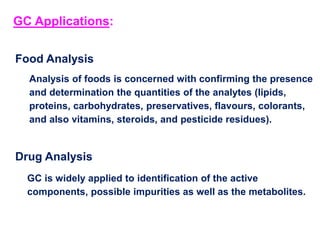
Food Analysis
Analysis of foods is concerned with confirming the presence
and determination the quantities of the analytes (lipids,
proteins, carbohydrates, preservatives, flavours, colorants,
and also vitamins, steroids, and pesticide residues).
Drug Analysis
GC is widely applied to identification of the active
components, possible impurities as well as the metabolites.
GC Applications:
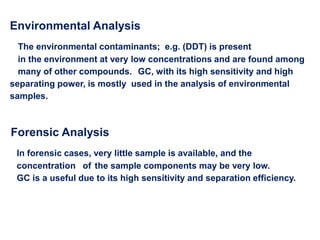
Forensic Analysis
In forensic cases, very little sample is available, and the
concentration of the sample components may be very low.
GC is a useful due to its high sensitivity and separation efficiency.
Environmental Analysis
The environmental contaminants; e.g. (DDT) is present
in the environment at very low concentrations and are found among
many of other compounds. GC, with its high sensitivity and high
separating power, is mostly used in the analysis of environmental
samples.
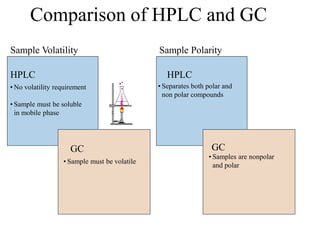
Comparison of HPLC and GC
Sample Volatility Sample Polarity
HPLC
• No volatility requirement
• Sample must be soluble
in mobile phase
GC
• Sample must be volatile
HPLC
GC
• Separates both polar and
non polar compounds
• Samples are nonpolar
and polar
Comparison of HPLC and GC
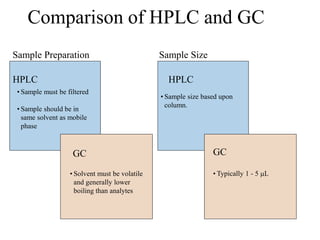
Sample Preparation Sample Size
HPLC
• Sample must be filtered
• Sample should be in
same solvent as mobile
phase
GC
• Solvent must be volatile
and generally lower
boiling than analytes
HPLC
GC
• Sample size based upon
column.
• Typically 1 - 5 L
Comparison of HPLC and GC
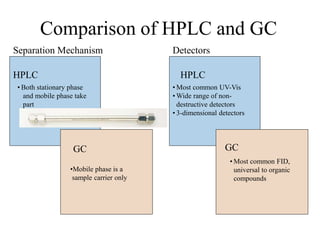
Separation Mechanism Detectors
HPLC
• Both stationary phase
and mobile phase take
part
GC
•Mobile phase is a
sample carrier only
HPLC
GC
• Most common UV-Vis
• Wide range of non-
destructive detectors
• 3-dimensional detectors
• Most common FID,
universal to organic
compounds
4_2019_05_13!10_06_24_PM.ppt

4_2019_05_13!10_06_24_PM.ppt

  • 1.
  • 2.
    Gas chromatography isa technique used for separation of volatile substances, or substances that can be made volatile, from one another in a gaseous mixture at high temperatures. A sample containing the materials to be separated is injected into the gas chromatograph. A mobile phase (carrier gas) moves through a column that contains a wall coated or granular solid coated stationary phase. As the carrier gas flows through the column, the components of the sample come in contact with the stationary phase. The different components of the sample have different affinities for the stationary phase, which results in differential migration of solutes, thus leading to separation
  • 3.
    Gas chromatography canbe used for both qualitative and quantitative analysis. Comparison of retention times can be used to identify materials in the sample by comparing retention times of peaks in a sample to retention times for standards. The same limitations for qualitative analysis There are two types of Gas chromatography Gas - Solid Chromatography (GSC) Gas - Liquid Chromatography (GLC)
  • 4.
    Gas - SolidChromatography (GSC) The stationary phase, in this case, is a solid like silica or alumina. It is the affinity of solutes towards adsorption onto the stationary phase which determines, in part, the retention time. The mobile phase is, of course, a suitable carrier gas. This gas chromatographic technique is most useful for the separation and analysis of gases like CH4, CO2, CO, ... etc.
  • 5.
    Gas - LiquidChromatography (GLC) The stationary phase is a liquid with very low volatility while the mobile phase is a suitable carrier gas. GLC is the most widely used technique for separation of volatile species. The presence of a wide variety of stationary phases with contrasting selectivities and easy column preparation add to the assets of GLC or simply GC.
  • 6.
    Gas Chromatography (GC) *Gaschromatography is a chromatographic technique that can be used to separate volatile organic compounds. *It consists of a flowing mobile phase an injection port a separation column (the stationary phase) an oven a detector.
  • 8.
    The organic compoundsare separated due to differences in their partitioning behavior between the mobile gas phase and the stationary phase in the column. Principle
  • 9.
    Mobile phases aregenerally inert gases such as helium, argon, or nitrogen. The injection port consists of a rubber septum through which a syringe needle is inserted to inject the sample. The injection port is maintained at a higher temperature than the boiling point of the least volatile component in the sample mixture.
  • 10.
    Since the partitioningbehavior is dependent on temperature, the separation column is usually contained in a thermostat-controlled oven. Separating components with a wide range of boiling points is accomplished by starting at a low oven temperature and increasing the temperature over time to elute the high-boiling point components.
  • 11.
    A gas chromatographyoven, open to show a capillary column
  • 12.
     The mobilephase (carrier gas) should be chemically inert, dry and free from O2 (helium, argon, nitrogen and hydrogen).  The carrier gas should be of high purity; impurities in the carrier gas such as water vapour, air and trace gaseous hydrocarbons can cause reactions with sample and cause column deterioration and affect detector performance.  The gas supply is associated with pressure regulator and flow controller. Gas Supply Gas supply Pressure regulator Flow controller
  • 13.
    Sample Injection System Flowmeter Gas supply Pressure regulator Flow controller Septum Detector Oven Column Injector Recorder  GC chart Samples GC must be volatile. Samples which are non volatile are converted into a volatile derivative. Preparation of the Sample : GC Column Most GC columns are made from high-purity fused silica capillary, the inner wall of the capillary coated with the stationary phase. GC columns vary in length from less than 2 m to 50 m or more. In order to fit into the column oven, they are usually formed as coils. The control of column’s temperature is critical to attain a good separation in GC, thus the column is located inside a thermostated oven to control the temperature. GC Detectors  Thermal conductivity detector (TCD)  Flame ionization detector (FID)  Nitrogen phosphorous detectors (NPD)
  • 14.
    Food Analysis Analysis offoods is concerned with confirming the presence and determination the quantities of the analytes (lipids, proteins, carbohydrates, preservatives, flavours, colorants, and also vitamins, steroids, and pesticide residues). Drug Analysis GC is widely applied to identification of the active components, possible impurities as well as the metabolites. GC Applications:
  • 15.
    Forensic Analysis In forensiccases, very little sample is available, and the concentration of the sample components may be very low. GC is a useful due to its high sensitivity and separation efficiency. Environmental Analysis The environmental contaminants; e.g. (DDT) is present in the environment at very low concentrations and are found among many of other compounds. GC, with its high sensitivity and high separating power, is mostly used in the analysis of environmental samples.
  • 16.
    Comparison of HPLCand GC Sample Volatility Sample Polarity HPLC • No volatility requirement • Sample must be soluble in mobile phase GC • Sample must be volatile HPLC GC • Separates both polar and non polar compounds • Samples are nonpolar and polar
  • 17.
    Comparison of HPLCand GC Sample Preparation Sample Size HPLC • Sample must be filtered • Sample should be in same solvent as mobile phase GC • Solvent must be volatile and generally lower boiling than analytes HPLC GC • Sample size based upon column. • Typically 1 - 5 L
  • 18.
    Comparison of HPLCand GC Separation Mechanism Detectors HPLC • Both stationary phase and mobile phase take part GC •Mobile phase is a sample carrier only HPLC GC • Most common UV-Vis • Wide range of non- destructive detectors • 3-dimensional detectors • Most common FID, universal to organic compounds