Teamwork in Healthcare
Making patients safer
W. Ward Flemons MD
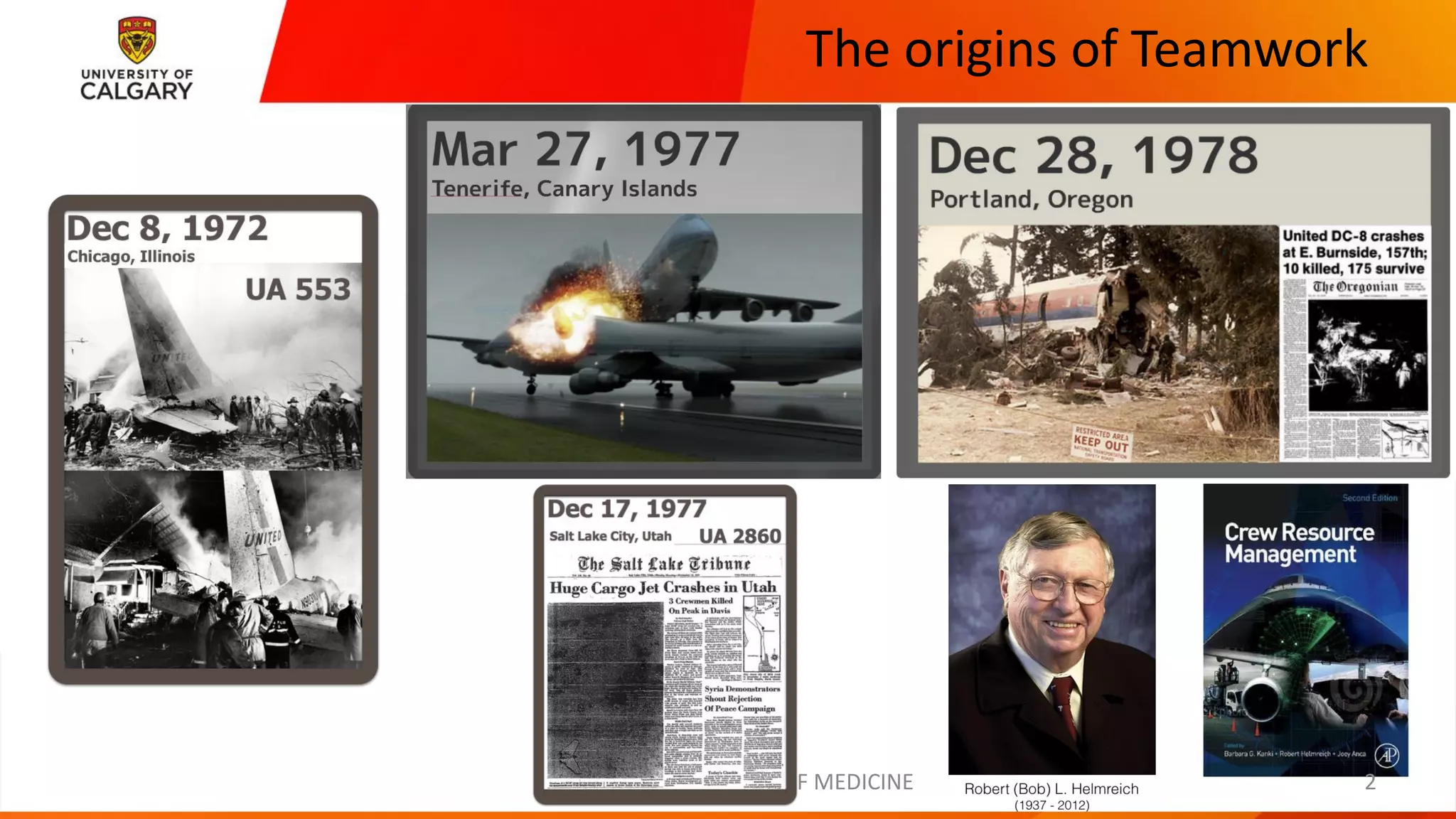
The origins of Teamwork
CUMMING SCHOOL OF MEDICINE 2
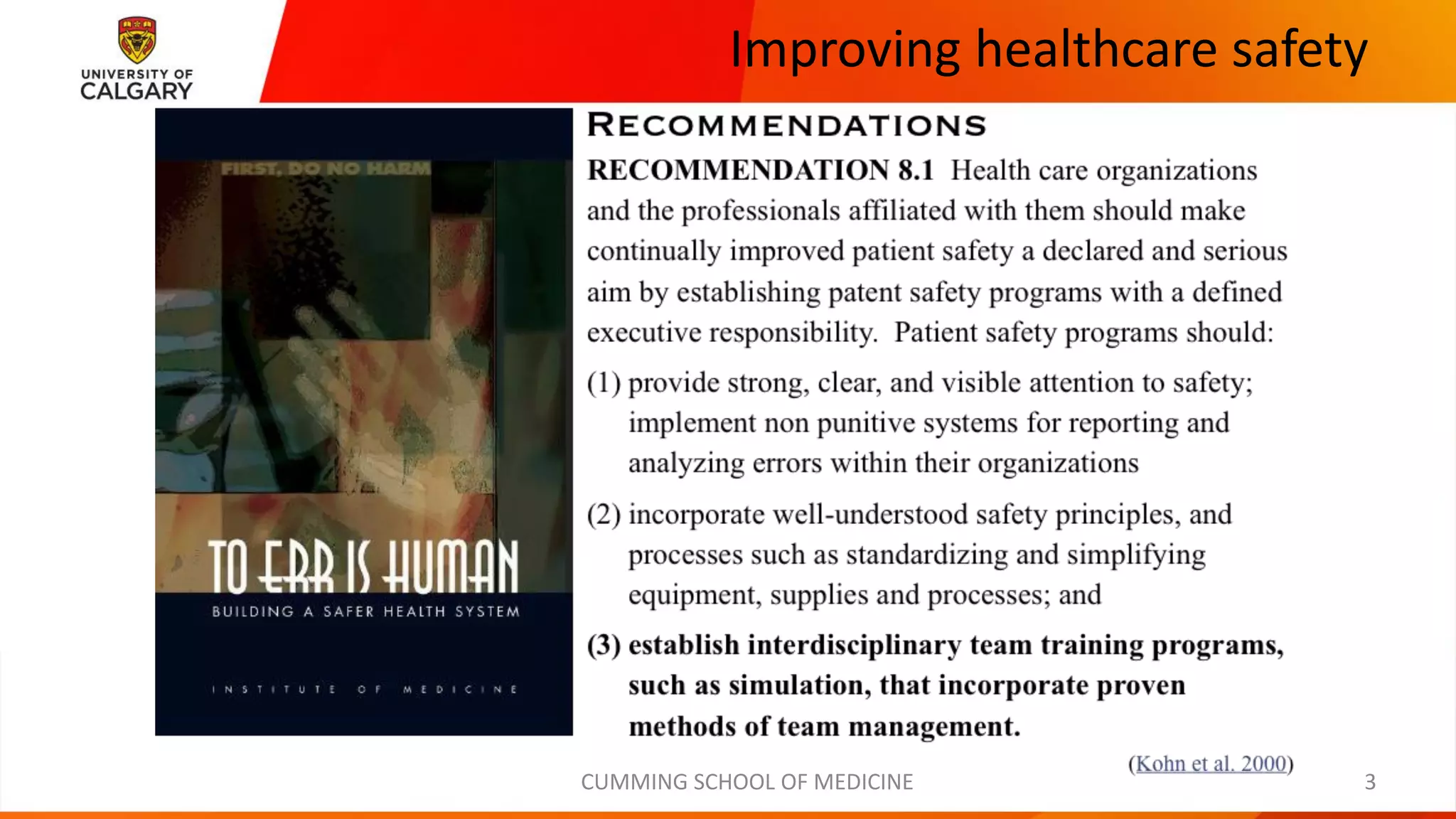
Improving healthcare safety
CUMMING SCHOOL OF MEDICINE 3
Teaching Teamwork to undergraduates
▪ Team STEPPS designed as an organizational strategy
▪ Skills are not well defined – can they be tested?
▪ Physician oriented
▪ Passive learning (slides) > > Active learning
▪ Undergraduates have limited or no clinical experience
▪ Team skills are ‘soft’ skills
▪ Often learned during simulation BUT . . . .
▪ Cognitive overload – learning clinical skills 1st priority
CUMMING SCHOOL OF MEDICINE 4
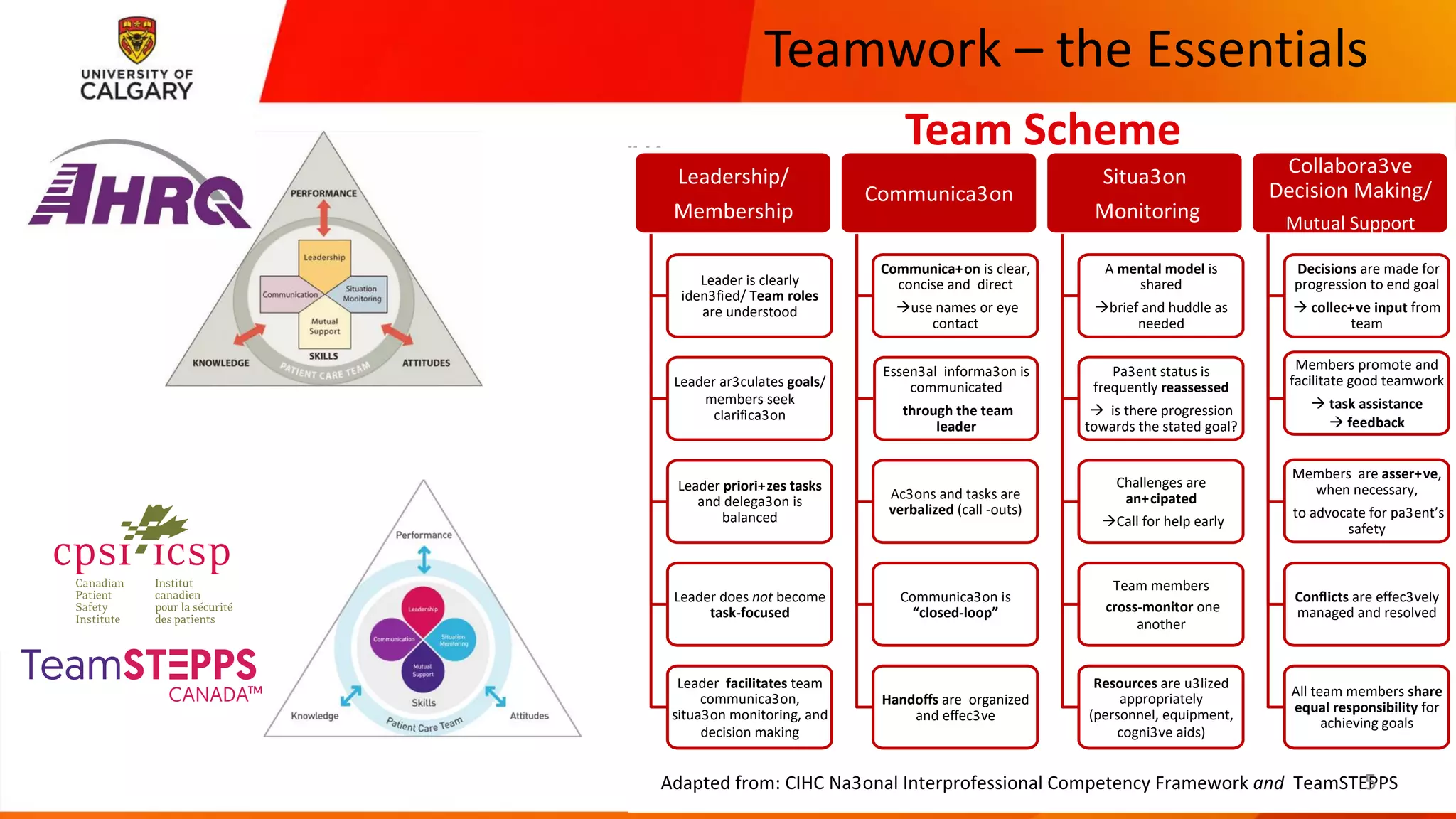
Teamwork – the Essentials
CUMMING SCHOOL OF MEDICINE
Team Scheme
TeamSTEPPS Canada™ Fundamentals
Core teamwork skills
1.4
Team Scheme
Leadership/
Membership
Leader is clearly
iden3fied/ Team roles
are understood
Leader priori+zes tasks
and delega3on is
balanced
Leader ar3culates goals/
members seek
clarifica3on
Leader does not become
task-focused
Leader facilitates team
communica3on,
situa3on monitoring, and
decision making
Communica3on
Essen3al informa3on is
communicated
through the team
leader
Communica+on is clear,
concise and direct
àuse names or eye
contact
Ac3ons and tasks are
verbalized (call -outs)
Communica3on is
“closed-loop”
Handoffs are organized
and effec3ve
Situa3on
Monitoring
A mental model is
shared
àbrief and huddle as
needed
Pa3ent status is
frequently reassessed
à is there progression
towards the stated goal?
Challenges are
an+cipated
àCall for help early
Team members
cross-monitor one
another
Resources are u3lized
appropriately
(personnel, equipment,
cogni3ve aids)
Collabora3ve
Decision Making/
Mutual Support
Decisions are made for
progression to end goal
à collec+ve input from
team
Members are asser+ve,
when necessary,
to advocate for pa3ent’s
safety
Members promote and
facilitate good teamwork
à task assistance
à feedback
Conflicts are effec3vely
managed and resolved
All team members share
equal responsibility for
achieving goals
Adapted from: CIHC Na3onal Interprofessional Competency Framework and TeamSTEPPS5
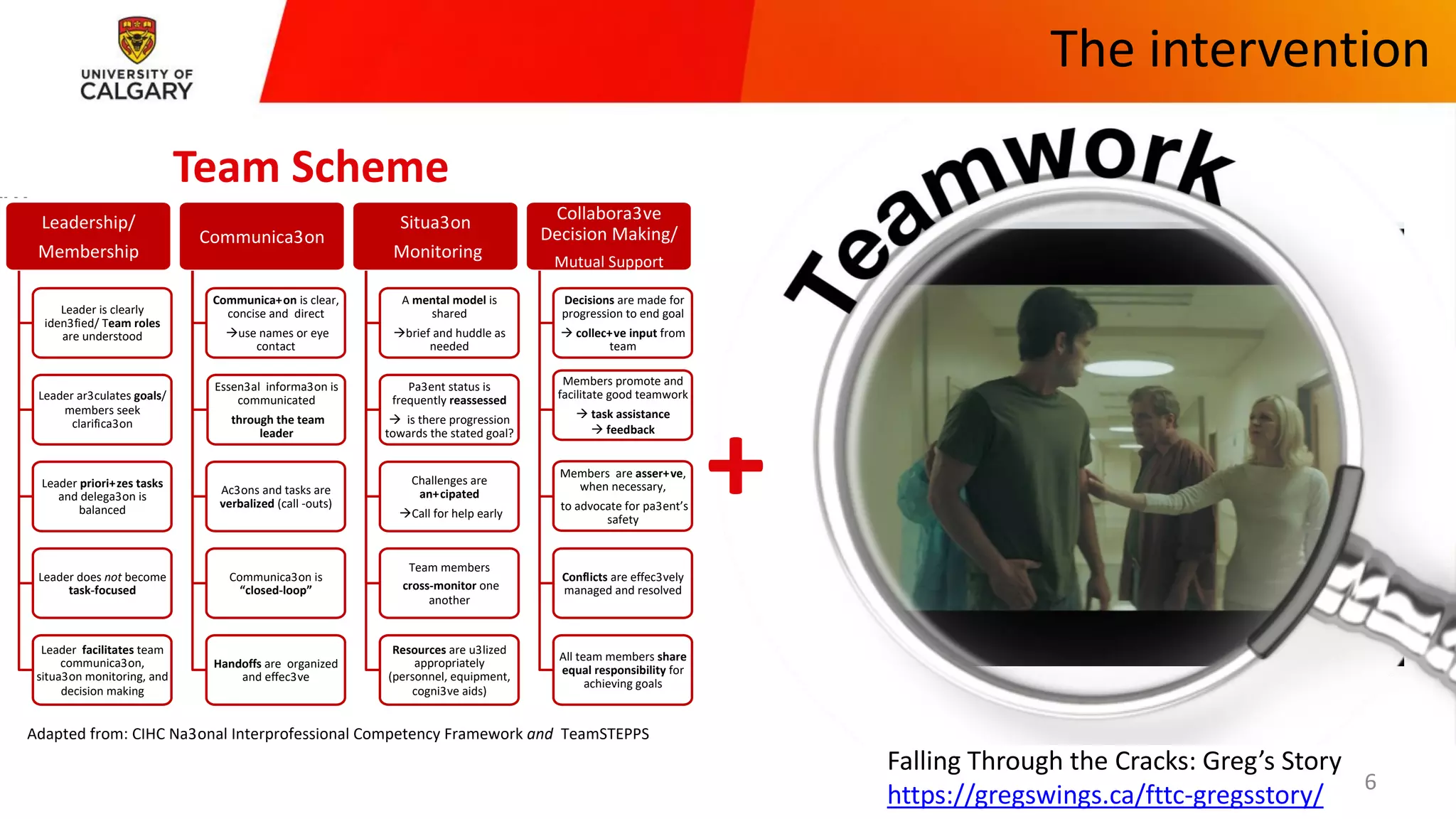
The intervention
CUMMING SCHOOL OF MEDICINE
Team SchemeTeam Scheme
Leadership/
Membership
Leader is clearly
iden3fied/ Team roles
are understood
Leader priori+zes tasks
and delega3on is
balanced
Leader ar3culates goals/
members seek
clarifica3on
Leader does not become
task-focused
Leader facilitates team
communica3on,
situa3on monitoring, and
decision making
Communica3on
Essen3al informa3on is
communicated
through the team
leader
Communica+on is clear,
concise and direct
àuse names or eye
contact
Ac3ons and tasks are
verbalized (call -outs)
Communica3on is
“closed-loop”
Handoffs are organized
and effec3ve
Situa3on
Monitoring
A mental model is
shared
àbrief and huddle as
needed
Pa3ent status is
frequently reassessed
à is there progression
towards the stated goal?
Challenges are
an+cipated
àCall for help early
Team members
cross-monitor one
another
Resources are u3lized
appropriately
(personnel, equipment,
cogni3ve aids)
Collabora3ve
Decision Making/
Mutual Support
Decisions are made for
progression to end goal
à collec+ve input from
team
Members are asser+ve,
when necessary,
to advocate for pa3ent’s
safety
Members promote and
facilitate good teamwork
à task assistance
à feedback
Conflicts are effec3vely
managed and resolved
All team members share
equal responsibility for
achieving goals
Adapted from: CIHC Na3onal Interprofessional Competency Framework and TeamSTEPPS
+
Falling Through the Cracks: Greg’s Story
https://gregswings.ca/fttc-gregsstory/
6
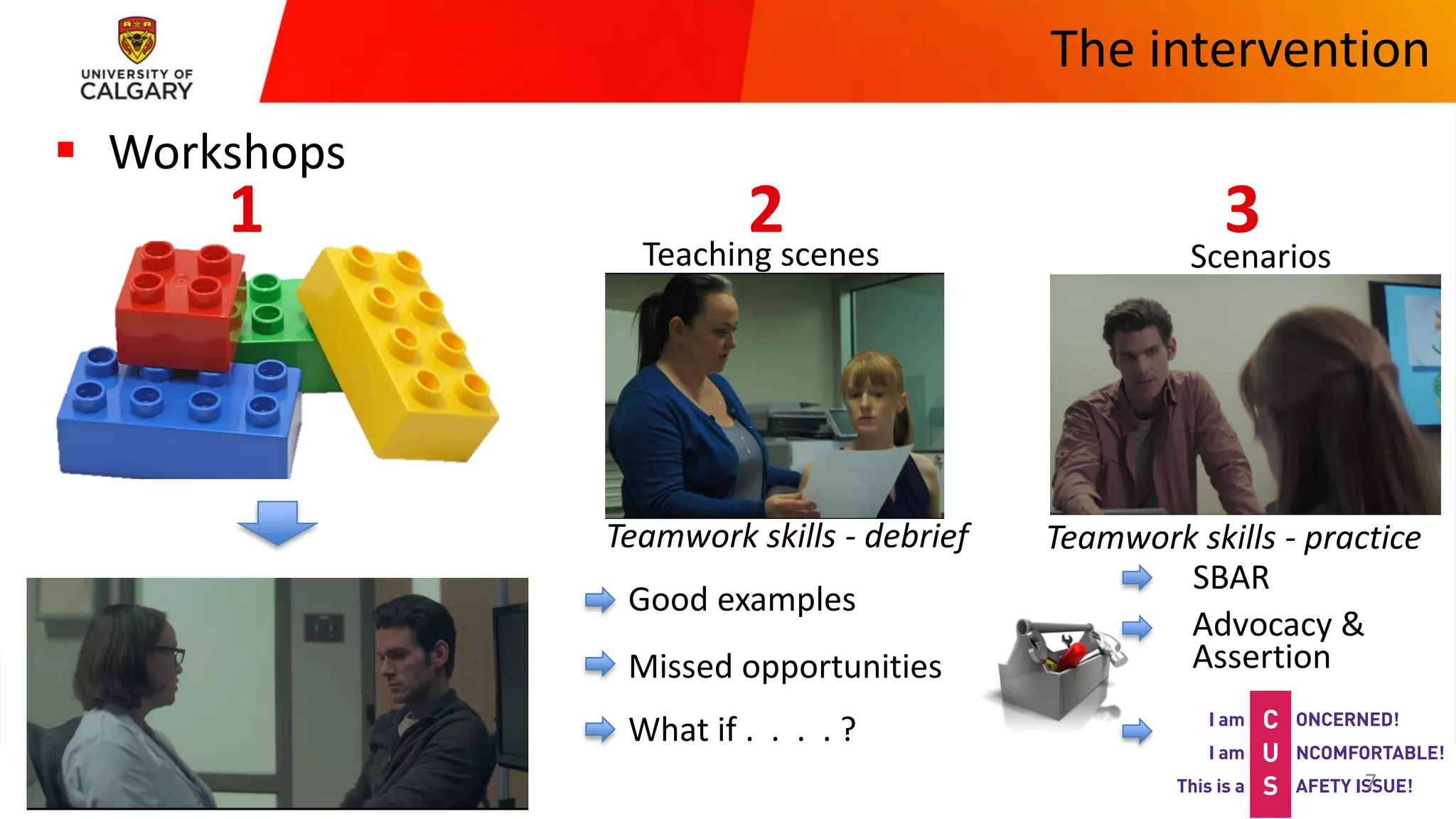
The intervention
CUMMING SCHOOL OF MEDICINE
▪ Workshops
1 2 3Scenarios
SBAR
Advocacy &
Assertion
Teamwork skills - debrief
Good examples
Missed opportunities
What if . . . . ?
Teaching scenes
Teamwork skills - practice
7
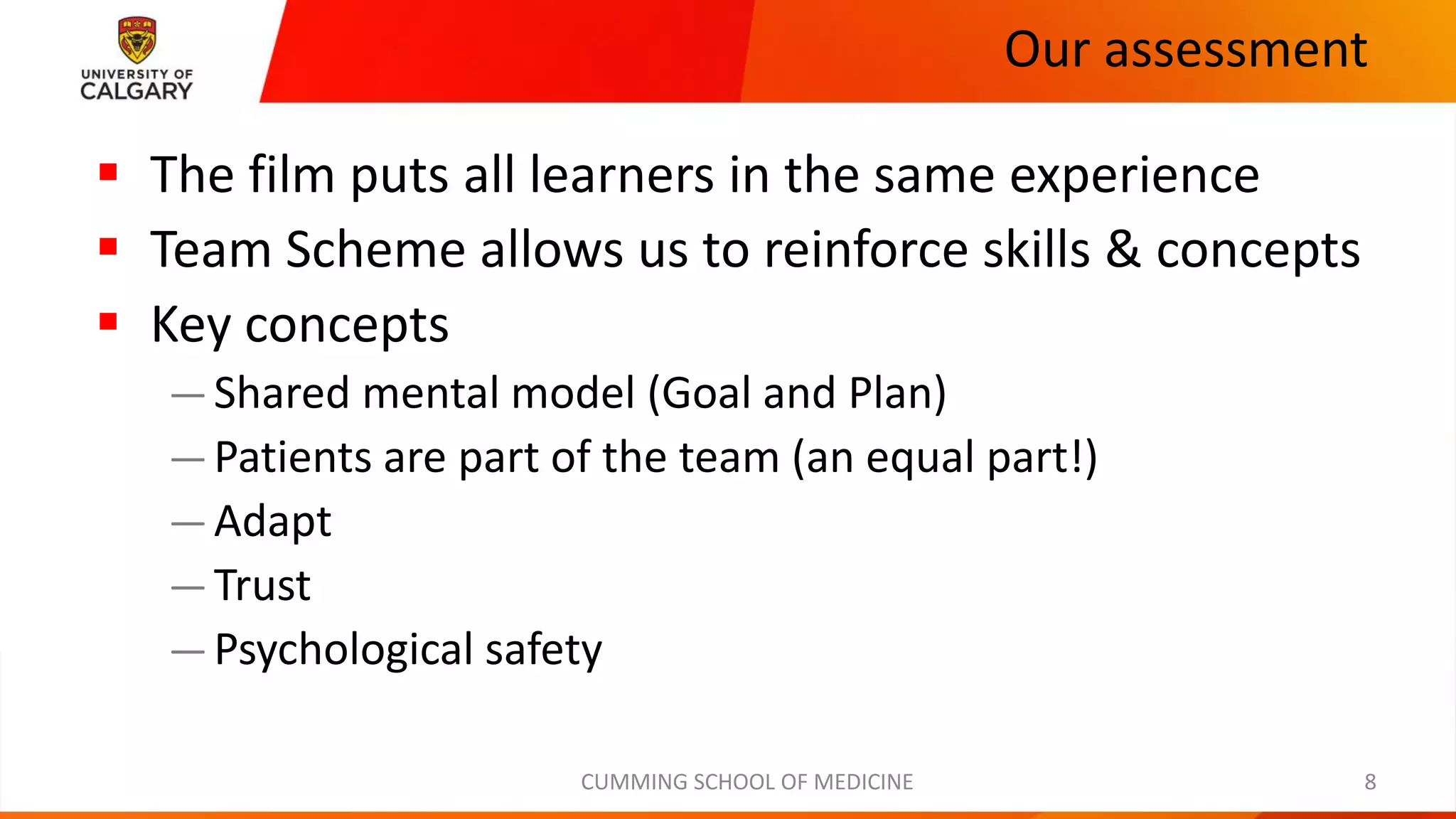
Our assessment
CUMMING SCHOOL OF MEDICINE
▪ The film puts all learners in the same experience
▪ Team Scheme allows us to reinforce skills & concepts
▪ Key concepts
—Shared mental model (Goal and Plan)
—Patients are part of the team (an equal part!)
—Adapt
—Trust
—Psychological safety
8
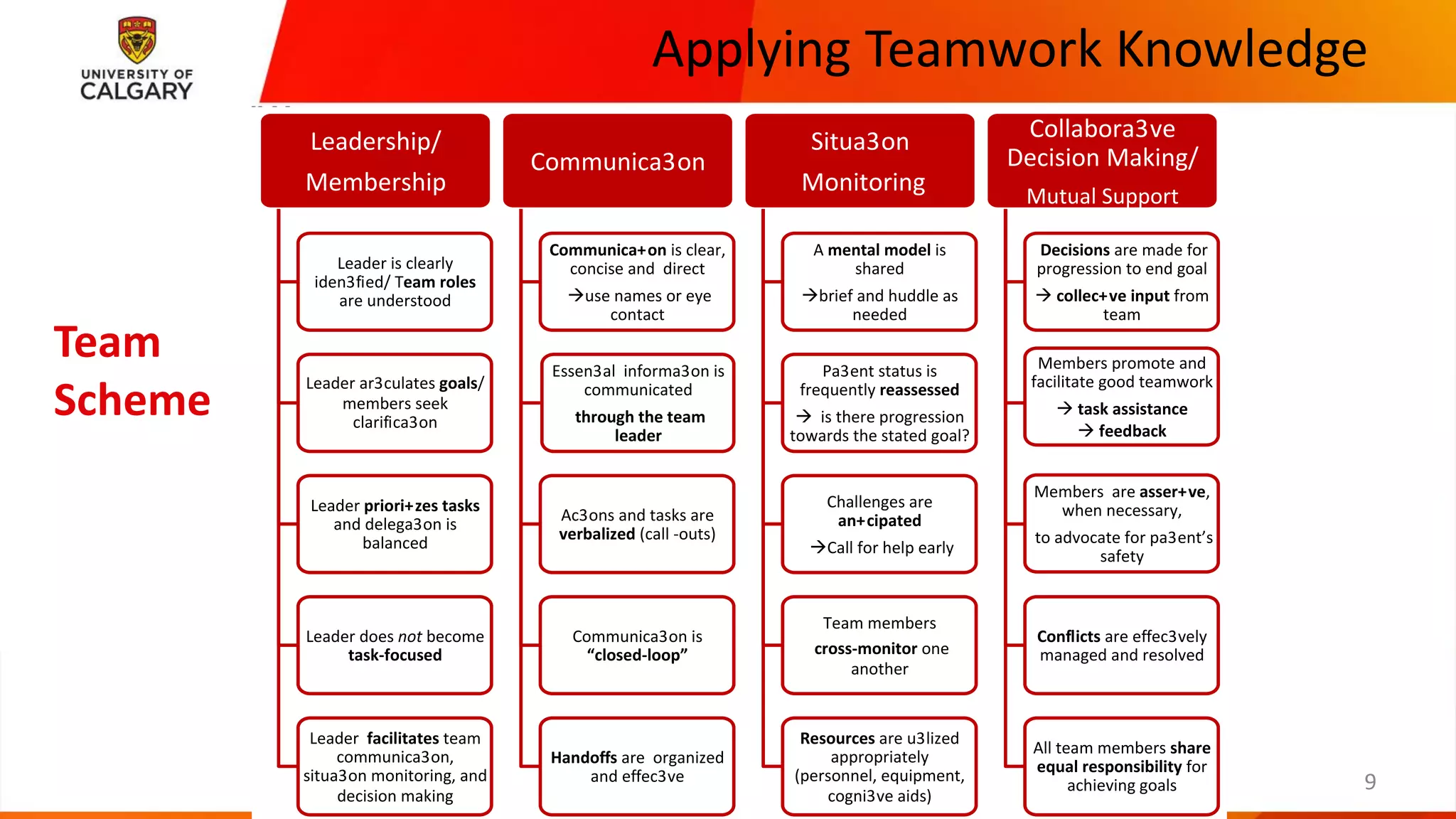
Applying Teamwork Knowledge
CUMMING SCHOOL OF MEDICINE
Team Scheme
Leadership/
Membership
Leader is clearly
iden3fied/ Team roles
are understood
Leader priori+zes tasks
and delega3on is
balanced
Leader ar3culates goals/
members seek
clarifica3on
Leader does not become
task-focused
Leader facilitates team
communica3on,
situa3on monitoring, and
decision making
Communica3on
Essen3al informa3on is
communicated
through the team
leader
Communica+on is clear,
concise and direct
àuse names or eye
contact
Ac3ons and tasks are
verbalized (call -outs)
Communica3on is
“closed-loop”
Handoffs are organized
and effec3ve
Situa3on
Monitoring
A mental model is
shared
àbrief and huddle as
needed
Pa3ent status is
frequently reassessed
à is there progression
towards the stated goal?
Challenges are
an+cipated
àCall for help early
Team members
cross-monitor one
another
Resources are u3lized
appropriately
(personnel, equipment,
cogni3ve aids)
Collabora3ve
Decision Making/
Mutual Support
Decisions are made for
progression to end goal
à collec+ve input from
team
Members are asser+ve,
when necessary,
to advocate for pa3ent’s
safety
Members promote and
facilitate good teamwork
à task assistance
à feedback
Conflicts are effec3vely
managed and resolved
All team members share
equal responsibility for
achieving goals
Team
Scheme
9
The Co-pilot Collective
CUMMING SCHOOL OF MEDICINE
▪ Bringing people together to create change
▪ http://gregswings.ca/the-co-pilot-collective/
10
Teamwork in Healthcare
Making patients safer

Conquer Silence Webcast - Deck 2 of 2

  • 1.
    Teamwork in Healthcare Makingpatients safer W. Ward Flemons MD
  • 2.
    The origins ofTeamwork CUMMING SCHOOL OF MEDICINE 2
  • 3.
  • 4.
    Teaching Teamwork toundergraduates ▪ Team STEPPS designed as an organizational strategy ▪ Skills are not well defined – can they be tested? ▪ Physician oriented ▪ Passive learning (slides) > > Active learning ▪ Undergraduates have limited or no clinical experience ▪ Team skills are ‘soft’ skills ▪ Often learned during simulation BUT . . . . ▪ Cognitive overload – learning clinical skills 1st priority CUMMING SCHOOL OF MEDICINE 4
  • 5.
    Teamwork – theEssentials CUMMING SCHOOL OF MEDICINE Team Scheme TeamSTEPPS Canada™ Fundamentals Core teamwork skills 1.4 Team Scheme Leadership/ Membership Leader is clearly iden3fied/ Team roles are understood Leader priori+zes tasks and delega3on is balanced Leader ar3culates goals/ members seek clarifica3on Leader does not become task-focused Leader facilitates team communica3on, situa3on monitoring, and decision making Communica3on Essen3al informa3on is communicated through the team leader Communica+on is clear, concise and direct àuse names or eye contact Ac3ons and tasks are verbalized (call -outs) Communica3on is “closed-loop” Handoffs are organized and effec3ve Situa3on Monitoring A mental model is shared àbrief and huddle as needed Pa3ent status is frequently reassessed à is there progression towards the stated goal? Challenges are an+cipated àCall for help early Team members cross-monitor one another Resources are u3lized appropriately (personnel, equipment, cogni3ve aids) Collabora3ve Decision Making/ Mutual Support Decisions are made for progression to end goal à collec+ve input from team Members are asser+ve, when necessary, to advocate for pa3ent’s safety Members promote and facilitate good teamwork à task assistance à feedback Conflicts are effec3vely managed and resolved All team members share equal responsibility for achieving goals Adapted from: CIHC Na3onal Interprofessional Competency Framework and TeamSTEPPS5
  • 6.
    The intervention CUMMING SCHOOLOF MEDICINE Team SchemeTeam Scheme Leadership/ Membership Leader is clearly iden3fied/ Team roles are understood Leader priori+zes tasks and delega3on is balanced Leader ar3culates goals/ members seek clarifica3on Leader does not become task-focused Leader facilitates team communica3on, situa3on monitoring, and decision making Communica3on Essen3al informa3on is communicated through the team leader Communica+on is clear, concise and direct àuse names or eye contact Ac3ons and tasks are verbalized (call -outs) Communica3on is “closed-loop” Handoffs are organized and effec3ve Situa3on Monitoring A mental model is shared àbrief and huddle as needed Pa3ent status is frequently reassessed à is there progression towards the stated goal? Challenges are an+cipated àCall for help early Team members cross-monitor one another Resources are u3lized appropriately (personnel, equipment, cogni3ve aids) Collabora3ve Decision Making/ Mutual Support Decisions are made for progression to end goal à collec+ve input from team Members are asser+ve, when necessary, to advocate for pa3ent’s safety Members promote and facilitate good teamwork à task assistance à feedback Conflicts are effec3vely managed and resolved All team members share equal responsibility for achieving goals Adapted from: CIHC Na3onal Interprofessional Competency Framework and TeamSTEPPS + Falling Through the Cracks: Greg’s Story https://gregswings.ca/fttc-gregsstory/ 6
  • 7.
    The intervention CUMMING SCHOOLOF MEDICINE ▪ Workshops 1 2 3Scenarios SBAR Advocacy & Assertion Teamwork skills - debrief Good examples Missed opportunities What if . . . . ? Teaching scenes Teamwork skills - practice 7
  • 8.
    Our assessment CUMMING SCHOOLOF MEDICINE ▪ The film puts all learners in the same experience ▪ Team Scheme allows us to reinforce skills & concepts ▪ Key concepts —Shared mental model (Goal and Plan) —Patients are part of the team (an equal part!) —Adapt —Trust —Psychological safety 8
  • 9.
    Applying Teamwork Knowledge CUMMINGSCHOOL OF MEDICINE Team Scheme Leadership/ Membership Leader is clearly iden3fied/ Team roles are understood Leader priori+zes tasks and delega3on is balanced Leader ar3culates goals/ members seek clarifica3on Leader does not become task-focused Leader facilitates team communica3on, situa3on monitoring, and decision making Communica3on Essen3al informa3on is communicated through the team leader Communica+on is clear, concise and direct àuse names or eye contact Ac3ons and tasks are verbalized (call -outs) Communica3on is “closed-loop” Handoffs are organized and effec3ve Situa3on Monitoring A mental model is shared àbrief and huddle as needed Pa3ent status is frequently reassessed à is there progression towards the stated goal? Challenges are an+cipated àCall for help early Team members cross-monitor one another Resources are u3lized appropriately (personnel, equipment, cogni3ve aids) Collabora3ve Decision Making/ Mutual Support Decisions are made for progression to end goal à collec+ve input from team Members are asser+ve, when necessary, to advocate for pa3ent’s safety Members promote and facilitate good teamwork à task assistance à feedback Conflicts are effec3vely managed and resolved All team members share equal responsibility for achieving goals Team Scheme 9
  • 10.
    The Co-pilot Collective CUMMINGSCHOOL OF MEDICINE ▪ Bringing people together to create change ▪ http://gregswings.ca/the-co-pilot-collective/ 10
  • 11.