Incident Analysis Learning Program - Module Four


Comprehensive Analysis Method

Jan. 10, 2013
Welcome


Ioana Popescu   Sandi Kossey   Erin Pollock   Tina Cullimore
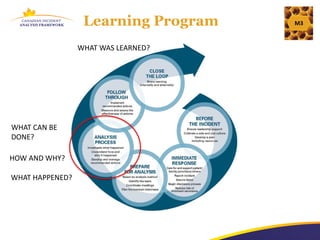
Learning Program   M3


                 WHAT WAS LEARNED?


WHAT CAN BE
DONE?

HOW AND WHY?

WHAT HAPPENED?
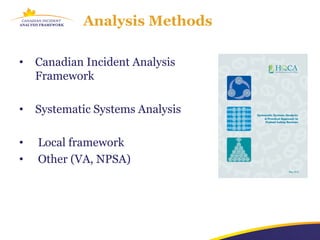
Analysis Methods

•   Canadian Incident Analysis
    Framework

•   Systematic Systems Analysis

•   Local framework
•   Other (VA, NPSA)
Learning Objectives

The knowledge elements include an understanding of the:
• Steps to take when undertaking a comprehensive analysis
• Benefits and limitations of different diagramming tools
• Various considerations when writing statements of
   findings

The performance elements include the ability to:
• Describe the steps to create a timeline of the event
• Perform the main steps to analyze information to identify
   contributing factors and relationships
Agenda


3-parts
   • Knowledge expert

   • Practice leader

   • Facilitated discussion
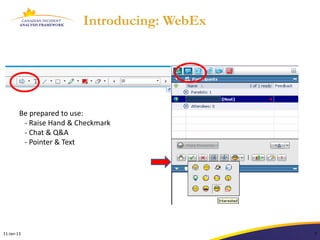
Introducing: WebEx


        Be prepared to use:
         - Raise Hand & Checkmark
         - Chat & Q&A
         - Pointer & Text


                                    7
11-Jan-13                                     7
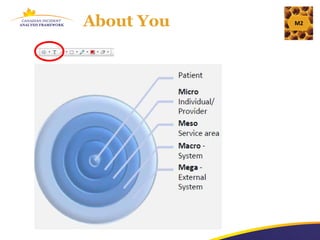
About You   M2
Presentation


Wayne Miller
Has this ever happened in one of
            your facilities?
3:45 pm Call from Nurse manager – Patient has been
  given the wrong medication. Patient is unconscious
  and has been moved to the ICU and assessment is
  ongoing.
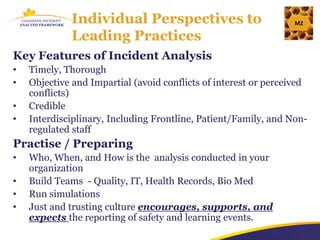
Individual Perspectives to                           M2

             Leading Practices
Key Features of Incident Analysis
•   Timely, Thorough
•   Objective and Impartial (avoid conflicts of interest or perceived
    conflicts)
•   Credible
•   Interdisciplinary, Including Frontline, Patient/Family, and Non-
    regulated staff
Practise / Preparing
•   Who, When, and How is the analysis conducted in your
    organization
•   Build Teams - Quality, IT, Health Records, Bio Med
•   Run simulations
•   Just and trusting culture encourages, supports, and
    expects the reporting of safety and learning events.
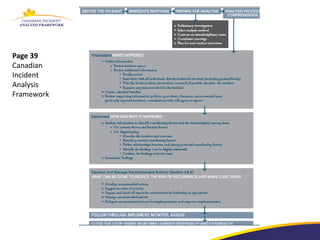
Page 39
Canadian
Incident
Analysis
Framework
Gather Information

•   Caution…Do not jump to solutions, conclusions,
    and assumptions.

•   Caution…The team will not understand the
    contributing factors related to the incident if they
    do not understand the circumstances surrounding
    the incident.

•   Caution…The facilitator must have systematic
    processes for identifying the gaps in information
    and for accurately addressing those gaps.
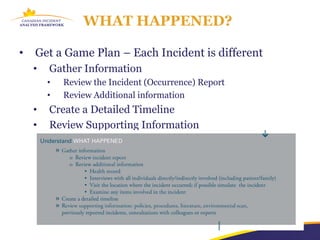
WHAT HAPPENED?

•   Get a Game Plan – Each Incident is different
    •   Gather Information
        •   Review the Incident (Occurrence) Report
        •   Review Additional information
    •   Create a Detailed Timeline
    •   Review Supporting Information
Review the Incident Report &
              Additional information

•   Triggers for a comprehensive analysis
    •   Incident report is based on initial understanding
    •   Others
•   Review the health record
•   Conduct interviews
•   Visit the location where the incident occurred
•   Secure items OR look at similar items/devices to
    help build that understanding
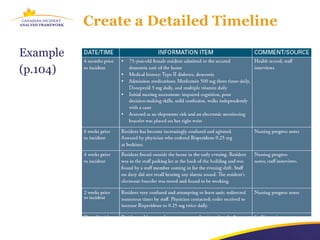
Create a Detailed Timeline

Example
(p.104)
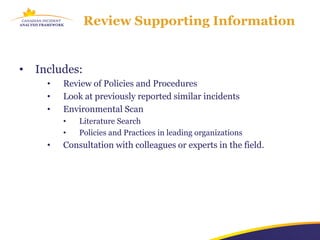
Review Supporting Information


•   Includes:
      •   Review of Policies and Procedures
      •   Look at previously reported similar incidents
      •   Environmental Scan
          •   Literature Search
          •   Policies and Practices in leading organizations
      •   Consultation with colleagues or experts in the field.
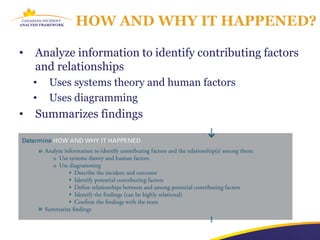
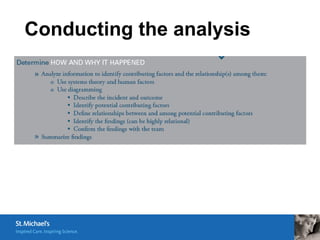
HOW AND WHY IT HAPPENED?

•   Analyze information to identify contributing factors
    and relationships
    •   Uses systems theory and human factors
    •   Uses diagramming
•   Summarizes findings
Analyze Information

•   Build on understanding by asking questions to
    determine contributing factors and relationships of
    factors to the event.
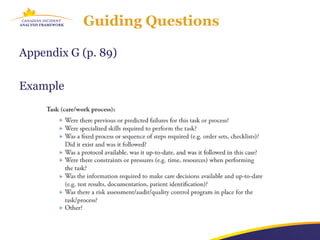
    •   Appendix G, Page 89, Guiding Questions
•   Allows lens to focus on system issues which may
    have contributed to the event—rather than focus on
    the person
•   What was this influenced by?
•   What else affected the circumstances?
Use Systems Theory and Human
            Factors

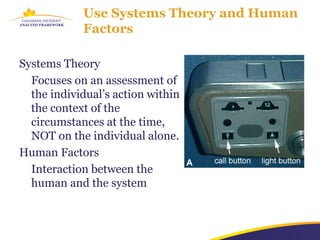
Systems Theory
  Focuses on an assessment of
  the individual’s action within
  the context of the
  circumstances at the time,
  NOT on the individual alone.
Human Factors
  Interaction between the
  human and the system
Use Diagramming

•   Identify and understand
    inter-relationships between
    and among contributing
    factors
•   Provides a map which, when
    used correctly, helps the
    team identify the “route”
    which was taken and why it
    was taken.
•   Shifts the focus from the
    person to the system in
    which the person works.
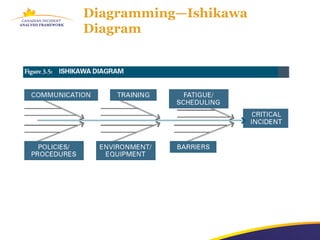
Diagramming—Ishikawa
Diagram
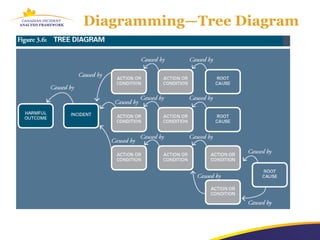
Diagramming—Tree Diagram
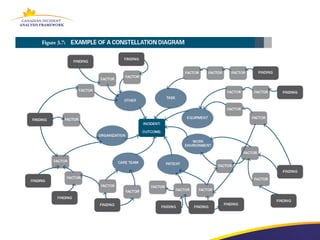
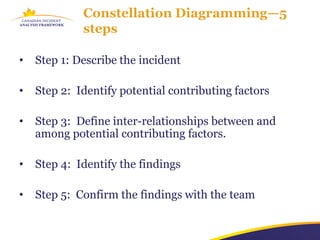
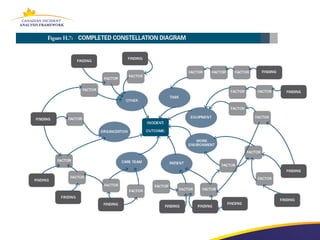
Constellation Diagramming—5
             steps

•   Step 1: Describe the incident

•   Step 2: Identify potential contributing factors

•   Step 3: Define inter-relationships between and
    among potential contributing factors.

•   Step 4: Identify the findings

•   Step 5: Confirm the findings with the team
Guiding Questions

Appendix G (p. 89)

Example
Summarize Findings

•   Statements of findings
•   Describe the relationships between the contributing
    factors and the incident and/or outcome.
•   Three categories of findings:
            Factors that if corrected would likely have prevented
             the incident or mitigated the harm.
            Factors that if corrected, would NOT have prevented
             the incident or mitigated the harm, but are
             important for patient/staff safety or safe patient care
             in general
            Mitigating factors—factors that didn’t allow the
             incident to have more serious consequences and
             represent solid safeguards that should be kept in
             place
Statement of Findings

Example

“The use of gravity intravenous infusion
  sets in the Emergency Department
  increased the likelihood that an
  intravenous narcotics infusion would be
  infused at a higher than intended rate
  when the patient changed his position on
  the stretcher”
Confirm Findings

Team should agree on the findings before developing
  recommended actions

Work through disagreements to achieve consensus

If key individuals who were involved in the event were
   not part of the analysis team, ask for their feedback
   on the findings.

Include a Back-Checking Step
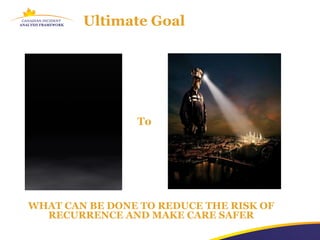
Ultimate Goal


                To


WHAT CAN BE DONE TO REDUCE THE RISK OF
  RECURRENCE AND MAKE CARE SAFER
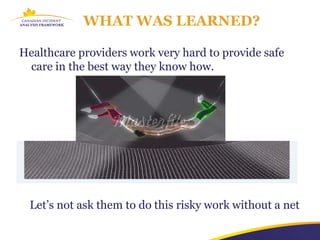
WHAT WAS LEARNED?

Healthcare providers work very hard to provide safe
 care in the best way they know how.


  Let’s not ask them to do this risky work without a net
Real-life Experience


Dr. Chris Hayes
Incident Analysis Framework:
     Real-life Experience

Module 4: Comprehensive analysis method
January 10, 2013
What is critical incident
(ie. a severe harmful patient safety incident)


• Any unintended event that occurs when a
  patient receives treatment in the hospital,
   – that results in death, or serious disability,
     injury or harm to the patient, and

   – does not result primarily from the patients'
     underlying medical condition or from a known
     risk inherent in providing the treatment
What is critical incident
 (ie. a severe harmful patient safety incident)

• Not factored into event that occurs when a
  Any unintended the definition at St.
  patient receives treatment in the hospital,
  Michael’s
   – perspective of patient outcome is considered
   – that results in death, or serious disability,
     first….harm feels like harm!!
     injury or harm to the patient, and
   – assumes inherent risks are fixed with no
   – potential in learning or reducing…eg CLI
     does not result primarily from the patients'
   – data supports inherent risk of or fromd/t known
     underlying medical condition death a
     adverse events providing the treatment
     risk inherent in = 1/116
An example
• Patient admitted to the ICU following a large stroke. At
  approximately midnight the patient began having generalized
  seizures. She paged the resident on call. The resident came and
  asked for some Ativan. As the resident was giving the Ativan he
  asked the nurse to quickly get some Dilantin (phenytoin). The nurse
  left the bedside to prepare the medication in an IV minibag, returned
  to the bedside and began to hang the drug. Meanwhile the Ativan
  had stopped the seizure and the resident returned to his call room.
• 20 minutes later the patient’s blood pressure rose to 230 over 120
  mmHg. The patient began complaining of chest pain and was
  visibly short of breath. The nurse paged the resident to the bedside
  STAT. The resident on arrival asked for some IV metoprolol. He
  gave 20mg in total with little effect on the blood pressure.
An example

• Eventually the patient was stabilized but had suffered a large heart
  attack and now had significant congestive heart failure.
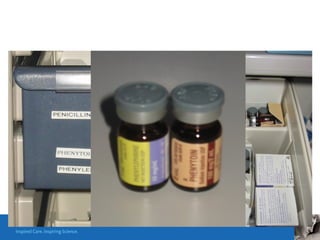
• Later that evening the resident noticed a vial of phenylephrine at the
  patient’s bedside. He showed this to the nurse who became
  immediately very upset and was later sent home.

• The Charge Nurse reported the incident later that evening, the
  family was informed of the incident and received an apology
• Risk Management & QI team reviewed the incident details and
  decided that a comprehensive review be conducted
So it’s an adverse event

• The next phase is to analyze the event in
  order to know:
  – What happened
  – How and why it happened
  – What can be done to reduce the likelihood of
    recurrence and make care safer
  – What was learned
Conducting the analysis
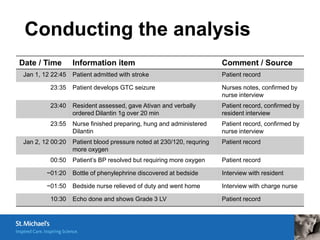
Date / Time        Information item                                    Comment / Source
 Jan 1, 12 22:45   Patient admitted with stroke                        Patient record

          23:35    Patient develops GTC seizure                        Nurses notes, confirmed by
                                                                       nurse interview
          23:40    Resident assessed, gave Ativan and verbally         Patient record, confirmed by
                   ordered Dilantin 1g over 20 min                     resident interview
          23:55    Nurse finished preparing, hung and administered     Patient record, confirmed by
                   Dilantin                                            nurse interview
 Jan 2, 12 00:20   Patient blood pressure noted at 230/120, requring   Patient record
                   more oxygen
          00:50    Patient’s BP resolved but requiring more oxygen     Patient record

         ~01:20    Bottle of phenylephrine discovered at bedside       Interview with resident

         ~01:50    Bedside nurse relieved of duty and went home        Interview with charge nurse

          10:30    Echo done and shows Grade 3 LV                      Patient record
Conducting the analysis

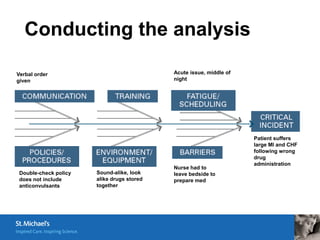
Verbal order                                Acute issue, middle of
given                                       night


                                                                     Patient suffers
                                                                     large MI and CHF
                                                                     following wrong
                                                                     drug
                                                                     administration
                                            Nurse had to
 Double-check policy   Sound-alike, look    leave bedside to
 does not include      alike drugs stored   prepare med
 anticonvulsants       together
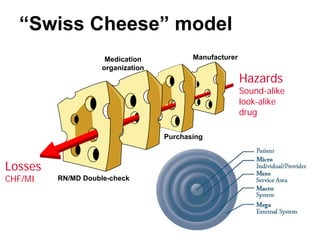
“Swiss Cheese” model
                     Medication           Manufacturer
                    organization
                                                         Hazards
                                                         Sound-alike
                                                         look-alike
                                                         drug

                                   Purchasing


Losses
CHF/MI   RN/MD Double-check
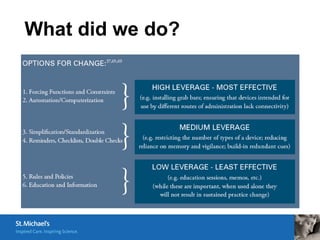
What did we do?
What did we do?
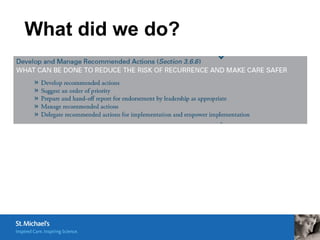
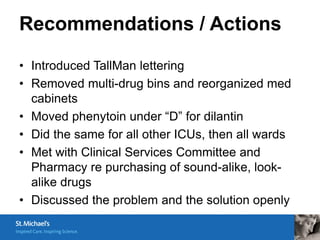
Recommendations / Actions

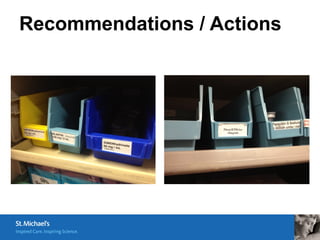
• Introduced TallMan lettering
• Removed multi-drug bins and reorganized med
  cabinets
• Moved phenytoin under “D” for dilantin
• Did the same for all other ICUs, then all wards
• Met with Clinical Services Committee and
  Pharmacy re purchasing of sound-alike, look-
  alike drugs
• Discussed the problem and the solution openly
Recommendations / Actions
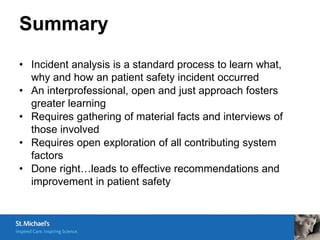
Summary
• Incident analysis is a standard process to learn what,
  why and how an patient safety incident occurred
• An interprofessional, open and just approach fosters
  greater learning
• Requires gathering of material facts and interviews of
  those involved
• Requires open exploration of all contributing system
  factors
• Done right…leads to effective recommendations and
  improvement in patient safety
Case Study – Virtual Group Exercise
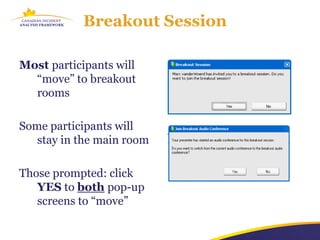
Breakout Session

Most participants will
  “move” to breakout
  rooms

Some participants will
   stay in the main room

Those prompted: click
   YES to both pop-up
   screens to “move”
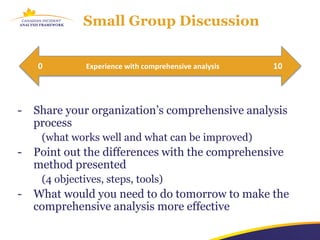
Small Group Discussion


    0          Experience with comprehensive analysis   10


-   Share your organization’s comprehensive analysis
    process
     (what works well and what can be improved)
-   Point out the differences with the comprehensive
    method presented
     (4 objectives, steps, tools)
-   What would you need to do tomorrow to make the
    comprehensive analysis more effective
Large Group De-Briefing
Wrap-up
Next Steps

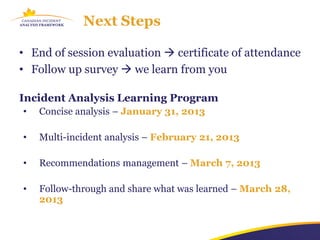
• End of session evaluation  certificate of attendance
• Follow up survey  we learn from you

Incident Analysis Learning Program
•   Concise analysis – January 31, 2013

•   Multi-incident analysis – February 21, 2013

•   Recommendations management – March 7, 2013

•   Follow-through and share what was learned – March 28,
    2013
Resource slide

Learning Program – previous modules:
   http://www.patientsafetyinstitute.ca/English/news/IncidentAnalysisLearningP
   rogram/Pages/Session-Recordings-and-Documents.aspx

HQCA’s Systematic Systems Analysis
  http://www.hqca.ca/assets/files/HQCA%20SSA%20Patient%20Safety%20Revi
  ews%20FINAL%20June%202012.pdf


Incident Analysis Tools
   http://www.patientsafetyinstitute.ca/English/toolsResources/IncidentAnal
   ysis/Pages/Tools.aspx
Mulţumesc
  Thank You

Module 4: Comprehensive analysis method

  • 1.
    Incident Analysis LearningProgram - Module Four Comprehensive Analysis Method Jan. 10, 2013
  • 2.
    Welcome Ioana Popescu Sandi Kossey Erin Pollock Tina Cullimore
  • 3.
    Learning Program M3 WHAT WAS LEARNED? WHAT CAN BE DONE? HOW AND WHY? WHAT HAPPENED?
  • 4.
    Analysis Methods • Canadian Incident Analysis Framework • Systematic Systems Analysis • Local framework • Other (VA, NPSA)
  • 5.
    Learning Objectives The knowledgeelements include an understanding of the: • Steps to take when undertaking a comprehensive analysis • Benefits and limitations of different diagramming tools • Various considerations when writing statements of findings The performance elements include the ability to: • Describe the steps to create a timeline of the event • Perform the main steps to analyze information to identify contributing factors and relationships
  • 6.
    Agenda 3-parts • Knowledge expert • Practice leader • Facilitated discussion
  • 7.
    Introducing: WebEx Be prepared to use: - Raise Hand & Checkmark - Chat & Q&A - Pointer & Text 7 11-Jan-13 7
  • 8.
  • 9.
  • 10.
    Has this everhappened in one of your facilities? 3:45 pm Call from Nurse manager – Patient has been given the wrong medication. Patient is unconscious and has been moved to the ICU and assessment is ongoing.
  • 11.
    Individual Perspectives to M2 Leading Practices Key Features of Incident Analysis • Timely, Thorough • Objective and Impartial (avoid conflicts of interest or perceived conflicts) • Credible • Interdisciplinary, Including Frontline, Patient/Family, and Non- regulated staff Practise / Preparing • Who, When, and How is the analysis conducted in your organization • Build Teams - Quality, IT, Health Records, Bio Med • Run simulations • Just and trusting culture encourages, supports, and expects the reporting of safety and learning events.
  • 12.
  • 14.
    Gather Information • Caution…Do not jump to solutions, conclusions, and assumptions. • Caution…The team will not understand the contributing factors related to the incident if they do not understand the circumstances surrounding the incident. • Caution…The facilitator must have systematic processes for identifying the gaps in information and for accurately addressing those gaps.
  • 15.
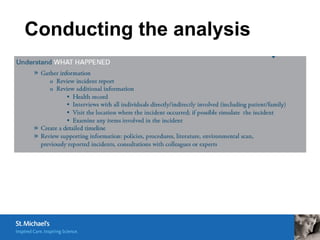
    WHAT HAPPENED? • Get a Game Plan – Each Incident is different • Gather Information • Review the Incident (Occurrence) Report • Review Additional information • Create a Detailed Timeline • Review Supporting Information
  • 16.
    Review the IncidentReport & Additional information • Triggers for a comprehensive analysis • Incident report is based on initial understanding • Others • Review the health record • Conduct interviews • Visit the location where the incident occurred • Secure items OR look at similar items/devices to help build that understanding
  • 17.
    Create a DetailedTimeline Example (p.104)
  • 18.
    Review Supporting Information • Includes: • Review of Policies and Procedures • Look at previously reported similar incidents • Environmental Scan • Literature Search • Policies and Practices in leading organizations • Consultation with colleagues or experts in the field.
  • 19.
    HOW AND WHYIT HAPPENED? • Analyze information to identify contributing factors and relationships • Uses systems theory and human factors • Uses diagramming • Summarizes findings
  • 20.
    Analyze Information • Build on understanding by asking questions to determine contributing factors and relationships of factors to the event. • Appendix G, Page 89, Guiding Questions • Allows lens to focus on system issues which may have contributed to the event—rather than focus on the person • What was this influenced by? • What else affected the circumstances?
  • 21.
    Use Systems Theoryand Human Factors Systems Theory Focuses on an assessment of the individual’s action within the context of the circumstances at the time, NOT on the individual alone. Human Factors Interaction between the human and the system
  • 22.
    Use Diagramming • Identify and understand inter-relationships between and among contributing factors • Provides a map which, when used correctly, helps the team identify the “route” which was taken and why it was taken. • Shifts the focus from the person to the system in which the person works.
  • 23.
  • 24.
  • 26.
    Constellation Diagramming—5 steps • Step 1: Describe the incident • Step 2: Identify potential contributing factors • Step 3: Define inter-relationships between and among potential contributing factors. • Step 4: Identify the findings • Step 5: Confirm the findings with the team
  • 28.
  • 29.
    Summarize Findings • Statements of findings • Describe the relationships between the contributing factors and the incident and/or outcome. • Three categories of findings:  Factors that if corrected would likely have prevented the incident or mitigated the harm.  Factors that if corrected, would NOT have prevented the incident or mitigated the harm, but are important for patient/staff safety or safe patient care in general  Mitigating factors—factors that didn’t allow the incident to have more serious consequences and represent solid safeguards that should be kept in place
  • 30.
    Statement of Findings Example “Theuse of gravity intravenous infusion sets in the Emergency Department increased the likelihood that an intravenous narcotics infusion would be infused at a higher than intended rate when the patient changed his position on the stretcher”
  • 31.
    Confirm Findings Team shouldagree on the findings before developing recommended actions Work through disagreements to achieve consensus If key individuals who were involved in the event were not part of the analysis team, ask for their feedback on the findings. Include a Back-Checking Step
  • 32.
    Ultimate Goal To WHAT CAN BE DONE TO REDUCE THE RISK OF RECURRENCE AND MAKE CARE SAFER
  • 33.
    WHAT WAS LEARNED? Healthcareproviders work very hard to provide safe care in the best way they know how. Let’s not ask them to do this risky work without a net
  • 34.
  • 35.
    Incident Analysis Framework: Real-life Experience Module 4: Comprehensive analysis method January 10, 2013
  • 36.
    What is criticalincident (ie. a severe harmful patient safety incident) • Any unintended event that occurs when a patient receives treatment in the hospital, – that results in death, or serious disability, injury or harm to the patient, and – does not result primarily from the patients' underlying medical condition or from a known risk inherent in providing the treatment
  • 37.
    What is criticalincident (ie. a severe harmful patient safety incident) • Not factored into event that occurs when a Any unintended the definition at St. patient receives treatment in the hospital, Michael’s – perspective of patient outcome is considered – that results in death, or serious disability, first….harm feels like harm!! injury or harm to the patient, and – assumes inherent risks are fixed with no – potential in learning or reducing…eg CLI does not result primarily from the patients' – data supports inherent risk of or fromd/t known underlying medical condition death a adverse events providing the treatment risk inherent in = 1/116
  • 38.
    An example • Patientadmitted to the ICU following a large stroke. At approximately midnight the patient began having generalized seizures. She paged the resident on call. The resident came and asked for some Ativan. As the resident was giving the Ativan he asked the nurse to quickly get some Dilantin (phenytoin). The nurse left the bedside to prepare the medication in an IV minibag, returned to the bedside and began to hang the drug. Meanwhile the Ativan had stopped the seizure and the resident returned to his call room. • 20 minutes later the patient’s blood pressure rose to 230 over 120 mmHg. The patient began complaining of chest pain and was visibly short of breath. The nurse paged the resident to the bedside STAT. The resident on arrival asked for some IV metoprolol. He gave 20mg in total with little effect on the blood pressure.
  • 39.
    An example • Eventuallythe patient was stabilized but had suffered a large heart attack and now had significant congestive heart failure. • Later that evening the resident noticed a vial of phenylephrine at the patient’s bedside. He showed this to the nurse who became immediately very upset and was later sent home. • The Charge Nurse reported the incident later that evening, the family was informed of the incident and received an apology • Risk Management & QI team reviewed the incident details and decided that a comprehensive review be conducted
  • 40.
    So it’s anadverse event • The next phase is to analyze the event in order to know: – What happened – How and why it happened – What can be done to reduce the likelihood of recurrence and make care safer – What was learned
  • 41.
  • 42.
    Conducting the analysis Date/ Time Information item Comment / Source Jan 1, 12 22:45 Patient admitted with stroke Patient record 23:35 Patient develops GTC seizure Nurses notes, confirmed by nurse interview 23:40 Resident assessed, gave Ativan and verbally Patient record, confirmed by ordered Dilantin 1g over 20 min resident interview 23:55 Nurse finished preparing, hung and administered Patient record, confirmed by Dilantin nurse interview Jan 2, 12 00:20 Patient blood pressure noted at 230/120, requring Patient record more oxygen 00:50 Patient’s BP resolved but requiring more oxygen Patient record ~01:20 Bottle of phenylephrine discovered at bedside Interview with resident ~01:50 Bedside nurse relieved of duty and went home Interview with charge nurse 10:30 Echo done and shows Grade 3 LV Patient record
  • 43.
  • 44.
    Conducting the analysis Verbalorder Acute issue, middle of given night Patient suffers large MI and CHF following wrong drug administration Nurse had to Double-check policy Sound-alike, look leave bedside to does not include alike drugs stored prepare med anticonvulsants together
  • 46.
    “Swiss Cheese” model Medication Manufacturer organization Hazards Sound-alike look-alike drug Purchasing Losses CHF/MI RN/MD Double-check
  • 48.
  • 49.
  • 50.
    Recommendations / Actions •Introduced TallMan lettering • Removed multi-drug bins and reorganized med cabinets • Moved phenytoin under “D” for dilantin • Did the same for all other ICUs, then all wards • Met with Clinical Services Committee and Pharmacy re purchasing of sound-alike, look- alike drugs • Discussed the problem and the solution openly
  • 51.
  • 52.
    Summary • Incident analysisis a standard process to learn what, why and how an patient safety incident occurred • An interprofessional, open and just approach fosters greater learning • Requires gathering of material facts and interviews of those involved • Requires open exploration of all contributing system factors • Done right…leads to effective recommendations and improvement in patient safety
  • 53.
    Case Study –Virtual Group Exercise
  • 54.
    Breakout Session Most participantswill “move” to breakout rooms Some participants will stay in the main room Those prompted: click YES to both pop-up screens to “move”
  • 55.
    Small Group Discussion 0 Experience with comprehensive analysis 10 - Share your organization’s comprehensive analysis process (what works well and what can be improved) - Point out the differences with the comprehensive method presented (4 objectives, steps, tools) - What would you need to do tomorrow to make the comprehensive analysis more effective
  • 56.
  • 57.
  • 58.
    Next Steps • Endof session evaluation  certificate of attendance • Follow up survey  we learn from you Incident Analysis Learning Program • Concise analysis – January 31, 2013 • Multi-incident analysis – February 21, 2013 • Recommendations management – March 7, 2013 • Follow-through and share what was learned – March 28, 2013
  • 59.
    Resource slide Learning Program– previous modules: http://www.patientsafetyinstitute.ca/English/news/IncidentAnalysisLearningP rogram/Pages/Session-Recordings-and-Documents.aspx HQCA’s Systematic Systems Analysis http://www.hqca.ca/assets/files/HQCA%20SSA%20Patient%20Safety%20Revi ews%20FINAL%20June%202012.pdf Incident Analysis Tools http://www.patientsafetyinstitute.ca/English/toolsResources/IncidentAnal ysis/Pages/Tools.aspx
  • 60.