
THE PRODUCTION PYRAMIDTHE PRODUCTION PYRAMID
ANDAND
5-S5-S
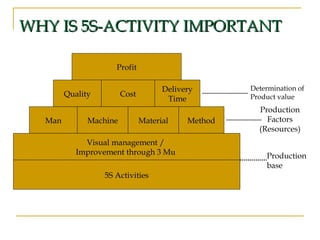
WHY IS 5S-ACTIVITY IMPORTANTWHY IS 5S-ACTIVITY IMPORTANT
Profit
Quality Cost
Delivery
Time
Man Machine Material Method
Visual management /
Improvement through 3 Mu
Determination of
Product value
Production
Factors
(Resources)
5S Activities
Production
base
WHAT IS 5S?WHAT IS 5S?
(Seiri, Seiton, Seiso, Seiketsu, and Shitsuke)?(Seiri, Seiton, Seiso, Seiketsu, and Shitsuke)?
Definition of the 5S
1. Seiri:
Sort out items which are necessary and items which are not necessary,
and eliminate items which are not necessary.
2. Seiton:
Make arrangement so that you can easily take out any time what you
want.
3. Seiso:
Perform cleaning to remove dirt, soil, etc.
4. Seiketsu:
Maintain a clean state.
5. Shitsuke:
Build up the habit of abiding by what is laid down.
1. SEIRI (Sorting)1. SEIRI (Sorting)
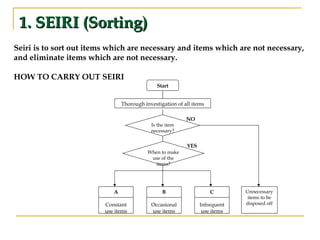
Seiri is to sort out items which are necessary and items which are not necessary,
and eliminate items which are not necessary.
HOW TO CARRY OUT SEIRI
Start
Thorough investigation of all items
Is the item
necessary?
When to make
use of the
items?
A
Constant
use items
B
Occasional
use items
C
Infrequent
use items
Unnecessary
items to be
disposed off
NO
YES
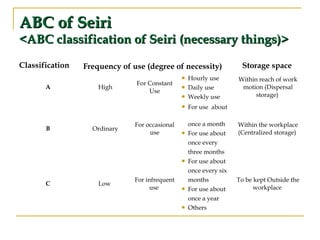
ABC of SeiriABC of Seiri
<ABC classification of Seiri (necessary things)><ABC classification of Seiri (necessary things)>
Classification Frequency of use (degree of necessity) Storage space
A High
For Constant
Use
 Hourly use
 Daily use
 Weekly use
Within reach of work
motion (Dispersal
storage)
B Ordinary
For occasional
use
 For use about
once a month
 For use about
once every
three months
Within the workplace
(Centralized storage)
C Low
For infrequent
use
 For use about
once every six
months
 For use about
once a year
 Others
To be kept Outside the
workplace
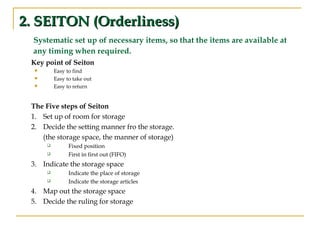
2. SEITON (Orderliness)2. SEITON (Orderliness)
Systematic set up of necessary items, so that the items are available at
any timing when required.
Key point of Seiton
 Easy to find
 Easy to take out
 Easy to return
The Five steps of Seiton
1. Set up of room for storage
2. Decide the setting manner fro the storage.
(the storage space, the manner of storage)
 Fixed position
 First in first out (FIFO)
3. Indicate the storage space
 Indicate the place of storage
 Indicate the storage articles
4. Map out the storage space
5. Decide the ruling for storage
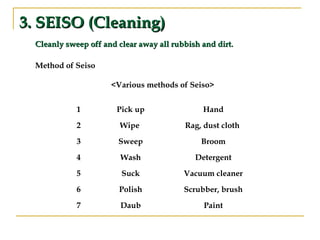
3. SEISO (Cleaning)3. SEISO (Cleaning)
Cleanly sweep off and clear away all rubbish and dirt.Cleanly sweep off and clear away all rubbish and dirt.
Method of Seiso
<Various methods of Seiso>
1 Pick up Hand
2 Wipe Rag, dust cloth
3 Sweep Broom
4 Wash Detergent
5 Suck Vacuum cleaner
6 Polish Scrubber, brush
7 Daub Paint
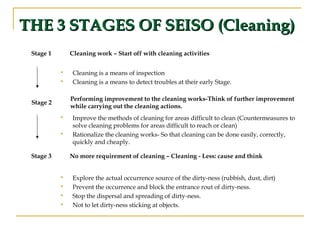
THE 3 STAGES OF SEISO (Cleaning)THE 3 STAGES OF SEISO (Cleaning)
 Cleaning is a means of inspection
 Cleaning is a means to detect troubles at their early Stage.
 Improve the methods of cleaning for areas difficult to clean (Countermeasures to
solve cleaning problems for areas difficult to reach or clean)
 Rationalize the cleaning works- So that cleaning can be done easily, correctly,
quickly and cheaply.
 Explore the actual occurrence source of the dirty-ness (rubbish, dust, dirt)
 Prevent the occurrence and block the entrance rout of dirty-ness.
 Stop the dispersal and spreading of dirty-ness.
 Not to let dirty-ness sticking at objects.
Stage 1 Cleaning work – Start off with cleaning activities
Stage 2
Performing improvement to the cleaning works-Think of further improvement
while carrying out the cleaning actions.
Stage 3 No more requirement of cleaning – Cleaning - Less: cause and think
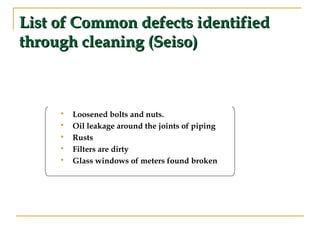
List of Common defects identifiedList of Common defects identified
through cleaning (Seiso)through cleaning (Seiso)
 Loosened bolts and nuts.
 Oil leakage around the joints of piping
 Rusts
 Filters are dirty
 Glass windows of meters found broken
4. SEIKETSU (Cleanliness)4. SEIKETSU (Cleanliness)
Seiketsu means to sustain the clean conditions without returning
to dirty-ness. (i.e. To sustain the conditions of the efforts done by
Seiri, Seiton and Seiso)
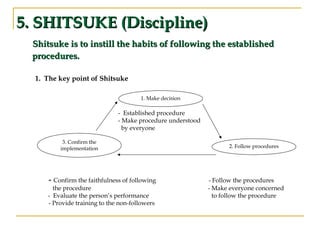
5. SHITSUKE (Discipline)5. SHITSUKE (Discipline)
Shitsuke is to instill the habits of following the establishedShitsuke is to instill the habits of following the established
procedures.procedures.
1. The key point of Shitsuke
1. Make decision
- Established procedure
- Make procedure understood
by everyone
3. Confirm the
implementation 2. Follow procedures
- Confirm the faithfulness of following - Follow the procedures
the procedure - Make everyone concerned
- Evaluate the person’s performance to follow the procedure
- Provide training to the non-followers
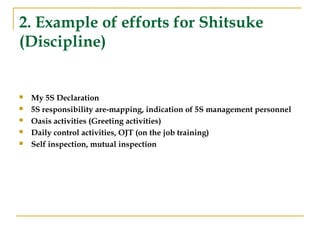
2. Example of efforts for Shitsuke
(Discipline)
 My 5S Declaration
 5S responsibility are-mapping, indication of 5S management personnel
 Oasis activities (Greeting activities)
 Daily control activities, OJT (on the job training)
 Self inspection, mutual inspection
5-S Activity

5-S Activity

  • 1.
    THE PRODUCTION PYRAMIDTHEPRODUCTION PYRAMID ANDAND 5-S5-S
  • 2.
    WHY IS 5S-ACTIVITYIMPORTANTWHY IS 5S-ACTIVITY IMPORTANT Profit Quality Cost Delivery Time Man Machine Material Method Visual management / Improvement through 3 Mu Determination of Product value Production Factors (Resources) 5S Activities Production base
  • 3.
    WHAT IS 5S?WHATIS 5S? (Seiri, Seiton, Seiso, Seiketsu, and Shitsuke)?(Seiri, Seiton, Seiso, Seiketsu, and Shitsuke)? Definition of the 5S 1. Seiri: Sort out items which are necessary and items which are not necessary, and eliminate items which are not necessary. 2. Seiton: Make arrangement so that you can easily take out any time what you want. 3. Seiso: Perform cleaning to remove dirt, soil, etc. 4. Seiketsu: Maintain a clean state. 5. Shitsuke: Build up the habit of abiding by what is laid down.
  • 4.
    1. SEIRI (Sorting)1.SEIRI (Sorting) Seiri is to sort out items which are necessary and items which are not necessary, and eliminate items which are not necessary. HOW TO CARRY OUT SEIRI Start Thorough investigation of all items Is the item necessary? When to make use of the items? A Constant use items B Occasional use items C Infrequent use items Unnecessary items to be disposed off NO YES
  • 5.
    ABC of SeiriABCof Seiri <ABC classification of Seiri (necessary things)><ABC classification of Seiri (necessary things)> Classification Frequency of use (degree of necessity) Storage space A High For Constant Use  Hourly use  Daily use  Weekly use Within reach of work motion (Dispersal storage) B Ordinary For occasional use  For use about once a month  For use about once every three months Within the workplace (Centralized storage) C Low For infrequent use  For use about once every six months  For use about once a year  Others To be kept Outside the workplace
  • 6.
    2. SEITON (Orderliness)2.SEITON (Orderliness) Systematic set up of necessary items, so that the items are available at any timing when required. Key point of Seiton  Easy to find  Easy to take out  Easy to return The Five steps of Seiton 1. Set up of room for storage 2. Decide the setting manner fro the storage. (the storage space, the manner of storage)  Fixed position  First in first out (FIFO) 3. Indicate the storage space  Indicate the place of storage  Indicate the storage articles 4. Map out the storage space 5. Decide the ruling for storage
  • 7.
    3. SEISO (Cleaning)3.SEISO (Cleaning) Cleanly sweep off and clear away all rubbish and dirt.Cleanly sweep off and clear away all rubbish and dirt. Method of Seiso <Various methods of Seiso> 1 Pick up Hand 2 Wipe Rag, dust cloth 3 Sweep Broom 4 Wash Detergent 5 Suck Vacuum cleaner 6 Polish Scrubber, brush 7 Daub Paint
  • 8.
    THE 3 STAGESOF SEISO (Cleaning)THE 3 STAGES OF SEISO (Cleaning)  Cleaning is a means of inspection  Cleaning is a means to detect troubles at their early Stage.  Improve the methods of cleaning for areas difficult to clean (Countermeasures to solve cleaning problems for areas difficult to reach or clean)  Rationalize the cleaning works- So that cleaning can be done easily, correctly, quickly and cheaply.  Explore the actual occurrence source of the dirty-ness (rubbish, dust, dirt)  Prevent the occurrence and block the entrance rout of dirty-ness.  Stop the dispersal and spreading of dirty-ness.  Not to let dirty-ness sticking at objects. Stage 1 Cleaning work – Start off with cleaning activities Stage 2 Performing improvement to the cleaning works-Think of further improvement while carrying out the cleaning actions. Stage 3 No more requirement of cleaning – Cleaning - Less: cause and think
  • 9.
    List of Commondefects identifiedList of Common defects identified through cleaning (Seiso)through cleaning (Seiso)  Loosened bolts and nuts.  Oil leakage around the joints of piping  Rusts  Filters are dirty  Glass windows of meters found broken
  • 10.
    4. SEIKETSU (Cleanliness)4.SEIKETSU (Cleanliness) Seiketsu means to sustain the clean conditions without returning to dirty-ness. (i.e. To sustain the conditions of the efforts done by Seiri, Seiton and Seiso)
  • 11.
    5. SHITSUKE (Discipline)5.SHITSUKE (Discipline) Shitsuke is to instill the habits of following the establishedShitsuke is to instill the habits of following the established procedures.procedures. 1. The key point of Shitsuke 1. Make decision - Established procedure - Make procedure understood by everyone 3. Confirm the implementation 2. Follow procedures - Confirm the faithfulness of following - Follow the procedures the procedure - Make everyone concerned - Evaluate the person’s performance to follow the procedure - Provide training to the non-followers
  • 12.
    2. Example ofefforts for Shitsuke (Discipline)  My 5S Declaration  5S responsibility are-mapping, indication of 5S management personnel  Oasis activities (Greeting activities)  Daily control activities, OJT (on the job training)  Self inspection, mutual inspection