© Health Catalyst. Confidential and Proprietary.
Patient Safety Incident
Reporting Functionality Reduces
Barriers and Improves Care
© Health Catalyst. Confidential and Proprietary.
Health Catalyst Editors
Article
Summary
For organizations that are striving to improve patient
safety, incident reports are a valuable tool for safety
leaders to identify and investigate conditions that may
lead to errors or cause harm. Historically, incident
reporting has involved complicated forms and a lack of
transparency which can discourage employees from
reporting events. The newest module in Health Catalyst’s
Patient Safety Monitor application, Voluntary Event
Reporting, provides an easy-to-use application that is
convenient, efficient, productive, and informative.
Voluntary Event Reporting offers game-changing support
for organizations dedicated to nurturing a safety culture
and leveraging reliable data and analytics for better
outcomes by ensuring your teams have what they need
to report events, follow up, learn, and improve.
© Health Catalyst. Confidential and Proprietary.
Patient Safety Incident Reporting Functionality
Reduces Barriers and Improves Care
The erosion of patient safety gains amidst the
COVID-19 pandemic continues to sound
healthcare alarms. Leaders from the Centers for
Medicare & Medicaid Services and the Centers for
Disease Control and Prevention recently noted
“We have observed substantial deterioration on
multiple patient safety metrics since the beginning
of the pandemic, despite decades of attention to
complications of care,”
Safety audits and error reporting have also fallen
by the wayside due in large part to the exhaustion
of frontline staff and personnel shortages.
The Erosion of Patient Safety
© Health Catalyst. Confidential and Proprietary.
Patient Safety Incident Reporting Functionality
Reduces Barriers and Improves Care
To improve safety, healthcare leaders must find
new and simpler ways to support safety practices.
They must renew their focus on creating a safety
culture where staff continually scan and monitor
their environment to identify and correct even
minor deviations that could lead to unsafe
conditions.
A holistic, data-driven approach to safety
improvements — focused on incident reporting,
automated event detection, and care audits —
is imperative to future-proof healthcare
organizations.
Ways to Support Safety
© Health Catalyst. Confidential and Proprietary.
Create a Comprehensive
Safety Event Detection
and Analysis Strategy
© Health Catalyst. Confidential and Proprietary.
Create a Comprehensive Safety Event Detection and Analysis Strategy
Simplify and safeguard incident reporting. The Institute for
Healthcare Improvement (IHI) notes that error reporting should be
one component of an organization’s larger effort to detect and
prevent harm. IHI notes, “Public health researchers have
established that only 10 to 20 percent of errors are ever reported
and, of those, some 90 to 95 percent cause no harm to patients.
For example, a wrong medication prepared and delivered to the
patient may or may not cause harm.” Indeed, incident reporting is
one piece of a broader safety strategy that identifies errors and
helps pinpoint system flaws and failures that create opportunity
for harm to occur.
IHI further elaborates on the value of focusing on harm with this
example: “When a patient admitted for routine surgery gets a
staph infection while an inpatient, that hospital-induced illness is
certainly harmful. The harm is caused not by individual error but
by an institution’s inadequate germ-protection system”.
Incident Reporting
© Health Catalyst. Confidential and Proprietary.
Create a Comprehensive Safety Event Detection and Analysis Strategy
Incident reporting is one of three important ways that actual or potential harm is
identified; the other two methods include:
 Automated surveillance. Data values that exceed expected ranges are automatically
detected and elevated to the appropriate patient safety team member. Examples
include:
– Drugs ordered, such as Benadryl, which is a common antidote for an allergic reaction
– An abrupt medication stop
– Lab results
– Patient symptoms, such as a stage 1 pressure ulcer or unexplained lethargy
 Care audits. Systematic reviews of any of the following to fill data gaps in the EHR
and create a holistic view of harm, risk, and care deviation:
– Care processes (e.g., central line insertion, wound care)
– Outcomes (e.g., post-operative complications)
– Structure (e.g., resource and equipment availability)
– Significant events (e.g., medication errors, patient complaints)
Incident Reporting
© Health Catalyst. Confidential and Proprietary.
Create a Comprehensive Safety Event Detection and Analysis Strategy
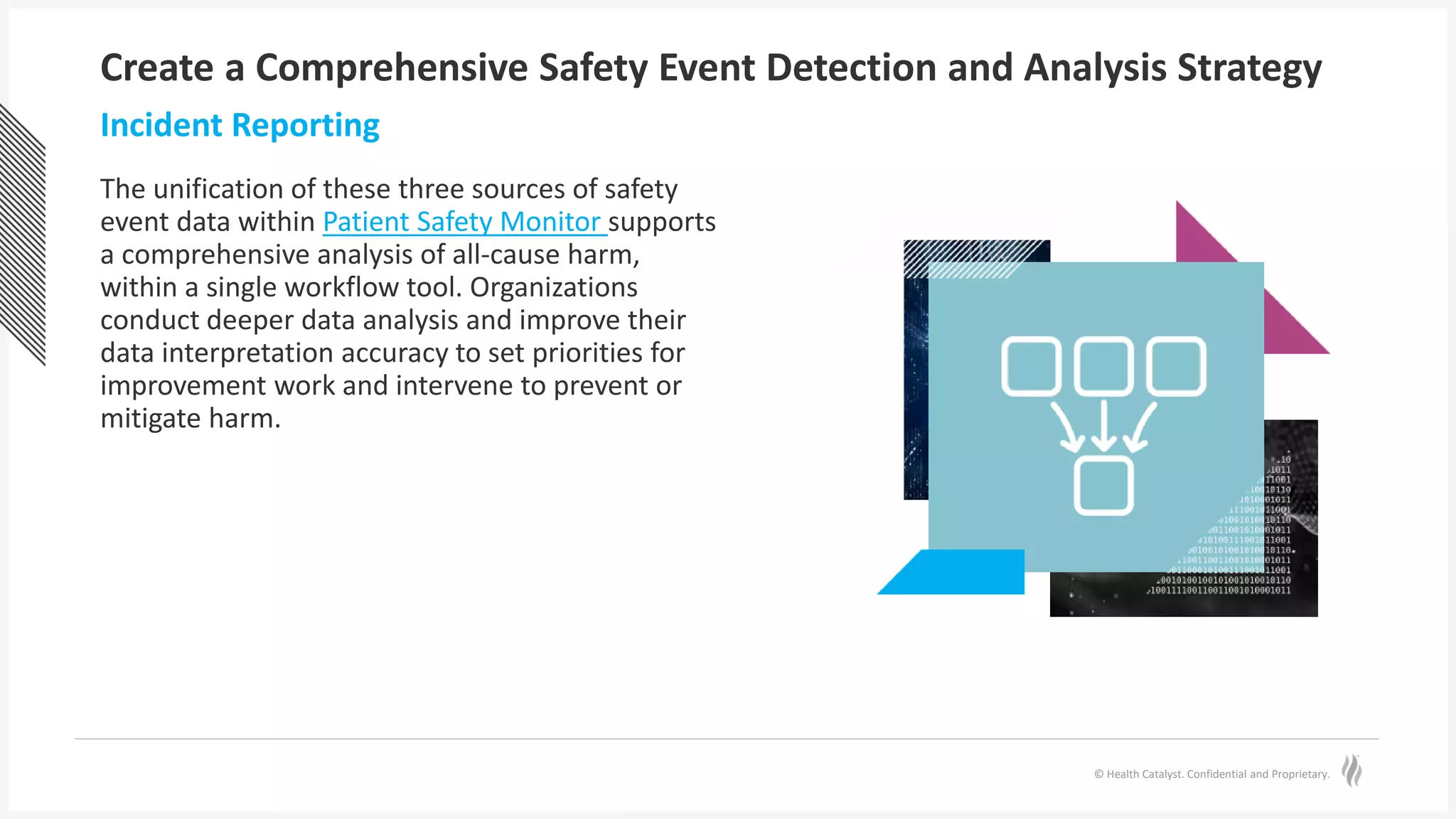
The unification of these three sources of safety
event data within Patient Safety Monitor supports
a comprehensive analysis of all-cause harm,
within a single workflow tool. Organizations
conduct deeper data analysis and improve their
data interpretation accuracy to set priorities for
improvement work and intervene to prevent or
mitigate harm.
Incident Reporting
© Health Catalyst. Confidential and Proprietary.
The Role of Healthcare
Incident Reporting Software
in Capturing Safety Event Data
© Health Catalyst. Confidential and Proprietary.
The Role of Healthcare Incident Reporting Software
In Capturing Safety Event Data
Incident reports are a valuable component of an
enterprise safety program because they create visibility
to conditions that lead to errors and may cause harm.
Mistakes in healthcare are rarely due to a single point
of failure; they almost always result from a combination
of human error, unsafe procedures, and equipment.
Historic tendencies to blame individuals involved in
safety events have led to a crisis of underreporting,
where staff are unlikely to document mistakes or near
misses for fear that they will be punished. And yet this
lack of visibility prevents organizations from putting
systems in place that would help guard against similar
errors in the future.
Visibility to Conditions
© Health Catalyst. Confidential and Proprietary.
The Role of Healthcare Incident Reporting Software
In Capturing Safety Event Data
Voluntary incident reporting allows safety leaders to
identify and investigate conditions that create risk for
error. An analysis of the root cause of each incident or
event supports thorough consideration of all factors
that may have led to the breach, including:
 Sequence of events, timeline
 Nature, magnitude, location, and timing of the incident
 Changes in people, equipment, or information
 Controls in place that may have failed
Incident reports help organizations evolve individual
and system-level factors that contribute to medical
error, foster transparency, and support a continuous
improvement culture.
Visibility to Conditions
© Health Catalyst. Confidential and Proprietary.
Increase the Likelihood of
Incident Reporting with Patient
Safety Monitor’s Newest Module:
Voluntary Event Reporting
© Health Catalyst. Confidential and Proprietary.
Increase the Likelihood of Incident Reporting with Patient Safety
Monitor’s Newest Module
The newest module in Health Catalyst’s Patient Safety Monitor application, Voluntary
Event Reporting, provides a streamlined and user-friendly workflow for healthcare staff to
report safety events. Benefits include:
 Ease of use: An efficient form design uses standardized questions and a freeform text field to
easily capture all necessary information
 Convenience: Staff members enter event data directly into the patient safety application
 Efficiency: A report may be initiated in as little as six clicks
 Confidentiality: Users can submit reports anonymously or under their own username
 Productive: A feedback loop allows the reporter to follow the incident resolution process, and
for the investigator to request additional information from the reporter; this feedback
mechanism is supported for submissions made anonymously or using a username
 Informative: Incident reporters receive email notifications when an incident status has
changed, a comment is added, or a case is closed
Health Catalyst’s Patient Safety Monitor Application
© Health Catalyst. Confidential and Proprietary.
Increase the Likelihood of Incident Reporting with Patient Safety
Monitor’s Newest Module
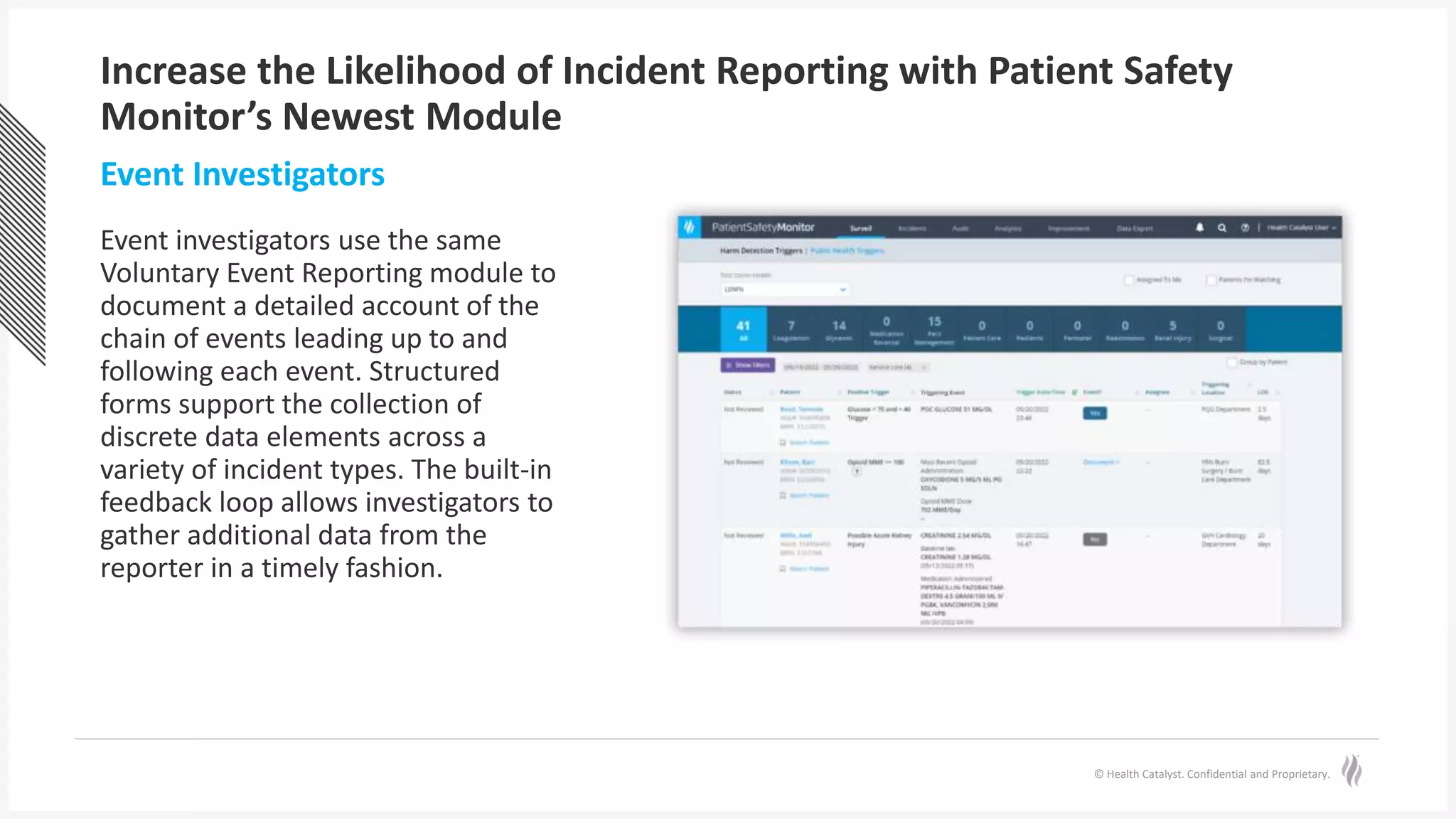
Event investigators use the same
Voluntary Event Reporting module to
document a detailed account of the
chain of events leading up to and
following each event. Structured
forms support the collection of
discrete data elements across a
variety of incident types. The built-in
feedback loop allows investigators to
gather additional data from the
reporter in a timely fashion.
Event Investigators
© Health Catalyst. Confidential and Proprietary.
Improve the Efficacy of
Patient Safety Initiatives with
Voluntary Event Reporting
© Health Catalyst. Confidential and Proprietary.
Improve the Efficacy of Patient Safety Initiatives
with Voluntary Event Reporting
Unlike legacy tools that discourage incident reporting with old technology, complicated forms,
and the inability to inform the reporter of issue resolution, Health Catalyst’s Patient Safety
Monitor leverages a modern user experience and comprehensive safety application to
capture, investigate, analyze, and manage incidents. Effective and efficient incident reporting
complements a broader safety strategy that provides visibility into all potential and actual
harm occurring in an organization using a three-pronged approach: trigger-based data
surveillance, incident reporting, and care audits.
Voluntary Event Reporting offers game-changing support for organizations dedicated to
nurturing a safety culture and leveraging reliable data and analytics for better outcomes by
ensuring your teams have what they need to report events, follow up, learn, and improve.
Health Catalyst’s Patient Safety Monitor
© Health Catalyst. Confidential and Proprietary.
1 Optimize Patient Safety, Manage Risk, and
Continuously Improve Outcomes
3 Trigger-Based Surveillance System Improves Patient Safety
2 Improving Patient Safety and Quality: What Healthcare
Can Learn from the Airline and Nuclear Industries
Here Are Some Articles We Suggest
Additional Reading
4 Using Analytics to Improve Patient Safety Surveillance
Makes Patients Safer
5 Six Ways Health Systems Use Analytics to Improve Patient Safety

Patient Safety Incident Reporting Functionality Reduces Barriers and Improves Care

  • 1.
    © Health Catalyst.Confidential and Proprietary. Patient Safety Incident Reporting Functionality Reduces Barriers and Improves Care
  • 2.
    © Health Catalyst.Confidential and Proprietary. Health Catalyst Editors
  • 3.
    Article Summary For organizations thatare striving to improve patient safety, incident reports are a valuable tool for safety leaders to identify and investigate conditions that may lead to errors or cause harm. Historically, incident reporting has involved complicated forms and a lack of transparency which can discourage employees from reporting events. The newest module in Health Catalyst’s Patient Safety Monitor application, Voluntary Event Reporting, provides an easy-to-use application that is convenient, efficient, productive, and informative. Voluntary Event Reporting offers game-changing support for organizations dedicated to nurturing a safety culture and leveraging reliable data and analytics for better outcomes by ensuring your teams have what they need to report events, follow up, learn, and improve.
  • 4.
    © Health Catalyst.Confidential and Proprietary. Patient Safety Incident Reporting Functionality Reduces Barriers and Improves Care The erosion of patient safety gains amidst the COVID-19 pandemic continues to sound healthcare alarms. Leaders from the Centers for Medicare & Medicaid Services and the Centers for Disease Control and Prevention recently noted “We have observed substantial deterioration on multiple patient safety metrics since the beginning of the pandemic, despite decades of attention to complications of care,” Safety audits and error reporting have also fallen by the wayside due in large part to the exhaustion of frontline staff and personnel shortages. The Erosion of Patient Safety
  • 5.
    © Health Catalyst.Confidential and Proprietary. Patient Safety Incident Reporting Functionality Reduces Barriers and Improves Care To improve safety, healthcare leaders must find new and simpler ways to support safety practices. They must renew their focus on creating a safety culture where staff continually scan and monitor their environment to identify and correct even minor deviations that could lead to unsafe conditions. A holistic, data-driven approach to safety improvements — focused on incident reporting, automated event detection, and care audits — is imperative to future-proof healthcare organizations. Ways to Support Safety
  • 6.
    © Health Catalyst.Confidential and Proprietary. Create a Comprehensive Safety Event Detection and Analysis Strategy
  • 7.
    © Health Catalyst.Confidential and Proprietary. Create a Comprehensive Safety Event Detection and Analysis Strategy Simplify and safeguard incident reporting. The Institute for Healthcare Improvement (IHI) notes that error reporting should be one component of an organization’s larger effort to detect and prevent harm. IHI notes, “Public health researchers have established that only 10 to 20 percent of errors are ever reported and, of those, some 90 to 95 percent cause no harm to patients. For example, a wrong medication prepared and delivered to the patient may or may not cause harm.” Indeed, incident reporting is one piece of a broader safety strategy that identifies errors and helps pinpoint system flaws and failures that create opportunity for harm to occur. IHI further elaborates on the value of focusing on harm with this example: “When a patient admitted for routine surgery gets a staph infection while an inpatient, that hospital-induced illness is certainly harmful. The harm is caused not by individual error but by an institution’s inadequate germ-protection system”. Incident Reporting
  • 8.
    © Health Catalyst.Confidential and Proprietary. Create a Comprehensive Safety Event Detection and Analysis Strategy Incident reporting is one of three important ways that actual or potential harm is identified; the other two methods include:  Automated surveillance. Data values that exceed expected ranges are automatically detected and elevated to the appropriate patient safety team member. Examples include: – Drugs ordered, such as Benadryl, which is a common antidote for an allergic reaction – An abrupt medication stop – Lab results – Patient symptoms, such as a stage 1 pressure ulcer or unexplained lethargy  Care audits. Systematic reviews of any of the following to fill data gaps in the EHR and create a holistic view of harm, risk, and care deviation: – Care processes (e.g., central line insertion, wound care) – Outcomes (e.g., post-operative complications) – Structure (e.g., resource and equipment availability) – Significant events (e.g., medication errors, patient complaints) Incident Reporting
  • 9.
    © Health Catalyst.Confidential and Proprietary. Create a Comprehensive Safety Event Detection and Analysis Strategy The unification of these three sources of safety event data within Patient Safety Monitor supports a comprehensive analysis of all-cause harm, within a single workflow tool. Organizations conduct deeper data analysis and improve their data interpretation accuracy to set priorities for improvement work and intervene to prevent or mitigate harm. Incident Reporting
  • 10.
    © Health Catalyst.Confidential and Proprietary. The Role of Healthcare Incident Reporting Software in Capturing Safety Event Data
  • 11.
    © Health Catalyst.Confidential and Proprietary. The Role of Healthcare Incident Reporting Software In Capturing Safety Event Data Incident reports are a valuable component of an enterprise safety program because they create visibility to conditions that lead to errors and may cause harm. Mistakes in healthcare are rarely due to a single point of failure; they almost always result from a combination of human error, unsafe procedures, and equipment. Historic tendencies to blame individuals involved in safety events have led to a crisis of underreporting, where staff are unlikely to document mistakes or near misses for fear that they will be punished. And yet this lack of visibility prevents organizations from putting systems in place that would help guard against similar errors in the future. Visibility to Conditions
  • 12.
    © Health Catalyst.Confidential and Proprietary. The Role of Healthcare Incident Reporting Software In Capturing Safety Event Data Voluntary incident reporting allows safety leaders to identify and investigate conditions that create risk for error. An analysis of the root cause of each incident or event supports thorough consideration of all factors that may have led to the breach, including:  Sequence of events, timeline  Nature, magnitude, location, and timing of the incident  Changes in people, equipment, or information  Controls in place that may have failed Incident reports help organizations evolve individual and system-level factors that contribute to medical error, foster transparency, and support a continuous improvement culture. Visibility to Conditions
  • 13.
    © Health Catalyst.Confidential and Proprietary. Increase the Likelihood of Incident Reporting with Patient Safety Monitor’s Newest Module: Voluntary Event Reporting
  • 14.
    © Health Catalyst.Confidential and Proprietary. Increase the Likelihood of Incident Reporting with Patient Safety Monitor’s Newest Module The newest module in Health Catalyst’s Patient Safety Monitor application, Voluntary Event Reporting, provides a streamlined and user-friendly workflow for healthcare staff to report safety events. Benefits include:  Ease of use: An efficient form design uses standardized questions and a freeform text field to easily capture all necessary information  Convenience: Staff members enter event data directly into the patient safety application  Efficiency: A report may be initiated in as little as six clicks  Confidentiality: Users can submit reports anonymously or under their own username  Productive: A feedback loop allows the reporter to follow the incident resolution process, and for the investigator to request additional information from the reporter; this feedback mechanism is supported for submissions made anonymously or using a username  Informative: Incident reporters receive email notifications when an incident status has changed, a comment is added, or a case is closed Health Catalyst’s Patient Safety Monitor Application
  • 15.
    © Health Catalyst.Confidential and Proprietary. Increase the Likelihood of Incident Reporting with Patient Safety Monitor’s Newest Module Event investigators use the same Voluntary Event Reporting module to document a detailed account of the chain of events leading up to and following each event. Structured forms support the collection of discrete data elements across a variety of incident types. The built-in feedback loop allows investigators to gather additional data from the reporter in a timely fashion. Event Investigators
  • 16.
    © Health Catalyst.Confidential and Proprietary. Improve the Efficacy of Patient Safety Initiatives with Voluntary Event Reporting
  • 17.
    © Health Catalyst.Confidential and Proprietary. Improve the Efficacy of Patient Safety Initiatives with Voluntary Event Reporting Unlike legacy tools that discourage incident reporting with old technology, complicated forms, and the inability to inform the reporter of issue resolution, Health Catalyst’s Patient Safety Monitor leverages a modern user experience and comprehensive safety application to capture, investigate, analyze, and manage incidents. Effective and efficient incident reporting complements a broader safety strategy that provides visibility into all potential and actual harm occurring in an organization using a three-pronged approach: trigger-based data surveillance, incident reporting, and care audits. Voluntary Event Reporting offers game-changing support for organizations dedicated to nurturing a safety culture and leveraging reliable data and analytics for better outcomes by ensuring your teams have what they need to report events, follow up, learn, and improve. Health Catalyst’s Patient Safety Monitor
  • 18.
    © Health Catalyst.Confidential and Proprietary. 1 Optimize Patient Safety, Manage Risk, and Continuously Improve Outcomes 3 Trigger-Based Surveillance System Improves Patient Safety 2 Improving Patient Safety and Quality: What Healthcare Can Learn from the Airline and Nuclear Industries Here Are Some Articles We Suggest Additional Reading 4 Using Analytics to Improve Patient Safety Surveillance Makes Patients Safer 5 Six Ways Health Systems Use Analytics to Improve Patient Safety