China–Pakistan Economic Corridor
CPEC, is a collection of projects currently under construction at
a cost of $46 billion, intended to rapidly expand and upgrade
Pakistani infrastructure as well as deepen and broaden economic
links between Pakistan and the People's Republic of China.
The corridor is considered to be an extension of China's
ambitious One Belt, One Road initiative.
CPEC is considered economically vital to Pakistan in helping it
drive economic growth.
The Pakistani media and government have called CPEC
investments a "game and fate changer" for the region, while both
China and Pakistan intend that the massive investment plan will
transform Pakistan into a regional economic hub and further
boost the deepening ties between the two countries.
CPEC Game and Fate changer
Main Projects and Zones
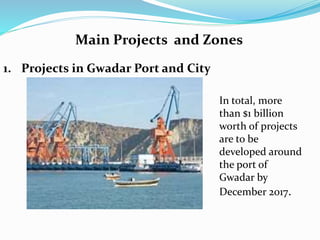
1. Projects in Gwadar Port and City
In total, more
than $1 billion
worth of projects
are to be
developed around
the port of
Gwadar by
December 2017.
Under CPEC agreement, Gwadar Port will initially be expanded and
upgraded to allow for docking of larger ships with deadweight
tonnage of up to 70,000.
Improvement plans also include construction of a $130 million
breakwater around the port, as well as the construction of a floating
liquefied natural gas facility that will have a capacity of 500 million
cubic feet of liquified natural gas per day and will be connected to
the Gwadar-Nawabshah segment of the Iran–Pakistan gas pipeline.
The expanded port will be located near a 2,282 acre free trade
area in Gwadar which is being modelled on the lines of the
Special Economic Zones of China. Business established in the
special economic zone will be exempt from Pakistani income,
sales, and federal excise taxes for 23 years
The special economic zone will be completed in three
phases. By 2025, it is envisaged that manufacturing and
processing industries will be developed, while further
expansion of the zone is intended to be complete by 2030.
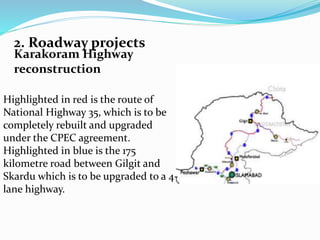
2. Roadway projects
Karakoram Highway
reconstruction
Highlighted in red is the route of
National Highway 35, which is to be
completely rebuilt and upgraded
under the CPEC agreement.
Highlighted in blue is the 175
kilometre road between Gilgit and
Skardu which is to be upgraded to a 4-
lane highway.
Eastern Alignment
The term Eastern Alignment of CPEC refers to roadway
projects located in Sindh and Punjab provinces - some of
which were first envisioned in 1991.
As part of the Eastern Alignment, a 1,152 km long motorway will
connect Pakistan's two largest cities, Karachi and Lahore. The
entire Eastern Alignment motorway project is divided into four
sections: a 136 kilometre long section between Karachi and
Hyderabad also known as the M9 motorway, a 296 kilometre long
section between Hyderabad and Sukkur, a 387 kilometre long
section between Sukku and Multan, and a 333 kilometre section
between Multan and Lahore.
Western Alignment
It refers to Balochistan, Khyber Pakhtunkhwa, and western
Punjab Province as part of the Western Alignment. The Western
Alignment project will result in the upgrading of several hundred
kilometre's worth of road into 2 and 4-lane divided highways by
mid-2018.
In total, the CPEC project envisages re-construction of 870
kilometres of road in Balochistan province alone as part of the
Western Alignment. Of those 870 kilometres of road, 620
kilometres have already been rebuilt as of January 2016.
3. Railway projects
a)Overhaul of Main Line 1 Railway
The plan includes a complete overhaul of the 1,687 kilometre long
Main Line 1 railway (ML-1) between Karachi and Peshawar at a cost
of $3.65 billion for the first phase of the project.
b)Overhaul of Main Line 2 Railway
The CPEC project also calls for similar major upgrade on the 1,254
kilometre long Main Line 2 (ML-2) railway between Kotri in Sindh
province, and Attock in northern Punjab province via the cities of
Larkana and Dera Ghazi Khan.
c)Overhaul of Main Line 3 Railway
Medium term plans for the Main Line 3 (ML-3) railway line
will also include construction of a 560 kilometre long
railway line between Bostan near the Afghanistan border, to
Kotla Jam near the city of Dera Ismail Khan, which will
provide access to southern Afghanistan.
Orange Line Metro
The $1.6 billion Orange Line of the Lahore Metro is under
construction and is regarded as a commercial project under CPEC.
Construction on the line has already begun, with planned
completion by Winter 2017.
The line will be 27.1-kilometre (16.8 mi) long, of which 25.4
kilometres (15.8 mi) will be elevated, with the remaining portion
to be underground between Jain Mandir and Lakshmi
Chowk.When complete, the project will have the capacity to
transport 250,000 commuters per day, with plans to increase
capacity to 500,000 commuters per day by 2025.
4.Energy sector projects
a)Renewable-energy projects
Solar power plant – the 6,500 acre Quaid-e-Azam Solar Park
near the city of Bahawalpur with an estimated capacity of
1000MW is expected to be completed in December 2016.
Similarly, Dawood wind power project,Suki Kinari Hydropower
Project in the Kaghan Valley and Kohala Hydropower Project
being constructed.
b)Coal
Despite several renewable energy projects, the bulk of new energy
generation capacity under CPEC will be coal-based plants, with
$5.8 billion worth of coal power projects expected to be completed
by early 2019 as part of the CPEC's "Early Harvest" projects.
c)Liquified natural gas
Liquefied natural gas power LNG projects are also considered
vital to CPEC. The Chinese government has announced its
intention to build a $2.5 billion 711 kilometre long liquid natural
gas pipeline from Gwadar to Nawabshah in province as part of
CPEC.
The project should not be confused with the $2 billion 1,100
kilometer North-South Pipeline liquified natural gas pipeline
which is to be constructed with Russian assistance between
Karachi and Lahore with anticipated completion by 2018. Nor
should it be confused with the planned $7.5 billion TAPI Pipeline
which is a planned project involving Turkmenistan, Afghanistan,
Pakistan, and India.
Effects on Employability of Country
Pakistani officials predict that the project will result in the
creation of upwards of 700,000 direct jobs between 2015–2030,
and add 2 to 2.5 percentage points to the country's annual
economic growth.
Where all the planned projects to be implemented, the value
of those projects would be equal to all foreign direct
investment in Pakistan since 1970, and would be equivalent to
17% of Pakistan's 2015 gross domestic product.
Key challenges
Security
China has expressed concern that some separatist groups in
Xinjiang may be collaborating with insurgents in Pakistan, and
has expressed a desire to strengthen security ties. construction
workers could be kidnapped and ransomed. that Pakistan plans
to train 12,000 security personnel to protect Chinese workers on
the corridor
The Government of India, which shares tense relations with
Pakistan, regards portions of the CPEC project negatively as they
pass through the Pakistani-administered side of Kashmir;
territory that India disputes. The Indian Ministry of External
Affairs in May 2015 also summoned the Chinese envoy in New
Delhi to lodge India's opposition to the project.
The Chinese Premier dismissed the concerns, describing CPEC as
a "commercial project"[that would not target any third party.
Indian objections to CPEC
Cpec

Cpec

  • 3.
    China–Pakistan Economic Corridor CPEC,is a collection of projects currently under construction at a cost of $46 billion, intended to rapidly expand and upgrade Pakistani infrastructure as well as deepen and broaden economic links between Pakistan and the People's Republic of China. The corridor is considered to be an extension of China's ambitious One Belt, One Road initiative.
  • 4.
    CPEC is consideredeconomically vital to Pakistan in helping it drive economic growth. The Pakistani media and government have called CPEC investments a "game and fate changer" for the region, while both China and Pakistan intend that the massive investment plan will transform Pakistan into a regional economic hub and further boost the deepening ties between the two countries. CPEC Game and Fate changer
  • 5.
    Main Projects andZones 1. Projects in Gwadar Port and City In total, more than $1 billion worth of projects are to be developed around the port of Gwadar by December 2017.
  • 6.
    Under CPEC agreement,Gwadar Port will initially be expanded and upgraded to allow for docking of larger ships with deadweight tonnage of up to 70,000. Improvement plans also include construction of a $130 million breakwater around the port, as well as the construction of a floating liquefied natural gas facility that will have a capacity of 500 million cubic feet of liquified natural gas per day and will be connected to the Gwadar-Nawabshah segment of the Iran–Pakistan gas pipeline.
  • 7.
    The expanded portwill be located near a 2,282 acre free trade area in Gwadar which is being modelled on the lines of the Special Economic Zones of China. Business established in the special economic zone will be exempt from Pakistani income, sales, and federal excise taxes for 23 years The special economic zone will be completed in three phases. By 2025, it is envisaged that manufacturing and processing industries will be developed, while further expansion of the zone is intended to be complete by 2030.
  • 8.
    2. Roadway projects KarakoramHighway reconstruction Highlighted in red is the route of National Highway 35, which is to be completely rebuilt and upgraded under the CPEC agreement. Highlighted in blue is the 175 kilometre road between Gilgit and Skardu which is to be upgraded to a 4- lane highway.
  • 9.
    Eastern Alignment The termEastern Alignment of CPEC refers to roadway projects located in Sindh and Punjab provinces - some of which were first envisioned in 1991. As part of the Eastern Alignment, a 1,152 km long motorway will connect Pakistan's two largest cities, Karachi and Lahore. The entire Eastern Alignment motorway project is divided into four sections: a 136 kilometre long section between Karachi and Hyderabad also known as the M9 motorway, a 296 kilometre long section between Hyderabad and Sukkur, a 387 kilometre long section between Sukku and Multan, and a 333 kilometre section between Multan and Lahore.
  • 10.
    Western Alignment It refersto Balochistan, Khyber Pakhtunkhwa, and western Punjab Province as part of the Western Alignment. The Western Alignment project will result in the upgrading of several hundred kilometre's worth of road into 2 and 4-lane divided highways by mid-2018. In total, the CPEC project envisages re-construction of 870 kilometres of road in Balochistan province alone as part of the Western Alignment. Of those 870 kilometres of road, 620 kilometres have already been rebuilt as of January 2016.
  • 11.
    3. Railway projects a)Overhaulof Main Line 1 Railway The plan includes a complete overhaul of the 1,687 kilometre long Main Line 1 railway (ML-1) between Karachi and Peshawar at a cost of $3.65 billion for the first phase of the project. b)Overhaul of Main Line 2 Railway The CPEC project also calls for similar major upgrade on the 1,254 kilometre long Main Line 2 (ML-2) railway between Kotri in Sindh province, and Attock in northern Punjab province via the cities of Larkana and Dera Ghazi Khan.
  • 12.
    c)Overhaul of MainLine 3 Railway Medium term plans for the Main Line 3 (ML-3) railway line will also include construction of a 560 kilometre long railway line between Bostan near the Afghanistan border, to Kotla Jam near the city of Dera Ismail Khan, which will provide access to southern Afghanistan.
  • 13.
    Orange Line Metro The$1.6 billion Orange Line of the Lahore Metro is under construction and is regarded as a commercial project under CPEC. Construction on the line has already begun, with planned completion by Winter 2017. The line will be 27.1-kilometre (16.8 mi) long, of which 25.4 kilometres (15.8 mi) will be elevated, with the remaining portion to be underground between Jain Mandir and Lakshmi Chowk.When complete, the project will have the capacity to transport 250,000 commuters per day, with plans to increase capacity to 500,000 commuters per day by 2025.
  • 14.
    4.Energy sector projects a)Renewable-energyprojects Solar power plant – the 6,500 acre Quaid-e-Azam Solar Park near the city of Bahawalpur with an estimated capacity of 1000MW is expected to be completed in December 2016. Similarly, Dawood wind power project,Suki Kinari Hydropower Project in the Kaghan Valley and Kohala Hydropower Project being constructed.
  • 15.
    b)Coal Despite several renewableenergy projects, the bulk of new energy generation capacity under CPEC will be coal-based plants, with $5.8 billion worth of coal power projects expected to be completed by early 2019 as part of the CPEC's "Early Harvest" projects. c)Liquified natural gas Liquefied natural gas power LNG projects are also considered vital to CPEC. The Chinese government has announced its intention to build a $2.5 billion 711 kilometre long liquid natural gas pipeline from Gwadar to Nawabshah in province as part of CPEC.
  • 16.
    The project shouldnot be confused with the $2 billion 1,100 kilometer North-South Pipeline liquified natural gas pipeline which is to be constructed with Russian assistance between Karachi and Lahore with anticipated completion by 2018. Nor should it be confused with the planned $7.5 billion TAPI Pipeline which is a planned project involving Turkmenistan, Afghanistan, Pakistan, and India.
  • 17.
    Effects on Employabilityof Country Pakistani officials predict that the project will result in the creation of upwards of 700,000 direct jobs between 2015–2030, and add 2 to 2.5 percentage points to the country's annual economic growth. Where all the planned projects to be implemented, the value of those projects would be equal to all foreign direct investment in Pakistan since 1970, and would be equivalent to 17% of Pakistan's 2015 gross domestic product.
  • 18.
    Key challenges Security China hasexpressed concern that some separatist groups in Xinjiang may be collaborating with insurgents in Pakistan, and has expressed a desire to strengthen security ties. construction workers could be kidnapped and ransomed. that Pakistan plans to train 12,000 security personnel to protect Chinese workers on the corridor
  • 19.
    The Government ofIndia, which shares tense relations with Pakistan, regards portions of the CPEC project negatively as they pass through the Pakistani-administered side of Kashmir; territory that India disputes. The Indian Ministry of External Affairs in May 2015 also summoned the Chinese envoy in New Delhi to lodge India's opposition to the project. The Chinese Premier dismissed the concerns, describing CPEC as a "commercial project"[that would not target any third party. Indian objections to CPEC