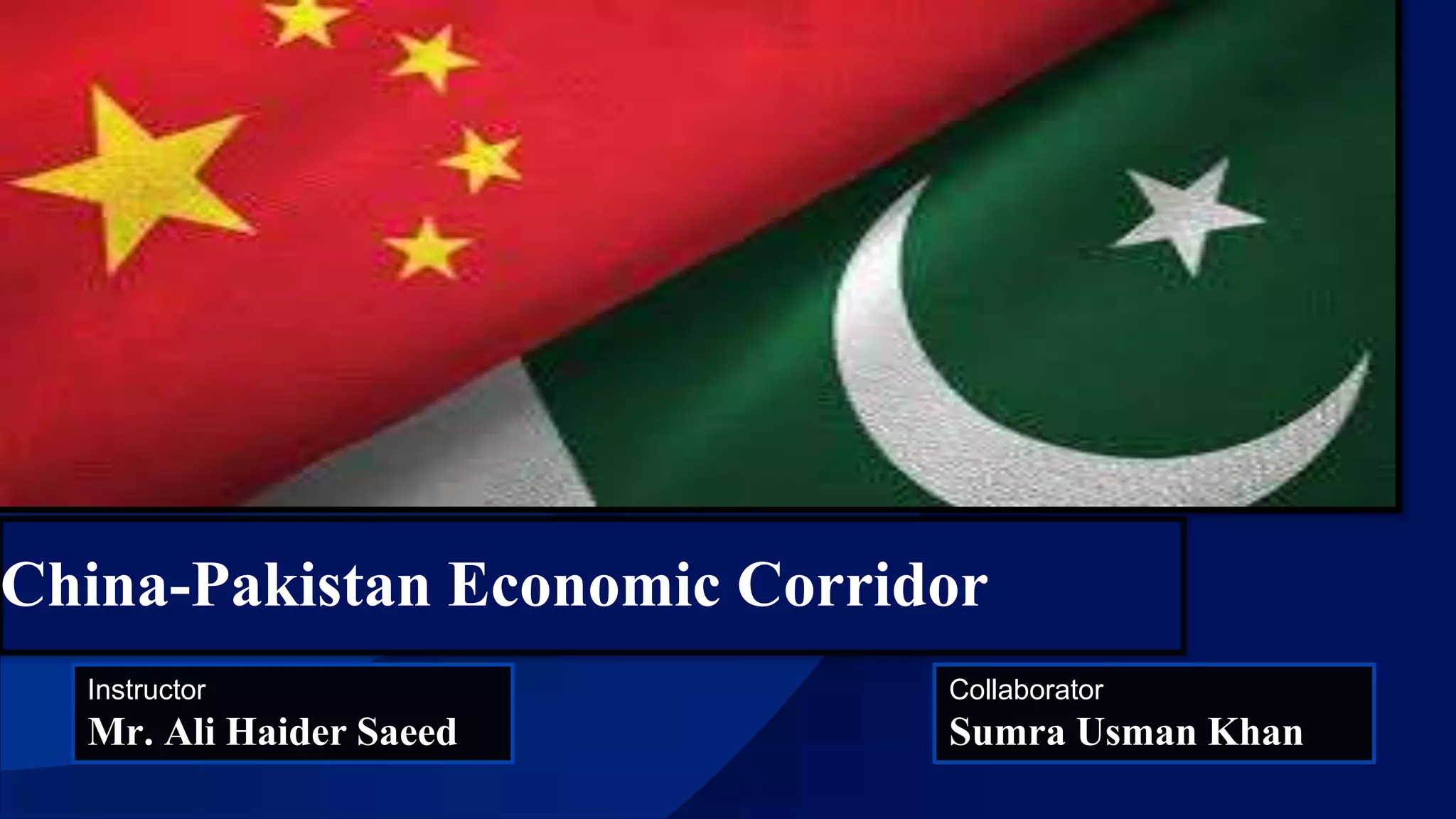
China-Pakistan Economic Corridor
Collaborator
Sumra Usman Khan
Instructor
Mr. Ali Haider Saeed
Presentation outlines
 Brief account on Pak-China relations
 History of silk roads
 One belt one road
 Introduction to CPEC
 Historical perspective of CPEC
 Geography of CPEC in Pakistan (eastern, western and central route)
 Projects in CPEC
 Progress in projects of CPEC
 Pakistan’s interest in CPEC
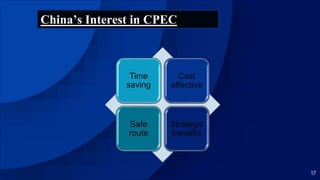
 China’s interest in CPEC
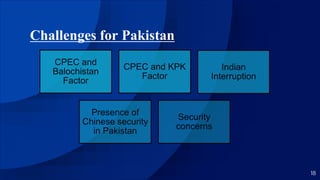
 Challenges For Pakistan
 Global political concerns on CPEC (USA, Russia, India)
 Conclusion
Pak-China Relations
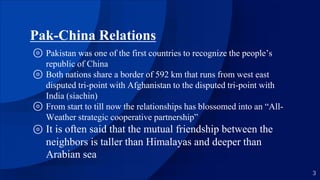
⊚ Pakistan was one of the first countries to recognize the people’s
republic of China
⊚ Both nations share a border of 592 km that runs from west east
disputed tri-point with Afghanistan to the disputed tri-point with
India (siachin)
⊚ From start to till now the relationships has blossomed into an “All-
Weather strategic cooperative partnership”
⊚ It is often said that the mutual friendship between the
neighbors is taller than Himalayas and deeper than
Arabian sea
3
4
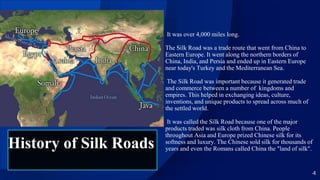
It was over 4,000 miles long.
The Silk Road was a trade route that went from China to
Eastern Europe. It went along the northern borders of
China, India, and Persia and ended up in Eastern Europe
near today's Turkey and the Mediterranean Sea.
The Silk Road was important because it generated trade
and commerce between a number of kingdoms and
empires. This helped in exchanging ideas, culture,
inventions, and unique products to spread across much of
the settled world.
It was called the Silk Road because one of the major
products traded was silk cloth from China. People
throughout Asia and Europe prized Chinese silk for its
softness and luxury. The Chinese sold silk for thousands of
years and even the Romans called China the "land of silk".
History of Silk Roads
One Belt One Road
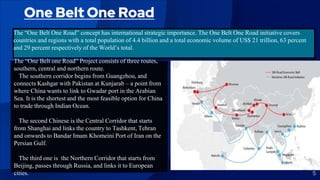
The “One Belt One Road” concept has international strategic importance. The One Belt One Road initiative covers
countries and regions with a total population of 4.4 billion and a total economic volume of US$ 21 trillion, 63 percent
and 29 percent respectively of the World’s total.
5
The “One Belt one Road” Project consists of three routes,
southern, central and northern route.
The southern corridor begins from Guangzhou, and
connects Kashgar with Pakistan at Kunjarab – a point from
where China wants to link to Gwadar port in the Arabian
Sea. It is the shortest and the most feasible option for China
to trade through Indian Ocean.
The second Chinese is the Central Corridor that starts
from Shanghai and links the country to Tashkent, Tehran
and onwards to Bandar Imam Khomeini Port of Iran on the
Persian Gulf.
The third one is the Northern Corridor that starts from
Beijing, passes through Russia, and links it to European
cities.
Introduction to CPEC
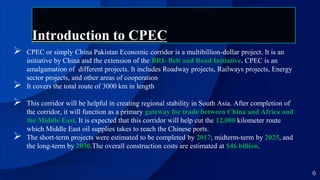
 CPEC or simply China Pakistan Economic corridor is a multibillion-dollar project. It is an
initiative by China and the extension of the BRI- Belt and Road Initiative. CPEC is an
amalgamation of different projects. It includes Roadway projects, Railways projects, Energy
sector projects, and other areas of cooperation
 It covers the total route of 3000 km in length
 This corridor will be helpful in creating regional stability in South Asia. After completion of
the corridor, it will function as a primary gateway for trade between China and Africa and
the Middle East. It is expected that this corridor will help cut the 12,000 kilometer route
which Middle East oil supplies takes to reach the Chinese ports.
 The short-term projects were estimated to be completed by 2017; midterm-term by 2025, and
the long-term by 2030.The overall construction costs are estimated at $46 billion.
6
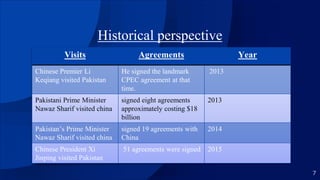
Historical perspective
7
Visits Agreements Year
Chinese Premier Li
Keqiang visited Pakistan
He signed the landmark
CPEC agreement at that
time.
2013
Pakistani Prime Minister
Nawaz Sharif visited china
signed eight agreements
approximately costing $18
billion
2013
Pakistan’s Prime Minister
Nawaz Sharif visited china
signed 19 agreements with
China
2014
Chinese President Xi
Jinping visited Pakistan
51 agreements were signed 2015
8
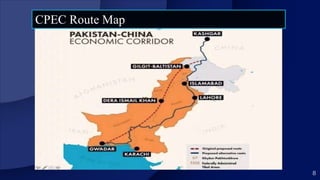
CPEC Route Map
Projects in CPEC
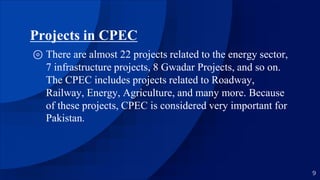
⊚ There are almost 22 projects related to the energy sector,
7 infrastructure projects, 8 Gwadar Projects, and so on.
The CPEC includes projects related to Roadway,
Railway, Energy, Agriculture, and many more. Because
of these projects, CPEC is considered very important for
Pakistan.
9
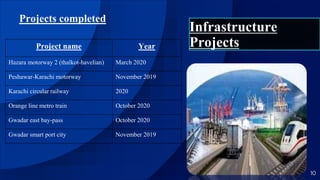
Infrastructure
Projects
10
Project name Year
Hazara motorway 2 (thalkot-havelian) March 2020
Peshawar-Karachi motorway November 2019
Karachi circular railway 2020
Orange line metro train October 2020
Gwadar east bay-pass October 2020
Gwadar smart port city November 2019
Projects completed
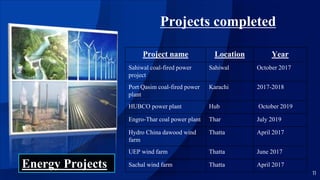
Projects completed
11
Project name Location Year
Sahiwal coal-fired power
project
Sahiwal October 2017
Port Qasim coal-fired power
plant
Karachi 2017-2018
HUBCO power plant Hub October 2019
Engro-Thar coal power plant Thar July 2019
Hydro China dawood wind
farm
Thatta April 2017
UEP wind farm Thatta June 2017
Sachal wind farm Thatta April 2017
Energy Projects
Geography of CPEC in Pakistan
⊚ This project will run through most of Pakistan starting from Gwadar in
Balochistan and ending in Kashgar in south-western China, while passing
through parts of Punjab, Sindh, Balochistan, Khyber Pakhtunkhwa
provinces and GilgitBaltistan in northern Pakistan to reach the Khunjrab
Pass and beyond to China.
12
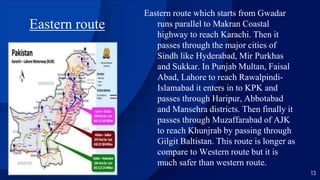
Eastern route
Eastern route which starts from Gwadar
runs parallel to Makran Coastal
highway to reach Karachi. Then it
passes through the major cities of
Sindh like Hyderabad, Mir Purkhas
and Sukkar. In Punjab Multan, Faisal
Abad, Lahore to reach Rawalpindi-
Islamabad it enters in to KPK and
passes through Haripur, Abbotabad
and Mansehra districts. Then finally it
passes through Muzaffarabad of AJK
to reach Khunjrab by passing through
Gilgit Baltistan. This route is longer as
compare to Western route but it is
much safer than western route.
13
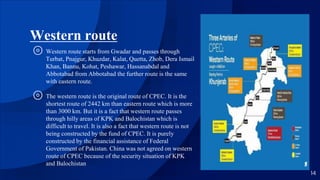
⊚ Western route starts from Gwadar and passes through
Turbat, Pnajgur, Khuzdar, Kalat, Quetta, Zhob, Dera Ismail
Khan, Bannu, Kohat, Peshawar, Hassanabdal and
Abbotabad from Abbotabad the further route is the same
with eastern route.
⊚ The western route is the original route of CPEC. It is the
shortest route of 2442 km than eastern route which is more
than 3000 km. But it is a fact that western route passes
through hilly areas of KPK and Balochistan which is
difficult to travel. It is also a fact that western route is not
being constructed by the fund of CPEC. It is purely
constructed by the financial assistance of Federal
Government of Pakistan. China was not agreed on western
route of CPEC because of the security situation of KPK
and Balochistan
14
Western route
Central route
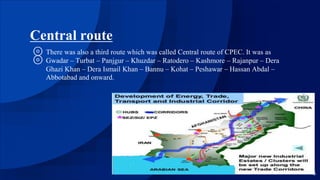
⊚ There was also a third route which was called Central route of CPEC. It was as
⊚ Gwadar – Turbat – Panjgur – Khuzdar – Ratodero – Kashmore – Rajanpur – Dera
Ghazi Khan – Dera Ismail Khan – Bannu – Kohat – Peshawar – Hassan Abdal –
Abbotabad and onward.
15
16
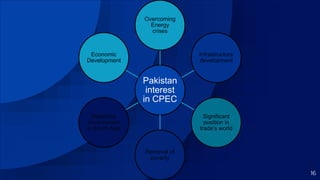
Pakistan
interest
in CPEC
Overcoming
Energy
crises
Infrastructure
development
Significant
position in
trade’s world
Removal of
poverty
Balanced
environment
in South Asia
Economic
Development
17
Time
saving
Cost
effective
Safe
route
Strategic
benefits
China’s Interest in CPEC
Challenges for Pakistan
18
CPEC and
Balochistan
Factor
CPEC and KPK
Factor
Indian
Interruption
Presence of
Chinese security
in Pakistan
Security
concerns
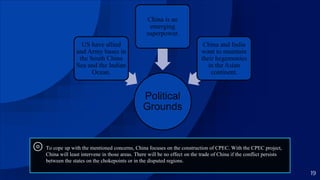
⊚ To cope up with the mentioned concerns, China focuses on the construction of CPEC. With the CPEC project,
China will least intervene in those areas. There will be no effect on the trade of China if the conflict persists
between the states on the chokepoints or in the disputed regions.
19
Political
Grounds
US have allied
and Army bases in
the South China
Sea and the Indian
Ocean.
China is an
emerging
superpower.
China and India
want to maintain
their hegemonies
in the Asian
continent.
Global Political Concerns on CPEC
Malacca Dilemma
⊚ One of the main political concern for constructing the CPEC is Malacca Dilemma.
As mentioned earlier, China needs to pass through the Strait of Malacca to do trade
with other countries. It is a disputed region, Strait of Malacca consist of the disputed
Spratly Islands. There is a global tension in this strait between China, Taiwan,
Vietnam, Philippines, and America. Almost 80% of the middle east energy imports
pass through this strait.
20
Global Political Concerns on CPEC
American Concern
⊚ The American concern regarding CPEC is not so good. As with the help of
CPEC, Pakistan and China will be able to boost its economy. China is already
a threat to the United States, American hegemony will also be decreased
with this CPEC.
European Concern
⊚ Some of the pro-west European countries don’t support the idea of BRI and CPEC,
whereas, some countries are in favor of this project. As it will benefit them as well.
The major portion of the European trade consists of Chinese products. They can get
to the Chinese market easily. Moreover, their orders can also reach in less time
21
Global Political Concerns on CPEC
22
Russian interest in CPEC
Russia supports this project. As both China and Russia is a communist state, furthermore,
Russians always work against Americans. Therefore, Russia has recently shown its interest
in CPEC as well. Furthermore, Russia is also keen to invest in the energy sector of CPEC
Indian Concern
India is a threat to Pakistan since its independence. With the help of CPEC, the economy of
Pakistan will get strengthens. In addition to this, Pakistan will become a stronger country
and will be renowned in the international world. India doesn’t want this to happens.
Furthermore, the Chinese hegemony will also increase with this project. India is also not an
ally of China. To minimize the value of CPEC project india has also signed a treaty on
“Chaah bahar” project along with Afghanistan with iran but no practical work has been
started on it
Concluding Remarks
⊚ Some people criticized CPEC. They believe that CPEC is doing the same as
The East India Company did. On the other hand, India and the USA
criticized the grounds that this project is a debt trap and is a soft power
policy of China. But let’s see what is going to happen next but for sure we
can say if Pakistan really consider it as opportunity it could be a game
changer for our declining economy and to tackle with the above mentioned
threats Pakistan’s needs to develop strong strategic communication with
China without making any compromise on nation’s integrity and
sovereignty
23
THANKYOU
24
ANY QUESTIONS?

CPEC : Media & Current Affairs : Student Collaboration

  • 1.
    China-Pakistan Economic Corridor Collaborator SumraUsman Khan Instructor Mr. Ali Haider Saeed
  • 2.
    Presentation outlines  Briefaccount on Pak-China relations  History of silk roads  One belt one road  Introduction to CPEC  Historical perspective of CPEC  Geography of CPEC in Pakistan (eastern, western and central route)  Projects in CPEC  Progress in projects of CPEC  Pakistan’s interest in CPEC  China’s interest in CPEC  Challenges For Pakistan  Global political concerns on CPEC (USA, Russia, India)  Conclusion
  • 3.
    Pak-China Relations ⊚ Pakistanwas one of the first countries to recognize the people’s republic of China ⊚ Both nations share a border of 592 km that runs from west east disputed tri-point with Afghanistan to the disputed tri-point with India (siachin) ⊚ From start to till now the relationships has blossomed into an “All- Weather strategic cooperative partnership” ⊚ It is often said that the mutual friendship between the neighbors is taller than Himalayas and deeper than Arabian sea 3
  • 4.
    4 It was over4,000 miles long. The Silk Road was a trade route that went from China to Eastern Europe. It went along the northern borders of China, India, and Persia and ended up in Eastern Europe near today's Turkey and the Mediterranean Sea. The Silk Road was important because it generated trade and commerce between a number of kingdoms and empires. This helped in exchanging ideas, culture, inventions, and unique products to spread across much of the settled world. It was called the Silk Road because one of the major products traded was silk cloth from China. People throughout Asia and Europe prized Chinese silk for its softness and luxury. The Chinese sold silk for thousands of years and even the Romans called China the "land of silk". History of Silk Roads
  • 5.
    One Belt OneRoad The “One Belt One Road” concept has international strategic importance. The One Belt One Road initiative covers countries and regions with a total population of 4.4 billion and a total economic volume of US$ 21 trillion, 63 percent and 29 percent respectively of the World’s total. 5 The “One Belt one Road” Project consists of three routes, southern, central and northern route. The southern corridor begins from Guangzhou, and connects Kashgar with Pakistan at Kunjarab – a point from where China wants to link to Gwadar port in the Arabian Sea. It is the shortest and the most feasible option for China to trade through Indian Ocean. The second Chinese is the Central Corridor that starts from Shanghai and links the country to Tashkent, Tehran and onwards to Bandar Imam Khomeini Port of Iran on the Persian Gulf. The third one is the Northern Corridor that starts from Beijing, passes through Russia, and links it to European cities.
  • 6.
    Introduction to CPEC CPEC or simply China Pakistan Economic corridor is a multibillion-dollar project. It is an initiative by China and the extension of the BRI- Belt and Road Initiative. CPEC is an amalgamation of different projects. It includes Roadway projects, Railways projects, Energy sector projects, and other areas of cooperation  It covers the total route of 3000 km in length  This corridor will be helpful in creating regional stability in South Asia. After completion of the corridor, it will function as a primary gateway for trade between China and Africa and the Middle East. It is expected that this corridor will help cut the 12,000 kilometer route which Middle East oil supplies takes to reach the Chinese ports.  The short-term projects were estimated to be completed by 2017; midterm-term by 2025, and the long-term by 2030.The overall construction costs are estimated at $46 billion. 6
  • 7.
    Historical perspective 7 Visits AgreementsYear Chinese Premier Li Keqiang visited Pakistan He signed the landmark CPEC agreement at that time. 2013 Pakistani Prime Minister Nawaz Sharif visited china signed eight agreements approximately costing $18 billion 2013 Pakistan’s Prime Minister Nawaz Sharif visited china signed 19 agreements with China 2014 Chinese President Xi Jinping visited Pakistan 51 agreements were signed 2015
  • 8.
  • 9.
    Projects in CPEC ⊚There are almost 22 projects related to the energy sector, 7 infrastructure projects, 8 Gwadar Projects, and so on. The CPEC includes projects related to Roadway, Railway, Energy, Agriculture, and many more. Because of these projects, CPEC is considered very important for Pakistan. 9
  • 10.
    Infrastructure Projects 10 Project name Year Hazaramotorway 2 (thalkot-havelian) March 2020 Peshawar-Karachi motorway November 2019 Karachi circular railway 2020 Orange line metro train October 2020 Gwadar east bay-pass October 2020 Gwadar smart port city November 2019 Projects completed
  • 11.
    Projects completed 11 Project nameLocation Year Sahiwal coal-fired power project Sahiwal October 2017 Port Qasim coal-fired power plant Karachi 2017-2018 HUBCO power plant Hub October 2019 Engro-Thar coal power plant Thar July 2019 Hydro China dawood wind farm Thatta April 2017 UEP wind farm Thatta June 2017 Sachal wind farm Thatta April 2017 Energy Projects
  • 12.
    Geography of CPECin Pakistan ⊚ This project will run through most of Pakistan starting from Gwadar in Balochistan and ending in Kashgar in south-western China, while passing through parts of Punjab, Sindh, Balochistan, Khyber Pakhtunkhwa provinces and GilgitBaltistan in northern Pakistan to reach the Khunjrab Pass and beyond to China. 12
  • 13.
    Eastern route Eastern routewhich starts from Gwadar runs parallel to Makran Coastal highway to reach Karachi. Then it passes through the major cities of Sindh like Hyderabad, Mir Purkhas and Sukkar. In Punjab Multan, Faisal Abad, Lahore to reach Rawalpindi- Islamabad it enters in to KPK and passes through Haripur, Abbotabad and Mansehra districts. Then finally it passes through Muzaffarabad of AJK to reach Khunjrab by passing through Gilgit Baltistan. This route is longer as compare to Western route but it is much safer than western route. 13
  • 14.
    ⊚ Western routestarts from Gwadar and passes through Turbat, Pnajgur, Khuzdar, Kalat, Quetta, Zhob, Dera Ismail Khan, Bannu, Kohat, Peshawar, Hassanabdal and Abbotabad from Abbotabad the further route is the same with eastern route. ⊚ The western route is the original route of CPEC. It is the shortest route of 2442 km than eastern route which is more than 3000 km. But it is a fact that western route passes through hilly areas of KPK and Balochistan which is difficult to travel. It is also a fact that western route is not being constructed by the fund of CPEC. It is purely constructed by the financial assistance of Federal Government of Pakistan. China was not agreed on western route of CPEC because of the security situation of KPK and Balochistan 14 Western route
  • 15.
    Central route ⊚ Therewas also a third route which was called Central route of CPEC. It was as ⊚ Gwadar – Turbat – Panjgur – Khuzdar – Ratodero – Kashmore – Rajanpur – Dera Ghazi Khan – Dera Ismail Khan – Bannu – Kohat – Peshawar – Hassan Abdal – Abbotabad and onward. 15
  • 16.
    16 Pakistan interest in CPEC Overcoming Energy crises Infrastructure development Significant position in trade’sworld Removal of poverty Balanced environment in South Asia Economic Development
  • 17.
  • 18.
    Challenges for Pakistan 18 CPECand Balochistan Factor CPEC and KPK Factor Indian Interruption Presence of Chinese security in Pakistan Security concerns
  • 19.
    ⊚ To copeup with the mentioned concerns, China focuses on the construction of CPEC. With the CPEC project, China will least intervene in those areas. There will be no effect on the trade of China if the conflict persists between the states on the chokepoints or in the disputed regions. 19 Political Grounds US have allied and Army bases in the South China Sea and the Indian Ocean. China is an emerging superpower. China and India want to maintain their hegemonies in the Asian continent.
  • 20.
    Global Political Concernson CPEC Malacca Dilemma ⊚ One of the main political concern for constructing the CPEC is Malacca Dilemma. As mentioned earlier, China needs to pass through the Strait of Malacca to do trade with other countries. It is a disputed region, Strait of Malacca consist of the disputed Spratly Islands. There is a global tension in this strait between China, Taiwan, Vietnam, Philippines, and America. Almost 80% of the middle east energy imports pass through this strait. 20
  • 21.
    Global Political Concernson CPEC American Concern ⊚ The American concern regarding CPEC is not so good. As with the help of CPEC, Pakistan and China will be able to boost its economy. China is already a threat to the United States, American hegemony will also be decreased with this CPEC. European Concern ⊚ Some of the pro-west European countries don’t support the idea of BRI and CPEC, whereas, some countries are in favor of this project. As it will benefit them as well. The major portion of the European trade consists of Chinese products. They can get to the Chinese market easily. Moreover, their orders can also reach in less time 21
  • 22.
    Global Political Concernson CPEC 22 Russian interest in CPEC Russia supports this project. As both China and Russia is a communist state, furthermore, Russians always work against Americans. Therefore, Russia has recently shown its interest in CPEC as well. Furthermore, Russia is also keen to invest in the energy sector of CPEC Indian Concern India is a threat to Pakistan since its independence. With the help of CPEC, the economy of Pakistan will get strengthens. In addition to this, Pakistan will become a stronger country and will be renowned in the international world. India doesn’t want this to happens. Furthermore, the Chinese hegemony will also increase with this project. India is also not an ally of China. To minimize the value of CPEC project india has also signed a treaty on “Chaah bahar” project along with Afghanistan with iran but no practical work has been started on it
  • 23.
    Concluding Remarks ⊚ Somepeople criticized CPEC. They believe that CPEC is doing the same as The East India Company did. On the other hand, India and the USA criticized the grounds that this project is a debt trap and is a soft power policy of China. But let’s see what is going to happen next but for sure we can say if Pakistan really consider it as opportunity it could be a game changer for our declining economy and to tackle with the above mentioned threats Pakistan’s needs to develop strong strategic communication with China without making any compromise on nation’s integrity and sovereignty 23
  • 24.