OBOR
One Belt One Road
Presented by:
Muhammad Sohaib Manzoor
Introduction
■ OBOR stands for “One Belt One Road”.
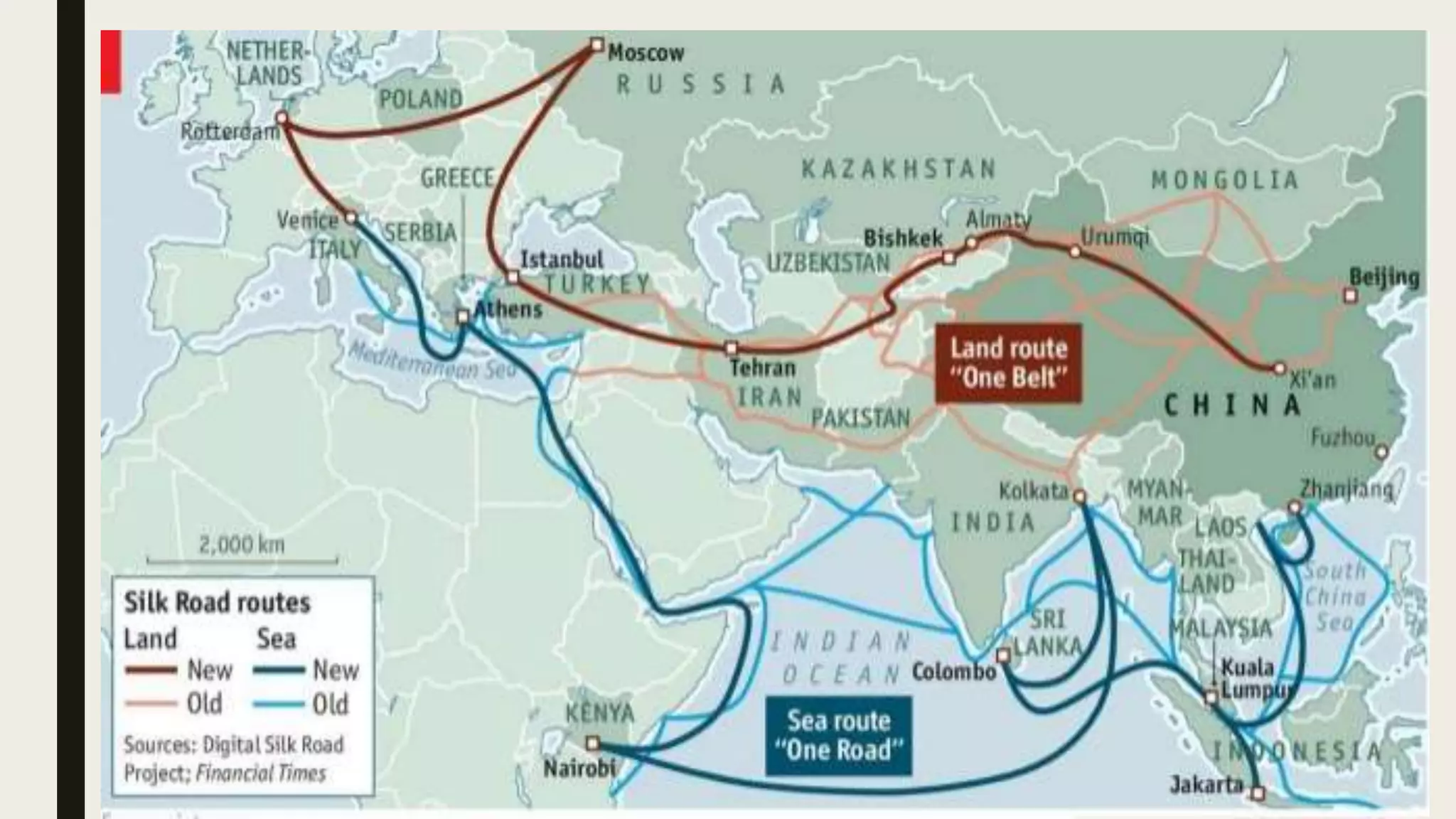
■ It is a combination of the Silk road economic belt (SREB)
and the 21st century maritime silk route.
■ This initiative was introduced by Xi Jinping in the year
2013.
■ Approximately 70 countries has joined together for this
initiative excluding India.
■ It involves developing a lot of infrastructure mostly around
transport and energy such as roads, bridges, gas stations
and power plants.
■ Approximate budget for this project is 8 trillion $.
Facts
Objectives
Information
Facts:
■ Approximately 70 countries.
■ 60% of worlds population.
■ 40% of worlds wealth.
■ Connectivity and cooperation between
Asian, African, European countries with
China.
Objectives:
These are the objectives of china behind
OBOR initiative
 Boost its GDP.
 Develop international clout.
 Capacity will be channelized.
 Yuan’s usage.
 Regional disparities.
Six economic corridors and one maritime route have
been proposed under the OBOR.
1. New Eurasian Land Bridge. (connect Western China to
Western Russia)
2. China-Mongolia-Russia Corridor (North China to Eastern
Russia via Mongolia)
3. China-Central Asia-West Asia Corridor (Western China to
Turkey via Central and West Asia.
4. China-Indochina Penisula Corridor (Southern China to
Singapore via Indochina.
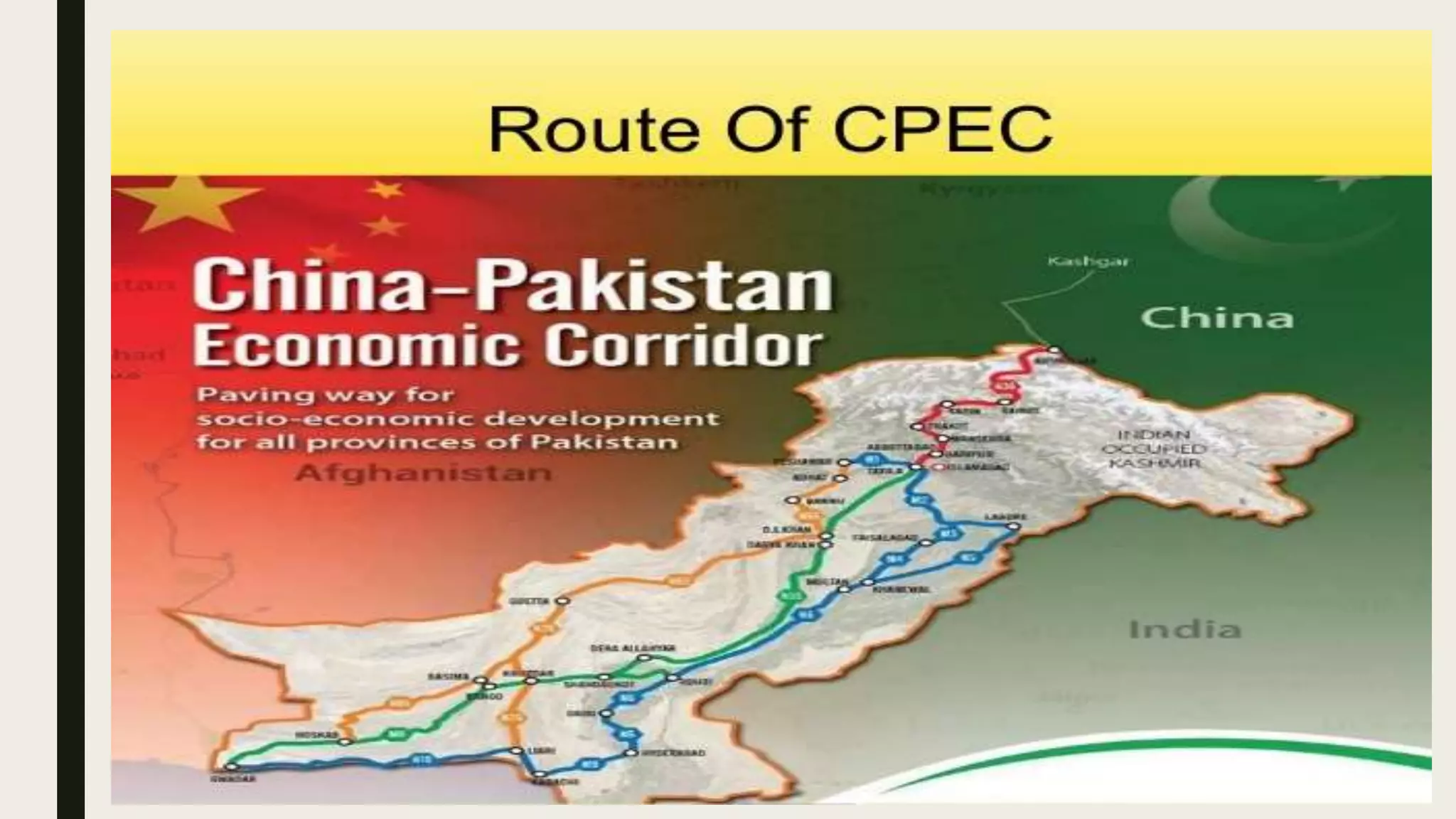
5. China-Pakistan Corridor (South Western China to and
through Pakistan.
6. Bangladesh-China-India-Myanmar Corridor (Southern
China to India via Bangladesh and Myanmar.
7. Maritime Silk Road connecting Coastal China to the
Mediterranean via Singapore-Malaysia, the Indian Ocean,
the Arabian Sea.
Benefits of other countries involved
■ It could bridge the infrastructural deficit in developing
countries like Afghanistan and Pakistan.
■ Increased Investment.
■ Increased Trade.
■ The countries involved can see a boost in their GDP.
CPEC
China-Pakistan Economic
Corridor
Introduction to CPEC
■ Karakoram highway was started in 1959 and was
completed in 1979. (open to the public since 1986)
■ It connects China’s XinJiang region with Pakistan’s Gilgit-
Baltistan Khyber Pakhtunkhwa region’s.
■ China Pakistan Economic Corridor is a collection of
projects.
■ Link the Pakistani region of Gwadar Port to China’s
northwestern autonomous region of XinJiang.
History of Pakistan-China Relations
■ Pakistan-China relations began in 1950
■ Strategic Alliance was formed in 1972 and
economic co-operation began in 1979
■ China has invested 20 billion $ in various
projects in Pakistan
Project Proposal
■ Proposed in May 2013 by Chinese President Xi
Jinping
■ CPEC act as a bridge in Maritime Silk Route
■ The project was launched on April 20, 2015
MOU
The project was launched on April 20, 2015
when Chinese President Xi Jinping and Pakistani
Prime Minister Nawaz Sharif signed 51 agreements
and Memorandums of Understanding valued at $46
billion.
MOU
■ MoU on provision of Chinese governmental concessional loan
for second phase up-gradation of the Karakorum Highway
(Havelian to Thakot).
■ MOU on provision of Chinese governmental concessional loan
for Karachi-Lahore Motorway (Multan to Sukkur).
■ MoU on provision of Chinese governmental concessional loan
for Gwadar port East Bay Expressway Project.
■ MoU on provision of Chinese governmental concessional loan
for Gwadar international airport.
■ Framework agreement on cooperation on major
communications infrastructure project.
■ Agreement on financing for Lahore Orange line Metro Train
project.
■ MoU with respect to cooperation between Wapda and CTG..
CPEC-Energy Priority Projects
■ 2×660MW Coal-fired Power Plants at Port Qasim Karachi
■ Suki Kinari Hydropower Station, Naran,Khyber
Pukhtunkhwa
■ Sahiwal 2x660MW Coal-fired Power Plant, Punjab
■ Quaid-e-Azam 1000MW Solar Park (Bahawalpur) Quaid-e-
Azam
■ Matiari to Lahore ±660kV HVDC Transmission Line Project
■ Matiari (Port Qasim) —Faisalabad Transmission Line
Project
■ Sachal Wind Farm (Jhimpir, Thatta)
CPEC Infrastructure Projects
■ Peshawar-Karachi Motorway (Multan-Sukkur Section)
■ Khuzdar-Basima Road N-30 (110 km)
■ Upgradation of D.I.Khan (Yarik) - Zhob, N-50 Phase-I (210
km)
■ KKH Thakot-Raikot N35 remaining portion (136 Km)
■ Havelian Dry port (450 M. Twenty-Foot Equivalent Units)
■ Capacity Development of Pakistan Railways
■ KKH Phase II (Thakot -Havelian Section)
Benefits to China
■ Chinese Industries are facing problems to compete in
global market due to high transportation cost and delivery
time
■ It would decrease the travel distance cost greatly from
China to Gulf
■ Even if China uses CPEC for 50% of its oil supplies then it
will save $6 Million every day, almost $2 billion every year
■ Independent path from India and USA’s interference
■ New business markets in other countries
Benefits to Pakistan
■ Strategic and economic trade routes
■ Development of Infrastructure
■ Connecting all provinces
■ Development of Fata, KPK and Balochistan
■ Job Opportunities
■ CPEC from all counts will prove a game changer
■ Investments by China will boost Pakistan’s $274 billion
GDP by over 15%
Disadvantages
■ FTA leads to threat for local markets and local
manufacturer’s
■ Disturb local industries
■ Difficult to compete Chinese product in market
■ Dependent to China
Conclusion
■ Natural Gateway for China
■ Positive response by both countries through mutual
co-operation
■ Both countries are keen to enhance trade activities
■ Infrastructural improvements and Development of
Dams
■ Stability of economy by investment in different
sectors

OBOR

  • 1.
    OBOR One Belt OneRoad Presented by: Muhammad Sohaib Manzoor
  • 2.
    Introduction ■ OBOR standsfor “One Belt One Road”. ■ It is a combination of the Silk road economic belt (SREB) and the 21st century maritime silk route. ■ This initiative was introduced by Xi Jinping in the year 2013. ■ Approximately 70 countries has joined together for this initiative excluding India. ■ It involves developing a lot of infrastructure mostly around transport and energy such as roads, bridges, gas stations and power plants. ■ Approximate budget for this project is 8 trillion $.
  • 4.
  • 5.
    Facts: ■ Approximately 70countries. ■ 60% of worlds population. ■ 40% of worlds wealth. ■ Connectivity and cooperation between Asian, African, European countries with China.
  • 6.
    Objectives: These are theobjectives of china behind OBOR initiative  Boost its GDP.  Develop international clout.  Capacity will be channelized.  Yuan’s usage.  Regional disparities.
  • 7.
    Six economic corridorsand one maritime route have been proposed under the OBOR. 1. New Eurasian Land Bridge. (connect Western China to Western Russia) 2. China-Mongolia-Russia Corridor (North China to Eastern Russia via Mongolia) 3. China-Central Asia-West Asia Corridor (Western China to Turkey via Central and West Asia. 4. China-Indochina Penisula Corridor (Southern China to Singapore via Indochina.
  • 8.
    5. China-Pakistan Corridor(South Western China to and through Pakistan. 6. Bangladesh-China-India-Myanmar Corridor (Southern China to India via Bangladesh and Myanmar. 7. Maritime Silk Road connecting Coastal China to the Mediterranean via Singapore-Malaysia, the Indian Ocean, the Arabian Sea.
  • 9.
    Benefits of othercountries involved ■ It could bridge the infrastructural deficit in developing countries like Afghanistan and Pakistan. ■ Increased Investment. ■ Increased Trade. ■ The countries involved can see a boost in their GDP.
  • 10.
  • 11.
    Introduction to CPEC ■Karakoram highway was started in 1959 and was completed in 1979. (open to the public since 1986) ■ It connects China’s XinJiang region with Pakistan’s Gilgit- Baltistan Khyber Pakhtunkhwa region’s. ■ China Pakistan Economic Corridor is a collection of projects. ■ Link the Pakistani region of Gwadar Port to China’s northwestern autonomous region of XinJiang.
  • 13.
    History of Pakistan-ChinaRelations ■ Pakistan-China relations began in 1950 ■ Strategic Alliance was formed in 1972 and economic co-operation began in 1979 ■ China has invested 20 billion $ in various projects in Pakistan
  • 14.
    Project Proposal ■ Proposedin May 2013 by Chinese President Xi Jinping ■ CPEC act as a bridge in Maritime Silk Route ■ The project was launched on April 20, 2015
  • 15.
    MOU The project waslaunched on April 20, 2015 when Chinese President Xi Jinping and Pakistani Prime Minister Nawaz Sharif signed 51 agreements and Memorandums of Understanding valued at $46 billion.
  • 16.
    MOU ■ MoU onprovision of Chinese governmental concessional loan for second phase up-gradation of the Karakorum Highway (Havelian to Thakot). ■ MOU on provision of Chinese governmental concessional loan for Karachi-Lahore Motorway (Multan to Sukkur). ■ MoU on provision of Chinese governmental concessional loan for Gwadar port East Bay Expressway Project. ■ MoU on provision of Chinese governmental concessional loan for Gwadar international airport. ■ Framework agreement on cooperation on major communications infrastructure project. ■ Agreement on financing for Lahore Orange line Metro Train project. ■ MoU with respect to cooperation between Wapda and CTG..
  • 17.
    CPEC-Energy Priority Projects ■2×660MW Coal-fired Power Plants at Port Qasim Karachi ■ Suki Kinari Hydropower Station, Naran,Khyber Pukhtunkhwa ■ Sahiwal 2x660MW Coal-fired Power Plant, Punjab ■ Quaid-e-Azam 1000MW Solar Park (Bahawalpur) Quaid-e- Azam ■ Matiari to Lahore ±660kV HVDC Transmission Line Project ■ Matiari (Port Qasim) —Faisalabad Transmission Line Project ■ Sachal Wind Farm (Jhimpir, Thatta)
  • 18.
    CPEC Infrastructure Projects ■Peshawar-Karachi Motorway (Multan-Sukkur Section) ■ Khuzdar-Basima Road N-30 (110 km) ■ Upgradation of D.I.Khan (Yarik) - Zhob, N-50 Phase-I (210 km) ■ KKH Thakot-Raikot N35 remaining portion (136 Km) ■ Havelian Dry port (450 M. Twenty-Foot Equivalent Units) ■ Capacity Development of Pakistan Railways ■ KKH Phase II (Thakot -Havelian Section)
  • 19.
    Benefits to China ■Chinese Industries are facing problems to compete in global market due to high transportation cost and delivery time ■ It would decrease the travel distance cost greatly from China to Gulf ■ Even if China uses CPEC for 50% of its oil supplies then it will save $6 Million every day, almost $2 billion every year ■ Independent path from India and USA’s interference ■ New business markets in other countries
  • 20.
    Benefits to Pakistan ■Strategic and economic trade routes ■ Development of Infrastructure ■ Connecting all provinces ■ Development of Fata, KPK and Balochistan ■ Job Opportunities ■ CPEC from all counts will prove a game changer ■ Investments by China will boost Pakistan’s $274 billion GDP by over 15%
  • 21.
    Disadvantages ■ FTA leadsto threat for local markets and local manufacturer’s ■ Disturb local industries ■ Difficult to compete Chinese product in market ■ Dependent to China
  • 22.
    Conclusion ■ Natural Gatewayfor China ■ Positive response by both countries through mutual co-operation ■ Both countries are keen to enhance trade activities ■ Infrastructural improvements and Development of Dams ■ Stability of economy by investment in different sectors