FARMING NOTES from kingshay
COW BEHAVIOUR
Take the time to stand back and look at what your cows are telling
you. Their behaviour will highlight the pressure points in your
system. Ignoring these signals will depress herd health and
productivity.
HOW TO ASSESS COW BEHAVIOUR
There are often a number of factors influencing cow behaviour so
interpretation can be tricky e.g. is a cow swishing her tail because
there are flies swarming around or is this a sign that she is suffering from Sub Acute Rumen Acidosis?
• Observe from large to small – first evaluate the entire herd (step 1), then groups within the herd,
followed by individual animals (steps 2 and 3)
• Areas to look at include behaviour, cow condition, posture, cleanliness and alertness
Step 1: HERD INDICATORS
Go into your shed when the
cows are quiet and observe the
whole herd – what is causing the
behaviours you see? Look at:
• How the cows are using the
cubicles
• How cows are standing at the
feed face
• Space per cow – are there
signs of overcrowding?
• Average rumen fill
• Lameness (use our
Locomotion Scoring sheet to
fully assess herd lameness)
• Bulling cows – are cows
showing signs of heat? (see our Farming Note ‘Getting a Grip’)
Use the table below to record the percentage of your herd expressing different
behaviours 2 HOURS AFTER AN ACTIVITY such as feeding or milking. If signs are genuine
they will be repeated.
ACTIVITY
NO. OF
COWS
% OF
GROUP
TARGET
%
POSSIBLE CAUSES
Feeding 10-15% >15% - Inadequate feed space or poor ration palatability
Drinking 2-3% >3% - Inadequate rim space or water fill rate
Loafing 5%
>5% Inadequate building ventilation, not enough cubicle spaces,
incorrect cubicle dimensions, inadequate bedding
Lying 80+%
<80% - Not enough cubicle spaces, uncomfortable lying surfaces or
poor feed availability
Are there groups of cubicles that cows are not using? This may be
caused by poor ventilation or incorrect cubicle dimensions
Standing in cubicles 4%
>4% - Uncomfortable lying surfaces, incorrect cubicle dimensions
(See our series of Farming Notes on ‘Cubicle Modifications’ )
Perching (2 feet in 2
feet out of cubicles)
<5% >5% - Wrong positioning of neck rail
Standing diagonally in
cubicles
0% >0% - Cubicles set at the wrong width, wrong positioning of neck rail
Lying diagonally in
cubicles
0%
>0% - Poor lunging space, incorrect brisket board, cubicles set at the
wrong width
Targets are guides only. % of cows in each activity will vary depending on time of day
Total no. cows in group:
Key Points
• What are your cows telling you
about their environment?
• First look at the whole herd and
then individual cow signs
• Assess behavioural and
physical indicators
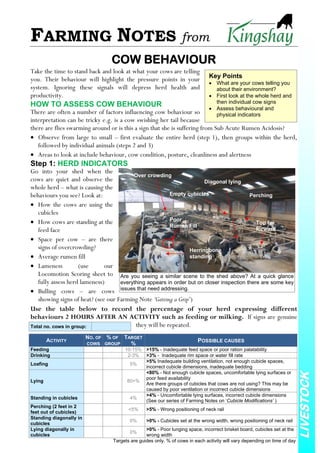
Are you seeing a similar scene to the shed above? At a quick glance
everything appears in order but on closer inspection there are some key
issues that need addressing.
Poor
Rumen Fill
Empty cubicles
Too far
forward
Perching
Diagonal lying
Over crowding
Herringbone
standing
Issued February 2009
All rights reserved. All information provided by Kingshay in this report is copyright and
is not to be reproduced, stored or transmitted in any form or distributed to other persons
without written permission of Kingshay.
Disclaimer – Kingshay can take no responsibility for the
consequences of actions carried out as a result of the
information contained in this Report.
Bridge Farm, West Bradley, Glastonbury, BA6 8LU — T: 01458 851555, F: 01458 851444 E: contact.us@kingshay.co.uk www.kingshay.com
Step 2: INDIVIDUAL COW BEHAVIOUR
BREATHING RATES
Are cows breathing at an elevated rate? A healthy
cow should take a deep breath 10 to 30 times per
minute. If cows are breathing faster assess:
• Ventilation - Is enough air
freely flowing in, up and out of
the building? Are there cobwebs
on the roof? (See our Farming
Note on ‘Ventilation’)
• Signs of illness or acidosis -
Fast breathing can be a sign of
pain or fever
TAIL TWITCHING
Are cows tail twitching despite there being no
flies? If so assess:
• Feed intakes - Irregular feed intakes can be a
sign of acidosis
• Milk Quality and yield -
Low milk fat percents are a
common symptom of acidosis
with severe cases resulting in
reduced yields
FEEDING STANCE RUMINATING RATE
Are cows standing in a herringbone style and
stretching for food? This puts pressure on the
front feet causing horn overgrowth, sole ulcers
and reduced intakes. Assess:
• Feed surface height - Cows should feed off
a surface that is 6 inches higher than the
standing surface. See our Farming Note ‘Barrier
Design’
• Stocking rates - Ideally you should aim for a
minimum of 0.75m/cow of feed space, (see
our Farming Note on ‘Building Dimensions’)
Are cows chewing between 30-60 times before re
swallowing? If not, assess:
• The long fibre
content of the diet
– if chop length is
too short then
cows will not
ruminate for long
enough, reducing
saliva production
leading to SARA
Step 3: PHYSICAL INDICATORS
Injuries on hocks and thighs
Hock damage can range from roughness of the
hair to more severe callouses.
• Are cows lying still or
shifting around in the
cubicles? This is a sign
that the bedding
surface is un-
comfortable, damp,
or abrasive
• Damp bedding caused
by poor ventilation
causes bed sore type injuries on hocks and
thighs
• Excess use of hydrated lime can cause hock
damage.
Injuries on the ribs, backs and hooks
• Do cows rub themselves as they rise and fall in
the cubicles? Look for rubbed areas of metal
• Are there any sharp edges
or objects in the shed?
Rubbed necks and
Briskets
• Are cows rubbing against
the neck rail or wall at the feed trough
MUCK ON THE LEGS
More than 2 inches of muck above the coronary
band indicates a problem-
Scraper alley width
• High stocking rates combined with narrow
passages will result in high levels of slurry in
the passageways. See our Farming Note on
‘Building Design and Layout’ for a guide to
measurements
Scraper efficiency
• Post scraping, there should be less than a cow
pat worth of muck in an area 1m2
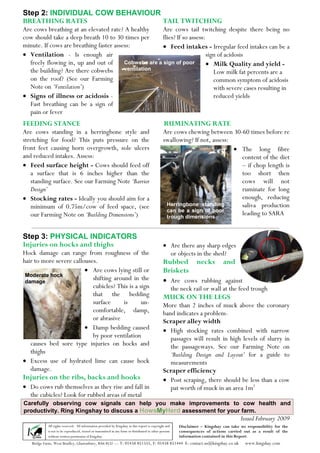
Cobwebs are a sign of poor
ventilation
Carefully observing cow signals can help you make improvements to cow health and
productivity. Ring Kingshay to discuss a HowsMyHerd assessment for your farm.
Moderate hock
damage
Herringbone standing
can be a sign of poor
trough dimensions

Cow behaviour & signals

  • 1.
    FARMING NOTES fromkingshay COW BEHAVIOUR Take the time to stand back and look at what your cows are telling you. Their behaviour will highlight the pressure points in your system. Ignoring these signals will depress herd health and productivity. HOW TO ASSESS COW BEHAVIOUR There are often a number of factors influencing cow behaviour so interpretation can be tricky e.g. is a cow swishing her tail because there are flies swarming around or is this a sign that she is suffering from Sub Acute Rumen Acidosis? • Observe from large to small – first evaluate the entire herd (step 1), then groups within the herd, followed by individual animals (steps 2 and 3) • Areas to look at include behaviour, cow condition, posture, cleanliness and alertness Step 1: HERD INDICATORS Go into your shed when the cows are quiet and observe the whole herd – what is causing the behaviours you see? Look at: • How the cows are using the cubicles • How cows are standing at the feed face • Space per cow – are there signs of overcrowding? • Average rumen fill • Lameness (use our Locomotion Scoring sheet to fully assess herd lameness) • Bulling cows – are cows showing signs of heat? (see our Farming Note ‘Getting a Grip’) Use the table below to record the percentage of your herd expressing different behaviours 2 HOURS AFTER AN ACTIVITY such as feeding or milking. If signs are genuine they will be repeated. ACTIVITY NO. OF COWS % OF GROUP TARGET % POSSIBLE CAUSES Feeding 10-15% >15% - Inadequate feed space or poor ration palatability Drinking 2-3% >3% - Inadequate rim space or water fill rate Loafing 5% >5% Inadequate building ventilation, not enough cubicle spaces, incorrect cubicle dimensions, inadequate bedding Lying 80+% <80% - Not enough cubicle spaces, uncomfortable lying surfaces or poor feed availability Are there groups of cubicles that cows are not using? This may be caused by poor ventilation or incorrect cubicle dimensions Standing in cubicles 4% >4% - Uncomfortable lying surfaces, incorrect cubicle dimensions (See our series of Farming Notes on ‘Cubicle Modifications’ ) Perching (2 feet in 2 feet out of cubicles) <5% >5% - Wrong positioning of neck rail Standing diagonally in cubicles 0% >0% - Cubicles set at the wrong width, wrong positioning of neck rail Lying diagonally in cubicles 0% >0% - Poor lunging space, incorrect brisket board, cubicles set at the wrong width Targets are guides only. % of cows in each activity will vary depending on time of day Total no. cows in group: Key Points • What are your cows telling you about their environment? • First look at the whole herd and then individual cow signs • Assess behavioural and physical indicators Are you seeing a similar scene to the shed above? At a quick glance everything appears in order but on closer inspection there are some key issues that need addressing. Poor Rumen Fill Empty cubicles Too far forward Perching Diagonal lying Over crowding Herringbone standing
  • 2.
    Issued February 2009 Allrights reserved. All information provided by Kingshay in this report is copyright and is not to be reproduced, stored or transmitted in any form or distributed to other persons without written permission of Kingshay. Disclaimer – Kingshay can take no responsibility for the consequences of actions carried out as a result of the information contained in this Report. Bridge Farm, West Bradley, Glastonbury, BA6 8LU — T: 01458 851555, F: 01458 851444 E: contact.us@kingshay.co.uk www.kingshay.com Step 2: INDIVIDUAL COW BEHAVIOUR BREATHING RATES Are cows breathing at an elevated rate? A healthy cow should take a deep breath 10 to 30 times per minute. If cows are breathing faster assess: • Ventilation - Is enough air freely flowing in, up and out of the building? Are there cobwebs on the roof? (See our Farming Note on ‘Ventilation’) • Signs of illness or acidosis - Fast breathing can be a sign of pain or fever TAIL TWITCHING Are cows tail twitching despite there being no flies? If so assess: • Feed intakes - Irregular feed intakes can be a sign of acidosis • Milk Quality and yield - Low milk fat percents are a common symptom of acidosis with severe cases resulting in reduced yields FEEDING STANCE RUMINATING RATE Are cows standing in a herringbone style and stretching for food? This puts pressure on the front feet causing horn overgrowth, sole ulcers and reduced intakes. Assess: • Feed surface height - Cows should feed off a surface that is 6 inches higher than the standing surface. See our Farming Note ‘Barrier Design’ • Stocking rates - Ideally you should aim for a minimum of 0.75m/cow of feed space, (see our Farming Note on ‘Building Dimensions’) Are cows chewing between 30-60 times before re swallowing? If not, assess: • The long fibre content of the diet – if chop length is too short then cows will not ruminate for long enough, reducing saliva production leading to SARA Step 3: PHYSICAL INDICATORS Injuries on hocks and thighs Hock damage can range from roughness of the hair to more severe callouses. • Are cows lying still or shifting around in the cubicles? This is a sign that the bedding surface is un- comfortable, damp, or abrasive • Damp bedding caused by poor ventilation causes bed sore type injuries on hocks and thighs • Excess use of hydrated lime can cause hock damage. Injuries on the ribs, backs and hooks • Do cows rub themselves as they rise and fall in the cubicles? Look for rubbed areas of metal • Are there any sharp edges or objects in the shed? Rubbed necks and Briskets • Are cows rubbing against the neck rail or wall at the feed trough MUCK ON THE LEGS More than 2 inches of muck above the coronary band indicates a problem- Scraper alley width • High stocking rates combined with narrow passages will result in high levels of slurry in the passageways. See our Farming Note on ‘Building Design and Layout’ for a guide to measurements Scraper efficiency • Post scraping, there should be less than a cow pat worth of muck in an area 1m2 Cobwebs are a sign of poor ventilation Carefully observing cow signals can help you make improvements to cow health and productivity. Ring Kingshay to discuss a HowsMyHerd assessment for your farm. Moderate hock damage Herringbone standing can be a sign of poor trough dimensions