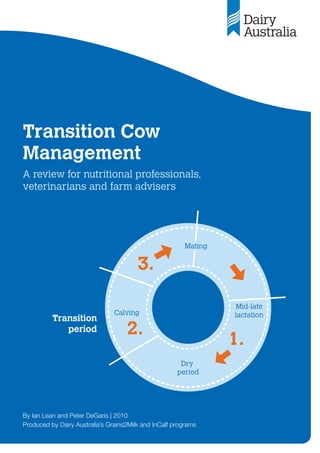


Transition Cow
Management
A review for nutritional professionals,
veterinarians and farm advisers
Dry
period
Mid-late
lactation
Calving
Mating
Transition
period
By Ian Lean and Peter DeGaris | 2010
Produced by Dairy Australia’s Grains2Milk and InCalf programs
Publisher		 Dairy Australia
Authors			 Ian Lean and Peter DeGaris
Editors			 Steve Little and John Penry
Thanks to Barry Zimmermann, Tim Harrington, Ian Sawyer and Joanne Campbell for their editorial assistance.
This review was commissioned by Dairy Australia’s Grains2Milk and InCalf programs.
For further information, please contact: enquiries@dairyaustralia.com.au | Tel: 03 9694 3777
Disclaimer
Whilst all reasonable efforts have been taken to ensure the accuracy of Transition Cow Management – A review for nutritional
professionals, veterinarians and farm advisers, use of the information contained herein is at one’s own risk. To the fullest extent
permitted by Australian law, Dairy Australia disclaims all liability for any losses, costs, damages and the like sustained or incurred
as a result of the use of or reliance upon the information contained herein, including, without limitation, liability stemming from
reliance upon any part which may contain inadvertent errors, whether typographical or otherwise, or omissions of any kind.
© Dairy Australia Limited 2016. All rights reserved.
ISBN 978-0-9581814-9-5
Reprinted 2016
1
	 Transition Cow Management:
Ian Lean and Peter DeGaris 	 A review for nutritional professionals, veterinarians and farm advisers
Section 1:
Introduction
Table of contents
Foreword ...................................................................... 3
1. The transition period............................................ 5
The transition period and its importance ................................... 5
All metabolic processes are intricately linked ........................... 5
Adaptive hormonal changes to lactation .................................... 6
Aims of transition ...................................................................................... 6
Benefits of an integrated approach to transition nutrition . 6
Potential risks from improving transition cow nutrition? ... 8
Managing the post-calving transition period ........................... 9
2. Establishing successful lactations ................ 11
Rumen adaptation ................................................................................ 11
Dry matter intake ................................................................................... 12
Demand for calcium ............................................................................. 13
Lipid mobilisation and impact on liver function .................. 14
Demands of foetus and udder for nutrients ........................... 14
3. 	Components of a fully integrated ................ 15
transition diet
Energy and protein ............................................................................... 15
Macrominerals and Dietary Cation Anion ................................ 18
Difference (DCAD)
Microminerals .......................................................................................... 18
Rumen modifiers .................................................................................... 18
Buffers and other possible additives ........................................... 19
4. Milk fever – pathophysiology and control .... 21
Milk fever – a gateway disease........................................................ 21
Age and breed ......................................................................................... 22
Calcium ........................................................................................................ 22
Magnesium ................................................................................................ 23
Phosphorus ............................................................................................... 23
Dietary Cation Anion Difference (DCAD) .................................. 23
Physiology of DCAD theory of milk fever control ....................... 24
Use of urine pH to monitor efficacy of acidification ................. 25
DCAD equations .................................................................................... 26
Calcium ..................................................................................................... 27
Magnesium .............................................................................................. 27
Phosphorus .............................................................................................. 28
Length of exposure ................................................................................ 28
5. Approaches to transition feeding .................... 33
Other approaches to transition feeding ................................... 35
Energy intake restrictions .................................................................... 35
Vitamin D .................................................................................................. 35
Hydrochloric acid to reduce DCAD ................................................. 35
Calcium drenches at calving ............................................................. 35
Partial budgets ........................................................................................ 36
Assumptions used in these partial budgets ................................. 37
Appendices .............................................................. 39
A. Causes of lameness ......................................................................... 39
B. Hormones involved in establishing lactation ................... 41
C. Guidelines for formulating transition diets ........................ 43
Definition of terms ................................................. 45
References ................................................................ 47
2
Transition Cow Management: 	
A review for nutritional professionals, veterinarians and farm advisers	 Ian Lean and Peter DeGaris
3
	 Transition Cow Management:
Ian Lean and Peter DeGaris 	 A review for nutritional professionals, veterinarians and farm advisers
Section 1:
Introduction
Foreword
Transition cow management has been one of the most significant advances in dairy nutrition and
production world-wide over the past 20 years, providing a major opportunity to improve cow health,
milk production and reproductive performance.
While a substantial number of Australian dairy farmers have implemented successful transition
feeding programs pre-calving, reporting dramatic reductions in milk fever and other cow health
problems around calving, and improvements in milk production and fertility, many other farmers are
yet to do so.
In response to this, Dairy Australia’s Grains2Milk and InCalf programs have joined together to support
the adoption of effective transition cow management programs across the Australian dairy industry.
There have been major advances in understanding the needs of the transition cow and the use of
transition feeding programs pre-calving in just the past few years. Given this, we felt that the first thing
needed was an extensive technical review on transition cow management.
Dr Ian Lean (SBScibus) and Dr Peter DeGaris (Tarwin Veterinary Group) were well-positioned to conduct
this review for Grains2Milk and InCalf. Ian has published more peer-reviewed papers on transition
feeding than any other Australian, and Peter has recently completed his PhD at University of Sydney
on transition cow management.
The result is this publication, which is the most extensive review of transition cow management ever
undertaken, drawing on more than 300 peer-reviewed scientific papers. It provides an up-to-date
technical resource for nutritional professionals, veterinarians and farm advisers on the many aspects of
transition cow management, and serves as the technical foundation for additional adviser and farmer
information resources being developed by Grains2Milk and InCalf.
We trust that you find this review a valuable technical resource.
Steve Little and Barry Zimmermann
(on behalf of Dairy Australia’s
Grains2Milk and InCalf programs)
4
Transition Cow Management: 	
A review for nutritional professionals, veterinarians and farm advisers	 Ian Lean and Peter DeGaris
4
4
5
	 Transition Cow Management:
Ian Lean and Peter DeGaris 	 A review for nutritional professionals, veterinarians and farm advisers
Section 1
The transition period
and its importance
The periparturient or transition period is defined
as the four weeks before and after calving, and is
characterised by greatly increased risk of disease
(Curtis et al. 1985; Shanks 1981; Stevenson and
Lean 1998).
This period is dominated by a series of
adaptations to the demands of lactation, a type
process termed ‘homeorhetic’(Bauman and
Currie 1980). Homeorhetic processes are the
long -term adaptations to a change in state,
such as from being non-lactating to lactating,
and involve an orchestrated series of changes in
metabolism that allow an animal to adapt to the
challenges of the altered state.
Diseases that result from disordered homeorhetic
change reflect disorders in homeostasis, in other
words, these are failures to adapt that result in
shortages of nutrients that are vital for existence.
These conditions are often inter-related (Curtis
et al. 1983; Curtis et al. 1985; Curtis 1997) and
include:
•	 hypocalcaemia and downer cows;
•	 hypomagnesaemia;
•	 ketosis and fatty liver;
•	 udder oedema;
•	 abomasal displacement;
•	 RFM/metritis; and
•	 poor fertility and poor production.
All metabolic processes
are intricately linked
While there has been, in the past, a tendency
to look at metabolic systems in isolation, all
metabolic processes are intricately linked. This
concept reflects a need for effective homeostatic
control of metabolism. A failure of one metabolic
process will inevitably impact on the efficiency
others. As research progresses, intricate
homeostatic links between metabolic processes
once thought to be distant and unrelated are
continually uncovered.
As a result of the increased understanding of
homeostatic processes, the concept of transition
feeding has evolved from one focused on only
control of milk fever to an integrated nutritional
approach that optimises:
•	 rumen function;
•	 calcium and bone metabolism;
•	 energy metabolism;
•	 protein metabolism; and
•	 immune function.
While addressing any one of these areas in
isolation will be of some benefit, developing
integrated nutritional strategies based on
an understanding of the homoeostatic and
homeorhetic processes involved in the transition
from a non-lactating to lactating animal will have
substantial benefits.
Grummer (1995) stated that “If transition feeding
is important, then perturbations in nutrition
during this period should affect lactation, health
and reproductive performance.” There is now a
substantial body of evidence clearly confirming
6
Transition Cow Management: 	
A review for nutritional professionals, veterinarians and farm advisers	 Ian Lean and Peter DeGaris
that the transition period represents a brief but
critically important period of time in a cow’s
life where careful manipulation of diet can
impact substantially on subsequent health and
productivity.
Adaptive hormonal
changes to lactation
Changes in hormone metabolism before calving
have been well described (Bauman and Currie
1980; Bell 1995). Bauman and Currie (1980) noted
the following adaptive changes to lactation:
•	 increased lipolysis (breakdown of fats);
•	 decreased lipogenesis (fat synthesis);
•	 increased gluconeogenesis (glucose synthesis);
•	 increased glycogenolysis (breakdown of
glycogen to provide energy);
•	 increased use of lipids and decreased glucose
use as an energy source;
•	 increased mobilisation of protein reserves;
•	 increased absorption of minerals and
mobilisation of mineral reserves; and
•	 increased food consumption and increased
absorptive capacity for nutrients.
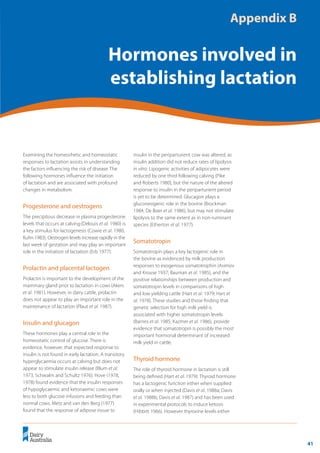
The following hormones influence the initiation
of lactation and are associated with profound
changes in metabolism:
•	 progesterone and oestrogens;
•	 prolactin and placental lactogen;
•	 insulin and glucagon;
•	 somatotropin;
•	 thyroid hormone; and
•	 glucorticoids.
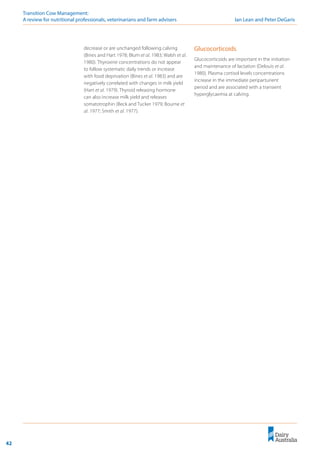
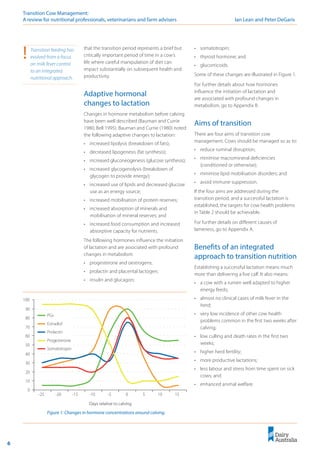
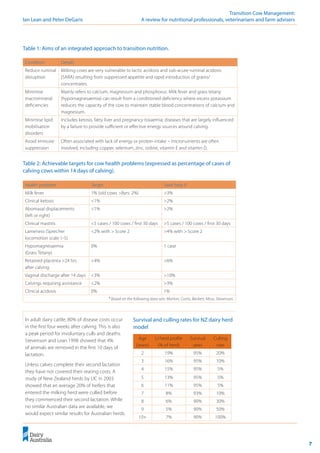
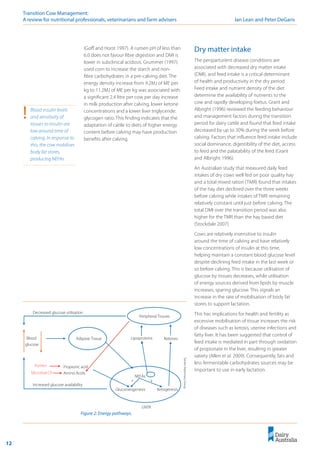
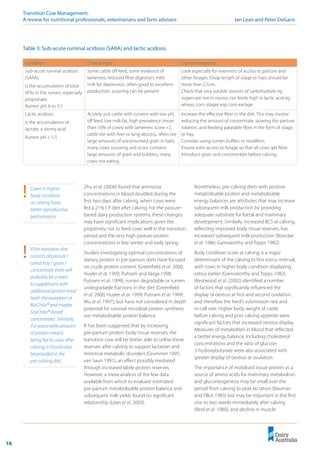
Some of these changes are illustrated in Figure 1.
For further details about how hormones
influence the initiation of lactation and
are associated with profound changes in
metabolism, go to Appendix B.
Aims of transition
There are four aims of transition cow
management. Cows should be managed so as to:
•	 reduce ruminal disruption;
•	 minimise macromineral deficiencies
(conditioned or otherwise);
•	 minimise lipid mobilisation disorders; and
•	 avoid immune suppression.
If the four aims are addressed during the
transition period, and a successful lactation is
established, the targets for cow health problems
in Table 2 should be achievable.
For further details on different causes of
lameness, go to Appendix A.
Benefits of an integrated
approach to transition nutrition
Establishing a successful lactation means much
more than delivering a live calf. It also means:
•	 a cow with a rumen well adapted to higher
energy feeds;
•	 almost no clinical cases of milk fever in the
herd;
•	 very low incidence of other cow health
problems common in the first two weeks after
calving;
•	 low culling and death rates in the first two
weeks;
•	 higher herd fertility;
•	 more productive lactations;
•	 less labour and stress from time spent on sick
cows; and
•	 enhanced animal welfare.
!	 Transition feeding has
evolved from a focus
on milk fever control
to an integrated
nutritional approach.
Figure 1: Changes in hormone concentrations around calving.
0
10
20
30
40
50
60
70
80
90
100
-25 -20 -15 -10 -5 0 5 10 15
PGs
Estradiol
Prolactin
Progesterone
Somatotropin
Days relative to calving
7
	 Transition Cow Management:
Ian Lean and Peter DeGaris 	 A review for nutritional professionals, veterinarians and farm advisers
Condition Details
Reduce ruminal
disruption
Milking cows are very vulnerable to lactic acidosis and sub-acute ruminal acidosis
(SARA) resulting from suppressed appetite and rapid introduction of grains/
concentrates.
Minimise
macromineral
deficiencies
Mainly refers to calcium, magnesium and phosphorus. Milk fever and grass tetany
(hypomagnesaemia) can result from a conditioned deficiency where excess potassium
reduces the capacity of the cow to maintain stable blood concentrations of calcium and
magnesium.
Minimise lipid
mobilisation
disorders
Includes ketosis, fatty liver and pregnancy toxaemia; diseases that are largely influenced
by a failure to provide sufficient or effective energy sources around calving.
Avoid immune
suppression
Often associated with lack of energy or protein intake – micronutrients are often
involved, including copper, selenium, zinc, iodine, vitamin E and vitamin D.
Table 1: Aims of an integrated approach to transition nutrition.
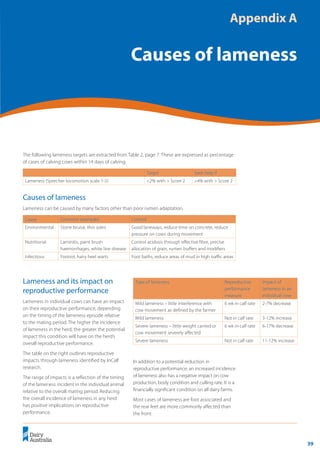
Health problem Target Seek help if
Milk fever 1% (old cows >8yrs: 2%) >3%
Clinical ketosis <1% >2%
Abomasal displacements
(left or right)
<1% >2%
Clinical mastitis <5 cases / 100 cows / first 30 days >5 cases / 100 cows / first 30 days
Lameness (Sprecher
locomotion scale 1-5)
<2% with > Score 2 >4% with > Score 2
Hypomagnesaemia
(Grass Tetany)
0% 1 case
Retained placenta >24 hrs
after calving
<4% >6%
Vaginal discharge after 14 days <3% >10%
Calvings requiring assistance <2% >3%
Clinical acidosis 0% 1%
* Based on the following data sets: Morton, Curtis, Beckett, Moss, Stevenson.
Table 2: Achievable targets for cow health problems (expressed as percentage of cases of
calving cows within 14 days of calving).
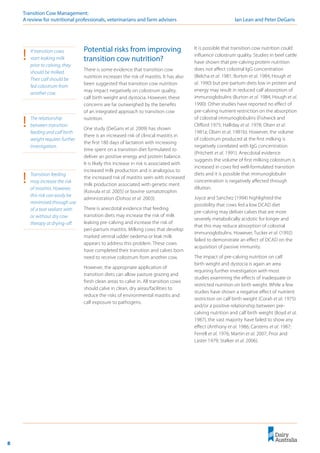
In adult dairy cattle, 80% of disease costs occur
in the first four weeks after calving. This is also
a peak period for involuntary culls and deaths.
Stevenson and Lean 1998 showed that 4%
of animals are removed in the first 10 days of
lactation.
Unless calves complete their second lactation
they have not covered their rearing costs. A
study of New Zealand herds by LIC in 2003
showed that an average 20% of heifers that
entered the milking herd were culled before
they commenced their second lactation. While
no similar Australian data are available, we
would expect similar results for Australian herds.
Survival and culling rates for NZ dairy herd
model
Age
(years)
Ll herd profile
(% of herd)
Survival
rates
Culling
rate
2 19% 95% 20%
3 16% 95% 10%
4 15% 95% 5%
5 13% 95% 5%
6 11% 95% 5%
7 8% 93% 10%
8 6% 90% 30%
9 5% 90% 50%
10+ 7% 90% 100%
8
Transition Cow Management: 	
A review for nutritional professionals, veterinarians and farm advisers	 Ian Lean and Peter DeGaris
Potential risks from improving
transition cow nutrition?
There is some evidence that transition cow
nutrition increases the risk of mastitis. It has also
been suggested that transition cow nutrition
may impact negatively on colostrum quality,
calf birth weight and dystocia. However, these
concerns are far outweighed by the benefits
of an integrated approach to transition cow
nutrition.
One study (DeGaris et al. 2009) has shown
there is an increased risk of clinical mastitis in
the first 180 days of lactation with increasing
time spent on a transition diet formulated to
deliver an positive energy and protein balance.
It is likely this increase in risk is associated with
increased milk production and is analogous to
the increased risk of mastitis seen with increased
milk production associated with genetic merit
(Koivula et al. 2005) or bovine somatotrophin
administration (Dohoo et al. 2003).
There is anecdotal evidence that feeding
transition diets may increase the risk of milk
leaking pre-calving and increase the risk of
peri-partum mastitis. Milking cows that develop
marked ventral udder oedema or leak milk
appears to address this problem. These cows
have completed their transition and calves born
need to receive colostrum from another cow.
However, the appropriate application of
transition diets can allow pasture grazing and
fresh clean areas to calve in. All transition cows
should calve in clean, dry areas/facilities to
reduce the risks of environmental mastitis and
calf exposure to pathogens.
It is possible that transition cow nutrition could
influence colostrum quality. Studies in beef cattle
have shown that pre-calving protein nutrition
does not affect colostral IgG concentration
(Belcha et al. 1981; Burton et al. 1984; Hough et
al. 1990) but pre-partum diets low in protein and
energy may result in reduced calf absorption of
immunoglobulins (Burton et al. 1984; Hough et al.
1990). Other studies have reported no effect of
pre-calving nutrient restriction on the absorption
of colostral immunoglobulins (Fishwick and
Clifford 1975; Halliday et al. 1978; Olsen et al.
1981a; Olsen et al. 1981b). However, the volume
of colostrum produced at the first milking is
negatively correlated with IgG concentration
(Pritchett et al. 1991). Anecdotal evidence
suggests the volume of first milking colostrum is
increased in cows fed well-formulated transition
diets and it is possible that immunoglobulin
concentration is negatively affected through
dilution.
Joyce and Sanchez (1994) highlighted the
possibility that cows fed a low DCAD diet
pre-calving may deliver calves that are more
severely metabolically acidotic for longer and
that this may reduce absorption of colostral
immunoglobulins. However, Tucker et al. (1992)
failed to demonstrate an effect of DCAD on the
acquisition of passive immunity.
The impact of pre-calving nutrition on calf
birth weight and dystocia is again an area
requiring further investigation with most
studies examining the effects of inadequate or
restricted nutrition on birth weight. While a few
studies have shown a negative effect of nutrient
restriction on calf birth weight (Corah et al. 1975)
and/or a positive relationship between pre-
calving nutrition and calf birth weight (Boyd et al.
1987), the vast majority have failed to show any
effect (Anthony et al. 1986; Carstens et al. 1987;
Ferrell et al. 1976; Martin et al. 2007; Prior and
Laster 1979; Stalker et al. 2006).
!	 If transition cows
start leaking milk
prior to calving, they
should be milked.
Their calf should be
fed colostrum from
another cow.
!	 The relationship
between transition
feeding and calf birth
weight requires further
investigation.
!	 Transition feeding
may increase the risk
of mastitis. However,
this risk can easily be
minimised through use
of a teat sealant with
or without dry cow
therapy at drying-off.
9
	 Transition Cow Management:
Ian Lean and Peter DeGaris 	 A review for nutritional professionals, veterinarians and farm advisers
Managing the post-calving
transition period
While the focus of transition management of the
dairy cow tends to be on the pre-calving period,
the transition period extends to the first four
weeks of lactation. While a detailed discussion
on the nutritional requirements of the dairy
cow during this period is beyond the scope
of this review, the nutrition and management
of the post-calving transition cow is of equal
importance as that of the pre-calving transition
cow. During this period there is substantial
up regulation of all metabolic processes that
drive continued udder development, recovery
of appetite and immune function and the
resumption of reproductive activity.
All the concepts of sound nutrition that are
important in the pre-calving transition period are
equally important in the post-calving transition
period. Continued ruminal adaptation to high
concentrate diets is critical to control the risk
of sub-acute ruminal acidosis (SARA) and lactic
acidosis, careful attention to macro and micro
mineral metabolism, as well as energy and protein
metabolism, is essential for a successful lactation.
Again, the concepts of homeostatic and
homeorhetic change are crucial. Failure to
adequately support one area of metabolism will
inevitably impact negatively on other metabolic
processes. Careful attention to minimise the
depth and length of negative energy and protein
balance are equally as important as the provision of
adequate calcium, magnesium and phosphorus.
Please note: Section 2 and onwards of this review
focus on the pre-calving transition period.
10
Transition Cow Management: 	
A review for nutritional professionals, veterinarians and farm advisers	 Ian Lean and Peter DeGaris
11
	 Transition Cow Management:
Ian Lean and Peter DeGaris 	 A review for nutritional professionals, veterinarians and farm advisers
The key to establishing successful lactations lies
in overcoming five main challenges:
•	 rumen adaptation;
•	 reduced dry matter intake;
•	 higher demands for calcium;
•	 impact of lipid mobilisation on liver function;
and
•	 demands of the foetus and udder for
nutrients.
An integrated approach to managing transition
cows is needed if these challenges are to be
dealt with effectively.
Rumen adaptation
Despite recent changes in management to
provide more energy dense rations in the
transition period, dry cow rations will continue
to have a lower energy density than lactating
cow rations and a lower content of fermentable
carbohydrate, even in pasture-dominant
feeding systems.
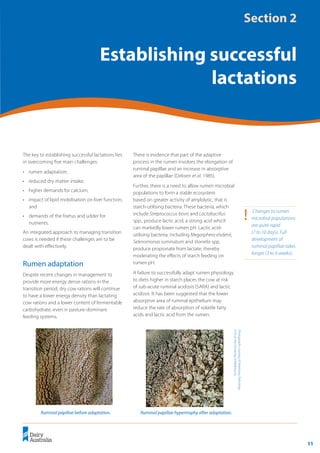
There is evidence that part of the adaptive
process in the rumen involves the elongation of
ruminal papillae and an increase in absorptive
area of the papillae (Dirksen et al. 1985).
Further, there is a need to allow rumen microbial
populations to form a stable ecosystem
based on greater activity of amylolytic, that is
starch-utilising bacteria. These bacteria, which
include Streptococcus bovis and Lactobacillus
spp., produce lactic acid, a strong acid which
can markedly lower rumen pH. Lactic acid-
utilising bacteria, including Megasphera elsdenii,
Selenomonas ruminatum and Vionella spp,
produce propionate from lactate, thereby
moderating the effects of starch feeding on
rumen pH.
A failure to successfully adapt rumen physiology
to diets higher in starch places the cow at risk
of sub-acute ruminal acidosis (SARA) and lactic
acidosis. It has been suggested that the lower
absorptive area of ruminal epithelium may
reduce the rate of absorption of volatile fatty
acids and lactic acid from the rumen.
!	 Changes to rumen
microbial populations
are quite rapid
(7 to 10 days). Full
development of
ruminal papillae takes
longer (3 to 6 weeks).
Section 2
Establishing successful
lactations
Ruminal papillae before adaptation.
Photographs
courtesy
of
Veterinary
Pathology
Unit
at
the
University
of
Melbourne.
Ruminal papillae hypertrophy after adaptation.
12
Transition Cow Management: 	
A review for nutritional professionals, veterinarians and farm advisers	 Ian Lean and Peter DeGaris
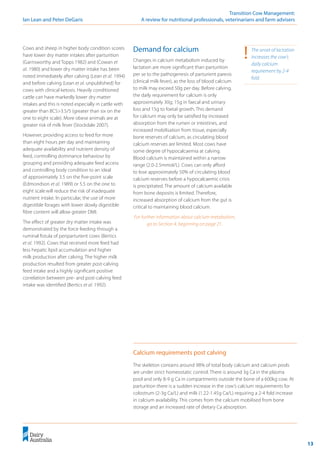
Figure 2: Energy pathways.
Tarwin
Veterinary
Group
Blood
glucose
Adipose Tissue
Peripheral Tissues
NEFAs
Ketogenesis
Gluconeogenesis
Propionic acid
Amino Acids
Ketones
+ +
LIVER
Increased glucose availability
Decreased glucose utilisation
Rumen
Microbial CP
Lipoproteins
(Goff and Horst 1997). A rumen pH of less than
6.0 does not favour fibre digestion and DMI is
lower in subclinical acidosis. Grummer (1997)
used corn to increase the starch and non-
fibre carbohydrates in a pre-calving diet. The
energy density increase from 9.2MJ of ME per
kg to 11.2MJ of ME per kg was associated with
a significant 2.4 litre per cow per day increase
in milk production after calving, lower ketone
concentrations and a lower liver triglyceride:
glycogen ratio. This finding indicates that the
adaptation of cattle to diets of higher energy
content before calving may have production
benefits after calving.
Dry matter intake
The periparturient disease conditions are
associated with decreased dry matter intake
(DMI), and feed intake is a critical determinant
of health and productivity in the dry period.
Feed intake and nutrient density of the diet
determine the availability of nutrients to the
cow and rapidly developing foetus. Grant and
Albright (1996) reviewed the feeding behaviour
and management factors during the transition
period for dairy cattle and found that feed intake
decreased by up to 30% during the week before
calving. Factors that influence feed intake include
social dominance, digestibility of the diet, access
to feed and the palatability of the feed (Grant
and Albright 1996).
An Australian study that measured daily feed
intakes of dry cows well fed on poor quality hay
and a total mixed ration (TMR) found that intakes
of the hay diet declined over the three weeks
before calving while intakes of TMR remaining
relatively constant until just before calving. The
total DMI over the transition period was also
higher for the TMR than the hay based diet
(Stockdale 2007).
Cows are relatively insensitive to insulin
around the time of calving and have relatively
low concentrations of insulin at this time,
helping maintain a constant blood glucose level
despite declining feed intake in the last week or
so before calving. This is because utilisation of
glucose by tissues decreases, while utilisation
of energy sources derived from lipids by muscle
increases, sparing glucose. This signals an
increase in the rate of mobilisation of body fat
stores to support lactation.
This has implications for health and fertility as
excessive mobilisation of tissue increases the risk
of diseases such as ketosis, uterine infections and
fatty liver. It has been suggested that control of
feed intake is mediated in part through oxidation
of propionate in the liver, resulting in greater
satiety (Allen et al. 2009). Consequently, fats and
less fermentable carbohydrates sources may be
important to use in early lactation.
!	 Blood insulin levels
and sensitivity of
tissues to insulin are
low around time of
calving. In response to
this, the cow mobilises
body fat stores,
producing NEFAs.
13
	 Transition Cow Management:
Ian Lean and Peter DeGaris 	 A review for nutritional professionals, veterinarians and farm advisers
Cows and sheep in higher body condition scores
have lower dry matter intakes after parturition
(Garnsworthy and Topps 1982) and (Cowan et
al. 1980) and lower dry matter intake has been
noted immediately after calving (Lean et al. 1994)
and before calving (Lean et al. unpublished) for
cows with clinical ketosis. Heavily conditioned
cattle can have markedly lower dry matter
intakes and this is noted especially in cattle with
greater than BCS>3.5/5 (greater than six on the
one to eight scale). More obese animals are at
greater risk of milk fever (Stockdale 2007).
However, providing access to feed for more
than eight hours per day and maintaining
adequate availability and nutrient density of
feed, controlling dominance behaviour by
grouping and providing adequate feed access
and controlling body condition to an ideal
of approximately 3.5 on the five-point scale
(Edmondson et al. 1989) or 5.5 on the one to
eight scalewill reduce the risk of inadequate
nutrient intake. In particular, the use of more
digestible forages with lower slowly digestible
fibre content will allow greater DMI.
The effect of greater dry matter intake was
demonstrated by the force feeding through a
ruminal fistula of periparturient cows (Bertics
et al. 1992). Cows that received more feed had
less hepatic lipid accumulation and higher
milk production after calving. The higher milk
production resulted from greater post-calving
feed intake and a highly significant positive
correlation between pre- and post-calving feed
intake was identified (Bertics et al. 1992).
Demand for calcium
Changes in calcium metabolism induced by
lactation are more significant than parturition
per se to the pathogenesis of parturient paresis
(clinical milk fever), as the loss of blood calcium
to milk may exceed 50g per day. Before calving,
the daily requirement for calcium is only
approximately 30g; 15g in faecal and urinary
loss and 15g to foetal growth. This demand
for calcium may only be satisfied by increased
absorption from the rumen or intestines, and
increased mobilisation from tissue, especially
bone reserves of calcium, as circulating blood
calcium reserves are limited. Most cows have
some degree of hypocalcaemia at calving.
Blood calcium is maintained within a narrow
range (2.0-2.5mmol/L). Cows can only afford
to lose approximately 50% of circulating blood
calcium reserves before a hypocalcaemic crisis
is precipitated. The amount of calcium available
from bone deposits is limited. Therefore,
increased absorption of calcium from the gut is
critical to maintaining blood calcium.
For further information about calcium metabolism,
go to Section 4, beginning on page 21.
!	 The onset of lactation
increases the cow’s
daily calcium
requirement by 2-4
fold.
The skeleton contains around 98% of total body calcium and calcium pools
are under strict homeostatic control. There is around 3g Ca in the plasma
pool and only 8-9 g Ca in compartments outside the bone of a 600kg cow. At
parturition there is a sudden increase in the cow’s calcium requirements for
colostrum (2-3g Ca/L) and milk (1.22-1.45g Ca/L) requiring a 2-4 fold increase
in calcium availability. This comes from the calcium mobilised from bone
storage and an increased rate of dietary Ca absorption.
Calcium requirements post calving
14
Transition Cow Management: 	
A review for nutritional professionals, veterinarians and farm advisers	 Ian Lean and Peter DeGaris
Lipid mobilisation and
impact on liver function
Ruminants are adapted to manage periods
of poor-quality feed intake or a lack of feed
intake. Part of the adaptation is to be in a state
where body tissue reserves of protein or fats
can be mobilised in support of the foetus and
milk production. Overton (2001) examined the
effects of lipid mobilisation on liver function.
Increased tissue mobilisation increases the
flow of free fatty acids to the liver for oxidation
and increases the need to export some of
these back to peripheral tissues as ketones. The
liver may not be able to re-export sufficient
of these and accumulates fat in hepatocytes.
The implications of this accumulation are that
both rates of gluconeogenesis and ureagenesis
may be impaired (Strang et al. 1998). Strang et
al. (1998) found that hepatic ureagenesis was
reduced 40% through exposure of liver cells
to free fatty acids that resulted in increased
triglyceride accumulation similar to that of cows
after calving.
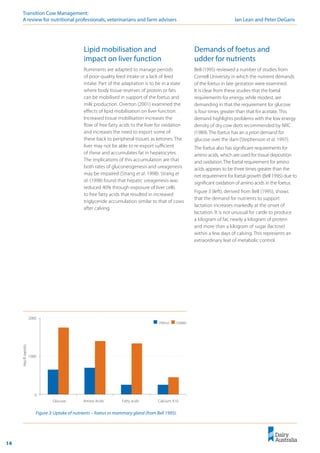
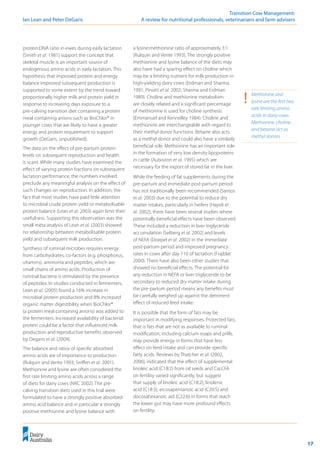
Figure 3: Uptake of nutrients – foetus vs mammary gland (from Bell 1995).
0
1000
2000
Uptake
g/day
Glucose Amino Acids Fatty acids Calcium X10
Uterus Udder
Demands of foetus and
udder for nutrients
Bell (1995) reviewed a number of studies from
Cornell University in which the nutrient demands
of the foetus in late gestation were examined.
It is clear from these studies that the foetal
requirements for energy, while modest, are
demanding in that the requirement for glucose
is four times greater than that for acetate. This
demand highlights problems with the low energy
density of dry cow diets recommended by NRC
(1989). The foetus has an a priori demand for
glucose over the dam (Stephenson et al. 1997).
The foetus also has significant requirements for
amino acids, which are used for tissue deposition
and oxidation. The foetal requirement for amino
acids appears to be three times greater than the
net requirement for foetal growth (Bell 1995) due to
significant oxidation of amino acids in the foetus.
Figure 3 (left), derived from Bell (1995), shows
that the demand for nutrients to support
lactation increases markedly at the onset of
lactation. It is not unusual for cattle to produce
a kilogram of fat, nearly a kilogram of protein
and more than a kilogram of sugar (lactose)
within a few days of calving. This represents an
extraordinary feat of metabolic control.
15
	 Transition Cow Management:
Ian Lean and Peter DeGaris 	 A review for nutritional professionals, veterinarians and farm advisers
As discussed in Section 1, a diet that provides
the transition cow with all the nutritional
components necessary to support these
intricately linked metabolic processes:
•	 rumen function;
•	 calcium and bone metabolism;
•	 energy metabolism;
•	 protein metabolism; and
•	 immune function.
as she adapts to lactation will have substantial
health and productivity benefits.
Components of an integrated transition diet to
consider are:
•	 energy and protein;
•	 macrominerals and DCAD;
•	 microminerals;
•	 rumen modifiers; and
•	 buffers and other possible additives.
Energy and protein
The demands for amino acids and glucose by
the feto-placental unit, and amino acids,
glucose and fatty acids by the mammary gland
particularly during stage two lactogenesis
(Bell 1995; Tucker 1985) combine with a lowered
potential DM intake immediately before calving
(Marquardt et al. 1977) to place the cow at great
risk of mobilising significant amounts of body
fat and protein.
Estimated energy balance after calving improves
with increasing the energy density of the pre-
calving ration (Grum et al. 1996; Holcomb et al.
2001; Minor et al. 1998). These improvements
have been associated with trends towards
increased milk production, lowered milk fat
percentage and significant increases in protein
percentage and yield (Minor et al. 1998). The
effect of increased energy density of the pre-
calving diet, in particular increased fermentable
carbohydrate concentration, may in part be
mediated through increased development of
rumen papillae in response to increased VFA
production (Dirksen et al. 1985). The increased
absorptive capacity of the rumen may have
reduced the risk of VFA accumulation, depression
of rumen pH and subsequent risk of sub-acute
ruminal acidosis (SARA) and lactic acidosis in
response to the feeding of high concentrate diets
after calving (see Table 3 for more information
about SARA and lactic acidosis). For every herd
with clinical acidosis present, Bramley et al. (2008)
found 10 herds with a very high prevalence of
subclinical acidosis. For a full review of acidosis
see Lean et al. (2007).
Because adaptation and development of rumen
papillae takes between three and six weeks
(Kauffold et al. 1975; Dirksen et al. 1985), the
benefit of increasing exposure to a pre-partum
diet high in fermentable carbohydrate (i.e.
starches and sugars) is likely to be curvilinear.
There are also likely to be benefits associated
with the pre-calving adaptation of the rumen
microflora to post-calving diets high in
concentrates (Curtis et al. 1985).
Section 3
Components of an
integrated transition diet
16
Transition Cow Management: 	
A review for nutritional professionals, veterinarians and farm advisers	 Ian Lean and Peter DeGaris
Zhu et al. (2000) found that ammonia
concentrations in blood doubled during the
first two days after calving, when cows were
fed a 21% CP diet after calving. For the pasture-
based dairy production systems, these changes
may have significant implications given the
propensity not to feed cows well in the transition
period and the very high pasture protein
concentrations in late winter and early spring.
Studies investigating optimal concentrations of
dietary protein in pre-partum diets have focused
on crude protein content (Greenfield et al. 2000;
Huyler et al. 1999; Putnam and Varga 1998;
Putnam et al. 1999), rumen degradable or rumen
undegradable fractions in the diet (Greenfield
et al. 2000; Huyler et al. 1999; Putnam et al. 1999;
Wu et al. 1997), but have not considered in depth
potential for ruminal microbial protein synthesis
nor metabolisable protein balance.
It has been suggested that by increasing
pre-partum protein body tissue reserves, the
transition cow will be better able to utilise these
reserves after calving to support lactation and
minimise metabolic disorders (Grummer 1995;
van Saun 1991), an effect possibly mediated
through increased labile protein reserves.
However, a meta-analysis of the few data
available from which to evaluate estimated
pre-partum metabolisable protein balance and
subsequent milk yields found no significant
relationship (Lean et al. 2003).
Nonetheless, pre-calving diets with positive
metabolisable protein and metabolisable
energy balances are attributes that may increase
subsequent milk production by providing
adequate substrate for foetal and mammary
development. Similarly, increased BCS at calving,
reflecting improved body tissue reserves, has
increased subsequent milk production (Boisclair
et al. 1986; Gainsworthy and Topps 1982).
Body condition score at calving is a major
determinant of the calving to first estrus interval,
with cows in higher body condition displaying
estrus earlier (Garnsworthy and Topps 1982).
Westwood et al. (2002) identified a number
of factors that significantly influenced the
display of oestrus at first and second ovulation,
and therefore the herd’s submission rate and
in-calf rate. Higher body weight of cattle
before calving and post calving appetite were
significant factors that increased oestrus display.
Measures of metabolites in blood that reflected
a better energy balance, including cholesterol
concentrations and the ratio of glucose:
3-hydroxybutyrate were also associated with
greater display of oestrus at ovulation.
The importance of mobilised tissue protein as a
source of amino acids for mammary metabolism
and gluconeogenesis may be small over the
period from calving to peak lactation (Bauman
and Elliot 1983) but may be important in the first
one to two weeks immediately after calving
(Reid et al. 1980), and decline in muscle
!	 Cows in higher
body condition
at calving have
better reproductive
performance.
Condition Clinical signs Control measures
Sub-acute ruminal acidosis
(SARA):
Is the accumulation of total
VFAs in the rumen, especially
propionate.
Rumen pH: 6 to 5.5
Some cattle off feed, some evidence of
lameness, reduced fibre digestion, mild
milk fat depression, often good to excellent
production, scouring can be present
Look especially for evenness of access to pasture and
other forages. Chop length of silage or hays should be
more than 2.5cm.
Check that very soluble sources of carbohydrate eg
sugars are not in excess, nor feeds high in lactic acid eg
wheys, corn silages esp corn earlage
Lactic acidosis:
Is the accumulation of
lactate, a strong acid.
Rumen pH < 5.5
Acutely sick cattle with rumens with low pH,
off feed, low milk fat, high prevalence (more
than 10% of cows) with lameness score >2,
cattle die with liver or lung abscess, often see
large amounts of unconsumed grain in bails,
many cows scouring and scour contains
large amounts of grain and bubbles, many
cows not eating.
Increase the effective fibre in the diet. This may involve
reducing the amount of concentrate, slowing the pasture
rotation, and feeding palatable fibre in the form of silage
or hay.
Consider using rumen buffers or modifiers.
Ensure even access to forage so that all cows get fibre.
Introduce grain and concentrates before calving.
Table 3: Sub-acute ruminal acidosis (SARA) and lactic acidosis.
!	 If the transition diet
consists of pasture /
cereal hay / grain /
concentrate there will
probably be a need
to supplement with
additional protein meal
(with the exception of
BioChlor® and maybe
SoyChlor®-based
concentrate). Similarly,
if a reasonable amount
of protein meal is
being fed to cows after
calving, it should also
be provided in the
pre-calving diet.
17
	 Transition Cow Management:
Ian Lean and Peter DeGaris 	 A review for nutritional professionals, veterinarians and farm advisers
protein:DNA ratio in ewes during early lactation
(Smith et al. 1981) support the concept that
skeletal muscle is an important source of
endogenous amino acids in early lactation. This
hypothesis that improved protein and energy
balance improved subsequent production is
supported to some extent by the trend toward
proportionally higher milk and protein yield in
response to increasing days exposure to a
pre-calving transition diet containing a protein
meal containing anions such as BioChlor® in
younger cows that are likely to have a greater
energy and protein requirement to support
growth (DeGaris, unpublished).
The data on the effect of pre-partum protein
levels on subsequent reproduction and health
is scant. While many studies have examined the
effect of varying protein fractions on subsequent
lactation performance, the numbers involved
preclude any meaningful analysis on the effect of
such changes on reproduction. In addition, the
fact that most studies have paid little attention
to microbial crude protein yield or metabolisable
protein balance (Lean et al. 2003) again limit their
usefulness. Supporting this observation was the
small meta analysis of Lean et al. (2003) showed
no relationship between metabolisable protein
yield and subsequent milk production.
Synthesis of ruminal microbes requires energy
from carbohydrates, co-factors (e.g. phosphorus,
vitamins), ammonia and peptides, which are
small chains of amino acids. Production of
ruminal bacteria is stimulated by the presence
of peptides. In studies conducted in fermenters,
Lean et al. (2005) found a 16% increase in
microbial protein production and 8% increased
organic matter digestibility when BioChlor®
(a protein meal containing anions) was added to
the fermenters. Increased availability of bacterial
protein could be a factor that influenced milk
production and reproductive benefits observed
by Degaris et al. (2009).
The balance and ratios of specific absorbed
amino acids are of importance to production
(Rulquin and Verite 1993; Sniffen et al. 2001).
Methionine and lysine are often considered the
first rate limiting amino acids across a range
of diets for dairy cows (NRC 2002). The pre-
calving transition diets used in this trial were
formulated to have a strongly positive absorbed
amino acid balance and in particular a strongly
positive methionine and lysine balance with
a lysine:methionine ratio of approximately 3:1
(Rulquin and Verite 1993). The strongly positive
methionine and lysine balance of the diets may
also have had a sparing effect on choline which
may be a limiting nutrient for milk production in
high-yielding dairy cows (Erdman and Sharma
1991; Pinotti et al. 2002; Sharma and Erdman
1989). Choline and methionine metabolism
are closely related and a significant percentage
of methionine is used for choline synthesis
(Emmanuel and Kennelley 1984). Choline and
methionine are interchangeable with regard to
their methyl donor functions. Betaine also acts
as a methyl donor and could also have a similarly
beneficial role. Methionine has an important role
in the formation of very low density lipoproteins
in cattle (Auboiron et al. 1995) which are
necessary for the export of stored fat in the liver.
While the feeding of fat supplements during the
pre-partum and immediate post-partum period
has not traditionally been recommended (Santos
et al. 2003) due to the potential to reduce dry
matter intakes, particularly in heifers (Hayirli et
al. 2002), there have been several studies where
potentially beneficial effects have been observed.
These included a reduction in liver triglyceride
accumulation (Selberg et al. 2002) and levels
of NEFA (Doepel et al. 2002) in the immediate
post-partum period and improved pregnancy
rates in cows after day 110 of lactation (Frajblat
2000). There have also been other studies that
showed no beneficial effects. The potential for
any reduction in NEFA or liver triglyceride to be
secondary to reduced dry matter intake during
the pre-partum period means any benefits must
be carefully weighed up against the detriment
effect of reduced feed intake.
It is possible that the form of fats may be
important in modifying responses. Protected fats,
that is fats that are not as available to ruminal
modification, including calcium soaps and prills,
may provide energy in forms that have less
effect on feed intake and can provide specific
fatty acids. Reviews by Thatcher et al. (2002,
2006), indicated that the effect of supplemental
linoleic acid (C18:2) from oil seeds and CaLCFA
on fertility varied significantly, but suggest
that supply of linoleic acid (C18:2), linolenic
acid (C18:3), eicosapentanoic acid (C20:5) and
docosahexanoic aid (C22:6) in forms that reach
the lower gut may have more profound effects
on fertility.
!	 Methionine and
lysine are the first two
rate limiting amino
acids in dairy cows.
Methionine, choline
and betaine act as
methyl donors.
18
Transition Cow Management: 	
A review for nutritional professionals, veterinarians and farm advisers	 Ian Lean and Peter DeGaris
Macrominerals and Dietary
Cation Anion Difference
The historic focus of milk fever prevention was
on calcium intake. Gradually, understandings
have emerged that calcium intake alone does
not determine milk fever risk. In Section 4, the
roles of macromineral nutrition are addressed,
in particular the important roles of calcium,
magnesium, phosphorus and dietary cation
anion difference (DCAD) as determined by
potassium, sodium, chloride and sulphur
concentrations are evaluated.
Microminerals
Although trace mineral nutrition in dairy cattle is
of importance and many trace minerals improve
immune function (Gaylean et al. 1999), the
capacity interactions with other dietary inputs
and variation in individual animal requirements
means that despite extensive study, there are still
many areas that require clarification (Lean 1987).
Of recent interest is the area of chromium
metabolism (Cr). Chromium is an active
component of glucose tolerance factor and
may have an effect through increasing insulin
sensitivity of certain tissues. While the results from
studies examining Cr supplementation in dairy
and beef cattle as well as sheep are inconsistent,
dietary supplementation of Cr during times of
stress may be of benefit. It has been proposed that
Cr supplementation during the pre-calving period
may reduce insulin resistance and subsequently
decrease plasma NEFA, liver triglyceride levels
and improve glucose tolerance, which may result
in improved productivity in the post-calving
period (Hayirli et al. 2001). Positive metabolic and
production responses have been demonstrated
in response to Cr supplementation pre-calving
(Hayirli et al. 2001).
Rumen modifiers
Rumen modifiers act directly on rumen microbes,
altering the balance between the different
populations and the proportions of the volatile
fatty acids (VFAs) they produce. As such, they
play a part in adapting the rumen. Ionophore
rumen modifiers include sodium monensin and
lasalocid. Antibiotic rumen modifiers include
virginiamycin and tylosin.
!	 Chromium may
provide metabolic and
production benefits
by helping to increase
insulin sensitivity of
tissues.
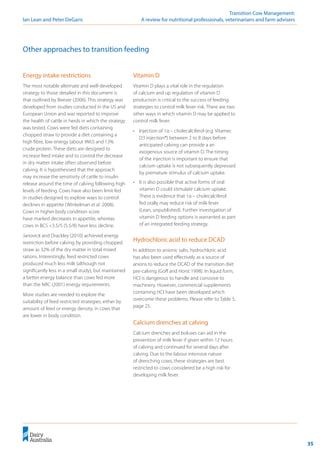
The effects of sodium monensin, e.g. Rumensin,®
are primarily increased ruminal propionate
balance, reflecting an increase in propionate
producing bacteria compared to those
producing formate, acetate, lactate and butyrate.
There is a concomitant decrease in methane
production and a sparing effect on ruminal
protein digestion (Bergen and Bates 1984;
Richardson et al. 1976; Russell and Strobel 1989;
Van Nevel and Demeyer 1977).
When administered to dairy cows pre-calving
and continued through early lactation, sodium
monensin improved indicators of energy balance
both pre- (Duffield et al. 2003; Stephenson et
al. 1997) and post-partum (Duffield et al. 1998;
Green et al. 1999), with significant increases
in subsequent milk yield (Beckett et al. 1998;
Duffield et al. 1999a). However, when the effect
of monensin fed pre-partum is isolated from
that of post-partum treatment there appears to
be minimal improvements in milk yield, fat and
protein percentages or yields (Juchem et al. 2004;
Vallimont et al. 2001). No studies have examined
the effect of duration of exposure of the pre-
partum cow to monensin on either measures
of energy balance, production or disease
prevalence.
Virginiamycin,* e.g. Eskalin,® reduces lactic
acid production in vitro (Nagaraja et al. 1987)
and the potential for lactic acid accumulation
in vivo (Clayton et al. 1999). These effects are
probably meditated through selective inhibition
of Lactobacillus spp. and Streptococcus bovis.
There is a potential for lactic acid accumulation
when there is an abrupt increase in concentrate
feeding, as often occurs around calving.
Tylosin, e.g. Tylan,® has also been demonstrated
to reduce lactic acid production in vitro
(Nagaraja et al. 1987) and to control liver abscess
in feed lot cattle, a likely sequelae of lactic
acidosis (Nagaraja and Chengappa 1998). In dairy
cattle, tylosin reduced ruminal accumulation
of both D and L-lactate (Lean et al. 2000) and in
combination with sodium monensin; tylosin was
equivalent to virginiamycin in reducing lactic
acid production in vitro (Nagaraja et al. 1987).
In vivo, monensin and tylosin in combination
significantly increased total ruminal volatile fatty
acid production (Lean et al. 2000).
!	 If a rumen modifier is
used in the lactation
diet, the same rumen
modifier should be
used in the transition
diet pre-calving.
*	 Virginiamycin is only
available with a medicated
feed order provided by a
veterinarian.
19
	 Transition Cow Management:
Ian Lean and Peter DeGaris 	 A review for nutritional professionals, veterinarians and farm advisers
Buffers and other
possible additives
Controlling the risk of acidosis is critical, but
buffering using sodium bicarbonate is contra-
indicated because of the very high DCAD of the
buffer. It is possible to use magnesium oxide to
supply magnesium and to act as a neutralising
agent. Low DCAD buffering agents may also
have a role.
One buffer available in Australia is derived from
red seaweed (Acid Buf®). The inclusion rate of this
product is around 40-80g/cow/day for transition
period cows and it has demonstrated buffering
capacity between pH 5-7. The DCAD of this
product is close to neutral so it can be safely
used in a transition ration. This product is 30%
calcium and 6% magnesium.
Most critically, it is generally unnecessary to
have a diet high in risk for acidosis provided
before calving. The buffers including sodium
bicarbonate are suitable to be fed after calving.
The rumen modifiers are fed before calving to
gain specific benefits on metabolism,
e.g. monensin, or to adapt the cow to these
before feeding rates of grains increase after
calving, e.g. virginiamycin or tylosin.
Perennial ryegrasses may be high in the
endophyte alkaloids ergovaline and lolitreme
(and others). The presence of these alkaloids
at elevated levels may have extensive effects
on production, reproduction and health of
dairy cattle (Lean 2005). While no studies have
examined the effect of these alkaloids on cattle
when fed specifically during the transition
period, there are many potential pathways
whereby a negative effect on subsequent
productivity may be exerted. Random surveys of
pastures in south-west Victoria has demonstrated
levels of alkaloids in excess of those required to
cause disease in cattle in approximately 30% of
samples (Reed 2005).
Of the many other mycotoxins that exist,
zearalenone has recently gained some notoriety.
Zearalenone has been demonstrated to have
serious effects on the fertility of sheep in
New Zealand (di Menna et al. 1987). Similar
observations have been made in Australia
(D. Moore – personal communication) and the
effect of zearalenone and other mycotoxins
Nutrient Total diet analysis (dry matter basis)
Far-off dry cows
(More than
four weeks
pre-calving)
Transition cows
(Last four weeks
pre-calving)
Fresh cows
(first four
weeks
post-calving)
Neutral Detergent Fibre
% (NDF)
> 36% >36% >32%
Physically effective NDF % 30% 25-30% >19%
Crude protein (CP) % >12% 14-16% 16-19%
Degradability of CP 80% 65-70% 65-70%
Metabolisable energy
intake per day (MJ)
90-100 100-120 160
Estimated energy density
(MJ ME / kg DM)
10 (9)* 11 11.5-12
Starch % Up to 18% 18-22 22-24
Sugar % Up to 4% 4-6 6-8
Fat % 3% 4-5% 4-5%
Calcium % 0.4% 0.4 to 0.6% 0.8 to 1.0%
Phosphorus % 0.25% 0.25 to 0.4% 0.4%
Magnesium % 0.3% 0.45% 0.3%
DCAD^ Meq/kg <150 <80 >250
Selenium mg/kg 0.3 0.3 0.3
Copper mg/kg 10 15 20
Cobalt mg/kg 0.11 0.11 0.11
Zinc mg/kg 40 48 48
Manganese mg/kg 12 15 15
Iodine mg/kg 0.6 0.6 0.6
Vitamin A iu/g 2000 3200 3200
Vitamin D iu/g 1000 # 1000
Vitamin E iu/g 15 30# 15
*Energy content that is desirable will vary with body condition
^ See Section 4 for details
# Vitamin D and E concentrations in the transition period are yet to be determined. Vitamin D
inputs, in particular, will be determined by new understandings of the use of this vitamin to
prevent milk fever.
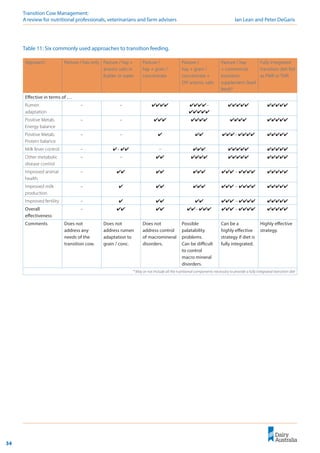
Table 4: Recommendations for far-off, transition and fresh cow diets.
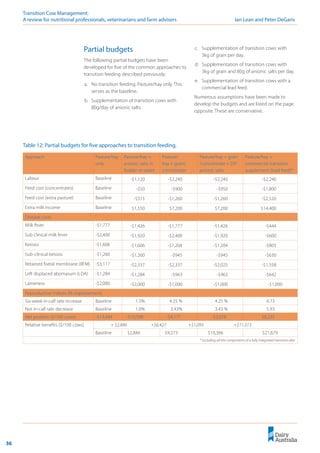
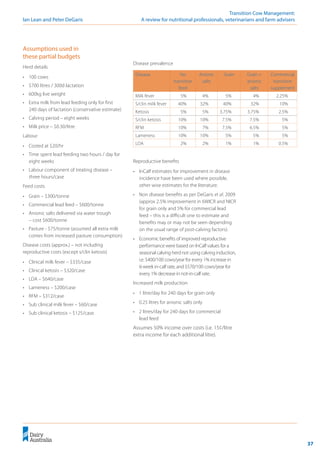
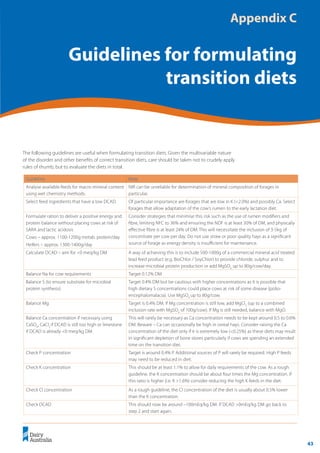
Table 4 provides nutritional recommendations for an fully integrated transition
diet pre-calving, in addition to recommendations for the preceeding far-off
dry cow diet and the subsequent fresh cow diet fed after calving.
on animal health may have been substantially
underestimated in the past.
Effective mycotoxins binders are readily available
and may be an important component of the
pre-calving diet in some specific circumstances.
However, documented evidence of the
effectiveness of some products ability to bind
specific mycotoxins is lacking.
20
Transition Cow Management: 	
A review for nutritional professionals, veterinarians and farm advisers	 Ian Lean and Peter DeGaris
21
	 Transition Cow Management:
Ian Lean and Peter DeGaris 	 A review for nutritional professionals, veterinarians and farm advisers
Milk fever – a gateway disease
Milk fever risk is predicated from dietary levels of
calcium, magnesium, phosphorus and DCAD, age
and breed of cattle, and duration of exposure to
the pre-calving transition diet. Ignoring any of
these areas could lead to poor results.
Milk fever or parturient paresis is a clinical
manifestation of hypocalcaemia, a condition that
affects most cows after calving. Hypocalcaemia
has been arbitrarily defined as a blood
concentration <2.0 mmol/L.
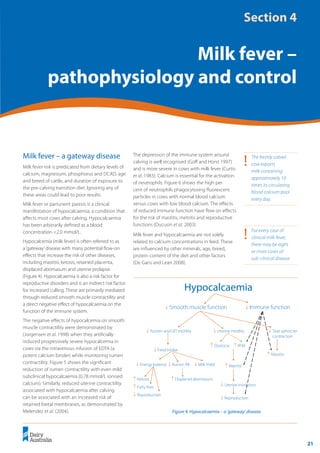
Hypocalcemia (milk fever) is often referred to as
a‘gateway’disease with many potential flow-on
effects that increase the risk of other diseases,
including mastitis, ketosis, retained placenta,
displaced abomasum and uterine prolapse.
(Figure 4). Hypocalcaemia is also a risk factor for
reproductive disorders and is an indirect risk factor
for increased culling. These are primarily mediated
through reduced smooth muscle contractility and
a direct negative effect of hypocalcaemia on the
function of the immune system.
The negative effects of hypocalcemia on smooth
muscle contractility were demonstrated by
(Jorgensen et al. 1998) when they artificially
induced progressively severe hypocalcemia in
cows via the intravenous infusion of EDTA (a
potent calcium binder) while monitoring rumen
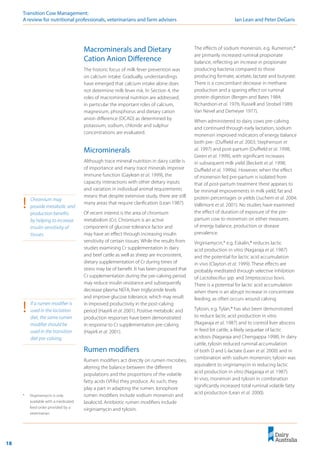
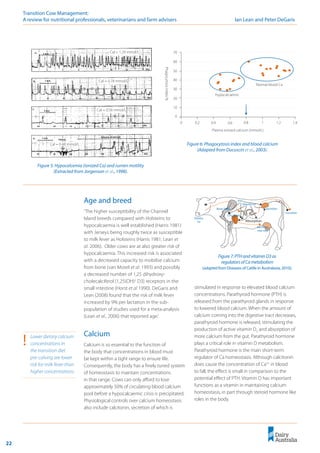
contractility. Figure 5 shows the significant
reduction of rumen contractility with even mild
subclinical hypocalcaemia (0.78 mmol/L ionised
calcium). Similarly, reduced uterine contractility
associated with hypocalcaemia after calving
can be associated with an increased risk of
retained foetal membranes, as demonstrated by
Melendez et al. (2004).
The depression of the immune system around
calving is well recognised (Goff and Horst 1997)
and is more severe in cows with milk fever (Curtis
et al. 1983). Calcium is essential for the activation
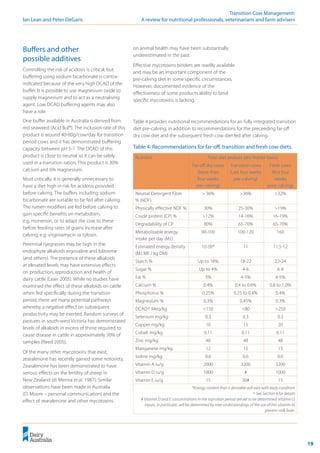
of neutrophils. Figure 6 shows the high per
cent of neutrophils phagocytosing fluorescent
particles in cows with normal blood calcium
versus cows with low blood calcium. The effects
of reduced immune function have flow on effects
for the risk of mastitis, metritis and reproductive
functions (Ducusin et al. 2003).
Milk fever and hypocalcaemia are not solely
related to calcium concentrations in feed. These
are influenced by other minerals, age, breed,
protein content of the diet and other factors
(De Garis and Lean 2008).
!	 The freshly calved
cow exports
milk containing
approximately 10
times its circulating
blood calcium pool
every day.
Section 4
Milk fever –
pathophysiology and control
Figure 4: Hypocalcaemia – a ‘gateway’ disease.
Hypocalcaemia
↓ Smooth muscle function
↓ Rumen and GIT motility
↓ Immune function
↓ Uterine motility ↓ Teat sphincter
contraction
↓ Feed Intake
↓ Energy balance ↓ Rumen fill
↑ Ketosis
↑ Fatty liver
↓ Reproduction
↑ Displaced abomasum
↓ Milk Yield
↑ Dystocia ↑ RFM
↓ Uterine involution
↑ Metritis
↓ Reproduction
↑ Mastitis
!	 For every case of
clinical milk fever,
there may be eight
or more cases of
sub-clinical disease.
22
Transition Cow Management: 	
A review for nutritional professionals, veterinarians and farm advisers	 Ian Lean and Peter DeGaris
Figure 5: Hypocalcemia (ionized Ca) and rumen motility
(Extracted from Jorgenson et al., 1998).
Figure 6: Phagocytosis index and blood calcium
(Adapted from Ducuscin et al., 2003).
Phagocytosis
index
%
Plasma ionized calcium (mmol/L)
Hypocalcaemic
Normal blood Ca
70
60
50
40
30
20
10
0
0 0.2 0.4 0.6 0.8 1 1.2 1.4
▼
Age and breed
‘The higher susceptibility of the Channel
Island breeds compared with Holsteins to
hypocalcaemia is well established (Harris 1981)
with Jerseys being roughly twice as susceptible
to milk fever as Holsteins (Harris 1981; Lean et
al. 2006). Older cows are at also greater risk of
hypocalcaemia. This increased risk is associated
with a decreased capacity to mobilise calcium
from bone (van Mosel et al. 1993) and possibly
a decreased number of 1,25 dihydroxy-
cholecalciferol (1,25(OH)2
D3) receptors in the
small intestine (Horst et al 1990). DeGaris and
Lean (2008) found that the risk of milk fever
increased by 9% per lactation in the sub-
population of studies used for a meta-analysis
(Lean et al., 2006) that reported age.’
Calcium
Calcium is so essential to the function of
the body that concentrations in blood must
be kept within a tight range to ensure life.
Consequently, the body has a finely tuned system
of homeostasis to maintain concentrations
in that range. Cows can only afford to lose
approximately 50% of circulating blood calcium
pool before a hypocalcaemic crisis is precipitated.
Physiological controls over calcium homeostasis
also include calcitonin, secretion of which is
stimulated in response to elevated blood calcium
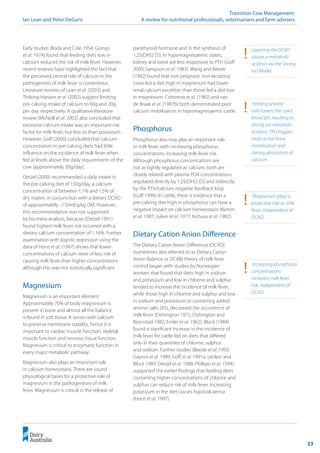
concentrations. Parathyroid hormone (PTH) is
released from the parathyroid glands in response
to lowered blood calcium. When the amount of
calcium coming into the digestive tract decreases,
parathyroid hormone is released, stimulating the
production of active vitamin D3
and absorption of
more calcium from the gut. Parathyroid hormone
plays a critical role in vitamin D metabolism.
Parathyroid hormone is the main short-term
regulator of Ca homeostasis. Although calcitonin
does cause the concentration of Ca2+
in blood
to fall, the effect is small in comparison to the
potential effect of PTH. Vitamin D has important
functions as a vitamin in maintaining calcium
homeostasis, in part through steroid hormone like
roles in the body.
!	 Lower dietary calcium
concentrations in
the transition diet
pre-calving are lower
risk for milk fever than
higher concentrations.
Dietary
Ca
Excretion
into milk
Excretion
Excretion
Absorption
PTH
Vitamin D3
Bone Store
Circulation
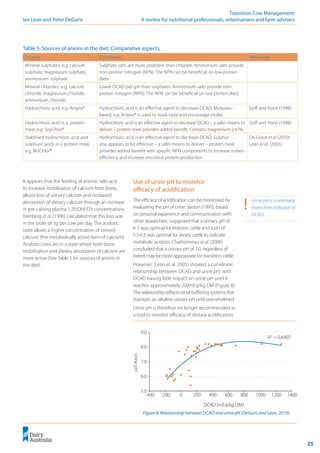
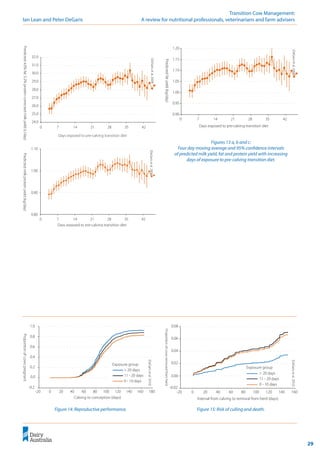
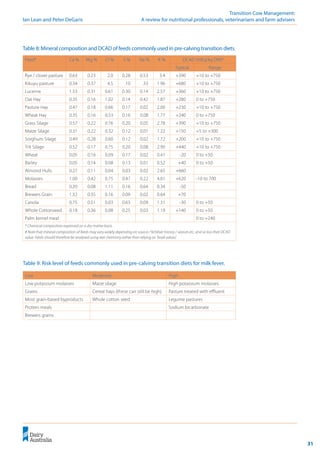
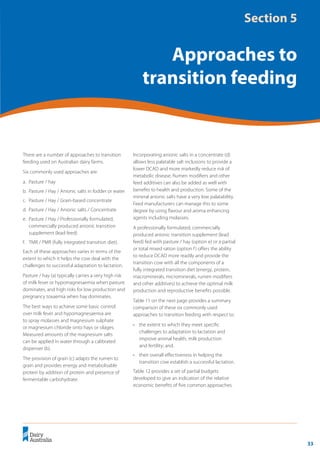
Figure7:PTHandvitaminD3as
regulatorsofCametabolism
(adaptedfromDiseases of Cattle in Australasia, 2010).
Cal = 0.78 mmol/L
Cal = 0.56 mmol/L
Cal = 0.48 mmol/L
Cal = 1.29 mmol/L
23
	 Transition Cow Management:
Ian Lean and Peter DeGaris 	 A review for nutritional professionals, veterinarians and farm advisers
Early studies (Boda and Cole 1954; Goings
et al. 1974) found that feeding diets low in
calcium reduced the risk of milk fever. However,
recent reviews have highlighted the fact that
the perceived central role of calcium in the
pathogenesis of milk fever is contentious.
Literature reviews of Lean et al. (2003) and
Thilsing-Hansen et al. (2002) suggest limiting
pre-calving intake of calcium to 60g and 20g
per day, respectively. A qualitative literature
review (McNeill et al. 2002) also concluded that
excessive calcium intake was an important risk
factor for milk fever, but less so than potassium.
However, Goff (2000) concluded that calcium
concentration in pre-calving diets had little
influence on the incidence of milk fever when
fed at levels above the daily requirements of the
cow (approximately 30g/day).
Oetzel (2000) recommended a daily intake in
the pre-calving diet of 150g/day, a calcium
concentration of between 1.1% and 1.5% of
dry matter, in conjunction with a dietary DCAD
of approximately –150mEq/kg DM. However,
this recommendation was not supported
by his meta-analysis, because (Oetzel 1991)
found highest milk fever risk occurred with a
dietary calcium concentration of 1.16%. Further
examination with logistic regression using the
data of Horst et al. (1997) shows that lower
concentrations of calcium were of less risk of
causing milk fever than higher concentrations
although this was not statistically significant.
Magnesium
Magnesium is an important element.
Approximately 70% of body magnesium is
present in bone and almost all the balance
is found in soft tissue. It serves with calcium
to preserve membrane stability, hence it is
important to cardiac muscle function, skeletal
muscle function and nervous tissue function.
Magnesium is critical to enzymatic function in
every major metabolic pathway.
Magnesium also plays an important role
in calcium homeostasis. There are sound
physiological bases for a protective role of
magnesium in the pathogeneses of milk
fever. Magnesium is critical in the release of
parathyroid hormone and in the synthesis of
1,25(OH)2 D3. In hypomagnesaemic states,
kidney and bone are less responsive to PTH (Goff
2000; Sampson et al. 1983). Wang and Beede
(1992) found that non-pregnant, non-lactating
cows fed a diet high in magnesium had lower
renal calcium excretion than those fed a diet low
in magnesium. Contreras et al. (1982) and van
de Braak et al. (1987b) both demonstrated poor
calcium mobilisation in hypomagnesaemic cattle.
Phosphorus
Phosphorus also may play an important role
in milk fever, with increasing phosphorus
concentrations increasing milk fever risk.
Although phosphorus concentrations are
not as tightly regulated as calcium, both are
closely related with plasma PO4 concentrations
regulated directly by 1,25(OH)2 D3 and indirectly
by the PTH/calcium negative feedback loop
(Goff 1999). In cattle, there is evidence that a
pre-calving diet high in phosphorus can have a
negative impact on calcium homeostasis (Barton
et al. 1987; Julien et al. 1977; Kichura et al. 1982).
Dietary Cation Anion Difference
The Dietary Cation Anion Difference (DCAD)
(sometimes also referred to as Dietary Cation
Anion Balance or DCAB) theory of milk fever
control began with studies by Norwegian
workers that found that diets high in sodium
and potassium and low in chlorine and sulphur
tended to increase the incidence of milk fever,
while those high in chlorine and sulphur and low
in sodium and potassium or containing added
anionic salts (AS), decreased the occurrence of
milk fever (Dishington 1975; Dishington and
Bjornstad 1982; Ender et al. 1962). Block (1984)
found a significant increase in the incidence of
milk fever for cattle fed on diets that differed
only in their quantities of chlorine, sulphur
and sodium. Further studies (Beede et al. 1992;
Gaynor et al. 1989; Goff et al. 1991a; Leclerc and
Block 1989; Oetzel et al. 1988; Phillipo et al. 1994)
supported the earlier findings that feeding diets
containing higher concentrations of chlorine and
sulphur can reduce risk of milk fever. Increasing
potassium in the diet causes hypocalcaemia
(Horst et al. 1997).
!	 Magnesium plays a
protective role re. milk
fever, independent of
DCAD.
!	 Increasing phosphorus
concentrations
increases milk fever
risk, independent of
DCAD.
!	 Feeding anionic
salts lowers the cow’s
blood pH, resulting in
strong ion metabolic
acidosis. This triggers
more active bone
mobilisation and
dietary absorption of
calcium.
!	 Lowering the DCAD
causes a metabolic
acidosis via the Strong
Ion Model.
24
Transition Cow Management: 	
A review for nutritional professionals, veterinarians and farm advisers	 Ian Lean and Peter DeGaris
Physiology of DCAD theory
of milk fever control
The underlying physiology of the DCAD theory of
milk fever control has its basis in the Strong Ion
Model of acid/base balance (Singer and Hastings
1948), modified by Stewart (1981) and simplified
by Constable (1997). The basic tenets of the
Simplified Strong Ion Model are that plasma pH
is determined by four independent factors; the
partial pressure of CO2
(PCO2
); solubility of CO2
in
plasma (S) which is temperature dependent; the
net strong ion charge or strong ion difference
([SID+
]) and the total plasma concentration of
non-volatile weak buffers, principally albumin,
globulin and phosphate ([ATOT
]). The major strong
ions consist of cations (Na+
, K+
, Mg2+,
Ca2+
and
NH4
+
) and anions (Cl-
and S04
2-
).
The Simplified Strong Ion Model predicts that
plasma pH can be lowered by:
•	 increasing the temperature thereby increasing
solubility of CO2
in plasma (S);
•	 increasing PCO2
(respiratory acidosis);
•	 decreasing [ATOT
]; and
•	 decreasing [SID+
].
Application of DCAD theory to prevent milk fever
aims to reduce the [SID+], consequently lowering
plasma pH, resulting in strong ion metabolic
acidosis. This is can be achieved by feeding salts
of the strong cations (CaCl2
, CaSO4
, MgCl2
, MgSO4
,
NH4
Cl and (NH4
)2SO4
) or acids of the anions (HCl
and H2
SO4
) (See Table 7). The strong cations Ca2+
,
Mg2+
and NH4+
are absorbed to a lesser extent
from the GIT than are the strong anions Cl-
and
SO4
2-
. This results in a relative excess of absorbed
anions compared to absorbed cations lowering
the [SID+
] and subsequently plasma pH. Salt
(NaCl) and KCl have a net effect of zero on the
[SID+
], because Na+
and K+
are absorbed with
near 100% efficiency in the intestine.
A number of possible means by which risk of
milk fever may be influenced by feeding greater
concentration of the salts of the strong cations
(anionic salts) have been identified:
1.	 Diets high in anionic salts cause metabolic
acidosis in goats (Fredeen et al. 1988a;
Fredeen et al. 1988b) and cattle (Gaynor et al.
1989), these observations being consistent
with the Simplified Strong Ion Model.
2.	 Diets high in anionic salts stimulate a calciuria
(Gaynor et al. 1989; Lomba et al. 1978; Oetzel
et al. 1991; Phillipo et al. 1994).
3.	 Elevated hydroxyproline concentrations have
been observed in cows fed anionic salts (Block
1984; Gaynor et al. 1989), probably indicating
bone mobilisation.
4.	 Plasma ionised calcium concentrations
increase with feeding of anionic salts (Oetzel
et al. 1991; Phillipo et al. 1994).
5.	 Diets high in anionic salts stimulate higher
plasma levels of 1,25(OH)2D3 before calving
(Gaynor et al. 1989; Phillipo et al. 1994).
Calciuria can be induced by acute acidosis
in a number of species. Metabolic acidosis
increases mobilisation of calcium from rat liver
mitochondria (Akerman 1978) and mobilisation
of calcium from bone, independent of, and in
conjunction with, PTH (Beck and Webster 1976).
The Simplified Strong Ion Model
The Simplified Strong Ion Model (Constable (1999) to predict plasma pH is:
pH = pK1
´+ log
pK1
´ is the ion product of water,
Ka
is the effective equilibrium disassociation constant for plasma non-volatile weak acids,
[SID+
] is the strong ion difference, [ATOT
] is the plasma non-volatile weak acid concentration,
S is the solubility of CO2
in plasma and
pCO2
is the partial pressure of CO2
in plasma.
2
*
)
1
0
/
(
]
[
]
[
C
O
p
H
a
TOT
a
p
S
K
A
K
SID �
+
+
�
S*Pco2
25
	 Transition Cow Management:
Ian Lean and Peter DeGaris 	 A review for nutritional professionals, veterinarians and farm advisers
Figure 8: Relationship between DCAD and urine pH (DeGaris and Lean, 2010).
!	 Urine pH is a relatively
insensitive indicator of
DCAD.
R2
= 0.6407
5.0
6.0
7.0
8.0
9.0
-400 -200 0 200 400 600 800 1000 1200 1400
DCAD (mEq/kg DM)
Urine
pH
Sources Comments References
Mineral sulphates, e.g. calcium
sulphate, magnesium sulphate,
ammonium sulphate
Sulphate salts are more palatable than chloride. Ammonium salts provide
non-protein nitrogen (NPN). The NPN can be beneficial on low protein
diets.
Mineral chlorides, e.g. calcium
chloride, magnesium chloride,
ammonium chloride
Lower DCAD per gm than sulphates. Ammonium salts provide non-
protein nitrogen (NPN). The NPN can be beneficial on low protein diets.
Hydrochloric acid, e.g. Anipro® Hydrochloric acid is an effective agent to decrease DCAD. Molasses-
based, e.g. Anipro® is used to mask taste and encourage intake.
Goff and Horst (1998)
Hydrochloric acid in a protein
meal, e.g. SoyChlor®
Hydrochloric acid is an effective agent to decrease DCAD – a safer means to
deliver – protein meal provides added benefit. Contains magnesium 2.47%.
Goff and Horst (1998)
Stabilised hydrochloric acid and
sulphuric acids in a protein meal,
e.g. BioChlor®
Hydrochloric acid is an effective agent to decrease DCAD. Sulphur
also appears to be effective – a safer means to deliver – protein meal
provides added benefit with specific NPN components to increase rumen
efficiency and increase microbial protein production
De Groot et al (2010)
Lean et al. (2005)
It appears that the feeding of anionic salts acts
to increase mobilisation of calcium from bone,
allows loss of urinary calcium and increased
absorption of dietary calcium through an increase
in pre-calving plasma 1,25(OH)2
D3 concentrations.
Ramberg et al. (1996) calculated that this loss was
in the order of 3g per cow per day. The acidotic
state allows a higher concentration of ionised
calcium (the metabolically active form of calcium).
Acidotic cows are in a state where both bone
mobilisation and dietary absorption of calcium are
more active (See Table 5 for sources of anions in
the diet).
Use of urine pH to monitor
efficacy of acidification
The efficacy of acidification can be monitored by
evaluating the pH of urine. Jardon (1995), based
on personal experience and communication with
other researchers, suggested that a urinary pH of
6-7 was optimal for Holstein cattle and a pH of
5.5-6.5 was optimal for Jersey cattle to indicate
metabolic acidosis. Charbonneau et al. (2006)
concluded that a urinary pH of 7.0, regardless of
breed, may be more appropriate for transition cattle.
However, (Lean et al. 2005) showed a curvilinear
relationship between DCAD and urine pH, with
DCAD having little impact on urine pH until it
reaches approximately 200mEq/kg DM (Figure 8).
This relationship reflects renal buffering systems that
maintain an alkaline urinary pH until overwhelmed.
Urine pH is therefore no longer recommended as
a tool to monitor efficacy of dietary acidification.
Table 5: Sources of anions in the diet: Comparative aspects.
26
Transition Cow Management: 	
A review for nutritional professionals, veterinarians and farm advisers	 Ian Lean and Peter DeGaris
DCAD equations
Many equations have been proposed for
calculating the DCAD of rations. The variations
of the DCAD equations are generally broken into
short equations that contain only Na+
, K+
, Cl-
and
S2-
and longer equations that contain also Ca2+
,
Mg2+
and phosphorus in varying combinations
and with differing coefficients.
Two significant meta-analyses of milk fever
risk were conducted by Oetzel (1991) and
Enevoldson (1993). Both Enevoldson (1993)
and Oetzel (1991) used fixed effects models
for predicting outcomes and it is now widely
accepted that these models are vulnerable
to over-dispersion associated with clustering
of effects in trials. Random effects models are
preferred for such analyses. There are a large
number of new studies that could be added to
the original data of Oetzel (1991) to increase the
statistical power of a new meta-analysis.
The review and meta-analysis of Lean et al.
(2006) developed two statistically significant and
biologically plausible equations for predicting
the milk fever risk based on pre-calving
dietary constituents. The authors preferred the
equation whereby the risk of milk fever could
be predicated from the dietary levels of calcium,
magnesium, phosphorus, DCAD as calculated
by (Na+
+ K+
) – (Cl-
+ S2-
), breed and duration of
exposure to the diet [-5.76 + 5.48 (Ca) –5.05 (Mg)
+ 1.85 (P) +0.02 (DCAD) – 2.03 (Ca2) + 0.03 (Days
of Exposure)].
!	 In pasture-
based feeding
systems, calcium
concentrations in the
total diet below 0.6%
(DM basis) have the
lowest milk fever risk.
Another meta-analysis examining DCAD only
(Charbonneau et al. 2006) determined the most
appropriate form of the DCAD equation was (Na+
+ K+
) – (Cl-
+ 0.6 S2-
) on the basis that this equation
could be used to predict both milk fever risk and
urine pH. However, the equation Na+
+ K+
) – (Cl-
+
S2-
) was equivalent in predicting milk fever risk
(Charbonneau et al. 2006).
Consequently, based on the Simplified Strong
Ion Model and the meta-analyses of Lean et
al. (2005) and Charbonneau et al. (2006), we
conclude that the equation DCAD = Na+
+ K+
) –
(Cl-
+ S2-
) should be used to predict the effect of a
diet on the risk of milk fever.
Importantly, this linear relationship between
DCAD and milk fever risk (Lean et al. 2005)
predicts that any reduction in the DCAD will
decrease the risk of milk fever (Figure 9).
The aim of DCAD manipulation of pre-calving
diets must be to reduce milk fever risk and not
necessarily manipulate blood or urine pH. A target
of 0 meq/kg DCAD or less is ideal. However, as
Figure 9 illustrates, any decrease in DCAD results in
an incremental reduction in milk fever risk.
Figure 9: Relationship between DCAD and milk fever risk (Lean et al. 2006).
0.0
1.0
2.0
3.0
4.0
5.0
6.0
7.0
-400 -200 0 200 400 600 800 1000 1200
DCAD (mEq/kg DM)
Milk
fever
incidence
(%)
!	 Any decrease in DCAD
will reduce milk fever
risk, even if 0 mEq/kg is
not achieved.
!	 The most appropriate
DCAD equation to
predict the effect of a
diet is: DCAD =
(Na+
+ K+
) – (Cl-
+ S2-
).
The dairy industry has
asked feed laboratories
to use this equation
and express results in
mEq/kg.
27
	 Transition Cow Management:
Ian Lean and Peter DeGaris 	 A review for nutritional professionals, veterinarians and farm advisers
Figure 10: Effect of calcium on milk fever risk.
Figure 11: Effect of magnesium on milk fever risk.
(DeGaris
2010)
0.0
1.0
2.0
3.0
4.0
0 0.5 1 1.5 2 2.5 3
Ca% of total diet (DM basis)
Milk
fever
incidence
%
(DeGaris
2010)
0
0.4
0.8
1.2
1.6
2
0 0.1 0.2 0.3 0.4 0.5 0.6 0.7 0.8
Mg %of DM
Milk
fever
incidence
(%) !	 Always be sure to
express DCAD in
mEq/kg DM.
!	 Because they
impact on milk fever
independent of DCAD,
calcium, magnesium
and phosphorus
should not be included
in DCAD equations.
Calcium
The quadratic effect of calcium present in both
the models developed by Oetzel (1991) and Lean
et al. (2006) supports a hypothesis that either low
dietary calcium percentage (Boda and Cole 1954;
Goings et al. 1974; Wiggers et al. 1975) or high
dietary calcium percentage (Lomba et al. 1978;
Oetzel et al. 1988) fed pre-calving reduces milk
fever risk.
The effect of low calcium diets on calcium
homeostasis is well established, however, the
process by which very high dietary calcium
concentrations pre-calving may reduce milk
fever risk is unclear. A protective effect of high
dietary calcium was first proposed in the 1930s
(Gould 1933; Mattick and Little 1933) but has
been substantially refuted (Boda 1956; Boda
and Cole 1954; Goings et al. 1974; Wiggers et al.
1975). However, the hypercalciuric effect of low
DCAD diets (Vagnoni and Oetzel 1998; van Mosel
et al. 1993) may lower readily available bone
calcium, hence bone calcium reserves available
for mobilisation after calving. It has been
suggested that feeding higher dietary calcium
concentrations pre-calving may reduce this
effect (Lean et al. 2003). This hypercalcuric effect
may be exacerbated with increased duration of
exposure to a low DCAD diet pre-calving. Longer
exposure to a pre-calving transition diet would,
therefore, increase the incidence of milk fever as
predicted by models developed by Lean et al.
(2006). Although increased urinary calcium loss
on low DCAD diets has been demonstrated (van
Mosel et al. 1993; Vagoni and Oetzel 1998), an
effect of duration of exposure to the low DCAD
diet on milk fever risk has not been established in
trial work.
At present we recommend controlling calcium
concentrations in the diet to around 0.4% to
0.6% before calving.
Equations for predicting DCAD that included
calcium on the cationic side of the equation
appear flawed as the effect predicted by the
meta-analysis (Lean et al. 2006) is a linear increase
in milk fever risk with increasing dietary calcium,
whereas the effect of calcium on milk fever risk is
quadratic (Lean et al. 2005; Oetzel 1991).
Magnesium
Similarly, magnesium, if included on the cationic
side of a DCAD equation, would have a linear
effect of increasing the risk of milk fever. The
opposite effect is observed (Contreras et al.
1982; Goff 2000; Sampson et al. 1983; Wang and
Beede 1992) and is predicted using the equation
developed by Lean et al. (2006). Similarly to Ca,
Mg is not included in the calculation of [SID+
]
(Constable 1999).
The equation developed by Lean et al. (2005)
predicts that the effect of increasing Mg
concentration in the pre-calving diet is a very
substantial decrease in the risk of milk fever.
At present, we recommend a magnesium
concentration in the diet of at least 0.45%
before calving.
28
Transition Cow Management: 	
A review for nutritional professionals, veterinarians and farm advisers	 Ian Lean and Peter DeGaris
Phosphorus
Phosphorus has been considered to contribute
to the anionic side of the DCAD equation, but
high P concentrations have been associated with
increased risk of milk fever (Barton et al. 1987;
Julien et al. 1977; Kichura et al. 1982; Lean et al.
2005; Lean et al. 2003). This is consistent with the
simplified strong ion model of Constable (1999)
that predicts increasing plasma phosphate will
increase [ATOT
] and increase plasma pH.
Length of exposure
Length of exposure to the transition diet pre-
calving was a consistently significant variable
in models developed by Lean et al. (2006) with
this variable and acted to substantially modify
coefficients for calcium and magnesium.
Therefore, it was necessary to include this
variable in models, in contrast to those previously
developed by Oetzel (1991) and Enevoldsen
(1993).
While the optimum time spent on a transition
diet pre-calving for milk fever control has not
been determined, effective urinary acidification
can occur in five to seven days. However,
excessive time spent on low DCAD diets may
increase the risk of milk fever (Lean et al. 2006).
The optimum time spent on a transition diet is
likely to be around 21 days.
A recent Australian study (DeGaris et al. 2009;
DeGaris et al. 2008) examined the effects of
pre-calving transition diets formulated to
deliver a positive metabolisable energy and
protein balance sufficient to meet cow and
foetal requirements; a negative DCAD; a level of
calcium, magnesium and phosphorus suitable
for control of milk fever; a level of micronutrients
sufficient to meet cow and foetal requirements
and deliver antibiotic rumen modifiers to reduce
the risk of ruminal acidosis before and after
calving.
This study demonstrated statistically significant
and economically important increases in milk
and milk protein yield, submission rates and six
and 21 week in-calf rates. It found the maximum
increases in milk yield, milk protein yield and
milk fat yield occurred at 24 days of exposure to
a well-balanced transition diet (Figures 13 a, b
and c). While there were no detrimental effects
of exposures greater than 24 days, there was no
further increase in production.
This study also examined the effects of time
spent on pre-calving transition diets on
reproductive measures and animal health.
Continual improvements in the calving to
conception interval were seen with increasing
time spent on the transition diets (Figure 14),
which would be expected to translate into
improvements in six-week in-calf rate and not-
in-calf rate. Similar benefits were also seen on
the proportion of cows that either died or were
culled from the study herds (Figure 15).
Although the reproductive and health benefits
of feeding a balanced transition diet are likely to
improve with increasing days cows are fed a diet,
the potential negative effect on the risk of milk
fever and the lack of a benefit on production of
feeding cows for more than 24 days pre-calving,
means the recommendation of 21 days on a
transition diet pre-calving is sound. To achieve
this target, very accurate predicted calving dates
are essential. This necessitates early and accurate
pregnancy diagnosis.
From the variables included in the equation used
to predict milk fever, developed by Lean et al.
(2006) and the meta-analysis of Charbonneau
et al. (2006) it is clear that both the DCAD as
calculated by (Na+
+ K+
) – (Cl-
+ S2-
) and macro
mineral concentration, in particular calcium,
magnesium, and phosphorus of the diet are of
great importance in determining the risk of milk
fever, as is time spent on a pre-calving transition
diet and breed of cattle.
Figure 12: Effect of phosphorus on milk fever risk.
(DeGaris
et
al.
2010)
0
1
2
3
4
5
6
0 0.2 0.4 0.6 0.8 1 1.2 1.4 1.6
P %of DM
Milk
fever
incidence
(%)
!	Phosphorus
concentrations should
be controlled before
calving to <0.4%.
!	 The optimal time spent
on a transition diet
pre-calving is likely to
be about 21 days.
29
	 Transition Cow Management:
Ian Lean and Peter DeGaris 	 A review for nutritional professionals, veterinarians and farm advisers
Figures 13 a, b and c:
Four day moving average and 95% confidence intervals
of predicted milk yield, fat and protein yield with increasing
days of exposure to pre-calving transition diet.
Figure 14: Reproductive performance. Figure 15: Risk of culling and death.
24.0
25.0
26.0
27.0
28.0
29.0
30.0
31.0
32.0
0 7 14 21 28 35 42
Days exposed to pre-calving transition diet
Predicted
4.0%
fat
3.2%
protein
corrected
milk
yield
(L/day)
(DeGaris
et
al.
2008)
(DeGaris
et
al.
2008)
0.90
0.95
1.00
1.05
1.10
1.15
1.20
0 7 14 21 28 35 42
Days exposed to pre-calving transition diet
Predicted
fat
yield
(kg/day)
(DeGaris
et
al.
2008)
0.80
0.90
1.00
1.10
0 7 14 21 28 35 42
Days exposed to pre-calving transition diet
Predicted
milk
protein
yield
(kg/day)
Calving to conception (days)
180
160
140
120
100
80
60
40
20
0
-20
Proportion
of
cows
pregnant
1.0
0.8
0.6
0.4
0.2
0.0
-0.2
Exposure group
> 20 days
11 - 20 days
0 - 10 days
(DeGaris
et
al.
2010)
Interval from calving to removal from herd (days)
160
140
120
100
80
60
40
20
0
-20
Proportion
of
cows
removed
from
herd
0.08
0.06
0.04
0.02
0.00
-0.02
Exposure group
> 20 days
11 - 20 days
0 - 10 days
(DeGaris
et
al.
2010)
30
Transition Cow Management: 	
A review for nutritional professionals, veterinarians and farm advisers	 Ian Lean and Peter DeGaris
Mineral composition and DCAD of minerals and
anionic feeds commonly used in transition diets
pre-calving are provided in Table 6.
Conversion factors needed to calculate DCAD
from % DM are provided in Table 7.
Mineral Ca % Mg % Cl % S % Na % K % DCAD*
(mEq/Kg)
Magnesium sulphate
(Epsom salts)
MgSO4.7H2O – 9.98 – 13.01 – – -8100
Magnesium chloride MgCl.6H2O – 11.96 34.87 - – – -9830
Calcium sulphate (Gypsum) CaSO4.2H2O 27.26 – 18.63 – – -10590
Calcium chloride CaCl2.2H20 23.28 – 48.22 – – -13800
Ammonium sulphate (NH4)2SO4 – – – 24.26 – – -14950
Ammonium chloride NH4Cl – – 66.26 – – – -18590
Magnesium oxide MgO – 58.0 – – – – 0
Sodium bicarbonate NaHCO2 – – – – 27.00 – +11740
Sodium chloride (Salt) NaCl – – 60.70 – 39.34 – 0
Limestone (Lime) Limestone 37.0 2.06 0.03 0.04 0.06 0.12 +20
BioChlor* BioChlor* 0.09 0.29 10.11 2.36 1.10 1.09 -3540
SoyChlor 16:7* SoyChlor 16:7* 4.04 2.65 10.29 0.35 0.15 0.70 -2870
* As per short DCAD equation: (Na+
+ K+
) – (Cl-
+ S2-
)
Table 6: Mineral composition and DCAD of minerals and anionic feeds commonly used in
pre-calving transition diets (DM basis).
Example DCAD calculation for typical wheat hay
as per Table 8, using the short DCAD equation:
DCAD in mEq/kg DM
= [(0.08% * 434.98) + (1.77% * 255.74)] –
[(0.53% * 282.06) + (0.16% *623.75)]
= 487.5 – 249.3
= 238.2 mEq/kg DM
Element To convert % DM to mEq/kg DM: multiply by
Sodium 434.98
Potassium 255.74
Chloride 282.06
Sulphur 623.75
Table 7: Conversion factors from per cent dry matter to mEq/kg DM.
31
	 Transition Cow Management:
Ian Lean and Peter DeGaris 	 A review for nutritional professionals, veterinarians and farm advisers
Low Moderate High
Low potassium molasses Maize silage High potassium molasses
Grains Cereal hays (these can still be high) Pasture treated with effluent
Most grain-based byproducts Whole cotton seed Legume pastures
Protein meals Sodium bicarbonate
Brewers grains
Table 9: Risk level of feeds commonly used in pre-calving transition diets for milk fever.
Table 8: Mineral composition and DCAD of feeds commonly used in pre-calving transition diets.
Feed* Ca % Mg % Cl % S % Na % K % DCAD (mEq/kg DM)#
Typical Range
Rye / clover pasture 0.63 0.23 2.0 0.28 0.53 3.4 +390 +10 to +750
Kikuyu pasture 0.34 0.37 4.5 .10 .33 1.96 +680 +10 to +750
Lucerne 1.53 0.31 0.61 0.30 0.14 2.57 +360 +10 to +750
Oat Hay 0.35 0.16 1.02 0.14 0.42 1.87 +280 0 to +750
Pasture Hay 0.47 0.18 0.66 0.17 0.02 2.00 +230 +10 to +750
Wheat Hay 0.35 0.16 0.53 0.16 0.08 1.77 +240 0 to +750
Grass Silage 0.57 0.22 0.76 0.20 0.05 2.78 +390 +10 to +750
Maize Silage 0.31 0.22 0.32 0.12 0.01 1.22 +150 +5 to +300
Sorghum Silage 0.49 0.28 0.60 0.12 0.02 1.72 +200 +10 to +750
Trit Silage 0.52 0.17 0.75 0.20 0.08 2.90 +440 +10 to +750
Wheat 0.05 0.16 0.09 0.17 0.02 0.41 -20 0 to +50
Barley 0.05 0.14 0.08 0.13 0.01 0.52 +40 0 to +50
Almond Hulls 0.27 0.11 0.04 0.03 0.02 2.65 +660
Molasses 1.00 0.42 0.75 0.47 0.22 4.01 +620 -10 to 700
Bread 0.20 0.08 1.11 0.16 0.64 0.34 -50
Brewers Grain 1.32 0.35 0.16 0.09 0.02 0.64 +70
Canola 0.75 0.51 0.03 0.63 0.09 1.31 -30 0 to +50
Whole Cottonseed 0.18 0.36 0.08 0.25 0.03 1.19 +140 0 to +50
Palm kernel meal 0 to +240
* Chemical composition expressed on a dry matter basis.
# Note that mineral composition of feeds may vary widely depending on source / fertiliser history / season etc. and so too their DCAD
value. Feeds should therefore be analysed using wet chemistry rather than relying on ‘book values’.
32
Transition Cow Management: 	
A review for nutritional professionals, veterinarians and farm advisers	 Ian Lean and Peter DeGaris
This
diet
is
LOW
risk:
✓	
DCAD
is
0meq
/kg
DM
✓	
Ca
is
<
0.6%
DM
as
recommended
✓	
P
is
very
close
to
max.
0.4%
DM
as
recommended
✓	
Mg
is
very
close
to
min.
0.45%
DM
as
recommended
This
diet
is
HIGH
risk:
✗	
DCAD
is
highly
positive
✗	
Calcium
is
above
recommended
max.
0.6%
DM
✗	
P
is
above
recommended
max.
0.4%
DM
✗	
Mg
is
below
recommended
min.
0.45%
DM
✗	
Contains
sodium
bicarbonate
which
has
a
very
high
DCAD
Table
10:
Examples
of
low
and
high
milk
fever
risk
pre-calving
transition
diets.
a)
LOW
risk
diet
Feed
ingredient
kg
DM
Na
K
S
Cl
DCAD
Ca
P
Mg
%
g/d
%
g/d
%
g/d
%
g/d
mEq/
kg
DM
%
g/d
%
g/d
%
g/d
Ryegrass
silage
4.00
0.63
25.20
3.63
145.20
0.19
7.60
1.70
68.00
600
0.59
23.60
0.32
12.80
0.17
6.80
Wheat
hay
2.30
0.08
1.84
2.34
53.82
0.11
2.53
1.12
25.76
250
0.19
4.37
0.29
6.67
0.08
1.84
Kikuyu
pasture
2.00
0.10
2.00
3.39
67.80
0.24
4.80
1.96
39.20
210
0.50
10.00
0.42
8.40
0.20
4.00
Wheat
2.70
0.00
0.00
0.42
11.34
0.13
3.51
0.12
3.24
-10
0.06
1.62
0.36
9.72
0.12
3.24
Lupins
0.90
0.50
4.50
0.82
7.38
0.20
1.80
0.08
0.72
280
0.29
2.61
0.33
2.97
0.14
1.26
1kg
commercial
Anionic
concentrate
1.00
1.14
11.40
1.37
13.70
4.14
41.40
6.57
65.70
-3590
0.18
1.80
0.99
9.90
2.13
21.30
Limestone
0.03
0.06
0.02
0.12
0.04
0.04
0.01
0.03
0.01
20
33.00
9.90
0.02
0.01
2.06
0.62
Magnesium
oxide
0.03
0.00
0.00
0.00
0.00
0.00
0.00
0.00
0.00
0
3.07
0.92
0.00
0.00
54.00
16.20
Total
diet
12.96
0.35
44.96
2.31
299.28
0.48
61.65
1.56
202.63
0
0.42
54.82
0.39
50.47
0.43
55.26
b)
HIGH
risk
diet
(using
feeds
and
minerals
typically
used
in
a
milker
diet)
Feed
ingredient
kg
DM
Na
K
S
Cl
DCAD
Ca
P
Mg
%
g/d
%
g/d
%
g/d
%
g/d
mEq/
kg
DM
%
g/d
%
g/d
%
g/d
Kikuyu
pasture
2.00
0.10
2.00
3.39
67.80
0.24
4.80
1.96
39.20
208
0.5
10.00
0.42
8.40
0.20
4.00
Ryegrass
silage
4.00
0.63
25.20
3.63
145.20
0.19
7.60
1.70
68.00
604
0.59
23.60
0.32
12.80
0.17
6.80
Wheat
hay
2.30
0.08
1.84
2.34
53.82
0.11
2.53
1.12
25.76
249
0.19
4.37
0.29
6.67
0.08
1.84
Wheat
2.70
0.00
0.00
0.42
11.34
0.13
3.51
0.12
3.24
-8
0.06
1.62
0.36
9.72
0.12
3.24
Lupins
0.90
0.50
4.50
0.82
7.38
0.20
1.80
0.08
0.72
280
0.29
2.61
0.33
2.97
0.14
1.26
Limestone
0.06
0.06
0.04
0.12
0.07
0.04
0.02
0.03
0.02
23
37
22.20
0.00
0.00
2.06
1.24
Magnesium
oxide
0.02
0.00
0.00
0.00
0.00
0.00
0.00
0.00
0.00
0
0
0.00
0.00
0.00
58.00
11.60
Sodium
bicarbonate
0.06
27
16.20
0.00
0.00
0.00
0.00
0.00
0.00
11744
0
0.00
0.00
0.00
0.00
0.00
0.5kg
commercial
milker
premix
0.50
6.6
33.00
0.4
2.00
0.15
0.75
0.12
0.60
2846
6
30.00
2.40
14.00
3.00
15.00
Total
diet
12.50
0.66
82.80
2.29
287.60
0.17
21.00
1.10
137.5
460
0.75
94.40
0.43
54.60
0.36
45.00
Steps
to
calculate
DCAD:
1.
Analyse
all
feed
ingredients
for
nutrient
and
mineral
content
using
wet
chemistry
methods
for
minerals.
2.
Calculate
relative
contribution
of
each
feed
to
total
diet
mineral
content
(g/day).
3.
Sum
total
g/d
for
each
mineral
delivered
in
diet.
4.
Calculate
percentage
of
each
mineral
in
total
diet
5.
Calculate
DCAD
in
mEq/Kg
DM
using
[(Na%
*
434.98)
+
(K%
*
255.74)]
–
[(Cl%
*
282.06)
+
(S%
*623.75)]
33
	 Transition Cow Management:
Ian Lean and Peter DeGaris 	 A review for nutritional professionals, veterinarians and farm advisers
There are a number of approaches to transition
feeding used on Australian dairy farms.
Six commonly used approaches are:
a.	 Pasture / hay
b.	 Pasture / Hay / Anionic salts in fodder or water
c.	 Pasture / Hay / Grain-based concentrate
d.	 Pasture / Hay / Anionic salts / Concentrate
e.	 Pasture / Hay / Professionally formulated,
commercially produced anionic transition
supplement (lead feed)
f.	 TMR / PMR (fully integrated transition diet).
Each of these approaches varies in terms of the
extent to which it helps the cow deal with the
challenges to successful adaptation to lactation.
Pasture / hay (a) typically carries a very high risk
of milk fever or hypomagnesaemia when pasture
dominates, and high risks for low production and
pregnancy toxaemia when hay dominates.
The best ways to achieve some basic control
over milk fever and hypomagnesaemia are
to spray molasses and magnesium sulphate
or magnesium chloride onto hays or silages.
Measured amounts of the magnesium salts
can be applied in water through a calibrated
dispenser (b).
The provision of grain (c) adapts the rumen to
grain and provides energy and metabolisable
protein by addition of protein and presence of
fermentable carbohydrate.
Incorporating anionic salts in a concentrate (d)
allows less palatable salt inclusions to provide a
lower DCAD and more markedly reduce risk of
metabolic disease. Rumen modifiers and other
feed additives can also be added as well with
benefits to health and production. Some of the
mineral anionic salts have a very low palatability.
Feed manufacturers can manage this to some
degree by using flavour and aroma enhancing
agents including molasses.
A professionally formulated, commercially
produced anionic transition supplement (lead
feed) fed with pasture / hay (option e) or a partial
or total mixed ration (option f) offers the ability
to reduce DCAD more readily and provide the
transition cow with all the components of a
fully integrated transition diet (energy, protein,
macrominerals, microminerals, rumen modifiers
and other additives) to achieve the optimal milk
production and reproductive benefits possible.
Table 11 on the next page provides a summary
comparison of these six commonly used
approaches to transition feeding with respect to:
•	 the extent to which they meet specific
challenges to adaptation to lactation and
improve animal health, milk production
and fertility; and.
•	 their overall effectiveness in helping the
transition cow establish a successful lactation.
Table 12 provides a set of partial budgets
developed to give an indication of the relative
economic benefits of five common approaches.
Section 5
Approaches to
transition feeding
34
Transition Cow Management: 	
A review for nutritional professionals, veterinarians and farm advisers	 Ian Lean and Peter DeGaris
Table 11: Six commonly used approaches to transition feeding.
Approach: Pasture / hay only Pasture / hay +
anionic salts in
fodder or water
Pasture /
hay + grain /
concentrate
Pasture /
hay + grain /
concentrate +
DIY anionic salts
Pasture / hay
+ commercial
transition
supplement (lead
feed)*
Fully integrated
transition diet fed
as PMR or TMR
Effective in terms of …
Rumen
adaptation
– – ✔✔✔✔ ✔✔✔✔–
✔✔✔✔✔
✔✔✔✔✔ ✔✔✔✔✔
Positive Metab.
Energy balance
– – ✔✔✔ ✔✔✔✔ ✔✔✔✔ ✔✔✔✔✔
Positive Metab.
Protein balance
– – ✔ ✔✔ ✔✔✔– ✔✔✔✔ ✔✔✔✔✔
Milk fever control – ✔– ✔✔ – ✔✔✔ ✔✔✔✔✔ ✔✔✔✔✔
Other metabolic
disease control
– – ✔✔ ✔✔✔✔ ✔✔✔✔✔ ✔✔✔✔✔
Improved animal
health
– ✔✔ ✔✔ ✔✔✔ ✔✔✔ – ✔✔✔✔ ✔✔✔✔✔
Improved milk
production
– ✔ ✔✔ ✔✔✔ ✔✔✔ – ✔✔✔✔ ✔✔✔✔✔
Improved fertility – ✔ ✔✔ ✔✔ ✔✔✔ – ✔✔✔✔ ✔✔✔✔✔
Overall
effectiveness
– ✔✔ ✔✔ ✔✔– ✔✔✔ ✔✔✔ – ✔✔✔✔ ✔✔✔✔✔
Comments Does not
address any
needs of the
transition cow.
Does not
address rumen
adaptation to
grain / conc.
Does not
address control
of macromineral
disorders.
Possible
palatability
problems.
Can be difficult
to control
macro mineral
disorders.
Can be a
highly effective
strategy if diet is
fully integrated.
Highly effective
strategy.
* May or not include all the nutritional components necessary to provide a fully integrated transition diet
35
	 Transition Cow Management:
Ian Lean and Peter DeGaris 	 A review for nutritional professionals, veterinarians and farm advisers
Other approaches to transition feeding
Vitamin D
Vitamin D plays a vital role in the regulation
of calcium and up regulation of vitamin D
production is critical to the success of feeding
strategies to control milk fever risk. There are two
other ways in which vitamin D may be applied to
control milk fever:
•	 Injection of 1α – cholecalciferol (e.g. Vitamec
D3 injection®) between 2 to 8 days before
anticipated calving can provide a an
exogenous source of vitamin D. The timing
of the injection is important to ensure that
calcium uptake is not subsequently depressed
by premature stimulus of calcium uptake.
•	 It is also possible that active forms of oral
vitamin D could stimulate calcium uptake.
There is evidence that 1α – cholecalciferol
fed orally may reduce risk of milk fever
(Lean, unpublished). Further investigation of
vitamin D feeding options is warranted as part
of an integrated feeding strategy.
Hydrochloric acid to reduce DCAD
In addition to anionic salts, hydrochloric acid
has also been used effectively as a source of
anions to reduce the DCAD of the transition diet
pre-calving (Goff and Horst 1998). In liquid form,
HCl is dangerous to handle and corrosive to
machinery. However, commercial supplements
containing HCl have been developed which
overcome these problems. Please refer to Table 5,
page 25.
Calcium drenches at calving
Calcium drenches and boluses can aid in the
prevention of milk fever if given within 12 hours
of calving and continued for several days after
calving. Due to the labour intensive nature
of drenching cows, these strategies are best
restricted to cows considered be a high risk for
developing milk fever.
Energy intake restrictions
The most notable alternate and well-developed
strategy to those detailed in this document is
that outlined by Beever (2006). This strategy was
developed from studies conducted in the US and
European Union and was reported to improve
the health of cattle in herds in which the strategy
was tested. Cows were fed diets containing
chopped straw to provide a diet containing a
high fibre, low energy (about 9MJ) and 13%
crude protein. These diets are designed to
increase feed intake and to control the decrease
in dry matter intake often observed before
calving. It is hypothesised that the approach
may increase the sensitivity of cattle to insulin
release around the time of calving following high
levels of feeding. Cows have also been limit fed
in studies designed to explore ways to control
declines in appetite (Winkelman et al. 2008).
Cows in higher body condition score
have marked decreases in appetite, whereas
cows in BCS <3.5/5 (5.5/8) have less decline.
Janovick and Drackley (2010) achieved energy
restriction before calving by providing chopped
straw as 32% of the dry matter in total mixed
rations. Interestingly, feed restricted cows
produced much less milk (although not
significantly less in a small study), but maintained
a better energy balance than cows fed more
than the NRC (2001) energy requirements.
More studies are needed to explore the
suitability of feed restricted strategies, either by
amount of feed or energy density, in cows that
are lower in body condition.
36
Transition Cow Management: 	
A review for nutritional professionals, veterinarians and farm advisers	 Ian Lean and Peter DeGaris
Partial budgets
The following partial budgets have been
developed for five of the common approaches to
transition feeding described previously:
a.	 No transition feeding. Pasture/hay only. This
serves as the baseline.
b.	 Supplementation of transition cows with
80g/day of anionic salts.
Approach Pasture/hay
only
Pasture/hay +
anionic salts in
fodder or water
Pasture/
hay + grain/
concentrate
Pasture/hay + grain
/concentrate + DIY
anionic salts
Pasture/hay +
commercial transition
supplement (lead feed)*
Labour Baseline -$1,120 -$2,240 -$2,240 -$2,240
Feed cost (concentrates) Baseline -$50 -$900 -$950 -$1,800
Feed cost (extra pasture) Baseline -$315 -$1,260 -$1,260 -$2,520
Extra milk income Baseline $1,550 $7,200 $7,200 $14,400
Disease costs
Milk fever -$1,777 -$1,426 -$1,777 -$1,426 -$444
Sub clinical milk fever -$2,400 -$1,920 -$2,400 -$1,920 -$600
Ketosis -$1,606 -$1,606 -$1,204 -$1,204 -$803
Sub-clinical ketosis -$1,260 -$1,260 -$945 -$945 -$630
Retained foetal membrane (RFM) -$3,117 -$2,337 -$2,337 -$2,025 -$1,558
Left displaced abomasum (LDA) -$1,284 -$1,284 -$963 -$963 -$642
Lameness -$2,000 -$2,000 -$1,000 -$1,000 -$1,000
Reproductive Indices (% improvement)
Six-week in-calf rate increase Baseline 1.5% 4.25 % 4.25 % 6.73
Not in-calf rate decrease Baseline 1.0% 3.43% 3.43 % 5.93
Net position ($/100 cows) -$13,444 -$10,598 -$4,171 -$3,078 $8,235
Relative benefits ($/100 cows) + $2,846 +$6,427 +$1,093 +$11,313
Baseline $2,846 $9,273 $10,366 $21,679
* Including all the components of a fully integrated transition diet.
Table 12: Partial budgets for five approaches to transition feeding.
c.	 Supplementation of transition cows with
3kg of grain per day.
d.	 Supplementation of transition cows with
3kg of grain and 80g of anionic salts per day.
e.	 Supplementation of transition cows with a
commercial lead feed.
Numerous assumptions have been made to
develop the budgets and are listed on the page
opposite. These are conservative.
37
	 Transition Cow Management:
Ian Lean and Peter DeGaris 	 A review for nutritional professionals, veterinarians and farm advisers
Assumptions used in
these partial budgets
Herd details
•	 100 cows
•	 5700 litres / 300d lactation
•	 600kg live weight
•	 Extra milk from lead feeding only for first
240 days of lactation (conservative estimate)
•	 Calving period – eight weeks
•	 Milk price – $0.30/litre
Labour
•	 Costed at $20/hr
•	 Time spent lead feeding two hours / day for
eight weeks
•	 Labour component of treating disease –
three hours/case
Feed costs
•	 Grain – $300/tonne
•	 Commercial lead feed – $600/tonne
•	 Anionic salts delivered via water trough
– cost $600/tonne
•	 Pasture - $75/tonne (assumed all extra milk
comes from increased pasture consumption)
Disease costs (approx.) – not including
reproductive costs (except s/clin ketosis)
•	 Clinical milk fever – $335/case
•	 Clinical ketosis – $320/case
•	 LDA – $640/case
•	 Lameness – $200/case
•	 RFM – $312/case
•	 Sub clinical milk fever – $60/case
•	 Sub clinical ketosis – $125/case.
Disease prevalence
Disease No
transition
feed
Anionic
salts
Grain Grain +
anionic
salts
Commercial
transition
supplement
Milk fever 5% 4% 5% 4% 2.25%
S/clin milk fever 40% 32% 40% 32% 10%
Ketosis 5% 5% 3.75% 3.75% 2.5%
S/clin ketosis 10% 10% 7.5% 7.5% 5%
RFM 10% 7% 7.5% 6.5% 5%
Lameness 10% 10% 5% 5% 5%
LDA 2% 2% 1% 1% 0.5%
Reproductive benefits
•	 InCalf estimates for improvement in disease
incidence have been used where possible,
other wise estimates for the literature.
•	 Non disease benefits as per DeGaris et al. 2009
(approx 2.5% improvement in 6WICR and NICR
for grain only and 5% for commercial lead
feed – this is a difficult one to estimate and
benefits may or may not be seen depending
on the usual range of post-calving factors).
•	 Economic benefits of improved reproductive
performance were based on InCalf values for a
seasonal calving herd not using calving induction,
i.e. $400/100 cows/year for every 1% increase in
6-week in-calf rate, and $570/100 cows/year for
every 1% decrease in not-in-calf rate.
Increased milk production
•	 1 litre/day for 240 days for grain only
•	 0.25 litres for anionic salts only
•	 2 litres/day for 240 days for commercial
lead feed
Assumes 50% income over costs (i.e. 15¢/litre
extra income for each additional litre).
38
Transition Cow Management: 	
A review for nutritional professionals, veterinarians and farm advisers	 Ian Lean and Peter DeGaris
39
	 Transition Cow Management:
Ian Lean and Peter DeGaris 	 A review for nutritional professionals, veterinarians and farm advisers
The following lameness targets are extracted from Table 2, page 7. These are expressed as percentage
of cases of calving cows within 14 days of calving.
Target Seek help if
Lameness (Sprecher locomotion scale 1-5) <2% with > Score 2 >4% with > Score 2
Causes of lameness
Lameness can be caused by many factors other than poor rumen adaptation.
Cause Common examples Control
Environmental Stone bruise, thin soles Good laneways, reduce time on concrete, reduce
pressure on cows during movement
Nutritional Laminitis, paint brush
haemorrhages, white line disease
Control acidosis through effective fibre, precise
allocation of grain, rumen buffers and modifiers
Infectious Footrot, hairy heel warts Foot baths, reduce areas of mud in high traffic areas
Appendix A
Causes of lameness
Lameness and its impact on
reproductive performance
Lameness in individual cows can have an impact
on their reproductive performance, depending
on the timing of the lameness episode relative
to the mating period. The higher the incidence
of lameness in the herd, the greater the potential
impact this condition will have on the herd’s
overall reproductive performance.
The table on the right outlines reproductive
impacts through lameness identified by InCalf
research.
The range of impacts is a reflection of the timing
of the lameness incident in the individual animal
relative to the overall mating period. Reducing
the overall incidence of lameness in any herd
has positive implications on reproductive
performance.
Type of lameness Reproductive
performance
measure
Impact of
lameness in an
individual cow
Mild lameness – little interference with
cow movement as defined by the farmer
6 wk in calf rate 2-7% decrease
Mild lameness Not in calf rate 3-12% increase
Severe lameness – little weight carried or
cow movement severely affected
6 wk in calf rate 6-17% decrease
Severe lameness Not in calf rate 11-12% increase
In addition to a potential reduction in
reproductive performance, an increased incidence
of lameness also has a negative impact on cow
production, body condition and culling rate. It is a
financially significant condition on all dairy farms.
Most cases of lameness are foot associated and
the rear feet are more commonly affected than
the front.
40
Transition Cow Management: 	
A review for nutritional professionals, veterinarians and farm advisers	 Ian Lean and Peter DeGaris
41
	 Transition Cow Management:
Ian Lean and Peter DeGaris 	 A review for nutritional professionals, veterinarians and farm advisers
Examining the homeorhetic and homeostatic
responses to lactation assists in understanding
the factors influencing the risk of disease. The
following hormones influence the initiation
of lactation and are associated with profound
changes in metabolism.
Progesterone and oestrogens
The precipitous decrease in plasma progesterone
levels that occurs at calving(Delouis et al. 1980) is
a key stimulus for lactogenesis (Cowie et al. 1980,
Kuhn 1983). Oestrogen levels increase rapidly in the
last week of gestation and may play an important
role in the initiation of lactation (Erb 1977).
Prolactin and placental lactogen
Prolactin is important to the development of the
mammary gland prior to lactation in cows(Akers
et al. 1981). However, in dairy cattle, prolactin
does not appear to play an important role in the
maintenance of lactation (Plaut et al. 1987).
Insulin and glucagon
These hormones play a central role in the
homeostatic control of glucose. There is
evidence, however, that expected response to
insulin is not found in early lactation. A transitory
hyperglycaemia occurs at calving but does not
appear to stimulate insulin release (Blum et al.
1973, Schwalm and Schultz 1976). Hove (1978,
1978) found evidence that the insulin responses
of hypoglycaemic and ketonaemic cows were
less to both glucose infusions and feeding than
normal cows. Metz and van den Berg (1977)
found that the response of adipose tissue to
insulin in the periparturient cow was altered, as
insulin addition did not reduce rates of lipolysis
in vitro. Lipogenic activities of adipocytes were
reduced by one third following calving (Pike
and Roberts 1980), but the nature of the altered
response to insulin in the periparturient period
is yet to be determined. Glucagon plays a
gluconeogenic role in the bovine (Brockman
1984, De Boer et al. 1986), but may not stimulate
lipolysis to the same extent as in non-ruminant
species (Etherton et al. 1977).
Somatotropin
Somatotropin plays a key lactogenic role in
the bovine as evidenced by milk production
responses to exogenous somatotrophin (Asimov
and Krouse 1937; Bauman et al. 1985), and the
positive relationships between production and
somatotropin levels in comparisons of high
and low yielding cattle (Hart et al. 1979; Hart et
al. 1978). These studies and those finding that
genetic selection for high milk yield is
associated with higher somatotropin levels
(Barnes et al. 1985; Kazmer et al. 1986), provide
evidence that somatotropin is possibly the most
important hormonal determinant of increased
milk yield in cattle.
Thyroid hormone
The role of thyroid hormone in lactation is still
being defined (Hart et al. 1979). Thyroid hormone
has a lactogenic function either when supplied
orally or when injected (Davis et al. 1988a; Davis
et al. 1988b; Davis et al. 1987) and has been used
in experimental protocols to induce ketosis
(Hibbitt 1966). However thyroxine levels either
Appendix B
Hormones involved in
establishing lactation
42
Transition Cow Management: 	
A review for nutritional professionals, veterinarians and farm advisers	 Ian Lean and Peter DeGaris
decrease or are unchanged following calving
(Bines and Hart 1978; Blum et al. 1983; Walsh et al.
1980). Thyroxine concentrations do not appear
to follow systematic daily trends or increase
with food deprivation (Bines et al. 1983) and are
negatively correlated with changes in milk yield
(Hart et al. 1979). Thyroid releasing hormone
can also increase milk yield and releases
somatotrophin (Beck and Tucker 1979; Bourne et
al. 1977; Smith et al. 1977).
Glucocorticoids
Glucocorticoids are important in the initiation
and maintenance of lactation (Delouis et al.
1980). Plasma cortisol levels concentrations
increase in the immediate periparturient
period and are associated with a transient
hyperglycaemia at calving.
43
	 Transition Cow Management:
Ian Lean and Peter DeGaris 	 A review for nutritional professionals, veterinarians and farm advisers
The following guidelines are useful when formulating transition diets. Given the multivariable nature
of the disorder and other benefits of correct transition diets, care should be taken not to crudely apply
rules of thumb, but to evaluate the diets in total.
Appendix C
Guidelines for formulating
transition diets
Guideline Note
Analyse available feeds for macro mineral content
using wet chemistry methods.
NIR can be unreliable for determination of mineral composition of forages in
particular.
Select feed ingredients that have a low DCAD. Of particular importance are forages that are low in K (<2.0%) and possibly Ca. Select
forages that allow adaptation of the cow’s rumen to the early lactation diet.
Formulate ration to deliver a positive energy and
protein balance without placing cows at risk of
SARA and lactic acidosis
Cows – approx. 1100-1200g metab. protein/day
Heifers – approx. 1300-1400g/day
Consider strategies that minimise this risk such as the use of rumen modifiers and
fibre, limiting NFC to 36% and ensuring the NDF is at least 30% of DM, and physically
effective fibre is at least 24% of DM. This will necessitate the inclusion of 3-5kg of
concentrate per cow per day. Do not use straw or poor quality hays as a significant
source of forage as energy density is insufficient for maintenance.
Calculate DCAD – aim for <0 meq/kg DM. A way of achieving this is to include 500-1000g of a commercial mineral acid treated
lead feed product (e.g. BioChlor / SoyChlor) to provide chloride, sulphur and to
increase microbial protein production or add MgSO4
up to 80g/cow/day.
Balance Na for cow requirements Target 0.12% DM
Balance S (to ensure substrate for microbial
protein synthesis)
Target 0.4% DM but be cautious with higher concentrations as it is possible that
high dietary S concentrations could place cows at risk of some disease (polio-
encephalomalacia). Use MgSO4
up to 80g/cow.
Balance Mg Target is 0.4% DM. If Mg concentration is still low, add MgCl2
(up to a combined
inclusion rate with MgSO4
of 100g/cow). If Mg is still needed, balance with MgO.
Balance Ca concentration if necessary using
CaSO4
, CaCl2
if DCAD is still too high or limestone
if DCAD is already <0 meq/kg DM.
This will rarely be necessary as Ca concentration needs to be kept around 0.5 to 0.6%
DM. Beware – Ca can occasionally be high in cereal hays. Consider raising the Ca
concentration of the diet only if it is extremely low (<0.25%) as these diets may result
in significant depletion of bone stores particularly if cows are spending an extended
time on the transition diet.
Check P concentration Target is around 0.4% P. Additional sources of P will rarely be required. High P feeds
may need to be reduced in diet.
Check K concentration This should be at least 1.1% to allow for daily requirements of the cow. As a rough
guideline, the K concentration should be about four times the Mg concentration. If
this ratio is higher (i.e. K >1.6%) consider reducing the high K feeds in the diet.
Check Cl concentration As a rough guideline, the Cl concentration of the diet is usually about 0.5% lower
than the K concentration.
Check DCAD This should now be around –100mEq/kg DM. If DCAD >0mEq/kg DM go back to
step 2 and start again.
44
Transition Cow Management: 	
A review for nutritional professionals, veterinarians and farm advisers	 Ian Lean and Peter DeGaris
45
	 Transition Cow Management:
Ian Lean and Peter DeGaris 	 A review for nutritional professionals, veterinarians and farm advisers
Definition of terms
Acetate A salt of acetic acid that is formed in the rumen during fermentation. Also referred to as a volatile fatty
acid and produced from the breakdown of structural carbohydrates such as cellulose.
Acetonaemia See ketosis
Adipocytes A cell specialised for the storage of fat.
Anion An ion carrying a negative charge.
Anionic salts Salts able to contribute chloride or sulphide ions to a diet.
Betaine The carboxylic acid derived by oxidation of choline. Betaine carries and donates methyl molecules to
the body.
Butyrate A salt of butyric acid that is formed in the rumen during fermentation. Also referred to as a volatile fatty
acid and produced from the breakdown of structural carbohydrates such as cellulose.
Calciuria The presence of calcium salts in the urine.
Cation An ion carrying a positive charge.
Choline A quaternary amine that occurs in the phospholipid phosphatidylcholine and the neurotransmitter
acetylcholine, and is an important methyl donor in intermediary metabolism.
Curvilinear A line appearing as a curve.
Curvilinear relationship A non-linear relationship.
Dissociation constant The tendency of a solute to dissociate in solution.
Endophyte alkaloids A group of organic, basic substances produced by a parasitic plant fungi organism living in perennial
ryegrass.
Exogenous Caused by factors outside the organism.
Fermentable
carbohydrate
The substrates of digestion in the reticulorumen, including non-structural carbohydrates (starch, sugar,
pectin) and structural carbohydrates (cellulose and hemicellulose).
Gluconeogenesis The synthesis of glucose from non-carbohydrate sources such as amino acids, propionate and glycerol.
It occurs primarily in the liver.
Glycogen A polysaccharide that is the primary carbohydrate storage material in animals. It is formed and stored in
the liver and muscles.
Glycogenolysis The splitting up of glycogen in the liver or muscles yielding glucose-1-phosphate.
Homeorhetic or
homeorhesis
Derived from the Greek for ‘similar flow’, this is a concept encompassing dynamic systems that return to
a trajectory as opposed to systems that return to a particular state, which is termed homeostasis.
Homeostasis A tendency of biological systems to maintain stability while continually adjusting to conditions that are
optimal for survival.
Hyper calciuric An abnormally increased level of calcium salts in the urine.
IgG The abbreviation for a type of immunoglobulins that are a specialised class of serum proteins. Also
called antibodies. IgG is one of five types of immunoglobulins (IgG, IgM, IgA, IgD and IgE).
46
Transition Cow Management: 	
A review for nutritional professionals, veterinarians and farm advisers	 Ian Lean and Peter DeGaris
Immunoglobulins See definition of IgG.
Insulin A peptide hormone formed in the pancreas, insulin is secreted into the blood in response to a rise in
the concentration of blood glucose. Insulin promotes the storage of glucose, increases protein and lipid
synthesis, and inhibits gluconeogenesis.
Insulin resistance A condition where higher-than-usual insulin concentrations are needed to achieve normal metabolic
responses.
Insulin sensitivity A measure of how quickly circulating insulin will decrease blood glucose.
Ion An atom or group of atoms having a positive (cation) or negative (anion) electric charge by virtue of
having gained or lost one or more electrons.
Ketone Any compound containing the carbonyl group CO. The carbonyl group is within a chain of carbon
atoms.
Ketone bodies The substances acetone, acetoacetic acid and beta-hydroxybutyric acid. They are normal metabolic
products derived from excess acetyl CoA from fatty acids within the liver and are oxidised by
extrahepatic tissues.
Ketosis Accumulation in the body and tissues of large quantities of ketone bodies.
Ketosis, pregnancy
toxaemia
In ruminants ketosis is often used synonymously with ketosis.
Lactogenesis The production of milk by the mammary glands.
Lead feed Generic term used to describe many types of concentrate feed used in the transition period. Often, but
not always, this term infers the inclusion of anionic salts in the concentrate.
Lipogenesis The transformation of non-fat food materials into fat.
Lipolysis The splitting up or decomposition of fat.
Meta analysis Any systematic procedure for statistically combining the results of many different studies that address a
set of related research hypotheses.
Metabolic acidosis Acidosis caused by metabolic disturbance.
Metritis Inflammation of the uterus.
Mycotoxin Poisonous substance produced by a fungus.
NEFA (non-esterified
fatty acid)
Any fatty acid that occurs free, rather than esterified with glycerol to form a glyceride or other lipid.
Usually as a result of hydrolysis. The fraction of plasma fatty acids not in the form of glycerol esters.
Neutrophils A granular leukocyte or white blood cell.
Pathogenesis The cellular events, reaction and other pathological mechanisms occurring in the development of
disease.
Periparturient A description of the last few weeks of gestation and the first few weeks after birth.
Phagocytosis The engulfing of micro-organisms or other cells and foreign particles by phagocytes (e.g. neutrophils).
Propionate A salt of propionic acid and a precursor for carbohydrate in the ruminant. Also referred to as a volatile
fatty acid and produced from the breakdown of structural carbohydrates such as cellulose.
Quadratic effect A curvilinear effect or quadratic effect.
rBSt Bovine somatotrophin or bovine growth hormone.
SARA (sub acute
ruminal acidosis)
Reduction in the pH of the rumen to between 6 and 5.5, due to the accumulation of volatile fatty acids
(VFAs) in the rumen, especially propionate.
Sprecher locomotion
scale
A 1-to-5 scale used to assess the severity of lameness in cattle based on the observation of cows
standing and walking (gait).
Trigyceride A compound consisting of three molecules of fatty acids bound with one molecule of glycerol.
A neutral fat that is the normal storage form of lipids in animals.
Ureagenesis The formation of urea in the liver from animo acids and other ammonia compounds.
Volatile fatty acids Short chain acids soluble in water (see acetic, butyric, propionic acids). Formed from the fermentation of
structural carbohydrates in the rumen.
47
	 Transition Cow Management:
Ian Lean and Peter DeGaris 	 A review for nutritional professionals, veterinarians and farm advisers
Akerman, K.E.O. (1978), Effect of pH and Ca2+ on retention of Ca2+ by rat liver
mitochondria. Archive of Biochemestry and Biophysiology 189:156-262.
Akers, R.M., D.E. Bauman, A.V. Capuco, G.T. Goodman and H.A. Tucker (1981),
Prolactin regulation of milk secretion and biochemical differentiation of mammary
epithelial cells in periparturient cows. Endocrinology 109:23-30.
Allen, M.S., B.J. Bradford and M. Oba (2009), Board-invited review: the hepatic
oxidation theory of the control of feed intake and its application to ruminates. J.
Anim. Sci. 87: 3317-3334.
Anthony, R.V., R.A. Bellows, R.E. Short, R.B. Staigmiller, C.C. Kaltenbach and T.G. Dunn
(1986), Fetal Growth of Beef Calves. I. Efffect of Prepartum Dietary Crude Protein on
Birth Weight, Blood Metabolites and Steroid Hormone Concentrations. J. Anim Sci.
62:1363-1374.
Asimov, G.J. and N.K. Krouse (1937), The lactogenic preparations from the anterior
pituitary and the increase of milk yield in cows. J. Dairy Sci. 20:289-306.
Auboiron, S., D. Durand, J.C. Robert, M.J. Chapman and D. Bauchart (1995), Effects
of dietary fat and L-methionine on the hepatic metabolism of very low-density
lipoproteins in the preruminant calf, Bos. spp. Reprod. Nutr. Dev. 35:167-178.
Barnes, M.A., G.W. Kazmer, R.M. Akers and R.E. Pearson (1985), Influence of selection
for milk yield on endogenous hormones and metabolites in Holstein heifers and
cows J. Anim Sci. 60:271-284.
Barton, B.A., N.A. Jorgensen and H.F. DeLuca (1987), Impact of prepartum dietary
phosphorus intake on calcium homeostasis at parturition. J. Dairy Sci. 70:1186-
1191.
Bauman, D.E. and W.B. Currie (1980), Partitioning of nutrients during pregnancy
and lactation: A review of mechanism involving homeostasis and homeorhesis. J.
Dairy Sci. 63:1514-1529.
Bauman, D.E. and J.M. Elliot (1983), Control of nutrient partitioning in lactating
ruminants. In: Biochemistry of Lactation. (Ed. T.B. Mepham), Elsevier, Amsterdam, p.
437.
Bauman, D.E., P.J. Eppard, M.J. DeGeeter and G.M. Lanza (1985), Responses of high-
producing dairy cows to long-term treatment with pituitary somatotropin and
recombinant somatotropin. J. Dairy Sci. 68:1352-1362.
Beck, N. and S.K. Webster (1976), Effects of acute metabolic acidosis on parathyroid
hormone action and calcium mobilisation. Am. J. Physiol. 230:127-131.
Beck, N.F.G. and H.A. Tucker (1979), Effects of TRH and ergocryptine on arterial and
venous concentrations of growth hormone in lactating cow. Proc. Soc. Exp. Biol.
Med. 160:287-290.
Beckett, S.D., I.J. Lean, R. Dyson, W. Tranter and L.K. Wade (1998), Effects of
monensin on the reproduction, health and milk production of dairy cows. J. Dairy
Sci. 81:1563-1573.
Beede, D.K., W.K. Sanchez and C. Wang (1992), Macrominerals. In: Large Dairy Herd
Management (Eds H.H. Van Horn and C.J. Wilcox), University of Florida, Gainsville,
pp 272-286.
Beever, D.E. (2006), The impact of controlled nutrition during the dry period on
dairy cow health, fertility and performance. Animal Reproduction Science. 96: 212-
226.
Belcha, F., C. Bull, D. Olson, R. Ross and S. Curtis (1981), Effects of prepartum protein
restriction in the beef cow on emmunoglobulin content in blood and colostral
whey and subsequent immunoglobulin absorption by the neonatal calf. J. Anim
Sci. 53:1174-1180.
Bell, A.W. (1995), Regulation of organic nutrient metabolism during transition from
late pregnancy to early lactation. J. Anim Sci. 73:2804-2819.
Bellows, R.A. and R.E. Short (1978), Effects of precalving feed level on birth weight,
calving difficulty and subsequent fertility. J. Anim Sci. 46:1522-1528.
Bergen, W.G. and D.B. Bates (1984), Ionophores: Their effect on production
efficiency and mode of action. J. Anim. Sci. 58:1465-1483.
Bertics, S.J., R.R. Grummer, C. Cadorniga-Valino and E.E. Stoddard (1992), Effect of
prepartum dry matter intake on liver triglyceride concentration and early lactation.
J. Dairy Sci. 75:1914-1922.
Bines, J.A. and I.C. Hart (1978), Hormonal regulation of the partition of energy
between milk and body tissue in adult cattle. Proc. Nutr. Soc. 37:281.
Bines, J.A., I.C. Hart and S.V. Morant (1983), Endocrine control of energy metabolism
in the cow: Diurnal variations in the concentrations of hormones and metabolites
in the blood plasma of beef and dairy cows Horm. Metab. Res. 15:330.
Block, E. (1984), Manipulating dietary anions and cations for prepartum dairy cows
to reduce incidence of milk fever. J. Dairy Sci. 67:2939-2948.
Blum, J.W., P. Kunz, H. Leuenberger, K. Gautschi and M. Keller (1983), Thyroid
hormones, blood plasma metabolites and haematological parameters in
relationship to milk yield in dairy cows. Anim. Prod. 36:93-104.
Blum, J.W., R.B. Wilson and D.S. Kronfeld (1973), Plasma insulin concentrations in
parturient cows J. Dairy Sci. 56:459-464.
Boda, J.M. (1956), Further studies on the influence of dietary calcium and
phosphorus on the incidence of milk fever. J. Dairy Sci. 39:66-72.
Boda, J.M. and H.H. Cole (1954), The influence of dietary calcium and phosphorus
on the incidence of milk fever. J. Dairy Sci. 37:360-372.
Boisclair, Y., D.G. Grieve, J.B. Stone, O.B. Allen and G.K. MacLeod (1986), Effect of
prepartum energy, body condition and sodium bicarbonate on production of
cows in early lactation. J. Dairy Sci. 69:2636-2647.
Bourne, R.A., H.A. Tucker and E.M. Convey (1977), Serum growth hormone
concentrations after growth hormone or thyrotropin releasing hormone in cow. J.
Dairy Sci. 60:1629-1635.
Brockman, R.P. (1984), Pancreatic and adrenal hormone regulation of metabolism.
In: Control of digestion and metabolism in ruminants (Eds L.P. Millgan, W.L. Grovum
and A. Dobson), Prentice-Hall, New Jersey, pp 405-419.
Burton, J.H., A.A. Hosein, D.G. Grieve and B.N. Wilkie (1984) Immunoglobulin
absorption in calves influenced by dietary protein intakes of their dams. Can. J.
Anim. Sci. 64:185-186.
Carstens, G.E., D.E. Johnson, M.D. Holland and K.G. Odde (1987), Effects of
Prepartum Protein Nutrition and Birth Weight on Basal Metabolism in Bovine
Neonates. J. Anim Sci. 65:745-751.
Charbonneau, E., D. Pellerin and G.R. Oetzel (2006), Impact of lowering dietary
cation-anion difference in nonlactating dairy cows: a meta-analysis. J. Dairy Sci.
89:537-548.
References
48
Transition Cow Management: 	
A review for nutritional professionals, veterinarians and farm advisers	 Ian Lean and Peter DeGaris
Chew, B.P., J.R. Eisenman and T.S. Tanaka (1984), Arginine infusion stimulates
prolactin, growth hormone, insulin and subsequent lactation in pregnant dairy
cows. J. Dairy Sci. 67:2507-2518.
Clayton, E.H., I.J. Lean, J.B. Rowe and J.W. Cox (1999), Effects of feeding
virginiamycin and sodium bicarbonate to grazing lactating dairy cows. J. Dairy Sci.
82:1545-1554.
Constable, P.D. (1997), A simplified strong ion model for acid-base equilibria:
application to horse plasma. J. Appl. Physiol. 83:297-311.
Constable, P.D. (1999), Clinical assessment of acid-base status: strong ion difference
theory. Vet. Clin. North Am. Food Anim. Pract. 15:447-471.
Contreras, P.A., R. Manston and B.F. Samson (1982), Calcium homeostasis in
hypomagnesaemic cattle. Res. Vet. Sci. 33:10-16.
Corah, L., T.G. Dunn and C.C. Kaltenbach (1975), Influence of prepartum nutrition
on the reproductve performance of beef females and the performance of their
progeny. J. Anim Sci. 41:819-824.
Corbett, R.B. (2002), Influence of days fed a close-up dry cow ration and heat stress
on subsequent milk production in western dairy herds. J. Dairy Sci. 85 (Suppl.
1):191 (Abstr).
Cowan, R.T., J.J. Robinson, I. McDonald and R. Smart (1980), Effects of body fatness
at lambing and diet in lactation on body tissue loss, feed intake and milk yield of
ewes in early lactation. J. Agric. Sci. 95:497-514.
Cowie, A.T., I.A. Forsyth and I.C. Hart (1980), Properties and regulatory mechanisms
of the mammotrophic hormones of the anterior pituitary and placen. In: Hormonal
Control of Lactation. Springer-Verlag, Berlin, pp 20-56.
Curtis, C.R., E.H. Erb and C.J. Sniffen (1983), Association of parturient hypocalcemia
with eight periparturinet disorders in Holstein cows. Journal of the American
Veterinary Medical Association 183:559.
Curtis, C.R., E.H. Erb, C.J. Sniffen, R.D. Smith and D.S. Kronfeld (1985), Path analysis
of dry period nutrition, postpartum metabolic and reproductive disorders, and
mastitis in holstein cows. J. Dairy Sci. 68:2347-2360.
Curtis, M.A. (1997), Epidemiology of uterine infections in dairy cows. Antioxidant and
metabolic investigations. University of Sydney.
Curtis, M.A. and I.J. Lean (1998), Path analysis of metabolic and antioxidant risk
factors for periparturient and postparturient conditions and reproductive performance
in dairy cows, Sydney, Australia, pp 809-818.
Davis, S.R., R.J. Collier and J.P. McNamara (1988a), Effects of thyroxine and growth
hormone treatment of dairy cows on mammary uptake of glucose, oxygen and
other milk fat precursors. J. Anim Sci. 66:80-89.
Davis, S.R., R.J. Collier, J.P. McNamara, H.H. Head and W. Sussman (1988b), Effects
of thyroxine and growth hormone treatment of dairy cows on milk yield, cardiac
output and mammary blood flow. J. Anim Sci. 66:70-79.
Davis, S.R., P.D. Gluckman, I.C. Hart and H.V. Henderson (1987), Effects of
injecting growth hormone or thyroxine on milk production and blood plasma
concentrations of insulin-like growth factors I and II in dairy cows. J. Endocrinol.
114:17-24.
De Boer, G., A. Trenkle and J.W. Young (1986), Secretion and clearance rates of
glucagon in dairy cows J. Dairy Sci. 69:721-733.
DeGaris, P.J., I.J. Lean, A.R. Rabiee and C. Heuer (2008), Effects of increasing days of
exposure to pre-partum transition diets on milk production and milk composition
in dairy cows. Aust. Vet. J. 86:341-351.
DeGaris, P.J., I.J. Lean, A.R. Rabee and C. Heuer (2010), Effects of increasing days of
exposure to pre-partum diets on reproduction and health in dairy cows. Aust. Vet.
J. 88:84-92.
DeGroot, M.A. (2004), The effect of prepartum anionic supplementation on
periparturient feed intake and behaviour, health and milk production. Oregon State
University, p 98.
DeGroot, M.A., E. Block and P.D. French (2010), Effect of Prepartum Anionic
Supplementation on Feed Intake, Health, and Milk Production. J. Dairy Sci. 93: in
press
Delouis, C., J. Djaine, L.M. Houdebine and M. Terqui (1980), Relation between
hormones and mammary gland function. J. Dairy Sci. 63:1492-1513.
di Menna, M.E., D.R. Lauren, P.R. Poole, P.H. Mortimer, R.A. Hill and M.P. Agnew
(1987), Zearalenon in New Zealand pasture herbage and the mycotoxin-producing
potential of Fusarium species from pasture. New Zeal. J. Agr. Res. 30:499-504.
Dirksen, G., H.G. Liebich and K. Mayer (1985), Adaptive changes of the ruminal
mucosa and functional and clinical significance. Bov. Pract. 20:116-120.
Dishington, I.W. (1975), Prevention of milk fever (hypocalcemia paresis puerperalis)
by dietary salt supplements. Acta Vet. Scand. 16:503-512.
Dishington, I.W. and J. Bjornstad (1982), Prevention of milk fever by dietary means.
Acta Vet. Scand. 23:336-343.
Doepel, L., H. Lapierre and J.J. Kennelly (2002), Peripartum performance and
metabolism of dairy cows in response to prepartum energy and protein intake. J.
Dairy Sci. 85:2315-2334.
Dohoo, I.R., K.E. Leslie, L. DesCoteaux, A.H. Fredeen, P. Dowling, P. Preston and W.
Shewfelt (2003), A meta-analysis review of the effects of recombinant bovine
somatotropin. 1. Methodology and effects on production. Can. J. Vet. Res. 67:241-
251.
Ducusin, R.J.T., Y. Uzuka, E. Satoh, M. Otani, M. Nishimura, S. Tanabe and T. Sarashina
(2003), Effects of extracellular Ca2+
on phagocytosis and intracellular Ca2+
concentrations in polymorphonuclear leukocytes of postpartum dairy cows. Res.
Vet. Sci. 75: 27-32.
Duffield, T.F., S. LeBlanc, R. Bagg, K.E. Leslie, J. Ten Hag and P. Dick (2003), Effect of a
monensin controlled release capsule on metabolic parameters in transition dairy
cows. J. Dairy Sci. 86:1171-1176.
Duffield, T.F., K.E. Leslie, D. Sandals, K. Lissemore, B.W. McBride, J.H. Lumsden, P.
Dick and R. Bagg (1998), Effect of prepartum administration of monensin in a
controlled-release capsule on post partum energy indicators in lactating dairy
cows. J. Dairy Sci. 81:2354-2361.
Duffield, T.F., K.E. Leslie, D. Sandals, K. Lissemore, B.W. McBride, J.H. Lumsden, P.
Dick and R. Bagg (1999a), Effect of a monensin-controlled release capsule on cow
health and reproductive performance. J. Dairy Sci. 82:2377-2384.
Duffield, T.F., K.E. Leslie, D. Sandals, K. Lissemore, B.W. McBride, J.H. Lumsden, P. Dick
and R. Bagg (1999b), The impact of a monensin controlled-release capsule on
subclinical ketosis in the transition dairy cow. J. Dairy Sci. 82:333-342.
Dususin R.J.T, Y. Uzuka, E. Satoh, M. Otani, M. Nishimura, S. Tanabe and T. Sarashima
(2002), Effects of extracellular Ca 2+ on phagocytosis and intracellular Ca 2+
concentrations in ploymorphonuclear leakocytes of postpartum dairy cows. Res.
Vet. Sci. 75:27-32
Edmondson, A.J., I.J. Lean, L.D. Weaver, T. Farver and G. Webster (1989), A body
condition scoring chart for Holstein dairy cows. J. Dairy Sci. 72:68-78.
Emmanuel, B. and J.J. Kennelley (1984), Kinetics of methionine and choline and
their incorporation into plasma lipids and milk componants in lactating goats. J.
Dairy Sci. 67:1912-1918.
Ender, F., I.W. Dishington and A. Helgebostad (1962) Parturient paresis and related
forms of hypocalcemic disorders induced experimentally in dairy cows. Acta Vet.
Scand. 3:5-52.
Enevoldsen, C. (1993), Nutritional risk factors for milk fever in dairy cattle: Meta-
analysis revisited. Acta Vet. Scand. 89:131-134.
Erb, E.H. (1977), Hormonal control of mammogenesis and onset of lactation in
cows – A review J. Dairy Sci. 60:156-169.
Erdman, R.A. and B.K. Sharma (1991), Effect of dietary rumen-protected choline in
lactating dairy cows. J. Dairy Sci. 74:1641-1647.
Etherton, T.D., D.E. Bauman and J.R.J. Romans (1977), Lipolysis in subcutaneous and
perirenal adipose tissue from sheep and dairy steers. J. Anim Sci. 44:1100-1106.
Ferrell, C., W. Garrett and N. Hinman (1976), Growth, development and
composition of the udder and gravid uterus of beef heifers during pregnancy. J.
Anim Sci. 42:1477-1489.
Fishwick, G. and D. Clifford (1975), The effects of a low protein intake by beef cows
during pregnancy on the voluntary intake of roughage, the composition of the
colostrum and the serum immune goblulin concentration of their calves. In: Proc.
Nutr. Soc., p 74.
Frajblat, M. (2000), Metabolic state and follicular development in the post-partum
lactating dairy cow. In: Department of Animal Science. Cornell University.
Fredeen, A.H., E.J. DePeeters and R.L. Baldwin (1988a), Characterisation of acid-
base disturbances on calcium and phosphorus balances of dietary fixed ions in
pregnant or lactating does. J. Anim. Sci. 66:157-173.
Fredeen, A.H., E.J. DePeeters and R.L. Baldwin (1988b), Effects of acid-base
disturbances caused by differences in dietary fixed ion balance on kinetics of
calcium metabolism in ruminants with high calcium demand. J. Anim. Sci. 66:174-
184.
Gainsworthy, P.C. and J.H. Topps (1982), The effect of body condition of dairy cows
at calving on their food intake and performance when given complete diets. Anim.
Prod. 35:113-119.
49
	 Transition Cow Management:
Ian Lean and Peter DeGaris 	 A review for nutritional professionals, veterinarians and farm advisers
Garnsworthy, P.C. and J.H. Topps (1982), The effect of body condition of dairy cows
at calving on their food intake and performance when given complete diets. Anim.
Prod. 35:113-119.
Gaylean, M.L., L.J. Perino and G.C. Duff (1999), Interaction of cattle health/immunity
and nutrition. J. Anim Sci. 77:1120-1134.
Gaynor, P.J., F.J. Mueller, J.K. Miller, N. Ramsey, J.P. Goff and R.L. Horst (1989),
Parturient hypocalcemia in jersey cows fed alfalfa haylage-based diets with
different cation to anion ratios. J. Dairy Sci. 72:2525-2531.
Goff, J.P. (1999), Treatment of calcium, phosphorus and magnesium balance
disorders. Vet. Clin. North Am. Food Anim. Pract. 15:619-639.
Goff, J.P. (2000), Pathophisiology of calcium and phosphorus disorders. Vet. Clin.
North Am. Food Anim. Pract. 16:319-337.
Goff, J.P. and R.L. Horst (1997), Physiological changes at parturition and their
relationship to metabolic disorders J. Dairy Sci. 80:1260-1268.
Goff, J.P., R.L. Horst, F.J. Mueller, J.K. Miller, G.A. Kiess and H.H. Dowlen
(1991a). Addition of Chloride to a Prepartal Diet High in Cations Increases
1,25-Dihydroxyvitamin D Response to Hypocalcemia Preventing Milk Fever. J. Dairy
Sci. 74:3863-3871.
Goff, J.P. and R.L. Horst (1998), Use of hydrochloric acid as a source of anions for
prevention of milk fever. J. Dairy Sci. 81:2874-2880.
Goff, J.P., T.A. Reinhardt, D.C. Beitz and R.L. Horst (1995), Breed affects tissue vitamin
D receptor concentration in periparturient dairy cows: A milk fever risk factor? J.
Dairy Sci. 78 (Suppl. 1) (1995), p. 184 (Abstr).
Goings, R.L., N.L. Jacobson, D.C. Beitz, E.T. Littledike and K.D. Wiggers (1974),
Prevention of Parturient Paresis by a Prepartum Calcium Deficient Diet. J. Dairy Sci.
57:1184-1188.
Gould, G.N.J. (1933), The provision of minerals for milking cows by feeding and
fertilizing. Vet. Rec. 13:7.
Grant, R.J. and J.L. Albright (1996), Feeding Behavior and Management Factors
During the Transition Period in Dairy Cattle. J. Anim. Sci. 73:2791-2803.
Green, B.L., B.W. McBride, D. Sandals, K.E. Leslie, R. Bagg and P. Dick (1999), The
Impact of a Monensin Controlled-Release Capsule on subclinical Ketosis in the
Transition Dairy Cow. J. Dairy Sci. 82:333-342.
Greenfield, R.B., M.J. Cecava, T.R. Johnson and S.S. Donkin (2000), Impact of dietary
protein amount and rumen degradability on intake, Prepartum liver triglyceride,
plasma metabolites and milk production in transition dairy cattle. J. Dairy Sci.
83:703-710.
Grum, D.E., J.K. Drackley, R.S. Younker, D.W. LaCount and J.J. Veenhuizen (1996),
Nutrition during the dry period and hepatic lipid metabolism of periparturient
dairy cows. J. Dairy Sci. 79:1850-1864.
Grummer, R.R. (1995), Impact of changes in organic nutrient metabolism on
feeding the transition dairy cow. J. Anim Sci. 73:2828-2833.
Halliday, R., A. Russell, M. Williams and J. Peart (1978), Effects of energy intake
during late pregnancy and genotype on immunoglobulin transfer to calves in
suckler herds. Res. Vet. Sci. 24:26-31.
Harris D.J. (1981), Factors predisposing to parturient paresis. AVJ. 57:357-361.
Hart, I.C., J.A. Bines and S.V. Morant (1979), Endocrine control of energy metabolism
in the cow: Correlations of hormones and metabolites in high and low yielding
cows for stages of lactation J. Dairy Sci. 62:270-277.
Hart, I.C., J.A. Bines, S.V. Morant and J.L. Ridley (1978), Endocrine control of energy
metabolism in the cow: Comparison of the levels of hormones (prolactin, growth
hormone, thyroxine, and insulin) and metabolites in the plasma of high- and low-
yielding cattle at various stages of lactation. J. Endocrinol. 77:333-345.
Hayirli, A., D.R. Bremmer, S.J. Bertics, M.T. Socha and R.R. Grummer (2001), Effect
of chromium supplementation on production and metabolic parameters in
Periparturient dairy cows. J. Dairy Sci. 84:1218-1230.
Hayirli, A., R.R. Grummer, E.V. Nordheim and R.M. Crump (2002), Animal and dietary
factors affecting feed intake during the prefresh transition period in holsteins. J.
Dairy Sci. 85:3430-3443.
Hibbitt, K.G. (1966), The induction of ketosis in the lactating dairy cow. J. Dairy Res.
33:291-298.
Holcomb, C.S., H.H. Van Horn, H.H. Head, M.B. Hall and C.J. Wilcox (2001), Effects of
prepartum dry matter intake and forage percentage on postpartum performance
of lactating dairy cows. J. Dairy Sci. 84:2051-2058.
Horst, R.L., J.P. Goff and T.A. Reinhardt (1990), Advancing age results in reduction of
intestinal and bone 1,25-(OH)2D receptor. J. Endocrinol. 1:29.
Horst, R.L., J.P. Goff, T.A. Reinhardt and D.R. Buxton (1997), Strategies for Preventing
Milk Fever in Dairy Cattle. J. Dairy Sci. 80:1269-1280.
Hough, R.L., F.D. McCarthy, H.D. Kent, D.E. Eversole and M.L. Wahlberg (1990),
Influence of nutritional restriction during late gestation on production measures
and passive immunity in beef cattle. J. Anim Sci. 58:2622-2627.
Hove, K. (1978), Insulin secretion in lactating cows: Response to glucose infused
intravenously in normal, ketonemic, and starved animals J. Dairy Sci. 61:1407-1413.
Hove, K. and K. Halse (1978), Absence of feeding-induced variations in plasma
insulin in hypoglycaemic-ketonaemic cows. Acta. Vet. Scand. 19:215-218.
Huyler, M.T., R.L. Kincaid and D.F. Dostal (1999), Metabolic and yield responses of
multiparous holstein cows to prepartum rumen-undegradable protein. J. Dairy Sci.
82:527-536.
Janovick, N.A. and J.K. Drackley (2010), Prepartum dietary management of energy
intake effects postpartum intake and lactational performance of primiparous and
multiparous Holstein cows. J. Dairy Sci. 93:3086-3102.
Jardon, P. W. (1995), Using urine pH to monitor anionic salt programs. Comp. Cont.
Educ. Pract. 17:860-862.
Jorgenson R.J., N.R. Nyengaard, S. Hara, J.M. Enemark and P.H. Andersen (1998),
Rumen motility during induced hyper- and hypocalcaemia. Acta. Vet. Scand.
39:331-338.
Joyce, P. W. and W. Sanchez (1994), Dietary cation-anion difference and forage type
during the dry period: effect of lactation performance and metabolic disorders of
cows and health of calves. J. Dairy Sci. 77 (Suppl. 1):97 (Abstr.).
Joyce, P.W., W.K. Sanchez and J.P. Goff (1997), Effect of anionic salts in prepartum
diets based on alfalfa. J. Dairy Sci. 80:2866-2875.
Jorgensen, R.J. N.R. Nyengaard, S. Hara, J.M. Enemark and P.H. Andersen (1998),
Rumen Motility During Induced Hyper- and Hypocalcaemia, Acta. Vet. Scand. 39(3)
331.
Juchem, S.O., F.A.P. Santos, H. Imaizumi, A.V. Pires and E.C. Barnabe (2004),
Production and blood parameters of Holstein cows treated pre partum with
sodium monensin or propylene glycol. J. Dairy Sci. 87:680-689.
Julien, W.E., H.R. Conrad, J.W. Hibbs and W.L. Crist (1977), Milk fever in dairy cows.
VIII. Effect of injected vitamin D3 and calcium and phosphorus intake on incidence.
J. Dairy Sci. 60:431-436.
Kauffold, P., J. Voiqt and B. Piatkowski (1975), Studies of the influence of nutritional
factors on the ruminal mucosa. 1. Structure and functional state of the ruminal
mucosa after feeding of extreme rations and abrupt change in nutrition. Archiv fur
Tierernahrung 25:247-256.
Kazmer, G.W., M.A. Barnes, R.M. Akers and R.E. Pearson (1986), Effect of genetic
selection for milk yield on plasma growth hormone and prolactin concentration in
Holstein cow. J. Anim Sci. 63:1220-1227.
Kichura, T.S., R.L. Horst, D.C. Beitz and E.T. Littledike (1982), Relationships between
Prepartal Dietary Calcium and Phosphorus, Vitamin D Metabolism, and Parturient
Paresis in Dairy Cows. J. Nutr. 112:480-487.
Kim, H., S. Yoon, U. Kweon, S. Park, H. Jeong and J. Ha. (1997), Effect of dietary ion
balance (DIB) on incidence of milk fever, milk yield and reproductive efficiency in
dairy cows. J. Livestock Sci. 39:34-43.
Koivula, M., E.A. Mantysaari, E. Negussie and T. Serenius (2005), Genetic and
phenotypic relationships among milk yield and somatic cell count before and after
clinical mastitis. J. Dairy Sci. 88:827-833.
Kuhn, N.J. (1983), The biochemistry of lactation. In: The Biochemistry of Lactation.
(Ed. T.B. Mepham), Elsevier, Amsterdam, pp 351-379.
Lamond, D.R. (1964), The influence of undernutrition on reproduction in the cow.
Animal Breeding Abstracts 32:359-372.
Lean, I.J. (1987), Nutrition of Dairy Cattle. The University of Sydney Post-Graduate
Foundation in Veterinary Science.
Lean, I.J. (2005), Perennial ryegrass endophytes – effects on dairy cattle. In:
Perennial ryegrass toxicosis in Australia. Meat & Livestock Australia, Sydney, Attwood,
Victoria, pp 29-36.
Lean, I.J. et al. (2007) Ruminal acidosis – aetiopathogenesis, prevention and treatment:
a review for veterinarians and nutritional professionals. Australian Veterinary
Association, Australia.
Lean, I.J., M.L. Bruss, H.F. Trout, J.C. Galland, T.B. Farver, J. Rostami, C.A. Holmberg and
L.D. Weaver (1994), Bovine ketosis and somatotropin: Risk factors for ketosis and
effects of ketosis on health and production. Res. Vet. Sci. 57:200-209.
50
Transition Cow Management: 	
A review for nutritional professionals, veterinarians and farm advisers	 Ian Lean and Peter DeGaris
Lean, I.J., P.J. DeGaris, D.M. McNeil and E. Block (2005), Hypocalcemia in dairy cows:
meta analysis and dietary cation anion difference theory revisited. J. Dairy Sci.
89:669-684.
Lean, I.J., P.J. DeGaris, L.K. Wade and Z.K. Rajczyk (2003), Transition Management
of Dairy Cows: 2003. In: Australian & New Zealand combined Dairy Veterinarians’
Conference. Foundation for Continuing Education of the N.Z. Veterinary
Association, Taupo, New Zealand, pp 221-248.
Lean, I.J., T.K. Miller Webster, W. Hoover, W. Chalupa, C.J. Sniffen, E. Evans, E. Block
and A.R. Rabiee (2005), Effects of BioChlor and Fermenten on microbial protein
synthesis in continuous culture fermenters. J. Dairy Sci. 88(7):2524-2536.
Lean, I.J., L.K. Wade, C.M.A. and J. Porter (2000), New approaches to control of
ruminal acidosis in dairy cattle. Asian Austral. J. Anim. 13 (Suppl.):266-269.
Leclerc, H. and E. Block (1989), Effects of Reducing Dietary Cation-Anion Balance for
Prepartum Dairy Cows with Specific Reference to Hypocalcemic Parturient Paresis.
Can. J. Anim. Sci. 69:411-423.
Lomba, F., G. Chauvaux, E. Teller, L. Lengeis and V. Bienfet (1978), Calcium
digestability in cows as influenced by the excess of alkaline ions over stable acid
ions in thier diets. Br. J. Nutr. 39:425-429.
Marquardt, J.P., R.L. Horst and N.A. Jorgensen (1977), Effect of Parity on Dry Matter
Intake at Parturition in Dairy Cattle. J. Dairy Sci. 60:929-934.
Martin, J.L., K.A. Vonnahme, D.C. Adams, G.P. Lardy and R.N. Funston (2007), Effects
of dam nutrition on growth and reproductive performance of heifer calves. J. Anim
Sci. 85:841-847.
Mattick, E.C.V. and W.L. Little (1933), The calcium content of cows blood. II. (a)
Calcium in the blood of perturient heifers. (b) Effect of the infection of parathyroid
extract, irradiation, etc. (c) some case reports of milk fever. Vet. Rec. 13:1091.
Melendez et al. (2004), Am. J. Vet. Res. 65:1071.
Metz, S.H.M. and S.G. Van Den Bergh (1977), Regulation of fat mobilization in
adipose tissue of dairy cows in the period around parturition. Neth. J. Agric. Sci.
25:198-211.
Minor, D.J., S.L. Trower, B.D. Strang, R.D. Shaver and R.R. Grummer (1998), Effect of
nonfibre carboydrate and niacin on periparturient metabolic status and lactation
of dairy cows. J. Dairy Sci. 81:189-200.
Nagaraja, T.G. and M.M. Chengappa (1998), Liver abscesses in feedlot cattle: a
review. J. Anim Sci. 76:287-298.
Nagaraja, T.G., M.B. Talylor, D.L. Harmon and L.E. Boyer (1987), In vitro lactic acid
inhibition and alterations in volatile fatty acid production by antimicrobial feed
additives. J. Anim Sci. 65:1064-1076.
Oetzel, G.R. (1991), Meta-analysis of Nutritional Risk Factors for Milk Fever in Dairy
Cattle. J. Dairy Sci. 74:3900-3912.
Oetzel, G.R., M.J. Fettemn and D.W. Hamar (1991), Screening of anionic salts for
palatability, effects on acid-base status, and urinary calcium excretion in dairy
cows. J. Dairy Sci. 74:965-971.
Oetzel, G.R., J.D. Olson, D.R. Curtis and M.J. Fettemn (1988), Ammonium Chloride
and Ammonium Sulphate for Prevention of Parturient Paresis in Dairy Cows. J.
Dairy Sci. 71:3302-3309.
Olsen, D., R. Bull, L. Woodward and K. Kelley (1981a), Effects of maternal
nutritional restriction and cold stress on young calves: absorption of colostral
immunoglobulins. Am. J. Vet. Res. 42:876-880.
Olsen, D., L. Woodward, R. Bull and D. Everson (1981b), Immunoglobulin levels in
serum and colostral whey of protein-metabolisable energy restricted beef cows.
Res. Vet. Sci. 30:49-52.
Overton, T.R. (2001), Managing metabolism of transition cows through nutrition. In:
Proc 36th Pacific Northwest Animal Nutrition Conference.
Park, A.F., J.E. Shirley, E.C. Titgemeyer, M.J. Meyer, M.J. van Baale and M.J. van de Haar
(2002), Effect of protein level in prepartum diets on metabolism and performance
of dairy cows. J. Dairy Sci. 85:1815-1828.
Parkinson, T.J., J.J. Vermunt and J. Malmo (2010), Diseases of Cattle in Australasia,
VetLearn, New Zealand.
Phillipo, M., G.W. Reid and I.M. Nevison (1994), Parturient hypocalcaemia in dairy
cows: Effects of dietary acidity on plasma mineral and calciotropic hormones. Res.
Vet. Sci. 56:303-309.
Pike, B.V. and C.J. Roberts (1980), The metabolic activity of bovine adipocytes
before and after parturition. Res. Vet. Sci. 29:108-110.
Pinotti, L., A. Baldi and V. Dell’Orto (2002), Comparative Mammalian Choline
Metabolism with emphasis on the High-Yielding Dairy Cow. Nutr. Res. Rev. 15:315-
331.
Plaut, K., D.E. Bauman, N. Agergaard and R.M. Akers (1987), Effect of exogenous
prolactin administration on lactational performance of dairy cows. Dom. Anim.
Endocrin. 4:279-290.
Prior, R. and D. Laster (1979), Development of the bovine fetus. J. Anim Sci. 48:1546-
1553.
Pritchett, L.C., C.C. Gay, T.E. Besser and D.E. Hancock (1991), Management and
production factors influencing immunoglobulin G1 concentration in colostrum
from holstein cows. J. Dairy Sci. 74:2336-2341.
Putnam, D.E. and G.A. Varga (1998), Protein Density and its Influence on Metabolite
Concentration and Nitrogen Retention by Holstein Cows in Late Gestation. J. Dairy
Sci. 81:1608-1618.
Putnam, D.E., G.A. Varga and H.M. Dann (1999), Metabolic and Production
Responses to Dietary Protein and Exogenous Somatotropin in Late Gestation Dairy
Cows. J. Dairy Sci. 82:982-995.
Reed, K.F.M. (2005), Perennial rye grass toxins in Australian pasture. In: Perennial
ryegrass toxicosis in Australia. Meat & Livestock Australia, Attwood, pp 11-19.
Reid, I.M., C.J. Roberts and G.D. Baird (1980), The effects of underfeeding during
pregnancy and lactation on structure and chemistry of bovine liver and muscle. J.
Agric. Sci. 94:239-245.
Richardson, L.F., A.P. Raun, E.L. Potter, C.O. Cooley and B.W. McBride (1976), Effect of
monensin on rumen fermentation in vitro and in vivo. J. Anim. Sci. 43:657.
Rulquin, J. and R. Verite (1993), Amino acid nutrition of dairy cows: production
effects and animal requirements. In: Recent advances in animal nutrition. (eds P.C.
Garnsworthy and D.J.A. Cole) University Press, Nottingham, p 55.
Russell, J.B. and H.J. Strobel (1989), Effect of ionophores on ruminal fermentation.
Appl. Environ Microbiol. 55:1-6.
Sampson, B.F., R. Manston and M.J. Vagg (1983), Magnesium and Milk Fever. Vet.
Rec. 112:447-449.
Santos, J.E.P., E.J. DePeters, P.W. Jardon and J.T. Huber (2001), Effect of Prepartum
Dietary Protein Level on Performance of Primigravid and Multiparous Holstein
Dairy Cows. J. Dairy Sci. 84:312-224.
Santos, J.E.P., S.O. Juchem, K.N. Galvao and R.L.A. Cerri (2003), Transition
cow management to reduce metabolic disease adn improve reporductive
management. Adv. Dairy Technol. 15:287-304.
Schwalm, J.W. and L.H. Schultz (1976), Relationship of insulin concentration to
blood metabolites in the dairy cow. J. Dairy Sci. 59:255-261.
Selberg, K.T., C.R. Staples and L. Badinga (2002), Production and metabolic
responses to dietary conjugated linoleic acid (CLA) and trans-octadecenoic acid
isomers in periparturient dairy cows. J. Dairy Sci. 85 (suppl 1):19 (abstr).
Shanks, L. (1981), Postpartum distribution of costs and disorders of health. J. Dairy
Sci. 64:683.
Sharma, B.K. and R.A. Erdman (1989), Effects of dietary and abomasally infused
choline on milk production responses of lactating dairy cows. J. Nutr. 119:248-254.
Singer, R.B. and A.B. Hastings (1948), An improved clinical method for the
estimation of disturbances of the acid-base balance of human blood. Medicine
27:223-242.
Smith, R.W., K.A. Knight and A. Walsh (1981), Effects of lactation on the
concentration of protein, lipids and nucleic acids in ovine skeletal muscle. Res. Vet.
Sci. 30:253-254.
Smith, V.G., R.R. Hacker, J.H. Burton and D.M. Viera (1977), Response of bovine
serum prolactin and growth hormone to duodenal, abomasal and oral
administration of thyrotropin-releasing hormone. J. Dairy Sci. 60:1624-1628.
Sniffen, C.J., W.H. Chalupa, T. Ueda, H. Suzuki, I. Shinzato, T. Fujieda, W.E. Julien,
L. Rode, P. Robinson, J. Harrison, A.H. Fredeen and J.E. Nocek (2001), Amino acid
nutrition of the lactating dairy cow. Proc. Cornell Nutr. Conf. pp 188-197
Stalker, L.A., D.C. Adams, T.J. Klopfenstein, D.M. Feuz and R.N. Funston (2006), Effects
of pre- and postpartum nutrition on reproduction in spring calving cows and calf
feedlot performance. J. Anim Sci. 84:2582-2589.
Stephenson, K.A., I.J. Lean, M.L. Hyde, M.A. Curtis, J.K. Garvin and L.B. Lowe (1997),
Effects of monensin on the metabolism of periparturient dairy cows. J. Dairy Sci.
80:830-837.
51
	 Transition Cow Management:
Ian Lean and Peter DeGaris 	 A review for nutritional professionals, veterinarians and farm advisers
Stevenson, M.A. and I.J. Lean (1998), Culling in eight New South Wales dairy herds:
Part 1 Descriptive epidemiology. Aust Vet. J. 76:482-488.
Stewart, P.A. (1981), Strong ions, plus carbon dioxide, plus weak acid, isolated
blood plasma and isolated intracellular fluid. In: How to understand acid-base.
Elsevier, New York, pp 110-144.
Stockdale, C.R. (2007), Effects of body condition and diet in late gestation on the
subsequent health and performance of dairy cows. Aust. J. Exp. Agr. 47, 495-501.
Strang, B.D., S.J. Bertics, R.R. Grummer and L.E. Armentano (1998), Effect of long-
chain fatty acids on triglyceride accumulation, gluconeogenesis, and ureagenesis
in bovine hepatocyctes. J. Dairy Sci. 81:728-739.
Tucker, H.A. (1985), Endocrine and neural control of the mammary gland. In:
Lactation (Ed. B.L. Larson). Iowa State University Press, p 39.
Tucker, W.B., J.F. Hogue, G.D. Adams, M. Aslam, I.S. Shin and G. Morgan (1992),
Influence of Dietary Cation-Anion Balance During the Dry Period on the
Occurrence of Parturient Paresis in Cows Fed Excess Calcium. J. Anim. Sci. 70:1238-
1250.
Vagnoni, D.B. and G.R. Oetzel (1998), Effects of Dietary Cation-Anion Difference on
the Acid-Base Status of Dry Cows. J. Dairy Sci. 81:1643-1652.
Vallimont, J.E., G.A. Varga, A. Arieli, T.W. Cassidy and K.A. Cummins (2001), Effects
of prepartum somatotropin and monensin on metabolism and production of
periparturient holstein dairy cows. J. Dairy Sci. 84:2607-2621.
van de Braak, A.E., A.T. Van’t Klooster and A. Malestein (1987b), Influence of a
Deficient Supply of Magnesium during the Dry Period on the Rate of Calcium
Mobilization by Dairy Cows at Parturition. Res. Vet. Sci. 42:101-108.
van de Haar, M.J., G. Yousif, B.K. Sharma, T.H. Herdt, R.S. Emery, M.S. Allen and J.S.
Liesman (1999), Effect of energy and protein density of prepartum diets on fat
and protein metabolism of dairy cattle in the periparturient period. J. Dairy Sci.
82:1282-1295.
van Mosel, M., A.T. Van’t Klooster, F. van Mosel and J.V.D. Kuilen (1993), Effects of
Reducing Dietary [(Na+
+ K+
) - (Cl-
+ SO4
=
)] on the Rate of Calcium Mobilisation by
Dairy Cows at Parturition. Res. Vet. Sci. 54:1-9.
Van Nevel, C.J. and D.I. Demeyer (1977), Effect of monensin on rumen metabolism
in vitro. Appl. Environ Microbiol. 34:251-257.
van Saun, R.J. (1991), Dry cow nutrition: the key to improved fresh cow
performance. Vet. Clin. North Am. Food Anim. Pract. 7:599-620.
Walsh, D.S., J.A. Vesely and S. Mahadevan (1980), Relationship between milk
production and circulating hormones in dairy cows J. Dairy Sci. 63:290-294.
Wang, C. and D.K. Beede (1992), Effects of Diet Magnesium on Acid-Base Status
and Calcium Metabolism of Dry Cows Fed Acidogenic Salts. J. Dairy Sci. 75:829-836.
Westwood, C.T., I.J. Lean and J.K. Garvin (2002), Factors influencing fertility of
holstein dairy cows: a multivariate description. J. Dairy Sci. 85:3225-3237.
Wiggers, K.D., D.K. Nelson and N.L. Jacobson (1975), Prevention of Parturient Paresis
by a Low-Calcium Diet Prepartum: A Field Study. J. Dairy Sci. 58:430-431.
Wu, Z., R.J. Fisher, C.E. Polan and C.G. Schwab (1997), Lactation performance
of cows fed low or high ruminally undegradable protein prepartum and
supplemental methionine and lysine postpartum. J. Dairy Sci. 80:722-729.
Zhu, L.H., L.E. Armentano, D.R. Bremmer, R.R. Grummer and S.J. Bertics (2000),
Plasma concentration of urea, ammonia, glutamine around calving, and the
relation of hepatic triglyceride, to plasma ammonia removal and blood acid-base
balance. J. Dairy Sci. 83:734-740.
52
Transition Cow Management: 	
A review for nutritional professionals, veterinarians and farm advisers	 Ian Lean and Peter DeGaris
0591
|
Feb
2016
Dairy Australia Limited ABN 60 105 227 987
Level 5, IBM Centre
60 City Road, Southbank VIC 3006 Australia
T + 61 3 9694 3777 F + 61 3 9694 3701
E enquiries@dairyaustralia.com.au
dairyaustralia.com.au

Transition cow

  • 1.
    Transition Cow Management A reviewfor nutritional professionals, veterinarians and farm advisers Dry period Mid-late lactation Calving Mating Transition period By Ian Lean and Peter DeGaris | 2010 Produced by Dairy Australia’s Grains2Milk and InCalf programs
  • 2.
    Publisher Dairy Australia Authors Ian Lean and Peter DeGaris Editors Steve Little and John Penry Thanks to Barry Zimmermann, Tim Harrington, Ian Sawyer and Joanne Campbell for their editorial assistance. This review was commissioned by Dairy Australia’s Grains2Milk and InCalf programs. For further information, please contact: enquiries@dairyaustralia.com.au | Tel: 03 9694 3777 Disclaimer Whilst all reasonable efforts have been taken to ensure the accuracy of Transition Cow Management – A review for nutritional professionals, veterinarians and farm advisers, use of the information contained herein is at one’s own risk. To the fullest extent permitted by Australian law, Dairy Australia disclaims all liability for any losses, costs, damages and the like sustained or incurred as a result of the use of or reliance upon the information contained herein, including, without limitation, liability stemming from reliance upon any part which may contain inadvertent errors, whether typographical or otherwise, or omissions of any kind. © Dairy Australia Limited 2016. All rights reserved. ISBN 978-0-9581814-9-5 Reprinted 2016
  • 3.
    1 Transition CowManagement: Ian Lean and Peter DeGaris A review for nutritional professionals, veterinarians and farm advisers Section 1: Introduction Table of contents Foreword ...................................................................... 3 1. The transition period............................................ 5 The transition period and its importance ................................... 5 All metabolic processes are intricately linked ........................... 5 Adaptive hormonal changes to lactation .................................... 6 Aims of transition ...................................................................................... 6 Benefits of an integrated approach to transition nutrition . 6 Potential risks from improving transition cow nutrition? ... 8 Managing the post-calving transition period ........................... 9 2. Establishing successful lactations ................ 11 Rumen adaptation ................................................................................ 11 Dry matter intake ................................................................................... 12 Demand for calcium ............................................................................. 13 Lipid mobilisation and impact on liver function .................. 14 Demands of foetus and udder for nutrients ........................... 14 3. Components of a fully integrated ................ 15 transition diet Energy and protein ............................................................................... 15 Macrominerals and Dietary Cation Anion ................................ 18 Difference (DCAD) Microminerals .......................................................................................... 18 Rumen modifiers .................................................................................... 18 Buffers and other possible additives ........................................... 19 4. Milk fever – pathophysiology and control .... 21 Milk fever – a gateway disease........................................................ 21 Age and breed ......................................................................................... 22 Calcium ........................................................................................................ 22 Magnesium ................................................................................................ 23 Phosphorus ............................................................................................... 23 Dietary Cation Anion Difference (DCAD) .................................. 23 Physiology of DCAD theory of milk fever control ....................... 24 Use of urine pH to monitor efficacy of acidification ................. 25 DCAD equations .................................................................................... 26 Calcium ..................................................................................................... 27 Magnesium .............................................................................................. 27 Phosphorus .............................................................................................. 28 Length of exposure ................................................................................ 28 5. Approaches to transition feeding .................... 33 Other approaches to transition feeding ................................... 35 Energy intake restrictions .................................................................... 35 Vitamin D .................................................................................................. 35 Hydrochloric acid to reduce DCAD ................................................. 35 Calcium drenches at calving ............................................................. 35 Partial budgets ........................................................................................ 36 Assumptions used in these partial budgets ................................. 37 Appendices .............................................................. 39 A. Causes of lameness ......................................................................... 39 B. Hormones involved in establishing lactation ................... 41 C. Guidelines for formulating transition diets ........................ 43 Definition of terms ................................................. 45 References ................................................................ 47
  • 4.
    2 Transition Cow Management: A review for nutritional professionals, veterinarians and farm advisers Ian Lean and Peter DeGaris
  • 5.
    3 Transition CowManagement: Ian Lean and Peter DeGaris A review for nutritional professionals, veterinarians and farm advisers Section 1: Introduction Foreword Transition cow management has been one of the most significant advances in dairy nutrition and production world-wide over the past 20 years, providing a major opportunity to improve cow health, milk production and reproductive performance. While a substantial number of Australian dairy farmers have implemented successful transition feeding programs pre-calving, reporting dramatic reductions in milk fever and other cow health problems around calving, and improvements in milk production and fertility, many other farmers are yet to do so. In response to this, Dairy Australia’s Grains2Milk and InCalf programs have joined together to support the adoption of effective transition cow management programs across the Australian dairy industry. There have been major advances in understanding the needs of the transition cow and the use of transition feeding programs pre-calving in just the past few years. Given this, we felt that the first thing needed was an extensive technical review on transition cow management. Dr Ian Lean (SBScibus) and Dr Peter DeGaris (Tarwin Veterinary Group) were well-positioned to conduct this review for Grains2Milk and InCalf. Ian has published more peer-reviewed papers on transition feeding than any other Australian, and Peter has recently completed his PhD at University of Sydney on transition cow management. The result is this publication, which is the most extensive review of transition cow management ever undertaken, drawing on more than 300 peer-reviewed scientific papers. It provides an up-to-date technical resource for nutritional professionals, veterinarians and farm advisers on the many aspects of transition cow management, and serves as the technical foundation for additional adviser and farmer information resources being developed by Grains2Milk and InCalf. We trust that you find this review a valuable technical resource. Steve Little and Barry Zimmermann (on behalf of Dairy Australia’s Grains2Milk and InCalf programs)
  • 6.
    4 Transition Cow Management: A review for nutritional professionals, veterinarians and farm advisers Ian Lean and Peter DeGaris 4 4
  • 7.
    5 Transition CowManagement: Ian Lean and Peter DeGaris A review for nutritional professionals, veterinarians and farm advisers Section 1 The transition period The transition period and its importance The periparturient or transition period is defined as the four weeks before and after calving, and is characterised by greatly increased risk of disease (Curtis et al. 1985; Shanks 1981; Stevenson and Lean 1998). This period is dominated by a series of adaptations to the demands of lactation, a type process termed ‘homeorhetic’(Bauman and Currie 1980). Homeorhetic processes are the long -term adaptations to a change in state, such as from being non-lactating to lactating, and involve an orchestrated series of changes in metabolism that allow an animal to adapt to the challenges of the altered state. Diseases that result from disordered homeorhetic change reflect disorders in homeostasis, in other words, these are failures to adapt that result in shortages of nutrients that are vital for existence. These conditions are often inter-related (Curtis et al. 1983; Curtis et al. 1985; Curtis 1997) and include: • hypocalcaemia and downer cows; • hypomagnesaemia; • ketosis and fatty liver; • udder oedema; • abomasal displacement; • RFM/metritis; and • poor fertility and poor production. All metabolic processes are intricately linked While there has been, in the past, a tendency to look at metabolic systems in isolation, all metabolic processes are intricately linked. This concept reflects a need for effective homeostatic control of metabolism. A failure of one metabolic process will inevitably impact on the efficiency others. As research progresses, intricate homeostatic links between metabolic processes once thought to be distant and unrelated are continually uncovered. As a result of the increased understanding of homeostatic processes, the concept of transition feeding has evolved from one focused on only control of milk fever to an integrated nutritional approach that optimises: • rumen function; • calcium and bone metabolism; • energy metabolism; • protein metabolism; and • immune function. While addressing any one of these areas in isolation will be of some benefit, developing integrated nutritional strategies based on an understanding of the homoeostatic and homeorhetic processes involved in the transition from a non-lactating to lactating animal will have substantial benefits. Grummer (1995) stated that “If transition feeding is important, then perturbations in nutrition during this period should affect lactation, health and reproductive performance.” There is now a substantial body of evidence clearly confirming
  • 8.
    6 Transition Cow Management: A review for nutritional professionals, veterinarians and farm advisers Ian Lean and Peter DeGaris that the transition period represents a brief but critically important period of time in a cow’s life where careful manipulation of diet can impact substantially on subsequent health and productivity. Adaptive hormonal changes to lactation Changes in hormone metabolism before calving have been well described (Bauman and Currie 1980; Bell 1995). Bauman and Currie (1980) noted the following adaptive changes to lactation: • increased lipolysis (breakdown of fats); • decreased lipogenesis (fat synthesis); • increased gluconeogenesis (glucose synthesis); • increased glycogenolysis (breakdown of glycogen to provide energy); • increased use of lipids and decreased glucose use as an energy source; • increased mobilisation of protein reserves; • increased absorption of minerals and mobilisation of mineral reserves; and • increased food consumption and increased absorptive capacity for nutrients. The following hormones influence the initiation of lactation and are associated with profound changes in metabolism: • progesterone and oestrogens; • prolactin and placental lactogen; • insulin and glucagon; • somatotropin; • thyroid hormone; and • glucorticoids. Some of these changes are illustrated in Figure 1. For further details about how hormones influence the initiation of lactation and are associated with profound changes in metabolism, go to Appendix B. Aims of transition There are four aims of transition cow management. Cows should be managed so as to: • reduce ruminal disruption; • minimise macromineral deficiencies (conditioned or otherwise); • minimise lipid mobilisation disorders; and • avoid immune suppression. If the four aims are addressed during the transition period, and a successful lactation is established, the targets for cow health problems in Table 2 should be achievable. For further details on different causes of lameness, go to Appendix A. Benefits of an integrated approach to transition nutrition Establishing a successful lactation means much more than delivering a live calf. It also means: • a cow with a rumen well adapted to higher energy feeds; • almost no clinical cases of milk fever in the herd; • very low incidence of other cow health problems common in the first two weeks after calving; • low culling and death rates in the first two weeks; • higher herd fertility; • more productive lactations; • less labour and stress from time spent on sick cows; and • enhanced animal welfare. ! Transition feeding has evolved from a focus on milk fever control to an integrated nutritional approach. Figure 1: Changes in hormone concentrations around calving. 0 10 20 30 40 50 60 70 80 90 100 -25 -20 -15 -10 -5 0 5 10 15 PGs Estradiol Prolactin Progesterone Somatotropin Days relative to calving
  • 9.
    7 Transition CowManagement: Ian Lean and Peter DeGaris A review for nutritional professionals, veterinarians and farm advisers Condition Details Reduce ruminal disruption Milking cows are very vulnerable to lactic acidosis and sub-acute ruminal acidosis (SARA) resulting from suppressed appetite and rapid introduction of grains/ concentrates. Minimise macromineral deficiencies Mainly refers to calcium, magnesium and phosphorus. Milk fever and grass tetany (hypomagnesaemia) can result from a conditioned deficiency where excess potassium reduces the capacity of the cow to maintain stable blood concentrations of calcium and magnesium. Minimise lipid mobilisation disorders Includes ketosis, fatty liver and pregnancy toxaemia; diseases that are largely influenced by a failure to provide sufficient or effective energy sources around calving. Avoid immune suppression Often associated with lack of energy or protein intake – micronutrients are often involved, including copper, selenium, zinc, iodine, vitamin E and vitamin D. Table 1: Aims of an integrated approach to transition nutrition. Health problem Target Seek help if Milk fever 1% (old cows >8yrs: 2%) >3% Clinical ketosis <1% >2% Abomasal displacements (left or right) <1% >2% Clinical mastitis <5 cases / 100 cows / first 30 days >5 cases / 100 cows / first 30 days Lameness (Sprecher locomotion scale 1-5) <2% with > Score 2 >4% with > Score 2 Hypomagnesaemia (Grass Tetany) 0% 1 case Retained placenta >24 hrs after calving <4% >6% Vaginal discharge after 14 days <3% >10% Calvings requiring assistance <2% >3% Clinical acidosis 0% 1% * Based on the following data sets: Morton, Curtis, Beckett, Moss, Stevenson. Table 2: Achievable targets for cow health problems (expressed as percentage of cases of calving cows within 14 days of calving). In adult dairy cattle, 80% of disease costs occur in the first four weeks after calving. This is also a peak period for involuntary culls and deaths. Stevenson and Lean 1998 showed that 4% of animals are removed in the first 10 days of lactation. Unless calves complete their second lactation they have not covered their rearing costs. A study of New Zealand herds by LIC in 2003 showed that an average 20% of heifers that entered the milking herd were culled before they commenced their second lactation. While no similar Australian data are available, we would expect similar results for Australian herds. Survival and culling rates for NZ dairy herd model Age (years) Ll herd profile (% of herd) Survival rates Culling rate 2 19% 95% 20% 3 16% 95% 10% 4 15% 95% 5% 5 13% 95% 5% 6 11% 95% 5% 7 8% 93% 10% 8 6% 90% 30% 9 5% 90% 50% 10+ 7% 90% 100%
  • 10.
    8 Transition Cow Management: A review for nutritional professionals, veterinarians and farm advisers Ian Lean and Peter DeGaris Potential risks from improving transition cow nutrition? There is some evidence that transition cow nutrition increases the risk of mastitis. It has also been suggested that transition cow nutrition may impact negatively on colostrum quality, calf birth weight and dystocia. However, these concerns are far outweighed by the benefits of an integrated approach to transition cow nutrition. One study (DeGaris et al. 2009) has shown there is an increased risk of clinical mastitis in the first 180 days of lactation with increasing time spent on a transition diet formulated to deliver an positive energy and protein balance. It is likely this increase in risk is associated with increased milk production and is analogous to the increased risk of mastitis seen with increased milk production associated with genetic merit (Koivula et al. 2005) or bovine somatotrophin administration (Dohoo et al. 2003). There is anecdotal evidence that feeding transition diets may increase the risk of milk leaking pre-calving and increase the risk of peri-partum mastitis. Milking cows that develop marked ventral udder oedema or leak milk appears to address this problem. These cows have completed their transition and calves born need to receive colostrum from another cow. However, the appropriate application of transition diets can allow pasture grazing and fresh clean areas to calve in. All transition cows should calve in clean, dry areas/facilities to reduce the risks of environmental mastitis and calf exposure to pathogens. It is possible that transition cow nutrition could influence colostrum quality. Studies in beef cattle have shown that pre-calving protein nutrition does not affect colostral IgG concentration (Belcha et al. 1981; Burton et al. 1984; Hough et al. 1990) but pre-partum diets low in protein and energy may result in reduced calf absorption of immunoglobulins (Burton et al. 1984; Hough et al. 1990). Other studies have reported no effect of pre-calving nutrient restriction on the absorption of colostral immunoglobulins (Fishwick and Clifford 1975; Halliday et al. 1978; Olsen et al. 1981a; Olsen et al. 1981b). However, the volume of colostrum produced at the first milking is negatively correlated with IgG concentration (Pritchett et al. 1991). Anecdotal evidence suggests the volume of first milking colostrum is increased in cows fed well-formulated transition diets and it is possible that immunoglobulin concentration is negatively affected through dilution. Joyce and Sanchez (1994) highlighted the possibility that cows fed a low DCAD diet pre-calving may deliver calves that are more severely metabolically acidotic for longer and that this may reduce absorption of colostral immunoglobulins. However, Tucker et al. (1992) failed to demonstrate an effect of DCAD on the acquisition of passive immunity. The impact of pre-calving nutrition on calf birth weight and dystocia is again an area requiring further investigation with most studies examining the effects of inadequate or restricted nutrition on birth weight. While a few studies have shown a negative effect of nutrient restriction on calf birth weight (Corah et al. 1975) and/or a positive relationship between pre- calving nutrition and calf birth weight (Boyd et al. 1987), the vast majority have failed to show any effect (Anthony et al. 1986; Carstens et al. 1987; Ferrell et al. 1976; Martin et al. 2007; Prior and Laster 1979; Stalker et al. 2006). ! If transition cows start leaking milk prior to calving, they should be milked. Their calf should be fed colostrum from another cow. ! The relationship between transition feeding and calf birth weight requires further investigation. ! Transition feeding may increase the risk of mastitis. However, this risk can easily be minimised through use of a teat sealant with or without dry cow therapy at drying-off.
  • 11.
    9 Transition CowManagement: Ian Lean and Peter DeGaris A review for nutritional professionals, veterinarians and farm advisers Managing the post-calving transition period While the focus of transition management of the dairy cow tends to be on the pre-calving period, the transition period extends to the first four weeks of lactation. While a detailed discussion on the nutritional requirements of the dairy cow during this period is beyond the scope of this review, the nutrition and management of the post-calving transition cow is of equal importance as that of the pre-calving transition cow. During this period there is substantial up regulation of all metabolic processes that drive continued udder development, recovery of appetite and immune function and the resumption of reproductive activity. All the concepts of sound nutrition that are important in the pre-calving transition period are equally important in the post-calving transition period. Continued ruminal adaptation to high concentrate diets is critical to control the risk of sub-acute ruminal acidosis (SARA) and lactic acidosis, careful attention to macro and micro mineral metabolism, as well as energy and protein metabolism, is essential for a successful lactation. Again, the concepts of homeostatic and homeorhetic change are crucial. Failure to adequately support one area of metabolism will inevitably impact negatively on other metabolic processes. Careful attention to minimise the depth and length of negative energy and protein balance are equally as important as the provision of adequate calcium, magnesium and phosphorus. Please note: Section 2 and onwards of this review focus on the pre-calving transition period.
  • 12.
    10 Transition Cow Management: A review for nutritional professionals, veterinarians and farm advisers Ian Lean and Peter DeGaris
  • 13.
    11 Transition CowManagement: Ian Lean and Peter DeGaris A review for nutritional professionals, veterinarians and farm advisers The key to establishing successful lactations lies in overcoming five main challenges: • rumen adaptation; • reduced dry matter intake; • higher demands for calcium; • impact of lipid mobilisation on liver function; and • demands of the foetus and udder for nutrients. An integrated approach to managing transition cows is needed if these challenges are to be dealt with effectively. Rumen adaptation Despite recent changes in management to provide more energy dense rations in the transition period, dry cow rations will continue to have a lower energy density than lactating cow rations and a lower content of fermentable carbohydrate, even in pasture-dominant feeding systems. There is evidence that part of the adaptive process in the rumen involves the elongation of ruminal papillae and an increase in absorptive area of the papillae (Dirksen et al. 1985). Further, there is a need to allow rumen microbial populations to form a stable ecosystem based on greater activity of amylolytic, that is starch-utilising bacteria. These bacteria, which include Streptococcus bovis and Lactobacillus spp., produce lactic acid, a strong acid which can markedly lower rumen pH. Lactic acid- utilising bacteria, including Megasphera elsdenii, Selenomonas ruminatum and Vionella spp, produce propionate from lactate, thereby moderating the effects of starch feeding on rumen pH. A failure to successfully adapt rumen physiology to diets higher in starch places the cow at risk of sub-acute ruminal acidosis (SARA) and lactic acidosis. It has been suggested that the lower absorptive area of ruminal epithelium may reduce the rate of absorption of volatile fatty acids and lactic acid from the rumen. ! Changes to rumen microbial populations are quite rapid (7 to 10 days). Full development of ruminal papillae takes longer (3 to 6 weeks). Section 2 Establishing successful lactations Ruminal papillae before adaptation. Photographs courtesy of Veterinary Pathology Unit at the University of Melbourne. Ruminal papillae hypertrophy after adaptation.
  • 14.
    12 Transition Cow Management: A review for nutritional professionals, veterinarians and farm advisers Ian Lean and Peter DeGaris Figure 2: Energy pathways. Tarwin Veterinary Group Blood glucose Adipose Tissue Peripheral Tissues NEFAs Ketogenesis Gluconeogenesis Propionic acid Amino Acids Ketones + + LIVER Increased glucose availability Decreased glucose utilisation Rumen Microbial CP Lipoproteins (Goff and Horst 1997). A rumen pH of less than 6.0 does not favour fibre digestion and DMI is lower in subclinical acidosis. Grummer (1997) used corn to increase the starch and non- fibre carbohydrates in a pre-calving diet. The energy density increase from 9.2MJ of ME per kg to 11.2MJ of ME per kg was associated with a significant 2.4 litre per cow per day increase in milk production after calving, lower ketone concentrations and a lower liver triglyceride: glycogen ratio. This finding indicates that the adaptation of cattle to diets of higher energy content before calving may have production benefits after calving. Dry matter intake The periparturient disease conditions are associated with decreased dry matter intake (DMI), and feed intake is a critical determinant of health and productivity in the dry period. Feed intake and nutrient density of the diet determine the availability of nutrients to the cow and rapidly developing foetus. Grant and Albright (1996) reviewed the feeding behaviour and management factors during the transition period for dairy cattle and found that feed intake decreased by up to 30% during the week before calving. Factors that influence feed intake include social dominance, digestibility of the diet, access to feed and the palatability of the feed (Grant and Albright 1996). An Australian study that measured daily feed intakes of dry cows well fed on poor quality hay and a total mixed ration (TMR) found that intakes of the hay diet declined over the three weeks before calving while intakes of TMR remaining relatively constant until just before calving. The total DMI over the transition period was also higher for the TMR than the hay based diet (Stockdale 2007). Cows are relatively insensitive to insulin around the time of calving and have relatively low concentrations of insulin at this time, helping maintain a constant blood glucose level despite declining feed intake in the last week or so before calving. This is because utilisation of glucose by tissues decreases, while utilisation of energy sources derived from lipids by muscle increases, sparing glucose. This signals an increase in the rate of mobilisation of body fat stores to support lactation. This has implications for health and fertility as excessive mobilisation of tissue increases the risk of diseases such as ketosis, uterine infections and fatty liver. It has been suggested that control of feed intake is mediated in part through oxidation of propionate in the liver, resulting in greater satiety (Allen et al. 2009). Consequently, fats and less fermentable carbohydrates sources may be important to use in early lactation. ! Blood insulin levels and sensitivity of tissues to insulin are low around time of calving. In response to this, the cow mobilises body fat stores, producing NEFAs.
  • 15.
    13 Transition CowManagement: Ian Lean and Peter DeGaris A review for nutritional professionals, veterinarians and farm advisers Cows and sheep in higher body condition scores have lower dry matter intakes after parturition (Garnsworthy and Topps 1982) and (Cowan et al. 1980) and lower dry matter intake has been noted immediately after calving (Lean et al. 1994) and before calving (Lean et al. unpublished) for cows with clinical ketosis. Heavily conditioned cattle can have markedly lower dry matter intakes and this is noted especially in cattle with greater than BCS>3.5/5 (greater than six on the one to eight scale). More obese animals are at greater risk of milk fever (Stockdale 2007). However, providing access to feed for more than eight hours per day and maintaining adequate availability and nutrient density of feed, controlling dominance behaviour by grouping and providing adequate feed access and controlling body condition to an ideal of approximately 3.5 on the five-point scale (Edmondson et al. 1989) or 5.5 on the one to eight scalewill reduce the risk of inadequate nutrient intake. In particular, the use of more digestible forages with lower slowly digestible fibre content will allow greater DMI. The effect of greater dry matter intake was demonstrated by the force feeding through a ruminal fistula of periparturient cows (Bertics et al. 1992). Cows that received more feed had less hepatic lipid accumulation and higher milk production after calving. The higher milk production resulted from greater post-calving feed intake and a highly significant positive correlation between pre- and post-calving feed intake was identified (Bertics et al. 1992). Demand for calcium Changes in calcium metabolism induced by lactation are more significant than parturition per se to the pathogenesis of parturient paresis (clinical milk fever), as the loss of blood calcium to milk may exceed 50g per day. Before calving, the daily requirement for calcium is only approximately 30g; 15g in faecal and urinary loss and 15g to foetal growth. This demand for calcium may only be satisfied by increased absorption from the rumen or intestines, and increased mobilisation from tissue, especially bone reserves of calcium, as circulating blood calcium reserves are limited. Most cows have some degree of hypocalcaemia at calving. Blood calcium is maintained within a narrow range (2.0-2.5mmol/L). Cows can only afford to lose approximately 50% of circulating blood calcium reserves before a hypocalcaemic crisis is precipitated. The amount of calcium available from bone deposits is limited. Therefore, increased absorption of calcium from the gut is critical to maintaining blood calcium. For further information about calcium metabolism, go to Section 4, beginning on page 21. ! The onset of lactation increases the cow’s daily calcium requirement by 2-4 fold. The skeleton contains around 98% of total body calcium and calcium pools are under strict homeostatic control. There is around 3g Ca in the plasma pool and only 8-9 g Ca in compartments outside the bone of a 600kg cow. At parturition there is a sudden increase in the cow’s calcium requirements for colostrum (2-3g Ca/L) and milk (1.22-1.45g Ca/L) requiring a 2-4 fold increase in calcium availability. This comes from the calcium mobilised from bone storage and an increased rate of dietary Ca absorption. Calcium requirements post calving
  • 16.
    14 Transition Cow Management: A review for nutritional professionals, veterinarians and farm advisers Ian Lean and Peter DeGaris Lipid mobilisation and impact on liver function Ruminants are adapted to manage periods of poor-quality feed intake or a lack of feed intake. Part of the adaptation is to be in a state where body tissue reserves of protein or fats can be mobilised in support of the foetus and milk production. Overton (2001) examined the effects of lipid mobilisation on liver function. Increased tissue mobilisation increases the flow of free fatty acids to the liver for oxidation and increases the need to export some of these back to peripheral tissues as ketones. The liver may not be able to re-export sufficient of these and accumulates fat in hepatocytes. The implications of this accumulation are that both rates of gluconeogenesis and ureagenesis may be impaired (Strang et al. 1998). Strang et al. (1998) found that hepatic ureagenesis was reduced 40% through exposure of liver cells to free fatty acids that resulted in increased triglyceride accumulation similar to that of cows after calving. Figure 3: Uptake of nutrients – foetus vs mammary gland (from Bell 1995). 0 1000 2000 Uptake g/day Glucose Amino Acids Fatty acids Calcium X10 Uterus Udder Demands of foetus and udder for nutrients Bell (1995) reviewed a number of studies from Cornell University in which the nutrient demands of the foetus in late gestation were examined. It is clear from these studies that the foetal requirements for energy, while modest, are demanding in that the requirement for glucose is four times greater than that for acetate. This demand highlights problems with the low energy density of dry cow diets recommended by NRC (1989). The foetus has an a priori demand for glucose over the dam (Stephenson et al. 1997). The foetus also has significant requirements for amino acids, which are used for tissue deposition and oxidation. The foetal requirement for amino acids appears to be three times greater than the net requirement for foetal growth (Bell 1995) due to significant oxidation of amino acids in the foetus. Figure 3 (left), derived from Bell (1995), shows that the demand for nutrients to support lactation increases markedly at the onset of lactation. It is not unusual for cattle to produce a kilogram of fat, nearly a kilogram of protein and more than a kilogram of sugar (lactose) within a few days of calving. This represents an extraordinary feat of metabolic control.
  • 17.
    15 Transition CowManagement: Ian Lean and Peter DeGaris A review for nutritional professionals, veterinarians and farm advisers As discussed in Section 1, a diet that provides the transition cow with all the nutritional components necessary to support these intricately linked metabolic processes: • rumen function; • calcium and bone metabolism; • energy metabolism; • protein metabolism; and • immune function. as she adapts to lactation will have substantial health and productivity benefits. Components of an integrated transition diet to consider are: • energy and protein; • macrominerals and DCAD; • microminerals; • rumen modifiers; and • buffers and other possible additives. Energy and protein The demands for amino acids and glucose by the feto-placental unit, and amino acids, glucose and fatty acids by the mammary gland particularly during stage two lactogenesis (Bell 1995; Tucker 1985) combine with a lowered potential DM intake immediately before calving (Marquardt et al. 1977) to place the cow at great risk of mobilising significant amounts of body fat and protein. Estimated energy balance after calving improves with increasing the energy density of the pre- calving ration (Grum et al. 1996; Holcomb et al. 2001; Minor et al. 1998). These improvements have been associated with trends towards increased milk production, lowered milk fat percentage and significant increases in protein percentage and yield (Minor et al. 1998). The effect of increased energy density of the pre- calving diet, in particular increased fermentable carbohydrate concentration, may in part be mediated through increased development of rumen papillae in response to increased VFA production (Dirksen et al. 1985). The increased absorptive capacity of the rumen may have reduced the risk of VFA accumulation, depression of rumen pH and subsequent risk of sub-acute ruminal acidosis (SARA) and lactic acidosis in response to the feeding of high concentrate diets after calving (see Table 3 for more information about SARA and lactic acidosis). For every herd with clinical acidosis present, Bramley et al. (2008) found 10 herds with a very high prevalence of subclinical acidosis. For a full review of acidosis see Lean et al. (2007). Because adaptation and development of rumen papillae takes between three and six weeks (Kauffold et al. 1975; Dirksen et al. 1985), the benefit of increasing exposure to a pre-partum diet high in fermentable carbohydrate (i.e. starches and sugars) is likely to be curvilinear. There are also likely to be benefits associated with the pre-calving adaptation of the rumen microflora to post-calving diets high in concentrates (Curtis et al. 1985). Section 3 Components of an integrated transition diet
  • 18.
    16 Transition Cow Management: A review for nutritional professionals, veterinarians and farm advisers Ian Lean and Peter DeGaris Zhu et al. (2000) found that ammonia concentrations in blood doubled during the first two days after calving, when cows were fed a 21% CP diet after calving. For the pasture- based dairy production systems, these changes may have significant implications given the propensity not to feed cows well in the transition period and the very high pasture protein concentrations in late winter and early spring. Studies investigating optimal concentrations of dietary protein in pre-partum diets have focused on crude protein content (Greenfield et al. 2000; Huyler et al. 1999; Putnam and Varga 1998; Putnam et al. 1999), rumen degradable or rumen undegradable fractions in the diet (Greenfield et al. 2000; Huyler et al. 1999; Putnam et al. 1999; Wu et al. 1997), but have not considered in depth potential for ruminal microbial protein synthesis nor metabolisable protein balance. It has been suggested that by increasing pre-partum protein body tissue reserves, the transition cow will be better able to utilise these reserves after calving to support lactation and minimise metabolic disorders (Grummer 1995; van Saun 1991), an effect possibly mediated through increased labile protein reserves. However, a meta-analysis of the few data available from which to evaluate estimated pre-partum metabolisable protein balance and subsequent milk yields found no significant relationship (Lean et al. 2003). Nonetheless, pre-calving diets with positive metabolisable protein and metabolisable energy balances are attributes that may increase subsequent milk production by providing adequate substrate for foetal and mammary development. Similarly, increased BCS at calving, reflecting improved body tissue reserves, has increased subsequent milk production (Boisclair et al. 1986; Gainsworthy and Topps 1982). Body condition score at calving is a major determinant of the calving to first estrus interval, with cows in higher body condition displaying estrus earlier (Garnsworthy and Topps 1982). Westwood et al. (2002) identified a number of factors that significantly influenced the display of oestrus at first and second ovulation, and therefore the herd’s submission rate and in-calf rate. Higher body weight of cattle before calving and post calving appetite were significant factors that increased oestrus display. Measures of metabolites in blood that reflected a better energy balance, including cholesterol concentrations and the ratio of glucose: 3-hydroxybutyrate were also associated with greater display of oestrus at ovulation. The importance of mobilised tissue protein as a source of amino acids for mammary metabolism and gluconeogenesis may be small over the period from calving to peak lactation (Bauman and Elliot 1983) but may be important in the first one to two weeks immediately after calving (Reid et al. 1980), and decline in muscle ! Cows in higher body condition at calving have better reproductive performance. Condition Clinical signs Control measures Sub-acute ruminal acidosis (SARA): Is the accumulation of total VFAs in the rumen, especially propionate. Rumen pH: 6 to 5.5 Some cattle off feed, some evidence of lameness, reduced fibre digestion, mild milk fat depression, often good to excellent production, scouring can be present Look especially for evenness of access to pasture and other forages. Chop length of silage or hays should be more than 2.5cm. Check that very soluble sources of carbohydrate eg sugars are not in excess, nor feeds high in lactic acid eg wheys, corn silages esp corn earlage Lactic acidosis: Is the accumulation of lactate, a strong acid. Rumen pH < 5.5 Acutely sick cattle with rumens with low pH, off feed, low milk fat, high prevalence (more than 10% of cows) with lameness score >2, cattle die with liver or lung abscess, often see large amounts of unconsumed grain in bails, many cows scouring and scour contains large amounts of grain and bubbles, many cows not eating. Increase the effective fibre in the diet. This may involve reducing the amount of concentrate, slowing the pasture rotation, and feeding palatable fibre in the form of silage or hay. Consider using rumen buffers or modifiers. Ensure even access to forage so that all cows get fibre. Introduce grain and concentrates before calving. Table 3: Sub-acute ruminal acidosis (SARA) and lactic acidosis. ! If the transition diet consists of pasture / cereal hay / grain / concentrate there will probably be a need to supplement with additional protein meal (with the exception of BioChlor® and maybe SoyChlor®-based concentrate). Similarly, if a reasonable amount of protein meal is being fed to cows after calving, it should also be provided in the pre-calving diet.
  • 19.
    17 Transition CowManagement: Ian Lean and Peter DeGaris A review for nutritional professionals, veterinarians and farm advisers protein:DNA ratio in ewes during early lactation (Smith et al. 1981) support the concept that skeletal muscle is an important source of endogenous amino acids in early lactation. This hypothesis that improved protein and energy balance improved subsequent production is supported to some extent by the trend toward proportionally higher milk and protein yield in response to increasing days exposure to a pre-calving transition diet containing a protein meal containing anions such as BioChlor® in younger cows that are likely to have a greater energy and protein requirement to support growth (DeGaris, unpublished). The data on the effect of pre-partum protein levels on subsequent reproduction and health is scant. While many studies have examined the effect of varying protein fractions on subsequent lactation performance, the numbers involved preclude any meaningful analysis on the effect of such changes on reproduction. In addition, the fact that most studies have paid little attention to microbial crude protein yield or metabolisable protein balance (Lean et al. 2003) again limit their usefulness. Supporting this observation was the small meta analysis of Lean et al. (2003) showed no relationship between metabolisable protein yield and subsequent milk production. Synthesis of ruminal microbes requires energy from carbohydrates, co-factors (e.g. phosphorus, vitamins), ammonia and peptides, which are small chains of amino acids. Production of ruminal bacteria is stimulated by the presence of peptides. In studies conducted in fermenters, Lean et al. (2005) found a 16% increase in microbial protein production and 8% increased organic matter digestibility when BioChlor® (a protein meal containing anions) was added to the fermenters. Increased availability of bacterial protein could be a factor that influenced milk production and reproductive benefits observed by Degaris et al. (2009). The balance and ratios of specific absorbed amino acids are of importance to production (Rulquin and Verite 1993; Sniffen et al. 2001). Methionine and lysine are often considered the first rate limiting amino acids across a range of diets for dairy cows (NRC 2002). The pre- calving transition diets used in this trial were formulated to have a strongly positive absorbed amino acid balance and in particular a strongly positive methionine and lysine balance with a lysine:methionine ratio of approximately 3:1 (Rulquin and Verite 1993). The strongly positive methionine and lysine balance of the diets may also have had a sparing effect on choline which may be a limiting nutrient for milk production in high-yielding dairy cows (Erdman and Sharma 1991; Pinotti et al. 2002; Sharma and Erdman 1989). Choline and methionine metabolism are closely related and a significant percentage of methionine is used for choline synthesis (Emmanuel and Kennelley 1984). Choline and methionine are interchangeable with regard to their methyl donor functions. Betaine also acts as a methyl donor and could also have a similarly beneficial role. Methionine has an important role in the formation of very low density lipoproteins in cattle (Auboiron et al. 1995) which are necessary for the export of stored fat in the liver. While the feeding of fat supplements during the pre-partum and immediate post-partum period has not traditionally been recommended (Santos et al. 2003) due to the potential to reduce dry matter intakes, particularly in heifers (Hayirli et al. 2002), there have been several studies where potentially beneficial effects have been observed. These included a reduction in liver triglyceride accumulation (Selberg et al. 2002) and levels of NEFA (Doepel et al. 2002) in the immediate post-partum period and improved pregnancy rates in cows after day 110 of lactation (Frajblat 2000). There have also been other studies that showed no beneficial effects. The potential for any reduction in NEFA or liver triglyceride to be secondary to reduced dry matter intake during the pre-partum period means any benefits must be carefully weighed up against the detriment effect of reduced feed intake. It is possible that the form of fats may be important in modifying responses. Protected fats, that is fats that are not as available to ruminal modification, including calcium soaps and prills, may provide energy in forms that have less effect on feed intake and can provide specific fatty acids. Reviews by Thatcher et al. (2002, 2006), indicated that the effect of supplemental linoleic acid (C18:2) from oil seeds and CaLCFA on fertility varied significantly, but suggest that supply of linoleic acid (C18:2), linolenic acid (C18:3), eicosapentanoic acid (C20:5) and docosahexanoic aid (C22:6) in forms that reach the lower gut may have more profound effects on fertility. ! Methionine and lysine are the first two rate limiting amino acids in dairy cows. Methionine, choline and betaine act as methyl donors.
  • 20.
    18 Transition Cow Management: A review for nutritional professionals, veterinarians and farm advisers Ian Lean and Peter DeGaris Macrominerals and Dietary Cation Anion Difference The historic focus of milk fever prevention was on calcium intake. Gradually, understandings have emerged that calcium intake alone does not determine milk fever risk. In Section 4, the roles of macromineral nutrition are addressed, in particular the important roles of calcium, magnesium, phosphorus and dietary cation anion difference (DCAD) as determined by potassium, sodium, chloride and sulphur concentrations are evaluated. Microminerals Although trace mineral nutrition in dairy cattle is of importance and many trace minerals improve immune function (Gaylean et al. 1999), the capacity interactions with other dietary inputs and variation in individual animal requirements means that despite extensive study, there are still many areas that require clarification (Lean 1987). Of recent interest is the area of chromium metabolism (Cr). Chromium is an active component of glucose tolerance factor and may have an effect through increasing insulin sensitivity of certain tissues. While the results from studies examining Cr supplementation in dairy and beef cattle as well as sheep are inconsistent, dietary supplementation of Cr during times of stress may be of benefit. It has been proposed that Cr supplementation during the pre-calving period may reduce insulin resistance and subsequently decrease plasma NEFA, liver triglyceride levels and improve glucose tolerance, which may result in improved productivity in the post-calving period (Hayirli et al. 2001). Positive metabolic and production responses have been demonstrated in response to Cr supplementation pre-calving (Hayirli et al. 2001). Rumen modifiers Rumen modifiers act directly on rumen microbes, altering the balance between the different populations and the proportions of the volatile fatty acids (VFAs) they produce. As such, they play a part in adapting the rumen. Ionophore rumen modifiers include sodium monensin and lasalocid. Antibiotic rumen modifiers include virginiamycin and tylosin. ! Chromium may provide metabolic and production benefits by helping to increase insulin sensitivity of tissues. The effects of sodium monensin, e.g. Rumensin,® are primarily increased ruminal propionate balance, reflecting an increase in propionate producing bacteria compared to those producing formate, acetate, lactate and butyrate. There is a concomitant decrease in methane production and a sparing effect on ruminal protein digestion (Bergen and Bates 1984; Richardson et al. 1976; Russell and Strobel 1989; Van Nevel and Demeyer 1977). When administered to dairy cows pre-calving and continued through early lactation, sodium monensin improved indicators of energy balance both pre- (Duffield et al. 2003; Stephenson et al. 1997) and post-partum (Duffield et al. 1998; Green et al. 1999), with significant increases in subsequent milk yield (Beckett et al. 1998; Duffield et al. 1999a). However, when the effect of monensin fed pre-partum is isolated from that of post-partum treatment there appears to be minimal improvements in milk yield, fat and protein percentages or yields (Juchem et al. 2004; Vallimont et al. 2001). No studies have examined the effect of duration of exposure of the pre- partum cow to monensin on either measures of energy balance, production or disease prevalence. Virginiamycin,* e.g. Eskalin,® reduces lactic acid production in vitro (Nagaraja et al. 1987) and the potential for lactic acid accumulation in vivo (Clayton et al. 1999). These effects are probably meditated through selective inhibition of Lactobacillus spp. and Streptococcus bovis. There is a potential for lactic acid accumulation when there is an abrupt increase in concentrate feeding, as often occurs around calving. Tylosin, e.g. Tylan,® has also been demonstrated to reduce lactic acid production in vitro (Nagaraja et al. 1987) and to control liver abscess in feed lot cattle, a likely sequelae of lactic acidosis (Nagaraja and Chengappa 1998). In dairy cattle, tylosin reduced ruminal accumulation of both D and L-lactate (Lean et al. 2000) and in combination with sodium monensin; tylosin was equivalent to virginiamycin in reducing lactic acid production in vitro (Nagaraja et al. 1987). In vivo, monensin and tylosin in combination significantly increased total ruminal volatile fatty acid production (Lean et al. 2000). ! If a rumen modifier is used in the lactation diet, the same rumen modifier should be used in the transition diet pre-calving. * Virginiamycin is only available with a medicated feed order provided by a veterinarian.
  • 21.
    19 Transition CowManagement: Ian Lean and Peter DeGaris A review for nutritional professionals, veterinarians and farm advisers Buffers and other possible additives Controlling the risk of acidosis is critical, but buffering using sodium bicarbonate is contra- indicated because of the very high DCAD of the buffer. It is possible to use magnesium oxide to supply magnesium and to act as a neutralising agent. Low DCAD buffering agents may also have a role. One buffer available in Australia is derived from red seaweed (Acid Buf®). The inclusion rate of this product is around 40-80g/cow/day for transition period cows and it has demonstrated buffering capacity between pH 5-7. The DCAD of this product is close to neutral so it can be safely used in a transition ration. This product is 30% calcium and 6% magnesium. Most critically, it is generally unnecessary to have a diet high in risk for acidosis provided before calving. The buffers including sodium bicarbonate are suitable to be fed after calving. The rumen modifiers are fed before calving to gain specific benefits on metabolism, e.g. monensin, or to adapt the cow to these before feeding rates of grains increase after calving, e.g. virginiamycin or tylosin. Perennial ryegrasses may be high in the endophyte alkaloids ergovaline and lolitreme (and others). The presence of these alkaloids at elevated levels may have extensive effects on production, reproduction and health of dairy cattle (Lean 2005). While no studies have examined the effect of these alkaloids on cattle when fed specifically during the transition period, there are many potential pathways whereby a negative effect on subsequent productivity may be exerted. Random surveys of pastures in south-west Victoria has demonstrated levels of alkaloids in excess of those required to cause disease in cattle in approximately 30% of samples (Reed 2005). Of the many other mycotoxins that exist, zearalenone has recently gained some notoriety. Zearalenone has been demonstrated to have serious effects on the fertility of sheep in New Zealand (di Menna et al. 1987). Similar observations have been made in Australia (D. Moore – personal communication) and the effect of zearalenone and other mycotoxins Nutrient Total diet analysis (dry matter basis) Far-off dry cows (More than four weeks pre-calving) Transition cows (Last four weeks pre-calving) Fresh cows (first four weeks post-calving) Neutral Detergent Fibre % (NDF) > 36% >36% >32% Physically effective NDF % 30% 25-30% >19% Crude protein (CP) % >12% 14-16% 16-19% Degradability of CP 80% 65-70% 65-70% Metabolisable energy intake per day (MJ) 90-100 100-120 160 Estimated energy density (MJ ME / kg DM) 10 (9)* 11 11.5-12 Starch % Up to 18% 18-22 22-24 Sugar % Up to 4% 4-6 6-8 Fat % 3% 4-5% 4-5% Calcium % 0.4% 0.4 to 0.6% 0.8 to 1.0% Phosphorus % 0.25% 0.25 to 0.4% 0.4% Magnesium % 0.3% 0.45% 0.3% DCAD^ Meq/kg <150 <80 >250 Selenium mg/kg 0.3 0.3 0.3 Copper mg/kg 10 15 20 Cobalt mg/kg 0.11 0.11 0.11 Zinc mg/kg 40 48 48 Manganese mg/kg 12 15 15 Iodine mg/kg 0.6 0.6 0.6 Vitamin A iu/g 2000 3200 3200 Vitamin D iu/g 1000 # 1000 Vitamin E iu/g 15 30# 15 *Energy content that is desirable will vary with body condition ^ See Section 4 for details # Vitamin D and E concentrations in the transition period are yet to be determined. Vitamin D inputs, in particular, will be determined by new understandings of the use of this vitamin to prevent milk fever. Table 4: Recommendations for far-off, transition and fresh cow diets. Table 4 provides nutritional recommendations for an fully integrated transition diet pre-calving, in addition to recommendations for the preceeding far-off dry cow diet and the subsequent fresh cow diet fed after calving. on animal health may have been substantially underestimated in the past. Effective mycotoxins binders are readily available and may be an important component of the pre-calving diet in some specific circumstances. However, documented evidence of the effectiveness of some products ability to bind specific mycotoxins is lacking.
  • 22.
    20 Transition Cow Management: A review for nutritional professionals, veterinarians and farm advisers Ian Lean and Peter DeGaris
  • 23.
    21 Transition CowManagement: Ian Lean and Peter DeGaris A review for nutritional professionals, veterinarians and farm advisers Milk fever – a gateway disease Milk fever risk is predicated from dietary levels of calcium, magnesium, phosphorus and DCAD, age and breed of cattle, and duration of exposure to the pre-calving transition diet. Ignoring any of these areas could lead to poor results. Milk fever or parturient paresis is a clinical manifestation of hypocalcaemia, a condition that affects most cows after calving. Hypocalcaemia has been arbitrarily defined as a blood concentration <2.0 mmol/L. Hypocalcemia (milk fever) is often referred to as a‘gateway’disease with many potential flow-on effects that increase the risk of other diseases, including mastitis, ketosis, retained placenta, displaced abomasum and uterine prolapse. (Figure 4). Hypocalcaemia is also a risk factor for reproductive disorders and is an indirect risk factor for increased culling. These are primarily mediated through reduced smooth muscle contractility and a direct negative effect of hypocalcaemia on the function of the immune system. The negative effects of hypocalcemia on smooth muscle contractility were demonstrated by (Jorgensen et al. 1998) when they artificially induced progressively severe hypocalcemia in cows via the intravenous infusion of EDTA (a potent calcium binder) while monitoring rumen contractility. Figure 5 shows the significant reduction of rumen contractility with even mild subclinical hypocalcaemia (0.78 mmol/L ionised calcium). Similarly, reduced uterine contractility associated with hypocalcaemia after calving can be associated with an increased risk of retained foetal membranes, as demonstrated by Melendez et al. (2004). The depression of the immune system around calving is well recognised (Goff and Horst 1997) and is more severe in cows with milk fever (Curtis et al. 1983). Calcium is essential for the activation of neutrophils. Figure 6 shows the high per cent of neutrophils phagocytosing fluorescent particles in cows with normal blood calcium versus cows with low blood calcium. The effects of reduced immune function have flow on effects for the risk of mastitis, metritis and reproductive functions (Ducusin et al. 2003). Milk fever and hypocalcaemia are not solely related to calcium concentrations in feed. These are influenced by other minerals, age, breed, protein content of the diet and other factors (De Garis and Lean 2008). ! The freshly calved cow exports milk containing approximately 10 times its circulating blood calcium pool every day. Section 4 Milk fever – pathophysiology and control Figure 4: Hypocalcaemia – a ‘gateway’ disease. Hypocalcaemia ↓ Smooth muscle function ↓ Rumen and GIT motility ↓ Immune function ↓ Uterine motility ↓ Teat sphincter contraction ↓ Feed Intake ↓ Energy balance ↓ Rumen fill ↑ Ketosis ↑ Fatty liver ↓ Reproduction ↑ Displaced abomasum ↓ Milk Yield ↑ Dystocia ↑ RFM ↓ Uterine involution ↑ Metritis ↓ Reproduction ↑ Mastitis ! For every case of clinical milk fever, there may be eight or more cases of sub-clinical disease.
  • 24.
    22 Transition Cow Management: A review for nutritional professionals, veterinarians and farm advisers Ian Lean and Peter DeGaris Figure 5: Hypocalcemia (ionized Ca) and rumen motility (Extracted from Jorgenson et al., 1998). Figure 6: Phagocytosis index and blood calcium (Adapted from Ducuscin et al., 2003). Phagocytosis index % Plasma ionized calcium (mmol/L) Hypocalcaemic Normal blood Ca 70 60 50 40 30 20 10 0 0 0.2 0.4 0.6 0.8 1 1.2 1.4 ▼ Age and breed ‘The higher susceptibility of the Channel Island breeds compared with Holsteins to hypocalcaemia is well established (Harris 1981) with Jerseys being roughly twice as susceptible to milk fever as Holsteins (Harris 1981; Lean et al. 2006). Older cows are at also greater risk of hypocalcaemia. This increased risk is associated with a decreased capacity to mobilise calcium from bone (van Mosel et al. 1993) and possibly a decreased number of 1,25 dihydroxy- cholecalciferol (1,25(OH)2 D3) receptors in the small intestine (Horst et al 1990). DeGaris and Lean (2008) found that the risk of milk fever increased by 9% per lactation in the sub- population of studies used for a meta-analysis (Lean et al., 2006) that reported age.’ Calcium Calcium is so essential to the function of the body that concentrations in blood must be kept within a tight range to ensure life. Consequently, the body has a finely tuned system of homeostasis to maintain concentrations in that range. Cows can only afford to lose approximately 50% of circulating blood calcium pool before a hypocalcaemic crisis is precipitated. Physiological controls over calcium homeostasis also include calcitonin, secretion of which is stimulated in response to elevated blood calcium concentrations. Parathyroid hormone (PTH) is released from the parathyroid glands in response to lowered blood calcium. When the amount of calcium coming into the digestive tract decreases, parathyroid hormone is released, stimulating the production of active vitamin D3 and absorption of more calcium from the gut. Parathyroid hormone plays a critical role in vitamin D metabolism. Parathyroid hormone is the main short-term regulator of Ca homeostasis. Although calcitonin does cause the concentration of Ca2+ in blood to fall, the effect is small in comparison to the potential effect of PTH. Vitamin D has important functions as a vitamin in maintaining calcium homeostasis, in part through steroid hormone like roles in the body. ! Lower dietary calcium concentrations in the transition diet pre-calving are lower risk for milk fever than higher concentrations. Dietary Ca Excretion into milk Excretion Excretion Absorption PTH Vitamin D3 Bone Store Circulation Figure7:PTHandvitaminD3as regulatorsofCametabolism (adaptedfromDiseases of Cattle in Australasia, 2010). Cal = 0.78 mmol/L Cal = 0.56 mmol/L Cal = 0.48 mmol/L Cal = 1.29 mmol/L
  • 25.
    23 Transition CowManagement: Ian Lean and Peter DeGaris A review for nutritional professionals, veterinarians and farm advisers Early studies (Boda and Cole 1954; Goings et al. 1974) found that feeding diets low in calcium reduced the risk of milk fever. However, recent reviews have highlighted the fact that the perceived central role of calcium in the pathogenesis of milk fever is contentious. Literature reviews of Lean et al. (2003) and Thilsing-Hansen et al. (2002) suggest limiting pre-calving intake of calcium to 60g and 20g per day, respectively. A qualitative literature review (McNeill et al. 2002) also concluded that excessive calcium intake was an important risk factor for milk fever, but less so than potassium. However, Goff (2000) concluded that calcium concentration in pre-calving diets had little influence on the incidence of milk fever when fed at levels above the daily requirements of the cow (approximately 30g/day). Oetzel (2000) recommended a daily intake in the pre-calving diet of 150g/day, a calcium concentration of between 1.1% and 1.5% of dry matter, in conjunction with a dietary DCAD of approximately –150mEq/kg DM. However, this recommendation was not supported by his meta-analysis, because (Oetzel 1991) found highest milk fever risk occurred with a dietary calcium concentration of 1.16%. Further examination with logistic regression using the data of Horst et al. (1997) shows that lower concentrations of calcium were of less risk of causing milk fever than higher concentrations although this was not statistically significant. Magnesium Magnesium is an important element. Approximately 70% of body magnesium is present in bone and almost all the balance is found in soft tissue. It serves with calcium to preserve membrane stability, hence it is important to cardiac muscle function, skeletal muscle function and nervous tissue function. Magnesium is critical to enzymatic function in every major metabolic pathway. Magnesium also plays an important role in calcium homeostasis. There are sound physiological bases for a protective role of magnesium in the pathogeneses of milk fever. Magnesium is critical in the release of parathyroid hormone and in the synthesis of 1,25(OH)2 D3. In hypomagnesaemic states, kidney and bone are less responsive to PTH (Goff 2000; Sampson et al. 1983). Wang and Beede (1992) found that non-pregnant, non-lactating cows fed a diet high in magnesium had lower renal calcium excretion than those fed a diet low in magnesium. Contreras et al. (1982) and van de Braak et al. (1987b) both demonstrated poor calcium mobilisation in hypomagnesaemic cattle. Phosphorus Phosphorus also may play an important role in milk fever, with increasing phosphorus concentrations increasing milk fever risk. Although phosphorus concentrations are not as tightly regulated as calcium, both are closely related with plasma PO4 concentrations regulated directly by 1,25(OH)2 D3 and indirectly by the PTH/calcium negative feedback loop (Goff 1999). In cattle, there is evidence that a pre-calving diet high in phosphorus can have a negative impact on calcium homeostasis (Barton et al. 1987; Julien et al. 1977; Kichura et al. 1982). Dietary Cation Anion Difference The Dietary Cation Anion Difference (DCAD) (sometimes also referred to as Dietary Cation Anion Balance or DCAB) theory of milk fever control began with studies by Norwegian workers that found that diets high in sodium and potassium and low in chlorine and sulphur tended to increase the incidence of milk fever, while those high in chlorine and sulphur and low in sodium and potassium or containing added anionic salts (AS), decreased the occurrence of milk fever (Dishington 1975; Dishington and Bjornstad 1982; Ender et al. 1962). Block (1984) found a significant increase in the incidence of milk fever for cattle fed on diets that differed only in their quantities of chlorine, sulphur and sodium. Further studies (Beede et al. 1992; Gaynor et al. 1989; Goff et al. 1991a; Leclerc and Block 1989; Oetzel et al. 1988; Phillipo et al. 1994) supported the earlier findings that feeding diets containing higher concentrations of chlorine and sulphur can reduce risk of milk fever. Increasing potassium in the diet causes hypocalcaemia (Horst et al. 1997). ! Magnesium plays a protective role re. milk fever, independent of DCAD. ! Increasing phosphorus concentrations increases milk fever risk, independent of DCAD. ! Feeding anionic salts lowers the cow’s blood pH, resulting in strong ion metabolic acidosis. This triggers more active bone mobilisation and dietary absorption of calcium. ! Lowering the DCAD causes a metabolic acidosis via the Strong Ion Model.
  • 26.
    24 Transition Cow Management: A review for nutritional professionals, veterinarians and farm advisers Ian Lean and Peter DeGaris Physiology of DCAD theory of milk fever control The underlying physiology of the DCAD theory of milk fever control has its basis in the Strong Ion Model of acid/base balance (Singer and Hastings 1948), modified by Stewart (1981) and simplified by Constable (1997). The basic tenets of the Simplified Strong Ion Model are that plasma pH is determined by four independent factors; the partial pressure of CO2 (PCO2 ); solubility of CO2 in plasma (S) which is temperature dependent; the net strong ion charge or strong ion difference ([SID+ ]) and the total plasma concentration of non-volatile weak buffers, principally albumin, globulin and phosphate ([ATOT ]). The major strong ions consist of cations (Na+ , K+ , Mg2+, Ca2+ and NH4 + ) and anions (Cl- and S04 2- ). The Simplified Strong Ion Model predicts that plasma pH can be lowered by: • increasing the temperature thereby increasing solubility of CO2 in plasma (S); • increasing PCO2 (respiratory acidosis); • decreasing [ATOT ]; and • decreasing [SID+ ]. Application of DCAD theory to prevent milk fever aims to reduce the [SID+], consequently lowering plasma pH, resulting in strong ion metabolic acidosis. This is can be achieved by feeding salts of the strong cations (CaCl2 , CaSO4 , MgCl2 , MgSO4 , NH4 Cl and (NH4 )2SO4 ) or acids of the anions (HCl and H2 SO4 ) (See Table 7). The strong cations Ca2+ , Mg2+ and NH4+ are absorbed to a lesser extent from the GIT than are the strong anions Cl- and SO4 2- . This results in a relative excess of absorbed anions compared to absorbed cations lowering the [SID+ ] and subsequently plasma pH. Salt (NaCl) and KCl have a net effect of zero on the [SID+ ], because Na+ and K+ are absorbed with near 100% efficiency in the intestine. A number of possible means by which risk of milk fever may be influenced by feeding greater concentration of the salts of the strong cations (anionic salts) have been identified: 1. Diets high in anionic salts cause metabolic acidosis in goats (Fredeen et al. 1988a; Fredeen et al. 1988b) and cattle (Gaynor et al. 1989), these observations being consistent with the Simplified Strong Ion Model. 2. Diets high in anionic salts stimulate a calciuria (Gaynor et al. 1989; Lomba et al. 1978; Oetzel et al. 1991; Phillipo et al. 1994). 3. Elevated hydroxyproline concentrations have been observed in cows fed anionic salts (Block 1984; Gaynor et al. 1989), probably indicating bone mobilisation. 4. Plasma ionised calcium concentrations increase with feeding of anionic salts (Oetzel et al. 1991; Phillipo et al. 1994). 5. Diets high in anionic salts stimulate higher plasma levels of 1,25(OH)2D3 before calving (Gaynor et al. 1989; Phillipo et al. 1994). Calciuria can be induced by acute acidosis in a number of species. Metabolic acidosis increases mobilisation of calcium from rat liver mitochondria (Akerman 1978) and mobilisation of calcium from bone, independent of, and in conjunction with, PTH (Beck and Webster 1976). The Simplified Strong Ion Model The Simplified Strong Ion Model (Constable (1999) to predict plasma pH is: pH = pK1 ´+ log pK1 ´ is the ion product of water, Ka is the effective equilibrium disassociation constant for plasma non-volatile weak acids, [SID+ ] is the strong ion difference, [ATOT ] is the plasma non-volatile weak acid concentration, S is the solubility of CO2 in plasma and pCO2 is the partial pressure of CO2 in plasma. 2 * ) 1 0 / ( ] [ ] [ C O p H a TOT a p S K A K SID � + + � S*Pco2
  • 27.
    25 Transition CowManagement: Ian Lean and Peter DeGaris A review for nutritional professionals, veterinarians and farm advisers Figure 8: Relationship between DCAD and urine pH (DeGaris and Lean, 2010). ! Urine pH is a relatively insensitive indicator of DCAD. R2 = 0.6407 5.0 6.0 7.0 8.0 9.0 -400 -200 0 200 400 600 800 1000 1200 1400 DCAD (mEq/kg DM) Urine pH Sources Comments References Mineral sulphates, e.g. calcium sulphate, magnesium sulphate, ammonium sulphate Sulphate salts are more palatable than chloride. Ammonium salts provide non-protein nitrogen (NPN). The NPN can be beneficial on low protein diets. Mineral chlorides, e.g. calcium chloride, magnesium chloride, ammonium chloride Lower DCAD per gm than sulphates. Ammonium salts provide non- protein nitrogen (NPN). The NPN can be beneficial on low protein diets. Hydrochloric acid, e.g. Anipro® Hydrochloric acid is an effective agent to decrease DCAD. Molasses- based, e.g. Anipro® is used to mask taste and encourage intake. Goff and Horst (1998) Hydrochloric acid in a protein meal, e.g. SoyChlor® Hydrochloric acid is an effective agent to decrease DCAD – a safer means to deliver – protein meal provides added benefit. Contains magnesium 2.47%. Goff and Horst (1998) Stabilised hydrochloric acid and sulphuric acids in a protein meal, e.g. BioChlor® Hydrochloric acid is an effective agent to decrease DCAD. Sulphur also appears to be effective – a safer means to deliver – protein meal provides added benefit with specific NPN components to increase rumen efficiency and increase microbial protein production De Groot et al (2010) Lean et al. (2005) It appears that the feeding of anionic salts acts to increase mobilisation of calcium from bone, allows loss of urinary calcium and increased absorption of dietary calcium through an increase in pre-calving plasma 1,25(OH)2 D3 concentrations. Ramberg et al. (1996) calculated that this loss was in the order of 3g per cow per day. The acidotic state allows a higher concentration of ionised calcium (the metabolically active form of calcium). Acidotic cows are in a state where both bone mobilisation and dietary absorption of calcium are more active (See Table 5 for sources of anions in the diet). Use of urine pH to monitor efficacy of acidification The efficacy of acidification can be monitored by evaluating the pH of urine. Jardon (1995), based on personal experience and communication with other researchers, suggested that a urinary pH of 6-7 was optimal for Holstein cattle and a pH of 5.5-6.5 was optimal for Jersey cattle to indicate metabolic acidosis. Charbonneau et al. (2006) concluded that a urinary pH of 7.0, regardless of breed, may be more appropriate for transition cattle. However, (Lean et al. 2005) showed a curvilinear relationship between DCAD and urine pH, with DCAD having little impact on urine pH until it reaches approximately 200mEq/kg DM (Figure 8). This relationship reflects renal buffering systems that maintain an alkaline urinary pH until overwhelmed. Urine pH is therefore no longer recommended as a tool to monitor efficacy of dietary acidification. Table 5: Sources of anions in the diet: Comparative aspects.
  • 28.
    26 Transition Cow Management: A review for nutritional professionals, veterinarians and farm advisers Ian Lean and Peter DeGaris DCAD equations Many equations have been proposed for calculating the DCAD of rations. The variations of the DCAD equations are generally broken into short equations that contain only Na+ , K+ , Cl- and S2- and longer equations that contain also Ca2+ , Mg2+ and phosphorus in varying combinations and with differing coefficients. Two significant meta-analyses of milk fever risk were conducted by Oetzel (1991) and Enevoldson (1993). Both Enevoldson (1993) and Oetzel (1991) used fixed effects models for predicting outcomes and it is now widely accepted that these models are vulnerable to over-dispersion associated with clustering of effects in trials. Random effects models are preferred for such analyses. There are a large number of new studies that could be added to the original data of Oetzel (1991) to increase the statistical power of a new meta-analysis. The review and meta-analysis of Lean et al. (2006) developed two statistically significant and biologically plausible equations for predicting the milk fever risk based on pre-calving dietary constituents. The authors preferred the equation whereby the risk of milk fever could be predicated from the dietary levels of calcium, magnesium, phosphorus, DCAD as calculated by (Na+ + K+ ) – (Cl- + S2- ), breed and duration of exposure to the diet [-5.76 + 5.48 (Ca) –5.05 (Mg) + 1.85 (P) +0.02 (DCAD) – 2.03 (Ca2) + 0.03 (Days of Exposure)]. ! In pasture- based feeding systems, calcium concentrations in the total diet below 0.6% (DM basis) have the lowest milk fever risk. Another meta-analysis examining DCAD only (Charbonneau et al. 2006) determined the most appropriate form of the DCAD equation was (Na+ + K+ ) – (Cl- + 0.6 S2- ) on the basis that this equation could be used to predict both milk fever risk and urine pH. However, the equation Na+ + K+ ) – (Cl- + S2- ) was equivalent in predicting milk fever risk (Charbonneau et al. 2006). Consequently, based on the Simplified Strong Ion Model and the meta-analyses of Lean et al. (2005) and Charbonneau et al. (2006), we conclude that the equation DCAD = Na+ + K+ ) – (Cl- + S2- ) should be used to predict the effect of a diet on the risk of milk fever. Importantly, this linear relationship between DCAD and milk fever risk (Lean et al. 2005) predicts that any reduction in the DCAD will decrease the risk of milk fever (Figure 9). The aim of DCAD manipulation of pre-calving diets must be to reduce milk fever risk and not necessarily manipulate blood or urine pH. A target of 0 meq/kg DCAD or less is ideal. However, as Figure 9 illustrates, any decrease in DCAD results in an incremental reduction in milk fever risk. Figure 9: Relationship between DCAD and milk fever risk (Lean et al. 2006). 0.0 1.0 2.0 3.0 4.0 5.0 6.0 7.0 -400 -200 0 200 400 600 800 1000 1200 DCAD (mEq/kg DM) Milk fever incidence (%) ! Any decrease in DCAD will reduce milk fever risk, even if 0 mEq/kg is not achieved. ! The most appropriate DCAD equation to predict the effect of a diet is: DCAD = (Na+ + K+ ) – (Cl- + S2- ). The dairy industry has asked feed laboratories to use this equation and express results in mEq/kg.
  • 29.
    27 Transition CowManagement: Ian Lean and Peter DeGaris A review for nutritional professionals, veterinarians and farm advisers Figure 10: Effect of calcium on milk fever risk. Figure 11: Effect of magnesium on milk fever risk. (DeGaris 2010) 0.0 1.0 2.0 3.0 4.0 0 0.5 1 1.5 2 2.5 3 Ca% of total diet (DM basis) Milk fever incidence % (DeGaris 2010) 0 0.4 0.8 1.2 1.6 2 0 0.1 0.2 0.3 0.4 0.5 0.6 0.7 0.8 Mg %of DM Milk fever incidence (%) ! Always be sure to express DCAD in mEq/kg DM. ! Because they impact on milk fever independent of DCAD, calcium, magnesium and phosphorus should not be included in DCAD equations. Calcium The quadratic effect of calcium present in both the models developed by Oetzel (1991) and Lean et al. (2006) supports a hypothesis that either low dietary calcium percentage (Boda and Cole 1954; Goings et al. 1974; Wiggers et al. 1975) or high dietary calcium percentage (Lomba et al. 1978; Oetzel et al. 1988) fed pre-calving reduces milk fever risk. The effect of low calcium diets on calcium homeostasis is well established, however, the process by which very high dietary calcium concentrations pre-calving may reduce milk fever risk is unclear. A protective effect of high dietary calcium was first proposed in the 1930s (Gould 1933; Mattick and Little 1933) but has been substantially refuted (Boda 1956; Boda and Cole 1954; Goings et al. 1974; Wiggers et al. 1975). However, the hypercalciuric effect of low DCAD diets (Vagnoni and Oetzel 1998; van Mosel et al. 1993) may lower readily available bone calcium, hence bone calcium reserves available for mobilisation after calving. It has been suggested that feeding higher dietary calcium concentrations pre-calving may reduce this effect (Lean et al. 2003). This hypercalcuric effect may be exacerbated with increased duration of exposure to a low DCAD diet pre-calving. Longer exposure to a pre-calving transition diet would, therefore, increase the incidence of milk fever as predicted by models developed by Lean et al. (2006). Although increased urinary calcium loss on low DCAD diets has been demonstrated (van Mosel et al. 1993; Vagoni and Oetzel 1998), an effect of duration of exposure to the low DCAD diet on milk fever risk has not been established in trial work. At present we recommend controlling calcium concentrations in the diet to around 0.4% to 0.6% before calving. Equations for predicting DCAD that included calcium on the cationic side of the equation appear flawed as the effect predicted by the meta-analysis (Lean et al. 2006) is a linear increase in milk fever risk with increasing dietary calcium, whereas the effect of calcium on milk fever risk is quadratic (Lean et al. 2005; Oetzel 1991). Magnesium Similarly, magnesium, if included on the cationic side of a DCAD equation, would have a linear effect of increasing the risk of milk fever. The opposite effect is observed (Contreras et al. 1982; Goff 2000; Sampson et al. 1983; Wang and Beede 1992) and is predicted using the equation developed by Lean et al. (2006). Similarly to Ca, Mg is not included in the calculation of [SID+ ] (Constable 1999). The equation developed by Lean et al. (2005) predicts that the effect of increasing Mg concentration in the pre-calving diet is a very substantial decrease in the risk of milk fever. At present, we recommend a magnesium concentration in the diet of at least 0.45% before calving.
  • 30.
    28 Transition Cow Management: A review for nutritional professionals, veterinarians and farm advisers Ian Lean and Peter DeGaris Phosphorus Phosphorus has been considered to contribute to the anionic side of the DCAD equation, but high P concentrations have been associated with increased risk of milk fever (Barton et al. 1987; Julien et al. 1977; Kichura et al. 1982; Lean et al. 2005; Lean et al. 2003). This is consistent with the simplified strong ion model of Constable (1999) that predicts increasing plasma phosphate will increase [ATOT ] and increase plasma pH. Length of exposure Length of exposure to the transition diet pre- calving was a consistently significant variable in models developed by Lean et al. (2006) with this variable and acted to substantially modify coefficients for calcium and magnesium. Therefore, it was necessary to include this variable in models, in contrast to those previously developed by Oetzel (1991) and Enevoldsen (1993). While the optimum time spent on a transition diet pre-calving for milk fever control has not been determined, effective urinary acidification can occur in five to seven days. However, excessive time spent on low DCAD diets may increase the risk of milk fever (Lean et al. 2006). The optimum time spent on a transition diet is likely to be around 21 days. A recent Australian study (DeGaris et al. 2009; DeGaris et al. 2008) examined the effects of pre-calving transition diets formulated to deliver a positive metabolisable energy and protein balance sufficient to meet cow and foetal requirements; a negative DCAD; a level of calcium, magnesium and phosphorus suitable for control of milk fever; a level of micronutrients sufficient to meet cow and foetal requirements and deliver antibiotic rumen modifiers to reduce the risk of ruminal acidosis before and after calving. This study demonstrated statistically significant and economically important increases in milk and milk protein yield, submission rates and six and 21 week in-calf rates. It found the maximum increases in milk yield, milk protein yield and milk fat yield occurred at 24 days of exposure to a well-balanced transition diet (Figures 13 a, b and c). While there were no detrimental effects of exposures greater than 24 days, there was no further increase in production. This study also examined the effects of time spent on pre-calving transition diets on reproductive measures and animal health. Continual improvements in the calving to conception interval were seen with increasing time spent on the transition diets (Figure 14), which would be expected to translate into improvements in six-week in-calf rate and not- in-calf rate. Similar benefits were also seen on the proportion of cows that either died or were culled from the study herds (Figure 15). Although the reproductive and health benefits of feeding a balanced transition diet are likely to improve with increasing days cows are fed a diet, the potential negative effect on the risk of milk fever and the lack of a benefit on production of feeding cows for more than 24 days pre-calving, means the recommendation of 21 days on a transition diet pre-calving is sound. To achieve this target, very accurate predicted calving dates are essential. This necessitates early and accurate pregnancy diagnosis. From the variables included in the equation used to predict milk fever, developed by Lean et al. (2006) and the meta-analysis of Charbonneau et al. (2006) it is clear that both the DCAD as calculated by (Na+ + K+ ) – (Cl- + S2- ) and macro mineral concentration, in particular calcium, magnesium, and phosphorus of the diet are of great importance in determining the risk of milk fever, as is time spent on a pre-calving transition diet and breed of cattle. Figure 12: Effect of phosphorus on milk fever risk. (DeGaris et al. 2010) 0 1 2 3 4 5 6 0 0.2 0.4 0.6 0.8 1 1.2 1.4 1.6 P %of DM Milk fever incidence (%) ! Phosphorus concentrations should be controlled before calving to <0.4%. ! The optimal time spent on a transition diet pre-calving is likely to be about 21 days.
  • 31.
    29 Transition CowManagement: Ian Lean and Peter DeGaris A review for nutritional professionals, veterinarians and farm advisers Figures 13 a, b and c: Four day moving average and 95% confidence intervals of predicted milk yield, fat and protein yield with increasing days of exposure to pre-calving transition diet. Figure 14: Reproductive performance. Figure 15: Risk of culling and death. 24.0 25.0 26.0 27.0 28.0 29.0 30.0 31.0 32.0 0 7 14 21 28 35 42 Days exposed to pre-calving transition diet Predicted 4.0% fat 3.2% protein corrected milk yield (L/day) (DeGaris et al. 2008) (DeGaris et al. 2008) 0.90 0.95 1.00 1.05 1.10 1.15 1.20 0 7 14 21 28 35 42 Days exposed to pre-calving transition diet Predicted fat yield (kg/day) (DeGaris et al. 2008) 0.80 0.90 1.00 1.10 0 7 14 21 28 35 42 Days exposed to pre-calving transition diet Predicted milk protein yield (kg/day) Calving to conception (days) 180 160 140 120 100 80 60 40 20 0 -20 Proportion of cows pregnant 1.0 0.8 0.6 0.4 0.2 0.0 -0.2 Exposure group > 20 days 11 - 20 days 0 - 10 days (DeGaris et al. 2010) Interval from calving to removal from herd (days) 160 140 120 100 80 60 40 20 0 -20 Proportion of cows removed from herd 0.08 0.06 0.04 0.02 0.00 -0.02 Exposure group > 20 days 11 - 20 days 0 - 10 days (DeGaris et al. 2010)
  • 32.
    30 Transition Cow Management: A review for nutritional professionals, veterinarians and farm advisers Ian Lean and Peter DeGaris Mineral composition and DCAD of minerals and anionic feeds commonly used in transition diets pre-calving are provided in Table 6. Conversion factors needed to calculate DCAD from % DM are provided in Table 7. Mineral Ca % Mg % Cl % S % Na % K % DCAD* (mEq/Kg) Magnesium sulphate (Epsom salts) MgSO4.7H2O – 9.98 – 13.01 – – -8100 Magnesium chloride MgCl.6H2O – 11.96 34.87 - – – -9830 Calcium sulphate (Gypsum) CaSO4.2H2O 27.26 – 18.63 – – -10590 Calcium chloride CaCl2.2H20 23.28 – 48.22 – – -13800 Ammonium sulphate (NH4)2SO4 – – – 24.26 – – -14950 Ammonium chloride NH4Cl – – 66.26 – – – -18590 Magnesium oxide MgO – 58.0 – – – – 0 Sodium bicarbonate NaHCO2 – – – – 27.00 – +11740 Sodium chloride (Salt) NaCl – – 60.70 – 39.34 – 0 Limestone (Lime) Limestone 37.0 2.06 0.03 0.04 0.06 0.12 +20 BioChlor* BioChlor* 0.09 0.29 10.11 2.36 1.10 1.09 -3540 SoyChlor 16:7* SoyChlor 16:7* 4.04 2.65 10.29 0.35 0.15 0.70 -2870 * As per short DCAD equation: (Na+ + K+ ) – (Cl- + S2- ) Table 6: Mineral composition and DCAD of minerals and anionic feeds commonly used in pre-calving transition diets (DM basis). Example DCAD calculation for typical wheat hay as per Table 8, using the short DCAD equation: DCAD in mEq/kg DM = [(0.08% * 434.98) + (1.77% * 255.74)] – [(0.53% * 282.06) + (0.16% *623.75)] = 487.5 – 249.3 = 238.2 mEq/kg DM Element To convert % DM to mEq/kg DM: multiply by Sodium 434.98 Potassium 255.74 Chloride 282.06 Sulphur 623.75 Table 7: Conversion factors from per cent dry matter to mEq/kg DM.
  • 33.
    31 Transition CowManagement: Ian Lean and Peter DeGaris A review for nutritional professionals, veterinarians and farm advisers Low Moderate High Low potassium molasses Maize silage High potassium molasses Grains Cereal hays (these can still be high) Pasture treated with effluent Most grain-based byproducts Whole cotton seed Legume pastures Protein meals Sodium bicarbonate Brewers grains Table 9: Risk level of feeds commonly used in pre-calving transition diets for milk fever. Table 8: Mineral composition and DCAD of feeds commonly used in pre-calving transition diets. Feed* Ca % Mg % Cl % S % Na % K % DCAD (mEq/kg DM)# Typical Range Rye / clover pasture 0.63 0.23 2.0 0.28 0.53 3.4 +390 +10 to +750 Kikuyu pasture 0.34 0.37 4.5 .10 .33 1.96 +680 +10 to +750 Lucerne 1.53 0.31 0.61 0.30 0.14 2.57 +360 +10 to +750 Oat Hay 0.35 0.16 1.02 0.14 0.42 1.87 +280 0 to +750 Pasture Hay 0.47 0.18 0.66 0.17 0.02 2.00 +230 +10 to +750 Wheat Hay 0.35 0.16 0.53 0.16 0.08 1.77 +240 0 to +750 Grass Silage 0.57 0.22 0.76 0.20 0.05 2.78 +390 +10 to +750 Maize Silage 0.31 0.22 0.32 0.12 0.01 1.22 +150 +5 to +300 Sorghum Silage 0.49 0.28 0.60 0.12 0.02 1.72 +200 +10 to +750 Trit Silage 0.52 0.17 0.75 0.20 0.08 2.90 +440 +10 to +750 Wheat 0.05 0.16 0.09 0.17 0.02 0.41 -20 0 to +50 Barley 0.05 0.14 0.08 0.13 0.01 0.52 +40 0 to +50 Almond Hulls 0.27 0.11 0.04 0.03 0.02 2.65 +660 Molasses 1.00 0.42 0.75 0.47 0.22 4.01 +620 -10 to 700 Bread 0.20 0.08 1.11 0.16 0.64 0.34 -50 Brewers Grain 1.32 0.35 0.16 0.09 0.02 0.64 +70 Canola 0.75 0.51 0.03 0.63 0.09 1.31 -30 0 to +50 Whole Cottonseed 0.18 0.36 0.08 0.25 0.03 1.19 +140 0 to +50 Palm kernel meal 0 to +240 * Chemical composition expressed on a dry matter basis. # Note that mineral composition of feeds may vary widely depending on source / fertiliser history / season etc. and so too their DCAD value. Feeds should therefore be analysed using wet chemistry rather than relying on ‘book values’.
  • 34.
    32 Transition Cow Management: A review for nutritional professionals, veterinarians and farm advisers Ian Lean and Peter DeGaris This diet is LOW risk: ✓ DCAD is 0meq /kg DM ✓ Ca is < 0.6% DM as recommended ✓ P is very close to max. 0.4% DM as recommended ✓ Mg is very close to min. 0.45% DM as recommended This diet is HIGH risk: ✗ DCAD is highly positive ✗ Calcium is above recommended max. 0.6% DM ✗ P is above recommended max. 0.4% DM ✗ Mg is below recommended min. 0.45% DM ✗ Contains sodium bicarbonate which has a very high DCAD Table 10: Examples of low and high milk fever risk pre-calving transition diets. a) LOW risk diet Feed ingredient kg DM Na K S Cl DCAD Ca P Mg % g/d % g/d % g/d % g/d mEq/ kg DM % g/d % g/d % g/d Ryegrass silage 4.00 0.63 25.20 3.63 145.20 0.19 7.60 1.70 68.00 600 0.59 23.60 0.32 12.80 0.17 6.80 Wheat hay 2.30 0.08 1.84 2.34 53.82 0.11 2.53 1.12 25.76 250 0.19 4.37 0.29 6.67 0.08 1.84 Kikuyu pasture 2.00 0.10 2.00 3.39 67.80 0.24 4.80 1.96 39.20 210 0.50 10.00 0.42 8.40 0.20 4.00 Wheat 2.70 0.00 0.00 0.42 11.34 0.13 3.51 0.12 3.24 -10 0.06 1.62 0.36 9.72 0.12 3.24 Lupins 0.90 0.50 4.50 0.82 7.38 0.20 1.80 0.08 0.72 280 0.29 2.61 0.33 2.97 0.14 1.26 1kg commercial Anionic concentrate 1.00 1.14 11.40 1.37 13.70 4.14 41.40 6.57 65.70 -3590 0.18 1.80 0.99 9.90 2.13 21.30 Limestone 0.03 0.06 0.02 0.12 0.04 0.04 0.01 0.03 0.01 20 33.00 9.90 0.02 0.01 2.06 0.62 Magnesium oxide 0.03 0.00 0.00 0.00 0.00 0.00 0.00 0.00 0.00 0 3.07 0.92 0.00 0.00 54.00 16.20 Total diet 12.96 0.35 44.96 2.31 299.28 0.48 61.65 1.56 202.63 0 0.42 54.82 0.39 50.47 0.43 55.26 b) HIGH risk diet (using feeds and minerals typically used in a milker diet) Feed ingredient kg DM Na K S Cl DCAD Ca P Mg % g/d % g/d % g/d % g/d mEq/ kg DM % g/d % g/d % g/d Kikuyu pasture 2.00 0.10 2.00 3.39 67.80 0.24 4.80 1.96 39.20 208 0.5 10.00 0.42 8.40 0.20 4.00 Ryegrass silage 4.00 0.63 25.20 3.63 145.20 0.19 7.60 1.70 68.00 604 0.59 23.60 0.32 12.80 0.17 6.80 Wheat hay 2.30 0.08 1.84 2.34 53.82 0.11 2.53 1.12 25.76 249 0.19 4.37 0.29 6.67 0.08 1.84 Wheat 2.70 0.00 0.00 0.42 11.34 0.13 3.51 0.12 3.24 -8 0.06 1.62 0.36 9.72 0.12 3.24 Lupins 0.90 0.50 4.50 0.82 7.38 0.20 1.80 0.08 0.72 280 0.29 2.61 0.33 2.97 0.14 1.26 Limestone 0.06 0.06 0.04 0.12 0.07 0.04 0.02 0.03 0.02 23 37 22.20 0.00 0.00 2.06 1.24 Magnesium oxide 0.02 0.00 0.00 0.00 0.00 0.00 0.00 0.00 0.00 0 0 0.00 0.00 0.00 58.00 11.60 Sodium bicarbonate 0.06 27 16.20 0.00 0.00 0.00 0.00 0.00 0.00 11744 0 0.00 0.00 0.00 0.00 0.00 0.5kg commercial milker premix 0.50 6.6 33.00 0.4 2.00 0.15 0.75 0.12 0.60 2846 6 30.00 2.40 14.00 3.00 15.00 Total diet 12.50 0.66 82.80 2.29 287.60 0.17 21.00 1.10 137.5 460 0.75 94.40 0.43 54.60 0.36 45.00 Steps to calculate DCAD: 1. Analyse all feed ingredients for nutrient and mineral content using wet chemistry methods for minerals. 2. Calculate relative contribution of each feed to total diet mineral content (g/day). 3. Sum total g/d for each mineral delivered in diet. 4. Calculate percentage of each mineral in total diet 5. Calculate DCAD in mEq/Kg DM using [(Na% * 434.98) + (K% * 255.74)] – [(Cl% * 282.06) + (S% *623.75)]
  • 35.
    33 Transition CowManagement: Ian Lean and Peter DeGaris A review for nutritional professionals, veterinarians and farm advisers There are a number of approaches to transition feeding used on Australian dairy farms. Six commonly used approaches are: a. Pasture / hay b. Pasture / Hay / Anionic salts in fodder or water c. Pasture / Hay / Grain-based concentrate d. Pasture / Hay / Anionic salts / Concentrate e. Pasture / Hay / Professionally formulated, commercially produced anionic transition supplement (lead feed) f. TMR / PMR (fully integrated transition diet). Each of these approaches varies in terms of the extent to which it helps the cow deal with the challenges to successful adaptation to lactation. Pasture / hay (a) typically carries a very high risk of milk fever or hypomagnesaemia when pasture dominates, and high risks for low production and pregnancy toxaemia when hay dominates. The best ways to achieve some basic control over milk fever and hypomagnesaemia are to spray molasses and magnesium sulphate or magnesium chloride onto hays or silages. Measured amounts of the magnesium salts can be applied in water through a calibrated dispenser (b). The provision of grain (c) adapts the rumen to grain and provides energy and metabolisable protein by addition of protein and presence of fermentable carbohydrate. Incorporating anionic salts in a concentrate (d) allows less palatable salt inclusions to provide a lower DCAD and more markedly reduce risk of metabolic disease. Rumen modifiers and other feed additives can also be added as well with benefits to health and production. Some of the mineral anionic salts have a very low palatability. Feed manufacturers can manage this to some degree by using flavour and aroma enhancing agents including molasses. A professionally formulated, commercially produced anionic transition supplement (lead feed) fed with pasture / hay (option e) or a partial or total mixed ration (option f) offers the ability to reduce DCAD more readily and provide the transition cow with all the components of a fully integrated transition diet (energy, protein, macrominerals, microminerals, rumen modifiers and other additives) to achieve the optimal milk production and reproductive benefits possible. Table 11 on the next page provides a summary comparison of these six commonly used approaches to transition feeding with respect to: • the extent to which they meet specific challenges to adaptation to lactation and improve animal health, milk production and fertility; and. • their overall effectiveness in helping the transition cow establish a successful lactation. Table 12 provides a set of partial budgets developed to give an indication of the relative economic benefits of five common approaches. Section 5 Approaches to transition feeding
  • 36.
    34 Transition Cow Management: A review for nutritional professionals, veterinarians and farm advisers Ian Lean and Peter DeGaris Table 11: Six commonly used approaches to transition feeding. Approach: Pasture / hay only Pasture / hay + anionic salts in fodder or water Pasture / hay + grain / concentrate Pasture / hay + grain / concentrate + DIY anionic salts Pasture / hay + commercial transition supplement (lead feed)* Fully integrated transition diet fed as PMR or TMR Effective in terms of … Rumen adaptation – – ✔✔✔✔ ✔✔✔✔– ✔✔✔✔✔ ✔✔✔✔✔ ✔✔✔✔✔ Positive Metab. Energy balance – – ✔✔✔ ✔✔✔✔ ✔✔✔✔ ✔✔✔✔✔ Positive Metab. Protein balance – – ✔ ✔✔ ✔✔✔– ✔✔✔✔ ✔✔✔✔✔ Milk fever control – ✔– ✔✔ – ✔✔✔ ✔✔✔✔✔ ✔✔✔✔✔ Other metabolic disease control – – ✔✔ ✔✔✔✔ ✔✔✔✔✔ ✔✔✔✔✔ Improved animal health – ✔✔ ✔✔ ✔✔✔ ✔✔✔ – ✔✔✔✔ ✔✔✔✔✔ Improved milk production – ✔ ✔✔ ✔✔✔ ✔✔✔ – ✔✔✔✔ ✔✔✔✔✔ Improved fertility – ✔ ✔✔ ✔✔ ✔✔✔ – ✔✔✔✔ ✔✔✔✔✔ Overall effectiveness – ✔✔ ✔✔ ✔✔– ✔✔✔ ✔✔✔ – ✔✔✔✔ ✔✔✔✔✔ Comments Does not address any needs of the transition cow. Does not address rumen adaptation to grain / conc. Does not address control of macromineral disorders. Possible palatability problems. Can be difficult to control macro mineral disorders. Can be a highly effective strategy if diet is fully integrated. Highly effective strategy. * May or not include all the nutritional components necessary to provide a fully integrated transition diet
  • 37.
    35 Transition CowManagement: Ian Lean and Peter DeGaris A review for nutritional professionals, veterinarians and farm advisers Other approaches to transition feeding Vitamin D Vitamin D plays a vital role in the regulation of calcium and up regulation of vitamin D production is critical to the success of feeding strategies to control milk fever risk. There are two other ways in which vitamin D may be applied to control milk fever: • Injection of 1α – cholecalciferol (e.g. Vitamec D3 injection®) between 2 to 8 days before anticipated calving can provide a an exogenous source of vitamin D. The timing of the injection is important to ensure that calcium uptake is not subsequently depressed by premature stimulus of calcium uptake. • It is also possible that active forms of oral vitamin D could stimulate calcium uptake. There is evidence that 1α – cholecalciferol fed orally may reduce risk of milk fever (Lean, unpublished). Further investigation of vitamin D feeding options is warranted as part of an integrated feeding strategy. Hydrochloric acid to reduce DCAD In addition to anionic salts, hydrochloric acid has also been used effectively as a source of anions to reduce the DCAD of the transition diet pre-calving (Goff and Horst 1998). In liquid form, HCl is dangerous to handle and corrosive to machinery. However, commercial supplements containing HCl have been developed which overcome these problems. Please refer to Table 5, page 25. Calcium drenches at calving Calcium drenches and boluses can aid in the prevention of milk fever if given within 12 hours of calving and continued for several days after calving. Due to the labour intensive nature of drenching cows, these strategies are best restricted to cows considered be a high risk for developing milk fever. Energy intake restrictions The most notable alternate and well-developed strategy to those detailed in this document is that outlined by Beever (2006). This strategy was developed from studies conducted in the US and European Union and was reported to improve the health of cattle in herds in which the strategy was tested. Cows were fed diets containing chopped straw to provide a diet containing a high fibre, low energy (about 9MJ) and 13% crude protein. These diets are designed to increase feed intake and to control the decrease in dry matter intake often observed before calving. It is hypothesised that the approach may increase the sensitivity of cattle to insulin release around the time of calving following high levels of feeding. Cows have also been limit fed in studies designed to explore ways to control declines in appetite (Winkelman et al. 2008). Cows in higher body condition score have marked decreases in appetite, whereas cows in BCS <3.5/5 (5.5/8) have less decline. Janovick and Drackley (2010) achieved energy restriction before calving by providing chopped straw as 32% of the dry matter in total mixed rations. Interestingly, feed restricted cows produced much less milk (although not significantly less in a small study), but maintained a better energy balance than cows fed more than the NRC (2001) energy requirements. More studies are needed to explore the suitability of feed restricted strategies, either by amount of feed or energy density, in cows that are lower in body condition.
  • 38.
    36 Transition Cow Management: A review for nutritional professionals, veterinarians and farm advisers Ian Lean and Peter DeGaris Partial budgets The following partial budgets have been developed for five of the common approaches to transition feeding described previously: a. No transition feeding. Pasture/hay only. This serves as the baseline. b. Supplementation of transition cows with 80g/day of anionic salts. Approach Pasture/hay only Pasture/hay + anionic salts in fodder or water Pasture/ hay + grain/ concentrate Pasture/hay + grain /concentrate + DIY anionic salts Pasture/hay + commercial transition supplement (lead feed)* Labour Baseline -$1,120 -$2,240 -$2,240 -$2,240 Feed cost (concentrates) Baseline -$50 -$900 -$950 -$1,800 Feed cost (extra pasture) Baseline -$315 -$1,260 -$1,260 -$2,520 Extra milk income Baseline $1,550 $7,200 $7,200 $14,400 Disease costs Milk fever -$1,777 -$1,426 -$1,777 -$1,426 -$444 Sub clinical milk fever -$2,400 -$1,920 -$2,400 -$1,920 -$600 Ketosis -$1,606 -$1,606 -$1,204 -$1,204 -$803 Sub-clinical ketosis -$1,260 -$1,260 -$945 -$945 -$630 Retained foetal membrane (RFM) -$3,117 -$2,337 -$2,337 -$2,025 -$1,558 Left displaced abomasum (LDA) -$1,284 -$1,284 -$963 -$963 -$642 Lameness -$2,000 -$2,000 -$1,000 -$1,000 -$1,000 Reproductive Indices (% improvement) Six-week in-calf rate increase Baseline 1.5% 4.25 % 4.25 % 6.73 Not in-calf rate decrease Baseline 1.0% 3.43% 3.43 % 5.93 Net position ($/100 cows) -$13,444 -$10,598 -$4,171 -$3,078 $8,235 Relative benefits ($/100 cows) + $2,846 +$6,427 +$1,093 +$11,313 Baseline $2,846 $9,273 $10,366 $21,679 * Including all the components of a fully integrated transition diet. Table 12: Partial budgets for five approaches to transition feeding. c. Supplementation of transition cows with 3kg of grain per day. d. Supplementation of transition cows with 3kg of grain and 80g of anionic salts per day. e. Supplementation of transition cows with a commercial lead feed. Numerous assumptions have been made to develop the budgets and are listed on the page opposite. These are conservative.
  • 39.
    37 Transition CowManagement: Ian Lean and Peter DeGaris A review for nutritional professionals, veterinarians and farm advisers Assumptions used in these partial budgets Herd details • 100 cows • 5700 litres / 300d lactation • 600kg live weight • Extra milk from lead feeding only for first 240 days of lactation (conservative estimate) • Calving period – eight weeks • Milk price – $0.30/litre Labour • Costed at $20/hr • Time spent lead feeding two hours / day for eight weeks • Labour component of treating disease – three hours/case Feed costs • Grain – $300/tonne • Commercial lead feed – $600/tonne • Anionic salts delivered via water trough – cost $600/tonne • Pasture - $75/tonne (assumed all extra milk comes from increased pasture consumption) Disease costs (approx.) – not including reproductive costs (except s/clin ketosis) • Clinical milk fever – $335/case • Clinical ketosis – $320/case • LDA – $640/case • Lameness – $200/case • RFM – $312/case • Sub clinical milk fever – $60/case • Sub clinical ketosis – $125/case. Disease prevalence Disease No transition feed Anionic salts Grain Grain + anionic salts Commercial transition supplement Milk fever 5% 4% 5% 4% 2.25% S/clin milk fever 40% 32% 40% 32% 10% Ketosis 5% 5% 3.75% 3.75% 2.5% S/clin ketosis 10% 10% 7.5% 7.5% 5% RFM 10% 7% 7.5% 6.5% 5% Lameness 10% 10% 5% 5% 5% LDA 2% 2% 1% 1% 0.5% Reproductive benefits • InCalf estimates for improvement in disease incidence have been used where possible, other wise estimates for the literature. • Non disease benefits as per DeGaris et al. 2009 (approx 2.5% improvement in 6WICR and NICR for grain only and 5% for commercial lead feed – this is a difficult one to estimate and benefits may or may not be seen depending on the usual range of post-calving factors). • Economic benefits of improved reproductive performance were based on InCalf values for a seasonal calving herd not using calving induction, i.e. $400/100 cows/year for every 1% increase in 6-week in-calf rate, and $570/100 cows/year for every 1% decrease in not-in-calf rate. Increased milk production • 1 litre/day for 240 days for grain only • 0.25 litres for anionic salts only • 2 litres/day for 240 days for commercial lead feed Assumes 50% income over costs (i.e. 15¢/litre extra income for each additional litre).
  • 40.
    38 Transition Cow Management: A review for nutritional professionals, veterinarians and farm advisers Ian Lean and Peter DeGaris
  • 41.
    39 Transition CowManagement: Ian Lean and Peter DeGaris A review for nutritional professionals, veterinarians and farm advisers The following lameness targets are extracted from Table 2, page 7. These are expressed as percentage of cases of calving cows within 14 days of calving. Target Seek help if Lameness (Sprecher locomotion scale 1-5) <2% with > Score 2 >4% with > Score 2 Causes of lameness Lameness can be caused by many factors other than poor rumen adaptation. Cause Common examples Control Environmental Stone bruise, thin soles Good laneways, reduce time on concrete, reduce pressure on cows during movement Nutritional Laminitis, paint brush haemorrhages, white line disease Control acidosis through effective fibre, precise allocation of grain, rumen buffers and modifiers Infectious Footrot, hairy heel warts Foot baths, reduce areas of mud in high traffic areas Appendix A Causes of lameness Lameness and its impact on reproductive performance Lameness in individual cows can have an impact on their reproductive performance, depending on the timing of the lameness episode relative to the mating period. The higher the incidence of lameness in the herd, the greater the potential impact this condition will have on the herd’s overall reproductive performance. The table on the right outlines reproductive impacts through lameness identified by InCalf research. The range of impacts is a reflection of the timing of the lameness incident in the individual animal relative to the overall mating period. Reducing the overall incidence of lameness in any herd has positive implications on reproductive performance. Type of lameness Reproductive performance measure Impact of lameness in an individual cow Mild lameness – little interference with cow movement as defined by the farmer 6 wk in calf rate 2-7% decrease Mild lameness Not in calf rate 3-12% increase Severe lameness – little weight carried or cow movement severely affected 6 wk in calf rate 6-17% decrease Severe lameness Not in calf rate 11-12% increase In addition to a potential reduction in reproductive performance, an increased incidence of lameness also has a negative impact on cow production, body condition and culling rate. It is a financially significant condition on all dairy farms. Most cases of lameness are foot associated and the rear feet are more commonly affected than the front.
  • 42.
    40 Transition Cow Management: A review for nutritional professionals, veterinarians and farm advisers Ian Lean and Peter DeGaris
  • 43.
    41 Transition CowManagement: Ian Lean and Peter DeGaris A review for nutritional professionals, veterinarians and farm advisers Examining the homeorhetic and homeostatic responses to lactation assists in understanding the factors influencing the risk of disease. The following hormones influence the initiation of lactation and are associated with profound changes in metabolism. Progesterone and oestrogens The precipitous decrease in plasma progesterone levels that occurs at calving(Delouis et al. 1980) is a key stimulus for lactogenesis (Cowie et al. 1980, Kuhn 1983). Oestrogen levels increase rapidly in the last week of gestation and may play an important role in the initiation of lactation (Erb 1977). Prolactin and placental lactogen Prolactin is important to the development of the mammary gland prior to lactation in cows(Akers et al. 1981). However, in dairy cattle, prolactin does not appear to play an important role in the maintenance of lactation (Plaut et al. 1987). Insulin and glucagon These hormones play a central role in the homeostatic control of glucose. There is evidence, however, that expected response to insulin is not found in early lactation. A transitory hyperglycaemia occurs at calving but does not appear to stimulate insulin release (Blum et al. 1973, Schwalm and Schultz 1976). Hove (1978, 1978) found evidence that the insulin responses of hypoglycaemic and ketonaemic cows were less to both glucose infusions and feeding than normal cows. Metz and van den Berg (1977) found that the response of adipose tissue to insulin in the periparturient cow was altered, as insulin addition did not reduce rates of lipolysis in vitro. Lipogenic activities of adipocytes were reduced by one third following calving (Pike and Roberts 1980), but the nature of the altered response to insulin in the periparturient period is yet to be determined. Glucagon plays a gluconeogenic role in the bovine (Brockman 1984, De Boer et al. 1986), but may not stimulate lipolysis to the same extent as in non-ruminant species (Etherton et al. 1977). Somatotropin Somatotropin plays a key lactogenic role in the bovine as evidenced by milk production responses to exogenous somatotrophin (Asimov and Krouse 1937; Bauman et al. 1985), and the positive relationships between production and somatotropin levels in comparisons of high and low yielding cattle (Hart et al. 1979; Hart et al. 1978). These studies and those finding that genetic selection for high milk yield is associated with higher somatotropin levels (Barnes et al. 1985; Kazmer et al. 1986), provide evidence that somatotropin is possibly the most important hormonal determinant of increased milk yield in cattle. Thyroid hormone The role of thyroid hormone in lactation is still being defined (Hart et al. 1979). Thyroid hormone has a lactogenic function either when supplied orally or when injected (Davis et al. 1988a; Davis et al. 1988b; Davis et al. 1987) and has been used in experimental protocols to induce ketosis (Hibbitt 1966). However thyroxine levels either Appendix B Hormones involved in establishing lactation
  • 44.
    42 Transition Cow Management: A review for nutritional professionals, veterinarians and farm advisers Ian Lean and Peter DeGaris decrease or are unchanged following calving (Bines and Hart 1978; Blum et al. 1983; Walsh et al. 1980). Thyroxine concentrations do not appear to follow systematic daily trends or increase with food deprivation (Bines et al. 1983) and are negatively correlated with changes in milk yield (Hart et al. 1979). Thyroid releasing hormone can also increase milk yield and releases somatotrophin (Beck and Tucker 1979; Bourne et al. 1977; Smith et al. 1977). Glucocorticoids Glucocorticoids are important in the initiation and maintenance of lactation (Delouis et al. 1980). Plasma cortisol levels concentrations increase in the immediate periparturient period and are associated with a transient hyperglycaemia at calving.
  • 45.
    43 Transition CowManagement: Ian Lean and Peter DeGaris A review for nutritional professionals, veterinarians and farm advisers The following guidelines are useful when formulating transition diets. Given the multivariable nature of the disorder and other benefits of correct transition diets, care should be taken not to crudely apply rules of thumb, but to evaluate the diets in total. Appendix C Guidelines for formulating transition diets Guideline Note Analyse available feeds for macro mineral content using wet chemistry methods. NIR can be unreliable for determination of mineral composition of forages in particular. Select feed ingredients that have a low DCAD. Of particular importance are forages that are low in K (<2.0%) and possibly Ca. Select forages that allow adaptation of the cow’s rumen to the early lactation diet. Formulate ration to deliver a positive energy and protein balance without placing cows at risk of SARA and lactic acidosis Cows – approx. 1100-1200g metab. protein/day Heifers – approx. 1300-1400g/day Consider strategies that minimise this risk such as the use of rumen modifiers and fibre, limiting NFC to 36% and ensuring the NDF is at least 30% of DM, and physically effective fibre is at least 24% of DM. This will necessitate the inclusion of 3-5kg of concentrate per cow per day. Do not use straw or poor quality hays as a significant source of forage as energy density is insufficient for maintenance. Calculate DCAD – aim for <0 meq/kg DM. A way of achieving this is to include 500-1000g of a commercial mineral acid treated lead feed product (e.g. BioChlor / SoyChlor) to provide chloride, sulphur and to increase microbial protein production or add MgSO4 up to 80g/cow/day. Balance Na for cow requirements Target 0.12% DM Balance S (to ensure substrate for microbial protein synthesis) Target 0.4% DM but be cautious with higher concentrations as it is possible that high dietary S concentrations could place cows at risk of some disease (polio- encephalomalacia). Use MgSO4 up to 80g/cow. Balance Mg Target is 0.4% DM. If Mg concentration is still low, add MgCl2 (up to a combined inclusion rate with MgSO4 of 100g/cow). If Mg is still needed, balance with MgO. Balance Ca concentration if necessary using CaSO4 , CaCl2 if DCAD is still too high or limestone if DCAD is already <0 meq/kg DM. This will rarely be necessary as Ca concentration needs to be kept around 0.5 to 0.6% DM. Beware – Ca can occasionally be high in cereal hays. Consider raising the Ca concentration of the diet only if it is extremely low (<0.25%) as these diets may result in significant depletion of bone stores particularly if cows are spending an extended time on the transition diet. Check P concentration Target is around 0.4% P. Additional sources of P will rarely be required. High P feeds may need to be reduced in diet. Check K concentration This should be at least 1.1% to allow for daily requirements of the cow. As a rough guideline, the K concentration should be about four times the Mg concentration. If this ratio is higher (i.e. K >1.6%) consider reducing the high K feeds in the diet. Check Cl concentration As a rough guideline, the Cl concentration of the diet is usually about 0.5% lower than the K concentration. Check DCAD This should now be around –100mEq/kg DM. If DCAD >0mEq/kg DM go back to step 2 and start again.
  • 46.
    44 Transition Cow Management: A review for nutritional professionals, veterinarians and farm advisers Ian Lean and Peter DeGaris
  • 47.
    45 Transition CowManagement: Ian Lean and Peter DeGaris A review for nutritional professionals, veterinarians and farm advisers Definition of terms Acetate A salt of acetic acid that is formed in the rumen during fermentation. Also referred to as a volatile fatty acid and produced from the breakdown of structural carbohydrates such as cellulose. Acetonaemia See ketosis Adipocytes A cell specialised for the storage of fat. Anion An ion carrying a negative charge. Anionic salts Salts able to contribute chloride or sulphide ions to a diet. Betaine The carboxylic acid derived by oxidation of choline. Betaine carries and donates methyl molecules to the body. Butyrate A salt of butyric acid that is formed in the rumen during fermentation. Also referred to as a volatile fatty acid and produced from the breakdown of structural carbohydrates such as cellulose. Calciuria The presence of calcium salts in the urine. Cation An ion carrying a positive charge. Choline A quaternary amine that occurs in the phospholipid phosphatidylcholine and the neurotransmitter acetylcholine, and is an important methyl donor in intermediary metabolism. Curvilinear A line appearing as a curve. Curvilinear relationship A non-linear relationship. Dissociation constant The tendency of a solute to dissociate in solution. Endophyte alkaloids A group of organic, basic substances produced by a parasitic plant fungi organism living in perennial ryegrass. Exogenous Caused by factors outside the organism. Fermentable carbohydrate The substrates of digestion in the reticulorumen, including non-structural carbohydrates (starch, sugar, pectin) and structural carbohydrates (cellulose and hemicellulose). Gluconeogenesis The synthesis of glucose from non-carbohydrate sources such as amino acids, propionate and glycerol. It occurs primarily in the liver. Glycogen A polysaccharide that is the primary carbohydrate storage material in animals. It is formed and stored in the liver and muscles. Glycogenolysis The splitting up of glycogen in the liver or muscles yielding glucose-1-phosphate. Homeorhetic or homeorhesis Derived from the Greek for ‘similar flow’, this is a concept encompassing dynamic systems that return to a trajectory as opposed to systems that return to a particular state, which is termed homeostasis. Homeostasis A tendency of biological systems to maintain stability while continually adjusting to conditions that are optimal for survival. Hyper calciuric An abnormally increased level of calcium salts in the urine. IgG The abbreviation for a type of immunoglobulins that are a specialised class of serum proteins. Also called antibodies. IgG is one of five types of immunoglobulins (IgG, IgM, IgA, IgD and IgE).
  • 48.
    46 Transition Cow Management: A review for nutritional professionals, veterinarians and farm advisers Ian Lean and Peter DeGaris Immunoglobulins See definition of IgG. Insulin A peptide hormone formed in the pancreas, insulin is secreted into the blood in response to a rise in the concentration of blood glucose. Insulin promotes the storage of glucose, increases protein and lipid synthesis, and inhibits gluconeogenesis. Insulin resistance A condition where higher-than-usual insulin concentrations are needed to achieve normal metabolic responses. Insulin sensitivity A measure of how quickly circulating insulin will decrease blood glucose. Ion An atom or group of atoms having a positive (cation) or negative (anion) electric charge by virtue of having gained or lost one or more electrons. Ketone Any compound containing the carbonyl group CO. The carbonyl group is within a chain of carbon atoms. Ketone bodies The substances acetone, acetoacetic acid and beta-hydroxybutyric acid. They are normal metabolic products derived from excess acetyl CoA from fatty acids within the liver and are oxidised by extrahepatic tissues. Ketosis Accumulation in the body and tissues of large quantities of ketone bodies. Ketosis, pregnancy toxaemia In ruminants ketosis is often used synonymously with ketosis. Lactogenesis The production of milk by the mammary glands. Lead feed Generic term used to describe many types of concentrate feed used in the transition period. Often, but not always, this term infers the inclusion of anionic salts in the concentrate. Lipogenesis The transformation of non-fat food materials into fat. Lipolysis The splitting up or decomposition of fat. Meta analysis Any systematic procedure for statistically combining the results of many different studies that address a set of related research hypotheses. Metabolic acidosis Acidosis caused by metabolic disturbance. Metritis Inflammation of the uterus. Mycotoxin Poisonous substance produced by a fungus. NEFA (non-esterified fatty acid) Any fatty acid that occurs free, rather than esterified with glycerol to form a glyceride or other lipid. Usually as a result of hydrolysis. The fraction of plasma fatty acids not in the form of glycerol esters. Neutrophils A granular leukocyte or white blood cell. Pathogenesis The cellular events, reaction and other pathological mechanisms occurring in the development of disease. Periparturient A description of the last few weeks of gestation and the first few weeks after birth. Phagocytosis The engulfing of micro-organisms or other cells and foreign particles by phagocytes (e.g. neutrophils). Propionate A salt of propionic acid and a precursor for carbohydrate in the ruminant. Also referred to as a volatile fatty acid and produced from the breakdown of structural carbohydrates such as cellulose. Quadratic effect A curvilinear effect or quadratic effect. rBSt Bovine somatotrophin or bovine growth hormone. SARA (sub acute ruminal acidosis) Reduction in the pH of the rumen to between 6 and 5.5, due to the accumulation of volatile fatty acids (VFAs) in the rumen, especially propionate. Sprecher locomotion scale A 1-to-5 scale used to assess the severity of lameness in cattle based on the observation of cows standing and walking (gait). Trigyceride A compound consisting of three molecules of fatty acids bound with one molecule of glycerol. A neutral fat that is the normal storage form of lipids in animals. Ureagenesis The formation of urea in the liver from animo acids and other ammonia compounds. Volatile fatty acids Short chain acids soluble in water (see acetic, butyric, propionic acids). Formed from the fermentation of structural carbohydrates in the rumen.
  • 49.
    47 Transition CowManagement: Ian Lean and Peter DeGaris A review for nutritional professionals, veterinarians and farm advisers Akerman, K.E.O. (1978), Effect of pH and Ca2+ on retention of Ca2+ by rat liver mitochondria. Archive of Biochemestry and Biophysiology 189:156-262. Akers, R.M., D.E. Bauman, A.V. Capuco, G.T. Goodman and H.A. Tucker (1981), Prolactin regulation of milk secretion and biochemical differentiation of mammary epithelial cells in periparturient cows. Endocrinology 109:23-30. Allen, M.S., B.J. Bradford and M. Oba (2009), Board-invited review: the hepatic oxidation theory of the control of feed intake and its application to ruminates. J. Anim. Sci. 87: 3317-3334. Anthony, R.V., R.A. Bellows, R.E. Short, R.B. Staigmiller, C.C. Kaltenbach and T.G. Dunn (1986), Fetal Growth of Beef Calves. I. Efffect of Prepartum Dietary Crude Protein on Birth Weight, Blood Metabolites and Steroid Hormone Concentrations. J. Anim Sci. 62:1363-1374. Asimov, G.J. and N.K. Krouse (1937), The lactogenic preparations from the anterior pituitary and the increase of milk yield in cows. J. Dairy Sci. 20:289-306. Auboiron, S., D. Durand, J.C. Robert, M.J. Chapman and D. Bauchart (1995), Effects of dietary fat and L-methionine on the hepatic metabolism of very low-density lipoproteins in the preruminant calf, Bos. spp. Reprod. Nutr. Dev. 35:167-178. Barnes, M.A., G.W. Kazmer, R.M. Akers and R.E. Pearson (1985), Influence of selection for milk yield on endogenous hormones and metabolites in Holstein heifers and cows J. Anim Sci. 60:271-284. Barton, B.A., N.A. Jorgensen and H.F. DeLuca (1987), Impact of prepartum dietary phosphorus intake on calcium homeostasis at parturition. J. Dairy Sci. 70:1186- 1191. Bauman, D.E. and W.B. Currie (1980), Partitioning of nutrients during pregnancy and lactation: A review of mechanism involving homeostasis and homeorhesis. J. Dairy Sci. 63:1514-1529. Bauman, D.E. and J.M. Elliot (1983), Control of nutrient partitioning in lactating ruminants. In: Biochemistry of Lactation. (Ed. T.B. Mepham), Elsevier, Amsterdam, p. 437. Bauman, D.E., P.J. Eppard, M.J. DeGeeter and G.M. Lanza (1985), Responses of high- producing dairy cows to long-term treatment with pituitary somatotropin and recombinant somatotropin. J. Dairy Sci. 68:1352-1362. Beck, N. and S.K. Webster (1976), Effects of acute metabolic acidosis on parathyroid hormone action and calcium mobilisation. Am. J. Physiol. 230:127-131. Beck, N.F.G. and H.A. Tucker (1979), Effects of TRH and ergocryptine on arterial and venous concentrations of growth hormone in lactating cow. Proc. Soc. Exp. Biol. Med. 160:287-290. Beckett, S.D., I.J. Lean, R. Dyson, W. Tranter and L.K. Wade (1998), Effects of monensin on the reproduction, health and milk production of dairy cows. J. Dairy Sci. 81:1563-1573. Beede, D.K., W.K. Sanchez and C. Wang (1992), Macrominerals. In: Large Dairy Herd Management (Eds H.H. Van Horn and C.J. Wilcox), University of Florida, Gainsville, pp 272-286. Beever, D.E. (2006), The impact of controlled nutrition during the dry period on dairy cow health, fertility and performance. Animal Reproduction Science. 96: 212- 226. Belcha, F., C. Bull, D. Olson, R. Ross and S. Curtis (1981), Effects of prepartum protein restriction in the beef cow on emmunoglobulin content in blood and colostral whey and subsequent immunoglobulin absorption by the neonatal calf. J. Anim Sci. 53:1174-1180. Bell, A.W. (1995), Regulation of organic nutrient metabolism during transition from late pregnancy to early lactation. J. Anim Sci. 73:2804-2819. Bellows, R.A. and R.E. Short (1978), Effects of precalving feed level on birth weight, calving difficulty and subsequent fertility. J. Anim Sci. 46:1522-1528. Bergen, W.G. and D.B. Bates (1984), Ionophores: Their effect on production efficiency and mode of action. J. Anim. Sci. 58:1465-1483. Bertics, S.J., R.R. Grummer, C. Cadorniga-Valino and E.E. Stoddard (1992), Effect of prepartum dry matter intake on liver triglyceride concentration and early lactation. J. Dairy Sci. 75:1914-1922. Bines, J.A. and I.C. Hart (1978), Hormonal regulation of the partition of energy between milk and body tissue in adult cattle. Proc. Nutr. Soc. 37:281. Bines, J.A., I.C. Hart and S.V. Morant (1983), Endocrine control of energy metabolism in the cow: Diurnal variations in the concentrations of hormones and metabolites in the blood plasma of beef and dairy cows Horm. Metab. Res. 15:330. Block, E. (1984), Manipulating dietary anions and cations for prepartum dairy cows to reduce incidence of milk fever. J. Dairy Sci. 67:2939-2948. Blum, J.W., P. Kunz, H. Leuenberger, K. Gautschi and M. Keller (1983), Thyroid hormones, blood plasma metabolites and haematological parameters in relationship to milk yield in dairy cows. Anim. Prod. 36:93-104. Blum, J.W., R.B. Wilson and D.S. Kronfeld (1973), Plasma insulin concentrations in parturient cows J. Dairy Sci. 56:459-464. Boda, J.M. (1956), Further studies on the influence of dietary calcium and phosphorus on the incidence of milk fever. J. Dairy Sci. 39:66-72. Boda, J.M. and H.H. Cole (1954), The influence of dietary calcium and phosphorus on the incidence of milk fever. J. Dairy Sci. 37:360-372. Boisclair, Y., D.G. Grieve, J.B. Stone, O.B. Allen and G.K. MacLeod (1986), Effect of prepartum energy, body condition and sodium bicarbonate on production of cows in early lactation. J. Dairy Sci. 69:2636-2647. Bourne, R.A., H.A. Tucker and E.M. Convey (1977), Serum growth hormone concentrations after growth hormone or thyrotropin releasing hormone in cow. J. Dairy Sci. 60:1629-1635. Brockman, R.P. (1984), Pancreatic and adrenal hormone regulation of metabolism. In: Control of digestion and metabolism in ruminants (Eds L.P. Millgan, W.L. Grovum and A. Dobson), Prentice-Hall, New Jersey, pp 405-419. Burton, J.H., A.A. Hosein, D.G. Grieve and B.N. Wilkie (1984) Immunoglobulin absorption in calves influenced by dietary protein intakes of their dams. Can. J. Anim. Sci. 64:185-186. Carstens, G.E., D.E. Johnson, M.D. Holland and K.G. Odde (1987), Effects of Prepartum Protein Nutrition and Birth Weight on Basal Metabolism in Bovine Neonates. J. Anim Sci. 65:745-751. Charbonneau, E., D. Pellerin and G.R. Oetzel (2006), Impact of lowering dietary cation-anion difference in nonlactating dairy cows: a meta-analysis. J. Dairy Sci. 89:537-548. References
  • 50.
    48 Transition Cow Management: A review for nutritional professionals, veterinarians and farm advisers Ian Lean and Peter DeGaris Chew, B.P., J.R. Eisenman and T.S. Tanaka (1984), Arginine infusion stimulates prolactin, growth hormone, insulin and subsequent lactation in pregnant dairy cows. J. Dairy Sci. 67:2507-2518. Clayton, E.H., I.J. Lean, J.B. Rowe and J.W. Cox (1999), Effects of feeding virginiamycin and sodium bicarbonate to grazing lactating dairy cows. J. Dairy Sci. 82:1545-1554. Constable, P.D. (1997), A simplified strong ion model for acid-base equilibria: application to horse plasma. J. Appl. Physiol. 83:297-311. Constable, P.D. (1999), Clinical assessment of acid-base status: strong ion difference theory. Vet. Clin. North Am. Food Anim. Pract. 15:447-471. Contreras, P.A., R. Manston and B.F. Samson (1982), Calcium homeostasis in hypomagnesaemic cattle. Res. Vet. Sci. 33:10-16. Corah, L., T.G. Dunn and C.C. Kaltenbach (1975), Influence of prepartum nutrition on the reproductve performance of beef females and the performance of their progeny. J. Anim Sci. 41:819-824. Corbett, R.B. (2002), Influence of days fed a close-up dry cow ration and heat stress on subsequent milk production in western dairy herds. J. Dairy Sci. 85 (Suppl. 1):191 (Abstr). Cowan, R.T., J.J. Robinson, I. McDonald and R. Smart (1980), Effects of body fatness at lambing and diet in lactation on body tissue loss, feed intake and milk yield of ewes in early lactation. J. Agric. Sci. 95:497-514. Cowie, A.T., I.A. Forsyth and I.C. Hart (1980), Properties and regulatory mechanisms of the mammotrophic hormones of the anterior pituitary and placen. In: Hormonal Control of Lactation. Springer-Verlag, Berlin, pp 20-56. Curtis, C.R., E.H. Erb and C.J. Sniffen (1983), Association of parturient hypocalcemia with eight periparturinet disorders in Holstein cows. Journal of the American Veterinary Medical Association 183:559. Curtis, C.R., E.H. Erb, C.J. Sniffen, R.D. Smith and D.S. Kronfeld (1985), Path analysis of dry period nutrition, postpartum metabolic and reproductive disorders, and mastitis in holstein cows. J. Dairy Sci. 68:2347-2360. Curtis, M.A. (1997), Epidemiology of uterine infections in dairy cows. Antioxidant and metabolic investigations. University of Sydney. Curtis, M.A. and I.J. Lean (1998), Path analysis of metabolic and antioxidant risk factors for periparturient and postparturient conditions and reproductive performance in dairy cows, Sydney, Australia, pp 809-818. Davis, S.R., R.J. Collier and J.P. McNamara (1988a), Effects of thyroxine and growth hormone treatment of dairy cows on mammary uptake of glucose, oxygen and other milk fat precursors. J. Anim Sci. 66:80-89. Davis, S.R., R.J. Collier, J.P. McNamara, H.H. Head and W. Sussman (1988b), Effects of thyroxine and growth hormone treatment of dairy cows on milk yield, cardiac output and mammary blood flow. J. Anim Sci. 66:70-79. Davis, S.R., P.D. Gluckman, I.C. Hart and H.V. Henderson (1987), Effects of injecting growth hormone or thyroxine on milk production and blood plasma concentrations of insulin-like growth factors I and II in dairy cows. J. Endocrinol. 114:17-24. De Boer, G., A. Trenkle and J.W. Young (1986), Secretion and clearance rates of glucagon in dairy cows J. Dairy Sci. 69:721-733. DeGaris, P.J., I.J. Lean, A.R. Rabiee and C. Heuer (2008), Effects of increasing days of exposure to pre-partum transition diets on milk production and milk composition in dairy cows. Aust. Vet. J. 86:341-351. DeGaris, P.J., I.J. Lean, A.R. Rabee and C. Heuer (2010), Effects of increasing days of exposure to pre-partum diets on reproduction and health in dairy cows. Aust. Vet. J. 88:84-92. DeGroot, M.A. (2004), The effect of prepartum anionic supplementation on periparturient feed intake and behaviour, health and milk production. Oregon State University, p 98. DeGroot, M.A., E. Block and P.D. French (2010), Effect of Prepartum Anionic Supplementation on Feed Intake, Health, and Milk Production. J. Dairy Sci. 93: in press Delouis, C., J. Djaine, L.M. Houdebine and M. Terqui (1980), Relation between hormones and mammary gland function. J. Dairy Sci. 63:1492-1513. di Menna, M.E., D.R. Lauren, P.R. Poole, P.H. Mortimer, R.A. Hill and M.P. Agnew (1987), Zearalenon in New Zealand pasture herbage and the mycotoxin-producing potential of Fusarium species from pasture. New Zeal. J. Agr. Res. 30:499-504. Dirksen, G., H.G. Liebich and K. Mayer (1985), Adaptive changes of the ruminal mucosa and functional and clinical significance. Bov. Pract. 20:116-120. Dishington, I.W. (1975), Prevention of milk fever (hypocalcemia paresis puerperalis) by dietary salt supplements. Acta Vet. Scand. 16:503-512. Dishington, I.W. and J. Bjornstad (1982), Prevention of milk fever by dietary means. Acta Vet. Scand. 23:336-343. Doepel, L., H. Lapierre and J.J. Kennelly (2002), Peripartum performance and metabolism of dairy cows in response to prepartum energy and protein intake. J. Dairy Sci. 85:2315-2334. Dohoo, I.R., K.E. Leslie, L. DesCoteaux, A.H. Fredeen, P. Dowling, P. Preston and W. Shewfelt (2003), A meta-analysis review of the effects of recombinant bovine somatotropin. 1. Methodology and effects on production. Can. J. Vet. Res. 67:241- 251. Ducusin, R.J.T., Y. Uzuka, E. Satoh, M. Otani, M. Nishimura, S. Tanabe and T. Sarashina (2003), Effects of extracellular Ca2+ on phagocytosis and intracellular Ca2+ concentrations in polymorphonuclear leukocytes of postpartum dairy cows. Res. Vet. Sci. 75: 27-32. Duffield, T.F., S. LeBlanc, R. Bagg, K.E. Leslie, J. Ten Hag and P. Dick (2003), Effect of a monensin controlled release capsule on metabolic parameters in transition dairy cows. J. Dairy Sci. 86:1171-1176. Duffield, T.F., K.E. Leslie, D. Sandals, K. Lissemore, B.W. McBride, J.H. Lumsden, P. Dick and R. Bagg (1998), Effect of prepartum administration of monensin in a controlled-release capsule on post partum energy indicators in lactating dairy cows. J. Dairy Sci. 81:2354-2361. Duffield, T.F., K.E. Leslie, D. Sandals, K. Lissemore, B.W. McBride, J.H. Lumsden, P. Dick and R. Bagg (1999a), Effect of a monensin-controlled release capsule on cow health and reproductive performance. J. Dairy Sci. 82:2377-2384. Duffield, T.F., K.E. Leslie, D. Sandals, K. Lissemore, B.W. McBride, J.H. Lumsden, P. Dick and R. Bagg (1999b), The impact of a monensin controlled-release capsule on subclinical ketosis in the transition dairy cow. J. Dairy Sci. 82:333-342. Dususin R.J.T, Y. Uzuka, E. Satoh, M. Otani, M. Nishimura, S. Tanabe and T. Sarashima (2002), Effects of extracellular Ca 2+ on phagocytosis and intracellular Ca 2+ concentrations in ploymorphonuclear leakocytes of postpartum dairy cows. Res. Vet. Sci. 75:27-32 Edmondson, A.J., I.J. Lean, L.D. Weaver, T. Farver and G. Webster (1989), A body condition scoring chart for Holstein dairy cows. J. Dairy Sci. 72:68-78. Emmanuel, B. and J.J. Kennelley (1984), Kinetics of methionine and choline and their incorporation into plasma lipids and milk componants in lactating goats. J. Dairy Sci. 67:1912-1918. Ender, F., I.W. Dishington and A. Helgebostad (1962) Parturient paresis and related forms of hypocalcemic disorders induced experimentally in dairy cows. Acta Vet. Scand. 3:5-52. Enevoldsen, C. (1993), Nutritional risk factors for milk fever in dairy cattle: Meta- analysis revisited. Acta Vet. Scand. 89:131-134. Erb, E.H. (1977), Hormonal control of mammogenesis and onset of lactation in cows – A review J. Dairy Sci. 60:156-169. Erdman, R.A. and B.K. Sharma (1991), Effect of dietary rumen-protected choline in lactating dairy cows. J. Dairy Sci. 74:1641-1647. Etherton, T.D., D.E. Bauman and J.R.J. Romans (1977), Lipolysis in subcutaneous and perirenal adipose tissue from sheep and dairy steers. J. Anim Sci. 44:1100-1106. Ferrell, C., W. Garrett and N. Hinman (1976), Growth, development and composition of the udder and gravid uterus of beef heifers during pregnancy. J. Anim Sci. 42:1477-1489. Fishwick, G. and D. Clifford (1975), The effects of a low protein intake by beef cows during pregnancy on the voluntary intake of roughage, the composition of the colostrum and the serum immune goblulin concentration of their calves. In: Proc. Nutr. Soc., p 74. Frajblat, M. (2000), Metabolic state and follicular development in the post-partum lactating dairy cow. In: Department of Animal Science. Cornell University. Fredeen, A.H., E.J. DePeeters and R.L. Baldwin (1988a), Characterisation of acid- base disturbances on calcium and phosphorus balances of dietary fixed ions in pregnant or lactating does. J. Anim. Sci. 66:157-173. Fredeen, A.H., E.J. DePeeters and R.L. Baldwin (1988b), Effects of acid-base disturbances caused by differences in dietary fixed ion balance on kinetics of calcium metabolism in ruminants with high calcium demand. J. Anim. Sci. 66:174- 184. Gainsworthy, P.C. and J.H. Topps (1982), The effect of body condition of dairy cows at calving on their food intake and performance when given complete diets. Anim. Prod. 35:113-119.
  • 51.
    49 Transition CowManagement: Ian Lean and Peter DeGaris A review for nutritional professionals, veterinarians and farm advisers Garnsworthy, P.C. and J.H. Topps (1982), The effect of body condition of dairy cows at calving on their food intake and performance when given complete diets. Anim. Prod. 35:113-119. Gaylean, M.L., L.J. Perino and G.C. Duff (1999), Interaction of cattle health/immunity and nutrition. J. Anim Sci. 77:1120-1134. Gaynor, P.J., F.J. Mueller, J.K. Miller, N. Ramsey, J.P. Goff and R.L. Horst (1989), Parturient hypocalcemia in jersey cows fed alfalfa haylage-based diets with different cation to anion ratios. J. Dairy Sci. 72:2525-2531. Goff, J.P. (1999), Treatment of calcium, phosphorus and magnesium balance disorders. Vet. Clin. North Am. Food Anim. Pract. 15:619-639. Goff, J.P. (2000), Pathophisiology of calcium and phosphorus disorders. Vet. Clin. North Am. Food Anim. Pract. 16:319-337. Goff, J.P. and R.L. Horst (1997), Physiological changes at parturition and their relationship to metabolic disorders J. Dairy Sci. 80:1260-1268. Goff, J.P., R.L. Horst, F.J. Mueller, J.K. Miller, G.A. Kiess and H.H. Dowlen (1991a). Addition of Chloride to a Prepartal Diet High in Cations Increases 1,25-Dihydroxyvitamin D Response to Hypocalcemia Preventing Milk Fever. J. Dairy Sci. 74:3863-3871. Goff, J.P. and R.L. Horst (1998), Use of hydrochloric acid as a source of anions for prevention of milk fever. J. Dairy Sci. 81:2874-2880. Goff, J.P., T.A. Reinhardt, D.C. Beitz and R.L. Horst (1995), Breed affects tissue vitamin D receptor concentration in periparturient dairy cows: A milk fever risk factor? J. Dairy Sci. 78 (Suppl. 1) (1995), p. 184 (Abstr). Goings, R.L., N.L. Jacobson, D.C. Beitz, E.T. Littledike and K.D. Wiggers (1974), Prevention of Parturient Paresis by a Prepartum Calcium Deficient Diet. J. Dairy Sci. 57:1184-1188. Gould, G.N.J. (1933), The provision of minerals for milking cows by feeding and fertilizing. Vet. Rec. 13:7. Grant, R.J. and J.L. Albright (1996), Feeding Behavior and Management Factors During the Transition Period in Dairy Cattle. J. Anim. Sci. 73:2791-2803. Green, B.L., B.W. McBride, D. Sandals, K.E. Leslie, R. Bagg and P. Dick (1999), The Impact of a Monensin Controlled-Release Capsule on subclinical Ketosis in the Transition Dairy Cow. J. Dairy Sci. 82:333-342. Greenfield, R.B., M.J. Cecava, T.R. Johnson and S.S. Donkin (2000), Impact of dietary protein amount and rumen degradability on intake, Prepartum liver triglyceride, plasma metabolites and milk production in transition dairy cattle. J. Dairy Sci. 83:703-710. Grum, D.E., J.K. Drackley, R.S. Younker, D.W. LaCount and J.J. Veenhuizen (1996), Nutrition during the dry period and hepatic lipid metabolism of periparturient dairy cows. J. Dairy Sci. 79:1850-1864. Grummer, R.R. (1995), Impact of changes in organic nutrient metabolism on feeding the transition dairy cow. J. Anim Sci. 73:2828-2833. Halliday, R., A. Russell, M. Williams and J. Peart (1978), Effects of energy intake during late pregnancy and genotype on immunoglobulin transfer to calves in suckler herds. Res. Vet. Sci. 24:26-31. Harris D.J. (1981), Factors predisposing to parturient paresis. AVJ. 57:357-361. Hart, I.C., J.A. Bines and S.V. Morant (1979), Endocrine control of energy metabolism in the cow: Correlations of hormones and metabolites in high and low yielding cows for stages of lactation J. Dairy Sci. 62:270-277. Hart, I.C., J.A. Bines, S.V. Morant and J.L. Ridley (1978), Endocrine control of energy metabolism in the cow: Comparison of the levels of hormones (prolactin, growth hormone, thyroxine, and insulin) and metabolites in the plasma of high- and low- yielding cattle at various stages of lactation. J. Endocrinol. 77:333-345. Hayirli, A., D.R. Bremmer, S.J. Bertics, M.T. Socha and R.R. Grummer (2001), Effect of chromium supplementation on production and metabolic parameters in Periparturient dairy cows. J. Dairy Sci. 84:1218-1230. Hayirli, A., R.R. Grummer, E.V. Nordheim and R.M. Crump (2002), Animal and dietary factors affecting feed intake during the prefresh transition period in holsteins. J. Dairy Sci. 85:3430-3443. Hibbitt, K.G. (1966), The induction of ketosis in the lactating dairy cow. J. Dairy Res. 33:291-298. Holcomb, C.S., H.H. Van Horn, H.H. Head, M.B. Hall and C.J. Wilcox (2001), Effects of prepartum dry matter intake and forage percentage on postpartum performance of lactating dairy cows. J. Dairy Sci. 84:2051-2058. Horst, R.L., J.P. Goff and T.A. Reinhardt (1990), Advancing age results in reduction of intestinal and bone 1,25-(OH)2D receptor. J. Endocrinol. 1:29. Horst, R.L., J.P. Goff, T.A. Reinhardt and D.R. Buxton (1997), Strategies for Preventing Milk Fever in Dairy Cattle. J. Dairy Sci. 80:1269-1280. Hough, R.L., F.D. McCarthy, H.D. Kent, D.E. Eversole and M.L. Wahlberg (1990), Influence of nutritional restriction during late gestation on production measures and passive immunity in beef cattle. J. Anim Sci. 58:2622-2627. Hove, K. (1978), Insulin secretion in lactating cows: Response to glucose infused intravenously in normal, ketonemic, and starved animals J. Dairy Sci. 61:1407-1413. Hove, K. and K. Halse (1978), Absence of feeding-induced variations in plasma insulin in hypoglycaemic-ketonaemic cows. Acta. Vet. Scand. 19:215-218. Huyler, M.T., R.L. Kincaid and D.F. Dostal (1999), Metabolic and yield responses of multiparous holstein cows to prepartum rumen-undegradable protein. J. Dairy Sci. 82:527-536. Janovick, N.A. and J.K. Drackley (2010), Prepartum dietary management of energy intake effects postpartum intake and lactational performance of primiparous and multiparous Holstein cows. J. Dairy Sci. 93:3086-3102. Jardon, P. W. (1995), Using urine pH to monitor anionic salt programs. Comp. Cont. Educ. Pract. 17:860-862. Jorgenson R.J., N.R. Nyengaard, S. Hara, J.M. Enemark and P.H. Andersen (1998), Rumen motility during induced hyper- and hypocalcaemia. Acta. Vet. Scand. 39:331-338. Joyce, P. W. and W. Sanchez (1994), Dietary cation-anion difference and forage type during the dry period: effect of lactation performance and metabolic disorders of cows and health of calves. J. Dairy Sci. 77 (Suppl. 1):97 (Abstr.). Joyce, P.W., W.K. Sanchez and J.P. Goff (1997), Effect of anionic salts in prepartum diets based on alfalfa. J. Dairy Sci. 80:2866-2875. Jorgensen, R.J. N.R. Nyengaard, S. Hara, J.M. Enemark and P.H. Andersen (1998), Rumen Motility During Induced Hyper- and Hypocalcaemia, Acta. Vet. Scand. 39(3) 331. Juchem, S.O., F.A.P. Santos, H. Imaizumi, A.V. Pires and E.C. Barnabe (2004), Production and blood parameters of Holstein cows treated pre partum with sodium monensin or propylene glycol. J. Dairy Sci. 87:680-689. Julien, W.E., H.R. Conrad, J.W. Hibbs and W.L. Crist (1977), Milk fever in dairy cows. VIII. Effect of injected vitamin D3 and calcium and phosphorus intake on incidence. J. Dairy Sci. 60:431-436. Kauffold, P., J. Voiqt and B. Piatkowski (1975), Studies of the influence of nutritional factors on the ruminal mucosa. 1. Structure and functional state of the ruminal mucosa after feeding of extreme rations and abrupt change in nutrition. Archiv fur Tierernahrung 25:247-256. Kazmer, G.W., M.A. Barnes, R.M. Akers and R.E. Pearson (1986), Effect of genetic selection for milk yield on plasma growth hormone and prolactin concentration in Holstein cow. J. Anim Sci. 63:1220-1227. Kichura, T.S., R.L. Horst, D.C. Beitz and E.T. Littledike (1982), Relationships between Prepartal Dietary Calcium and Phosphorus, Vitamin D Metabolism, and Parturient Paresis in Dairy Cows. J. Nutr. 112:480-487. Kim, H., S. Yoon, U. Kweon, S. Park, H. Jeong and J. Ha. (1997), Effect of dietary ion balance (DIB) on incidence of milk fever, milk yield and reproductive efficiency in dairy cows. J. Livestock Sci. 39:34-43. Koivula, M., E.A. Mantysaari, E. Negussie and T. Serenius (2005), Genetic and phenotypic relationships among milk yield and somatic cell count before and after clinical mastitis. J. Dairy Sci. 88:827-833. Kuhn, N.J. (1983), The biochemistry of lactation. In: The Biochemistry of Lactation. (Ed. T.B. Mepham), Elsevier, Amsterdam, pp 351-379. Lamond, D.R. (1964), The influence of undernutrition on reproduction in the cow. Animal Breeding Abstracts 32:359-372. Lean, I.J. (1987), Nutrition of Dairy Cattle. The University of Sydney Post-Graduate Foundation in Veterinary Science. Lean, I.J. (2005), Perennial ryegrass endophytes – effects on dairy cattle. In: Perennial ryegrass toxicosis in Australia. Meat & Livestock Australia, Sydney, Attwood, Victoria, pp 29-36. Lean, I.J. et al. (2007) Ruminal acidosis – aetiopathogenesis, prevention and treatment: a review for veterinarians and nutritional professionals. Australian Veterinary Association, Australia. Lean, I.J., M.L. Bruss, H.F. Trout, J.C. Galland, T.B. Farver, J. Rostami, C.A. Holmberg and L.D. Weaver (1994), Bovine ketosis and somatotropin: Risk factors for ketosis and effects of ketosis on health and production. Res. Vet. Sci. 57:200-209.
  • 52.
    50 Transition Cow Management: A review for nutritional professionals, veterinarians and farm advisers Ian Lean and Peter DeGaris Lean, I.J., P.J. DeGaris, D.M. McNeil and E. Block (2005), Hypocalcemia in dairy cows: meta analysis and dietary cation anion difference theory revisited. J. Dairy Sci. 89:669-684. Lean, I.J., P.J. DeGaris, L.K. Wade and Z.K. Rajczyk (2003), Transition Management of Dairy Cows: 2003. In: Australian & New Zealand combined Dairy Veterinarians’ Conference. Foundation for Continuing Education of the N.Z. Veterinary Association, Taupo, New Zealand, pp 221-248. Lean, I.J., T.K. Miller Webster, W. Hoover, W. Chalupa, C.J. Sniffen, E. Evans, E. Block and A.R. Rabiee (2005), Effects of BioChlor and Fermenten on microbial protein synthesis in continuous culture fermenters. J. Dairy Sci. 88(7):2524-2536. Lean, I.J., L.K. Wade, C.M.A. and J. Porter (2000), New approaches to control of ruminal acidosis in dairy cattle. Asian Austral. J. Anim. 13 (Suppl.):266-269. Leclerc, H. and E. Block (1989), Effects of Reducing Dietary Cation-Anion Balance for Prepartum Dairy Cows with Specific Reference to Hypocalcemic Parturient Paresis. Can. J. Anim. Sci. 69:411-423. Lomba, F., G. Chauvaux, E. Teller, L. Lengeis and V. Bienfet (1978), Calcium digestability in cows as influenced by the excess of alkaline ions over stable acid ions in thier diets. Br. J. Nutr. 39:425-429. Marquardt, J.P., R.L. Horst and N.A. Jorgensen (1977), Effect of Parity on Dry Matter Intake at Parturition in Dairy Cattle. J. Dairy Sci. 60:929-934. Martin, J.L., K.A. Vonnahme, D.C. Adams, G.P. Lardy and R.N. Funston (2007), Effects of dam nutrition on growth and reproductive performance of heifer calves. J. Anim Sci. 85:841-847. Mattick, E.C.V. and W.L. Little (1933), The calcium content of cows blood. II. (a) Calcium in the blood of perturient heifers. (b) Effect of the infection of parathyroid extract, irradiation, etc. (c) some case reports of milk fever. Vet. Rec. 13:1091. Melendez et al. (2004), Am. J. Vet. Res. 65:1071. Metz, S.H.M. and S.G. Van Den Bergh (1977), Regulation of fat mobilization in adipose tissue of dairy cows in the period around parturition. Neth. J. Agric. Sci. 25:198-211. Minor, D.J., S.L. Trower, B.D. Strang, R.D. Shaver and R.R. Grummer (1998), Effect of nonfibre carboydrate and niacin on periparturient metabolic status and lactation of dairy cows. J. Dairy Sci. 81:189-200. Nagaraja, T.G. and M.M. Chengappa (1998), Liver abscesses in feedlot cattle: a review. J. Anim Sci. 76:287-298. Nagaraja, T.G., M.B. Talylor, D.L. Harmon and L.E. Boyer (1987), In vitro lactic acid inhibition and alterations in volatile fatty acid production by antimicrobial feed additives. J. Anim Sci. 65:1064-1076. Oetzel, G.R. (1991), Meta-analysis of Nutritional Risk Factors for Milk Fever in Dairy Cattle. J. Dairy Sci. 74:3900-3912. Oetzel, G.R., M.J. Fettemn and D.W. Hamar (1991), Screening of anionic salts for palatability, effects on acid-base status, and urinary calcium excretion in dairy cows. J. Dairy Sci. 74:965-971. Oetzel, G.R., J.D. Olson, D.R. Curtis and M.J. Fettemn (1988), Ammonium Chloride and Ammonium Sulphate for Prevention of Parturient Paresis in Dairy Cows. J. Dairy Sci. 71:3302-3309. Olsen, D., R. Bull, L. Woodward and K. Kelley (1981a), Effects of maternal nutritional restriction and cold stress on young calves: absorption of colostral immunoglobulins. Am. J. Vet. Res. 42:876-880. Olsen, D., L. Woodward, R. Bull and D. Everson (1981b), Immunoglobulin levels in serum and colostral whey of protein-metabolisable energy restricted beef cows. Res. Vet. Sci. 30:49-52. Overton, T.R. (2001), Managing metabolism of transition cows through nutrition. In: Proc 36th Pacific Northwest Animal Nutrition Conference. Park, A.F., J.E. Shirley, E.C. Titgemeyer, M.J. Meyer, M.J. van Baale and M.J. van de Haar (2002), Effect of protein level in prepartum diets on metabolism and performance of dairy cows. J. Dairy Sci. 85:1815-1828. Parkinson, T.J., J.J. Vermunt and J. Malmo (2010), Diseases of Cattle in Australasia, VetLearn, New Zealand. Phillipo, M., G.W. Reid and I.M. Nevison (1994), Parturient hypocalcaemia in dairy cows: Effects of dietary acidity on plasma mineral and calciotropic hormones. Res. Vet. Sci. 56:303-309. Pike, B.V. and C.J. Roberts (1980), The metabolic activity of bovine adipocytes before and after parturition. Res. Vet. Sci. 29:108-110. Pinotti, L., A. Baldi and V. Dell’Orto (2002), Comparative Mammalian Choline Metabolism with emphasis on the High-Yielding Dairy Cow. Nutr. Res. Rev. 15:315- 331. Plaut, K., D.E. Bauman, N. Agergaard and R.M. Akers (1987), Effect of exogenous prolactin administration on lactational performance of dairy cows. Dom. Anim. Endocrin. 4:279-290. Prior, R. and D. Laster (1979), Development of the bovine fetus. J. Anim Sci. 48:1546- 1553. Pritchett, L.C., C.C. Gay, T.E. Besser and D.E. Hancock (1991), Management and production factors influencing immunoglobulin G1 concentration in colostrum from holstein cows. J. Dairy Sci. 74:2336-2341. Putnam, D.E. and G.A. Varga (1998), Protein Density and its Influence on Metabolite Concentration and Nitrogen Retention by Holstein Cows in Late Gestation. J. Dairy Sci. 81:1608-1618. Putnam, D.E., G.A. Varga and H.M. Dann (1999), Metabolic and Production Responses to Dietary Protein and Exogenous Somatotropin in Late Gestation Dairy Cows. J. Dairy Sci. 82:982-995. Reed, K.F.M. (2005), Perennial rye grass toxins in Australian pasture. In: Perennial ryegrass toxicosis in Australia. Meat & Livestock Australia, Attwood, pp 11-19. Reid, I.M., C.J. Roberts and G.D. Baird (1980), The effects of underfeeding during pregnancy and lactation on structure and chemistry of bovine liver and muscle. J. Agric. Sci. 94:239-245. Richardson, L.F., A.P. Raun, E.L. Potter, C.O. Cooley and B.W. McBride (1976), Effect of monensin on rumen fermentation in vitro and in vivo. J. Anim. Sci. 43:657. Rulquin, J. and R. Verite (1993), Amino acid nutrition of dairy cows: production effects and animal requirements. In: Recent advances in animal nutrition. (eds P.C. Garnsworthy and D.J.A. Cole) University Press, Nottingham, p 55. Russell, J.B. and H.J. Strobel (1989), Effect of ionophores on ruminal fermentation. Appl. Environ Microbiol. 55:1-6. Sampson, B.F., R. Manston and M.J. Vagg (1983), Magnesium and Milk Fever. Vet. Rec. 112:447-449. Santos, J.E.P., E.J. DePeters, P.W. Jardon and J.T. Huber (2001), Effect of Prepartum Dietary Protein Level on Performance of Primigravid and Multiparous Holstein Dairy Cows. J. Dairy Sci. 84:312-224. Santos, J.E.P., S.O. Juchem, K.N. Galvao and R.L.A. Cerri (2003), Transition cow management to reduce metabolic disease adn improve reporductive management. Adv. Dairy Technol. 15:287-304. Schwalm, J.W. and L.H. Schultz (1976), Relationship of insulin concentration to blood metabolites in the dairy cow. J. Dairy Sci. 59:255-261. Selberg, K.T., C.R. Staples and L. Badinga (2002), Production and metabolic responses to dietary conjugated linoleic acid (CLA) and trans-octadecenoic acid isomers in periparturient dairy cows. J. Dairy Sci. 85 (suppl 1):19 (abstr). Shanks, L. (1981), Postpartum distribution of costs and disorders of health. J. Dairy Sci. 64:683. Sharma, B.K. and R.A. Erdman (1989), Effects of dietary and abomasally infused choline on milk production responses of lactating dairy cows. J. Nutr. 119:248-254. Singer, R.B. and A.B. Hastings (1948), An improved clinical method for the estimation of disturbances of the acid-base balance of human blood. Medicine 27:223-242. Smith, R.W., K.A. Knight and A. Walsh (1981), Effects of lactation on the concentration of protein, lipids and nucleic acids in ovine skeletal muscle. Res. Vet. Sci. 30:253-254. Smith, V.G., R.R. Hacker, J.H. Burton and D.M. Viera (1977), Response of bovine serum prolactin and growth hormone to duodenal, abomasal and oral administration of thyrotropin-releasing hormone. J. Dairy Sci. 60:1624-1628. Sniffen, C.J., W.H. Chalupa, T. Ueda, H. Suzuki, I. Shinzato, T. Fujieda, W.E. Julien, L. Rode, P. Robinson, J. Harrison, A.H. Fredeen and J.E. Nocek (2001), Amino acid nutrition of the lactating dairy cow. Proc. Cornell Nutr. Conf. pp 188-197 Stalker, L.A., D.C. Adams, T.J. Klopfenstein, D.M. Feuz and R.N. Funston (2006), Effects of pre- and postpartum nutrition on reproduction in spring calving cows and calf feedlot performance. J. Anim Sci. 84:2582-2589. Stephenson, K.A., I.J. Lean, M.L. Hyde, M.A. Curtis, J.K. Garvin and L.B. Lowe (1997), Effects of monensin on the metabolism of periparturient dairy cows. J. Dairy Sci. 80:830-837.
  • 53.
    51 Transition CowManagement: Ian Lean and Peter DeGaris A review for nutritional professionals, veterinarians and farm advisers Stevenson, M.A. and I.J. Lean (1998), Culling in eight New South Wales dairy herds: Part 1 Descriptive epidemiology. Aust Vet. J. 76:482-488. Stewart, P.A. (1981), Strong ions, plus carbon dioxide, plus weak acid, isolated blood plasma and isolated intracellular fluid. In: How to understand acid-base. Elsevier, New York, pp 110-144. Stockdale, C.R. (2007), Effects of body condition and diet in late gestation on the subsequent health and performance of dairy cows. Aust. J. Exp. Agr. 47, 495-501. Strang, B.D., S.J. Bertics, R.R. Grummer and L.E. Armentano (1998), Effect of long- chain fatty acids on triglyceride accumulation, gluconeogenesis, and ureagenesis in bovine hepatocyctes. J. Dairy Sci. 81:728-739. Tucker, H.A. (1985), Endocrine and neural control of the mammary gland. In: Lactation (Ed. B.L. Larson). Iowa State University Press, p 39. Tucker, W.B., J.F. Hogue, G.D. Adams, M. Aslam, I.S. Shin and G. Morgan (1992), Influence of Dietary Cation-Anion Balance During the Dry Period on the Occurrence of Parturient Paresis in Cows Fed Excess Calcium. J. Anim. Sci. 70:1238- 1250. Vagnoni, D.B. and G.R. Oetzel (1998), Effects of Dietary Cation-Anion Difference on the Acid-Base Status of Dry Cows. J. Dairy Sci. 81:1643-1652. Vallimont, J.E., G.A. Varga, A. Arieli, T.W. Cassidy and K.A. Cummins (2001), Effects of prepartum somatotropin and monensin on metabolism and production of periparturient holstein dairy cows. J. Dairy Sci. 84:2607-2621. van de Braak, A.E., A.T. Van’t Klooster and A. Malestein (1987b), Influence of a Deficient Supply of Magnesium during the Dry Period on the Rate of Calcium Mobilization by Dairy Cows at Parturition. Res. Vet. Sci. 42:101-108. van de Haar, M.J., G. Yousif, B.K. Sharma, T.H. Herdt, R.S. Emery, M.S. Allen and J.S. Liesman (1999), Effect of energy and protein density of prepartum diets on fat and protein metabolism of dairy cattle in the periparturient period. J. Dairy Sci. 82:1282-1295. van Mosel, M., A.T. Van’t Klooster, F. van Mosel and J.V.D. Kuilen (1993), Effects of Reducing Dietary [(Na+ + K+ ) - (Cl- + SO4 = )] on the Rate of Calcium Mobilisation by Dairy Cows at Parturition. Res. Vet. Sci. 54:1-9. Van Nevel, C.J. and D.I. Demeyer (1977), Effect of monensin on rumen metabolism in vitro. Appl. Environ Microbiol. 34:251-257. van Saun, R.J. (1991), Dry cow nutrition: the key to improved fresh cow performance. Vet. Clin. North Am. Food Anim. Pract. 7:599-620. Walsh, D.S., J.A. Vesely and S. Mahadevan (1980), Relationship between milk production and circulating hormones in dairy cows J. Dairy Sci. 63:290-294. Wang, C. and D.K. Beede (1992), Effects of Diet Magnesium on Acid-Base Status and Calcium Metabolism of Dry Cows Fed Acidogenic Salts. J. Dairy Sci. 75:829-836. Westwood, C.T., I.J. Lean and J.K. Garvin (2002), Factors influencing fertility of holstein dairy cows: a multivariate description. J. Dairy Sci. 85:3225-3237. Wiggers, K.D., D.K. Nelson and N.L. Jacobson (1975), Prevention of Parturient Paresis by a Low-Calcium Diet Prepartum: A Field Study. J. Dairy Sci. 58:430-431. Wu, Z., R.J. Fisher, C.E. Polan and C.G. Schwab (1997), Lactation performance of cows fed low or high ruminally undegradable protein prepartum and supplemental methionine and lysine postpartum. J. Dairy Sci. 80:722-729. Zhu, L.H., L.E. Armentano, D.R. Bremmer, R.R. Grummer and S.J. Bertics (2000), Plasma concentration of urea, ammonia, glutamine around calving, and the relation of hepatic triglyceride, to plasma ammonia removal and blood acid-base balance. J. Dairy Sci. 83:734-740.
  • 54.
    52 Transition Cow Management: A review for nutritional professionals, veterinarians and farm advisers Ian Lean and Peter DeGaris
  • 56.
    0591 | Feb 2016 Dairy Australia LimitedABN 60 105 227 987 Level 5, IBM Centre 60 City Road, Southbank VIC 3006 Australia T + 61 3 9694 3777 F + 61 3 9694 3701 E enquiries@dairyaustralia.com.au dairyaustralia.com.au