Diarrhea & Constipation
                            ASSIGNMENT # 1
                                                                                 PATH-202

Submitted to:                 Dr. Imtiaz Ahmed Khan

Submitted by:                 Waqas Nawaz
                              11-arid-975
                              DVM 4th semester


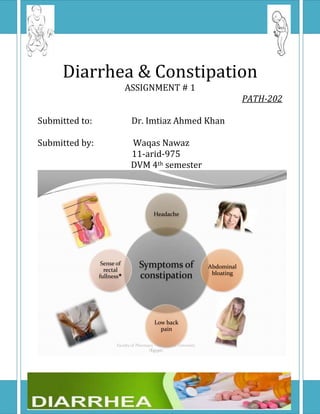
                                           Headache


                 Sense of
                  rectal
                                   Symptoms of                       Abdominal
                                                                      bloating
                fullness          constipation


                                           Low back
                                             pain

                       Faculty of Pharmacy - Alexandria University
                                        (Egypt)
CONSTIPATION

      Constipation, costiveness, or irregularity is a condition of the digestive system in
which a person experiences difficulty in defecation. Obstipation is used for severe
constipation that prevents passage of both stools and gas.

 Common among children and pregnant women; Constipation refers to infrequent or hard
stools. It is the passage of dry and hard stools, usually fewer than 3x a week. People with
this condition may find bowel movement painful and difficult.

1-SIGN & SYMPTOMS:

    A desire to defecate

    Pain and intestinal discomfort

    Swelling in the abdomen, cramps and colic

    In some cases up to several days without being able to defecate with grave harm and
     body poisoning

    Constipation is one of the main causes of hemorrhoids and appendicitis, as well as
     acne and general intoxication of the body.

    Difficulty in starting or completing a bowel movement

    Infrequent and difficult passage of stool

    Passing hard stool after prolonged straining in the toilet

    Excessive gas & Sense of bloating

    Intestinal obstruction

    Vomiting

    Headaches

    Loss of appetite

    Coated (furred) tongue

    Offensive breath

    Bad taste in your mouth
You are considered constipated if you have two or more of the following for at least
       3 months:

    Straining during a bowel movement more than 25% of the time.

    Hard stools more than 25% of the time.

    Incomplete evacuation more than 25% of the time.

    Two or fewer bowel movements in a week

Types of stool:

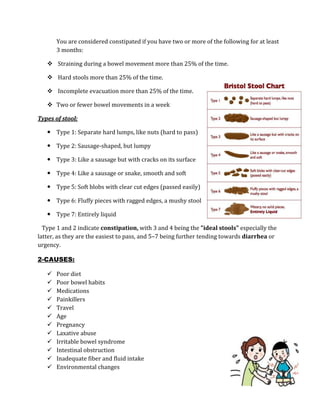
    Type 1: Separate hard lumps, like nuts (hard to pass)

    Type 2: Sausage-shaped, but lumpy

    Type 3: Like a sausage but with cracks on its surface

    Type 4: Like a sausage or snake, smooth and soft

    Type 5: Soft blobs with clear cut edges (passed easily)

    Type 6: Fluffy pieces with ragged edges, a mushy stool

    Type 7: Entirely liquid

  Type 1 and 2 indicate constipation, with 3 and 4 being the "ideal stools" especially the
latter, as they are the easiest to pass, and 5–7 being further tending towards diarrhea or
urgency.

2-CAUSES:

      Poor diet
      Poor bowel habits
      Medications
      Painkillers
      Travel
      Age
      Pregnancy
      Laxative abuse
      Irritable bowel syndrome
      Intestinal obstruction
      Inadequate fiber and fluid intake
      Environmental changes
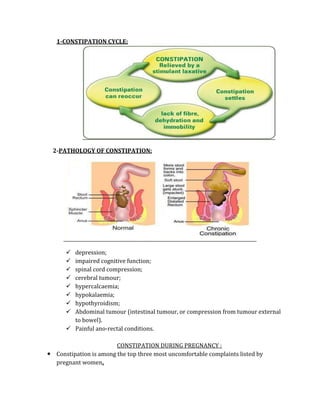
1-CONSTIPATION CYCLE:


  2-PATHOLOGY OF CONSTIPATION:


       depression;
       impaired cognitive function;
       spinal cord compression;
       cerebral tumour;
       hypercalcaemia;
       hypokalaemia;
       hypothyroidism;
       Abdominal tumour (intestinal tumour, or compression from tumour external
        to bowel).
       Painful ano-rectal conditions.

                        CONSTIPATION DURING PREGNANCY :
 Constipation is among the top three most uncomfortable complaints listed by
  pregnant women.
What causes constipation during pregnancy:
       In the first trimester it is caused by progesterone which slows down
          intestinal activity
       In the later part of pregnancy the pressure of your uterus on your intestines
          and rectum makes your system sluggish
       Iron supplement that you need for anemia has a constipating effect.
       Stress and tension contributes to constipation
       You are more susceptible to constipation if you had this problem in your
          prepregnancy days
       You lead a sedentary lifestyle


3-PATHOPHYSIOLOGY OF CONSTIPATION:

      Medications

         Opioids

         Calcium-channel blockers

         Anticholinergic

       Decreased motility
       Ileus
       Mechanical obstruction
       Metabolic abnormalities
       Spinal cord compression
       Dehydration
       Autonomic dysfunction
       Malignancy

4-TREATMENT & CURE:

    Drink 8 to 10 glasses of water per day (drink them before meals and never during or
    after meals it affects digestion).
    Eat one carrot a day (don’t forget to drink a lot of pure water). Exercise preferably
    before going to bed.
    Eat high fiber diet to provide natural bulk in daily food intake and help move food to
    the rectum; increase quantity of fruits & vegetables
    Take bulk-forming laxatives to absorb water in the intestines and acts as stools
    softener; this can be in the form of fiber supplements & Daily exercise
    For people with severe symptoms, surgical removal of colon may be an option
DIARRHEA

                 Diarrhea describes bowel movements (stools) that are loose and watery. It
is very common and usually not serious. Many people will have diarrhea once or twice each
year. It typically lasts two to three days and can be treated with over-the-counter (OTC)
medicines. Some people have diarrhea often as part of irritable bowel syndrome or other
chronic diseases of the large intestine.

The World Health Organization defines diarrhea as the passing of liquid or watery stools at
least 3 times in a 24-hour period. However, it is the consistency rather than the number of
stools that is important. Frequent passing of formed stools is not diarrhea.
Breastfed babies normally passes loose or pasty stools. The mother can tell if her baby has
an abnormal stool. We call it “mother’s definition”.


TYPES OF DIARRHEA:

Acute Diarrhoea

                             sudden onset and lasts less than two weeks

                             90% are infectious in etiology

                             10% are caused by medications, toxin ingestions, and ischemia

                             Viral, Bacterial, Protozoa (90%)

                               Medications

                               Laxatives or diuretic abuse

                               Ingestion of environmental preformed toxin such as seafood

                               Ischemic Colitis

Chronic Diarrhoea

                             Diarrhoea which lasts for more than 4 weeks

                             Most of the causes are non-infectious

                             Irritable Bowel Syndrome

                             Diverticular disease

                              Colorectal Cancer

If stools contain blood or mucus, it is called dysentery. If diarrhea persists for 14 days or
longer, it is called persistent diarrhea.
COMMON DIARRHEAS
1-SIGN & SYMPTOMS:
                                                                      Age <2 years: Rotavirus
    Abdominal bloating or cramps
                                                                      Age 2-5 years: Cholera; E. coli;
    Thin or loose stools
                                                                       Shigellosis
    Watery stool
    Sense of urgency to have a bowel movement                        All ages: E.coli; Campylobacter
    Nausea and vomiting
    In addition to the symptoms described above,                     Immunocompromized: Amebiasis;
     the symptoms of complicated diarrhea include:                     Cryptosporidium
  1. Blood, mucus, or undigested food in the stool
  2. Weight loss
  3. Fever

2-CAUSES:

   MALNUTRITION
       o Alcohol
       o Caffeine in soda, tea, coffee & chocolate
       o Food that cause gas such as beans & apples
       o Nicotine
       o Spicy foods
       o Foods high in acids such as orange
       o Fatty foods such as sausage & butter
       o Dairy products, particularly for those who are lactose intolerant
   BACTERIA
       o E.coli
       o Salmonella
       o Shigella
       o Campylobacter
       o Vibrio
                                                                   Diarrhea
       o Yersini
       o Clostridium difficle
                                                 Watery                                          Persistent
       o S.aureus                                                         Dysentery

       o B.cereus
       o C.botulinum                   Rotavirus E. coli Cholera   Amoebic       Bacillary
                                                                                                 Multiple
                                                                                                  cause
   VIRUS
       o Rotavirus
       o Adenoviruses
       o Caliciviruses
       o Astroviruses
       o Norwalk agents and Norwalk-like viruses
 FUNGI
      o Yeast
      o Candida
   PARASITE
      o Entameba histolytica
      o Giardia lamblia
      o Cryptosporidium
      o Isospora

DIARRHEA DUE TO MICROBES:

Transmission:

   Most of the diarrheal agents are transmitted by the fecal-oral route

   Cholera: water-borne disease; transmitted through water contaminated with feces

   Some viruses (such as rotavirus) can be transmitted through air

   Nosocommial transmission is possible

   Shigellosis (blood dysentery) is mainly transmitted person-to-person

   Shigellosis is a water-washed disease; transmitted more when there is scarcity of
    water

   Food and water contaminated directly or indirectly with feces or vomitus of infected
    persons are the principal mode of transmission. Ingestion of raw or inadequately
    cooked seafood or eating shelfish from coastal and estuarine waters can cause
    outbreaks of diarrhea. Person-to-person transmission occurs by hand-to-mouth
    transfer of the agent from feces of an infected individual. Respiratory spread is
    possible for rotavirus.

  3-PATHOPHYSIOLOGY OF DIARRHEA:

   Osmotic Diarrhea

   Malabsorption/Maldigestion/Fatty

   Secretory Diarrhea

   Inflammatory Diarrhea

   Abnormal Motility Diarrhea
1-Osmotic Diarrhea:

Mechanism:

   –   retention of water in the bowel as a result of an
       accumulation of non‐absorbable water‐soluble
       compounds
   –   non absorbed substance exert osmotic pressure
   –   -cease with fasting, discontinue oral agents

Causes:

   o Purgatives like magnesium sulfate or
     magnesium containing antacids
   o Especially associated with excessive
     intake of sorbitol and mannitol.
   o Disaccharide intolerance
   o Generalized malabsorption
   o Lactose intolerance

                                2-Malabsorption Diarrhea

Mechanism:

   –   Luminal Phase (Intraluminal maldigestion)                      Normal Ilium
   –   Mucosal Phase (Mucosal loss & Mucosal disease)
   –   Transport Phase (Fat malabsorption=Streatorrhea)

Causes:

   o Bacterial outgrowth
   o Pancreatic insufficiency
   o Mucosal disease (Crohn’s disease & Celiac sprue)

Celiac Sprue:
                                                           Celiac sprue
Gluten sensitive enteropathy

Reaction against gluten in diet

Epidemiology: Whites (European)
Diarrhea & malabsorption
3-Secretory Diarrhea

Mechanism:

          –   Active intestinal secretion of fluid and electrolytes as well as decreased
              absorption.
          –   Large volume, painless, persist with fasting
          –   Abnormal ION transport in intenstinal epithelial cells
          –   Abnormal mediators
          –   Diffuse mucosal disease

Causes:

      o Cholera enterotoxin, heat labile E.coli enterotoxin

      o Vasoactive Intestinal Peptide hormone in Verner-Morrison syndrome

      o Bile salts in colon following ileal resection

      o Laxatives like docusate sodium

      o Carcinoid tumours


                                4-Inflammatory Diarrhea

Mechanism:

          –   Damage to the intestinal mucosal cell leading to a loss of fluid and blood
          –   Pain, fever, bleeding, inflammatory manifestations

Causes:

Immunodeficiency patient

      o Infective conditions like Shigella dysentary

      o Inflammatory conditions

                 Ulcerative colitis and Crohn’s disease
5-Abnormal Motility Diarrhea

Mechanism:

   –   Increased frequency of defecation due to underlying diseases
   –   -large volume, signs of malabsorption (steatorrhoea)
   –   Diabetic diarrhea
   –   Hyperthyroidism
   –   Bloating & gas

Causes:

       o Diabetes mellitus- autonomic neuropathy

       o Post vagotomy

       o Hyperthyroid diarrhoea

       o Irritable Bowel Syndrome
4-TREATMENT & CURE:

 Inj. Ciprofloxacin

 Inj. Metronidazole

 Inj.Ranitidine

 C. Bifilac

 T.Paracetamol

 Non-specific treatment

   o   hydration
   o   Absorptions (Kaopectate®)
   o   Bismuth
   o   Antiperistaltics/opiate derivatives
   o   Fiber supplementation

 ORS (Oral Rehydration Solution)

 Antibiotics choice

o E. coli

            Quinolone

o Shigella

            Quinolone or TMP-SMX

o Vibrio cholera

            Tetracycline or quinolone

o Salmonella

            Quinolone or TMP-SMX

o Campylobacter

            Erythromycin or quinolone

o Yersinia

            tetracycline, TMP-SMX, or quinolone

Diarrhea & constipation

  • 1.
    Diarrhea & Constipation ASSIGNMENT # 1 PATH-202 Submitted to: Dr. Imtiaz Ahmed Khan Submitted by: Waqas Nawaz 11-arid-975 DVM 4th semester Headache Sense of rectal Symptoms of Abdominal bloating fullness constipation Low back pain Faculty of Pharmacy - Alexandria University (Egypt)
  • 2.
    CONSTIPATION Constipation, costiveness, or irregularity is a condition of the digestive system in which a person experiences difficulty in defecation. Obstipation is used for severe constipation that prevents passage of both stools and gas. Common among children and pregnant women; Constipation refers to infrequent or hard stools. It is the passage of dry and hard stools, usually fewer than 3x a week. People with this condition may find bowel movement painful and difficult. 1-SIGN & SYMPTOMS:  A desire to defecate  Pain and intestinal discomfort  Swelling in the abdomen, cramps and colic  In some cases up to several days without being able to defecate with grave harm and body poisoning  Constipation is one of the main causes of hemorrhoids and appendicitis, as well as acne and general intoxication of the body.  Difficulty in starting or completing a bowel movement  Infrequent and difficult passage of stool  Passing hard stool after prolonged straining in the toilet  Excessive gas & Sense of bloating  Intestinal obstruction  Vomiting  Headaches  Loss of appetite  Coated (furred) tongue  Offensive breath  Bad taste in your mouth
  • 3.
    You are consideredconstipated if you have two or more of the following for at least 3 months:  Straining during a bowel movement more than 25% of the time.  Hard stools more than 25% of the time.  Incomplete evacuation more than 25% of the time.  Two or fewer bowel movements in a week Types of stool:  Type 1: Separate hard lumps, like nuts (hard to pass)  Type 2: Sausage-shaped, but lumpy  Type 3: Like a sausage but with cracks on its surface  Type 4: Like a sausage or snake, smooth and soft  Type 5: Soft blobs with clear cut edges (passed easily)  Type 6: Fluffy pieces with ragged edges, a mushy stool  Type 7: Entirely liquid Type 1 and 2 indicate constipation, with 3 and 4 being the "ideal stools" especially the latter, as they are the easiest to pass, and 5–7 being further tending towards diarrhea or urgency. 2-CAUSES:  Poor diet  Poor bowel habits  Medications  Painkillers  Travel  Age  Pregnancy  Laxative abuse  Irritable bowel syndrome  Intestinal obstruction  Inadequate fiber and fluid intake  Environmental changes
  • 4.
    1-CONSTIPATION CYCLE: 2-PATHOLOGY OF CONSTIPATION:  depression;  impaired cognitive function;  spinal cord compression;  cerebral tumour;  hypercalcaemia;  hypokalaemia;  hypothyroidism;  Abdominal tumour (intestinal tumour, or compression from tumour external to bowel).  Painful ano-rectal conditions. CONSTIPATION DURING PREGNANCY :  Constipation is among the top three most uncomfortable complaints listed by pregnant women.
  • 5.
    What causes constipationduring pregnancy:  In the first trimester it is caused by progesterone which slows down intestinal activity  In the later part of pregnancy the pressure of your uterus on your intestines and rectum makes your system sluggish  Iron supplement that you need for anemia has a constipating effect.  Stress and tension contributes to constipation  You are more susceptible to constipation if you had this problem in your prepregnancy days  You lead a sedentary lifestyle 3-PATHOPHYSIOLOGY OF CONSTIPATION:  Medications  Opioids  Calcium-channel blockers  Anticholinergic  Decreased motility  Ileus  Mechanical obstruction  Metabolic abnormalities  Spinal cord compression  Dehydration  Autonomic dysfunction  Malignancy 4-TREATMENT & CURE: Drink 8 to 10 glasses of water per day (drink them before meals and never during or after meals it affects digestion). Eat one carrot a day (don’t forget to drink a lot of pure water). Exercise preferably before going to bed. Eat high fiber diet to provide natural bulk in daily food intake and help move food to the rectum; increase quantity of fruits & vegetables Take bulk-forming laxatives to absorb water in the intestines and acts as stools softener; this can be in the form of fiber supplements & Daily exercise For people with severe symptoms, surgical removal of colon may be an option
  • 6.
    DIARRHEA Diarrhea describes bowel movements (stools) that are loose and watery. It is very common and usually not serious. Many people will have diarrhea once or twice each year. It typically lasts two to three days and can be treated with over-the-counter (OTC) medicines. Some people have diarrhea often as part of irritable bowel syndrome or other chronic diseases of the large intestine. The World Health Organization defines diarrhea as the passing of liquid or watery stools at least 3 times in a 24-hour period. However, it is the consistency rather than the number of stools that is important. Frequent passing of formed stools is not diarrhea. Breastfed babies normally passes loose or pasty stools. The mother can tell if her baby has an abnormal stool. We call it “mother’s definition”. TYPES OF DIARRHEA: Acute Diarrhoea sudden onset and lasts less than two weeks 90% are infectious in etiology 10% are caused by medications, toxin ingestions, and ischemia Viral, Bacterial, Protozoa (90%) Medications Laxatives or diuretic abuse Ingestion of environmental preformed toxin such as seafood Ischemic Colitis Chronic Diarrhoea Diarrhoea which lasts for more than 4 weeks Most of the causes are non-infectious Irritable Bowel Syndrome Diverticular disease Colorectal Cancer If stools contain blood or mucus, it is called dysentery. If diarrhea persists for 14 days or longer, it is called persistent diarrhea.
  • 7.
    COMMON DIARRHEAS 1-SIGN &SYMPTOMS:  Age <2 years: Rotavirus  Abdominal bloating or cramps  Age 2-5 years: Cholera; E. coli;  Thin or loose stools Shigellosis  Watery stool  Sense of urgency to have a bowel movement  All ages: E.coli; Campylobacter  Nausea and vomiting  In addition to the symptoms described above,  Immunocompromized: Amebiasis; the symptoms of complicated diarrhea include: Cryptosporidium 1. Blood, mucus, or undigested food in the stool 2. Weight loss 3. Fever 2-CAUSES:  MALNUTRITION o Alcohol o Caffeine in soda, tea, coffee & chocolate o Food that cause gas such as beans & apples o Nicotine o Spicy foods o Foods high in acids such as orange o Fatty foods such as sausage & butter o Dairy products, particularly for those who are lactose intolerant  BACTERIA o E.coli o Salmonella o Shigella o Campylobacter o Vibrio Diarrhea o Yersini o Clostridium difficle Watery Persistent o S.aureus Dysentery o B.cereus o C.botulinum Rotavirus E. coli Cholera Amoebic Bacillary Multiple cause  VIRUS o Rotavirus o Adenoviruses o Caliciviruses o Astroviruses o Norwalk agents and Norwalk-like viruses
  • 8.
     FUNGI o Yeast o Candida  PARASITE o Entameba histolytica o Giardia lamblia o Cryptosporidium o Isospora DIARRHEA DUE TO MICROBES: Transmission:  Most of the diarrheal agents are transmitted by the fecal-oral route  Cholera: water-borne disease; transmitted through water contaminated with feces  Some viruses (such as rotavirus) can be transmitted through air  Nosocommial transmission is possible  Shigellosis (blood dysentery) is mainly transmitted person-to-person  Shigellosis is a water-washed disease; transmitted more when there is scarcity of water  Food and water contaminated directly or indirectly with feces or vomitus of infected persons are the principal mode of transmission. Ingestion of raw or inadequately cooked seafood or eating shelfish from coastal and estuarine waters can cause outbreaks of diarrhea. Person-to-person transmission occurs by hand-to-mouth transfer of the agent from feces of an infected individual. Respiratory spread is possible for rotavirus. 3-PATHOPHYSIOLOGY OF DIARRHEA:  Osmotic Diarrhea  Malabsorption/Maldigestion/Fatty  Secretory Diarrhea  Inflammatory Diarrhea  Abnormal Motility Diarrhea
  • 9.
    1-Osmotic Diarrhea: Mechanism: – retention of water in the bowel as a result of an accumulation of non‐absorbable water‐soluble compounds – non absorbed substance exert osmotic pressure – -cease with fasting, discontinue oral agents Causes: o Purgatives like magnesium sulfate or magnesium containing antacids o Especially associated with excessive intake of sorbitol and mannitol. o Disaccharide intolerance o Generalized malabsorption o Lactose intolerance 2-Malabsorption Diarrhea Mechanism: – Luminal Phase (Intraluminal maldigestion) Normal Ilium – Mucosal Phase (Mucosal loss & Mucosal disease) – Transport Phase (Fat malabsorption=Streatorrhea) Causes: o Bacterial outgrowth o Pancreatic insufficiency o Mucosal disease (Crohn’s disease & Celiac sprue) Celiac Sprue: Celiac sprue Gluten sensitive enteropathy Reaction against gluten in diet Epidemiology: Whites (European)
  • 10.
  • 11.
    3-Secretory Diarrhea Mechanism: – Active intestinal secretion of fluid and electrolytes as well as decreased absorption. – Large volume, painless, persist with fasting – Abnormal ION transport in intenstinal epithelial cells – Abnormal mediators – Diffuse mucosal disease Causes: o Cholera enterotoxin, heat labile E.coli enterotoxin o Vasoactive Intestinal Peptide hormone in Verner-Morrison syndrome o Bile salts in colon following ileal resection o Laxatives like docusate sodium o Carcinoid tumours 4-Inflammatory Diarrhea Mechanism: – Damage to the intestinal mucosal cell leading to a loss of fluid and blood – Pain, fever, bleeding, inflammatory manifestations Causes: Immunodeficiency patient o Infective conditions like Shigella dysentary o Inflammatory conditions Ulcerative colitis and Crohn’s disease
  • 12.
    5-Abnormal Motility Diarrhea Mechanism: – Increased frequency of defecation due to underlying diseases – -large volume, signs of malabsorption (steatorrhoea) – Diabetic diarrhea – Hyperthyroidism – Bloating & gas Causes: o Diabetes mellitus- autonomic neuropathy o Post vagotomy o Hyperthyroid diarrhoea o Irritable Bowel Syndrome
  • 13.
    4-TREATMENT & CURE: Inj. Ciprofloxacin  Inj. Metronidazole  Inj.Ranitidine  C. Bifilac  T.Paracetamol  Non-specific treatment o hydration o Absorptions (Kaopectate®) o Bismuth o Antiperistaltics/opiate derivatives o Fiber supplementation  ORS (Oral Rehydration Solution)  Antibiotics choice o E. coli Quinolone o Shigella Quinolone or TMP-SMX o Vibrio cholera Tetracycline or quinolone o Salmonella Quinolone or TMP-SMX o Campylobacter Erythromycin or quinolone o Yersinia tetracycline, TMP-SMX, or quinolone