Welcome
To
Byzantine Civilization
Presented By : Shanto Bhowmilk
Id: Bft – 02205660
Port-city international university
Byzantine History
 In 330, Roman Emperor Constantine moved his capital from Rome to
Byzantium.
 At the same time, the city was protected by the rugged Balkan
Mountains from the invading barbarians who overran Rome and the
Italian peninsula.
 During the reign of the Emperor Justinian from 527 to 565, Byzantium
gained control over Italy and southern Spain, all part of Justinian’s
dream of restoring the Roman Empire to its former greatness.
 In 1204, even crusaders seized Constantinople. They sacked the city,
destroyed manuscripts and priceless works of art, and declared a
crusader emperor.
 In 1261 a Byzantine emperor retook Constantinople, but the once-great
empire had vanished.
 Finally, in 1453, the Ottoman Turks captured Constantinople,
destroying the empire.
Social Status and Classes
 The Byzantine broke social classes down into three broad categories: the
Upper Class, the Middle Class, and the Lower Class.
 The upper class was the highest tier of people. This class began with the
emperor and trickled down to other wealthy owning families.
 The middle class was the second tier of citizens. These citizens had the most
potential for upward movement. Middle class citizens were just that, in the
middle.
 The lower class is quite self-explanatory; it’s the lowest tier of citizens in the
Byzantine Empire. This social category was made up of slaves and other
physical laborers. Often, these citizens had little rights, lacked an identity, and
were constantly disrespected by members of higher classes.
Source Of Evidence
 The art of the Byzantine Empire provides the major record from which
dress information comes.
 Much Byzantine art has a religious motif. Religious art favored traditional
rather than realistic representations of people.
 For example, early Byzantine artists depicted the evangelists in the
classical costume of fourth-century Romans.
 Christ as a king and Mary as a queen, both dressed in royal robes to
symbolize their status.
Fabric And ClothProduction
 Production of silk fabrics was a secret process held first by the Chinese
and later by the Koreans and Japanese.
 Byzantine historians reported that in the sixth century a pair of monks
brought the secret of sericulture (silk production) to the Byzantine
emperor. These monks supposedly smuggled a number of silkworm eggs
out of China in a hollow bamboo pole and learned how to breed, feed,
and raise silkworms.
 From this point until the ninth century (when Greeks in Sicily also began
to produce silk), the Byzantines produced silk for the western world. The
emperor charged enormous prices for the silk; therefore, only the
wealthiest Europeans could afford the fabric.
 While lack of money restricted the number of garments owned and the
fineness of the material, clothing choices for the non-elite went beyond
strictly utilitarian decisions.
Byzantine Costume For Men
• Tunic
• Pallium / Lorum
• Toga
• Paludamentum
Byzantine Costume for Men - Tunic
 Generally men wore two tunics: the under tunic with closely fitted
sleeves and the outer tunic with shorter, wider sleeves. When the
tunic was belted, some of the fabric bloused out and over the
belt. Fabrics had overall patterns with bands of jeweled
decoration placed at hems and on sleeves, with wide, decorative
yokes at the neck.
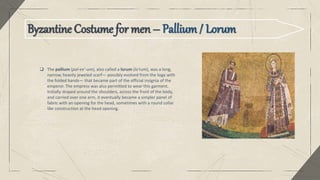
Byzantine Costume for men– Pallium / Lorum
 The pallium (pal-ee’-um), also called a lorum (lo’rum), was a long,
narrow, heavily jeweled scarf— possibly evolved from the toga with
the folded bands— that became part of the official insignia of the
emperor. The empress was also permitted to wear this garment.
Initially draped around the shoulders, across the front of the body,
and carried over one arm, it eventually became a simpler panel of
fabric with an opening for the head, sometimes with a round collar
like construction at the head opening.
Byzantine Costume for Men- Toga
 A vestige of the toga remained—a narrow band of folded fabric
that wrapped around the body in the same way as the toga.
Eventually, even this was transformed into the emperor’s
narrow, jeweled scarf.
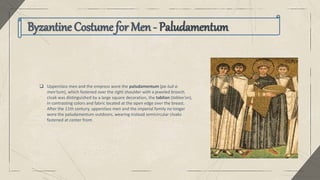
Byzantine Costume for Men- Paludamentum
 Upperclass men and the empress wore the paludamentum (pa-lud-a-
men’tum), which fastened over the right shoulder with a jeweled brooch.
cloak was distinguished by a large square decoration, the tablion (tablee’on),
in contrasting colors and fabric located at the open edge over the breast.
After the 11th century, upperclass men and the imperial family no longer
wore the paludamentum outdoors, wearing instead semicircular cloaks
fastened at center front.
Byzantine Costumefor Women
• Dalmatic
• Clavi
• Pallim / Loram
• Roundels
Byzantine Costume for Women- Dalmatic
 Gradually, the wide, long-sleeved tunic called the dalmatic, decorated
with clavi and segmentae, replaced the outer tunic. Women wore the
dalmatic over an under tunic with closely fitted sleeves. A simple veil
worn over the head replaced the palla for a time. Eventually the palla
returned to use in a modified form that wrapped around the body and
covered the upper part of the skirt, the bodice, and either one or both
shoulders.
Byzantine Women Costume- Clavi
 Women, on the other hand, wore clothing in various colors, also
with clavi. By the late Roman period, garments were increasingly
decorated with borders, roundels (round, rectangular, or star-shaped
ornaments) and short clavi. During the Byzantine period that followed, the
detail within the roundels and clavi became more ornate and colorful,
including floral, animal, and human depictions and showing mythological
(often Dionysian) scenes.”
Byzantine Women Costume – Lorum / Pallum
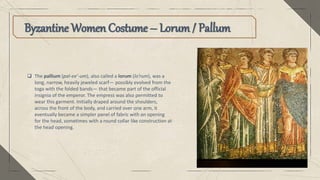
 The pallium (pal-ee’-um), also called a lorum (lo’rum), was a
long, narrow, heavily jeweled scarf— possibly evolved from the
toga with the folded bands— that became part of the official
insignia of the emperor. The empress was also permitted to
wear this garment. Initially draped around the shoulders,
across the front of the body, and carried over one arm, it
eventually became a simpler panel of fabric with an opening
for the head, sometimes with a round collar like construction at
the head opening.
Byzantine Costume Decorative Motif – Roundels
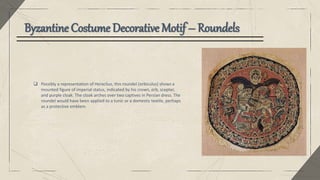
 Possibly a representation of Heraclius, this roundel (orbiculus) shows a
mounted figure of imperial status, indicated by his crown, orb, scepter,
and purple cloak. The cloak arches over two captives in Persian dress. The
roundel would have been applied to a tunic or a domestic textile, perhaps
as a protective emblem.
Headdress Or Hairstyle Or Headwear (Men And Women)
 From the 4th to 10th centuries, men tended to be clean shaven.
Later, men were more likely to have beards. Men wore Phrygian
bonnet like styles, or conical caps, and several versions of a high hat
with an upstanding brim surrounding a high-crowned turban, a
smooth, close-fitting crown, or a soft crown with a tassel at the back.
Emperors wore jeweled crowns, often with suspended strings of
pearls.
Byzantine Footwear
 Red apparently was a favored color for empresses and their retinue.
Some tied, while others buckled at the ankle. Hose worn under the
shoes are visible in some paintings, particularly when the tunics are
shorter in length. Men, not women, seem to have worn boots. Most
boots ended just below the calf, although a few boots are depicted as
high at the front and lower behind the knee. Some decorated styles
were worn by the wealthy. Military figures from the early Byzantine
Empire wore Roman-like, open-toed boots; later they adopted a
closed boot.
Byzantine Jewelry (men And Women)
 Empresses wore wide, jeweled collars over the paludamentum or at the
neck of the dress.
 Other important items of jewelry included pins, earrings, bracelets,
rings, and other types of necklaces.
 Jewelers were skilled in techniques of working gold, setting precious
stones, enameling, and making mosaics.
 Justinian I, Latin in full Flavius Justinianus, original name Petrus
Sabbatius, (born 483, Tauresium, Dardania [probably near
modern Skopje, North Macedonia]—died November 14,
565, Constantinople [now Istanbul,
Turkey]), Byzantine emperor (527–565), noted for his
administrative reorganization of the imperial government and for
his sponsorship of a codification of laws known as the Code of
Justinian (Codex Justinianus; 534).
Emperor Justinian
Conclusion
 Byzantine Civilization was under Roman law. Latin was it official
language. However, Greek was also common. Christianity was the
main religion in Byzantine Empire. Justinian I took over the mantle
of power in 527 and ruled until his death in 565. He was considered
as the first great ruler of the Empire. During his reign, Byzantine
Empire excelled in almost every sphere.
Byzantine civilization presentation

Byzantine civilization presentation

  • 1.
    Welcome To Byzantine Civilization Presented By: Shanto Bhowmilk Id: Bft – 02205660 Port-city international university
  • 2.
    Byzantine History  In330, Roman Emperor Constantine moved his capital from Rome to Byzantium.  At the same time, the city was protected by the rugged Balkan Mountains from the invading barbarians who overran Rome and the Italian peninsula.  During the reign of the Emperor Justinian from 527 to 565, Byzantium gained control over Italy and southern Spain, all part of Justinian’s dream of restoring the Roman Empire to its former greatness.  In 1204, even crusaders seized Constantinople. They sacked the city, destroyed manuscripts and priceless works of art, and declared a crusader emperor.  In 1261 a Byzantine emperor retook Constantinople, but the once-great empire had vanished.  Finally, in 1453, the Ottoman Turks captured Constantinople, destroying the empire.
  • 3.
    Social Status andClasses  The Byzantine broke social classes down into three broad categories: the Upper Class, the Middle Class, and the Lower Class.  The upper class was the highest tier of people. This class began with the emperor and trickled down to other wealthy owning families.  The middle class was the second tier of citizens. These citizens had the most potential for upward movement. Middle class citizens were just that, in the middle.  The lower class is quite self-explanatory; it’s the lowest tier of citizens in the Byzantine Empire. This social category was made up of slaves and other physical laborers. Often, these citizens had little rights, lacked an identity, and were constantly disrespected by members of higher classes.
  • 4.
    Source Of Evidence The art of the Byzantine Empire provides the major record from which dress information comes.  Much Byzantine art has a religious motif. Religious art favored traditional rather than realistic representations of people.  For example, early Byzantine artists depicted the evangelists in the classical costume of fourth-century Romans.  Christ as a king and Mary as a queen, both dressed in royal robes to symbolize their status.
  • 5.
    Fabric And ClothProduction Production of silk fabrics was a secret process held first by the Chinese and later by the Koreans and Japanese.  Byzantine historians reported that in the sixth century a pair of monks brought the secret of sericulture (silk production) to the Byzantine emperor. These monks supposedly smuggled a number of silkworm eggs out of China in a hollow bamboo pole and learned how to breed, feed, and raise silkworms.  From this point until the ninth century (when Greeks in Sicily also began to produce silk), the Byzantines produced silk for the western world. The emperor charged enormous prices for the silk; therefore, only the wealthiest Europeans could afford the fabric.  While lack of money restricted the number of garments owned and the fineness of the material, clothing choices for the non-elite went beyond strictly utilitarian decisions.
  • 6.
    Byzantine Costume ForMen • Tunic • Pallium / Lorum • Toga • Paludamentum
  • 7.
    Byzantine Costume forMen - Tunic  Generally men wore two tunics: the under tunic with closely fitted sleeves and the outer tunic with shorter, wider sleeves. When the tunic was belted, some of the fabric bloused out and over the belt. Fabrics had overall patterns with bands of jeweled decoration placed at hems and on sleeves, with wide, decorative yokes at the neck.
  • 8.
    Byzantine Costume formen– Pallium / Lorum  The pallium (pal-ee’-um), also called a lorum (lo’rum), was a long, narrow, heavily jeweled scarf— possibly evolved from the toga with the folded bands— that became part of the official insignia of the emperor. The empress was also permitted to wear this garment. Initially draped around the shoulders, across the front of the body, and carried over one arm, it eventually became a simpler panel of fabric with an opening for the head, sometimes with a round collar like construction at the head opening.
  • 9.
    Byzantine Costume forMen- Toga  A vestige of the toga remained—a narrow band of folded fabric that wrapped around the body in the same way as the toga. Eventually, even this was transformed into the emperor’s narrow, jeweled scarf.
  • 10.
    Byzantine Costume forMen- Paludamentum  Upperclass men and the empress wore the paludamentum (pa-lud-a- men’tum), which fastened over the right shoulder with a jeweled brooch. cloak was distinguished by a large square decoration, the tablion (tablee’on), in contrasting colors and fabric located at the open edge over the breast. After the 11th century, upperclass men and the imperial family no longer wore the paludamentum outdoors, wearing instead semicircular cloaks fastened at center front.
  • 11.
    Byzantine Costumefor Women •Dalmatic • Clavi • Pallim / Loram • Roundels
  • 12.
    Byzantine Costume forWomen- Dalmatic  Gradually, the wide, long-sleeved tunic called the dalmatic, decorated with clavi and segmentae, replaced the outer tunic. Women wore the dalmatic over an under tunic with closely fitted sleeves. A simple veil worn over the head replaced the palla for a time. Eventually the palla returned to use in a modified form that wrapped around the body and covered the upper part of the skirt, the bodice, and either one or both shoulders.
  • 13.
    Byzantine Women Costume-Clavi  Women, on the other hand, wore clothing in various colors, also with clavi. By the late Roman period, garments were increasingly decorated with borders, roundels (round, rectangular, or star-shaped ornaments) and short clavi. During the Byzantine period that followed, the detail within the roundels and clavi became more ornate and colorful, including floral, animal, and human depictions and showing mythological (often Dionysian) scenes.”
  • 14.
    Byzantine Women Costume– Lorum / Pallum  The pallium (pal-ee’-um), also called a lorum (lo’rum), was a long, narrow, heavily jeweled scarf— possibly evolved from the toga with the folded bands— that became part of the official insignia of the emperor. The empress was also permitted to wear this garment. Initially draped around the shoulders, across the front of the body, and carried over one arm, it eventually became a simpler panel of fabric with an opening for the head, sometimes with a round collar like construction at the head opening.
  • 15.
    Byzantine Costume DecorativeMotif – Roundels  Possibly a representation of Heraclius, this roundel (orbiculus) shows a mounted figure of imperial status, indicated by his crown, orb, scepter, and purple cloak. The cloak arches over two captives in Persian dress. The roundel would have been applied to a tunic or a domestic textile, perhaps as a protective emblem.
  • 16.
    Headdress Or HairstyleOr Headwear (Men And Women)  From the 4th to 10th centuries, men tended to be clean shaven. Later, men were more likely to have beards. Men wore Phrygian bonnet like styles, or conical caps, and several versions of a high hat with an upstanding brim surrounding a high-crowned turban, a smooth, close-fitting crown, or a soft crown with a tassel at the back. Emperors wore jeweled crowns, often with suspended strings of pearls.
  • 17.
    Byzantine Footwear  Redapparently was a favored color for empresses and their retinue. Some tied, while others buckled at the ankle. Hose worn under the shoes are visible in some paintings, particularly when the tunics are shorter in length. Men, not women, seem to have worn boots. Most boots ended just below the calf, although a few boots are depicted as high at the front and lower behind the knee. Some decorated styles were worn by the wealthy. Military figures from the early Byzantine Empire wore Roman-like, open-toed boots; later they adopted a closed boot.
  • 18.
    Byzantine Jewelry (menAnd Women)  Empresses wore wide, jeweled collars over the paludamentum or at the neck of the dress.  Other important items of jewelry included pins, earrings, bracelets, rings, and other types of necklaces.  Jewelers were skilled in techniques of working gold, setting precious stones, enameling, and making mosaics.
  • 19.
     Justinian I,Latin in full Flavius Justinianus, original name Petrus Sabbatius, (born 483, Tauresium, Dardania [probably near modern Skopje, North Macedonia]—died November 14, 565, Constantinople [now Istanbul, Turkey]), Byzantine emperor (527–565), noted for his administrative reorganization of the imperial government and for his sponsorship of a codification of laws known as the Code of Justinian (Codex Justinianus; 534). Emperor Justinian
  • 20.
    Conclusion  Byzantine Civilizationwas under Roman law. Latin was it official language. However, Greek was also common. Christianity was the main religion in Byzantine Empire. Justinian I took over the mantle of power in 527 and ruled until his death in 565. He was considered as the first great ruler of the Empire. During his reign, Byzantine Empire excelled in almost every sphere.