
PERFORMANCE
MANAGEMENT
Costing Techniques
Topics Covered

Throughput Accounting
Theory of constraints-TOC
Target Costing
Throughput

Throughput: The rate at which the system generates money through sales.


Throughput
 =Sales revenue- Direct material cost

Objective of this accounting is to increase the throughput and reduce the
 inventory and operational expenses.
Theory of constraints-TOC

Bottleneck-the factors which prevents the throughput being higher. For
 example-inadequately trained staff, unreliable supply of material etc.

Goldratt and Cox describe the process of identifying and taking steps to
 remove constraints as TOC.
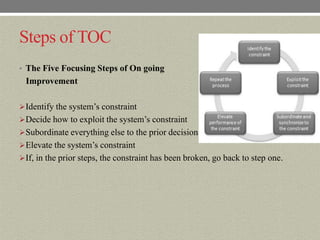
Steps of TOC
• The Five Focusing Steps of On going
 Improvement

 Identify the system’s constraint
 Decide how to exploit the system’s constraint
 Subordinate everything else to the prior decisions
 Elevate the system’s constraint
 If, in the prior steps, the constraint has been broken, go back to step one.
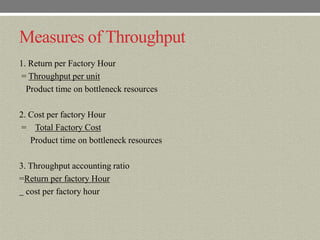
Measures of Throughput
1. Return per Factory Hour
= Throughput per unit
  Product time on bottleneck resources

2. Cost per factory Hour
= Total Factory Cost
   Product time on bottleneck resources

3. Throughput accounting ratio
=Return per factory Hour
  cost per factory hour
Target Costing

 Target costing is the process of determining the maximum allowable cost
 for a new product and then developing a prototype that can be profitably
 made for that maximum target cost figure.

 Target Cost = Anticipated selling price – Desired profit
Steps of Target Costing
  Planning

  Concept design

  Basic design

  Detailed design

  Manufacturing Preparation
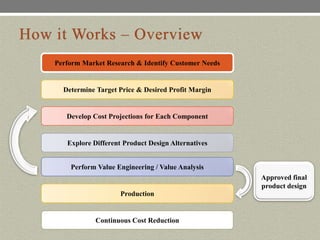
How it Works – Overview
    Perform Market Research & Identify Customer Needs


      Determine Target Price & Desired Profit Margin


       Develop Cost Projections for Each Component


       Explore Different Product Design Alternatives


        Perform Value Engineering / Value Analysis
                                                        Approved final
                                                        product design
                        Production


                Continuous Cost Reduction
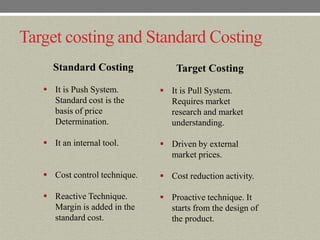
Target costing and Standard Costing
     Standard Costing              Target Costing
    It is Push System.         It is Pull System.
     Standard cost is the        Requires market
     basis of price              research and market
     Determination.              understanding.

    It an internal tool.       Driven by external
                                 market prices.

    Cost control technique.    Cost reduction activity.

    Reactive Technique.        Proactive technique. It
     Margin is added in the      starts from the design of
     standard cost.              the product.
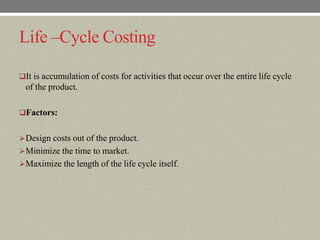
Life –Cycle Costing

It is accumulation of costs for activities that occur over the entire life cycle
 of the product.

Factors:


 Design costs out of the product.
 Minimize the time to market.
 Maximize the length of the life cycle itself.
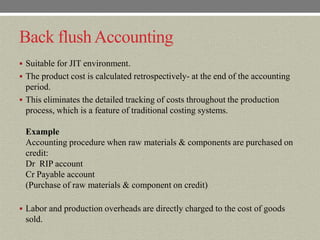
Back flush Accounting
 Suitable for JIT environment.
 The product cost is calculated retrospectively- at the end of the accounting
  period.
 This eliminates the detailed tracking of costs throughout the production
  process, which is a feature of traditional costing systems.

 Example
 Accounting procedure when raw materials & components are purchased on
 credit:
 Dr RIP account
 Cr Payable account
 (Purchase of raw materials & component on credit)

 Labor and production overheads are directly charged to the cost of goods
 sold.
KAPP EDGE SOLUTIONS PVT. LTD.
WWW.ONLINEGLOBALCAREER.COM
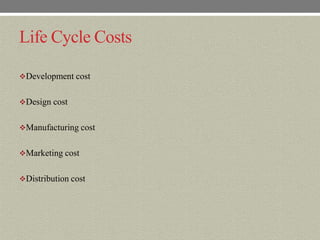
Life Cycle Costs

Development cost


Design cost


Manufacturing cost


Marketing cost


Distribution cost
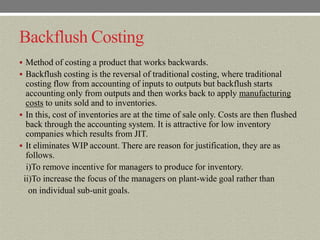
Backflush Costing
 Method of costing a product that works backwards.
 Backflush costing is the reversal of traditional costing, where traditional
  costing flow from accounting of inputs to outputs but backflush starts
  accounting only from outputs and then works back to apply manufacturing
  costs to units sold and to inventories.
 In this, cost of inventories are at the time of sale only. Costs are then flushed
  back through the accounting system. It is attractive for low inventory
  companies which results from JIT.
 It eliminates WIP account. There are reason for justification, they are as
  follows.
  i)To remove incentive for managers to produce for inventory.
 ii)To increase the focus of the managers on plant-wide goal rather than
   on individual sub-unit goals.
Thanks
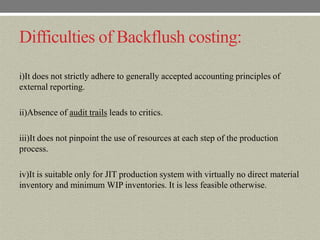
Difficulties of Backflush costing:

i)It does not strictly adhere to generally accepted accounting principles of
external reporting.

ii)Absence of audit trails leads to critics.

iii)It does not pinpoint the use of resources at each step of the production
process.

iv)It is suitable only for JIT production system with virtually no direct material
inventory and minimum WIP inventories. It is less feasible otherwise.

Costing techniques

  • 1.
  • 2.
    Topics Covered Throughput Accounting Theoryof constraints-TOC Target Costing
  • 3.
    Throughput Throughput: The rateat which the system generates money through sales. Throughput =Sales revenue- Direct material cost Objective of this accounting is to increase the throughput and reduce the inventory and operational expenses.
  • 4.
    Theory of constraints-TOC Bottleneck-thefactors which prevents the throughput being higher. For example-inadequately trained staff, unreliable supply of material etc. Goldratt and Cox describe the process of identifying and taking steps to remove constraints as TOC.
  • 5.
    Steps of TOC •The Five Focusing Steps of On going Improvement  Identify the system’s constraint  Decide how to exploit the system’s constraint  Subordinate everything else to the prior decisions  Elevate the system’s constraint  If, in the prior steps, the constraint has been broken, go back to step one.
  • 6.
    Measures of Throughput 1.Return per Factory Hour = Throughput per unit Product time on bottleneck resources 2. Cost per factory Hour = Total Factory Cost Product time on bottleneck resources 3. Throughput accounting ratio =Return per factory Hour cost per factory hour
  • 7.
    Target Costing  Targetcosting is the process of determining the maximum allowable cost for a new product and then developing a prototype that can be profitably made for that maximum target cost figure.  Target Cost = Anticipated selling price – Desired profit
  • 8.
    Steps of TargetCosting  Planning  Concept design  Basic design  Detailed design  Manufacturing Preparation
  • 9.
    How it Works– Overview Perform Market Research & Identify Customer Needs Determine Target Price & Desired Profit Margin Develop Cost Projections for Each Component Explore Different Product Design Alternatives Perform Value Engineering / Value Analysis Approved final product design Production Continuous Cost Reduction
  • 10.
    Target costing andStandard Costing Standard Costing Target Costing  It is Push System.  It is Pull System. Standard cost is the Requires market basis of price research and market Determination. understanding.  It an internal tool.  Driven by external market prices.  Cost control technique.  Cost reduction activity.  Reactive Technique.  Proactive technique. It Margin is added in the starts from the design of standard cost. the product.
  • 11.
    Life –Cycle Costing Itis accumulation of costs for activities that occur over the entire life cycle of the product. Factors:  Design costs out of the product.  Minimize the time to market.  Maximize the length of the life cycle itself.
  • 12.
    Back flush Accounting Suitable for JIT environment.  The product cost is calculated retrospectively- at the end of the accounting period.  This eliminates the detailed tracking of costs throughout the production process, which is a feature of traditional costing systems. Example Accounting procedure when raw materials & components are purchased on credit: Dr RIP account Cr Payable account (Purchase of raw materials & component on credit)  Labor and production overheads are directly charged to the cost of goods sold.
  • 13.
    KAPP EDGE SOLUTIONSPVT. LTD. WWW.ONLINEGLOBALCAREER.COM
  • 14.
    Life Cycle Costs Developmentcost Design cost Manufacturing cost Marketing cost Distribution cost
  • 15.
    Backflush Costing  Methodof costing a product that works backwards.  Backflush costing is the reversal of traditional costing, where traditional costing flow from accounting of inputs to outputs but backflush starts accounting only from outputs and then works back to apply manufacturing costs to units sold and to inventories.  In this, cost of inventories are at the time of sale only. Costs are then flushed back through the accounting system. It is attractive for low inventory companies which results from JIT.  It eliminates WIP account. There are reason for justification, they are as follows. i)To remove incentive for managers to produce for inventory. ii)To increase the focus of the managers on plant-wide goal rather than on individual sub-unit goals.
  • 16.
  • 17.
    Difficulties of Backflushcosting: i)It does not strictly adhere to generally accepted accounting principles of external reporting. ii)Absence of audit trails leads to critics. iii)It does not pinpoint the use of resources at each step of the production process. iv)It is suitable only for JIT production system with virtually no direct material inventory and minimum WIP inventories. It is less feasible otherwise.