Strategic Cost Management By Augustin Amaladas Prof. Augustin Amaladas
Strategic Management Traditional Management accounting is based on comparing actual results against pre set standard (Typically budget), identifying and analysing variances and taking remedial action to ensure that future outcomes confirm with budgeted outcomes. Existing activities are not reviewed. They are based on cost containment rather than cost reduction. But strategic management is focuses on cost reduction and continuous improvement.
Value analysis/value engineering Aims at the assigned target cost by  A)identifying improved product design Eliminating unnecessary functions that increases product cost and for which customers are not willing to pay for it. Requires functional analysis The value for each element is determined which customer is willing to pay.
Value analysis/ value engineering Cost of each function of a product is compared  with the benefits perceived by the customers. If the cost of the function exceeds the benefit to the customer, the function is either eliminated, modified to reduce the cost or enhanced in terms of its perceived value so that its value exceeds the cost.
2.Business process reengineering Examining business process and making substantial changes Redesign of how work done through activities. Collection of activities that are linked together in a coordinated manner to achieve a  specific objective Example: See next slide
Material handling Scheduling production Storing  material Processing business orders Inspecting   materials Paying suppliers
Aims of reengineering Improve the key business processes Simplification, cost reduction, improved quality and enhanced customer satisfaction.
Process Sending production schedule direct to the nominated suppliers and ask the suppliers to deliver according to the production schedule. Inspection done for quality in the supplier’s centre. Benefit: permanent reduction  of storage cost, handling cost, inspection cost
Reengineering Features: 1. radical and dramatic changes in the processes 2. Abandoning current practices and reinventing completely new methods of performing business processes. 3. Focus on major changes rather than marginal change. 4.It also involves adopting JIT system
3.TQM All business  functions are involved in a process of continuous quality improvement Moved from statistical monitoring of manufacturing processes to customer oriented process of continuous improvement High quality but on time Earlier belief is that quality increases cost but it has saved many companies because of quality. Better to produce product at cheaper rate first rather than wasting resources by making substandard product  and spending on rework, rejection, scraped or return to customers How is it done?
TQM Management accounting can provide reports and measures that motivate and evaluate managerial efforts to improve quality The reports are divided into 1.prevention cost 2.appraisal cost 3.Internal failure cost 4.external failure cost
Cost of quality report Quality training Supplier reviews Quality engineering Preventive maintenance 1.Prevention costs Percentage of sales
Cost of quality report Inspection of material received Inspection of WIP and completed units Testing equipment Quality audits 2. Appraisal costs
Cost of quality report Scrap Rework Down due to quality problems retesting 3. Internal failure cost
Cost of quality report Returns Recalls Warranty repairs Handling customer  complaints Foregone contribution from lost sales 4.  External failure costs
How Zero defects policy determined? Do not use percentages as a unit of measurement Use parts per million (PPM) It creates pressure for action and trend in defect rates. Quality reports are useful to top management where as non financial quality measures provide more timely and appropriate target measure for quality improvement.
Statistical tools Quality control chart used to distinguish between random and non-random variations in operating processes. We use X+1SD:  X+2SD  days usage Operation-A _ X+1SD _ X+2sd Statistical quality control chart _ X _ X-1sd _ X-2d
Control chart-explanations The control limits are based on a  series of past observations of a process when it is under control and working efficiently. The Past observations are used to estimate the population mean and the population standard deviation. If control limits are say X+2sd , so that all observations are outside the range are investigated. X+/- 2sd covers 95.45% of the population therefore 4.55% of future operations would result from pure chance when process is under control.
Problems Page-958 views 22.2 in Drury
4.Value chain analysis Performance of one activity affects the performance and cost of other activities. It gives link performance of one  and its effects on the other. There are interdependent exist between activities and greater amount of coordination required
5.Product life cycle costing Traditional management accounting control procedures have focused primarily on the manufacturing stage of a product’s life cycle. Pre-manufacturing costs such as R&D, design, post manufacturing abandonment and disposal costs are treated as period cost .They are not incorporated in the product cost calculation.
Product life cycle costing-continuation Life cycle costing estimates and accumulates costs over the entire product life cycle so that the profit earned will cover the entire life cycle cost. It helps management to understand the cost consequence of developing and making a product and identify areas for cost reduction.
Tradition vs life cycle reporting Most of the reporting on a perod –by- period basis Profits are not monitored over the life of the product LCR traces costs and revenues over various calendar periods. Hurdles: tracing all costs inadequate feed back information
Product life cycle phases- relationship between costs committed and costs incurred Percentage of costs and committed Product life cycle Cost committed Post sales and service And abandonment phase Prod u ct planning And design phase Product manufacturing And sales phase Costs incurred 20% 40% 60% 80% 100%
Explanations 1.Cost management can be most effectively exercised during planning and design stage and not at the manufacturing stage. 2.Later stage more focus on cost containment than cost management. 3. Aeroplanes manufacturing-high costs at planning and development but huge abandonment costs at nuclear waste and other toxic chemicals. 1.80% of the costs are committed during the planning and design stage 2.Majority of costs are incurred at the manufacturing stage but they have aready become locked in at the planning and design stage and difficult to alter. 3.The pattern of cost commitment and incurrence will differ based on the industry and specific product introduced.
problems Advanced cost and management Accounting-by Saxana and Vasist –Prob.16.48-P.16.59 Prob.16.49-P.16.61 Cost and management accounting by Drury-prob.22.18-P979-981
Activity Based Costing Historical development Traditionally cost  accountants  had arbitrarily added a broad percentage of expenses onto the  direct costs  to allow for the  indirect costs . However as the percentages of indirect or  overhead costs  had risen, this technique became increasingly inaccurate because the indirect costs were not caused equally by all the products. For example, one product might take more time in one expensive machine than another product, but since the amount of direct labor and materials might be the same, the additional cost for the use of the machine would not be recognised when the same broad 'on-cost' percentage is added to all products. Consequently, when multiple products share common costs, there is a danger of one product subsidizing another.
The 1970s and 1980s The concepts of ABC were developed in the  manufacturing sector  of the United States during the 1970s and 1980s. During this time, the  Consortium for Advanced Manufacturing-International , now known simply as CAM-I, provided a formative role for studying and formalizing the principles that have become more formally known as Activity-Based Costing. [1]
cost management systems Robin Cooper  and  Robert Kaplan , proponent of the  Balanced Scorecard , brought notice to these concepts in a number of articles published in  Harvard Business Review  beginning in 1988. Cooper and Kaplan described ABC as an approach to solve the problems of traditional  cost management systems . These traditional costing systems are often unable to determine accurately the actual costs of  production  and of the costs of related services. Consequently managers were making decisions based on inaccurate data especially where there are multiple products.
Instead of using broad arbitrary percentages to allocate costs, ABC seeks to identify cause and effect relationships to objectively assign costs. Once costs of the activities have been identified, the cost of each activity is attributed to each product to the extent that the product uses the activity. In this way ABC often identifies areas of high overhead costs per unit and so directs attention to finding ways to reduce the costs or to charge more for costly products.
They initially focused on manufacturing industry where increasing technology and productivity improvements have reduced the relative proportion of the direct costs of labor and materials, but have increased relative proportion of indirect costs. For example, increased automation has reduced labor, which is a direct cost, but has increased depreciation, which is an indirect cost.
Like manufacturing industries,  financial institutions  also have diverse products and customers which can cause cross-product cross-customer subsidies. Since personnel expenses represent the largest single component of non-interest expense in financial institutions, these costs must also be attributed more accurately to products and customers. Activity based costing, even though originally developed for manufacturing, may even be a more useful tool for doing this
cost driver Direct labor and materials are relatively easy to trace directly to products, but it is more difficult to directly allocate indirect costs to products. Where products use common resources differently, some sort of weighting is needed in the cost allocation process. The measure of the use of a shared activity by each of the products is known as the  cost driver . For example, the cost of the activity of bank tellers can be ascribed to each product by measuring how long each product's transactions takes at the counter and then by measuring the number of each type of transaction.
Limitations Even in activity-based costing, some overhead costs are difficult to assign to products and customers, for example the chief executive's salary. These costs are termed 'business sustaining' and are not assigned to products and customers because there is no meaningful method. This lump of unallocated overhead costs must nevertheless be met by contributions from each of the products, but it is not as large as the overhead costs before ABC is employed.
Although some may argue that costs untraceable to activities should be "arbitrarily allocated" to products, it is important to realize that the only purpose of ABC is to provide information to management. Therefore, there is no reason to assign any cost in an arbitrary manner.
The Four Steps to ABC Implementation  Identify activities —perform an in-depth analysis of the operating processes of each responsibility segment. Each process may consist of one or more activities required by outputs.
Assign resource costs to activities this is sometimes called "tracing." Traceability refers to tracing costs to cost objects to determine why costs were incurred. DoD categorizes costs in three ways:  Direct —costs that can be traced directly to one output. Example: the material costs (varnish, wood, paint) to build a chair.  Indirect— costs that cannot be allocated to an individual output; in other words, they benefit two or more outputs, but not all outputs. Examples: maintenance costs for the saws that cut the wood, storage costs, other construction materials, and quality assurance.)  General & Administrative —costs that cannot reasonably be associated with any particular product or service produced (overhead). These costs would remain the same no matter what output the activity produced. Examples: salaries of personnel in purchasing department, depreciation on equipment, and plant security
Identify outputs y Identify all of the outputs for which an activity segment performs activities and consumes resources. Outputs can be products, services, or customers (persons or entities to whom a federal agency is required to provide goods or services
Assign activity costs to outputs activity costs to outputs using activity drivers. Activity drivers assign activity costs to outputs based on individual outputs’ consumption or demand for activities. For example, a driver may be the number of times an activity is performed (transaction driver) or the length of time an activity is performed (duration driver).
Activity-Based Costing encourages managers to identify which activities are value-added—those that will best accomplish a mission, deliver a service, or meet a customer demand. It improves operational efficiency and enhances decision-making through better, more meaningful cost information
6.Activity based costing/Target costing Mechanism for determining selling prices. It is a cost management tool. TATA tries to manufacture a car at Rs. 1 ,00,000. – is a typical example for target costing.
Stages of target costing 1. Determine the target price which customers will be prepared to pay for the product 2.Deduct a target profit margin fro the target price to determine the target cost 3. Estimate the actual cost of the product 4.If estimated actual cost exceeds the target cost , investigate ways of driving down the actual cost to the target cost
Target costing-Continues Customer oriented approach Used by Japanese copanies and recently adopted by Europe and the USA. Recently call canters are trying to adopt this as Indian currency strengthened.
Procedures: 1.Market research to find the customer’s perceived value-tear down analysis-examining the competitors’ products-dismantling of the competitor's product.use value engineering 2.How customers differentiate the product from the competitors 3.Target profit margin depends on planned return on investment and fix % of profits on sales 4.Decomposed into a target profit for each product. 5.Deduct the target profit from target price 6.Compare with the predicted actual cost. 7. If predicted cost>target cost then efforts are made to close the gap.
What is required? Team approach Team members include: 1.designers 2. engineers 3. Purchasing 4. manufacturing 5. marketing 6. management accounting personnel The discipline of a team approach ensures that no particular group is able to impose functional preferences. Aim During product design process  is that elimination of product functions that add costs which do not increase market price.
Role of suppliers Suppliers are included in the design team They can suggest standard parts/alternative parts instead of custom-design parts which will reduce the product cost.
If target costs not achieved ? Product should not be launched Design teams should not be allowed to achieve target cost by eliminating desirable product functions. Design teams use tear-down analysis Value engineering is to achieve the target cost.
Problems 1. Illustration of target costing-Management and cost accounting by Colin Drury-page 948
7. Kaizen costing It is a mechanism for reducing and managing costs. Improvement to the process rather than applied during design stage. Cost reduction through the increased efficiency of the production process. To reduce the cost of components and the products by a pre-specified amount It is heavily on empowerment of employees Workers are given more responsibilities to improve the processes and reduce costs.
8.The balanced score card The most recent contribution to strategic management accounting Integrated framework of performance measurement Balanced score card analysis by Southwest Airlines-Next page
Balanced score card analysis by Southwest by Kaplan and Norton Balanced score card analysis  2.Customer How do customer  See us? 3.Internal What must we excel At? 4.Learning Can we continue to Improve and  Create value? 1.Financial How do we look To shareholders?
1.Financial potential score card measures(Looking back) Market share Revenue growth Operating profit Return on equity Stock Market Performance Growth in margin Patient censes Unit profitability Fund raised For capital Improvement Cost per care % of revenue  -new program Revenue/cost  Per available Passenger mile Mix of freight Mix of full fare To discounted Average age  of fleet Available seat  Miles and  related yields Outstanding  Loan balances Deposit balances Non interest income Generic Health care Airlines Banking
2.Customer service and satisfaction(Looking  from   the outside in) Customer satisfaction Customer retention Quality customer  Service Sales from new Products/services Patient satisfactory  Survey Patient retention Patient referral Rate Admission or dis Charge timeliness Medical plan awareness Lost bag report Per 10000  Passangers Denied boarding  Rate Flight cancellation  Rate Customer compla Ins. Customer retention No. of new  Customers No.of products  Per customer Face time spent  Between loan  Officers and  customers Generic Health care Airlines Banking
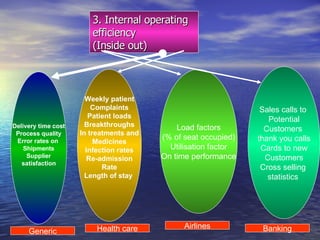
3. Internal operating efficiency (Inside out) Delivery time cost Process quality Error rates on  Shipments Supplier satisfaction Weekly patient Complaints Patient loads Breakthroughs In treatments and Medicines Infection rates Re-admission Rate Length of stay  Load factors (% of seat occupied) Utilisation factor On time performance Sales calls to  Potential Customers  thank you calls Cards to new Customers Cross selling  statistics  Generic Health care Airlines Banking
4. Learning and Growth(looking ahed) Employee skill Level Training availa Bility Employee satisfaction Job retention Over time worked Vacation Time taken Traininghours Per care giver No. of peer  viewed  Papers published No.of grants awarded Referring MDs Employee turnover rate Employee  Absenteeism Work safety statistics Performance  Appraisals completed Training programs Hours per employee Test results from Training knowledge Of product  offering, Sales, and service Employee satis Faction survey Generic Health care Airlines Banking
Soutern Airlines’ Balanced Scorecard frame work   Cycle time optimisation ESOP Ground crew training 30 minutes 90% Yr.1  70% Yr.3  90% Yr.5  100% On ground time On time departure %ground crew trained % Ground crew stockholders Fast internal  Turnaround Ground crew alignment Internal  learning Quality management Customer loyalty program 1 1 FAA on time arrival rating Customer ranking(Market) Flight is on time Lowest prices Customer 30% CAGR 20% CAGR 5% CAGR Market value Seat revenue Plane least cost Profitability More customers Fewer planes Financial Initiative (Key action) Target(rate Of improvementneeded) Measurement How success are measured) Objectives (achieve&critical to success) Strategic theme Operating efficiency
Benefits and limitations 1. single report but four different perspective 2.Specific performance measure Operational measurements together Improves communications within organisation
Problems Drury-27.17 page-1024 Drury-23.18 page 1025
Activity Based costing Learning objectives: Explain why a cost accumulation system is required for generating relevant cost information for decision making; Describe the differences between activity-based and traditional

Strategic Cost Management

  • 1.
    Strategic Cost ManagementBy Augustin Amaladas Prof. Augustin Amaladas
  • 2.
    Strategic Management TraditionalManagement accounting is based on comparing actual results against pre set standard (Typically budget), identifying and analysing variances and taking remedial action to ensure that future outcomes confirm with budgeted outcomes. Existing activities are not reviewed. They are based on cost containment rather than cost reduction. But strategic management is focuses on cost reduction and continuous improvement.
  • 3.
    Value analysis/value engineeringAims at the assigned target cost by A)identifying improved product design Eliminating unnecessary functions that increases product cost and for which customers are not willing to pay for it. Requires functional analysis The value for each element is determined which customer is willing to pay.
  • 4.
    Value analysis/ valueengineering Cost of each function of a product is compared with the benefits perceived by the customers. If the cost of the function exceeds the benefit to the customer, the function is either eliminated, modified to reduce the cost or enhanced in terms of its perceived value so that its value exceeds the cost.
  • 5.
    2.Business process reengineeringExamining business process and making substantial changes Redesign of how work done through activities. Collection of activities that are linked together in a coordinated manner to achieve a specific objective Example: See next slide
  • 6.
    Material handling Schedulingproduction Storing material Processing business orders Inspecting materials Paying suppliers
  • 7.
    Aims of reengineeringImprove the key business processes Simplification, cost reduction, improved quality and enhanced customer satisfaction.
  • 8.
    Process Sending productionschedule direct to the nominated suppliers and ask the suppliers to deliver according to the production schedule. Inspection done for quality in the supplier’s centre. Benefit: permanent reduction of storage cost, handling cost, inspection cost
  • 9.
    Reengineering Features: 1.radical and dramatic changes in the processes 2. Abandoning current practices and reinventing completely new methods of performing business processes. 3. Focus on major changes rather than marginal change. 4.It also involves adopting JIT system
  • 10.
    3.TQM All business functions are involved in a process of continuous quality improvement Moved from statistical monitoring of manufacturing processes to customer oriented process of continuous improvement High quality but on time Earlier belief is that quality increases cost but it has saved many companies because of quality. Better to produce product at cheaper rate first rather than wasting resources by making substandard product and spending on rework, rejection, scraped or return to customers How is it done?
  • 11.
    TQM Management accountingcan provide reports and measures that motivate and evaluate managerial efforts to improve quality The reports are divided into 1.prevention cost 2.appraisal cost 3.Internal failure cost 4.external failure cost
  • 12.
    Cost of qualityreport Quality training Supplier reviews Quality engineering Preventive maintenance 1.Prevention costs Percentage of sales
  • 13.
    Cost of qualityreport Inspection of material received Inspection of WIP and completed units Testing equipment Quality audits 2. Appraisal costs
  • 14.
    Cost of qualityreport Scrap Rework Down due to quality problems retesting 3. Internal failure cost
  • 15.
    Cost of qualityreport Returns Recalls Warranty repairs Handling customer complaints Foregone contribution from lost sales 4. External failure costs
  • 16.
    How Zero defectspolicy determined? Do not use percentages as a unit of measurement Use parts per million (PPM) It creates pressure for action and trend in defect rates. Quality reports are useful to top management where as non financial quality measures provide more timely and appropriate target measure for quality improvement.
  • 17.
    Statistical tools Qualitycontrol chart used to distinguish between random and non-random variations in operating processes. We use X+1SD: X+2SD days usage Operation-A _ X+1SD _ X+2sd Statistical quality control chart _ X _ X-1sd _ X-2d
  • 18.
    Control chart-explanations Thecontrol limits are based on a series of past observations of a process when it is under control and working efficiently. The Past observations are used to estimate the population mean and the population standard deviation. If control limits are say X+2sd , so that all observations are outside the range are investigated. X+/- 2sd covers 95.45% of the population therefore 4.55% of future operations would result from pure chance when process is under control.
  • 19.
  • 20.
    4.Value chain analysisPerformance of one activity affects the performance and cost of other activities. It gives link performance of one and its effects on the other. There are interdependent exist between activities and greater amount of coordination required
  • 21.
    5.Product life cyclecosting Traditional management accounting control procedures have focused primarily on the manufacturing stage of a product’s life cycle. Pre-manufacturing costs such as R&D, design, post manufacturing abandonment and disposal costs are treated as period cost .They are not incorporated in the product cost calculation.
  • 22.
    Product life cyclecosting-continuation Life cycle costing estimates and accumulates costs over the entire product life cycle so that the profit earned will cover the entire life cycle cost. It helps management to understand the cost consequence of developing and making a product and identify areas for cost reduction.
  • 23.
    Tradition vs lifecycle reporting Most of the reporting on a perod –by- period basis Profits are not monitored over the life of the product LCR traces costs and revenues over various calendar periods. Hurdles: tracing all costs inadequate feed back information
  • 24.
    Product life cyclephases- relationship between costs committed and costs incurred Percentage of costs and committed Product life cycle Cost committed Post sales and service And abandonment phase Prod u ct planning And design phase Product manufacturing And sales phase Costs incurred 20% 40% 60% 80% 100%
  • 25.
    Explanations 1.Cost managementcan be most effectively exercised during planning and design stage and not at the manufacturing stage. 2.Later stage more focus on cost containment than cost management. 3. Aeroplanes manufacturing-high costs at planning and development but huge abandonment costs at nuclear waste and other toxic chemicals. 1.80% of the costs are committed during the planning and design stage 2.Majority of costs are incurred at the manufacturing stage but they have aready become locked in at the planning and design stage and difficult to alter. 3.The pattern of cost commitment and incurrence will differ based on the industry and specific product introduced.
  • 26.
    problems Advanced costand management Accounting-by Saxana and Vasist –Prob.16.48-P.16.59 Prob.16.49-P.16.61 Cost and management accounting by Drury-prob.22.18-P979-981
  • 27.
    Activity Based CostingHistorical development Traditionally cost accountants had arbitrarily added a broad percentage of expenses onto the direct costs to allow for the indirect costs . However as the percentages of indirect or overhead costs had risen, this technique became increasingly inaccurate because the indirect costs were not caused equally by all the products. For example, one product might take more time in one expensive machine than another product, but since the amount of direct labor and materials might be the same, the additional cost for the use of the machine would not be recognised when the same broad 'on-cost' percentage is added to all products. Consequently, when multiple products share common costs, there is a danger of one product subsidizing another.
  • 28.
    The 1970s and1980s The concepts of ABC were developed in the manufacturing sector of the United States during the 1970s and 1980s. During this time, the Consortium for Advanced Manufacturing-International , now known simply as CAM-I, provided a formative role for studying and formalizing the principles that have become more formally known as Activity-Based Costing. [1]
  • 29.
    cost management systemsRobin Cooper and Robert Kaplan , proponent of the Balanced Scorecard , brought notice to these concepts in a number of articles published in Harvard Business Review beginning in 1988. Cooper and Kaplan described ABC as an approach to solve the problems of traditional cost management systems . These traditional costing systems are often unable to determine accurately the actual costs of production and of the costs of related services. Consequently managers were making decisions based on inaccurate data especially where there are multiple products.
  • 30.
    Instead of usingbroad arbitrary percentages to allocate costs, ABC seeks to identify cause and effect relationships to objectively assign costs. Once costs of the activities have been identified, the cost of each activity is attributed to each product to the extent that the product uses the activity. In this way ABC often identifies areas of high overhead costs per unit and so directs attention to finding ways to reduce the costs or to charge more for costly products.
  • 31.
    They initially focusedon manufacturing industry where increasing technology and productivity improvements have reduced the relative proportion of the direct costs of labor and materials, but have increased relative proportion of indirect costs. For example, increased automation has reduced labor, which is a direct cost, but has increased depreciation, which is an indirect cost.
  • 32.
    Like manufacturing industries, financial institutions also have diverse products and customers which can cause cross-product cross-customer subsidies. Since personnel expenses represent the largest single component of non-interest expense in financial institutions, these costs must also be attributed more accurately to products and customers. Activity based costing, even though originally developed for manufacturing, may even be a more useful tool for doing this
  • 33.
    cost driver Directlabor and materials are relatively easy to trace directly to products, but it is more difficult to directly allocate indirect costs to products. Where products use common resources differently, some sort of weighting is needed in the cost allocation process. The measure of the use of a shared activity by each of the products is known as the cost driver . For example, the cost of the activity of bank tellers can be ascribed to each product by measuring how long each product's transactions takes at the counter and then by measuring the number of each type of transaction.
  • 34.
    Limitations Even inactivity-based costing, some overhead costs are difficult to assign to products and customers, for example the chief executive's salary. These costs are termed 'business sustaining' and are not assigned to products and customers because there is no meaningful method. This lump of unallocated overhead costs must nevertheless be met by contributions from each of the products, but it is not as large as the overhead costs before ABC is employed.
  • 35.
    Although some mayargue that costs untraceable to activities should be "arbitrarily allocated" to products, it is important to realize that the only purpose of ABC is to provide information to management. Therefore, there is no reason to assign any cost in an arbitrary manner.
  • 36.
    The Four Stepsto ABC Implementation Identify activities —perform an in-depth analysis of the operating processes of each responsibility segment. Each process may consist of one or more activities required by outputs.
  • 37.
    Assign resource coststo activities this is sometimes called "tracing." Traceability refers to tracing costs to cost objects to determine why costs were incurred. DoD categorizes costs in three ways: Direct —costs that can be traced directly to one output. Example: the material costs (varnish, wood, paint) to build a chair. Indirect— costs that cannot be allocated to an individual output; in other words, they benefit two or more outputs, but not all outputs. Examples: maintenance costs for the saws that cut the wood, storage costs, other construction materials, and quality assurance.) General & Administrative —costs that cannot reasonably be associated with any particular product or service produced (overhead). These costs would remain the same no matter what output the activity produced. Examples: salaries of personnel in purchasing department, depreciation on equipment, and plant security
  • 38.
    Identify outputs yIdentify all of the outputs for which an activity segment performs activities and consumes resources. Outputs can be products, services, or customers (persons or entities to whom a federal agency is required to provide goods or services
  • 39.
    Assign activity coststo outputs activity costs to outputs using activity drivers. Activity drivers assign activity costs to outputs based on individual outputs’ consumption or demand for activities. For example, a driver may be the number of times an activity is performed (transaction driver) or the length of time an activity is performed (duration driver).
  • 40.
    Activity-Based Costing encouragesmanagers to identify which activities are value-added—those that will best accomplish a mission, deliver a service, or meet a customer demand. It improves operational efficiency and enhances decision-making through better, more meaningful cost information
  • 41.
    6.Activity based costing/Targetcosting Mechanism for determining selling prices. It is a cost management tool. TATA tries to manufacture a car at Rs. 1 ,00,000. – is a typical example for target costing.
  • 42.
    Stages of targetcosting 1. Determine the target price which customers will be prepared to pay for the product 2.Deduct a target profit margin fro the target price to determine the target cost 3. Estimate the actual cost of the product 4.If estimated actual cost exceeds the target cost , investigate ways of driving down the actual cost to the target cost
  • 43.
    Target costing-Continues Customeroriented approach Used by Japanese copanies and recently adopted by Europe and the USA. Recently call canters are trying to adopt this as Indian currency strengthened.
  • 44.
    Procedures: 1.Market researchto find the customer’s perceived value-tear down analysis-examining the competitors’ products-dismantling of the competitor's product.use value engineering 2.How customers differentiate the product from the competitors 3.Target profit margin depends on planned return on investment and fix % of profits on sales 4.Decomposed into a target profit for each product. 5.Deduct the target profit from target price 6.Compare with the predicted actual cost. 7. If predicted cost>target cost then efforts are made to close the gap.
  • 45.
    What is required?Team approach Team members include: 1.designers 2. engineers 3. Purchasing 4. manufacturing 5. marketing 6. management accounting personnel The discipline of a team approach ensures that no particular group is able to impose functional preferences. Aim During product design process is that elimination of product functions that add costs which do not increase market price.
  • 46.
    Role of suppliersSuppliers are included in the design team They can suggest standard parts/alternative parts instead of custom-design parts which will reduce the product cost.
  • 47.
    If target costsnot achieved ? Product should not be launched Design teams should not be allowed to achieve target cost by eliminating desirable product functions. Design teams use tear-down analysis Value engineering is to achieve the target cost.
  • 48.
    Problems 1. Illustrationof target costing-Management and cost accounting by Colin Drury-page 948
  • 49.
    7. Kaizen costingIt is a mechanism for reducing and managing costs. Improvement to the process rather than applied during design stage. Cost reduction through the increased efficiency of the production process. To reduce the cost of components and the products by a pre-specified amount It is heavily on empowerment of employees Workers are given more responsibilities to improve the processes and reduce costs.
  • 50.
    8.The balanced scorecard The most recent contribution to strategic management accounting Integrated framework of performance measurement Balanced score card analysis by Southwest Airlines-Next page
  • 51.
    Balanced score cardanalysis by Southwest by Kaplan and Norton Balanced score card analysis 2.Customer How do customer See us? 3.Internal What must we excel At? 4.Learning Can we continue to Improve and Create value? 1.Financial How do we look To shareholders?
  • 52.
    1.Financial potential scorecard measures(Looking back) Market share Revenue growth Operating profit Return on equity Stock Market Performance Growth in margin Patient censes Unit profitability Fund raised For capital Improvement Cost per care % of revenue -new program Revenue/cost Per available Passenger mile Mix of freight Mix of full fare To discounted Average age of fleet Available seat Miles and related yields Outstanding Loan balances Deposit balances Non interest income Generic Health care Airlines Banking
  • 53.
    2.Customer service andsatisfaction(Looking from the outside in) Customer satisfaction Customer retention Quality customer Service Sales from new Products/services Patient satisfactory Survey Patient retention Patient referral Rate Admission or dis Charge timeliness Medical plan awareness Lost bag report Per 10000 Passangers Denied boarding Rate Flight cancellation Rate Customer compla Ins. Customer retention No. of new Customers No.of products Per customer Face time spent Between loan Officers and customers Generic Health care Airlines Banking
  • 54.
    3. Internal operatingefficiency (Inside out) Delivery time cost Process quality Error rates on Shipments Supplier satisfaction Weekly patient Complaints Patient loads Breakthroughs In treatments and Medicines Infection rates Re-admission Rate Length of stay Load factors (% of seat occupied) Utilisation factor On time performance Sales calls to Potential Customers thank you calls Cards to new Customers Cross selling statistics Generic Health care Airlines Banking
  • 55.
    4. Learning andGrowth(looking ahed) Employee skill Level Training availa Bility Employee satisfaction Job retention Over time worked Vacation Time taken Traininghours Per care giver No. of peer viewed Papers published No.of grants awarded Referring MDs Employee turnover rate Employee Absenteeism Work safety statistics Performance Appraisals completed Training programs Hours per employee Test results from Training knowledge Of product offering, Sales, and service Employee satis Faction survey Generic Health care Airlines Banking
  • 56.
    Soutern Airlines’ BalancedScorecard frame work Cycle time optimisation ESOP Ground crew training 30 minutes 90% Yr.1 70% Yr.3 90% Yr.5 100% On ground time On time departure %ground crew trained % Ground crew stockholders Fast internal Turnaround Ground crew alignment Internal learning Quality management Customer loyalty program 1 1 FAA on time arrival rating Customer ranking(Market) Flight is on time Lowest prices Customer 30% CAGR 20% CAGR 5% CAGR Market value Seat revenue Plane least cost Profitability More customers Fewer planes Financial Initiative (Key action) Target(rate Of improvementneeded) Measurement How success are measured) Objectives (achieve&critical to success) Strategic theme Operating efficiency
  • 57.
    Benefits and limitations1. single report but four different perspective 2.Specific performance measure Operational measurements together Improves communications within organisation
  • 58.
    Problems Drury-27.17 page-1024Drury-23.18 page 1025
  • 59.
    Activity Based costingLearning objectives: Explain why a cost accumulation system is required for generating relevant cost information for decision making; Describe the differences between activity-based and traditional