Cost Management
MR. KISHORE S
ASSISTANT PROFESSOR
DEPT. OF COMMERCE AND MANAGEMENT
SURANA COLLEGE, PEENYA
Unit 1
COST CONTROL AND COST REDUCTION
Contents
• Meaning of cost control and cost reduction,
areas covered by cost control and cost
reduction – product design, target costing,
value analysis, value engineering, value
chain analysis, Business Process Re-
Engineering (theory only).
Introduction to Cost Management
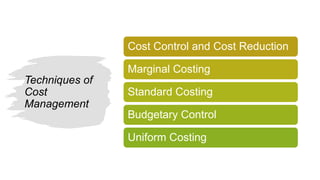
Techniques of
Cost
Management
Cost Control and Cost Reduction
Marginal Costing
Standard Costing
Budgetary Control
Uniform Costing
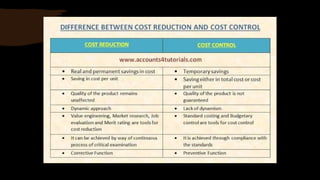
• Cost control is the practice of
identifying and reducing business
expenses to increase profits, and it
starts with the budgeting process.
Cost control is an important factor
in maintaining and growing
profitability.
• According to CIMA, Landon, “Cost
control is the regulation by executive
action of the cost of operating an
undertaking particularly where
action is guided by cost accounting”.
• Cost reduction is a planned positive
approach to reduce expenditure. It is a
corrective function by continuous process
of analysis of costs, functions, etc. for
further economy in application of factors
of production.
• According to CIMA Landon, “Cost
reduction refers to the achievement of real
and permanent reduction in the unit cost
of goods manufactured or services
rendered without impairing their
suitability for use intended”.
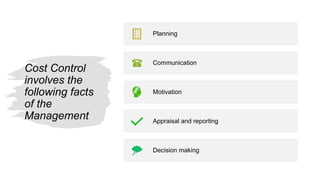
Cost Control
involves the
following facts
of the
Management
Planning
Communication
Motivation
Appraisal and reporting
Decision making
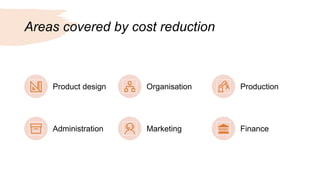
Areas covered by cost reduction
Product design Organisation Production
Administration Marketing Finance
PRODUCT DESIGN
• Product design is essentially the efficient
and effective generation and development of
ideas through a process that leads to new
products.
• The design of the product provides
the greatest scope for cost reduction.
Product design being the first step in
production, if cost reduction can be made at
design stage, then it is likely that the
benefits can be availed to the maximum.
Target Costing
• Target costing is a technique of cost
management which originated in Japan in
1970’s. Target costing is an approach to
determine a product's life-cycle cost which
should be sufficient to develop specified
functionality and quality, while ensuring its
desired profit. It involves setting a target
cost by subtracting a desired profit margin from
a competitive market price.
Features of
Target Costing
System
i. It is an integral part of the product design
and introduction of new products
ii. Target selling price is determined using
different forecasting techniques for any
given product.
iii. It is integral to setting the target selling
price for the establishment of target
production volumes, given the relationship
between price and volume.
iv. It determines cost reduction targets
Value analysis
Value analysis is an approach to improving the value of a product
or process by understanding its constituent components and their
associated costs. It then seeks to find improvements to the
components by either reducing their cost or increasing the value
of the functions.
According to CIMA “Value analysis is systematic inter-disciplinary
examination of factors affecting the cost of a product or service,
in order to devise means of achieving the specified purpose most
economically at the required standard of quality and reliability”.
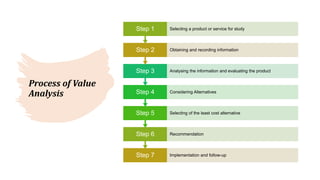
Process of Value
Analysis
Step 7 Implementation and follow-up
Step 6 Recommendation
Step 5 Selecting of the least cost alternative
Step 4 Considering Alternatives
Step 3 Analysing the information and evaluating the product
Step 2 Obtaining and recording information
Step 1 Selecting a product or service for study
Value
engineering
• Value engineering (VE) is a systematic
method to improve the value of goods or
products and services by using an
examination of function. Value can be
increased by either improving the function
or reducing the cost.
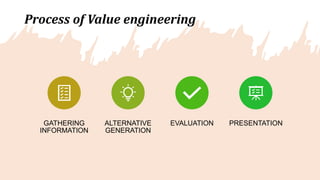
Process of Value engineering
GATHERING
INFORMATION
ALTERNATIVE
GENERATION
EVALUATION PRESENTATION
Value chain analysis
• Value chain analysis which helps to identify
a firm’s core competencies and distinguish
those activities that drive competitive
advantage. The cost structure of an
organization can be subdivided into
separate processes or functions assuming
that the cost drivers for each of these
activities behave differently.
Business
process Re-
Engineering
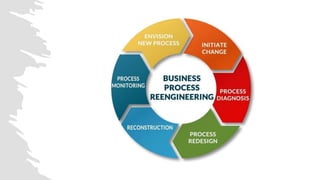
• Business process reengineering (BPR) is the
analysis and redesign of workflows within
and between enterprises in order to
optimize end-to-end processes and
automate non-value- added tasks.
• Hammer and champy suggested seven re-
engineering principles to streamline the
work process and thereby achieve
significant levels of improvement in quality,
time management, speed and profitability
1. Organize around outcomes, not tasks
2. Identify all the processes in an organization
and prioritize them in order of redesign
urgency.
3. Integrate information processing work into
the real work that produces the
information.
4. Treat geographically dispersed resources
as though they were centralized.
5. Link parallel activities in the workflow
instead of just integrating their results.
6. Put the decision point where the work is
performed and build control into the
process.
7. Capture information once and at the
source.
Thank you

Chapter 1 - Cost controal and cost reduction`

  • 1.
    Cost Management MR. KISHORES ASSISTANT PROFESSOR DEPT. OF COMMERCE AND MANAGEMENT SURANA COLLEGE, PEENYA
  • 2.
    Unit 1 COST CONTROLAND COST REDUCTION
  • 3.
    Contents • Meaning ofcost control and cost reduction, areas covered by cost control and cost reduction – product design, target costing, value analysis, value engineering, value chain analysis, Business Process Re- Engineering (theory only).
  • 4.
  • 5.
    Techniques of Cost Management Cost Controland Cost Reduction Marginal Costing Standard Costing Budgetary Control Uniform Costing
  • 6.
    • Cost controlis the practice of identifying and reducing business expenses to increase profits, and it starts with the budgeting process. Cost control is an important factor in maintaining and growing profitability. • According to CIMA, Landon, “Cost control is the regulation by executive action of the cost of operating an undertaking particularly where action is guided by cost accounting”.
  • 7.
    • Cost reductionis a planned positive approach to reduce expenditure. It is a corrective function by continuous process of analysis of costs, functions, etc. for further economy in application of factors of production. • According to CIMA Landon, “Cost reduction refers to the achievement of real and permanent reduction in the unit cost of goods manufactured or services rendered without impairing their suitability for use intended”.
  • 9.
    Cost Control involves the followingfacts of the Management Planning Communication Motivation Appraisal and reporting Decision making
  • 10.
    Areas covered bycost reduction Product design Organisation Production Administration Marketing Finance
  • 11.
    PRODUCT DESIGN • Productdesign is essentially the efficient and effective generation and development of ideas through a process that leads to new products. • The design of the product provides the greatest scope for cost reduction. Product design being the first step in production, if cost reduction can be made at design stage, then it is likely that the benefits can be availed to the maximum.
  • 12.
  • 13.
    • Target costingis a technique of cost management which originated in Japan in 1970’s. Target costing is an approach to determine a product's life-cycle cost which should be sufficient to develop specified functionality and quality, while ensuring its desired profit. It involves setting a target cost by subtracting a desired profit margin from a competitive market price.
  • 14.
    Features of Target Costing System i.It is an integral part of the product design and introduction of new products ii. Target selling price is determined using different forecasting techniques for any given product. iii. It is integral to setting the target selling price for the establishment of target production volumes, given the relationship between price and volume. iv. It determines cost reduction targets
  • 15.
  • 16.
    Value analysis isan approach to improving the value of a product or process by understanding its constituent components and their associated costs. It then seeks to find improvements to the components by either reducing their cost or increasing the value of the functions. According to CIMA “Value analysis is systematic inter-disciplinary examination of factors affecting the cost of a product or service, in order to devise means of achieving the specified purpose most economically at the required standard of quality and reliability”.
  • 17.
    Process of Value Analysis Step7 Implementation and follow-up Step 6 Recommendation Step 5 Selecting of the least cost alternative Step 4 Considering Alternatives Step 3 Analysing the information and evaluating the product Step 2 Obtaining and recording information Step 1 Selecting a product or service for study
  • 18.
    Value engineering • Value engineering(VE) is a systematic method to improve the value of goods or products and services by using an examination of function. Value can be increased by either improving the function or reducing the cost.
  • 19.
    Process of Valueengineering GATHERING INFORMATION ALTERNATIVE GENERATION EVALUATION PRESENTATION
  • 20.
    Value chain analysis •Value chain analysis which helps to identify a firm’s core competencies and distinguish those activities that drive competitive advantage. The cost structure of an organization can be subdivided into separate processes or functions assuming that the cost drivers for each of these activities behave differently.
  • 22.
    Business process Re- Engineering • Businessprocess reengineering (BPR) is the analysis and redesign of workflows within and between enterprises in order to optimize end-to-end processes and automate non-value- added tasks. • Hammer and champy suggested seven re- engineering principles to streamline the work process and thereby achieve significant levels of improvement in quality, time management, speed and profitability
  • 23.
    1. Organize aroundoutcomes, not tasks 2. Identify all the processes in an organization and prioritize them in order of redesign urgency. 3. Integrate information processing work into the real work that produces the information. 4. Treat geographically dispersed resources as though they were centralized. 5. Link parallel activities in the workflow instead of just integrating their results. 6. Put the decision point where the work is performed and build control into the process. 7. Capture information once and at the source.
  • 24.