MANAGERIAL ECONOMICS
     MODULE 4
             BY
        Mr. Anirban
 Christ College Institute of
        Management
         Bangalore


      Anirban / Micro Economics   Module 4 / CCIM   1
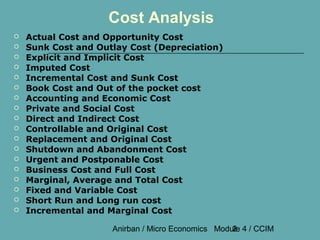
Cost Analysis
   Actual Cost and Opportunity Cost
   Sunk Cost and Outlay Cost (Depreciation)
   Explicit and Implicit Cost
   Imputed Cost
   Incremental Cost and Sunk Cost
   Book Cost and Out of the pocket cost
   Accounting and Economic Cost
   Private and Social Cost
   Direct and Indirect Cost
   Controllable and Original Cost
   Replacement and Original Cost
   Shutdown and Abandonment Cost
   Urgent and Postponable Cost
   Business Cost and Full Cost
   Marginal, Average and Total Cost
   Fixed and Variable Cost
   Short Run and Long run cost
   Incremental and Marginal Cost

                     Anirban / Micro Economics Module 4 / CCIM
                                                   2
Cost Analysis – Traditional Cost Theory
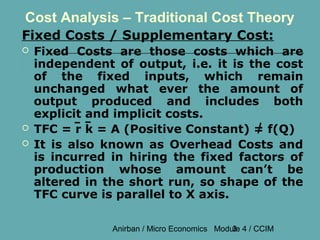
Fixed Costs / Supplementary Cost:
   Fixed Costs are those costs which are
    independent of output, i.e. it is the cost
    of the fixed inputs, which remain
    unchanged what ever the amount of
    output produced and includes both
    explicit and implicit costs.
   TFC = r k = A (Positive Constant) = f(Q)
   It is also known as Overhead Costs and
    is incurred in hiring the fixed factors of
    production whose amount can’t be
    altered in the short run, so shape of the
    TFC curve is parallel to X axis.

                Anirban / Micro Economics Module 4 / CCIM
                                              3
Cost Analysis – Traditional Cost Theory
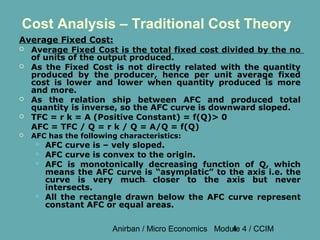
Average Fixed Cost:
   Average Fixed Cost is the total fixed cost divided by the no
    of units of the output produced.
   As the Fixed Cost is not directly related with the quantity
    produced by the producer, hence per unit average fixed
    cost is lower and lower when quantity produced is more
    and more.
   As the relation ship between AFC and produced total
    quantity is inverse, so the AFC curve is downward sloped.
   TFC = r k = A (Positive Constant) = f(Q)> 0
    AFC = TFC / Q = r k / Q = A/Q = f(Q)
   AFC has the following characteristics:
        AFC curve is – vely sloped.
        AFC curve is convex to the origin.
        AFC is monotonically decreasing function of Q, which
         means the AFC curve is “asymplatic” to the axis i.e. the
         curve is very much closer to the axis but never
         intersects.
        All the rectangle drawn below the AFC curve represent
         constant AFC or equal areas.


                        Anirban / Micro Economics Module 4 / CCIM
                                                      4
Cost Analysis – Traditional Cost Theory
Total Variable Costs:
   Variable costs are those costs which change of output,
    i.e. Variable costs are those costs which are incurred on
    the employment of the variable factors of production
    whose amount can be altered in the short run.
   Let in the cost function Labour is the only variable input,
    So TVC = w L, where
      L =     Amount of Labour employed,
      w    =    Price per unit of Labour (Wage) which is
        given         so fixed.
   The shape of the TVC curve reflects the “Law of variable
    proportion” that more and more output produced, it
    increases at a increasing rate, after point of inflection it
    increases at a diminishing rate.
   To the shape of the TVC curve is the mirror reflection of
    the total product curve, i.e. inverse S shape. (Concave
    [Convex] to the Q axis due to increasing [diminishing]
    returns and point of Inflection represents Constant
    returns.

                      Anirban / Micro Economics Module 4 / CCIM
                                                    5
Cost Analysis – Traditional Cost Theory
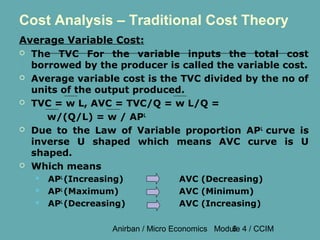
Average Variable Cost:
 The TVC For the variable inputs the total cost
  borrowed by the producer is called the variable cost.
 Average variable cost is the TVC divided by the no of
  units of the output produced.
 TVC = w L, AVC = TVC/Q = w L/Q =

     w/(Q/L) = w / APL
 Due to the Law of Variable proportion AP L curve is
  inverse U shaped which means AVC curve is U
  shaped.
 Which means
      APL (Increasing)             AVC (Decreasing)
      APL (Maximum)                AVC (Minimum)
      APL (Decreasing)             AVC (Increasing)

                    Anirban / Micro Economics Module 4 / CCIM
                                                  6
Cost Analysis – Traditional Cost Theory
Marginal Cost:
   Marginal Cost represents the last unit cost, i.e.
    addition to the total cost of production due to
    the increase in production by one unit.
   MC = d/dq (TC) = [TC2 – TC1] / [Q2 – Q1]
   If TC2 > TC1 , MC >0
   If TC2 < TC1 , MC <0
   If TC2 = TC1 , MC =0
   Theoretically MC may be positive or negative
    but rational production behaviour considering
    Positive MC.
Total Cost:
   TC = TFC + TVC
   AC = AFC + AVC

                  Anirban / Micro Economics Module 4 / CCIM
                                                7
Cost Analysis – Traditional Cost Theory
Problems:
   Obtain the break even level of output x, given
    the following information: [Ans: 40000]
      Cost Function           : C = 200000 + 10x
      Revenue Function        : R = 15x
   The total cost of production of firm is given by
    the following function: [P = 1.72]
            C = (5/13)x + 200
    If the quantity sold is Rs 150 units, at what
    price should the firm sell so as to break even?
   If the Cost function is C(x) = 5x + 350 and
    Revenue function is R(x) = 50x – x2, Find the
    Break even Values, [10, 35]


                Anirban / Micro Economics Module 4 / CCIM
                                              8
Cost Analysis – Traditional Cost Theory
   If the total cost function is written as TC =
    1/3X3 – 3X2 + 9X, where X is the output in
    thousands units. At what level output, AC is
    minimum. [4500 units]
   The total cost of production of a firm is
    given by the following function :
       C = 5/13 X + 200. Find
    a) The total cost on output of 65 units.
    b) The AC for an output of 100 units.
    c) The marginal cost for an output of 50
    units.
    d) If the quantity sold is 150units, at what
    price should the firm    sell so    as to
    break even? [225, 31/13, 5/13, 67/39]


                 Anirban / Micro Economics Module 4 / CCIM
                                               9
Cost Analysis – Traditional Cost Theory
   The following information is given below:
       Demand Function     : P = 12 – 0.4q
       Cost Function       : C = 5 + 4q + 0.6q2,
    Where C denotes the total cost, P is the
    price per unit and q is the quantity
    produced. Determine P and q in order to
    maximize the total profit. [ q = 4 and P =
    10.6]
   A firm has the following functions, find the
    maximum profit. [Profit = 5000]
       Revenue Function (R):R = 100q – q2
       Cost Function (C)     :C = q3 – 57/2 q2


                 Anirban / Micro Economics Module 4 / CCIM
                                               10

Cost

  • 1.
    MANAGERIAL ECONOMICS MODULE 4 BY Mr. Anirban Christ College Institute of Management Bangalore Anirban / Micro Economics Module 4 / CCIM 1
  • 2.
    Cost Analysis  Actual Cost and Opportunity Cost  Sunk Cost and Outlay Cost (Depreciation)  Explicit and Implicit Cost  Imputed Cost  Incremental Cost and Sunk Cost  Book Cost and Out of the pocket cost  Accounting and Economic Cost  Private and Social Cost  Direct and Indirect Cost  Controllable and Original Cost  Replacement and Original Cost  Shutdown and Abandonment Cost  Urgent and Postponable Cost  Business Cost and Full Cost  Marginal, Average and Total Cost  Fixed and Variable Cost  Short Run and Long run cost  Incremental and Marginal Cost Anirban / Micro Economics Module 4 / CCIM 2
  • 3.
    Cost Analysis –Traditional Cost Theory Fixed Costs / Supplementary Cost:  Fixed Costs are those costs which are independent of output, i.e. it is the cost of the fixed inputs, which remain unchanged what ever the amount of output produced and includes both explicit and implicit costs.  TFC = r k = A (Positive Constant) = f(Q)  It is also known as Overhead Costs and is incurred in hiring the fixed factors of production whose amount can’t be altered in the short run, so shape of the TFC curve is parallel to X axis. Anirban / Micro Economics Module 4 / CCIM 3
  • 4.
    Cost Analysis –Traditional Cost Theory Average Fixed Cost:  Average Fixed Cost is the total fixed cost divided by the no of units of the output produced.  As the Fixed Cost is not directly related with the quantity produced by the producer, hence per unit average fixed cost is lower and lower when quantity produced is more and more.  As the relation ship between AFC and produced total quantity is inverse, so the AFC curve is downward sloped.  TFC = r k = A (Positive Constant) = f(Q)> 0 AFC = TFC / Q = r k / Q = A/Q = f(Q)  AFC has the following characteristics:  AFC curve is – vely sloped.  AFC curve is convex to the origin.  AFC is monotonically decreasing function of Q, which means the AFC curve is “asymplatic” to the axis i.e. the curve is very much closer to the axis but never intersects.  All the rectangle drawn below the AFC curve represent constant AFC or equal areas. Anirban / Micro Economics Module 4 / CCIM 4
  • 5.
    Cost Analysis –Traditional Cost Theory Total Variable Costs:  Variable costs are those costs which change of output, i.e. Variable costs are those costs which are incurred on the employment of the variable factors of production whose amount can be altered in the short run.  Let in the cost function Labour is the only variable input, So TVC = w L, where  L = Amount of Labour employed,  w = Price per unit of Labour (Wage) which is given so fixed.  The shape of the TVC curve reflects the “Law of variable proportion” that more and more output produced, it increases at a increasing rate, after point of inflection it increases at a diminishing rate.  To the shape of the TVC curve is the mirror reflection of the total product curve, i.e. inverse S shape. (Concave [Convex] to the Q axis due to increasing [diminishing] returns and point of Inflection represents Constant returns. Anirban / Micro Economics Module 4 / CCIM 5
  • 6.
    Cost Analysis –Traditional Cost Theory Average Variable Cost:  The TVC For the variable inputs the total cost borrowed by the producer is called the variable cost.  Average variable cost is the TVC divided by the no of units of the output produced.  TVC = w L, AVC = TVC/Q = w L/Q = w/(Q/L) = w / APL  Due to the Law of Variable proportion AP L curve is inverse U shaped which means AVC curve is U shaped.  Which means  APL (Increasing) AVC (Decreasing)  APL (Maximum) AVC (Minimum)  APL (Decreasing) AVC (Increasing) Anirban / Micro Economics Module 4 / CCIM 6
  • 7.
    Cost Analysis –Traditional Cost Theory Marginal Cost:  Marginal Cost represents the last unit cost, i.e. addition to the total cost of production due to the increase in production by one unit.  MC = d/dq (TC) = [TC2 – TC1] / [Q2 – Q1]  If TC2 > TC1 , MC >0  If TC2 < TC1 , MC <0  If TC2 = TC1 , MC =0  Theoretically MC may be positive or negative but rational production behaviour considering Positive MC. Total Cost:  TC = TFC + TVC  AC = AFC + AVC Anirban / Micro Economics Module 4 / CCIM 7
  • 8.
    Cost Analysis –Traditional Cost Theory Problems:  Obtain the break even level of output x, given the following information: [Ans: 40000] Cost Function : C = 200000 + 10x Revenue Function : R = 15x  The total cost of production of firm is given by the following function: [P = 1.72] C = (5/13)x + 200 If the quantity sold is Rs 150 units, at what price should the firm sell so as to break even?  If the Cost function is C(x) = 5x + 350 and Revenue function is R(x) = 50x – x2, Find the Break even Values, [10, 35] Anirban / Micro Economics Module 4 / CCIM 8
  • 9.
    Cost Analysis –Traditional Cost Theory  If the total cost function is written as TC = 1/3X3 – 3X2 + 9X, where X is the output in thousands units. At what level output, AC is minimum. [4500 units]  The total cost of production of a firm is given by the following function : C = 5/13 X + 200. Find a) The total cost on output of 65 units. b) The AC for an output of 100 units. c) The marginal cost for an output of 50 units. d) If the quantity sold is 150units, at what price should the firm sell so as to break even? [225, 31/13, 5/13, 67/39] Anirban / Micro Economics Module 4 / CCIM 9
  • 10.
    Cost Analysis –Traditional Cost Theory  The following information is given below: Demand Function : P = 12 – 0.4q Cost Function : C = 5 + 4q + 0.6q2, Where C denotes the total cost, P is the price per unit and q is the quantity produced. Determine P and q in order to maximize the total profit. [ q = 4 and P = 10.6]  A firm has the following functions, find the maximum profit. [Profit = 5000] Revenue Function (R):R = 100q – q2 Cost Function (C) :C = q3 – 57/2 q2 Anirban / Micro Economics Module 4 / CCIM 10