COST THEORY AND ANALYSIS
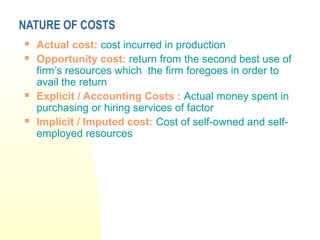
NATURE OF COSTS
 Actual cost: cost incurred in production
 Opportunity cost: return from the second best use of
firm’s resources which the firm foregoes in order to
avail the return
 Explicit / Accounting Costs : Actual money spent in
purchasing or hiring services of factor
 Implicit / Imputed cost: Cost of self-owned and self-
employed resources
 Fixed costs: Costs which do not change with change
in Out Put.
 Variable or Prime costs: Costs which change with
change in level of Out Put
 Accounting costs: Cost as stated in books of
accounts (explicit cost only)
 Economic Costs: includes both explicit & implicit cost
NATURE OF COSTS
 Marginal cost: Change in total cost associated with
a one-unit change in output
 Incremental Costs: Total additional cost of
implementing a managerial decision
 Sunk Costs: costs which do not change by varying
the nature or level of business activity
NATURE OF COSTS
NATURE OF COSTS
 Private cost: Actually incurred or provided for by an
individual for its business activity
 Social cost: Cost to society on account of production of
good
 Original cost: cost incurred originally
 Replacement cost: cost incurred in replacing
EXERCISE
A Carpenter makes 100 chairs per month & sells them at
Rs 150 per piece. His expenses on rent of shop, cost of
wood & other materials are worth Rs 5000. He employs 2
workers whose monthly wage bill stand at Rs 2400 & pays
electricity bill of Rs 500 per month. He has invested Rs
50,000 in the form of machines, tools & inventories of
which Rs 25,000 is from his own fund & remaining 25,000
is a loan from bank at interest rate of 18% p.a. Assuming
imputed cost of his own time, own shop & own savings of
Rs 25000 as Rs 3000, Rs 1000 & Rs 250 respectively,
find:
 Explicit cost
 Implicit cost
 Accounting profit
 Economic profit
ANSWERS
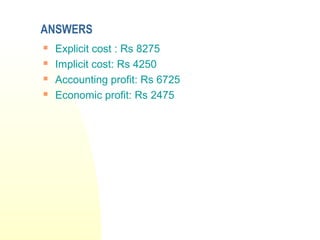
 Explicit cost : Rs 8275
 Implicit cost: Rs 4250
 Accounting profit: Rs 6725
 Economic profit: Rs 2475
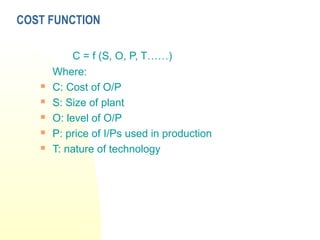
COST FUNCTION
C = f (S, O, P, T……)
Where:
 C: Cost of O/P
 S: Size of plant
 O: level of O/P
 P: price of I/Ps used in production
 T: nature of technology
SR RELATIONSHIP BETWEEN PRODUCTION AND
COST
 A firm’s cost structure is intimately related to its
production process
 Costs are determined by the production technology and
input prices
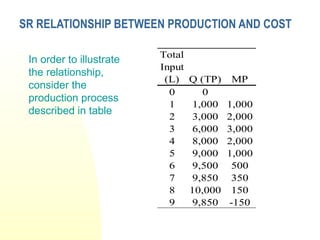
SR RELATIONSHIP BETWEEN PRODUCTION AND COST
In order to illustrate
the relationship,
consider the
production process
described in table
Total
Input
(L) Q (TP) MP
0 0
1 1,000 1,000
2 3,000 2,000
3 6,000 3,000
4 8,000 2,000
5 9,000 1,000
6 9,500 500
7 9,850 350
8 10,000 150
9 9,850 -150
SR RELATIONSHIP BETWEEN PRODUCTION & COST
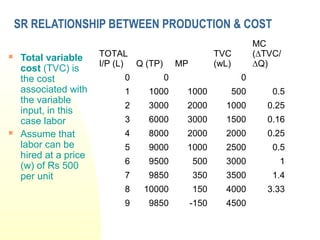
 Total variable
cost (TVC) is
the cost
associated with
the variable
input, in this
case labor
 Assume that
labor can be
hired at a price
(w) of Rs 500
per unit
TOTAL
I/P (L) Q (TP) MP
TVC
(wL)
MC
(∆TVC/
∆Q)
0 0 0
1 1000 1000 500 0.5
2 3000 2000 1000 0.25
3 6000 3000 1500 0.16
4 8000 2000 2000 0.25
5 9000 1000 2500 0.5
6 9500 500 3000 1
7 9850 350 3500 1.4
8 10000 150 4000 3.33
9 9850 -150 4500
SR RELATIONSHIP BETWEEN PRODUCTION & COST
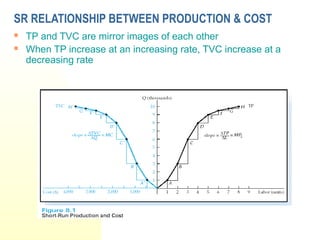
 TP and TVC are mirror images of each other
 When TP increase at an increasing rate, TVC increase at a
decreasing rate
RELATION B/W MP & MC
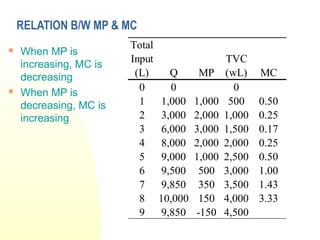
 When MP is
increasing, MC is
decreasing
 When MP is
decreasing, MC is
increasing
Total
Input
(L) Q MP
TVC
(wL) MC
0 0 0
1 1,000 1,000 500 0.50
2 3,000 2,000 1,000 0.25
3 6,000 3,000 1,500 0.17
4 8,000 2,000 2,000 0.25
5 9,000 1,000 2,500 0.50
6 9,500 500 3,000 1.00
7 9,850 350 3,500 1.43
8 10,000 150 4,000 3.33
9 9,850 -150 4,500
SHORT-RUN COST FUNCTIONS
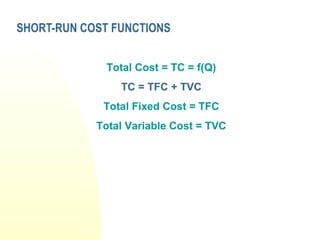
Total Cost = TC = f(Q)
TC = TFC + TVC
Total Fixed Cost = TFC
Total Variable Cost = TVC
SHORT-RUN COST FUNCTIONS
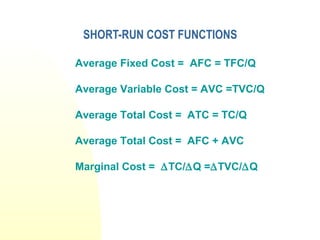
Average Fixed Cost = AFC = TFC/Q
Average Variable Cost = AVC =TVC/Q
Average Total Cost = ATC = TC/Q
Average Total Cost = AFC + AVC
Marginal Cost = ∆TC/∆Q =∆TVC/∆Q
SHORT-RUN COST FUNCTIONS
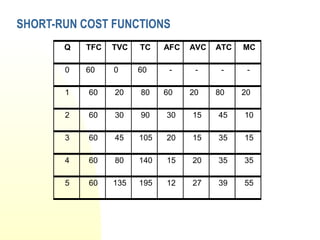
Q TFC TVC TC AFC AVC ATC MC
0 60 0 60 - - - -
1 60 20 80 60 20 80 20
2 60 30 90 30 15 45 10
3 60 45 105 20 15 35 15
4 60 80 140 15 20 35 35
5 60 135 195 12 27 39 55
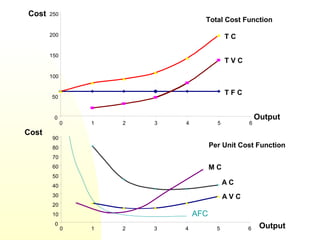
0
50
100
150
200
250
0 1 2 3 4 5 6
Output
Output
Cost
Cost
Total Cost Function
Per Unit Cost Function
0
10
20
30
40
50
60
70
80
90
0 1 2 3 4 5 6
T C
A V C
A C
M C
T F C
T V C
AFC
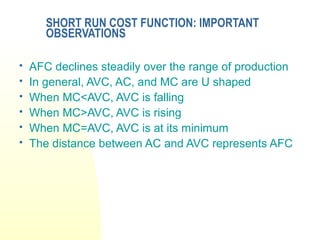
SHORT RUN COST FUNCTION: IMPORTANT
OBSERVATIONS
 AFC declines steadily over the range of production
 In general, AVC, AC, and MC are U shaped
 When MC<AVC, AVC is falling
 When MC>AVC, AVC is rising
 When MC=AVC, AVC is at its minimum
 The distance between AC and AVC represents AFC
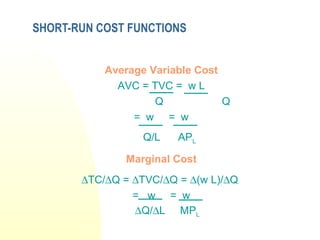
SHORT-RUN COST FUNCTIONS
Average Variable Cost
AVC = TVC = w L
Q Q
= w = w
Q/L APL
Marginal Cost
∆TC/∆Q = ∆TVC/∆Q = ∆(w L)/∆Q
= w = w
∆Q/∆L MPL
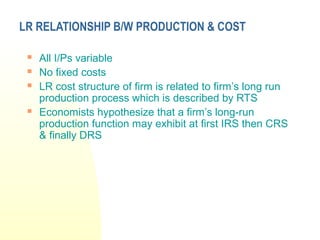
LR RELATIONSHIP B/W PRODUCTION & COST
 All I/Ps variable
 No fixed costs
 LR cost structure of firm is related to firm’s long run
production process which is described by RTS
 Economists hypothesize that a firm’s long-run
production function may exhibit at first IRS then CRS
& finally DRS
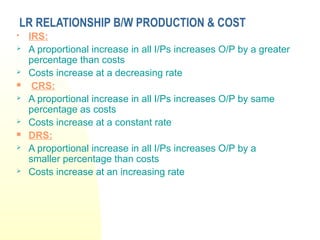
LR RELATIONSHIP B/W PRODUCTION & COST
 IRS:
 A proportional increase in all I/Ps increases O/P by a greater
percentage than costs
 Costs increase at a decreasing rate
 CRS:
 A proportional increase in all I/Ps increases O/P by same
percentage as costs
 Costs increase at a constant rate
 DRS:
 A proportional increase in all I/Ps increases O/P by a
smaller percentage than costs
 Costs increase at an increasing rate
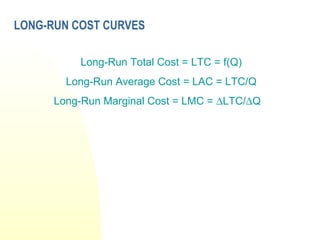
LONG-RUN COST CURVES
Long-Run Total Cost = LTC = f(Q)
Long-Run Average Cost = LAC = LTC/Q
Long-Run Marginal Cost = LMC = ∆LTC/∆Q
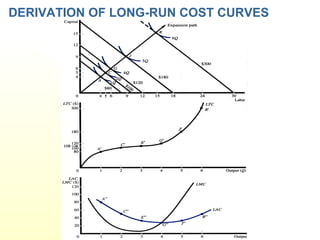
DERIVATION OF LONG-RUN COST CURVES
LAC
 shows the lowest average cost of producing each
level of O/P when the firm can build the most
appropriate plant to produce each level of O/P
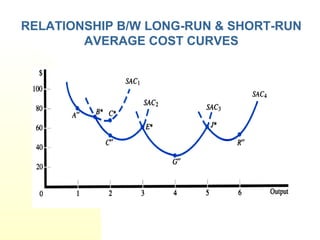
RELATIONSHIP B/W LONG-RUN & SHORT-RUN
AVERAGE COST CURVES
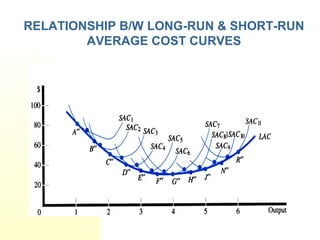
RELATIONSHIP B/W LONG-RUN & SHORT-RUN
AVERAGE COST CURVES
LONG-RUN COST FUNCTION
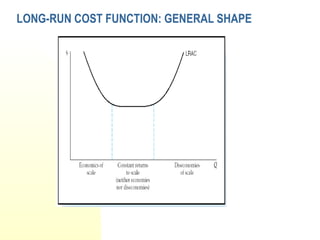
 When LRAC declines: firm experiences
economies of scale (per-unit costs are falling)
 When LRAC increases: firm experiences
diseconomies of scale (per-unit costs are rising)
LONG-RUN COST FUNCTION: GENERAL SHAPE
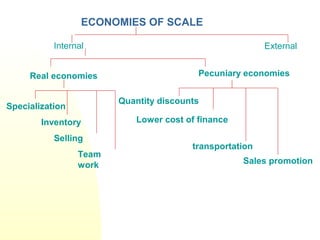
ECONOMIES OF SCALE
Inventory
Specialization
Team
work
Real economies Pecuniary economies
transportation
Lower cost of finance
Quantity discounts
Selling
Internal External
Sales promotion
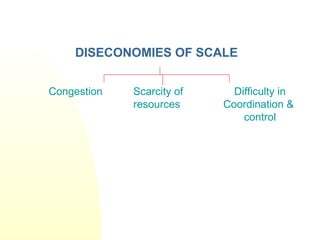
DISECONOMIES OF SCALE
Congestion Difficulty in
Coordination &
control
Scarcity of
resources
MANAGERIAL USES OF COST FUNCTIONS:
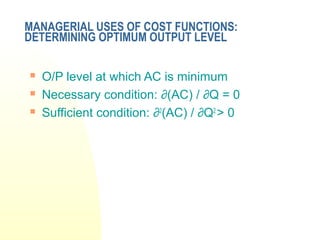
DETERMINING OPTIMUM OUTPUT LEVEL
 O/P level at which AC is minimum
 Necessary condition: ∂(AC) / ∂Q = 0
 Sufficient condition: ∂2
(AC) / ∂Q2
> 0
MANAGERIAL USES OF COST FUNCTIONS:
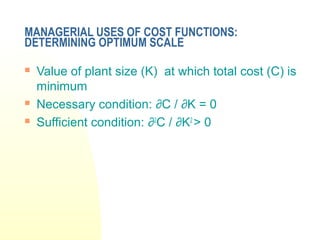
DETERMINING OPTIMUM SCALE
 Value of plant size (K) at which total cost (C) is
minimum
 Necessary condition: ∂C / ∂K = 0
 Sufficient condition: ∂2
C / ∂K2
> 0
SPECIAL TOPICS IN COST THEORY
(1) PROFIT CONTRIBUTION ANALYSIS
Total Revenue = TR = (P)(Q)
Total Cost = TC = TFC + (AVC)(Q)
Profit = TR -TC
Profit = Π = PQ - [TFC + (AVC)(Q)]
Q = TFC + Π
P - (AVC)
Profit contribution = P - AVC
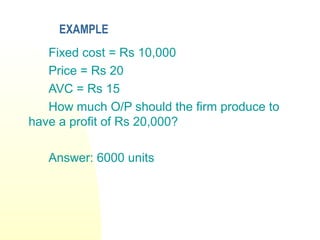
EXAMPLE
Fixed cost = Rs 10,000
Price = Rs 20
AVC = Rs 15
How much O/P should the firm produce to
have a profit of Rs 20,000?
Answer: 6000 units
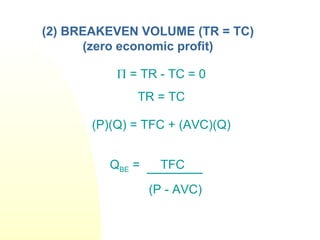
Π = TR - TC = 0
TR = TC
(P)(Q) = TFC + (AVC)(Q)
(2) BREAKEVEN VOLUME (TR = TC)
(zero economic profit)
QBE = TFC
(P - AVC)
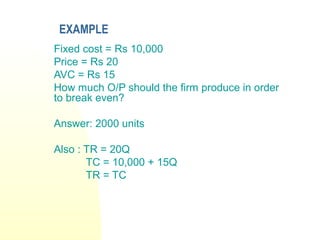
EXAMPLE
Fixed cost = Rs 10,000
Price = Rs 20
AVC = Rs 15
How much O/P should the firm produce in order
to break even?
Answer: 2000 units
Also : TR = 20Q
TC = 10,000 + 15Q
TR = TC
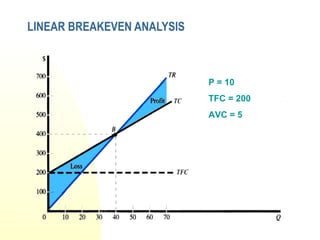
LINEAR BREAKEVEN ANALYSIS
P = 10
TFC = 200
AVC = 5
LINEAR BREAKEVEN ANALYSIS: SHORTCOMINGS
 Assumes constant prices
 Assumes constant average variable costs
EXCERCISE
 Petersen & Lewis Page # 248: Breaking even on
Microcomputer software
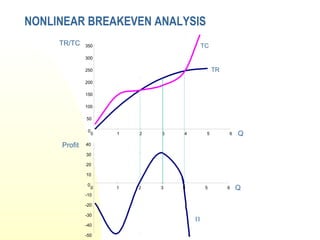
0
50
100
150
200
250
300
350
0 1 2 3 4 5 6
TR/TC
Q
TC
TR
-50
-40
-30
-20
-10
0
10
20
30
40
0 1 2 3 4 5 6
Profit
Q
Π
NONLINEAR BREAKEVEN ANALYSIS
(3) OPERATING LEVERAGE
Operating Leverage = TFC/TVC
Degree of Operating Leverage (or profit elasticity) = DOL
Π = PQ - TFC + (AVC)(Q)
= Q(P - AVC) - TFC
∆Π = ∆Q(P - AVC)
DOL = %∆Π = ∆Π/ Π = ∆Π * Q = E Π
%∆Q ∆Q/Q ∆Q Π
DOL = ∆Q(P - AVC)Q = Q(P - AVC)
∆Q[Q(P - AVC) - TFC] Q(P - AVC) - TFC
(4) LEARNING CURVE
 Workers improve with practice so per unit cost of
additional O/P declines
 Measures % decrease in additional labor cost
each time O/P doubles
 An “80 percent” learning curve implies that each
time O/P doubles, L costs associated with
incremental output decrease to 80% of previous
level
UTILITY OF LEARNING CURVES
 To forecast needs of
 personnel
 machinery
 raw materials
 Scheduling production
 Determining Selling price of product
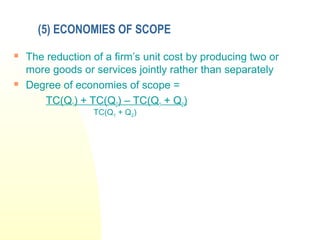
(5) ECONOMIES OF SCOPE
 The reduction of a firm’s unit cost by producing two or
more goods or services jointly rather than separately
 Degree of economies of scope =
TC(Q1) + TC(Q2) – TC(Q1 + Q2)
TC(Q1 + Q2)
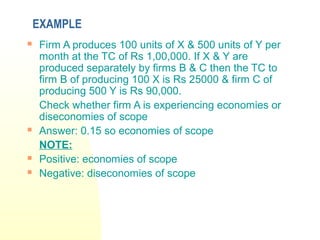
EXAMPLE
 Firm A produces 100 units of X & 500 units of Y per
month at the TC of Rs 1,00,000. If X & Y are
produced separately by firms B & C then the TC to
firm B of producing 100 X is Rs 25000 & firm C of
producing 500 Y is Rs 90,000.
Check whether firm A is experiencing economies or
diseconomies of scope
 Answer: 0.15 so economies of scope
NOTE:
 Positive: economies of scope
 Negative: diseconomies of scope

F0dd9 cost

  • 1.
  • 2.
    NATURE OF COSTS Actual cost: cost incurred in production  Opportunity cost: return from the second best use of firm’s resources which the firm foregoes in order to avail the return  Explicit / Accounting Costs : Actual money spent in purchasing or hiring services of factor  Implicit / Imputed cost: Cost of self-owned and self- employed resources
  • 3.
     Fixed costs:Costs which do not change with change in Out Put.  Variable or Prime costs: Costs which change with change in level of Out Put  Accounting costs: Cost as stated in books of accounts (explicit cost only)  Economic Costs: includes both explicit & implicit cost NATURE OF COSTS
  • 4.
     Marginal cost:Change in total cost associated with a one-unit change in output  Incremental Costs: Total additional cost of implementing a managerial decision  Sunk Costs: costs which do not change by varying the nature or level of business activity NATURE OF COSTS
  • 5.
    NATURE OF COSTS Private cost: Actually incurred or provided for by an individual for its business activity  Social cost: Cost to society on account of production of good  Original cost: cost incurred originally  Replacement cost: cost incurred in replacing
  • 6.
    EXERCISE A Carpenter makes100 chairs per month & sells them at Rs 150 per piece. His expenses on rent of shop, cost of wood & other materials are worth Rs 5000. He employs 2 workers whose monthly wage bill stand at Rs 2400 & pays electricity bill of Rs 500 per month. He has invested Rs 50,000 in the form of machines, tools & inventories of which Rs 25,000 is from his own fund & remaining 25,000 is a loan from bank at interest rate of 18% p.a. Assuming imputed cost of his own time, own shop & own savings of Rs 25000 as Rs 3000, Rs 1000 & Rs 250 respectively, find:  Explicit cost  Implicit cost  Accounting profit  Economic profit
  • 7.
    ANSWERS  Explicit cost: Rs 8275  Implicit cost: Rs 4250  Accounting profit: Rs 6725  Economic profit: Rs 2475
  • 8.
    COST FUNCTION C =f (S, O, P, T……) Where:  C: Cost of O/P  S: Size of plant  O: level of O/P  P: price of I/Ps used in production  T: nature of technology
  • 9.
    SR RELATIONSHIP BETWEENPRODUCTION AND COST  A firm’s cost structure is intimately related to its production process  Costs are determined by the production technology and input prices
  • 10.
    SR RELATIONSHIP BETWEENPRODUCTION AND COST In order to illustrate the relationship, consider the production process described in table Total Input (L) Q (TP) MP 0 0 1 1,000 1,000 2 3,000 2,000 3 6,000 3,000 4 8,000 2,000 5 9,000 1,000 6 9,500 500 7 9,850 350 8 10,000 150 9 9,850 -150
  • 11.
    SR RELATIONSHIP BETWEENPRODUCTION & COST  Total variable cost (TVC) is the cost associated with the variable input, in this case labor  Assume that labor can be hired at a price (w) of Rs 500 per unit TOTAL I/P (L) Q (TP) MP TVC (wL) MC (∆TVC/ ∆Q) 0 0 0 1 1000 1000 500 0.5 2 3000 2000 1000 0.25 3 6000 3000 1500 0.16 4 8000 2000 2000 0.25 5 9000 1000 2500 0.5 6 9500 500 3000 1 7 9850 350 3500 1.4 8 10000 150 4000 3.33 9 9850 -150 4500
  • 12.
    SR RELATIONSHIP BETWEENPRODUCTION & COST  TP and TVC are mirror images of each other  When TP increase at an increasing rate, TVC increase at a decreasing rate
  • 13.
    RELATION B/W MP& MC  When MP is increasing, MC is decreasing  When MP is decreasing, MC is increasing Total Input (L) Q MP TVC (wL) MC 0 0 0 1 1,000 1,000 500 0.50 2 3,000 2,000 1,000 0.25 3 6,000 3,000 1,500 0.17 4 8,000 2,000 2,000 0.25 5 9,000 1,000 2,500 0.50 6 9,500 500 3,000 1.00 7 9,850 350 3,500 1.43 8 10,000 150 4,000 3.33 9 9,850 -150 4,500
  • 14.
    SHORT-RUN COST FUNCTIONS TotalCost = TC = f(Q) TC = TFC + TVC Total Fixed Cost = TFC Total Variable Cost = TVC
  • 15.
    SHORT-RUN COST FUNCTIONS AverageFixed Cost = AFC = TFC/Q Average Variable Cost = AVC =TVC/Q Average Total Cost = ATC = TC/Q Average Total Cost = AFC + AVC Marginal Cost = ∆TC/∆Q =∆TVC/∆Q
  • 16.
    SHORT-RUN COST FUNCTIONS QTFC TVC TC AFC AVC ATC MC 0 60 0 60 - - - - 1 60 20 80 60 20 80 20 2 60 30 90 30 15 45 10 3 60 45 105 20 15 35 15 4 60 80 140 15 20 35 35 5 60 135 195 12 27 39 55
  • 17.
    0 50 100 150 200 250 0 1 23 4 5 6 Output Output Cost Cost Total Cost Function Per Unit Cost Function 0 10 20 30 40 50 60 70 80 90 0 1 2 3 4 5 6 T C A V C A C M C T F C T V C AFC
  • 18.
    SHORT RUN COSTFUNCTION: IMPORTANT OBSERVATIONS  AFC declines steadily over the range of production  In general, AVC, AC, and MC are U shaped  When MC<AVC, AVC is falling  When MC>AVC, AVC is rising  When MC=AVC, AVC is at its minimum  The distance between AC and AVC represents AFC
  • 19.
    SHORT-RUN COST FUNCTIONS AverageVariable Cost AVC = TVC = w L Q Q = w = w Q/L APL Marginal Cost ∆TC/∆Q = ∆TVC/∆Q = ∆(w L)/∆Q = w = w ∆Q/∆L MPL
  • 20.
    LR RELATIONSHIP B/WPRODUCTION & COST  All I/Ps variable  No fixed costs  LR cost structure of firm is related to firm’s long run production process which is described by RTS  Economists hypothesize that a firm’s long-run production function may exhibit at first IRS then CRS & finally DRS
  • 21.
    LR RELATIONSHIP B/WPRODUCTION & COST  IRS:  A proportional increase in all I/Ps increases O/P by a greater percentage than costs  Costs increase at a decreasing rate  CRS:  A proportional increase in all I/Ps increases O/P by same percentage as costs  Costs increase at a constant rate  DRS:  A proportional increase in all I/Ps increases O/P by a smaller percentage than costs  Costs increase at an increasing rate
  • 22.
    LONG-RUN COST CURVES Long-RunTotal Cost = LTC = f(Q) Long-Run Average Cost = LAC = LTC/Q Long-Run Marginal Cost = LMC = ∆LTC/∆Q
  • 23.
  • 24.
    LAC  shows thelowest average cost of producing each level of O/P when the firm can build the most appropriate plant to produce each level of O/P
  • 25.
    RELATIONSHIP B/W LONG-RUN& SHORT-RUN AVERAGE COST CURVES
  • 26.
    RELATIONSHIP B/W LONG-RUN& SHORT-RUN AVERAGE COST CURVES
  • 27.
    LONG-RUN COST FUNCTION When LRAC declines: firm experiences economies of scale (per-unit costs are falling)  When LRAC increases: firm experiences diseconomies of scale (per-unit costs are rising)
  • 28.
  • 29.
    ECONOMIES OF SCALE Inventory Specialization Team work Realeconomies Pecuniary economies transportation Lower cost of finance Quantity discounts Selling Internal External Sales promotion
  • 30.
    DISECONOMIES OF SCALE CongestionDifficulty in Coordination & control Scarcity of resources
  • 31.
    MANAGERIAL USES OFCOST FUNCTIONS: DETERMINING OPTIMUM OUTPUT LEVEL  O/P level at which AC is minimum  Necessary condition: ∂(AC) / ∂Q = 0  Sufficient condition: ∂2 (AC) / ∂Q2 > 0
  • 32.
    MANAGERIAL USES OFCOST FUNCTIONS: DETERMINING OPTIMUM SCALE  Value of plant size (K) at which total cost (C) is minimum  Necessary condition: ∂C / ∂K = 0  Sufficient condition: ∂2 C / ∂K2 > 0
  • 33.
    SPECIAL TOPICS INCOST THEORY
  • 34.
    (1) PROFIT CONTRIBUTIONANALYSIS Total Revenue = TR = (P)(Q) Total Cost = TC = TFC + (AVC)(Q) Profit = TR -TC Profit = Π = PQ - [TFC + (AVC)(Q)] Q = TFC + Π P - (AVC) Profit contribution = P - AVC
  • 35.
    EXAMPLE Fixed cost =Rs 10,000 Price = Rs 20 AVC = Rs 15 How much O/P should the firm produce to have a profit of Rs 20,000? Answer: 6000 units
  • 36.
    Π = TR- TC = 0 TR = TC (P)(Q) = TFC + (AVC)(Q) (2) BREAKEVEN VOLUME (TR = TC) (zero economic profit) QBE = TFC (P - AVC)
  • 37.
    EXAMPLE Fixed cost =Rs 10,000 Price = Rs 20 AVC = Rs 15 How much O/P should the firm produce in order to break even? Answer: 2000 units Also : TR = 20Q TC = 10,000 + 15Q TR = TC
  • 38.
    LINEAR BREAKEVEN ANALYSIS P= 10 TFC = 200 AVC = 5
  • 39.
    LINEAR BREAKEVEN ANALYSIS:SHORTCOMINGS  Assumes constant prices  Assumes constant average variable costs
  • 40.
    EXCERCISE  Petersen &Lewis Page # 248: Breaking even on Microcomputer software
  • 41.
    0 50 100 150 200 250 300 350 0 1 23 4 5 6 TR/TC Q TC TR -50 -40 -30 -20 -10 0 10 20 30 40 0 1 2 3 4 5 6 Profit Q Π NONLINEAR BREAKEVEN ANALYSIS
  • 42.
    (3) OPERATING LEVERAGE OperatingLeverage = TFC/TVC Degree of Operating Leverage (or profit elasticity) = DOL Π = PQ - TFC + (AVC)(Q) = Q(P - AVC) - TFC ∆Π = ∆Q(P - AVC) DOL = %∆Π = ∆Π/ Π = ∆Π * Q = E Π %∆Q ∆Q/Q ∆Q Π DOL = ∆Q(P - AVC)Q = Q(P - AVC) ∆Q[Q(P - AVC) - TFC] Q(P - AVC) - TFC
  • 43.
    (4) LEARNING CURVE Workers improve with practice so per unit cost of additional O/P declines  Measures % decrease in additional labor cost each time O/P doubles  An “80 percent” learning curve implies that each time O/P doubles, L costs associated with incremental output decrease to 80% of previous level
  • 44.
    UTILITY OF LEARNINGCURVES  To forecast needs of  personnel  machinery  raw materials  Scheduling production  Determining Selling price of product
  • 45.
    (5) ECONOMIES OFSCOPE  The reduction of a firm’s unit cost by producing two or more goods or services jointly rather than separately  Degree of economies of scope = TC(Q1) + TC(Q2) – TC(Q1 + Q2) TC(Q1 + Q2)
  • 46.
    EXAMPLE  Firm Aproduces 100 units of X & 500 units of Y per month at the TC of Rs 1,00,000. If X & Y are produced separately by firms B & C then the TC to firm B of producing 100 X is Rs 25000 & firm C of producing 500 Y is Rs 90,000. Check whether firm A is experiencing economies or diseconomies of scope  Answer: 0.15 so economies of scope NOTE:  Positive: economies of scope  Negative: diseconomies of scope