Presentation on :
Types of cost
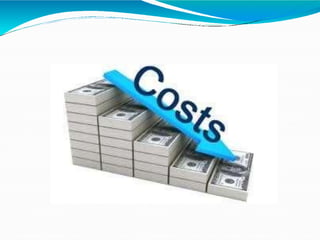
A cost is the value of money that has been used up to
produce something.
Definition of cost
The expenses faced by the business in the process of
supplying goods and services to consumer
Types of costs
 Opportunity cost and actualcost
 Direct and indirectcost
 Explicit and implicitcost
 Historical and replacementcost
 Fixed cost and variablecost
 Real and primecost
 Total,average,and marginal cost
Opportunity cost and actual cost
Opportunity cost : Cost incurred for
loosing next best alternative
Actual cost : An actual amount paid or incurred, as
opposed to estimated cost or standard cost.
Explicit and implicit cost
Explicit cost refers to the money expended to buy or
hire resources from outside the organization for the
process of production
Implicit cost refers to the cost of use of the self owned
resources of organization that are used in production
Direct and Indirect cost
Direct cost is acost.
Direct Cost: Direct costs are those cost that have directly
accountable to specific cost object such as a process or
product
Ex:wages paid ,salary paid labor, material…etc
Indirect cost:
Indirect cost are those costs which are not directly
accountable to specific cost object or not directly
related to production
Ex: insurance, mentainence ,telecom, ….etc
Historical and replacement cost
Historical cost refers to the original (actual) cost
incurred at the time the asset was acquired
The replacement cost is the price that an entity would
pay to replace an existing assets at current market
price that may not be market value of that asset.
Fixed and variable cost
Fixed cost is the cost that remains unchanged
irrespective of the output level or sales revenue such as
intrest,rent,salaries etc
Variable cost are thoese costs that vary depending
on a company’s production volume; they raise as
production increases and fall as production decreases
Real cost and Prime costReal cost of a production refers to the physical quantities
of various factors used in producing commodity
Ex: Real cost of a table composes of a carpenter’s labor to
cubic feet of a wood ,a dozen of nails, half a bottle of
varnish…..etc
“ Real cost thus signifies the aggregate of real productive
resources absorbed in the production”
Prime cost
The direct cost of commodity in terms of the materials
and labor involved in its production excluding fixed
cost
By calculating prime cost the firm can decide how much
should be their selling price to earn profit
Total cost
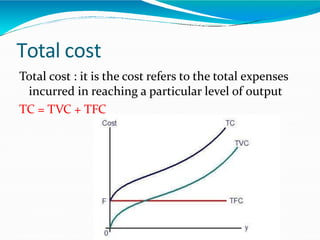
Total cost : it is the cost refers to the total expenses
incurred in reaching a particular level of output
TC = TVC + TFC
Marginal costThe marginal cost is also per unit cost of production. It
is the addition made to the total cost by producing
one more unit of output
MCn = TCn – TCn-1
i.e the marginal cost of the unit of output is the total
cost of producing n units minus the total cost of
producing
n-1 (i.e …one less in the total) units of output
Average cost
Average cost is the total cost divided by total units of
output Thus,
TC
AC =
Q
WhereQ is the quantity produced
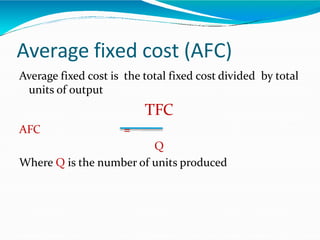
Average fixed cost (AFC)
Average fixed cost is the total fixed cost divided by total
units of output
TFC
AFC =
Q
Where Q is the number of units produced
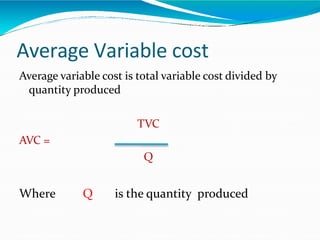
Average Variable cost
Average variable cost is total variable cost divided by
quantity produced
TVC
AVC =
Q
Where Q is the quantity produced
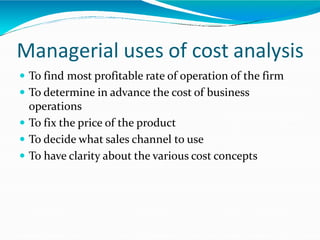
Managerial uses of cost analysis
 To find most profitable rate of operation of the firm
 To determine in advance the cost of business
operations
 To fix the price of the product
 To decide what sales channel to use
 To have clarity about the various cost concepts

presentaion on types of cost

  • 1.
  • 3.
    A cost isthe value of money that has been used up to produce something.
  • 4.
    Definition of cost Theexpenses faced by the business in the process of supplying goods and services to consumer
  • 5.
    Types of costs Opportunity cost and actualcost  Direct and indirectcost  Explicit and implicitcost  Historical and replacementcost  Fixed cost and variablecost  Real and primecost  Total,average,and marginal cost
  • 6.
    Opportunity cost andactual cost Opportunity cost : Cost incurred for loosing next best alternative Actual cost : An actual amount paid or incurred, as opposed to estimated cost or standard cost.
  • 7.
    Explicit and implicitcost Explicit cost refers to the money expended to buy or hire resources from outside the organization for the process of production Implicit cost refers to the cost of use of the self owned resources of organization that are used in production
  • 8.
    Direct and Indirectcost Direct cost is acost. Direct Cost: Direct costs are those cost that have directly accountable to specific cost object such as a process or product Ex:wages paid ,salary paid labor, material…etc Indirect cost: Indirect cost are those costs which are not directly accountable to specific cost object or not directly related to production Ex: insurance, mentainence ,telecom, ….etc
  • 9.
    Historical and replacementcost Historical cost refers to the original (actual) cost incurred at the time the asset was acquired The replacement cost is the price that an entity would pay to replace an existing assets at current market price that may not be market value of that asset.
  • 10.
    Fixed and variablecost Fixed cost is the cost that remains unchanged irrespective of the output level or sales revenue such as intrest,rent,salaries etc Variable cost are thoese costs that vary depending on a company’s production volume; they raise as production increases and fall as production decreases
  • 11.
    Real cost andPrime costReal cost of a production refers to the physical quantities of various factors used in producing commodity Ex: Real cost of a table composes of a carpenter’s labor to cubic feet of a wood ,a dozen of nails, half a bottle of varnish…..etc “ Real cost thus signifies the aggregate of real productive resources absorbed in the production”
  • 12.
    Prime cost The directcost of commodity in terms of the materials and labor involved in its production excluding fixed cost By calculating prime cost the firm can decide how much should be their selling price to earn profit
  • 13.
    Total cost Total cost: it is the cost refers to the total expenses incurred in reaching a particular level of output TC = TVC + TFC
  • 14.
    Marginal costThe marginalcost is also per unit cost of production. It is the addition made to the total cost by producing one more unit of output MCn = TCn – TCn-1 i.e the marginal cost of the unit of output is the total cost of producing n units minus the total cost of producing n-1 (i.e …one less in the total) units of output
  • 15.
    Average cost Average costis the total cost divided by total units of output Thus, TC AC = Q WhereQ is the quantity produced
  • 16.
    Average fixed cost(AFC) Average fixed cost is the total fixed cost divided by total units of output TFC AFC = Q Where Q is the number of units produced
  • 17.
    Average Variable cost Averagevariable cost is total variable cost divided by quantity produced TVC AVC = Q Where Q is the quantity produced
  • 18.
    Managerial uses ofcost analysis  To find most profitable rate of operation of the firm  To determine in advance the cost of business operations  To fix the price of the product  To decide what sales channel to use  To have clarity about the various cost concepts