Corrosion
• Corrosion Basics
– General corrosion theory
– Corrosion examples
• Specialty Problems
– CO2 and H2S
– O2 in sea water injection
– Acid Treatment
– Packer Fluids
Major Causes of Corrosion
• Salt water (excellent electrolyte, chloride source)
• H2S (acid gas with iron sulfide the by-product)
• CO2 (Major cause of produced gas corrosion)
• O2 (key player, reduce any way possible)
• Bacteria (by products, acid produced)
Other Factors
• pH
• Chlorides (influences corrosion inhibitor
solubility)
• Temperature (Increase usually increases
corrosion)
• Pressures (CO2 and H2S more soluble in H20)
• Velocity - important in stripping films, even for
sweet systems
• Wear/Abrasion (accelerates corrosion)
• Solids – strips film and erodes metal
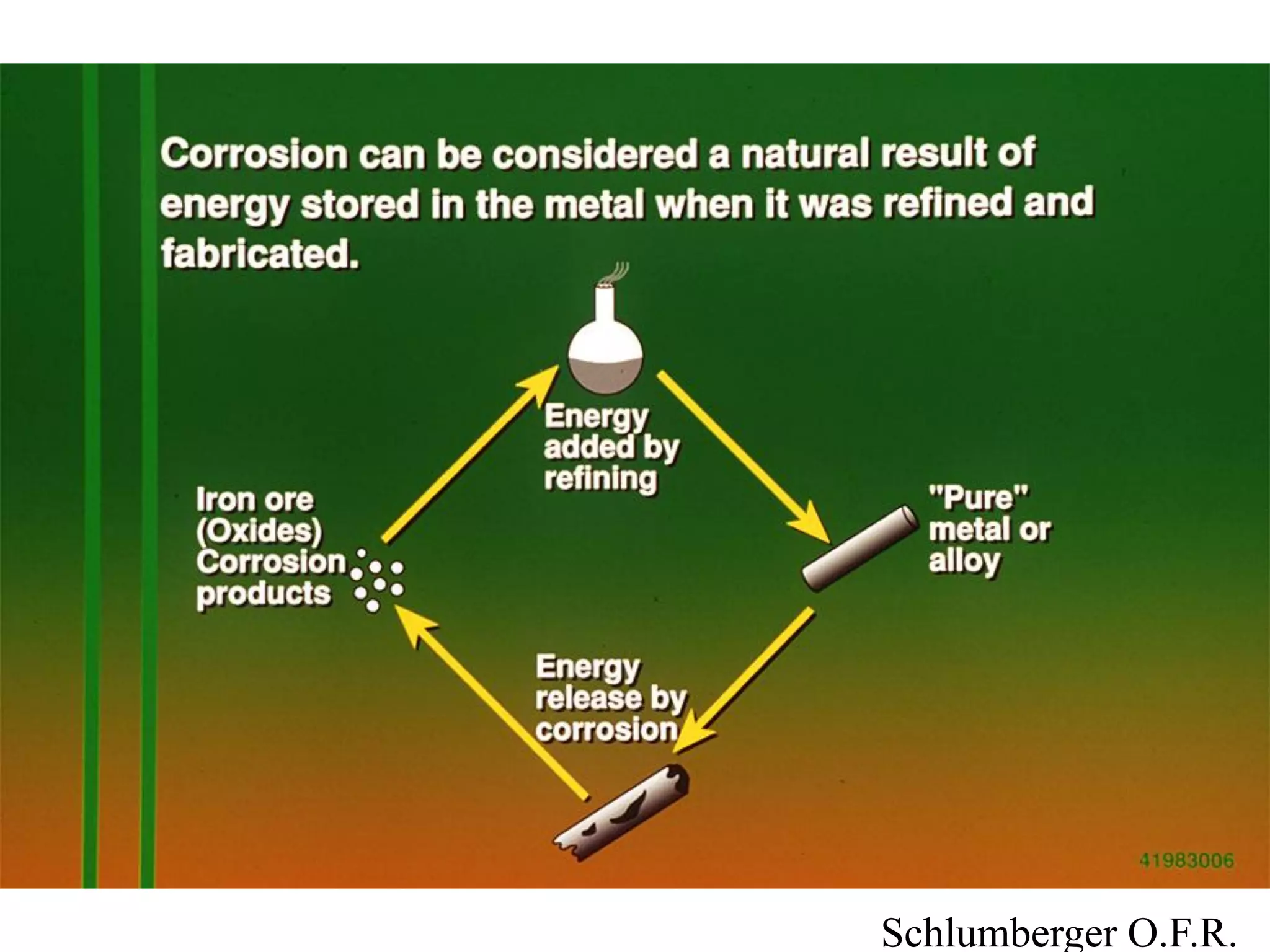
Chemical Corrosion
• H2S
– weak acid, source of H+
– very corrosive, especially at low pressure
– different regions of corrosion w/temp.
• CO2
– weak acid, (must hydrate to become acid)
– leads to pitting damage
• Strong acids - HCl, HCl/HF, acetic, formic
• Brines - chlorides and zinc are worst
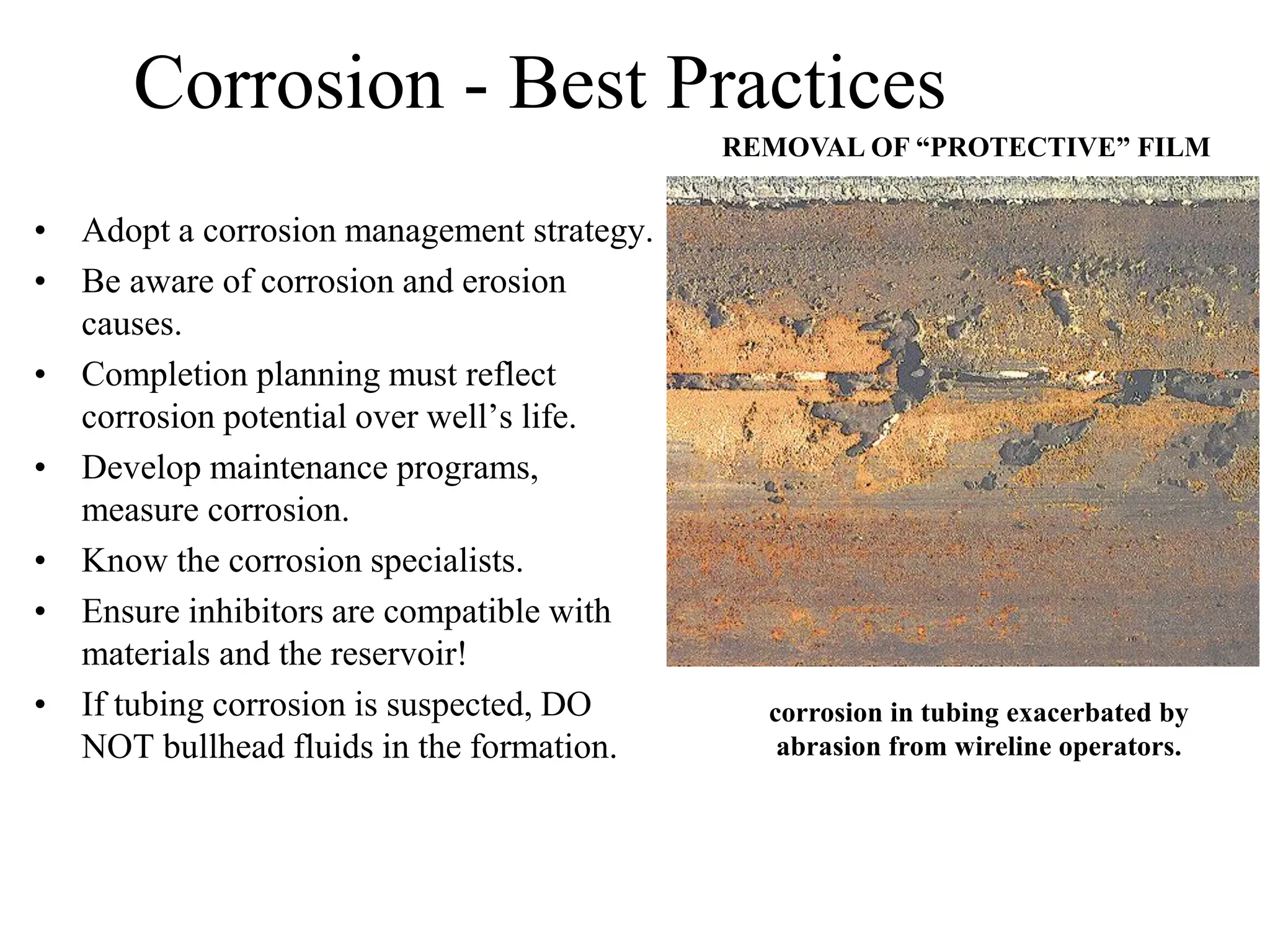
corrosion in tubing exacerbated by
abrasion from wireline operators.
REMOVAL OF “PROTECTIVE” FILM
Corrosion - Best Practices
• Adopt a corrosion management strategy.
• Be aware of corrosion and erosion
causes.
• Completion planning must reflect
corrosion potential over well’s life.
• Develop maintenance programs,
measure corrosion.
• Know the corrosion specialists.
• Ensure inhibitors are compatible with
materials and the reservoir!
• If tubing corrosion is suspected, DO
NOT bullhead fluids in the formation.
1970’s Industry Study of Failures
Method % of Failures
Corrosion (all types) 33%
Fatigue 18%
Brittle Fracture 9%
Mechanical Damage 14%
Fab./Welding Defects 16%
Other 10%
Causes of Petroleum Related Failures
(1970’s study)
Cause % of Failures
CO2 Corrosion 28%
H2S Corrosion 18%
Corrosion at the weld 18%
Pitting 12%
Erosion Corrosion 9%
Galvanic 6%
Crevice 3%
Impingement 3%
Stress Corrosion 3%
Schlumberger O.F.R.
The size and number of the crystals present in metals are a function of
the cooling process (quenching).
Corrosion Types
• Galvanic – a potential difference between dissimilar metals in
contact creates a current flow. This may also occur in some metals at
the grain boundaries.
• Crevice Corrosion – Intensive localized electrochemical
corrosion occurs within crevices when in contact with a corrosive
fluid. Will accelerate after start.
• Pitting – Extremely localized attack that results in holes in the
metal. Will accelerate after start.
• Stress Corrosion – Occurs in metal that is subject to both stress
and a corrosive environment. May start at a “stress riser” like a wrench
mark or packer slip mark.
Corrosion Types
• Erosion Corrosion – Passage of fluid at high velocity may
remove the thin, protective oxide film that protects exposed metal
surface.
• Hydrogen Sulfide Corrosion – H2S gas a water creates an
acid gas environment resulting in FeSx and hydrogen.
• Hydrogen Embrittlement – Atomic hydrogen diffuses into
the grain boundary of the metal, generating trapped larger molecules of
hydrogen molecules, resulting in metal embrittlement.
• Hydrogen Corrosion – Hydrogen blistering, hydrogen
embrittlement, decarburization and hydrogen attack..
CO2 Partial Pressure
• Severity is a function of the partial pressure
– 0-3 psi - very low – non chrome use possible
– 3-7 psi – marginal for chrome use
– 7-10 psi – medium to serious problem
– >10 psi – severe problem, requires CRA even
for short term application.
Partial pressure is the mole fraction of the specific gas times the total
pressure. If the CO2 mole concentration is 1% and the pressure is 200
psi, the partial pressure is 0.01 x 200 = 2 psi.
CO2 corrosion
CO2 localised attack in 7” production tubing
The corrosion
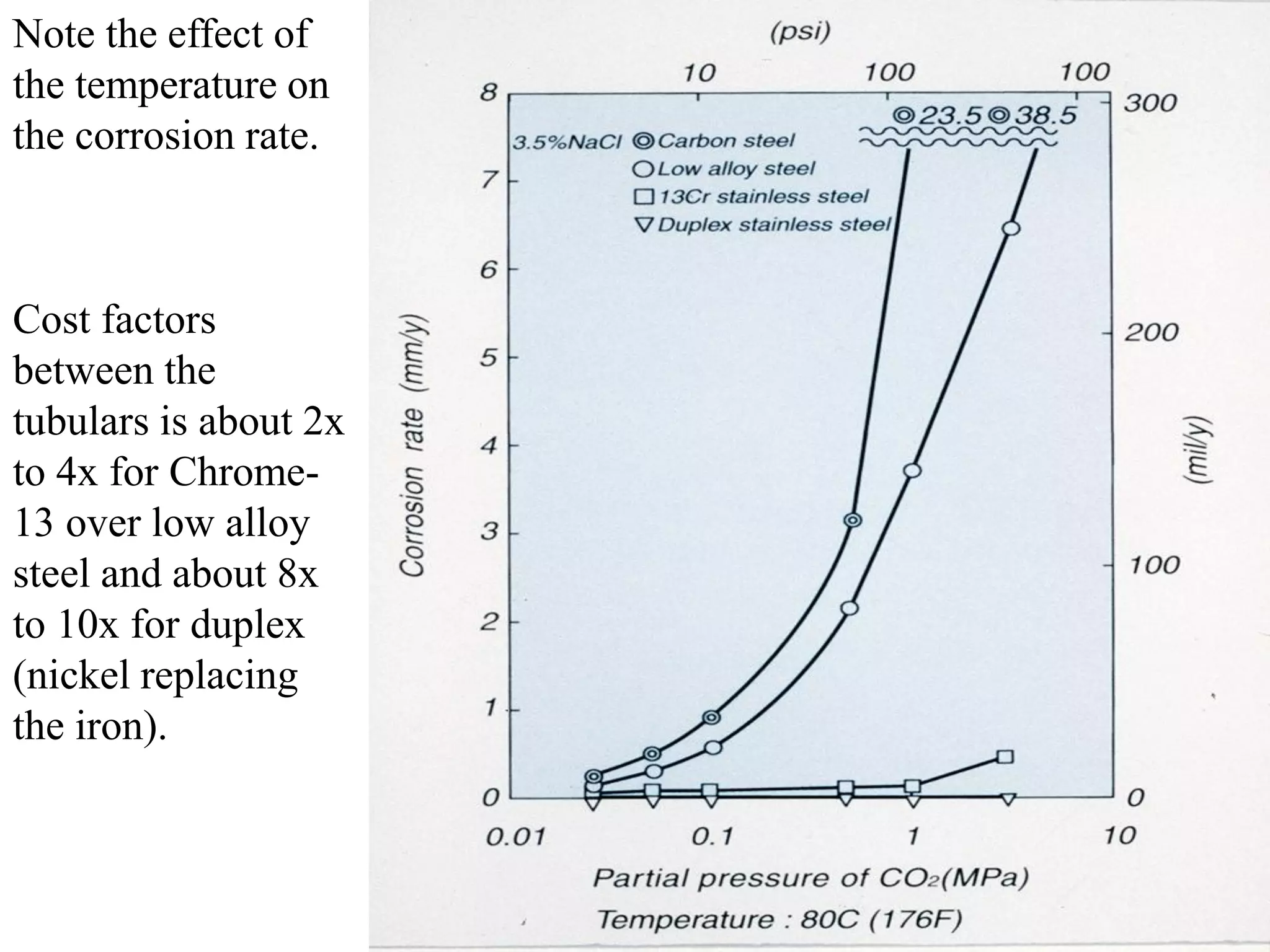
rate of CO2 is a
function of
partial pressure,
temperature,
chloride
presence of
water and the
type of material.
Corrosion rate in
MPY – mills per
year is a standard
method of
expression, but not a
good way to express
corrosion where
pitting is the major
failure.
Note the effect of
the temperature on
the corrosion rate.
Cost factors
between the
tubulars is about 2x
to 4x for Chrome-
13 over low alloy
steel and about 8x
to 10x for duplex
(nickel replacing
the iron).
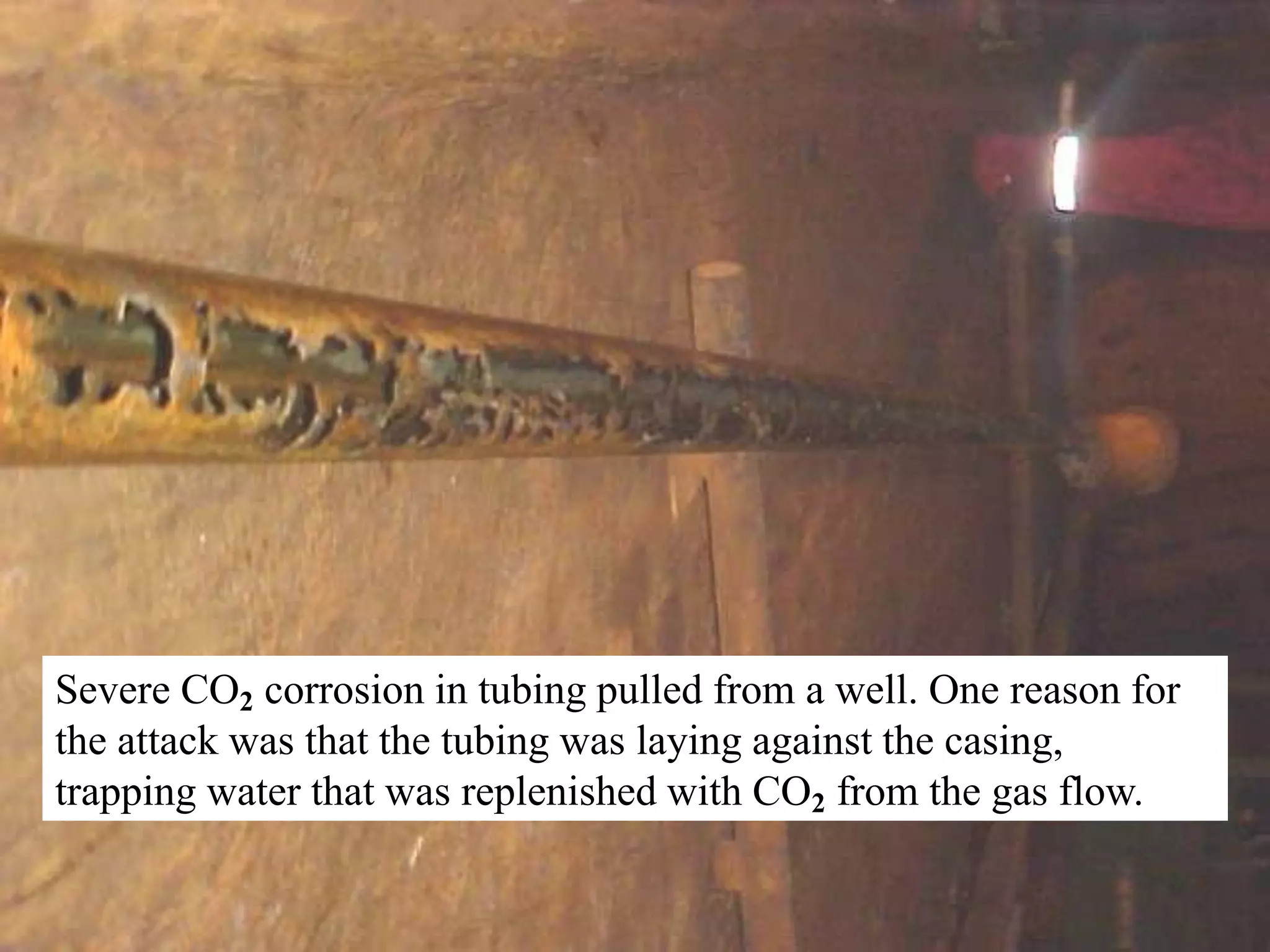
Severe CO2 corrosion in tubing pulled from a well. One reason for
the attack was that the tubing was laying against the casing,
trapping water that was replenished with CO2 from the gas flow.
Thinned and
embrittled tubing
twisted apart when
trying to break
connection during
a tubing pull.
CO2 CORROSION ISOPLOT
Corrosion weakened pipe – large areas can
be affected.
Trench corrosion common from CO2 attack.
Mills/per year or mm/yr may not be a good
indicator when the metal loss is in pitting.
Chloride Stress Cracking
• Starts at a pit, scratch or notch. Crack
proceeds primarily along grain boundaries.
The cracking process is accelerated by
chloride ions and lower pH.
Stress Sulfide Corrosion
• Occurs when metal is in tension and
exposed to H2S and water.
• Generates atomic hydrogen. Hydrogen
moves between grains of the metal.
Reduces metal ductility.
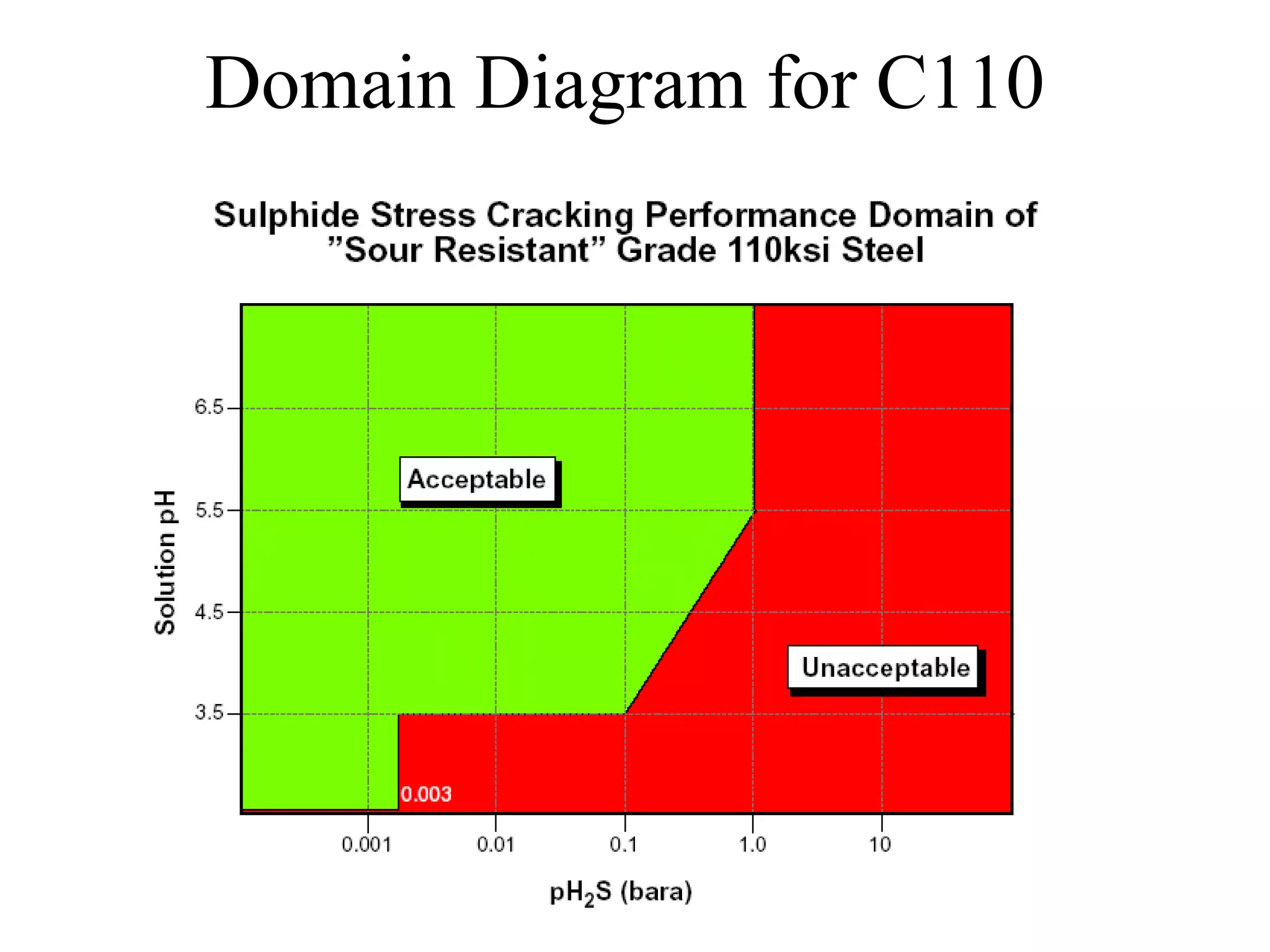
Domain Diagram for C110
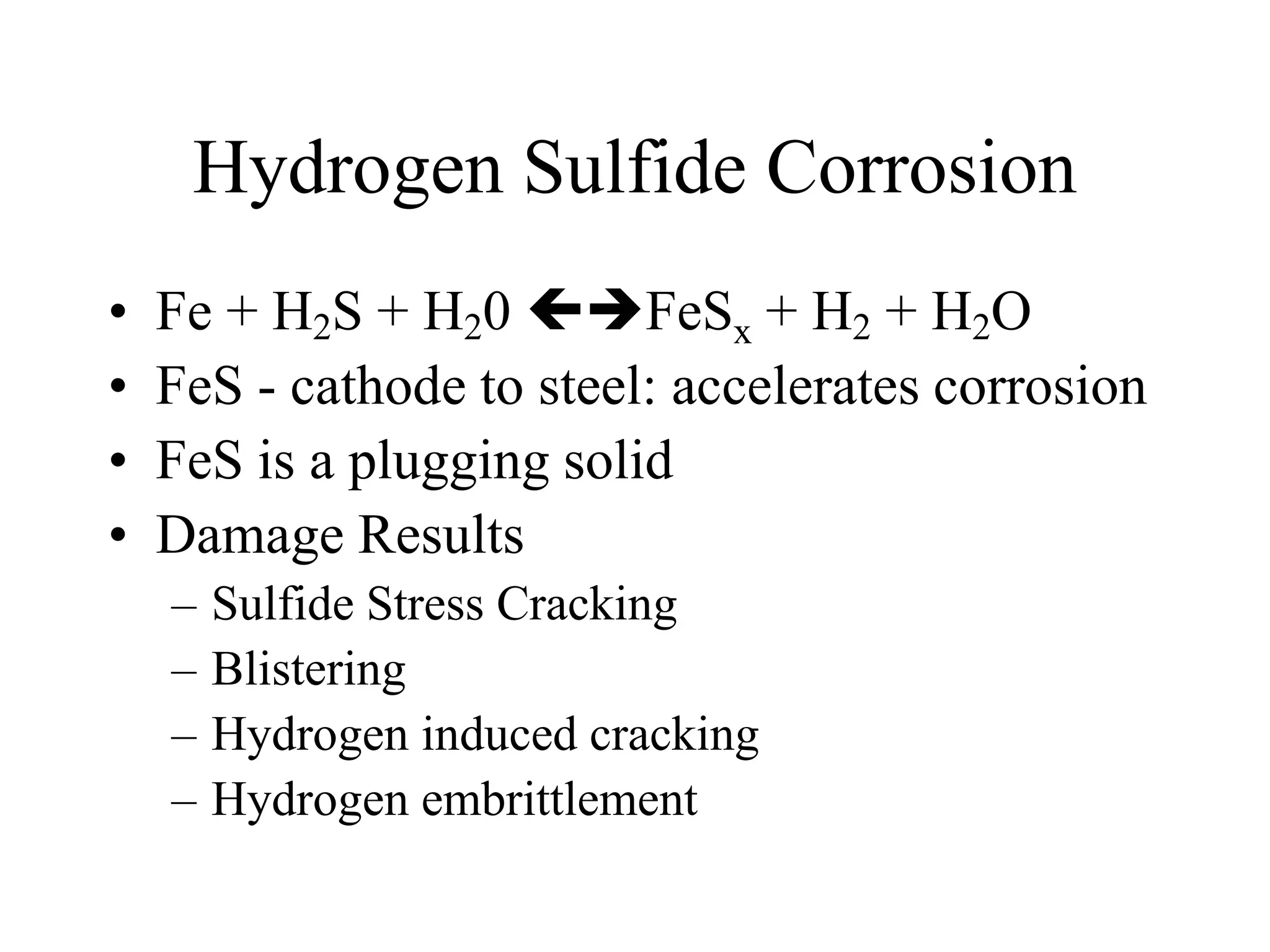
Hydrogen Sulfide Corrosion
• Fe + H2S + H20 FeSx + H2 + H2O
• FeS - cathode to steel: accelerates corrosion
• FeS is a plugging solid
• Damage Results
– Sulfide Stress Cracking
– Blistering
– Hydrogen induced cracking
– Hydrogen embrittlement
H2S corrosion is minimized by sweetening the gas (knocking the H2S out
or raising pH.
Domain Diagram for Super 13Cr
pH
3.5
4.5
5.5
0.001 0.01 0.1 1.0
pH2S (bara)
Domain Diagram For The Sulphide Stress Cracking Limits
Of 95ksi Super 13Cr Alloys In High Chloride (120,000 ppm Cl-) Waters
UNACCEPTABLE
ACCEPTABLE
0.03bara
FURTHER ASSESSMENT REQUIRED
pH
3.5
4.5
5.5
0.001 0.01 0.1 1.0
pH2S (bara)
Domain Diagram For The Sulphide Stress Cracking Limits
Of 95ksi Super 13Cr Alloys In High Chloride (120,000 ppm Cl-) Waters
UNACCEPTABLE
ACCEPTABLE
0.03bara
FURTHER ASSESSMENT REQUIRED
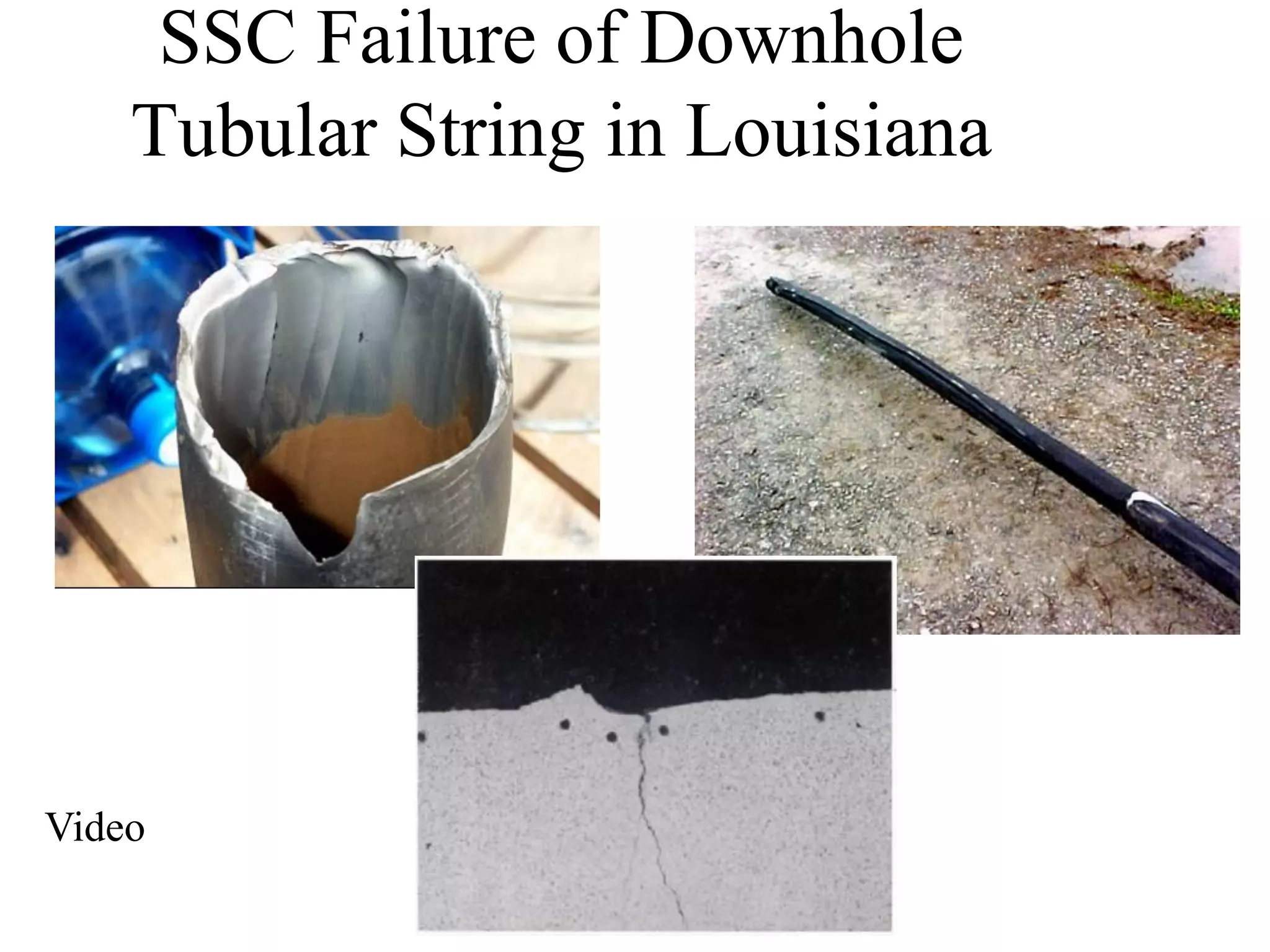
SSC Failure of Downhole
Tubular String in Louisiana
Video
Crevice Corrosion
• The physical nature of the crevice formed by the
tubing to coupling metal-to-metal seal may
produce a low pH aggressive environment that is
different from the bulk solution chemistry – hence
a material that looks fine when tested as a flat
strip of metal can fail when the test sample (or
actual tubing) includes a tight crevice.
• This damage can be very rapid in water injection
wells, wells that produce some brine or in wells
where there is water alternating gas (WAG)
sequencing – causing failure at the metal-to-metal
seals in a matter of months.
Crevice Corrosion
Note the seal crevice corrosion – this caused a leak to the annulus.
Crevice Corrosion
Note the pit that started the washout – seal
crevice corrosion.
O2 Corrosion
Dissolved Gas Effect on Corrosion
0
5
10
15
20
25
0 1 2 3 4 5 6 7 8
OverallCorrosionRateofCarbonSteel
O2
CO2
H2S
Dissolved Gas Concentration in Water Phase, ppm
0 1 2 3 4 5 6 7 8
0 100 200 300 400 500 600 700 800
0 50 100 150 200 250 300 350 400
O2
H2S
CO2
There is no corrosion mechanism more damaging on a concentration
basis than oxygen – small amounts of oxygen, water and chlorides
can ruin a chrome tubing completion in a few months. Injection
wells are the most severely affected – minimise oxygen and don’t use
chrome pipe in injectors.
20 ppb O2 limit for
seawater in carbon steel
injection tubulars.
13Cr is CO2 resistant but
very susceptible to pitting
corrosion in aerated
brines. 5 ppb O2 is
suggested as a limit, but
even these levels have not
been confirmed.
Oxygen in Surface Waters
• 32oF - 10 ppm (saturation)
• 212oF - 0 ppm
ppm O2 = 10 - 0.055 (T - 30o)
T = water system temperature, oF
A split in the side of 5-
1/2” casing. Cause was
unknown – mechanical
damage (thinning by
drill string abrasion)
was suspected.
Wear Damage
Abrasion by solids, gas bubbles or liquid droplets may significantly
increase corrosion by continuously removing the protective oxide or
other films that cover the surface following the initial chemical reaction.
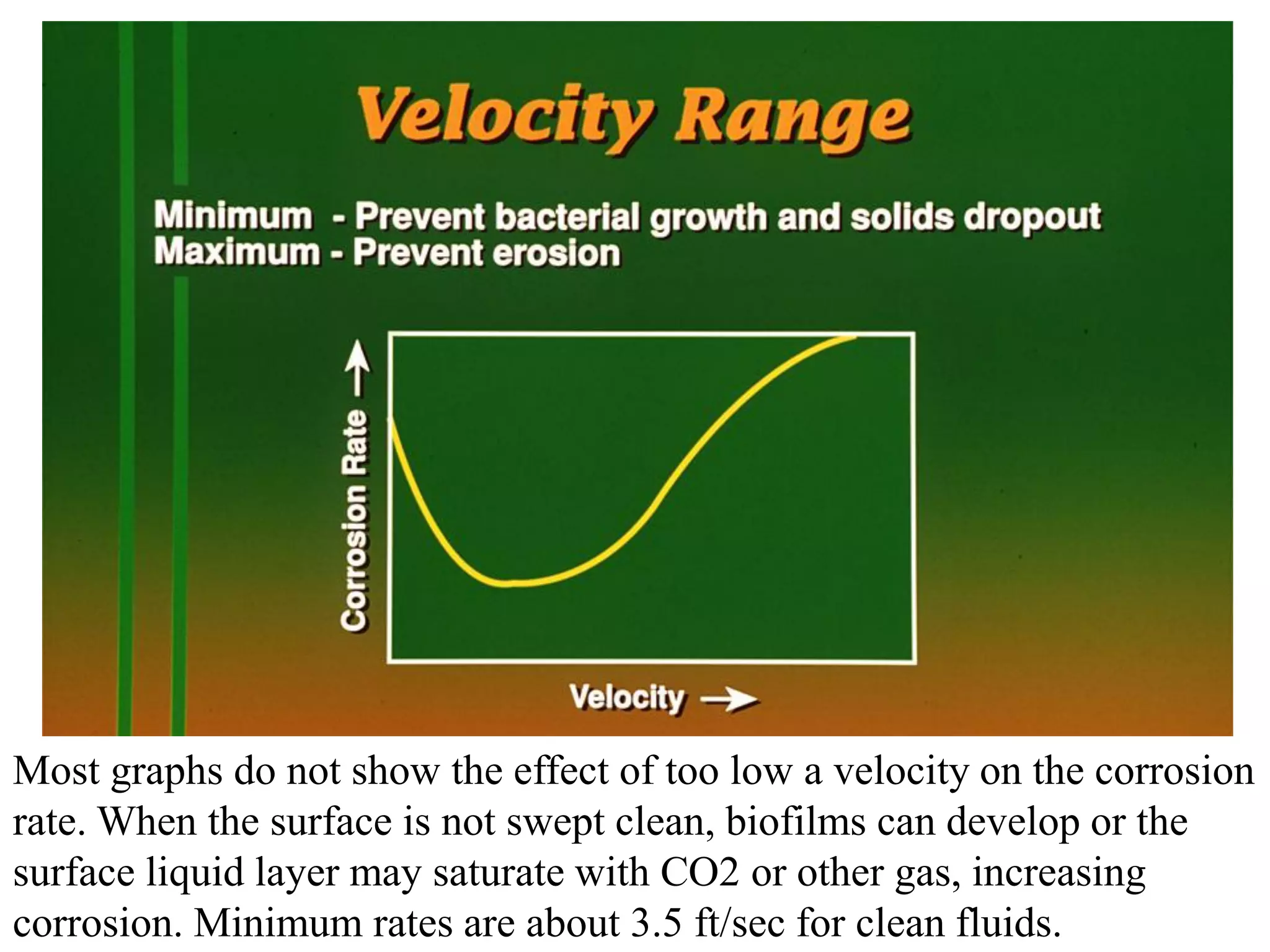
Most graphs do not show the effect of too low a velocity on the corrosion
rate. When the surface is not swept clean, biofilms can develop or the
surface liquid layer may saturate with CO2 or other gas, increasing
corrosion. Minimum rates are about 3.5 ft/sec for clean fluids.
Note the effect of
increasing flowing
fluid density on
corrosion rate.
Also – presence of
solids in the
flowing fluids
very significantly
lowers the
maximum
permissible flow
rate.
Erosion - All Liquid Flow
• Described by API Equation 14E
Vc = C (density)1/2
where: Vc = critical flow velocity, ft/sec
density = fluid density in g/cc
C = 100 for long life projects
C = 150 for short life project
C = >200 for peak flows
Corrosion increases after
water cut reaches 10 to 20%.
The cause is removal of the
protective oil film. In the third
phase, the pipe is completely
water coated and corrosion
rate becomes more constant.
Wetting of the
surface by water
significantly
accelerates
corrosion.
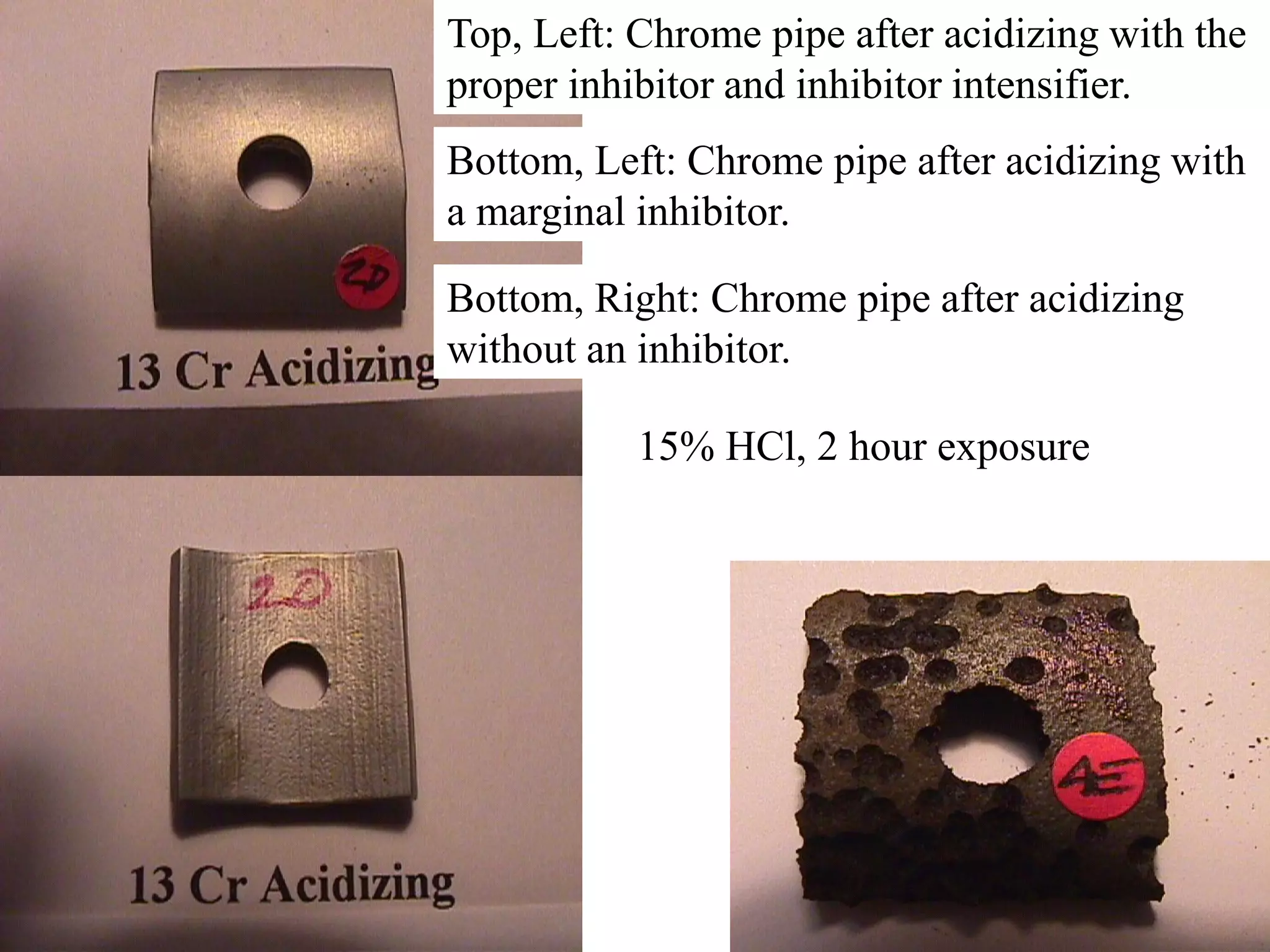
Top, Left: Chrome pipe after acidizing with the
proper inhibitor and inhibitor intensifier.
Bottom, Left: Chrome pipe after acidizing with
a marginal inhibitor.
Bottom, Right: Chrome pipe after acidizing
without an inhibitor.
15% HCl, 2 hour exposure
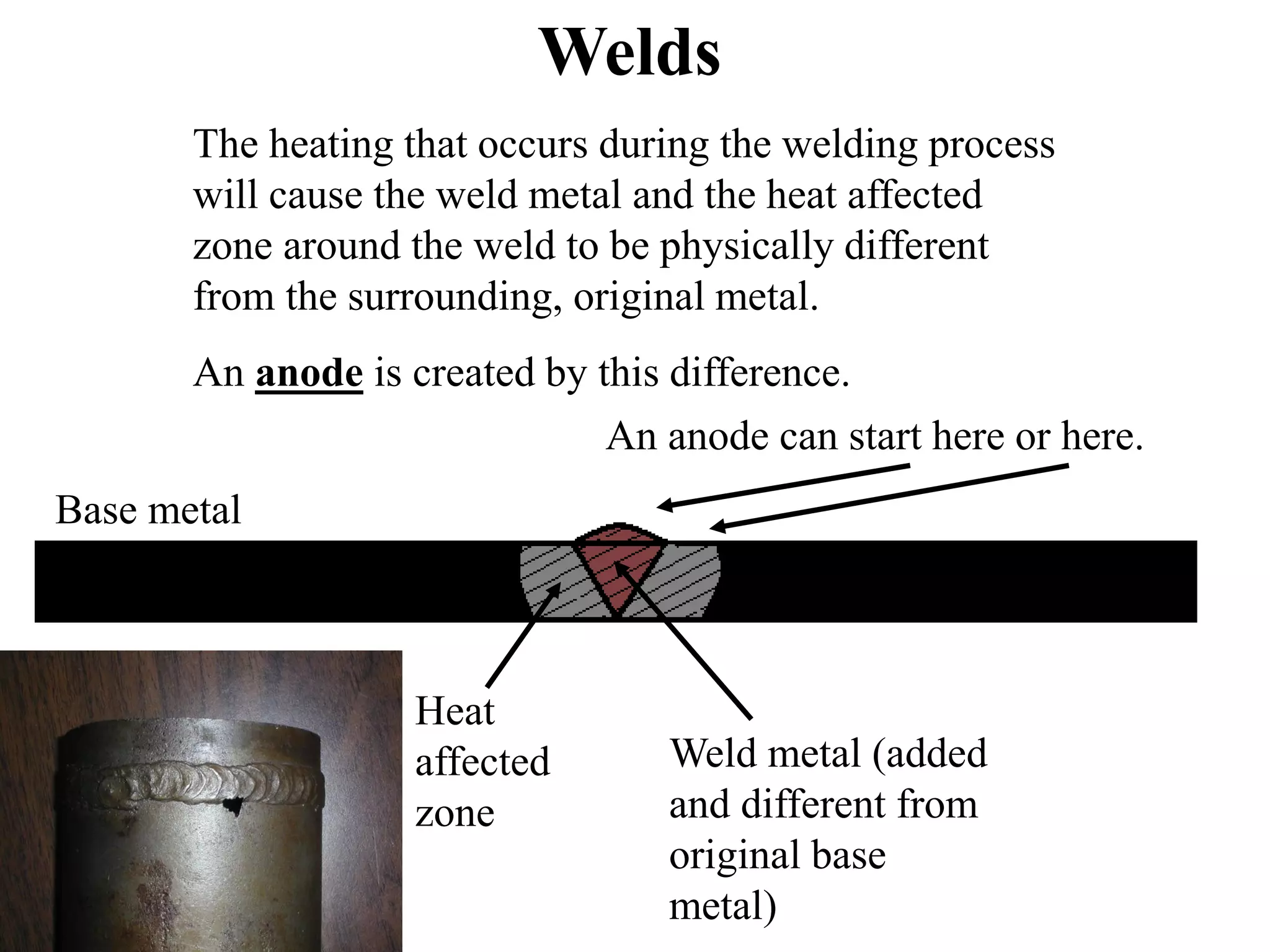
Welds
The heating that occurs during the welding process
will cause the weld metal and the heat affected
zone around the weld to be physically different
from the surrounding, original metal.
An anode is created by this difference.
An anode can start here or here.
Heat
affected
zone
Weld metal (added
and different from
original base
metal)
Base metal
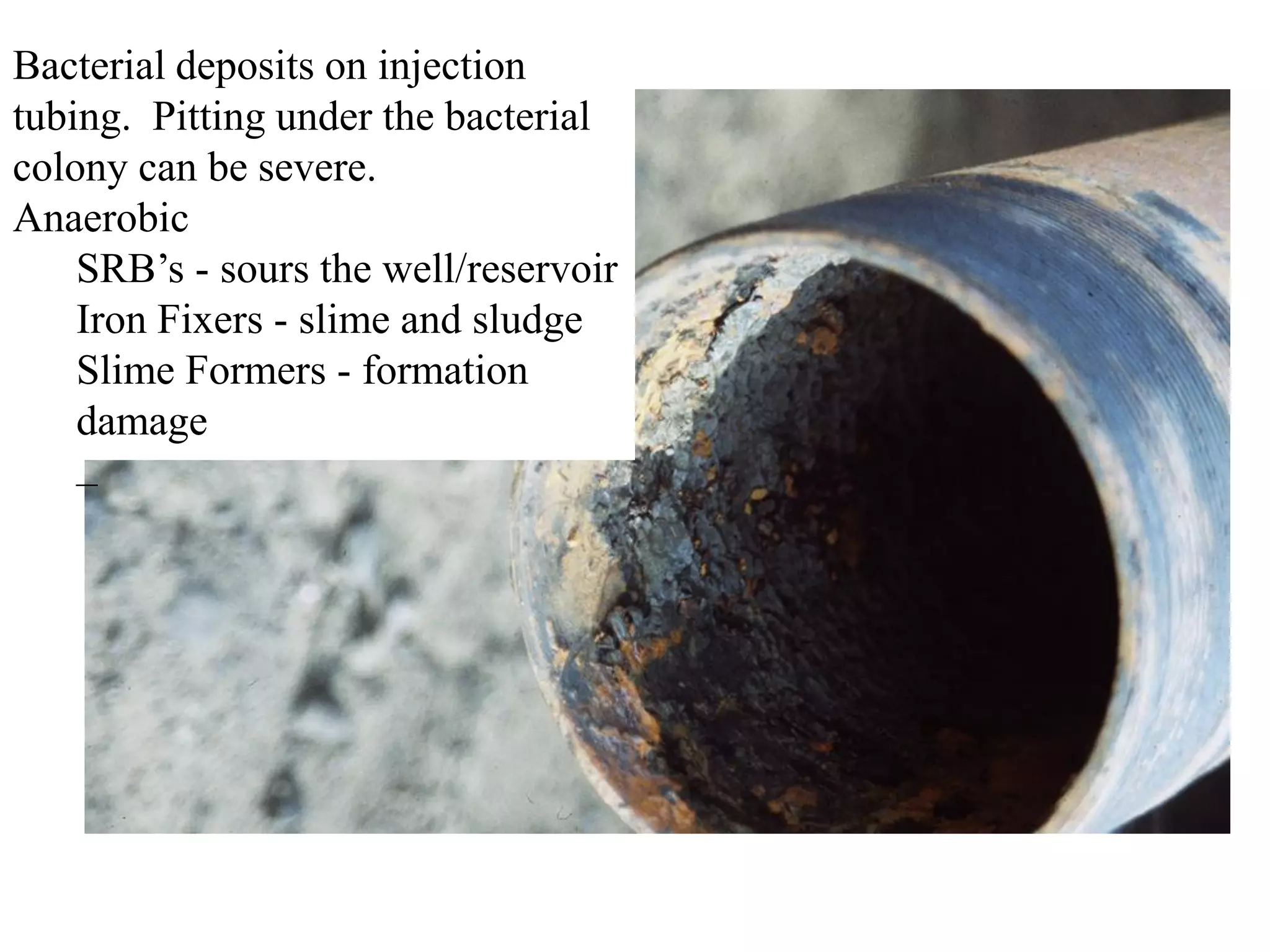
Bacterial deposits on injection
tubing. Pitting under the bacterial
colony can be severe.
Anaerobic
SRB’s - sours the well/reservoir
Iron Fixers - slime and sludge
Slime Formers - formation
damage
–
Sulfate Reducing Bacteria
• SRB’s anaerobic bacteria
– colony growth most numerous
– low pH below colony
• Generates high H2S concentration in small
area
• worst where velocity < 3-1/2 fps
Erskine – Failure of 25Cr Duplex SS
Source – BP Corrosion – John Alkire
and John JW Martin
Many of the super alloy
failures have been
linked backed to the
brines used for
completions.
High Island – Failure of 13Cr
Alloy
Cracking initiated at a
stress riser – impact
or wrench mark.
Sacrificial Anodes - Galvanic Series
in Sea Water
1. Magnesium
2. Zinc
3 soft aluminum
4.cadmium
5. hard aluminum
6. steel
7. stainless steel (300 series)
8. lead
9. brass and bronze
10. Inconel
11. Hasteloy C 276
Sacrificial anode (magnesium) from an offshore platform. This was a
round bar stock anode.
Controlling Corrosion
1. Maintain high pH
2. Control gas breakout
3. Use passive metals
4. Remove Oxygen
5. Control velocities
6. Lower chlorides
7. Bacteria control
8. Acid/brine use considerations and alternatives
9. Liquid removal
10. Inhibitor injection
11. coatings
Typical Corrosion Inhibitors
How do Corrosion Inhibitors
Work?
METAL
SURFACE
WATER
AND OIL
Polar
Group
Alkyl
chainOil
film
Inhibitor Deployment
• inject via quill
• counter-current to flow
• atomising quill for gas systems
• continuous injection (10 - 50 ppm) better than batch
• keep feed tank full and pump operating
• corrosion inhibitor squeeze can affect
reservoir wettability and the return concentration
is often too low to be useful (ca 5 ppm)

Corrosion basic

  • 1.
    Corrosion • Corrosion Basics –General corrosion theory – Corrosion examples • Specialty Problems – CO2 and H2S – O2 in sea water injection – Acid Treatment – Packer Fluids
  • 2.
    Major Causes ofCorrosion • Salt water (excellent electrolyte, chloride source) • H2S (acid gas with iron sulfide the by-product) • CO2 (Major cause of produced gas corrosion) • O2 (key player, reduce any way possible) • Bacteria (by products, acid produced)
  • 3.
    Other Factors • pH •Chlorides (influences corrosion inhibitor solubility) • Temperature (Increase usually increases corrosion) • Pressures (CO2 and H2S more soluble in H20) • Velocity - important in stripping films, even for sweet systems • Wear/Abrasion (accelerates corrosion) • Solids – strips film and erodes metal
  • 4.
    Chemical Corrosion • H2S –weak acid, source of H+ – very corrosive, especially at low pressure – different regions of corrosion w/temp. • CO2 – weak acid, (must hydrate to become acid) – leads to pitting damage • Strong acids - HCl, HCl/HF, acetic, formic • Brines - chlorides and zinc are worst
  • 5.
    corrosion in tubingexacerbated by abrasion from wireline operators. REMOVAL OF “PROTECTIVE” FILM Corrosion - Best Practices • Adopt a corrosion management strategy. • Be aware of corrosion and erosion causes. • Completion planning must reflect corrosion potential over well’s life. • Develop maintenance programs, measure corrosion. • Know the corrosion specialists. • Ensure inhibitors are compatible with materials and the reservoir! • If tubing corrosion is suspected, DO NOT bullhead fluids in the formation.
  • 6.
    1970’s Industry Studyof Failures Method % of Failures Corrosion (all types) 33% Fatigue 18% Brittle Fracture 9% Mechanical Damage 14% Fab./Welding Defects 16% Other 10%
  • 7.
    Causes of PetroleumRelated Failures (1970’s study) Cause % of Failures CO2 Corrosion 28% H2S Corrosion 18% Corrosion at the weld 18% Pitting 12% Erosion Corrosion 9% Galvanic 6% Crevice 3% Impingement 3% Stress Corrosion 3%
  • 8.
  • 9.
    The size andnumber of the crystals present in metals are a function of the cooling process (quenching).
  • 10.
    Corrosion Types • Galvanic– a potential difference between dissimilar metals in contact creates a current flow. This may also occur in some metals at the grain boundaries. • Crevice Corrosion – Intensive localized electrochemical corrosion occurs within crevices when in contact with a corrosive fluid. Will accelerate after start. • Pitting – Extremely localized attack that results in holes in the metal. Will accelerate after start. • Stress Corrosion – Occurs in metal that is subject to both stress and a corrosive environment. May start at a “stress riser” like a wrench mark or packer slip mark.
  • 11.
    Corrosion Types • ErosionCorrosion – Passage of fluid at high velocity may remove the thin, protective oxide film that protects exposed metal surface. • Hydrogen Sulfide Corrosion – H2S gas a water creates an acid gas environment resulting in FeSx and hydrogen. • Hydrogen Embrittlement – Atomic hydrogen diffuses into the grain boundary of the metal, generating trapped larger molecules of hydrogen molecules, resulting in metal embrittlement. • Hydrogen Corrosion – Hydrogen blistering, hydrogen embrittlement, decarburization and hydrogen attack..
  • 12.
    CO2 Partial Pressure •Severity is a function of the partial pressure – 0-3 psi - very low – non chrome use possible – 3-7 psi – marginal for chrome use – 7-10 psi – medium to serious problem – >10 psi – severe problem, requires CRA even for short term application. Partial pressure is the mole fraction of the specific gas times the total pressure. If the CO2 mole concentration is 1% and the pressure is 200 psi, the partial pressure is 0.01 x 200 = 2 psi.
  • 13.
    CO2 corrosion CO2 localisedattack in 7” production tubing
  • 14.
    The corrosion rate ofCO2 is a function of partial pressure, temperature, chloride presence of water and the type of material. Corrosion rate in MPY – mills per year is a standard method of expression, but not a good way to express corrosion where pitting is the major failure.
  • 15.
    Note the effectof the temperature on the corrosion rate. Cost factors between the tubulars is about 2x to 4x for Chrome- 13 over low alloy steel and about 8x to 10x for duplex (nickel replacing the iron).
  • 16.
    Severe CO2 corrosionin tubing pulled from a well. One reason for the attack was that the tubing was laying against the casing, trapping water that was replenished with CO2 from the gas flow.
  • 17.
    Thinned and embrittled tubing twistedapart when trying to break connection during a tubing pull.
  • 18.
  • 19.
    Corrosion weakened pipe– large areas can be affected.
  • 20.
    Trench corrosion commonfrom CO2 attack. Mills/per year or mm/yr may not be a good indicator when the metal loss is in pitting.
  • 21.
    Chloride Stress Cracking •Starts at a pit, scratch or notch. Crack proceeds primarily along grain boundaries. The cracking process is accelerated by chloride ions and lower pH.
  • 22.
    Stress Sulfide Corrosion •Occurs when metal is in tension and exposed to H2S and water. • Generates atomic hydrogen. Hydrogen moves between grains of the metal. Reduces metal ductility.
  • 24.
  • 25.
    Hydrogen Sulfide Corrosion •Fe + H2S + H20 FeSx + H2 + H2O • FeS - cathode to steel: accelerates corrosion • FeS is a plugging solid • Damage Results – Sulfide Stress Cracking – Blistering – Hydrogen induced cracking – Hydrogen embrittlement
  • 26.
    H2S corrosion isminimized by sweetening the gas (knocking the H2S out or raising pH.
  • 27.
    Domain Diagram forSuper 13Cr pH 3.5 4.5 5.5 0.001 0.01 0.1 1.0 pH2S (bara) Domain Diagram For The Sulphide Stress Cracking Limits Of 95ksi Super 13Cr Alloys In High Chloride (120,000 ppm Cl-) Waters UNACCEPTABLE ACCEPTABLE 0.03bara FURTHER ASSESSMENT REQUIRED pH 3.5 4.5 5.5 0.001 0.01 0.1 1.0 pH2S (bara) Domain Diagram For The Sulphide Stress Cracking Limits Of 95ksi Super 13Cr Alloys In High Chloride (120,000 ppm Cl-) Waters UNACCEPTABLE ACCEPTABLE 0.03bara FURTHER ASSESSMENT REQUIRED
  • 28.
    SSC Failure ofDownhole Tubular String in Louisiana Video
  • 29.
    Crevice Corrosion • Thephysical nature of the crevice formed by the tubing to coupling metal-to-metal seal may produce a low pH aggressive environment that is different from the bulk solution chemistry – hence a material that looks fine when tested as a flat strip of metal can fail when the test sample (or actual tubing) includes a tight crevice. • This damage can be very rapid in water injection wells, wells that produce some brine or in wells where there is water alternating gas (WAG) sequencing – causing failure at the metal-to-metal seals in a matter of months.
  • 30.
    Crevice Corrosion Note theseal crevice corrosion – this caused a leak to the annulus.
  • 31.
    Crevice Corrosion Note thepit that started the washout – seal crevice corrosion.
  • 32.
    O2 Corrosion Dissolved GasEffect on Corrosion 0 5 10 15 20 25 0 1 2 3 4 5 6 7 8 OverallCorrosionRateofCarbonSteel O2 CO2 H2S Dissolved Gas Concentration in Water Phase, ppm 0 1 2 3 4 5 6 7 8 0 100 200 300 400 500 600 700 800 0 50 100 150 200 250 300 350 400 O2 H2S CO2 There is no corrosion mechanism more damaging on a concentration basis than oxygen – small amounts of oxygen, water and chlorides can ruin a chrome tubing completion in a few months. Injection wells are the most severely affected – minimise oxygen and don’t use chrome pipe in injectors. 20 ppb O2 limit for seawater in carbon steel injection tubulars. 13Cr is CO2 resistant but very susceptible to pitting corrosion in aerated brines. 5 ppb O2 is suggested as a limit, but even these levels have not been confirmed.
  • 33.
    Oxygen in SurfaceWaters • 32oF - 10 ppm (saturation) • 212oF - 0 ppm ppm O2 = 10 - 0.055 (T - 30o) T = water system temperature, oF
  • 34.
    A split inthe side of 5- 1/2” casing. Cause was unknown – mechanical damage (thinning by drill string abrasion) was suspected. Wear Damage
  • 35.
    Abrasion by solids,gas bubbles or liquid droplets may significantly increase corrosion by continuously removing the protective oxide or other films that cover the surface following the initial chemical reaction.
  • 36.
    Most graphs donot show the effect of too low a velocity on the corrosion rate. When the surface is not swept clean, biofilms can develop or the surface liquid layer may saturate with CO2 or other gas, increasing corrosion. Minimum rates are about 3.5 ft/sec for clean fluids.
  • 37.
    Note the effectof increasing flowing fluid density on corrosion rate. Also – presence of solids in the flowing fluids very significantly lowers the maximum permissible flow rate.
  • 38.
    Erosion - AllLiquid Flow • Described by API Equation 14E Vc = C (density)1/2 where: Vc = critical flow velocity, ft/sec density = fluid density in g/cc C = 100 for long life projects C = 150 for short life project C = >200 for peak flows
  • 39.
    Corrosion increases after watercut reaches 10 to 20%. The cause is removal of the protective oil film. In the third phase, the pipe is completely water coated and corrosion rate becomes more constant. Wetting of the surface by water significantly accelerates corrosion.
  • 41.
    Top, Left: Chromepipe after acidizing with the proper inhibitor and inhibitor intensifier. Bottom, Left: Chrome pipe after acidizing with a marginal inhibitor. Bottom, Right: Chrome pipe after acidizing without an inhibitor. 15% HCl, 2 hour exposure
  • 43.
    Welds The heating thatoccurs during the welding process will cause the weld metal and the heat affected zone around the weld to be physically different from the surrounding, original metal. An anode is created by this difference. An anode can start here or here. Heat affected zone Weld metal (added and different from original base metal) Base metal
  • 44.
    Bacterial deposits oninjection tubing. Pitting under the bacterial colony can be severe. Anaerobic SRB’s - sours the well/reservoir Iron Fixers - slime and sludge Slime Formers - formation damage –
  • 45.
    Sulfate Reducing Bacteria •SRB’s anaerobic bacteria – colony growth most numerous – low pH below colony • Generates high H2S concentration in small area • worst where velocity < 3-1/2 fps
  • 46.
    Erskine – Failureof 25Cr Duplex SS Source – BP Corrosion – John Alkire and John JW Martin Many of the super alloy failures have been linked backed to the brines used for completions.
  • 47.
    High Island –Failure of 13Cr Alloy
  • 48.
    Cracking initiated ata stress riser – impact or wrench mark.
  • 52.
    Sacrificial Anodes -Galvanic Series in Sea Water 1. Magnesium 2. Zinc 3 soft aluminum 4.cadmium 5. hard aluminum 6. steel 7. stainless steel (300 series) 8. lead 9. brass and bronze 10. Inconel 11. Hasteloy C 276
  • 53.
    Sacrificial anode (magnesium)from an offshore platform. This was a round bar stock anode.
  • 54.
    Controlling Corrosion 1. Maintainhigh pH 2. Control gas breakout 3. Use passive metals 4. Remove Oxygen 5. Control velocities 6. Lower chlorides 7. Bacteria control 8. Acid/brine use considerations and alternatives 9. Liquid removal 10. Inhibitor injection 11. coatings
  • 55.
  • 56.
    How do CorrosionInhibitors Work? METAL SURFACE WATER AND OIL Polar Group Alkyl chainOil film
  • 57.
    Inhibitor Deployment • injectvia quill • counter-current to flow • atomising quill for gas systems • continuous injection (10 - 50 ppm) better than batch • keep feed tank full and pump operating • corrosion inhibitor squeeze can affect reservoir wettability and the return concentration is often too low to be useful (ca 5 ppm)