CORRELATION ANALYSIS
MEANING OF CORRELATION ANALYSIS 
Correlation analysis is a process to find out the 
degree of relationship between two or more 
variables by applying various statistical tools and 
techniques. 
According to A.M. Tuttle 
“Correlation is an analysis of the association between 
two or more variable”
USES OF CORRELATION ANALYSIS 
• It is used in deriving the degree and direction of 
relationship within the variables. 
• It is used in reducing the range of uncertainty in 
matter of prediction. 
• It I used in presenting the average relationship 
between any two variables through a single value of 
coefficient of correlation.
USES OF CORRELATION ANALYSIS 
• In the field of science and philosophy these 
methods are used for making progressive 
conclusions. 
• In the field of nature also, it is used in 
observing the multiplicity of the inter related 
forces.
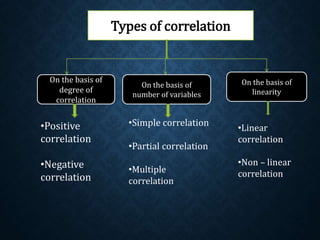
Types of correlation 
On the basis of 
degree of 
correlation 
On the basis of 
number of variables 
On the basis of 
linearity 
•Positive 
correlation 
•Negative 
correlation 
•Simple correlation 
•Partial correlation 
•Multiple 
correlation 
•Linear 
correlation 
•Non – linear 
correlation
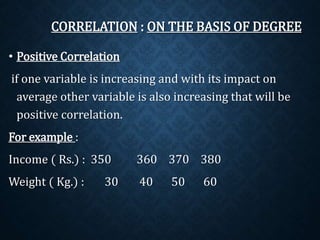
CORRELATION : ON THE BASIS OF DEGREE 
• Positive Correlation 
if one variable is increasing and with its impact on 
average other variable is also increasing that will be 
positive correlation. 
For example : 
Income ( Rs.) : 350 360 370 380 
Weight ( Kg.) : 30 40 50 60
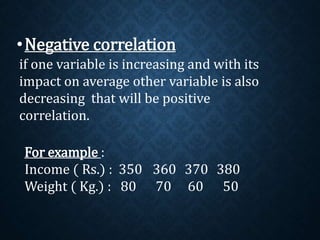
•Negative correlation 
if one variable is increasing and with its 
impact on average other variable is also 
decreasing that will be positive 
correlation. 
For example : 
Income ( Rs.) : 350 360 370 380 
Weight ( Kg.) : 80 70 60 50
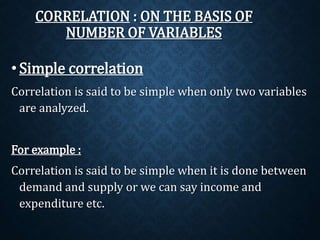
CORRELATION : ON THE BASIS OF 
NUMBER OF VARIABLES 
• Simple correlation 
Correlation is said to be simple when only two variables 
are analyzed. 
For example : 
Correlation is said to be simple when it is done between 
demand and supply or we can say income and 
expenditure etc.
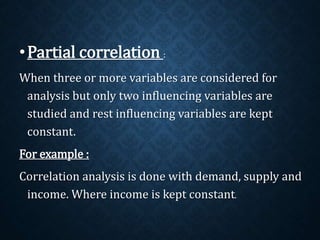
•Partial correlation : 
When three or more variables are considered for 
analysis but only two influencing variables are 
studied and rest influencing variables are kept 
constant. 
For example : 
Correlation analysis is done with demand, supply and 
income. Where income is kept constant.
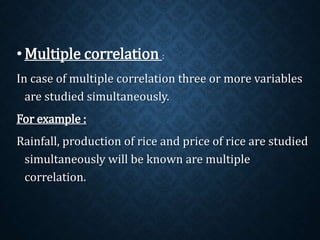
•Multiple correlation : 
In case of multiple correlation three or more variables 
are studied simultaneously. 
For example : 
Rainfall, production of rice and price of rice are studied 
simultaneously will be known are multiple 
correlation.
CORRELATION : ON THE BASIS OF 
LINEARITY 
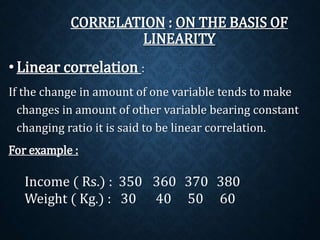
• Linear correlation : 
If the change in amount of one variable tends to make 
changes in amount of other variable bearing constant 
changing ratio it is said to be linear correlation. 
For example : 
Income ( Rs.) : 350 360 370 380 
Weight ( Kg.) : 30 40 50 60
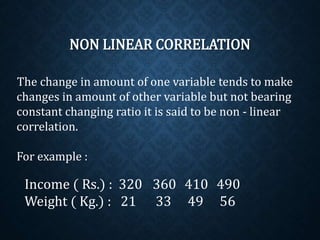
NON LINEAR CORRELATION 
If The change in amount of one variable tends to make 
changes in amount of other variable but not bearing 
constant changing ratio it is said to be non - linear 
correlation. 
For example : 
Income ( Rs.) : 320 360 410 490 
Weight ( Kg.) : 21 33 49 56
IMPORTANCE OF CORRELATION 
ANALYSIS : 
• Measures the degree of relation i.e. whether it is positive 
or negative. 
• Estimating values of variables i.e. if variables are highly 
correlated then we can find value of variable with the 
help of gives value of variable. 
• Helps in understanding economic behavior.
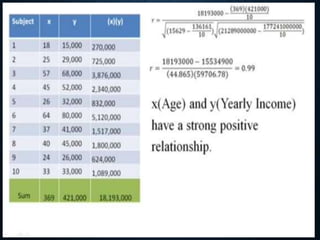
PEARSON r (CORRELATION) 
•A linear correlation necessary to find the 
degree of the association of two sets of 
variables X and Y.
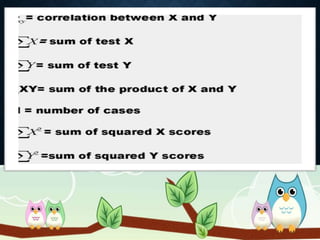
FORMULA:
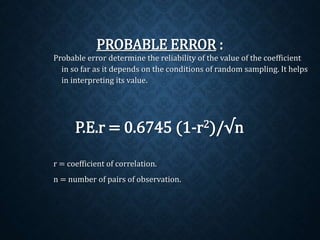
PROBABLE ERROR : 
Probable error determine the reliability of the value of the coefficient 
in so far as it depends on the conditions of random sampling. It helps 
in interpreting its value. 
P.E.r = 0.6745 (1-r2)/√n 
r = coefficient of correlation. 
n = number of pairs of observation.
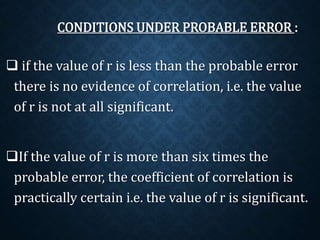
CONDITIONS UNDER PROBABLE ERROR : 
 if the value of r is less than the probable error 
there is no evidence of correlation, i.e. the value 
of r is not at all significant. 
If the value of r is more than six times the 
probable error, the coefficient of correlation is 
practically certain i.e. the value of r is significant.
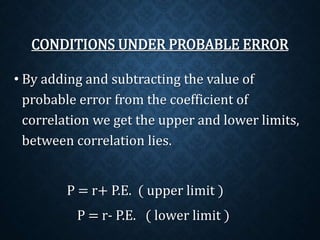
CONDITIONS UNDER PROBABLE ERROR 
• By adding and subtracting the value of 
probable error from the coefficient of 
correlation we get the upper and lower limits, 
between correlation lies. 
P = r+ P.E. ( upper limit ) 
P = r- P.E. ( lower limit )
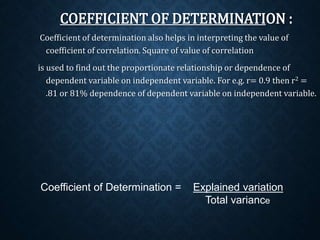
COEFFICIENT OF DETERMINATION : 
Coefficient of determination also helps in interpreting the value of 
coefficient of correlation. Square of value of correlation 
is used to find out the proportionate relationship or dependence of 
dependent variable on independent variable. For e.g. r= 0.9 then r2 = 
.81 or 81% dependence of dependent variable on independent variable. 
Coefficient of Determination = Explained variation 
Total variance
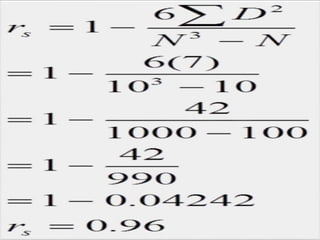
SPEARMAN RANK CORRELATION 
A statistic which is used to measure the 
relationship of paired ranks assigned to 
individual scores on two variables.
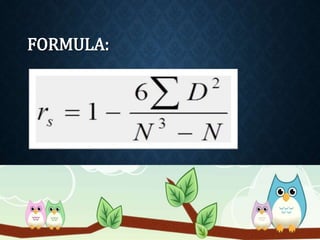
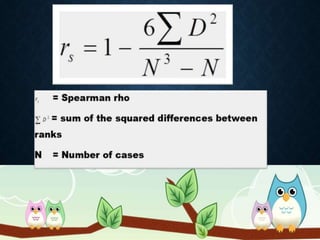
FORMULA:
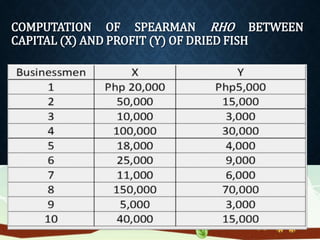
COMPUTATION OF SPEARMAN RHO BETWEEN 
CAPITAL (X) AND PROFIT (Y) OF DRIED FISH
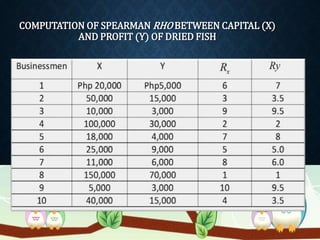
COMPUTATION OF SPEARMAN RHO BETWEEN CAPITAL (X) 
AND PROFIT (Y) OF DRIED FISH
Businessme 
n 
X Y Rx Ry D D2 
1 Php 
20,000 
Php5,000 7 1.0 1.00 
2 50,000 15,000 3 3.5 -0.5 0.25 
3 10,000 3,000 9 9.5 -0.5 0.25 
4 100,000 30,000 2 2 0 0 
5 18,000 4,000 7 8 -1.0 1.00 
6 25,000 9,000 5 5.0 0 0 
7 11,000 6,000 8 6.0 2.0 4.00 
8 150,000 70,000 1 1 0 0 
9 5,000 3,000 10 9.5 0.5 0.25 
10 40,000 15,000 4 3.5 0.5 0.25
THANK 
YOU
REFERENCES : 
• S. P. Gupta 
• S. C. Gupta 
• www.wikipedia.org 
• Mr. Kohli 
• Mr. D. Patri

Correlationanalysis

  • 1.
  • 2.
    MEANING OF CORRELATIONANALYSIS Correlation analysis is a process to find out the degree of relationship between two or more variables by applying various statistical tools and techniques. According to A.M. Tuttle “Correlation is an analysis of the association between two or more variable”
  • 3.
    USES OF CORRELATIONANALYSIS • It is used in deriving the degree and direction of relationship within the variables. • It is used in reducing the range of uncertainty in matter of prediction. • It I used in presenting the average relationship between any two variables through a single value of coefficient of correlation.
  • 4.
    USES OF CORRELATIONANALYSIS • In the field of science and philosophy these methods are used for making progressive conclusions. • In the field of nature also, it is used in observing the multiplicity of the inter related forces.
  • 5.
    Types of correlation On the basis of degree of correlation On the basis of number of variables On the basis of linearity •Positive correlation •Negative correlation •Simple correlation •Partial correlation •Multiple correlation •Linear correlation •Non – linear correlation
  • 6.
    CORRELATION : ONTHE BASIS OF DEGREE • Positive Correlation if one variable is increasing and with its impact on average other variable is also increasing that will be positive correlation. For example : Income ( Rs.) : 350 360 370 380 Weight ( Kg.) : 30 40 50 60
  • 7.
    •Negative correlation ifone variable is increasing and with its impact on average other variable is also decreasing that will be positive correlation. For example : Income ( Rs.) : 350 360 370 380 Weight ( Kg.) : 80 70 60 50
  • 8.
    CORRELATION : ONTHE BASIS OF NUMBER OF VARIABLES • Simple correlation Correlation is said to be simple when only two variables are analyzed. For example : Correlation is said to be simple when it is done between demand and supply or we can say income and expenditure etc.
  • 9.
    •Partial correlation : When three or more variables are considered for analysis but only two influencing variables are studied and rest influencing variables are kept constant. For example : Correlation analysis is done with demand, supply and income. Where income is kept constant.
  • 10.
    •Multiple correlation : In case of multiple correlation three or more variables are studied simultaneously. For example : Rainfall, production of rice and price of rice are studied simultaneously will be known are multiple correlation.
  • 11.
    CORRELATION : ONTHE BASIS OF LINEARITY • Linear correlation : If the change in amount of one variable tends to make changes in amount of other variable bearing constant changing ratio it is said to be linear correlation. For example : Income ( Rs.) : 350 360 370 380 Weight ( Kg.) : 30 40 50 60
  • 12.
    NON LINEAR CORRELATION If The change in amount of one variable tends to make changes in amount of other variable but not bearing constant changing ratio it is said to be non - linear correlation. For example : Income ( Rs.) : 320 360 410 490 Weight ( Kg.) : 21 33 49 56
  • 13.
    IMPORTANCE OF CORRELATION ANALYSIS : • Measures the degree of relation i.e. whether it is positive or negative. • Estimating values of variables i.e. if variables are highly correlated then we can find value of variable with the help of gives value of variable. • Helps in understanding economic behavior.
  • 15.
    PEARSON r (CORRELATION) •A linear correlation necessary to find the degree of the association of two sets of variables X and Y.
  • 16.
  • 20.
    PROBABLE ERROR : Probable error determine the reliability of the value of the coefficient in so far as it depends on the conditions of random sampling. It helps in interpreting its value. P.E.r = 0.6745 (1-r2)/√n r = coefficient of correlation. n = number of pairs of observation.
  • 21.
    CONDITIONS UNDER PROBABLEERROR :  if the value of r is less than the probable error there is no evidence of correlation, i.e. the value of r is not at all significant. If the value of r is more than six times the probable error, the coefficient of correlation is practically certain i.e. the value of r is significant.
  • 22.
    CONDITIONS UNDER PROBABLEERROR • By adding and subtracting the value of probable error from the coefficient of correlation we get the upper and lower limits, between correlation lies. P = r+ P.E. ( upper limit ) P = r- P.E. ( lower limit )
  • 23.
    COEFFICIENT OF DETERMINATION: Coefficient of determination also helps in interpreting the value of coefficient of correlation. Square of value of correlation is used to find out the proportionate relationship or dependence of dependent variable on independent variable. For e.g. r= 0.9 then r2 = .81 or 81% dependence of dependent variable on independent variable. Coefficient of Determination = Explained variation Total variance
  • 24.
    SPEARMAN RANK CORRELATION A statistic which is used to measure the relationship of paired ranks assigned to individual scores on two variables.
  • 25.
  • 27.
    COMPUTATION OF SPEARMANRHO BETWEEN CAPITAL (X) AND PROFIT (Y) OF DRIED FISH
  • 28.
    COMPUTATION OF SPEARMANRHO BETWEEN CAPITAL (X) AND PROFIT (Y) OF DRIED FISH
  • 29.
    Businessme n XY Rx Ry D D2 1 Php 20,000 Php5,000 7 1.0 1.00 2 50,000 15,000 3 3.5 -0.5 0.25 3 10,000 3,000 9 9.5 -0.5 0.25 4 100,000 30,000 2 2 0 0 5 18,000 4,000 7 8 -1.0 1.00 6 25,000 9,000 5 5.0 0 0 7 11,000 6,000 8 6.0 2.0 4.00 8 150,000 70,000 1 1 0 0 9 5,000 3,000 10 9.5 0.5 0.25 10 40,000 15,000 4 3.5 0.5 0.25
  • 31.
  • 32.
    REFERENCES : •S. P. Gupta • S. C. Gupta • www.wikipedia.org • Mr. Kohli • Mr. D. Patri