In ordinary speech, the term rent means hiring
somethings like rent of house, rent of machine etc. but
economic rent means special sense. It refers to that
part of the payment by a tenant which is made only for
the use of land, i.e., free gift of nature…….
DEFINITION OF RENT
Concept of Economic Rent and
Contract Rent
The Ricardian theory of rent is based on following assumptions:
a) Economic Rent: According to the classical economists, economic rent is that payment which is made for the use of land alone.
It is the price for original and indestructible power of land. It is determined by the fertility of land. It is called ‘net’ rent.
Modern economists use the term ‘rent’ to mean the payments made to land, other free gift of nature, capital and labour which are
‘scarce’ in the short run. So, they get some special payments. Many factors earn some income over and above their minimum
earning in short period which is rent.
b) Contract Rent: It is the amount of total contractual payment made by the tenant to the landlord according to the agreement. It
is determined by the forces of demand and supply of assets in the market it is also called gross rent. This includes the economic
rent together with the interest on the capital invested and labour charge wages
Ricardian Theory of Rent
 The theory of economic rent was first propounded by the English Classical
Economist David Ricardo (1773 -1823). David Ricardo in his book.
"Principles of Political Economy and Taxation", defined rent as that:
 "Portion of the produce of the earth which is paid to a landlord on account
of the original and indestructible powers of the soil, Ricardo in his theory of
rent has emphasized that rent is a reward for the services of land which is
fixed in supply. Secondly, it arises due to original qualities of land which
are indestructible". (The original indestructible powers of the soil include
natural soil, fertility, mineral deposits, climatic conditions etc., etc.).
Determination Of Rent
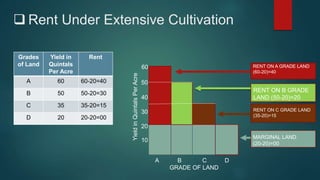
(i) Rent Under Extensive Cultivation.
(ii) Rent Under Intensive Cultivation
 Rent Under Extensive Cultivation
Grades
of Land
Yield in
Quintals
Per Acre
Rent
A 60 60-20=40
B 50 50-20=30
C 35 35-20=15
D 20 20-20=00
10
20
30
40
50
60
A B C D
GRADE OF LAND
YieldinQuintalsPerAcre
RENT ON A GRADE LAND
(60-20)=40
RENT ON B GRADE
LAND (50-20)=20
RENT ON C GRADE LAND
(35-20)=15
MARGINAL LAND
(20-20)=00
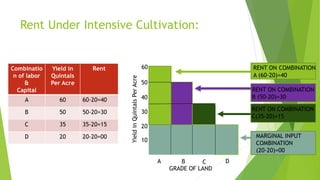
Rent Under Intensive Cultivation:
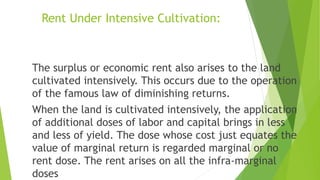
The surplus or economic rent also arises to the land
cultivated intensively. This occurs due to the operation
of the famous law of diminishing returns.
When the land is cultivated intensively, the application
of additional doses of labor and capital brings in less
and less of yield. The dose whose cost just equates the
value of marginal return is regarded marginal or no
rent dose. The rent arises on all the infra-marginal
doses
Rent Under Intensive Cultivation:
Combinatio
n of labor
&
Capital
Yield in
Quintals
Per Acre
Rent
A 60 60-20=40
B 50 50-20=30
C 35 35-20=15
D 20 20-20=00
10
20
30
40
50
60 RENT ON COMBINATION
A (60-20)=40
RENT ON COMBINATION
B (50-20)=30
MARGINAL INPUT
COMBINATION
(20-20)=00
RENT ON COMBINATION
C(35-20)=15
YieldinQuintalsPerAcre
A B C D
GRADE OF LAND
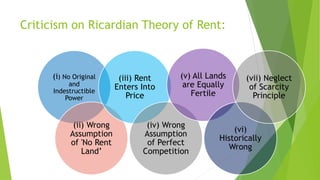
Criticism on Ricardian Theory of Rent:
(i) No Original
and
Indestructible
Power
(ii) Wrong
Assumption
of 'No Rent
Land’
(iii) Rent
Enters Into
Price
(iv) Wrong
Assumption
of Perfect
Competition
(v) All Lands
are Equally
Fertile
(vi)
Historically
Wrong
(vii) Neglect
of Scarcity
Principle
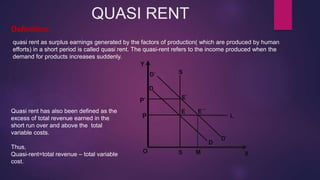
QUASI RENT
O S M X
Y
P
P`
D
D` S
E`
E``E
D
D`
L
Quasi rent has also been defined as the
excess of total revenue earned in the
short run over and above the total
variable costs.
Thus,
Quasi-rent=total revenue – total variable
cost.
quasi rent as surplus earnings generated by the factors of production( which are produced by human
efforts) in a short period is called quasi rent. The quasi-rent refers to the income produced when the
demand for products increases suddenly.
Definition:
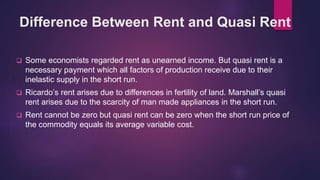
Difference Between Rent and Quasi Rent
Rent is a payment for natural gifts of nature like land. Quasi rent is a
payment for man made appliances like machines.
As the supply of land cannot be changed, rent persists in both short run
and long run. But quasi rent is a short run phenomenon which
disappears in the long run when the supply of man made goods is
increased.
Rent is permanent in nature while quasi rent is a temporary
phenomenon.
Difference Between Rent and Quasi Rent
 Some economists regarded rent as unearned income. But quasi rent is a
necessary payment which all factors of production receive due to their
inelastic supply in the short run.
 Ricardo’s rent arises due to differences in fertility of land. Marshall’s quasi
rent arises due to the scarcity of man made appliances in the short run.
 Rent cannot be zero but quasi rent can be zero when the short run price of
the commodity equals its average variable cost.
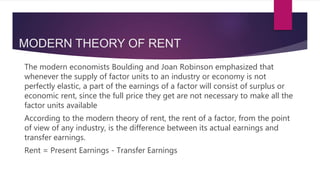
MODERN THEORY OF RENT
The modern economists Boulding and Joan Robinson emphasized that
whenever the supply of factor units to an industry or economy is not
perfectly elastic, a part of the earnings of a factor will consist of surplus or
economic rent, since the full price they get are not necessary to make all the
factor units available
According to the modern theory of rent, the rent of a factor, from the point
of view of any industry, is the difference between its actual earnings and
transfer earnings.
Rent = Present Earnings - Transfer Earnings
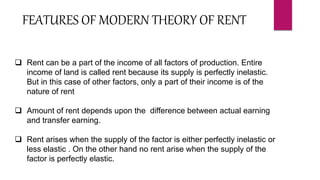
FEATURES OF MODERN THEORY OF RENT
 Rent can be a part of the income of all factors of production. Entire
income of land is called rent because its supply is perfectly inelastic.
But in this case of other factors, only a part of their income is of the
nature of rent
 Amount of rent depends upon the difference between actual earning
and transfer earning.
 Rent arises when the supply of the factor is either perfectly inelastic or
less elastic . On the other hand no rent arise when the supply of the
factor is perfectly elastic.
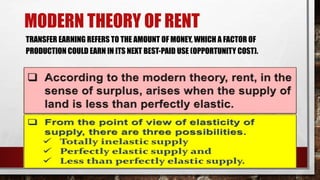
MODERN THEORY OF RENT
TRANSFER EARNING REFERS TO THE AMOUNT OF MONEY, WHICH A FACTOR OF
PRODUCTION COULD EARN IN ITS NEXT BEST-PAID USE (OPPORTUNITY COST).
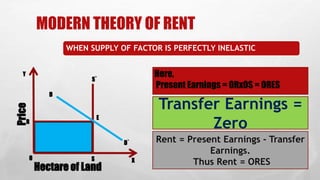
MODERN THEORY OF RENT
O S
S`
D
D`
R
Y
X
Transfer Earnings =
Zero
Here,
Present Earnings = ORxOS = ORES
Rent = Present Earnings - Transfer
Earnings.
Thus Rent = ORES
E
WHEN SUPPLY OF FACTOR IS PERFECTLY INELASTIC
Price
Hectare of Land
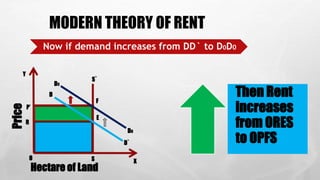
O S
S`
D
D`
Y
X
E
D0
D0
P’
Now if demand increases from DD` to D0D0
Then Rent
increases
from ORES
to OPFS
Price
Hectare of Land
MODERN THEORY OF RENT
R
F
O M
D
D`
S
Y
X
E
S`
Price
Hectare of Land
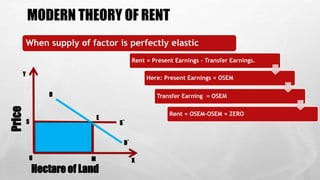
When supply of factor is perfectly elastic
Rent = Present Earnings - Transfer Earnings.
Here: Present Earnings = OSEM
Transfer Earning = OSEM
Rent = OSEM-OSEM = ZERO
MODERN THEORY OF RENT
O M
D
D`
S
X
E
S`
Price
Hectare of Land
Y
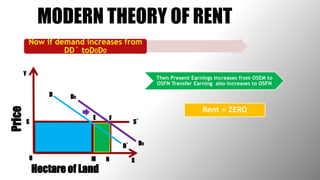
Now if demand increases from
DD` toD0D0
Then Present Earnings increases from OSEM to
OSFN Transfer Earning also increases to OSFN
F
N
Rent = ZERO
D0
D0
MODERN THEORY OF RENT
Rent

Rent

  • 1.
    In ordinary speech,the term rent means hiring somethings like rent of house, rent of machine etc. but economic rent means special sense. It refers to that part of the payment by a tenant which is made only for the use of land, i.e., free gift of nature……. DEFINITION OF RENT
  • 2.
    Concept of EconomicRent and Contract Rent The Ricardian theory of rent is based on following assumptions: a) Economic Rent: According to the classical economists, economic rent is that payment which is made for the use of land alone. It is the price for original and indestructible power of land. It is determined by the fertility of land. It is called ‘net’ rent. Modern economists use the term ‘rent’ to mean the payments made to land, other free gift of nature, capital and labour which are ‘scarce’ in the short run. So, they get some special payments. Many factors earn some income over and above their minimum earning in short period which is rent. b) Contract Rent: It is the amount of total contractual payment made by the tenant to the landlord according to the agreement. It is determined by the forces of demand and supply of assets in the market it is also called gross rent. This includes the economic rent together with the interest on the capital invested and labour charge wages
  • 3.
    Ricardian Theory ofRent  The theory of economic rent was first propounded by the English Classical Economist David Ricardo (1773 -1823). David Ricardo in his book. "Principles of Political Economy and Taxation", defined rent as that:  "Portion of the produce of the earth which is paid to a landlord on account of the original and indestructible powers of the soil, Ricardo in his theory of rent has emphasized that rent is a reward for the services of land which is fixed in supply. Secondly, it arises due to original qualities of land which are indestructible". (The original indestructible powers of the soil include natural soil, fertility, mineral deposits, climatic conditions etc., etc.).
  • 4.
    Determination Of Rent (i)Rent Under Extensive Cultivation. (ii) Rent Under Intensive Cultivation
  • 5.
     Rent UnderExtensive Cultivation Grades of Land Yield in Quintals Per Acre Rent A 60 60-20=40 B 50 50-20=30 C 35 35-20=15 D 20 20-20=00 10 20 30 40 50 60 A B C D GRADE OF LAND YieldinQuintalsPerAcre RENT ON A GRADE LAND (60-20)=40 RENT ON B GRADE LAND (50-20)=20 RENT ON C GRADE LAND (35-20)=15 MARGINAL LAND (20-20)=00
  • 6.
    Rent Under IntensiveCultivation: The surplus or economic rent also arises to the land cultivated intensively. This occurs due to the operation of the famous law of diminishing returns. When the land is cultivated intensively, the application of additional doses of labor and capital brings in less and less of yield. The dose whose cost just equates the value of marginal return is regarded marginal or no rent dose. The rent arises on all the infra-marginal doses
  • 7.
    Rent Under IntensiveCultivation: Combinatio n of labor & Capital Yield in Quintals Per Acre Rent A 60 60-20=40 B 50 50-20=30 C 35 35-20=15 D 20 20-20=00 10 20 30 40 50 60 RENT ON COMBINATION A (60-20)=40 RENT ON COMBINATION B (50-20)=30 MARGINAL INPUT COMBINATION (20-20)=00 RENT ON COMBINATION C(35-20)=15 YieldinQuintalsPerAcre A B C D GRADE OF LAND
  • 8.
    Criticism on RicardianTheory of Rent: (i) No Original and Indestructible Power (ii) Wrong Assumption of 'No Rent Land’ (iii) Rent Enters Into Price (iv) Wrong Assumption of Perfect Competition (v) All Lands are Equally Fertile (vi) Historically Wrong (vii) Neglect of Scarcity Principle
  • 9.
    QUASI RENT O SM X Y P P` D D` S E` E``E D D` L Quasi rent has also been defined as the excess of total revenue earned in the short run over and above the total variable costs. Thus, Quasi-rent=total revenue – total variable cost. quasi rent as surplus earnings generated by the factors of production( which are produced by human efforts) in a short period is called quasi rent. The quasi-rent refers to the income produced when the demand for products increases suddenly. Definition:
  • 10.
    Difference Between Rentand Quasi Rent Rent is a payment for natural gifts of nature like land. Quasi rent is a payment for man made appliances like machines. As the supply of land cannot be changed, rent persists in both short run and long run. But quasi rent is a short run phenomenon which disappears in the long run when the supply of man made goods is increased. Rent is permanent in nature while quasi rent is a temporary phenomenon.
  • 11.
    Difference Between Rentand Quasi Rent  Some economists regarded rent as unearned income. But quasi rent is a necessary payment which all factors of production receive due to their inelastic supply in the short run.  Ricardo’s rent arises due to differences in fertility of land. Marshall’s quasi rent arises due to the scarcity of man made appliances in the short run.  Rent cannot be zero but quasi rent can be zero when the short run price of the commodity equals its average variable cost.
  • 12.
    MODERN THEORY OFRENT The modern economists Boulding and Joan Robinson emphasized that whenever the supply of factor units to an industry or economy is not perfectly elastic, a part of the earnings of a factor will consist of surplus or economic rent, since the full price they get are not necessary to make all the factor units available According to the modern theory of rent, the rent of a factor, from the point of view of any industry, is the difference between its actual earnings and transfer earnings. Rent = Present Earnings - Transfer Earnings
  • 13.
    FEATURES OF MODERNTHEORY OF RENT  Rent can be a part of the income of all factors of production. Entire income of land is called rent because its supply is perfectly inelastic. But in this case of other factors, only a part of their income is of the nature of rent  Amount of rent depends upon the difference between actual earning and transfer earning.  Rent arises when the supply of the factor is either perfectly inelastic or less elastic . On the other hand no rent arise when the supply of the factor is perfectly elastic.
  • 14.
    MODERN THEORY OFRENT TRANSFER EARNING REFERS TO THE AMOUNT OF MONEY, WHICH A FACTOR OF PRODUCTION COULD EARN IN ITS NEXT BEST-PAID USE (OPPORTUNITY COST).
  • 15.
    MODERN THEORY OFRENT O S S` D D` R Y X Transfer Earnings = Zero Here, Present Earnings = ORxOS = ORES Rent = Present Earnings - Transfer Earnings. Thus Rent = ORES E WHEN SUPPLY OF FACTOR IS PERFECTLY INELASTIC Price Hectare of Land
  • 16.
    O S S` D D` Y X E D0 D0 P’ Now ifdemand increases from DD` to D0D0 Then Rent increases from ORES to OPFS Price Hectare of Land MODERN THEORY OF RENT R F
  • 17.
    O M D D` S Y X E S` Price Hectare ofLand When supply of factor is perfectly elastic Rent = Present Earnings - Transfer Earnings. Here: Present Earnings = OSEM Transfer Earning = OSEM Rent = OSEM-OSEM = ZERO MODERN THEORY OF RENT
  • 18.
    O M D D` S X E S` Price Hectare ofLand Y Now if demand increases from DD` toD0D0 Then Present Earnings increases from OSEM to OSFN Transfer Earning also increases to OSFN F N Rent = ZERO D0 D0 MODERN THEORY OF RENT