1
Measurement of Variables:
Operational Definition
CHAPTER 11
2
Chapter Objectives
 Explain when operationalization of
variables is necessary.
 Operationally define variables.
 Describe the advantages of using
existing measurement scales to
operationalize variables.
Measurement
 Measurement: the assignment of
numbers or other symbols to
characteristics (or attributes) of objects
according to a pre-specified set of rules.
3
(Characteristics of) Objects
 Objects include persons, strategic
business units, companies, countries, kitchen
appliances, restaurants, shampoo, yogurt and
so on.
 Examples of characteristics of objects are
arousal seeking tendency, achievement
motivation, organizational effectiveness,
shopping enjoyment, length, weight, ethnic
diversity, service quality, conditioning effects
and taste.
5
5
Measurement of the Variables
 Measurement of variables in the
theoretical framework is an integral part
of research and an important aspect of
research design.
 Unless the variables are measured in
some way, we will not be able to test
our hypotheses and find answers to
complex research issues.
6
Measurement of Variables
 There are two types of variables:
 Objective nature: could be measured
 Subjective nature: hard to be measured
 Objects that can be physically measured:
 The length and width of an office table
 The office floor area
 The demographic characteristics of the
employees: →
7
Measurement of Variables
1. How long have you been working in this
organization.
2. What is your job title.
3. What is your marital status?
4. The number of your children.
 The absenteeism of employees.
 The number of products produced.
 The number of products rejects during the
course of each month.
8
Measurement of Variables
 Objects that can’t be physically
measured:
 The perceptions of individuals.
 extent of authority given to the
individual.
 how the supervisor treats the workers.
 promotional opportunities.
 The degree of understanding.
9
Measurement of Variables
 One technique to measure these
variables, is to reduce the abstract notion to
observable behavior and characteristics.
 For instance, the concept of thirst is
abstract; we cannot see thirst.
 We expect a thirsty person to drink water.
 We determine the thirst levels by the
measure of the quantity of water that a
person drink.
10
Operational Definition:
Dimensions and Elements
 Operational definition is a statement of the
specific dimensions and elements through which a
concept will become measurable.
 Operationalizing is done by looking at the
behavioral dimensions, or properties denoted by
the concept. These are then translated into
observable and measurable elements.
 Operationally defining a concept involves a
series of steps. An example will help to illustrate
how this is done.
11
Example: Operationalizing the
Concept of Achievement Motivation
 What behavioral dimensions or
characteristics would we expect to find in
people with high achievement motivation?
 The people who have high achievement
motivation would probably have the
following five typical broad
characteristics, which we will call
dimensions:
12
Example (Cont.)
1. They would be driven by work
2. No mood to relax
3. Prefer to work on their own rather with
others
4. They engage in challenging jobs rather
than easy ones.
5. They like to get feedback from their
superiors, colleagues, to know how they are
progressing.
13
Example (Cont.)
 Although, breaking the concept of
Achievement Motivation into the above five
dimensions has reduced its level of
abstraction, we have still not operationalized
the concept into measurable elements of
behavior.
 This could be done by breaking each
dimension into its elements, in order to
distinguish those who have high motivation
from those with less.
14
Example (Cont.)
 Elements of dimension 1: (They would be
driven by work)
(1) be at work all the time
(2) be reluctant to take time off from work
(3) persevere even in the face of some
setbacks
 All the above elements could be counted by
asking a direct questions to the respondents
through a questioners or an interviews.
15
Example (Cont.)
 Elements of Dimension 2: (No mood to
relax)
 The degree of unwillingness to relax can be
measured by asking persons such questions
as:
(1) how often do you think about work while
you are away from the workplace?
(2) what are your hobbies?
(3) how do you spend your time when you are
away from workplace?
16
Example (Cont.)
 Elements of Dimension 3: (Prefer to
work on their own rather with others)
 Individuals with high achievement
motivation have no patience with
ineffective people and does not like to
work with others.
17
Example (Cont.)
 Elements of Dimension 4: (They
engage in challenging jobs rather than
easy ones)
 They don’t like routine jobs
 they like to take moderate, rather than
overwhelming challenges
18
Example (Cont.)
 Elements of Dimension 5: (They like
to get feedback from their superiors,
colleagues, to know how they are
progressing)
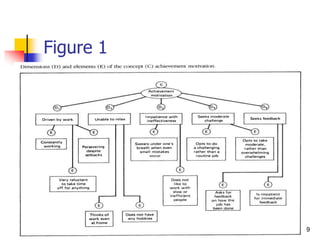
 asks for feedback on how the job has
been done, both negative and positive.
 ( see Figure 1)
19
Figure 1
20
Operational Definition:
Dimensions and Elements
 Operationally defining the concept is
the best way to measure it. We
measure it by ask the respondents to
report their own behavior patterns by
asking them appropriate questions,
which they can respond to on some
scale that we provide.
21
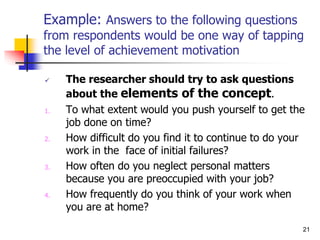
Example: Answers to the following questions
from respondents would be one way of tapping
the level of achievement motivation
 The researcher should try to ask questions
about the elements of the concept.
1. To what extent would you push yourself to get the
job done on time?
2. How difficult do you find it to continue to do your
work in the face of initial failures?
3. How often do you neglect personal matters
because you are preoccupied with your job?
4. How frequently do you think of your work when
you are at home?
22
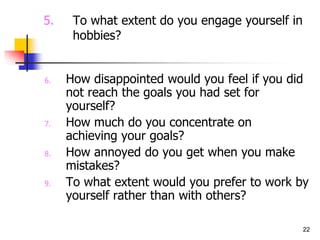
5. To what extent do you engage yourself in
hobbies?
6. How disappointed would you feel if you did
not reach the goals you had set for
yourself?
7. How much do you concentrate on
achieving your goals?
8. How annoyed do you get when you make
mistakes?
9. To what extent would you prefer to work by
yourself rather than with others?
23
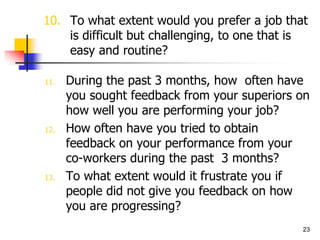
10. To what extent would you prefer a job that
is difficult but challenging, to one that is
easy and routine?
11. During the past 3 months, how often have
you sought feedback from your superiors on
how well you are performing your job?
12. How often have you tried to obtain
feedback on your performance from your
co-workers during the past 3 months?
13. To what extent would it frustrate you if
people did not give you feedback on how
you are progressing?
24
What an Operational Definition Is
Not
 Just as important to understand what an
operational definition is, equally important is to
remember what it is not.
 An operational definition does not describe the
correlates of the concept.
The operational definition does not consist of
delineating the reasons, antecedents,
consequences, or correlates of the concept. Rather,
it describes its observable characteristics in
order to be able to measure the concept.
25
What an Operational Definition Is
Not
For example, achievement motivation and
performance and/or success may be highly
correlated.
Thus, We cannot measure an individual’s level of
motivation through success and/or performance.
Performance and success could have been made
possible as a consequence of achievement
motivation, but in themselves, the two are not
measures of it.
For instance, a person with high achievement motivation may
have failed for some reason, perhaps beyond his control, to
perform the job successfully.
26
What an Operational Definition Is
Not
 If we judge the achievement motivation of
this person with performance as the
yardstick, we would have measured the
wrong concept. Instead of measuring
achievement motivation-our variable of
interest- we would have measured
performance, another variable we had not
intended to measure nor were interested in.
27
Example
Operationalizing the Concept of
Learning
 Learning is an important concept in the
educational setting. How could we measure
the abstract concept called learning?
First, we need to define the concept
operationally (the dimensions).
Second, break it down to observable and
measurable behaviors (the elements).
28
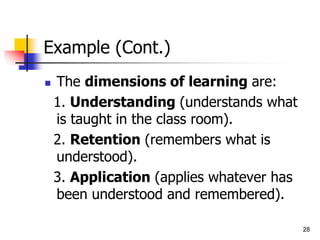
Example (Cont.)
 The dimensions of learning are:
1. Understanding (understands what
is taught in the class room).
2. Retention (remembers what is
understood).
3. Application (applies whatever has
been understood and remembered).
29
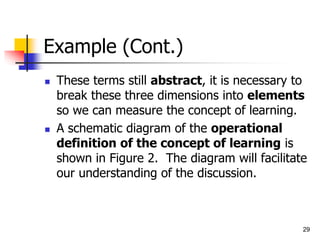
Example (Cont.)
 These terms still abstract, it is necessary to
break these three dimensions into elements
so we can measure the concept of learning.
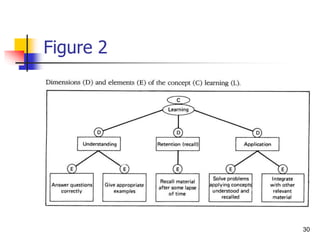
 A schematic diagram of the operational
definition of the concept of learning is
shown in Figure 2. The diagram will facilitate
our understanding of the discussion.
30
Figure 2
31
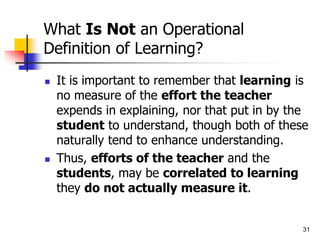
What Is Not an Operational
Definition of Learning?
 It is important to remember that learning is
no measure of the effort the teacher
expends in explaining, nor that put in by the
student to understand, though both of these
naturally tend to enhance understanding.
 Thus, efforts of the teacher and the
students, may be correlated to learning
they do not actually measure it.
32
A Measure of Student Learning
 An exam that measures learning in
students would include the following
questions (the particular dimensions
tapped are shown in parentheses):
1. Define the concept of motivation (recall).
2. State the various theories of motivation and
explain them, giving examples
(understanding and recall).
3. What is your viewpoint of the manager’s
role as motivator? (understanding and
analysis).
33
A Measure of Student Learning
4. Describe three different situations in which
a manager of a work organization would
use equity theory, the expectancy theory,
and job designs to motivate employees
(application).
5. How does motivation relate to leadership?
How are these concepts related to a
manager’s job? (understanding, retention,
application).
34
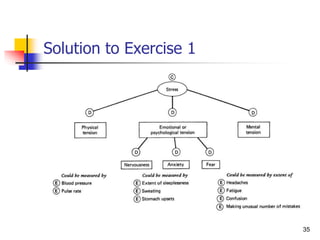
Exercise 1
 Schematically depict the operational
definition of the concept of stress
and develop 10 questions that would
measure stress.
35
Solution to Exercise 1
36
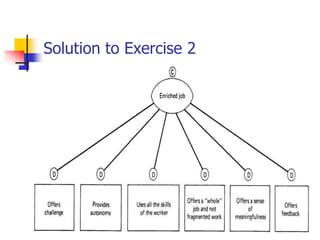
Exercise 2
 Schematically depict the operational
definition of the concept of enriched
job and develop 12 items to measure
it.
37
Solution to Exercise 2

Chapter 11: Operational definition.ppt

  • 1.
  • 2.
    2 Chapter Objectives  Explainwhen operationalization of variables is necessary.  Operationally define variables.  Describe the advantages of using existing measurement scales to operationalize variables.
  • 3.
    Measurement  Measurement: theassignment of numbers or other symbols to characteristics (or attributes) of objects according to a pre-specified set of rules. 3
  • 4.
    (Characteristics of) Objects Objects include persons, strategic business units, companies, countries, kitchen appliances, restaurants, shampoo, yogurt and so on.  Examples of characteristics of objects are arousal seeking tendency, achievement motivation, organizational effectiveness, shopping enjoyment, length, weight, ethnic diversity, service quality, conditioning effects and taste. 5
  • 5.
    5 Measurement of theVariables  Measurement of variables in the theoretical framework is an integral part of research and an important aspect of research design.  Unless the variables are measured in some way, we will not be able to test our hypotheses and find answers to complex research issues.
  • 6.
    6 Measurement of Variables There are two types of variables:  Objective nature: could be measured  Subjective nature: hard to be measured  Objects that can be physically measured:  The length and width of an office table  The office floor area  The demographic characteristics of the employees: →
  • 7.
    7 Measurement of Variables 1.How long have you been working in this organization. 2. What is your job title. 3. What is your marital status? 4. The number of your children.  The absenteeism of employees.  The number of products produced.  The number of products rejects during the course of each month.
  • 8.
    8 Measurement of Variables Objects that can’t be physically measured:  The perceptions of individuals.  extent of authority given to the individual.  how the supervisor treats the workers.  promotional opportunities.  The degree of understanding.
  • 9.
    9 Measurement of Variables One technique to measure these variables, is to reduce the abstract notion to observable behavior and characteristics.  For instance, the concept of thirst is abstract; we cannot see thirst.  We expect a thirsty person to drink water.  We determine the thirst levels by the measure of the quantity of water that a person drink.
  • 10.
    10 Operational Definition: Dimensions andElements  Operational definition is a statement of the specific dimensions and elements through which a concept will become measurable.  Operationalizing is done by looking at the behavioral dimensions, or properties denoted by the concept. These are then translated into observable and measurable elements.  Operationally defining a concept involves a series of steps. An example will help to illustrate how this is done.
  • 11.
    11 Example: Operationalizing the Conceptof Achievement Motivation  What behavioral dimensions or characteristics would we expect to find in people with high achievement motivation?  The people who have high achievement motivation would probably have the following five typical broad characteristics, which we will call dimensions:
  • 12.
    12 Example (Cont.) 1. Theywould be driven by work 2. No mood to relax 3. Prefer to work on their own rather with others 4. They engage in challenging jobs rather than easy ones. 5. They like to get feedback from their superiors, colleagues, to know how they are progressing.
  • 13.
    13 Example (Cont.)  Although,breaking the concept of Achievement Motivation into the above five dimensions has reduced its level of abstraction, we have still not operationalized the concept into measurable elements of behavior.  This could be done by breaking each dimension into its elements, in order to distinguish those who have high motivation from those with less.
  • 14.
    14 Example (Cont.)  Elementsof dimension 1: (They would be driven by work) (1) be at work all the time (2) be reluctant to take time off from work (3) persevere even in the face of some setbacks  All the above elements could be counted by asking a direct questions to the respondents through a questioners or an interviews.
  • 15.
    15 Example (Cont.)  Elementsof Dimension 2: (No mood to relax)  The degree of unwillingness to relax can be measured by asking persons such questions as: (1) how often do you think about work while you are away from the workplace? (2) what are your hobbies? (3) how do you spend your time when you are away from workplace?
  • 16.
    16 Example (Cont.)  Elementsof Dimension 3: (Prefer to work on their own rather with others)  Individuals with high achievement motivation have no patience with ineffective people and does not like to work with others.
  • 17.
    17 Example (Cont.)  Elementsof Dimension 4: (They engage in challenging jobs rather than easy ones)  They don’t like routine jobs  they like to take moderate, rather than overwhelming challenges
  • 18.
    18 Example (Cont.)  Elementsof Dimension 5: (They like to get feedback from their superiors, colleagues, to know how they are progressing)  asks for feedback on how the job has been done, both negative and positive.  ( see Figure 1)
  • 19.
  • 20.
    20 Operational Definition: Dimensions andElements  Operationally defining the concept is the best way to measure it. We measure it by ask the respondents to report their own behavior patterns by asking them appropriate questions, which they can respond to on some scale that we provide.
  • 21.
    21 Example: Answers tothe following questions from respondents would be one way of tapping the level of achievement motivation  The researcher should try to ask questions about the elements of the concept. 1. To what extent would you push yourself to get the job done on time? 2. How difficult do you find it to continue to do your work in the face of initial failures? 3. How often do you neglect personal matters because you are preoccupied with your job? 4. How frequently do you think of your work when you are at home?
  • 22.
    22 5. To whatextent do you engage yourself in hobbies? 6. How disappointed would you feel if you did not reach the goals you had set for yourself? 7. How much do you concentrate on achieving your goals? 8. How annoyed do you get when you make mistakes? 9. To what extent would you prefer to work by yourself rather than with others?
  • 23.
    23 10. To whatextent would you prefer a job that is difficult but challenging, to one that is easy and routine? 11. During the past 3 months, how often have you sought feedback from your superiors on how well you are performing your job? 12. How often have you tried to obtain feedback on your performance from your co-workers during the past 3 months? 13. To what extent would it frustrate you if people did not give you feedback on how you are progressing?
  • 24.
    24 What an OperationalDefinition Is Not  Just as important to understand what an operational definition is, equally important is to remember what it is not.  An operational definition does not describe the correlates of the concept. The operational definition does not consist of delineating the reasons, antecedents, consequences, or correlates of the concept. Rather, it describes its observable characteristics in order to be able to measure the concept.
  • 25.
    25 What an OperationalDefinition Is Not For example, achievement motivation and performance and/or success may be highly correlated. Thus, We cannot measure an individual’s level of motivation through success and/or performance. Performance and success could have been made possible as a consequence of achievement motivation, but in themselves, the two are not measures of it. For instance, a person with high achievement motivation may have failed for some reason, perhaps beyond his control, to perform the job successfully.
  • 26.
    26 What an OperationalDefinition Is Not  If we judge the achievement motivation of this person with performance as the yardstick, we would have measured the wrong concept. Instead of measuring achievement motivation-our variable of interest- we would have measured performance, another variable we had not intended to measure nor were interested in.
  • 27.
    27 Example Operationalizing the Conceptof Learning  Learning is an important concept in the educational setting. How could we measure the abstract concept called learning? First, we need to define the concept operationally (the dimensions). Second, break it down to observable and measurable behaviors (the elements).
  • 28.
    28 Example (Cont.)  Thedimensions of learning are: 1. Understanding (understands what is taught in the class room). 2. Retention (remembers what is understood). 3. Application (applies whatever has been understood and remembered).
  • 29.
    29 Example (Cont.)  Theseterms still abstract, it is necessary to break these three dimensions into elements so we can measure the concept of learning.  A schematic diagram of the operational definition of the concept of learning is shown in Figure 2. The diagram will facilitate our understanding of the discussion.
  • 30.
  • 31.
    31 What Is Notan Operational Definition of Learning?  It is important to remember that learning is no measure of the effort the teacher expends in explaining, nor that put in by the student to understand, though both of these naturally tend to enhance understanding.  Thus, efforts of the teacher and the students, may be correlated to learning they do not actually measure it.
  • 32.
    32 A Measure ofStudent Learning  An exam that measures learning in students would include the following questions (the particular dimensions tapped are shown in parentheses): 1. Define the concept of motivation (recall). 2. State the various theories of motivation and explain them, giving examples (understanding and recall). 3. What is your viewpoint of the manager’s role as motivator? (understanding and analysis).
  • 33.
    33 A Measure ofStudent Learning 4. Describe three different situations in which a manager of a work organization would use equity theory, the expectancy theory, and job designs to motivate employees (application). 5. How does motivation relate to leadership? How are these concepts related to a manager’s job? (understanding, retention, application).
  • 34.
    34 Exercise 1  Schematicallydepict the operational definition of the concept of stress and develop 10 questions that would measure stress.
  • 35.
  • 36.
    36 Exercise 2  Schematicallydepict the operational definition of the concept of enriched job and develop 12 items to measure it.
  • 37.