The University of Southern Mississippi College of Education and Psychology Department of Educational Leadership and Research James M. Thompson Proposal Defense Spring 2008
Agenda Brief Overview Statement of the Problem Rationale for the Study Theoretical Foundations Overview of Prior Literature Methodology Self-Disclosure
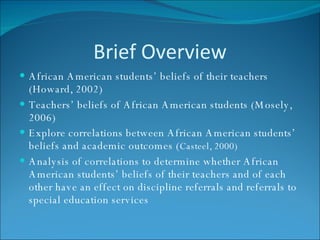
Brief Overview African American students’ beliefs of their teachers (Howard, 2002) Teachers’ beliefs of African American students (Mosely, 2006) Explore correlations between African American students’ beliefs and academic outcomes ( Casteel, 2000)  Analysis of correlations to determine whether African American students’ beliefs of their teachers and of each other have an effect on discipline referrals and referrals to special education services
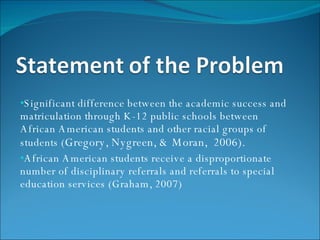
Significant difference between the academic success and matriculation through K-12 public schools between African American students and other racial groups of students ( Gregory, Nygreen, & Moran,  2006).  African American students receive a disproportionate number of disciplinary referrals and referrals to special education services (Graham, 2007)
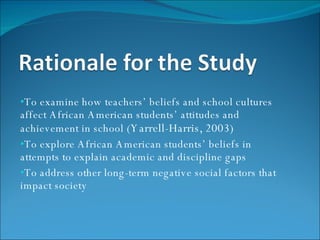
To examine how teachers’ beliefs and school cultures affect African American students’ attitudes and achievement in school ( Yarrell-Harris, 2003) To explore African American students’ beliefs in attempts to explain academic and discipline gaps To address other long-term negative social factors that impact society
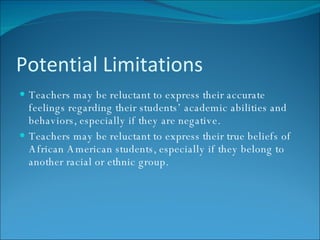
Potential Limitations Teachers may be reluctant to express their accurate feelings regarding their students’ academic abilities and behaviors, especially if they are negative. Teachers may be reluctant to express their true beliefs of African American students, especially if they belong to another racial or ethnic group.
Theoretical Foundations beliefs and expectations (Glenn, 1996). Physiological needs (Arkes & Garske, 1977).  Cultural context (Ware, 2006). Stereotype threats (Steele, 1998)
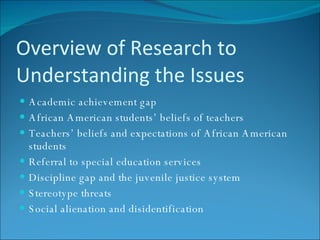
Overview of Research to Understanding the Issues Academic achievement gap African American students’ beliefs of teachers Teachers’ beliefs and expectations of African American students Referral to special education services Discipline gap and the juvenile justice system Stereotype threats Social alienation and disidentification
Study’s Methodology Research questions Hypotheses Research design Participants Instrumentations Statistical procedures planned to analyze the data
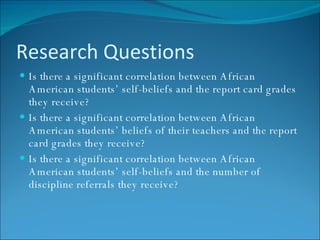
Research Questions Is there a significant correlation between African American students’ self-beliefs and the report card grades they receive? Is there a significant correlation between African American students’ beliefs of their teachers and the report card grades they receive?  Is there a significant correlation between African American students’ self-beliefs and the number of discipline referrals they receive?
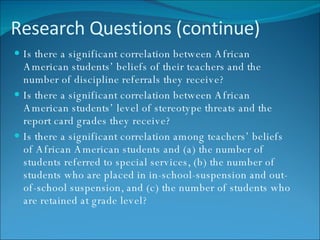
Research Questions (continue) Is there a significant correlation between African American students’ beliefs of their teachers and the number of discipline referrals they receive? Is there a significant correlation between African American students’ level of stereotype threats and the report card grades they receive? Is there a significant correlation among teachers’ beliefs of African American students and (a) the number of students referred to special services, (b) the number of students who are placed in in-school-suspension and out-of-school suspension, and (c) the number of students who are retained at grade level?
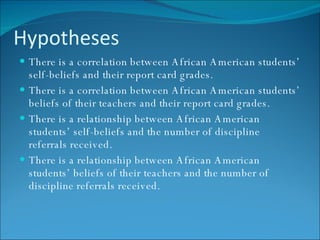
Hypotheses There is a correlation between African American students’ self-beliefs and their report card grades. There is a correlation between African American students’ beliefs of their teachers and their report card grades. There is a relationship between African American students’ self-beliefs and the number of discipline referrals received. There is a relationship between African American students’ beliefs of their teachers and the number of discipline referrals received.
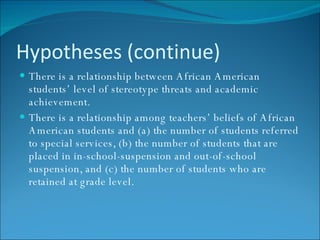
Hypotheses (continue) There is a relationship between African American students’ level of stereotype threats and academic achievement. There is a relationship among teachers’ beliefs of African American students and (a) the number of students referred to special services, (b) the number of students that are placed in in-school-suspension and out-of-school suspension, and (c) the number of students who are retained at grade level.
Research Design Quantitative research Dependent variables Report card grades Referrals to special education services Grade retentions Independent variables Students’ self-beliefs and stereotype threats Students’ beliefs of teachers Teachers’ beliefs of students
Participants African American students in fifth grade Teachers of African American students
Instrumentations Students’ beliefs School environment Classroom environment Discipline behavior Teachers’ beliefs African American students Career preparation Instructional strategies Classroom management School culture
Statistical Procedures Planned to Analyze the Data The variables and related data will be analyzed using descriptive, differential, and multi-linear regressions statistical techniques.
Self-Disclosure Researcher acknowledges set of beliefs and experiences regarding the research issues Awareness that some level of bias may surface Extra care will be taken to avoid bias
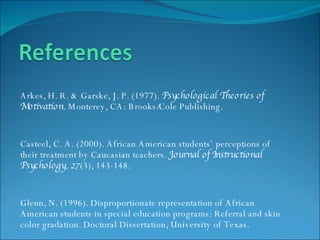
Arkes, H. R. & Garske, J. P. (1977).  Psychological Theories of  Motivation . Monterey, CA: Brooks/Cole Publishing.  Casteel, C. A. (2000). African American students’ perceptions of their treatment by Caucasian teachers.  Journal of Instructional Psychology ,  27 (3), 143-148. Glenn, N. (1996). Disproportionate representation of African American students in special education programs: Referral and skin color gradation. Doctoral Dissertation, University of Texas.
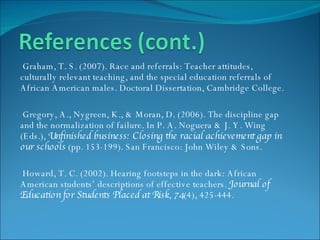
Graham, T. S. (2007). Race and referrals: Teacher attitudes, culturally relevant teaching, and the special education referrals of African American males. Doctoral Dissertation, Cambridge College. Gregory, A., Nygreen, K., & Moran, D. (2006). The discipline gap  and the normalization of failure. In P. A. Noguera & J. Y. Wing (Eds.),  Unfinished business: Closing the racial achievement gap in our schools  (pp. 153-199). San Francisco: John Wiley & Sons. Howard, T. C. (2002). Hearing footsteps in the dark: African American students’ descriptions of effective teachers.  Journal of Education for Students Placed at Risk ,  74 (4), 425-444.
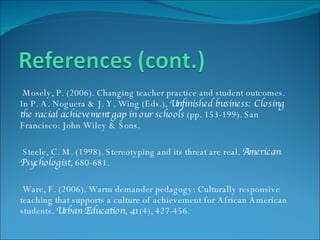
Mosely, P. (2006). Changing teacher practice and student outcomes. In P. A. Noguera & J. Y. Wing (Eds.),  Unfinished business: Closing the racial achievement gap in our schools  (pp. 153-199). San Francisco: John Wiley & Sons. Steele, C. M. (1998). Stereotyping and its threat are real.  American Psychologist , 680-681. Ware, F. (2006). Warm demander pedagogy: Culturally responsive teaching that supports a culture of achievement for African American students.  Urban Education ,  41 (4), 427-456.
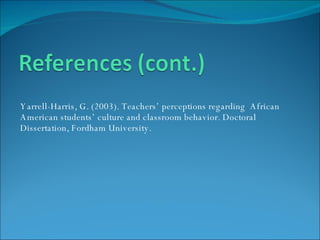
Yarrell-Harris, G. (2003). Teachers’ perceptions regarding  African American students’ culture and classroom behavior. Doctoral Dissertation, Fordham University.

Proposal Defense Power Point

  • 1.
    The University ofSouthern Mississippi College of Education and Psychology Department of Educational Leadership and Research James M. Thompson Proposal Defense Spring 2008
  • 2.
    Agenda Brief OverviewStatement of the Problem Rationale for the Study Theoretical Foundations Overview of Prior Literature Methodology Self-Disclosure
  • 3.
    Brief Overview AfricanAmerican students’ beliefs of their teachers (Howard, 2002) Teachers’ beliefs of African American students (Mosely, 2006) Explore correlations between African American students’ beliefs and academic outcomes ( Casteel, 2000) Analysis of correlations to determine whether African American students’ beliefs of their teachers and of each other have an effect on discipline referrals and referrals to special education services
  • 4.
    Significant difference betweenthe academic success and matriculation through K-12 public schools between African American students and other racial groups of students ( Gregory, Nygreen, & Moran, 2006). African American students receive a disproportionate number of disciplinary referrals and referrals to special education services (Graham, 2007)
  • 5.
    To examine howteachers’ beliefs and school cultures affect African American students’ attitudes and achievement in school ( Yarrell-Harris, 2003) To explore African American students’ beliefs in attempts to explain academic and discipline gaps To address other long-term negative social factors that impact society
  • 6.
    Potential Limitations Teachersmay be reluctant to express their accurate feelings regarding their students’ academic abilities and behaviors, especially if they are negative. Teachers may be reluctant to express their true beliefs of African American students, especially if they belong to another racial or ethnic group.
  • 7.
    Theoretical Foundations beliefsand expectations (Glenn, 1996). Physiological needs (Arkes & Garske, 1977). Cultural context (Ware, 2006). Stereotype threats (Steele, 1998)
  • 8.
    Overview of Researchto Understanding the Issues Academic achievement gap African American students’ beliefs of teachers Teachers’ beliefs and expectations of African American students Referral to special education services Discipline gap and the juvenile justice system Stereotype threats Social alienation and disidentification
  • 9.
    Study’s Methodology Researchquestions Hypotheses Research design Participants Instrumentations Statistical procedures planned to analyze the data
  • 10.
    Research Questions Isthere a significant correlation between African American students’ self-beliefs and the report card grades they receive? Is there a significant correlation between African American students’ beliefs of their teachers and the report card grades they receive? Is there a significant correlation between African American students’ self-beliefs and the number of discipline referrals they receive?
  • 11.
    Research Questions (continue)Is there a significant correlation between African American students’ beliefs of their teachers and the number of discipline referrals they receive? Is there a significant correlation between African American students’ level of stereotype threats and the report card grades they receive? Is there a significant correlation among teachers’ beliefs of African American students and (a) the number of students referred to special services, (b) the number of students who are placed in in-school-suspension and out-of-school suspension, and (c) the number of students who are retained at grade level?
  • 12.
    Hypotheses There isa correlation between African American students’ self-beliefs and their report card grades. There is a correlation between African American students’ beliefs of their teachers and their report card grades. There is a relationship between African American students’ self-beliefs and the number of discipline referrals received. There is a relationship between African American students’ beliefs of their teachers and the number of discipline referrals received.
  • 13.
    Hypotheses (continue) Thereis a relationship between African American students’ level of stereotype threats and academic achievement. There is a relationship among teachers’ beliefs of African American students and (a) the number of students referred to special services, (b) the number of students that are placed in in-school-suspension and out-of-school suspension, and (c) the number of students who are retained at grade level.
  • 14.
    Research Design Quantitativeresearch Dependent variables Report card grades Referrals to special education services Grade retentions Independent variables Students’ self-beliefs and stereotype threats Students’ beliefs of teachers Teachers’ beliefs of students
  • 15.
    Participants African Americanstudents in fifth grade Teachers of African American students
  • 16.
    Instrumentations Students’ beliefsSchool environment Classroom environment Discipline behavior Teachers’ beliefs African American students Career preparation Instructional strategies Classroom management School culture
  • 17.
    Statistical Procedures Plannedto Analyze the Data The variables and related data will be analyzed using descriptive, differential, and multi-linear regressions statistical techniques.
  • 18.
    Self-Disclosure Researcher acknowledgesset of beliefs and experiences regarding the research issues Awareness that some level of bias may surface Extra care will be taken to avoid bias
  • 19.
    Arkes, H. R.& Garske, J. P. (1977). Psychological Theories of Motivation . Monterey, CA: Brooks/Cole Publishing. Casteel, C. A. (2000). African American students’ perceptions of their treatment by Caucasian teachers. Journal of Instructional Psychology , 27 (3), 143-148. Glenn, N. (1996). Disproportionate representation of African American students in special education programs: Referral and skin color gradation. Doctoral Dissertation, University of Texas.
  • 20.
    Graham, T. S.(2007). Race and referrals: Teacher attitudes, culturally relevant teaching, and the special education referrals of African American males. Doctoral Dissertation, Cambridge College. Gregory, A., Nygreen, K., & Moran, D. (2006). The discipline gap and the normalization of failure. In P. A. Noguera & J. Y. Wing (Eds.), Unfinished business: Closing the racial achievement gap in our schools (pp. 153-199). San Francisco: John Wiley & Sons. Howard, T. C. (2002). Hearing footsteps in the dark: African American students’ descriptions of effective teachers. Journal of Education for Students Placed at Risk , 74 (4), 425-444.
  • 21.
    Mosely, P. (2006).Changing teacher practice and student outcomes. In P. A. Noguera & J. Y. Wing (Eds.), Unfinished business: Closing the racial achievement gap in our schools (pp. 153-199). San Francisco: John Wiley & Sons. Steele, C. M. (1998). Stereotyping and its threat are real. American Psychologist , 680-681. Ware, F. (2006). Warm demander pedagogy: Culturally responsive teaching that supports a culture of achievement for African American students. Urban Education , 41 (4), 427-456.
  • 22.
    Yarrell-Harris, G. (2003).Teachers’ perceptions regarding African American students’ culture and classroom behavior. Doctoral Dissertation, Fordham University.