LEARNIN
G
OUTCOME
S
After engaging withthis presentation, we
hope you can...
• Recognize different types of generative AI tools and
understand how this technology is continuously
evolving.
• Explain the basics of what generative AI tools like
ChatGPT can do, including their strengths and
limitations.
• Safely and responsibly use a variety of generative AI
tools for personal, research, professional, or
educational purposes, whether paid or freely
available, especially in a classroom setting.
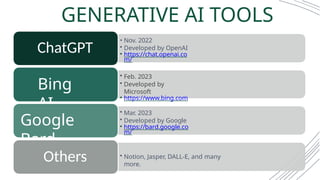
• Nov. 2022
•Developed by OpenAI
• https://chat.openai.co
m/
ChatGPT
• Feb. 2023
• Developed by
Microsoft
• https://www.bing.com
Bing
AI • Mar. 2023
• Developed by Google
• https://bard.google.co
m/
Google
Bard
• Notion, Jasper, DALL-E, and many
more.
Others
GENERATIVE AI TOOLS
5.
HOW DOES GENERATIVEAI
WORK?
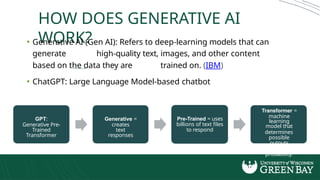
• Generative AI (Gen AI): Refers to deep-learning models that can
generate high-quality text, images, and other content
based on the data they are trained on. (IBM)
• ChatGPT: Large Language Model-based chatbot
GPT:
Generative Pre-
Trained
Transformer
Generative =
creates
text
responses
Pre-Trained = uses
billions of text files
to respond
Transformer =
machine
learning
model that
determines
possible
outputs
based on
probability.
6.
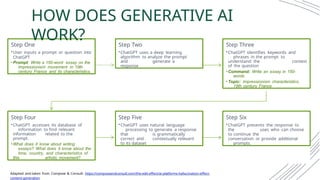
Step One
•User inputsa prompt or question into
ChatGPT
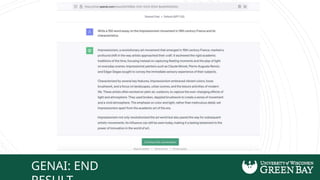
•Prompt: Write a 150-word essay on the
Impressionism movement in 19th
century France and its characteristics.
Step Two
•ChatGPT uses a deep learning
algorithm to analyze the prompt
and generate a
response
Step Three
•ChatGPT identifies keywords and
phrases in the prompt to
understand the context
of the question
•Command: Write an essay in 150-
words
•Topic: Impressionism characteristics,
19th century France
Step Four
•ChatGPT accesses its database of
information to find relevant
information related to the
prompt.
•What does it know about writing
essays? What does it know about the
time, country, and characteristics of
this artistic movement?
Step Five
•ChatGPT uses natural language
processing to generate a response
that is grammatically
correct and contextually relevant
to its dataset
Step Six
•ChatGPT presents the response to
the user, who can choose
to continue the
conversation or provide additional
prompts.
HOW DOES GENERATIVE AI
WORK?
Adapted and taken from Compose & Consult: https://composeandconsult.com/the-edit-effect/ai-platforms-hallucination-effect-
content-generation
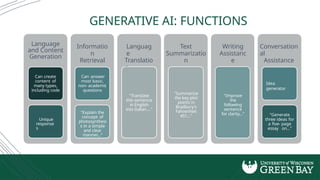
GENERATIVE AI: FUNCTIONS
Language
andContent
Generation
Can create
content of
many types,
including code
Unique
response
s
Informatio
n
Retrieval
Can answer
most basic,
non- academic
questions
"Explain the
concept of
photosynthesi
s in a simple
and clear
manner..."
Languag
e
Translatio
n
"Translate
this sentence
in English
into Italian...."
Text
Summarizatio
n
"Summarize
the key plot
points in
Bradbury's
Fahrenheit
451..."
Writing
Assistanc
e
"Improve
the
following
sentence
for clarity..."
Conversation
al
Assistance
Idea
generator
"Generate
three ideas for
a five- page
essay on..."
9.
GENERATIVE AI:
LIMITATIONS
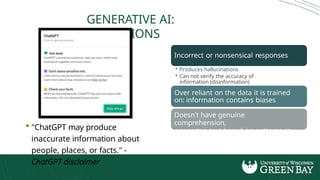
"ChatGPTmay produce
inaccurate information about
people, places, or facts." -
ChatGPT disclaimer
Incorrect or nonsensical responses
• Produces hallucinations
• Can not verify the accuracy of
information (disinformation)
Over reliant on the data it is trained
on: information contains biases
Doesn't have genuine
comprehension,
generates text based on patterns in
data
10.
GENERATIVE AI CONSIDERATIONS
Lackof regulations on the technology
•Potential copyright issues & ownership of content
Admin/Educators are still working on developing policies specific to GenAI
across the nation
When using GenAI, provide clear, concise directions or instructions
•Rephrase prompts if you aren't getting a desired result
Use any generative AI tool with caution
•Avoid sharing sensitive information
•Get permission before using another's intellectual property for prompts
11.
Encourage dialogue surroundingGenAI in the classroom
Provide your students with clear communication and
expectations
Consider ethical and legal issues when using AI tools
Recognize that AI detection tools are not perfect
Understand the inevitability of advancing AI technology
GENERATIVE AI CONSIDERATIONS
12.
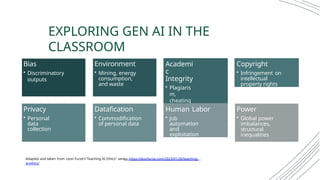
Bias
• Discriminatory
outputs
Environment
• Mining,energy
consumption,
and waste
Academi
c
Integrity
• Plagiaris
m,
cheating
Copyright
• Infringement on
intellectual
property rights
Privacy
• Personal
data
collection
Datafication
• Commodification
of personal data
Human Labor
• Job
automation
and
exploitation
Power
• Global power
imbalances,
structural
inequalities
EXPLORING GEN AI IN THE
CLASSROOM
Adapted and taken from Leon Furze's"Teaching AI Ethics" series: https://leonfurze.com/2023/01/26/teaching-
ai-ethics/
13.
WRAP-UP
Key Take-Aways
Thistechnology is not going away
and will continue to grow in its
applications
It isn't "smart" as it does not have the
ability to comprehend its output or data
It is not the end of traditional writing or
skills
Instead, it may help us determine which
skills are unique to humans and which
can be automated
Consider GenAI as a potential
brainstorming partner, not a fact finder
What's
Next?
Visit The Cowbell for more CATL
resources on Generative AI
View our next video which delves into
assessing the impact of generative AI on
your course
Talk with your colleagues and students,
and continue the dialogue around
appropriate usage
14.
CITATIONS & RESOURCES,
CONT.
GenerativeAI Tools
OpenAI. (n.d.). ChatGPT. https://chat.openai.com/
Google. (n.d.). Google Bard. https://bard.google.com/
Microsoft. (n.d.). Bing AI.
https://www.bing.com Generative AI
Research & Resources
Brandeis University. What does chatGPT Struggle to do? Preliminary Guidelines. Center for Teaching and Learning.
https://www.brandeis.edu/teaching/chatgpt- ai/chatgpt.html
Edwards, Benj. (2023 May 6). Why ChatGPT and Bing Chat are so good at making things up. Ars Technica. https://arstechnica.com/information-
technology/2023/04/why-ai-chatbots-are-the-ultimate-bs-machines-and-how-people-hope-to-fix-them/
IBM. (n.d). What is Generative AI? https://research.ibm.com/blog/what-is-generative-AI
May, J. (2023, February 2). ChatGPT is great – you’re just using it wrong. The Conversation. http://theconversation.com/chatgpt-is-great-youre-
just-using-it-wrong-
198848
OpenAI. (2022, November 30). Introducing ChatGPT. OpenAI Blog. https://openai.com/blog/chatgpt
Pasick, Adam. (2023, March 27). Artificial Intelligence Glossary: Neural Networks and Other Terms Explained. New
York Times. https://www.nytimes.com/article/ai-artificial-intelligence-glossary.html?unlocked_article_code=1.50w.suqA.kNa7PZ85bhiH&smid=url-
share
15.
CITATIONS & RESOURCES
GenerativeAI Research & Resources, cont.
Walters, W. H., & Wilder, E. I. (2023). Fabrication and errors in the bibliographic citations generated by ChatGPT.
Scientific Reports, 13(1), 14045. https://doi.org/10.1038/s41598-023-41032-5
(2023, Feb 22). Mind the Hallucination Effect: How AI Platforms like ChatGPT Can Generate Misleading Content. Compose & Consu lt: Expert
Science Writing. https://composeandconsult.com/the-edit-effect/ai-platforms-hallucination-effect-content-generation
Generative AI & the Classroom
CATL. (2023, May 2). Considerations for Using Generative AI tools. The Cowbell. Considerations for Using Generative AI Tools – The Cowbell
(uwgb.edu)
Dobrin, Sidney. (2023, May 15). Talking About Generative AI: A Guide for Educators. Broadview Press. https://broadviewpress.com/product/talking-
generative- ai/#tab-description
Furze, Leon. (n.d.). Teaching AI Ethics. Leon Furze. https://leonfurze.com/2023/01/26/teaching-ai-ethics/
Lo, L. S. (2023). The CLEAR path: A framework for enhancing information literacy through prompt engineering. The Journal of Academic
Librarianship, 49(4), 102720. https://doi.org/10.1016/j.acalib.2023.102720
Mollick, E. (2023, March 14). How to... use AI to unstick yourself. One Useful Thing. https://www.oneusefulthing.org/p/how-to-use-ai-to-unstick-
yourself
Yale. AI Guidance. Poorvu Center for Teaching and Learning. https://poorvucenter.yale.edu/AIguidance#1%20Understanding%20AI%20Chatbots
Yale. Incorporating AI in Teaching: Examples from Yale Instructors. Poorvu Center for Teaching and Learning. https://poorvucenter.yale.edu/ai-
teaching-examples



![제 23회 보아즈(BOAZ) 빅데이터 컨퍼런스 - [MBOAX] : ABSA를 활용한 소비자 반응 분석 기반 운영 효율화 대시보드 설계](https://cdn.slidesharecdn.com/ss_thumbnails/3-1boaz23rdconferencemboax-260203102709-9d519923-thumbnail.jpg?width=640&height=640&fit=bounds)


