 key concepts:
Types of correlation
Methods of studying correlation
a) Scatter diagram
b) Karl pearson’s coefficient of
correlation
c) Spearman’s Rank correlation
coefficient
d) Method of least squares
 Correlation: The degree of relationship between
the variables under consideration is measure
through the correlation analysis.
 The measure of correlation called the correlation
coefficient .
 Correlation is a statistical tool
that helps to measure and
analyze the degree of relationship
between two variables.
 Correlation analysis deals with
the association between two or
more variables.
 Positive relationships
 water
consumption and
temperature.
 study time and
grades.
 Negative
relationships:
 alcohol
consumption and
driving ability.
 Price & quantity
demanded
Types of Correlation
Type II
Correlation
Simple Multiple
Partial Total
 Simple correlation: Under simple correlation
problem there are only two variables are
studied.
 Multiple Correlation: Under Multiple Correlation
three or more than three variables are studied.
Ex. Qd = f ( P,PC, PS, t, y )
 Partial correlation: analysis recognizes more
than two variables but considers only two
variables keeping the other constant.
 Total correlation: is based on all the relevant
variables, which is normally not feasible.
Types of Correlation
Type III
Correlation
LINEAR NON LINEAR
 Linear correlation: Correlation is said to be
linear when the amount of change in one
variable tends to bear a constant ratio to the
amount of change in the other. The graph of
the variables having a linear relationship will
form a straight line.
Ex X = 1, 2, 3, 4, 5, 6, 7, 8,
Y = 5, 7, 9, 11, 13, 15, 17, 19,
Y = 3 + 2x
 Non Linear correlation: The correlation would
be non linear if the amount of change in one
variable does not bear a constant ratio to the
amount of change in the other variable.
 Scatter Diagram Method
 Graphic Method
 Karl Pearson’s Coefficient of
Correlation
 Method of Least Squares
 Scatter Diagram is a graph of
observed plotted points where
each points represents the values
of X & Y as a coordinate. It
portrays the relationship between
these two variables graphically.
Height
Weight
Height
of A
Weight
of A
Height
of B
Weight
of B
A linear
relationship
 Moderate Positive Correlation
Weight
Shoe
Size
r = + 0.4
 Perfect Negative Correlation
Exam score
TV
watching
per
week
r = -1.0
 Moderate Negative Correlation
Exam score
TV
watching
per
week
r = -.80
 Weak negative Correlation
Weight
Shoe
Size
r = - 0.2
 No Correlation (horizontal line)
Height
IQ
r = 0.0
 Simple & Non Mathematical
method
 Not influenced by the size of
extreme item
 First step in investing the
relationship between two variables
Can not adopt the an exact
degree of correlation
 No distinction between explanatory (x) and
response (y) variable.
 The null hypothesis test that r is significantly
different from zero (0).
 Requires both variables to be quantitative or
continuous variables
 Both variables must be normally distributed. If one
or both are not, either transform the variables to
near normality or use an alternative non-
parametric test of Spearman
 Use Spearman Correlation coefficient when the
shape of the distribution is not assumed or variable
is distribution-free.
 There is linear relationship between
two variables, i.e. when the two
variables are plotted on a scatter
diagram a straight line will be formed
by the points.
 Cause and effect relation exists
between different forces operating on
the item of the two variable series.
 Pearson’s ‘r’ is the most common
correlation coefficient.
 Karl Pearson’s Coefficient of
Correlation denoted by- ‘r’ The
coefficient of correlation ‘r’
measure the degree of linear
relationship between two variables
say x & y.
 .
Fall 2006 – Fundamentals of Business
Statistics 23
 Calculate the mean of the two series ‘x’ &’y’
 Calculate the deviations ‘x’ &’y’ in two series
from their respective mean.
 Square each deviation of ‘x’ &’y’ then obtain the
sum of the squared deviation i.e.∑x2 & .∑y2
 Multiply each deviation under x with each
deviation under y & obtain the product of
‘xy’.Then obtain the sum of the product of x , y
i.e. ∑xy
 Substitute the value in the formula.
 The coefficient of determination is the
portion of the total variation in the
dependent variable that is explained by
variation in the independent variable
 The coefficient of determination is also
called R-squared and is denoted as R2
Fall 2006 – Fundamentals of Business Statistics 25
1
R
0 2


Fall 2006 – Fundamentals of Business Statistics 26
(continued)
Note: In the single independent variable case, the coefficient of
determination is
where:
R2 = Coefficient of determination
r = Simple correlation coefficient
2
2
r
R 
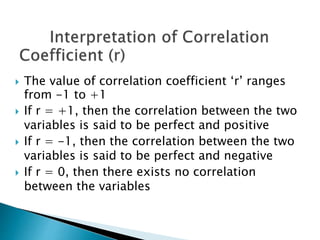
 The value of correlation coefficient ‘r’ ranges
from -1 to +1
 If r = +1, then the correlation between the two
variables is said to be perfect and positive
 If r = -1, then the correlation between the two
variables is said to be perfect and negative
 If r = 0, then there exists no correlation
between the variables
 It summarizes in one value,
the degree of correlation &
direction of correlation also.
 Always assume linear relationship
 Interpreting the value of r is
difficult.
 Value of Correlation Coefficient is
affected by the extreme values.
 Time consuming methods
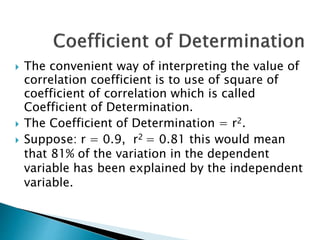
 The convenient way of interpreting the value of
correlation coefficient is to use of square of
coefficient of correlation which is called
Coefficient of Determination.
 The Coefficient of Determination = r2.
 Suppose: r = 0.9, r2 = 0.81 this would mean
that 81% of the variation in the dependent
variable has been explained by the independent
variable.
 The maximum value of r2 is 1 because it is
possible to explain all of the variation in y but it
is not possible to explain more than all of it.
 Coefficient of Determination =
Explained variation / Total variation
 When statistical series in which the variables
under study are not capable of quantitative
measurement but can be arranged in serial order,
in such situation pearson’s correlation coefficient
can not be used in such case Spearman Rank
correlation can be used.
 R = 1- (6 ∑D2 ) / N (N2 – 1)
 R = Rank correlation coefficient
 D = Difference of rank between paired item in two series.
 N = Total number of observation.
 The value of rank correlation coefficient, R
ranges from -1 to +1
 If R = +1, then there is complete agreement in
the order of the ranks and the ranks are in the
same direction
 If R = -1, then there is complete agreement in
the order of the ranks and the ranks are in the
opposite direction
 If R = 0, then there is no correlation
a) Problems where actual rank are given.
1) Calculate the difference ‘D’ of two Ranks
i.e. (R1 – R2).
2) Square the difference & calculate the sum
of the difference i.e. ∑D2
3) Substitute the values obtained in the
formula.
b) Problems where Ranks are not given :If the
ranks are not given, then we need to assign
ranks to the data series. The lowest value in
the series can be assigned rank 1 or the
highest value in the series can be assigned
rank 1. We need to follow the same scheme of
ranking for the other series.
Then calculate the rank correlation coefficient
in similar way as we do when the ranks are
given.
 Equal Ranks or tie in Ranks: In such cases
average ranks should be assigned to each
individual. R = 1- (6 ∑D2 ) + AF / N (N2 – 1)
AF = 1/12(m1
3 – m1) + 1/12(m2
3 – m2) +….
1/12(m2
3 – m2)
m = The number of time an item is repeated
 This method is simpler to understand and
easier to apply compared to karl pearson’s
correlation method.
 This method is useful where we can give the
ranks and not the actual data. (qualitative
term)
 This method is to use where the initial data in
the form of ranks.
 Cannot be used for finding out correlation in a
grouped frequency distribution.
 This method should be applied where N
exceeds 30.
 Show the amount (strength) of relationship
present
 Can be used to make predictions about the
variables under study.
 Can be used in many places, including natural
settings, libraries, etc.
 Easier to collect co relational data

12943625.ppt

  • 2.
     key concepts: Typesof correlation Methods of studying correlation a) Scatter diagram b) Karl pearson’s coefficient of correlation c) Spearman’s Rank correlation coefficient d) Method of least squares
  • 3.
     Correlation: Thedegree of relationship between the variables under consideration is measure through the correlation analysis.  The measure of correlation called the correlation coefficient .
  • 4.
     Correlation isa statistical tool that helps to measure and analyze the degree of relationship between two variables.  Correlation analysis deals with the association between two or more variables.
  • 5.
     Positive relationships water consumption and temperature.  study time and grades.  Negative relationships:  alcohol consumption and driving ability.  Price & quantity demanded
  • 6.
    Types of Correlation TypeII Correlation Simple Multiple Partial Total
  • 7.
     Simple correlation:Under simple correlation problem there are only two variables are studied.  Multiple Correlation: Under Multiple Correlation three or more than three variables are studied. Ex. Qd = f ( P,PC, PS, t, y )  Partial correlation: analysis recognizes more than two variables but considers only two variables keeping the other constant.  Total correlation: is based on all the relevant variables, which is normally not feasible.
  • 8.
    Types of Correlation TypeIII Correlation LINEAR NON LINEAR
  • 9.
     Linear correlation:Correlation is said to be linear when the amount of change in one variable tends to bear a constant ratio to the amount of change in the other. The graph of the variables having a linear relationship will form a straight line. Ex X = 1, 2, 3, 4, 5, 6, 7, 8, Y = 5, 7, 9, 11, 13, 15, 17, 19, Y = 3 + 2x  Non Linear correlation: The correlation would be non linear if the amount of change in one variable does not bear a constant ratio to the amount of change in the other variable.
  • 10.
     Scatter DiagramMethod  Graphic Method  Karl Pearson’s Coefficient of Correlation  Method of Least Squares
  • 11.
     Scatter Diagramis a graph of observed plotted points where each points represents the values of X & Y as a coordinate. It portrays the relationship between these two variables graphically.
  • 12.
    Height Weight Height of A Weight of A Height ofB Weight of B A linear relationship
  • 13.
     Moderate PositiveCorrelation Weight Shoe Size r = + 0.4
  • 14.
     Perfect NegativeCorrelation Exam score TV watching per week r = -1.0
  • 15.
     Moderate NegativeCorrelation Exam score TV watching per week r = -.80
  • 16.
     Weak negativeCorrelation Weight Shoe Size r = - 0.2
  • 17.
     No Correlation(horizontal line) Height IQ r = 0.0
  • 18.
     Simple &Non Mathematical method  Not influenced by the size of extreme item  First step in investing the relationship between two variables
  • 19.
    Can not adoptthe an exact degree of correlation
  • 20.
     No distinctionbetween explanatory (x) and response (y) variable.  The null hypothesis test that r is significantly different from zero (0).  Requires both variables to be quantitative or continuous variables  Both variables must be normally distributed. If one or both are not, either transform the variables to near normality or use an alternative non- parametric test of Spearman  Use Spearman Correlation coefficient when the shape of the distribution is not assumed or variable is distribution-free.
  • 21.
     There islinear relationship between two variables, i.e. when the two variables are plotted on a scatter diagram a straight line will be formed by the points.  Cause and effect relation exists between different forces operating on the item of the two variable series.
  • 22.
     Pearson’s ‘r’is the most common correlation coefficient.  Karl Pearson’s Coefficient of Correlation denoted by- ‘r’ The coefficient of correlation ‘r’ measure the degree of linear relationship between two variables say x & y.
  • 23.
     . Fall 2006– Fundamentals of Business Statistics 23
  • 24.
     Calculate themean of the two series ‘x’ &’y’  Calculate the deviations ‘x’ &’y’ in two series from their respective mean.  Square each deviation of ‘x’ &’y’ then obtain the sum of the squared deviation i.e.∑x2 & .∑y2  Multiply each deviation under x with each deviation under y & obtain the product of ‘xy’.Then obtain the sum of the product of x , y i.e. ∑xy  Substitute the value in the formula.
  • 25.
     The coefficientof determination is the portion of the total variation in the dependent variable that is explained by variation in the independent variable  The coefficient of determination is also called R-squared and is denoted as R2 Fall 2006 – Fundamentals of Business Statistics 25 1 R 0 2  
  • 26.
    Fall 2006 –Fundamentals of Business Statistics 26 (continued) Note: In the single independent variable case, the coefficient of determination is where: R2 = Coefficient of determination r = Simple correlation coefficient 2 2 r R 
  • 27.
     The valueof correlation coefficient ‘r’ ranges from -1 to +1  If r = +1, then the correlation between the two variables is said to be perfect and positive  If r = -1, then the correlation between the two variables is said to be perfect and negative  If r = 0, then there exists no correlation between the variables
  • 28.
     It summarizesin one value, the degree of correlation & direction of correlation also.
  • 29.
     Always assumelinear relationship  Interpreting the value of r is difficult.  Value of Correlation Coefficient is affected by the extreme values.  Time consuming methods
  • 30.
     The convenientway of interpreting the value of correlation coefficient is to use of square of coefficient of correlation which is called Coefficient of Determination.  The Coefficient of Determination = r2.  Suppose: r = 0.9, r2 = 0.81 this would mean that 81% of the variation in the dependent variable has been explained by the independent variable.
  • 31.
     The maximumvalue of r2 is 1 because it is possible to explain all of the variation in y but it is not possible to explain more than all of it.  Coefficient of Determination = Explained variation / Total variation
  • 32.
     When statisticalseries in which the variables under study are not capable of quantitative measurement but can be arranged in serial order, in such situation pearson’s correlation coefficient can not be used in such case Spearman Rank correlation can be used.  R = 1- (6 ∑D2 ) / N (N2 – 1)  R = Rank correlation coefficient  D = Difference of rank between paired item in two series.  N = Total number of observation.
  • 33.
     The valueof rank correlation coefficient, R ranges from -1 to +1  If R = +1, then there is complete agreement in the order of the ranks and the ranks are in the same direction  If R = -1, then there is complete agreement in the order of the ranks and the ranks are in the opposite direction  If R = 0, then there is no correlation
  • 34.
    a) Problems whereactual rank are given. 1) Calculate the difference ‘D’ of two Ranks i.e. (R1 – R2). 2) Square the difference & calculate the sum of the difference i.e. ∑D2 3) Substitute the values obtained in the formula.
  • 35.
    b) Problems whereRanks are not given :If the ranks are not given, then we need to assign ranks to the data series. The lowest value in the series can be assigned rank 1 or the highest value in the series can be assigned rank 1. We need to follow the same scheme of ranking for the other series. Then calculate the rank correlation coefficient in similar way as we do when the ranks are given.
  • 36.
     Equal Ranksor tie in Ranks: In such cases average ranks should be assigned to each individual. R = 1- (6 ∑D2 ) + AF / N (N2 – 1) AF = 1/12(m1 3 – m1) + 1/12(m2 3 – m2) +…. 1/12(m2 3 – m2) m = The number of time an item is repeated
  • 37.
     This methodis simpler to understand and easier to apply compared to karl pearson’s correlation method.  This method is useful where we can give the ranks and not the actual data. (qualitative term)  This method is to use where the initial data in the form of ranks.
  • 38.
     Cannot beused for finding out correlation in a grouped frequency distribution.  This method should be applied where N exceeds 30.
  • 39.
     Show theamount (strength) of relationship present  Can be used to make predictions about the variables under study.  Can be used in many places, including natural settings, libraries, etc.  Easier to collect co relational data