RIPER
AUTONOMOUS
NAAC &
NBA (UG)
SIRO- DSIR
Raghavendra Institute of Pharmaceutical Education and Research - Autonomous
K.R.Palli Cross, Chiyyedu, Anantapuramu, A. P- 515721 1
(Corrective Action Preventive Action)
A Seminar as a part of curricular requirement
for I year M. Pharm I semester
Presented by
V.NABI RASOOL. (20L81S0401).
Department of Pharmaceutical Quality Assurance.
Under the guidance/Mentorship of
Dr.Nawaz mohammed, M pharm ,PhD.,
Associate professor of
Pharmaceutical Quality assurance department
CAPA
RIPER
AUTONOMOUS
NAAC &
NBA (UG)
SIRO- DSIR
Raghavendra Institute of Pharmaceutical Education and Research - Autonomous
K.R.Palli Cross, Chiyyedu, Anantapuramu, A. P- 515721 2
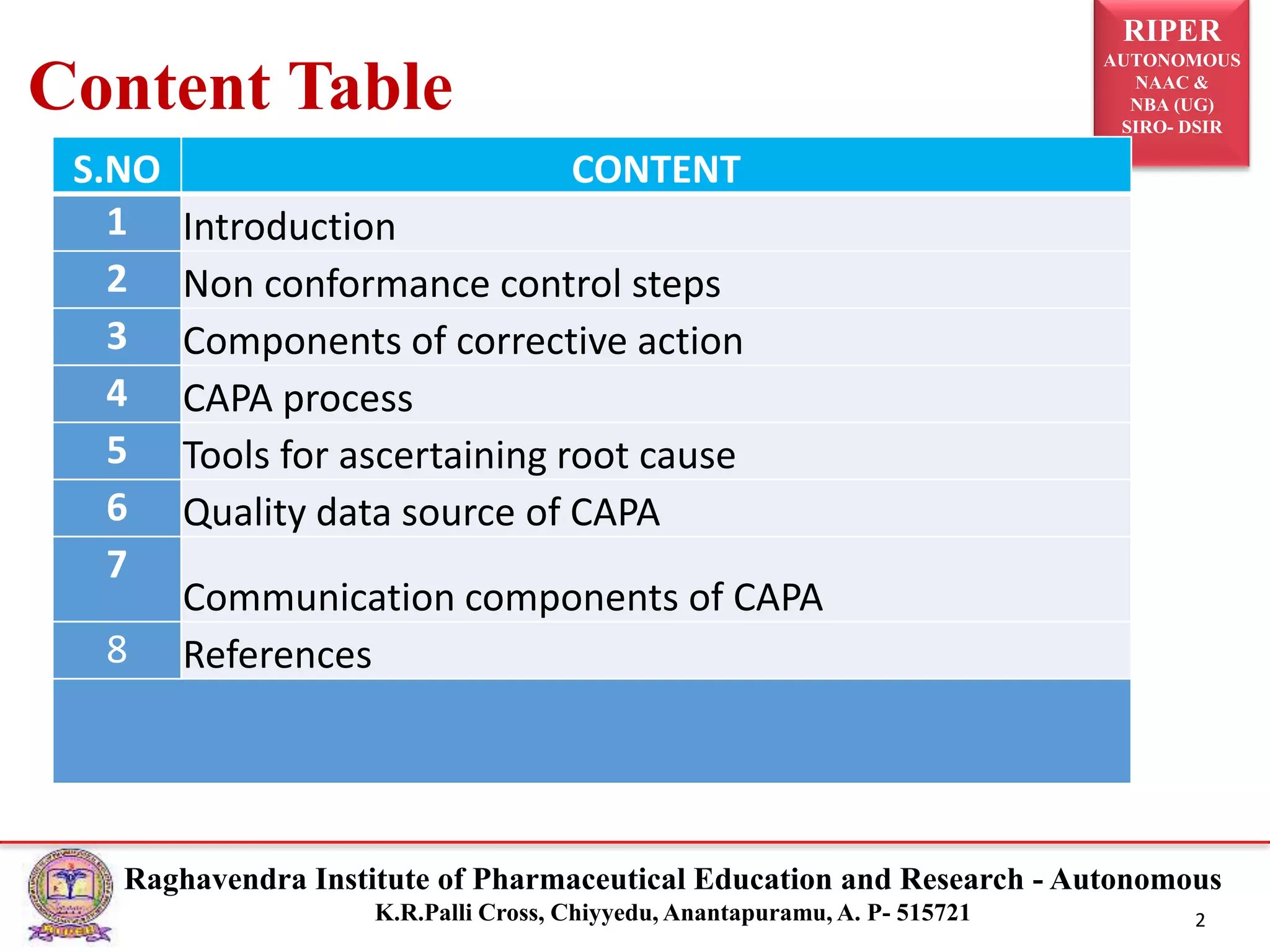
S.NO CONTENT
1 Introduction
2 Non conformance control steps
3 Components of corrective action
4 CAPA process
5 Tools for ascertaining root cause
6 Quality data source of CAPA
7
Communication components of CAPA
8 References
Content Table
RIPER
AUTONOMOUS
NAAC &
NBA (UG)
SIRO- DSIR
Raghavendra Institute of Pharmaceutical Education and Research - Autonomous
K.R.Palli Cross, Chiyyedu, Anantapuramu, A. P- 515721 3
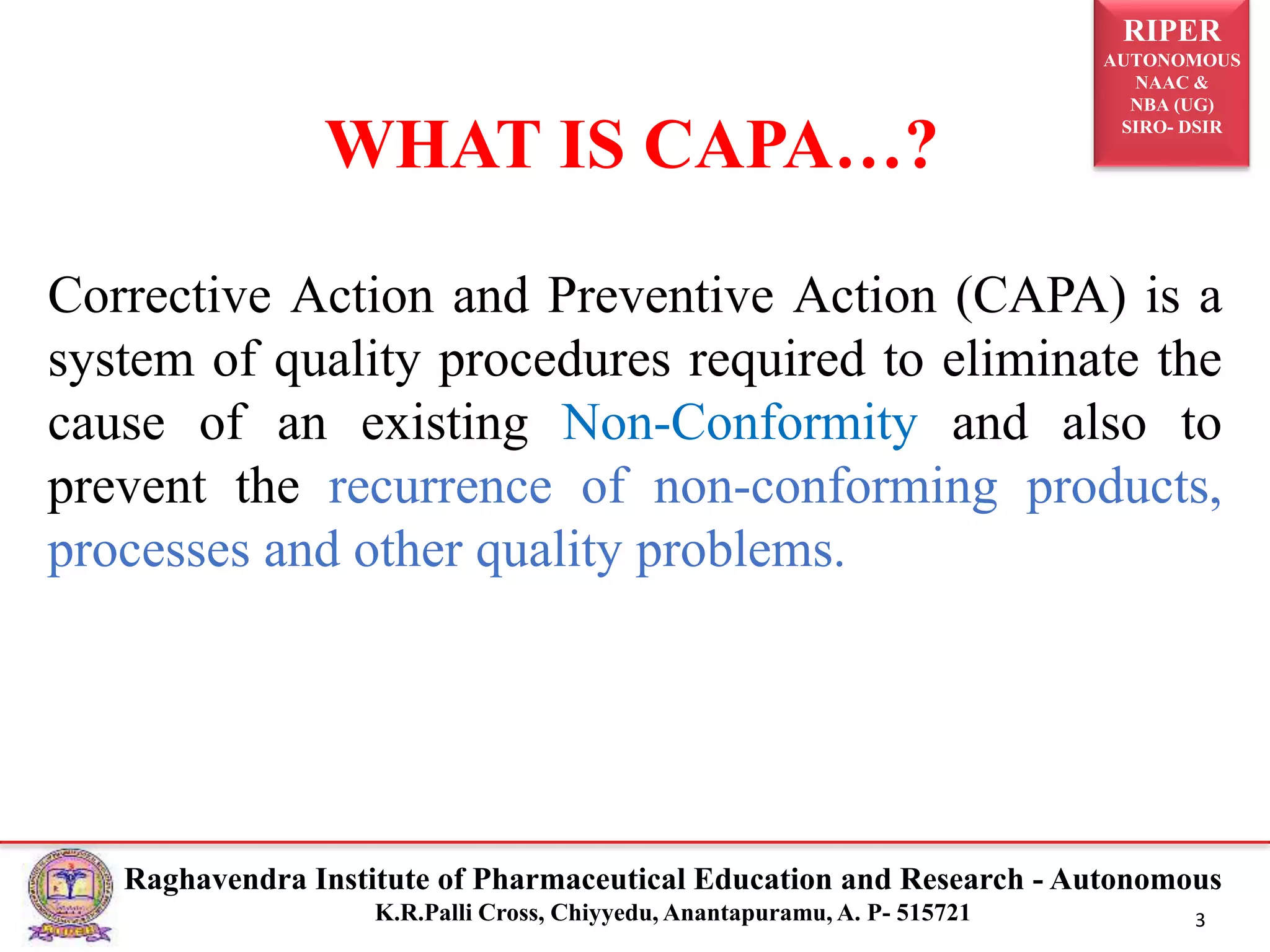
Corrective Action and Preventive Action (CAPA) is a
system of quality procedures required to eliminate the
cause of an existing Non-Conformity and also to
prevent the recurrence of non-conforming products,
processes and other quality problems.
WHAT IS CAPA…?
RIPER
AUTONOMOUS
NAAC &
NBA (UG)
SIRO- DSIR
Raghavendra Institute of Pharmaceutical Education and Research - Autonomous
K.R.Palli Cross, Chiyyedu, Anantapuramu, A. P- 515721 4
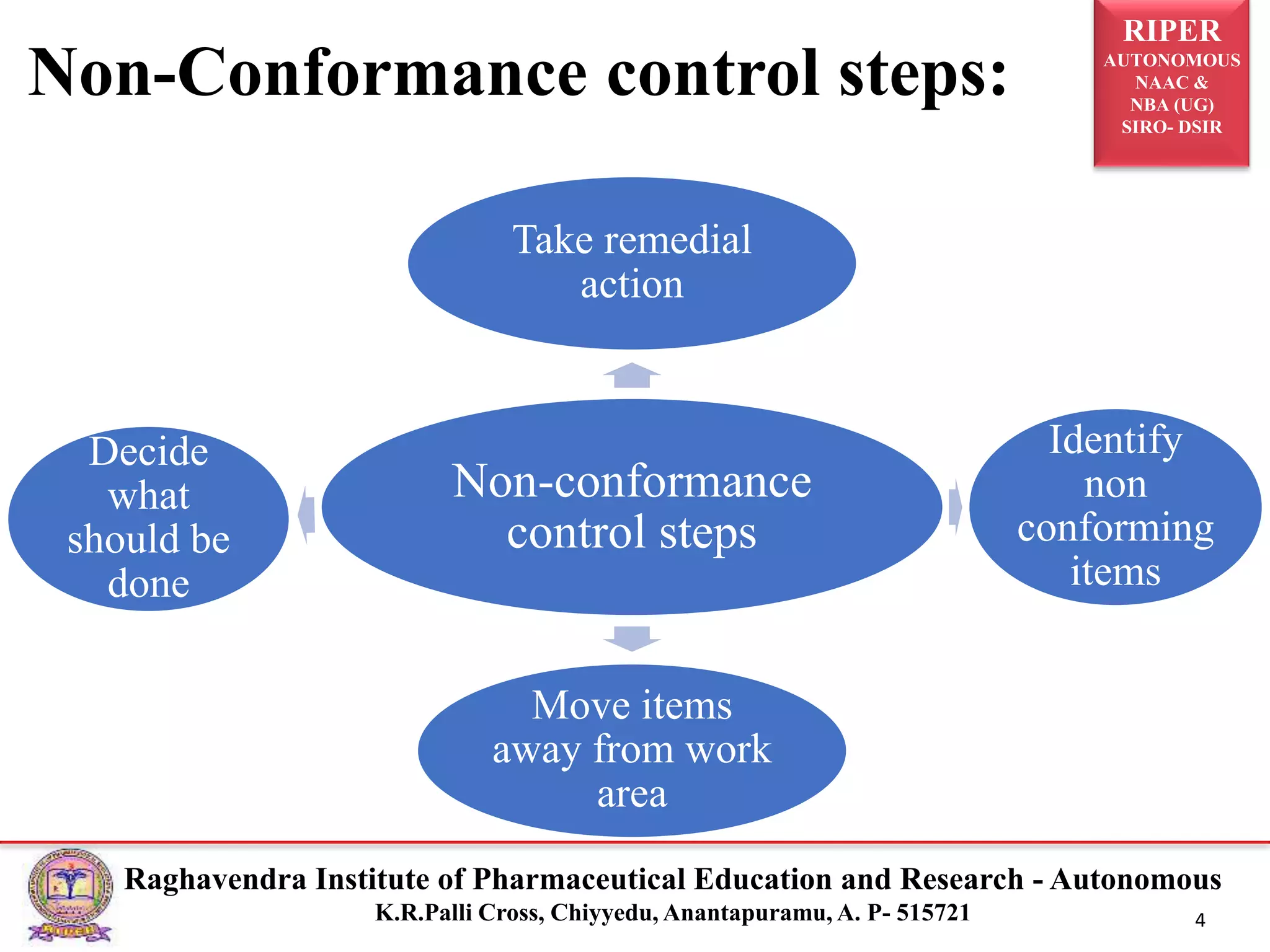
Non-Conformance control steps:
Non-conformance
control steps
Take remedial
action
Identify
non
conforming
items
Move items
away from work
area
Decide
what
should be
done
RIPER
AUTONOMOUS
NAAC &
NBA (UG)
SIRO- DSIR
Raghavendra Institute of Pharmaceutical Education and Research - Autonomous
K.R.Palli Cross, Chiyyedu, Anantapuramu, A. P- 515721 5
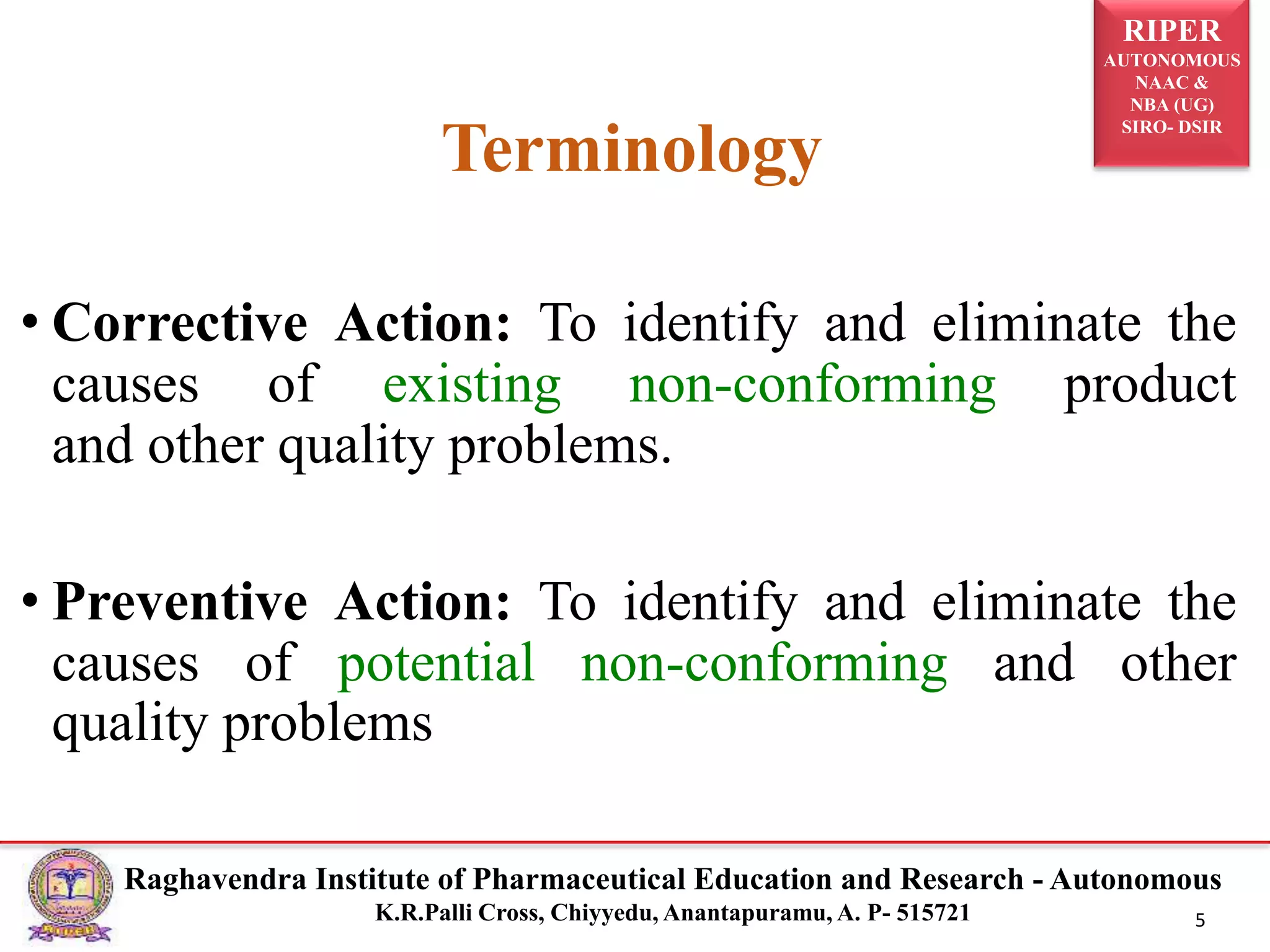
• Corrective Action: To identify and eliminate the
causes of existing non-conforming product
and other quality problems.
• Preventive Action: To identify and eliminate the
causes of potential non-conforming and other
quality problems
Terminology
RIPER
AUTONOMOUS
NAAC &
NBA (UG)
SIRO- DSIR
Raghavendra Institute of Pharmaceutical Education and Research - Autonomous
K.R.Palli Cross, Chiyyedu, Anantapuramu, A. P- 515721 6
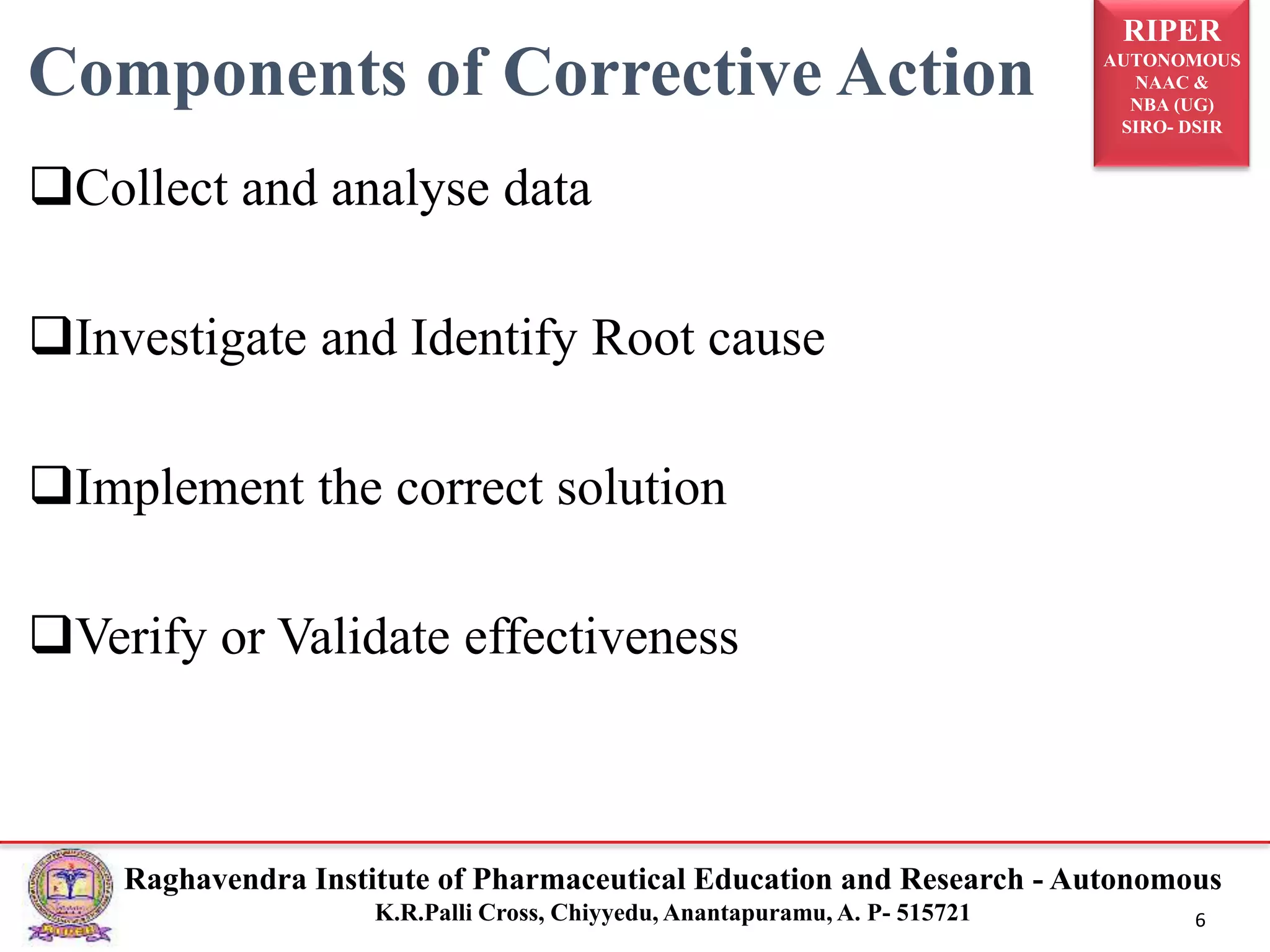
Components of Corrective Action
Collect and analyse data
Investigate and Identify Root cause
Implement the correct solution
Verify or Validate effectiveness
RIPER
AUTONOMOUS
NAAC &
NBA (UG)
SIRO- DSIR
Raghavendra Institute of Pharmaceutical Education and Research - Autonomous
K.R.Palli Cross, Chiyyedu, Anantapuramu, A. P- 515721 7
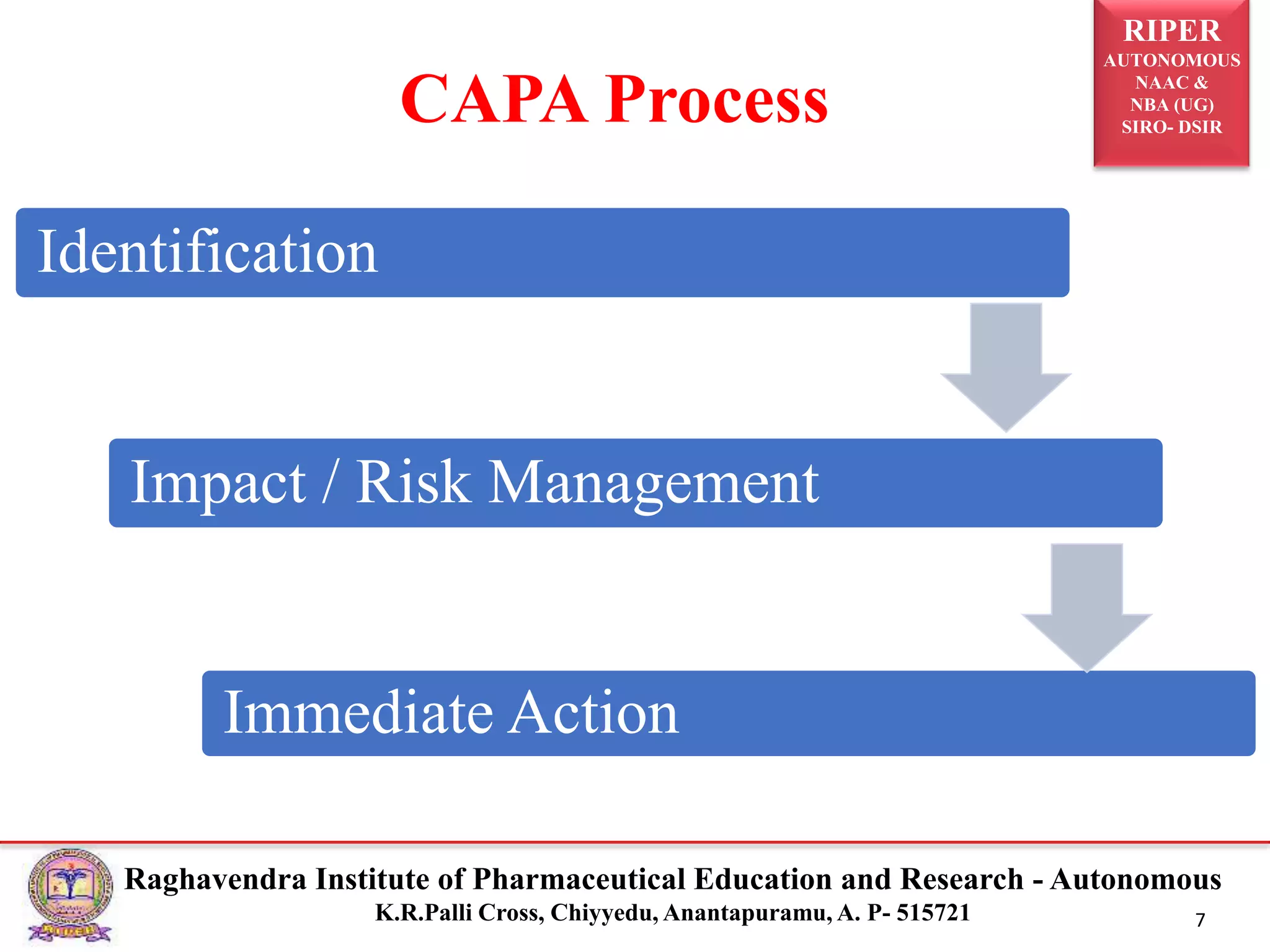
CAPA Process
Identification
Impact / Risk Management
Immediate Action
RIPER
AUTONOMOUS
NAAC &
NBA (UG)
SIRO- DSIR
Raghavendra Institute of Pharmaceutical Education and Research - Autonomous
K.R.Palli Cross, Chiyyedu, Anantapuramu, A. P- 515721 8
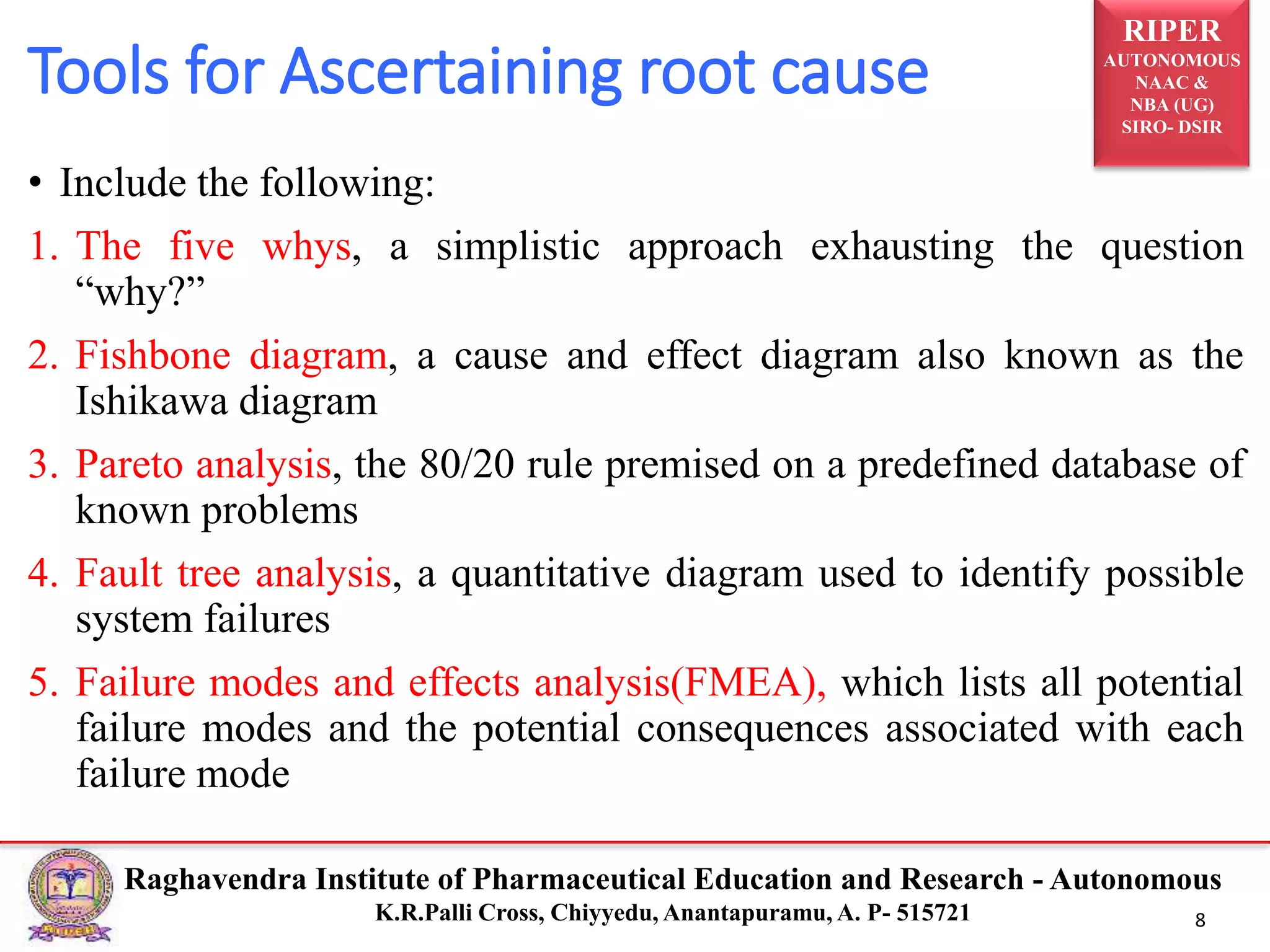
Tools for Ascertaining root cause
• Include the following:
1. The five whys, a simplistic approach exhausting the question
“why?”
2. Fishbone diagram, a cause and effect diagram also known as the
Ishikawa diagram
3. Pareto analysis, the 80/20 rule premised on a predefined database of
known problems
4. Fault tree analysis, a quantitative diagram used to identify possible
system failures
5. Failure modes and effects analysis(FMEA), which lists all potential
failure modes and the potential consequences associated with each
failure mode
RIPER
AUTONOMOUS
NAAC &
NBA (UG)
SIRO- DSIR
Raghavendra Institute of Pharmaceutical Education and Research - Autonomous
K.R.Palli Cross, Chiyyedu, Anantapuramu, A. P- 515721 9
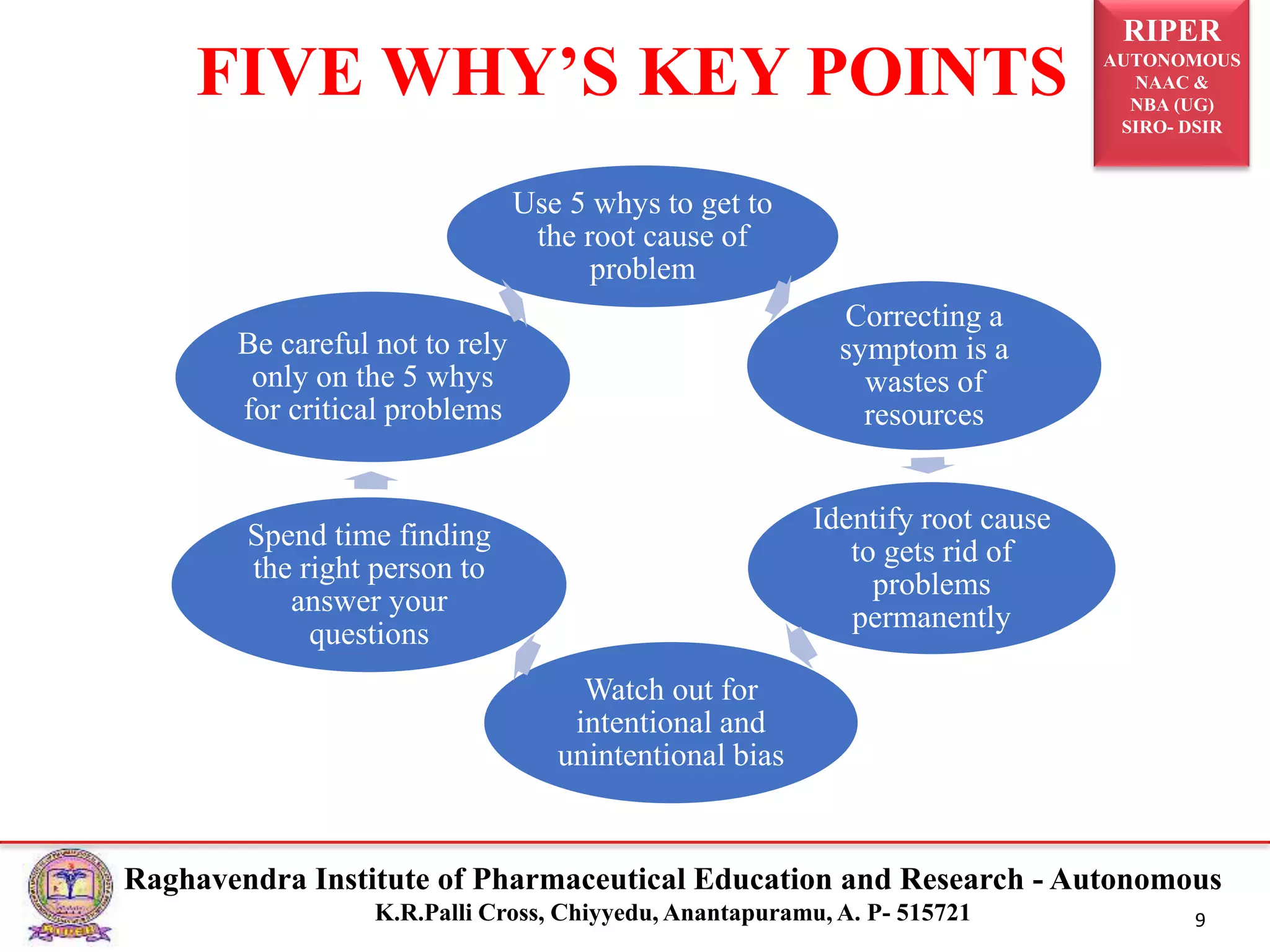
Use 5 whys to get to
the root cause of
problem
Correcting a
symptom is a
wastes of
resources
Identify root cause
to gets rid of
problems
permanently
Watch out for
intentional and
unintentional bias
Spend time finding
the right person to
answer your
questions
Be careful not to rely
only on the 5 whys
for critical problems
FIVE WHY’S KEY POINTS
RIPER
AUTONOMOUS
NAAC &
NBA (UG)
SIRO- DSIR
Raghavendra Institute of Pharmaceutical Education and Research - Autonomous
K.R.Palli Cross, Chiyyedu, Anantapuramu, A. P- 515721 10
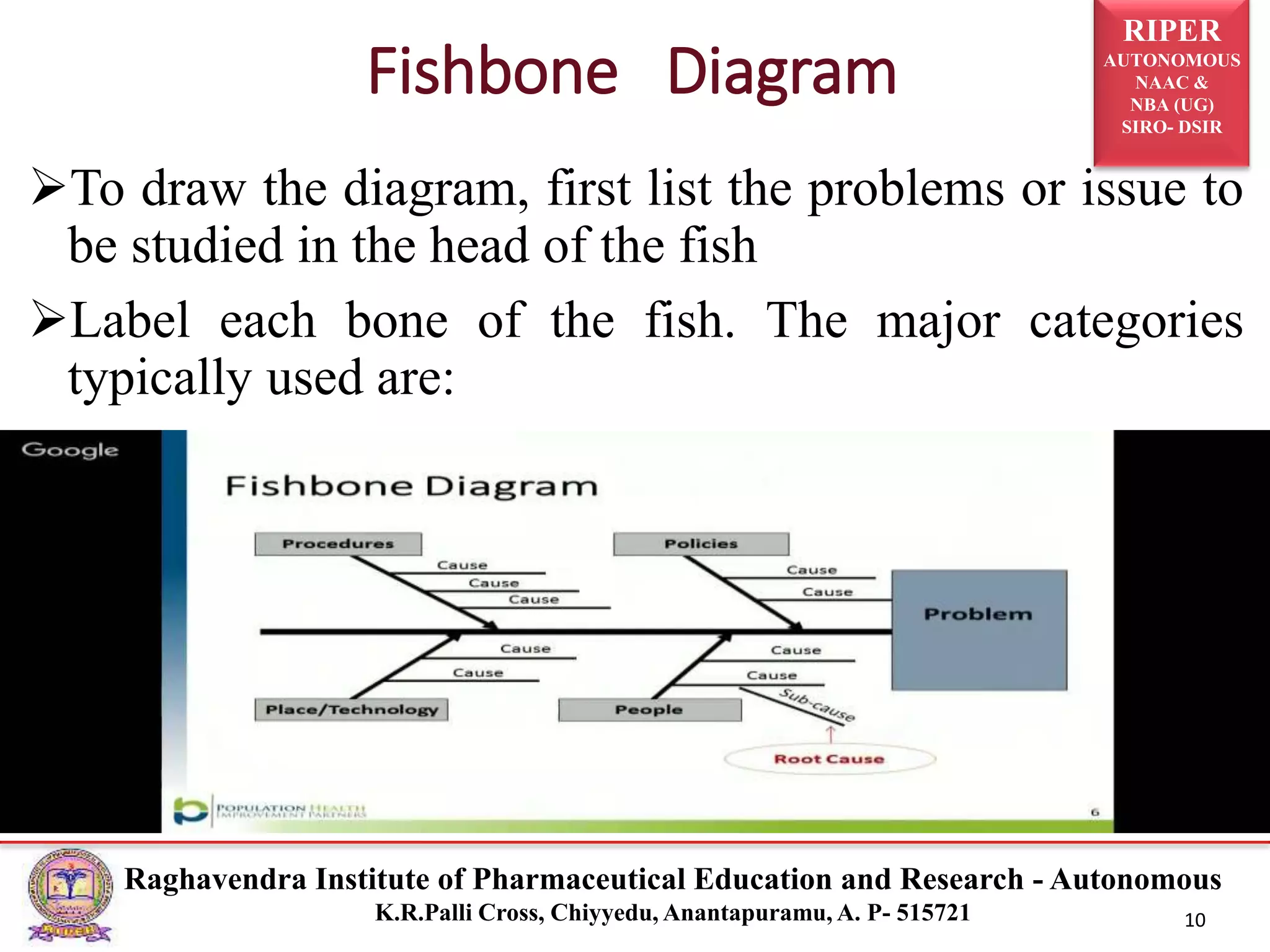
To draw the diagram, first list the problems or issue to
be studied in the head of the fish
Label each bone of the fish. The major categories
typically used are:
Fishbone Diagram
RIPER
AUTONOMOUS
NAAC &
NBA (UG)
SIRO- DSIR
Raghavendra Institute of Pharmaceutical Education and Research - Autonomous
K.R.Palli Cross, Chiyyedu, Anantapuramu, A. P- 515721 11
Pareto charts
In the pareto chart, the lengths of the bars represent
frequency or cost, and are arranged with longest bars
on the left and the shortest to the right. In this way
the chart visually depicts which situations are more
significant
RIPER
AUTONOMOUS
NAAC &
NBA (UG)
SIRO- DSIR
Raghavendra Institute of Pharmaceutical Education and Research - Autonomous
K.R.Palli Cross, Chiyyedu, Anantapuramu, A. P- 515721 12
When there are many problems or causes and you
want to focus on the most significant
When analysing data about the frequency of
problems or causes in a process
When analysing broad causes by looking at their
specific components
When communicating with others about your data
When to use pareto chart
RIPER
AUTONOMOUS
NAAC &
NBA (UG)
SIRO- DSIR
Raghavendra Institute of Pharmaceutical Education and Research - Autonomous
K.R.Palli Cross, Chiyyedu, Anantapuramu, A. P- 515721 13
The main advantage of Pareto charts are that they
are easy to understand as well as to present
Many managers prefer to see an analysis that is
easy to represent and understand and a Pareto chart
is strong tool for that
Advantages of pareto chart
RIPER
AUTONOMOUS
NAAC &
NBA (UG)
SIRO- DSIR
Raghavendra Institute of Pharmaceutical Education and Research - Autonomous
K.R.Palli Cross, Chiyyedu, Anantapuramu, A. P- 515721 14
Fault Tree Analysis (FTA) was first introduced by Bell Laboratories
and is one of the most widely used methods in system:
• - Reliability
• - Maintainability
• - Safety Analysis
The main purpose of FTA is to help in identify potential causes of
system failures before the failures actually occurs
It can also be used to evaluate the probability of the top event using
analytical or statistical methods
Fault Tree Analysis (FTA)
RIPER
AUTONOMOUS
NAAC &
NBA (UG)
SIRO- DSIR
Raghavendra Institute of Pharmaceutical Education and Research - Autonomous
K.R.Palli Cross, Chiyyedu, Anantapuramu, A. P- 515721 15
FTA focusses on the judgement of experts from various disciplines
Both agreements and differences in opinion on the inputs and
importance are accounted
Members are not likely to feel threatened, due to the focus on how
the system operates, not personnel
Graphic description clearly communicates the possible causes of
failure
Advantages of FTA
RIPER
AUTONOMOUS
NAAC &
NBA (UG)
SIRO- DSIR
Raghavendra Institute of Pharmaceutical Education and Research - Autonomous
K.R.Palli Cross, Chiyyedu, Anantapuramu, A. P- 515721 16
FMEA is a step by step approach for identifying all possible failures
in
- Design
- Manufacturing
- or final product or service
“Failures” are any errors or defects, especially ones that affect the
customer, and can be potential or actual
“Failure modes” means the ways, or modes, in which something
might fail
“Effects analysis” refers to studying the consequences, or effects, of
those failure
Failure Modes and Effects Analysis
RIPER
AUTONOMOUS
NAAC &
NBA (UG)
SIRO- DSIR
Raghavendra Institute of Pharmaceutical Education and Research - Autonomous
K.R.Palli Cross, Chiyyedu, Anantapuramu, A. P- 515721 17
Failure can be represented by Risk Priority Number (RPN)
RPN ranked as follows:
• RPN = (Potential Severity)×(Likelihood of
Occurrence)×(Ability to Detect)
For all numerical weights, a common industry standard is 1 to 5
scale. For Likelihood of occurrence, example use of 1 represents
“PRACTICALLY IMPOSSIBLE” and 5 represents “OCCURS
FREQUENTLY”
When applying FMEA, the high priority failures identified by higher
RPN’S are examined first. For the failure, a root cause is identified
and a corrective action is developed to eliminate the root cause
Analysing failure effects through FMEA
RIPER
AUTONOMOUS
NAAC &
NBA (UG)
SIRO- DSIR
Raghavendra Institute of Pharmaceutical Education and Research - Autonomous
K.R.Palli Cross, Chiyyedu, Anantapuramu, A. P- 515721 18
Stimulates open communication of potential failures and their
outcomes
Requires that all known or suspected potential failures be
considered
Ranks failures according to risk
Results in actions to reduce failure
Results in actions to reduce risk
Includes a follow up system and re-evaluation of potential failures
that favors continual improvement
Advantages of FMEA
RIPER
AUTONOMOUS
NAAC &
NBA (UG)
SIRO- DSIR
Raghavendra Institute of Pharmaceutical Education and Research - Autonomous
K.R.Palli Cross, Chiyyedu, Anantapuramu, A. P- 515721 19
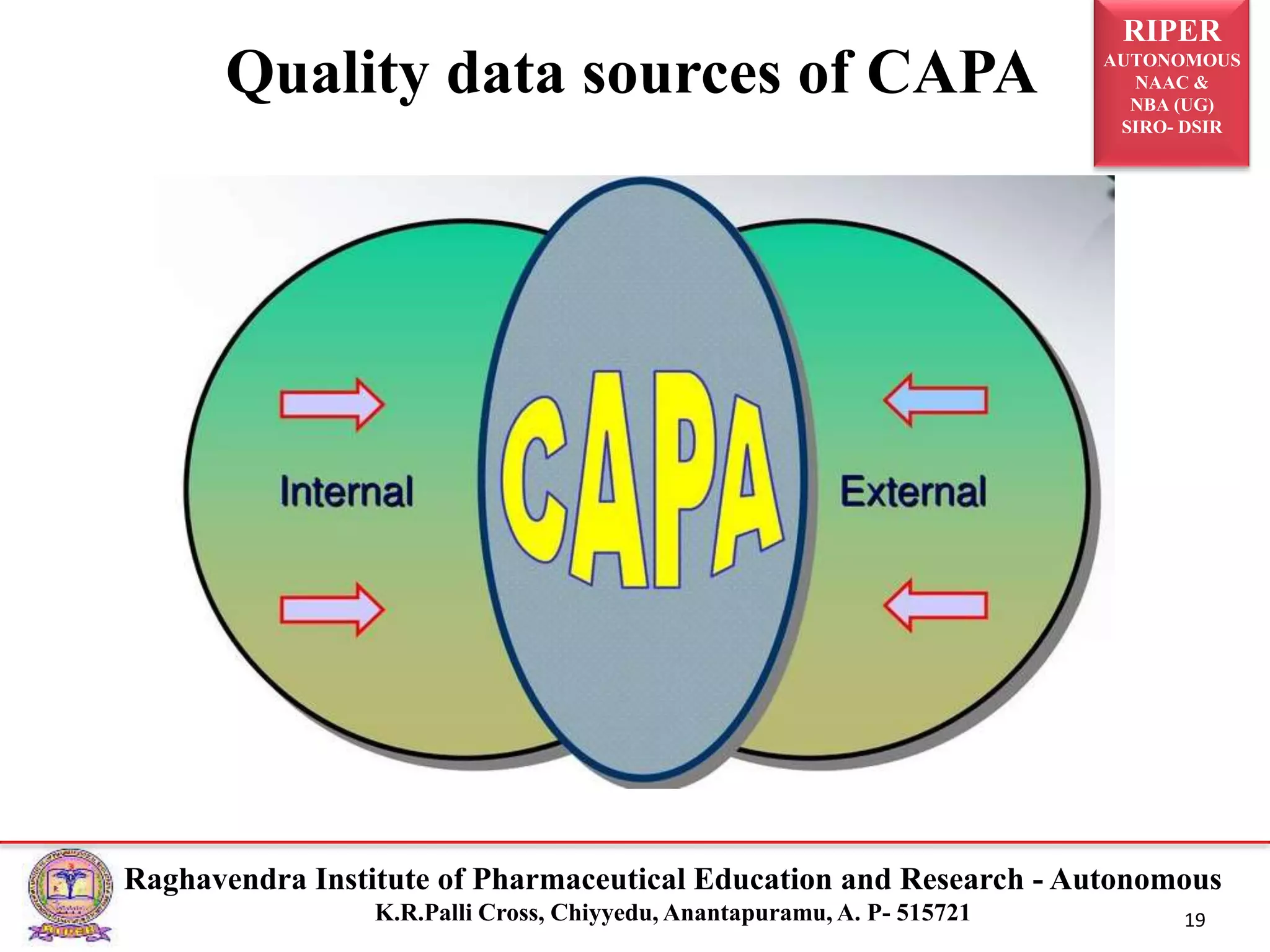
Quality data sources of CAPA
RIPER
AUTONOMOUS
NAAC &
NBA (UG)
SIRO- DSIR
Raghavendra Institute of Pharmaceutical Education and Research - Autonomous
K.R.Palli Cross, Chiyyedu, Anantapuramu, A. P- 515721 20
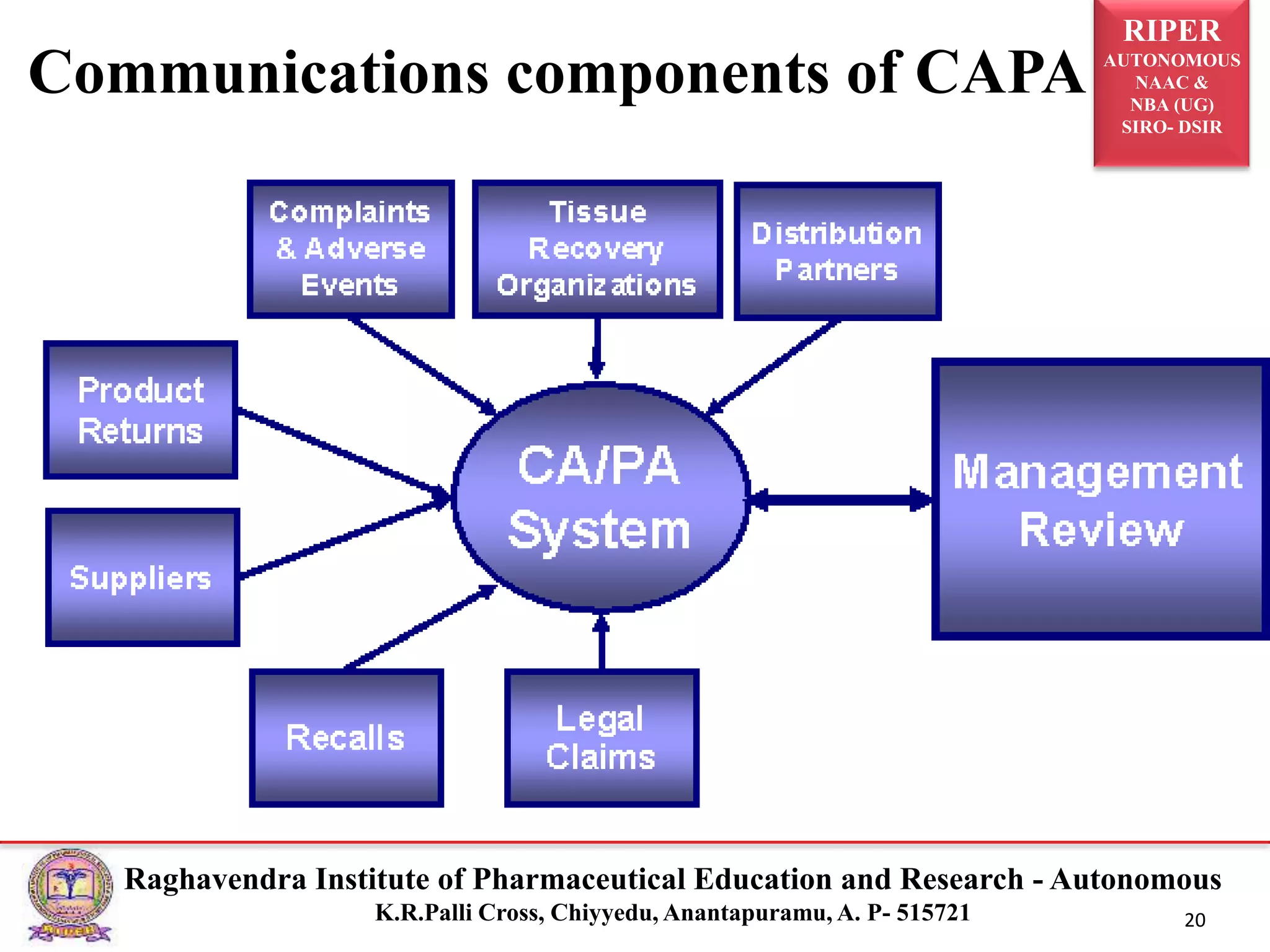
Communications components of CAPA
RIPER
AUTONOMOUS
NAAC &
NBA (UG)
SIRO- DSIR
Raghavendra Institute of Pharmaceutical Education and Research - Autonomous
K.R.Palli Cross, Chiyyedu, Anantapuramu, A. P- 515721 21
• https://www.fda.gov/corrective-and-preventive-actions-capa
• https://learnaboutgmp.com/good-manufacturing-practices-
cgmp/an-introduction-to-correction-and-preventive-actions-capa/
• https://quality-one.com/capa/
References
RIPER
AUTONOMOUS
NAAC &
NBA (UG)
SIRO- DSIR
Raghavendra Institute of Pharmaceutical Education and Research - Autonomous
K.R.Palli Cross, Chiyyedu, Anantapuramu, A. P- 515721 22

CAPA (Corrective action Preventive action)

  • 1.
    RIPER AUTONOMOUS NAAC & NBA (UG) SIRO-DSIR Raghavendra Institute of Pharmaceutical Education and Research - Autonomous K.R.Palli Cross, Chiyyedu, Anantapuramu, A. P- 515721 1 (Corrective Action Preventive Action) A Seminar as a part of curricular requirement for I year M. Pharm I semester Presented by V.NABI RASOOL. (20L81S0401). Department of Pharmaceutical Quality Assurance. Under the guidance/Mentorship of Dr.Nawaz mohammed, M pharm ,PhD., Associate professor of Pharmaceutical Quality assurance department CAPA
  • 2.
    RIPER AUTONOMOUS NAAC & NBA (UG) SIRO-DSIR Raghavendra Institute of Pharmaceutical Education and Research - Autonomous K.R.Palli Cross, Chiyyedu, Anantapuramu, A. P- 515721 2 S.NO CONTENT 1 Introduction 2 Non conformance control steps 3 Components of corrective action 4 CAPA process 5 Tools for ascertaining root cause 6 Quality data source of CAPA 7 Communication components of CAPA 8 References Content Table
  • 3.
    RIPER AUTONOMOUS NAAC & NBA (UG) SIRO-DSIR Raghavendra Institute of Pharmaceutical Education and Research - Autonomous K.R.Palli Cross, Chiyyedu, Anantapuramu, A. P- 515721 3 Corrective Action and Preventive Action (CAPA) is a system of quality procedures required to eliminate the cause of an existing Non-Conformity and also to prevent the recurrence of non-conforming products, processes and other quality problems. WHAT IS CAPA…?
  • 4.
    RIPER AUTONOMOUS NAAC & NBA (UG) SIRO-DSIR Raghavendra Institute of Pharmaceutical Education and Research - Autonomous K.R.Palli Cross, Chiyyedu, Anantapuramu, A. P- 515721 4 Non-Conformance control steps: Non-conformance control steps Take remedial action Identify non conforming items Move items away from work area Decide what should be done
  • 5.
    RIPER AUTONOMOUS NAAC & NBA (UG) SIRO-DSIR Raghavendra Institute of Pharmaceutical Education and Research - Autonomous K.R.Palli Cross, Chiyyedu, Anantapuramu, A. P- 515721 5 • Corrective Action: To identify and eliminate the causes of existing non-conforming product and other quality problems. • Preventive Action: To identify and eliminate the causes of potential non-conforming and other quality problems Terminology
  • 6.
    RIPER AUTONOMOUS NAAC & NBA (UG) SIRO-DSIR Raghavendra Institute of Pharmaceutical Education and Research - Autonomous K.R.Palli Cross, Chiyyedu, Anantapuramu, A. P- 515721 6 Components of Corrective Action Collect and analyse data Investigate and Identify Root cause Implement the correct solution Verify or Validate effectiveness
  • 7.
    RIPER AUTONOMOUS NAAC & NBA (UG) SIRO-DSIR Raghavendra Institute of Pharmaceutical Education and Research - Autonomous K.R.Palli Cross, Chiyyedu, Anantapuramu, A. P- 515721 7 CAPA Process Identification Impact / Risk Management Immediate Action
  • 8.
    RIPER AUTONOMOUS NAAC & NBA (UG) SIRO-DSIR Raghavendra Institute of Pharmaceutical Education and Research - Autonomous K.R.Palli Cross, Chiyyedu, Anantapuramu, A. P- 515721 8 Tools for Ascertaining root cause • Include the following: 1. The five whys, a simplistic approach exhausting the question “why?” 2. Fishbone diagram, a cause and effect diagram also known as the Ishikawa diagram 3. Pareto analysis, the 80/20 rule premised on a predefined database of known problems 4. Fault tree analysis, a quantitative diagram used to identify possible system failures 5. Failure modes and effects analysis(FMEA), which lists all potential failure modes and the potential consequences associated with each failure mode
  • 9.
    RIPER AUTONOMOUS NAAC & NBA (UG) SIRO-DSIR Raghavendra Institute of Pharmaceutical Education and Research - Autonomous K.R.Palli Cross, Chiyyedu, Anantapuramu, A. P- 515721 9 Use 5 whys to get to the root cause of problem Correcting a symptom is a wastes of resources Identify root cause to gets rid of problems permanently Watch out for intentional and unintentional bias Spend time finding the right person to answer your questions Be careful not to rely only on the 5 whys for critical problems FIVE WHY’S KEY POINTS
  • 10.
    RIPER AUTONOMOUS NAAC & NBA (UG) SIRO-DSIR Raghavendra Institute of Pharmaceutical Education and Research - Autonomous K.R.Palli Cross, Chiyyedu, Anantapuramu, A. P- 515721 10 To draw the diagram, first list the problems or issue to be studied in the head of the fish Label each bone of the fish. The major categories typically used are: Fishbone Diagram
  • 11.
    RIPER AUTONOMOUS NAAC & NBA (UG) SIRO-DSIR Raghavendra Institute of Pharmaceutical Education and Research - Autonomous K.R.Palli Cross, Chiyyedu, Anantapuramu, A. P- 515721 11 Pareto charts In the pareto chart, the lengths of the bars represent frequency or cost, and are arranged with longest bars on the left and the shortest to the right. In this way the chart visually depicts which situations are more significant
  • 12.
    RIPER AUTONOMOUS NAAC & NBA (UG) SIRO-DSIR Raghavendra Institute of Pharmaceutical Education and Research - Autonomous K.R.Palli Cross, Chiyyedu, Anantapuramu, A. P- 515721 12 When there are many problems or causes and you want to focus on the most significant When analysing data about the frequency of problems or causes in a process When analysing broad causes by looking at their specific components When communicating with others about your data When to use pareto chart
  • 13.
    RIPER AUTONOMOUS NAAC & NBA (UG) SIRO-DSIR Raghavendra Institute of Pharmaceutical Education and Research - Autonomous K.R.Palli Cross, Chiyyedu, Anantapuramu, A. P- 515721 13 The main advantage of Pareto charts are that they are easy to understand as well as to present Many managers prefer to see an analysis that is easy to represent and understand and a Pareto chart is strong tool for that Advantages of pareto chart
  • 14.
    RIPER AUTONOMOUS NAAC & NBA (UG) SIRO-DSIR Raghavendra Institute of Pharmaceutical Education and Research - Autonomous K.R.Palli Cross, Chiyyedu, Anantapuramu, A. P- 515721 14 Fault Tree Analysis (FTA) was first introduced by Bell Laboratories and is one of the most widely used methods in system: • - Reliability • - Maintainability • - Safety Analysis The main purpose of FTA is to help in identify potential causes of system failures before the failures actually occurs It can also be used to evaluate the probability of the top event using analytical or statistical methods Fault Tree Analysis (FTA)
  • 15.
    RIPER AUTONOMOUS NAAC & NBA (UG) SIRO-DSIR Raghavendra Institute of Pharmaceutical Education and Research - Autonomous K.R.Palli Cross, Chiyyedu, Anantapuramu, A. P- 515721 15 FTA focusses on the judgement of experts from various disciplines Both agreements and differences in opinion on the inputs and importance are accounted Members are not likely to feel threatened, due to the focus on how the system operates, not personnel Graphic description clearly communicates the possible causes of failure Advantages of FTA
  • 16.
    RIPER AUTONOMOUS NAAC & NBA (UG) SIRO-DSIR Raghavendra Institute of Pharmaceutical Education and Research - Autonomous K.R.Palli Cross, Chiyyedu, Anantapuramu, A. P- 515721 16 FMEA is a step by step approach for identifying all possible failures in - Design - Manufacturing - or final product or service “Failures” are any errors or defects, especially ones that affect the customer, and can be potential or actual “Failure modes” means the ways, or modes, in which something might fail “Effects analysis” refers to studying the consequences, or effects, of those failure Failure Modes and Effects Analysis
  • 17.
    RIPER AUTONOMOUS NAAC & NBA (UG) SIRO-DSIR Raghavendra Institute of Pharmaceutical Education and Research - Autonomous K.R.Palli Cross, Chiyyedu, Anantapuramu, A. P- 515721 17 Failure can be represented by Risk Priority Number (RPN) RPN ranked as follows: • RPN = (Potential Severity)×(Likelihood of Occurrence)×(Ability to Detect) For all numerical weights, a common industry standard is 1 to 5 scale. For Likelihood of occurrence, example use of 1 represents “PRACTICALLY IMPOSSIBLE” and 5 represents “OCCURS FREQUENTLY” When applying FMEA, the high priority failures identified by higher RPN’S are examined first. For the failure, a root cause is identified and a corrective action is developed to eliminate the root cause Analysing failure effects through FMEA
  • 18.
    RIPER AUTONOMOUS NAAC & NBA (UG) SIRO-DSIR Raghavendra Institute of Pharmaceutical Education and Research - Autonomous K.R.Palli Cross, Chiyyedu, Anantapuramu, A. P- 515721 18 Stimulates open communication of potential failures and their outcomes Requires that all known or suspected potential failures be considered Ranks failures according to risk Results in actions to reduce failure Results in actions to reduce risk Includes a follow up system and re-evaluation of potential failures that favors continual improvement Advantages of FMEA
  • 19.
    RIPER AUTONOMOUS NAAC & NBA (UG) SIRO-DSIR Raghavendra Institute of Pharmaceutical Education and Research - Autonomous K.R.Palli Cross, Chiyyedu, Anantapuramu, A. P- 515721 19 Quality data sources of CAPA
  • 20.
    RIPER AUTONOMOUS NAAC & NBA (UG) SIRO-DSIR Raghavendra Institute of Pharmaceutical Education and Research - Autonomous K.R.Palli Cross, Chiyyedu, Anantapuramu, A. P- 515721 20 Communications components of CAPA
  • 21.
    RIPER AUTONOMOUS NAAC & NBA (UG) SIRO-DSIR Raghavendra Institute of Pharmaceutical Education and Research - Autonomous K.R.Palli Cross, Chiyyedu, Anantapuramu, A. P- 515721 21 • https://www.fda.gov/corrective-and-preventive-actions-capa • https://learnaboutgmp.com/good-manufacturing-practices- cgmp/an-introduction-to-correction-and-preventive-actions-capa/ • https://quality-one.com/capa/ References
  • 22.
    RIPER AUTONOMOUS NAAC & NBA (UG) SIRO-DSIR Raghavendra Institute of Pharmaceutical Education and Research - Autonomous K.R.Palli Cross, Chiyyedu, Anantapuramu, A. P- 515721 22