CONCEPT OF CSR
CSR is defined as  economic, ethical ,  legal  and  discretionary  expectations that society has of organizations at a given point of time. Firms have  moral, ethical  and  philanthropic  responsibilities along with their duty to earn a fair return for investors and to comply with law.
CSR policy would function as a built in, self regulating mechanism where by company would monitor and ensure their adherence to law, ethical standards and international norms. Deliberate inclusion of public interest into corporate decision making and honoring of triple bottom line: People, planet and profit.
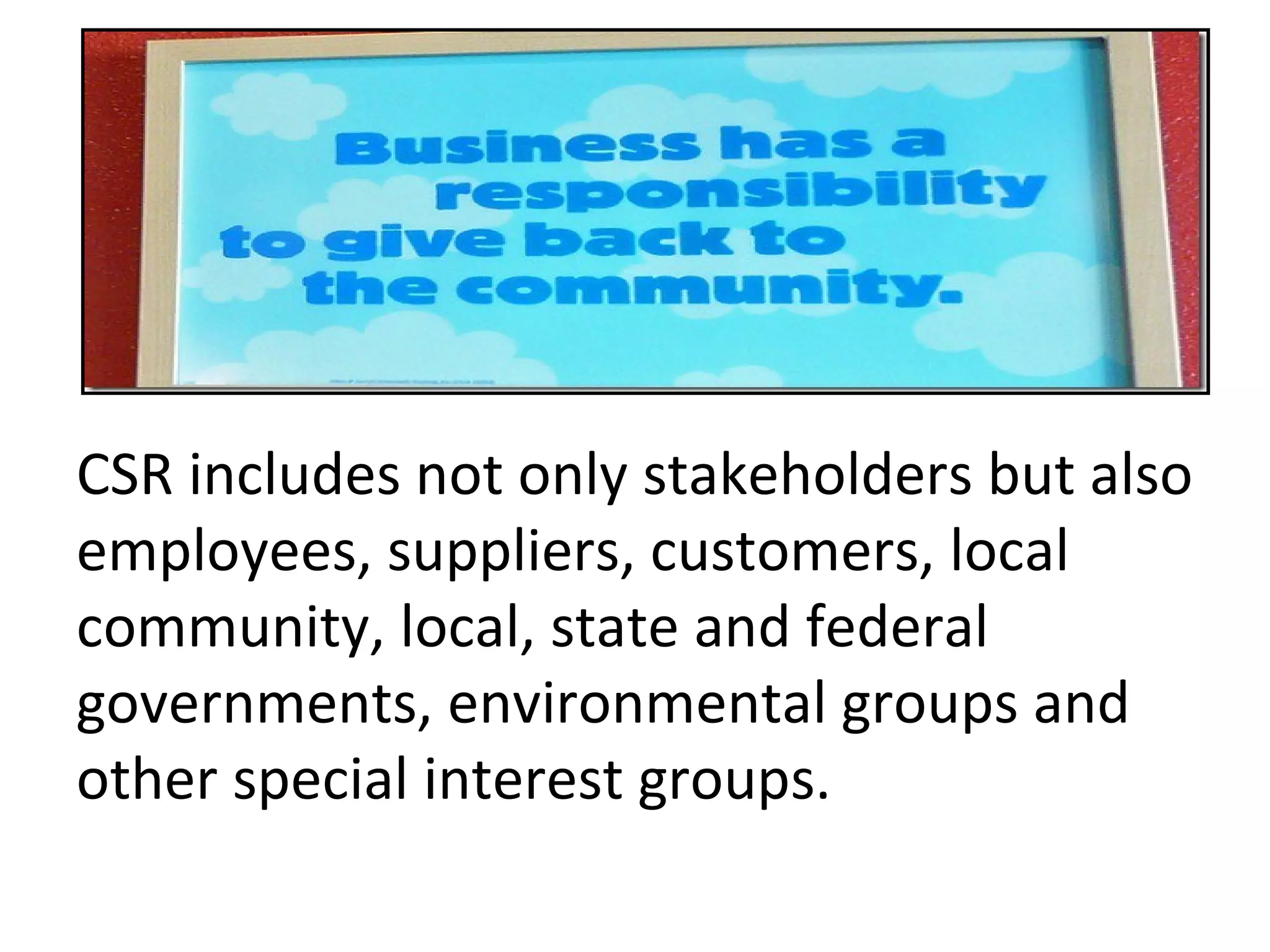
CSR includes not only stakeholders but also employees, suppliers, customers, local community, local, state and federal governments, environmental groups and other special interest groups.
Economic aspect of CSR is concerned with production of goods and services desired by customers at reasonable prices. Firms are require to be efficient, profitable and keep shareholders interest in mind.
LEGAL ASPECT OF CSR
Legal aspect of CSR is concerned that a company will fulfill all its legal compliances necessary to govern competition in the market place. A company already has several laws governing its operations like consumer and product laws, environmental laws and employment laws.
s CSR expects organizations to be good citizens. It expects firms to do proactive efforts to anticipate and meet the norms of society, even if they are not formally enacted in the law.
CSR IS NOT NEW TO INDIA CORPORATE :-  Means organised business SOCIAL :-  Meaning every thing dealing with people. RESPONISIBILITY :-  Means accountability between the two.
CSR involves various voluntary efforts:- Involves providing innovative solutions to societal and environmental. Acting in a socially responsible manner will create value for company. Firm committed to social cause give sense to employees that it will look after welfare of employees as well.
DEFINATIONS OF CSR Operating a business in a manner that meets or exceeds the ethical, legal, commercial and public expectations that society has of business. A concept whereby companies decide voluntarily to contribute to a better society and a cleaner environment. A concept whereby companies integrate social and environmental concerns in their business operations and in their interaction with their stakeholders on a voluntary basis
Corporate social responsibility must not be defined by tax planning strategies alone. Rather, it should be defined within framework of a corporate philosophy, which factors needs of community and the region in which corporate entity functions. -Prime minister Mr. Manmohan Singh.
HISTORY OF CSR :- The concept of CSR is relatively a new one-it is in use from 1960s. In 18 th  century Adam Smith expressed  classical   economic model of business. This model suggests that needs and desires of society could best be met by the unfettered interactions of individuals and organizations in market place.
HISTORY OF CSR:- A century after Smith, industrial revolution brought many technological changes leading to huge production of goods and more employment. Large organizations developed and acquired power and their founders became richest and most powerful men in the world. In the 19 th  century the concept of  social   darwinism  was in practised.
HISTORY OF CSR At the beginning of 20 th  century, big business houses were criticized as being too powerful and for practicing anti social and anti competitive practices. Laws and regulations were enacted to protect employees, consumers and society at large. In the 1960s and 1670s,  the civil right  movement,  consumerism , and  environmentalism  affected society’s expectations of business.


corporate social responsibility

  • 1.
  • 2.
  • 3.
    CSR is definedas economic, ethical , legal and discretionary expectations that society has of organizations at a given point of time. Firms have moral, ethical and philanthropic responsibilities along with their duty to earn a fair return for investors and to comply with law.
  • 4.
    CSR policy wouldfunction as a built in, self regulating mechanism where by company would monitor and ensure their adherence to law, ethical standards and international norms. Deliberate inclusion of public interest into corporate decision making and honoring of triple bottom line: People, planet and profit.
  • 5.
    CSR includes notonly stakeholders but also employees, suppliers, customers, local community, local, state and federal governments, environmental groups and other special interest groups.
  • 6.
    Economic aspect ofCSR is concerned with production of goods and services desired by customers at reasonable prices. Firms are require to be efficient, profitable and keep shareholders interest in mind.
  • 7.
  • 8.
    Legal aspect ofCSR is concerned that a company will fulfill all its legal compliances necessary to govern competition in the market place. A company already has several laws governing its operations like consumer and product laws, environmental laws and employment laws.
  • 9.
    s CSR expectsorganizations to be good citizens. It expects firms to do proactive efforts to anticipate and meet the norms of society, even if they are not formally enacted in the law.
  • 10.
    CSR IS NOTNEW TO INDIA CORPORATE :- Means organised business SOCIAL :- Meaning every thing dealing with people. RESPONISIBILITY :- Means accountability between the two.
  • 11.
    CSR involves variousvoluntary efforts:- Involves providing innovative solutions to societal and environmental. Acting in a socially responsible manner will create value for company. Firm committed to social cause give sense to employees that it will look after welfare of employees as well.
  • 12.
    DEFINATIONS OF CSROperating a business in a manner that meets or exceeds the ethical, legal, commercial and public expectations that society has of business. A concept whereby companies decide voluntarily to contribute to a better society and a cleaner environment. A concept whereby companies integrate social and environmental concerns in their business operations and in their interaction with their stakeholders on a voluntary basis
  • 13.
    Corporate social responsibilitymust not be defined by tax planning strategies alone. Rather, it should be defined within framework of a corporate philosophy, which factors needs of community and the region in which corporate entity functions. -Prime minister Mr. Manmohan Singh.
  • 14.
    HISTORY OF CSR:- The concept of CSR is relatively a new one-it is in use from 1960s. In 18 th century Adam Smith expressed classical economic model of business. This model suggests that needs and desires of society could best be met by the unfettered interactions of individuals and organizations in market place.
  • 15.
    HISTORY OF CSR:-A century after Smith, industrial revolution brought many technological changes leading to huge production of goods and more employment. Large organizations developed and acquired power and their founders became richest and most powerful men in the world. In the 19 th century the concept of social darwinism was in practised.
  • 16.
    HISTORY OF CSRAt the beginning of 20 th century, big business houses were criticized as being too powerful and for practicing anti social and anti competitive practices. Laws and regulations were enacted to protect employees, consumers and society at large. In the 1960s and 1670s, the civil right movement, consumerism , and environmentalism affected society’s expectations of business.
  • 17.
  • 18.