The Companies Act, 2013:
An overview
 The Companies Act, 2013, enacted on 29th
August, 2013 has the potential to be a historic
milestone, as it aims to improve corporate
governance & simplify regulations.
 The new law replaces the nearly 60 year old
Companies Act, 1956 („1956 Act‟).
The Companies Act, 2013:
An overview - Contd..
 The 2013 Act is more of a rule-based legislation
containing only 470 Sections and 7 Schedules which
means that the substantial part of the legislation will
be in the form of rules.
 There are over 180 sections in the 2013 Act where
rules have been prescribed.
The Companies Act, 2013:
An overview - Contd..
 100 sections of the 2013 Act have been notified and
consequently the corresponding sections of the 1956
Act cease to be in force.
 The first set of rules notified by the Ministry of
Corporate Affairs is Companies (Corporate Social
Responsibility Policy) Rules, 2014.
The Companies Act, 2013:
An overview - Contd..
 The 2013 Act has introduced several provisions
which would change the way Indian corporates do
business and one such provision is spending on
Corporate Social Responsibility (CSR) activities.
 CSR, which has largely been voluntary
contribution, by corporates has now been included in
law.
Definition
“Corporate Social Responsibility is the
continuing commitment by business to behave
ethically and contribute to economic
development while improving the quality of life
of the workforce and their families as well as of
the local community and society at large.”
 World Business Council for Sustainable
Development
How much money..?
 The new Companies Act 2013, lays down that 2% of profits
earned by a certain class of companies must be spent on
corporate social responsibility activities.
 It is estimated that an estimated Rs.27,000 crore will flow
into grassroots development and social enterprise sectors
every year.
 According to the Indian Institute of Corporate Affairs, out of
the 1.3 million companies in India, about 7,000 companies
are covered under the new CSR rule.
How many..?
 Number of companies in Kerala with net worth above
Rs.500 crores - 15
 Number of companies in Kerala with turn over above
Rs.1000 crores - 15
 Number of companies in Kerala with net profit above Rs.5
crores - 137
Section 135 of the Act
Corporate
Social
Responsibility
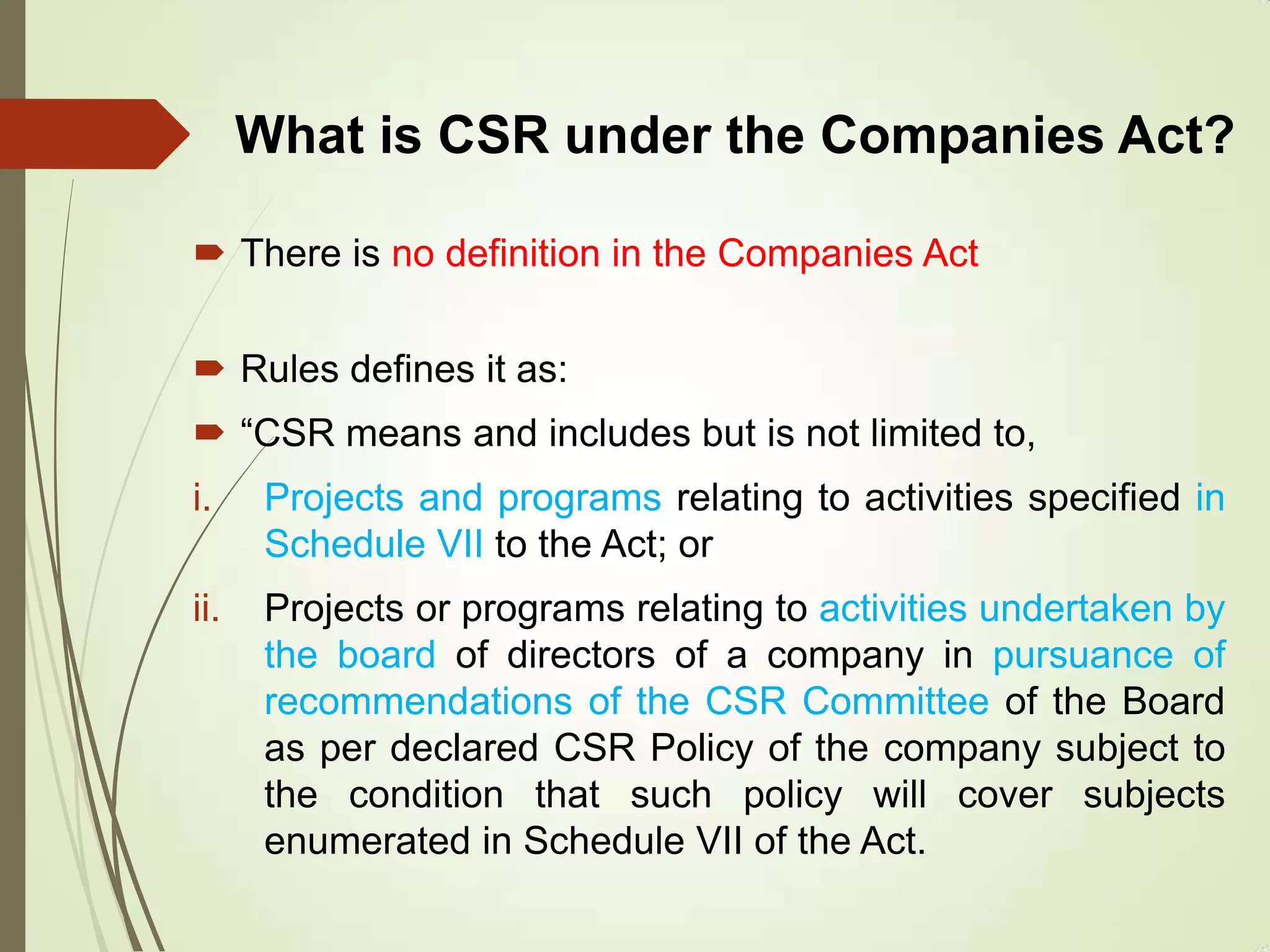
What is CSR under the Companies Act?
 There is no definition in the Companies Act
 Rules defines it as:
 “CSR means and includes but is not limited to,
i. Projects and programs relating to activities specified in
Schedule VII to the Act; or
ii. Projects or programs relating to activities undertaken by
the board of directors of a company in pursuance of
recommendations of the CSR Committee of the Board
as per declared CSR Policy of the company subject to
the condition that such policy will cover subjects
enumerated in Schedule VII of the Act.
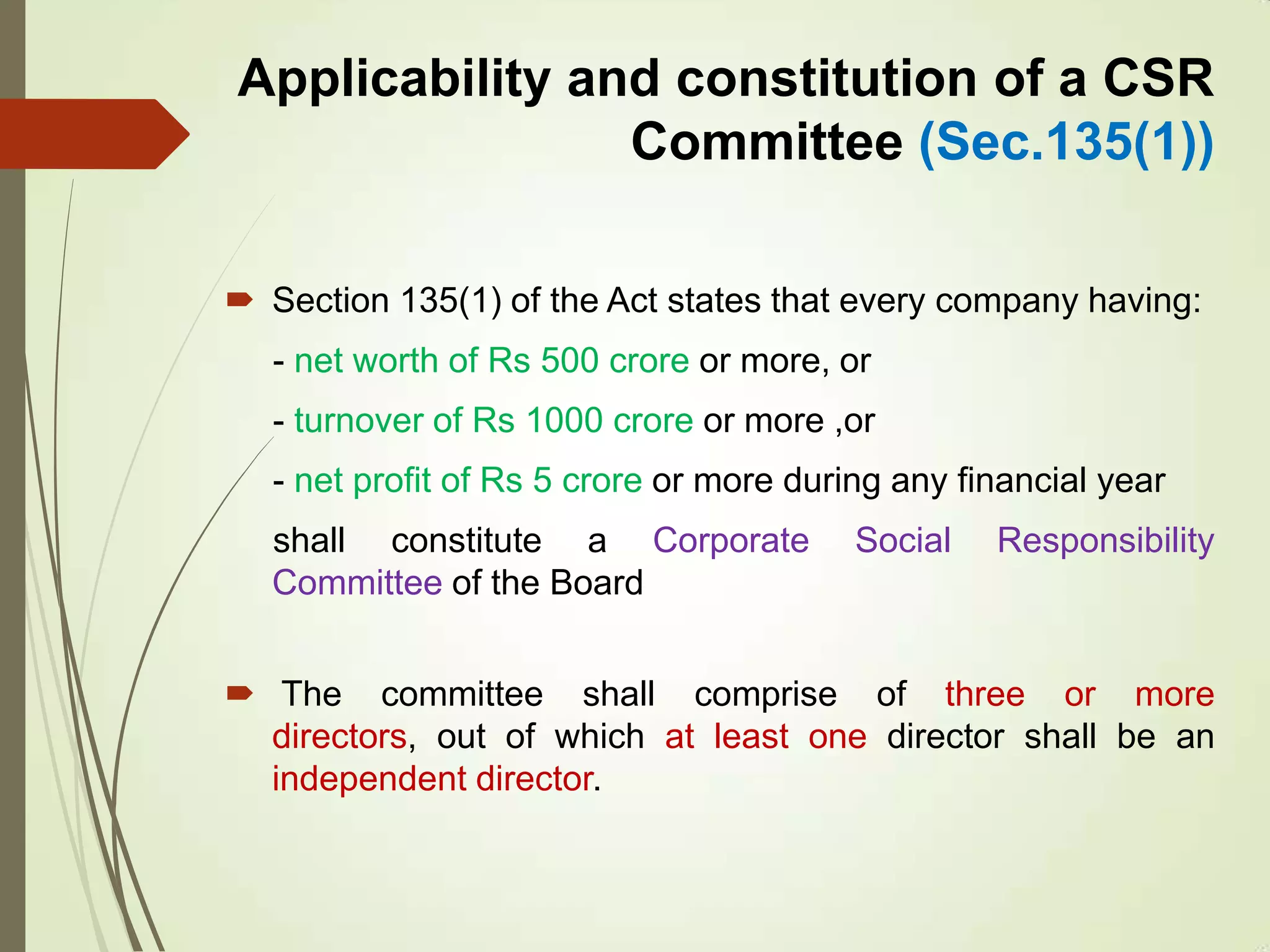
Applicability and constitution of a CSR
Committee (Sec.135(1))
 Section 135(1) of the Act states that every company having:
- net worth of Rs 500 crore or more, or
- turnover of Rs 1000 crore or more ,or
- net profit of Rs 5 crore or more during any financial year
shall constitute a Corporate Social Responsibility
Committee of the Board
 The committee shall comprise of three or more
directors, out of which at least one director shall be an
independent director.
Corporate Social Responsibility
[Sec 135]
Net worth ≥ 500
crores
Turnover ≥ 1000
crores
Net Profit ≥ 5 crores
CSR Committee
Consists of
3 or more
director
Functions out
of
which
One director
independent
director
Composition
1. Formulate
And recommend
CSR Policy
2. Recommend
amount of CSR
expenditure
to be incurred
3. Monitor CSR
Policy
Functions
Company
need
to spend
minimum 2% of
its average net
profits made
during the 3
immediately
financial years
Contribution
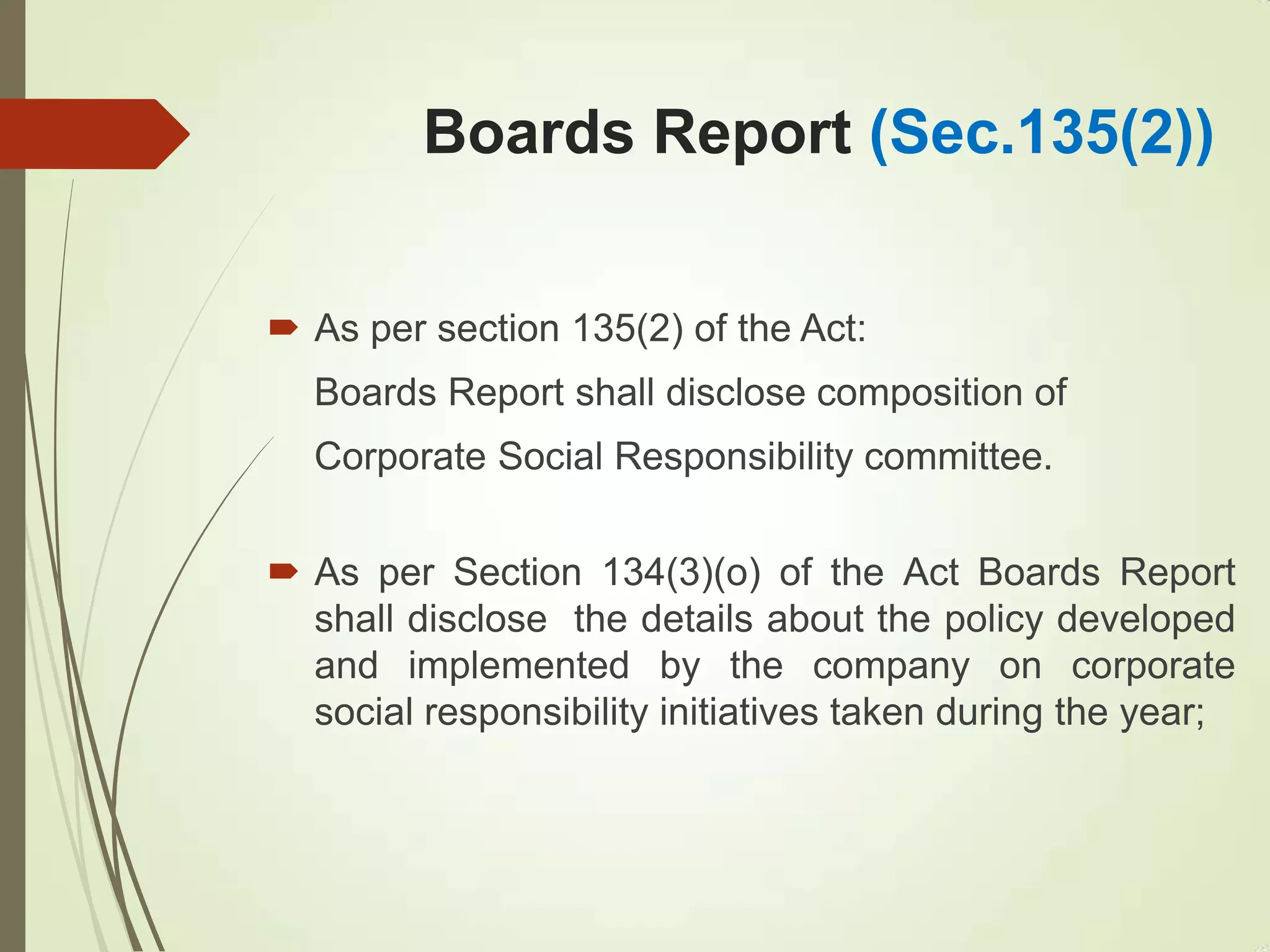
Boards Report (Sec.135(2))
 As per section 135(2) of the Act:
Boards Report shall disclose composition of
Corporate Social Responsibility committee.
 As per Section 134(3)(o) of the Act Boards Report
shall disclose the details about the policy developed
and implemented by the company on corporate
social responsibility initiatives taken during the year;
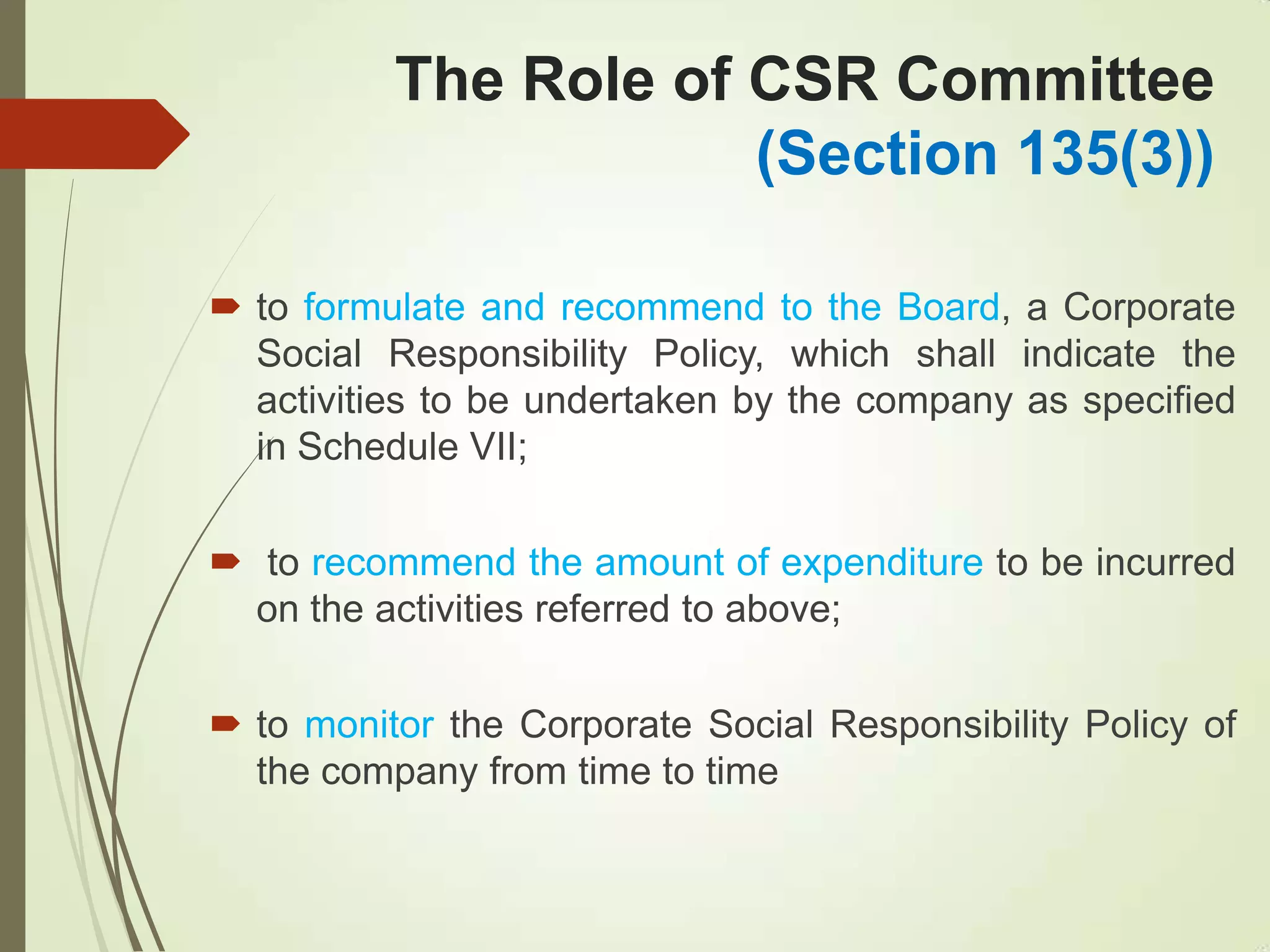
The Role of CSR Committee
(Section 135(3))
 to formulate and recommend to the Board, a Corporate
Social Responsibility Policy, which shall indicate the
activities to be undertaken by the company as specified
in Schedule VII;
 to recommend the amount of expenditure to be incurred
on the activities referred to above;
 to monitor the Corporate Social Responsibility Policy of
the company from time to time
Responsibility of the Board
(Section.135(4))
The Board of every company referred to above shall after taking into
account the recommendations made by CSR Committee:
 approve the CSR Policy for the company and disclose contents of
such Policy in its report and also place it on the company‟s website
 ensure that the activities as are included in CSR Policy of the
company are undertaken by the company, and
 ensure that the company spends, in every financial year, at least
two per cent of the average net profits made during the preceding 3
financial years.
 If the Company fails to spend such amount, the Board shall, in its
report specify the reasons for not spending the amount
 Company shall give preference to the local areas.
Schedule VII
Schedule VII had been modified by MCA
notification dated 27th February, 2014.
The new schedule VII, gives much clarity on
what is CSR under the Act.
CSR Activities under Sch.VII
1. Eradicating hunger, poverty and malnutrition, promoting
preventive health care and sanitation and making available
safe drinking water.
2. Promoting education, including special education and
employment enhancing vocation skills especially among
children, women, elderly, and the differently abled and
livelihood enhancement projects;
3. Promoting gender equality, empowering women, setting up
homes and hostels for women and orphans; setting up old
age homes, day care centres and such facilities for senior
citizens and measures for reducing in equalities faced by
socially and economically backward group.
CSR Activities under Sch.VII
Contd..
4. Ensuring environmental sustainability, ecological
balance, protection of flora and fauna, animal
welfare, agro forestry, conservation of natural resources
and maintaining quality of soil, air and water
5. Protection of national heritage, art and culture including
restoration of buildings and sites of historical importance
and works of arts and handicrafts.
6. Measure for the benefit of armed forces veterans, war
widows and their dependents
CSR Activities under Sch.VII
Contd..
7. Training to promote rural sports, nationally recognised
sports, Paralympics sports and Olympic sports
8. Contribution to the Prime Minister‟s National Relief Fund
or other fund set up by the Central Government for socio-
economic development and relief and welfare of the
Schedule Castes, the Schedule Tribes, other backward
classes, minorities and women.
9. Contributions or funds provided to technology incubators
located within academics institutions which are approved
by the Central Government.
10. Rural development projects.
Companies (Corporate Social
Responsibility Policy) Rules, 2014
brief details
 Notified on 27th February 2014
 Will be effective from 1st day of April 2014
 CSR defined as Projects as per Sch.VII
 CSR Policy is defined as Sch VII activities
 CSR Committee is defined & modified
 Net profit is defined
 Turnover is defined
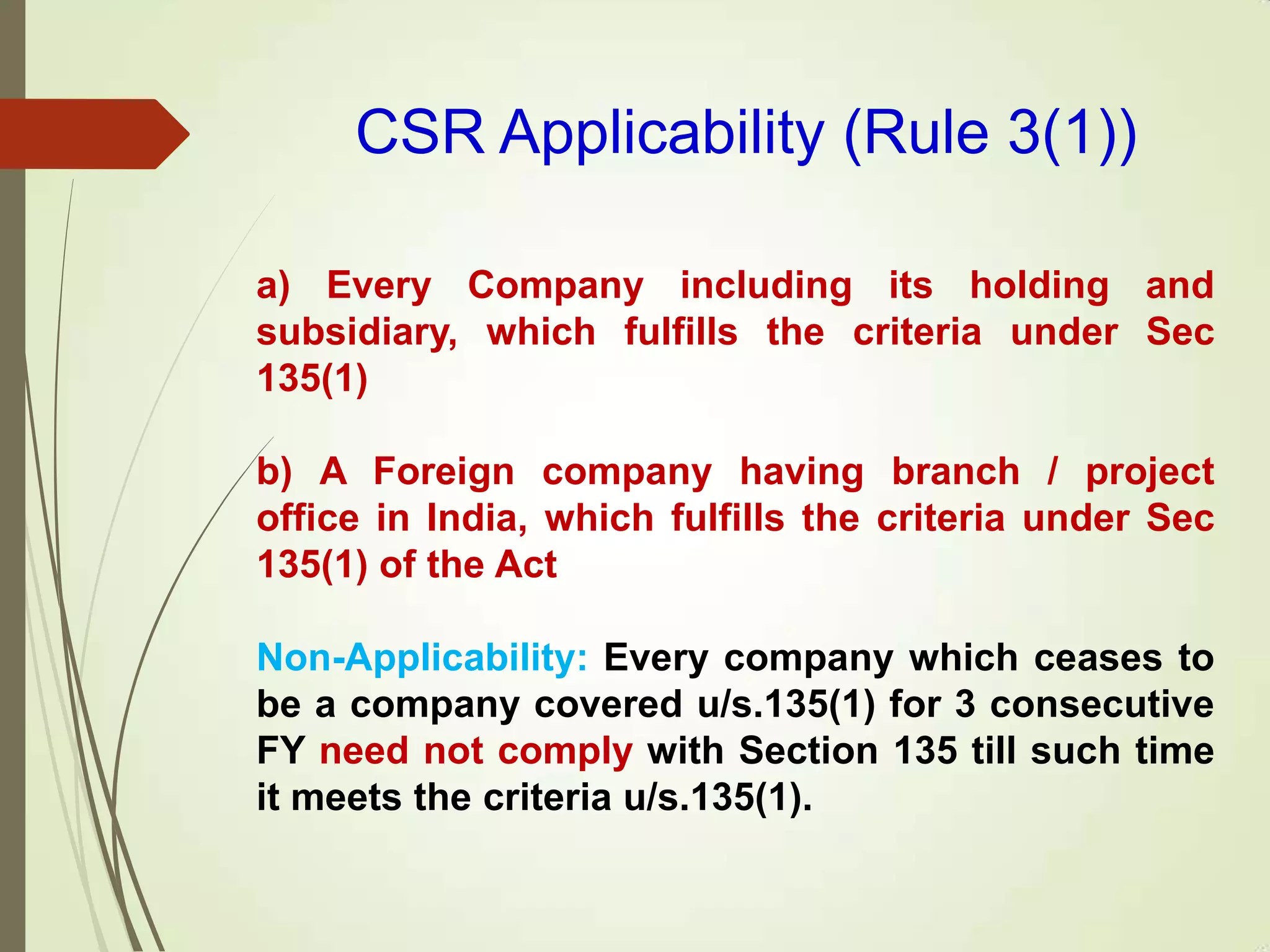
CSR Applicability (Rule 3(1))
a) Every Company including its holding and
subsidiary, which fulfills the criteria under Sec
135(1)
b) A Foreign company having branch / project
office in India, which fulfills the criteria under Sec
135(1) of the Act
Non-Applicability: Every company which ceases to
be a company covered u/s.135(1) for 3 consecutive
FY need not comply with Section 135 till such time
it meets the criteria u/s.135(1).
CSR Committee (Rule 3(2) and Rule 5)
a) Applicable Companies shall constitute CSR Committee
consisting of 3 or more directors out of which at least 1
director shall be independent director.
b) Unlisted public company or private company which is not
required to appoint independent director shall have its CSR
committee without independent director.
c) Private Company having only 2 Directors on its Board
shall constitute CSR Committee with only 2 directors.
d) The committee shall institute a transparent monitoring
mechanism for implementing CSR projects undertaken by
the company.
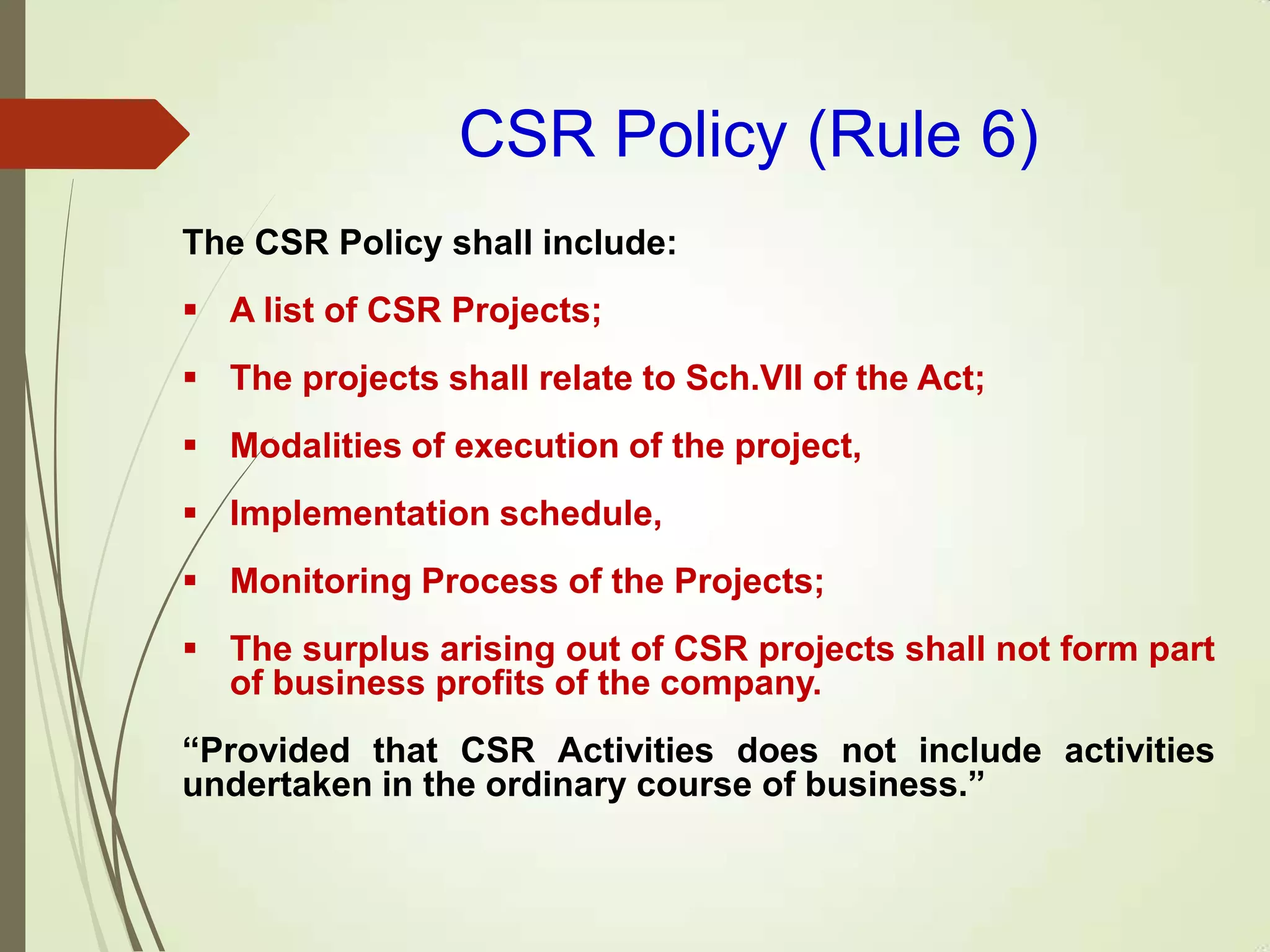
CSR Policy (Rule 6)
The CSR Policy shall include:
 A list of CSR Projects;
 The projects shall relate to Sch.VII of the Act;
 Modalities of execution of the project,
 Implementation schedule,
 Monitoring Process of the Projects;
 The surplus arising out of CSR projects shall not form part
of business profits of the company.
“Provided that CSR Activities does not include activities
undertaken in the ordinary course of business.”
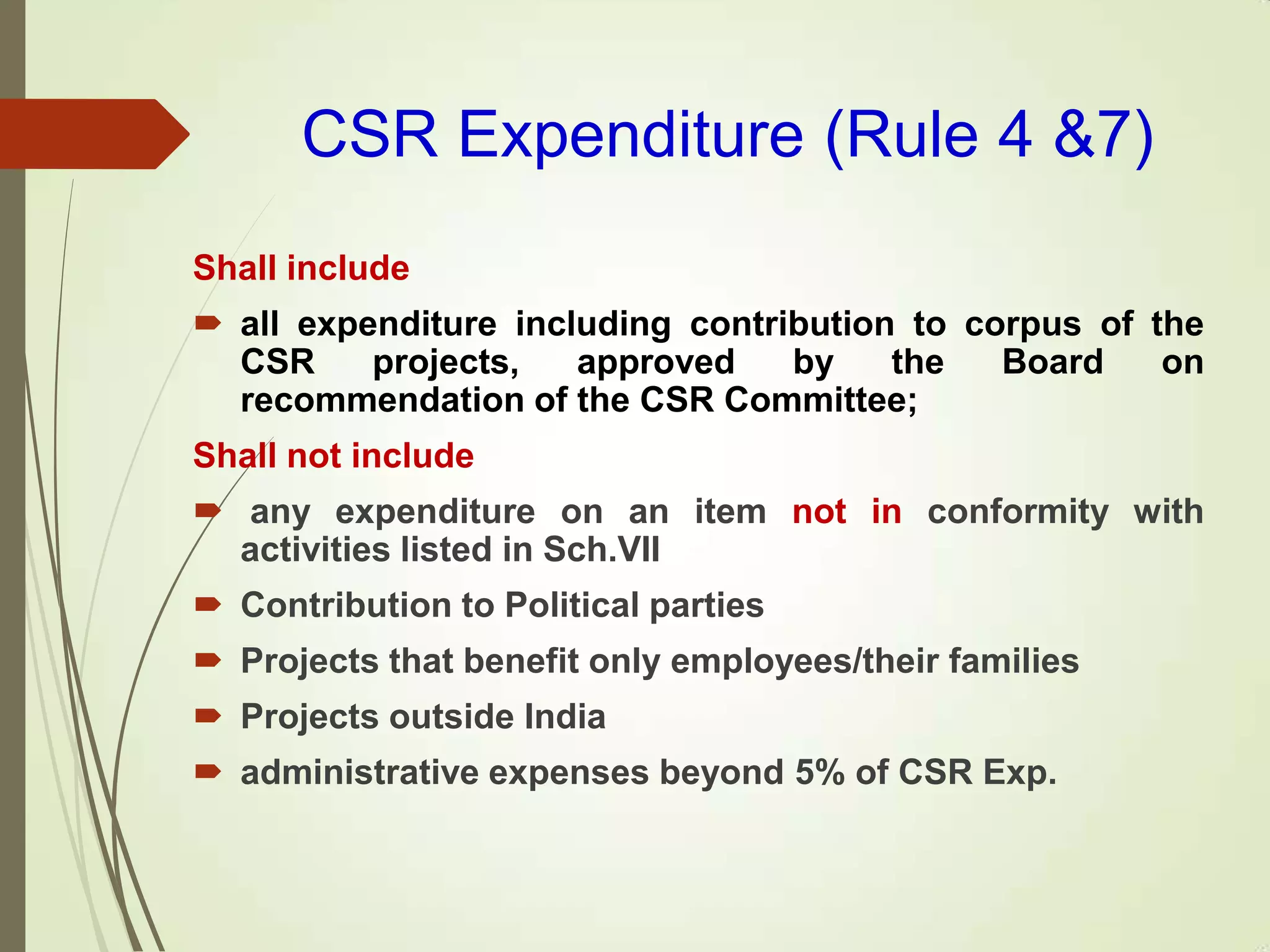
CSR Expenditure (Rule 4 &7)
Shall include
 all expenditure including contribution to corpus of the
CSR projects, approved by the Board on
recommendation of the CSR Committee;
Shall not include
 any expenditure on an item not in conformity with
activities listed in Sch.VII
 Contribution to Political parties
 Projects that benefit only employees/their families
 Projects outside India
 administrative expenses beyond 5% of CSR Exp.
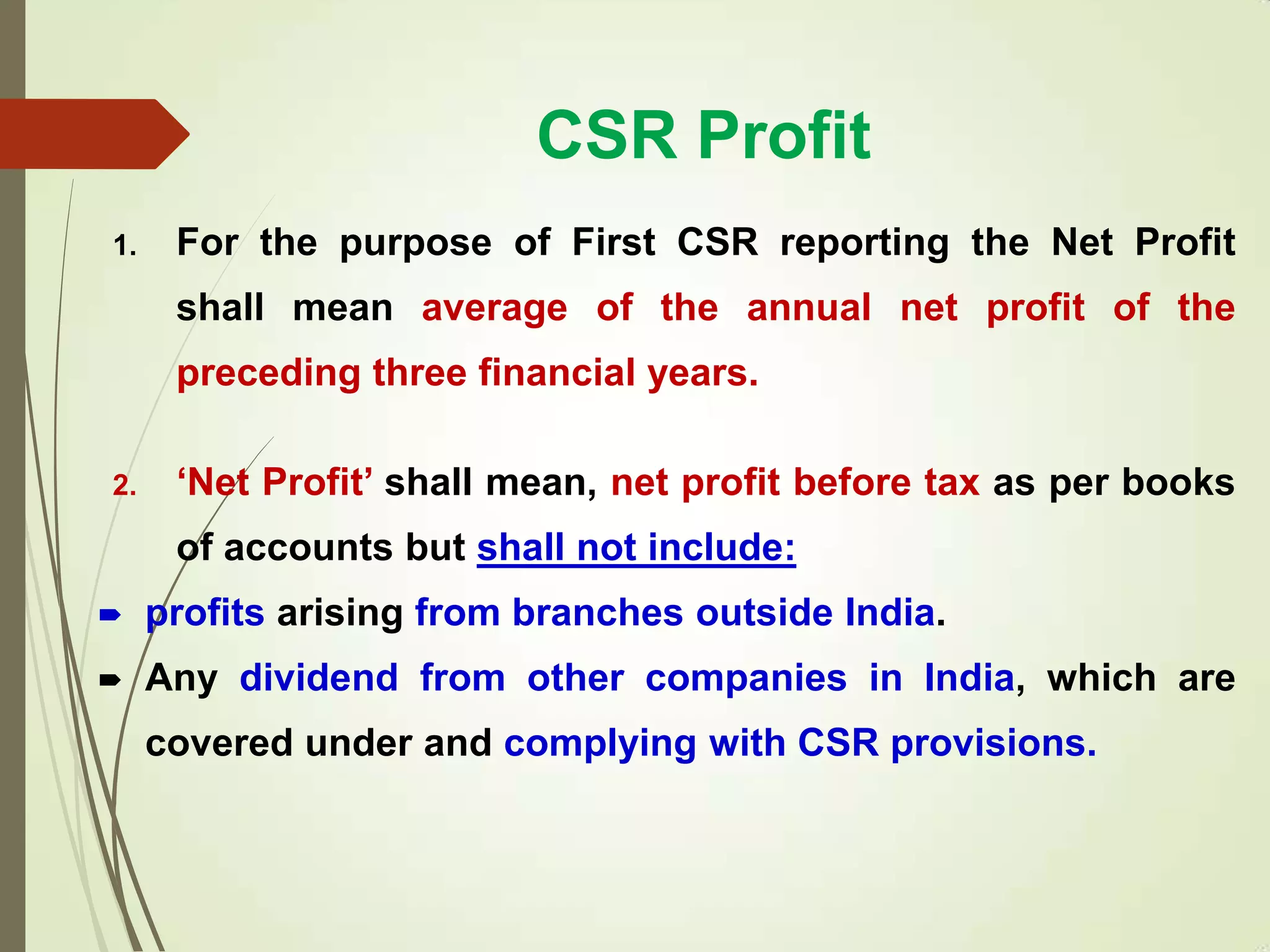
CSR Profit
1. For the purpose of First CSR reporting the Net Profit
shall mean average of the annual net profit of the
preceding three financial years.
2. „Net Profit‟ shall mean, net profit before tax as per books
of accounts but shall not include:
 profits arising from branches outside India.
 Any dividend from other companies in India, which are
covered under and complying with CSR provisions.
CSR Vehicles
 CSR activities can be carried on:
 by the company itself.
 through a Trust or a Society or a Section 8 Company
established by the Company for such purpose.
 through collaboration with another Company provided such
expenditure can be separately reported as per the procedure
stated in the Rules.
 An independent Trust or Society or another company with a
track record of 3 years in executing similar programs like CSR
activities.
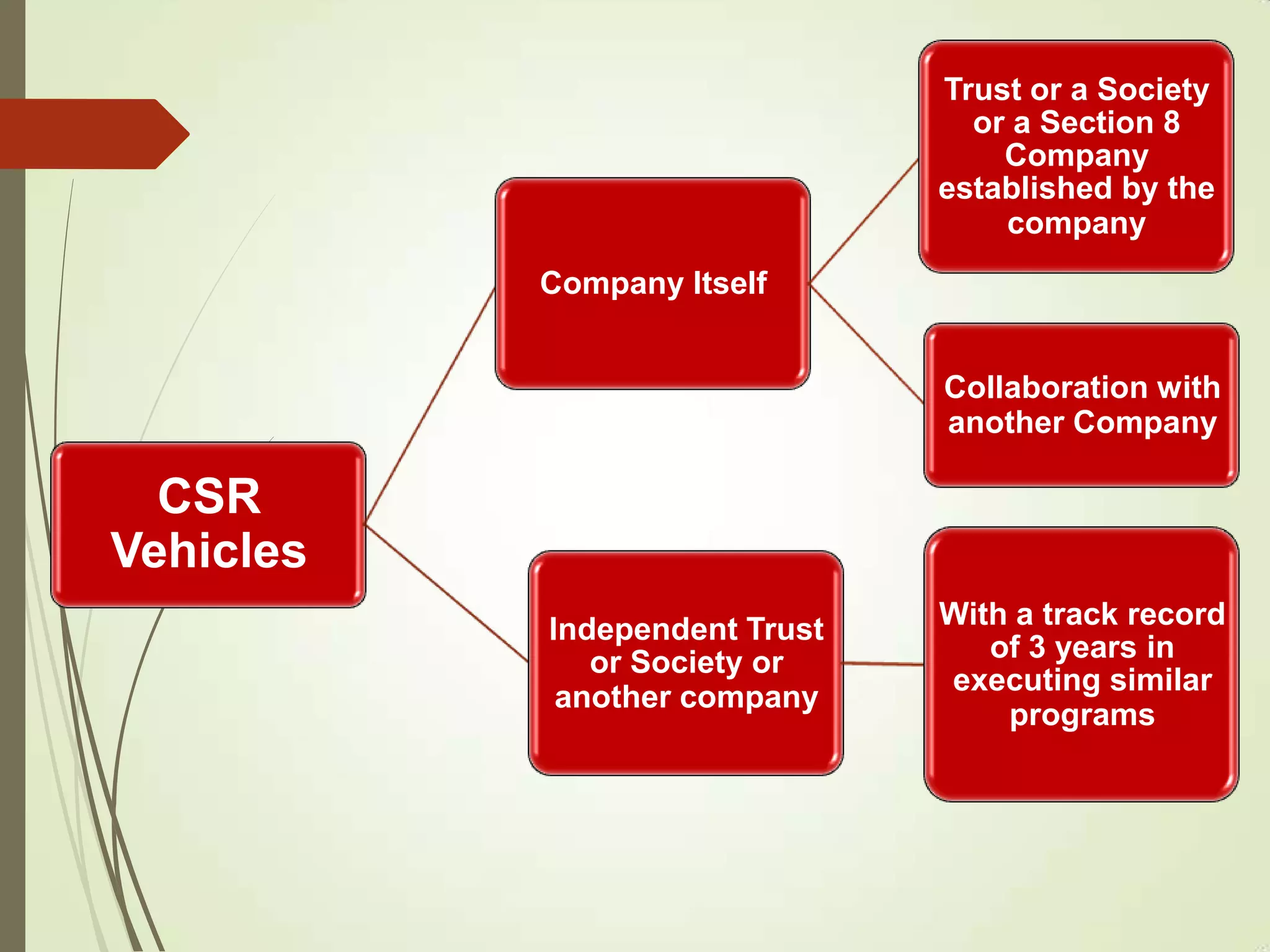
CSR
Vehicles
Company Itself
Trust or a Society
or a Section 8
Company
established by the
company
Collaboration with
another Company
Independent Trust
or Society or
another company
With a track record
of 3 years in
executing similar
programs
 If the company does not spend 2% of net profits as
required, then Board to report the reasons in the Board‟s
report.
 If a company fails to disclose CSR Policy and its
implementation in Board‟s Report, the company shall be
punishable with fine ranging from fifty thousand to twenty-
five lakh rupees and every officer of the company who is in
default shall be punishable with imprisonment for a term
which may extend to three years or with fine ranging from
fifty thousand rupees but which may extend to five lakh
rupees, or with both
Is there any penal provision?
What can be done if not provided.??
Conclusion
 The Companies Act, 2013 require big and profitable companies to
have a CSR Policy, CSR Committee.
 CSR Committee shall formulate, recommend and monitor CSR
Policy.
 Board shall approve the CSR Policy and disclose it in its report
and in companies website.
 Board shall ensure at least 2% of average net profit is spent every
year.
 The board shall specify reasons for not spending in its report.
 Non reporting shall result in prosecution.
Corporate Social Responsibility (CSR)

Corporate Social Responsibility (CSR)

  • 2.
    The Companies Act,2013: An overview  The Companies Act, 2013, enacted on 29th August, 2013 has the potential to be a historic milestone, as it aims to improve corporate governance & simplify regulations.  The new law replaces the nearly 60 year old Companies Act, 1956 („1956 Act‟).
  • 3.
    The Companies Act,2013: An overview - Contd..  The 2013 Act is more of a rule-based legislation containing only 470 Sections and 7 Schedules which means that the substantial part of the legislation will be in the form of rules.  There are over 180 sections in the 2013 Act where rules have been prescribed.
  • 4.
    The Companies Act,2013: An overview - Contd..  100 sections of the 2013 Act have been notified and consequently the corresponding sections of the 1956 Act cease to be in force.  The first set of rules notified by the Ministry of Corporate Affairs is Companies (Corporate Social Responsibility Policy) Rules, 2014.
  • 5.
    The Companies Act,2013: An overview - Contd..  The 2013 Act has introduced several provisions which would change the way Indian corporates do business and one such provision is spending on Corporate Social Responsibility (CSR) activities.  CSR, which has largely been voluntary contribution, by corporates has now been included in law.
  • 6.
    Definition “Corporate Social Responsibilityis the continuing commitment by business to behave ethically and contribute to economic development while improving the quality of life of the workforce and their families as well as of the local community and society at large.”  World Business Council for Sustainable Development
  • 7.
    How much money..? The new Companies Act 2013, lays down that 2% of profits earned by a certain class of companies must be spent on corporate social responsibility activities.  It is estimated that an estimated Rs.27,000 crore will flow into grassroots development and social enterprise sectors every year.  According to the Indian Institute of Corporate Affairs, out of the 1.3 million companies in India, about 7,000 companies are covered under the new CSR rule.
  • 8.
    How many..?  Numberof companies in Kerala with net worth above Rs.500 crores - 15  Number of companies in Kerala with turn over above Rs.1000 crores - 15  Number of companies in Kerala with net profit above Rs.5 crores - 137
  • 9.
    Section 135 ofthe Act Corporate Social Responsibility
  • 10.
    What is CSRunder the Companies Act?  There is no definition in the Companies Act  Rules defines it as:  “CSR means and includes but is not limited to, i. Projects and programs relating to activities specified in Schedule VII to the Act; or ii. Projects or programs relating to activities undertaken by the board of directors of a company in pursuance of recommendations of the CSR Committee of the Board as per declared CSR Policy of the company subject to the condition that such policy will cover subjects enumerated in Schedule VII of the Act.
  • 11.
    Applicability and constitutionof a CSR Committee (Sec.135(1))  Section 135(1) of the Act states that every company having: - net worth of Rs 500 crore or more, or - turnover of Rs 1000 crore or more ,or - net profit of Rs 5 crore or more during any financial year shall constitute a Corporate Social Responsibility Committee of the Board  The committee shall comprise of three or more directors, out of which at least one director shall be an independent director.
  • 12.
    Corporate Social Responsibility [Sec135] Net worth ≥ 500 crores Turnover ≥ 1000 crores Net Profit ≥ 5 crores CSR Committee Consists of 3 or more director Functions out of which One director independent director Composition 1. Formulate And recommend CSR Policy 2. Recommend amount of CSR expenditure to be incurred 3. Monitor CSR Policy Functions Company need to spend minimum 2% of its average net profits made during the 3 immediately financial years Contribution
  • 13.
    Boards Report (Sec.135(2)) As per section 135(2) of the Act: Boards Report shall disclose composition of Corporate Social Responsibility committee.  As per Section 134(3)(o) of the Act Boards Report shall disclose the details about the policy developed and implemented by the company on corporate social responsibility initiatives taken during the year;
  • 14.
    The Role ofCSR Committee (Section 135(3))  to formulate and recommend to the Board, a Corporate Social Responsibility Policy, which shall indicate the activities to be undertaken by the company as specified in Schedule VII;  to recommend the amount of expenditure to be incurred on the activities referred to above;  to monitor the Corporate Social Responsibility Policy of the company from time to time
  • 15.
    Responsibility of theBoard (Section.135(4)) The Board of every company referred to above shall after taking into account the recommendations made by CSR Committee:  approve the CSR Policy for the company and disclose contents of such Policy in its report and also place it on the company‟s website  ensure that the activities as are included in CSR Policy of the company are undertaken by the company, and  ensure that the company spends, in every financial year, at least two per cent of the average net profits made during the preceding 3 financial years.  If the Company fails to spend such amount, the Board shall, in its report specify the reasons for not spending the amount  Company shall give preference to the local areas.
  • 16.
    Schedule VII Schedule VIIhad been modified by MCA notification dated 27th February, 2014. The new schedule VII, gives much clarity on what is CSR under the Act.
  • 17.
    CSR Activities underSch.VII 1. Eradicating hunger, poverty and malnutrition, promoting preventive health care and sanitation and making available safe drinking water. 2. Promoting education, including special education and employment enhancing vocation skills especially among children, women, elderly, and the differently abled and livelihood enhancement projects; 3. Promoting gender equality, empowering women, setting up homes and hostels for women and orphans; setting up old age homes, day care centres and such facilities for senior citizens and measures for reducing in equalities faced by socially and economically backward group.
  • 18.
    CSR Activities underSch.VII Contd.. 4. Ensuring environmental sustainability, ecological balance, protection of flora and fauna, animal welfare, agro forestry, conservation of natural resources and maintaining quality of soil, air and water 5. Protection of national heritage, art and culture including restoration of buildings and sites of historical importance and works of arts and handicrafts. 6. Measure for the benefit of armed forces veterans, war widows and their dependents
  • 19.
    CSR Activities underSch.VII Contd.. 7. Training to promote rural sports, nationally recognised sports, Paralympics sports and Olympic sports 8. Contribution to the Prime Minister‟s National Relief Fund or other fund set up by the Central Government for socio- economic development and relief and welfare of the Schedule Castes, the Schedule Tribes, other backward classes, minorities and women. 9. Contributions or funds provided to technology incubators located within academics institutions which are approved by the Central Government. 10. Rural development projects.
  • 20.
  • 21.
    brief details  Notifiedon 27th February 2014  Will be effective from 1st day of April 2014  CSR defined as Projects as per Sch.VII  CSR Policy is defined as Sch VII activities  CSR Committee is defined & modified  Net profit is defined  Turnover is defined
  • 22.
    CSR Applicability (Rule3(1)) a) Every Company including its holding and subsidiary, which fulfills the criteria under Sec 135(1) b) A Foreign company having branch / project office in India, which fulfills the criteria under Sec 135(1) of the Act Non-Applicability: Every company which ceases to be a company covered u/s.135(1) for 3 consecutive FY need not comply with Section 135 till such time it meets the criteria u/s.135(1).
  • 23.
    CSR Committee (Rule3(2) and Rule 5) a) Applicable Companies shall constitute CSR Committee consisting of 3 or more directors out of which at least 1 director shall be independent director. b) Unlisted public company or private company which is not required to appoint independent director shall have its CSR committee without independent director. c) Private Company having only 2 Directors on its Board shall constitute CSR Committee with only 2 directors. d) The committee shall institute a transparent monitoring mechanism for implementing CSR projects undertaken by the company.
  • 24.
    CSR Policy (Rule6) The CSR Policy shall include:  A list of CSR Projects;  The projects shall relate to Sch.VII of the Act;  Modalities of execution of the project,  Implementation schedule,  Monitoring Process of the Projects;  The surplus arising out of CSR projects shall not form part of business profits of the company. “Provided that CSR Activities does not include activities undertaken in the ordinary course of business.”
  • 25.
    CSR Expenditure (Rule4 &7) Shall include  all expenditure including contribution to corpus of the CSR projects, approved by the Board on recommendation of the CSR Committee; Shall not include  any expenditure on an item not in conformity with activities listed in Sch.VII  Contribution to Political parties  Projects that benefit only employees/their families  Projects outside India  administrative expenses beyond 5% of CSR Exp.
  • 26.
    CSR Profit 1. Forthe purpose of First CSR reporting the Net Profit shall mean average of the annual net profit of the preceding three financial years. 2. „Net Profit‟ shall mean, net profit before tax as per books of accounts but shall not include:  profits arising from branches outside India.  Any dividend from other companies in India, which are covered under and complying with CSR provisions.
  • 27.
    CSR Vehicles  CSRactivities can be carried on:  by the company itself.  through a Trust or a Society or a Section 8 Company established by the Company for such purpose.  through collaboration with another Company provided such expenditure can be separately reported as per the procedure stated in the Rules.  An independent Trust or Society or another company with a track record of 3 years in executing similar programs like CSR activities.
  • 28.
    CSR Vehicles Company Itself Trust ora Society or a Section 8 Company established by the company Collaboration with another Company Independent Trust or Society or another company With a track record of 3 years in executing similar programs
  • 29.
     If thecompany does not spend 2% of net profits as required, then Board to report the reasons in the Board‟s report.  If a company fails to disclose CSR Policy and its implementation in Board‟s Report, the company shall be punishable with fine ranging from fifty thousand to twenty- five lakh rupees and every officer of the company who is in default shall be punishable with imprisonment for a term which may extend to three years or with fine ranging from fifty thousand rupees but which may extend to five lakh rupees, or with both Is there any penal provision? What can be done if not provided.??
  • 30.
    Conclusion  The CompaniesAct, 2013 require big and profitable companies to have a CSR Policy, CSR Committee.  CSR Committee shall formulate, recommend and monitor CSR Policy.  Board shall approve the CSR Policy and disclose it in its report and in companies website.  Board shall ensure at least 2% of average net profit is spent every year.  The board shall specify reasons for not spending in its report.  Non reporting shall result in prosecution.