Room No.6, 4th Floor, Commerce House
2A, Ganesh Chandra Avenue, Kolkata 700013
Connect me @ : (033) 3028 8955-57; (033) 3002 5630-33; 98310 99551
mamtab@mamtabinani.com
Visit me @ : www.mamtabinani.com
Companies Act, 2013
Corporate Social Responsibility
By CS Mamta Binani
Chairperson (Year 2010), EIRC of ICSI
At the ‘You’ Institute for professionals
SECTION 135 (incorporating notification dated
27.02.2014)
Under Chapter IX
Room No.6, 4th Floor, Commerce House
2A, Ganesh Chandra Avenue, Kolkata 700013
Connect me @ : (033) 3028 8955-57; (033) 3002 5630-33; 98310 99551
mamtab@mamtabinani.com
Visit me @ : www.mamtabinani.com
MCA vide notification dated
27th February 2014, has notified Section
135, Schedule VII of the Companies Act,
2013 (provisions relating to CSR)
and the Companies (Corporate Social
Responsibility Policy) Rules, 2014.
The same is effective from 1st April,
2014.
What does CSR mean?
Corporate Social Responsibility (CSR)
As per Rule 2(1)(c) of the Companies (Corporate Social
Responsibility Policy) Rules, 2014: CSR means and includes
but is not limited to:
(i) Projects or programs relating to activities specified in
Schedule VII to the Act; or
(ii) Projects or programs relating to activities undertaken by the
board of directors of a Company (Board) in pursuance of
recommendations of the CSR Committee of the Board as per
declared CSR policy of the company subject to the condition
that such policy will cover subjects enumerated in Schedule
VII of the Act.
(My comments: This is in the nature of an exhaustive
definition but still the language denotes it as an inclusive one)
Corporate Social Responsibility (CSR)
– a brief outline (Section 135)
Section 135 of the Act mandates CSR
It encompasses mainly 5 important elements:
• CSR Applicability
• CSR Committee
• CSR Policy & Activities
• CSR Expenditure
• CSR Reporting
135(1): Every company with either of the following 3:
 Net worth of Rs.500 crores or more during any financial year
Turnover of Rs.1000 crores or more during any financial year
Net profit of Rs.5 crores or more during any financial year
shall constitute a CSR Committee of the Board
Rule 3 of CSR Rules-Applicability
Rule 3: Who has to be comply with section 135 and its rules?
1. Every company including:
a. its holding company; or
b. its subsidiary company
2. A foreign company (as defined under sec 2(42)) having
its:
a. branch office or
b. project office in India
and
which fulfills the criteria specified in section 135(1) of the
Act shall have to comply with sec 135 and the relevant
Rules
What is CSR Committee
Definitions:
• Rule 2(1)(d) defines CSR Committee as:
It means the Corporate Social Responsibility
Committee of the Board referred to in section
135 of the Act.
CSR Committee-Composition
Composition (as given in section 135(1):
At least 3 Directors out of which at least 1
Independent Director.
However, an unlisted Public Company or a Private
Company not required to compulsorily appoint an
Independent Director shall have its Committee without
an Independent Director (Rule 5(1)(i)).
A Private Company having only two Directors on Board
shall constitute the Committee with two such Directors
(Rule 5(1)(ii)).
For a Foreign Company-atleast 2 persons. 1 out of these
2, shall be the person mentioned in section 380(1)(d) of
the Act. The other one shall be as nominated by the
foreign company
Disclosure of composition of CSR
committee-Sec 135(2)
Sec 135(2): The Board’s Report (u/s 134(3)) shall
disclose the composition of the CSR Committee
Section 135(3) - CSR Policy and
Expenditure
The CSR Committee shall (section 135(3))–
formulate the CSR Policy and
recommend the same to the Board
recommend the amount of expenditure to be
incurred on the activities
monitor the implementation of the CSR policy by
the Company from time to time.
• Rule 2(1)(e) defines CSR Policy as:
It relates to the activities to be undertaken by the
company as specified in Schedule VII and the
expenditure thereon, excluding activities
undertaken in pursuance of normal course of
business of a company
Section 135(4) – Duty of the Board
The Board of every such company shall –
Take into account the recommendations made
by the CSR Committee and
Approve the CSR policy for the Company
Disclose contents of such policy in the Board’s
Report and
Also place it on company’s website, if any
The Board of the company shall have to ensure
that the activities as are included in the CSR
Policy of the company are undertaken by the
company.
CSR Policy – Rule 6
Rule 6(1)
• The CSR Policy shall lay out the list of CSR projects/
programs
• It will specify the modalities of execution
• The implementation schedules
• Monitoring process
Rule 6(2)
The CSR Policy shall have to specify that the surplus
arising out of the CSR projects or programs or activities
shall not form part of the business profits of a
company.
Display of CSR activities on its website
Rule 9
The Board of Directors of the company shall,
after taking into account the
recommendations of CSR Committee,
approve the CSR Policy for the company &
disclose contents of such policy in its report
and the same shall be displayed on the
company’s website, if any, as per the
particulars specified in the Annexure
CSR Expenditure
Section 135 (5)
The Board of every company covered under CSR
shall ensure for every financial year that:
At least 2% of average net profits of the company
made during 3 immediately preceding financial
years is spent on CSR.
This spending to be made in pursuance of its laid
CSR Policy.
What is ‘Net Profit’
Rule 2(1)(f) of the Rules:
‘Net Profit’ means the net profit of a company
as per its financial statement prepared in
accordance with the applicable provisions of
the Act, but shall not include the following,
namely:
a. any profit arising from any overseas
branch(es) of the company, whether operated
as a separate company or otherwise; and
b. any dividend received from other
companies in India, which are covered under
and complying with provisions of sec 135
What is ‘Net Profit’
Net Profit definition continued:
• Provided that net profit in respect of a FY for
which the relevant financial statements were
prepared in accordance with the provisions of
the Companies Act, 1956 shall not be required
to be re-calculated in accordance with the
provisions of the Act.
• In case of a foreign company here, net profit
means the net profit of such company as per
profit and loss account prepared in terms of
clause (a) of sec 381(1) read with sec 198 of the
Act.
CSR Expenditure
Section 135 (5) - Provisos
1st Proviso: Companies shall give preference to local
areas and areas around it where it operates, for
spending the amount earmarked for CSR activities.
2nd Proviso: If the Company fails to spend such amount,
the Board shall have to specify the reasons for not
spending the said amount. This reporting will have to
be made under clause (o) of section 134(3).
Section 135 (5) – Explanation
For the purposes of section 135, ‘average net profit’
shall be calculated as per section 198.
CSR Expenditure
Rule 7
CSR expenditure shall include all expenditure
including contribution to:
a. corpus; or
b. on projects; or
c. programs relating to CSR activities approved
by the Board on the recommendation of its
CSR Committee
But does not include any expenditure on an
item not in conformity or not in line with
activities which fall within the purview of
Schedule VII of the Act.
CSR Reporting
Rule 8(1)
The Board’s Report of a company covered under
these rules pertaining to a financial year
commencing on or after the 1st day of April, 2014
shall include an annual report on CSR containing
particulars specified in Annexure.
Rule 8(2)
In case of foreign company, the balance sheet filed
under sub-clause (b) of sec 381(1) shall contain an
Annexure regarding report on CSR.
CSR Activities
Schedule VII lays down the activities to be
undertaken by Companies in their CSR policies.
The Central Government, vide notification dated
27.02.14, has amended the existing Schedule VII with
an intent of making it more exhaustive.
Activities relating to –
i. eradicating extreme hunger, poverty and malnutrition,
promoting preventive health care and sanitation and
making available safe drinking water; [scope widened,
clubbing clauses i and iv of earlier Schedule]
CSR Activities contd.
ii. promoting education, including special education and
employment enhancing vocational skills, especially among
children, women, elderly, and the differently abled and
livelihood enhancement projects; [scope widened; clauses ii and
vii clubbed from earlier Schedule]
iii. promoting gender equality, empowering women, setting up
homes and hostels for women and orphans; setting up old age
homes, day care centre and such other facilities for senior
citizens and measure for reducing inequalities faced by socially
and economically backward groups; [no effective change, well
defined from earlier Schedule]
iv. ensuring environmental sustainability, ecological balance,
protection of flora and fauna, animal welfare, agro forestry,
conservation of natural resource and maintaining quality of
soil, air and water; [Clause vi from earlier Schedule, further
detailed]
CSR Activities contd.
v. protection of national heritage, art and culture including
restoration of buildings and sites of historical importance and
work of art; setting up public libraries; promotion and
development of traditional arts and handicrafts; [new insertion]
vi. measures for the benefit of armed forces veterans, war widows and
their dependents; [new insertion]
vii. training to promote rural sports, nationally recognised sports,
paralympic sports and Olympic sports; [new insertion]
viii.contribution to the Prime Minister’s National Relief Fund or any
other fund set up by the Central Government for socio-economic
development and relief and welfare of the Scheduled Castes,
Scheduled Tribes, other backward classes, minorities and women;
[corresponds with Clause ix of earlier Schedule. However,
‘contributions to funds set up by State Governments’ has been
excluded in the revised Schedule]
CSR Activities contd.
ix. contributions or funds provided to technology incubators
located within academic institutions which are approved by
the Central Government; [new insertion]
x. rural development projects. [new insertion]
Deviations from earlier Schedule VII:
Activities relating to –
 Social business projects; and
 Combating human immunodeficiency virus, acquired
immune deficiency syndrome, malaria and other diseases;
have been excluded in the revised Schedule. Although, clause
(i) of revised Schedule includes ‘promotion of preventive
health care’.
CSR via section 8 companies
Rule 4(2)
The BOD may decide to undertake its CSR activities
approved by the CSR Committee:
• through a registered trust; or
• a registered society; or
• a sec 8 company established by the company or its
holding company or its subsidiary company or
associate company
Some pre-conditions-Proviso to Rule 4(2)
• If the trust, society or company is not established by
the company or its holding/subsidiary/associate
company, it shall have an established track record of
three years in undertaking similar programs or
projects.
• In all cases, the company has to specify:
a. project or programs to be undertaken through
these entities
b. the modalities of utilisation of funds on such
projects and the programs
c. the monitoring mechanism
d. the reporting mechanism
Collaboration with other companies
Rule 4(3)
A company may also collaborate with other companies
for undertaking CSR activities in such a manner that
the CSR Committees of respective companies are in a
position to report separately on such activities in
accordance with the CSR Rules.
Rule 4(4)
The CSR activities undertaken in India only shall
amount to CSR expenditure.
Rule 4(5)
The activities that only benefit the employees of the
company & their families shall not be considered as
CSR for the purpose of section 135.
Contribution to political party-not CSR
Rule 4(7)
Contribution of any amount directly or indirectly to
any political party under section 182, shall not be
considered as CSR activity.
Rule 4(6)
Companies may build CSR capacities of their own
personnel as well as those of their implementing
agencies through Institutions with established track
records of atleast 3 FY’s but such expenditure shall not
exceed 5% of total CSR expenditure of the company in
1 FY.
Format of Reporting – Annexure
Provide a brief outline of the company’s CSR policy
Provide overview of projects or programs proposed to be
undertaken
Provide a reference to the web-link to the CSR policy and
projects or programs
The composition of the CSR Committee
Average Net Profit of the company for last 3 financial
years
Prescribed CSR expenditure (2% of the amount
mentioned above)
Format of Reporting – Annexure (contd)
Details of CSR spent during the financial year:
a) total amount to be spent for the FY
b) amount unspent, if any
c) manner in which amount spent during the financial
year as per the format given in the annexure. It is quite
exhaustive. There are 8 columns. They are:
i. Serial number
ii. CSR project or activity identified
iii. Sector in which the project is covered
iv. Projects or programs:
a) Local area or other
b) Specify the state & district where undertaken from
Format of Reporting – Annexure (contd)
Contd…
v. Amount outlay (budget) project or programs wise
vi. Amount spent on the projects or programs: Sub-
heads:
a) Direct expenditure on projects or programs
b) Overhead
vii. Cumulative expenditure up to the reporting period
viii. Amount spent: Direct or through implementing
agency
Format of Reporting – Annexure (contd)
Point 6 of the annexure
The report also has to mention that in case the company
has failed to spend the 2% of the average NP of the last 3
FY’s or any part thereof, the company will have to provide
the reasons for not spending the amount in its BOARD’s
REPORT
Point 7 of the annexure
A responsibility statement of the CSR Committee that
the:
a) implementation and
b) monitoring of CSR policy
Is in compliance with the CSR objectives and policy of the
Co.
Format of Reporting – Annexure (contd)
Signature on this annexure
This report will have to be signed by the following persons:
a. CEO or MD or Director
b. Chairman – CSR Committee
c. Person specified under clause (d) of section 380(1) of the
Act – (this is relating to foreign companies only)
(This brings us to an end of the annexure)
CSR Practices worldwide
The fact that the older organizations with well known
CSR practices were founded in the 1980s and early 90’s
and even earlier is an evidence that the concept of
‘Corporate Social Responsibility’ is there for a long
long time.
Its world-over acceptance leaves no doubt that CSR is
no longer looked as a nice-to-have piece of corporate
business strategy!
Strategic CSR
It is about the business contribution to
sustainable development — how business can take
into account the economic, social and environmental
impact their operations will have on the society.
Strategic CSR could be conceived in this way...
“CSR can be much more than a cost, a constraint, or a
charitable deed—it can be a source of opportunity,
innovation, and competitive advantage.”
[The Centre for Business and Government at Harvard University]
Corporate Responsibility Index –
measuring Strategic CSR
The Corporate Responsibility Index (CR Index), is a robust
benchmarking tool that enables Companies to systematically
measure, manage and integrate responsible business practices.
Developed in consultation with leading global business
leaders, the first CR Index survey (The Corporate
Responsibility Index) was launched in 2002 in UK.
Unilever, Heineken, Marks & Spencer, Lloyds Banking Group
are few of the Companies which have been participating in the
Index since its inception.
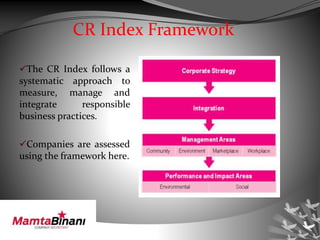
CR Index Framework
The CR Index follows a
systematic approach to
measure, manage and
integrate responsible
business practices.
Companies are assessed
using the framework here.
India in CSR initiatives
CSR is not new to India. Companies like TATA and BIRLA have
been imbibing the case for social good in their operations for
decades long before CSR become a popular cause.
ITC's e-Choupal is one such very successful case study. It is a
powerful illustration of a unique business model that delivers
large societal value by co-creating markets with rural
communities. The initiative has won the Stockholm Challenge
award apart from several others.
However, inspite of having such life size successful examples,
CSR in India is in a very nascent stage.
To facilitate greater corporate participation in CSR areas, BSE
(Bombay Stock Exchange) has recently signed a MoU with
Indian Institute of Corporate Affairs (IICA) to collaborate and
develop a CSR index and increase awareness about CSR.
Corporate Social Responsibility

Corporate Social Responsibility

  • 1.
    Room No.6, 4thFloor, Commerce House 2A, Ganesh Chandra Avenue, Kolkata 700013 Connect me @ : (033) 3028 8955-57; (033) 3002 5630-33; 98310 99551 mamtab@mamtabinani.com Visit me @ : www.mamtabinani.com Companies Act, 2013 Corporate Social Responsibility By CS Mamta Binani Chairperson (Year 2010), EIRC of ICSI At the ‘You’ Institute for professionals SECTION 135 (incorporating notification dated 27.02.2014) Under Chapter IX
  • 2.
    Room No.6, 4thFloor, Commerce House 2A, Ganesh Chandra Avenue, Kolkata 700013 Connect me @ : (033) 3028 8955-57; (033) 3002 5630-33; 98310 99551 mamtab@mamtabinani.com Visit me @ : www.mamtabinani.com MCA vide notification dated 27th February 2014, has notified Section 135, Schedule VII of the Companies Act, 2013 (provisions relating to CSR) and the Companies (Corporate Social Responsibility Policy) Rules, 2014. The same is effective from 1st April, 2014.
  • 3.
    What does CSRmean? Corporate Social Responsibility (CSR) As per Rule 2(1)(c) of the Companies (Corporate Social Responsibility Policy) Rules, 2014: CSR means and includes but is not limited to: (i) Projects or programs relating to activities specified in Schedule VII to the Act; or (ii) Projects or programs relating to activities undertaken by the board of directors of a Company (Board) in pursuance of recommendations of the CSR Committee of the Board as per declared CSR policy of the company subject to the condition that such policy will cover subjects enumerated in Schedule VII of the Act. (My comments: This is in the nature of an exhaustive definition but still the language denotes it as an inclusive one)
  • 4.
    Corporate Social Responsibility(CSR) – a brief outline (Section 135) Section 135 of the Act mandates CSR It encompasses mainly 5 important elements: • CSR Applicability • CSR Committee • CSR Policy & Activities • CSR Expenditure • CSR Reporting 135(1): Every company with either of the following 3:  Net worth of Rs.500 crores or more during any financial year Turnover of Rs.1000 crores or more during any financial year Net profit of Rs.5 crores or more during any financial year shall constitute a CSR Committee of the Board
  • 5.
    Rule 3 ofCSR Rules-Applicability Rule 3: Who has to be comply with section 135 and its rules? 1. Every company including: a. its holding company; or b. its subsidiary company 2. A foreign company (as defined under sec 2(42)) having its: a. branch office or b. project office in India and which fulfills the criteria specified in section 135(1) of the Act shall have to comply with sec 135 and the relevant Rules
  • 6.
    What is CSRCommittee Definitions: • Rule 2(1)(d) defines CSR Committee as: It means the Corporate Social Responsibility Committee of the Board referred to in section 135 of the Act.
  • 7.
    CSR Committee-Composition Composition (asgiven in section 135(1): At least 3 Directors out of which at least 1 Independent Director. However, an unlisted Public Company or a Private Company not required to compulsorily appoint an Independent Director shall have its Committee without an Independent Director (Rule 5(1)(i)). A Private Company having only two Directors on Board shall constitute the Committee with two such Directors (Rule 5(1)(ii)). For a Foreign Company-atleast 2 persons. 1 out of these 2, shall be the person mentioned in section 380(1)(d) of the Act. The other one shall be as nominated by the foreign company
  • 8.
    Disclosure of compositionof CSR committee-Sec 135(2) Sec 135(2): The Board’s Report (u/s 134(3)) shall disclose the composition of the CSR Committee
  • 9.
    Section 135(3) -CSR Policy and Expenditure The CSR Committee shall (section 135(3))– formulate the CSR Policy and recommend the same to the Board recommend the amount of expenditure to be incurred on the activities monitor the implementation of the CSR policy by the Company from time to time. • Rule 2(1)(e) defines CSR Policy as: It relates to the activities to be undertaken by the company as specified in Schedule VII and the expenditure thereon, excluding activities undertaken in pursuance of normal course of business of a company
  • 10.
    Section 135(4) –Duty of the Board The Board of every such company shall – Take into account the recommendations made by the CSR Committee and Approve the CSR policy for the Company Disclose contents of such policy in the Board’s Report and Also place it on company’s website, if any The Board of the company shall have to ensure that the activities as are included in the CSR Policy of the company are undertaken by the company.
  • 11.
    CSR Policy –Rule 6 Rule 6(1) • The CSR Policy shall lay out the list of CSR projects/ programs • It will specify the modalities of execution • The implementation schedules • Monitoring process Rule 6(2) The CSR Policy shall have to specify that the surplus arising out of the CSR projects or programs or activities shall not form part of the business profits of a company.
  • 12.
    Display of CSRactivities on its website Rule 9 The Board of Directors of the company shall, after taking into account the recommendations of CSR Committee, approve the CSR Policy for the company & disclose contents of such policy in its report and the same shall be displayed on the company’s website, if any, as per the particulars specified in the Annexure
  • 13.
    CSR Expenditure Section 135(5) The Board of every company covered under CSR shall ensure for every financial year that: At least 2% of average net profits of the company made during 3 immediately preceding financial years is spent on CSR. This spending to be made in pursuance of its laid CSR Policy.
  • 14.
    What is ‘NetProfit’ Rule 2(1)(f) of the Rules: ‘Net Profit’ means the net profit of a company as per its financial statement prepared in accordance with the applicable provisions of the Act, but shall not include the following, namely: a. any profit arising from any overseas branch(es) of the company, whether operated as a separate company or otherwise; and b. any dividend received from other companies in India, which are covered under and complying with provisions of sec 135
  • 15.
    What is ‘NetProfit’ Net Profit definition continued: • Provided that net profit in respect of a FY for which the relevant financial statements were prepared in accordance with the provisions of the Companies Act, 1956 shall not be required to be re-calculated in accordance with the provisions of the Act. • In case of a foreign company here, net profit means the net profit of such company as per profit and loss account prepared in terms of clause (a) of sec 381(1) read with sec 198 of the Act.
  • 16.
    CSR Expenditure Section 135(5) - Provisos 1st Proviso: Companies shall give preference to local areas and areas around it where it operates, for spending the amount earmarked for CSR activities. 2nd Proviso: If the Company fails to spend such amount, the Board shall have to specify the reasons for not spending the said amount. This reporting will have to be made under clause (o) of section 134(3). Section 135 (5) – Explanation For the purposes of section 135, ‘average net profit’ shall be calculated as per section 198.
  • 17.
    CSR Expenditure Rule 7 CSRexpenditure shall include all expenditure including contribution to: a. corpus; or b. on projects; or c. programs relating to CSR activities approved by the Board on the recommendation of its CSR Committee But does not include any expenditure on an item not in conformity or not in line with activities which fall within the purview of Schedule VII of the Act.
  • 18.
    CSR Reporting Rule 8(1) TheBoard’s Report of a company covered under these rules pertaining to a financial year commencing on or after the 1st day of April, 2014 shall include an annual report on CSR containing particulars specified in Annexure. Rule 8(2) In case of foreign company, the balance sheet filed under sub-clause (b) of sec 381(1) shall contain an Annexure regarding report on CSR.
  • 19.
    CSR Activities Schedule VIIlays down the activities to be undertaken by Companies in their CSR policies. The Central Government, vide notification dated 27.02.14, has amended the existing Schedule VII with an intent of making it more exhaustive. Activities relating to – i. eradicating extreme hunger, poverty and malnutrition, promoting preventive health care and sanitation and making available safe drinking water; [scope widened, clubbing clauses i and iv of earlier Schedule]
  • 20.
    CSR Activities contd. ii.promoting education, including special education and employment enhancing vocational skills, especially among children, women, elderly, and the differently abled and livelihood enhancement projects; [scope widened; clauses ii and vii clubbed from earlier Schedule] iii. promoting gender equality, empowering women, setting up homes and hostels for women and orphans; setting up old age homes, day care centre and such other facilities for senior citizens and measure for reducing inequalities faced by socially and economically backward groups; [no effective change, well defined from earlier Schedule] iv. ensuring environmental sustainability, ecological balance, protection of flora and fauna, animal welfare, agro forestry, conservation of natural resource and maintaining quality of soil, air and water; [Clause vi from earlier Schedule, further detailed]
  • 21.
    CSR Activities contd. v.protection of national heritage, art and culture including restoration of buildings and sites of historical importance and work of art; setting up public libraries; promotion and development of traditional arts and handicrafts; [new insertion] vi. measures for the benefit of armed forces veterans, war widows and their dependents; [new insertion] vii. training to promote rural sports, nationally recognised sports, paralympic sports and Olympic sports; [new insertion] viii.contribution to the Prime Minister’s National Relief Fund or any other fund set up by the Central Government for socio-economic development and relief and welfare of the Scheduled Castes, Scheduled Tribes, other backward classes, minorities and women; [corresponds with Clause ix of earlier Schedule. However, ‘contributions to funds set up by State Governments’ has been excluded in the revised Schedule]
  • 22.
    CSR Activities contd. ix.contributions or funds provided to technology incubators located within academic institutions which are approved by the Central Government; [new insertion] x. rural development projects. [new insertion] Deviations from earlier Schedule VII: Activities relating to –  Social business projects; and  Combating human immunodeficiency virus, acquired immune deficiency syndrome, malaria and other diseases; have been excluded in the revised Schedule. Although, clause (i) of revised Schedule includes ‘promotion of preventive health care’.
  • 23.
    CSR via section8 companies Rule 4(2) The BOD may decide to undertake its CSR activities approved by the CSR Committee: • through a registered trust; or • a registered society; or • a sec 8 company established by the company or its holding company or its subsidiary company or associate company
  • 24.
    Some pre-conditions-Proviso toRule 4(2) • If the trust, society or company is not established by the company or its holding/subsidiary/associate company, it shall have an established track record of three years in undertaking similar programs or projects. • In all cases, the company has to specify: a. project or programs to be undertaken through these entities b. the modalities of utilisation of funds on such projects and the programs c. the monitoring mechanism d. the reporting mechanism
  • 25.
    Collaboration with othercompanies Rule 4(3) A company may also collaborate with other companies for undertaking CSR activities in such a manner that the CSR Committees of respective companies are in a position to report separately on such activities in accordance with the CSR Rules. Rule 4(4) The CSR activities undertaken in India only shall amount to CSR expenditure. Rule 4(5) The activities that only benefit the employees of the company & their families shall not be considered as CSR for the purpose of section 135.
  • 26.
    Contribution to politicalparty-not CSR Rule 4(7) Contribution of any amount directly or indirectly to any political party under section 182, shall not be considered as CSR activity. Rule 4(6) Companies may build CSR capacities of their own personnel as well as those of their implementing agencies through Institutions with established track records of atleast 3 FY’s but such expenditure shall not exceed 5% of total CSR expenditure of the company in 1 FY.
  • 27.
    Format of Reporting– Annexure Provide a brief outline of the company’s CSR policy Provide overview of projects or programs proposed to be undertaken Provide a reference to the web-link to the CSR policy and projects or programs The composition of the CSR Committee Average Net Profit of the company for last 3 financial years Prescribed CSR expenditure (2% of the amount mentioned above)
  • 28.
    Format of Reporting– Annexure (contd) Details of CSR spent during the financial year: a) total amount to be spent for the FY b) amount unspent, if any c) manner in which amount spent during the financial year as per the format given in the annexure. It is quite exhaustive. There are 8 columns. They are: i. Serial number ii. CSR project or activity identified iii. Sector in which the project is covered iv. Projects or programs: a) Local area or other b) Specify the state & district where undertaken from
  • 29.
    Format of Reporting– Annexure (contd) Contd… v. Amount outlay (budget) project or programs wise vi. Amount spent on the projects or programs: Sub- heads: a) Direct expenditure on projects or programs b) Overhead vii. Cumulative expenditure up to the reporting period viii. Amount spent: Direct or through implementing agency
  • 30.
    Format of Reporting– Annexure (contd) Point 6 of the annexure The report also has to mention that in case the company has failed to spend the 2% of the average NP of the last 3 FY’s or any part thereof, the company will have to provide the reasons for not spending the amount in its BOARD’s REPORT Point 7 of the annexure A responsibility statement of the CSR Committee that the: a) implementation and b) monitoring of CSR policy Is in compliance with the CSR objectives and policy of the Co.
  • 31.
    Format of Reporting– Annexure (contd) Signature on this annexure This report will have to be signed by the following persons: a. CEO or MD or Director b. Chairman – CSR Committee c. Person specified under clause (d) of section 380(1) of the Act – (this is relating to foreign companies only) (This brings us to an end of the annexure)
  • 32.
    CSR Practices worldwide Thefact that the older organizations with well known CSR practices were founded in the 1980s and early 90’s and even earlier is an evidence that the concept of ‘Corporate Social Responsibility’ is there for a long long time. Its world-over acceptance leaves no doubt that CSR is no longer looked as a nice-to-have piece of corporate business strategy!
  • 33.
    Strategic CSR It isabout the business contribution to sustainable development — how business can take into account the economic, social and environmental impact their operations will have on the society. Strategic CSR could be conceived in this way... “CSR can be much more than a cost, a constraint, or a charitable deed—it can be a source of opportunity, innovation, and competitive advantage.” [The Centre for Business and Government at Harvard University]
  • 34.
    Corporate Responsibility Index– measuring Strategic CSR The Corporate Responsibility Index (CR Index), is a robust benchmarking tool that enables Companies to systematically measure, manage and integrate responsible business practices. Developed in consultation with leading global business leaders, the first CR Index survey (The Corporate Responsibility Index) was launched in 2002 in UK. Unilever, Heineken, Marks & Spencer, Lloyds Banking Group are few of the Companies which have been participating in the Index since its inception.
  • 35.
    CR Index Framework TheCR Index follows a systematic approach to measure, manage and integrate responsible business practices. Companies are assessed using the framework here.
  • 36.
    India in CSRinitiatives CSR is not new to India. Companies like TATA and BIRLA have been imbibing the case for social good in their operations for decades long before CSR become a popular cause. ITC's e-Choupal is one such very successful case study. It is a powerful illustration of a unique business model that delivers large societal value by co-creating markets with rural communities. The initiative has won the Stockholm Challenge award apart from several others. However, inspite of having such life size successful examples, CSR in India is in a very nascent stage. To facilitate greater corporate participation in CSR areas, BSE (Bombay Stock Exchange) has recently signed a MoU with Indian Institute of Corporate Affairs (IICA) to collaborate and develop a CSR index and increase awareness about CSR.