Kamal Ega
 The word ‘company’ was derived from the
Latin words
Com=with or together : Panis =bread
 A company can be defined as an "artificial
person", invisible, intangible, created under
law, with a discrete legal entity, perpetual
succession and a common seal.
 Corporate Personality
 Common Seal
 Limited Liability
 Perpetual Succession
 Separate Property
 Transferability of Shares
 Capacity to Sue and Be Sued
 The Indian company law begun with the
companies act 1850, modeled on British
companies act 1844
 The Indian Companies act of 1913 was based on
the British Companies act of 1908
 The Indian Companies act, 1956; April 1, 1956
 The Indian Companies act, 2013
 Passed in Lok sabha: December 18, 2012
 Passed in Rajya Sabha: August 08, 2013
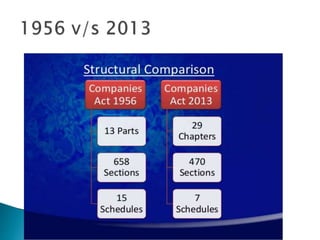
 Total number of sections: 470
 Total number of chapters: 29
 Total number of schedules: 7
 Effective from September 12, 2013
 J.J Irani Committee
 To promote the development of the economy
 To encourage transparency and accountability
 To promote high standards of corporate governance
 To recognize new concepts and procedures to support
business while protecting interests of all the
stakeholders
 To set up institutional structure in the form of various
authorities, bodies and panels (NCLT and NCLAT)
 To enforce stricter action against fraud and gross non -
compliance with company law provisions

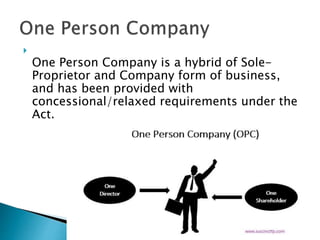
One Person Company is a hybrid of Sole-
Proprietor and Company form of business,
and has been provided with
concessional/relaxed requirements under the
Act.
 Associate company in relation to another
company, means a company in which that
other company has a significant influence,
but which is not a subsidiary and joint
venture company
 Significant influence means control of at least
twenty per cent of the total share capital, of
business decisions under an agreement
 Where a company is formed and registered under the
new law for the future project of to hold an asset of
intellectual property.
 Inactive company is one which has not been carrying
on any business operation, or has not made any
significant accounting transaction, or has not file
financial statements and annual returns during for the
last two financial years.
 Every listed company shall appoint at least
one woman director
 Every other public company having paid up
share capital of Rs. 100 crores or more or
turnover of Rs. 300 crore or more as on the
last date of latest audited financial
statements, shall also appoint at least one
woman director.
 Mandatory rotation of auditors for the listed and
other specifies class of companies
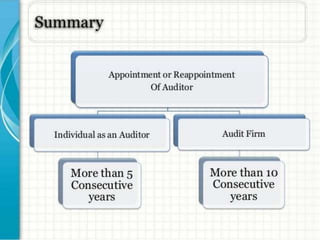
 Individual auditor to be rotate after a term of five
consecutive years
 Audit firm to be rotate after two terms of five
consecutive years
 Vigil (Whistle Blower) mechanism provides a
channel to the employees and directors to
report to the management concerns about
unethical behavior, actual or suspected fraud
or violation of the Codes of conduct or policy.
 Secretarial Audit is a process to check
compliances made by the Company under
Corporate Law & other laws, rules,
regulations, procedures etc. It is a
mechanism to monitor compliance with the
requirements of stated laws and processes.
 The Act simplified procedure for merger and
amalgamation of certain class of companies
such as holding and subsidiary and small
companies
 Minimum Capital Requirement: Private or public
company can be incorporated without the need for minimum
paid up share capital
 Common Seal: The requirement of having common seal
made optional
 Declaration of Dividend: no company shall declare
dividend unless carried over past losses and depreciation in
previous year or years are set off against profit of the
company for the current year
Presentation on companies act 2013... (2)

Presentation on companies act 2013... (2)

  • 1.
  • 2.
     The word‘company’ was derived from the Latin words Com=with or together : Panis =bread  A company can be defined as an "artificial person", invisible, intangible, created under law, with a discrete legal entity, perpetual succession and a common seal.
  • 3.
     Corporate Personality Common Seal  Limited Liability  Perpetual Succession  Separate Property  Transferability of Shares  Capacity to Sue and Be Sued
  • 4.
     The Indiancompany law begun with the companies act 1850, modeled on British companies act 1844  The Indian Companies act of 1913 was based on the British Companies act of 1908  The Indian Companies act, 1956; April 1, 1956  The Indian Companies act, 2013
  • 5.
     Passed inLok sabha: December 18, 2012  Passed in Rajya Sabha: August 08, 2013  Total number of sections: 470  Total number of chapters: 29  Total number of schedules: 7  Effective from September 12, 2013  J.J Irani Committee
  • 7.
     To promotethe development of the economy  To encourage transparency and accountability  To promote high standards of corporate governance  To recognize new concepts and procedures to support business while protecting interests of all the stakeholders  To set up institutional structure in the form of various authorities, bodies and panels (NCLT and NCLAT)  To enforce stricter action against fraud and gross non - compliance with company law provisions
  • 9.
     One Person Companyis a hybrid of Sole- Proprietor and Company form of business, and has been provided with concessional/relaxed requirements under the Act.
  • 10.
     Associate companyin relation to another company, means a company in which that other company has a significant influence, but which is not a subsidiary and joint venture company  Significant influence means control of at least twenty per cent of the total share capital, of business decisions under an agreement
  • 11.
     Where acompany is formed and registered under the new law for the future project of to hold an asset of intellectual property.  Inactive company is one which has not been carrying on any business operation, or has not made any significant accounting transaction, or has not file financial statements and annual returns during for the last two financial years.
  • 12.
     Every listedcompany shall appoint at least one woman director  Every other public company having paid up share capital of Rs. 100 crores or more or turnover of Rs. 300 crore or more as on the last date of latest audited financial statements, shall also appoint at least one woman director.
  • 13.
     Mandatory rotationof auditors for the listed and other specifies class of companies  Individual auditor to be rotate after a term of five consecutive years  Audit firm to be rotate after two terms of five consecutive years
  • 15.
     Vigil (WhistleBlower) mechanism provides a channel to the employees and directors to report to the management concerns about unethical behavior, actual or suspected fraud or violation of the Codes of conduct or policy.
  • 16.
     Secretarial Auditis a process to check compliances made by the Company under Corporate Law & other laws, rules, regulations, procedures etc. It is a mechanism to monitor compliance with the requirements of stated laws and processes.
  • 17.
     The Actsimplified procedure for merger and amalgamation of certain class of companies such as holding and subsidiary and small companies
  • 20.
     Minimum CapitalRequirement: Private or public company can be incorporated without the need for minimum paid up share capital  Common Seal: The requirement of having common seal made optional  Declaration of Dividend: no company shall declare dividend unless carried over past losses and depreciation in previous year or years are set off against profit of the company for the current year