Directors
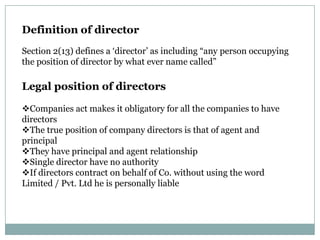
Definition of director
Section 2(13) defines a „director‟ as including “any person occupying
the position of director by what ever name called”

Legal position of directors

Companies act makes it obligatory for all the companies to have
directors
The true position of company directors is that of agent and
principal
They have principal and agent relationship
Single director have no authority
If directors contract on behalf of Co. without using the word
Limited / Pvt. Ltd he is personally liable
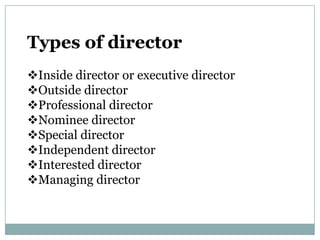
Types of director
Inside director or executive director
Outside director
Professional director
Nominee director
Special director
Independent director
Interested director
Managing director
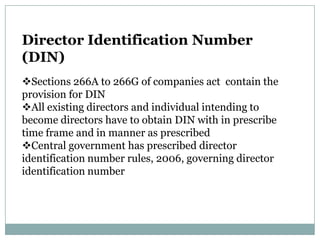
Director Identification Number
(DIN)
Sections 266A to 266G of companies act contain the
provision for DIN
All existing directors and individual intending to
become directors have to obtain DIN with in prescribe
time frame and in manner as prescribed
Central government has prescribed director
identification number rules, 2006, governing director
identification number
Who can be a director?
Anyone can become a director, with a few
exceptions:
Anyone disqualified by the company‟s own
Articles of Association (the rules relating to
the running of the company).
An undischarged bankrupt.
Someone disqualified by a court order.
The company‟s auditor
Qualification shares


No statutory requirement
Aoa may provide for qualification shares
Q/S should obtain within 2 months from
appointment
Maximum nominal value of shares not to exceed
Rs.5000
Q/S should be bought and not to take in gift
Number of directors (sec.252)

Public ltd company shall have at least 3 directors
Every Pvt company shall have at least 2 directors
Maximum No of directors 12 (Sec 259)
>12 central Govt permission is required

Restriction of Number of directorships (sec.278)
Maximum number of directorships 15
 following are excluded from count (Sec 278)
•Directorship in unlimited company
•Directorship in non profit organization
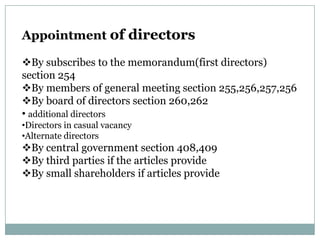
Appointment of directors

By subscribes to the memorandum(first directors)
section 254
By members of general meeting section 255,256,257,256
By board of directors section 260,262
• additional directors
•Directors in casual vacancy
•Alternate directors
By central government section 408,409
By third parties if the articles provide
By small shareholders if articles provide
Removal of directors
Removal by shareholders
Shareholders may remove by passing ordinary resolution
The following directors cant be removed buy SH
o directors appointed by central govt
oLife time directors appointed prior to 1-4-1956
oAppointed by Financial institutions and banks

Removable by central government
• if director is guilty of fraud misfeasance negligence
• the business is conducted with unsound business
principles
Removal by company law board

• it has power to terminate, modify any agreements
between company and director
•Director cant sue for any compensation for loss of
termination of office
•Such person cant serve any company for a period of 5
years
Resignation of directors

Companies act does not make express provision for
resignation of a director
A director may resign in a manner according to the
company articles.
If the articles contain no provision regarding the
resignation by a director ,he may resign his office at
any time by giving reasonable notice to the company.
Remuneration of directors

Directors are not entitled to remuneration unless
agreement is made
But company can pay them salary or commission or
specified percentage of net profit
Reference to section 198,309to 311 and 387 suggests
director can get managerial remuneration

Sitting fees
It is not a part of remuneration (Section 198 (2))
 it is paid to company which having paid up capital and
reserves of Rs.10 cores or above.
Up to Rs.20000 per meeting
Duties of Directors

Statutory duties
Duties to attend board meeting
Duty not to contract without board‟s consent
Duty in connection with general meetings
To disclose receipts transfer of property
To disclose receipt of compensation from transfer of shares
Duties to file declaration of solvency

Fiduciary and general duties
Duty of good faith
Not to make secret profits
Not to be negligent
Siddhartha
chitla

Directors

  • 1.
  • 2.
    Definition of director Section2(13) defines a „director‟ as including “any person occupying the position of director by what ever name called” Legal position of directors Companies act makes it obligatory for all the companies to have directors The true position of company directors is that of agent and principal They have principal and agent relationship Single director have no authority If directors contract on behalf of Co. without using the word Limited / Pvt. Ltd he is personally liable
  • 3.
    Types of director Insidedirector or executive director Outside director Professional director Nominee director Special director Independent director Interested director Managing director
  • 4.
    Director Identification Number (DIN) Sections266A to 266G of companies act contain the provision for DIN All existing directors and individual intending to become directors have to obtain DIN with in prescribe time frame and in manner as prescribed Central government has prescribed director identification number rules, 2006, governing director identification number
  • 5.
    Who can bea director? Anyone can become a director, with a few exceptions: Anyone disqualified by the company‟s own Articles of Association (the rules relating to the running of the company). An undischarged bankrupt. Someone disqualified by a court order. The company‟s auditor
  • 6.
    Qualification shares No statutoryrequirement Aoa may provide for qualification shares Q/S should obtain within 2 months from appointment Maximum nominal value of shares not to exceed Rs.5000 Q/S should be bought and not to take in gift
  • 7.
    Number of directors(sec.252) Public ltd company shall have at least 3 directors Every Pvt company shall have at least 2 directors Maximum No of directors 12 (Sec 259) >12 central Govt permission is required Restriction of Number of directorships (sec.278) Maximum number of directorships 15  following are excluded from count (Sec 278) •Directorship in unlimited company •Directorship in non profit organization
  • 8.
    Appointment of directors Bysubscribes to the memorandum(first directors) section 254 By members of general meeting section 255,256,257,256 By board of directors section 260,262 • additional directors •Directors in casual vacancy •Alternate directors By central government section 408,409 By third parties if the articles provide By small shareholders if articles provide
  • 9.
    Removal of directors Removalby shareholders Shareholders may remove by passing ordinary resolution The following directors cant be removed buy SH o directors appointed by central govt oLife time directors appointed prior to 1-4-1956 oAppointed by Financial institutions and banks Removable by central government • if director is guilty of fraud misfeasance negligence • the business is conducted with unsound business principles
  • 10.
    Removal by companylaw board • it has power to terminate, modify any agreements between company and director •Director cant sue for any compensation for loss of termination of office •Such person cant serve any company for a period of 5 years
  • 11.
    Resignation of directors Companiesact does not make express provision for resignation of a director A director may resign in a manner according to the company articles. If the articles contain no provision regarding the resignation by a director ,he may resign his office at any time by giving reasonable notice to the company.
  • 12.
    Remuneration of directors Directorsare not entitled to remuneration unless agreement is made But company can pay them salary or commission or specified percentage of net profit Reference to section 198,309to 311 and 387 suggests director can get managerial remuneration Sitting fees It is not a part of remuneration (Section 198 (2))  it is paid to company which having paid up capital and reserves of Rs.10 cores or above. Up to Rs.20000 per meeting
  • 13.
    Duties of Directors Statutoryduties Duties to attend board meeting Duty not to contract without board‟s consent Duty in connection with general meetings To disclose receipts transfer of property To disclose receipt of compensation from transfer of shares Duties to file declaration of solvency Fiduciary and general duties Duty of good faith Not to make secret profits Not to be negligent
  • 15.