MODIFIABLE
High bloodcholesterol level
Cigrette smoking
Tobacco use
Hypertension
Diabetes mellitus
Lack of estrogen in women
Physical activity
Obesity
7.
NON MODIFIABLE
Familyhistory of CAD
Age(35-55 years)
Gender (male)
Race (non white populations)
8.
PATHOPHYSIOLOGY
Due to etiologicalfactors
injury to the endothelial cell that lining the artery
inflammation and immune reactions
accumulation of lipids in the intima of arterial wall
T lymphocytes and monocytes that becomes as monocytes that becomes as macrophages
infiltrate
9.
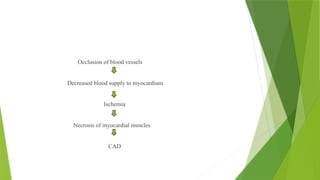
Occlusion of bloodvessels
Decreased blood supply to myocardium
Ischemia
Necrosis of myocardial muscles
CAD
ECG
Provide arecord of the heart’s electrical activity.
This simple test records any abnormal findings in the heart’s electrical impulses. Electrodes are
placed on the arms and chest to monitor electrical activity
15.
ECHOCARDIOGRAMS
It ismay be ordered if doctor suspects a problem with the heart muscles or one of the valves that
channel blood through heart
16.
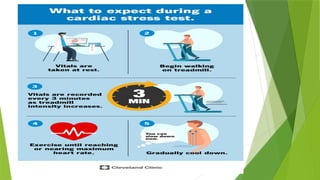
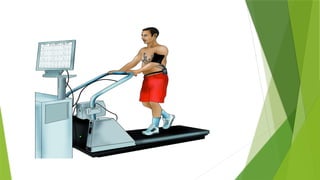
SRESS TEST
Theyare used to show how the heart reacts to physical exertion. Exercise stress tests are usually
performed on a treadmill or exercise bicycle.
19.
NUCLEAR CARDIAC IMAGING
It involves the use of small amounts of short lived radioactive material, which is injected into the
bloodstream.
A special camera (live motion x ray) detects the radioactivity of these materials, and the images
displayed show how heart pumps blood.
This is useful in identifying any areas of abnormal motion or for assessing the blood supply to the
heart muscle.
20.
ANGIOGRAPHY
It ismost accurate means to examine the coronary arteries.
It requires a surgical procedure called catheterization. During the procedure, catheters(small thin
plastic tubes) are placed in the artery of the leg or arm, and directed using an x ray machine to the
opening of each of the coronary arteries.
22.
MANAGEMENT
NURSING MANAGEMENT
Takehistory of the patients.
Gather information about patient symptoms.
Assess patients risk factors for CAD.
Assess patients family’s understanding level for the disease.
Identify patients and familys level of anxiety and use of appropriate coping mechanisms.
23.
MEDICAL MANAGEMENT
Antihypertensivemedicine
Methydopa : this medicine is used alone or with other medicications to treat high BP. Lowering high BP helps
prevent strokes , heart attacks, and kidney problems. Methyldopa works by relaxing blood vessels so blood can
flow more easily.
Sodium nitroprusside : it is used for lowering BP.
Amlodipoine: it is used with or withput other medications to treat high BP. Lowering high BP helps prevent
strokes , heart attacks, and kidney problems.
24.
SURGICAL MANAGEMENT
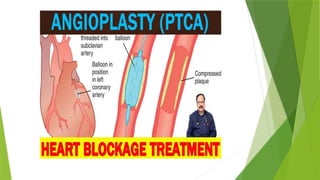
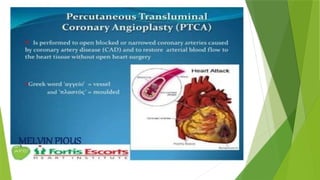
PTCA(Percutaneous Transluminal Coronary Angioplasty)
It is a minimally invasive procedure that widens blocked coronary arteries to improve blood flow to the heart.
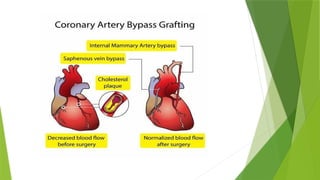
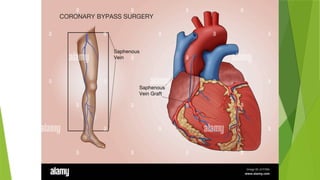
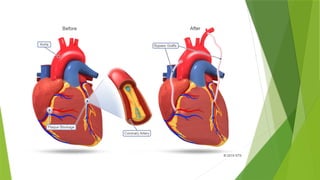
CABG(Coronary Artery Bypass Graft Surgery)
It is also known as bypass surgery, is a procedure that improves blood flow to the heart. It is used to treat CAD,
which occurs when the coronary arteries narrow or become blocked due to a buildup of fatty material.
it is a complicated surgery that can take several hours to complete.
PREVENTION
Quit smoking
Control condition such as high BP , high cholesterol and diabetes.
Stay physically active
Eat a low fat, low salt diet that is rich in fruits, vegetables and whole grains.
Maintain a healthy weight
Reduce and manage stress.