MKSS SITA BAI NARGUNDKAR COLLEGE OF
NURSIGN FOR WOMEN
CORONARY ARTERY DISEASE
PRESENTED BY-
Namaralata singh
CORONARY ARTERY DISEASE
CORONARY ARTERY DISEASE IS ALSO
KNOWN AS
• Ischemic heart disease
• Atherosclerotic heart disease
• Coronary heart disease
• Simple heart disease
• Coronary artery disease (CAD) is the most prevalent
type of cardiovascular disease in adults. For this reason,
it is important for nurses to become familiar with
various manifestations of coronary artery conditions
and methods for assessing, preventing, and treating
these disorders.
• Coronary artery disease is the leading cause of death in
the united state . CAD is characterized by the
accumulation of plague within the layers of the
coronary arteries .
The plague progressively enlarge , thicken and
calcify , causing a critical narrowing (70%) of
the coronary artery lumen , resulting in a
decrease in coronary blood flow and an
inadequate supply of oxygen to the heart
muscles.
DEFINITION -
ANATOMY AND PHYSIOLOGY OF
HEART
Incidence
• The 2016 heart disease and stroke statistic
update of the American heart association has
recently reported that 15.5 million person >20
years of age in the USA have coronary heart
disease , whilst the reported prevalence increased
with age for both women and men and it has been
estimated that approximately every 42 seconds.
TYPES OF CORONARY ARTERY
DISEASE –
• Obstructive coronary artery disease
• Nonobstructive coronary artery disease
• Coronary microvascular disease.
• Obstructive CAD was defined as
any stenosis 50% or greater in the left
main coronary artery, 70% or greater in any
other coronary artery, or both. Obstructive
CAD was defined as any stenosis 50% or
greater in the left main coronary artery, 70% or
greater in any other coronary artery, or both.
• Nonobstructive coronary artery disease (CAD) is
atherosclerotic plaque that would not be expected to
obstruct blood flow or result in anginal symptoms (such
as chest pain).
• Coronary microvascular disease (sometimes called
small artery disease or small vessel disease) is
heart disease that affects the walls and inner lining of
tiny coronary artery blood vessels that branch off from
the larger coronary arteries.
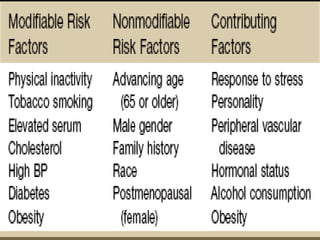
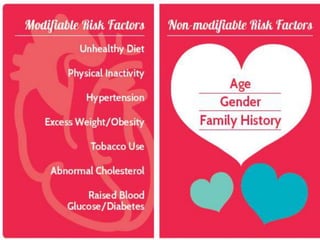
CORONARYARTERY DISEASE CAUSES
• Modifiable risk factor
• Non modifiable risk factor
• Contributing risk factor
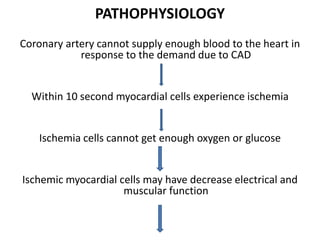
PATHOPHYSIOLOGY
Coronary artery cannot supply enough blood to the heart in
response to the demand due to CAD
Within 10 second myocardial cells experience ischemia
Ischemia cells cannot get enough oxygen or glucose
Ischemic myocardial cells may have decrease electrical and
muscular function
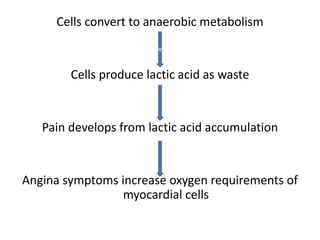
Cells convert to anaerobic metabolism
Cells produce lactic acid as waste
Pain develops from lactic acid accumulation
Angina symptoms increase oxygen requirements of
myocardial cells
v
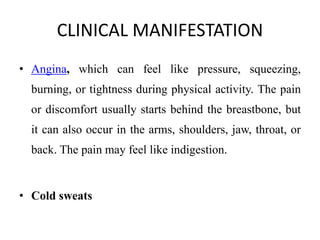
CLINICAL MANIFESTATION
• Angina, which can feel like pressure, squeezing,
burning, or tightness during physical activity. The pain
or discomfort usually starts behind the breastbone, but
it can also occur in the arms, shoulders, jaw, throat, or
back. The pain may feel like indigestion.
• Cold sweats
• Dizziness
• Light-headedness or dizziness
• Nausea or a feeling of indigestion
• Neck pain
• Shortness of breath, especially with activity
• Sleep disturbances
• Weakness
• Extreme fatigue.
• Heart palpitations.
• Swelling in your legs and feet, known as
edema.
• Swelling in your abdomen.
• Cough or congestion, caused by fluid in your
lungs.
• Chronic ischemic heart disease can cause signs
and symptoms such as the following:
• Angina
• Anxiety or nervousness
• Fatigue
• Neck pain 5
DIAGNOSTIC EVALUATION
• History collection
• Physical examination
• Electrocardiography
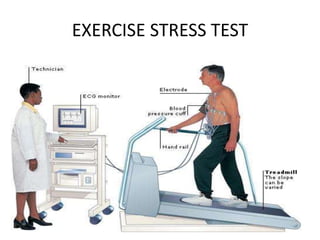
• Exercise – Stress test
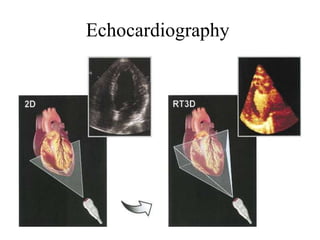
• Echocardiography (including stress echocardiography)
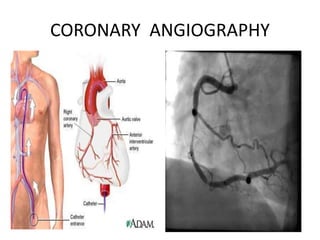
• Coronary angiography
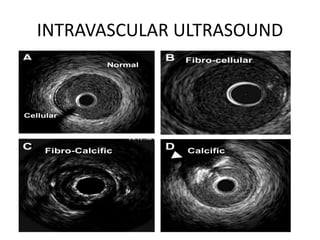
• Intravascular ultrasound
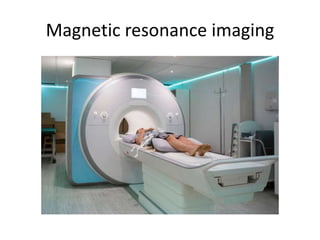
• Magnetic resonance imaging (MRI)
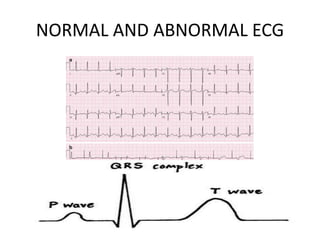
NORMAL AND ABNORMAL ECG
EXERCISE STRESS TEST
Echocardiography
CORONARY ANGIOGRAPHY
INTRAVASCULAR ULTRASOUND
Magnetic resonance imaging
COMPLICATION
• Heart failure
• CAD can lead to heart failure. Heart failure
means that the heart isn’t able to pump enough
blood to the rest of body. This can cause fluid
buildup in the lungs, difficulty breathing, and
swelling of the legs, liver, or abdomen.
Abnormal heartbeat(arrhythmia )
Atrial fibrillation causes heart to be
ineffective at pumping blood out of the atria to
the lower chambers of the heart (ventricles)
and into other parts of body for circulation.
Over time, atrial fibrillation can lead to an
ischemic stroke or heart failure.
• Chest pain
• Reduced blood flow in coronary arteries ,
heart doesn’t receive enough blood . This can
cause a type of pain called angina. Angina may
cause chest numbness sensations in chest with
tightness heaviness pressure aching burning
squeezing fullness.
• Heart attack
• If the fatty plaque in coronaries arteries ruptures, a
blood clot can form. This can greatly block and
decrease needed blood flow of heart, causing a heart
attack. The severe lack of oxygenated blood flow can
damage heart. Part of heart tissue may die.
• Sudden death
• If coronary artery blood flow to the heart is severely
blocked and not restored, it can cause sudden death.
MEDICAL MANAGEMENT
• Beta blockers
• Calcium channel blockers
• Ranolazine
• Nitroglycerin
• Angiotensin-converting enzyme (ACE) inhibitors and
angiotensin II receptor blockers (ARBs).
• Cholesterol-modifying medications.
• Aspirin.
SURGICAL MANAGEMENT
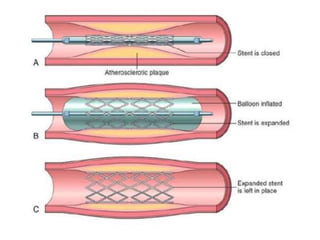
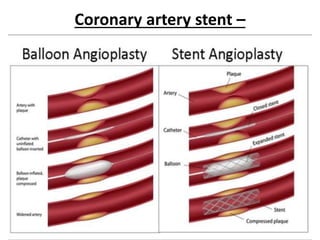
• Percutaneous transluminal coronary angioplasty (PTCA
) -,
A balloon tipped catheter is used to open blocked coronary
vessels and resolve ischemia . it is used in patient with
angina and as an intervention for ACS . the purpose of
PTCA is to improve blood flow with in a coronary artery
by compressing and cracking the atheroma .
Coronary artery stent –
PREVENTION
• Controlling cholesterol level
• Dietary measure
• Physical activity
• Medication
• Promoting cessation of tobacco use
• Managing hypertension
• Controlling diabetic mellitus
• Stressful lifestyle
HEALTH EDUCATION
• Diet
• Habits
• Exercise
• Medication
• Bowels
• Sexual advice
RESEARCH ARTICLE
• Personal Observation of Thiamine Therapy of Coronary Heart Diseases-A
Preliminary Approach of Physiologic Therapy with Case Reports
• Benjamin Yuehtung Lee1,3*, Julia H Bai2, Li Zhengya3 and Wang Yanrong3
• Abstract
• This report was based on clinical findings from a population with terrible
hard labor and inadequate food 6 decades ago. Thiamin was found
essential in body energy regeneration, curable for many heart disorders
including hypertension, and dramatically eliminating lipoma. Only thiamin
300 mg plus 1 ampule of VB Co. were injected twice daily in a case of
severe coronary heart disease and cured. Another 32 patients were then
followed. As the result of continuous 180-300 injections within 3-5
months, there was an initial non-responding stage about 3-8 weeks
without improvement of cardiac signs possibly due to reducing the
lipid/cholesterol blockers or blood cell debris.
• Once an interval was found, lipid/cholesterol removal by thiamin
would be progressed gradually or dramatically for totally 3-5
months until cardiac signs completely free for 2-4 years. No other
routine medicine was required. The associated abnormalities were
eradicated including kidney cyst, panic state, Parkinson syndrome,
nail-layering, peripheral neuritis. It could be “refueled” with only
vitamin B1 after a certain period if restenosis returned. Although all
regular medicine was canceled, associate hypertension,
hyperlipidemia, and diabetes were normalized or obviously reduced
and diabetes greatly improved in measured cases. Thus, update by
multiple institutes is required
• Conclusion
High dose of parenteral thiamin was curable for
CHD. It should be also an essential and prompt
rescue procedure in myocardial infarction,
cerebral apoplexy and electric shock of the heart.
Thiamin was highly effective in reducing body fat
and eliminating lipoma and should be an
essential agent in preventing and eliminating
obesity.
• CONCLUSION-
• Coronary artery disease is highest among
Indians . it is highly preventable and controllable
with diet and exercise with present treatment of
angioplasty and coronary bypass surgery person
can live long and fruitful life.
• The discomfort associated with angina pectoris
abates when supply become adequate for
demand , typically angina last for second to
minutes up to 15 mint . it is cured with the help
of proper early management .
THANK YOU

Coronary artery disease slide

  • 1.
    MKSS SITA BAINARGUNDKAR COLLEGE OF NURSIGN FOR WOMEN CORONARY ARTERY DISEASE PRESENTED BY- Namaralata singh
  • 2.
  • 3.
    CORONARY ARTERY DISEASEIS ALSO KNOWN AS • Ischemic heart disease • Atherosclerotic heart disease • Coronary heart disease • Simple heart disease
  • 5.
    • Coronary arterydisease (CAD) is the most prevalent type of cardiovascular disease in adults. For this reason, it is important for nurses to become familiar with various manifestations of coronary artery conditions and methods for assessing, preventing, and treating these disorders. • Coronary artery disease is the leading cause of death in the united state . CAD is characterized by the accumulation of plague within the layers of the coronary arteries .
  • 6.
    The plague progressivelyenlarge , thicken and calcify , causing a critical narrowing (70%) of the coronary artery lumen , resulting in a decrease in coronary blood flow and an inadequate supply of oxygen to the heart muscles.
  • 7.
  • 8.
  • 9.
    Incidence • The 2016heart disease and stroke statistic update of the American heart association has recently reported that 15.5 million person >20 years of age in the USA have coronary heart disease , whilst the reported prevalence increased with age for both women and men and it has been estimated that approximately every 42 seconds.
  • 10.
    TYPES OF CORONARYARTERY DISEASE – • Obstructive coronary artery disease • Nonobstructive coronary artery disease • Coronary microvascular disease.
  • 11.
    • Obstructive CADwas defined as any stenosis 50% or greater in the left main coronary artery, 70% or greater in any other coronary artery, or both. Obstructive CAD was defined as any stenosis 50% or greater in the left main coronary artery, 70% or greater in any other coronary artery, or both.
  • 12.
    • Nonobstructive coronaryartery disease (CAD) is atherosclerotic plaque that would not be expected to obstruct blood flow or result in anginal symptoms (such as chest pain). • Coronary microvascular disease (sometimes called small artery disease or small vessel disease) is heart disease that affects the walls and inner lining of tiny coronary artery blood vessels that branch off from the larger coronary arteries.
  • 13.
    CORONARYARTERY DISEASE CAUSES •Modifiable risk factor • Non modifiable risk factor • Contributing risk factor
  • 16.
    PATHOPHYSIOLOGY Coronary artery cannotsupply enough blood to the heart in response to the demand due to CAD Within 10 second myocardial cells experience ischemia Ischemia cells cannot get enough oxygen or glucose Ischemic myocardial cells may have decrease electrical and muscular function
  • 17.
    Cells convert toanaerobic metabolism Cells produce lactic acid as waste Pain develops from lactic acid accumulation Angina symptoms increase oxygen requirements of myocardial cells v
  • 18.
    CLINICAL MANIFESTATION • Angina,which can feel like pressure, squeezing, burning, or tightness during physical activity. The pain or discomfort usually starts behind the breastbone, but it can also occur in the arms, shoulders, jaw, throat, or back. The pain may feel like indigestion. • Cold sweats
  • 19.
    • Dizziness • Light-headednessor dizziness • Nausea or a feeling of indigestion • Neck pain • Shortness of breath, especially with activity • Sleep disturbances • Weakness • Extreme fatigue. • Heart palpitations.
  • 20.
    • Swelling inyour legs and feet, known as edema. • Swelling in your abdomen. • Cough or congestion, caused by fluid in your lungs. • Chronic ischemic heart disease can cause signs and symptoms such as the following: • Angina • Anxiety or nervousness • Fatigue • Neck pain 5
  • 21.
    DIAGNOSTIC EVALUATION • Historycollection • Physical examination • Electrocardiography • Exercise – Stress test • Echocardiography (including stress echocardiography) • Coronary angiography • Intravascular ultrasound • Magnetic resonance imaging (MRI)
  • 22.
  • 23.
  • 24.
  • 25.
  • 26.
  • 27.
  • 28.
    COMPLICATION • Heart failure •CAD can lead to heart failure. Heart failure means that the heart isn’t able to pump enough blood to the rest of body. This can cause fluid buildup in the lungs, difficulty breathing, and swelling of the legs, liver, or abdomen.
  • 29.
    Abnormal heartbeat(arrhythmia ) Atrialfibrillation causes heart to be ineffective at pumping blood out of the atria to the lower chambers of the heart (ventricles) and into other parts of body for circulation. Over time, atrial fibrillation can lead to an ischemic stroke or heart failure.
  • 30.
    • Chest pain •Reduced blood flow in coronary arteries , heart doesn’t receive enough blood . This can cause a type of pain called angina. Angina may cause chest numbness sensations in chest with tightness heaviness pressure aching burning squeezing fullness.
  • 31.
    • Heart attack •If the fatty plaque in coronaries arteries ruptures, a blood clot can form. This can greatly block and decrease needed blood flow of heart, causing a heart attack. The severe lack of oxygenated blood flow can damage heart. Part of heart tissue may die. • Sudden death • If coronary artery blood flow to the heart is severely blocked and not restored, it can cause sudden death.
  • 32.
    MEDICAL MANAGEMENT • Betablockers • Calcium channel blockers • Ranolazine • Nitroglycerin • Angiotensin-converting enzyme (ACE) inhibitors and angiotensin II receptor blockers (ARBs). • Cholesterol-modifying medications. • Aspirin.
  • 33.
    SURGICAL MANAGEMENT • Percutaneoustransluminal coronary angioplasty (PTCA ) -, A balloon tipped catheter is used to open blocked coronary vessels and resolve ischemia . it is used in patient with angina and as an intervention for ACS . the purpose of PTCA is to improve blood flow with in a coronary artery by compressing and cracking the atheroma .
  • 35.
  • 37.
    PREVENTION • Controlling cholesterollevel • Dietary measure • Physical activity • Medication • Promoting cessation of tobacco use • Managing hypertension • Controlling diabetic mellitus • Stressful lifestyle
  • 38.
    HEALTH EDUCATION • Diet •Habits • Exercise • Medication • Bowels • Sexual advice
  • 40.
    RESEARCH ARTICLE • PersonalObservation of Thiamine Therapy of Coronary Heart Diseases-A Preliminary Approach of Physiologic Therapy with Case Reports • Benjamin Yuehtung Lee1,3*, Julia H Bai2, Li Zhengya3 and Wang Yanrong3 • Abstract • This report was based on clinical findings from a population with terrible hard labor and inadequate food 6 decades ago. Thiamin was found essential in body energy regeneration, curable for many heart disorders including hypertension, and dramatically eliminating lipoma. Only thiamin 300 mg plus 1 ampule of VB Co. were injected twice daily in a case of severe coronary heart disease and cured. Another 32 patients were then followed. As the result of continuous 180-300 injections within 3-5 months, there was an initial non-responding stage about 3-8 weeks without improvement of cardiac signs possibly due to reducing the lipid/cholesterol blockers or blood cell debris.
  • 41.
    • Once aninterval was found, lipid/cholesterol removal by thiamin would be progressed gradually or dramatically for totally 3-5 months until cardiac signs completely free for 2-4 years. No other routine medicine was required. The associated abnormalities were eradicated including kidney cyst, panic state, Parkinson syndrome, nail-layering, peripheral neuritis. It could be “refueled” with only vitamin B1 after a certain period if restenosis returned. Although all regular medicine was canceled, associate hypertension, hyperlipidemia, and diabetes were normalized or obviously reduced and diabetes greatly improved in measured cases. Thus, update by multiple institutes is required
  • 42.
    • Conclusion High doseof parenteral thiamin was curable for CHD. It should be also an essential and prompt rescue procedure in myocardial infarction, cerebral apoplexy and electric shock of the heart. Thiamin was highly effective in reducing body fat and eliminating lipoma and should be an essential agent in preventing and eliminating obesity.
  • 43.
    • CONCLUSION- • Coronaryartery disease is highest among Indians . it is highly preventable and controllable with diet and exercise with present treatment of angioplasty and coronary bypass surgery person can live long and fruitful life. • The discomfort associated with angina pectoris abates when supply become adequate for demand , typically angina last for second to minutes up to 15 mint . it is cured with the help of proper early management .
  • 44.