Pulmonary artery banding
Raja Lahiri
• Pulmonary artery banding (PAB) is a technique of
palliative surgical therapy used by congenital heart
surgeons as a staged approach for operative correction
of congenital heart defects.
• This technique was widely used in the past as an initial
surgical intervention for infants born with cardiac
defects characterized by left-to-right shunting and
pulmonary overcirculation.
• Within the last two decades, early definitive
intracardiac repair has largely replaced palliation with
PAB.
• Although the use of PAB has recently significantly
decreased, it continues to maintain a therapeutic role
in certain subsets of patients with congenital heart
disease.
• The primary objective of performing PAB is to
reduce excessive pulmonary blood flow and
protect the pulmonary vasculature from
hypertrophy and irreversible (fixed)
pulmonary hypertension.
• More recently, PAB has played a role in the
preparation and "training" of the left ventricle
(LV) in patients with D- TGA who are evaluated
for a delayed arterial switch procedure.
History of the Procedure
• The first description of pulmonary artery banding (PAB) in
the literature was a report by Muller and Dammann at the
University of California, Los Angeles (UCLA) in 1951.
• In this report, Muller and Dammann described palliation by
the "creation of pulmonary stenosis" in a 5-month-old
infant who had a large ventricular septal defect (VSD) and
pulmonary overcirculation.
• Following this report, multiple studies were published
demonstrating the effectiveness of this technique in infants
with congestive heart failure (CHF) caused by large VSDs,
complex lesions (eg, atrioventricular canal [AVC] defects),
and tricuspid atresia.
• Although the use of PAB has declined, it remains an
essential technique for comprehensive surgical treatment
in patients with congenital heart disease. PAB is a palliative
but not a curative surgical procedure.
Pathophysiology
• Congenital heart defects with left-to-right shunting and unrestricted
pulmonary blood flow (PBF) due to a drop in pulmonary vascular
resistance result in pulmonary overcirculation.
• In the acute setting, this leads to pulmonary edema and congestive
heart failure (CHF) in the neonate.
• Within the first year of life, this unrestricted flow and pressure can
lead to medial hypertrophy of the pulmonary arterioles and fixed
pulmonary hypertension.
• Pulmonary artery banding (PAB) creates a narrowing, or stenosing,
of the main pulmonary artery (MPA) that decreases blood flow to
the branch pulmonary arteries and reduces PBF and pulmonary
artery pressure.
• In patients with cardiac defects that produce left-to-right shunting,
this restriction of PBF reduces the shunt volume and consequently
improves both systemic pressure and cardiac output.
• A reduction of PBF also decreases the total blood volume returning
to the LV (or the systemic ventricle) and often improves ventricular
function.
Indications
• Patients who are selected for pulmonary artery banding
(PAB) and staged cardiac repair are determined based on
the experience and training of the pediatric cardiologists
and congenital heart surgeons at any given institution.
• Most of these patients fall into 2 broad categories:
(1) those with pulmonary overcirculation and left-to-right
shunting who require reduction of pulmonary blood flow
(PBF) as a staged approach to more definitive repair and
(2) those with transposition of the great arteries (TGA) who
require training of the left ventricle (LV) as a staged
approach to the arterial switch procedure.
Patients in the first category who are considered for PAB
include those with the following diagnoses:
• Multiple muscular ventricular septal defects (VSDs)
with a "Swiss cheese" septum that is technically
difficult to repair in the neonate or requires a
ventriculotomy
• Single or multiple VSDs with coarctation of the aorta or
interrupted aortic arch, or contraindications to primary
repair, including very low birth weight, major
extracardiac conditions, major chromosomal
abnormalities, pneumonia, recovering from shock,
sepsis, multisystem organ failure, and intracranial
hemorrhage
• Single ventricle defects
• Unbalanced atrioventricular canal (AVC) defects
in which the LV is hypoplastic but the potential
exists for a 2-ventricle repair with further growth
and development
• Cardiac defects that require a homograft conduit
(eg, D-TGA with subpulmonic stenosis ) for
complete repair: Use of PAB may allow time for
growth of the patient before the complete repair.
Interim growth of the patient permits placement
of a larger conduit at the time of repair and
potentially increases the longevity of the conduit
and length of freedom from reoperation.
Patients in the second category who are considered
for
PAB include those with the following diagnoses:
• D-TGA that requires preparation of LV for an
arterial switch procedure following initial late
presentation or diagnosis in patients older than 1
month or older than about 6-8 weeks of age with
signs of LV deconditioning.
• D-TGA that requires preparation of LV for an
arterial switch procedure following a previous
Mustard or Senning procedure with the
development of right ventricular failure or L-TGA
that requires preparation of the LV prior to the
double switch procedure.
• Patients with single ventricle physiology and
unrestricted PBF are suitable for an early PAB to
prevent development of congestive heart failure
(CHF) and pulmonary hypertension. This group of
patients may include those who have tricuspid
atresia with unrestrictive VSD, unbalanced AVC
defect, and double inlet LV.
• Patients who have single ventricle physiology and
pulmonary overcirculation should undergo PAB in
the first 1-2 months of life to avoid irreversible
pulmonary hypertension that may complicate or
preclude a subsequent Fontan procedure
• Currently, most patients with D-TGA undergo an
arterial switch procedure within the first few
weeks of life. However, some newborns with D-
TGA and an intact ventricular septum may not
undergo an early arterial switch procedure
because of active infections, coexistent
noncardiac diseases, or a delay in diagnosis.
• Because of the risks of neonatal repair, neonates
with D-TGA and multiple VSDs may benefit from
bilateral PAB prior to definitive repair later in
infancy. This technique may be less prone to
damaging the neoaortic valve and root dilation
than banding of the main pulmonary artery.
• PAB is also used in patients with D-TGA who
develop right ventricular dysfunction after a
Mustard or Senning atrial switch procedure.
• The PAB is required for a longer period than
preparation of the ventricle in infants (<12
months).
• Although the overall early survival rate
approaches 90%, approximately one half of
these patients require heart transplantation
because of the progression of coexisting left
ventricular failure.
• Recent application of PAB has been reported in
patients with diagnosis of L-transposition or
physiologically corrected transposition of the
great arteries.
• This group of patients may present with failing
systemic RV.
• Using the same principle, the PAB is used to
retrain the LV in preparation for a double switch
operation, a combination of an atrial and arterial
switch.
• This operation places the LV as the systemic
ventricle and the mitral valve as the systemic AV
valve. This achieves anatomic repair of the
malformation.
• Another application of PAB is in patients with
elevated, but reactive, pulmonary
hypertension from long-standing left-to-right
shunting.
• An immediate surgical repair may carry
significant morbidity and even mortality. With
the use of a PAB and pulmonary vasodilator,
some of these patients may drop their
pulmonary vascular resistance and
subsequently respond more favorably to
surgery.
Anatomical considerations
• In most patients with cardiac defects requiring pulmonary
artery banding (PAB), the length of main pulmonary artery
(MPA) is sufficient to allow placement of the band in the
mid portion of the artery without impingement on either
the pulmonary valve, coronary arteries proximally or the
branch pulmonary arteries distally.
• The inferior wall of the right pulmonary artery (PA) arises
slightly more proximal on the MPA than the left PA. The
right PA also arises from the MPA at more of an acute
angle. Both of these factors increase risk of right PA
impingement by a distally placed band.
• In patients with pulmonary overcirculation, the MPA may
be quite large compared to the aorta. Additionally, the MPA
vessel wall may be thinned out by this dilatation, and the
adventitia may be quite attenuated. These changes
increase risk of tearing the wall of the MPA at the time of
PAB.
Contraindications
• Patients who have single ventricle defects in which the
aorta arises from an outflow chamber (eg, double inlet
left ventricle [LV], tricuspid atresia with transposition of
the great arteries [TGA]) have the potential for
development of significant subaortic obstruction.
• Pulmonary artery banding (PAB) is contraindicated in
the presence of such obstruction and in patients who
are at high risk for such obstruction.
• The ventricular hypertrophy that develops in response
to PAB may cause rapid progression of subaortic
obstruction leading to a combination of both ventricles
having outflow tract obstruction and progressive
hypertrophy.
• Bilateral PAB may be useful prior to complete repair in the
setting of low birth weight, prematurity, major associated
extracardiac conditions, severe preoperative acidosis not
correctable by medical therapy, pneumonia, as a staged
repair in truncus arteriosus with interrupted aortic arch,
and/or a combination of these factors.
• Bilateral PAB can be achieved using a 3.0-mm or 3.5-mm
Goretex graft placed around the right and left pulmonary
arteries
• Bilateral PAB has also been used as a bridge to decision
regarding biventricular versus univentricular palliation. For
example, bilateral PAB with maintenance of ductal patency
may allow time for adequate growth of a left ventricle so
that the infant can undergo biventricular repair. The
pulmonary artery bands can also be dilated in case of
desaturation, to allow further time before definitive
surgery.
Workup
• Routine laboratory tests are obtained preoperatively in
the assessment of a patient being considered for
pulmonary artery banding (PAB).
• Baseline arterial oxygen saturations should be obtained
by either pulse oximetry or ABG analysis.
• A baseline creatinine level should be obtained and
compared postoperatively during diuresis and
management of congestive heart failure (CHF).
• The hemoglobin and hematocrit should be optimized
to improve oxygen carrying capacity and oxygen
saturations following PAB.
• Imaging and/or diagnostic procedures include
echocardiography, magnetic resonance imaging with 3-
dimensional reconstruction, and/or cardiac
catherization.
• Preoperative treatment of patients with pulmonary
overcirculation and congestive heart failure (CHF)
should focus on minimizing left-to-right shunting,
improving cardiac function with inotropic support,
systemic afterload reduction, and aggressive diuresis.
• Mechanical ventilator support may be necessary to
maintain adequate ventilation and oxygenation in the
setting of pulmonary edema.
• Maintaining higher carbon dioxide levels and lower
fraction of inspired oxygen (FIO2) during ventilation
may assist in reducing pulmonary blood flow (PBF) and
pulmonary edema.
• If a patent ductus arteriosus (PDA) is present, attempts
should be made to reduce or close it with medical
therapy (eg, indomethacin) to reduce this source of
PBF.
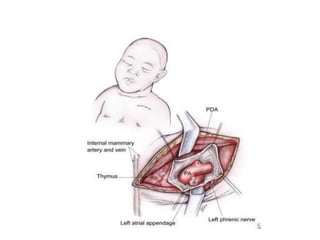
Surgical approach
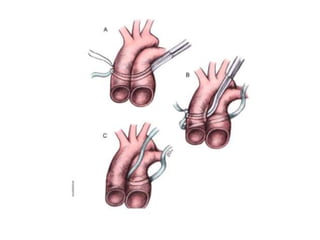
• Three standard surgical approaches to pulmonary
artery banding (PAB) have been established, depending
on the need to perform additional procedures at the
time of band placement.
– As an isolated procedure, PAB can be performed through
an anterior left thoracotomy in the second or third
interspace
– If performed in conjunction with a coarctation or
interrupted aortic arch repair, a left lateral thoracotomy is
used and the chest is entered through the third or fourth
intercostal space
– In patients with single ventricle physiology, TGA or in
whom an adjunct procedure is required, a median
sternotomy incision is preferred
• Patients may benefit from placement of a band that
can be easily and quickly tightened or loosened, both
at the initial procedure and during subsequent
interventions. The ability to readjust the band is
particularly useful in patients who exhibit dynamic
changes in cardiac output, pulmonary vascular
resistance, and systemic vascular resistance.
• Adjustable bands are also helpful in patients with AV
valve regurgitation, particularly complex AV canal
defects. The acute increase in afterload that
accompanies PAB may exacerbate AV valve
insufficiency. Staged tightening of the band is usually
well tolerated and allows improvement in insufficiency
by decreasing ventricular volume overload.
• The MPA and aorta are exposed, and the band is
prepared for placement.
• The estimated band circumference is marked on the
umbilical tape with fine sutures according to the
Trusler formula.
• PAB circumference in patients with noncyanotic
nonmixing lesions (eg, ventricular septal defect [VSD])
is 20 mm + 1 mm/kg body weight. For patients with
mixing lesions (eg, D-transposition of the great arteries
[TGA] with VSD), the formula is 24 mm + 1 mm/kg
body weight. In patients with single ventricles in whom
the Fontan procedure is planned, an intermediate
circumference of 22 mm + 1 mm/kg body weight is
preferred.
• The site of band placement is carefully selected in the
mid portion of the MPA trunk, and distortion or injury
to the pulmonary valve or impingement on the branch
pulmonary arteries is avoided.
• Dissection is performed in the adventitia between the
aorta and the MPA, and it is limited to prevent
proximal or distal band migration.
• The MPA is handled very carefully because it often is
dilated, thin-walled, and susceptible to injury.
Regardless of the operative approach, injuries to the
posterior wall of the MPA can be difficult to repair
because of limited exposure.
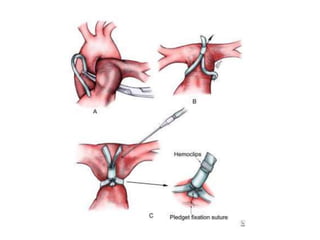
• Generally, the band is first passed through the
transverse sinus to encircle both the aorta and MPA.
The aortic end of the band is then carefully delivered
between the aorta and the MPA through the previous
site of dissection
• The marked sites on the band are identified and
aligned with each other on the anterior wall of
the MPA.
• The band is snared with a short segment of #8 or
#10 polyethylene tubing and fixed with medium
hemoclips.
• A felt or pericardial pledget is placed beneath the
band between the end of the snare and the MPA
wall to prevent injury to the artery from the
snare.
• The pledget and band material are then anchored
to the MPA adventitia to prevent band migration
• Physiologic assessment to determine the
appropriate tightness of the PAB includes
intraoperative measurements of the proximal and
distal PA pressures, systemic blood pressure, and
arterial oxygen saturation by pulse oximetry (or
by direct measurement of arterial blood gas
sampling).
• The goal of PAB is to produce a distal PA pressure
that is 30-50% of systemic pressure.
• Lower saturations of 75-80% may be acceptable
in patients with single ventricle physiology. The
target pressure for univentricular hearts is
15mmHg (Fontan pressure)
• Failure to achieve these levels in patients with
mixed circulations suggests inadequacy of the
interatrial communication.
• In such patients, addition of an atrial
septectomy or septostomy may be indicated.
• In addition to changes in PA pressure and
systemic oxygen saturation, one ideally should
note a concomitant rise in systemic arterial
pressure of 10-15 mm Hg.
• An adequate atrial communication should be
confirmed preoperatively in patients with single
ventricle physiology, including transposition with VSD
complexes. A balloon atrial septostomy is useful in
these situations.
• Kotani and colleagues measured intraoperative aortic
blood flow using a Transonic flow probe and found that
aortic blood flow increased by approximately 40% after
successful PAB. Their data suggested that higher pre-
PAB Qp/Qs (pulmonary [Qs]-systemic [Qp] blood flow
ratio) predicted a higher percentage increase in aortic
flow.
• Three patients with less than a 20% increase in aortic
blood flow died, required re-PAB, or developed
ventricular dysfunction.
• Aortic blood flow in these patients did not
increase even when the band was tightened
further than indicated with the Trusler formula.
• Kotani et al concluded that the limited response
to PAB in terms of increases in aortic blood flow is
a nonmutable marker of decreased cardiac
reserve, as opposed to a parameter that can be
targeted by further adjustment of pulmonary
artery band circumference (ie, making it tighter).
• The current practice is a combination of anatomic
(Trusler formula) and physiologic (indexed aortic
blood flow pre-PAB and post-PAB, in addition to
change in systemic blood pressure and SaO2)
assessment during surgery.
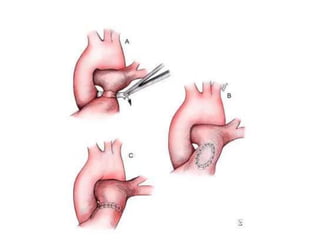
• PAB takedown is usually performed at the time of the
intracardiac repair through a median sternotomy.
Generally, the repair is completed first and the PAB
removal is performed at the end of the procedure.
• The band is dissected free from surrounding scar tissue
and removed. The area of banding usually remains
stenotic and requires repair.
• This repair can be achieved by resection and end-to-
end anastomosis of the proximal and distal MPA or by
vertical incision of the MPA followed by pericardial (or
polytetrafluoroethylene [PTFE]) patch repair of the
arteriotomy
• The repair must ensure relief of any branch PA stenosis
that may exist as a consequence of the PAB.
Post-op care
• Patients undergoing PAB are initially treated in the
intensive care unit (ICU).
• They often benefit from a course of intravenous inotropic
support and require careful attention to fluid balance and
volume status.
• Following PAB, improved hemodynamics and greater left
ventricular output often allow for diuresis and gradual
resolution of CHF.
• The assessment of a patient following PAB should ideally be
made under conditions of balanced volume status and in
the absence of atelectasis or ongoing pulmonary pathology.
• Although measured parameters from the operating room
are helpful guidelines, the overall clinical status of the
patient is the most important assessment.
• This includes changes in systemic blood pressure,
heart rate, oxygen saturation, and overall cardiac
function. Hypotension, bradycardia, and ischemic
electrocardiographic changes all indicate an
excessive band gradient and imminent cardiac
failure or arrest.
• The advantage of an adjustable PAB is that it
allows for rapid loosening of the band with a
hemoclip remover in the ICU, if necessary.
Catheter debanding is also an invaluable
technique in selected cases.
• Evaluation of the PAB is made by color flow Doppler
echocardiography at the bedside; it usually provides an
accurate assessment of band tightness, band gradient,
band position, and overall cardiac function.
• Any impingement or stenosis of the branch pulmonary
arteries can also be observed with this study. Rarely,
cardiac catheterization and direct measurement of PA
pressure and band gradient is necessary.
• More recently, cinemagnetic resonance imaging d 3-
dimensional reconstruction have been useful as
noninvasive methods of evaluation.
Follow-up
• Most patients undergoing pulmonary artery
banding (PAB) for pulmonary overcirculation are
monitored for 3-6 months and then undergo
more definitive repair of their cardiac defect.
• The degree of right ventricular hypertrophy that
develops in response to any given PAB gradient
varies greatly among infants. Those infants who
develop rapid and severe right ventricular
hypertrophy in response to PAB should be
considered for earlier definitive repair to prevent
long-term right ventricular dysfunction.
• Patients with D-TGA who undergo PAB for
training of the LV must be monitored with
serial echocardiography to assess "readiness"
of the LV before the arterial switch operation.
• After either technique, patients are monitored
with serial echocardiography that allows
quantitative measurements of left ventricular
mass index, as well as qualitative assessment
of ventricular septal geometry.
• Left-to-right septal bowing is an indication that
the LV can generate near-systemic pressure. Left
ventricular preparation is usually accomplished
within 7-10 days, after which patients may
undergo an arterial switch procedure, takedown
of shunt, and PAB.
• The early mortality rate is 4-5%, only slightly
greater than that for a primary arterial switch
procedure. In infants, this may be several weeks,
but older children may require longer periods of
banding to achieve adequate results.
Complications
• Although pulmonary artery banding (PAB) is a seemingly
simple operation, it has been associated with numerous
complications. One of the most common complications of
PAB is impingement and stenosis of one or both of the
branch pulmonary arteries. The right pulmonary artery (PA)
is involved in most cases of branch stenosis for anatomic
reasons already mentioned.
• The diagnosis of branch PA impingement is often suggested
by a chest radiograph that shows asymmetric vascular
markings between the right and left lungs.
• Definitive diagnosis can usually be made by
echocardiography, and fractional pulmonary blood flow
(PBF) to each lung can be determined with radionuclide
lung perfusion scanning.
• If significant branch stenosis is uncorrected, it
can lead to underdevelopment of the involved
lung with alveolar hypoplasia. Early recognition of
branch PA stenosis should allow a revision of the
PAB before the development of this late sequela.
• Limiting dissection of the tissue between the
aorta and the main pulmonary artery (MPA) and
fixing the band with sutures on the proximal MPA
adventitia both reduce risk of this complication.
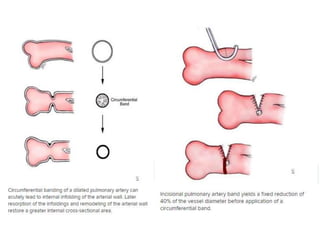
Use of the incisional PAB technique prevents
distal band migration and generally avoids this
complication.
• Conversely, if the band is placed too proximal on
the MPA, it may distort the pulmonary valve and
ultimately create dysplastic changes in the
pulmonary valve leaflets.
• This is particularly devastating when PAB is
performed as preparation for an arterial switch
procedure because the pulmonary valve becomes
the neo-aortic valve after the arterial switch
procedure. In addition, proximal placement of the
band can lead to obstruction of coronary blood
flow by direct impingement, usually of the
circumflex coronary artery
• Anomalous origin of a coronary artery may
increase risk of this complication.
• These complications can generally be avoided
by placement of the band more than 15 mm
distal to the pulmonary valve cusps.
• Preoperative demonstration of coronary
anatomy is helpful, but intraoperative
vigilance during the banding procedure should
avoid these types of complications.
• In patients with erosion of the band into the
PA, scarring and fibrosis around the band site
usually prevents the life-threatening bleeding
from occurring. Hemolytic anemia and local
thrombus formation have been reported.
• Erosion seems to occur with increased
frequency when narrow banding material is
used, although it can occur with any material.
Pulmonary artery pseudoaneurysm is a rare
complication of PAB.
• PA pseudoaneurysm may be preceded by local
infection and, like band erosion, is heralded by
loss of the band murmur and gradient.
Imaging studies demonstrate an enlarged
mediastinal shadow on chest radiography and
a markedly enlarged PA on echocardiography
or MRI.
• The diagnosis of PA pseudoaneurysm
formation mandates urgent surgical
intervention.
• Repair is performed on cardiopulmonary bypass
with patch repair of the MPA. Glutaraldehyde-
treated autologous pericardium is preferred to
synthetic material because this condition is
sometimes associated with infection.
• An additional complication is an ineffectual PAB
either from a loose band at the original
procedure or later disruption of the band or
erosion of the PA.
• The results of an ineffectual band are excessive
PBF and early recurrence or continuation of
congestive heart failure (CHF). In addition,
pulmonary vascular disease with irreversible
pulmonary hypertension may potentially
develop.
• Loss of band murmur and recurrence of CHF after
PAB suggests loosening or erosion of the band.
• Early evaluation and close follow-up should allow
revision before the onset of irreversible changes.
Outcome and Prognosis
• Pulmonary artery banding (PAB) should result in
improved hemodynamics and overall clinical
improvement in the patient.
• The signs and symptoms of congestive heart failure
(CHF) should resolve or become medically manageable,
cardiomegaly should decrease, and pulmonary vascular
resistance should decrease.
• PAB affords protection to the pulmonary vasculature
against fixed irreversible pulmonary hypertension
secondary to pulmonary overcirculation and elevated
pulmonary artery (PA) pressures.
• The mortality rate of PAB is clearly associated
more with the complexity of cardiac defect
and overall condition of the patients than with
the procedure itself.
• Patients who are selected for PAB and a
staged repair are often chosen because they
are considered too high risk to undergo
definitive repair. Therefore, the mortality rates
from earlier series have been as high as 25%.
• A decreasing mortality rate with PAB can be
related to improved operative techniques,
better patient selection, and timing of
intervention.
• Additionally, improvements in anesthetic and
postoperative management have also resulted
in a decreased mortality rate. Mortality rates
for PAB are reported in some series to be as
low as 3-5%.
Future and Controversies
• Almost half a century since the introduction of pulmonary
artery banding (PAB) by Muller and Dammann, this
procedure still has a defined role in the treatment of infants
who are not candidates for immediate definitive repair.
• In particular, it may be useful in patients with a functional
single ventricle not amenable to early repair and in whom a
future Fontan procedure is planned.
• It may also benefit patients with excessive pulmonary
blood flow who are considered too ill to undergo complete
repair of their cardiac defect.
• Interestingly, the original technique of an incisional band as
described by Muller and Dammann has resurfaced as a
desirable technique in some patients.
• The adjustable band technique has proved
useful and safe for most patients. Interest has
been shown for the development of an
intraluminal technique for PAB using circular
patches of fenestrated material.
• This requires a cardiopulmonary bypass to
perform and is therefore limited in its
applicability to most patients. Ongoing
research to develop a percutaneously
adjustable, thoracoscopically implantable,
pulmonary artery band is underway.
• Additionally, research is being conducted in
animals to develop a hydraulic main
pulmonary artery (MPA) constrictor as an
adjustable PAB.
• These types of devices would benefit patients
who require multiple adjustments of a PAB for
left ventricle (LV) training.
• An implantable device for PAB with telemetric
control, FloWatch-R-PAB (Endoart SA,
Lausanne, Switzerland) has emerged from
animal studies and is currently in clinical trials.
• Early clinical results have shown the efficacy
and reliability of the device, but more data
and experience are needed to define the role
of this technology in PAB.
• A percutaneously adjustable PAB technique
has been developed for LV training. Other
groups have developed percutaneously
adjustable devices.
• A strategy of deferring biventricular repair by the
application of a pulmonary artery band may not
be applicable in developing and third world
conditions primarily due to lack of patient
compliance.
• A study by Brooks et al indicates that less than
50% are eventually repaired in a reasonable time
frame. Moreover, patient follow-up is unreliable.
• Thus, in such circumstances, consideration should
be given to early definitive repair, even in
perceived high-risk cases.
• More recently, PAB has been proposed as a
treatment modality for LV dilated
cardiomyopathy with preserved RV function as
an additional strategy to delay or even avoid
heart transplantation in infants and young
children with terminal heart failure.
• The rationale is similar to that for training of
the morphologic LV in corrected transposition
of the great arteries (TGA).
Conclusion
• For most patients undergoing PAB, the goal of the
procedure remains reduction of pulmonary blood flow
(PBF) and preservation of pulmonary vessels from
hypertrophy and hypertension.
• More recently, a new indication of preparing the LV for
arterial switch in older infants and children with D-TGA
appears to have expanded the role of this procedure.
• Although some surgeons would contend that PAB is
largely of historical interest, this technique clearly will
continue to maintain a place in the therapeutic
armamentarium of the congenital heart surgeon.
Pa banding new

Pa banding new

  • 1.
  • 2.
    • Pulmonary arterybanding (PAB) is a technique of palliative surgical therapy used by congenital heart surgeons as a staged approach for operative correction of congenital heart defects. • This technique was widely used in the past as an initial surgical intervention for infants born with cardiac defects characterized by left-to-right shunting and pulmonary overcirculation. • Within the last two decades, early definitive intracardiac repair has largely replaced palliation with PAB. • Although the use of PAB has recently significantly decreased, it continues to maintain a therapeutic role in certain subsets of patients with congenital heart disease.
  • 3.
    • The primaryobjective of performing PAB is to reduce excessive pulmonary blood flow and protect the pulmonary vasculature from hypertrophy and irreversible (fixed) pulmonary hypertension. • More recently, PAB has played a role in the preparation and "training" of the left ventricle (LV) in patients with D- TGA who are evaluated for a delayed arterial switch procedure.
  • 4.
    History of theProcedure • The first description of pulmonary artery banding (PAB) in the literature was a report by Muller and Dammann at the University of California, Los Angeles (UCLA) in 1951. • In this report, Muller and Dammann described palliation by the "creation of pulmonary stenosis" in a 5-month-old infant who had a large ventricular septal defect (VSD) and pulmonary overcirculation. • Following this report, multiple studies were published demonstrating the effectiveness of this technique in infants with congestive heart failure (CHF) caused by large VSDs, complex lesions (eg, atrioventricular canal [AVC] defects), and tricuspid atresia. • Although the use of PAB has declined, it remains an essential technique for comprehensive surgical treatment in patients with congenital heart disease. PAB is a palliative but not a curative surgical procedure.
  • 5.
    Pathophysiology • Congenital heartdefects with left-to-right shunting and unrestricted pulmonary blood flow (PBF) due to a drop in pulmonary vascular resistance result in pulmonary overcirculation. • In the acute setting, this leads to pulmonary edema and congestive heart failure (CHF) in the neonate. • Within the first year of life, this unrestricted flow and pressure can lead to medial hypertrophy of the pulmonary arterioles and fixed pulmonary hypertension. • Pulmonary artery banding (PAB) creates a narrowing, or stenosing, of the main pulmonary artery (MPA) that decreases blood flow to the branch pulmonary arteries and reduces PBF and pulmonary artery pressure. • In patients with cardiac defects that produce left-to-right shunting, this restriction of PBF reduces the shunt volume and consequently improves both systemic pressure and cardiac output. • A reduction of PBF also decreases the total blood volume returning to the LV (or the systemic ventricle) and often improves ventricular function.
  • 6.
    Indications • Patients whoare selected for pulmonary artery banding (PAB) and staged cardiac repair are determined based on the experience and training of the pediatric cardiologists and congenital heart surgeons at any given institution. • Most of these patients fall into 2 broad categories: (1) those with pulmonary overcirculation and left-to-right shunting who require reduction of pulmonary blood flow (PBF) as a staged approach to more definitive repair and (2) those with transposition of the great arteries (TGA) who require training of the left ventricle (LV) as a staged approach to the arterial switch procedure.
  • 7.
    Patients in thefirst category who are considered for PAB include those with the following diagnoses: • Multiple muscular ventricular septal defects (VSDs) with a "Swiss cheese" septum that is technically difficult to repair in the neonate or requires a ventriculotomy • Single or multiple VSDs with coarctation of the aorta or interrupted aortic arch, or contraindications to primary repair, including very low birth weight, major extracardiac conditions, major chromosomal abnormalities, pneumonia, recovering from shock, sepsis, multisystem organ failure, and intracranial hemorrhage
  • 8.
    • Single ventricledefects • Unbalanced atrioventricular canal (AVC) defects in which the LV is hypoplastic but the potential exists for a 2-ventricle repair with further growth and development • Cardiac defects that require a homograft conduit (eg, D-TGA with subpulmonic stenosis ) for complete repair: Use of PAB may allow time for growth of the patient before the complete repair. Interim growth of the patient permits placement of a larger conduit at the time of repair and potentially increases the longevity of the conduit and length of freedom from reoperation.
  • 9.
    Patients in thesecond category who are considered for PAB include those with the following diagnoses: • D-TGA that requires preparation of LV for an arterial switch procedure following initial late presentation or diagnosis in patients older than 1 month or older than about 6-8 weeks of age with signs of LV deconditioning. • D-TGA that requires preparation of LV for an arterial switch procedure following a previous Mustard or Senning procedure with the development of right ventricular failure or L-TGA that requires preparation of the LV prior to the double switch procedure.
  • 10.
    • Patients withsingle ventricle physiology and unrestricted PBF are suitable for an early PAB to prevent development of congestive heart failure (CHF) and pulmonary hypertension. This group of patients may include those who have tricuspid atresia with unrestrictive VSD, unbalanced AVC defect, and double inlet LV. • Patients who have single ventricle physiology and pulmonary overcirculation should undergo PAB in the first 1-2 months of life to avoid irreversible pulmonary hypertension that may complicate or preclude a subsequent Fontan procedure
  • 11.
    • Currently, mostpatients with D-TGA undergo an arterial switch procedure within the first few weeks of life. However, some newborns with D- TGA and an intact ventricular septum may not undergo an early arterial switch procedure because of active infections, coexistent noncardiac diseases, or a delay in diagnosis. • Because of the risks of neonatal repair, neonates with D-TGA and multiple VSDs may benefit from bilateral PAB prior to definitive repair later in infancy. This technique may be less prone to damaging the neoaortic valve and root dilation than banding of the main pulmonary artery.
  • 12.
    • PAB isalso used in patients with D-TGA who develop right ventricular dysfunction after a Mustard or Senning atrial switch procedure. • The PAB is required for a longer period than preparation of the ventricle in infants (<12 months). • Although the overall early survival rate approaches 90%, approximately one half of these patients require heart transplantation because of the progression of coexisting left ventricular failure.
  • 13.
    • Recent applicationof PAB has been reported in patients with diagnosis of L-transposition or physiologically corrected transposition of the great arteries. • This group of patients may present with failing systemic RV. • Using the same principle, the PAB is used to retrain the LV in preparation for a double switch operation, a combination of an atrial and arterial switch. • This operation places the LV as the systemic ventricle and the mitral valve as the systemic AV valve. This achieves anatomic repair of the malformation.
  • 14.
    • Another applicationof PAB is in patients with elevated, but reactive, pulmonary hypertension from long-standing left-to-right shunting. • An immediate surgical repair may carry significant morbidity and even mortality. With the use of a PAB and pulmonary vasodilator, some of these patients may drop their pulmonary vascular resistance and subsequently respond more favorably to surgery.
  • 15.
    Anatomical considerations • Inmost patients with cardiac defects requiring pulmonary artery banding (PAB), the length of main pulmonary artery (MPA) is sufficient to allow placement of the band in the mid portion of the artery without impingement on either the pulmonary valve, coronary arteries proximally or the branch pulmonary arteries distally. • The inferior wall of the right pulmonary artery (PA) arises slightly more proximal on the MPA than the left PA. The right PA also arises from the MPA at more of an acute angle. Both of these factors increase risk of right PA impingement by a distally placed band. • In patients with pulmonary overcirculation, the MPA may be quite large compared to the aorta. Additionally, the MPA vessel wall may be thinned out by this dilatation, and the adventitia may be quite attenuated. These changes increase risk of tearing the wall of the MPA at the time of PAB.
  • 16.
    Contraindications • Patients whohave single ventricle defects in which the aorta arises from an outflow chamber (eg, double inlet left ventricle [LV], tricuspid atresia with transposition of the great arteries [TGA]) have the potential for development of significant subaortic obstruction. • Pulmonary artery banding (PAB) is contraindicated in the presence of such obstruction and in patients who are at high risk for such obstruction. • The ventricular hypertrophy that develops in response to PAB may cause rapid progression of subaortic obstruction leading to a combination of both ventricles having outflow tract obstruction and progressive hypertrophy.
  • 17.
    • Bilateral PABmay be useful prior to complete repair in the setting of low birth weight, prematurity, major associated extracardiac conditions, severe preoperative acidosis not correctable by medical therapy, pneumonia, as a staged repair in truncus arteriosus with interrupted aortic arch, and/or a combination of these factors. • Bilateral PAB can be achieved using a 3.0-mm or 3.5-mm Goretex graft placed around the right and left pulmonary arteries • Bilateral PAB has also been used as a bridge to decision regarding biventricular versus univentricular palliation. For example, bilateral PAB with maintenance of ductal patency may allow time for adequate growth of a left ventricle so that the infant can undergo biventricular repair. The pulmonary artery bands can also be dilated in case of desaturation, to allow further time before definitive surgery.
  • 18.
    Workup • Routine laboratorytests are obtained preoperatively in the assessment of a patient being considered for pulmonary artery banding (PAB). • Baseline arterial oxygen saturations should be obtained by either pulse oximetry or ABG analysis. • A baseline creatinine level should be obtained and compared postoperatively during diuresis and management of congestive heart failure (CHF). • The hemoglobin and hematocrit should be optimized to improve oxygen carrying capacity and oxygen saturations following PAB. • Imaging and/or diagnostic procedures include echocardiography, magnetic resonance imaging with 3- dimensional reconstruction, and/or cardiac catherization.
  • 19.
    • Preoperative treatmentof patients with pulmonary overcirculation and congestive heart failure (CHF) should focus on minimizing left-to-right shunting, improving cardiac function with inotropic support, systemic afterload reduction, and aggressive diuresis. • Mechanical ventilator support may be necessary to maintain adequate ventilation and oxygenation in the setting of pulmonary edema. • Maintaining higher carbon dioxide levels and lower fraction of inspired oxygen (FIO2) during ventilation may assist in reducing pulmonary blood flow (PBF) and pulmonary edema. • If a patent ductus arteriosus (PDA) is present, attempts should be made to reduce or close it with medical therapy (eg, indomethacin) to reduce this source of PBF.
  • 20.
    Surgical approach • Threestandard surgical approaches to pulmonary artery banding (PAB) have been established, depending on the need to perform additional procedures at the time of band placement. – As an isolated procedure, PAB can be performed through an anterior left thoracotomy in the second or third interspace – If performed in conjunction with a coarctation or interrupted aortic arch repair, a left lateral thoracotomy is used and the chest is entered through the third or fourth intercostal space – In patients with single ventricle physiology, TGA or in whom an adjunct procedure is required, a median sternotomy incision is preferred
  • 22.
    • Patients maybenefit from placement of a band that can be easily and quickly tightened or loosened, both at the initial procedure and during subsequent interventions. The ability to readjust the band is particularly useful in patients who exhibit dynamic changes in cardiac output, pulmonary vascular resistance, and systemic vascular resistance. • Adjustable bands are also helpful in patients with AV valve regurgitation, particularly complex AV canal defects. The acute increase in afterload that accompanies PAB may exacerbate AV valve insufficiency. Staged tightening of the band is usually well tolerated and allows improvement in insufficiency by decreasing ventricular volume overload.
  • 23.
    • The MPAand aorta are exposed, and the band is prepared for placement. • The estimated band circumference is marked on the umbilical tape with fine sutures according to the Trusler formula. • PAB circumference in patients with noncyanotic nonmixing lesions (eg, ventricular septal defect [VSD]) is 20 mm + 1 mm/kg body weight. For patients with mixing lesions (eg, D-transposition of the great arteries [TGA] with VSD), the formula is 24 mm + 1 mm/kg body weight. In patients with single ventricles in whom the Fontan procedure is planned, an intermediate circumference of 22 mm + 1 mm/kg body weight is preferred.
  • 24.
    • The siteof band placement is carefully selected in the mid portion of the MPA trunk, and distortion or injury to the pulmonary valve or impingement on the branch pulmonary arteries is avoided. • Dissection is performed in the adventitia between the aorta and the MPA, and it is limited to prevent proximal or distal band migration. • The MPA is handled very carefully because it often is dilated, thin-walled, and susceptible to injury. Regardless of the operative approach, injuries to the posterior wall of the MPA can be difficult to repair because of limited exposure. • Generally, the band is first passed through the transverse sinus to encircle both the aorta and MPA. The aortic end of the band is then carefully delivered between the aorta and the MPA through the previous site of dissection
  • 26.
    • The markedsites on the band are identified and aligned with each other on the anterior wall of the MPA. • The band is snared with a short segment of #8 or #10 polyethylene tubing and fixed with medium hemoclips. • A felt or pericardial pledget is placed beneath the band between the end of the snare and the MPA wall to prevent injury to the artery from the snare. • The pledget and band material are then anchored to the MPA adventitia to prevent band migration
  • 29.
    • Physiologic assessmentto determine the appropriate tightness of the PAB includes intraoperative measurements of the proximal and distal PA pressures, systemic blood pressure, and arterial oxygen saturation by pulse oximetry (or by direct measurement of arterial blood gas sampling). • The goal of PAB is to produce a distal PA pressure that is 30-50% of systemic pressure. • Lower saturations of 75-80% may be acceptable in patients with single ventricle physiology. The target pressure for univentricular hearts is 15mmHg (Fontan pressure)
  • 30.
    • Failure toachieve these levels in patients with mixed circulations suggests inadequacy of the interatrial communication. • In such patients, addition of an atrial septectomy or septostomy may be indicated. • In addition to changes in PA pressure and systemic oxygen saturation, one ideally should note a concomitant rise in systemic arterial pressure of 10-15 mm Hg.
  • 31.
    • An adequateatrial communication should be confirmed preoperatively in patients with single ventricle physiology, including transposition with VSD complexes. A balloon atrial septostomy is useful in these situations. • Kotani and colleagues measured intraoperative aortic blood flow using a Transonic flow probe and found that aortic blood flow increased by approximately 40% after successful PAB. Their data suggested that higher pre- PAB Qp/Qs (pulmonary [Qs]-systemic [Qp] blood flow ratio) predicted a higher percentage increase in aortic flow. • Three patients with less than a 20% increase in aortic blood flow died, required re-PAB, or developed ventricular dysfunction.
  • 32.
    • Aortic bloodflow in these patients did not increase even when the band was tightened further than indicated with the Trusler formula. • Kotani et al concluded that the limited response to PAB in terms of increases in aortic blood flow is a nonmutable marker of decreased cardiac reserve, as opposed to a parameter that can be targeted by further adjustment of pulmonary artery band circumference (ie, making it tighter). • The current practice is a combination of anatomic (Trusler formula) and physiologic (indexed aortic blood flow pre-PAB and post-PAB, in addition to change in systemic blood pressure and SaO2) assessment during surgery.
  • 33.
    • PAB takedownis usually performed at the time of the intracardiac repair through a median sternotomy. Generally, the repair is completed first and the PAB removal is performed at the end of the procedure. • The band is dissected free from surrounding scar tissue and removed. The area of banding usually remains stenotic and requires repair. • This repair can be achieved by resection and end-to- end anastomosis of the proximal and distal MPA or by vertical incision of the MPA followed by pericardial (or polytetrafluoroethylene [PTFE]) patch repair of the arteriotomy • The repair must ensure relief of any branch PA stenosis that may exist as a consequence of the PAB.
  • 35.
    Post-op care • Patientsundergoing PAB are initially treated in the intensive care unit (ICU). • They often benefit from a course of intravenous inotropic support and require careful attention to fluid balance and volume status. • Following PAB, improved hemodynamics and greater left ventricular output often allow for diuresis and gradual resolution of CHF. • The assessment of a patient following PAB should ideally be made under conditions of balanced volume status and in the absence of atelectasis or ongoing pulmonary pathology. • Although measured parameters from the operating room are helpful guidelines, the overall clinical status of the patient is the most important assessment.
  • 36.
    • This includeschanges in systemic blood pressure, heart rate, oxygen saturation, and overall cardiac function. Hypotension, bradycardia, and ischemic electrocardiographic changes all indicate an excessive band gradient and imminent cardiac failure or arrest. • The advantage of an adjustable PAB is that it allows for rapid loosening of the band with a hemoclip remover in the ICU, if necessary. Catheter debanding is also an invaluable technique in selected cases.
  • 37.
    • Evaluation ofthe PAB is made by color flow Doppler echocardiography at the bedside; it usually provides an accurate assessment of band tightness, band gradient, band position, and overall cardiac function. • Any impingement or stenosis of the branch pulmonary arteries can also be observed with this study. Rarely, cardiac catheterization and direct measurement of PA pressure and band gradient is necessary. • More recently, cinemagnetic resonance imaging d 3- dimensional reconstruction have been useful as noninvasive methods of evaluation.
  • 38.
    Follow-up • Most patientsundergoing pulmonary artery banding (PAB) for pulmonary overcirculation are monitored for 3-6 months and then undergo more definitive repair of their cardiac defect. • The degree of right ventricular hypertrophy that develops in response to any given PAB gradient varies greatly among infants. Those infants who develop rapid and severe right ventricular hypertrophy in response to PAB should be considered for earlier definitive repair to prevent long-term right ventricular dysfunction.
  • 39.
    • Patients withD-TGA who undergo PAB for training of the LV must be monitored with serial echocardiography to assess "readiness" of the LV before the arterial switch operation. • After either technique, patients are monitored with serial echocardiography that allows quantitative measurements of left ventricular mass index, as well as qualitative assessment of ventricular septal geometry.
  • 40.
    • Left-to-right septalbowing is an indication that the LV can generate near-systemic pressure. Left ventricular preparation is usually accomplished within 7-10 days, after which patients may undergo an arterial switch procedure, takedown of shunt, and PAB. • The early mortality rate is 4-5%, only slightly greater than that for a primary arterial switch procedure. In infants, this may be several weeks, but older children may require longer periods of banding to achieve adequate results.
  • 41.
    Complications • Although pulmonaryartery banding (PAB) is a seemingly simple operation, it has been associated with numerous complications. One of the most common complications of PAB is impingement and stenosis of one or both of the branch pulmonary arteries. The right pulmonary artery (PA) is involved in most cases of branch stenosis for anatomic reasons already mentioned. • The diagnosis of branch PA impingement is often suggested by a chest radiograph that shows asymmetric vascular markings between the right and left lungs. • Definitive diagnosis can usually be made by echocardiography, and fractional pulmonary blood flow (PBF) to each lung can be determined with radionuclide lung perfusion scanning.
  • 42.
    • If significantbranch stenosis is uncorrected, it can lead to underdevelopment of the involved lung with alveolar hypoplasia. Early recognition of branch PA stenosis should allow a revision of the PAB before the development of this late sequela. • Limiting dissection of the tissue between the aorta and the main pulmonary artery (MPA) and fixing the band with sutures on the proximal MPA adventitia both reduce risk of this complication. Use of the incisional PAB technique prevents distal band migration and generally avoids this complication.
  • 43.
    • Conversely, ifthe band is placed too proximal on the MPA, it may distort the pulmonary valve and ultimately create dysplastic changes in the pulmonary valve leaflets. • This is particularly devastating when PAB is performed as preparation for an arterial switch procedure because the pulmonary valve becomes the neo-aortic valve after the arterial switch procedure. In addition, proximal placement of the band can lead to obstruction of coronary blood flow by direct impingement, usually of the circumflex coronary artery
  • 44.
    • Anomalous originof a coronary artery may increase risk of this complication. • These complications can generally be avoided by placement of the band more than 15 mm distal to the pulmonary valve cusps. • Preoperative demonstration of coronary anatomy is helpful, but intraoperative vigilance during the banding procedure should avoid these types of complications.
  • 45.
    • In patientswith erosion of the band into the PA, scarring and fibrosis around the band site usually prevents the life-threatening bleeding from occurring. Hemolytic anemia and local thrombus formation have been reported. • Erosion seems to occur with increased frequency when narrow banding material is used, although it can occur with any material. Pulmonary artery pseudoaneurysm is a rare complication of PAB.
  • 46.
    • PA pseudoaneurysmmay be preceded by local infection and, like band erosion, is heralded by loss of the band murmur and gradient. Imaging studies demonstrate an enlarged mediastinal shadow on chest radiography and a markedly enlarged PA on echocardiography or MRI. • The diagnosis of PA pseudoaneurysm formation mandates urgent surgical intervention.
  • 47.
    • Repair isperformed on cardiopulmonary bypass with patch repair of the MPA. Glutaraldehyde- treated autologous pericardium is preferred to synthetic material because this condition is sometimes associated with infection. • An additional complication is an ineffectual PAB either from a loose band at the original procedure or later disruption of the band or erosion of the PA.
  • 48.
    • The resultsof an ineffectual band are excessive PBF and early recurrence or continuation of congestive heart failure (CHF). In addition, pulmonary vascular disease with irreversible pulmonary hypertension may potentially develop. • Loss of band murmur and recurrence of CHF after PAB suggests loosening or erosion of the band. • Early evaluation and close follow-up should allow revision before the onset of irreversible changes.
  • 49.
    Outcome and Prognosis •Pulmonary artery banding (PAB) should result in improved hemodynamics and overall clinical improvement in the patient. • The signs and symptoms of congestive heart failure (CHF) should resolve or become medically manageable, cardiomegaly should decrease, and pulmonary vascular resistance should decrease. • PAB affords protection to the pulmonary vasculature against fixed irreversible pulmonary hypertension secondary to pulmonary overcirculation and elevated pulmonary artery (PA) pressures.
  • 50.
    • The mortalityrate of PAB is clearly associated more with the complexity of cardiac defect and overall condition of the patients than with the procedure itself. • Patients who are selected for PAB and a staged repair are often chosen because they are considered too high risk to undergo definitive repair. Therefore, the mortality rates from earlier series have been as high as 25%.
  • 51.
    • A decreasingmortality rate with PAB can be related to improved operative techniques, better patient selection, and timing of intervention. • Additionally, improvements in anesthetic and postoperative management have also resulted in a decreased mortality rate. Mortality rates for PAB are reported in some series to be as low as 3-5%.
  • 52.
    Future and Controversies •Almost half a century since the introduction of pulmonary artery banding (PAB) by Muller and Dammann, this procedure still has a defined role in the treatment of infants who are not candidates for immediate definitive repair. • In particular, it may be useful in patients with a functional single ventricle not amenable to early repair and in whom a future Fontan procedure is planned. • It may also benefit patients with excessive pulmonary blood flow who are considered too ill to undergo complete repair of their cardiac defect. • Interestingly, the original technique of an incisional band as described by Muller and Dammann has resurfaced as a desirable technique in some patients.
  • 53.
    • The adjustableband technique has proved useful and safe for most patients. Interest has been shown for the development of an intraluminal technique for PAB using circular patches of fenestrated material. • This requires a cardiopulmonary bypass to perform and is therefore limited in its applicability to most patients. Ongoing research to develop a percutaneously adjustable, thoracoscopically implantable, pulmonary artery band is underway.
  • 54.
    • Additionally, researchis being conducted in animals to develop a hydraulic main pulmonary artery (MPA) constrictor as an adjustable PAB. • These types of devices would benefit patients who require multiple adjustments of a PAB for left ventricle (LV) training. • An implantable device for PAB with telemetric control, FloWatch-R-PAB (Endoart SA, Lausanne, Switzerland) has emerged from animal studies and is currently in clinical trials.
  • 55.
    • Early clinicalresults have shown the efficacy and reliability of the device, but more data and experience are needed to define the role of this technology in PAB. • A percutaneously adjustable PAB technique has been developed for LV training. Other groups have developed percutaneously adjustable devices.
  • 56.
    • A strategyof deferring biventricular repair by the application of a pulmonary artery band may not be applicable in developing and third world conditions primarily due to lack of patient compliance. • A study by Brooks et al indicates that less than 50% are eventually repaired in a reasonable time frame. Moreover, patient follow-up is unreliable. • Thus, in such circumstances, consideration should be given to early definitive repair, even in perceived high-risk cases.
  • 57.
    • More recently,PAB has been proposed as a treatment modality for LV dilated cardiomyopathy with preserved RV function as an additional strategy to delay or even avoid heart transplantation in infants and young children with terminal heart failure. • The rationale is similar to that for training of the morphologic LV in corrected transposition of the great arteries (TGA).
  • 58.
    Conclusion • For mostpatients undergoing PAB, the goal of the procedure remains reduction of pulmonary blood flow (PBF) and preservation of pulmonary vessels from hypertrophy and hypertension. • More recently, a new indication of preparing the LV for arterial switch in older infants and children with D-TGA appears to have expanded the role of this procedure. • Although some surgeons would contend that PAB is largely of historical interest, this technique clearly will continue to maintain a place in the therapeutic armamentarium of the congenital heart surgeon.