Seminar 
Presentation on 
Copyright in India 
Presented By: 
Himanshu Kansara 
B.Tech (Final Year) 
CSE
Structure of the Presentation 
Two parts 
(1) Copyright in India 
(2) Case Study: T-Series and Music Piracy
What is Copyright? 
“The exclusive right given by law for a certain term of years 
to an author, composer etc. (or his assignee) to print, publish 
and sell copies of his original work” 
Copyright is a right given by the law to creators of literary, 
dramatic, musical and artistic works and producers of 
cinematograph films and sound recordings. 
In fact, it is a bundle of rights including, inter alia, rights of 
reproduction, communication to the public, adaptation and 
translation of the work.
England & Wales 
Indian copyright law similar to 
England & Wales. First Copyright 
Act in England (and the world). 
1710 → “Queen Anne’s Statute”
United States 
First Act in 1790: did not protect foreign 
authors. 
Indigenous American literature suffered. 
Today: Copyright Act 1976 one of the 
major copyright laws in the world .
Copyright in India 
First Act in 1914, followed by the 
Copyright Act 1957. 
1957 Act: adopted many English 
provisions, introduced new ideas 
and concepts.
Copyright Act 1957 – Main Features 
Valid from 21 January 1958. 
Created Copyright Office and Copyright Board. 
Introduced civil and criminal remedies against infringement.
Copyright Act 1957 – Main Features (II) 
Performing rights societies’ rights (for instance, music 
royalties). 
Definition of categories in which copyright actually subsists. 
International copyright 
Definition of infringement
Copyright (Amendment) Act 1983 and 
1984 
Objectives 
Berne and Universal Copyright Conventions  grant of 
compulsory licenses by developing 
countries, publication by 
deceased authors. 
1984 Act: discouraging and 
preventing widespread video piracy.
Copyright (Amendment) Act 1992 
Defined ambit of the Copyright Board’s powers 
Introducing special rights 
for performers 
Assignment and licences of 
copyright 
Rights of copyright owners
The Nature of Copyright 
Statute-based, no registration necessary 
Copyright = intellectual property 
Combines different rights (literary works: the right to 
reproduce in hardback and paperback editions, the right of 
translation adaptation)
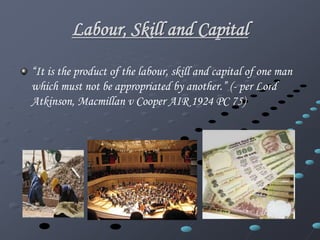
Labour, Skill and Capital 
“It is the product of the labour, skill and capital of one man 
which must not be appropriated by another.” (- per Lord 
Atkinson, Macmillan v Cooper AIR 1924 PC 75)
What Copyright Protects 
Original Literary, Dramatic, Musical and Artistic Works 
Cinematograph Films 
Sound Recordings
Literary Works 
Novels, poems, short stories 
Books on any subject 
Computer programmes, tables, computer databases 
Song lyrics
Computer Software 
Includes 
Programme Manuals 
Punched Cards 
Magnetic Tapes/Discs 
Computer printouts 
Computer programmes
Case Study 
On 
T-SERIES AND MUSIC PIRACY
Music Piracy 
The term piracy is generally used to describe the deliberate 
infringement of copyright on a commercial scale. It is illegal 
and criminal in nature. Music piracy basically refers to three 
kinds of activities: 
Counterfeiting 
Pirate Recording 
Bootlegging
Facts of Music Piracy 
According to the International Federation of the Phonographic 
Industry (IFPI), that identifies and attempts to solve problems of 
piracy, sales of pirate recordings were $ 2.1 billion in 1995. This 
represented unauthorized sales of 954 million music cassettes, 84 million 
CDs and 4 million LPs - indicating that one in every five recordings 
sold worldwide was a pirated copy. 
India was the world's third largest pirate market in volume and sixth in 
value. The Indian music industry lost millions of rupees each year to the 
pirates. Piracy levels were as high as 90 % in the early 1980s, coming 
down to 65% in the 1990s and to 40% in 2000.
T-Series 
In 1970’s - the Indian music industry was dominated by 
Gramophone Company of India (GCI) and Polydor (later 
named Music India Ltd.- MIL). 
Late 1970s - cassette players flooded the country 
In 1978 - with the Indian government liberalizing the import 
and export trade, new kinds of luxury consumer goods 
appeared in the market. 
Cassette players (and consequently, cassettes) were one such 
new item that quickly became popular in the country.
Copyright Violations 
Cassettes were incredibly cheap to produce and reproduce and 
could be easily distributed and transported. 
A large number of outfits began setting up illegal copying 
operations. 
Most copyright violators chose old Hindi film songs from the 
GCI catalogue. 
The bootleggers paid no royalties and no excise 
A major part of this piracy industry was reportedly owned 
and operated by T-Series.
Cover Versions 
Cover versions were albums that used the musical 
compositions as well as the lyrics of original well-known 
Hindi film soundtracks. 
Cover versions were considered to be legal as long as the 
makers had acquired permission from the original music 
companies. 
The Supreme Court had passed a directive that cover versions 
done after a period of three years from the release of the 
original music score were legal.
T-Series & Cover Versions 
Initially, Gulshan's cover versions featured only old Hindi 
film songs. 
Gulshan was able to make good margins on the overall deal. 
Soon, he began making cover versions of new movies as well. 
A cover version of what was reportedly one of India's biggest 
blockbuster movie, 'Hum Aapke Hain Kaun' in 1997
Conflict 
'Hum Aapke Hain Kaun' case went to the courts, Gulshan 
was murdered. 
With Gulshan's death began a period of uncertainty for the 
T-Series group. 
The music company was not doing very well as Gulshan had 
stopped buying music rights from outside7 and the T-Series' 
films had failed.
Court Order 
The High Court order said that the 
makers of version recordings relied 
upon a special provision of the Indian 
Copyright Act. 
Taking advantage of this provision, 
the pirates claimed that copyright owners 
of the compositions and lyrics were 
only entitled to a statutory license fee.
Conclusion 
The Court held that under the Copyright Act, assignments 
and licenses could only be made in writing. 
They had to be signed by the assignor/licensee. 
The Delhi High Court held that there was no provision for 
such automatic licensing and the sound recordings could be 
made by third parties only after they had obtained permission 
from the copyright owners.
References 
www.ircc.iitb.ac.in/.../Indian%20Copyright%20Act%20195 
7.html 
www.indiaip.com/india/copyrights/acts/act1957/act1957.ht 
ml 
www.icmrindia.org/free%20resources/casestudies/t-series- 
3.htm 
www.wipo.int/edocs/...ge.../wipo_smes_ge_10_ref_topic09 
_1.pdf 
www.legalindia.in/study-on-copyright-piracy-in-india
QUERIES

Copy right(a case study)

  • 1.
    Seminar Presentation on Copyright in India Presented By: Himanshu Kansara B.Tech (Final Year) CSE
  • 2.
    Structure of thePresentation Two parts (1) Copyright in India (2) Case Study: T-Series and Music Piracy
  • 3.
    What is Copyright? “The exclusive right given by law for a certain term of years to an author, composer etc. (or his assignee) to print, publish and sell copies of his original work” Copyright is a right given by the law to creators of literary, dramatic, musical and artistic works and producers of cinematograph films and sound recordings. In fact, it is a bundle of rights including, inter alia, rights of reproduction, communication to the public, adaptation and translation of the work.
  • 4.
    England & Wales Indian copyright law similar to England & Wales. First Copyright Act in England (and the world). 1710 → “Queen Anne’s Statute”
  • 5.
    United States FirstAct in 1790: did not protect foreign authors. Indigenous American literature suffered. Today: Copyright Act 1976 one of the major copyright laws in the world .
  • 6.
    Copyright in India First Act in 1914, followed by the Copyright Act 1957. 1957 Act: adopted many English provisions, introduced new ideas and concepts.
  • 7.
    Copyright Act 1957– Main Features Valid from 21 January 1958. Created Copyright Office and Copyright Board. Introduced civil and criminal remedies against infringement.
  • 8.
    Copyright Act 1957– Main Features (II) Performing rights societies’ rights (for instance, music royalties). Definition of categories in which copyright actually subsists. International copyright Definition of infringement
  • 9.
    Copyright (Amendment) Act1983 and 1984 Objectives Berne and Universal Copyright Conventions  grant of compulsory licenses by developing countries, publication by deceased authors. 1984 Act: discouraging and preventing widespread video piracy.
  • 10.
    Copyright (Amendment) Act1992 Defined ambit of the Copyright Board’s powers Introducing special rights for performers Assignment and licences of copyright Rights of copyright owners
  • 11.
    The Nature ofCopyright Statute-based, no registration necessary Copyright = intellectual property Combines different rights (literary works: the right to reproduce in hardback and paperback editions, the right of translation adaptation)
  • 12.
    Labour, Skill andCapital “It is the product of the labour, skill and capital of one man which must not be appropriated by another.” (- per Lord Atkinson, Macmillan v Cooper AIR 1924 PC 75)
  • 13.
    What Copyright Protects Original Literary, Dramatic, Musical and Artistic Works Cinematograph Films Sound Recordings
  • 14.
    Literary Works Novels,poems, short stories Books on any subject Computer programmes, tables, computer databases Song lyrics
  • 15.
    Computer Software Includes Programme Manuals Punched Cards Magnetic Tapes/Discs Computer printouts Computer programmes
  • 16.
    Case Study On T-SERIES AND MUSIC PIRACY
  • 17.
    Music Piracy Theterm piracy is generally used to describe the deliberate infringement of copyright on a commercial scale. It is illegal and criminal in nature. Music piracy basically refers to three kinds of activities: Counterfeiting Pirate Recording Bootlegging
  • 18.
    Facts of MusicPiracy According to the International Federation of the Phonographic Industry (IFPI), that identifies and attempts to solve problems of piracy, sales of pirate recordings were $ 2.1 billion in 1995. This represented unauthorized sales of 954 million music cassettes, 84 million CDs and 4 million LPs - indicating that one in every five recordings sold worldwide was a pirated copy. India was the world's third largest pirate market in volume and sixth in value. The Indian music industry lost millions of rupees each year to the pirates. Piracy levels were as high as 90 % in the early 1980s, coming down to 65% in the 1990s and to 40% in 2000.
  • 19.
    T-Series In 1970’s- the Indian music industry was dominated by Gramophone Company of India (GCI) and Polydor (later named Music India Ltd.- MIL). Late 1970s - cassette players flooded the country In 1978 - with the Indian government liberalizing the import and export trade, new kinds of luxury consumer goods appeared in the market. Cassette players (and consequently, cassettes) were one such new item that quickly became popular in the country.
  • 20.
    Copyright Violations Cassetteswere incredibly cheap to produce and reproduce and could be easily distributed and transported. A large number of outfits began setting up illegal copying operations. Most copyright violators chose old Hindi film songs from the GCI catalogue. The bootleggers paid no royalties and no excise A major part of this piracy industry was reportedly owned and operated by T-Series.
  • 21.
    Cover Versions Coverversions were albums that used the musical compositions as well as the lyrics of original well-known Hindi film soundtracks. Cover versions were considered to be legal as long as the makers had acquired permission from the original music companies. The Supreme Court had passed a directive that cover versions done after a period of three years from the release of the original music score were legal.
  • 22.
    T-Series & CoverVersions Initially, Gulshan's cover versions featured only old Hindi film songs. Gulshan was able to make good margins on the overall deal. Soon, he began making cover versions of new movies as well. A cover version of what was reportedly one of India's biggest blockbuster movie, 'Hum Aapke Hain Kaun' in 1997
  • 23.
    Conflict 'Hum AapkeHain Kaun' case went to the courts, Gulshan was murdered. With Gulshan's death began a period of uncertainty for the T-Series group. The music company was not doing very well as Gulshan had stopped buying music rights from outside7 and the T-Series' films had failed.
  • 24.
    Court Order TheHigh Court order said that the makers of version recordings relied upon a special provision of the Indian Copyright Act. Taking advantage of this provision, the pirates claimed that copyright owners of the compositions and lyrics were only entitled to a statutory license fee.
  • 25.
    Conclusion The Courtheld that under the Copyright Act, assignments and licenses could only be made in writing. They had to be signed by the assignor/licensee. The Delhi High Court held that there was no provision for such automatic licensing and the sound recordings could be made by third parties only after they had obtained permission from the copyright owners.
  • 26.
    References www.ircc.iitb.ac.in/.../Indian%20Copyright%20Act%20195 7.html www.indiaip.com/india/copyrights/acts/act1957/act1957.ht ml www.icmrindia.org/free%20resources/casestudies/t-series- 3.htm www.wipo.int/edocs/...ge.../wipo_smes_ge_10_ref_topic09 _1.pdf www.legalindia.in/study-on-copyright-piracy-in-india
  • 28.