Formal
Comm
unications
Formal Communications
• Communication taking place within an organisation may be broadly classified as
formal and informal communication.
• Formal Communication
• Formal communication flows through official channels designed in the
organisation chart.
• This communication may take place between a superior and subordinate, a
subordinate and superior or among same cadre employees or managers.
• The communications may be oral or written but generally recorded and filed in
the office.
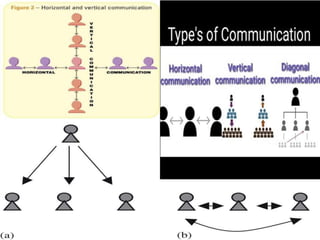
• Formal communication may be further classified as – Vertical and Horizontal.
• Vertical communication flows vertically i.e., upwards or downwards through
formal channels.
• Upward communications refer to flow of communication from subordinate to
superior whereas downward communication indicates communication from a
superior to subordinate.
• The examples of upward communication are – application for grant of leave,
submission of progress report, request for grants etc.
Formal Communications
•Similarly, the examples of downward communication include
– sending notice to employees to attend a meeting, ordering
subordinates to complete an assigned work, passing on
guidelines framed by top management to the subordinates
etc.,
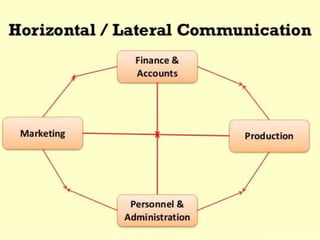
• Horizontal or lateral communication takes place between
one division and another.
•For example, a production manager may contact marketing
manager to discuss about schedule of product delivery,
product design, quality etc.
•The pattern through which communication flows within the
organisation is generally indicated through communication
network.
•Different types of communication networks may operate in
formal organisation.
Formal Communications
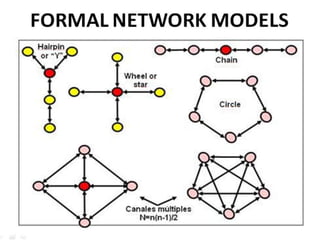
•Some of the popular communication networks are
presented and discussed in given figure.
• (i) Single chain: This network exists between a supervisor and his subordinates.
Since many levels exist in an organisation structure, communication flows from every
superior to his subordinate through single chain.
• (ii) Wheel: In wheel network, all subordinates under one superior communicate
through him only as he acts as a hub of the wheel. The subordinates are not allowed
to talk among themselves.
• (iii) Circular: In circular network, the communication moves in a circle. Each
person can communicate with his adjoining two persons. In this network,
communication flow is slow.
• (iv) Free flow: In this network, each person can communicate with others freely.
The flow of communication is fast in this network.
• (v) Inverted V: In this network, a subordinate is allowed to communicate with his
immediate superior as well as his superiors superior. However, in later case, only
prescribed communication takes place.
Formal Communications
Formal communication pgp VIVA VVIT

Formal communication pgp VIVA VVIT

  • 1.
  • 2.
    Formal Communications • Communicationtaking place within an organisation may be broadly classified as formal and informal communication. • Formal Communication • Formal communication flows through official channels designed in the organisation chart. • This communication may take place between a superior and subordinate, a subordinate and superior or among same cadre employees or managers. • The communications may be oral or written but generally recorded and filed in the office. • Formal communication may be further classified as – Vertical and Horizontal. • Vertical communication flows vertically i.e., upwards or downwards through formal channels. • Upward communications refer to flow of communication from subordinate to superior whereas downward communication indicates communication from a superior to subordinate. • The examples of upward communication are – application for grant of leave, submission of progress report, request for grants etc.
  • 3.
  • 5.
    •Similarly, the examplesof downward communication include – sending notice to employees to attend a meeting, ordering subordinates to complete an assigned work, passing on guidelines framed by top management to the subordinates etc., • Horizontal or lateral communication takes place between one division and another. •For example, a production manager may contact marketing manager to discuss about schedule of product delivery, product design, quality etc. •The pattern through which communication flows within the organisation is generally indicated through communication network. •Different types of communication networks may operate in formal organisation. Formal Communications
  • 7.
    •Some of thepopular communication networks are presented and discussed in given figure. • (i) Single chain: This network exists between a supervisor and his subordinates. Since many levels exist in an organisation structure, communication flows from every superior to his subordinate through single chain. • (ii) Wheel: In wheel network, all subordinates under one superior communicate through him only as he acts as a hub of the wheel. The subordinates are not allowed to talk among themselves. • (iii) Circular: In circular network, the communication moves in a circle. Each person can communicate with his adjoining two persons. In this network, communication flow is slow. • (iv) Free flow: In this network, each person can communicate with others freely. The flow of communication is fast in this network. • (v) Inverted V: In this network, a subordinate is allowed to communicate with his immediate superior as well as his superiors superior. However, in later case, only prescribed communication takes place. Formal Communications