Barriers
to Comm-
unication
Barriers to Communication
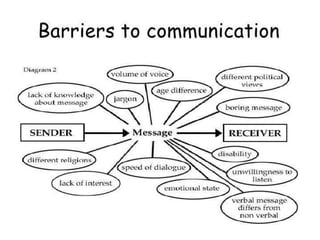
•It is generally observed that managers
face several problems due to
communication breakdowns or barriers.
•These barriers may prevent a
communication or filter part of it or carry
incorrect meaning due to which
misunderstandings may be created.
•Therefore, it is important for a manager to
identity such barriers and take measures
to overcome them.
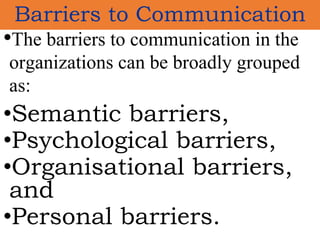
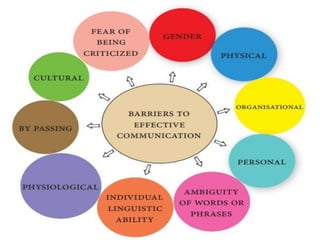
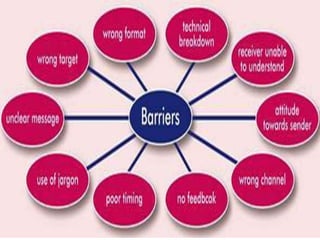
•The barriers to communication in the
organizations can be broadly grouped
as:
•Semantic barriers,
•Psychological barriers,
•Organisational barriers,
and
•Personal barriers.
Barriers to Communication
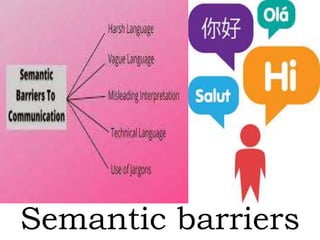
Semantic barriers
Personal barriers
• These are briefly discussed below:
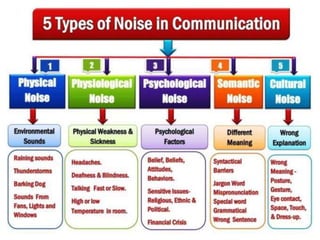
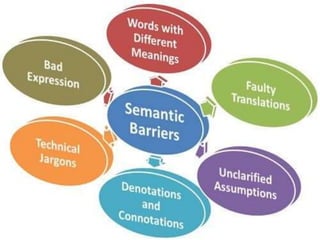
• Semantic barriers: Semantics is the branch of linguistics dealing with
the meaning of words and sentences. Semantic barriers are concerned
with problems and obstructions in the process of encoding and
decoding of message into words or impressions. Normally, such
barriers result on account of use of wrong words, faulty translations,
different interpretations etc.
• These are discussed below:
• (i) Badly expressed message: Some times intended meaning may not
be conveyed by a manager to his subordinates. These badly expressed
messages may be an account of inadequate vocabulary, usage of
wrong words, omission of needed words etc.
• (ii) Symbols with different meanings: A word may have several
meanings. Receiver has to perceive one such meaning for the word
used by communicator.
Barriers to Communication
Semantic barriers:
•For example, consider these three sentences where
the work ‘value’ is used: (a) What is the value of this
ring? (b) I value our friendship. (c) What is the value
of learning computer skills?
•You will find that the ‘value’ gives different meaning
in different contexts. Wrong perception leads to
communication problems.
•(iii) Faulty translations: Sometimes the
communications originally drafted in one language
(e.g., English) need to be translated to the language
understandable to workers (e.g., Hindi). If the
translator is not proficient with both the languages,
mistakes may creep in causing different meanings to
the communication.
Barriers to Communication
•(iv) Unclarified assumptions: Some communications
may have certain assumptions which are subject to
different interpretations.
•For example, a boss may instruct his subordinate,
“Take care of our guest”.
•Boss may mean that subordinate should take care of
transport, food, accommodation of the guest until he
leaves the place.
•The subordinate may interpret that guest should be
taken to hotel with care. Actually, the guest suffers
due to these unclarified assumptions.
Barriers to Communication
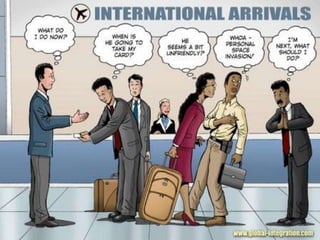
•(v) Technical jargon: It is usually found that
specialists use technical jargon while explaining to
persons who are not specialists in the concerned
field. Therefore, they may not understand the actual
meaning of many such words.
•(vi) Body language and gesture decoding: Every
movement of body communicates some meaning.
The body movement and gestures of communicator
matters so much in conveying the message. If there
is no match between what is said and what is
expressed in body movements, communications may
be wrongly perceived.
Barriers to Communication
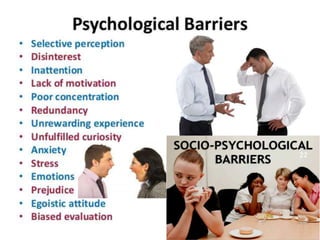
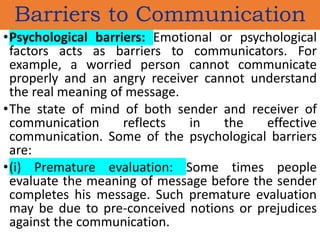
•Psychological barriers: Emotional or psychological
factors acts as barriers to communicators. For
example, a worried person cannot communicate
properly and an angry receiver cannot understand
the real meaning of message.
•The state of mind of both sender and receiver of
communication reflects in the effective
communication. Some of the psychological barriers
are:
•(i) Premature evaluation: Some times people
evaluate the meaning of message before the sender
completes his message. Such premature evaluation
may be due to pre-conceived notions or prejudices
against the communication.
Barriers to Communication
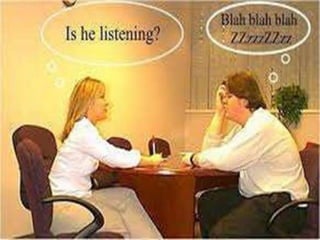
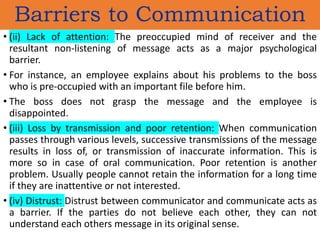
• (ii) Lack of attention: The preoccupied mind of receiver and the
resultant non-listening of message acts as a major psychological
barrier.
• For instance, an employee explains about his problems to the boss
who is pre-occupied with an important file before him.
• The boss does not grasp the message and the employee is
disappointed.
• (iii) Loss by transmission and poor retention: When communication
passes through various levels, successive transmissions of the message
results in loss of, or transmission of inaccurate information. This is
more so in case of oral communication. Poor retention is another
problem. Usually people cannot retain the information for a long time
if they are inattentive or not interested.
• (iv) Distrust: Distrust between communicator and communicate acts as
a barrier. If the parties do not believe each other, they can not
understand each others message in its original sense.
Barriers to Communication
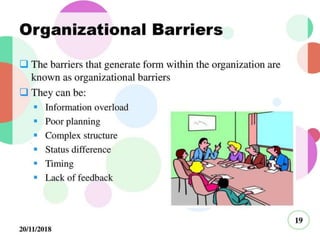
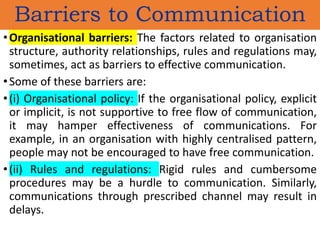
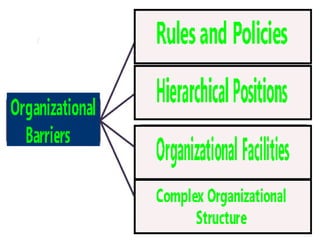
•Organisational barriers: The factors related to organisation
structure, authority relationships, rules and regulations may,
sometimes, act as barriers to effective communication.
•Some of these barriers are:
•(i) Organisational policy: If the organisational policy, explicit
or implicit, is not supportive to free flow of communication,
it may hamper effectiveness of communications. For
example, in an organisation with highly centralised pattern,
people may not be encouraged to have free communication.
•(ii) Rules and regulations: Rigid rules and cumbersome
procedures may be a hurdle to communication. Similarly,
communications through prescribed channel may result in
delays.
Barriers to Communication
•(iii) Status: Status of superior may create psychological
distance between him and his subordinates. A status
conscious manager also may not allow his subordinates
to express their feelings freely.
•(iv) Complexity in organisation structure: In an
organisation where there are number of managerial
levels, communication gets delayed and distorted as
number of filtering points are more.
•(v) Organisational facilities: If facilities for smooth, clear
and timely communications are not provided
communications may be hampered. Facilities like
frequent meetings, suggestion box, complaint box, social
and cultural gathering, transparency in operations etc.,
will encourage free flow of communication. Lack of
these facilities may create communication problems.
Barriers to Communication
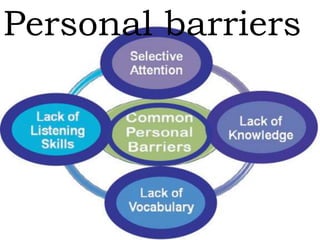
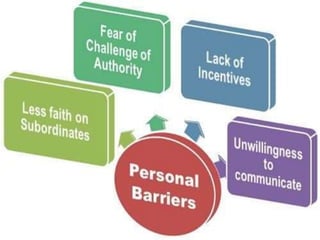
• Personal barriers: The personal factors of both sender and receiver
may exert influence on effective communication. Some of the personal
barriers of superiors and subordinates are mentioned below:
• (i) Fear of challenge to authority: If a superior perceives that a
particular communication may adversely affect his authority, he or she
may withhold or suppress such communication.
• (ii) Lack of confidence of superior on his subordinates: If superiors do
not have confidence on the competency of their subordinates, they
may not seek their advice or opinions.
• (iii) Unwillingness to communicate: Sometimes, subordinates may not
be prepared to communicate with their superiors, if they perceive that
it may adversely affect their interests.
• (iv) Lack of proper incentives: If there is no motivation or incentive for
communication, subordinates may not take initiative to communicate.
For example, if there is no reward or appreciation for a good
suggestion, the subordinates may not be willing to offer useful
suggestions.
Barriers to Communication
Barriers to communication pgp VIVA VVIT

Barriers to communication pgp VIVA VVIT

  • 1.
  • 2.
    Barriers to Communication •Itis generally observed that managers face several problems due to communication breakdowns or barriers. •These barriers may prevent a communication or filter part of it or carry incorrect meaning due to which misunderstandings may be created. •Therefore, it is important for a manager to identity such barriers and take measures to overcome them.
  • 3.
    •The barriers tocommunication in the organizations can be broadly grouped as: •Semantic barriers, •Psychological barriers, •Organisational barriers, and •Personal barriers. Barriers to Communication
  • 4.
  • 7.
  • 13.
    • These arebriefly discussed below: • Semantic barriers: Semantics is the branch of linguistics dealing with the meaning of words and sentences. Semantic barriers are concerned with problems and obstructions in the process of encoding and decoding of message into words or impressions. Normally, such barriers result on account of use of wrong words, faulty translations, different interpretations etc. • These are discussed below: • (i) Badly expressed message: Some times intended meaning may not be conveyed by a manager to his subordinates. These badly expressed messages may be an account of inadequate vocabulary, usage of wrong words, omission of needed words etc. • (ii) Symbols with different meanings: A word may have several meanings. Receiver has to perceive one such meaning for the word used by communicator. Barriers to Communication
  • 15.
  • 16.
    •For example, considerthese three sentences where the work ‘value’ is used: (a) What is the value of this ring? (b) I value our friendship. (c) What is the value of learning computer skills? •You will find that the ‘value’ gives different meaning in different contexts. Wrong perception leads to communication problems. •(iii) Faulty translations: Sometimes the communications originally drafted in one language (e.g., English) need to be translated to the language understandable to workers (e.g., Hindi). If the translator is not proficient with both the languages, mistakes may creep in causing different meanings to the communication. Barriers to Communication
  • 18.
    •(iv) Unclarified assumptions:Some communications may have certain assumptions which are subject to different interpretations. •For example, a boss may instruct his subordinate, “Take care of our guest”. •Boss may mean that subordinate should take care of transport, food, accommodation of the guest until he leaves the place. •The subordinate may interpret that guest should be taken to hotel with care. Actually, the guest suffers due to these unclarified assumptions. Barriers to Communication
  • 20.
    •(v) Technical jargon:It is usually found that specialists use technical jargon while explaining to persons who are not specialists in the concerned field. Therefore, they may not understand the actual meaning of many such words. •(vi) Body language and gesture decoding: Every movement of body communicates some meaning. The body movement and gestures of communicator matters so much in conveying the message. If there is no match between what is said and what is expressed in body movements, communications may be wrongly perceived. Barriers to Communication
  • 22.
    •Psychological barriers: Emotionalor psychological factors acts as barriers to communicators. For example, a worried person cannot communicate properly and an angry receiver cannot understand the real meaning of message. •The state of mind of both sender and receiver of communication reflects in the effective communication. Some of the psychological barriers are: •(i) Premature evaluation: Some times people evaluate the meaning of message before the sender completes his message. Such premature evaluation may be due to pre-conceived notions or prejudices against the communication. Barriers to Communication
  • 24.
    • (ii) Lackof attention: The preoccupied mind of receiver and the resultant non-listening of message acts as a major psychological barrier. • For instance, an employee explains about his problems to the boss who is pre-occupied with an important file before him. • The boss does not grasp the message and the employee is disappointed. • (iii) Loss by transmission and poor retention: When communication passes through various levels, successive transmissions of the message results in loss of, or transmission of inaccurate information. This is more so in case of oral communication. Poor retention is another problem. Usually people cannot retain the information for a long time if they are inattentive or not interested. • (iv) Distrust: Distrust between communicator and communicate acts as a barrier. If the parties do not believe each other, they can not understand each others message in its original sense. Barriers to Communication
  • 25.
    •Organisational barriers: Thefactors related to organisation structure, authority relationships, rules and regulations may, sometimes, act as barriers to effective communication. •Some of these barriers are: •(i) Organisational policy: If the organisational policy, explicit or implicit, is not supportive to free flow of communication, it may hamper effectiveness of communications. For example, in an organisation with highly centralised pattern, people may not be encouraged to have free communication. •(ii) Rules and regulations: Rigid rules and cumbersome procedures may be a hurdle to communication. Similarly, communications through prescribed channel may result in delays. Barriers to Communication
  • 27.
    •(iii) Status: Statusof superior may create psychological distance between him and his subordinates. A status conscious manager also may not allow his subordinates to express their feelings freely. •(iv) Complexity in organisation structure: In an organisation where there are number of managerial levels, communication gets delayed and distorted as number of filtering points are more. •(v) Organisational facilities: If facilities for smooth, clear and timely communications are not provided communications may be hampered. Facilities like frequent meetings, suggestion box, complaint box, social and cultural gathering, transparency in operations etc., will encourage free flow of communication. Lack of these facilities may create communication problems. Barriers to Communication
  • 28.
    • Personal barriers:The personal factors of both sender and receiver may exert influence on effective communication. Some of the personal barriers of superiors and subordinates are mentioned below: • (i) Fear of challenge to authority: If a superior perceives that a particular communication may adversely affect his authority, he or she may withhold or suppress such communication. • (ii) Lack of confidence of superior on his subordinates: If superiors do not have confidence on the competency of their subordinates, they may not seek their advice or opinions. • (iii) Unwillingness to communicate: Sometimes, subordinates may not be prepared to communicate with their superiors, if they perceive that it may adversely affect their interests. • (iv) Lack of proper incentives: If there is no motivation or incentive for communication, subordinates may not take initiative to communicate. For example, if there is no reward or appreciation for a good suggestion, the subordinates may not be willing to offer useful suggestions. Barriers to Communication