INTELLECTUAL
PROPERTY RIGHTS
ANUPRIYA N. R
DEPARTMENT OF PHARMACEUTICAL
QUALITY ASSURANCE
NGSMIPS, NITTE DEEMED TO BE
UNIVERSITY
MANGALORE
• Introduction
• Intellectual property rights
• Copyrights
• Design
• Trademark
• Trade Secrets
• Geographical Indications
• Patent
• Conclusion
• References
CONTENTS
2
The 21'st century was termed as the century of
knowledge. However, merely having the knowledge is
not enough, the protection of that knowledge and
convertion of that knowledge in to profit are
important for the survival of any high-tech business
and economy. The intellectual property laws & the
food and drug laws provide the pharmaceutical and
biotechnology industry with unparalleled protection.
These laws provide exclusivity, patent term
restoration, a patent extension under various
condition unmatched by any other industry.
Introduction
3
• Intellectual Property Rights (IPR) are the statutory
rights once granted allows the creator(s) or
owner(s) of the intellectual property to exclude
others from exploiting the same commercially for
a given period of time.
• It allows the creator(s)/owner(s) to have benefits
from their work when these are exploited
commercially.
• IPR are granted to an inventor or creator in lieu of
the discloser of his/her knowledge.
INTELLECTUAL PROPERTY RIGHTS
“Protection of property created by the intellect of
human mind”
4
IP
Patents
Trade
Secrets
Copy
Rights
Trade
marks
Design
Geograp
hical
indicatio
-ns
5
For every individual improved
mechanism
For outer shape and contour/
configuration
Brand name or logo for goods
denoted as
The client list, formula for a product
For music, art etc denoted as
DESIGN
TRADE
MARK ®
COPY
RIGHT
©
TRADE
SECRET
PATENT
6
• Copyright means exclusive right to do or
authorize others to do certain acts in relation
to
--Literary, dramatic, music, and artistic works.
--Books
--Cinema/TV programmes
--Sound recordings
• Permission is needed to reproduce the
copyrighted material.
COPYRIGHTS
7
• Term: Author's life plus sixty years (Books)
60 years (Films, photographs)
25 years (Broadcasting)
• It protect the publications of the studies.
• Information provided by the drug companies
may be protected by copyright law.
• Pharmaceutical companies routinely copyrighted
their package insert yet the generic approval
dictated that the package insert of the generic
drug to be the same as the reference listed
drug.
8
• The protection only for the appearance of the
article and not how it work.
• Design registration protects designs having
industrial or commercial use.
• Designs of stamp, labels, tokens, cards, or
cartoons and part of an article sold separately
can not be registered.
• Duration protection- 10 years and extendable for
another term of 5 years.
DESIGN
9
• A trade mark is any design that can distinguish
the goods of one trader from those of another.
• It includes words, logos, pictures, or
combination of these.
• A trademark is used as a marketing tool for
product positioning.
• The consumer will rely on the labels attached
to the product with certain expectation of the
quality of said product.
• Term: 10 years
TRADEMARK
10
• To register a trade mark the mark must be
distinctive and not contrary to law or
morality and not identical to the earlier
mark for the same or similar goods
• The notion ® may be used for the trademark only
if it is federally registered.
• In pharmaceutical arena, trade names for certain
drug may be registered as a trademark
• Essential features
of a trademark
• It must be a mark, brand,
heading, name, label,
signature or numerical shape
of goods, packaging,or
combination of these.
• It must be capable of being
represented graphically.
• It must be capable of
distinguishing the goods or
services of one person from
those of others.
• The use must be of a printed
or other visual representation
of the mark.
• Trademark which
are not
registerable
• Mark that contain or
comprises of any matter likely
to hurt the religious
susceptabilities of any class or
section of the citizens of
India.
• Mark that comprises of
scandalous or obscene matter.
• Mark which has nature as to
deceive the public or cause
confusion.
• Mark prohibited under the
Emblems and Name Act, 1950
• A trade secret is something that offers an
advantage in business if it keep as a secret.
• A trade secret can be a client list, the formula
for a product, etc.
• A trade secret does not have to be patentable,
but it must be capable of being maintained.
• For instance, a client list can be protected by
computer password, and the formula can be
safeguarded by disclosing it to a limited
number of people.
• Trade secrets are not registered with any
government or other agency
TRADE SECRETS
13
• An indication used to identify agricultural,
natural or manufactured goods originating from a
definite territory in India.
• It should have a special quality or charecteristics
or reputation based up on the climatic or
production charecteristics unique to the
geographical location.
• The registration of a geographical indication is
from a period of 10 years.
• Renewal is possible for further period of 10 years
each.
• Examples:Kancheepuram silk,Darjeeling Tea, Solapur
Chaddar, Mysore Silk, Kullu Shawl etc
GEOGRAPHICAL INDICATIONS
14
DEFINITION:
Exclusive right for being the true and first
inventor of a product or process, granted by
the govt. for a limited period, to exclude
others from making, using, selling or importing
the patented product or process with out his
consent, in exchange of full disclosure of his
invention.
Term: 20 years from the Date of Filing
PATENT
15
• A patent is only valid in the jurisdiction in
which it is granted
 Mumbai
 Chennai
 New Delhi
 Kolkata
WIPO -1967
PCT - 1970
WTO - 1995
Patent jurisdictions
16
Patent office branches
Lifecycle of a patent
Filing of
patent
application
Formal
Exami
nation
Publica-
tion of
Applica-
tion
Search and
Substantive
Examination
Grant and
Publicatio
n
17
• A product
• The apparatus for producing the product
• The process
• The composition of matter
What is patentable ?
18
• Novelty
• Utility
• Nonobviousness
• Written Disclosure
Basic requirements for patentability
19
• Computer programmes
• Medical and Surgical treatments
• Mathematical methods
• Business methods
• Discoveries
• Aesthetic creation
• New species of plant or animal
• The invension which are contrary to moral
standards and public order
• Invention related to atomic energy
What is not patentable
20
1. Application Form (Form 1)
2. Specification (Provisional/ Complete)
(Form 2)
3. Drawings
4. Undertaking under section 8 (Form 3)
5. Power of Authoritry
Documents required for filing a
patent application
21
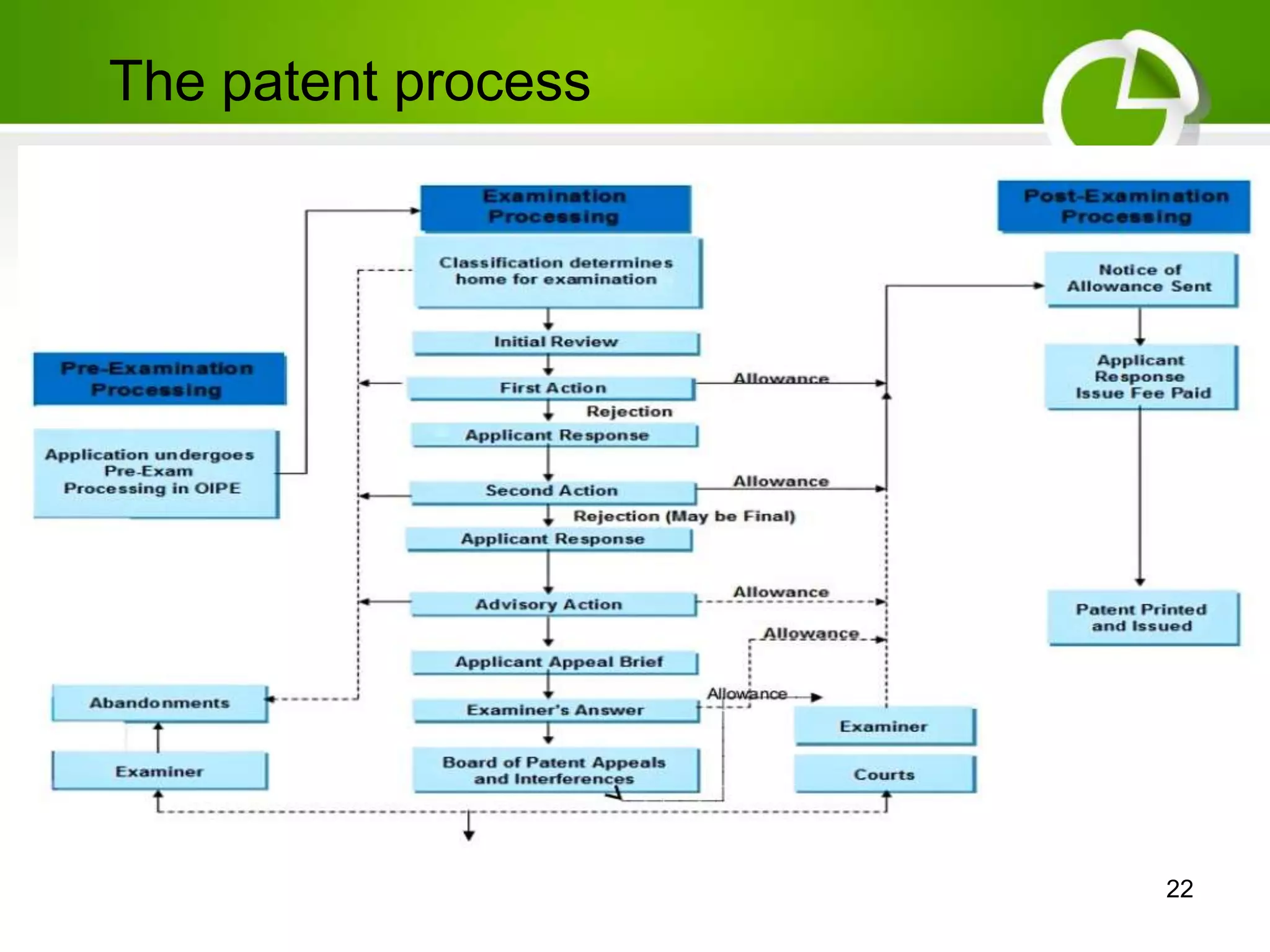
The patent process
22
Patent Laws
1856
• Patent
rights were
introduced
in India.
1872
• The Patent
and Design
Protection
Act.
1888
• Invention
and Design
Act
1911
• The Indian
Patent And
Designs Act.
1970
• The
Patent
Act
2005
• Product
Patent regime
in
Pharmaceutic
al
23
• It encourages research
• Induce an inventor to disclose his invention
• Encourage establishment of new industries
• Reasonable assurance for commercialization
• Facilitate technology transfer
• Stimulate R&D at Universities and Research
centers
• Acts as catalysts for new technologies and new
business
What does patent system do ?
24
• Any time after three years from the date of
sealing of a patent, application for compulsory
license to the government can be made by any
other party interested in using that invention
provided.
1. Reasonable requirements of public have not
been met.
2. patented invention is not available to public at
a reasonably affordable price.
3. patented invetion is not worked in India.
Compulsory Licence
25
• Infringement of a patent occures when a
competitor makes , uses,sells, offers to sell or
imports an embodiment of the invention with out
the permission of the patent owner.
• Types:
--Direct infringement
--Indirect infringement
Infringement
26
If you infringe someone else's patent you may
risk:
• Injunction, which means that all your products
may be removed from the market.
• Destruction of your products.
• Paying damages to the patent owner.
• Being sended to imprisonment.
Cosequences of infringement
27
A. Drug compound patent
B. Formulation/composition patent
C. synergistic combination patent
D. Technology patent
E. Polymorph patent
F. Biotechnology patent
G. Process patent
Types of Pharmaceutical Patents in
India
28
Examples
Example of the Desyrel® ( Trazodone hydrochloride ) 150-300 mg oral
tablets that can be separated in to three equal parts ( The so-called
Dividose® design )
31
Modified osmotic device that inside the tablet comprises
of two separate drug compartments separated by a swellable
Hydrogel partition. When hydrogel swells it pushes both drug
compartments to deliver two drug simutaneously in a
controlled manner
• Intellectual property (IP) is a category of property that
includes intangible creations of the human intellect, and
primarily encompasses copyrights, patents, and trademarks
• It also includes other types of rights, such as trade secrets,
publicity rights, moral rights, and rights against unfair
competition.
• The main purpose of intellectual property law is to
encourage the creation of a large variety of intellectual
goods.This gives economic incentive for their creation,
because it allows people to profit from the information and
intellectual goods they create. These economic incentives
are expected to stimulate innovation and contribute to the
technological progress of countries, which depends on the
extent of protection granted to innovators.
CONCLUTION
• Larry L. Augsbuger. Stephen W. Hoag. Pharmaceutical Dosage
Forms: Tablets. 3rd ed. 2008. Informa health care USA. P:251-267.
• Vipin Mathur. Patenting of Pharmaceuticals:AnIndian Perspective,
Int. J. Drug Dev & Res., July Sep 2012,4(3):27-34
• https://en.wikipedia.org/wiki/Intellectual_property [Accessesd on 28th
Oct.]
• http://www.wipo.int/edocs/pubdocs/en/intproperty/450/wipo_pub_450
.pdf [Accessesd on 28th Oct.]
• https://www.tutorialspoint.com/information_security_cyber_law/intelle
ctual_property_right.htm [Accessesd on 28th Oct.]
• https://users.wfu.edu/mcfallta/DIR0/pharma_patents.pdf [Accessesd
on 30th Oct.]
• https://patents.google.com/ [Accessesd on Nov 1.]
REFERANCES
35

Intellectual Property Rights

  • 1.
    INTELLECTUAL PROPERTY RIGHTS ANUPRIYA N.R DEPARTMENT OF PHARMACEUTICAL QUALITY ASSURANCE NGSMIPS, NITTE DEEMED TO BE UNIVERSITY MANGALORE
  • 2.
    • Introduction • Intellectualproperty rights • Copyrights • Design • Trademark • Trade Secrets • Geographical Indications • Patent • Conclusion • References CONTENTS 2
  • 3.
    The 21'st centurywas termed as the century of knowledge. However, merely having the knowledge is not enough, the protection of that knowledge and convertion of that knowledge in to profit are important for the survival of any high-tech business and economy. The intellectual property laws & the food and drug laws provide the pharmaceutical and biotechnology industry with unparalleled protection. These laws provide exclusivity, patent term restoration, a patent extension under various condition unmatched by any other industry. Introduction 3
  • 4.
    • Intellectual PropertyRights (IPR) are the statutory rights once granted allows the creator(s) or owner(s) of the intellectual property to exclude others from exploiting the same commercially for a given period of time. • It allows the creator(s)/owner(s) to have benefits from their work when these are exploited commercially. • IPR are granted to an inventor or creator in lieu of the discloser of his/her knowledge. INTELLECTUAL PROPERTY RIGHTS “Protection of property created by the intellect of human mind” 4
  • 5.
  • 6.
    For every individualimproved mechanism For outer shape and contour/ configuration Brand name or logo for goods denoted as The client list, formula for a product For music, art etc denoted as DESIGN TRADE MARK ® COPY RIGHT © TRADE SECRET PATENT 6
  • 7.
    • Copyright meansexclusive right to do or authorize others to do certain acts in relation to --Literary, dramatic, music, and artistic works. --Books --Cinema/TV programmes --Sound recordings • Permission is needed to reproduce the copyrighted material. COPYRIGHTS 7
  • 8.
    • Term: Author'slife plus sixty years (Books) 60 years (Films, photographs) 25 years (Broadcasting) • It protect the publications of the studies. • Information provided by the drug companies may be protected by copyright law. • Pharmaceutical companies routinely copyrighted their package insert yet the generic approval dictated that the package insert of the generic drug to be the same as the reference listed drug. 8
  • 9.
    • The protectiononly for the appearance of the article and not how it work. • Design registration protects designs having industrial or commercial use. • Designs of stamp, labels, tokens, cards, or cartoons and part of an article sold separately can not be registered. • Duration protection- 10 years and extendable for another term of 5 years. DESIGN 9
  • 10.
    • A trademark is any design that can distinguish the goods of one trader from those of another. • It includes words, logos, pictures, or combination of these. • A trademark is used as a marketing tool for product positioning. • The consumer will rely on the labels attached to the product with certain expectation of the quality of said product. • Term: 10 years TRADEMARK 10
  • 11.
    • To registera trade mark the mark must be distinctive and not contrary to law or morality and not identical to the earlier mark for the same or similar goods • The notion ® may be used for the trademark only if it is federally registered. • In pharmaceutical arena, trade names for certain drug may be registered as a trademark
  • 12.
    • Essential features ofa trademark • It must be a mark, brand, heading, name, label, signature or numerical shape of goods, packaging,or combination of these. • It must be capable of being represented graphically. • It must be capable of distinguishing the goods or services of one person from those of others. • The use must be of a printed or other visual representation of the mark. • Trademark which are not registerable • Mark that contain or comprises of any matter likely to hurt the religious susceptabilities of any class or section of the citizens of India. • Mark that comprises of scandalous or obscene matter. • Mark which has nature as to deceive the public or cause confusion. • Mark prohibited under the Emblems and Name Act, 1950
  • 13.
    • A tradesecret is something that offers an advantage in business if it keep as a secret. • A trade secret can be a client list, the formula for a product, etc. • A trade secret does not have to be patentable, but it must be capable of being maintained. • For instance, a client list can be protected by computer password, and the formula can be safeguarded by disclosing it to a limited number of people. • Trade secrets are not registered with any government or other agency TRADE SECRETS 13
  • 14.
    • An indicationused to identify agricultural, natural or manufactured goods originating from a definite territory in India. • It should have a special quality or charecteristics or reputation based up on the climatic or production charecteristics unique to the geographical location. • The registration of a geographical indication is from a period of 10 years. • Renewal is possible for further period of 10 years each. • Examples:Kancheepuram silk,Darjeeling Tea, Solapur Chaddar, Mysore Silk, Kullu Shawl etc GEOGRAPHICAL INDICATIONS 14
  • 15.
    DEFINITION: Exclusive right forbeing the true and first inventor of a product or process, granted by the govt. for a limited period, to exclude others from making, using, selling or importing the patented product or process with out his consent, in exchange of full disclosure of his invention. Term: 20 years from the Date of Filing PATENT 15
  • 16.
    • A patentis only valid in the jurisdiction in which it is granted  Mumbai  Chennai  New Delhi  Kolkata WIPO -1967 PCT - 1970 WTO - 1995 Patent jurisdictions 16 Patent office branches
  • 17.
    Lifecycle of apatent Filing of patent application Formal Exami nation Publica- tion of Applica- tion Search and Substantive Examination Grant and Publicatio n 17
  • 18.
    • A product •The apparatus for producing the product • The process • The composition of matter What is patentable ? 18
  • 19.
    • Novelty • Utility •Nonobviousness • Written Disclosure Basic requirements for patentability 19
  • 20.
    • Computer programmes •Medical and Surgical treatments • Mathematical methods • Business methods • Discoveries • Aesthetic creation • New species of plant or animal • The invension which are contrary to moral standards and public order • Invention related to atomic energy What is not patentable 20
  • 21.
    1. Application Form(Form 1) 2. Specification (Provisional/ Complete) (Form 2) 3. Drawings 4. Undertaking under section 8 (Form 3) 5. Power of Authoritry Documents required for filing a patent application 21
  • 22.
  • 23.
    Patent Laws 1856 • Patent rightswere introduced in India. 1872 • The Patent and Design Protection Act. 1888 • Invention and Design Act 1911 • The Indian Patent And Designs Act. 1970 • The Patent Act 2005 • Product Patent regime in Pharmaceutic al 23
  • 24.
    • It encouragesresearch • Induce an inventor to disclose his invention • Encourage establishment of new industries • Reasonable assurance for commercialization • Facilitate technology transfer • Stimulate R&D at Universities and Research centers • Acts as catalysts for new technologies and new business What does patent system do ? 24
  • 25.
    • Any timeafter three years from the date of sealing of a patent, application for compulsory license to the government can be made by any other party interested in using that invention provided. 1. Reasonable requirements of public have not been met. 2. patented invention is not available to public at a reasonably affordable price. 3. patented invetion is not worked in India. Compulsory Licence 25
  • 26.
    • Infringement ofa patent occures when a competitor makes , uses,sells, offers to sell or imports an embodiment of the invention with out the permission of the patent owner. • Types: --Direct infringement --Indirect infringement Infringement 26
  • 27.
    If you infringesomeone else's patent you may risk: • Injunction, which means that all your products may be removed from the market. • Destruction of your products. • Paying damages to the patent owner. • Being sended to imprisonment. Cosequences of infringement 27
  • 28.
    A. Drug compoundpatent B. Formulation/composition patent C. synergistic combination patent D. Technology patent E. Polymorph patent F. Biotechnology patent G. Process patent Types of Pharmaceutical Patents in India 28
  • 29.
    Examples Example of theDesyrel® ( Trazodone hydrochloride ) 150-300 mg oral tablets that can be separated in to three equal parts ( The so-called Dividose® design )
  • 31.
    31 Modified osmotic devicethat inside the tablet comprises of two separate drug compartments separated by a swellable Hydrogel partition. When hydrogel swells it pushes both drug compartments to deliver two drug simutaneously in a controlled manner
  • 33.
    • Intellectual property(IP) is a category of property that includes intangible creations of the human intellect, and primarily encompasses copyrights, patents, and trademarks • It also includes other types of rights, such as trade secrets, publicity rights, moral rights, and rights against unfair competition. • The main purpose of intellectual property law is to encourage the creation of a large variety of intellectual goods.This gives economic incentive for their creation, because it allows people to profit from the information and intellectual goods they create. These economic incentives are expected to stimulate innovation and contribute to the technological progress of countries, which depends on the extent of protection granted to innovators. CONCLUTION
  • 34.
    • Larry L.Augsbuger. Stephen W. Hoag. Pharmaceutical Dosage Forms: Tablets. 3rd ed. 2008. Informa health care USA. P:251-267. • Vipin Mathur. Patenting of Pharmaceuticals:AnIndian Perspective, Int. J. Drug Dev & Res., July Sep 2012,4(3):27-34 • https://en.wikipedia.org/wiki/Intellectual_property [Accessesd on 28th Oct.] • http://www.wipo.int/edocs/pubdocs/en/intproperty/450/wipo_pub_450 .pdf [Accessesd on 28th Oct.] • https://www.tutorialspoint.com/information_security_cyber_law/intelle ctual_property_right.htm [Accessesd on 28th Oct.] • https://users.wfu.edu/mcfallta/DIR0/pharma_patents.pdf [Accessesd on 30th Oct.] • https://patents.google.com/ [Accessesd on Nov 1.] REFERANCES
  • 35.