S
Copy Right
Norma Abundez
Spring 2015
EDTC 6340
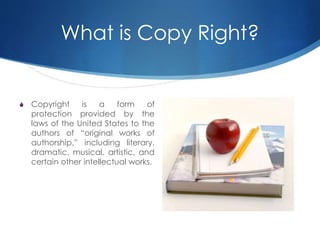
What is Copy Right?
S Copyright is a form of
protection provided by the
laws of the United States to the
authors of “original works of
authorship,” including literary,
dramatic, musical, artistic, and
certain other intellectual works.
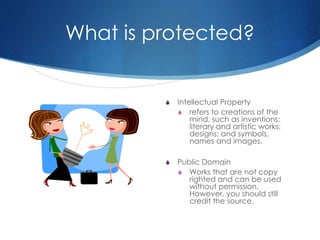
What is protected?
S Intellectual Property
S refers to creations of the
mind, such as inventions;
literary and artistic works;
designs; and symbols,
names and images.
S Public Domain
S Works that are not copy
righted and can be used
without permission.
However, you should still
credit the source.
Copy Right Rule of Thumb
S Fair Use
S Fair use allows you to use a small amount of
copyrighted materials for educational use only!
S First you must answer these questions?
S Does it have an educational purpose?
S Will your use deprive the author from making money?
S How much of the material are you using?
Teach Act
S The TEACH Act expands the scope of educators' rights to
perform and display works and to make the copies
integral to such performances and displays for digital
distance education, making the rights closer to those we
have in face-to-face teaching. For example, as indicated
above, an educator may show or perform any work
related to the curriculum, regardless of the medium, face-
to-face in the classroom - still images, music of every kind,
even movies. There are no limits and no permission
required
FAQs
S Teach Act
S Copy Right
S Test your plagiarism knowledge
S Software Piracy
References
S http://www.wipo.int/about-ip/en/
S http://www.cyberbee.com/cb_copyright.swf
S http://www.copyright.com/media/pdfs/CR-Teach-
Act.pdf
S http://www.copyright.gov/circs/circ01.pdf
S http://copyright.lib.utexas.edu/teachact.html
S http://www.teachingcopyright.org/handout/fair-use-faq

Copy right 1

  • 1.
  • 2.
    What is CopyRight? S Copyright is a form of protection provided by the laws of the United States to the authors of “original works of authorship,” including literary, dramatic, musical, artistic, and certain other intellectual works.
  • 3.
    What is protected? SIntellectual Property S refers to creations of the mind, such as inventions; literary and artistic works; designs; and symbols, names and images. S Public Domain S Works that are not copy righted and can be used without permission. However, you should still credit the source.
  • 4.
    Copy Right Ruleof Thumb S Fair Use S Fair use allows you to use a small amount of copyrighted materials for educational use only! S First you must answer these questions? S Does it have an educational purpose? S Will your use deprive the author from making money? S How much of the material are you using?
  • 5.
    Teach Act S TheTEACH Act expands the scope of educators' rights to perform and display works and to make the copies integral to such performances and displays for digital distance education, making the rights closer to those we have in face-to-face teaching. For example, as indicated above, an educator may show or perform any work related to the curriculum, regardless of the medium, face- to-face in the classroom - still images, music of every kind, even movies. There are no limits and no permission required
  • 6.
    FAQs S Teach Act SCopy Right S Test your plagiarism knowledge S Software Piracy
  • 8.
    References S http://www.wipo.int/about-ip/en/ S http://www.cyberbee.com/cb_copyright.swf Shttp://www.copyright.com/media/pdfs/CR-Teach- Act.pdf S http://www.copyright.gov/circs/circ01.pdf S http://copyright.lib.utexas.edu/teachact.html S http://www.teachingcopyright.org/handout/fair-use-faq