Copyright For
Teaching-Learning in
the 21st Century
Dr. Sabuj Kumar Chaudhuri
Department of Library & Information Science
University of Calcutta
Email: sabujkchaudhuri@gmail.com
Disclaimer
I am not lawyer. I can not give
you any legal advice
We Deal with the Contents
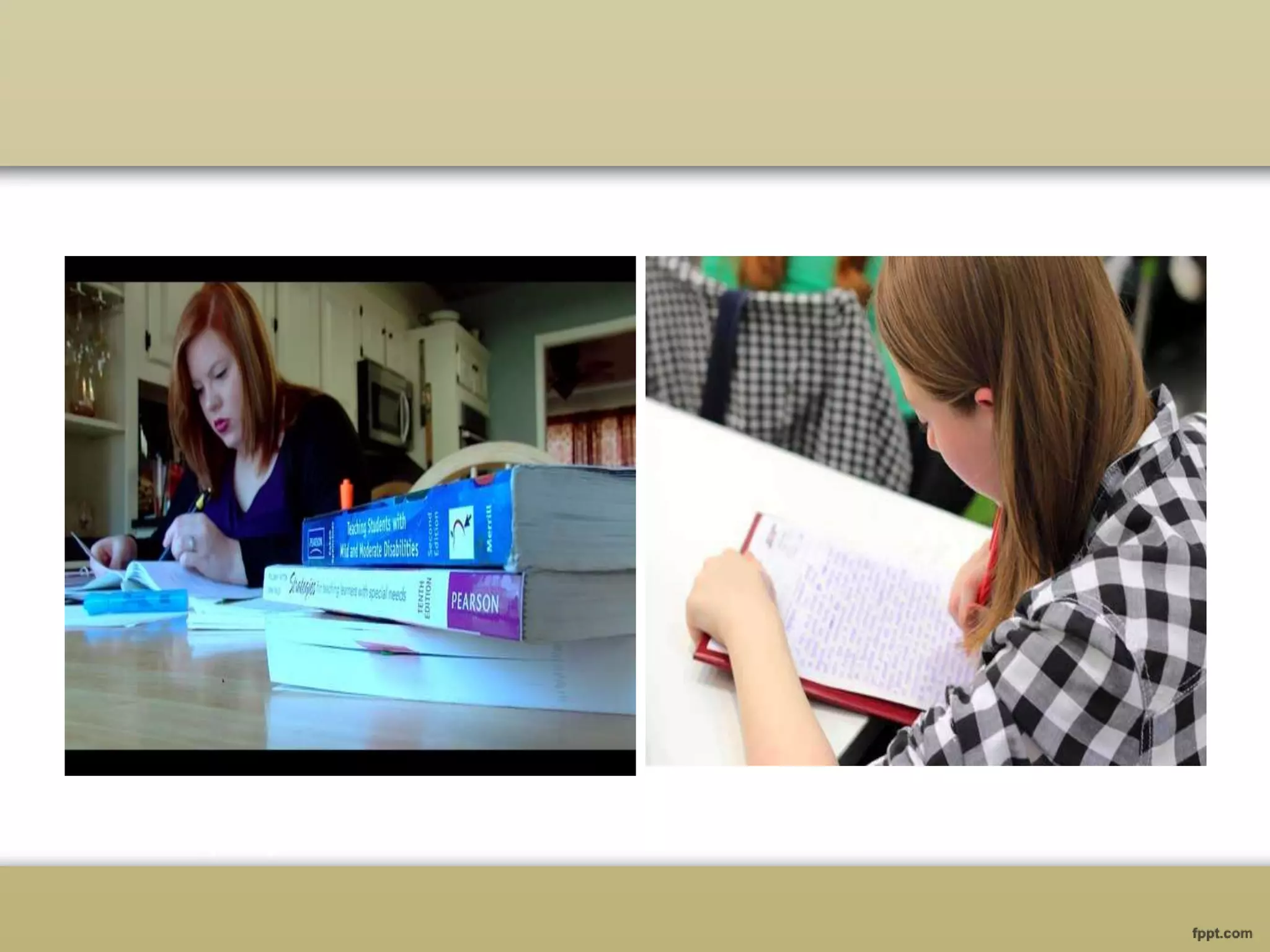
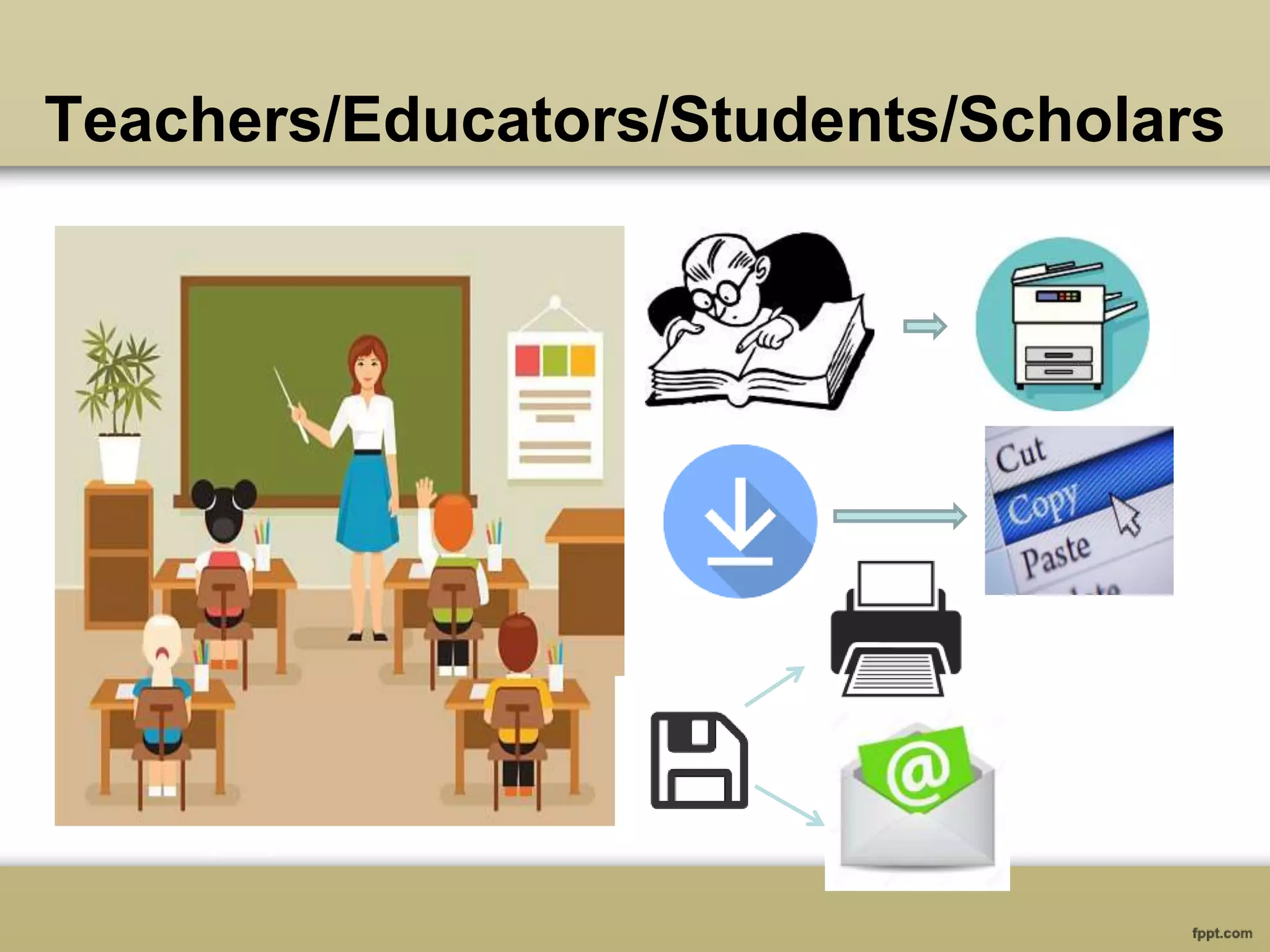
Teachers/Educators/Students/Scholars
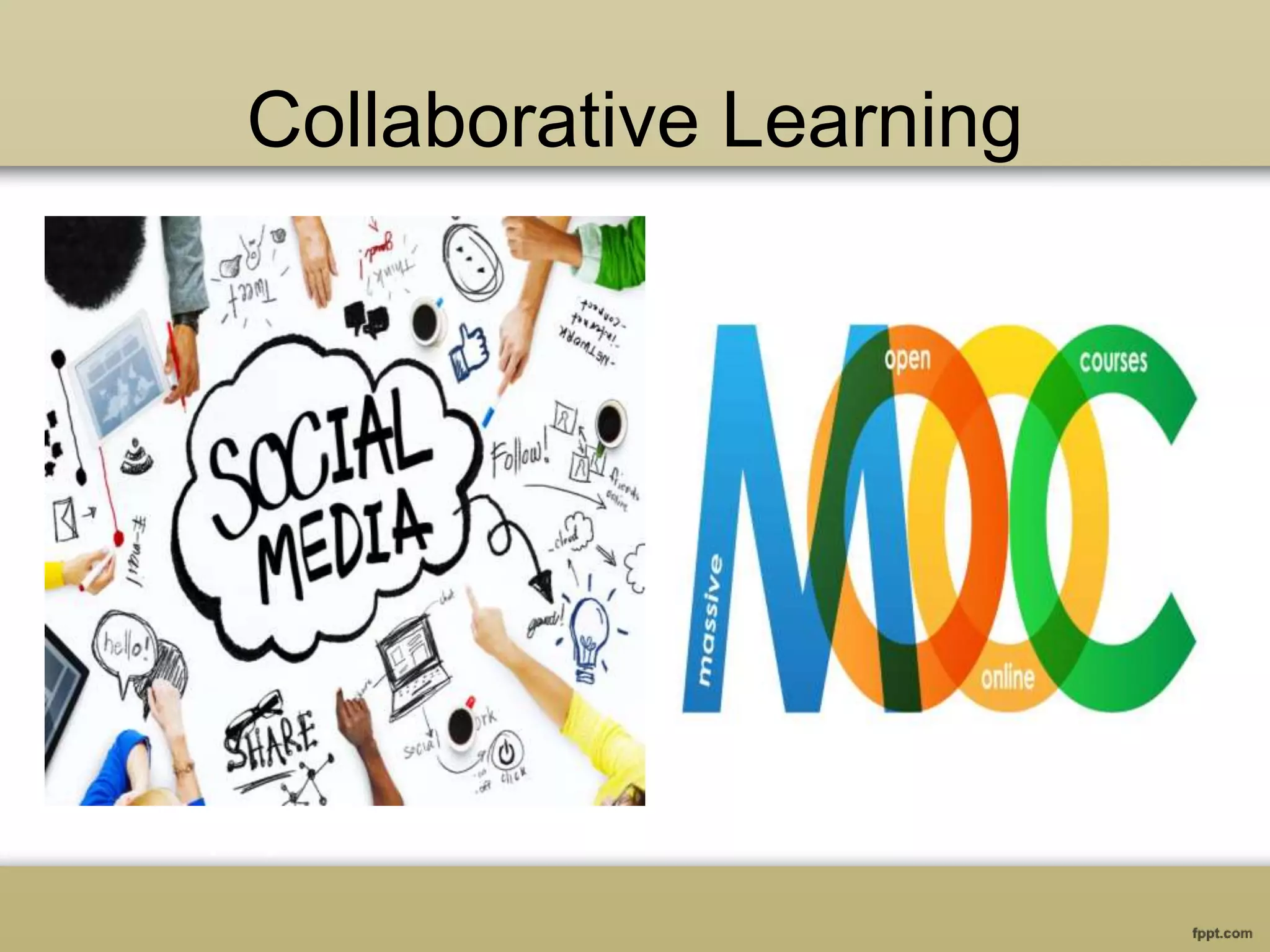
Collaborative Learning
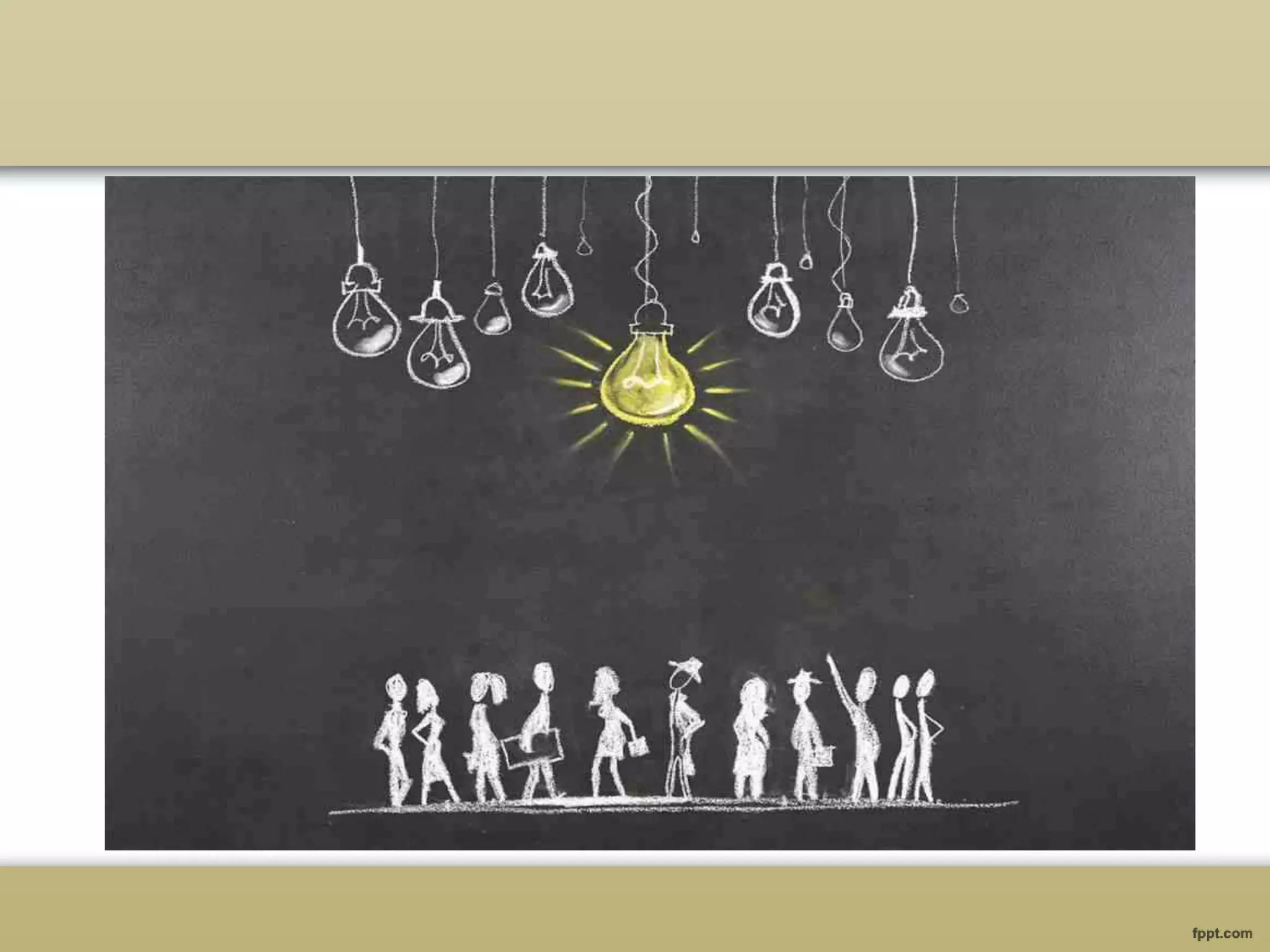
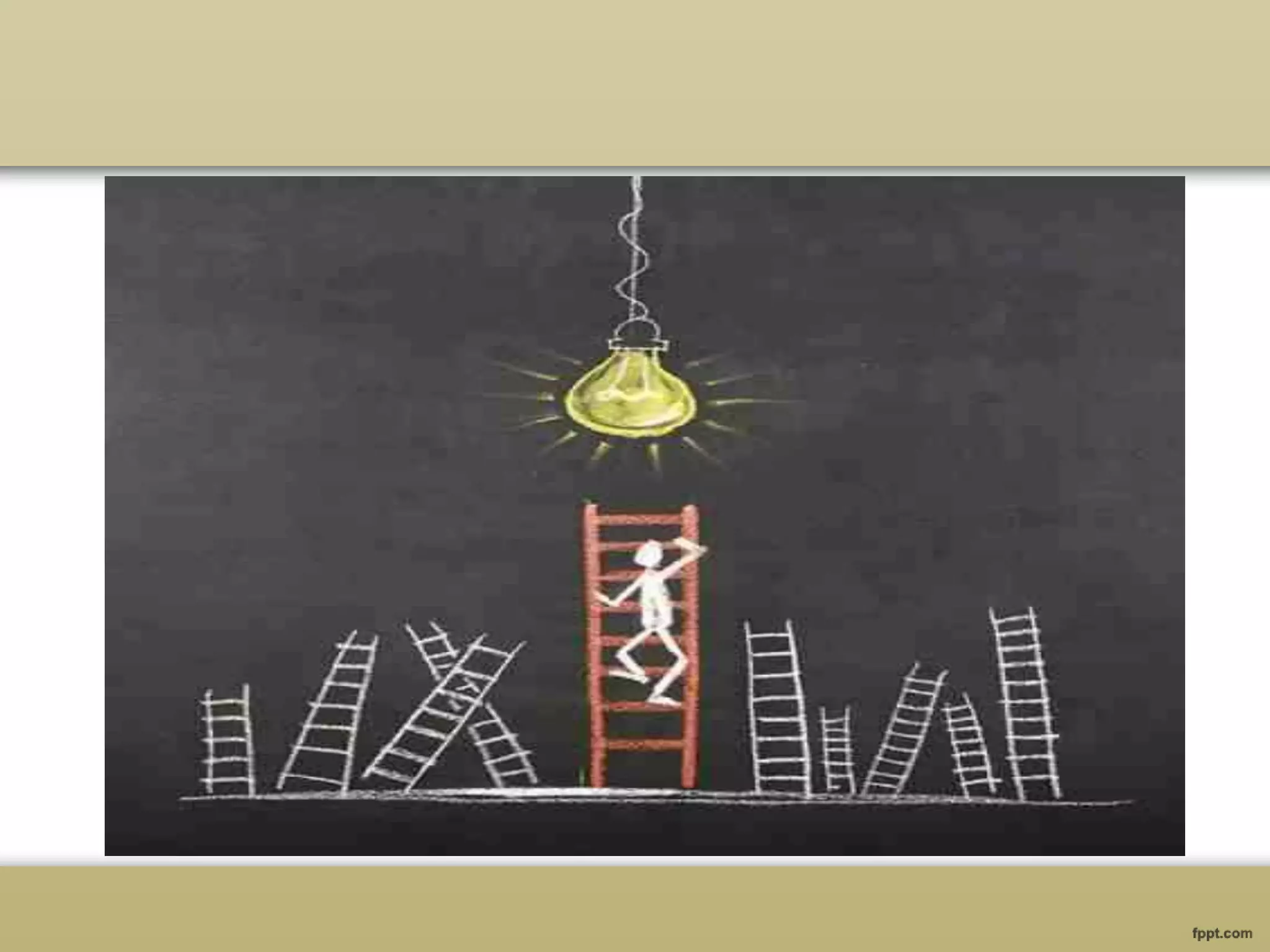
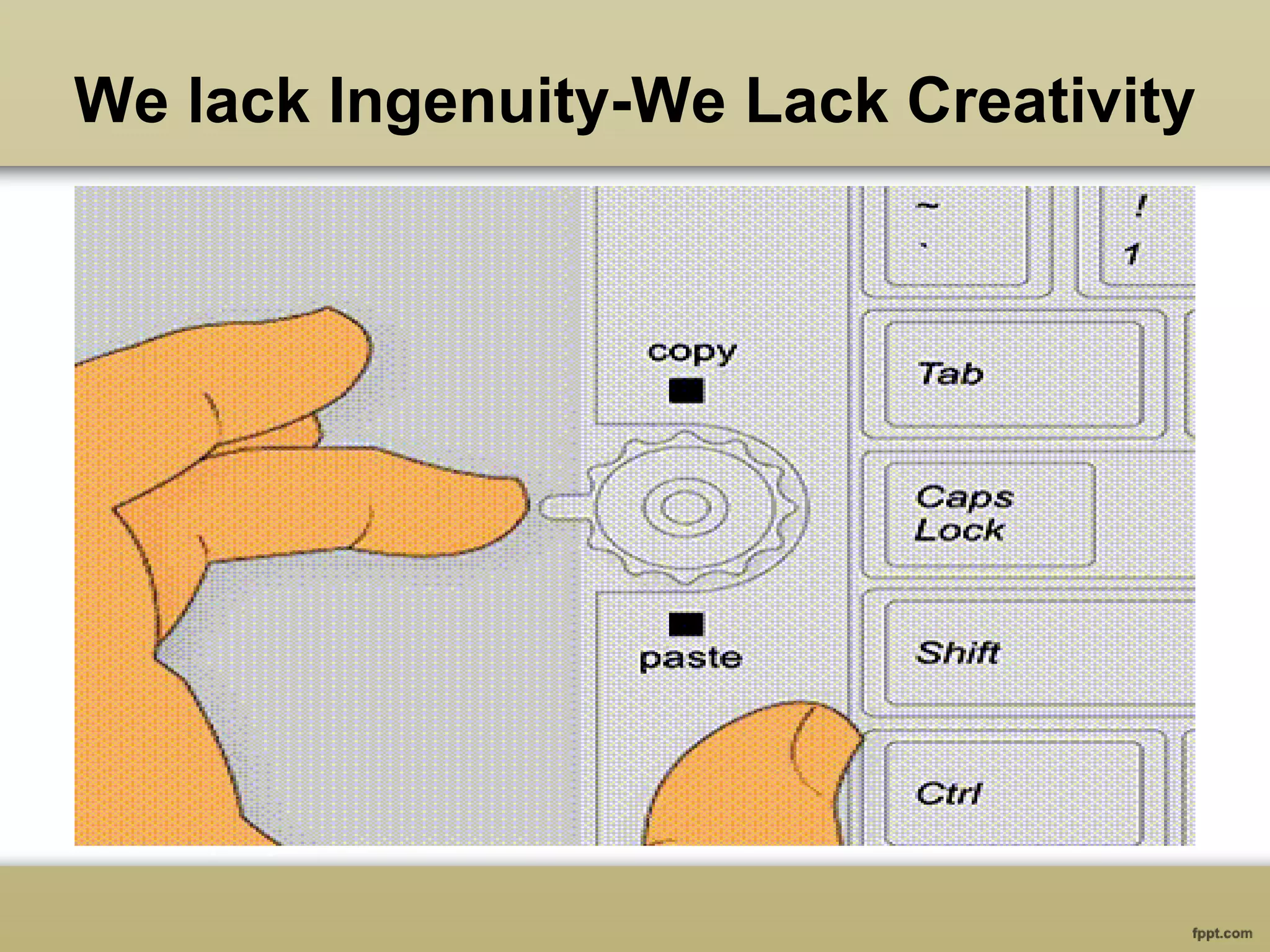
We lack Ingenuity-We Lack Creativity
Unfortunately, Internet is not Copyright Free Zone
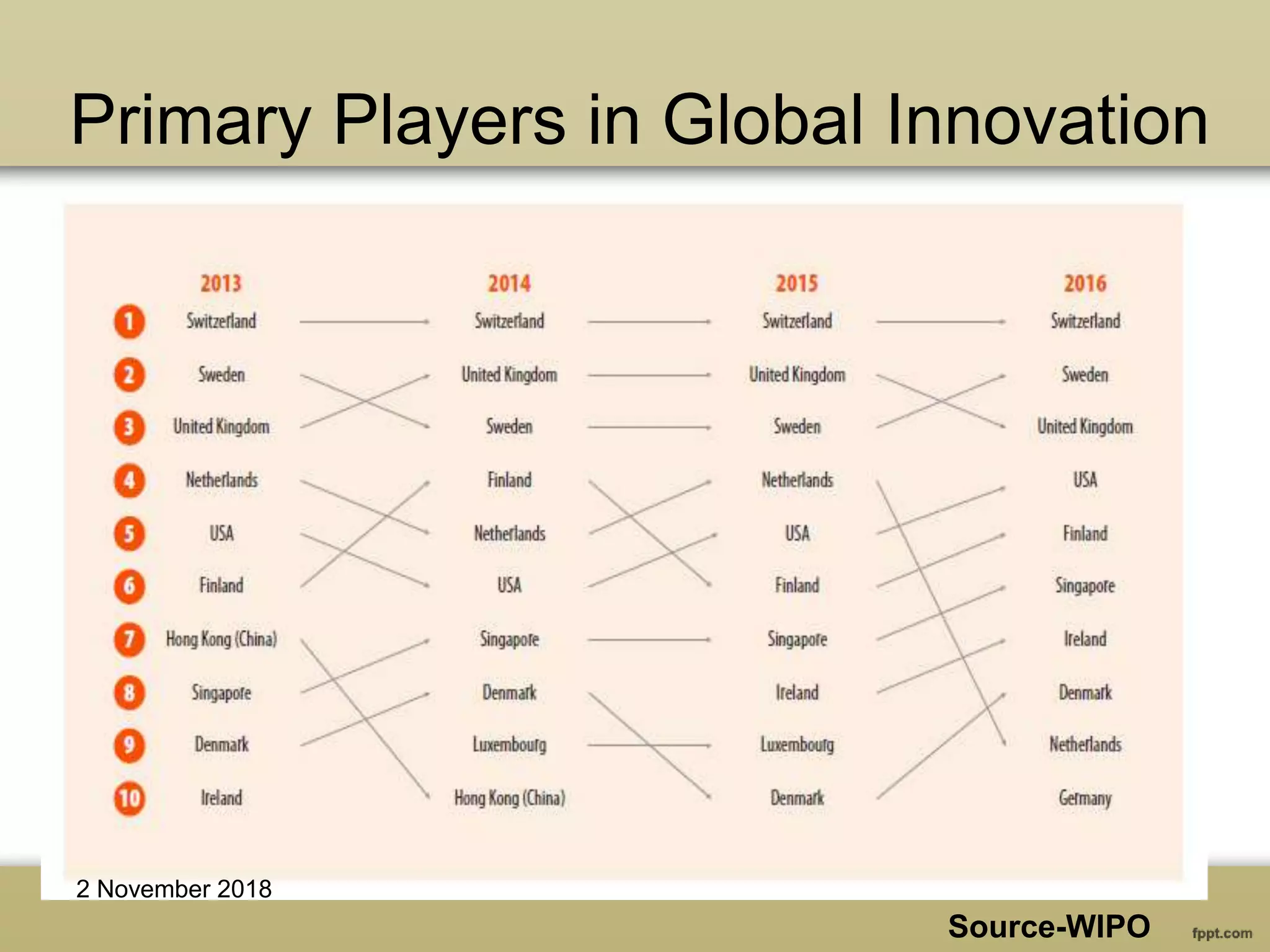
Primary Players in Global Innovation
Source-WIPO
2 November 2018
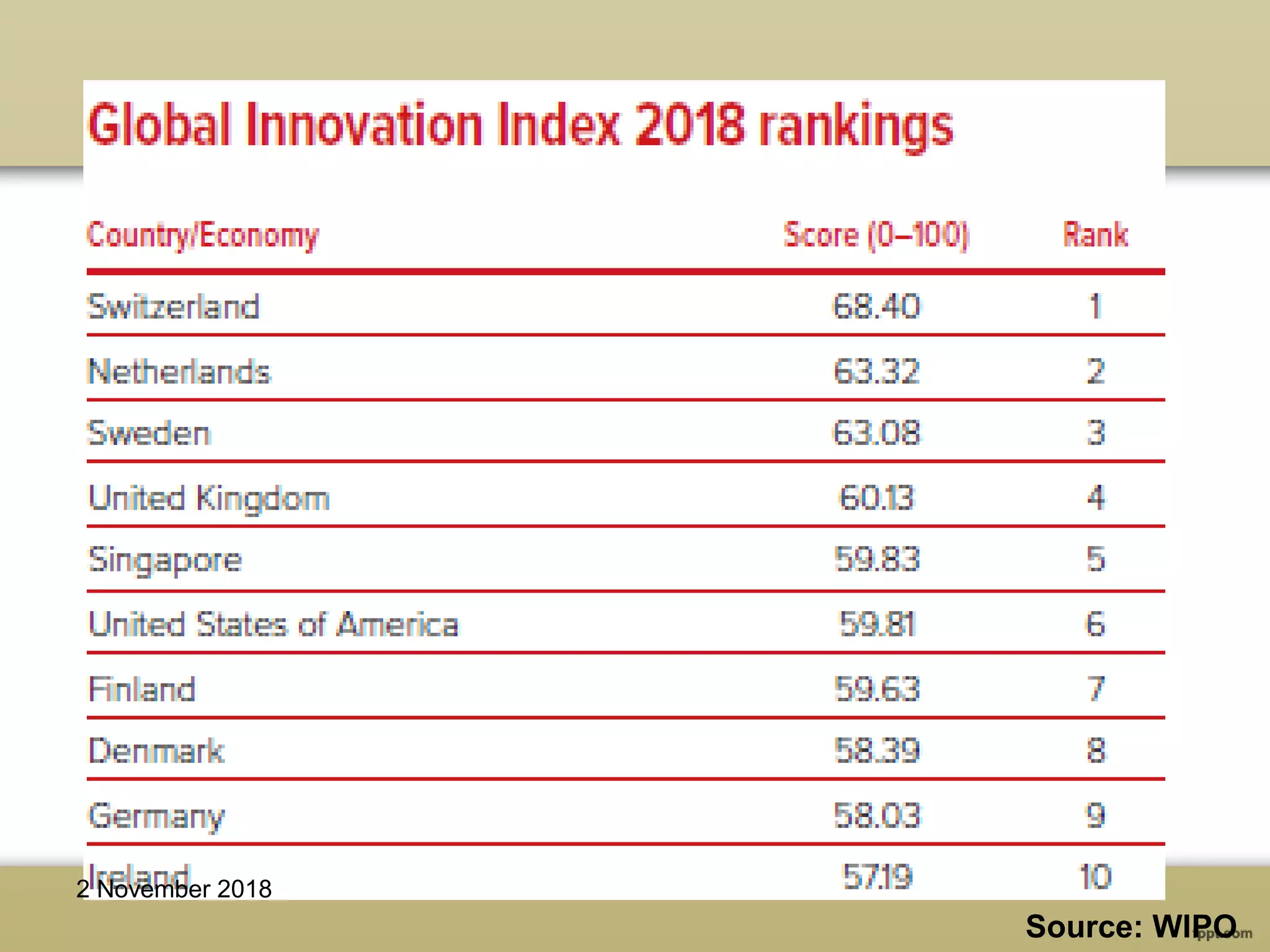
Source: WIPO
2 November 2018
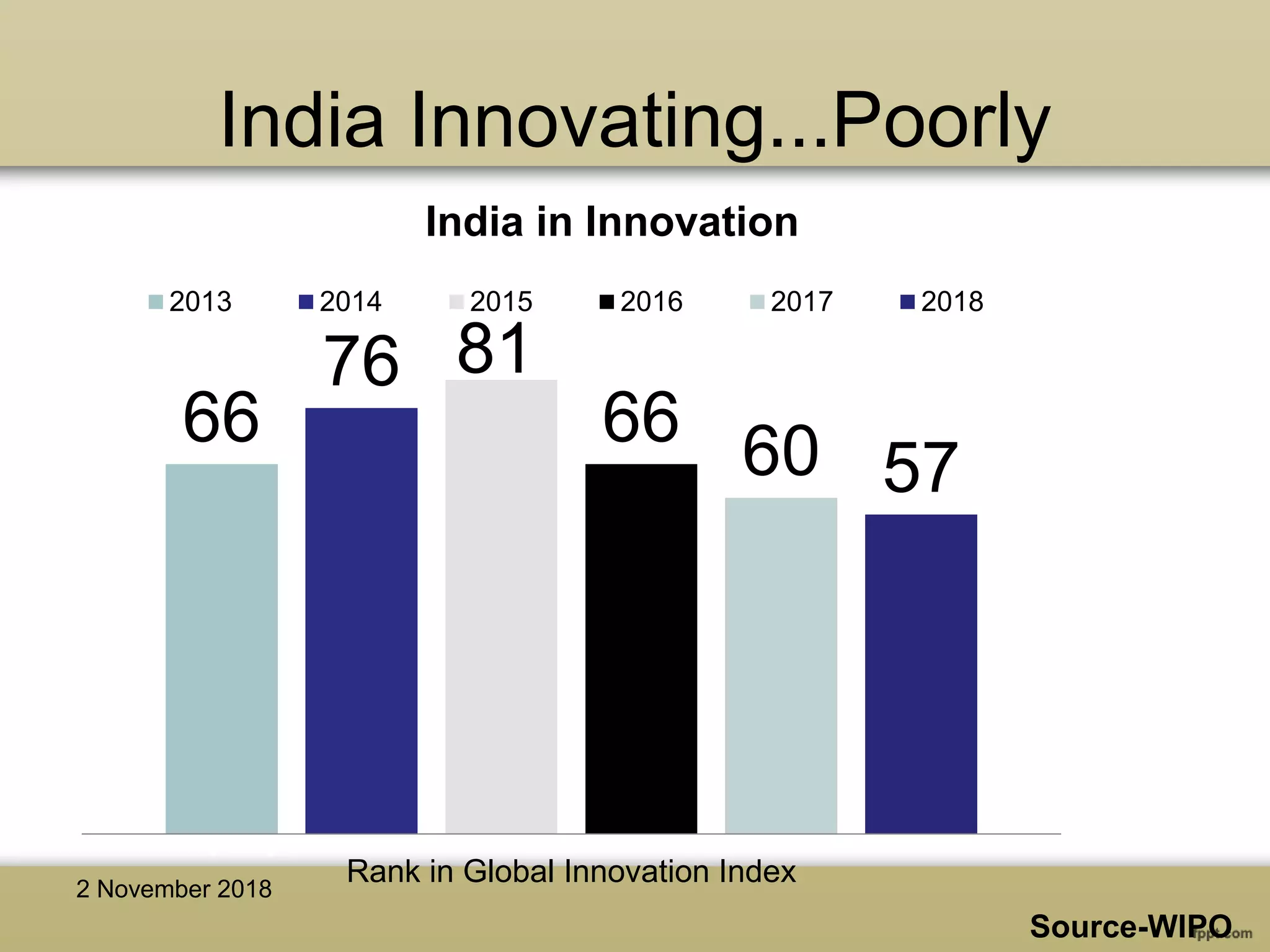
India Innovating...Poorly
66
76 81
66 60 57
Rank in Global Innovation Index
India in Innovation
2013 2014 2015 2016 2017 2018
Source-WIPO
2 November 2018
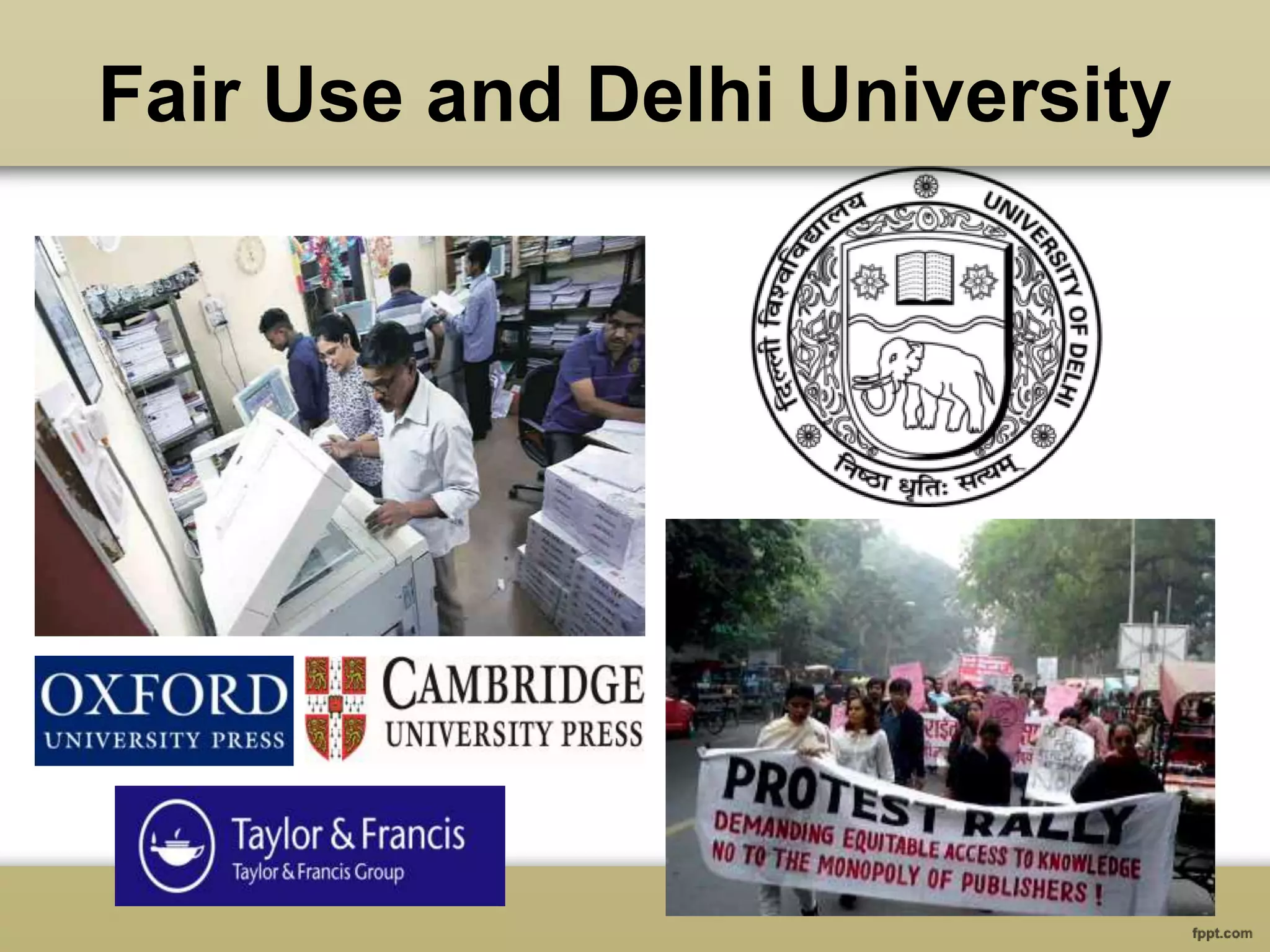
Fair Use and Delhi University
Contd...
• The petition was filed by three publishers—Oxford
University Press, Cambridge University Press and
Taylor & Francis —against the University of Delhi
and Rameshwari Photocopy Services, alleged to
have violated India’s copyright law by selling
photocopied compilations of study material as
‘course packs’. The petitioners argue that this
amounts to a parallel publishing enterprise of sorts
that is not just illegal, but also harms their market
sales.
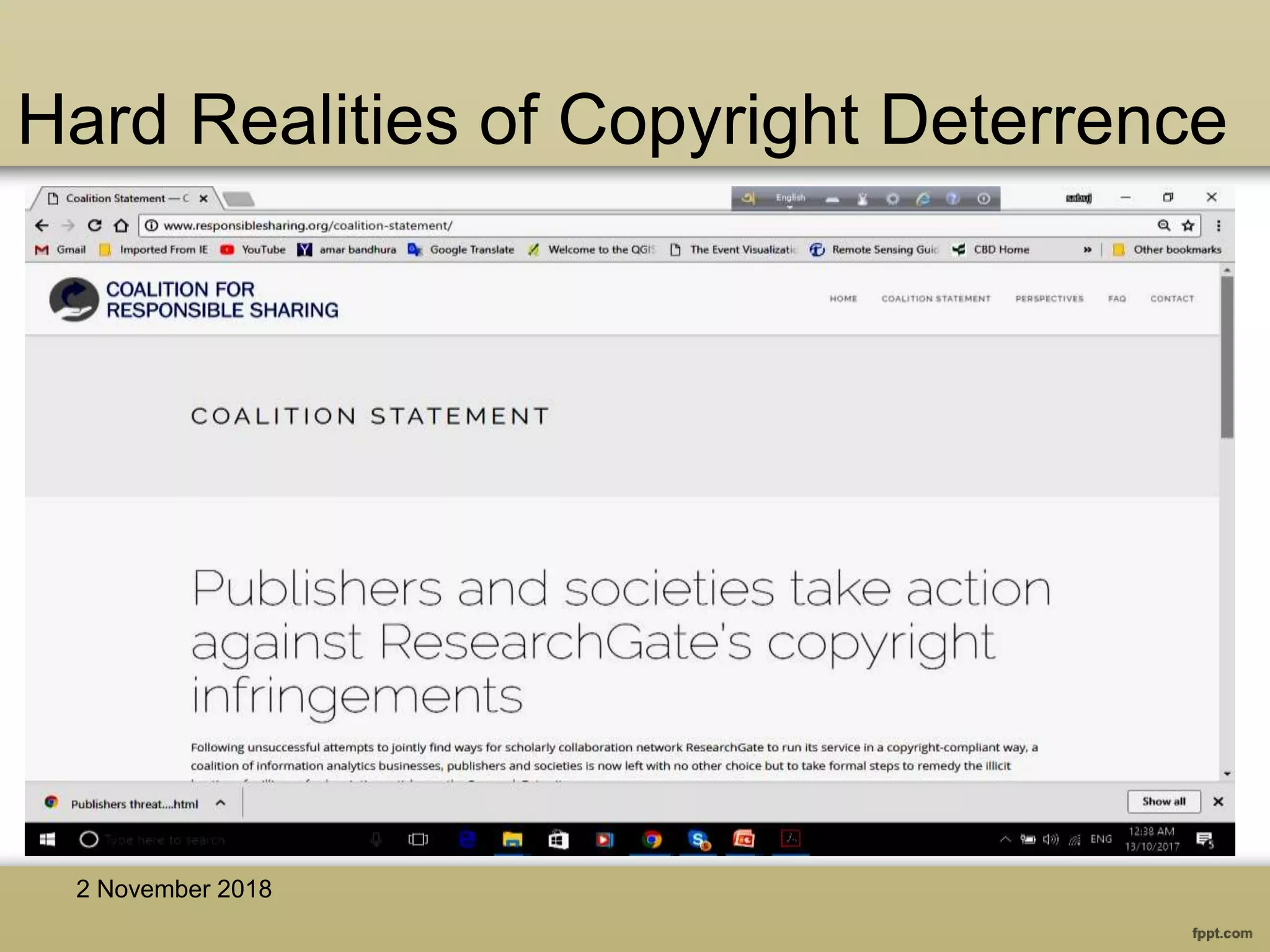
Hard Realities of Copyright Deterrence
2 November 2018
Renowned Publishers Blocking Sharing and Access to
Knowledge
2 November 2018
Technologically Protected Resources
2 November 2018
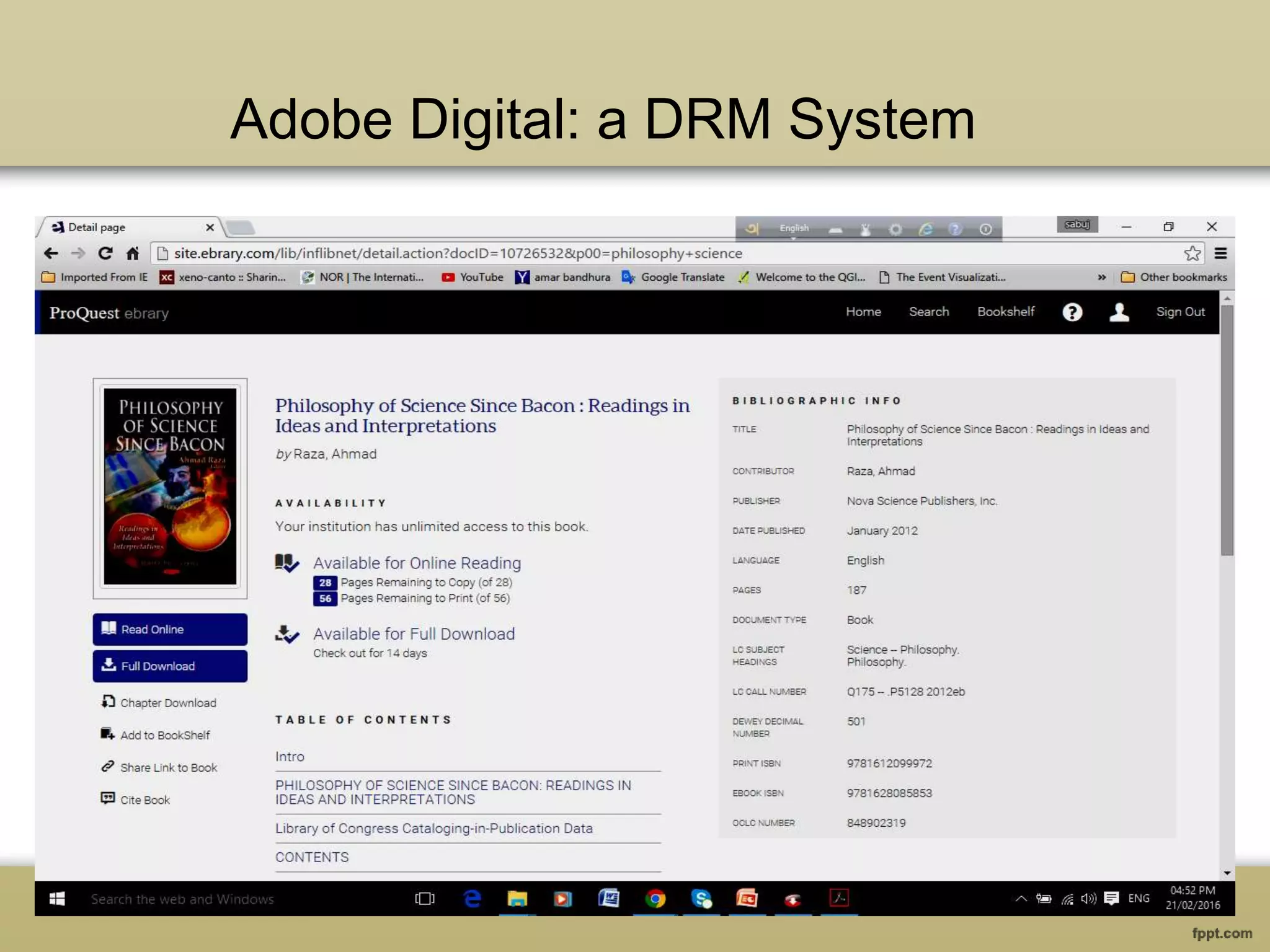
Adobe Digital: a DRM System
2 November 2018
2 November 2018
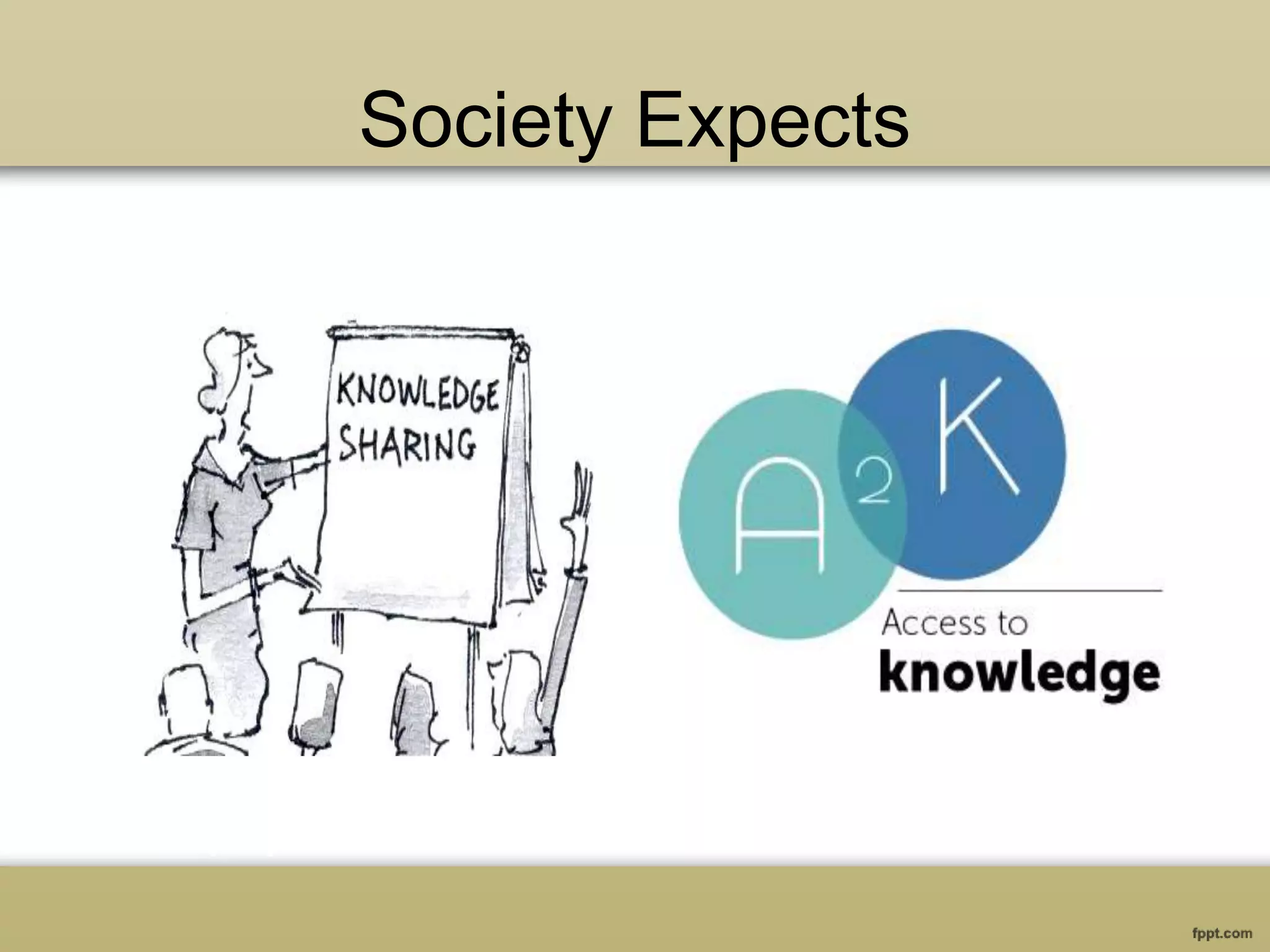
Society Expects
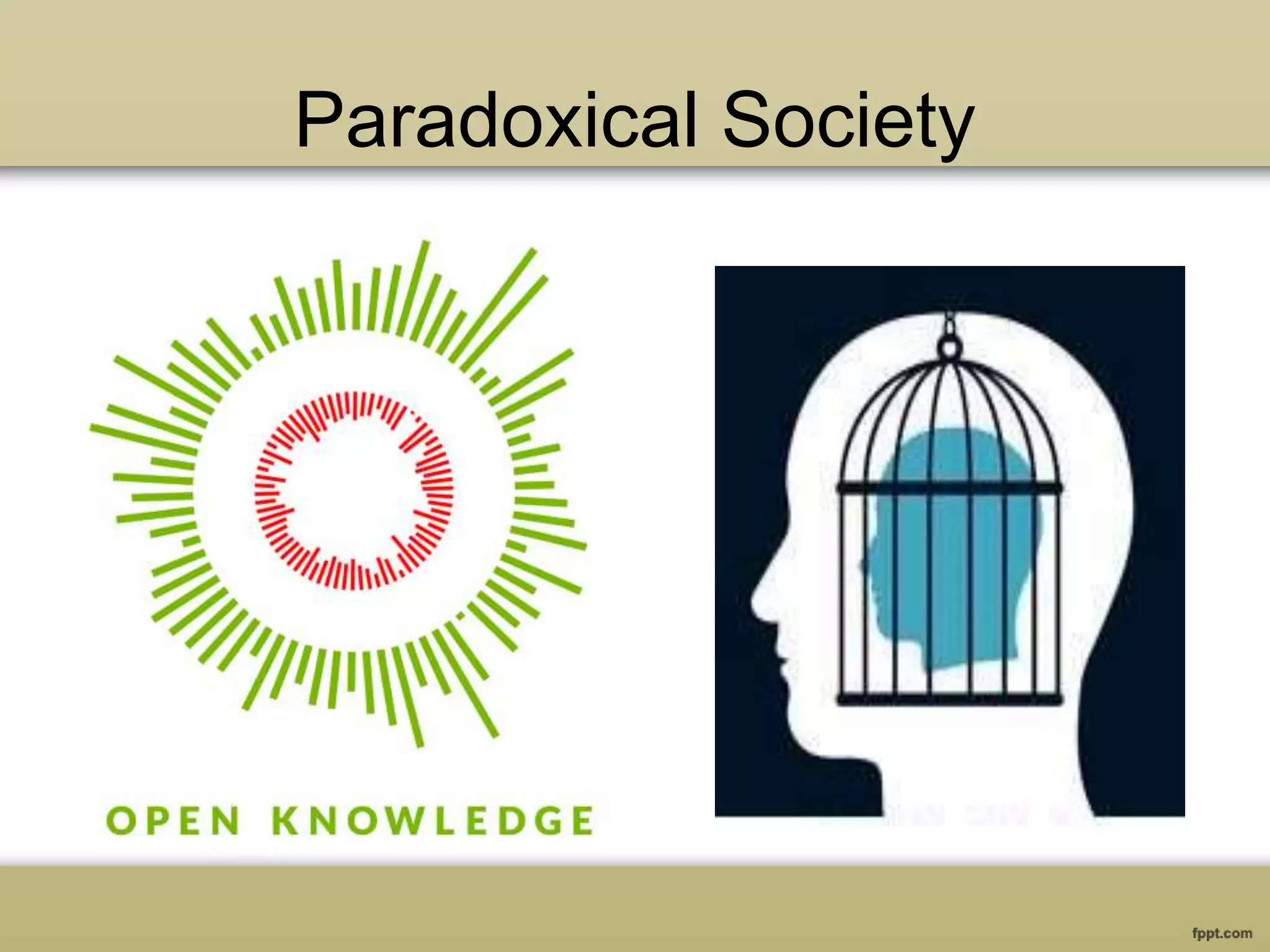
Paradoxical Society
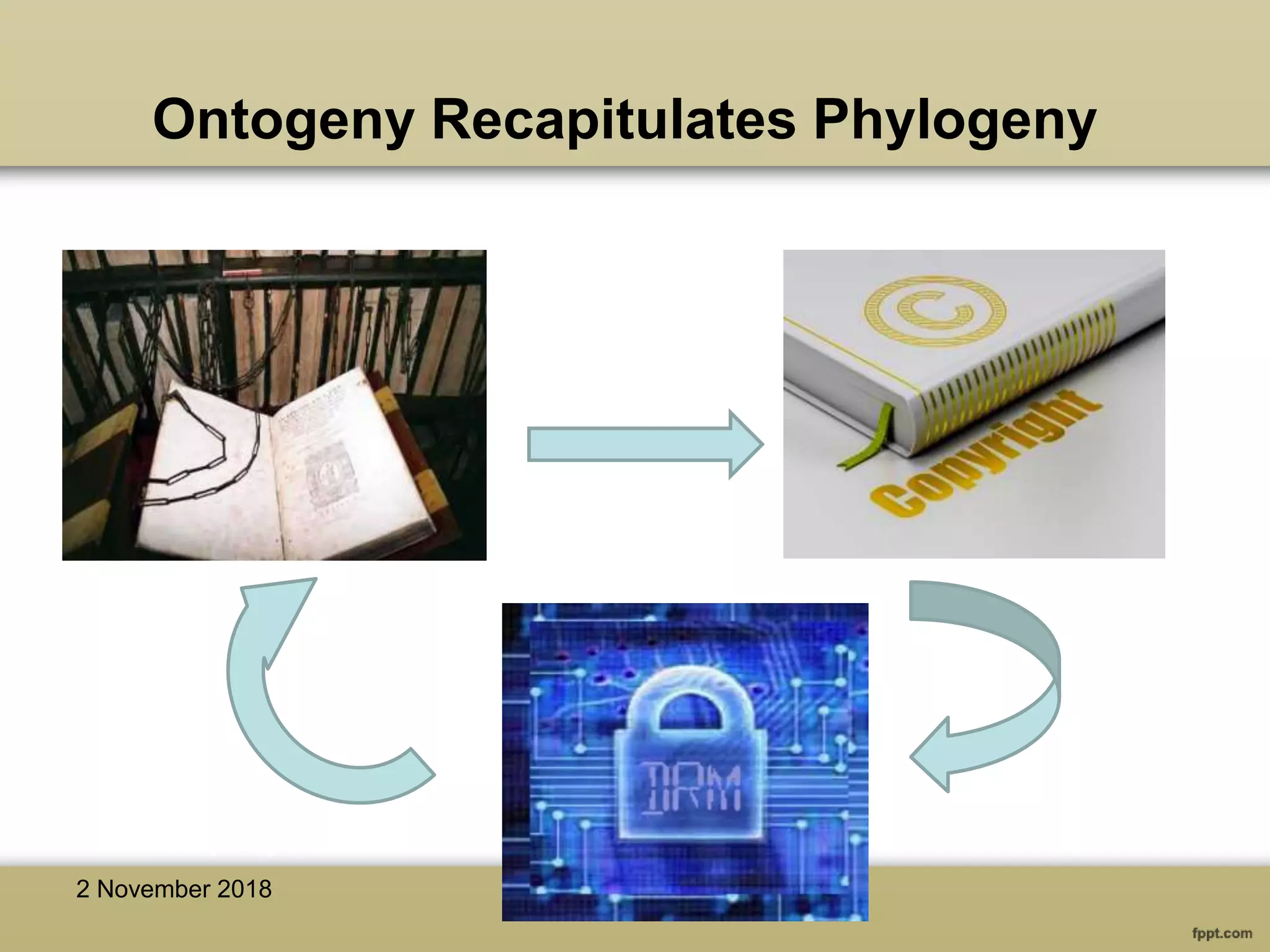
Ontogeny Recapitulates Phylogeny
2 November 2018
Let us Demystify Copyright...
IPR protecting your creativity
Basics of IPR
• What is property?
• What is Intellectual property (IP)?
• What is Intellectual Property
Rights(IPR)?
3011/2/2018
Property
• The primary definition in the Oxford English Dictionary states
that ‘proper’ means ‘belonging to oneself or itself.
• Generally it has 3 understandings :
• Scientific Understandings:
• Properties are attributes, characteristics or qualities that can be
applied generally to a group of objects.
• Legal Understandings:
• Property is the inclusion of rights of exclusive use and alienability
• Economic Understandings:
• Property includes all rights of individuals to valuable resources.
3111/2/2018
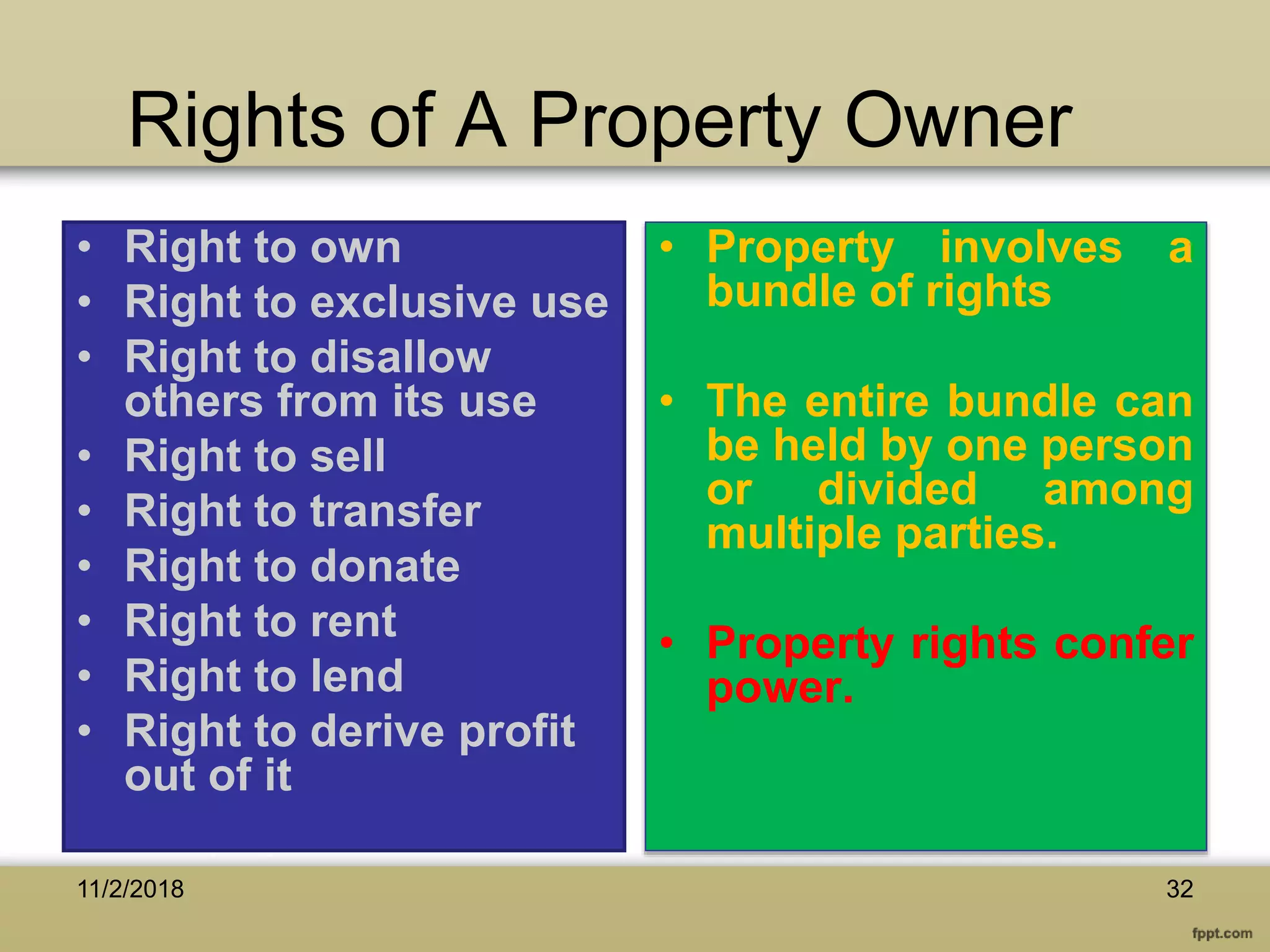
Rights of A Property Owner
• Right to own
• Right to exclusive use
• Right to disallow
others from its use
• Right to sell
• Right to transfer
• Right to donate
• Right to rent
• Right to lend
• Right to derive profit
out of it
• Property involves a
bundle of rights
• The entire bundle can
be held by one person
or divided among
multiple parties.
• Property rights confer
power.
11/2/2018 32
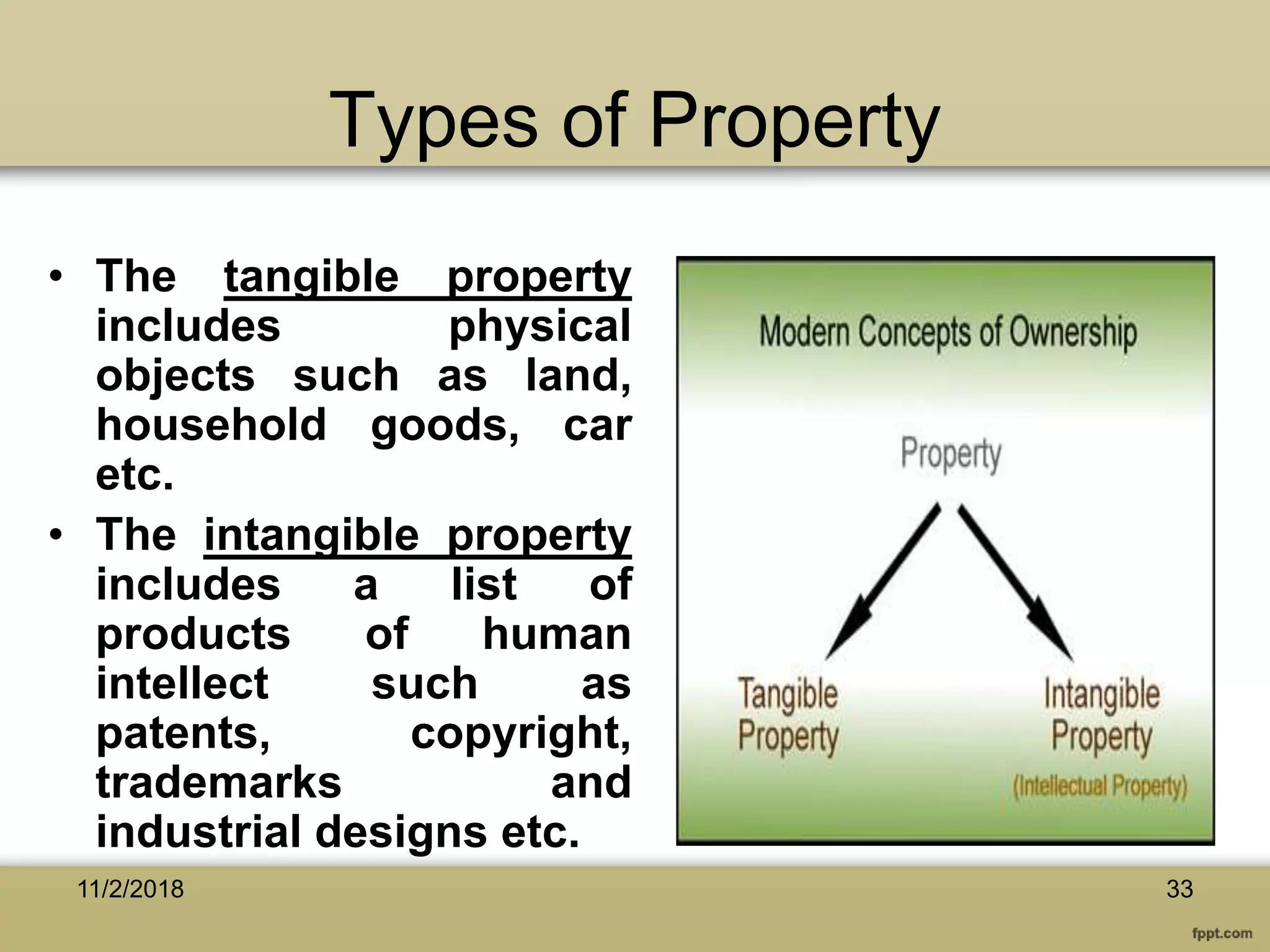
Types of Property
• The tangible property
includes physical
objects such as land,
household goods, car
etc.
• The intangible property
includes a list of
products of human
intellect such as
patents, copyright,
trademarks and
industrial designs etc.
3311/2/2018
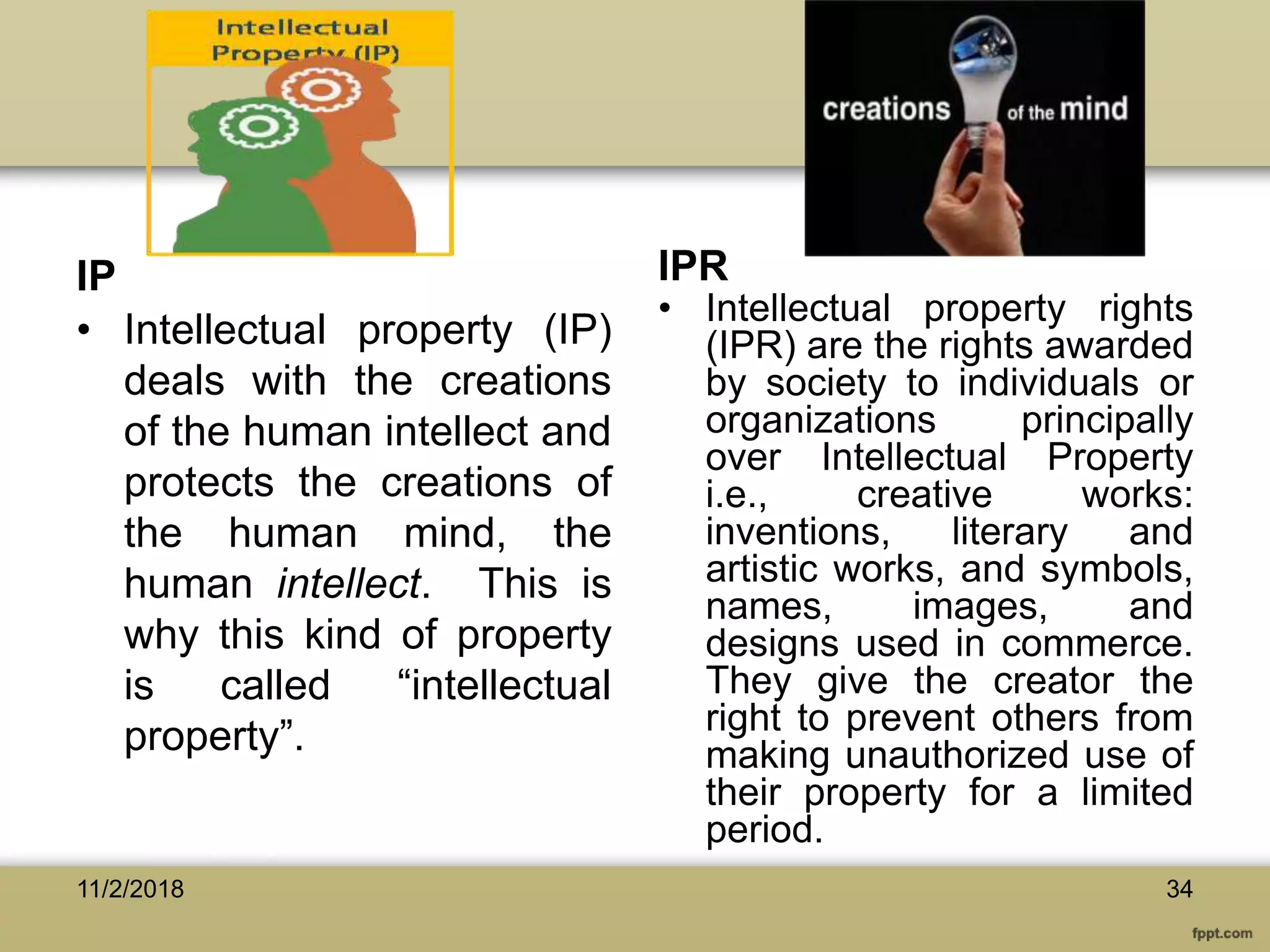
IP IPR
• Intellectual property (IP)
deals with the creations
of the human intellect and
protects the creations of
the human mind, the
human intellect. This is
why this kind of property
is called “intellectual
property”.
• Intellectual property rights
(IPR) are the rights awarded
by society to individuals or
organizations principally
over Intellectual Property
i.e., creative works:
inventions, literary and
artistic works, and symbols,
names, images, and
designs used in commerce.
They give the creator the
right to prevent others from
making unauthorized use of
their property for a limited
period.
3411/2/2018
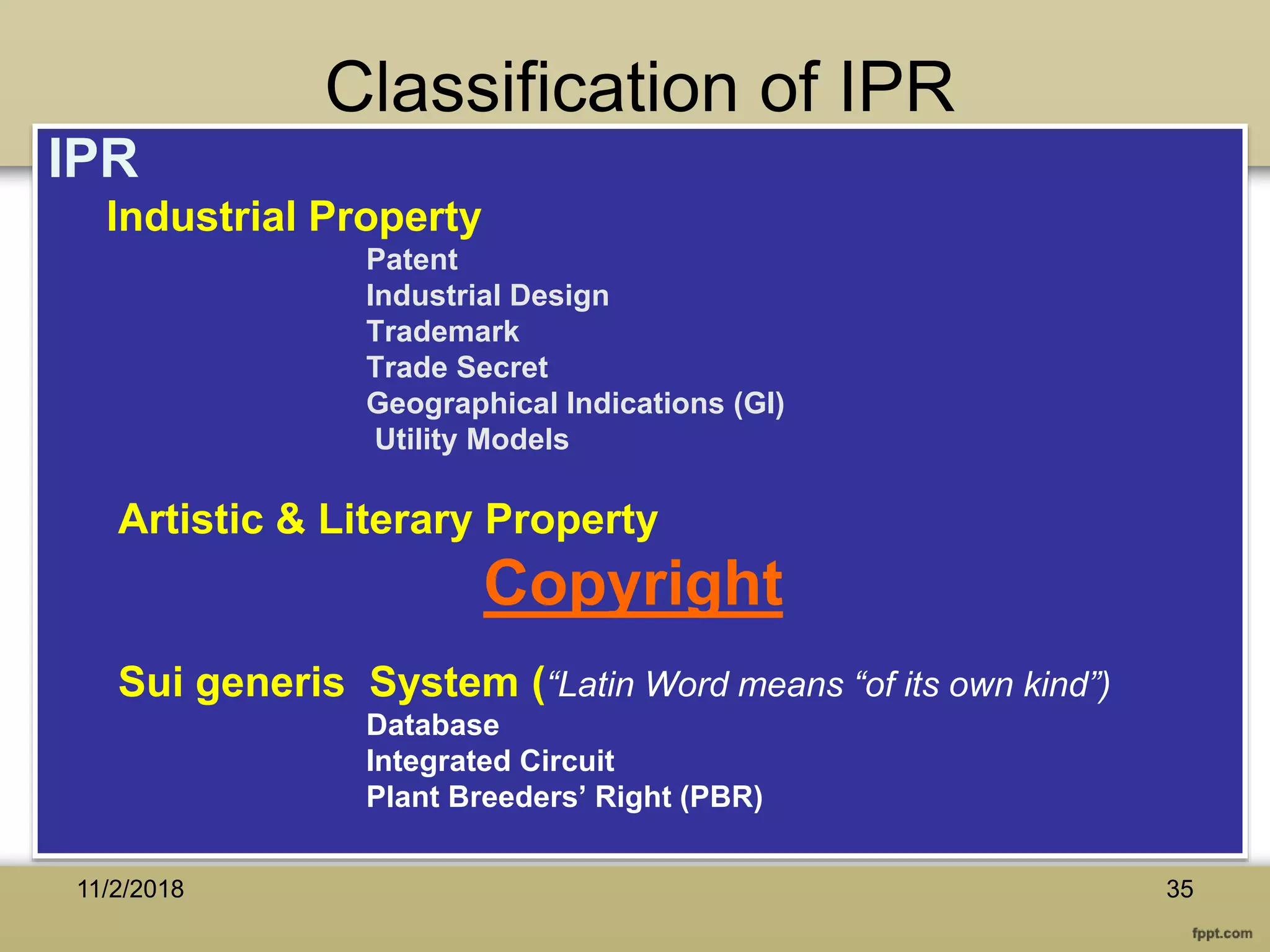
IPR
Industrial Property
Patent
Industrial Design
Trademark
Trade Secret
Geographical Indications (GI)
Utility Models
Artistic & Literary Property
Copyright
Sui generis System (“Latin Word means “of its own kind”)
Database
Integrated Circuit
Plant Breeders’ Right (PBR)
Classification of IPR
3511/2/2018
The Idea of Copyright
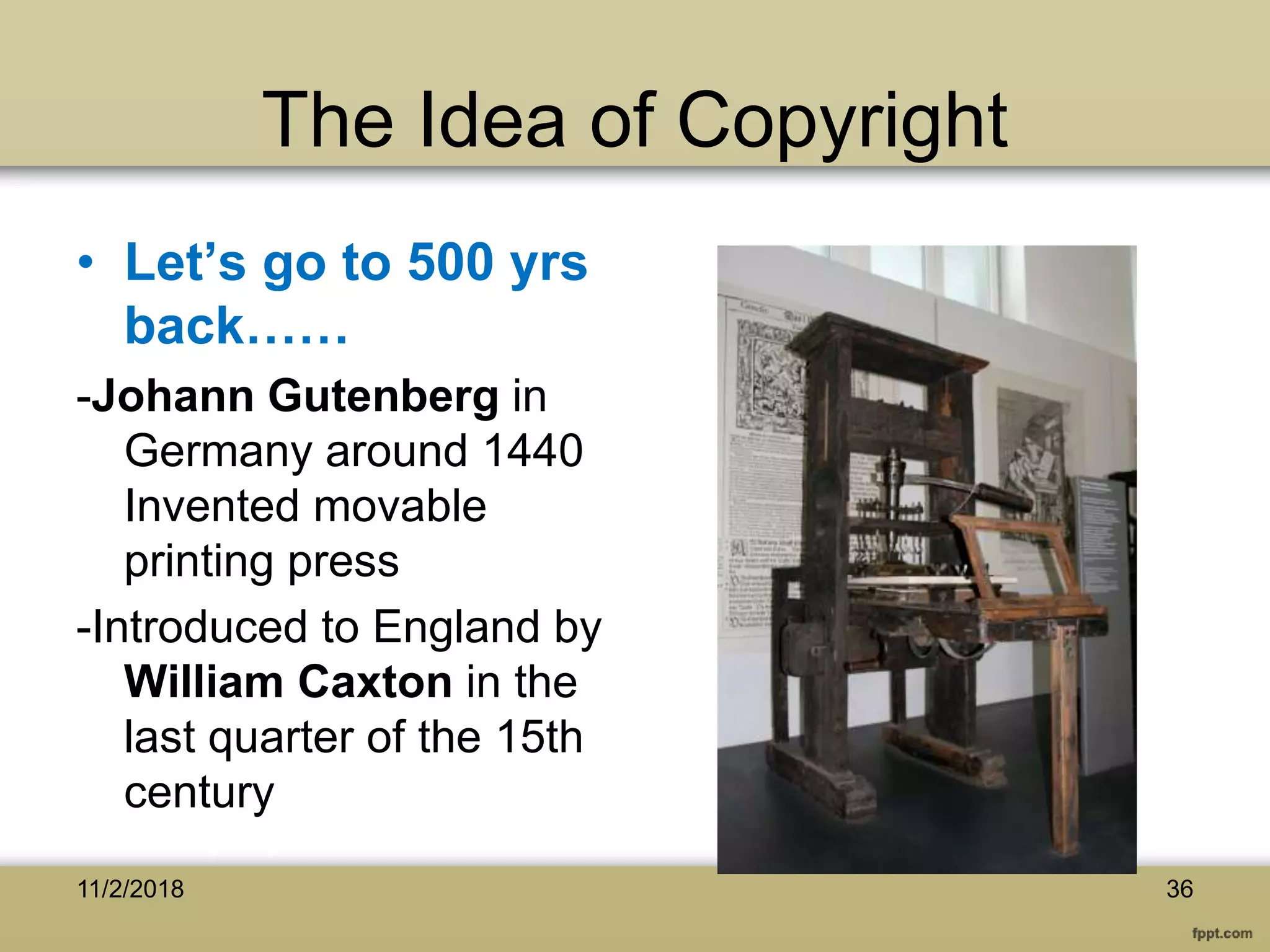
• Let’s go to 500 yrs
back……
-Johann Gutenberg in
Germany around 1440
Invented movable
printing press
-Introduced to England by
William Caxton in the
last quarter of the 15th
century
3611/2/2018
First Copyright Law
• England's Statute of
Anne (1710) is widely
regarded as the first
modern copyright law
that for the first time
protected the rights of
authors rather than
publishers of books.
• Term of copyright
was 28 years [14 years
+ 14 years if the author
was still alive]
3711/2/2018
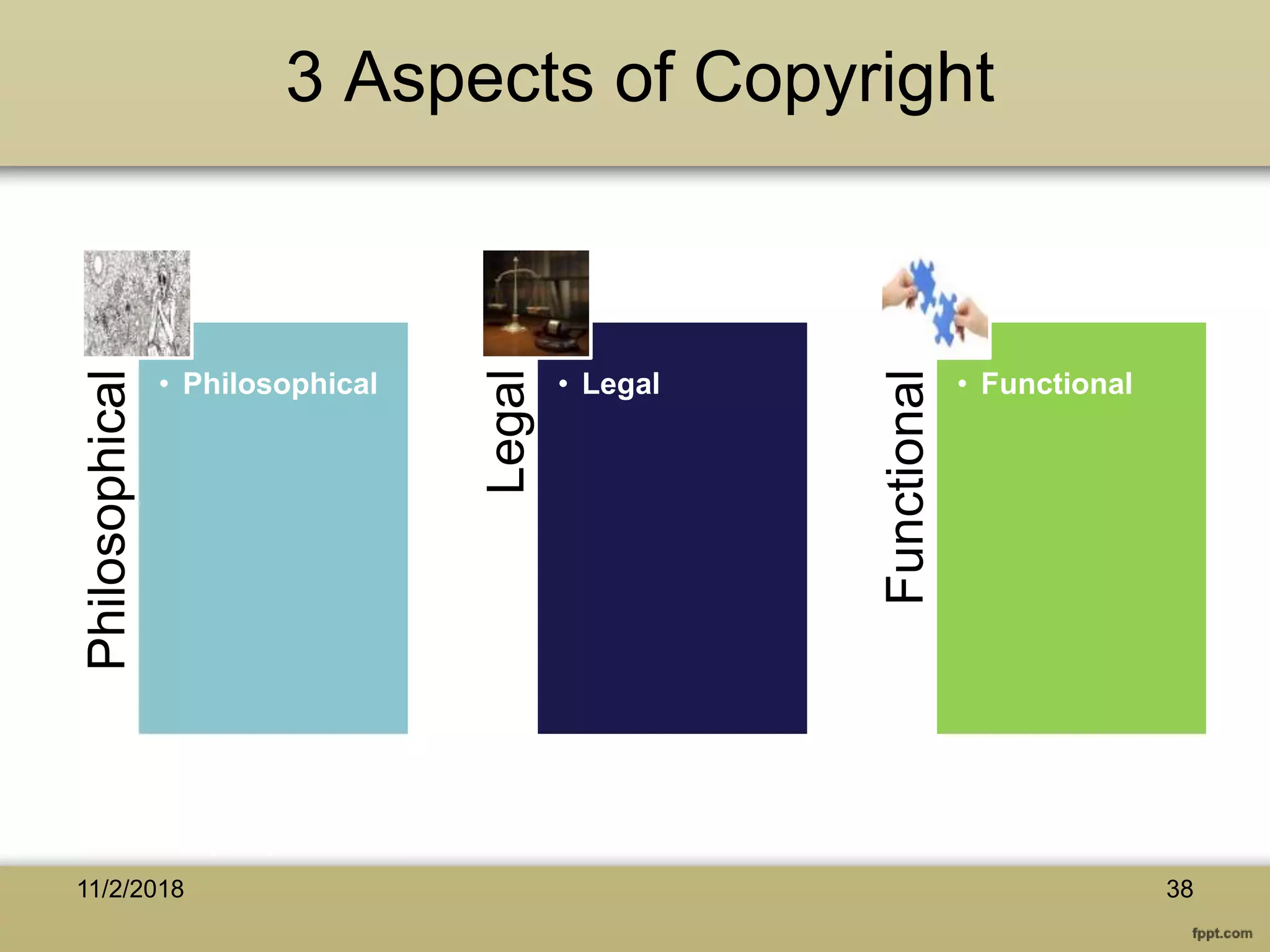
3 Aspects of Copyright
3811/2/2018
Philosophical
• Philosophical
Legal
• Legal
Functional
• Functional
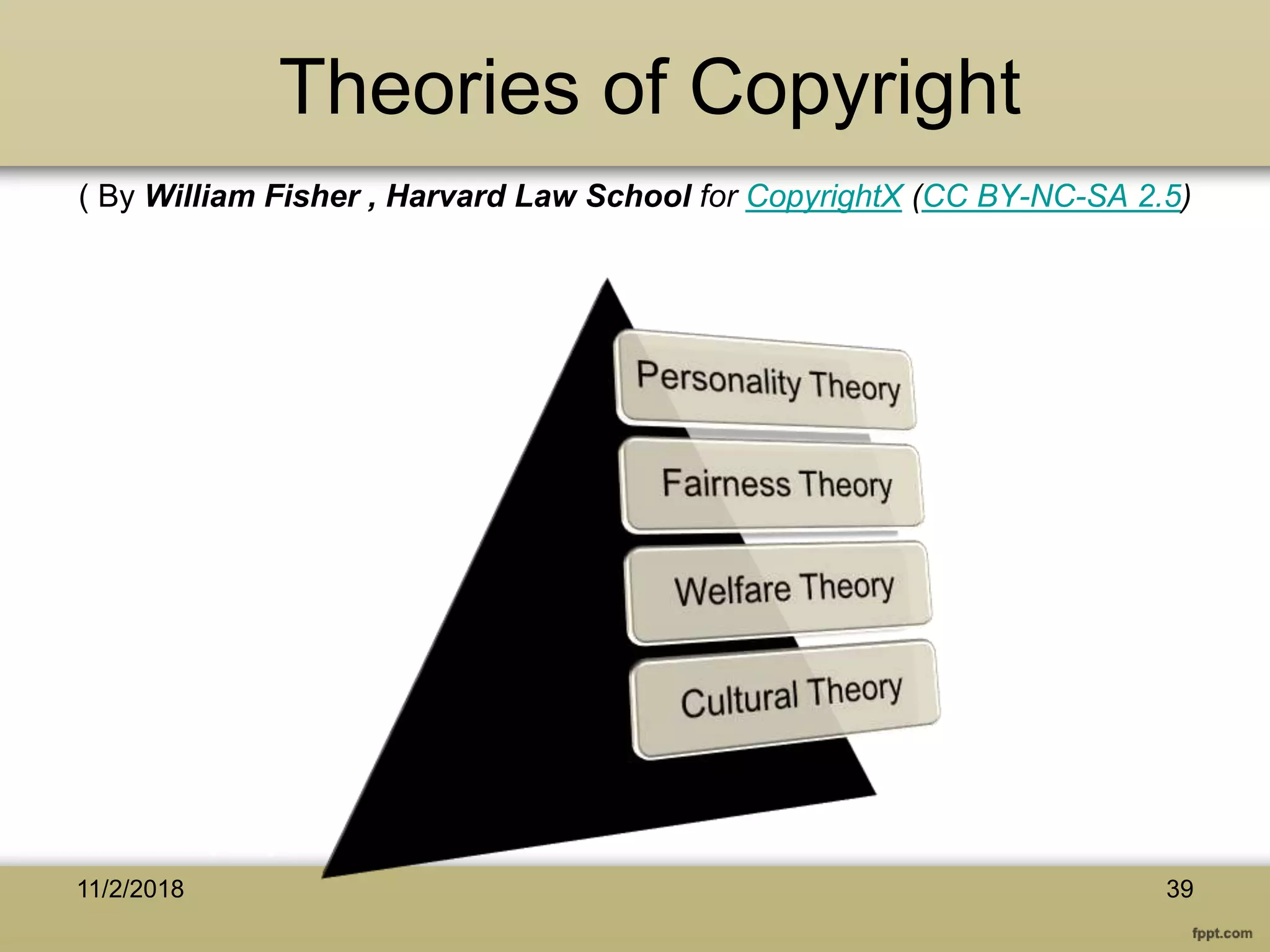
Theories of Copyright
( By William Fisher , Harvard Law School for CopyrightX (CC BY-NC-SA 2.5)
11/2/2018 39
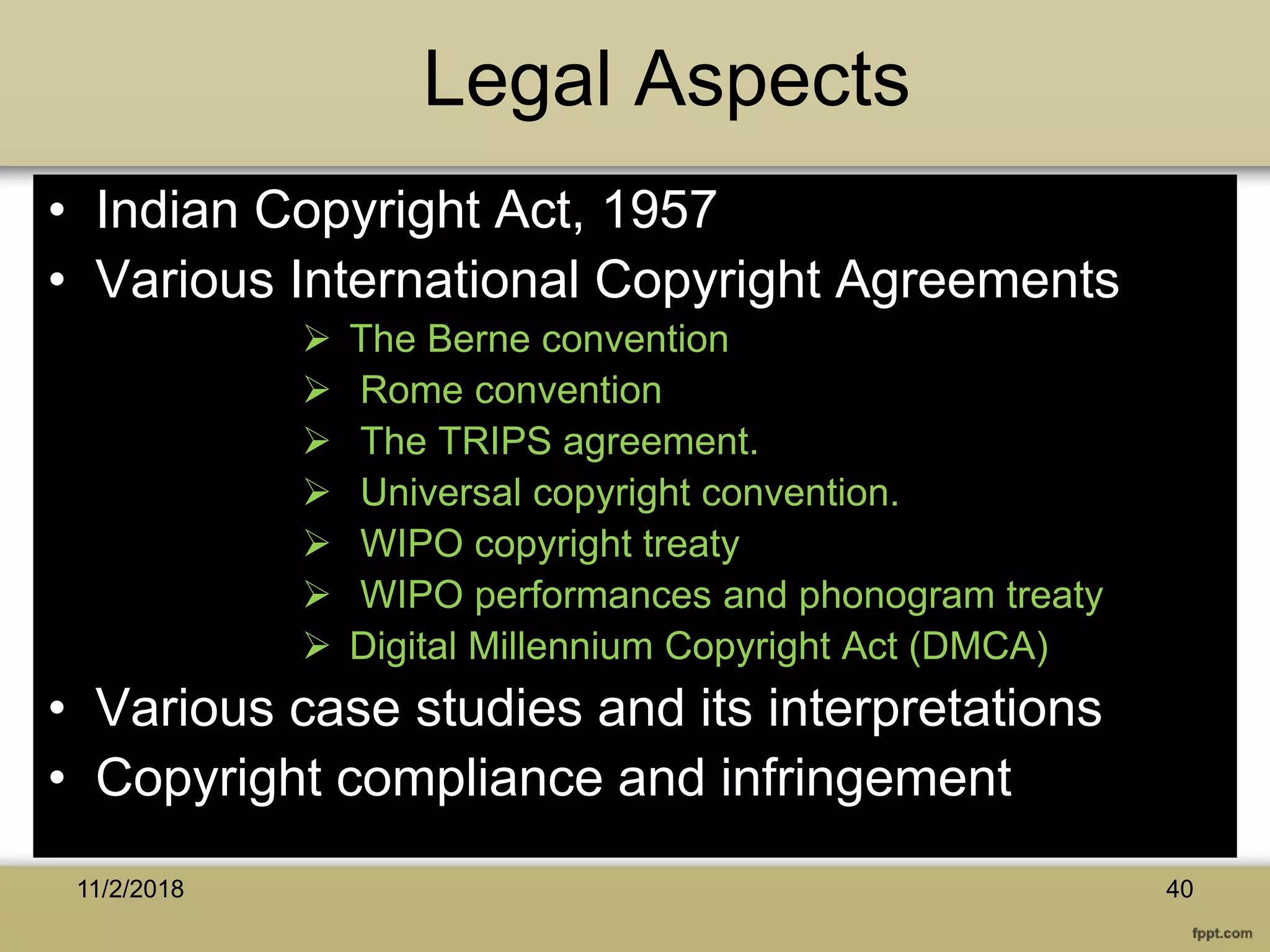
Legal Aspects
• Indian Copyright Act, 1957
• Various International Copyright Agreements
 The Berne convention
 Rome convention
 The TRIPS agreement.
 Universal copyright convention.
 WIPO copyright treaty
 WIPO performances and phonogram treaty
 Digital Millennium Copyright Act (DMCA)
• Various case studies and its interpretations
• Copyright compliance and infringement
11/2/2018 40
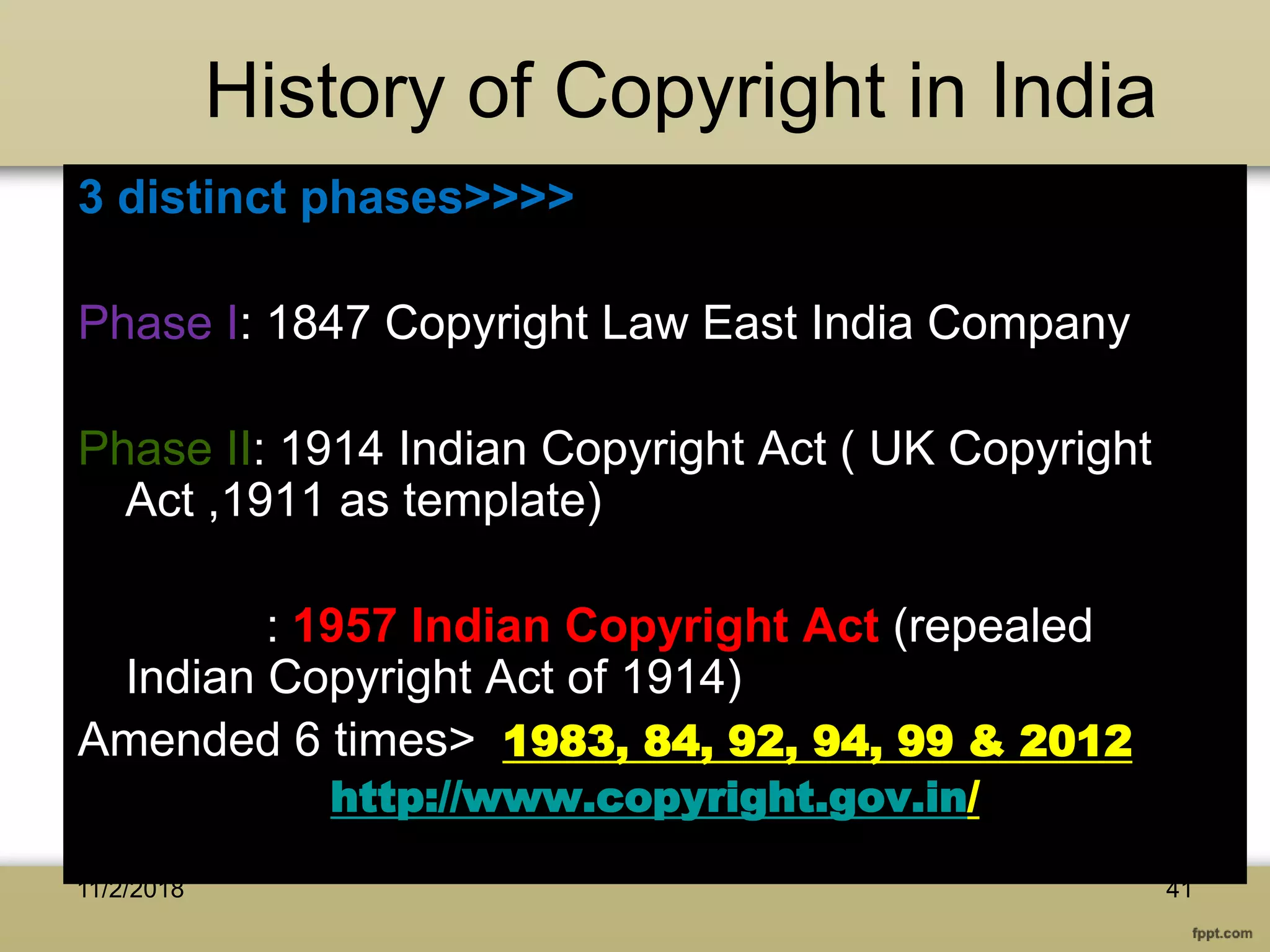
History of Copyright in India
3 distinct phases>>>>
Phase I: 1847 Copyright Law East India Company
Phase II: 1914 Indian Copyright Act ( UK Copyright
Act ,1911 as template)
Phase III: 1957 Indian Copyright Act (repealed
Indian Copyright Act of 1914)
Amended 6 times> 1983, 84, 92, 94, 99 & 2012
http://www.copyright.gov.in/
4111/2/2018
2 November 2018
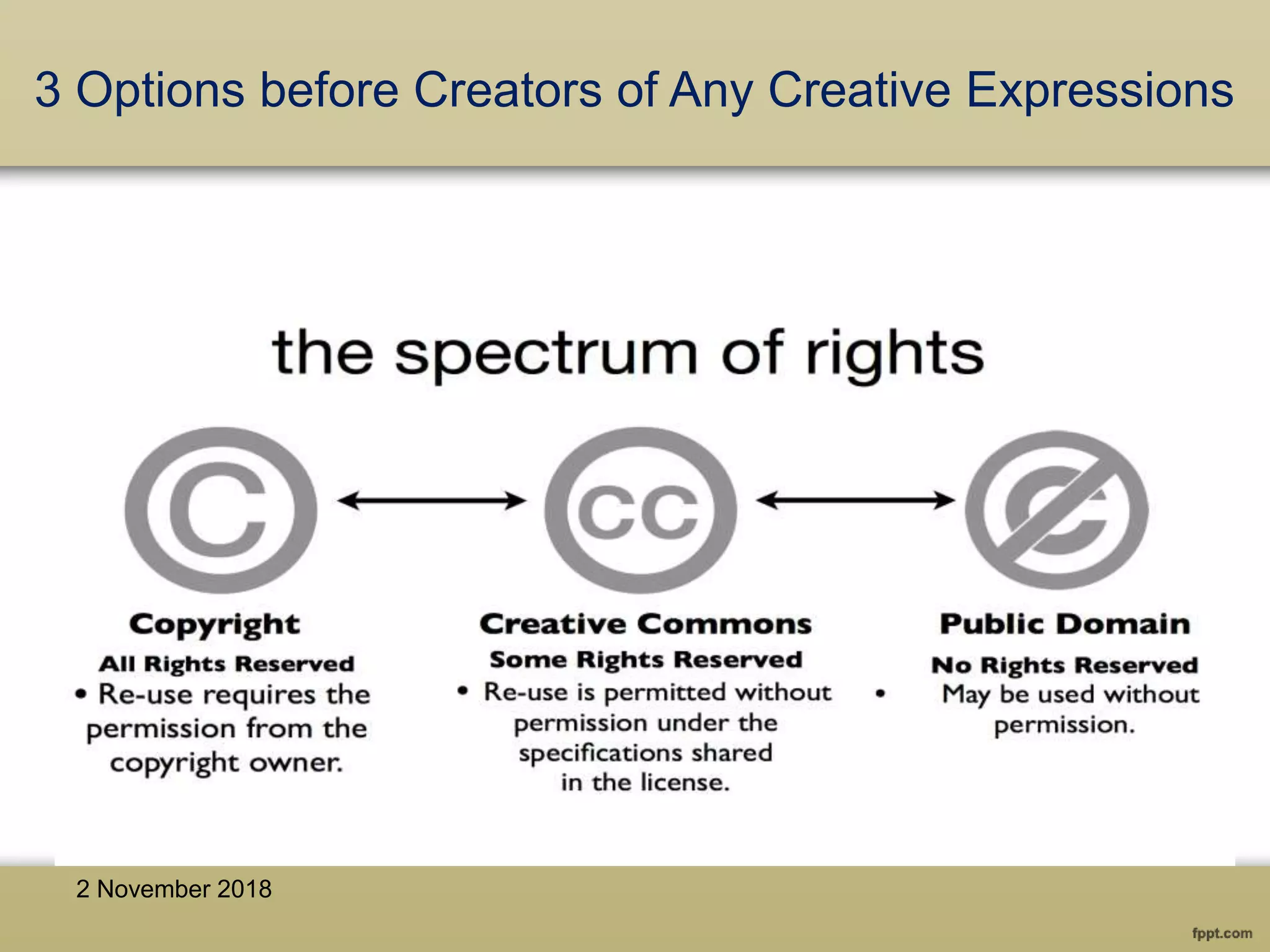
3 Options before Creators of Any Creative Expressions
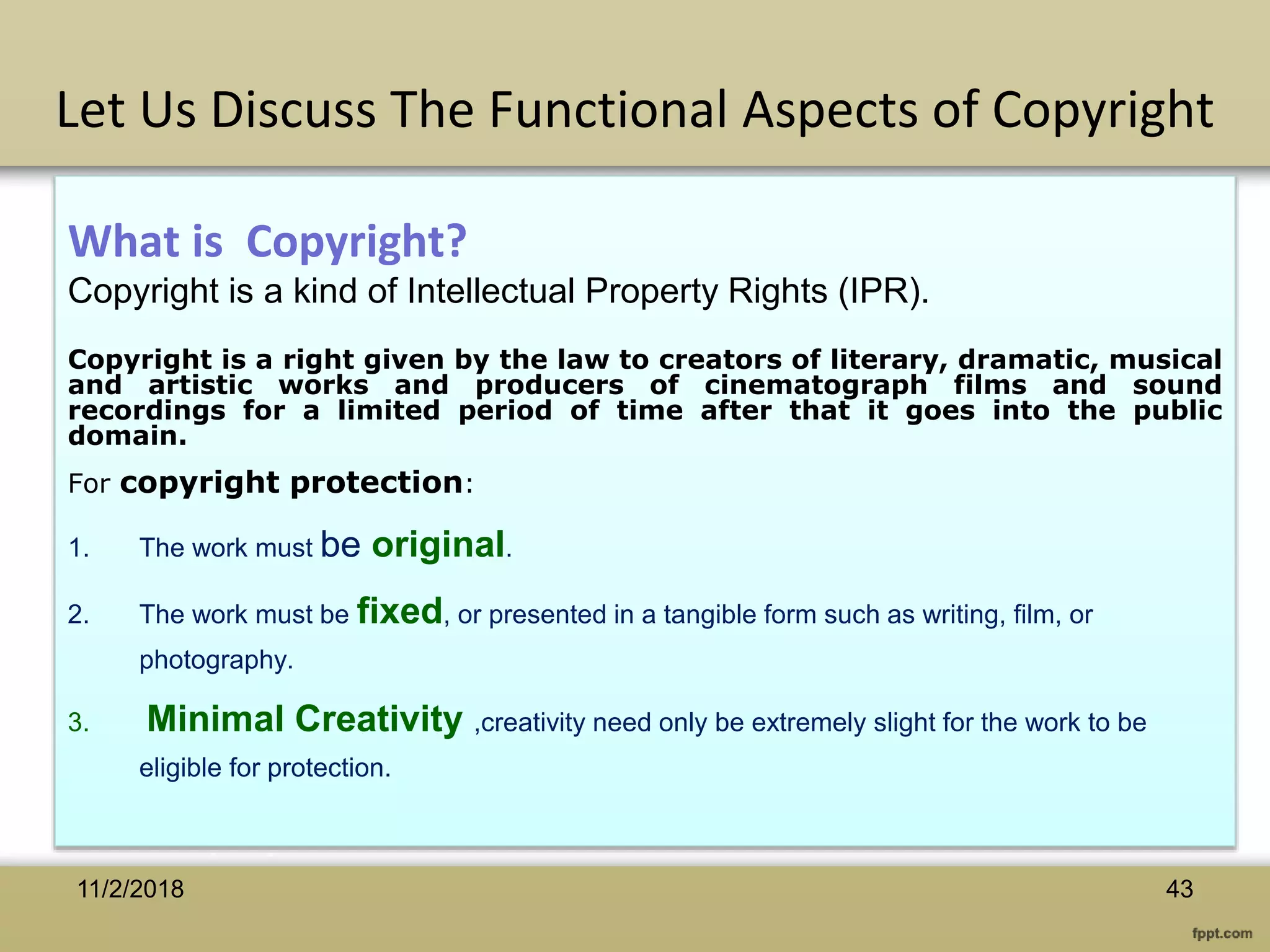
What is Copyright?
Copyright is a kind of Intellectual Property Rights (IPR).
Copyright is a right given by the law to creators of literary, dramatic, musical
and artistic works and producers of cinematograph films and sound
recordings for a limited period of time after that it goes into the public
domain.
For copyright protection:
1. The work must be original.
2. The work must be fixed, or presented in a tangible form such as writing, film, or
photography.
3. Minimal Creativity ,creativity need only be extremely slight for the work to be
eligible for protection.
Let Us Discuss The Functional Aspects of Copyright
4311/2/2018
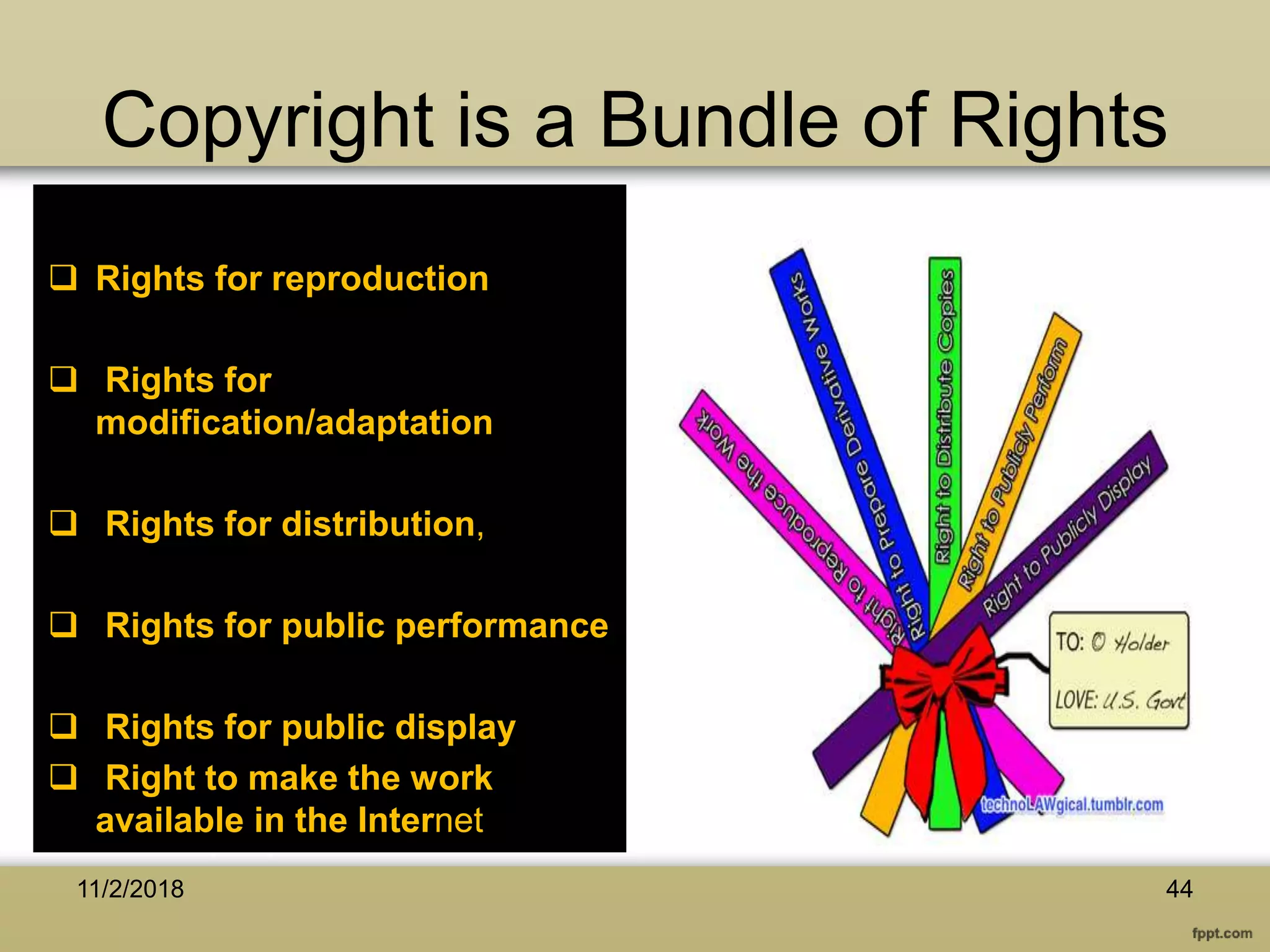
Copyright is a Bundle of Rights
 Rights for reproduction
 Rights for
modification/adaptation
 Rights for distribution,
 Rights for public performance
 Rights for public display
 Right to make the work
available in the Internet
11/2/2018 44
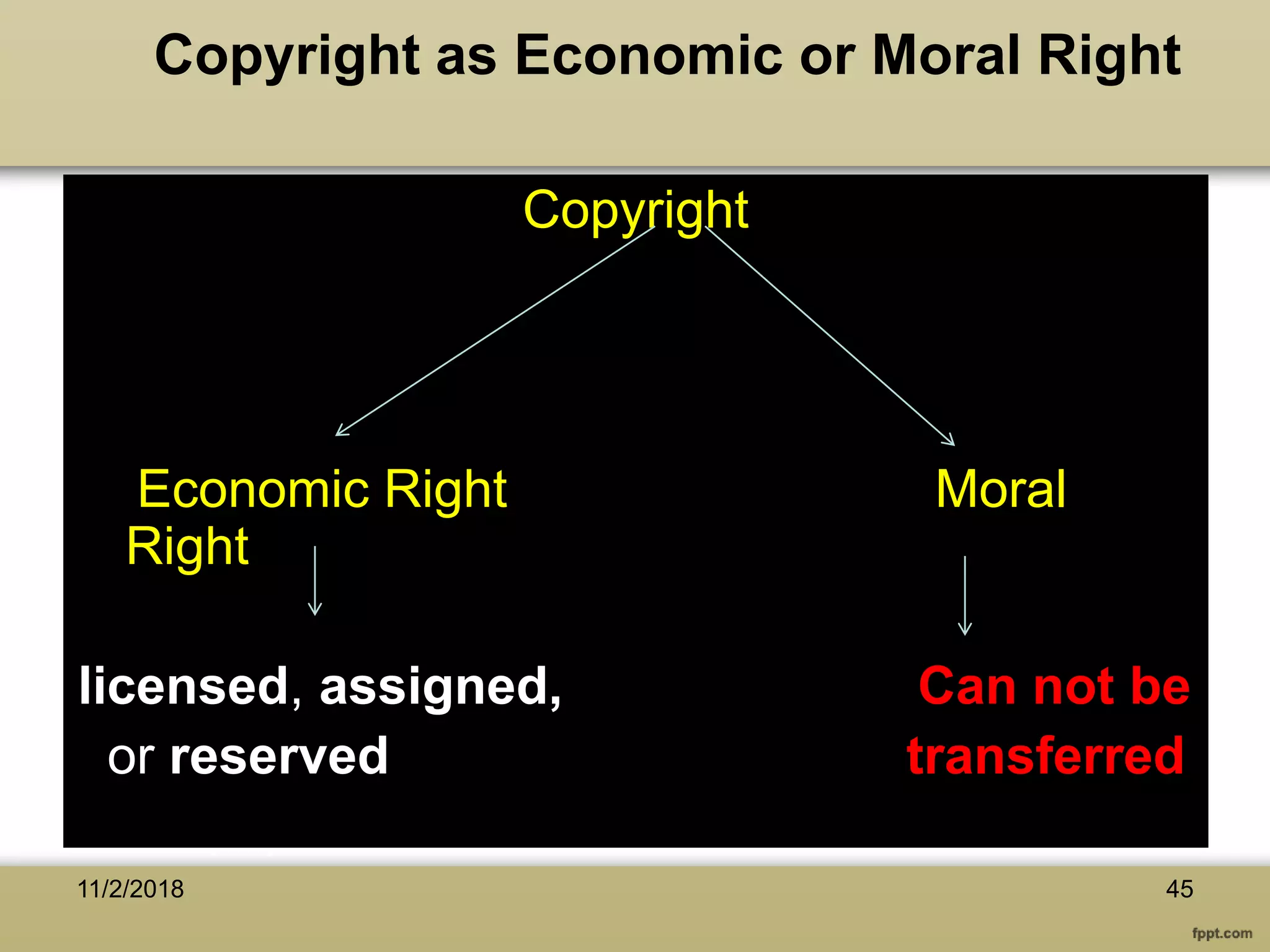
Copyright as Economic or Moral Right
Copyright
Economic Right Moral
Right
licensed, assigned, Can not be
or reserved transferred
11/2/2018 45
Who is Author?
• In the case of a literary or dramatic work the
author, i.e., the person who creates the work.
• In the case of a musical work, the composer.
• In the case of a cinematograph film, the
producer.
• In the case of a sound recording, the producer.
• In the case of a photograph, the photographer.
• In the case of a computer generated work, the
person who causes the work to be created.
4611/2/2018
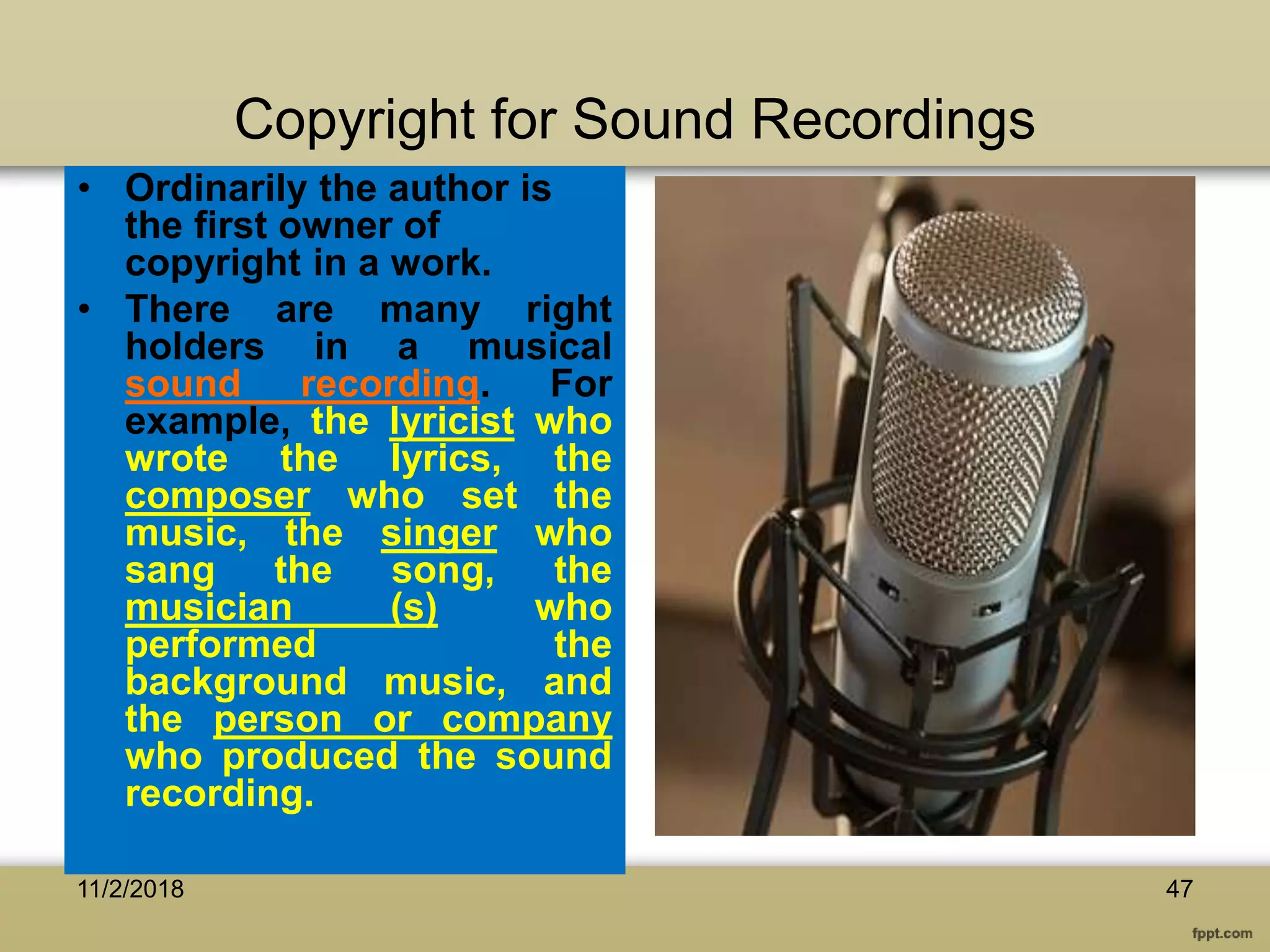
Copyright for Sound Recordings
• Ordinarily the author is
the first owner of
copyright in a work.
• There are many right
holders in a musical
sound recording. For
example, the lyricist who
wrote the lyrics, the
composer who set the
music, the singer who
sang the song, the
musician (s) who
performed the
background music, and
the person or company
who produced the sound
recording.
11/2/2018 47
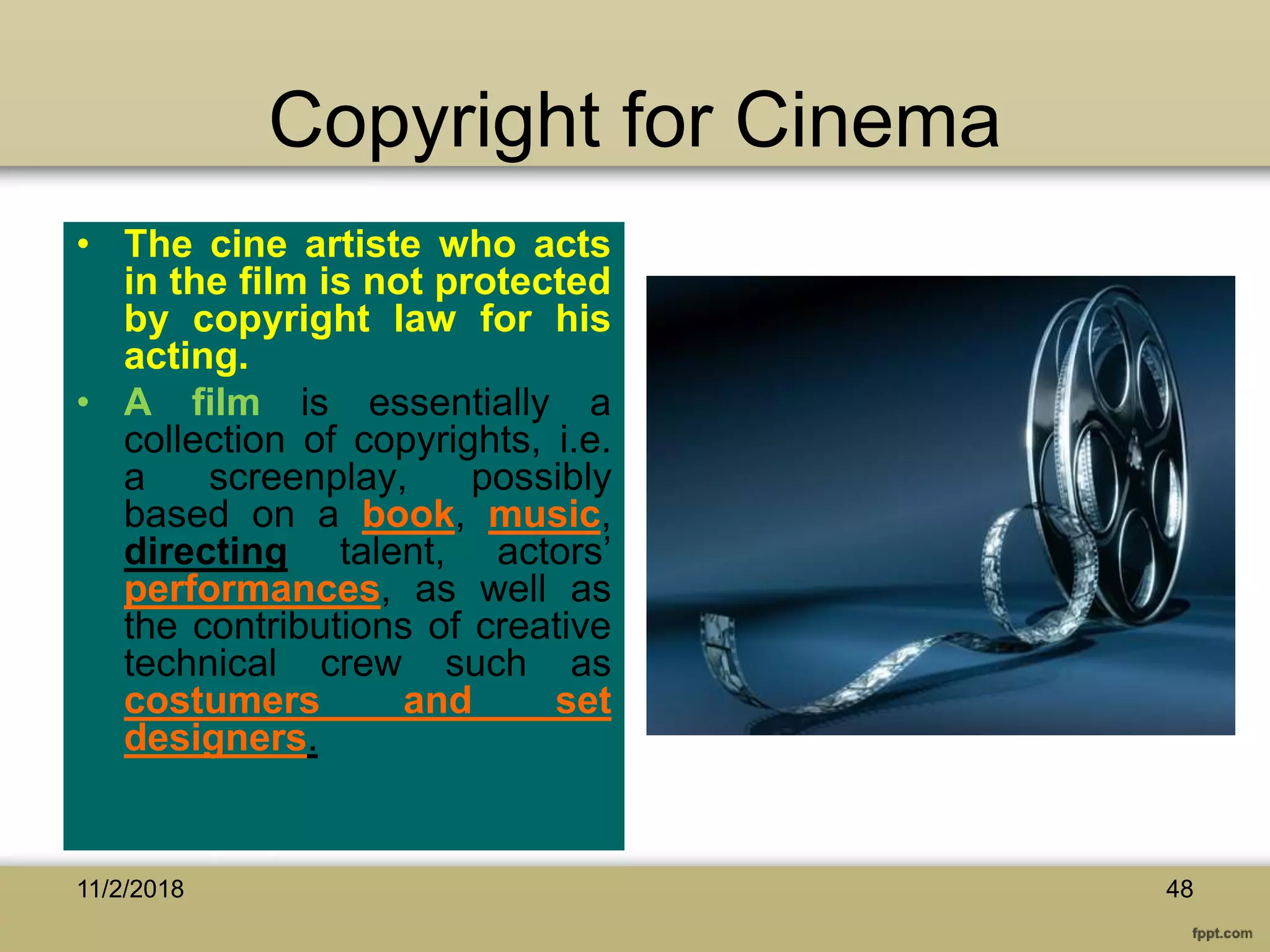
Copyright for Cinema
• The cine artiste who acts
in the film is not protected
by copyright law for his
acting.
• A film is essentially a
collection of copyrights, i.e.
a screenplay, possibly
based on a book, music,
directing talent, actors’
performances, as well as
the contributions of creative
technical crew such as
costumers and set
designers.
11/2/2018 48
No. Acquisition of copyright is automatic and it
does not require any formality. Copyright comes
into existence as soon as a work is created and no
formality is required to be completed for
acquiring copyright. However, certificate of
registration of copyright and the entries made
therein serve as prima facie evidence in a court of
law with reference to dispute relating to
ownership of copyright.
Is It Necessary To Register A Work To
Claim Copyright ?
4911/2/2018
Is copyright assignable?
• Yes. The owner of the copyright in an
existing work or the prospective owner of
the copyright in a future work may assign
to any person the copyright either wholly
or partially and either generally or subject
to limitations and either for the whole term
of the copyright or any part thereof.
11/2/2018 50
Is Copyright Licensable ?
• Yes. A copyright owner may grant a
license some or all of his rights to others to
exploit his work for monetary benefits. A
license may be exclusive or Non-
exclusive.
• License differs from Assignment as the
former means renting but the latter one is
giving ownership.
Difference Between Copyright Transfer and License
• A transfer of copyright is a
conveyance of ownership,
much like the sale of
personal property. When
you transfer your entire
interest in a copyrighted
work, or one or more of
your exclusive rights under
copyright, you give up all
claim to the right(s) you
convey.
• A license is a grant of
permission to exercise
your rights under
copyright. In copyright
terminology, there are
"non-exclusive" and
"exclusive" licenses.
Contd...
What will be the period of assignment if not
specifically stated in the assignments?
• If the period of assignment is not stated, it shall be
deemed to be five years from the date of assignment.
What will be the territorial extent of the assignment if
not specified in the assignment?
• If the territorial extent of assignment of the rights is not
specified, it shall be presumed to extend within the
whole of India.
Can an author relinquish copyright and, if so, how?
• The author of a work may relinquish all or any of the
rights comprising the copyright in the work by giving
notice in the prescribed form to the Registrar of
Copyrights.
11/2/2018 53
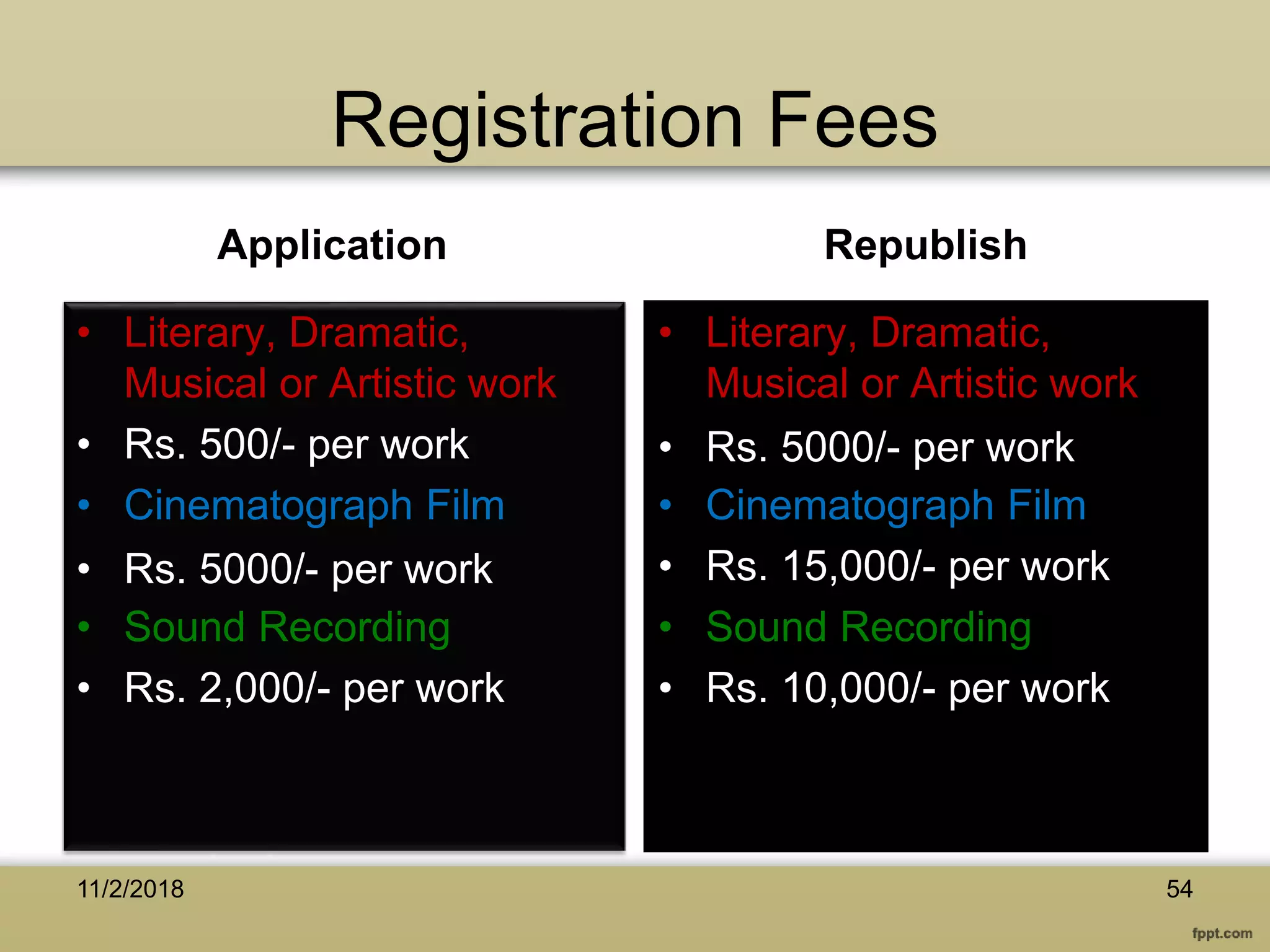
Registration Fees
Application
• Literary, Dramatic,
Musical or Artistic work
• Rs. 500/- per work
• Cinematograph Film
• Rs. 5000/- per work
• Sound Recording
• Rs. 2,000/- per work
Republish
• Literary, Dramatic,
Musical or Artistic work
• Rs. 5000/- per work
• Cinematograph Film
• Rs. 15,000/- per work
• Sound Recording
• Rs. 10,000/- per work
11/2/2018 54
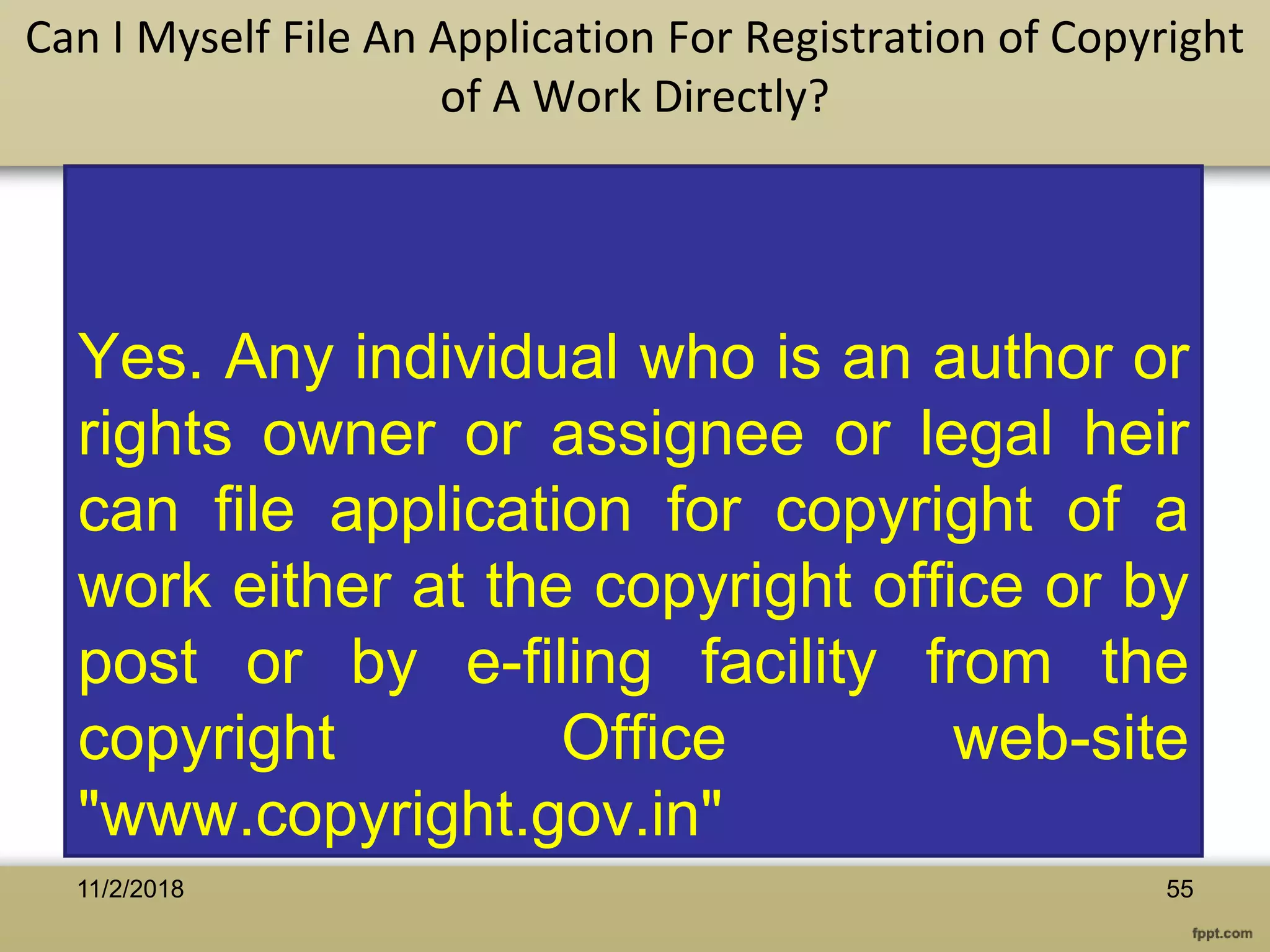
Yes. Any individual who is an author or
rights owner or assignee or legal heir
can file application for copyright of a
work either at the copyright office or by
post or by e-filing facility from the
copyright Office web-site
"www.copyright.gov.in"
Can I Myself File An Application For Registration of Copyright
of A Work Directly?
5511/2/2018
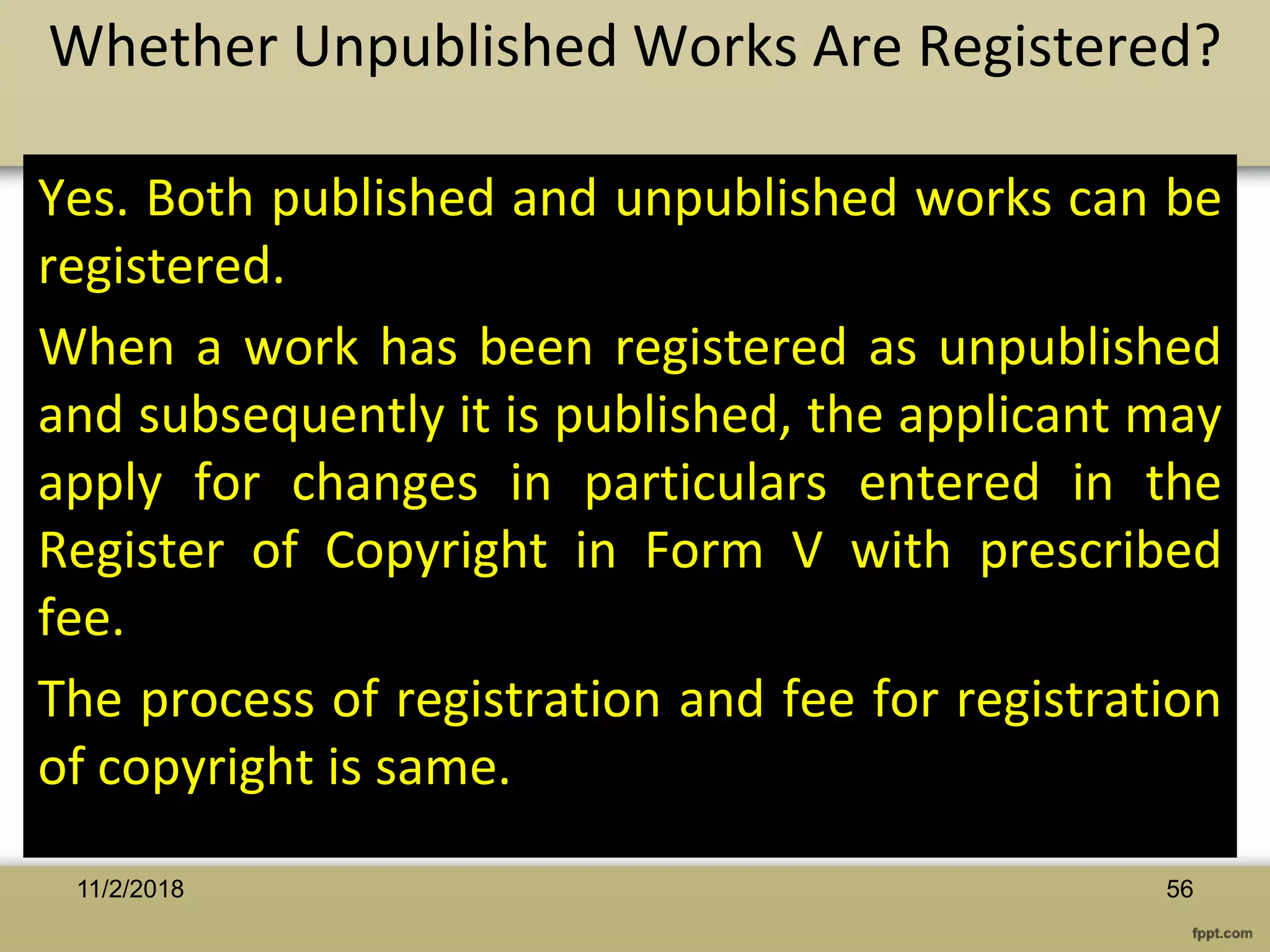
Yes. Both published and unpublished works can be
registered.
When a work has been registered as unpublished
and subsequently it is published, the applicant may
apply for changes in particulars entered in the
Register of Copyright in Form V with prescribed
fee.
The process of registration and fee for registration
of copyright is same.
Whether Unpublished Works Are Registered?
5611/2/2018
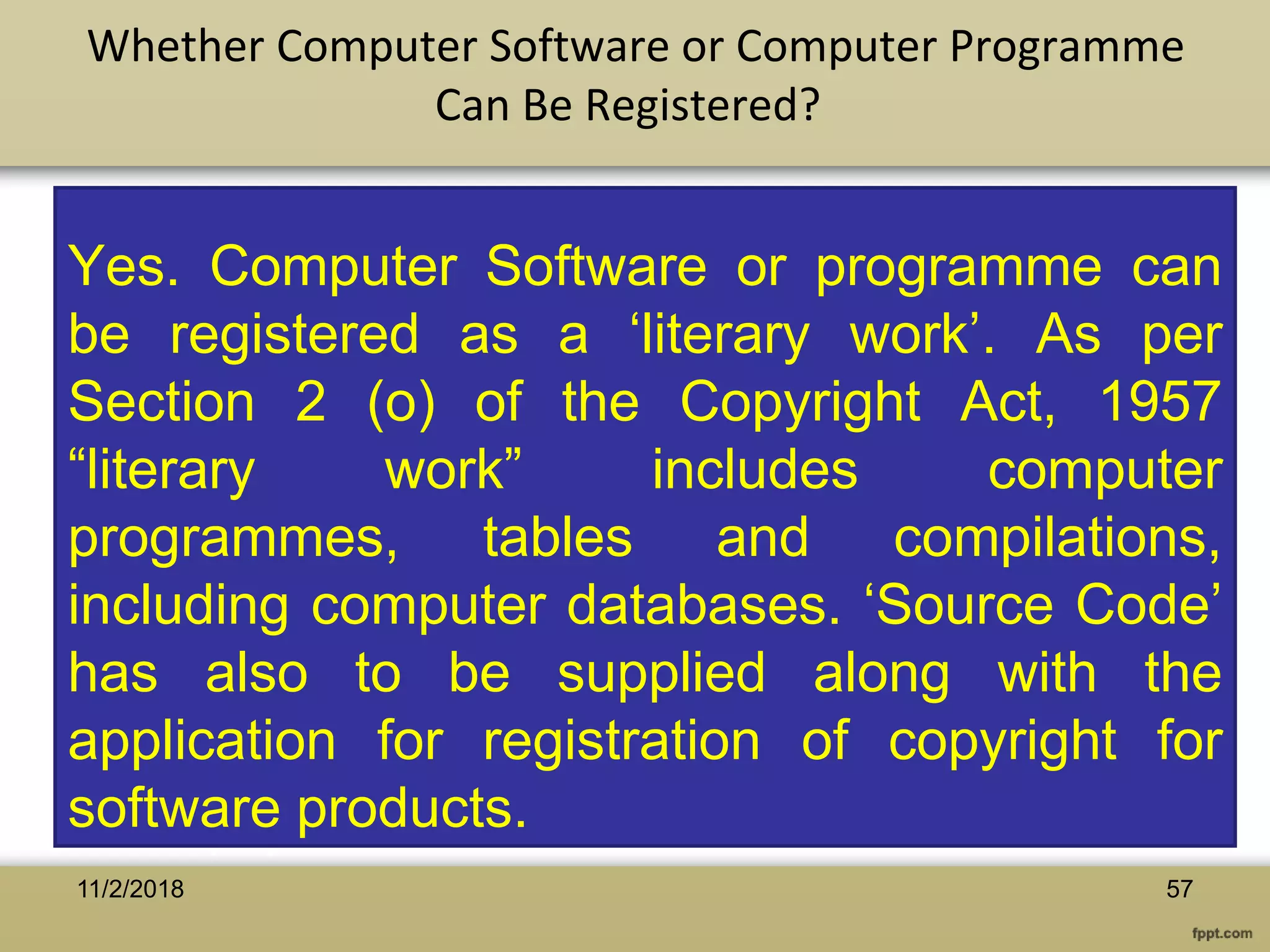
Yes. Computer Software or programme can
be registered as a ‘literary work’. As per
Section 2 (o) of the Copyright Act, 1957
“literary work” includes computer
programmes, tables and compilations,
including computer databases. ‘Source Code’
has also to be supplied along with the
application for registration of copyright for
software products.
Whether Computer Software or Computer Programme
Can Be Registered?
5711/2/2018
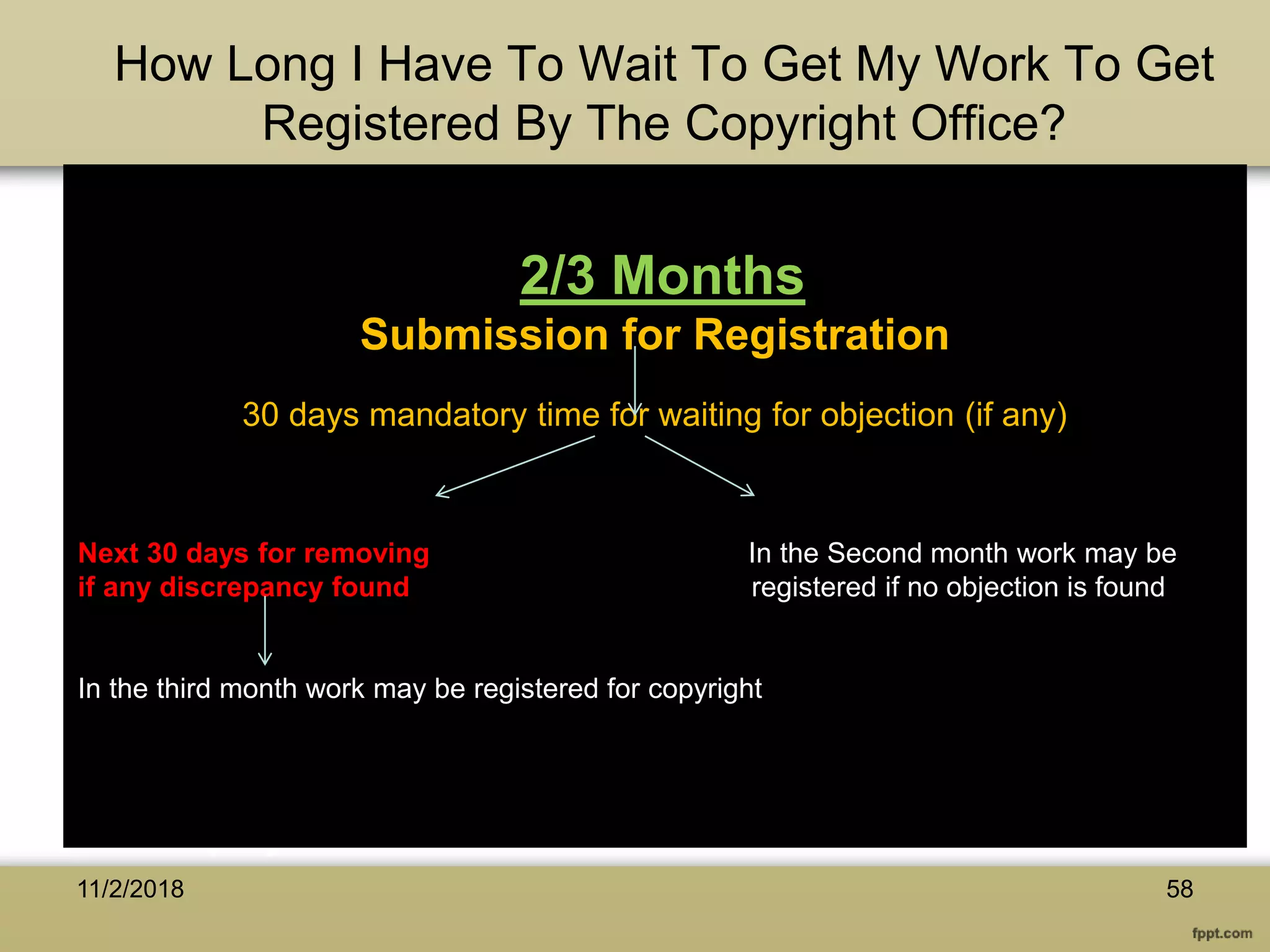
2/3 Months
Submission for Registration
30 days mandatory time for waiting for objection (if any)
Next 30 days for removing In the Second month work may be
if any discrepancy found registered if no objection is found
In the third month work may be registered for copyright
How Long I Have To Wait To Get My Work To Get
Registered By The Copyright Office?
5811/2/2018
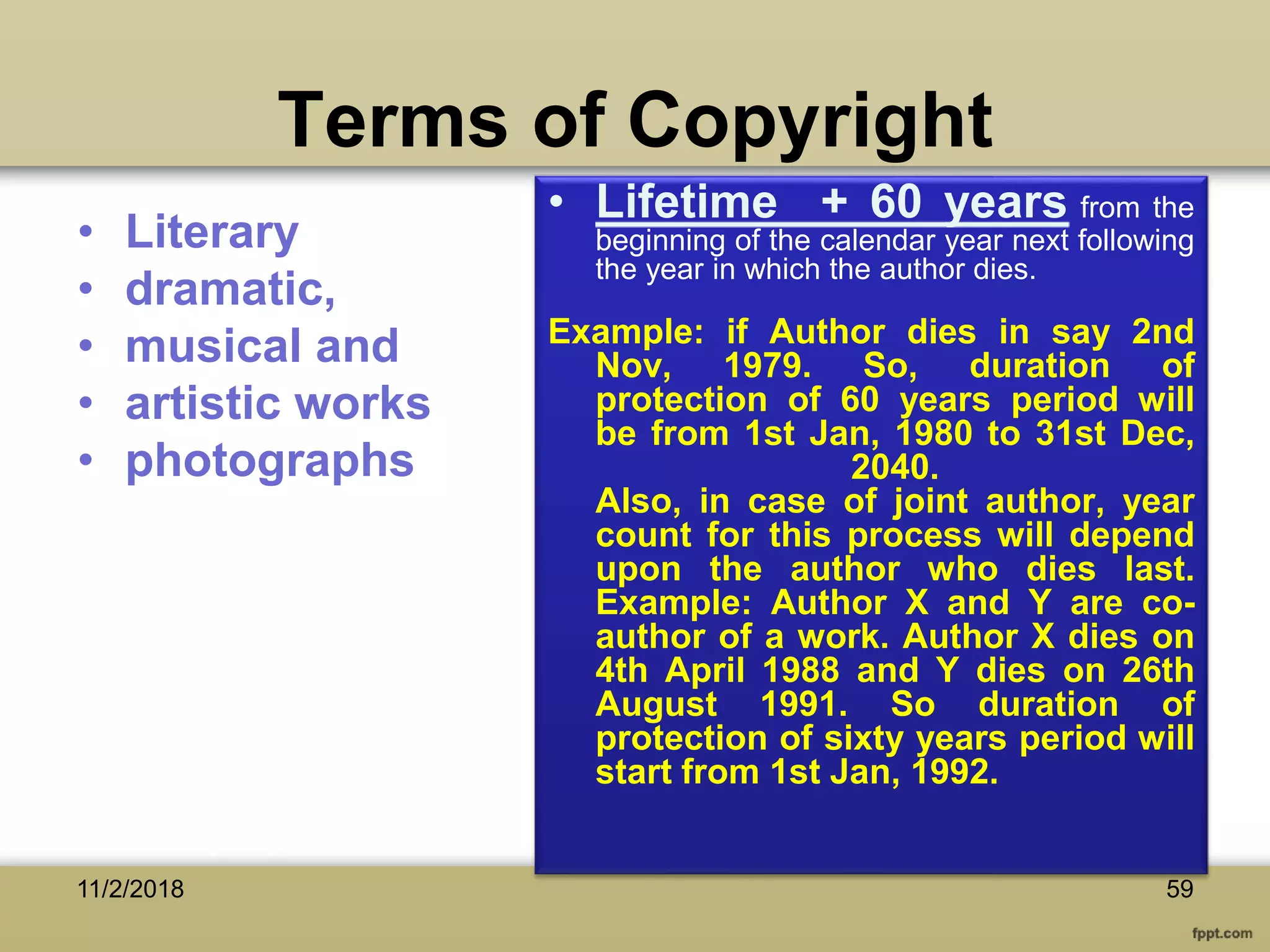
Terms of Copyright
• Literary
• dramatic,
• musical and
• artistic works
• photographs
• Lifetime + 60 years from the
beginning of the calendar year next following
the year in which the author dies.
Example: if Author dies in say 2nd
Nov, 1979. So, duration of
protection of 60 years period will
be from 1st Jan, 1980 to 31st Dec,
2040.
Also, in case of joint author, year
count for this process will depend
upon the author who dies last.
Example: Author X and Y are co-
author of a work. Author X dies on
4th April 1988 and Y dies on 26th
August 1991. So duration of
protection of sixty years period will
start from 1st Jan, 1992.
5911/2/2018
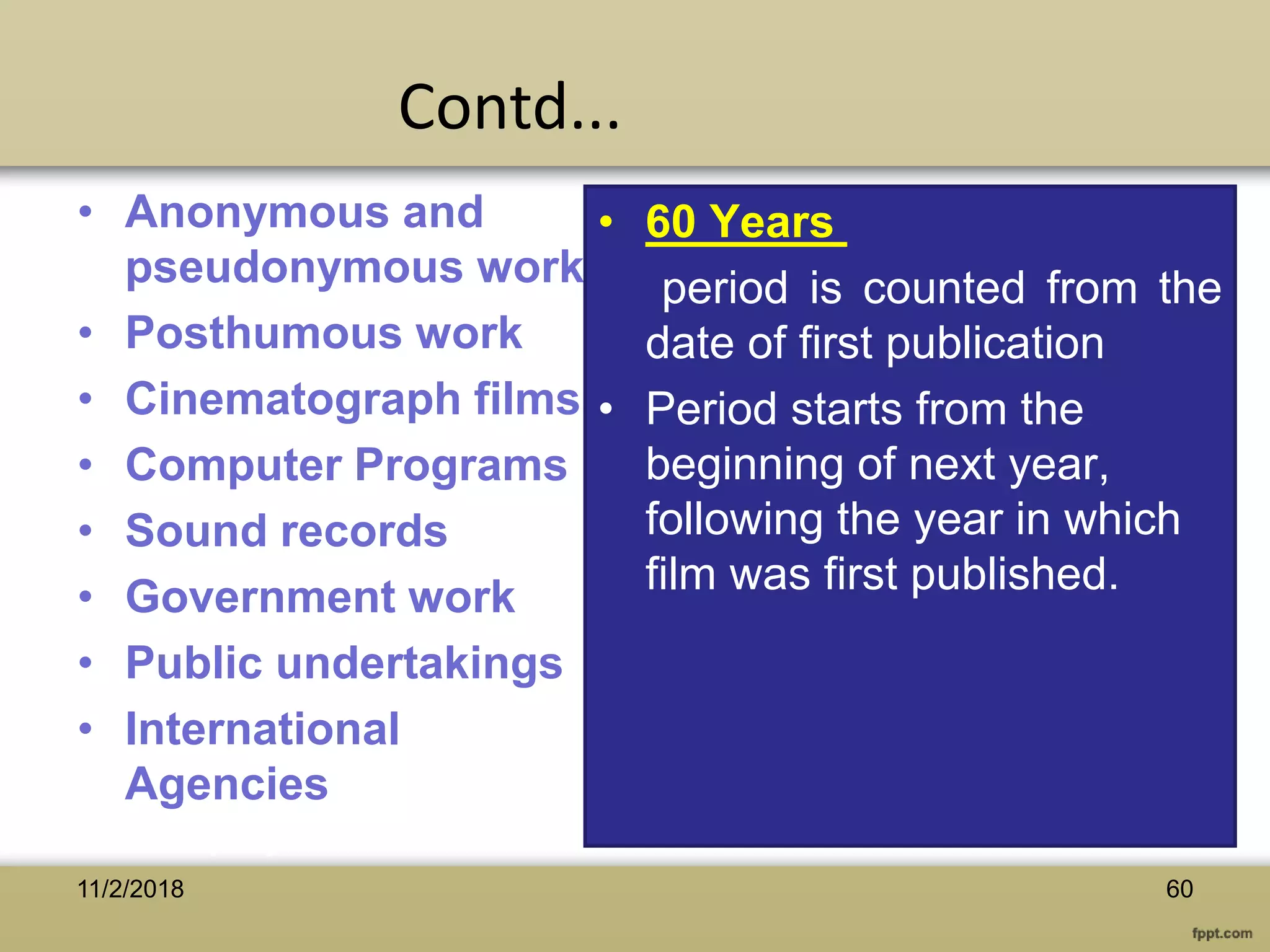
• Anonymous and
pseudonymous works
• Posthumous work
• Cinematograph films
• Computer Programs
• Sound records
• Government work
• Public undertakings
• International
Agencies
• 60 Years
period is counted from the
date of first publication
• Period starts from the
beginning of next year,
following the year in which
film was first published.
6011/2/2018
Contd...
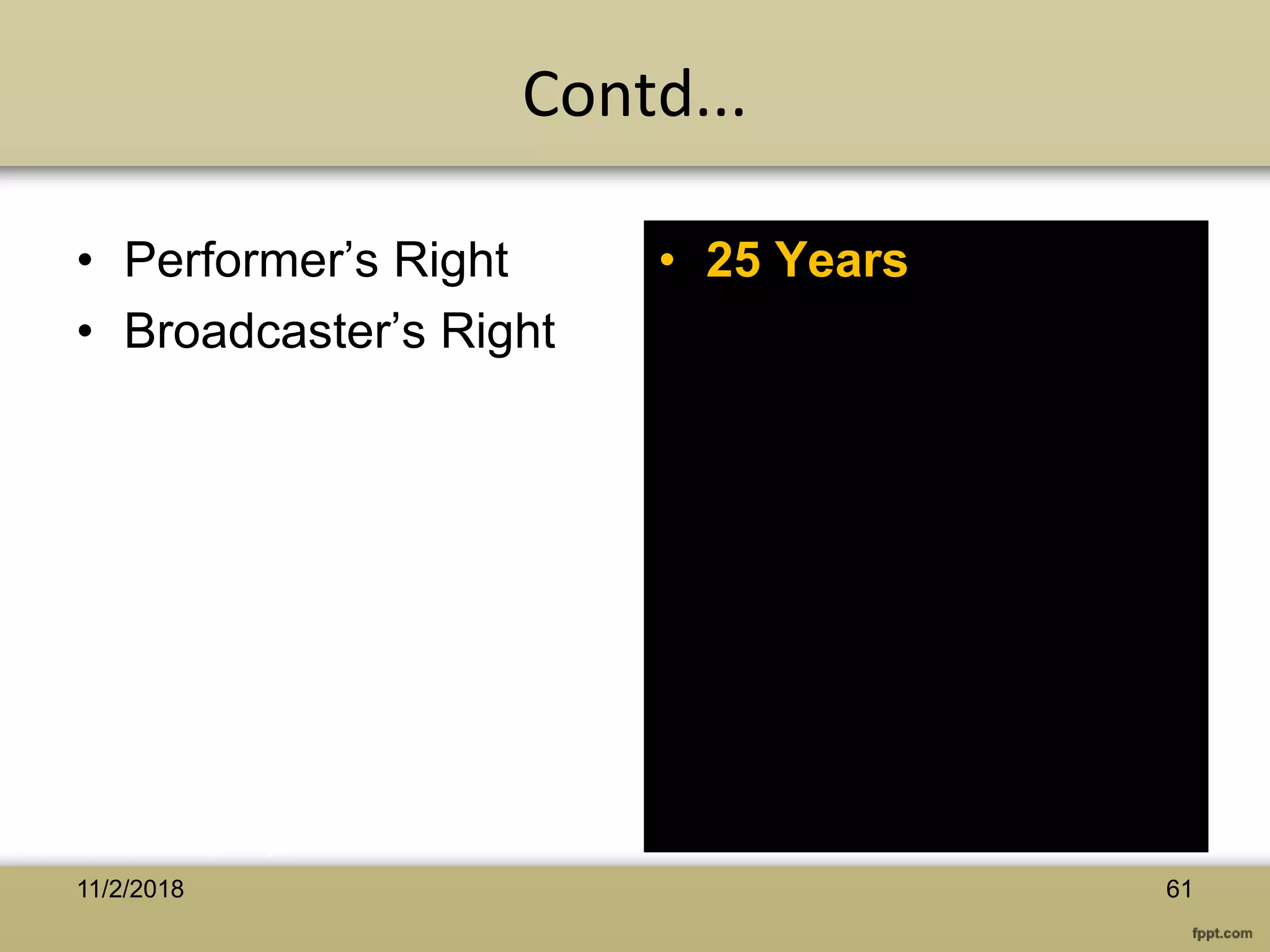
• Performer’s Right
• Broadcaster’s Right
• 25 Years
6111/2/2018
Contd...
Safety valve of Copyright
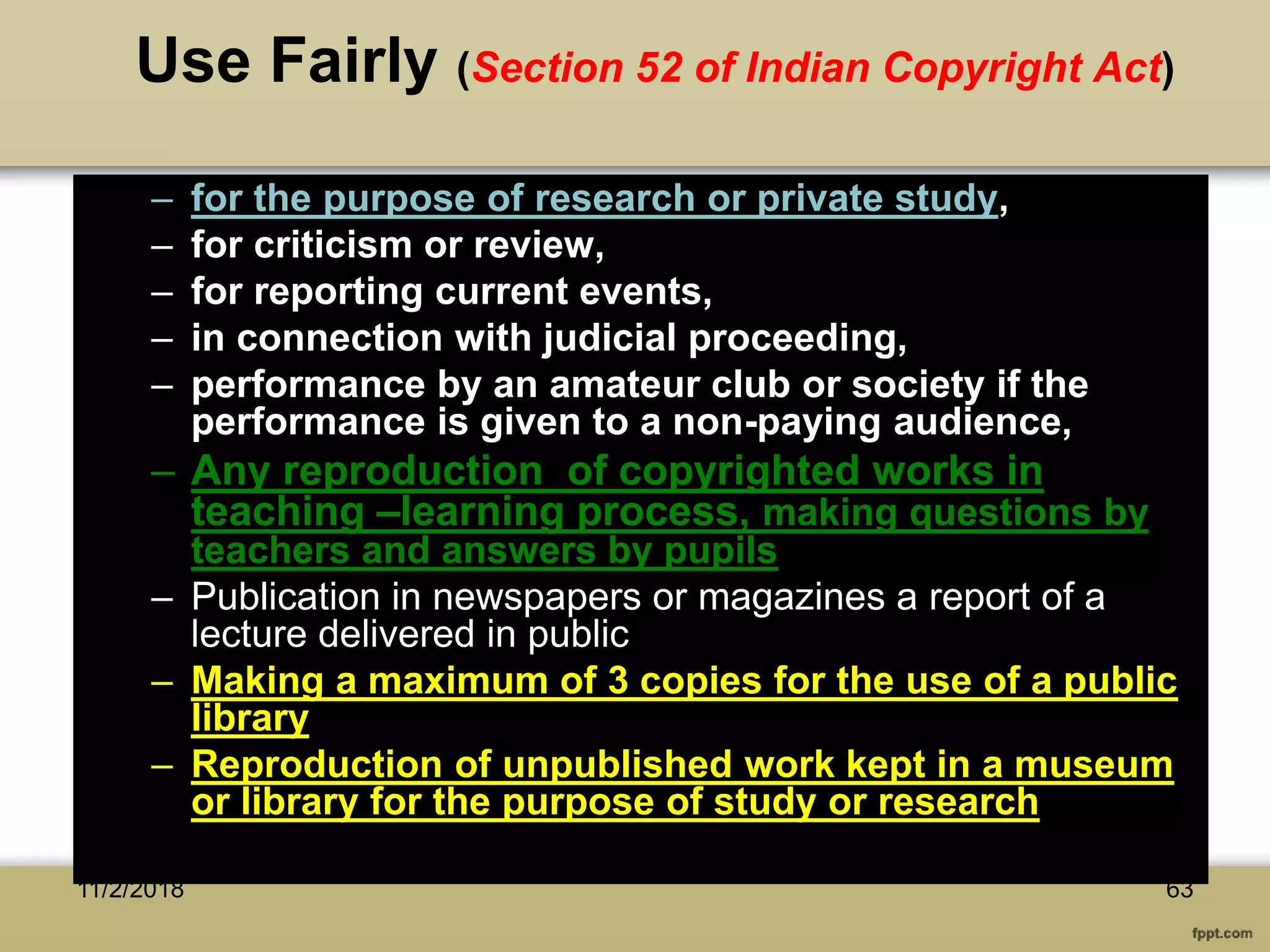
Use Fairly (Section 52 of Indian Copyright Act)
– for the purpose of research or private study,
– for criticism or review,
– for reporting current events,
– in connection with judicial proceeding,
– performance by an amateur club or society if the
performance is given to a non-paying audience,
– Any reproduction of copyrighted works in
teaching –learning process, making questions by
teachers and answers by pupils
– Publication in newspapers or magazines a report of a
lecture delivered in public
– Making a maximum of 3 copies for the use of a public
library
– Reproduction of unpublished work kept in a museum
or library for the purpose of study or research
11/2/2018 63
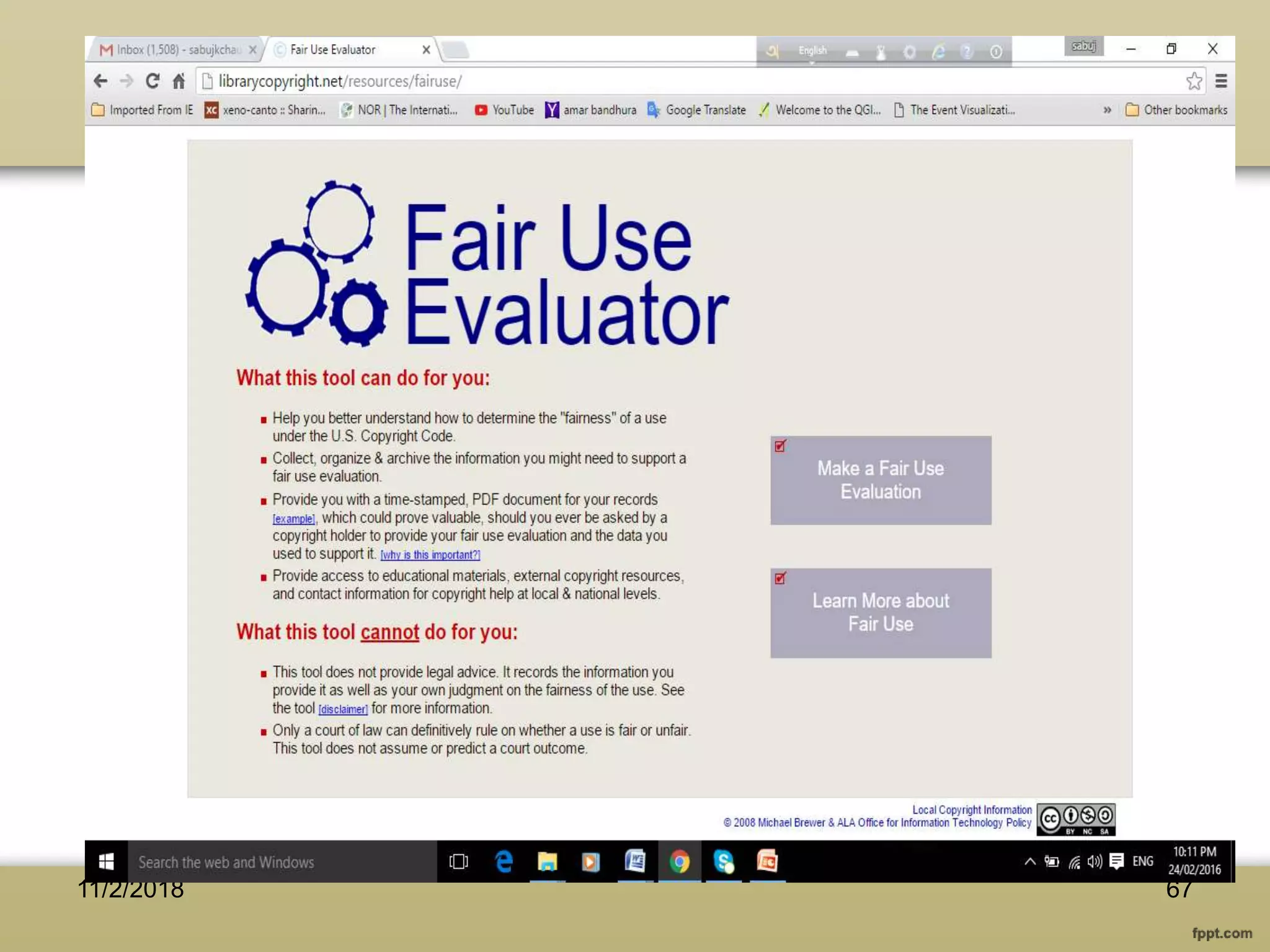
What is Fair Use ?
6411/2/2018
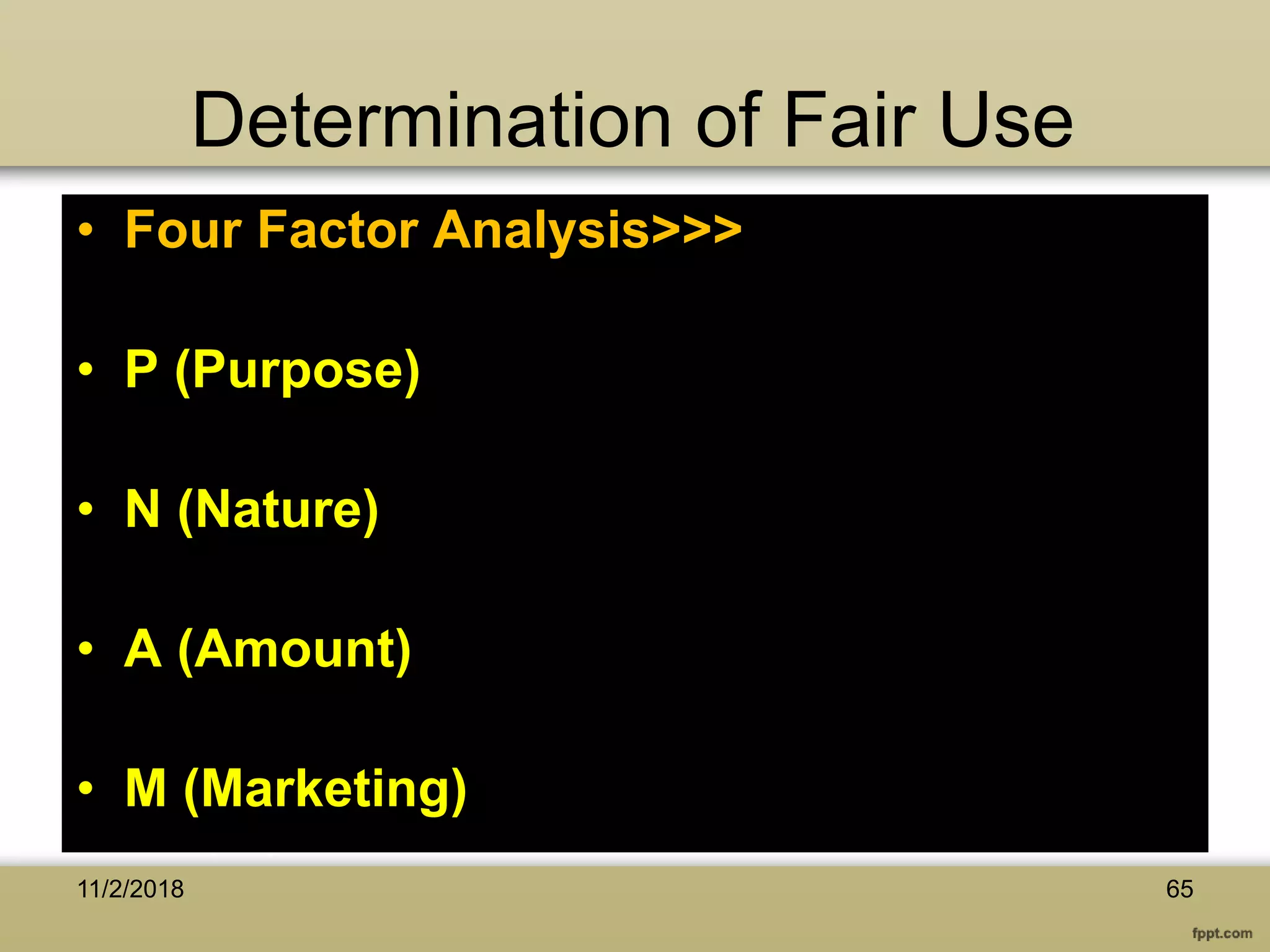
Determination of Fair Use
• Four Factor Analysis>>>
• P (Purpose)
• N (Nature)
• A (Amount)
• M (Marketing)
6511/2/2018
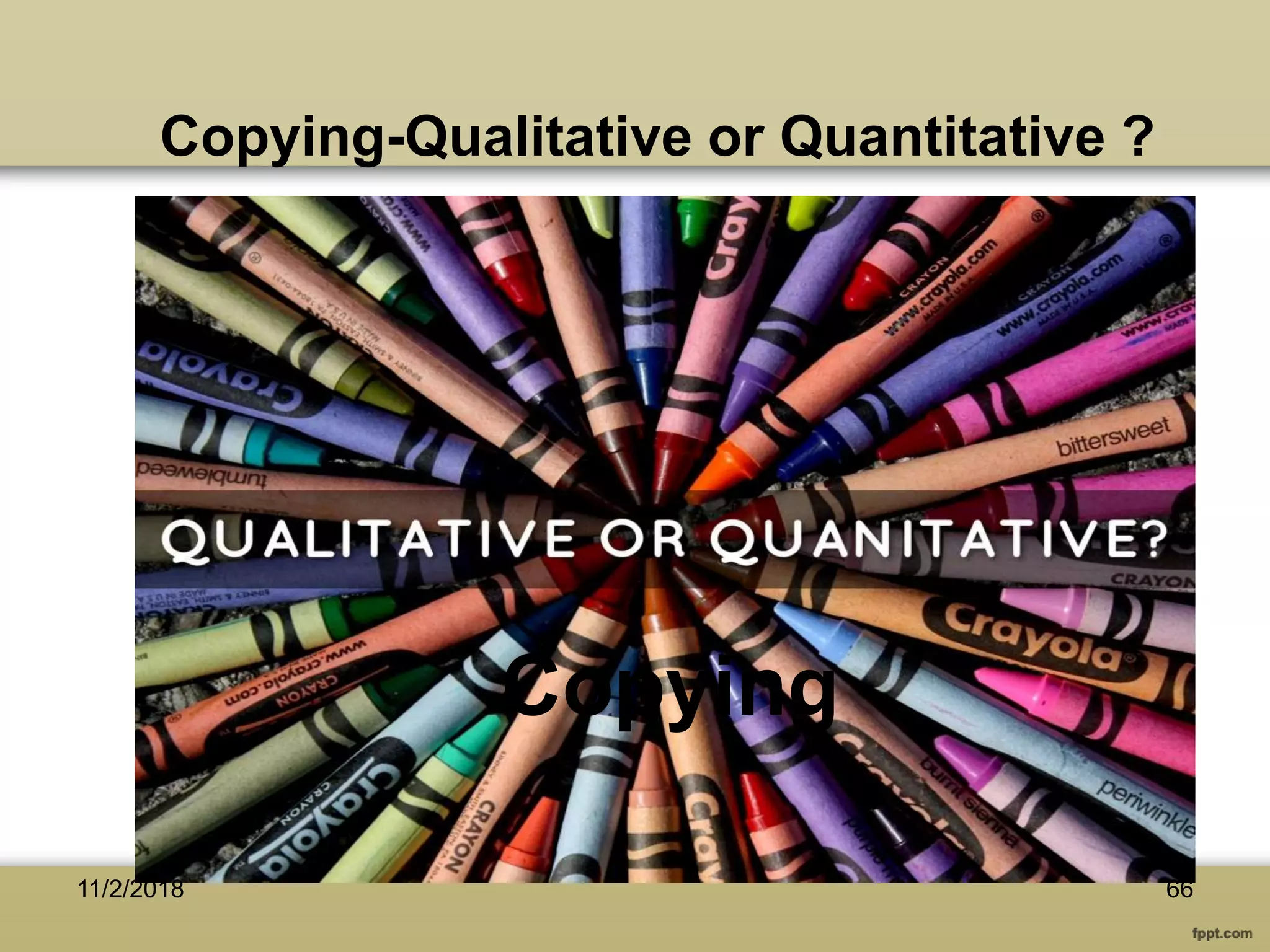
Copying-Qualitative or Quantitative ?
Copying
6611/2/2018
11/2/2018 67
Plagiarism
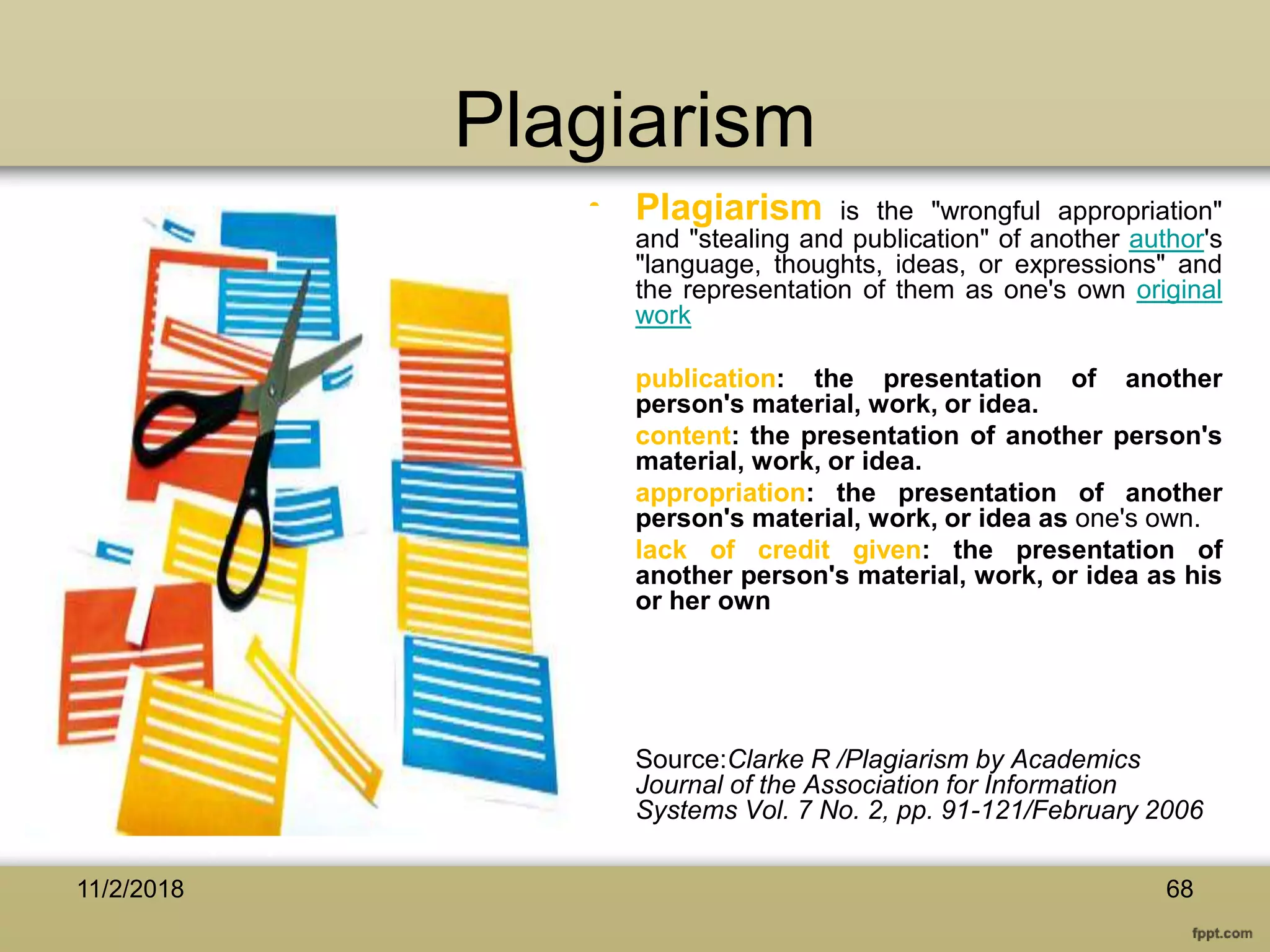
• Plagiarism is the "wrongful appropriation"
and "stealing and publication" of another author's
"language, thoughts, ideas, or expressions" and
the representation of them as one's own original
work
• publication: the presentation of another
person's material, work, or idea.
• content: the presentation of another person's
material, work, or idea.
• appropriation: the presentation of another
person's material, work, or idea as one's own.
• lack of credit given: the presentation of
another person's material, work, or idea as his
or her own
• Source:Clarke R /Plagiarism by Academics
Journal of the Association for Information
Systems Vol. 7 No. 2, pp. 91-121/February 2006
6811/2/2018
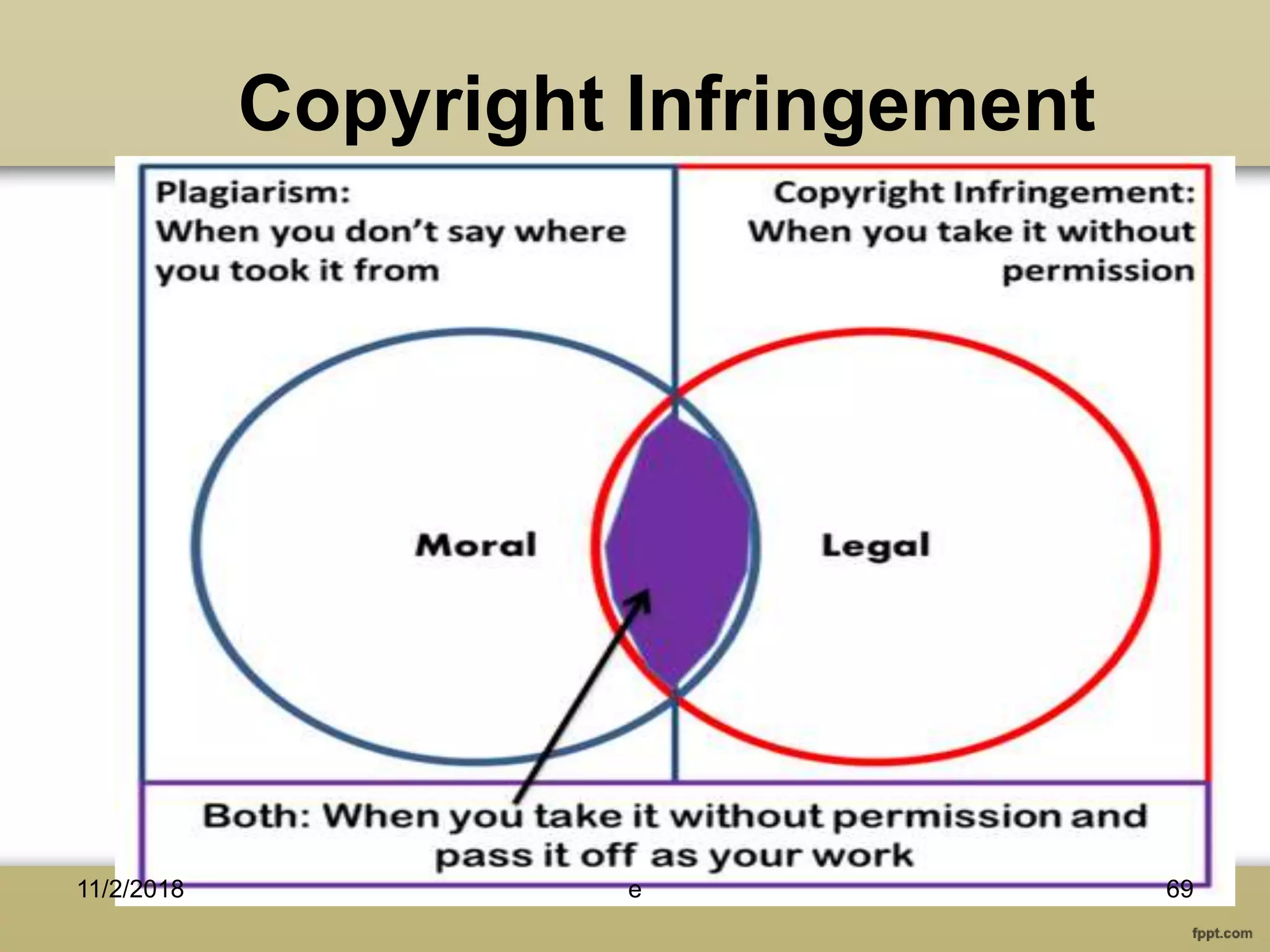
Copyright Infringement
69e11/2/2018
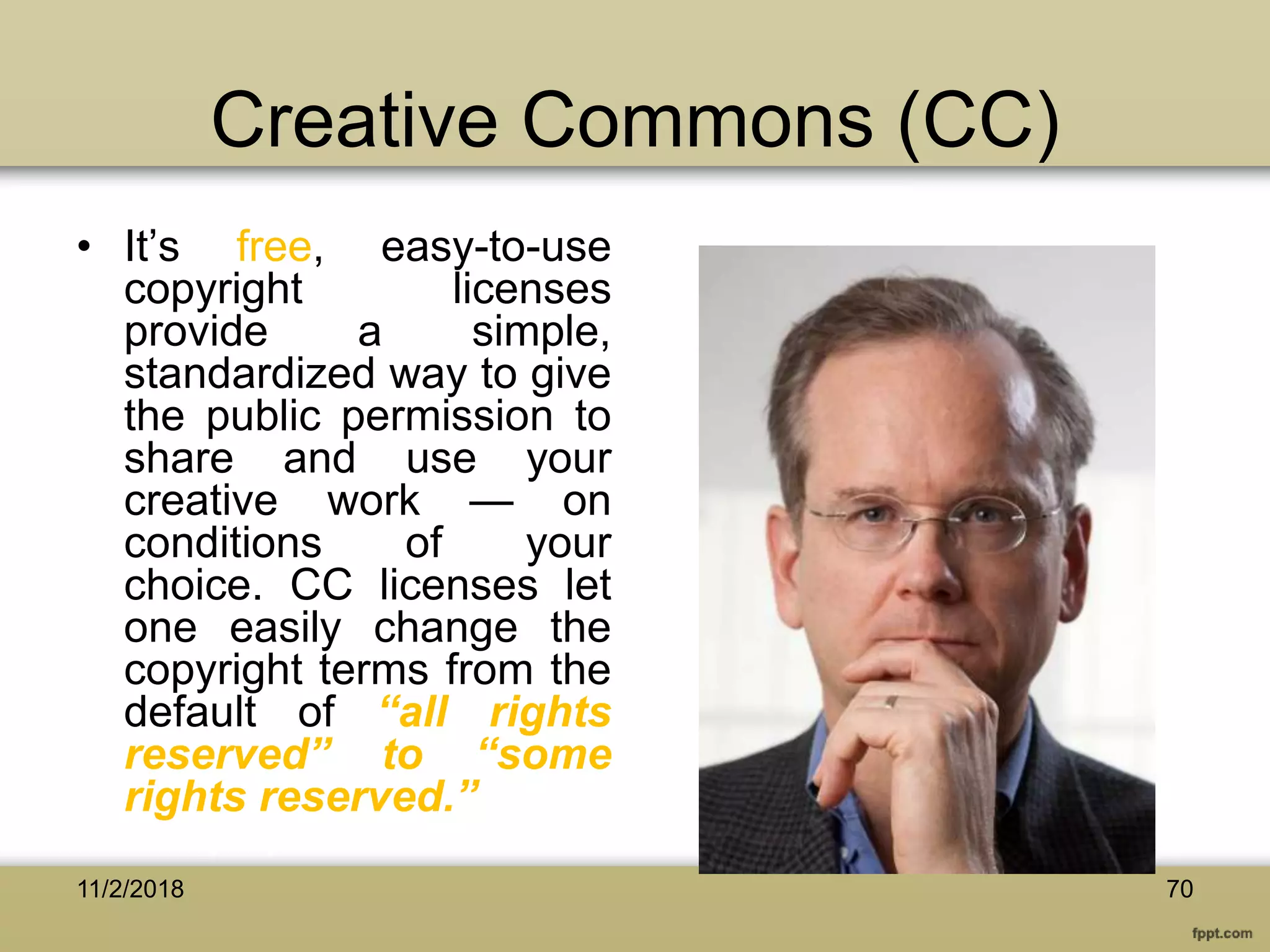
Creative Commons (CC)
• It’s free, easy-to-use
copyright licenses
provide a simple,
standardized way to give
the public permission to
share and use your
creative work — on
conditions of your
choice. CC licenses let
one easily change the
copyright terms from the
default of “all rights
reserved” to “some
rights reserved.”
11/2/2018 70
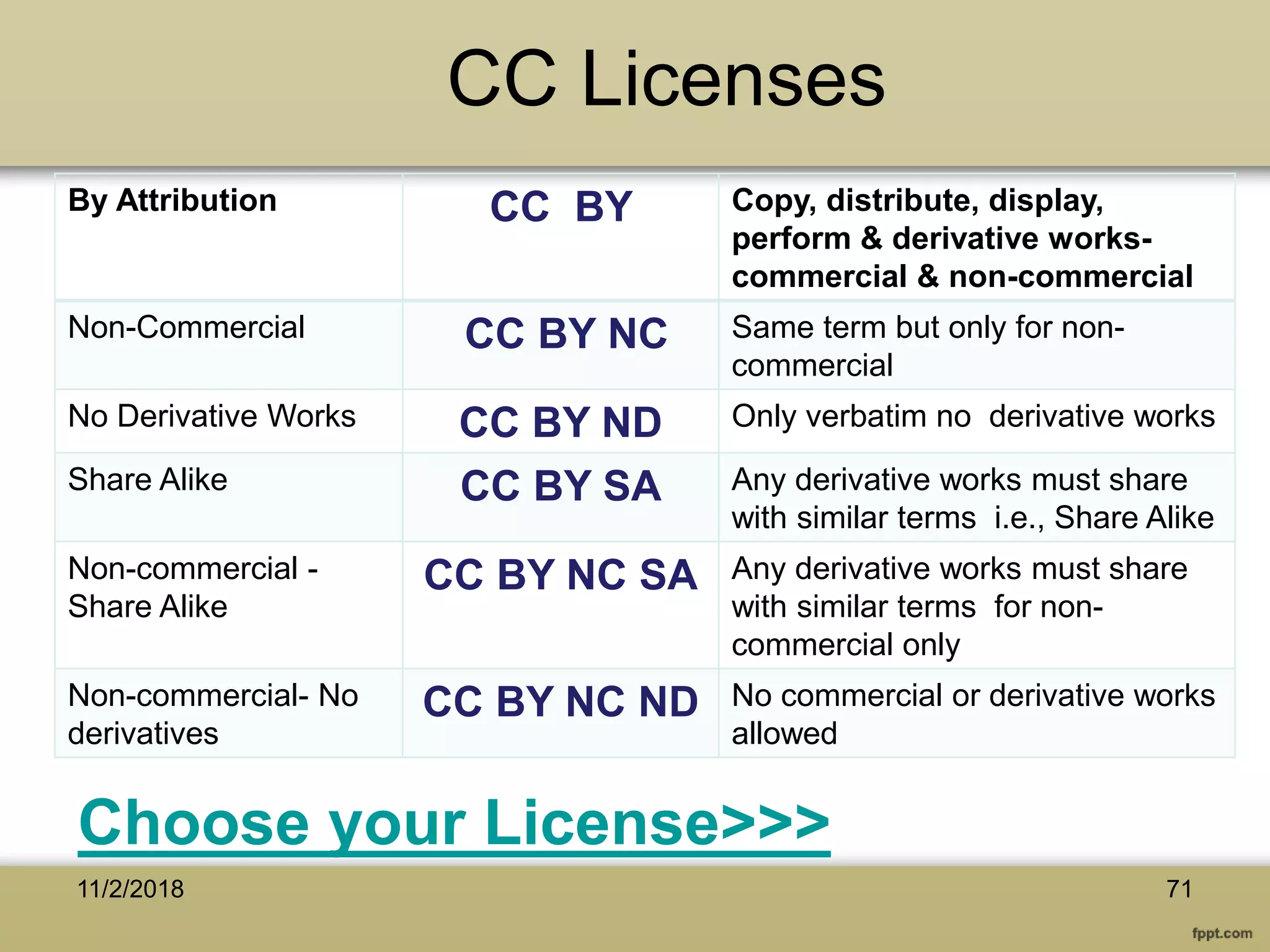
CC Licenses
7111/2/2018
By Attribution CC BY Copy, distribute, display,
perform & derivative works-
commercial & non-commercial
Non-Commercial CC BY NC Same term but only for non-
commercial
No Derivative Works CC BY ND Only verbatim no derivative works
Share Alike CC BY SA Any derivative works must share
with similar terms i.e., Share Alike
Non-commercial -
Share Alike
CC BY NC SA Any derivative works must share
with similar terms for non-
commercial only
Non-commercial- No
derivatives
CC BY NC ND No commercial or derivative works
allowed
Choose your License>>>
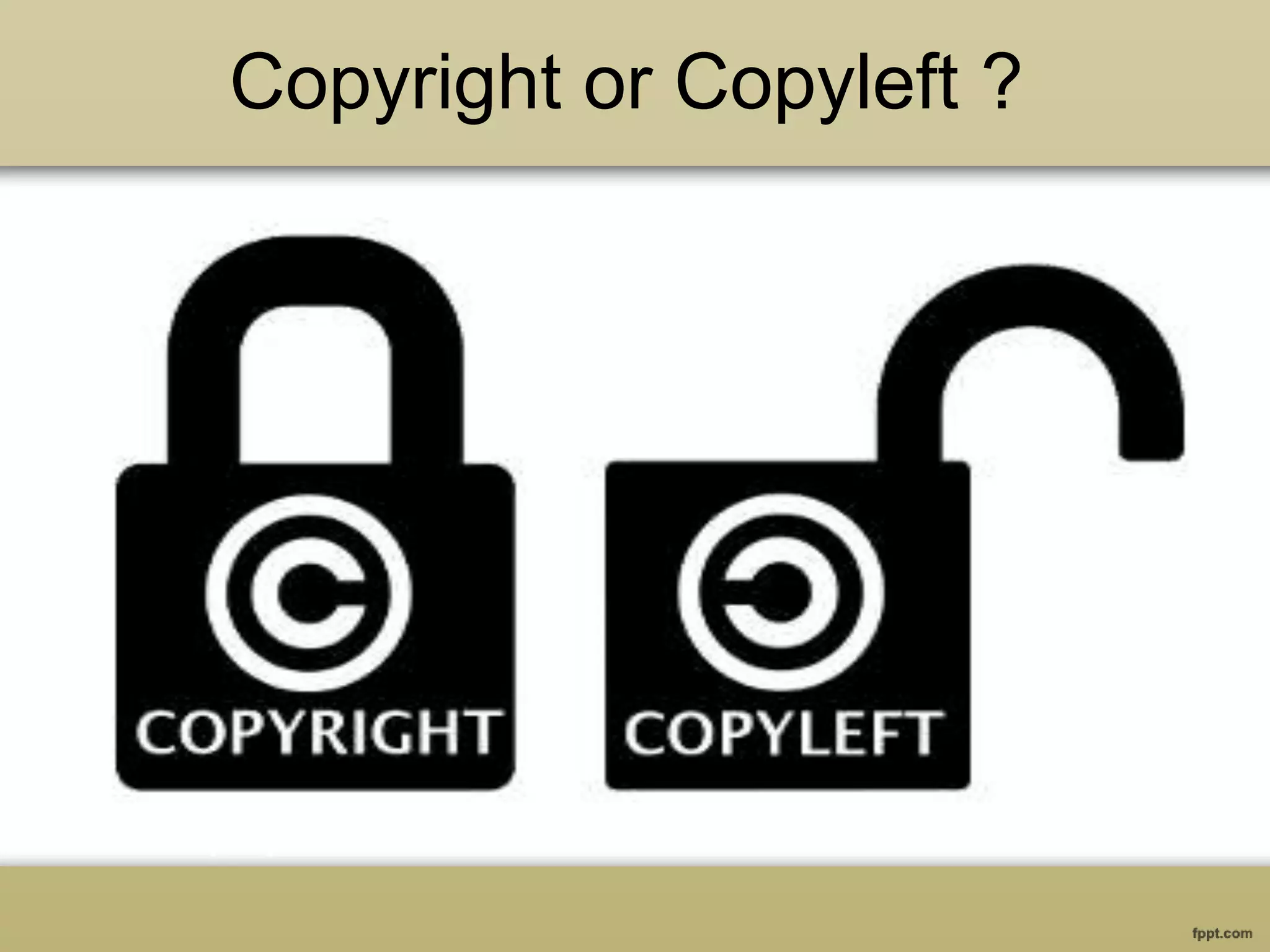
Copyright or Copyleft ?
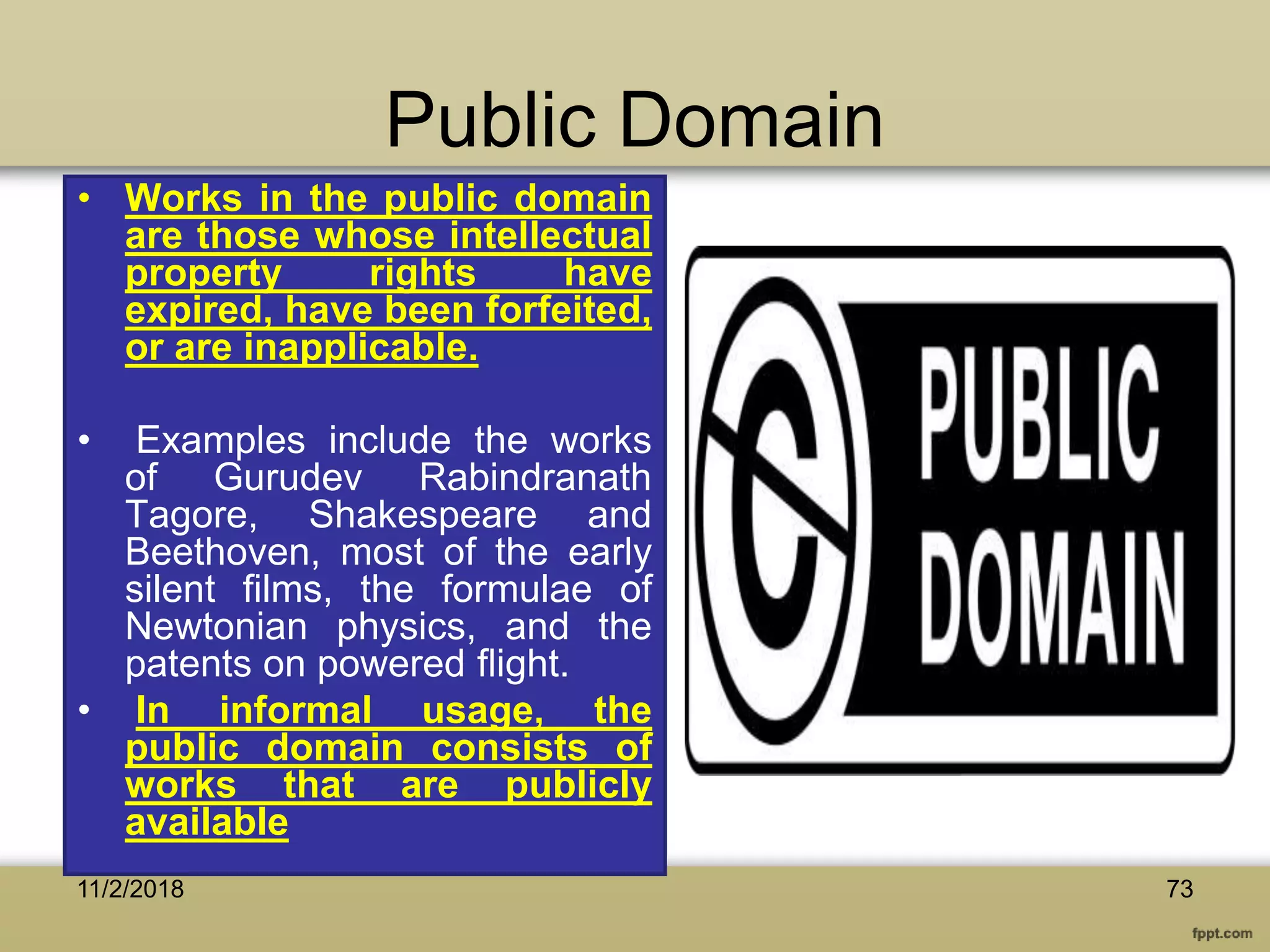
Public Domain
• Works in the public domain
are those whose intellectual
property rights have
expired, have been forfeited,
or are inapplicable.
• Examples include the works
of Gurudev Rabindranath
Tagore, Shakespeare and
Beethoven, most of the early
silent films, the formulae of
Newtonian physics, and the
patents on powered flight.
• In informal usage, the
public domain consists of
works that are publicly
available
7311/2/2018
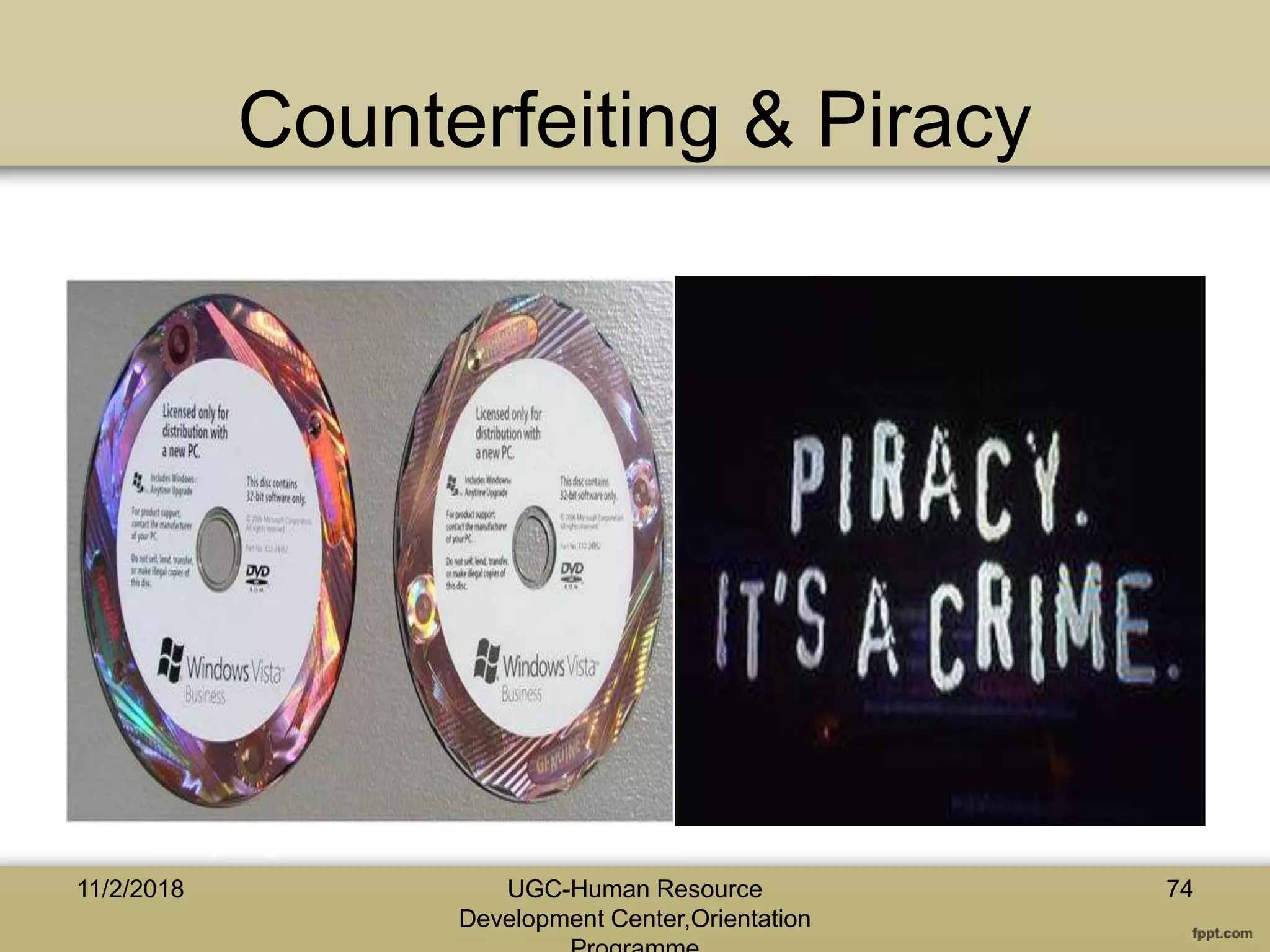
Counterfeiting & Piracy
74UGC-Human Resource
Development Center,Orientation
11/2/2018
Contd...
• ‘Counterfeiting’
refers to selling
works made to
resemble a
genuine copy, as
by replicating the
label, the
packaging, or the
recording itself
• ‘Piracy' refers to the
activity of
manufacturing
unauthorized copies
(‘pirate copies’) of
protected material
and dealing with such
copies by way of
distribution and sale.
7511/2/2018
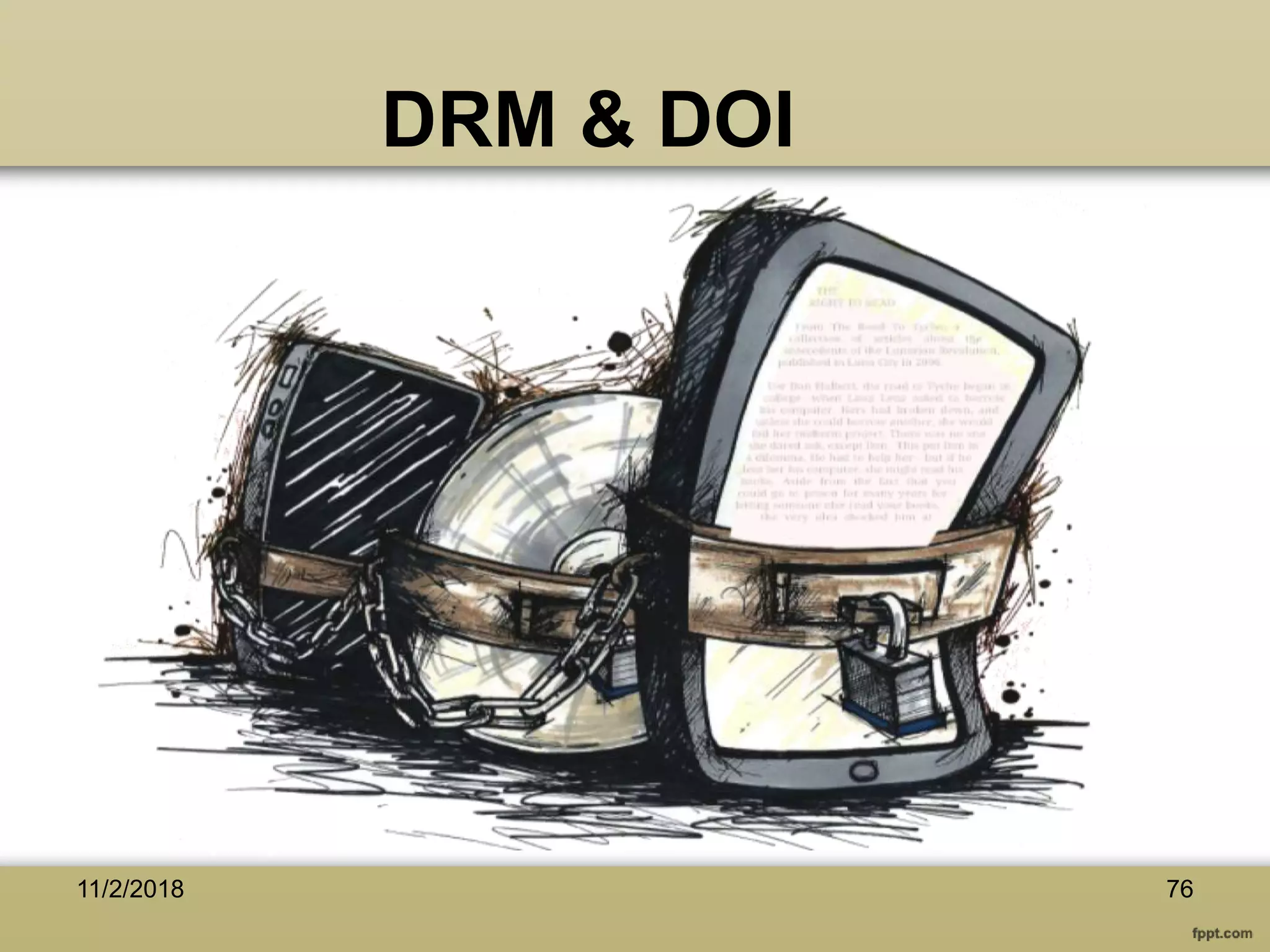
DRM & DOI
7611/2/2018
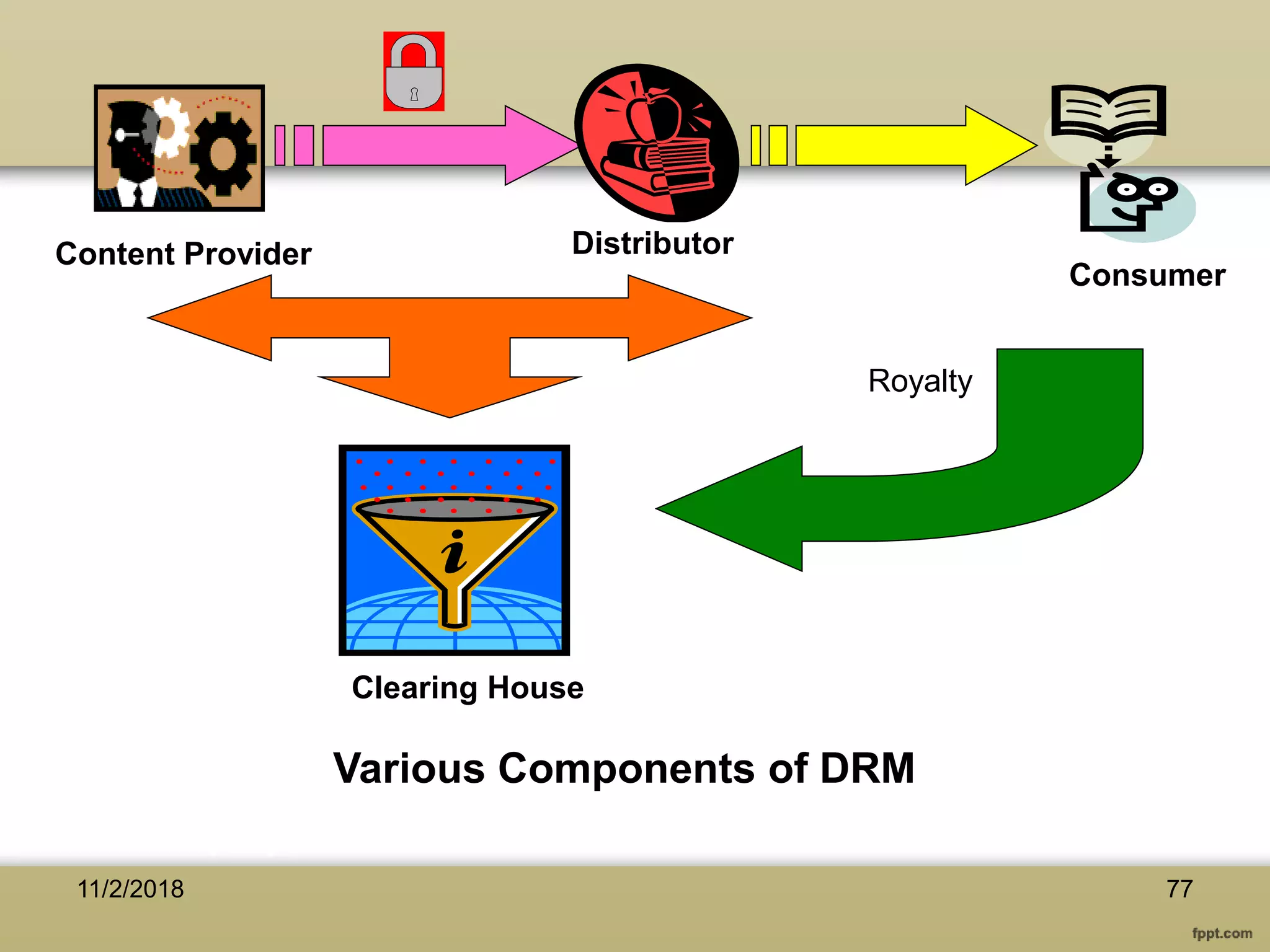
Various Components of DRM
Content Provider Distributor
Consumer
Clearing House
Royalty
7711/2/2018
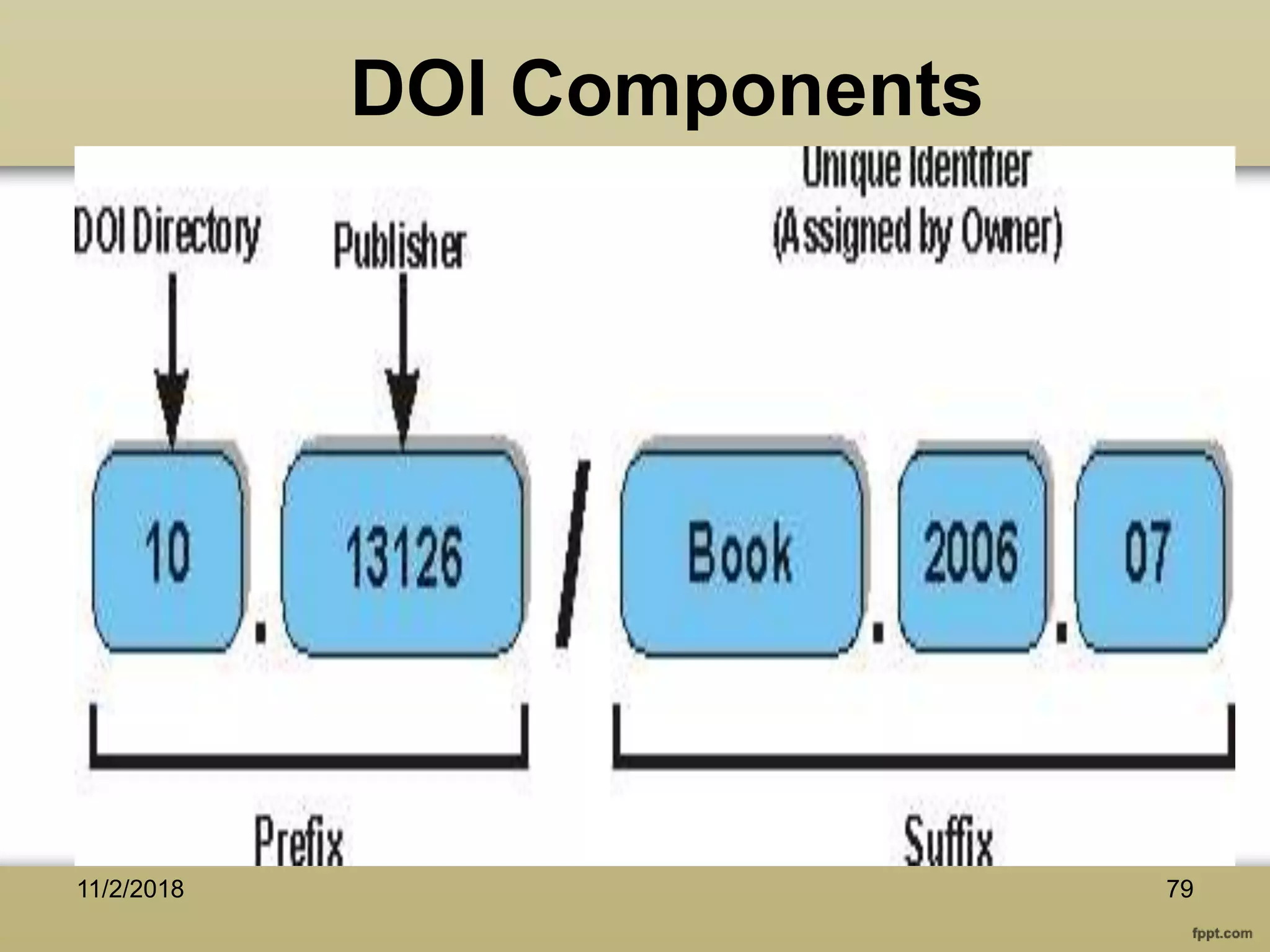
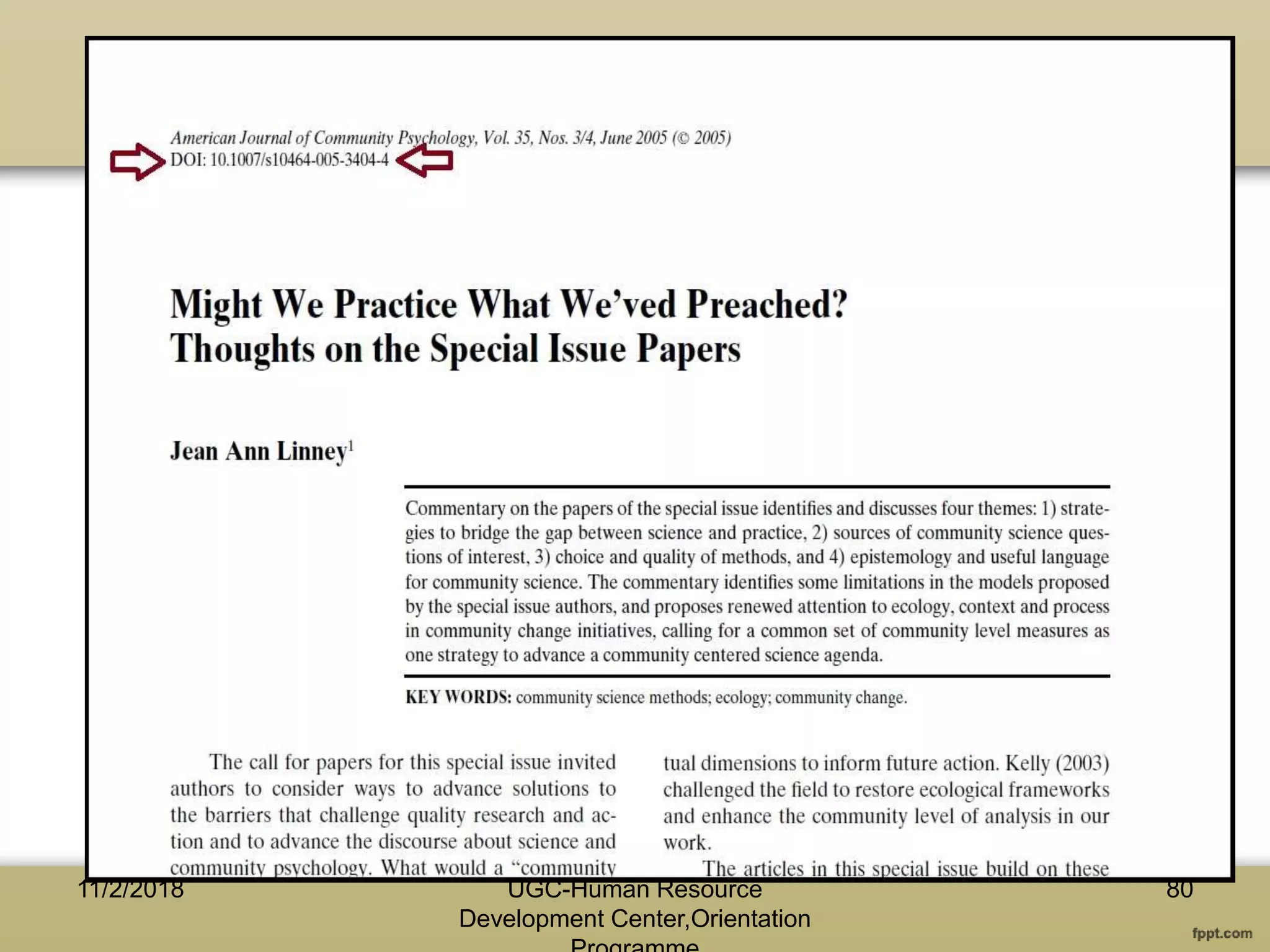
Digital Object Identifier (DOI)
• A digital object identifier is a unique
number that can be used to identify any
type or portion of content. DOI numbers
perform for long term (persistent) and
locatable (actionable) identification
information for specific content or
elements of content. The DOI system is
managed by the International DOI
foundation (IDF) that was established in
1998.
7811/2/2018
DOI Components
7911/2/2018
11/2/2018 UGC-Human Resource
Development Center,Orientation
80
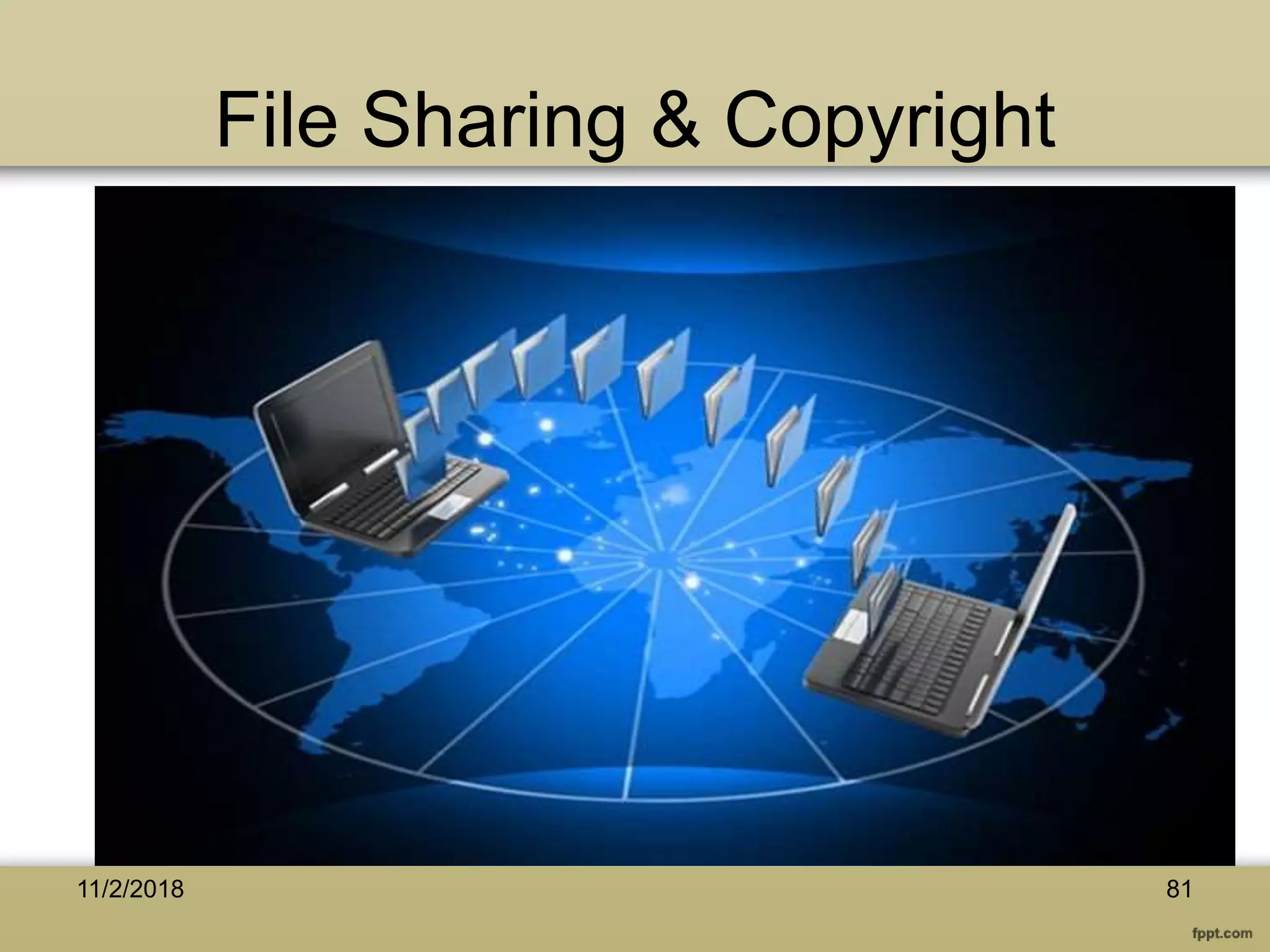
File Sharing & Copyright
11/2/2018 81
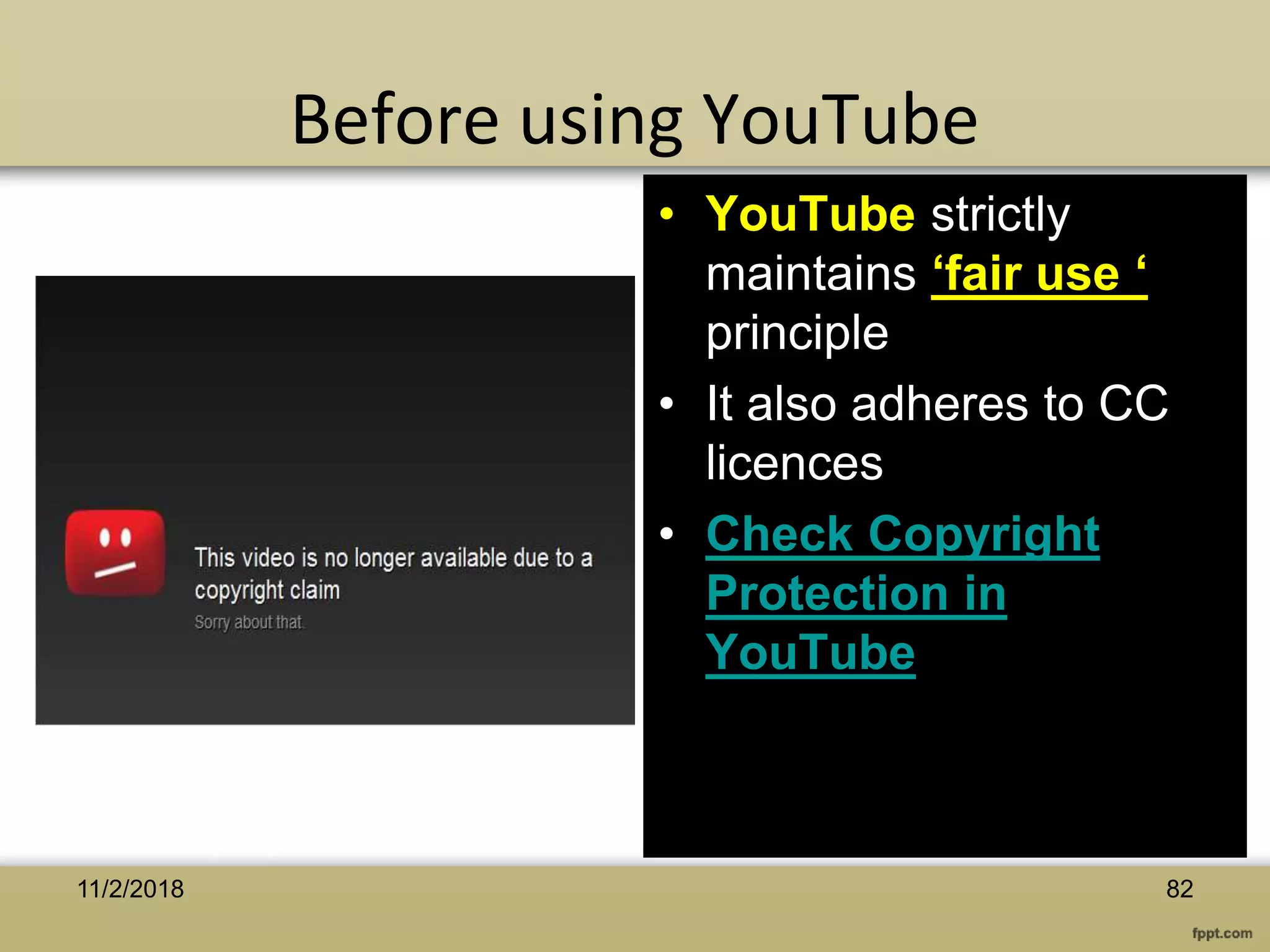
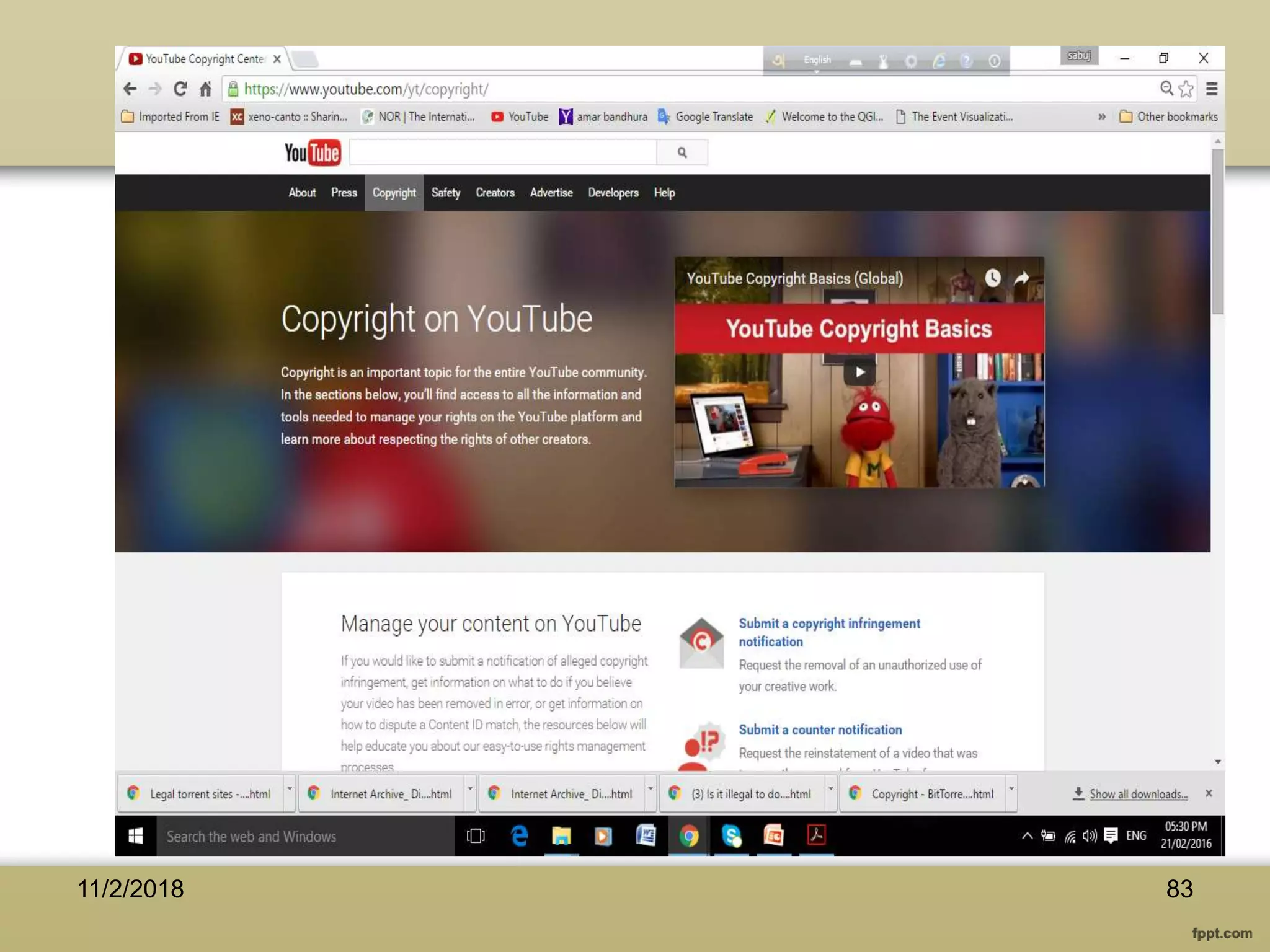
Before using YouTube
• YouTube strictly
maintains ‘fair use ‘
principle
• It also adheres to CC
licences
• Check Copyright
Protection in
YouTube
8211/2/2018
11/2/2018 83
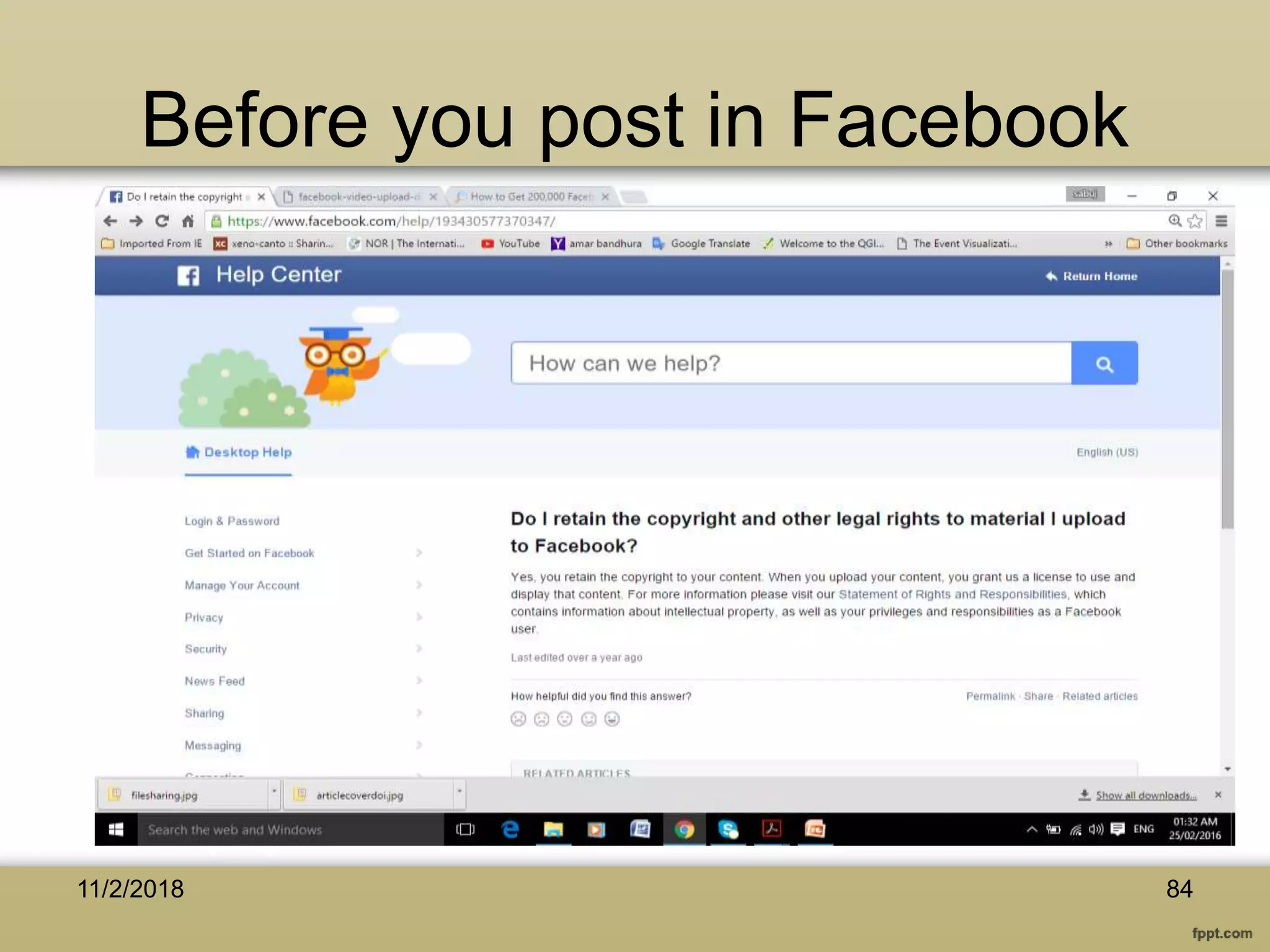
Before you post in Facebook
11/2/2018 84
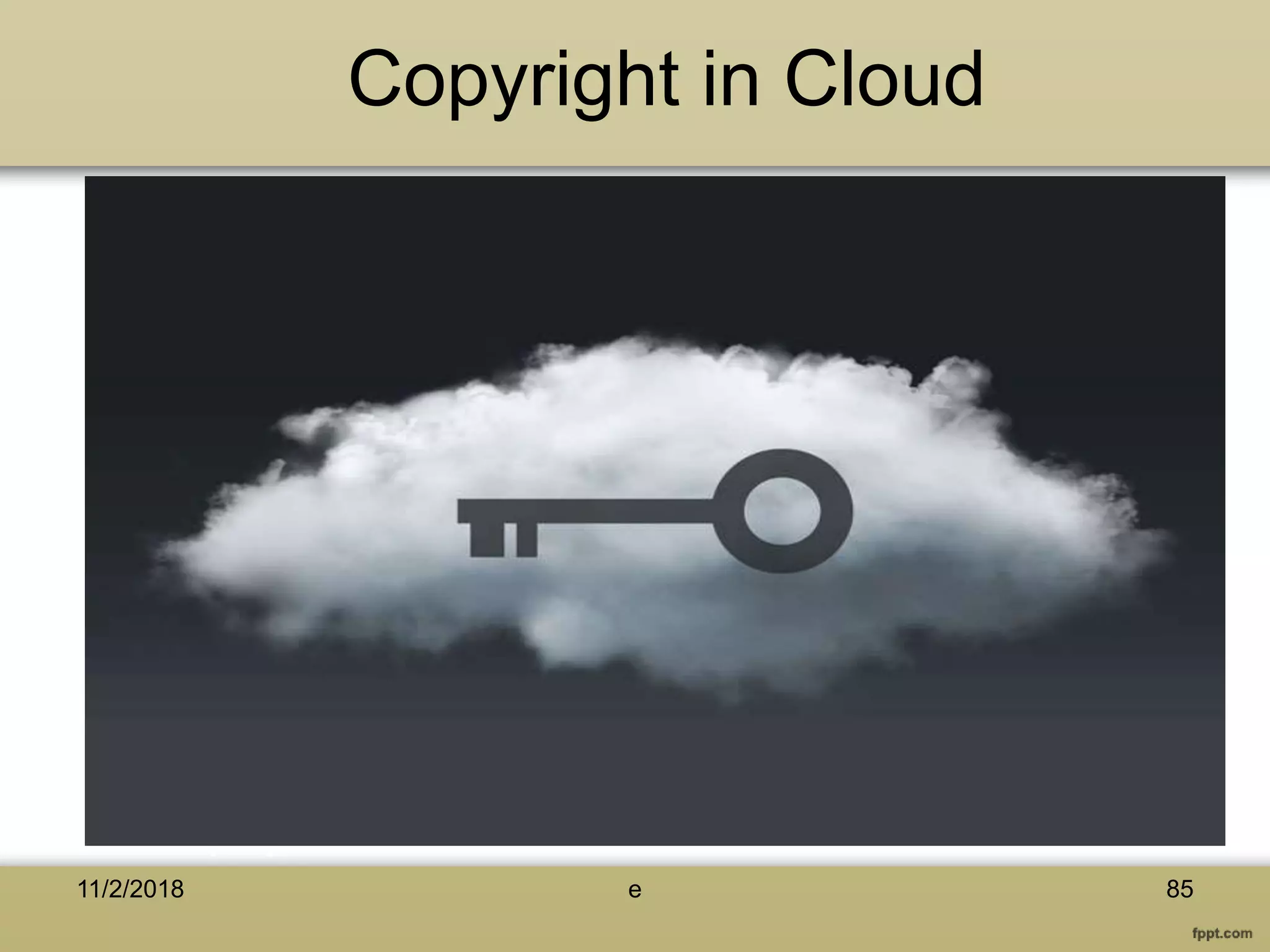
Copyright in Cloud
11/2/2018 e 85
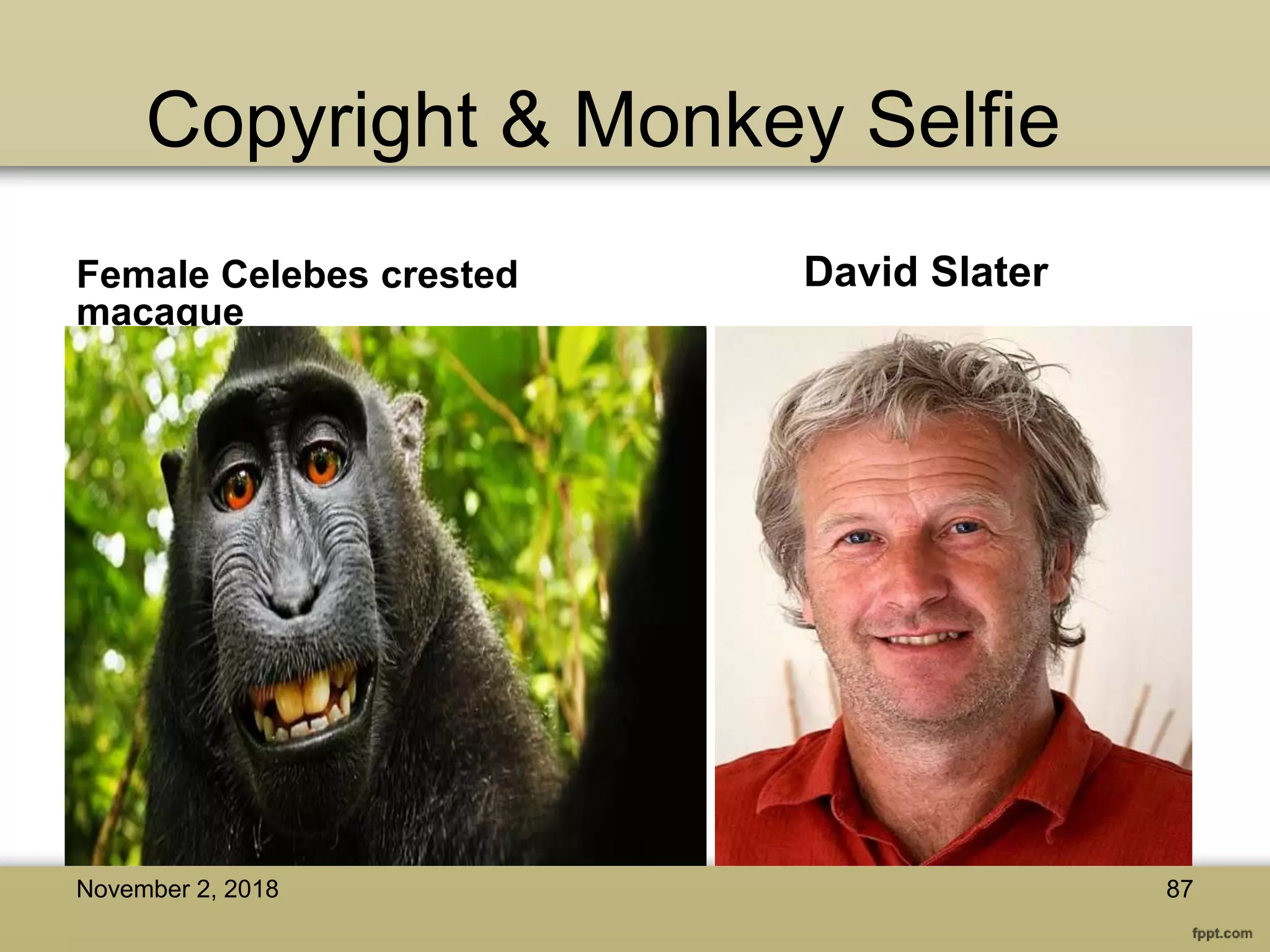
Copyright & Monkey Selfie
Female Celebes crested
macaque
David Slater
November 2, 2018 87
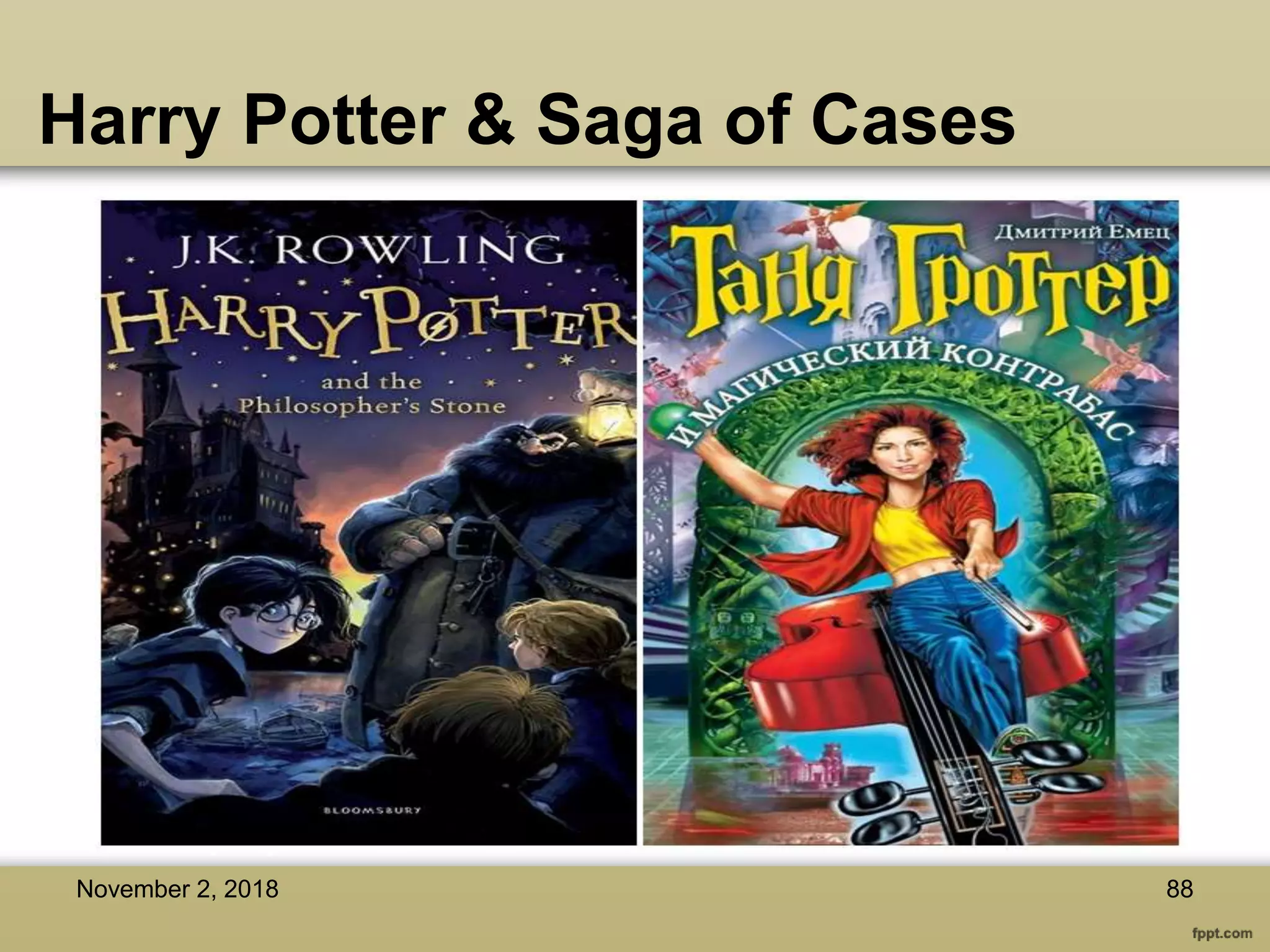
Harry Potter & Saga of Cases
November 2, 2018 88
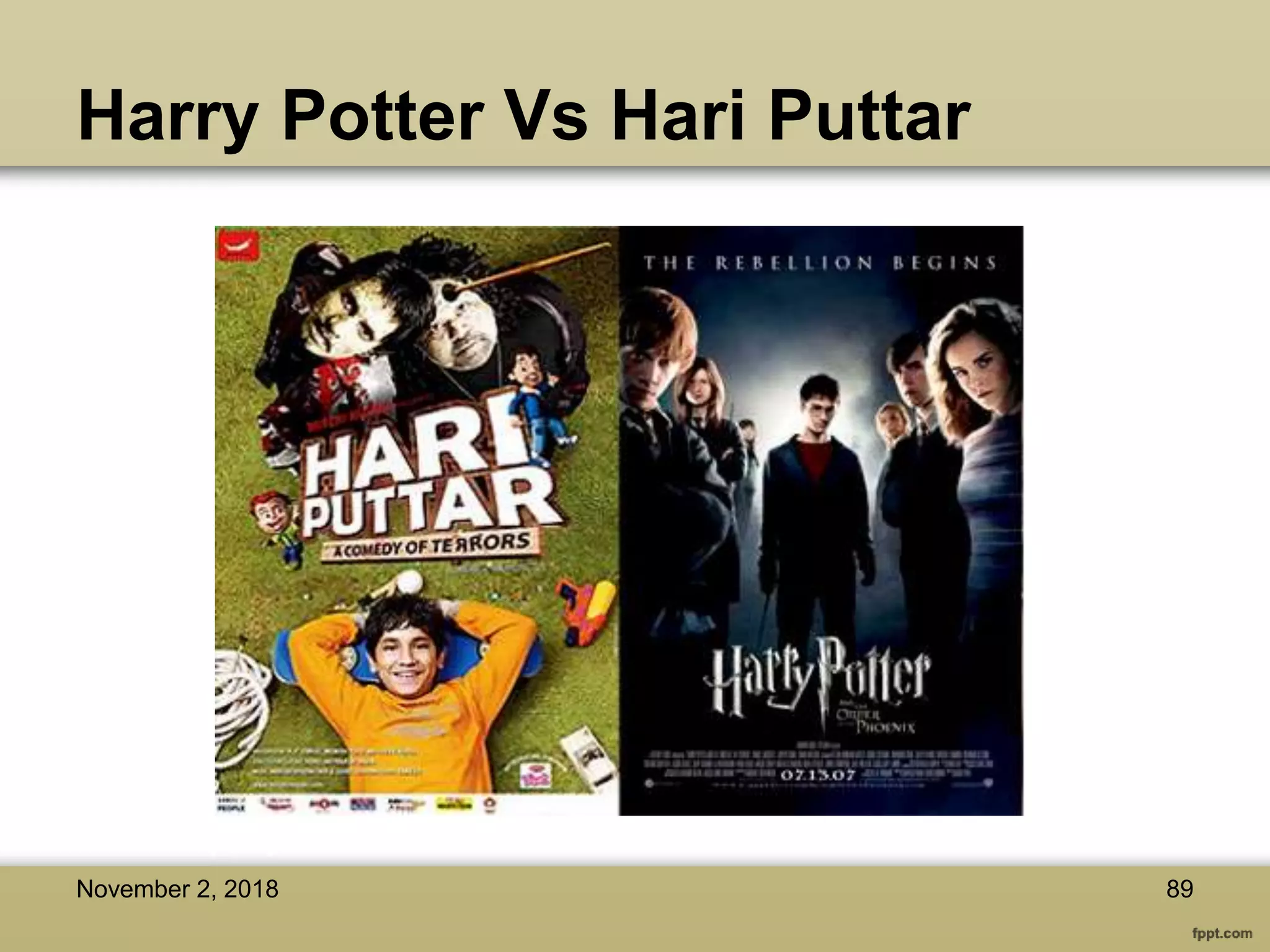
Harry Potter Vs Hari Puttar
November 2, 2018 89
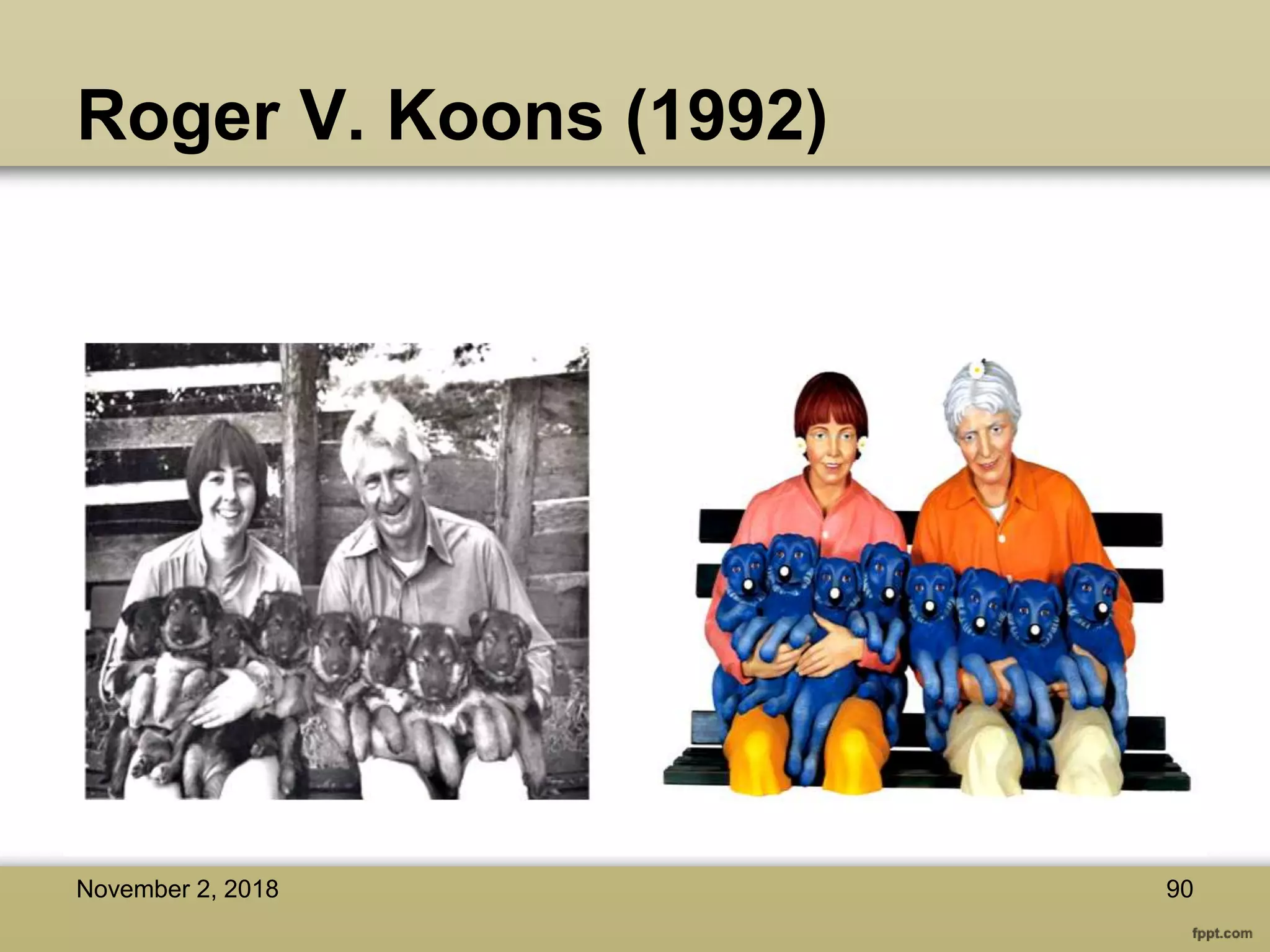
Roger V. Koons (1992)
November 2, 2018 90
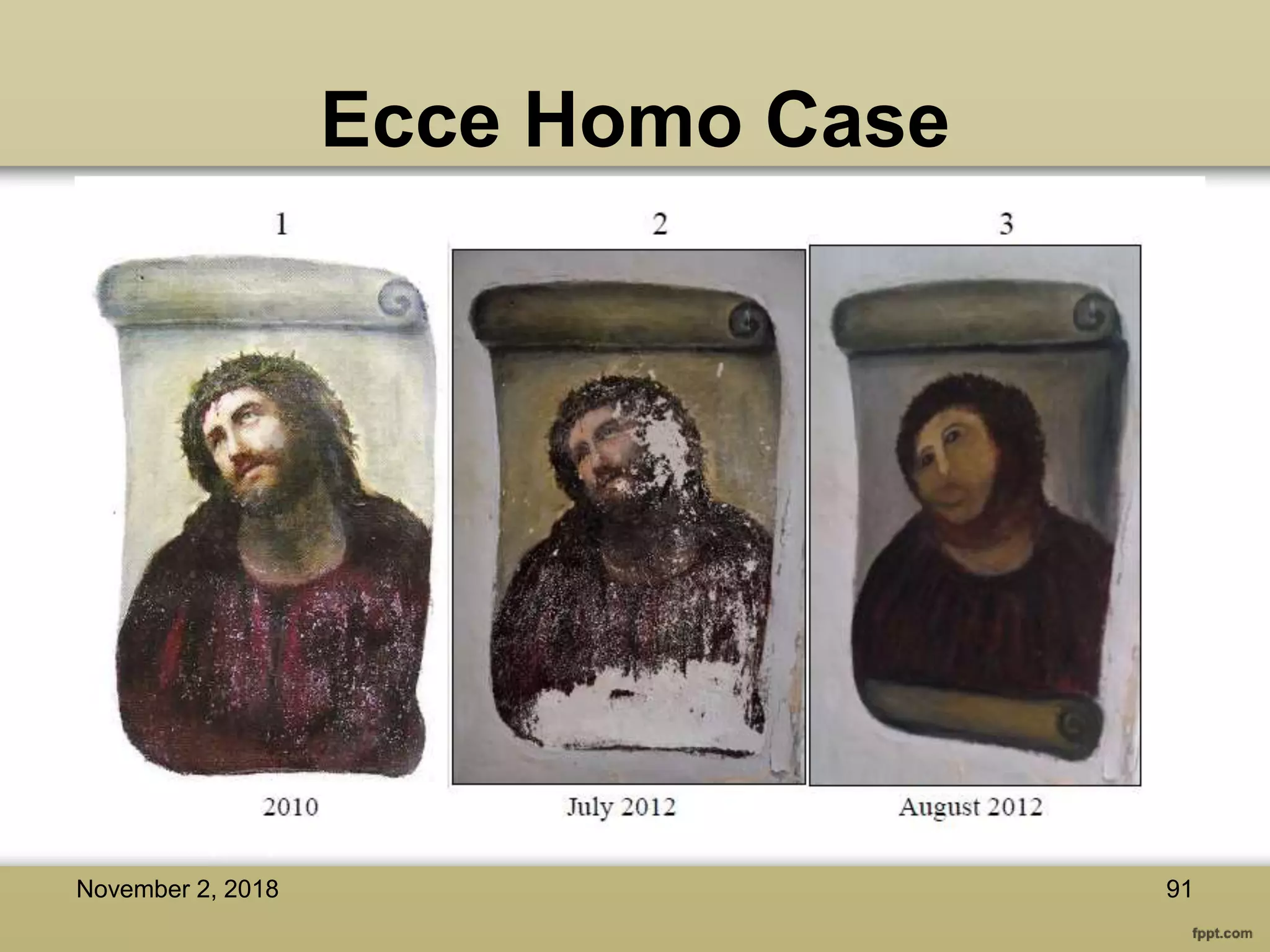
Ecce Homo Case
November 2, 2018 91
Copyright for Teaching-Learning in the 21st Century

Copyright for Teaching-Learning in the 21st Century

  • 1.
    Copyright For Teaching-Learning in the21st Century Dr. Sabuj Kumar Chaudhuri Department of Library & Information Science University of Calcutta Email: sabujkchaudhuri@gmail.com
  • 2.
    Disclaimer I am notlawyer. I can not give you any legal advice
  • 8.
    We Deal withthe Contents
  • 9.
  • 10.
  • 11.
    We lack Ingenuity-WeLack Creativity
  • 12.
    Unfortunately, Internet isnot Copyright Free Zone
  • 13.
    Primary Players inGlobal Innovation Source-WIPO 2 November 2018
  • 14.
  • 15.
    India Innovating...Poorly 66 76 81 6660 57 Rank in Global Innovation Index India in Innovation 2013 2014 2015 2016 2017 2018 Source-WIPO 2 November 2018
  • 16.
    Fair Use andDelhi University
  • 17.
    Contd... • The petitionwas filed by three publishers—Oxford University Press, Cambridge University Press and Taylor & Francis —against the University of Delhi and Rameshwari Photocopy Services, alleged to have violated India’s copyright law by selling photocopied compilations of study material as ‘course packs’. The petitioners argue that this amounts to a parallel publishing enterprise of sorts that is not just illegal, but also harms their market sales.
  • 18.
    Hard Realities ofCopyright Deterrence 2 November 2018
  • 19.
    Renowned Publishers BlockingSharing and Access to Knowledge 2 November 2018
  • 20.
  • 21.
    Adobe Digital: aDRM System 2 November 2018
  • 22.
  • 24.
  • 26.
  • 27.
  • 28.
    Let us DemystifyCopyright...
  • 29.
  • 30.
    Basics of IPR •What is property? • What is Intellectual property (IP)? • What is Intellectual Property Rights(IPR)? 3011/2/2018
  • 31.
    Property • The primarydefinition in the Oxford English Dictionary states that ‘proper’ means ‘belonging to oneself or itself. • Generally it has 3 understandings : • Scientific Understandings: • Properties are attributes, characteristics or qualities that can be applied generally to a group of objects. • Legal Understandings: • Property is the inclusion of rights of exclusive use and alienability • Economic Understandings: • Property includes all rights of individuals to valuable resources. 3111/2/2018
  • 32.
    Rights of AProperty Owner • Right to own • Right to exclusive use • Right to disallow others from its use • Right to sell • Right to transfer • Right to donate • Right to rent • Right to lend • Right to derive profit out of it • Property involves a bundle of rights • The entire bundle can be held by one person or divided among multiple parties. • Property rights confer power. 11/2/2018 32
  • 33.
    Types of Property •The tangible property includes physical objects such as land, household goods, car etc. • The intangible property includes a list of products of human intellect such as patents, copyright, trademarks and industrial designs etc. 3311/2/2018
  • 34.
    IP IPR • Intellectualproperty (IP) deals with the creations of the human intellect and protects the creations of the human mind, the human intellect. This is why this kind of property is called “intellectual property”. • Intellectual property rights (IPR) are the rights awarded by society to individuals or organizations principally over Intellectual Property i.e., creative works: inventions, literary and artistic works, and symbols, names, images, and designs used in commerce. They give the creator the right to prevent others from making unauthorized use of their property for a limited period. 3411/2/2018
  • 35.
    IPR Industrial Property Patent Industrial Design Trademark TradeSecret Geographical Indications (GI) Utility Models Artistic & Literary Property Copyright Sui generis System (“Latin Word means “of its own kind”) Database Integrated Circuit Plant Breeders’ Right (PBR) Classification of IPR 3511/2/2018
  • 36.
    The Idea ofCopyright • Let’s go to 500 yrs back…… -Johann Gutenberg in Germany around 1440 Invented movable printing press -Introduced to England by William Caxton in the last quarter of the 15th century 3611/2/2018
  • 37.
    First Copyright Law •England's Statute of Anne (1710) is widely regarded as the first modern copyright law that for the first time protected the rights of authors rather than publishers of books. • Term of copyright was 28 years [14 years + 14 years if the author was still alive] 3711/2/2018
  • 38.
    3 Aspects ofCopyright 3811/2/2018 Philosophical • Philosophical Legal • Legal Functional • Functional
  • 39.
    Theories of Copyright (By William Fisher , Harvard Law School for CopyrightX (CC BY-NC-SA 2.5) 11/2/2018 39
  • 40.
    Legal Aspects • IndianCopyright Act, 1957 • Various International Copyright Agreements  The Berne convention  Rome convention  The TRIPS agreement.  Universal copyright convention.  WIPO copyright treaty  WIPO performances and phonogram treaty  Digital Millennium Copyright Act (DMCA) • Various case studies and its interpretations • Copyright compliance and infringement 11/2/2018 40
  • 41.
    History of Copyrightin India 3 distinct phases>>>> Phase I: 1847 Copyright Law East India Company Phase II: 1914 Indian Copyright Act ( UK Copyright Act ,1911 as template) Phase III: 1957 Indian Copyright Act (repealed Indian Copyright Act of 1914) Amended 6 times> 1983, 84, 92, 94, 99 & 2012 http://www.copyright.gov.in/ 4111/2/2018
  • 42.
    2 November 2018 3Options before Creators of Any Creative Expressions
  • 43.
    What is Copyright? Copyrightis a kind of Intellectual Property Rights (IPR). Copyright is a right given by the law to creators of literary, dramatic, musical and artistic works and producers of cinematograph films and sound recordings for a limited period of time after that it goes into the public domain. For copyright protection: 1. The work must be original. 2. The work must be fixed, or presented in a tangible form such as writing, film, or photography. 3. Minimal Creativity ,creativity need only be extremely slight for the work to be eligible for protection. Let Us Discuss The Functional Aspects of Copyright 4311/2/2018
  • 44.
    Copyright is aBundle of Rights  Rights for reproduction  Rights for modification/adaptation  Rights for distribution,  Rights for public performance  Rights for public display  Right to make the work available in the Internet 11/2/2018 44
  • 45.
    Copyright as Economicor Moral Right Copyright Economic Right Moral Right licensed, assigned, Can not be or reserved transferred 11/2/2018 45
  • 46.
    Who is Author? •In the case of a literary or dramatic work the author, i.e., the person who creates the work. • In the case of a musical work, the composer. • In the case of a cinematograph film, the producer. • In the case of a sound recording, the producer. • In the case of a photograph, the photographer. • In the case of a computer generated work, the person who causes the work to be created. 4611/2/2018
  • 47.
    Copyright for SoundRecordings • Ordinarily the author is the first owner of copyright in a work. • There are many right holders in a musical sound recording. For example, the lyricist who wrote the lyrics, the composer who set the music, the singer who sang the song, the musician (s) who performed the background music, and the person or company who produced the sound recording. 11/2/2018 47
  • 48.
    Copyright for Cinema •The cine artiste who acts in the film is not protected by copyright law for his acting. • A film is essentially a collection of copyrights, i.e. a screenplay, possibly based on a book, music, directing talent, actors’ performances, as well as the contributions of creative technical crew such as costumers and set designers. 11/2/2018 48
  • 49.
    No. Acquisition ofcopyright is automatic and it does not require any formality. Copyright comes into existence as soon as a work is created and no formality is required to be completed for acquiring copyright. However, certificate of registration of copyright and the entries made therein serve as prima facie evidence in a court of law with reference to dispute relating to ownership of copyright. Is It Necessary To Register A Work To Claim Copyright ? 4911/2/2018
  • 50.
    Is copyright assignable? •Yes. The owner of the copyright in an existing work or the prospective owner of the copyright in a future work may assign to any person the copyright either wholly or partially and either generally or subject to limitations and either for the whole term of the copyright or any part thereof. 11/2/2018 50
  • 51.
    Is Copyright Licensable? • Yes. A copyright owner may grant a license some or all of his rights to others to exploit his work for monetary benefits. A license may be exclusive or Non- exclusive. • License differs from Assignment as the former means renting but the latter one is giving ownership.
  • 52.
    Difference Between CopyrightTransfer and License • A transfer of copyright is a conveyance of ownership, much like the sale of personal property. When you transfer your entire interest in a copyrighted work, or one or more of your exclusive rights under copyright, you give up all claim to the right(s) you convey. • A license is a grant of permission to exercise your rights under copyright. In copyright terminology, there are "non-exclusive" and "exclusive" licenses.
  • 53.
    Contd... What will bethe period of assignment if not specifically stated in the assignments? • If the period of assignment is not stated, it shall be deemed to be five years from the date of assignment. What will be the territorial extent of the assignment if not specified in the assignment? • If the territorial extent of assignment of the rights is not specified, it shall be presumed to extend within the whole of India. Can an author relinquish copyright and, if so, how? • The author of a work may relinquish all or any of the rights comprising the copyright in the work by giving notice in the prescribed form to the Registrar of Copyrights. 11/2/2018 53
  • 54.
    Registration Fees Application • Literary,Dramatic, Musical or Artistic work • Rs. 500/- per work • Cinematograph Film • Rs. 5000/- per work • Sound Recording • Rs. 2,000/- per work Republish • Literary, Dramatic, Musical or Artistic work • Rs. 5000/- per work • Cinematograph Film • Rs. 15,000/- per work • Sound Recording • Rs. 10,000/- per work 11/2/2018 54
  • 55.
    Yes. Any individualwho is an author or rights owner or assignee or legal heir can file application for copyright of a work either at the copyright office or by post or by e-filing facility from the copyright Office web-site "www.copyright.gov.in" Can I Myself File An Application For Registration of Copyright of A Work Directly? 5511/2/2018
  • 56.
    Yes. Both publishedand unpublished works can be registered. When a work has been registered as unpublished and subsequently it is published, the applicant may apply for changes in particulars entered in the Register of Copyright in Form V with prescribed fee. The process of registration and fee for registration of copyright is same. Whether Unpublished Works Are Registered? 5611/2/2018
  • 57.
    Yes. Computer Softwareor programme can be registered as a ‘literary work’. As per Section 2 (o) of the Copyright Act, 1957 “literary work” includes computer programmes, tables and compilations, including computer databases. ‘Source Code’ has also to be supplied along with the application for registration of copyright for software products. Whether Computer Software or Computer Programme Can Be Registered? 5711/2/2018
  • 58.
    2/3 Months Submission forRegistration 30 days mandatory time for waiting for objection (if any) Next 30 days for removing In the Second month work may be if any discrepancy found registered if no objection is found In the third month work may be registered for copyright How Long I Have To Wait To Get My Work To Get Registered By The Copyright Office? 5811/2/2018
  • 59.
    Terms of Copyright •Literary • dramatic, • musical and • artistic works • photographs • Lifetime + 60 years from the beginning of the calendar year next following the year in which the author dies. Example: if Author dies in say 2nd Nov, 1979. So, duration of protection of 60 years period will be from 1st Jan, 1980 to 31st Dec, 2040. Also, in case of joint author, year count for this process will depend upon the author who dies last. Example: Author X and Y are co- author of a work. Author X dies on 4th April 1988 and Y dies on 26th August 1991. So duration of protection of sixty years period will start from 1st Jan, 1992. 5911/2/2018
  • 60.
    • Anonymous and pseudonymousworks • Posthumous work • Cinematograph films • Computer Programs • Sound records • Government work • Public undertakings • International Agencies • 60 Years period is counted from the date of first publication • Period starts from the beginning of next year, following the year in which film was first published. 6011/2/2018 Contd...
  • 61.
    • Performer’s Right •Broadcaster’s Right • 25 Years 6111/2/2018 Contd...
  • 62.
    Safety valve ofCopyright
  • 63.
    Use Fairly (Section52 of Indian Copyright Act) – for the purpose of research or private study, – for criticism or review, – for reporting current events, – in connection with judicial proceeding, – performance by an amateur club or society if the performance is given to a non-paying audience, – Any reproduction of copyrighted works in teaching –learning process, making questions by teachers and answers by pupils – Publication in newspapers or magazines a report of a lecture delivered in public – Making a maximum of 3 copies for the use of a public library – Reproduction of unpublished work kept in a museum or library for the purpose of study or research 11/2/2018 63
  • 64.
    What is FairUse ? 6411/2/2018
  • 65.
    Determination of FairUse • Four Factor Analysis>>> • P (Purpose) • N (Nature) • A (Amount) • M (Marketing) 6511/2/2018
  • 66.
  • 67.
  • 68.
    Plagiarism • Plagiarism isthe "wrongful appropriation" and "stealing and publication" of another author's "language, thoughts, ideas, or expressions" and the representation of them as one's own original work • publication: the presentation of another person's material, work, or idea. • content: the presentation of another person's material, work, or idea. • appropriation: the presentation of another person's material, work, or idea as one's own. • lack of credit given: the presentation of another person's material, work, or idea as his or her own • Source:Clarke R /Plagiarism by Academics Journal of the Association for Information Systems Vol. 7 No. 2, pp. 91-121/February 2006 6811/2/2018
  • 69.
  • 70.
    Creative Commons (CC) •It’s free, easy-to-use copyright licenses provide a simple, standardized way to give the public permission to share and use your creative work — on conditions of your choice. CC licenses let one easily change the copyright terms from the default of “all rights reserved” to “some rights reserved.” 11/2/2018 70
  • 71.
    CC Licenses 7111/2/2018 By AttributionCC BY Copy, distribute, display, perform & derivative works- commercial & non-commercial Non-Commercial CC BY NC Same term but only for non- commercial No Derivative Works CC BY ND Only verbatim no derivative works Share Alike CC BY SA Any derivative works must share with similar terms i.e., Share Alike Non-commercial - Share Alike CC BY NC SA Any derivative works must share with similar terms for non- commercial only Non-commercial- No derivatives CC BY NC ND No commercial or derivative works allowed Choose your License>>>
  • 72.
  • 73.
    Public Domain • Worksin the public domain are those whose intellectual property rights have expired, have been forfeited, or are inapplicable. • Examples include the works of Gurudev Rabindranath Tagore, Shakespeare and Beethoven, most of the early silent films, the formulae of Newtonian physics, and the patents on powered flight. • In informal usage, the public domain consists of works that are publicly available 7311/2/2018
  • 74.
    Counterfeiting & Piracy 74UGC-HumanResource Development Center,Orientation 11/2/2018
  • 75.
    Contd... • ‘Counterfeiting’ refers toselling works made to resemble a genuine copy, as by replicating the label, the packaging, or the recording itself • ‘Piracy' refers to the activity of manufacturing unauthorized copies (‘pirate copies’) of protected material and dealing with such copies by way of distribution and sale. 7511/2/2018
  • 76.
  • 77.
    Various Components ofDRM Content Provider Distributor Consumer Clearing House Royalty 7711/2/2018
  • 78.
    Digital Object Identifier(DOI) • A digital object identifier is a unique number that can be used to identify any type or portion of content. DOI numbers perform for long term (persistent) and locatable (actionable) identification information for specific content or elements of content. The DOI system is managed by the International DOI foundation (IDF) that was established in 1998. 7811/2/2018
  • 79.
  • 80.
  • 81.
    File Sharing &Copyright 11/2/2018 81
  • 82.
    Before using YouTube •YouTube strictly maintains ‘fair use ‘ principle • It also adheres to CC licences • Check Copyright Protection in YouTube 8211/2/2018
  • 83.
  • 84.
    Before you postin Facebook 11/2/2018 84
  • 85.
  • 87.
    Copyright & MonkeySelfie Female Celebes crested macaque David Slater November 2, 2018 87
  • 88.
    Harry Potter &Saga of Cases November 2, 2018 88
  • 89.
    Harry Potter VsHari Puttar November 2, 2018 89
  • 90.
    Roger V. Koons(1992) November 2, 2018 90
  • 91.