INTRODUCTION TO
COPYRIGHT IN INDIA
Aravind TS
Structure of the Presentation
Three parts
(1) Copyright in India
(2) Case Study: Copyrighting DNA
(3) Infringement of Copyright
What is Copyright?
“The exclusive right given by law for a
certain term of years to an author,
composer etc. (or his assignee) to print,
publish and sell copies of his original work”
(Oxford English Dictionary)
Why Copyright?
Fair Play: Reward creative efforts. “Thou shall
not steal”
Exclusive rights for limited
time → Negative right:
prevent copying/reproduction
Copyright is necessary →
encourage dissemination of
copyrighted works = public interest
England & Wales
Indian copyright law similar to England &
Wales. First Copyright Act in England (and
the world)
1709 → Statute of Anne.
United States
First Act in 1790: did not protect foreign
authors
Indigenous American literature
suffered
Today: Copyright Act 1976 one
of the major copyright laws in
the world
The Copyright Act 1957
Indian Perspectives
Copyright in India
First Act in 1914, followed by the Copyright
Act 1957.
1957 Act: adopted many English provisions,
introduced new ideas and concepts.
Copyright Act 1957 – Main Features
Valid from 21 January 1958
Created Copyright Office and Copyright
Board
Introduced civil and criminal remedies
against infringement
Copyright Act 1957 – Main Features
Performing rights societies’ rights (for
instance, music royalties)
Definition of categories in which copyright
actually subsists
International copyright
Definition of infringement
Copyright (Amendment) Act 1992
Defined ambit of the Copyright Board’s
powers
Introducing special
rights for performers
Assignment and licences of copyright
Rights of copyright owners
Term of Copyright
Depends on nature of work/owner of
copyright and whether the work has been
published
Most works: 60 years
Broadcast Reproduction: 25 years
About Fixation, Labour, Skill and Capital
The Nature of Copyright
Statute-based, no registration necessary
Copyright = intellectual property
Combines different rights (literary works:
the right to reproduce in hardback and
paperback editions, the right of translation
adaptation)
Labour, Skill and Capital
“It is the product of the labour, skill and
capital of one man which must not be
appropriated by another.”
What Copyright Protects
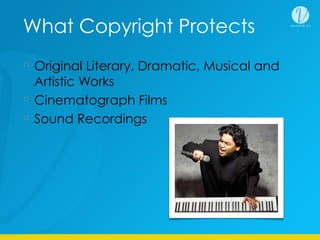
Original Literary, Dramatic, Musical and
Artistic Works
Cinematograph Films
Sound Recordings
Literary Works
Novels, poems, short stories
Books on any subject
Computer programmes,
tables, computer
databases
Song lyrics
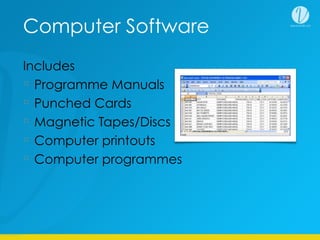
Computer Software
Includes
Programme Manuals
Punched Cards
Magnetic Tapes/Discs
Computer printouts
Computer programmes
Work in the biotech industry involving
copyrightable subject matter:
—Modification of genes of plants, animals
—To identify causes of diseases
—To make assays for the testing of various
diseases
—Manufacture of vaccines
Spotlight on Copyright for the
Biotech industry
When (Copy)right becomes wrong
Infringement of Copyright
Statutory Definition
Copyright Act 1957, s. 51
Infringement: exercising rights of the
copyright owner
Making, distributing, exhibiting and
importing infringing copies of the work
Factors Determining Infringement
Copying
Causal Connection
Subconscious Copying
Indirect Copying
Substantial Taking
Unaltered copying
Extent of defendant’s alteration
Character of Plaintiff’s and Defendant’s works
Nature and Extent of Plaintiff’s Effort
General Principles
R.C Anand v Delux Films
(1)No copyright in an idea. Violation of
copyright confined to form, manner and
arrangement, as well as expression of idea
by the author
(2) Where same idea developed in different
manner, similarities happen. Court to rule
on whether similarities are merely
substantial or fundamental
General Principles (2)
(3) Safest Test: Does the reader/
spectator/viewer have the
opinion/get the unshakeable
impression that the second work is a
copy of the original? (“the viewer test”)
(4) Same theme, different presentation →
Completely new work, no infringement
General Principles (3)
(5) Where there are only incidental similarities,
there is no copyright infringement
(6) Copyright infringement = piracy
it must be clearly proven
(7) Very difficult to prove violation of copyright
of stage play by a film
producer: the “viewer test” is applicable
Strengthening Copyright, Enhancing the
Reach of the Law
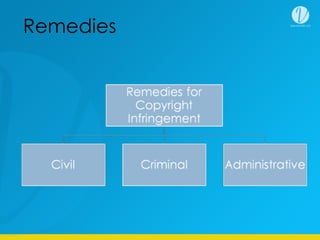
Remedies for Copyright Infringement
Remedies
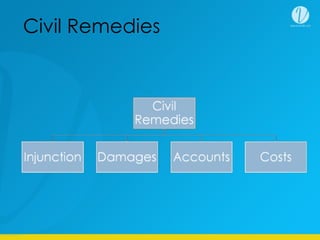
Civil Remedies
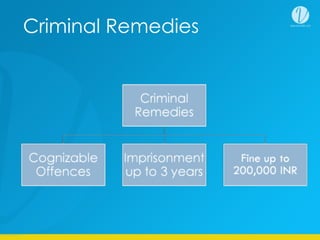
Criminal Remedies
Criminal Remedies
Copyright Act 1957, s.64 empowers the
Police (any officer not below the rank of
sub-inspector) to seize infringing copies
without warrant
Police Raids (Power of search, seizure &
arrest without a warrant)
Fines (min. 50,000-200,000 INR)
Imprisonment (6 months to 3 years)
31
THANK YOU
www.aravindts.com

Copy right

  • 1.
  • 2.
    Structure of thePresentation Three parts (1) Copyright in India (2) Case Study: Copyrighting DNA (3) Infringement of Copyright
  • 3.
    What is Copyright? “Theexclusive right given by law for a certain term of years to an author, composer etc. (or his assignee) to print, publish and sell copies of his original work” (Oxford English Dictionary)
  • 4.
    Why Copyright? Fair Play:Reward creative efforts. “Thou shall not steal” Exclusive rights for limited time → Negative right: prevent copying/reproduction Copyright is necessary → encourage dissemination of copyrighted works = public interest
  • 5.
    England & Wales Indiancopyright law similar to England & Wales. First Copyright Act in England (and the world) 1709 → Statute of Anne.
  • 6.
    United States First Actin 1790: did not protect foreign authors Indigenous American literature suffered Today: Copyright Act 1976 one of the major copyright laws in the world
  • 7.
    The Copyright Act1957 Indian Perspectives
  • 8.
    Copyright in India FirstAct in 1914, followed by the Copyright Act 1957. 1957 Act: adopted many English provisions, introduced new ideas and concepts.
  • 9.
    Copyright Act 1957– Main Features Valid from 21 January 1958 Created Copyright Office and Copyright Board Introduced civil and criminal remedies against infringement
  • 10.
    Copyright Act 1957– Main Features Performing rights societies’ rights (for instance, music royalties) Definition of categories in which copyright actually subsists International copyright Definition of infringement
  • 11.
    Copyright (Amendment) Act1992 Defined ambit of the Copyright Board’s powers Introducing special rights for performers Assignment and licences of copyright Rights of copyright owners
  • 12.
    Term of Copyright Dependson nature of work/owner of copyright and whether the work has been published Most works: 60 years Broadcast Reproduction: 25 years
  • 13.
    About Fixation, Labour,Skill and Capital The Nature of Copyright
  • 14.
    The Nature ofCopyright Statute-based, no registration necessary Copyright = intellectual property Combines different rights (literary works: the right to reproduce in hardback and paperback editions, the right of translation adaptation)
  • 15.
    Labour, Skill andCapital “It is the product of the labour, skill and capital of one man which must not be appropriated by another.”
  • 16.
    What Copyright Protects OriginalLiterary, Dramatic, Musical and Artistic Works Cinematograph Films Sound Recordings
  • 17.
    Literary Works Novels, poems,short stories Books on any subject Computer programmes, tables, computer databases Song lyrics
  • 18.
    Computer Software Includes Programme Manuals PunchedCards Magnetic Tapes/Discs Computer printouts Computer programmes
  • 19.
    Work in thebiotech industry involving copyrightable subject matter: —Modification of genes of plants, animals —To identify causes of diseases —To make assays for the testing of various diseases —Manufacture of vaccines Spotlight on Copyright for the Biotech industry
  • 20.
    When (Copy)right becomeswrong Infringement of Copyright
  • 21.
    Statutory Definition Copyright Act1957, s. 51 Infringement: exercising rights of the copyright owner Making, distributing, exhibiting and importing infringing copies of the work
  • 22.
    Factors Determining Infringement Copying CausalConnection Subconscious Copying Indirect Copying Substantial Taking Unaltered copying Extent of defendant’s alteration Character of Plaintiff’s and Defendant’s works Nature and Extent of Plaintiff’s Effort
  • 23.
    General Principles R.C Anandv Delux Films (1)No copyright in an idea. Violation of copyright confined to form, manner and arrangement, as well as expression of idea by the author (2) Where same idea developed in different manner, similarities happen. Court to rule on whether similarities are merely substantial or fundamental
  • 24.
    General Principles (2) (3)Safest Test: Does the reader/ spectator/viewer have the opinion/get the unshakeable impression that the second work is a copy of the original? (“the viewer test”) (4) Same theme, different presentation → Completely new work, no infringement
  • 25.
    General Principles (3) (5)Where there are only incidental similarities, there is no copyright infringement (6) Copyright infringement = piracy it must be clearly proven (7) Very difficult to prove violation of copyright of stage play by a film producer: the “viewer test” is applicable
  • 26.
    Strengthening Copyright, Enhancingthe Reach of the Law Remedies for Copyright Infringement
  • 27.
  • 28.
  • 29.
  • 30.
    Criminal Remedies Copyright Act1957, s.64 empowers the Police (any officer not below the rank of sub-inspector) to seize infringing copies without warrant Police Raids (Power of search, seizure & arrest without a warrant) Fines (min. 50,000-200,000 INR) Imprisonment (6 months to 3 years)
  • 31.