Outline:
   Introduction
   Steps of filling patents
   Introduction of GATT
   Introduction to TRIPS
Introduction:
   What is the meaning of IP?
    IP-INTELLECTUAL PROPERTY- is a term
    referring to a number of distinct types of
    creations of mind for which a set of exclusive
    rights are recognized in the corresponding
    fields of law.
 What   is the meaning of IPR?
          Intellectual Property Rights are
 the rights given to persons over the creations
 of their minds.
          They usually give the creator an
 exclusive right over the use of his/her creation
 for a certain period of time.
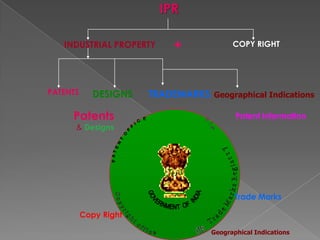
IPR

   INDUSTRIAL PROPERTY      +             COPY RIGHT


PATENTS      DESIGNS   TRADEMARKS Geographical Indications

     Patents                               Patent Information
      & Designs


                                           Trade Marks

          Copy Right

                                    Geographical Indications
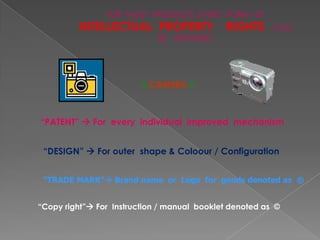
FOR MOST PRODUCTS EVERY FORM OF
          INTELLECTUAL PROPERTY              RIGHTS      CAN
                             BE OBTAINED


                         CAMERA


“PATENT”  For every individual improved mechanism


 “DESIGN”  For outer shape & Coloour / Configuration


 “TRADE MARK” Brand name or Logo for goods denoted as ®


“Copy right” For Instruction / manual booklet denoted as ©
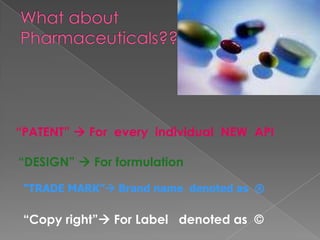
“PATENT”  For every individual NEW API

“DESIGN”  For formulation

 “TRADE MARK” Brand name denoted as ®

 “Copy right” For Label denoted as ©
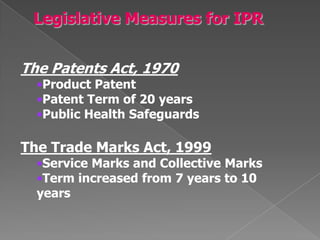
The Patents Act, 1970
  •Product Patent
  •Patent Term of 20 years
  •Public Health Safeguards

The Trade Marks Act, 1999
  •Service Marks and Collective Marks
  •Term increased from 7 years to 10
  years
   The Designs Act, 2000
   The Copyrights Act, 1957
   The Bio-Diversity Act, 2001
   The Layouts and Integrated Circuits Act
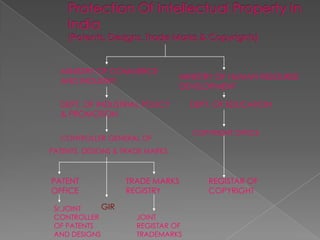
MINISTRY OF COMMERCE
                                 MINISTRY OF HUMAN RESOURSE
  AND INDUSTRY
                                 DEVELOPMENT

  DEPT. OF INDUSTRIAL POLICY        DEPT. OF EDUCATION
  & PROMOTION

                                    COPYRIGHT OFFICE
  CONTROLLER GENERAL OF
PATENTS, DESIGNS & TRADE MARKS


PATENT             TRADE MARKS          REGISTAR OF
OFFICE             REGISTRY             COPYRIGHT

 Sr.JOINT    GIR
 CONTROLLER           JOINT
 OF PATENTS           REGISTAR OF
 AND DESIGNS          TRADEMARKS
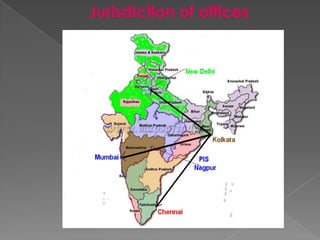
Jurisdiction of offices
1.   Protection Part


2.   Enforcement Part
•   Criteria for Patentability
    – New & useful
    – Non-obvious
    – Capable of Industrial Applications

•   Patents Act specifies
    – What are not inventions?
    – What are not patentable inventions?

•   How to get that monopoly right?
 Opposition   proceedings

 Licensing   provisions

 Infringements   suit provisions
   It encourages RESEARCH.
   Induces an inventor to disclose his
    inventions instead of keeping them as
    secret.
   Provides inducement for capital
    investment encouraging technological
    development.
   It encourages establishment of new
    industries.
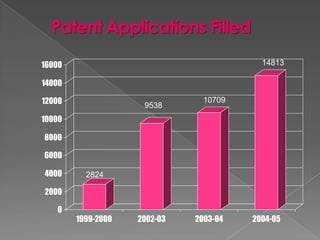
Patent Applications Filled
16000                                     14813

14000

12000                           10709
                     9538
10000

8000

6000

4000      2824

2000

   0
        1999-2000   2002-03   2003-04   2004-05
•   KNOWLEDGE OF INVENTION ADDS TO
    BASE FOR FURTHER RESEACH

•   REASONABLE ASSURANCE FOR
    COMMERCIALIZATION

•   PATENT- OPEN TO PUBLIC FOR USE
    – AFTER ITS TERM EXPIRES
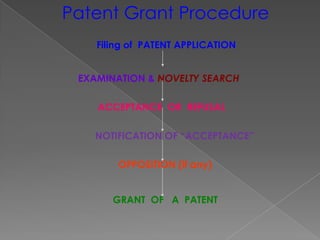
Patent Grant Procedure
    Filing of PATENT APPLICATION


 EXAMINATION & NOVELTY SEARCH

    ACCEPTANCE OR REFUSAL

   NOTIFICATION OF “ACCEPTANCE”

        OPPOSITION (if any)


       GRANT OF A PATENT
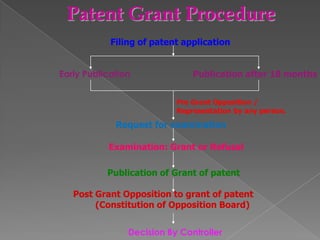
Patent Grant Procedure
            Filing of patent application


Early Publication              Publication after 18 months


                           Pre Grant Opposition /
                           Representation by any person.

             Request for examination

           Examination: Grant or Refusal

           Publication of Grant of patent

   Post Grant Opposition to grant of patent
        (Constitution of Opposition Board)


                Decision By Controller
Introduction:
   What is the meaning of GATT?

   GATT means “General Agreement on Tariffs and
    Trade”

   GATT is an international agreement on trade
    Formalities between different countries
    regarding trading & distribution of different
    commodities in between different countries.
   The main purpose of GATT is to provide
    guidelines on various aspects related to
    international trading of various commodities.

   Example:
     The state policies regarding import-export
    Protection of interests of the manufacturers
    and exporters through the IPR.
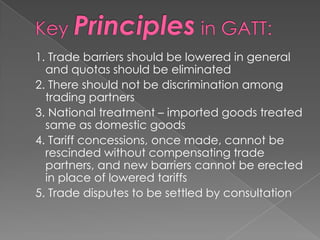
1. Trade barriers should be lowered in general
  and quotas should be eliminated
2. There should not be discrimination among
  trading partners
3. National treatment – imported goods treated
  same as domestic goods
4. Tariff concessions, once made, cannot be
  rescinded without compensating trade
  partners, and new barriers cannot be erected
  in place of lowered tariffs
5. Trade disputes to be settled by consultation
Introduction:
   What is the meaning of TRIPS?

   TRIPS means “Trade Related Aspects of
    Intellectual Property Rights(TRIPS)
    Agreement”
World Trade Organization (WTO):
  •   WTO is the successor to the General Agreement
      on Tariffs and Trade (GATT) established in the
      wake of the WWII

  •   First took effect in January 1995.
•   Growth in world trading.
•   Increased importance of global IP protection.
•   Existing provisions of international law were
    perceived insufficient.
       1. Absence of enforcement of rights before
    national judicial authorities.
       2. Lack of a dispute settlement mechanism
    between States.
       3. Standards were outdated.

The most detailed and
comprehensive
multilateral
agreement on
intellectual property
yet negotiated.
• TRIPS introduced intellectual property rules
  into the multilateral trading system for the first
  time.
• Membership in WTO requires a country to
  agree to adopt the minimum standards for
  intellectual property regulation.
• IP laws are established and enforced by each
  individual Member Country.
•   How basic principles of the trading system
    and other international intellectual property
    agreements should be applied.
•   How to give adequate IP protection.
•   How to enforce IP rights.
•   How to settle disputes on IP between
    members of the WTO.
•   Special transitional arrangement.
   Broadly through following two premises:
     (I) Widespread piracy, counterfeiting and
       infringements of intellectual property rights
       constituted a barrier to trade
    (II) IPRs transfer agreements
 To reduce distortions and impediments to
  international trade and take into account the need
  to promote competent as well as adequate
  protection of IPRs
 To ensure that measures and procedures to enforce
  IPRs do not themselves become barriers to
  legitimate trade
 To reduce tensions by reaching strengthened
  commitment to resolve disputes on trade-related
  IP issues through multilateral procedures
   To establish a mutually supportive relationship
    between the World Trade Organisation (WTO) and
    World Intellectual Property Organisation (WIPO)
The intellectual property areas covered by the TRIPs
  Agreement are:
  • Copyright and related rights
  • Trademarks
  • Industrial designs
  • Patents
  • Layout-designs (topographies) of integrated
     circuits
  • Undisclosed information, including trade secrets
  • Enforcement
 Standards: The agreement expresses minimum standards of
  protection
        (I) The subject matter to be protected
       (II) The rights to be conferred and permissible exceptions
      (III) The minimum period of protection

 Enforcement
       (I) Provisions for domestic procedure and remedies for the
          enforcement of the IPRs
      (II) Includes general principle applicable to IPR
  enforcement procedure apart from administrative, civil and
  criminal procedure available for enforcement of rights of the
  right holder

 Dispute settlement: The agreement further provides for the
  settlement of disputes over IPR among the member states
  within the parameters of dispute settlement procedure
IPR-"Intellectual Propert Rights" Basics for B. Pharm GTU Students

IPR-"Intellectual Propert Rights" Basics for B. Pharm GTU Students

  • 2.
    Outline:  Introduction  Steps of filling patents  Introduction of GATT  Introduction to TRIPS
  • 3.
    Introduction:  What is the meaning of IP? IP-INTELLECTUAL PROPERTY- is a term referring to a number of distinct types of creations of mind for which a set of exclusive rights are recognized in the corresponding fields of law.
  • 4.
     What is the meaning of IPR? Intellectual Property Rights are the rights given to persons over the creations of their minds. They usually give the creator an exclusive right over the use of his/her creation for a certain period of time.
  • 5.
    IPR INDUSTRIAL PROPERTY + COPY RIGHT PATENTS DESIGNS TRADEMARKS Geographical Indications Patents Patent Information & Designs Trade Marks Copy Right Geographical Indications
  • 6.
    FOR MOST PRODUCTSEVERY FORM OF INTELLECTUAL PROPERTY RIGHTS CAN BE OBTAINED CAMERA “PATENT”  For every individual improved mechanism “DESIGN”  For outer shape & Coloour / Configuration “TRADE MARK” Brand name or Logo for goods denoted as ® “Copy right” For Instruction / manual booklet denoted as ©
  • 7.
    “PATENT”  Forevery individual NEW API “DESIGN”  For formulation “TRADE MARK” Brand name denoted as ® “Copy right” For Label denoted as ©
  • 8.
    The Patents Act,1970 •Product Patent •Patent Term of 20 years •Public Health Safeguards The Trade Marks Act, 1999 •Service Marks and Collective Marks •Term increased from 7 years to 10 years
  • 9.
    The Designs Act, 2000  The Copyrights Act, 1957  The Bio-Diversity Act, 2001  The Layouts and Integrated Circuits Act
  • 10.
    MINISTRY OF COMMERCE MINISTRY OF HUMAN RESOURSE AND INDUSTRY DEVELOPMENT DEPT. OF INDUSTRIAL POLICY DEPT. OF EDUCATION & PROMOTION COPYRIGHT OFFICE CONTROLLER GENERAL OF PATENTS, DESIGNS & TRADE MARKS PATENT TRADE MARKS REGISTAR OF OFFICE REGISTRY COPYRIGHT Sr.JOINT GIR CONTROLLER JOINT OF PATENTS REGISTAR OF AND DESIGNS TRADEMARKS
  • 11.
  • 12.
    1. Protection Part 2. Enforcement Part
  • 13.
    Criteria for Patentability – New & useful – Non-obvious – Capable of Industrial Applications • Patents Act specifies – What are not inventions? – What are not patentable inventions? • How to get that monopoly right?
  • 14.
     Opposition proceedings  Licensing provisions  Infringements suit provisions
  • 15.
    It encourages RESEARCH.  Induces an inventor to disclose his inventions instead of keeping them as secret.  Provides inducement for capital investment encouraging technological development.  It encourages establishment of new industries.
  • 16.
    Patent Applications Filled 16000 14813 14000 12000 10709 9538 10000 8000 6000 4000 2824 2000 0 1999-2000 2002-03 2003-04 2004-05
  • 17.
    KNOWLEDGE OF INVENTION ADDS TO BASE FOR FURTHER RESEACH • REASONABLE ASSURANCE FOR COMMERCIALIZATION • PATENT- OPEN TO PUBLIC FOR USE – AFTER ITS TERM EXPIRES
  • 18.
    Patent Grant Procedure Filing of PATENT APPLICATION EXAMINATION & NOVELTY SEARCH ACCEPTANCE OR REFUSAL NOTIFICATION OF “ACCEPTANCE” OPPOSITION (if any) GRANT OF A PATENT
  • 19.
    Patent Grant Procedure Filing of patent application Early Publication Publication after 18 months Pre Grant Opposition / Representation by any person. Request for examination Examination: Grant or Refusal Publication of Grant of patent Post Grant Opposition to grant of patent (Constitution of Opposition Board) Decision By Controller
  • 21.
    Introduction:  What is the meaning of GATT?  GATT means “General Agreement on Tariffs and Trade”  GATT is an international agreement on trade Formalities between different countries regarding trading & distribution of different commodities in between different countries.
  • 22.
    The main purpose of GATT is to provide guidelines on various aspects related to international trading of various commodities.  Example: The state policies regarding import-export Protection of interests of the manufacturers and exporters through the IPR.
  • 23.
    1. Trade barriersshould be lowered in general and quotas should be eliminated 2. There should not be discrimination among trading partners 3. National treatment – imported goods treated same as domestic goods 4. Tariff concessions, once made, cannot be rescinded without compensating trade partners, and new barriers cannot be erected in place of lowered tariffs 5. Trade disputes to be settled by consultation
  • 24.
    Introduction:  What is the meaning of TRIPS?  TRIPS means “Trade Related Aspects of Intellectual Property Rights(TRIPS) Agreement”
  • 25.
    World Trade Organization(WTO): • WTO is the successor to the General Agreement on Tariffs and Trade (GATT) established in the wake of the WWII • First took effect in January 1995.
  • 26.
    Growth in world trading. • Increased importance of global IP protection. • Existing provisions of international law were perceived insufficient. 1. Absence of enforcement of rights before national judicial authorities. 2. Lack of a dispute settlement mechanism between States. 3. Standards were outdated.
  • 27.
    The most detailedand comprehensive multilateral agreement on intellectual property yet negotiated.
  • 28.
    • TRIPS introducedintellectual property rules into the multilateral trading system for the first time. • Membership in WTO requires a country to agree to adopt the minimum standards for intellectual property regulation. • IP laws are established and enforced by each individual Member Country.
  • 29.
    How basic principles of the trading system and other international intellectual property agreements should be applied. • How to give adequate IP protection. • How to enforce IP rights. • How to settle disputes on IP between members of the WTO. • Special transitional arrangement.
  • 30.
    Broadly through following two premises: (I) Widespread piracy, counterfeiting and infringements of intellectual property rights constituted a barrier to trade (II) IPRs transfer agreements
  • 31.
     To reducedistortions and impediments to international trade and take into account the need to promote competent as well as adequate protection of IPRs  To ensure that measures and procedures to enforce IPRs do not themselves become barriers to legitimate trade  To reduce tensions by reaching strengthened commitment to resolve disputes on trade-related IP issues through multilateral procedures
  • 32.
    To establish a mutually supportive relationship between the World Trade Organisation (WTO) and World Intellectual Property Organisation (WIPO)
  • 33.
    The intellectual propertyareas covered by the TRIPs Agreement are: • Copyright and related rights • Trademarks • Industrial designs • Patents • Layout-designs (topographies) of integrated circuits • Undisclosed information, including trade secrets • Enforcement
  • 34.
     Standards: Theagreement expresses minimum standards of protection (I) The subject matter to be protected (II) The rights to be conferred and permissible exceptions (III) The minimum period of protection  Enforcement (I) Provisions for domestic procedure and remedies for the enforcement of the IPRs (II) Includes general principle applicable to IPR enforcement procedure apart from administrative, civil and criminal procedure available for enforcement of rights of the right holder  Dispute settlement: The agreement further provides for the settlement of disputes over IPR among the member states within the parameters of dispute settlement procedure