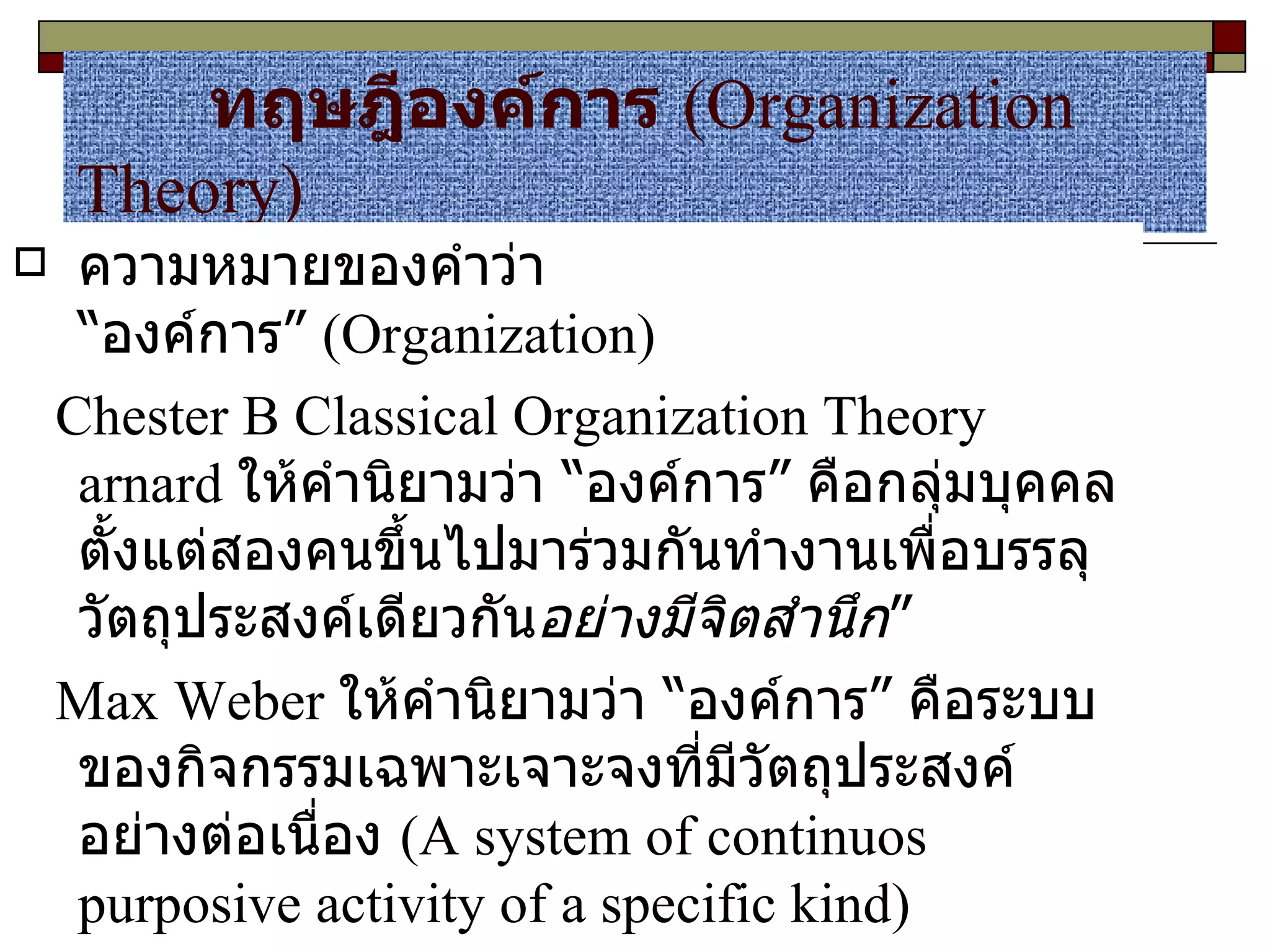
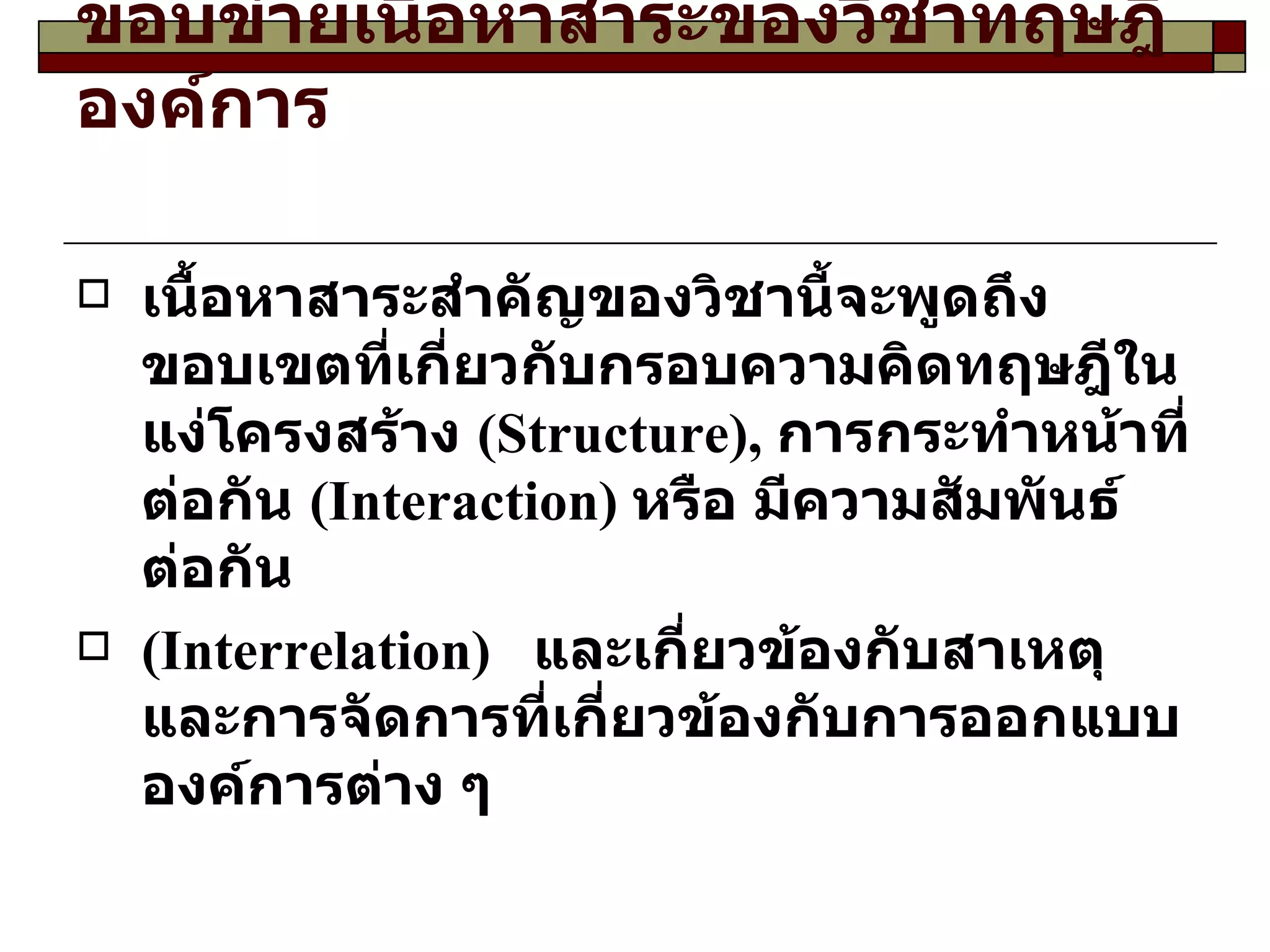
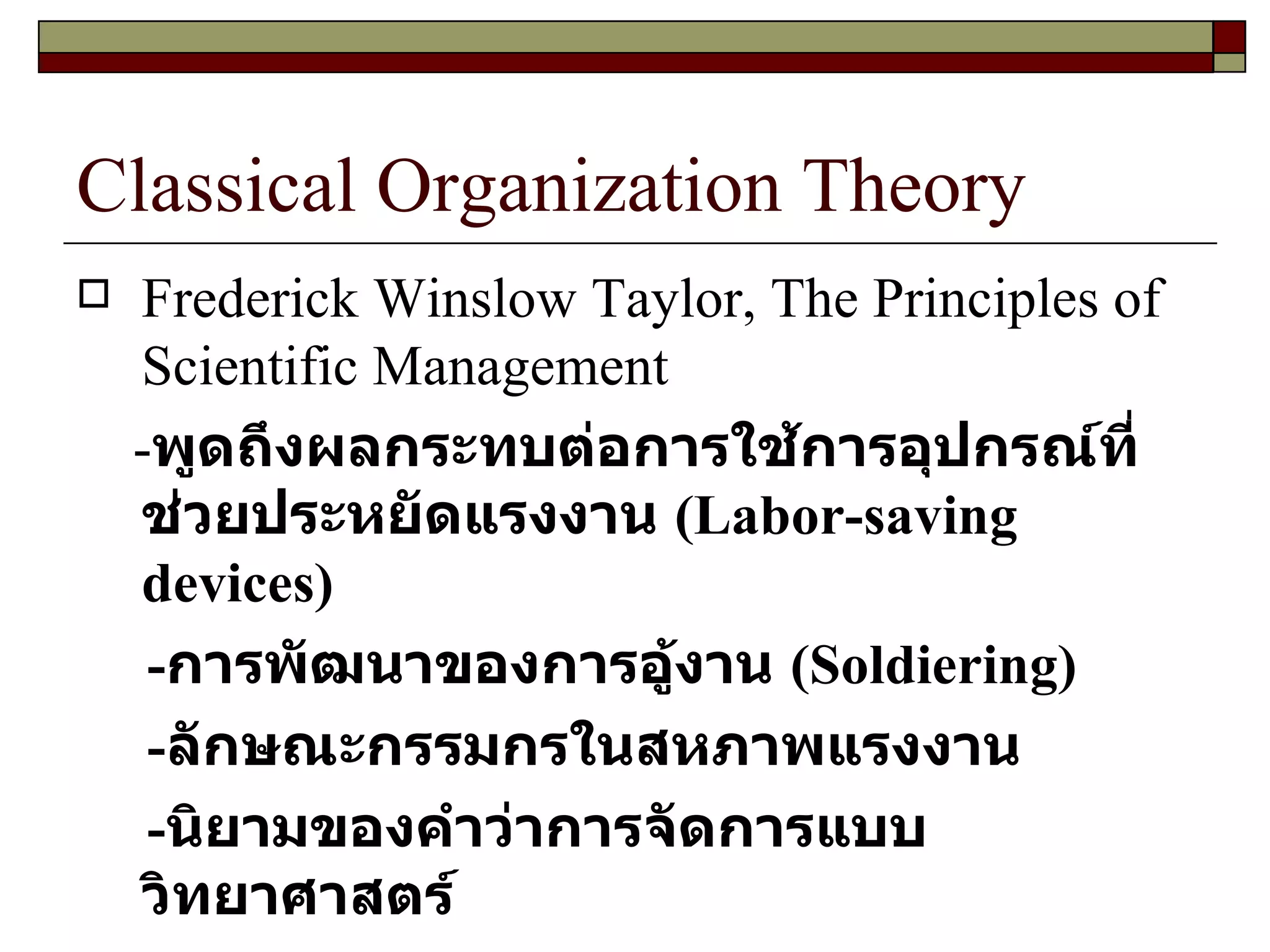
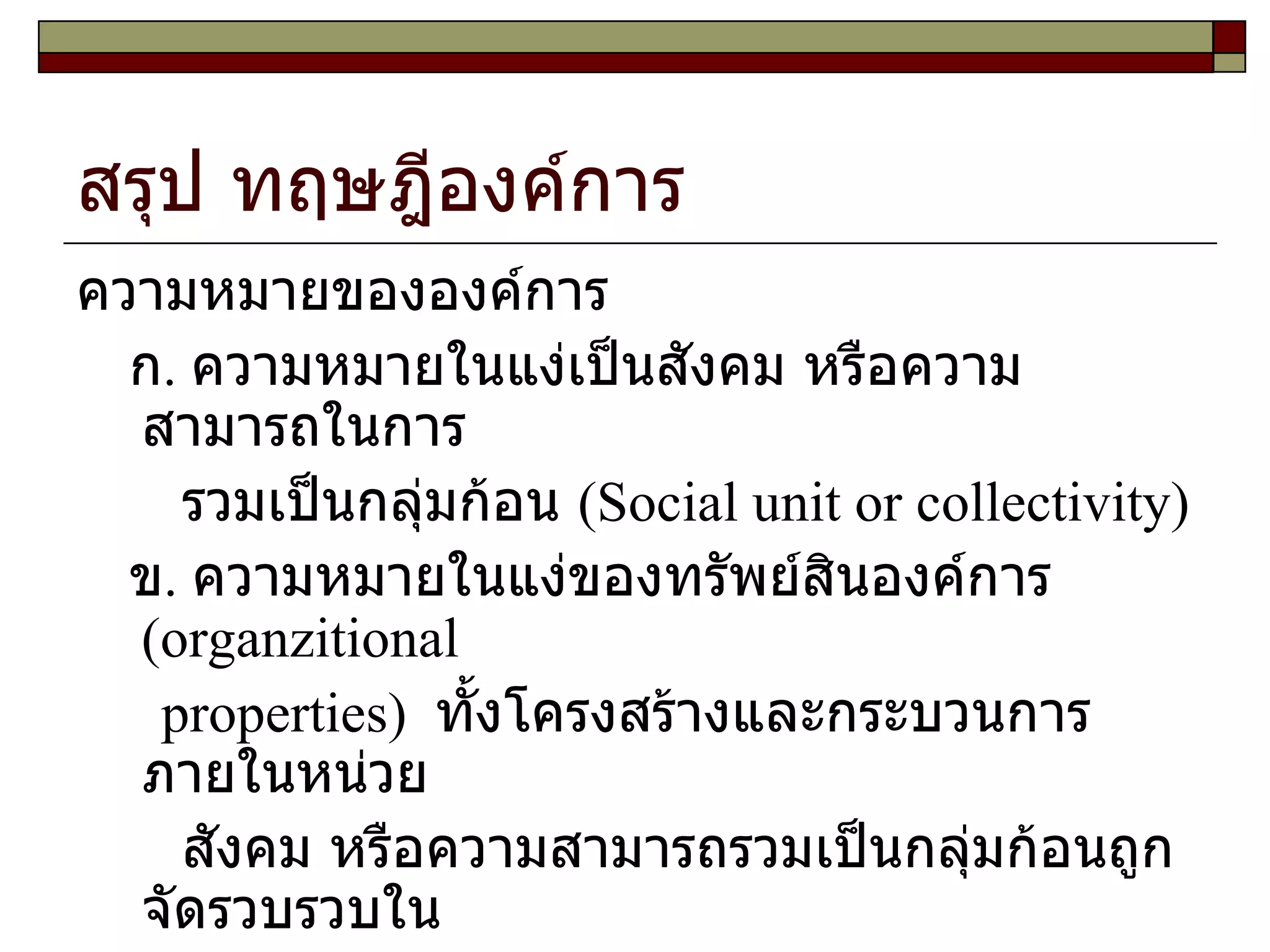
ทฤษฎีองค์การ ( Organization Theory ) ความหมายของคำว่า “องค์การ” ( Organization ) Chester B Classical Organization Theory arnard ให้คำนิยามว่า “องค์การ” คือกลุ่มบุคคลตั้งแต่สองคนขึ้นไปมาร่วมกันทำงานเพื่อบรรลุวัตถุประสงค์เดียวกัน อย่างมีจิตสำนึก ” Max Weber ให้คำนิยามว่า “องค์การ” คือระบบของกิจกรรมเฉพาะเจาะจงที่มีวัตถุประสงค์อย่างต่อเนื่อง ( A system of continuos purposive activity of a specific kind )
2.
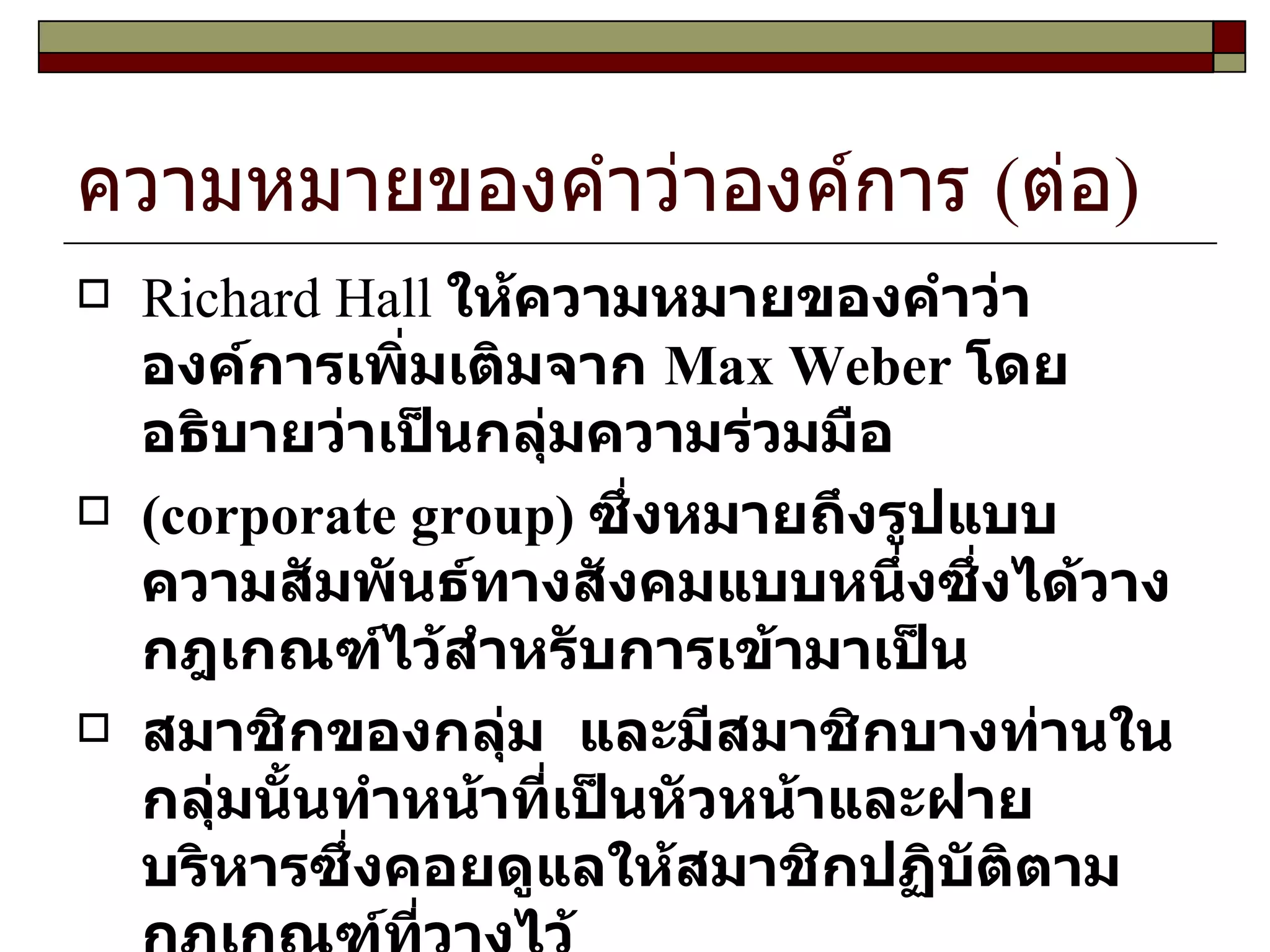
ความหมายของคำว่าองค์การ (ต่อ ) Richard Hall ให้ความหมายของคำว่าองค์การเพิ่มเติมจาก Max Weber โดยอธิบายว่าเป็นกลุ่มความร่วมมือ ( corporate group ) ซึ่งหมายถึงรูปแบบความสัมพันธ์ทางสังคมแบบหนึ่งซึ่งได้วางกฎเกณฑ์ไว้สำหรับการเข้ามาเป็น สมาชิกของกลุ่ม และมีสมาชิกบางท่านในกลุ่มนั้นทำหน้าที่เป็นหัวหน้าและฝายบริหารซึ่งคอยดูแลให้สมาชิกปฏิบัติตามกฎเกณฑ์ที่วางไว้
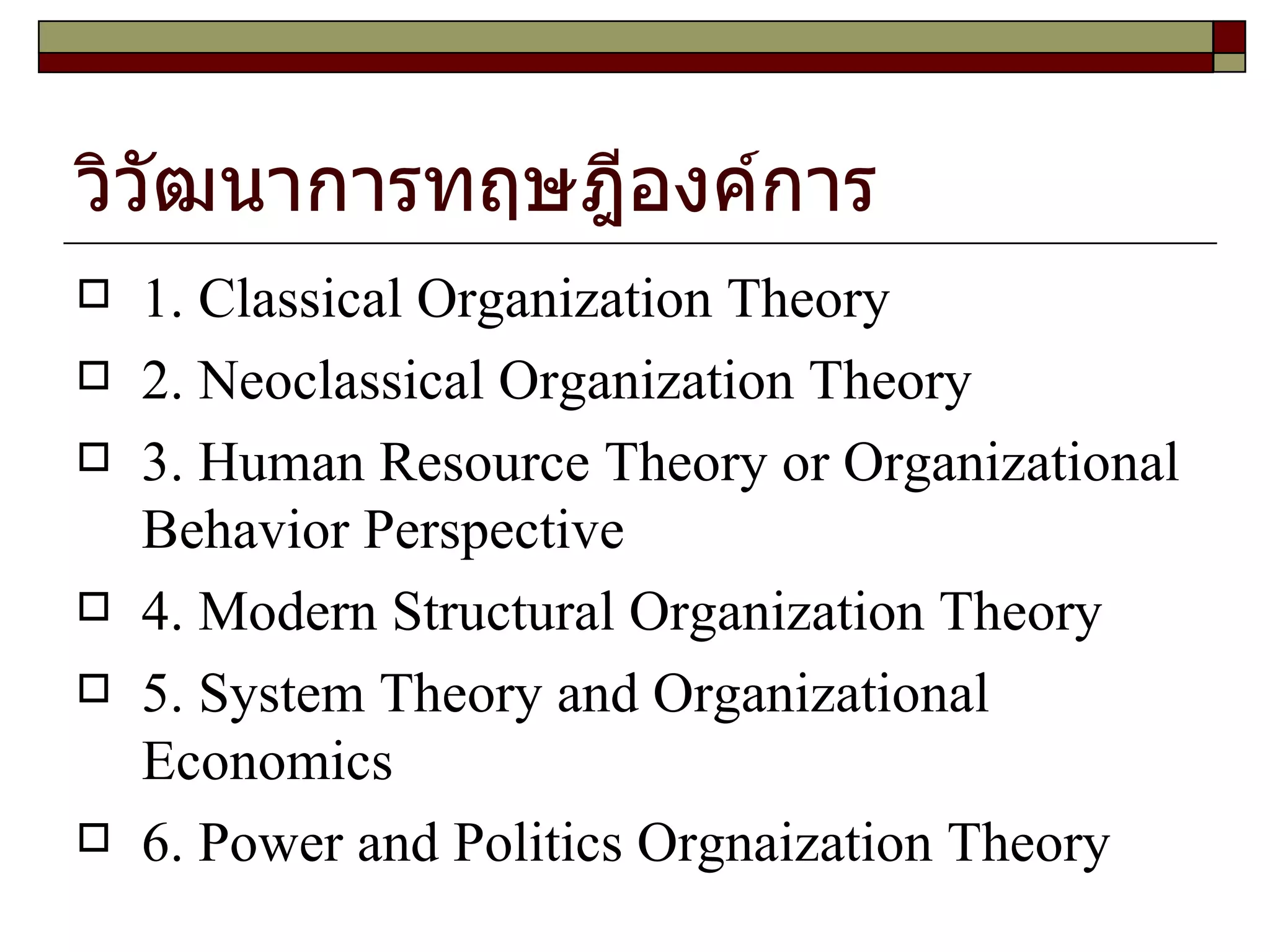
วิวัฒนาการทฤษฎีองค์การ 1. ClassicalOrganization Theory 2. Neoclassical Organization Theory 3. Human Resource Theory or Organizational Behavior Perspective 4. Modern Structural Organization Theory 5. System Theory and Organizational Economics 6. Power and Politics Orgnaization Theory
Classical Organization TheoryThe first theories of organization were concerned primarily with the anatomy, or structure, or formal organizations. Adam Smith, ” An Inquiry into the Nature and Causes of the Wealth of Nations ( 1776 ) and James Watt ( 1736-1819 ) ทั้งสองท่านเป็นบุคคลที่ผลักดันให้โลกของเราเป็นอุตสาหกรรม
9.
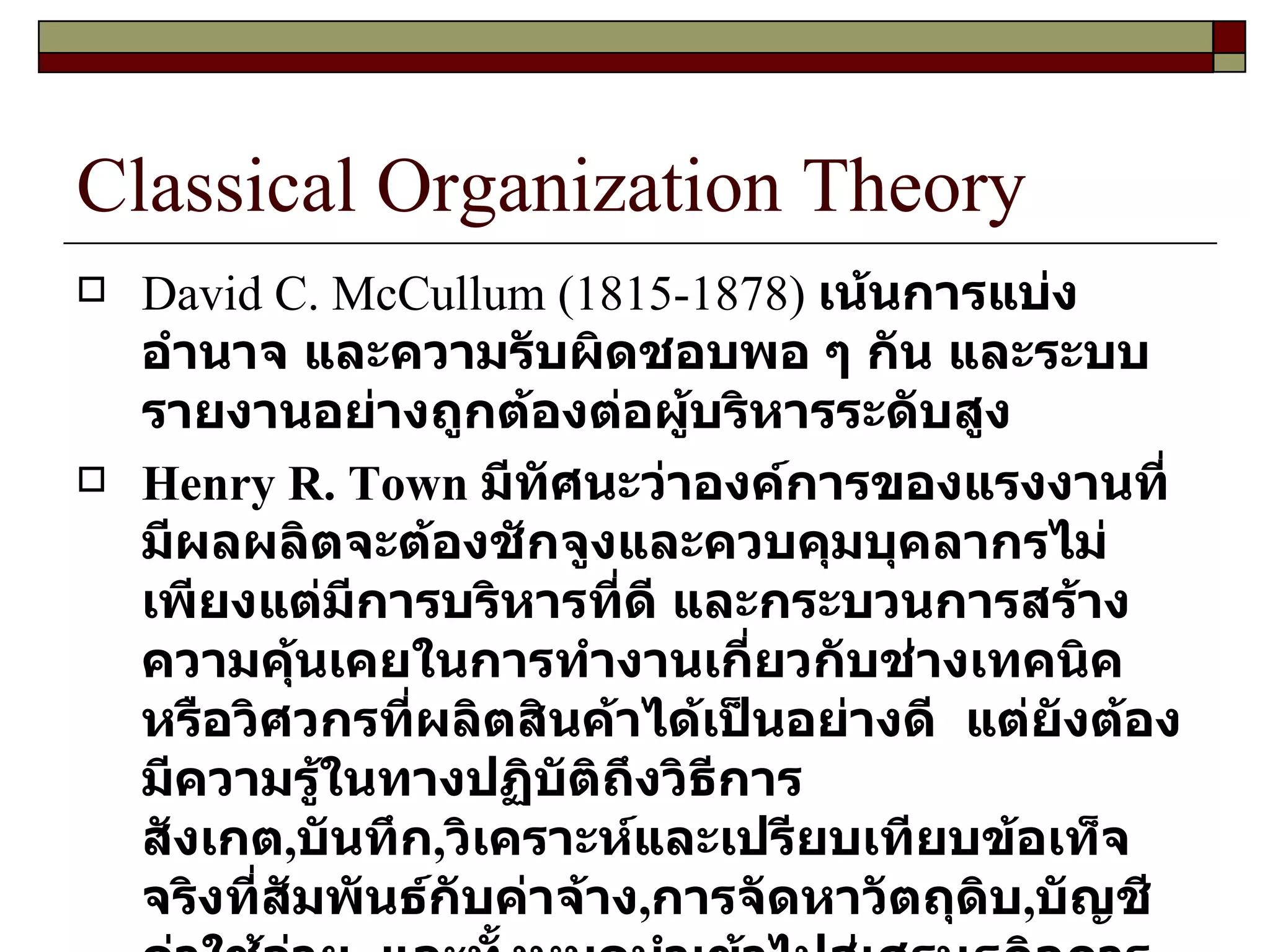
Classical Organization TheoryDavid C. McCullum ( 1815-1878 ) เน้นการแบ่งอำนาจ และความรับผิดชอบพอ ๆ กัน และระบบรายงานอย่างถูกต้องต่อผู้บริหารระดับสูง Henry R. Town มีทัศนะว่าองค์การของแรงงานที่มีผลผลิตจะต้องชักจูงและควบคุมบุคลากรไม่เพียงแต่มีการบริหารที่ดี และกระบวนการสร้างความคุ้นเคยในการทำงานเกี่ยวกับช่างเทคนิคหรือวิศวกรที่ผลิตสินค้าได้เป็นอย่างดี แต่ยังต้องมีความรู้ในทางปฏิบัติถึงวิธีการสังเกต , บันทึก , วิเคราะห์และเปรียบเทียบข้อเท็จจริงที่สัมพันธ์กับค่าจ้าง , การจัดหาวัตถุดิบ , บัญชีค่าใช้จ่าย และทั้งหมดนำเข้าไปสู่เศรษฐกิจการผลิต และต้นทุนสินค้าที่ผลิต
10.
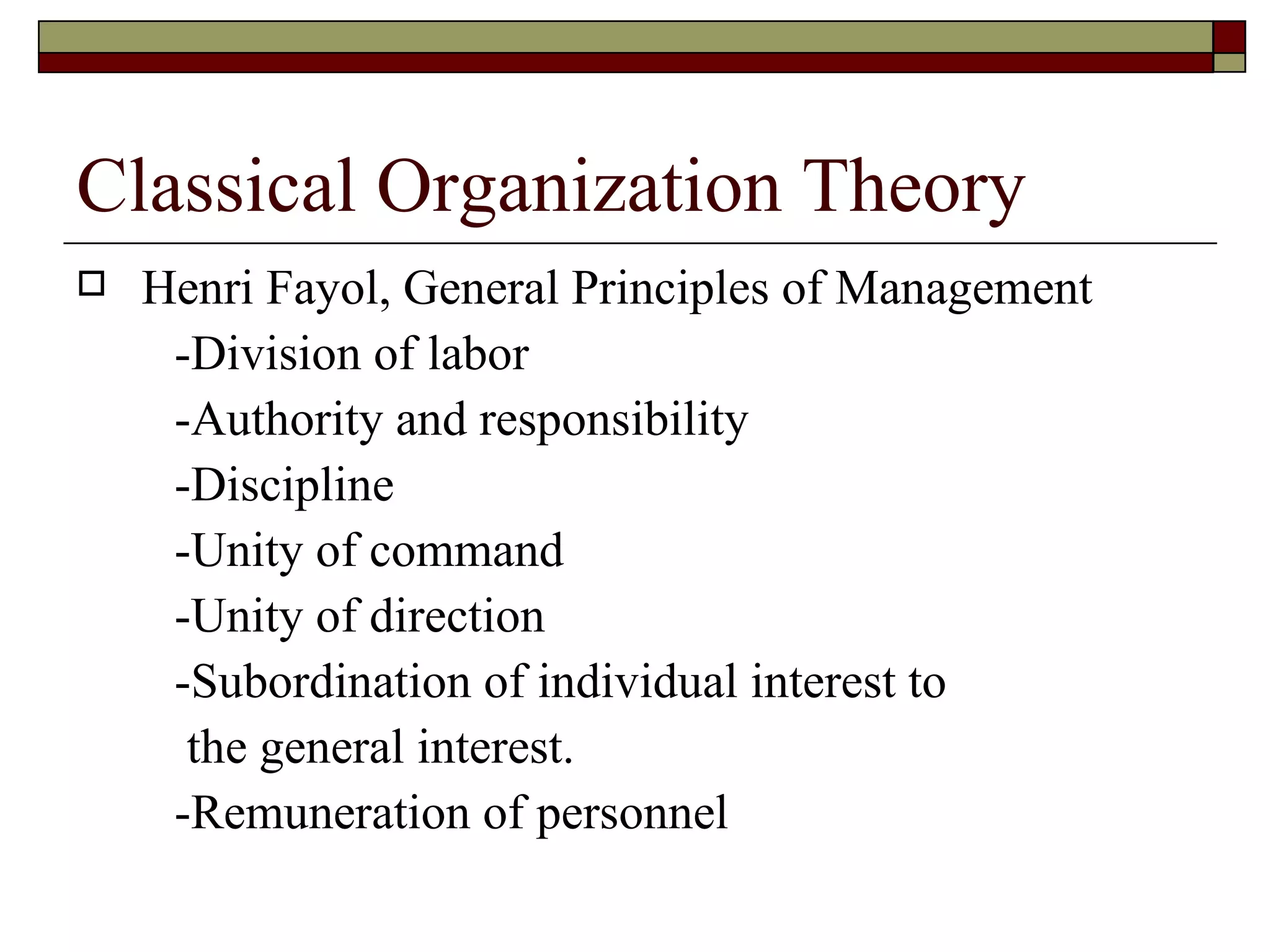
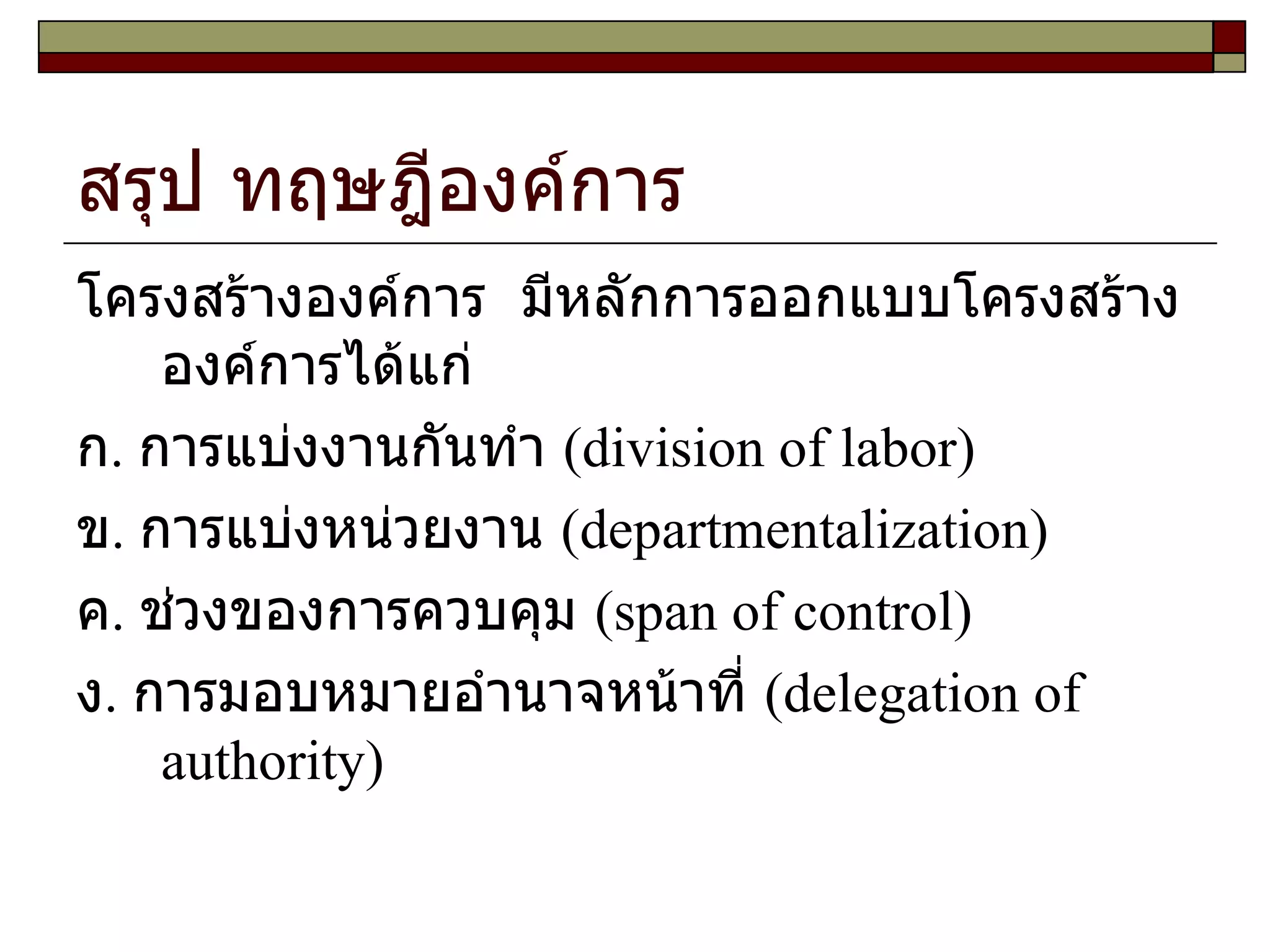
Classical Organization TheoryHenri Fayol, General Principles of Management -Division of labor -Authority and responsibility -Discipline -Unity of command -Unity of direction -Subordination of individual interest to the general interest. -Remuneration of personnel
11.
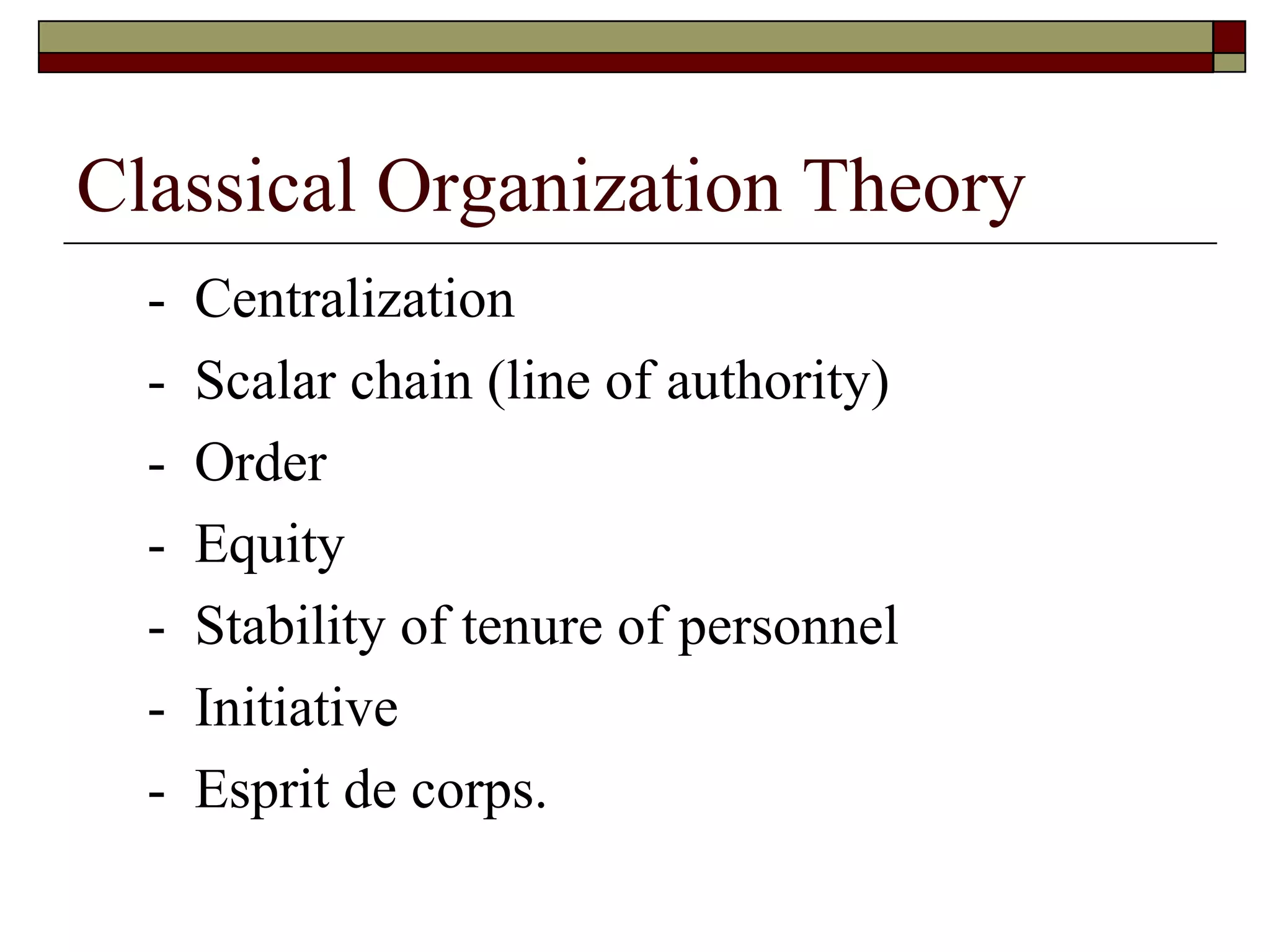
Classical Organization Theory- Centralization - Scalar chain ( line of authority ) - Order - Equity - Stability of tenure of personnel - Initiative - Esprit de corps.
Classical Organization TheoryMax Weber, Bureaucracy 1. The principles of fixed and official jurisdictional areas, which are generally ordered by rules, that is by law and administrative regulation. ทำงานโดยยึดหลักกฎระเบียบข้อบังคับที่แน่นอน
15.
Classical Organization Theory2. A hierarchy เน้นการทำงานตามสายการบังคับบัญชา 3. There is modern office is based upon written documents. มีการทำงานแบบสำนักงาน สมัยใหม่โดยยึดเอกสารที่มีลายลักษณ์อักษร 4. การทำงานยึดหลักความถนัดเฉพาะด้าน , คัดเลือกคนด้วยระบบคุณธรรม 5. ถือหลักประโยชน์ส่วนรวมเหนือกว่าประโยชน์ส่วนตน
16.
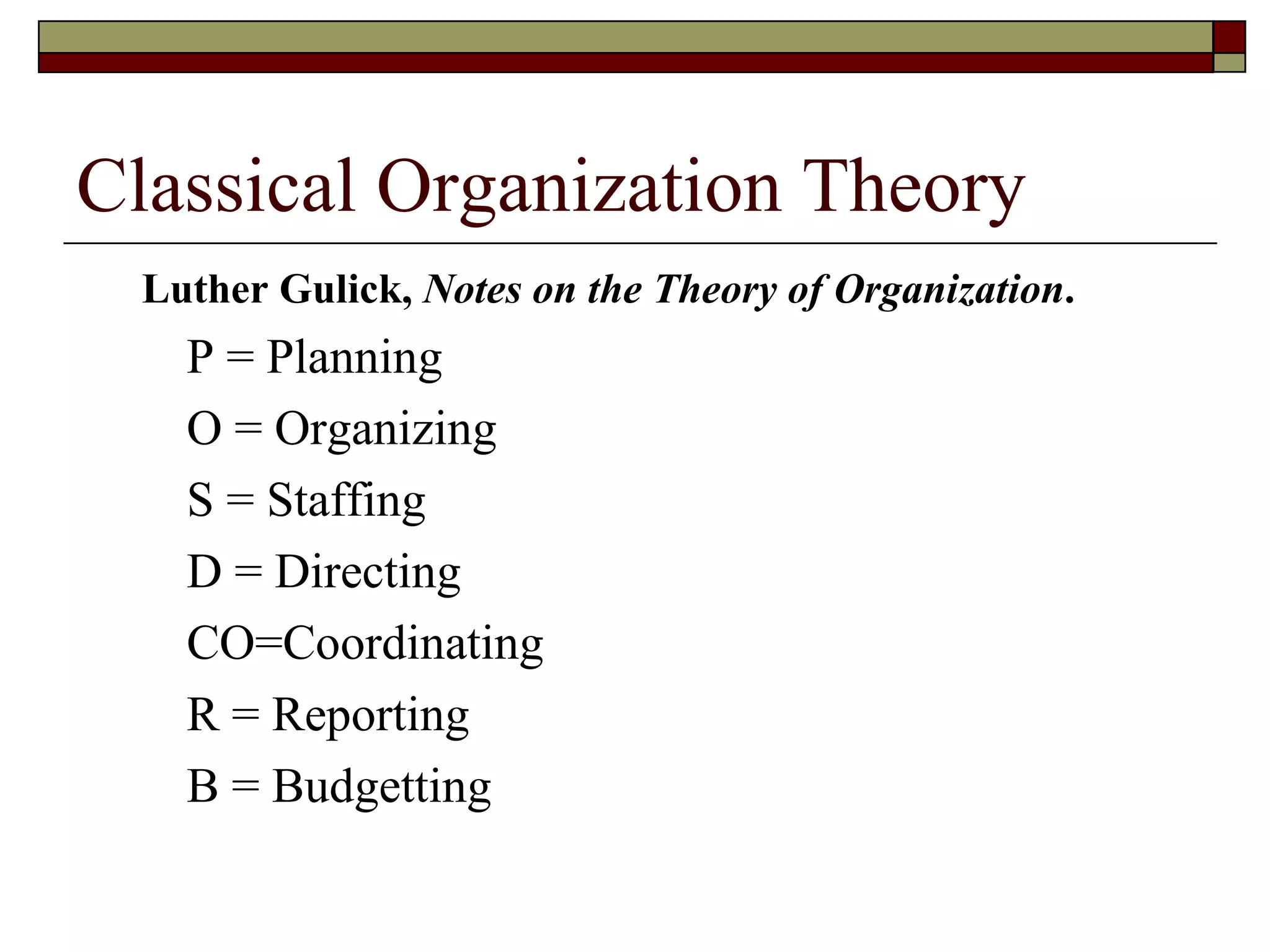
Classical Organization TheoryLuther Gulick, Notes on the Theory of Organization . Focus on: 1. Division of Labor –The whold and the Parts 2. The co-ordination of work 3. The span of control –One man one master CEO work is POSDCORB
17.
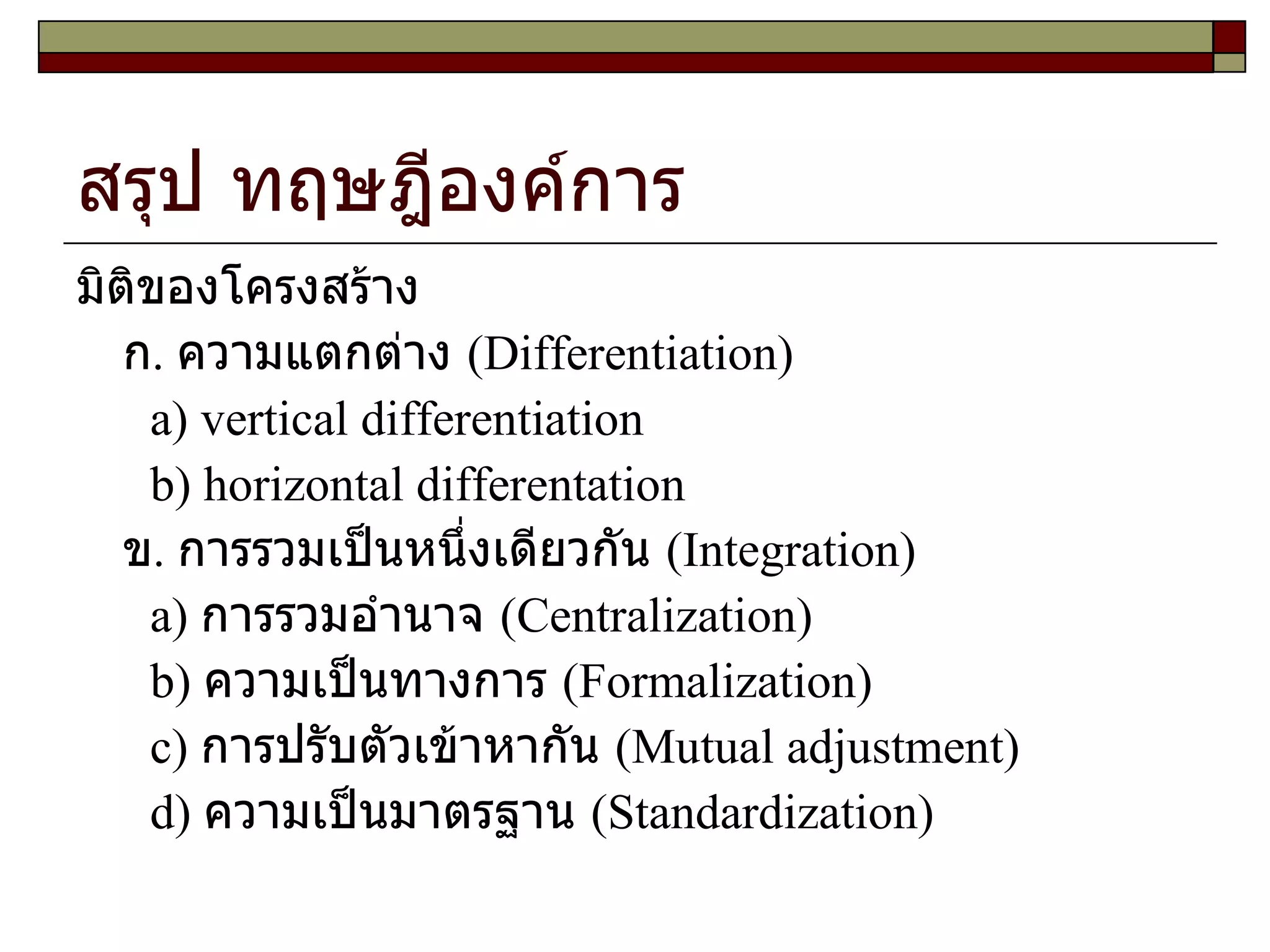
Classical Organization TheoryLuther Gulick, Notes on the Theory of Organization . P = Planning O = Organizing S = Staffing D = Directing CO=Coordinating R = Reporting B = Budgetting
18.
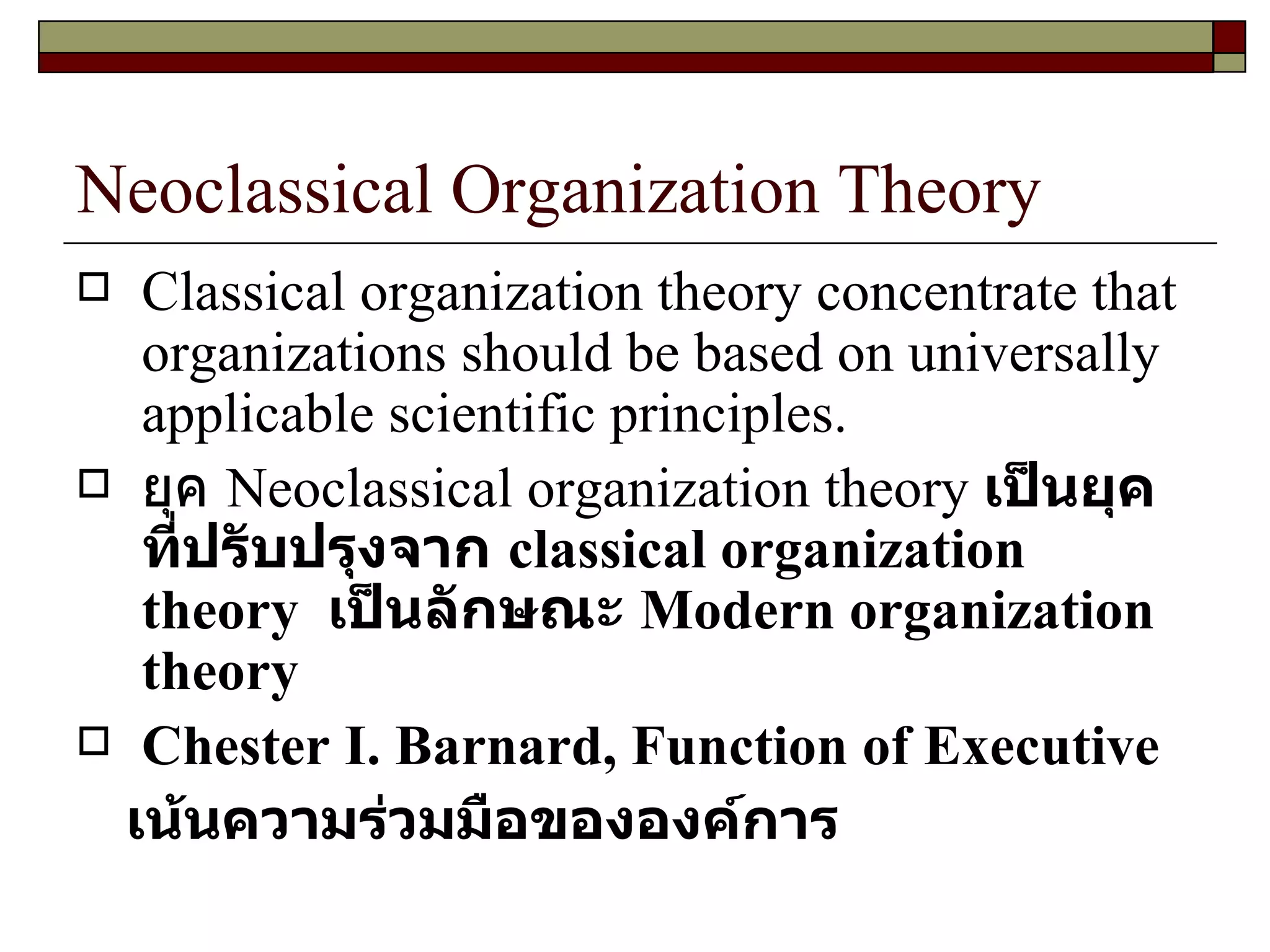
Neoclassical Organization TheoryClassical organization theory concentrate that organizations should be based on universally applicable scientific principles. ยุค Neoclassical organization theory เป็นยุคที่ปรับปรุงจาก classical organization theory เป็นลักษณะ Modern organization theory Chester I. Barnard, Function of Executive เน้นความร่วมมือขององค์การ
19.
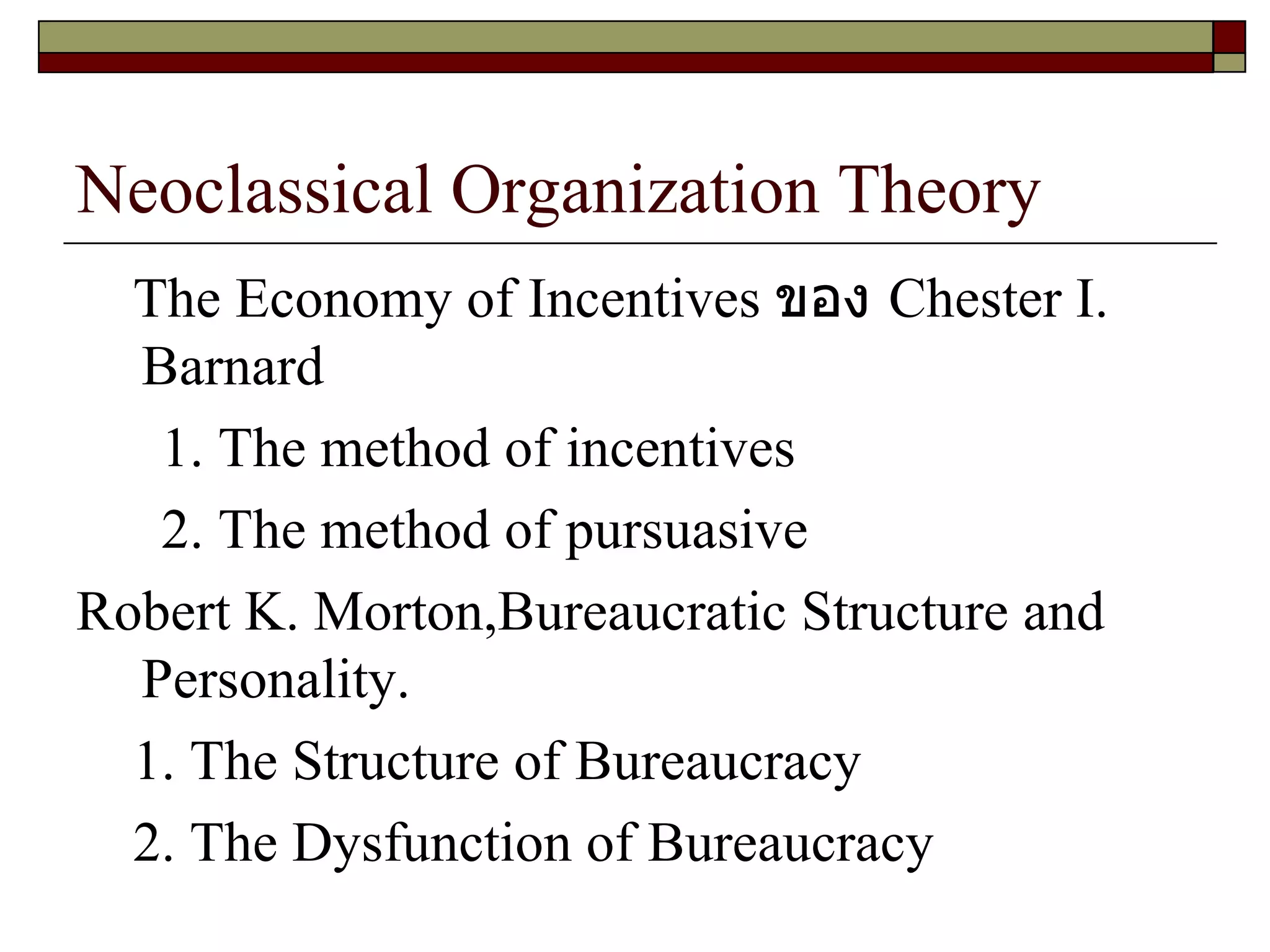
Neoclassical Organization TheoryThe Economy of Incentives ของ Chester I. Barnard 1. The method of incentives 2. The method of pursuasive Robert K. Morton,Bureaucratic Structure and Personality. 1. The Structure of Bureaucracy 2. The Dysfunction of Bureaucracy
20.
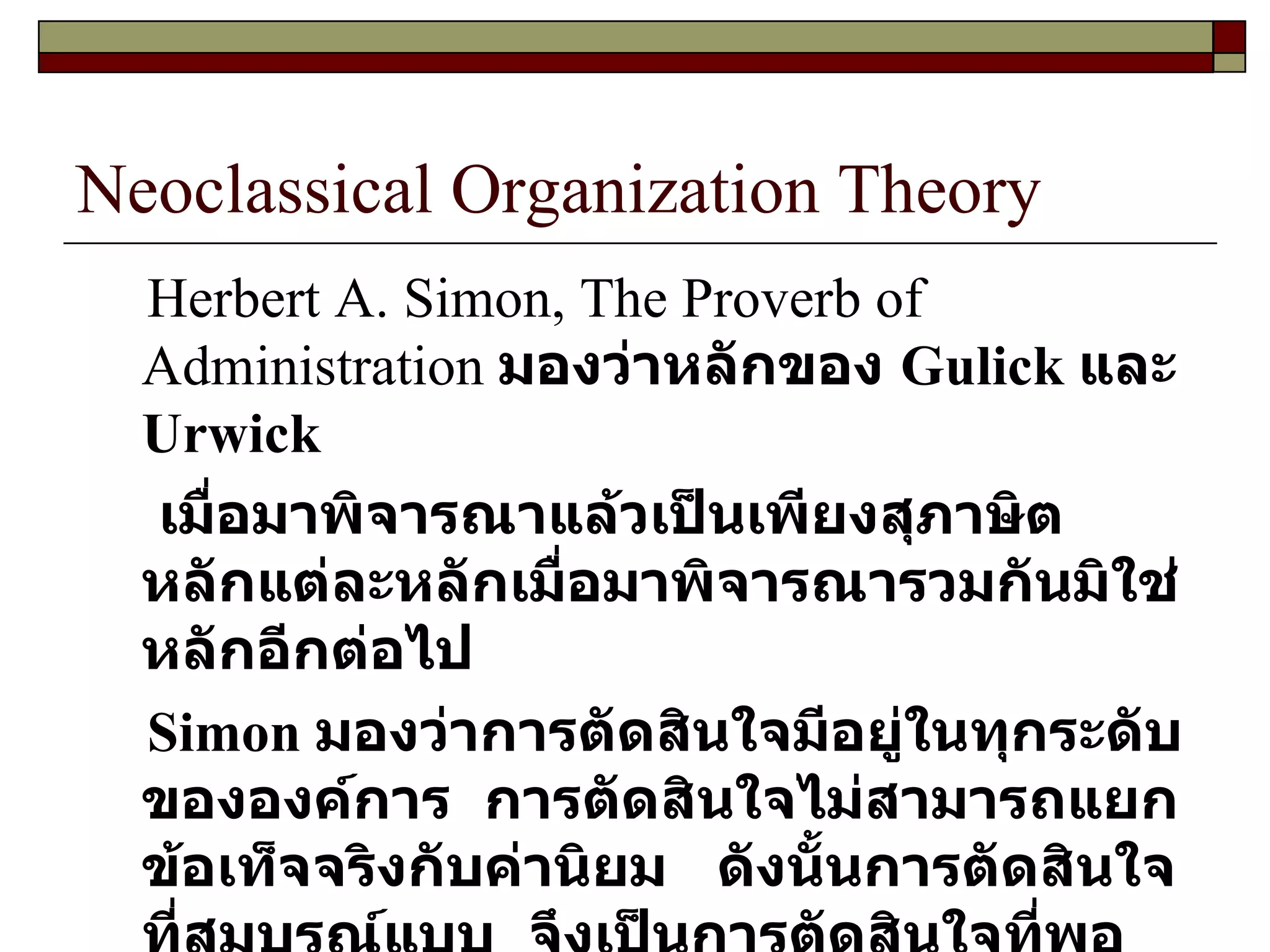
Neoclassical Organization TheoryHerbert A. Simon, The Proverb of Administration มองว่าหลักของ Gulick และ Urwick เมื่อมาพิจารณาแล้วเป็นเพียงสุภาษิต หลักแต่ละหลักเมื่อมาพิจารณารวมกันมิใช่หลักอีกต่อไป Simon มองว่าการตัดสินใจมีอยู่ในทุกระดับขององค์การ การตัดสินใจไม่สามารถแยกข้อเท็จจริงกับค่านิยม ดังนั้นการตัดสินใจที่สมบูรณ์แบบ จึงเป็นการตัดสินใจที่พอทำได้ ( Satificing )
21.
Neoclassical Organization TheoryRichard M.Cyert and James G. March “ A Behavioral Theory of Organizational Objectives. ” - The organization as a coalition - Stabilization and Elaboration of objectives - Changes in Objective Through Experience.
22.
Human Resource Theory,or the Organizational Behavior Perspective ในอดีต ผู้บริหารเป็นผู้รู้ที่ดีที่สุด ( The Boss knows best mindset ) Hugo Munsterberg นักจิตวิทยาชาวเยอรมัน ทำงานที่ ม . ฮาร์วาร์ด ได้รับการยกย่องว่าเป็นบิดาแห่ง “จิตวิทยาอุตสาหกรรม” หรือจิตวิทยาประยุกต์ เขาพยายามคัดเลือกคนงานให้เหมาะกับความต้องการของบริษัท การส่งเสริมให้พนักงานมีทัศนคติในเชิงบวกต่อการทำงาน และต่อองค์การ แนวความคิดของเขาจึงเน้นถึงวิธีการนำพฤติกรรมศาสตร์มาประยุกต์ใช้ในองค์การได้เป็นอย่างดี
Human Resource Theory,or the Organizational Behavior Perspective ทฤษฎีทรัพยากรมนุษย์ได้รับอิทธิพลจากองค์ความรู้ทางการวิจัย และทฤษฎีถูกสร้างจากสมมติฐานดังนี้ ก . องค์การเกิดขึ้นมาเพื่อตอบสนองความต้องการมนุษย์มากกว่าการแก้แค้น ข . เมื่อความสัมพันธ์ระหว่างบุคคลกับองค์การไม่ดี ทำให้บุคคลได้รับความทุกข์ทรมานจากภาวะกดขี่ครอบงำ ค . ความเหมาะสมระหว่างบุคคลกับองค์การก็คือ win-win game มนุษย์ต้องการทำงานสนุกและมีความหมาย และองค์การก็ปรารถนาคนเก่ง และความสามารถจากบุคลากร
25.
Human Resource Theory,or the Organizational Behavior Perspective แนวคิดทางพฤติกรรมองค์การที่เด่นชัดที่สุด ได้แก่การศึกษาวิจัยที่โรงงาน Hawthorn study ที่บริษัท Western Electric Company เขาแสดงให้เห็นการทดลองจากการเปลี่ยนแปลงสภาพแวดล้อมมีอิทธิพลต่อการเพิ่มผลผลิตเพียงใด โดยศึกษาปัจจัยด้านแสงสว่าง , อัตราการไหลของวัตถุดิบ , แผนการจ่ายค่าจ้างทางเลือก ผลการศึกษาพบว่าเป็นปัญหาทางด้านจิตวิทยาสังคมได้แก่ปัญหาความสัมพันธ์ระหว่างบุคคลในกลุ่ม , ปทัสถานของกลุ่ม , เป็นตัวควบคุมสภาพแวดล้อม
26.
Human Resource Theory,or the Organizational Behavior Perspective J.Steven Ott’s ( 1996 ) เขียนเรื่อง Classic Readings in organizational Behavior ได้อธิบายว่าหัวใจสำคัญของทฤษฎีการบริหารทรัพยากรมนุษย์ได้แก่ ก . การจูงใจ ( Motivation ) ข . พฤติกรรมกลุ่ม และพฤติกรรมระหว่างกลุ่ม ( group and intergroup behavior ) ค . ภาวะผู้นำ ( Leadership ) ง . ทีมการปฏิบัติงาน และการมอบหมายอำนาจให้ระดับล่าง ( empowerment )
27.
Human Resource Theory,or the Organizational Behavior Perspective แนวคิดของ Mary Parker Follett เขียน “ The Giving Orders ได้อธิบายว่าในองค์การควรจะออกคำสั่งอย่างไร คำสั่งอาจทำให้ลดทอนตัวบุคคล ( depersonalized ) การสร้างความอันหนึ่งอันเดียวกันจึงจะต้องเข้าไปเกี่ยวข้องกับการศึกษาเรื่องสถานการณ์ เพื่อค้นหากฎของสถานการณ์ ( Law of situation ) และให้การเชื่อฟังสิ่งนั้น ๆ
28.
Human Resource Theory,or the Organizational Behavior Perspective ทฤษฎีแรงจูงใจ ได้แก่ ของ Abraham Maslow ว่าด้วยลำดับขั้นความต้องการของมนุษย์ ( A Hierarchy of Need ) ได้อิทธิพลจากการศึกษาที่ Harthorne Experiments และทฤษฎี X,Y ของ Douglas Mcgregor มาจากจุดของการหันมาศึกษาการจูงใจในองค์การ ข้อสันนิษฐานทางทฤษฎีของ Maslow สรุปได้ดังนี้คือ ก . มนุษย์ทุกคนมีความต้องการอยู่ภายใต้โครงสร้างแรงจูงใจ ข . เมื่อความต้องการในระดับต่ำตอบสนองแล้ว ก็จะไม่ใช่แรงขับอีกต่อไป
Human Resource Theory,or the Organizational Behavior Perspective Bart Victor and Carroll Stephens เขียน Dark Side of the New organizational forms พบว่าแนวโน้มยุคมืดขององค์การคือ การมีสำนักงานอัตโนมัติ , การมีอาชีพเสมือนจริง , ความสัมพันธ์ระหว่างบุคคล , ระหว่างเพื่อนร่วมงาน , และองค์การมีลักษณะชั่วคราว องค์การแบบ Flat organization จะผลักดันความสัมพันธ์ระหว่างบุคคล ไปสู่ความต้องการที่มากกว่าและไปสู่การยัดเยียดมากกว่าเดิม
32.
Modern Structural OrganizationTheory Classical School เป็นลักษณะของ Structuralist พวกนี้เน้นโครงสร้าง , การออกแบบ , และกระบวนการผลิต Modern Structural organization theory มีรากฐานมาจาก Fayol, Taylor,Gulick, Weber โดยมองว่าประสิทธิภาพขององค์การเป็นสาระสำคัญของความสมเหตุสมผลขององค์การ และเป้าหมายของ Rationality ก็คือการเพิ่มผลผลิตของความมั่งคั่งและในแง่ของสินค้าและบริการที่ดี
33.
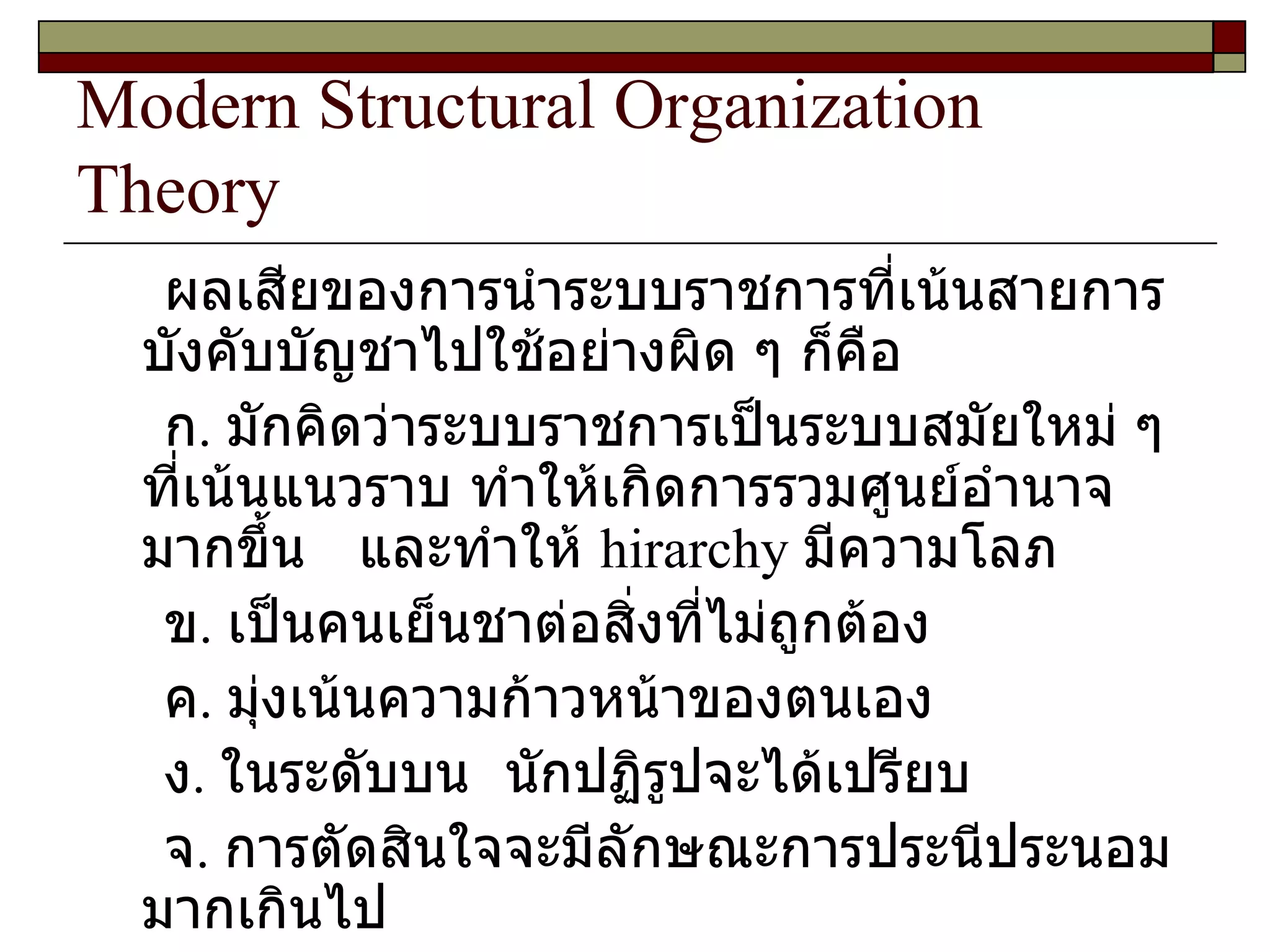
Modern Structural OrganizationTheory Modern Structural Organization Theory ได้รับอิทธิพลจากยุค Neoclassical,human relation, system theory Bolman and Deal ( 1997 ) ได้ตั้งสมมติฐานเกี่ยวกับกรอบทัศนะของโครงสร้างดังต่อไปนี้ ก . องค์การเป็นสถาบันที่สมเหตุสมผลโดยมีวัตถุประสงค์พื้นฐานเพื่อบรรลุเป้าหมายจากวัตถุประสงค์ที่กำหนดไว้ พฤติกรรมองค์การสมเหตุสมผลจะบรรลุความสำเร็จได้ดีที่สุดจากสิ่งที่สนับสนุนความสมเหตุสมผลขององค์การ
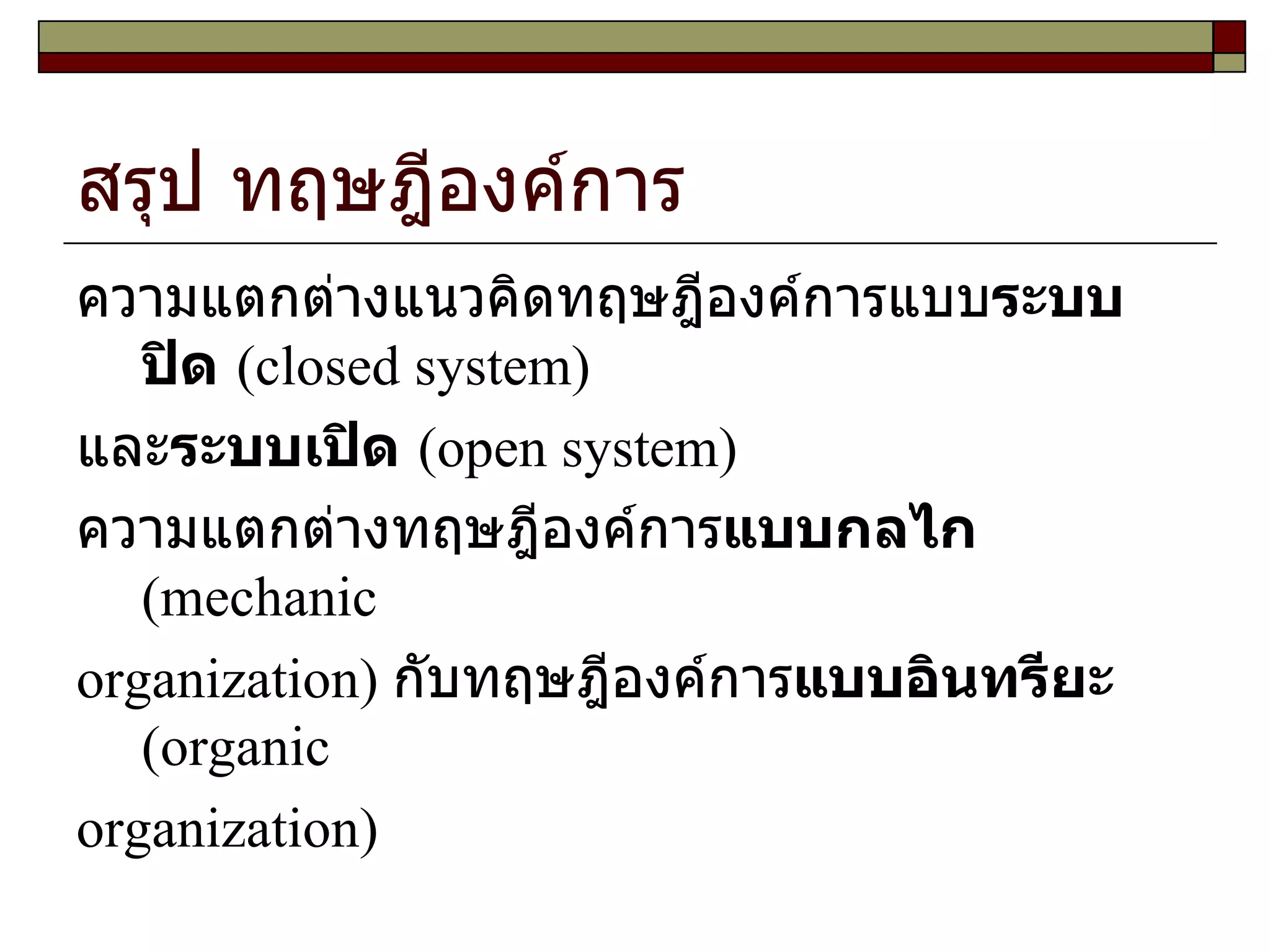
Modern Structural OrganizationTheory Tom Burns and G.M.Stalker เป็นผู้นำแนวคิดเกี่ยวกับสังคมเทคนิคสำหรับองค์การ ซึ่งต่อมาพัฒนาเป็นทฤษฎีเกี่ยวกับ mechanistic และ organic system ขององค์การ เขาเสนอแนะว่าในภาวะที่แน่นอนให้ใช้องค์การแบบกลไก หรือ mechanistic ซึ่งเป็นการบริหารแบบดั้งเดิมเกี่ยวกับสายการบังคับบัญชาภายใต้กฎระเบียบข้อบังคับที่เป็นทางการ มีการสื่อสารในแนวดิ่ง และมีการตัดสินใจที่มีการกำหนดมาแล้ว แต่ในสภาวะที่เป็นพลวัตร และเป็นสถานการณ์ที่มีการเปลี่ยนแปลงอย่างรวดเร็ว จำเป็นต้องใช้ organic system ซึ่งเน้นการมีส่วนร่วมและไว้วางใจคนงานสูง
36.
Modern Structural OrganizationTheory Peter M.Blue, W.Richard Scott ได้เขียนแนวคิดที่เกี่ยวกับองค์การที่เป็นทางการในหนังสือชื่อ “ Formal Organization: A Comparative approach ” กล่าวว่า องค์การที่ไม่เป็นทางการมีรากฐานมาจากองค์การที่ไม่เป็นทางการ และสนับสนุนองค์การที่เป็นทางการโดยกำหนดปทัสถานเพื่อการดำเนินงานขององค์การ Arthur H.Walker, Jay W.Lorsch ได้เขียนถึง Organization Choice:product or function พบว่า ผู้เชี่ยวชาญควรจะรวมหน้าที่เดียวกันโดยอยู่ภายใต้นายคนเดียวกัน โดยไม่คำนึงถึงความแตกต่างของผลิตภัณฑ์ หรือควรมีผู้ชำนาญการตามหน้าที่การงานที่แตกต่างกันภายใต้ผลิตภัณฑ์เดียวกัน ควรรวมกลุ่มผลิตภัณฑ์ภายใต้หัวหน้าคนเดียวกัน
37.
Modern Structural OrganizationTheory Adam Smith ให้ความสำคัญกับการแบ่งงานกันทำ เพื่อเพิ่มประสิทธิผลในการผลิตของโรงงาน ในปี 1922 Max Weber ได้อธิบายถึงแรงผลักดันที่เข้มแข็ง และต่อต้านคัดค้านกันอยู่ที่มีผลกระทบต่อองค์การทั้งหมด นั่นคือความต้องการแบ่งงานกันทำ กับการทำงานตามความถนัดเฉพาะด้าน การแบ่งงานกันทำไม่ได้จัดลำดับความสำคัญตามความถนัดเฉพาะด้านตามทักษะ , ผลิตภัณฑ์ และตามกระบวนการ
38.
Modern Structural OrganizationTheory Henry Minzberg เขียน “ The Structuring of Organization ” โดยถือเป็นส่วนประกอบหนึ่งของ Model และเขียน “ Power in and around Organization ” เป็นส่วนประกอบที่สองของ Model และเขียน “ Five Basic Parts of the Organization ”
39.
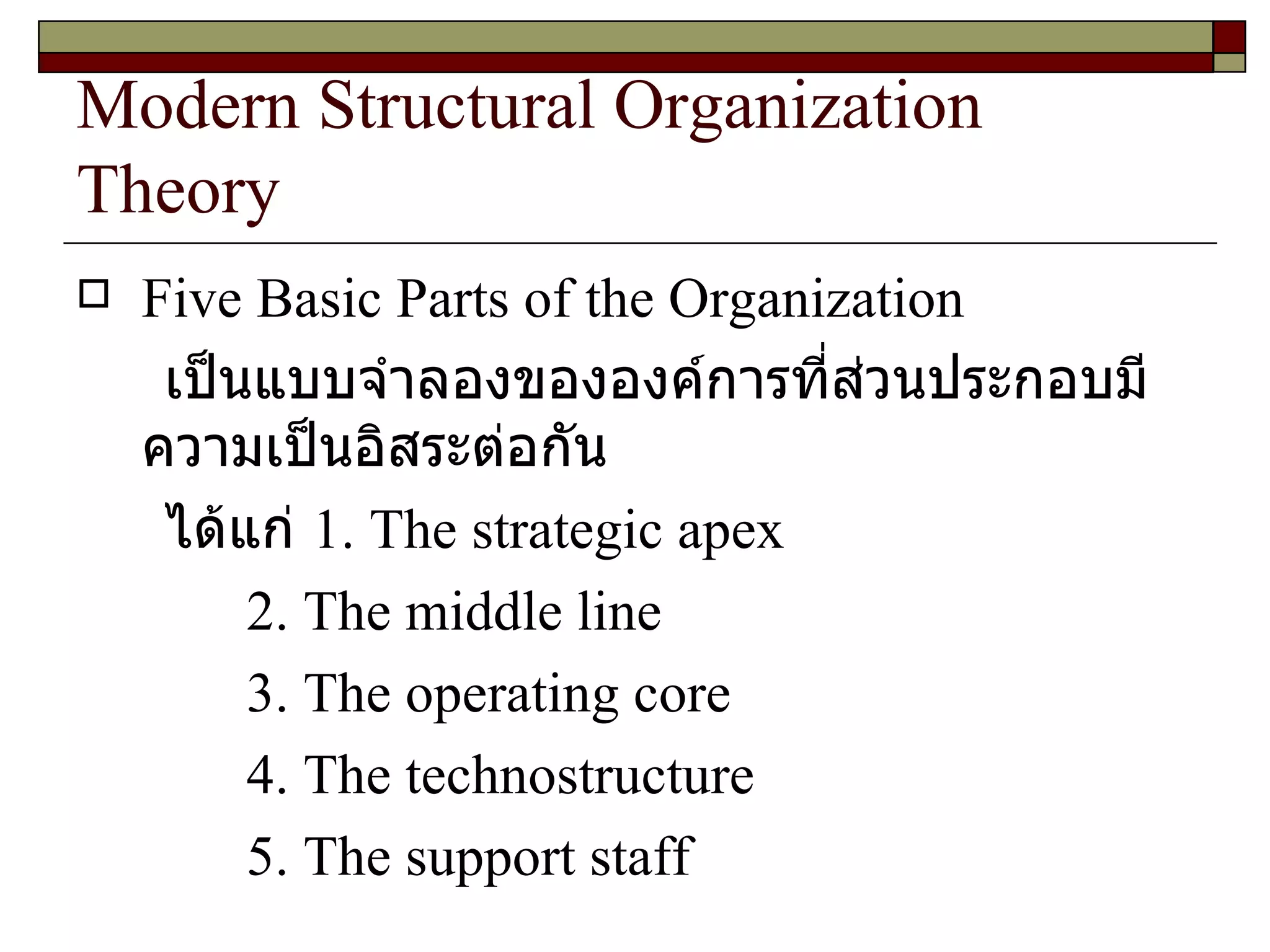
Modern Structural OrganizationTheory Five Basic Parts of the Organization เป็นแบบจำลองขององค์การที่ส่วนประกอบมีความเป็นอิสระต่อกัน ได้แก่ 1. The strategic apex 2. The middle line 3. The operating core 4. The technostructure 5. The support staff
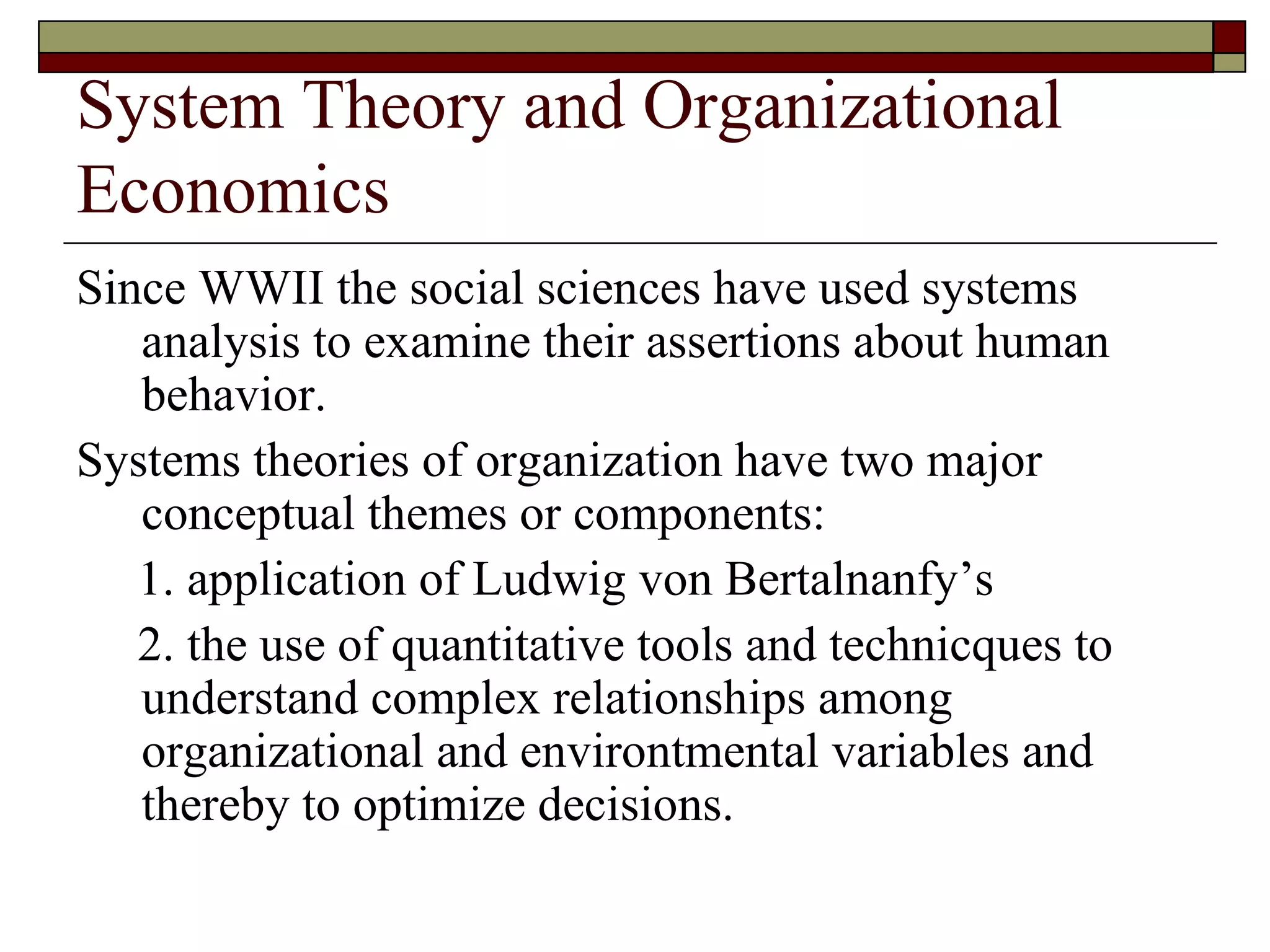
System Theory andOrganizational Economics Since WWII the social sciences have used systems analysis to examine their assertions about human behavior. Systems theories of organization have two major conceptual themes or components: 1. application of Ludwig von Bertalnanfy’s 2. the use of quantitative tools and technicques to understand complex relationships among organizational and environtmental variables and thereby to optimize decisions.
43.
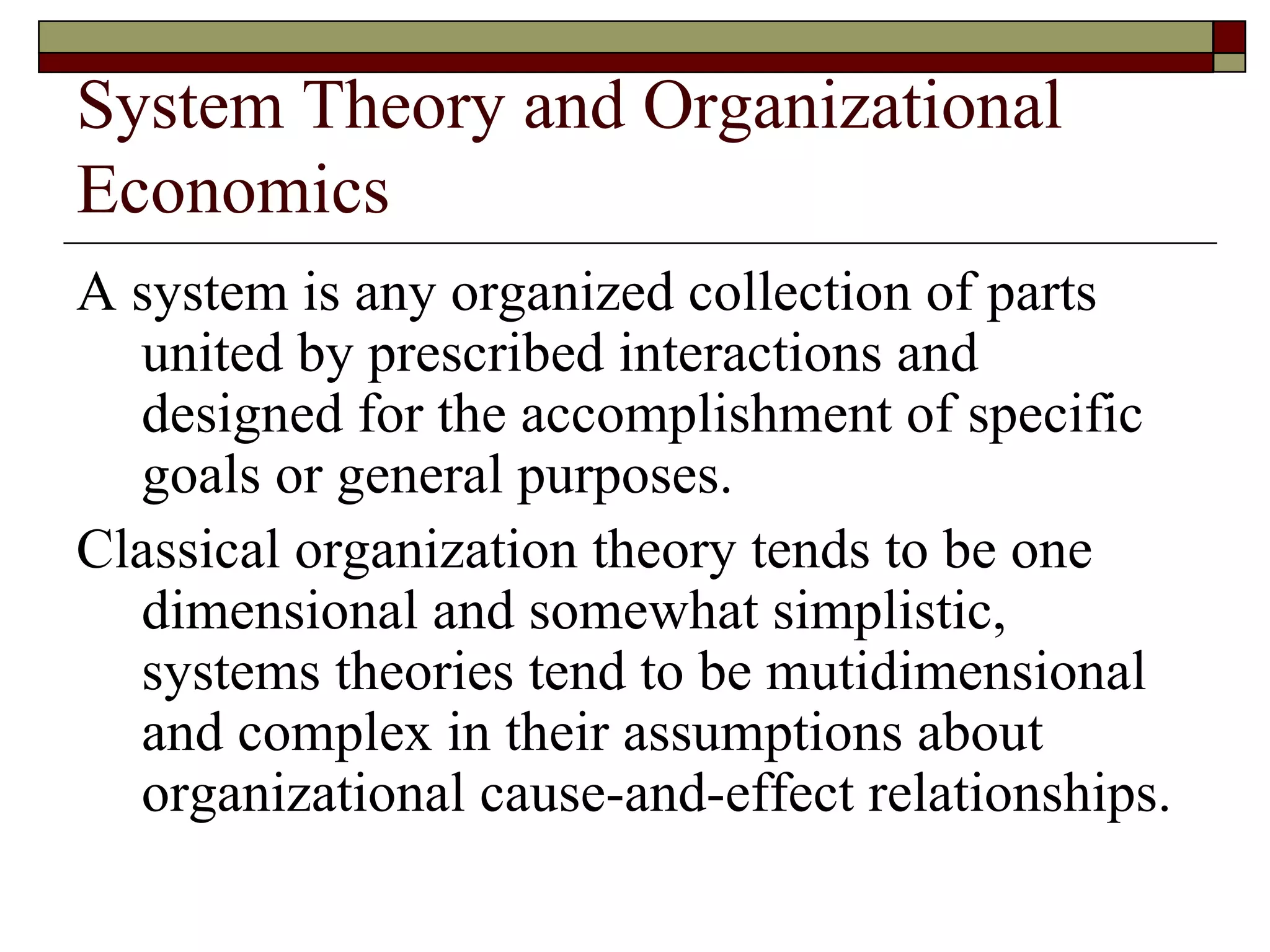
System Theory andOrganizational Economics A system is any organized collection of parts united by prescribed interactions and designed for the accomplishment of specific goals or general purposes. Classical organization theory tends to be one dimensional and somewhat simplistic, systems theories tend to be mutidimensional and complex in their assumptions about organizational cause-and-effect relationships.
44.
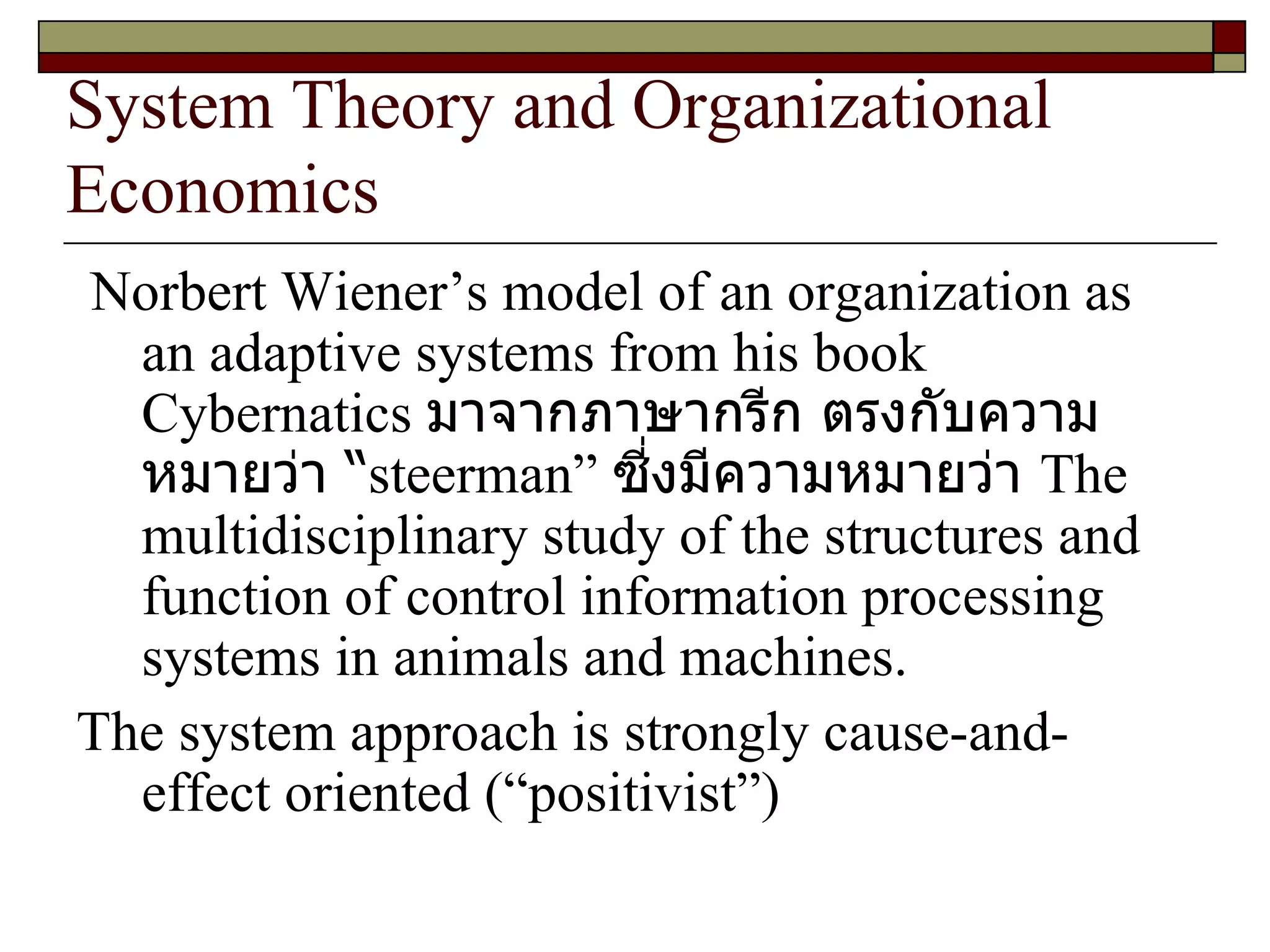
System Theory andOrganizational Economics Norbert Wiener’s model of an organization as an adaptive systems from his book Cybernatics มาจากภาษากรีก ตรงกับความหมายว่า “ steerman ” ซี่งมีความหมายว่า The multidisciplinary study of the structures and function of control information processing systems in animals and machines. The system approach is strongly cause-and-effect oriented (“ positivist ”)
45.
System Theory andOrganizational Economics Pioneering neoclassical theories provided important conceptual foundations for the system approach Herbert Simon and his associates contributed some of the most important of these. Simon visionary theories addressed bounded rationality and satisficing in organizational decision making ( 1957 ) and programmed and unprogrammed decisions ( 1960 ) William G.Scott, article “ Organization Theory:An Overview and Appraisal ” Katz and Kahn conclude that the traditional closed system view of organization has led to a failure to fully appreciate the interdependences and interaction between organization and their environments. (“ The Social Psychology of Organization ”)
46.
System Theory andOrganizational Economics James D.Thompson, in his influential l967 book Organization in Action, classifies most organization as open systems. เขาให้ความเห็นว่า แนวทางการศึกษาระบบปิดอาจเห็นจริงได้จากระดับเทคนิคของการปฏิบัติในองค์การ Thomson แสวงหาแนวทางเชื่อมช่องว่างระหว่างระบบปิด และระบบเปิด จากการถือเอาความไม่แน่นอนขององค์การเพื่อแก้ปัญหากับโลกภายนอก
47.
System Theory andOrganizational Economics สาขาเศรษฐศาสตร์องค์การกำเนิดจากบทความของ Ronald H.Coase, “ The Nature of the Firm ” เขาโต้แย้งว่าวิชาเศรษฐศาสตร์ไม่ได้ขึ้นอยู่กับทฤษฎีราคาอย่างเดียวที่จะอธิบายพฤติกรรมในองค์การ แม้ว่าทฤษฎีราคามักจะอธิบายการตัดสินใจจัดสรรทรัพยากรบางอย่าง และวิชานี้ขยายเติบโตเป็นทฤษฎีตัวแทน , ทฤษฎีของสิทธิในทรัพย์สิน และทฤษฎีต้นทุนแลกเปลี่ยน
48.
Power and PoliticsOrganization Theory Kanter contends that “ power is America’s last dirty word. It is easier to talk about money and much easier to talk about sex- than it is to talk about power ” . The power school rejects these assumptions about organizations as being naïve and unrealistic , and therefore of minimal practical value. Instead organization are viewed as complex systems of individuals and coalitions each having its own interests belief,values, preferences, perspectives and perceptions.
49.
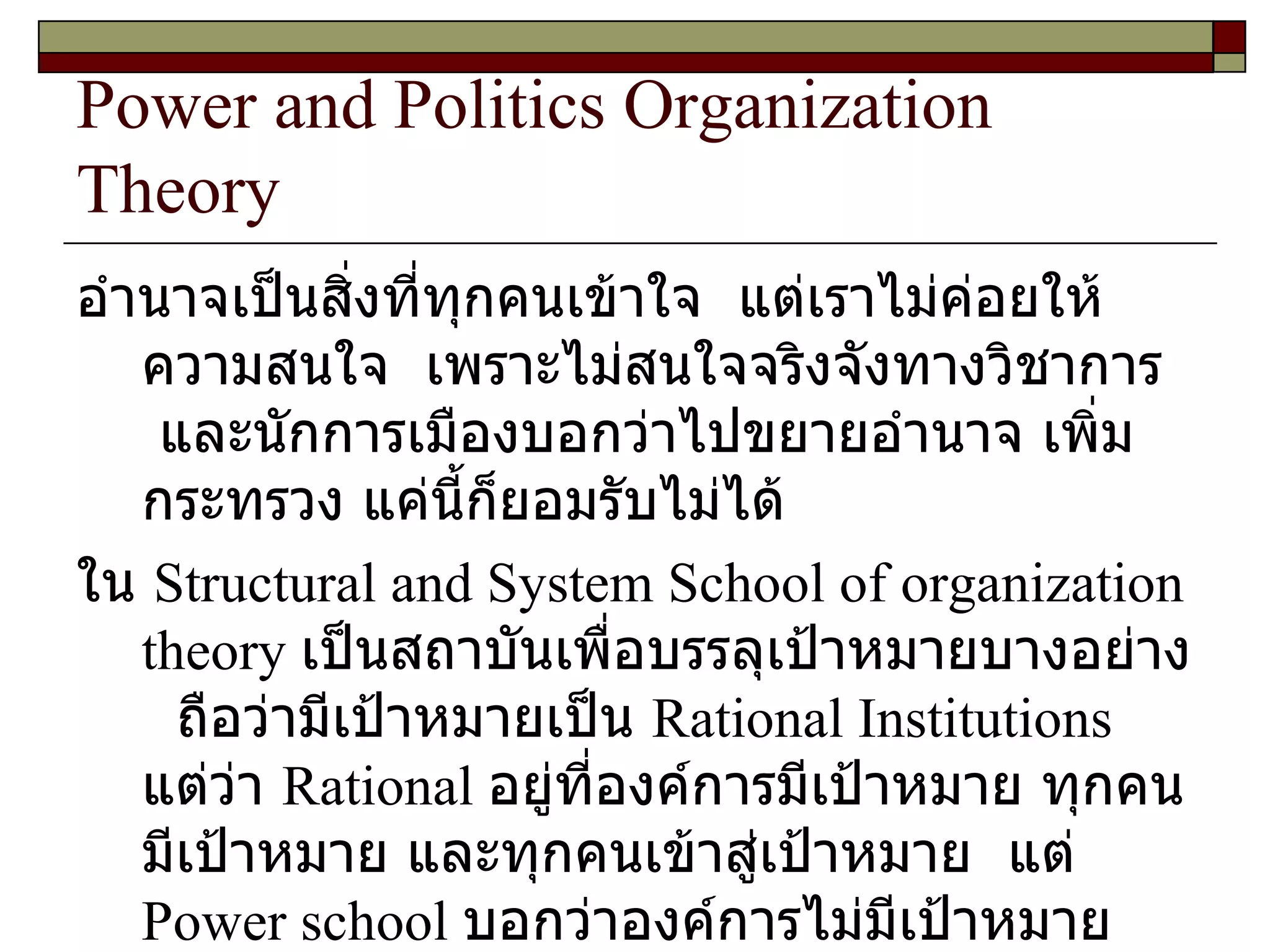
Power and PoliticsOrganization Theory อำนาจเป็นสิ่งที่ทุกคนเข้าใจ แต่เราไม่ค่อยให้ความสนใจ เพราะไม่สนใจจริงจังทางวิชาการ และนักการเมืองบอกว่าไปขยายอำนาจ เพิ่มกระทรวง แค่นี้ก็ยอมรับไม่ได้ ใน Structural and System School of organization theory เป็นสถาบันเพื่อบรรลุเป้าหมายบางอย่าง ถือว่ามีเป้าหมายเป็น Rational Institutions แต่ว่า Rational อยู่ที่องค์การมีเป้าหมาย ทุกคนมีเป้าหมาย และทุกคนเข้าสู่เป้าหมาย แต่ Power school บอกว่าองค์การไม่มีเป้าหมาย
50.
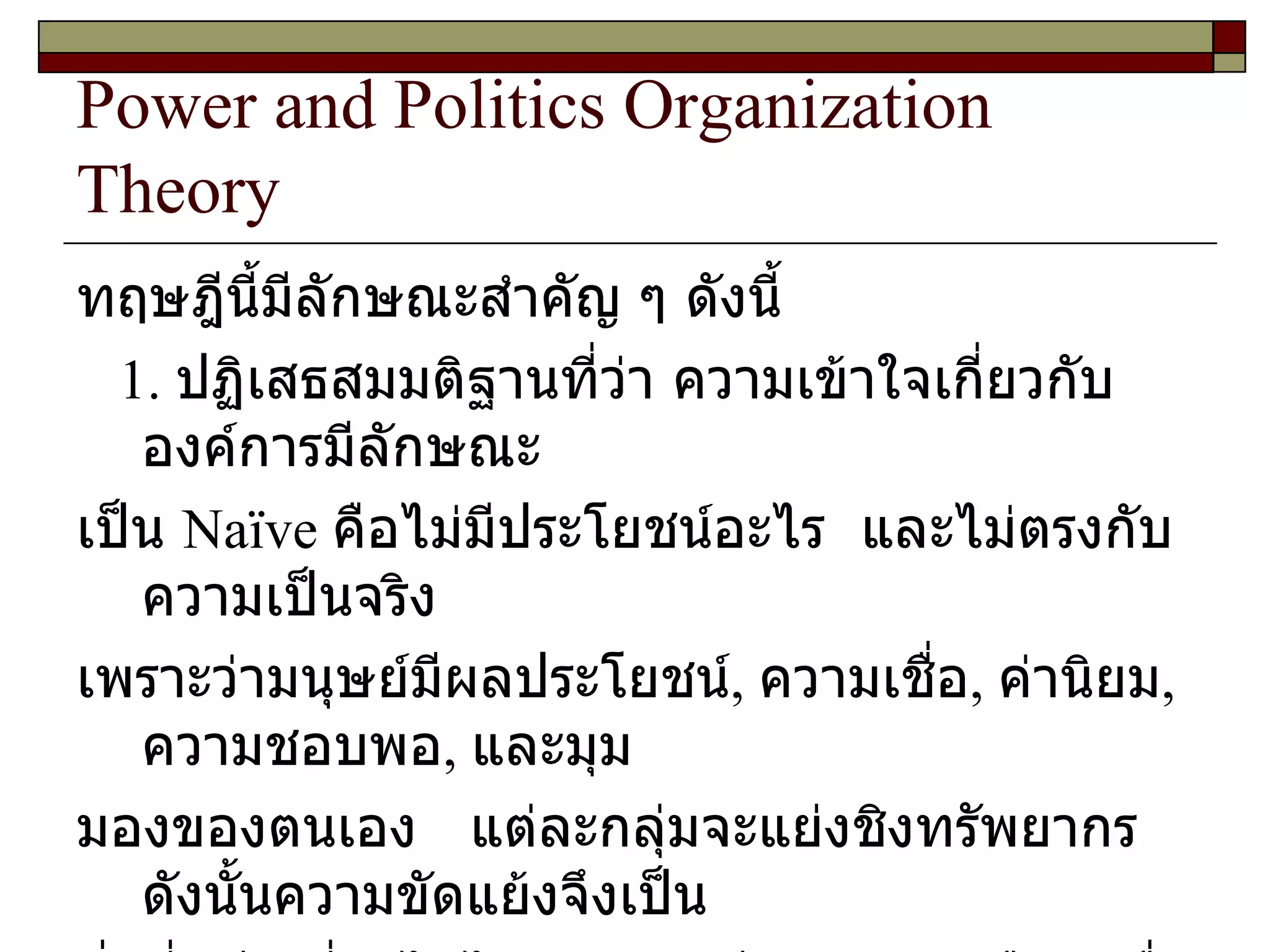
Power and PoliticsOrganization Theory ทฤษฎีนี้มีลักษณะสำคัญ ๆ ดังนี้ 1. ปฏิเสธสมมติฐานที่ว่า ความเข้าใจเกี่ยวกับองค์การมีลักษณะ เป็น Naïve คือไม่มีประโยชน์อะไร และไม่ตรงกับความเป็นจริง เพราะว่ามนุษย์มีผลประโยชน์ , ความเชื่อ , ค่านิยม , ความชอบพอ , และมุม มองของตนเอง แต่ละกลุ่มจะแย่งชิงทรัพยากร ดังนั้นความขัดแย้งจึงเป็น สิ่งที่หลีกเลี่ยงไม่ได้ การมีอิทธิพลเหนือคนอื่นจึงเป็นเครื่องมือสำคัญ ในการแย่งชิงทรัพยากรในองค์การที่หายาก
51.
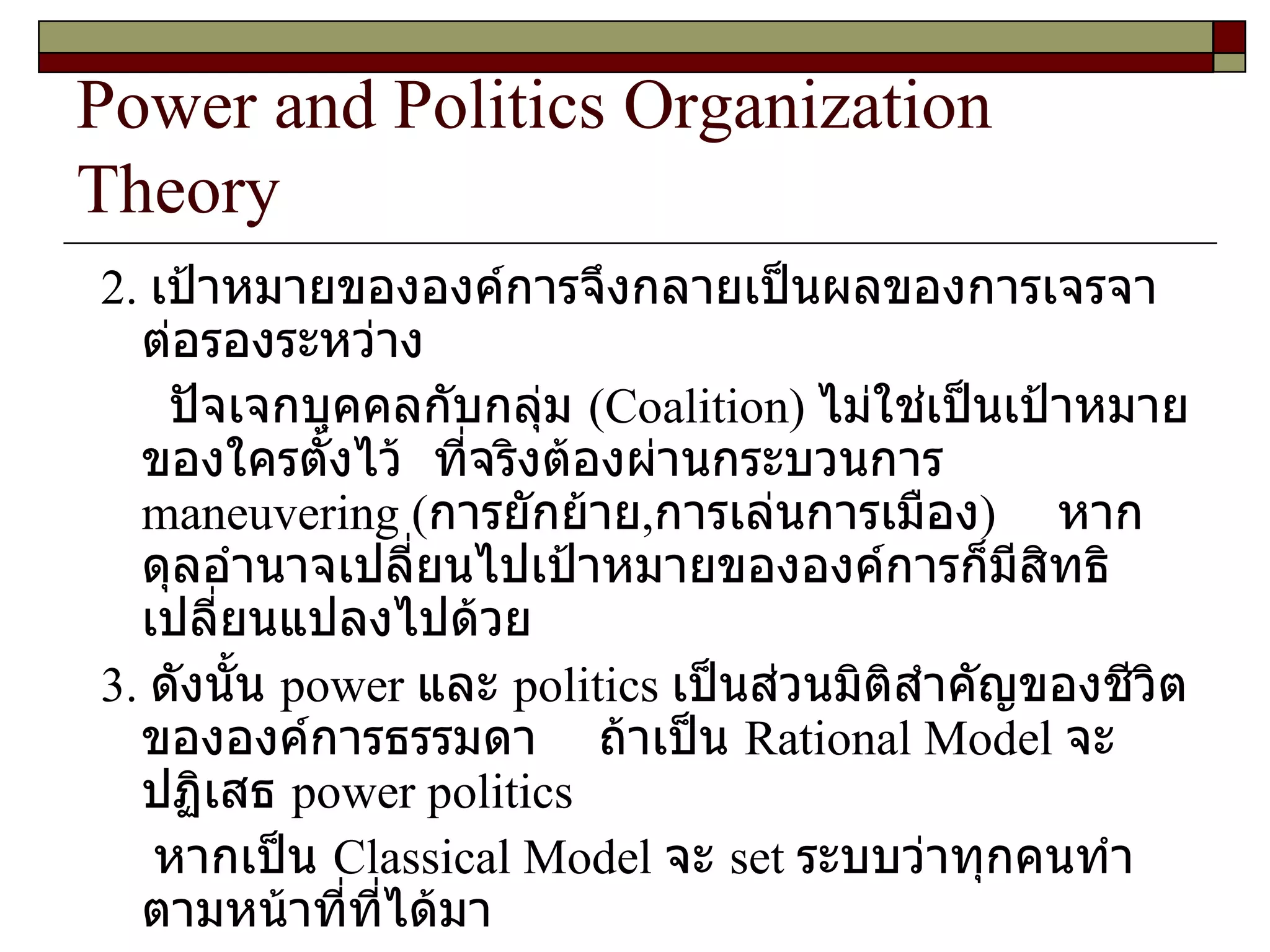
Power and PoliticsOrganization Theory 2. เป้าหมายขององค์การจึงกลายเป็นผลของการเจรจาต่อรองระหว่าง ปัจเจกบุคคลกับกลุ่ม ( Coalition ) ไม่ใช่เป็นเป้าหมายของใครตั้งไว้ ที่จริงต้องผ่านกระบวนการ maneuvering ( การยักย้าย , การเล่นการเมือง ) หากดุลอำนาจเปลี่ยนไปเป้าหมายขององค์การก็มีสิทธิเปลี่ยนแปลงไปด้วย 3. ดังนั้น power และ politics เป็นส่วนมิติสำคัญของชีวิตขององค์การธรรมดา ถ้าเป็น Rational Model จะปฏิเสธ power politics หากเป็น Classical Model จะ set ระบบว่าทุกคนทำตามหน้าที่ที่ได้มา ไม่มีใครมีอิทธิพลเหนือใคร
52.
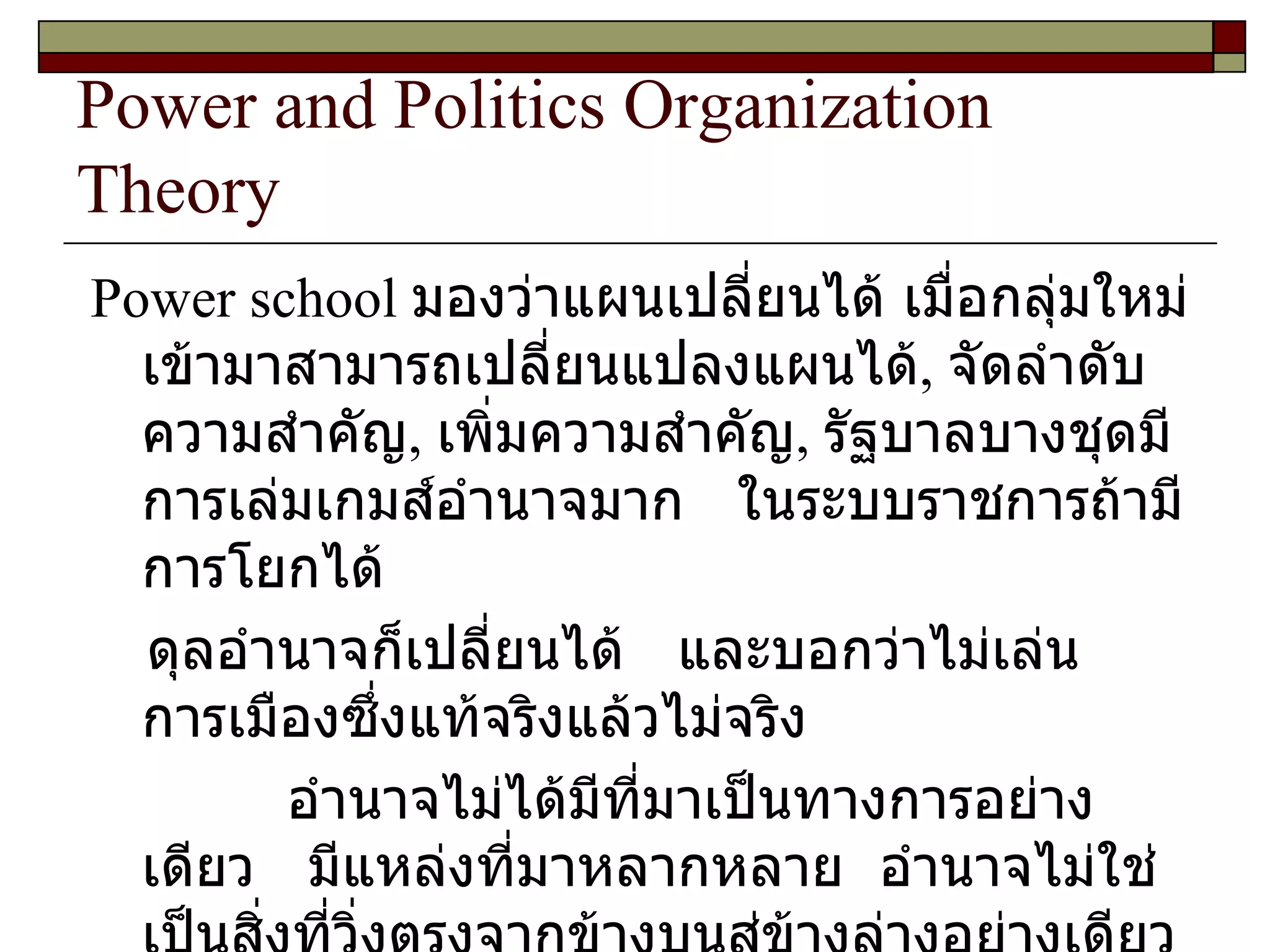
Power and PoliticsOrganization Theory Power school มองว่าแผนเปลี่ยนได้ เมื่อกลุ่มใหม่เข้ามาสามารถเปลี่ยนแปลงแผนได้ , จัดลำดับความสำคัญ , เพิ่มความสำคัญ , รัฐบาลบางชุดมีการเล่มเกมส์อำนาจมาก ในระบบราชการถ้ามีการโยกได้ ดุลอำนาจก็เปลี่ยนได้ และบอกว่าไม่เล่นการเมืองซึ่งแท้จริงแล้วไม่จริง อำนาจไม่ได้มีที่มาเป็นทางการอย่างเดียว มีแหล่งที่มาหลากหลาย อำนาจไม่ใช่เป็นสิ่งที่วิ่งตรงจากข้างบนสู่ข้างล่างอย่างเดียว แต่อำนาจเป็นสิ่งที่วิ่งได้ทุกทาง
53.
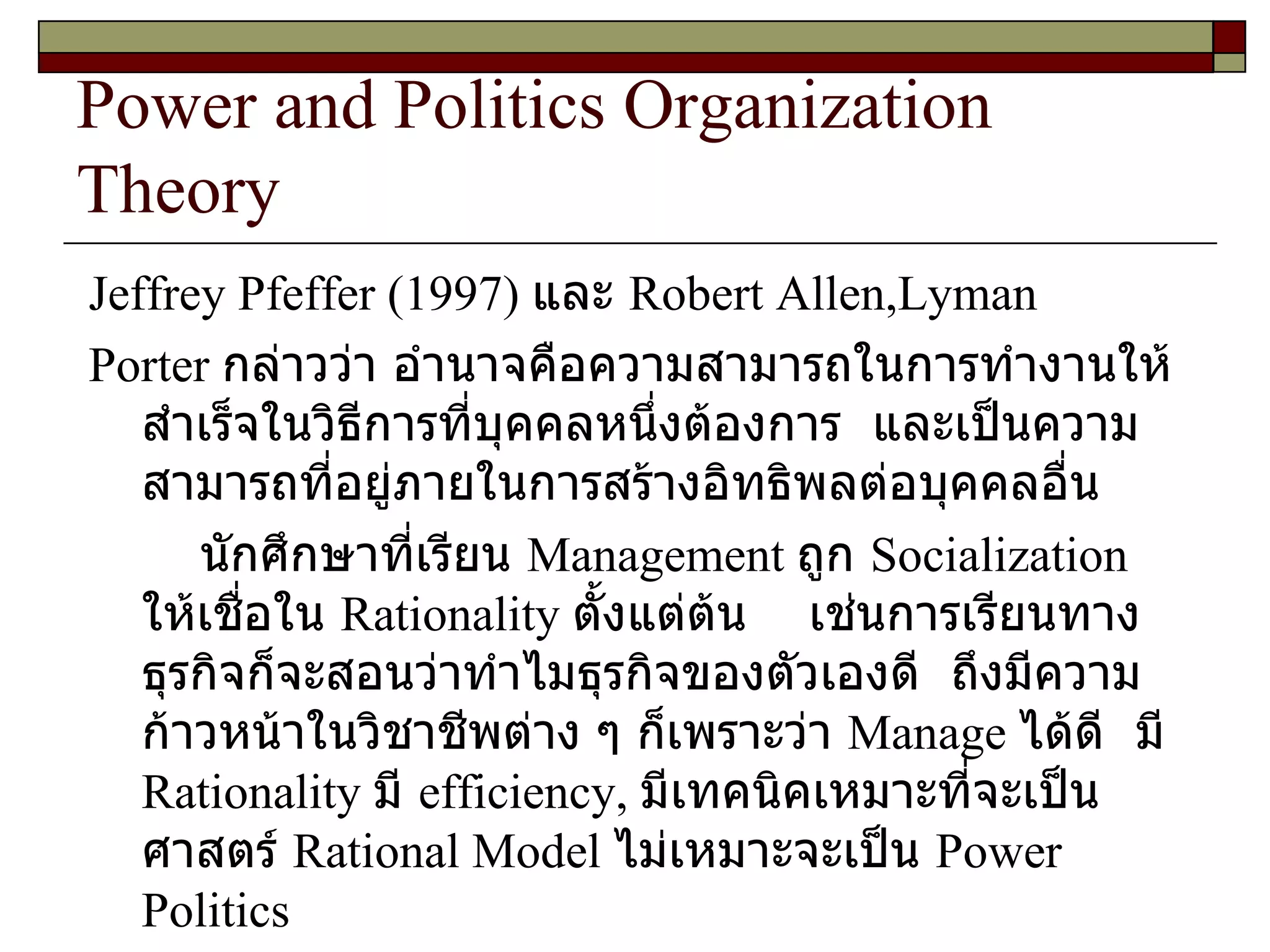
Power and PoliticsOrganization Theory Jeffrey Pfeffer ( 1997 ) และ Robert Allen,Lyman Porter กล่าวว่า อำนาจคือความสามารถในการทำงานให้สำเร็จในวิธีการที่บุคคลหนึ่งต้องการ และเป็นความสามารถที่อยู่ภายในการสร้างอิทธิพลต่อบุคคลอื่น นักศึกษาที่เรียน Management ถูก Socialization ให้เชื่อใน Rationality ตั้งแต่ต้น เช่นการเรียนทางธุรกิจก็จะสอนว่าทำไมธุรกิจของตัวเองดี ถึงมีความก้าวหน้าในวิชาชีพต่าง ๆ ก็เพราะว่า Manage ได้ดี มี Rationality มี efficiency, มีเทคนิคเหมาะที่จะเป็นศาสตร์ Rational Model ไม่เหมาะจะเป็น Power Politics
54.
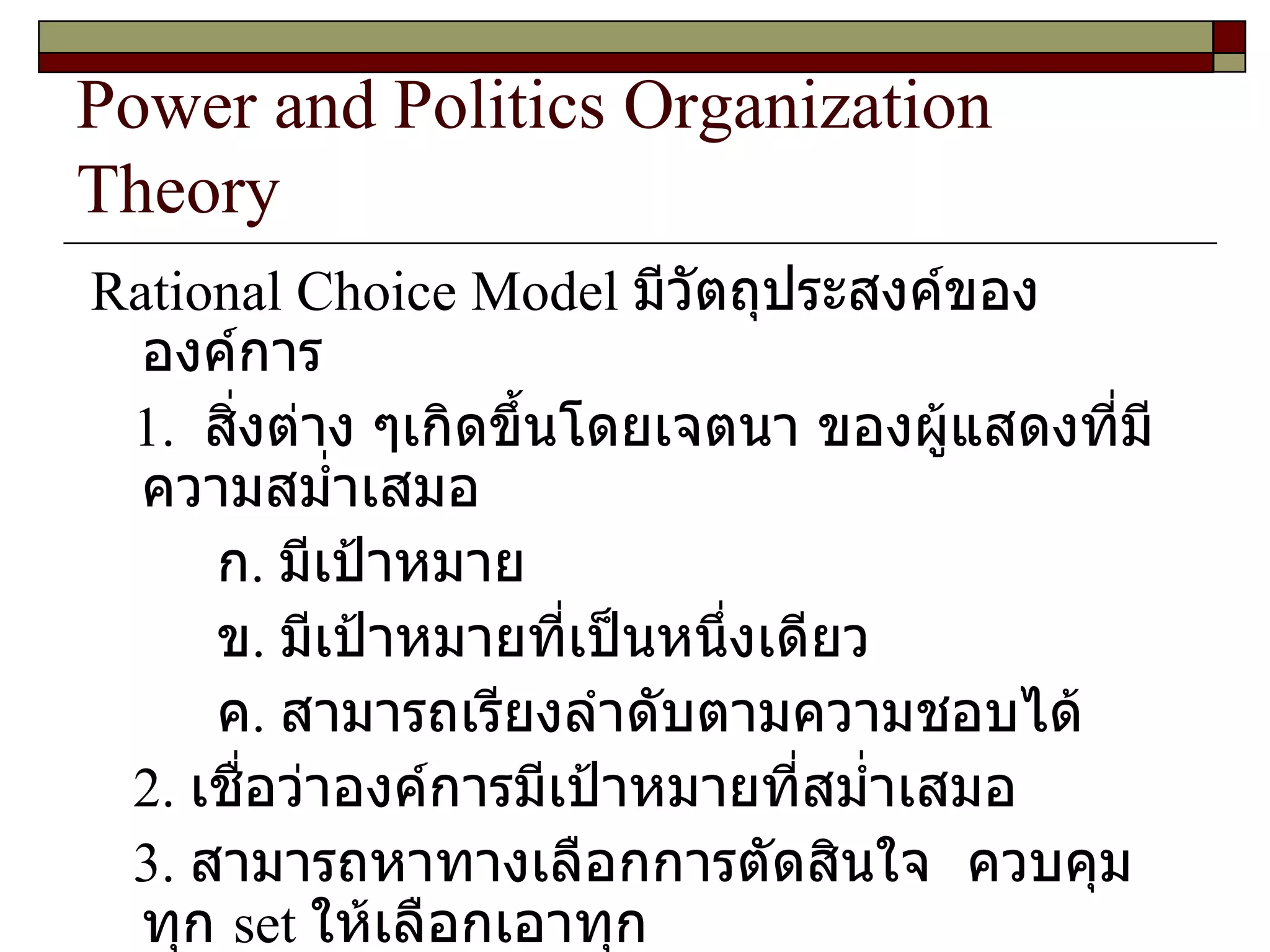
Power and PoliticsOrganization Theory Rational Choice Model มีวัตถุประสงค์ขององค์การ 1. สิ่งต่าง ๆเกิดขึ้นโดยเจตนา ของผู้แสดงที่มีความสม่ำเสมอ ก . มีเป้าหมาย ข . มีเป้าหมายที่เป็นหนึ่งเดียว ค . สามารถเรียงลำดับตามความชอบได้ 2. เชื่อว่าองค์การมีเป้าหมายที่สม่ำเสมอ 3. สามารถหาทางเลือกการตัดสินใจ ควบคุมทุก set ให้เลือกเอาทุก Rationality
55.
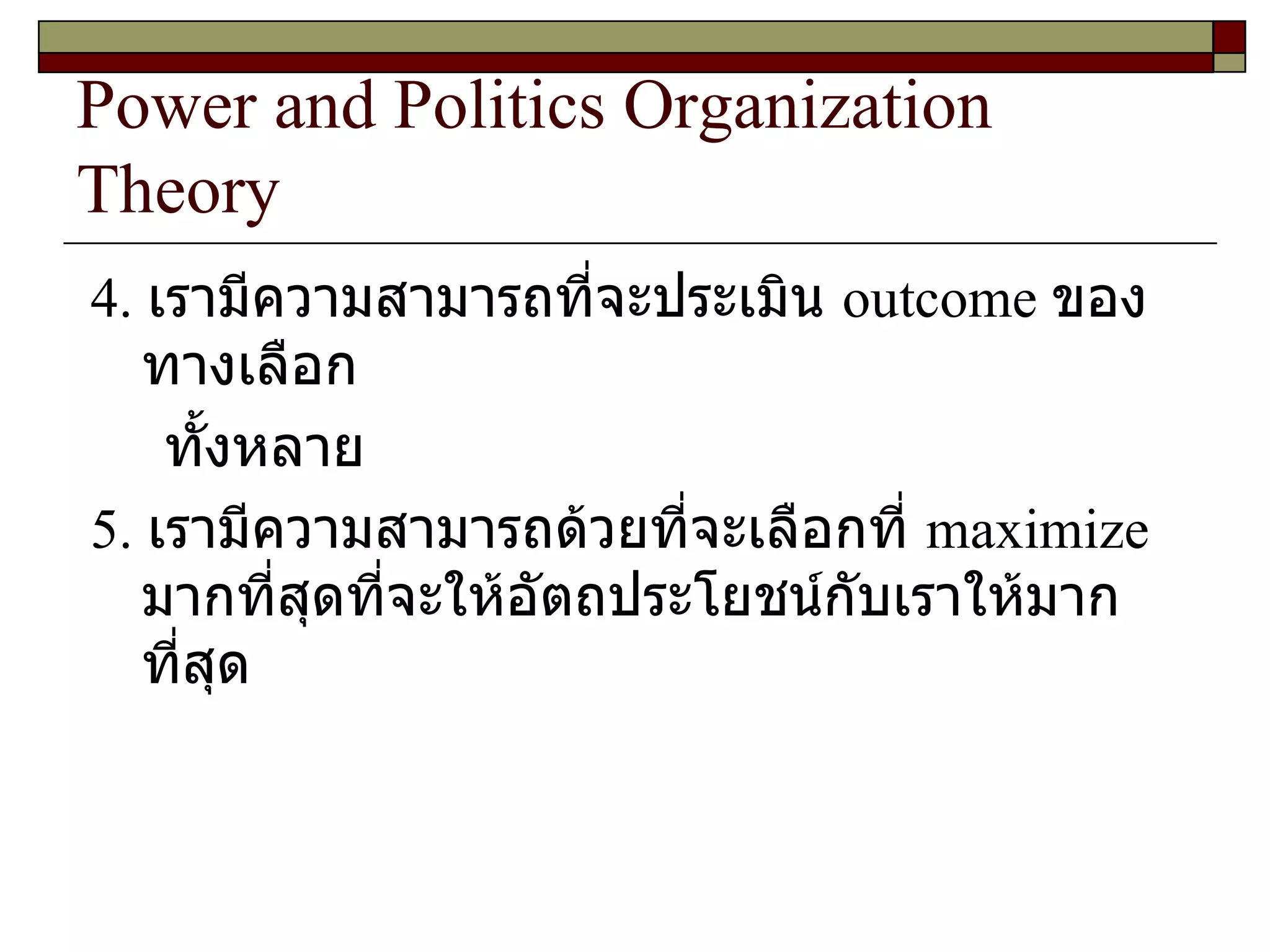
Power and PoliticsOrganization Theory 4. เรามีความสามารถที่จะประเมิน outcome ของทางเลือก ทั้งหลาย 5. เรามีความสามารถด้วยที่จะเลือกที่ maximize มากที่สุดที่จะให้อัตถประโยชน์กับเราให้มากที่สุด
56.
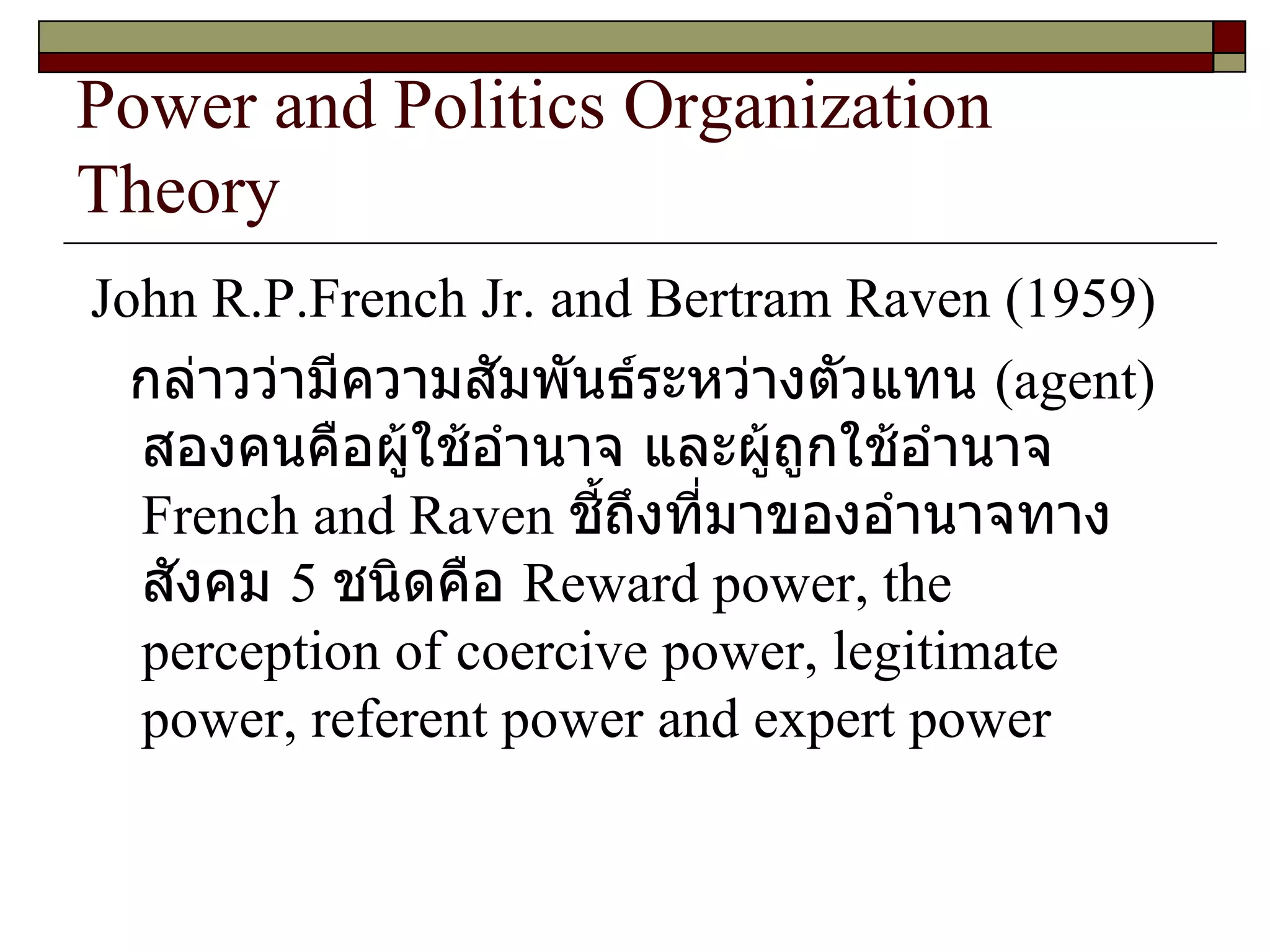
Power and PoliticsOrganization Theory John R.P.French Jr. and Bertram Raven ( 1959 ) กล่าวว่ามีความสัมพันธ์ระหว่างตัวแทน ( agent ) สองคนคือผู้ใช้อำนาจ และผู้ถูกใช้อำนาจ French and Raven ชี้ถึงที่มาของอำนาจทางสังคม 5 ชนิดคือ Reward power, the perception of coercive power, legitimate power, referent power and expert power
57.
Power and PoliticsOrganization Theory James March ศึกษาเรื่องอำนาจทางสังคมในองค์การ และอำนาจของชุมชน และเสนอให้หันมาศึกษาอำนาจของชุมชนเพื่อไปในทิศทางเดียวกันกับความสนใจขององค์การไร้พรมแดน , องค์การเสมือนจริง และเครือข่าย Henry Mintzberg ในหนังสือ Power in and organization ( l983 ) เสนอว่า พฤติกรรมองค์การเป็นเกมของอำนาจ ( power game ) ที่ผู้เล่นเป็น influence ( ผู้มีอำนาจจูงใจ ) ที่มีความต้องการหลากหลาย ที่ต้องการควบคุมการตัดสินใจขององค์การ และกิจกรรม
58.
Organizational and SenseMaking Organizational culture is the culture that exists in an organization, something akin to a societal culture. It is composed of many intangible phenomena, such as values, beliefs, assumptions, perceptions, behavioral norms, artifacts and patterns of behavior. The organizational culture perspective rejects the assumptions of the “ modern ” structural and system theories
59.
From the organizationalculture perspective, systems of formal rules, authority, and norms of rational behavior do not restrain the personal preferences of organizational members, Instead, they are controlled by cultural norms, values, beliefs, and assumptions. The organizational culture school has turned to qualitative research methods such as ethnography and participant observation. Organizational and Sense Making
60.
Organizational and SenseMaking A different orientation to cultures in organizations started to appear in the organization theory literature during the late 1970, and it became a “ Wave ” in the mid-1980s. This orientatin is known as the symbolic frame,symbolic management or organzitional symbolism. Bolmen and Deal ( 1997 ) identify the basic tanets of symbolic management as follows:
61.
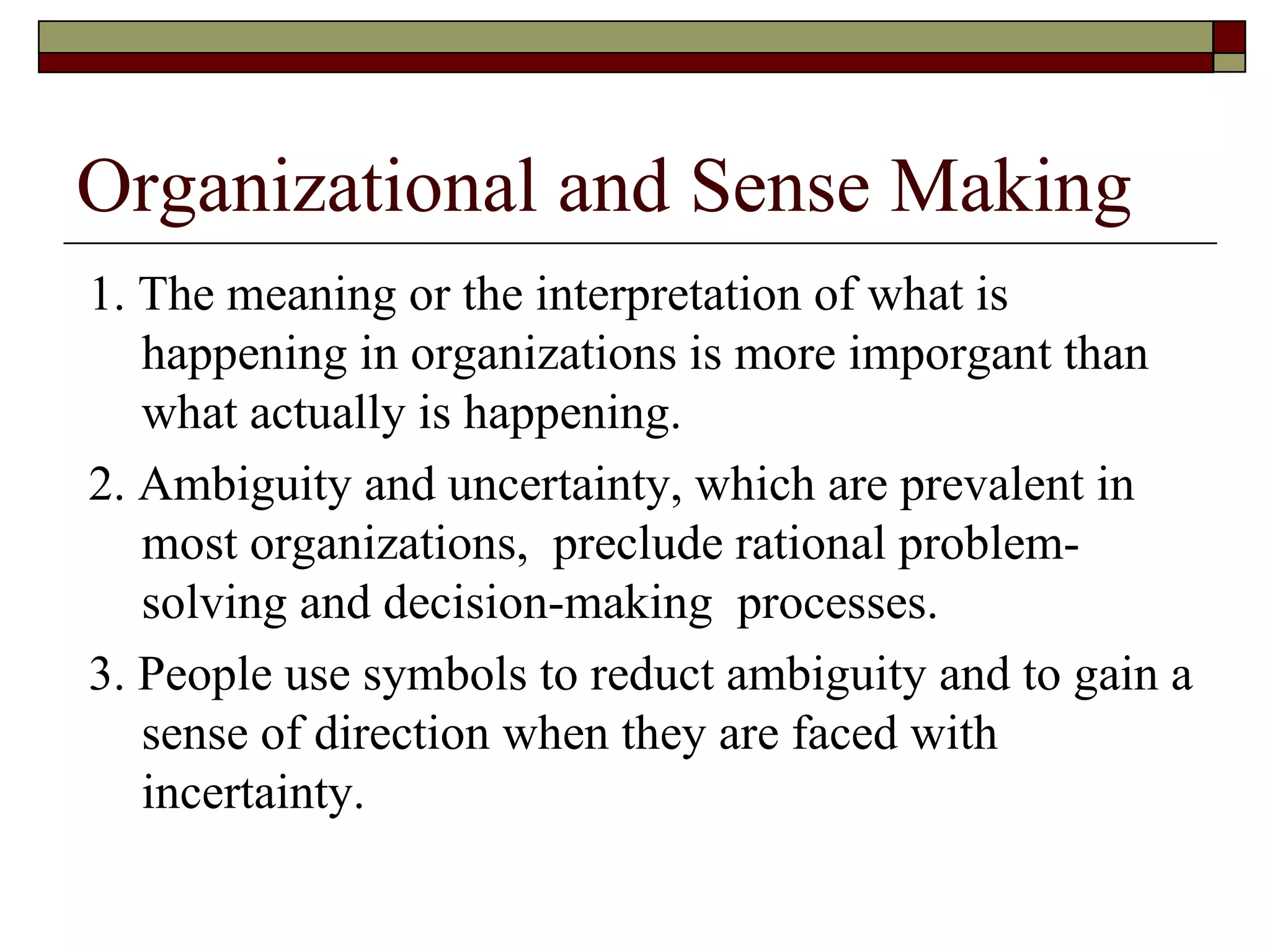
Organizational and SenseMaking 1. The meaning or the interpretation of what is happening in organizations is more imporgant than what actually is happening. 2. Ambiguity and uncertainty, which are prevalent in most organizations, preclude rational problem-solving and decision-making processes. 3. People use symbols to reduct ambiguity and to gain a sense of direction when they are faced with incertainty.
62.
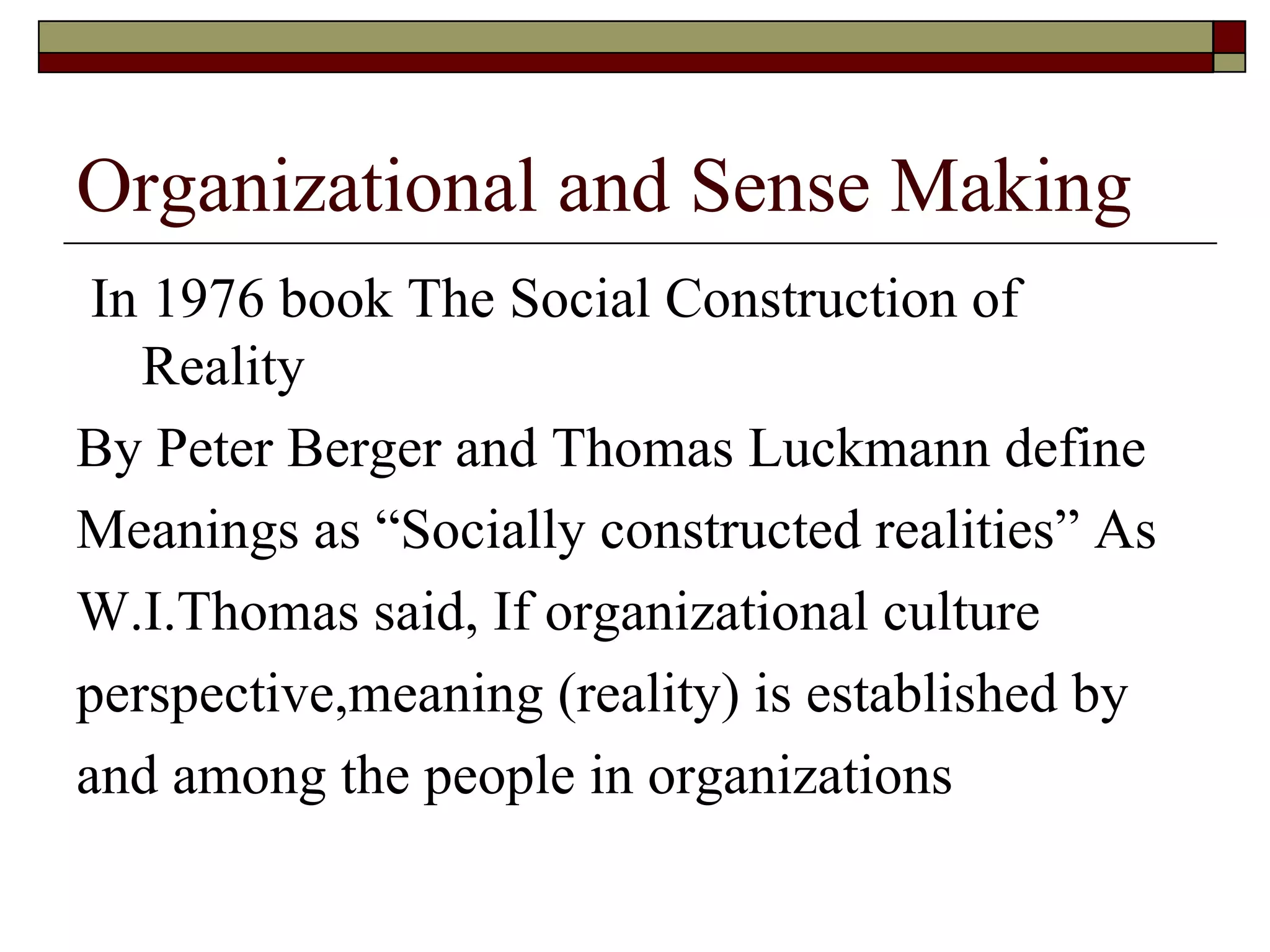
Organizational and SenseMaking In 1976 book The Social Construction of Reality By Peter Berger and Thomas Luckmann define Meanings as “ Socially constructed realities ” As W.I.Thomas said, If organizational culture perspective,meaning ( reality ) is established by and among the people in organizations
63.
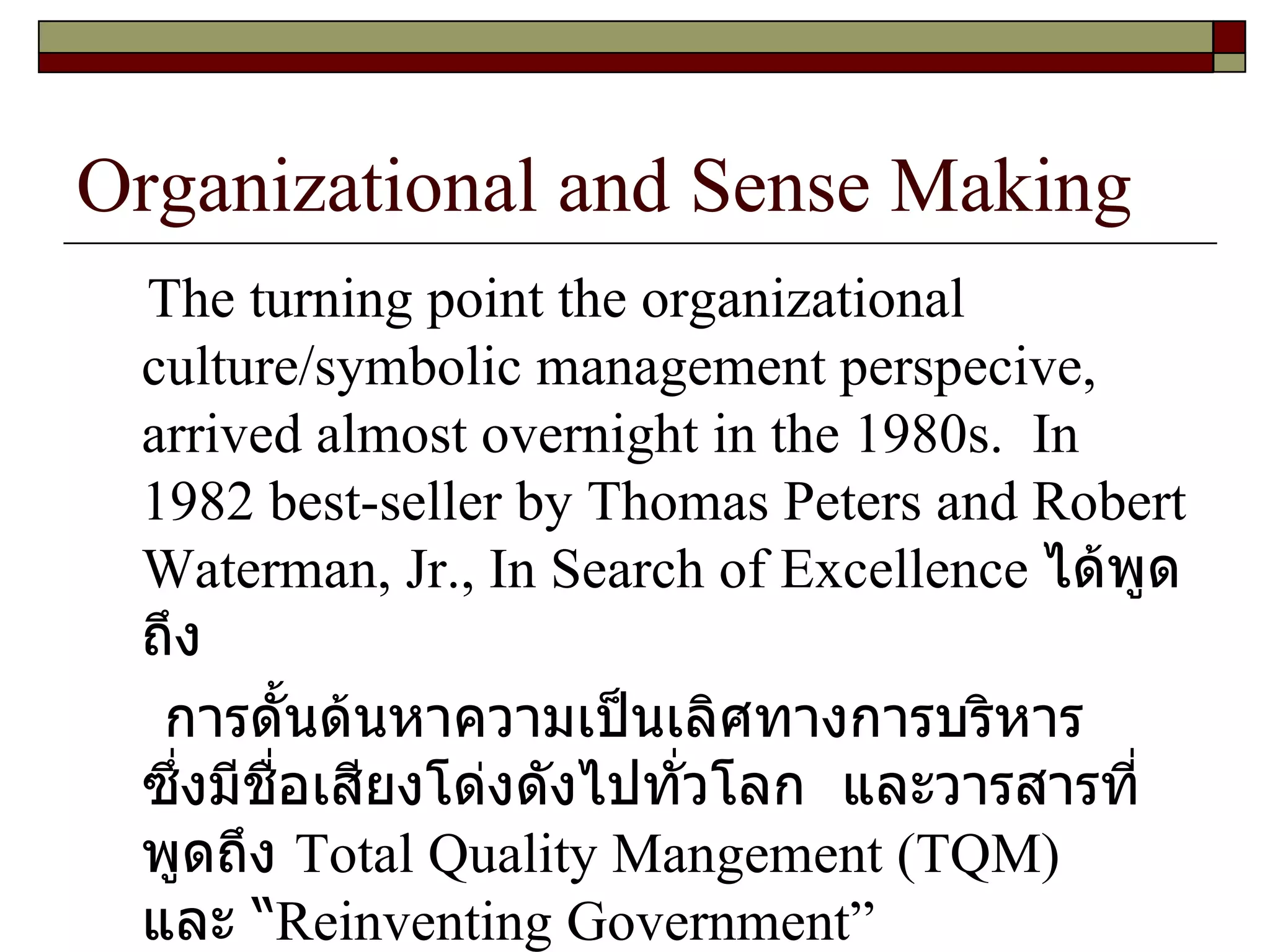
Organizational and SenseMaking The turning point the organizational culture/symbolic management perspecive, arrived almost overnight in the 1980s. In 1982 best-seller by Thomas Peters and Robert Waterman, Jr., In Search of Excellence ได้พูดถึง การดั้นด้นหาความเป็นเลิศทางการบริหาร ซึ่งมีชื่อเสียงโด่งดังไปทั่วโลก และวารสารที่พูดถึง Total Quality Mangement ( TQM ) และ “ Reinventing Government ”
64.
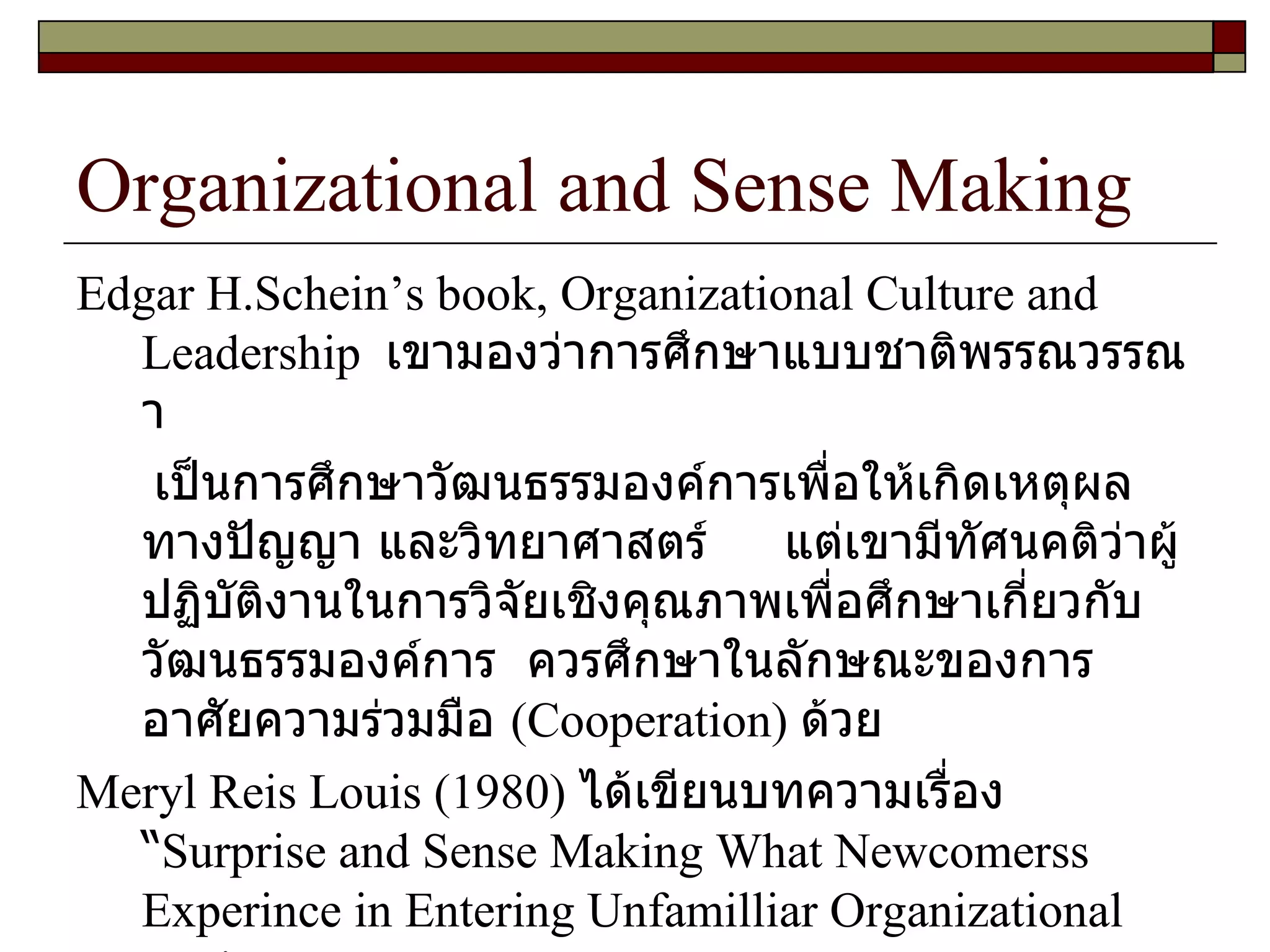
Organizational and SenseMaking Edgar H.Schein’s book, Organizational Culture and Leadership เขามองว่าการศึกษาแบบชาติพรรณวรรณา เป็นการศึกษาวัฒนธรรมองค์การเพื่อให้เกิดเหตุผลทางปัญญา และวิทยาศาสตร์ แต่เขามีทัศนคติว่าผู้ปฏิบัติงานในการวิจัยเชิงคุณภาพเพื่อศึกษาเกี่ยวกับวัฒนธรรมองค์การ ควรศึกษาในลักษณะของการอาศัยความร่วมมือ ( Cooperation ) ด้วย Meryl Reis Louis ( 1980 ) ได้เขียนบทความเรื่อง “ Surprise and Sense Making What Newcomerss Experince in Entering Unfamilliar Organizational Settings
65.
Organizational and SenseMaking Joan Acker เขียน “ Gendering Organizational Theory ” ได้กล่าวถึง วิธีการที่เราอ่านอิทธิพลขององค์การถึงวิธีที่เราจะผลิต โดยผ่านเลนส์ของผู้ชายในการมอง Scott Cook และ Dvora Yanow ใช้กรณีของ workshop เล็ก ๆ 3 แห่ง เขาได้สำรวจถึงความสัมพันธ์ระหว่างวัฒนธรรมองค์การ และการเรียนรู้องค์การ
66.
Organizational Culture ReformMovements This movement has two features: ( 1 ) their origins in the realization that U.S. companies had lost their competitiveness in the last three decades of the twentieth century ( 2 ) Their commitment to increasing organizational effectiveness, competitiveness, flexibility, and responsiveness by changing organizational cultures
67.
Organizational Culture ReformMovements Origin of this movement: concept of Q.C. by Dr.W.Edward Deming Reform Movement concentrated : 1. empowerment 2. policy, procedures, and layers of the hierarchy are eliminated. 3. Accoutability to bosses is replaced by accountability to customers or clients.
68.
Organizational Culture ReformMovements TQM : Deming’s now-famous fourteen points of management represent its essence. ( see 427-8 ) Japanese mangement: Theory Z by William Ouchi In search for excellent: the concept by Tom Peters and Bob Waterman, there are 8 attributes of management Excellent : 1. A bias for action 2. Close to the customer
69.
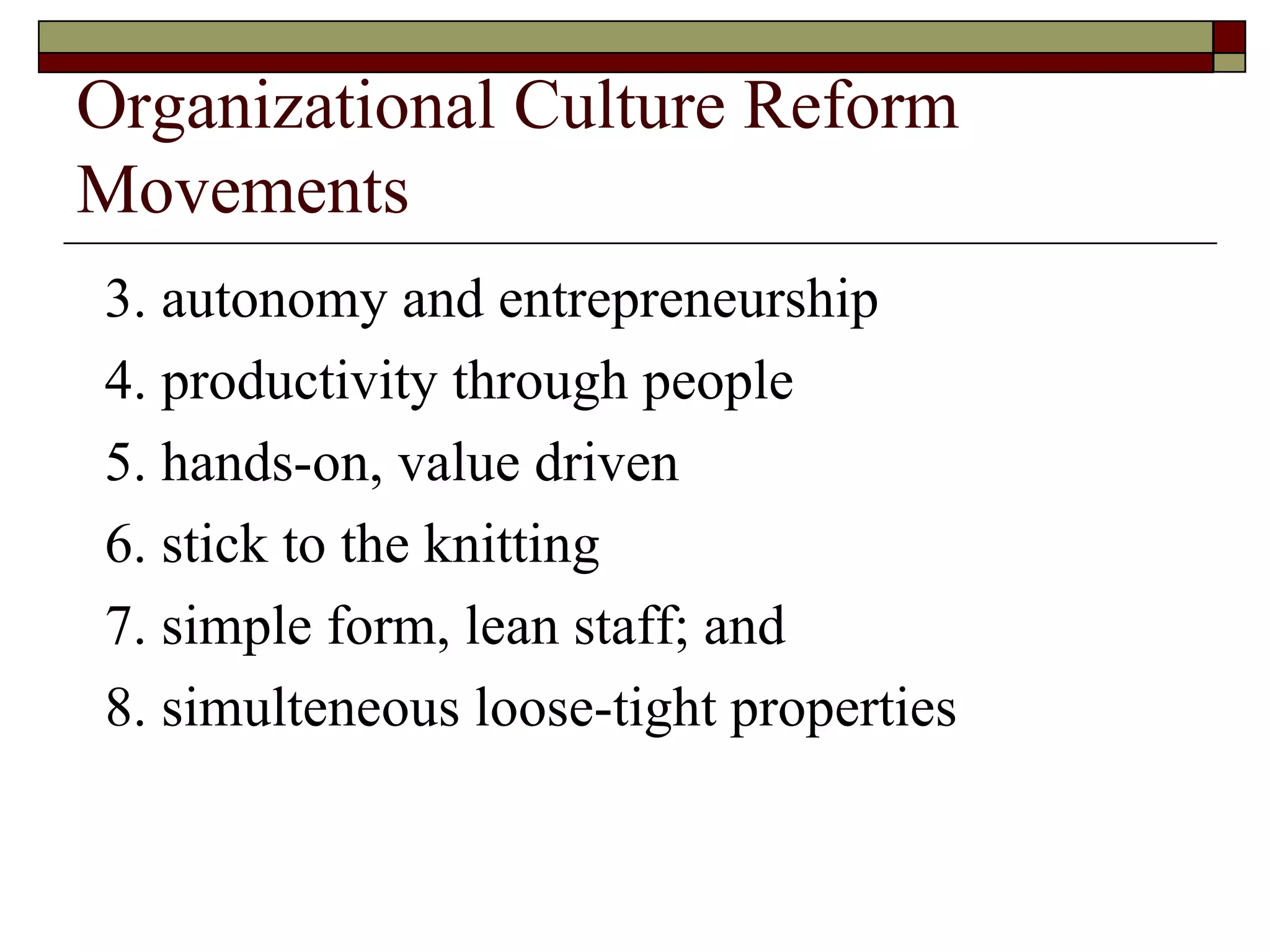
Organizational Culture ReformMovements 3. autonomy and entrepreneurship 4. productivity through people 5. hands-on, value driven 6. stick to the knitting 7. simple form, lean staff; and 8. simulteneous loose-tight properties
70.
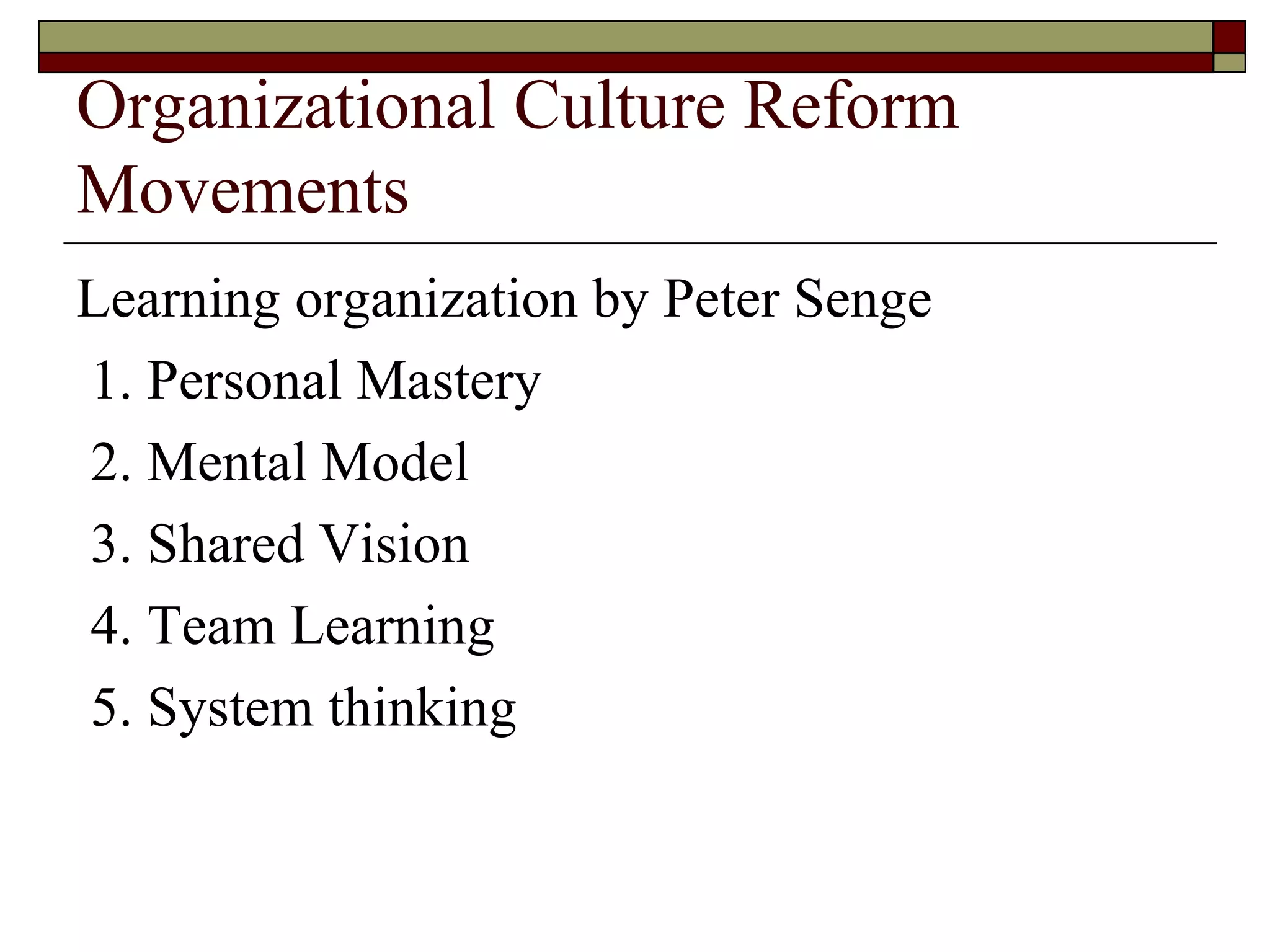
Organizational Culture ReformMovements Learning organization by Peter Senge 1. Personal Mastery 2. Mental Model 3. Shared Vision 4. Team Learning 5. System thinking
71.
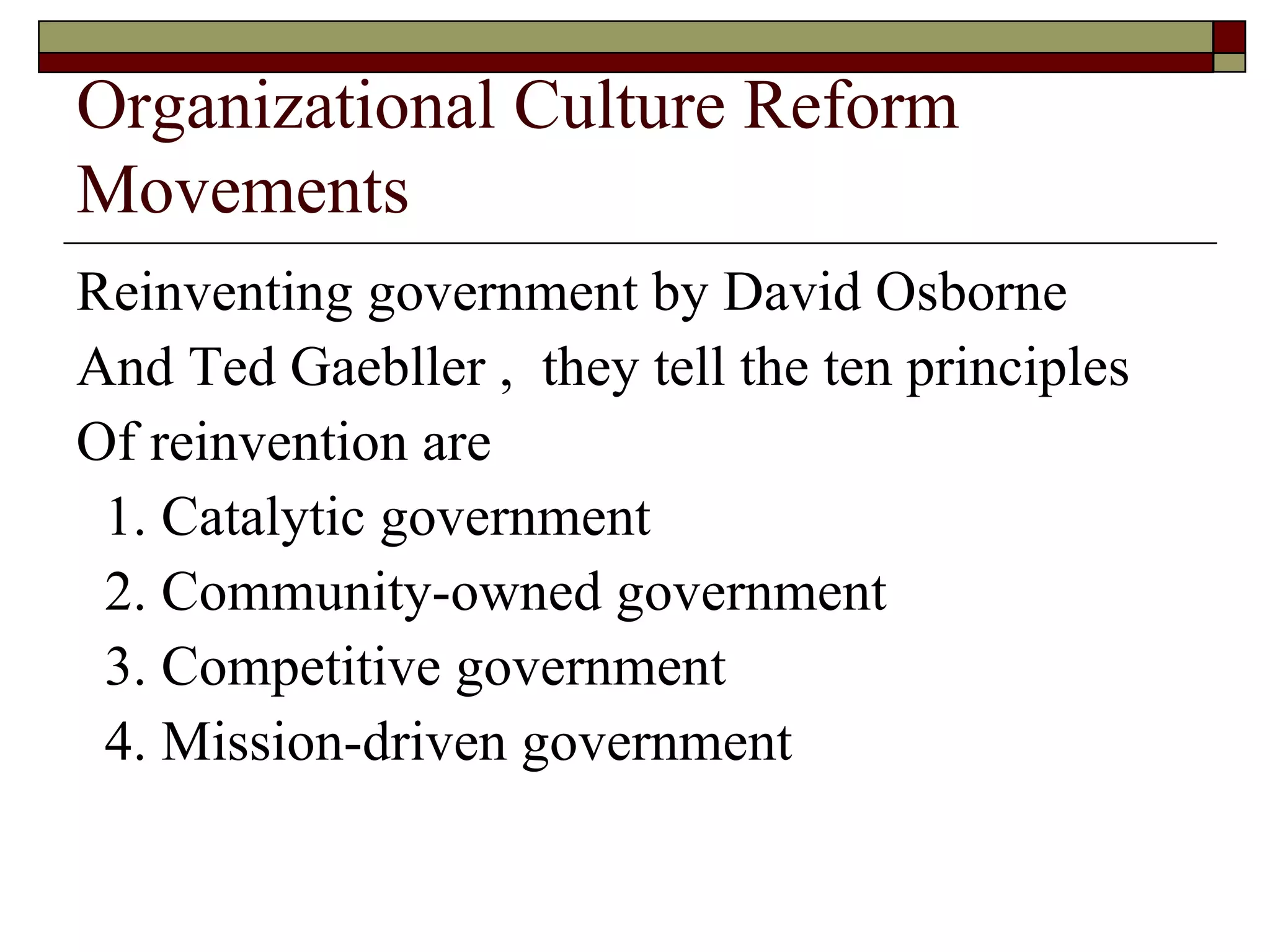
Organizational Culture ReformMovements Reinventing government by David Osborne And Ted Gaebller , they tell the ten principles Of reinvention are 1. Catalytic government 2. Community-owned government 3. Competitive government 4. Mission-driven government
72.
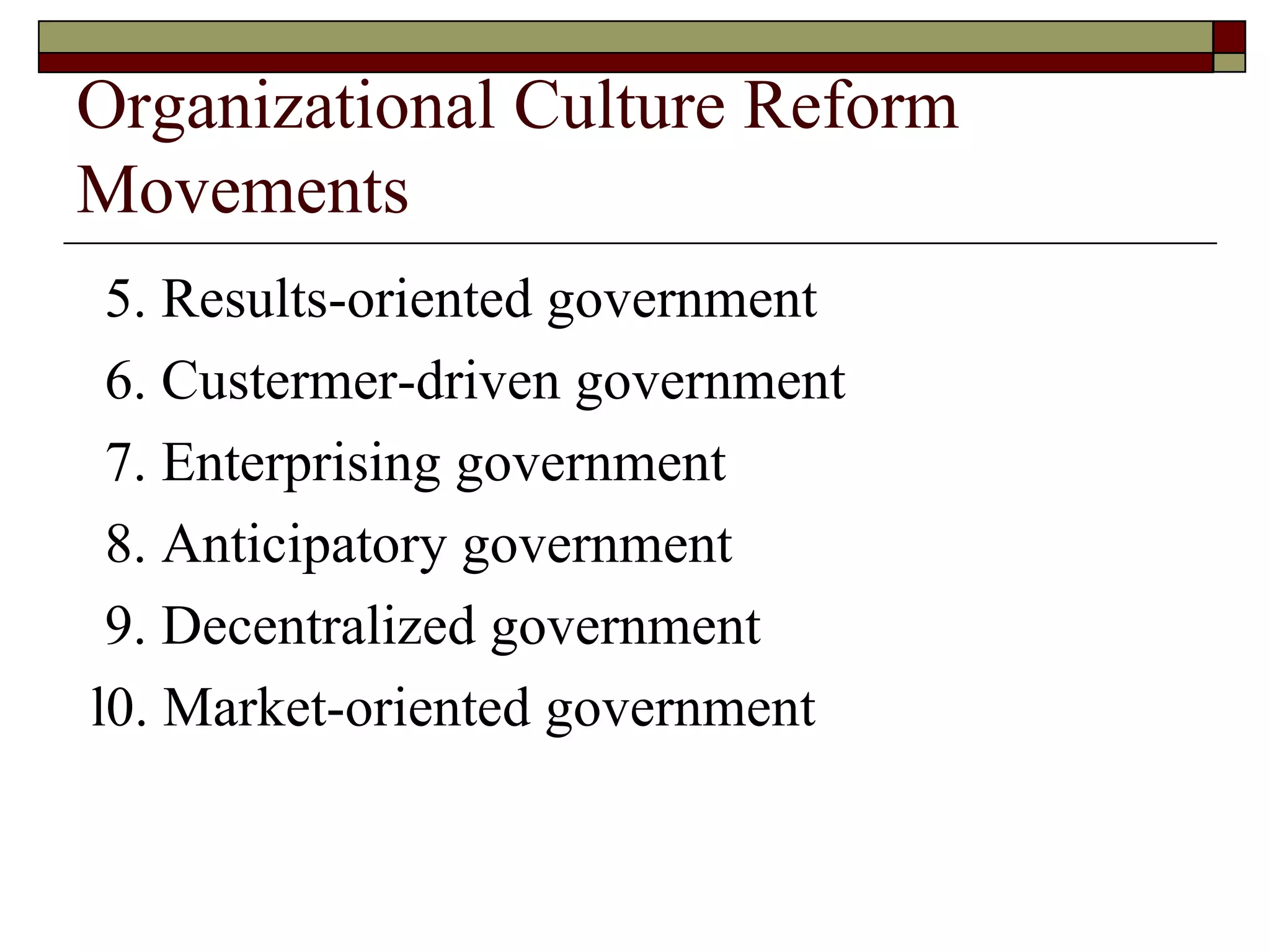
Organizational Culture ReformMovements 5. Results-oriented government 6. Custermer-driven government 7. Enterprising government 8. Anticipatory government 9. Decentralized government l0. Market-oriented government
73.
Organizational Culture ReformMovements Reengineering by Michael Hammer and James champy from the book, Reengineering the corporation ( 1993 )
74.
Postmodern and theInformation Age This age is the new era, on the boundary between order and chaos. It refers to a pervasive condition of unpredictability and complexity. The chaos and uncertainty of this approaching postmodern era has been accompanied—and accelerated-by rapidly advancing information technology.
75.
Postmodern and theInformation Age Although “ automating ” represented an Information technology revolution in the l960’s Postmodern organizations, the mental ability of humans in organizations to make sense when confronted by pervasive complexity and the role of humans and organizations in society.
76.
Postmodern and theInformation Age William Berquist’s ( l993 ) selection reprinted here, “ Postmodern Thought in a Nutshell: Where Art and Science Come Together. ” “ in many ways ,postmodernism is a fad- and at the same time about fads. Berquist identifies and explicates four themes of post modernism.
77.
Postmodern and theInformation Age 1. Objectivism versus constuctivism Objectivism is predeminated in the modern era – is rational, It assumes that there is an objective reality that can be discovered. Constructivism is a postmodern phenomenon believe that we construct our own social realities.
78.
Postmodern and theInformation Age 2. Language is it self reality 3. Globalization and segmentalism. 4. Fragmented and inconsistent image.
79.
Postmodern and theInformation Age Organizations must “ stay on top of new technology ” and work continuously to learn how to use it imaginatively. Janet Fulk and Gerardine chapter “ Articuation of Communication Technology and Organizational Form ” They utilize three perspectives in their analysis:
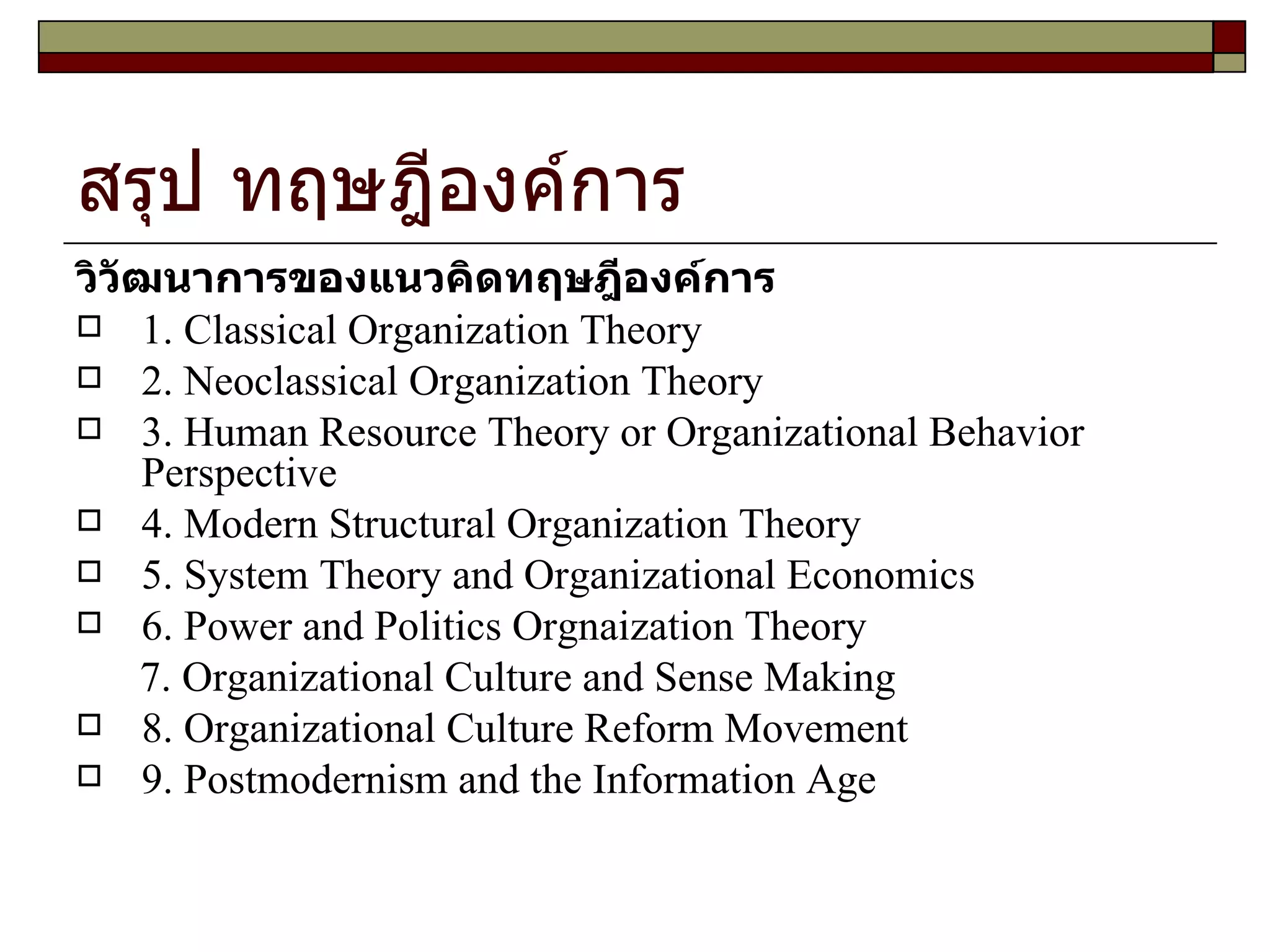
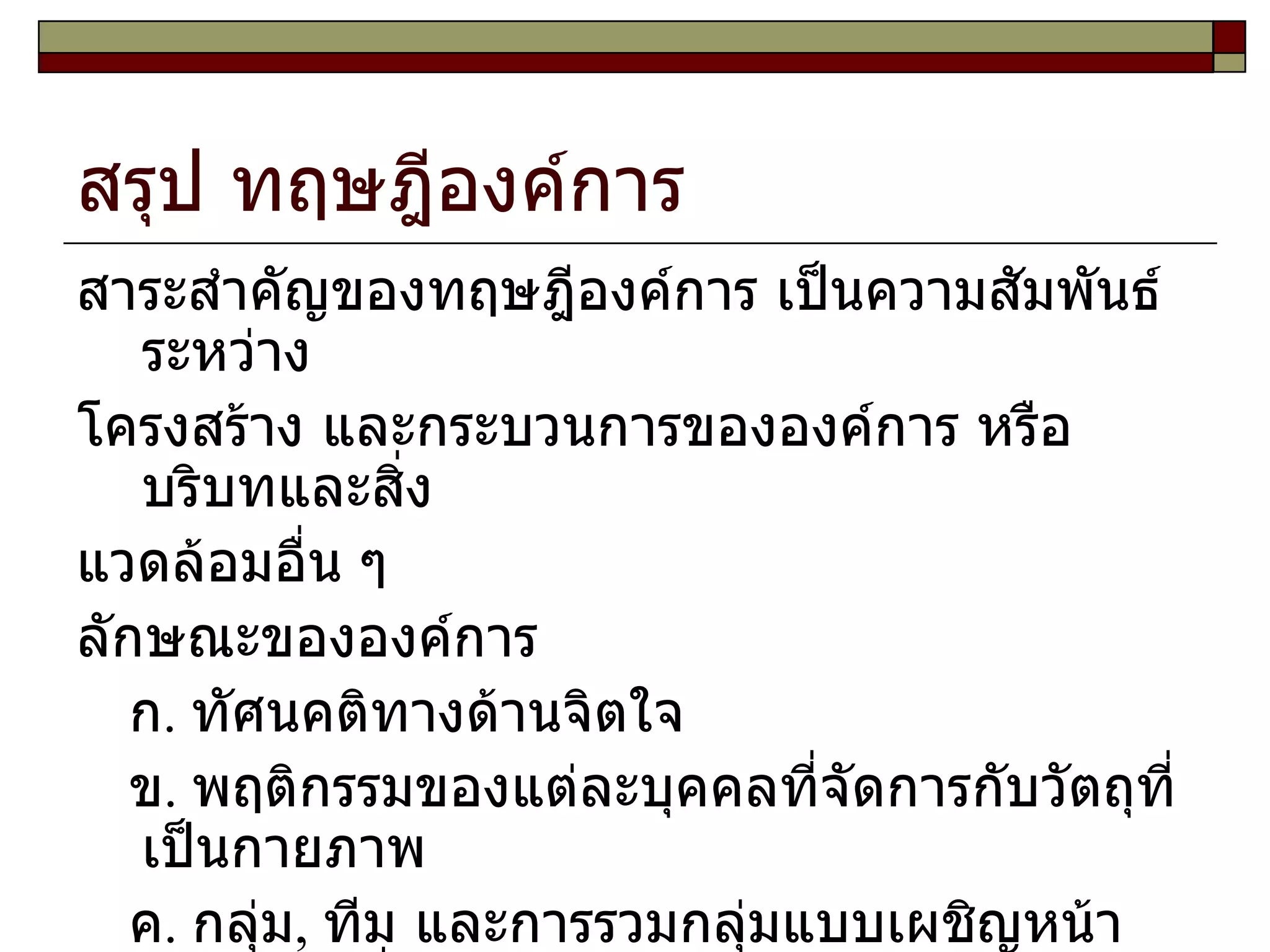
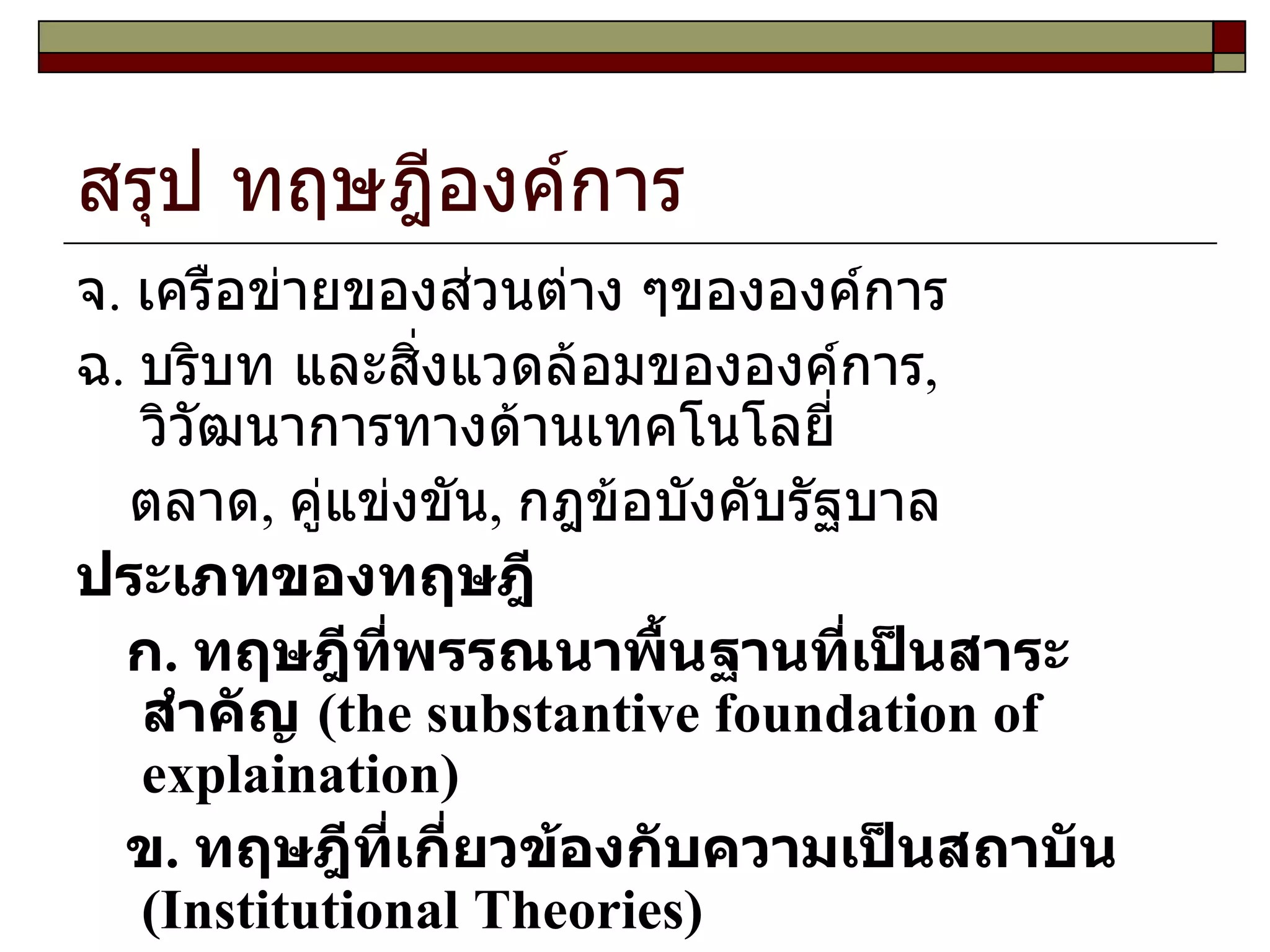
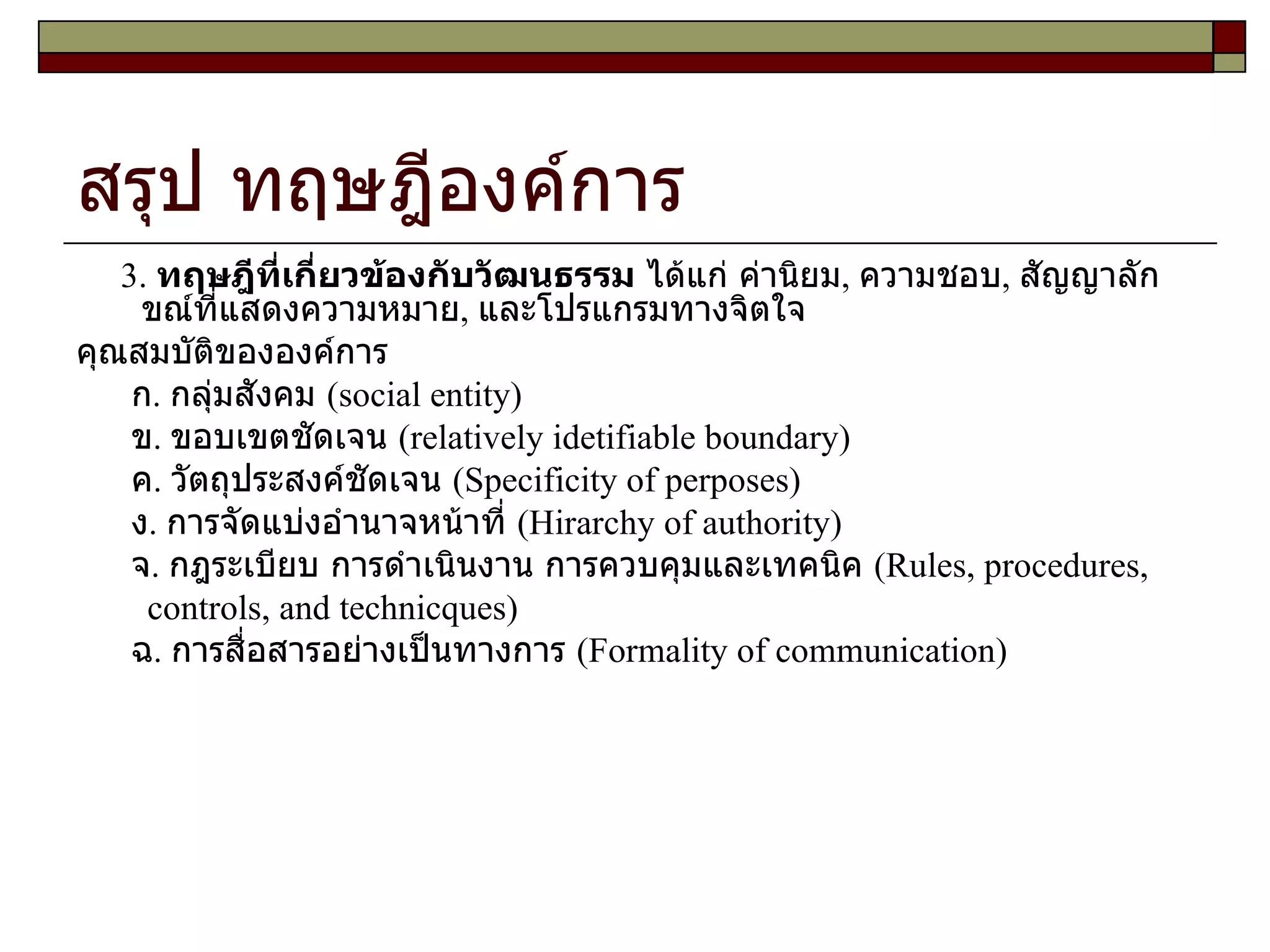
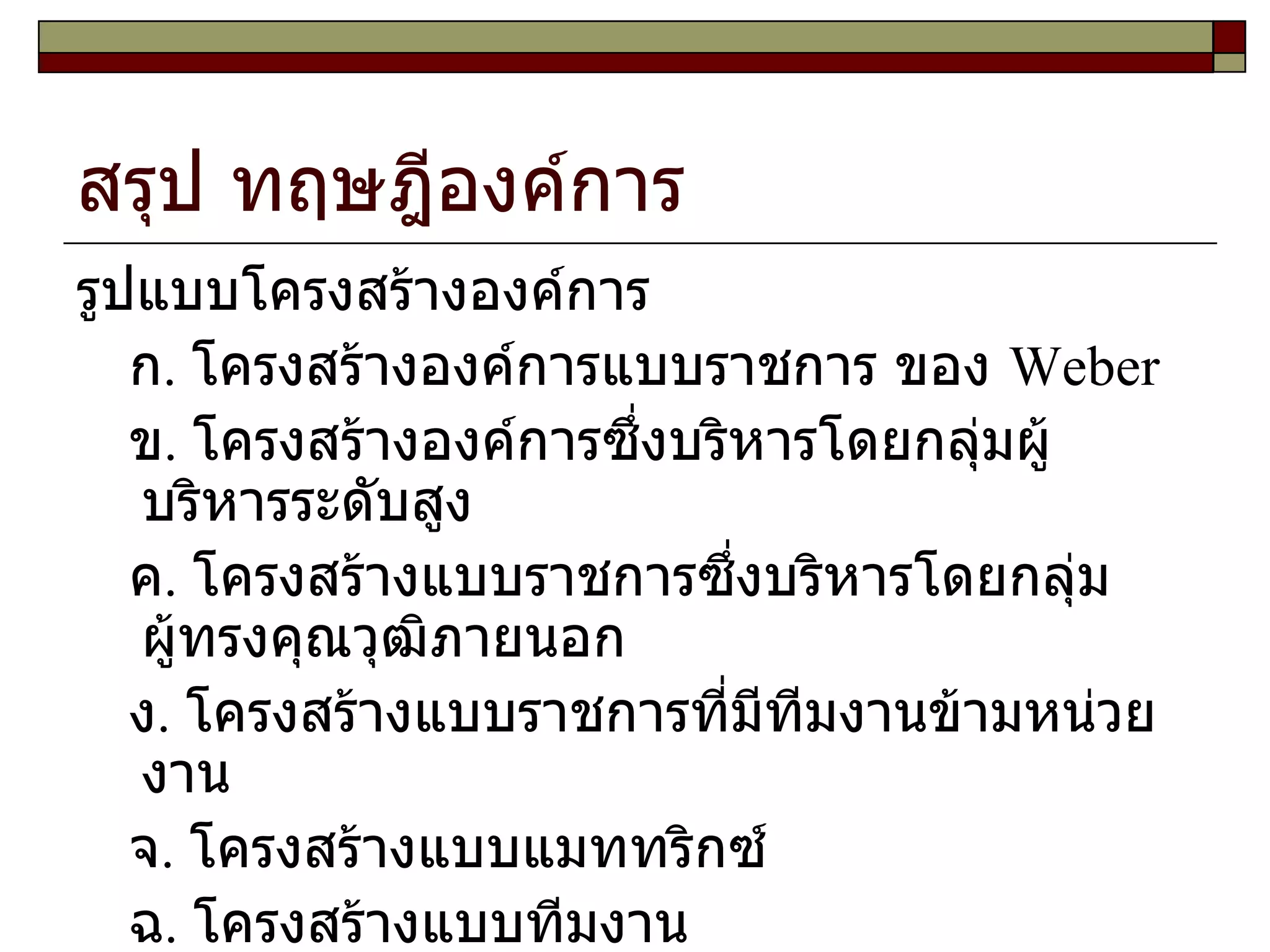
สรุป ทฤษฎีองค์การ วิวัฒนาการของแนวคิดทฤษฎีองค์การ 1. Classical Organization Theory 2. Neoclassical Organization Theory 3. Human Resource Theory or Organizational Behavior Perspective 4. Modern Structural Organization Theory 5. System Theory and Organizational Economics 6. Power and Politics Orgnaization Theory 7. Organizational Culture and Sense Making 8. Organizational Culture Reform Movement 9. Postmodernism and the Information Age