This document provides an overview of coordination compounds and coordination chemistry. It discusses key topics such as:
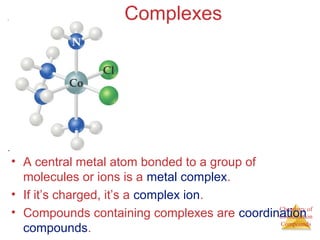
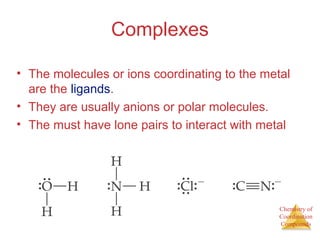
- Coordination complexes containing a central metal ion bonded to surrounding ligand molecules or ions.
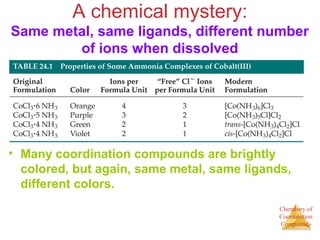
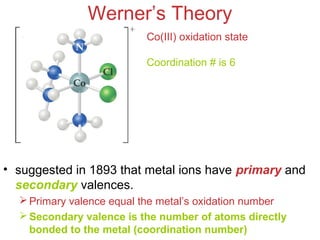
- Alfred Werner's theory from 1893 which proposed that metals have both a primary oxidation state and secondary coordination number.
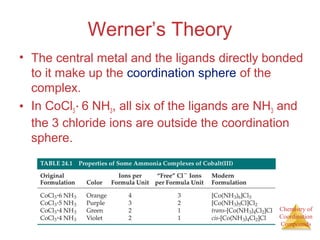
- The coordination sphere concept which describes ligands directly bonded to the metal versus outer ligands.
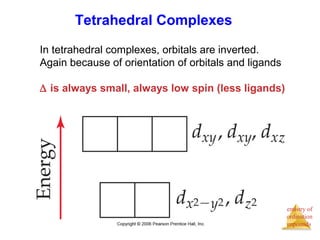
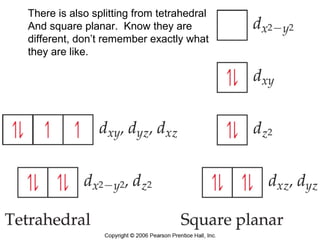
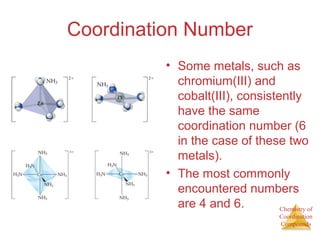
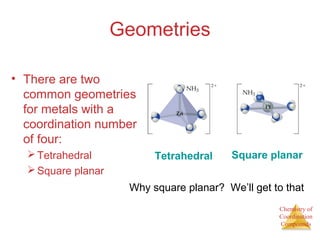
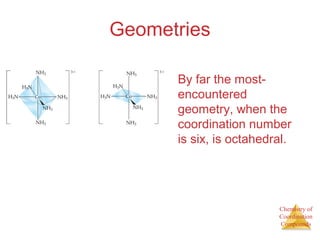
- Common geometries for coordination complexes including octahedral and tetrahedral.
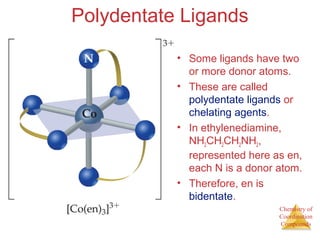
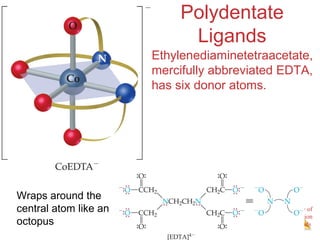
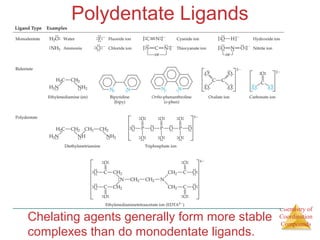
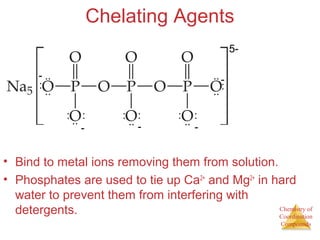
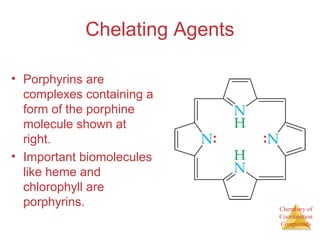
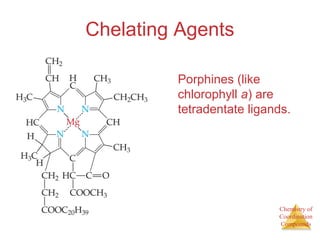
- The roles of polydentate ligands and chelating agents in forming stable complexes.
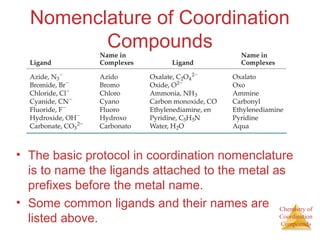
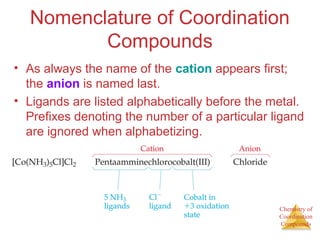
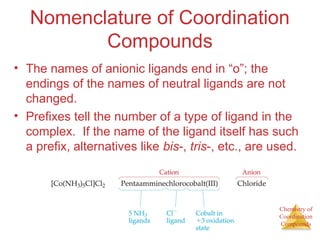
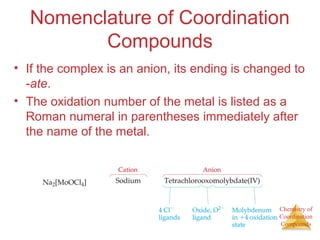
- Nomenclature rules for naming coordination compounds.
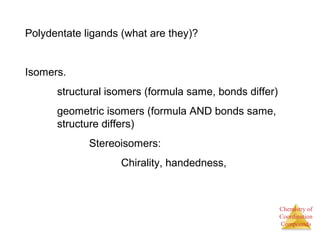
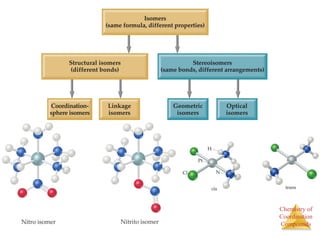
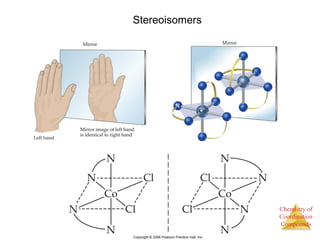
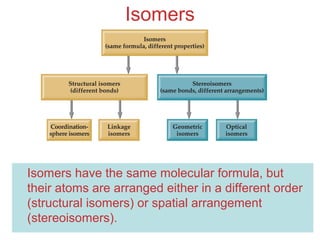
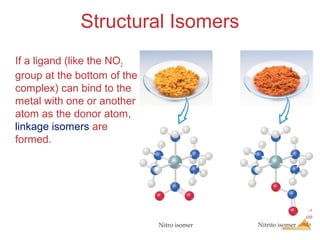
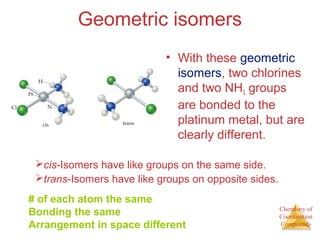
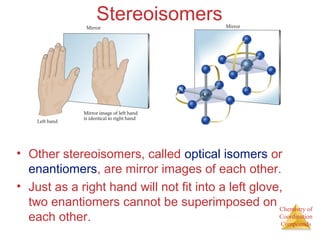
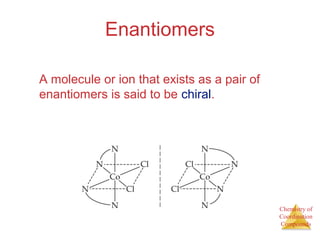
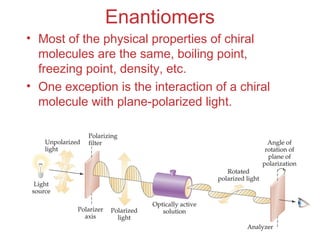
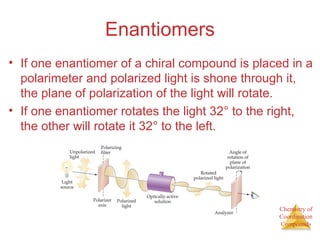
- Different types of isomers that can form including structural and stereoisomers.
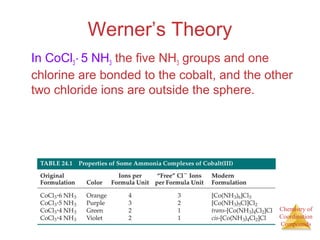
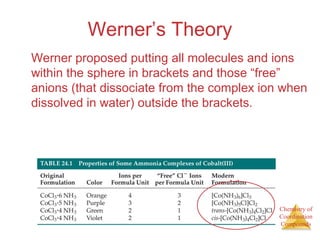
![Chemistry of
Coordination
Compounds
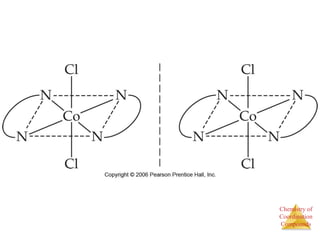
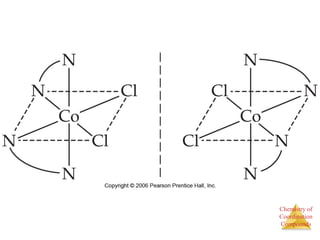
Werner’s Theory
• This approach correctly
predicts there would be two
forms of CoCl3 ∙ 4 NH3.
The formula would be written
[Co(NH3)4Cl2]Cl.
One of the two forms has the two
chlorines next to each other.
The other has the chlorines
opposite each other.](https://image.slidesharecdn.com/coordinationchemistry-230322044912-f4d9b204/85/coordinationchemistry-pdf-9-320.jpg)
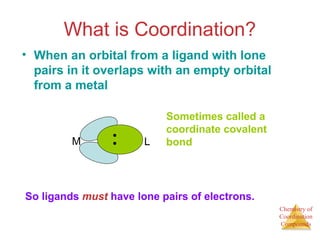
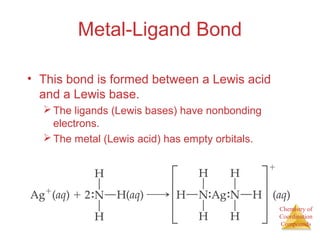
![Chemistry of
Coordination
Compounds
Structural Isomers
• Some isomers differ in what ligands are
bonded to the metal and what is outside
the coordination sphere; these are
coordination-sphere isomers.
• Three isomers of CrCl3(H2O)6 are
The violet [Cr(H2O)6]Cl3,
The green [Cr(H2O)5Cl]Cl2 ∙ H2O, and
The (also) green [Cr(H2O)4Cl2]Cl ∙ 2 H2O.](https://image.slidesharecdn.com/coordinationchemistry-230322044912-f4d9b204/85/coordinationchemistry-pdf-31-320.jpg)
![Chemistry of
Coordination
Compounds
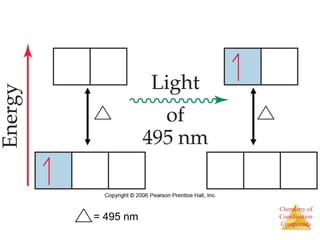
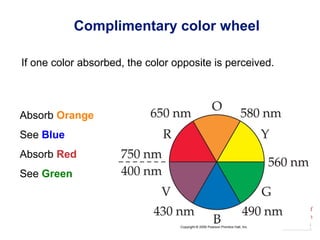
[Ti(H2O)6]3+
Absorbs in green yellow.
Looks purple.](https://image.slidesharecdn.com/coordinationchemistry-230322044912-f4d9b204/85/coordinationchemistry-pdf-45-320.jpg)