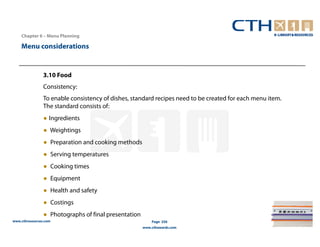
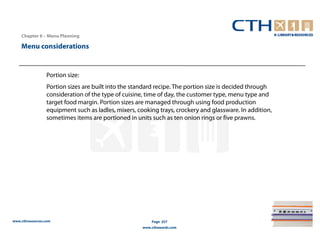
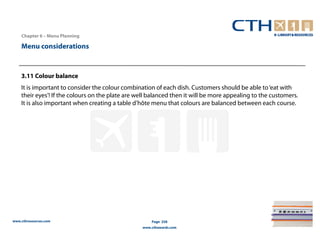
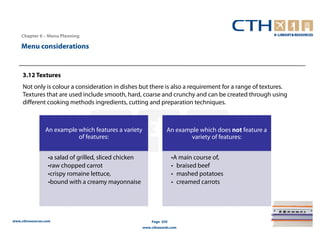
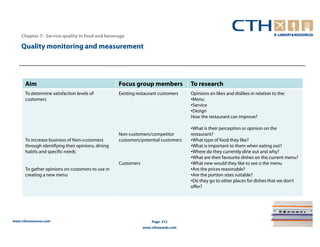
Food & Beverage Operations

                                    May2010


www.cthresources.com
                                                    1
                                     Page 1
                                www.cthawards.com
Content

                       I.    Description
                       II.   Learning Outcomes
                       III. Syllabus
                       IV. Assessment
                       V.    Chapters 1 - 8


www.cthresources.com                                  Page 2
                                                 www.cthawards.com
Description

    Description


    The aim of the Food & Beverage Operations module is to provide students with an understanding of the
    operational & supervisory aspects of running a food & beverage operation for an international clientele
    in a range of establishments.

    To encourage an appreciation of the origins of such systems & to understand the various factors
    involved in meeting customer needs. Students will gain an understanding of food & beverage & its
    service in a variety of styles of restaurant & establishments & they will have sufficient knowledge to
    produce a broad plan for specified food & beverage operations.


www.cthresources.com                                   Page 3
                                                  www.cthawards.com
Content

                       I.    Description
                       II.   Learning Outcomes
                       III. Syllabus
                       IV. Assessment
                       V.    Chapters 1 - 8


www.cthresources.com                                  Page 4
                                                 www.cthawards.com
Learning Outcomes

    Summary of Learning Outcomes


    On completion of this module, students will be able to:
          Demonstrate knowledge of the key functional areas of the food & beverage operation
          Describe the kitchen operation including food production systems, methods of cookery,
          kitchen layout & commodities
          Demonstrate the different methods of purchasing & food storage
          Examine the appropriateness of the different methods of food & beverage service to manage
          customer expectations
          Develop & plan menus according to customer requirements
          Describe the different types & requirements of banqueting functions


www.cthresources.com                               Page 5
                                              www.cthawards.com
Content

                       I.    Description
                       II.   Learning Outcomes
                       III. Syllabus
                       IV. Assessment
                       V.    Chapters 1 - 8


www.cthresources.com                                  Page 6
                                                 www.cthawards.com
Syllabus – Part 1 of 3

    Syllabus


                               ● Restaurant concepts & types of outlets; banqueting, fast food, hotel,
      Introduction to food &     industrial, outside catering, institutional, in-flight, restaurant, public
       beverage operations       house & transport catering
                               ● Typical organization structures & job titles in kitchen, restaurant &
                                 banqueting departments
                               ● Food production systems including traditional, centralised, cook-chill,
          Food production        cook-freeze & sous vide
            operations         ● The suitability of these systems to the operation. Methods of cookery.
                                 Kitchen layout & equipment. Commodities: food & non-food
                               ● The policies & procedures for purchasing of food & non-food items for a
                                 hospitality operation
     Purchasing & storage of   ● The use of standard purchasing specifications & other recognised
             goods               standards/brand names when ordering both food & non-food items.
                               ● The correct storage of commodities. The security aspects of storing high
                                 value items
                               ● Procedures for the issuing of stock items, including all records kept, &
                                 checks on the use of commodities

www.cthresources.com                                Page 7
                                               www.cthawards.com
Syllabus – Part 2 of 3

    Syllabus


                              ● Methods of food service, silver service, plate service, buffet, counter
       Food service systems     service, room service, self service, assisted service. Suitability & cost of
                                service styles
                              ● Meeting managing customer expectations. Staff skill levels. Preparation
                                & layout of food & service operations

       Production & sale of   ● Preparation & layout of beverage service, service of alcoholic & non-
         non-alcoholic &        alcoholic beverages & hot beverages
       alcoholic beverages    ● Beverage menu & wine list


                              ● Menu structure & trends
           Menu planning      ● Factors affecting the compilation of menus, menu development
                              ● Catering for customer requirements & trends in modern diets.


www.cthresources.com                              Page 8
                                             www.cthawards.com
Syllabus – Part 3 of 3

    Syllabus


        Providing excellent
                              ● Employee attitude, personal appearance, hygiene practices
        customer service in
         food & beverage      ● Attentiveness, body language, effective communication, team work,
            operations          attention to detail


                              ● Types of events, planning, organising & costing of an event. Menu &
     Banqueting & functions     service styles
                              ● Health, safety & hygiene considerations. Staffing the event. Evaluation


www.cthresources.com                              Page 9
                                             www.cthawards.com
Content

                       I.    Description
                       II.   Learning Outcomes
                       III. Syllabus
                       IV. Assessment
                       V.    Chapters 1 - 8


www.cthresources.com                                  Page 10
                                                 www.cthawards.com
Assessment

    Assessment


    This module will be assessed via a 2 ½ hour examination, set & marked by CTH.

    The examination will cover the whole of the assessment criteria in this unit & will take the form of 10 x 2
    mark questions & 5 x 4 mark questions in section A (40 marks). Section B will comprise of 5 x 20 mark
    questions of which candidates must select & answer three (60 marks).

    CTH is a London based awarding body & the syllabus content will in general reflect this. Any legislation
    & codes of practice will reflect the international nature of the industry & will not be country specific.
    International centres may find it advantageous to add local legislation or practice to their teaching but
    they should be aware that the CTH examination will not assess this local knowledge.


www.cthresources.com                                   Page 11
                                                  www.cthawards.com
Content

                       I.    Description
                       II.   Learning Outcomes
                       III. Syllabus
                       IV. Assessment
                       V.    Chapters 1 - 8


www.cthresources.com                                  Page 12
                                                 www.cthawards.com
Chapters

                       1.   Introduction to food & beverage
                       2.   Food production
                       3.   Purchasing food & beverage
                       4.   Food service delivery
                       5.   Beverages
                       6.   Menu planning
                       7.   Service quality in food & beverage
                       8.   Conference & banqueting


www.cthresources.com                               Page 13
                                              www.cthawards.com
Chapter 1 – Introduction to food & beverage

    Objectives


                In this chapter you will learn to :-
                       ● Present the key characteristics, objectives & challenges of the sector
                       ● Detail the diverse structure & scope of the sector
                       ● Explain the complexity of the classifying the sector
                       ● Describe & evaluate the characteristics & aims of a range of different types
                         of food & beverage operations


www.cthresources.com                                        Page 14
                                                       www.cthawards.com
Chapter 1 – Introduction to food & beverage

    Introduction to the food & beverage sector


                 1.    Introduction to the food & beverage sector
                       1.1 Food & beverage: main objectives & expectations
                       1.2 Characteristics of the food & beverage sector
                       1.3 Trends in food & beverage
                       1.4 Size & structure of the food & beverage industry
                       1.5 Classification & organisation of the sector: the challenge


www.cthresources.com                                        Page 15
                                                       www.cthawards.com
Chapter 1 – Introduction to food & beverage

    Introduction to the food & beverage sector


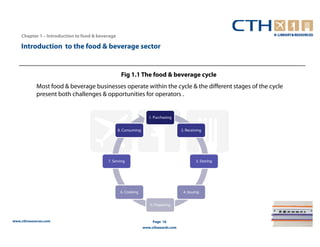
                                                   Fig 1.1 The food & beverage cycle
            Most food & beverage businesses operate within the cycle & the different stages of the cycle
            present both challenges & opportunities for operators .


                                                                    1. Purchasing


                                                  8. Consuming                       2. Receiving


                                           7. Serving                                         3. Storing


                                                   6. Cooking                         4. Issuing


                                                                    5. Preparing


www.cthresources.com                                                  Page 16
                                                                 www.cthawards.com
Chapter 1 – Introduction to food & beverage

    Introduction to the food & beverage sector


                 1.1 Food & beverage: main objectives & expectations
                       Most food & beverage operations aim to provide: -
                         Quality food & beverages
                         A clean, hygienic & safe environment
                         Comfortable & well designed facilities
                         Professional, attentive & friendly service
                         Value for money


www.cthresources.com                                       Page 17
                                                      www.cthawards.com
Chapter 1 – Introduction to food & beverage

    Introduction to the food & beverage sector


     The main challenges of the hospitality industry & the food sector are:-
     ● Intangibility – such as ambiance
     ● Simultaneous production & consumption - where mass production is difficult for it requires large
       amounts of customers & producers in one placer which would cause environmental, social, cultural &
       economic problems
     ● Heterogeneity – where service experience may vary due to different producers & consumers with
       different needs & requirements
     ● Consistency – is difficult to achieve due to the intangible element in food & beverage
     ● Perishability – where unused hospitality services cannot be stored, returned, claimed or resold
       Ownership – where the consumer only owns a hospitality product only for a certain period of time
       No guarantees – with little aftercare or service
      Imitation is easy – with no patents on service processes & easily copied by competitors
      Seasonality – where staffing & expenses are challenging to many restaurant operators
      External variables – that impact the running of the business such as political, economic,
      social, technological, legal & environmental change


www.cthresources.com                                   Page 18
                                                  www.cthawards.com
Chapter 1 – Introduction to food & beverage

    Introduction to the food & beverage sector


     1.2 Characteristics of the food & beverage sector
     Following are the main characteristics:-
     ● A vital part of everyday life
     ● Major contributor to the national economy
     ● Highly fragmented & complex
     ● Creates employment
     ● Encourages entrepreneurship
     ● Promotes diversity through many different food concepts & cuisines
     ● Fuels innovation
     ● Local multiplier using many other peripheral services
     ● Consumer led
     ● Competitive
     ● An opportunity to enjoy the company of friends, family & colleagues
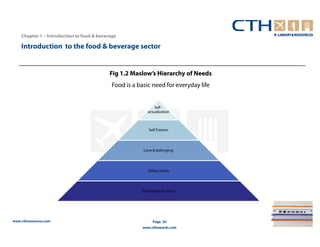
     ● Fulfils basic needs (see Fig 1.2)


www.cthresources.com                                   Page 19
                                                  www.cthawards.com
Chapter 1 – Introduction to food & beverage

    Introduction to the food & beverage sector


                                            Fig 1.2 Maslow’s Hierarchy of Needs
                                             Food is a basic need for everyday life


                                                               Self -
                                                           actualization


                                                           Self Esteem


                                                         Love & belonging


                                                           Safety needs


                                                        Physiological needs


www.cthresources.com                                          Page 20
                                                        www.cthawards.com
Chapter 1 – Introduction to food & beverage

    Introduction to the food & beverage sector


     1.3 Trends in food & beverage
     Following are some key trends in the UK:-
     ● Guests become more sophisticated
     ● More emphasis on food safety & sanitation
     ● More casual/less formal & theme restaurants
     ● Increase in ethnic restaurants & ethnic food
     ● Growth in chains –all cuisines
     ● Increase in convenience food
     ● Increase in coffee chains – coffee culture
     ● Increased take out meals & home meal replacement
     ● Outsourcing outlets in hotels – co-branding
     ● More focus on healthier eating
     ● Increase in organic food consumption, food sustainability & provenance


www.cthresources.com                                   Page 21
                                                  www.cthawards.com
Chapter 1 – Introduction to food & beverage

    Introduction to the food & beverage sector


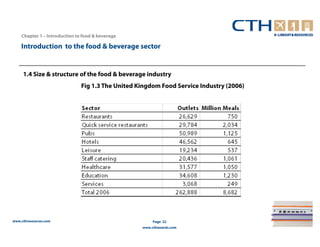
     1.4 Size & structure of the food & beverage industry
                               Fig 1.3 The United Kingdom Food Service Industry (2006)


www.cthresources.com                                    Page 22
                                                   www.cthawards.com
Chapter 1 – Introduction to food & beverage

    Introduction to the food & beverage sector


     1.5 Classification & organisation of the sector: the challenge
     The food & beverage sector is extremely diverse & fragmented that the size & scope of the industry
     creates a challenge when attempting to organise & classify it. It has many subsectors.
     Following are the classification approaches & options:-
     ● Commercial & non-commercial
     ● Size
     ● Ownership
     ● Star rating or quality
     ● Service method
     ● Food or beverage
     ● Concept or theme
     ● Revenue or turnover
     ● Location
     ● Meal time or meal period
     ● Customer type
     ● Cuisine
     ● Awards & schemes
www.cthresources.com                                   Page 23
                                                  www.cthawards.com
Chapter 1 – Introduction to food & beverage

    Introduction to the food & beverage sector


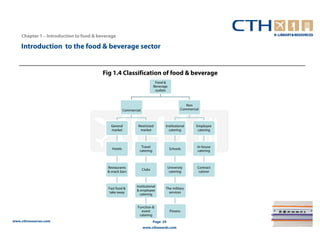
                                        Fig 1.4 Classification of food & beverage
                                                                            Food &
                                                                           Beverage
                                                                            outlets


                                                                                                Non
                                                      Commercial                             Commercial


                                             General          Restricted          Institutional      Employee
                                             market            market               catering          catering


                                                                Travel                                In-house
                                             Hotels                                   Schools
                                                               catering                               catering


                                           Restaurants                               University       Contract
                                                                   Clubs
                                           & snack bars                               catering         caterer


                                                             Institutional
                                           Fast food &                            The military
                                                             & employee
                                            take away                               services
                                                               catering


                                                              Function &
                                                                event                 Prisons
                                                               catering
www.cthresources.com                                                       Page 24
                                                                   www.cthawards.com
Chapter 1 – Introduction to food & beverage

    Introduction to the food & beverage sector


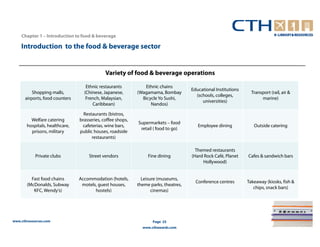
                                             Variety of food & beverage operations

                                   Ethnic restaurants          Ethnic chains
                                                                                     Educational Institutions
          Shopping malls,         (Chinese, Japanese,       (Wagamama, Bombay                                     Transport (rail, air &
                                                                                       (schools, colleges,
      airports, food counters      French, Malaysian,         Bicycle Yo Sushi,                                        marine)
                                                                                          universities)
                                      Caribbean)                  Nandos)

                                  Restaurants (bistros,
         Welfare catering       brasseries, coffee shops,
                                                            Supermarkets – food
       hospitals, healthcare,    cafeterias, wine bars,                                 Employee dining            Outside catering
                                                             retail ( food to go)
         prisons, military      public houses, roadside
                                      restaurants)

                                                                                       Themed restaurants
            Private clubs           Street vendors               Fine dining         (Hard Rock Café, Planet    Cafes & sandwich bars
                                                                                          Hollywood)


         Fast food chains       Accommodation (hotels,        Leisure (museums,
                                                                                       Conference centres       Takeaway (kiosks, fish &
       (McDonalds, Subway        motels, guest houses,      theme parks, theatres,
                                                                                                                   chips, snack bars)
          KFC, Wendy’s)                hostels)                    cinemas)


www.cthresources.com                                               Page 25
                                                              www.cthawards.com
Chapter 1 – Introduction to food & beverage

    Management options in food and beverage: main approaches


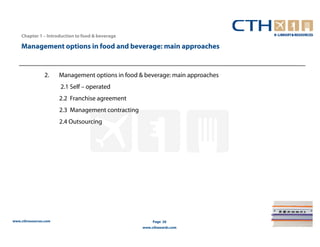
                2.     Management options in food & beverage: main approaches
                       2.1 Self – operated
                       2.2 Franchise agreement
                       2.3 Management contracting
                       2.4 Outsourcing


www.cthresources.com                                     Page 26
                                                    www.cthawards.com
Chapter 1 – Introduction to food & beverage

    Management options in food and beverage: main approaches


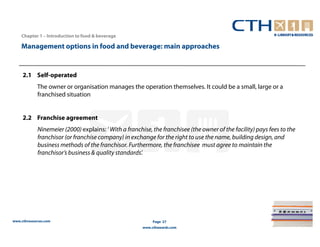
     2.1 Self-operated
             The owner or organisation manages the operation themselves. It could be a small, large or a
             franchised situation


     2.2 Franchise agreement
             Ninemeier (2000) explains: ‘ With a franchise, the franchisee (the owner of the facility) pays fees to the
             franchisor (or franchise company) in exchange for the right to use the name, building design, and
             business methods of the franchisor. Furthermore, the franchisee must agree to maintain the
             franchisor’s business & quality standards’.


www.cthresources.com                                         Page 27
                                                        www.cthawards.com
Chapter 1 – Introduction to food & beverage

    Management options in food and beverage: main approaches


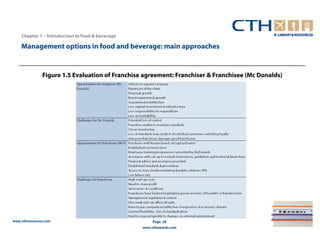
               Figure 1.5 Evaluation of Franchise agreement: Franchiser & Franchisee (Mc Donalds)


www.cthresources.com                                   Page 28
                                                  www.cthawards.com
Chapter 1 – Introduction to food & beverage

    Management options in food and beverage: main approaches


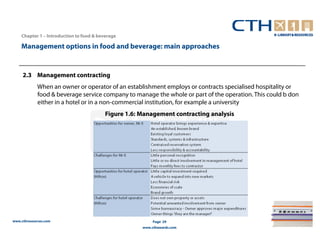
     2.3 Management contracting
             When an owner or operator of an establishment employs or contracts specialised hospitality or
             food & beverage service company to manage the whole or part of the operation. This could b don
             either in a hotel or in a non-commercial institution, for example a university
                                          Figure 1.6: Management contracting analysis


www.cthresources.com                                       Page 29
                                                      www.cthawards.com
Chapter 1 – Introduction to food & beverage

    Management options in food and beverage: main approaches


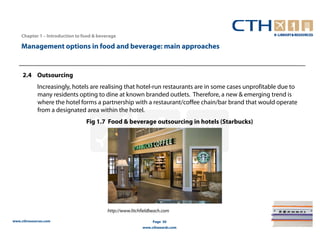
     2.4 Outsourcing
             Increasingly, hotels are realising that hotel-run restaurants are in some cases unprofitable due to
             many residents opting to dine at known branded outlets. Therefore, a new & emerging trend is
             where the hotel forms a partnership with a restaurant/coffee chain/bar brand that would operate
             from a designated area within the hotel.
                                 Fig 1.7 Food & beverage outsourcing in hotels (Starbucks)


                                           http://www.litchfieldbeach.com

www.cthresources.com                                             Page 30
                                                            www.cthawards.com
Chapter 1 – Introduction to food & beverage

    Commercial and non-commercial food & beverage operations


                 3.    Commercial and non-commercial food & beverage operations
                       3.1 Food & beverage in accommodation
                       3.2 Food & beverage services in hotels
                       3.3 Independent restaurants (small/medium enterprise – SME)
                       3.4 Ethnic restaurants
                       3.5 Themed restaurants
                       3.6 Public houses or licensed premises
                       3.7 Chained restaurants & bars
                       3.8 Food & beverage in transportation
                       3.9 Non-commercial food & beverage
                       3.10 Characteristics of non-commercial operations


www.cthresources.com                                         Page 31
                                                        www.cthawards.com
Chapter 1 – Introduction to food & beverage

    Commercial and non-commercial food & beverage operations


                 Main types of commercial & non-commercial food & beverage:-


                 Commercial
                 ● Food & beverage in accommodation
                 ● Independents operations
                 ● Themed restaurants
                 ● Public houses
                 ● Fast food chains
                 ● Transport services

                 Non-commercial
                 ● Military
                 ● Schools
                 ● Universities
                 ● Hospitals
                 ● Employee catering

www.cthresources.com                                    Page 32
                                                   www.cthawards.com
Chapter 1 – Introduction to food & beverage

    Commercial and non-commercial food & beverage operations


     3.1 Food & beverage in accommodation
             Can vary depending on location specific areas, size, ownership, location, goals, customer & quality.
                                           Coffee shop, Fine dining restaurant/s, Specialty restaurant, Bar, Coffee
             5-star hotels                 lounge/pastry counter, Conference & banqueting, Outside catering, 24-
                                           hour full room service menu, Executive lounge food & beverage services,
                                           In room guest amenities, Mini bar, Nightclub, karaoke, cigar room, pool
                                           café, delicatessen, Employee dining
                                           Coffee shop, Specialty restaurant, Bar & lounge, Room service (limited
             4-star hotels                 throughout the night), Guest amenities, Conference & banqueting, Mini
                                           bar, Employee dining

            Budget hotels                  Breakfast buffet, Bar, Vending machines, Employee dining


           Bed & breakfast                 Breakfast, Limited set menu available at set times on request

                  Hostel                   Snack bar, Vending, Food prepared on request to take away

www.cthresources.com                                        Page 33
                                                       www.cthawards.com
Chapter 1 – Introduction to food & beverage

    Commercial and non-commercial food & beverage operations


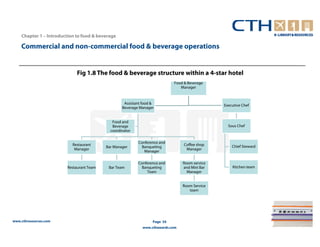
                             Fig 1.8 The food & beverage structure within a 4-star hotel
                                                                            Food & Beverage
                                                                               Manager


                                                   Assistant food &                             Executive Chef
                                                  Beverage Manager


                                             Food and
                                             Beverage                                             Sous Chef
                                            coordinator

                                                          Conference and
                           Restaurant                                            Coffee shop        Chief Steward
                                          Bar Manager       Banqueting
                            Manager                                               Manager
                                                             Manager

                                                          Conference and         Room service
                        Restaurant Team    Bar Team         Banqueting           and Mini Bar       Kitchen team
                                                              Team                 Manager


                                                                                 Room Service
                                                                                    team


www.cthresources.com                                              Page 34
                                                             www.cthawards.com
Chapter 1 – Introduction to food & beverage

    Commercial and non-commercial food & beverage operations


     3.2 Food & beverage services in hotels
             Most hotels operate multiple food & beverage outlets. Outlets, products and services offered are
             subject to change from property to property. The outlets could be:-
             ● Coffee shop
             ● Restaurant
             ● Fine dining
             ● Bar
             ● Lounge
             ● Executive lounge
             ● Conferencing & banqueting
             ● Outside catering
             ● Room service
             ● Mini bar
             ● Guest amenities
             ● Employee dining


www.cthresources.com                                    Page 35
                                                   www.cthawards.com
Chapter 1 – Introduction to food & beverage

    Commercial and non-commercial food & beverage operations


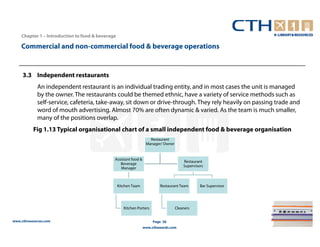
     3.3 Independent restaurants
             An independent restaurant is an individual trading entity, and in most cases the unit is managed
             by the owner. The restaurants could be themed ethnic, have a variety of service methods such as
             self-service, cafeteria, take-away, sit down or drive-through. They rely heavily on passing trade and
             word of mouth advertising. Almost 70% are often dynamic & varied. As the team is much smaller,
             many of the positions overlap.
          Fig 1.13 Typical organisational chart of a small independent food & beverage organisation
                                                                    Restaurant
                                                                  Manager/ Owner


                                              Assistant food &
                                                                                       Restaurant
                                                 Beverage
                                                                                       Supervisors
                                                 Manager


                                                  Kitchen Team            Restaurant Team       Bar Supervisor


                                                     Kitchen Porters               Cleaners


www.cthresources.com                                                   Page 36
                                                                 www.cthawards.com
Chapter 1 – Introduction to food & beverage

    Commercial and non-commercial food & beverage operations


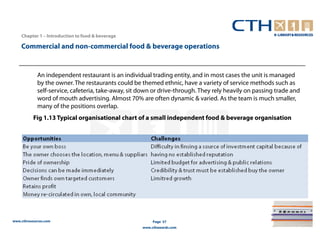
             An independent restaurant is an individual trading entity, and in most cases the unit is managed
             by the owner. The restaurants could be themed ethnic, have a variety of service methods such as
             self-service, cafeteria, take-away, sit down or drive-through. They rely heavily on passing trade and
             word of mouth advertising. Almost 70% are often dynamic & varied. As the team is much smaller,
             many of the positions overlap.
          Fig 1.13 Typical organisational chart of a small independent food & beverage organisation


www.cthresources.com                                      Page 37
                                                     www.cthawards.com
Chapter 1 – Introduction to food & beverage

    Commercial and non-commercial food & beverage operations


     3.4 Ethnic restraints
             These type of restaurants can be part of a chain but also independent in nature. Manage by
             owners and operated around a central theme such as Chinese, Japanese and Middle Eastern.


     3.5 Themed restaurants
             These type of restaurants are operations that have a central theme throughout such as music,
             entertainment or sport for example. For a example the Hard Rock Cafe.


     3.6 Public houses or licensed premises
             Public houses (‘pubs’) offer comfortable, relaxing environments for groups or individuals can get
             together to enjoy beverages. Beverages are the main products but they offer great verity of foods
             due to declining beverage sales. They outsource their kitchen to chef entrepreneurs and the
             growth in gastro pubs.


www.cthresources.com                                    Page 38
                                                   www.cthawards.com
Chapter 1 – Introduction to food & beverage

    Commercial and non-commercial food & beverage operations


     3.7 Chain restaurants and bars
             Key characteristics of chain restaurants
             ● Several units operating in different locations.
             ● Can be national, regional or global
             ● Operations normally duplicated and featured the same design, menus and operations in each
               unit.
             ● Good infrastructure and support networks – training and purchasing for example.
             ● Provide consistency and standardisation to customers.
             ● Centralised purchasing and distribution networks.
             ● Operations are normally themed around a central concept.
             ● Service systems can vary from take-away, drive thru, dine in, causal or fine dining.
             ● The operations can be owned by a parent company, a franchise or private owners.


www.cthresources.com                                         Page 39
                                                        www.cthawards.com
Chapter 1 – Introduction to food & beverage

    Commercial and non-commercial food & beverage operations


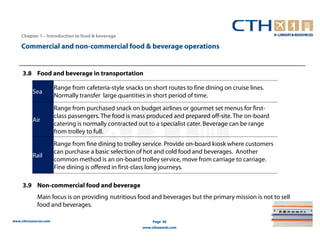
     3.8 Food and beverage in transportation

                       Range from cafeteria-style snacks on short routes to fine dining on cruise lines.
          Sea
                       Normally transfer large quantities in short period of time.
                       Range from purchased snack on budget airlines or gourmet set menus for first-
                       class passengers. The food is mass produced and prepared off-site. The on-board
          Air
                       catering is normally contracted out to a specialist cater. Beverage can be range
                       from trolley to full.
                       Range from fine dining to trolley service. Provide on-board kiosk where customers
                       can purchase a basic selection of hot and cold food and beverages. Another
          Rail
                       common method is an on-board trolley service, move from carriage to carriage.
                       Fine dining is offered in first-class long journeys.

     3.9 Non-commercial food and beverage
             Main focus is on providing nutritious food and beverages but the primary mission is not to sell
             food and beverages.

www.cthresources.com                                          Page 40
                                                         www.cthawards.com
Chapter 1 – Introduction to food & beverage

    Commercial and non-commercial food & beverage operations


     3.10 Characteristics of non-commercial operations
             ● Non-commercial institutions hire commercial food service management(contract) companies
               from outside to manage food service in their institutions.
             ● Commercial food service management companies exist to make profit.
             ● They carry out fully the food and service responsibilities for the institutions under contract.
             ● The institution or workplace can free itself from the day-to-day concern of managing food
               service operations.
             ● They are professional food service companies.
             ● These operations are planned to keep the expenses/ costs low; they are budget-oriented.
             ● They are part of properties that exist for reasons other than the service of food and beverages,
               which is only supportive.
             ● Competition is limited as the service is provided in a private, closed environment.
             ● Normally large scale, delivered at particular times of day.
             ● Business levels are quite predictable making it easier for production and planning.
             ● Emphasis is not placed on nutrition.


www.cthresources.com                                      Page 41
                                                     www.cthawards.com
Chapter 1 – Introduction to food & beverage

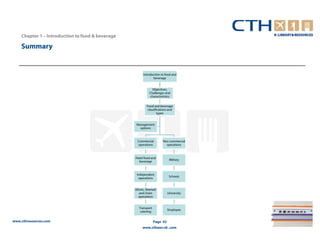
    Summary


                                                       Introduction to food and
                                                              beverage


                                                             Objectives,
                                                           Challenges and
                                                           characteristics


                                                         Food and beverage
                                                          classifications and
                                                                  types


                                                  Management
                                                    options


                                                   Commercial        Non commercial
                                                   operations          operations


                                                  Hotel food and
                                                                           Military
                                                    beverage


                                                  Independent
                                                                           Schools
                                                   operations


                                                  Ethnic, themed
                                                     and chain            University
                                                    operations


                                                    Transport
                                                                          Employee
                                                     catering


www.cthresources.com                                            Page 42
                                                      www.cthawards.com
Chapters

                       1.   Introduction to food & beverage
                       2.   Food production
                       3.   Purchasing food & beverage
                       4.   Food service delivery
                       5.   Beverages
                       6.   Menu planning
                       7.   Service quality in food & beverage
                       8.   Conference & banqueting


www.cthresources.com                               Page 43
                                              www.cthawards.com
Chapter 2 – Food production

    Objectives


                In this chapter you will learn to :-
                       ● Explain kitchen organization and the responsibilities of key personnel
                         employed
                       ● Describe and appraise the different food production methods
                       ● Identify the main food groups and commodities
                       ● Describe the main considerations in kitchen designs
                       ● Discuss the importance of achieving food cost
                       ● Explain the importance of food hygiene and control


www.cthresources.com                                        Page 44
                                                       www.cthawards.com
Chapter 2 – Food production

    Kitchen introduction


                 1.    Kitchen introduction
                       1.1 Communication
                       1.2 Kitchen chef characteristics
                       1.3 Staffing and responsibilities
                       1.4 Kitchen organization
                       1.5 Partie system analysis
                       1.6 The stewarding department


www.cthresources.com                                           Page 45
                                                          www.cthawards.com
Chapter 2 – Food production

    Kitchen introduction


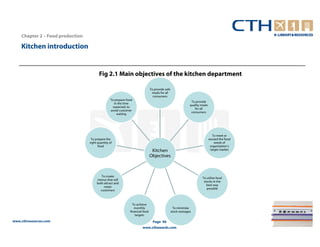
                                         Fig 2.1 Main objectives of the kitchen department

                                                                                To provide safe
                                                                                 meals for all
                                                                                  consumers
                                                  To prepare food
                                                                                                                To provide
                                                    in the time
                                                                                                               quality meals
                                                   expected, to
                                                                                                                  for all
                                                  avoid customer
                                                                                                                consumers
                                                      waiting


                                                                                                                                  To meet or
                                   To prepare the                                                                              exceed the food
                                  right quantity of                                                                                needs of
                                        food                                                                                    organization’s
                                                                                 Kitchen                                        target market

                                                                                Objectives


                                          To create
                                                                                                                        To utilize food
                                       menus that will
                                                                                                                         stocks in the
                                       both attract and
                                                                                                                           best way
                                            retain
                                                                                                                           possible
                                         customers


                                                                 To achieve
                                                                  monthly                           To minimize
                                                               financial food                     stock wastages
                                                                   targets
www.cthresources.com                                                              Page 46
                                                                        www.cthawards.com
Chapter 2 – Food production

    Kitchen introduction


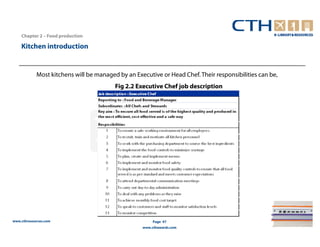
            Most kitchens will be managed by an Executive or Head Chef. Their responsibilities can be,
                                         Fig 2.2 Executive Chef job description


www.cthresources.com                                    Page 47
                                                   www.cthawards.com
Chapter 2 – Food production

    Kitchen introduction


                 1.1 Communication
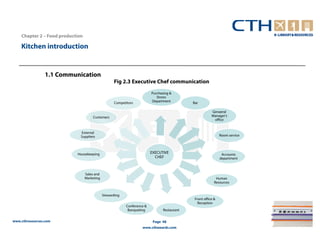
                                                    Fig 2.3 Executive Chef communication
                                                                          Purchasing &
                                                                             Stores
                                                    Competitors           Department          Bar

                                                                                                          Genaeral
                                      Customers                                                           Manager's
                                                                                                           office


                              External
                              Suppliers                                                                         Room service


                            Housekeeping                                  EXECUTIVE                              Accounts
                                                                            CHEF                                department


                                  Sales and
                                  Marketing                                                                  Human
                                                                                                            Resources


                                              Stewarding
                                                                                               Front office &
                                                                                                 Reception
                                                           Conference &
                                                            Banqueting           Restaurant


www.cthresources.com                                                       Page 48
                                                                    www.cthawards.com
Chapter 2 – Food production

    Kitchen introduction


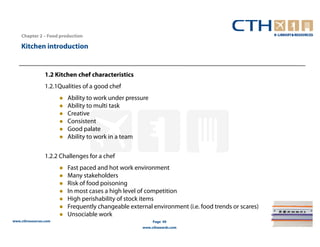
                 1.2 Kitchen chef characteristics
                 1.2.1Qualities of a good chef
                         Ability to work under pressure
                         Ability to multi task
                         Creative
                         Consistent
                         Good palate
                         Ability to work in a team

                 1.2.2 Challenges for a chef
                         Fast paced and hot work environment
                         Many stakeholders
                         Risk of food poisoning
                         In most cases a high level of competition
                         High perishability of stock items
                         Frequently changeable external environment (i.e. food trends or scares)
                         Unsociable work
www.cthresources.com                                      Page 49
                                                    www.cthawards.com
Chapter 2 – Food production

    Kitchen introduction


                 1.2.3 Opportunities for a chef
                         Be creative and showcase skills
                         Satisfy customers
                         Acquire and pass on skills
                         Meet lots of interesting people
                         Learn and sample a wide variety of different food
                         Travel
                         Obtain awards for culinary expertise

                 1.2.4 Chef presentation
                         Appearance – trimmed hair, clean hair, hair tied back if long, neatly
                         shaven, no earrings on males, studded earrings only for women
                         Accessories – wristwatch, maximum two rings, body piercings or tattoos
                         should not be visible, no visible necklaces
                         Trousers – pin striped, clean, well pressed
                         Shoes – slip resistant, in good repair

www.cthresources.com                                     Page 50
                                                    www.cthawards.com
Chapter 2 – Food production

    Kitchen introduction


                 1.3 Staffing and responsibilities
                       The organizational structure of a kitchen will depend on a number of factors
                       including : -
                          Size and kitchen space available
                          Quantity of food output (demand)
                          Number of food outlets to cater
                          Sophistication and type of menu
                          Equipment requirement
                          Location where production is taking place (in kitchen or outsourced)
                          Service methods (Buffets, plated)


www.cthresources.com                                      Page 51
                                                     www.cthawards.com
Chapter 2 – Food production

    Kitchen introduction


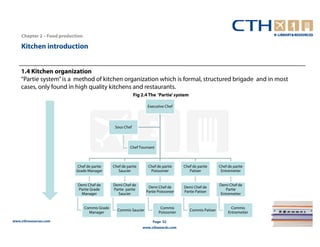
    1.4 Kitchen organization
    “Partie system” is a method of kitchen organization which is formal, structured brigade and in most
    cases, only found in high quality kitchens and restaurants.
                                                              Fig 2.4 The ‘Partie’ system

                                                                     Executive Chef


                                                  Sous Chef


                                                           Chef Tournant


                            Chef de partie       Chef de partie      Chef de partie     Chef de partie       Chef de partie
                            Grade Manager           Saucier           Poissonier           Patiser            Entremetier


                            Demi Chef de         Demi Chef de                                                Demi Chef de
                                                                     Demi Chef de       Demi Chef de
                            Partie Grade         Partie partie                                                   Partie
                                                                    Partie Poissonier   Partie Patiser
                              Manager              Saucier                                                    Entremetier


                                  Commis Grade                              Commis                                 Commis
                                                   Commis Saucier                           Commis Patiser
                                    Manager                                Poissonier                             Entremetier

www.cthresources.com                                                    Page 52
                                                                  www.cthawards.com
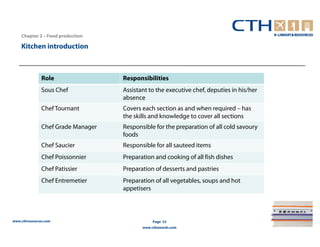
Chapter 2 – Food production

    Kitchen introduction


               Role                 Responsibilities
               Sous Chef            Assistant to the executive chef, deputies in his/her
                                    absence
               Chef Tournant        Covers each section as and when required – has
                                    the skills and knowledge to cover all sections
               Chef Grade Manager   Responsible for the preparation of all cold savoury
                                    foods
               Chef Saucier         Responsible for all sauteed items
               Chef Poissonnier     Preparation and cooking of all fish dishes
               Chef Patissier       Preparation of desserts and pastries
               Chef Entremetier     Preparation of all vegetables, soups and hot
                                    appetisers


www.cthresources.com                            Page 53
                                           www.cthawards.com
Chapter 2 – Food production

    Kitchen introduction


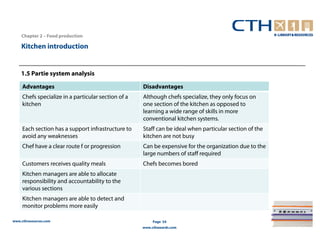
    1.5 Partie system analysis

     Advantages                                      Disadvantages
     Chefs specialize in a particular section of a   Although chefs specialize, they only focus on
     kitchen                                         one section of the kitchen as opposed to
                                                     learning a wide range of skills in more
                                                     conventional kitchen systems.
     Each section has a support infrastructure to    Staff can be ideal when particular section of the
     avoid any weaknesses                            kitchen are not busy
     Chef have a clear route f or progression        Can be expensive for the organization due to the
                                                     large numbers of staff required
     Customers receives quality meals                Chefs becomes bored
     Kitchen managers are able to allocate
     responsibility and accountability to the
     various sections
     Kitchen managers are able to detect and
     monitor problems more easily

www.cthresources.com                                      Page 54
                                                     www.cthawards.com
Chapter 2 – Food production

    Kitchen introduction


                       Many kitchens now provide chefs with opportunities to work and rotate in
                       other sections of the kitchen. The benefits of this for the organization: -

                          Chefs become multi skilled and therefore more flexible
                          Job satisfaction is more greater due to acquiring a more divers skill set
                          Labour cost are more streamlined due to better utilization of labour


www.cthresources.com                                        Page 55
                                                       www.cthawards.com
Chapter 2 – Food production

    Kitchen introduction


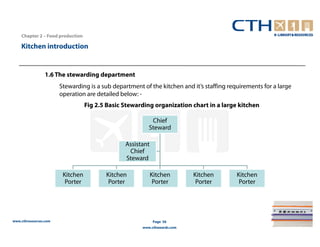
                 1.6 The stewarding department
                       Stewarding is a sub department of the kitchen and it’s staffing requirements for a large
                       operation are detailed below: -
                                  Fig 2.5 Basic Stewarding organization chart in a large kitchen

                                                          Chief
                                                         Steward

                                                Assistant
                                                 Chief
                                                Steward

                        Kitchen          Kitchen            Kitchen       Kitchen         Kitchen
                         Porter           Porter             Porter        Porter          Porter


www.cthresources.com                                         Page 56
                                                      www.cthawards.com
Chapter 2 – Food production

    Kitchen introduction


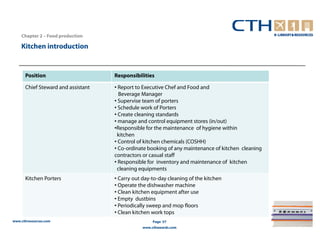
      Position                      Responsibilities

      Chief Steward and assistant   • Report to Executive Chef and Food and
                                      Beverage Manager
                                    • Supervise team of porters
                                    • Schedule work of Porters
                                    • Create cleaning standards
                                    • manage and control equipment stores (in/out)
                                    •Responsible for the maintenance of hygiene within
                                     kitchen
                                    • Control of kitchen chemicals (COSHH)
                                    • Co-ordinate booking of any maintenance of kitchen cleaning
                                    contractors or casual staff
                                    • Responsible for inventory and maintenance of kitchen
                                     cleaning equipments
      Kitchen Porters               • Carry out day-to-day cleaning of the kitchen
                                    • Operate the dishwasher machine
                                    • Clean kitchen equipment after use
                                    • Empty dustbins
                                    • Periodically sweep and mop floors
                                    • Clean kitchen work tops
www.cthresources.com                                 Page 57
                                                www.cthawards.com
Chapter 2 – Food production

    Kitchen design and planning considerations


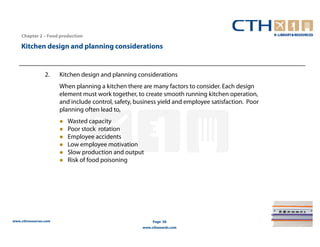
                 2.    Kitchen design and planning considerations
                       When planning a kitchen there are many factors to consider. Each design
                       element must work together, to create smooth running kitchen operation,
                       and include control, safety, business yield and employee satisfaction. Poor
                       planning often lead to,
                          Wasted capacity
                          Poor stock rotation
                          Employee accidents
                          Low employee motivation
                          Slow production and output
                          Risk of food poisoning


www.cthresources.com                                       Page 58
                                                      www.cthawards.com
Chapter 2 – Food production

    Kitchen design and planning considerations


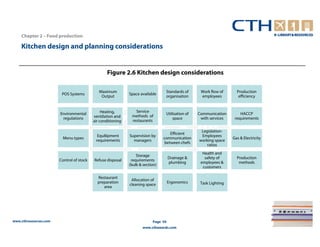
                                                 Figure 2.6 Kitchen design considerations

                                             Maximum                             Standards of      Work flow of      Production
                        POS Systems                          Space available
                                              Output                             organisation      employees          efficiency


                                               Heating,         Service
                       Environmental                                             Utilisation of   Communication        HACCP
                                          ventilation and     methods of
                        regulations                                                  space         with services    requirements
                                          air conditioning    restaurants

                                                                                                   Legislation-
                                                                                    Efficient
                                            Equ8ipment       Supervision by                        Employees
                         Menu types                                             communication                      Gas & Electricity
                                           requirements        managers                           working space
                                                                                 between chefs
                                                                                                      ratios
                                                                                                    Health and
                                                                 Storage
                                                                                    Drainage &       safety of       Production
                       Control of stock   Refuse disposal     requirements
                                                                                    plumbing       employees &        methods
                                                             (bulk & section)
                                                                                                    customers

                                            Restaurant
                                                              Allocation of
                                            preparation                             Ergonomics     Task Lighting
                                                             cleaning space
                                               area


www.cthresources.com                                                      Page 59
                                                                    www.cthawards.com
Chapter 2 – Food production

    Production methods and organisation


                3.     Production methods and organisation
                       3.1 Production methods
                       3.2 The conventional food production method
                       3.3 The sous-vide method of food production (vacuum cooking)
                       3.4 Sous-vide - evaluation
                       3.5 Cook-chill method of food production
                       3.6 Cook-freeze method of food production
                       3.7 The central distribution method of food production


www.cthresources.com                                      Page 60
                                                     www.cthawards.com
Chapter 2 – Food production

    Production methods and organisation


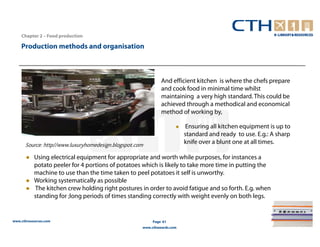
                                                             And efficient kitchen is where the chefs prepare
                                                             and cook food in minimal time whilst
                                                             maintaining a very high standard. This could be
                                                             achieved through a methodical and economical
                                                             method of working by,

                                                                        Ensuring all kitchen equipment is up to
                                                                        standard and ready to use. E.g.: A sharp
      Source: http//www.luxuryhomedesign.blogspot.com                   knife over a blunt one at all times.

           Using electrical equipment for appropriate and worth while purposes, for instances a
           potato peeler for 4 portions of potatoes which is likely to take more time in putting the
           machine to use than the time taken to peel potatoes it self is unworthy.
           Working systematically as possible
           The kitchen crew holding right postures in order to avoid fatigue and so forth. E.g. when
           standing for ;long periods of times standing correctly with weight evenly on both legs.


www.cthresources.com                                     Page 61
                                                    www.cthawards.com
Chapter 2 – Food production

    Production methods and organisation


                Ensuring all necessary equipment is ready and usable at the start of each working session.
                Positioning all work tops, sinks, stores, and refrigerators within easy reach to eliminate
                unnecessary movements of chefs.
                Storing all ingredients as close to the practical work area, starting from most frequently used
                items close at hand.
                Preparing the mise en place thoroughly to ensure the follow-on of a smooth and efficient
                service.
                 Following a clear and continuous work plan, opposed to a haphazard one. E.g. preparing those
                dishes first which demands more time to prepare.


                                                                        Source: Caterer & Hotelkeeper


www.cthresources.com                                     Page 62
                                                    www.cthawards.com
Chapter 2 – Food production

    Production methods and organisation


   3.1 Production methods
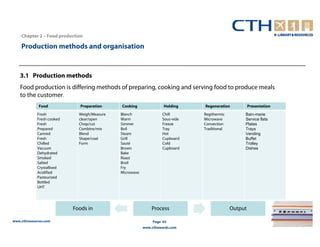
   Food production is differing methods of preparing, cooking and serving food to produce meals
   to the customer.
             Food              Preparation    Cooking               Holding    Regeneration           Presentation

             Fresh            Weigh/Measure   Blanch               Chill       Regithermic        Bain-marie
             Fresh cooked     clear/open      Warm                 Sous-vide   Microwave          Service flats
             Fresh            Chop/cut        Simmer               Freeze      Convection         Plates
             Prepared         Combine/mix     Boil                 Tray        Traditional        Trays
             Canned           Blend           Steam                Hot                            Vending
             Fresh            Shape/coat      Grill                Cupboard                       Buffet
             Chilled          Form            Sauté                Cold                           Trolley
             Vacuum                           Brown                Cupboard                       Dishes
             Dehydrated                       Bake
             Smoked                           Roast
             Salted                           Broil
             Crystallised                     Fry
             Acidified                        Microwave
             Pasteurized
             Bottled
             UHT


                            Foods in                          Process                        Output

www.cthresources.com                                           Page 63
                                                          www.cthawards.com
Chapter 2 – Food production

    Production methods and organisation


   3.1.1 Key considerations in food production
                Food hygiene
                Quality raw materials
                Foods should be stored properly
                Appropriate preparation for each food item
                Minimised wastage
                Employees should comply with handling regulations
                Foods should be cooked to proper temperatures

   Methods differ in relation to:

                Actual location where food is produced
                Total time from preparation to service
                Staff numbers required
                Level of hygiene and control
                Quantity of food produced


www.cthresources.com                                     Page 64
                                                   www.cthawards.com
Chapter 2 – Food production

    Production methods and organisation


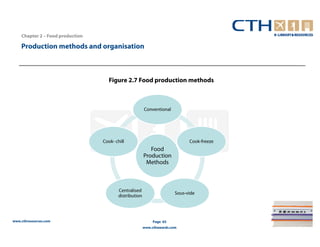
                                     Figure 2.7 Food production methods


                                                         Conventional


                                  Cook- chill                                  Cook-freeze
                                                            Food
                                                         Production
                                                          Methods


                                          Centralised
                                                                         Sous-vide
                                          distribution


www.cthresources.com                                          Page 65
                                                         www.cthawards.com
Chapter 2 – Food production

    Production methods and organisation


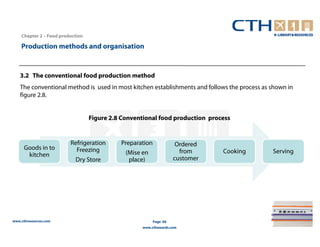
   3.2 The conventional food production method
   The conventional method is used in most kitchen establishments and follows the process as shown in
   figure 2.8.


                                  Figure 2.8 Conventional food production process


                         Refrigeration      Preparation              Ordered
      Goods in to          Freezing           (Mise en                from     Cooking       Serving
       kitchen
                           Dry Store           place)               customer


www.cthresources.com                                      Page 66
                                                   www.cthawards.com
Chapter 2 – Food production

    Production methods and organisation


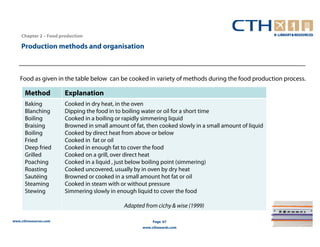
   Food as given in the table below can be cooked in variety of methods during the food production process.

      Method           Explanation
      Baking           Cooked in dry heat, in the oven
      Blanching        Dipping the food in to boiling water or oil for a short time
      Boiling          Cooked in a boiling or rapidly simmering liquid
      Braising         Browned in small amount of fat, then cooked slowly in a small amount of liquid
      Boiling          Cooked by direct heat from above or below
      Fried            Cooked in fat or oil
      Deep fried       Cooked in enough fat to cover the food
      Grilled          Cooked on a grill, over direct heat
      Poaching         Cooked in a liquid , just below boiling point (simmering)
      Roasting         Cooked uncovered, usually by in oven by dry heat
      Sautéing         Browned or cooked in a small amount hot fat or oil
      Steaming         Cooked in steam with or without pressure
      Stewing          Simmering slowly in enough liquid to cover the food

                                              Adapted from cichy & wise (1999)

www.cthresources.com                                      Page 67
                                                     www.cthawards.com
Chapter 2 – Food production

    Production methods and organisation


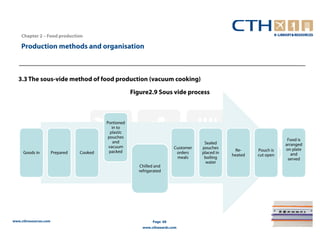
   3.3 The sous-vide method of food production (vacuum cooking)

                                                       Figure2.9 Sous vide process


                                           Portioned
                                              in to
                                             plastic
                                            pouches
                                               and                                                                    Food is
                                                                                      Sealed                         arranged
                                            vacuum                        Customer   pouches
                                                                                                  Re-     Pouch is   on plate
     Goods in          Prepared   Cooked    packed                         orders    placed in
                                                                                                 heated   cut open      and
                                                                           meals      boiling                         served
                                                                                       water
                                                         Chilled and
                                                         refrigerated


www.cthresources.com                                            Page 68
                                                           www.cthawards.com
Chapter 2 – Food production

    Production methods and organisation


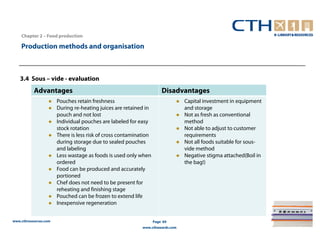
   3.4 Sous – vide - evaluation
           Advantages                                                  Disadvantages
                       Pouches retain freshness                                 Capital investment in equipment
                       During re-heating juices are retained in                 and storage
                       pouch and not lost                                       Not as fresh as conventional
                       Individual pouches are labeled for easy                  method
                       stock rotation                                           Not able to adjust to customer
                       There is less risk of cross contamination                requirements
                       during storage due to sealed pouches                     Not all foods suitable for sous-
                       and labeling                                             vide method
                       Less wastage as foods is used only when                  Negative stigma attached(Boil in
                       ordered                                                  the bag!)
                       Food can be produced and accurately
                       portioned
                       Chef does not need to be present for
                       reheating and finishing stage
                       Pouched can be frozen to extend life
                       Inexpensive regeneration


www.cthresources.com                                               Page 69
                                                            www.cthawards.com
Chapter 2 – Food production

    Production methods and organisation


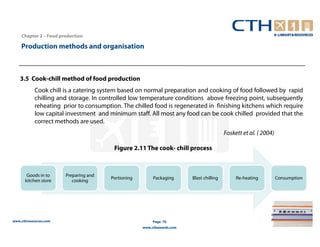
   3.5 Cook-chill method of food production
           Cook chill is a catering system based on normal preparation and cooking of food followed by rapid
           chilling and storage. In controlled low temperature conditions above freezing point, subsequently
           reheating prior to consumption. The chilled food is regenerated in finishing kitchens which require
           low capital investment and minimum staff. All most any food can be cook chilled provided that the
           correct methods are used.
                                                                                         Foskett et al. ( 2004)

                                        Figure 2.11 The cook- chill process


       Goods in to     Preparing and
                                       Portioning        Packaging      Blast chilling        Re-heating          Consumption
      kitchen store       cooking


www.cthresources.com                                     Page 70
                                                    www.cthawards.com
Chapter 2 – Food production

    Production methods and organisation


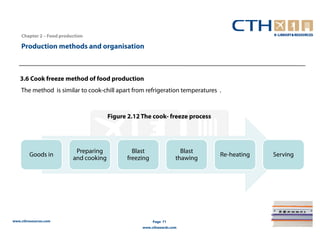
   3.6 Cook freeze method of food production
    The method is similar to cook-chill apart from refrigeration temperatures .


                                        Figure 2.12 The cook- freeze process


                           Preparing            Blast                 Blast
        Goods in                                                               Re-heating   Serving
                          and cooking         freezing              thawing


www.cthresources.com                                     Page 71
                                                    www.cthawards.com
Chapter 2 – Food production

    Production methods and organisation


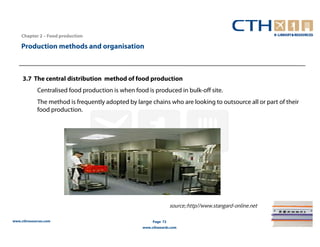
     3.7 The central distribution method of food production
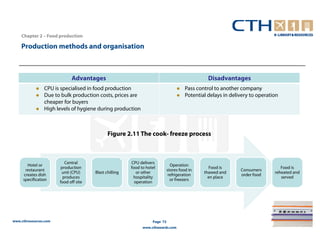
             Centralised food production is when food is produced in bulk-off site.
             The method is frequently adopted by large chains who are looking to outsource all or part of their
             food production.


                                                                   source;:http//www.stangard-online.net

www.cthresources.com                                     Page 72
                                                    www.cthawards.com
Chapter 2 – Food production

    Production methods and organisation


                             Advantages                                                          Disadvantages
                CPU is specialised in food production                                  Pass control to another company
                Due to bulk production costs, prices are                               Potential delays in delivery to operation
                cheaper for buyers
                High levels of hygiene during production


                                              Figure 2.11 The cook- freeze process


                          Central                       CPU delivers
       Hotel or                                                                Operation
                        production                      food to hotel                             Food is                        Food is
      restaurant                                                             stores food in                    Consumers
                        unit (CPU)     Blast chilling      or other                            thawed and                     reheated and
     creates dish                                                             refrigeration                    order food
                         produces                        hospitality                             en place                        served
     specification                                                             or freezers
                       food off site                      operation


www.cthresources.com                                               Page 73
                                                              www.cthawards.com
Chapter 2 – Food production

    Food classifications


                4.     Food classifications
                       There are many different types and varieties of food. One way of organising
                       ingredients is to categorise them into particular groups of families. Few of
                       food are detailed below.


www.cthresources.com                                       Page 74
                                                      www.cthawards.com
Chapter 2 – Food production

    Food classifications


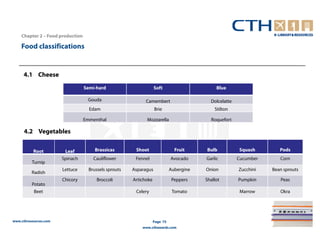
     4.1 Cheese
                                  Semi-hard                        Soft                       Blue

                                   Gouda                     Camembert                     Dolcelatte
                                    Edam                           Brie                      Stilton

                                  Emmenthal                  Mozzarella                    Roquefort

      4.2 Vegetables

          Root          Leaf           Brassicas        Shoot                  Fruit     Bulb           Squash        Pods
                       Spinach        Cauliflower       Fennel               Avocado     Garlic         Cucumber      Corn
          Turnip
                       Lettuce      Brussels sprouts   Asparagus             Aubergine   Onion          Zucchini   Bean sprouts
          Radish
                       Chicory          Broccoli       Artichoke              Peppers    Shallot        Pumpkin       Peas
          Potato
           Beet                                         Celery                Tomato                     Marrow       Okra


www.cthresources.com                                               Page 75
                                                           www.cthawards.com
Chapter 2 – Food production

    Food classifications


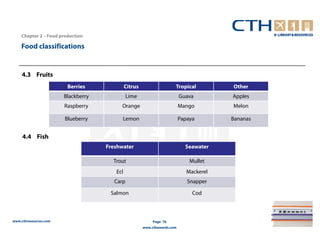
    4.3 Fruits
                        Berries              Citrus                   Tropical          Other
                       Blackberry             Lime                        Guava         Apples
                       Raspberry         Orange                           Mango         Melon

                       Blueberry          Lemon                           Papaya        Bananas


     4.4 Fish
                                    Freshwater                              Seawater

                                      Trout                                   Mullet
                                       Ecl                                   Mackerel
                                       Carp                                  Snapper

                                     Salmon                                    Cod


www.cthresources.com                                       Page 76
                                                      www.cthawards.com
Chapter 2 – Food production

    Food classifications


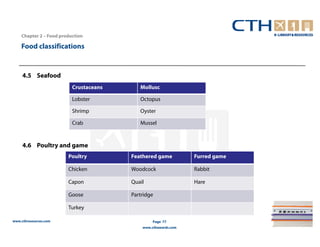
     4.5 Seafood
                          Crustaceans      Mollusc

                          Lobster          Octopus

                          Shrimp           Oyster

                          Crab             Mussel


     4.6 Poultry and game
                        Poultry         Feathered game          Furred game

                        Chicken         Woodcock                Rabbit

                        Capon           Quail                   Hare

                        Goose           Partridge

                        Turkey

www.cthresources.com                             Page 77
                                            www.cthawards.com
Chapter 2 – Food production

    Food cost and control


                 5.    Food cost and control
                       5.1 Food cost
                       5.2 Benefits of food cost for an organisation
                       5.3 How to achieve food cost targets?


www.cthresources.com                                        Page 78
                                                       www.cthawards.com
Chapter 2 – Food production

    Food cost and control


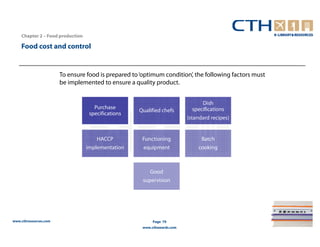
                       To ensure food is prepared to ‘optimum condition’, the following factors must
                       be implemented to ensure a quality product.


                                                                                Dish
                                     Purchase                               specifications
                                                    Qualified chefs
                                   specifications
                                                                          (standard recipes)


                                      HACCP           Functioning               Batch
                                  implementation      equipment               cooking


                                                         Good
                                                      supervision


www.cthresources.com                                       Page 79
                                                      www.cthawards.com
Chapter 2 – Food production

    Food cost and control


   5.1 Food cost
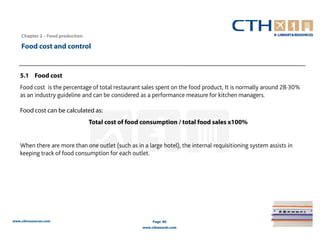
   Food cost is the percentage of total restaurant sales spent on the food product, It is normally around 28·30%
   as an industry guideline and can be considered as a performance measure for kitchen managers.

   Food cost can be calculated as:
                                  Total cost of food consumption / total food sales x100%


   When there are more than one outlet (such as in a large hotel), the internal requisitioning system assists in
   keeping track of food consumption for each outlet.


www.cthresources.com                                     Page 80
                                                    www.cthawards.com
Chapter 2 – Food production

    Food cost and control


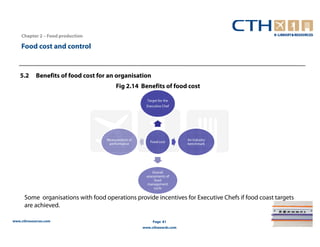
   5.2      Benefits of food cost for an organisation
                                          Fig 2.14 Benefits of food cost

                                                       Target for the
                                                       Executive Chef


                                     Measurement of                       An industry
                                                         Food cost
                                      performance                         benchmark


                                                           Overall
                                                       assessments of
                                                            food
                                                        management
                                                            cycle

      Some organisations with food operations provide incentives for Executive Chefs if food coast targets
      are achieved.

www.cthresources.com                                       Page 81
                                                      www.cthawards.com
Chapter 2 – Food production

    Food cost and control


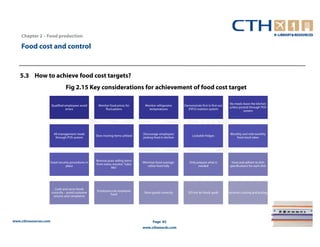
   5.3 How to achieve food cost targets?
                                 Fig 2.15 Key considerations for achievement of food cost target

                                                                                                                                            No meals leave the kitchen
                       Qualified employees avoid     Monitor food prices for      Monitor refrigerator     Demonstrate first in first out
                                                                                                                                            unless posted through POS
                                  errors                  fluctuations              temperatures             (FIFO) roattion system
                                                                                                                                                      system


                        All management meals                                     Discourage employees                                        Monthly and mid monthly
                                                    Slow moving items utilised                                   Lockable fridges
                         through POS system                                      picking food in kitchen                                         food stock takes


                                                    Remove poor selling items
                   Good security procedures in                                   Minimise food wastage,       Only prepare what is           Have and adhere to dish
                                                    from menu monitor ‘Sales
                             place                                                  utilise food fully              needed                  specifications for each dish
                                                             Mix’


                         Cook and serve foods
                                                    Employees eat employee
                       correctly – avoid customer                                 Store goods correctly       DO not let foods spoil!       Incorrect costing and pricing
                                                            food
                        returns and complaints


www.cthresources.com                                                                    Page 82
                                                                                 www.cthawards.com
Chapter 2 – Food production

    Food poisoning


                 6.    Food poisoning
                       6.1 Main types of food poisoning
                       6.2 Hazard Analysis Critical Control Point (HACCP)


www.cthresources.com                                       Page 83
                                                      www.cthawards.com
Chapter 2 – Food production

    Food poisoning


   6.1 Main types of food poisoning
                Salmonella
                Staphylococcus
                Clostridium
                Listeria


www.cthresources.com                       Page 84
                                      www.cthawards.com
Chapter 2 – Food production

    Food poisoning


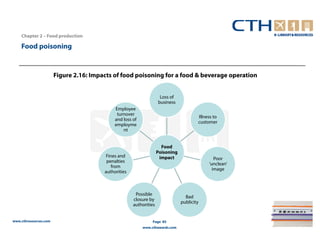
                       Figure 2.16: Impacts of food poisoning for a food & beverage operation


                                                                     Loss of
                                                                    business
                                             Employee
                                              turnover
                                                                                        Illness to
                                             and loss of
                                                                                        customer
                                             employme
                                                 nt


                                                                      Food
                                                                    Poisoning
                                         Fines and                   impact                     Poor
                                         penalties
                                                                                             ‘unclean’
                                            from
                                                                                               image
                                        authorities


                                                       Possible
                                                                                  Bad
                                                      closure by
                                                                                publicity
                                                      authorities


www.cthresources.com                                            Page 85
                                                           www.cthawards.com
Chapter 2 – Food production

    Food poisoning


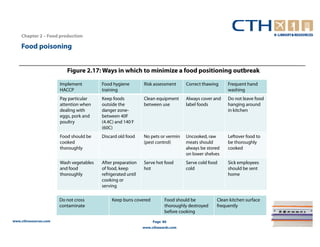
                          Figure 2.17: Ways in which to minimize a food positioning outbreak

                       Implement         Food hygiene         Risk assessment     Correct thawing    Frequent hand
                       HACCP             training                                                    washing
                       Pay particular    Keep foods           Clean equipment     Always cover and   Do not leave food
                       attention when    outside the          between use         label foods        hanging around
                       dealing with      danger zone-                                                in kitchen
                       eggs, pork and    between 40F
                       poultry           (4.4C) and 140 F
                                         (60C)
                       Food should be    Discard old food     No pets or vermin   Uncooked, raw      Leftover food to
                       cooked                                 (pest control)      meats should       be thoroughly
                       thoroughly                                                 always be stored   cooked
                                                                                  on lower shelves
                       Wash vegetables   After preparation    Serve hot food      Serve cold food    Sick employees
                       and food          of food, keep        hot                 cold               should be sent
                       thoroughly        refrigerated until                                          home
                                         cooking or
                                         serving

                       Do not cross           Keep buns covered          Food should be         Clean kitchen surface
                       contaminate                                       thoroughly destroyed   frequently
                                                                         before cooking
www.cthresources.com                                               Page 86
                                                              www.cthawards.com
Chapter 2 – Food production

    Food poisoning


   6.2             Hazard analysis Critical Control Point (HACCP)

   The HACCP system entails identifying potential risks during the food cycle and production stage and
   implementing controls to reduce those risks. This includes implementing regular checking systems and
   maintaining good records.


www.cthresources.com                                    Page 87
                                                   www.cthawards.com
Chapter 2 – Food production

    Food poisoning


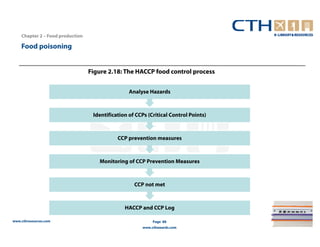
                                  Figure 2.18: The HACCP food control process


                                                  Analyse Hazards


                                   Identification of CCPs (Critical Control Points)


                                             CCP prevention measures


                                     Monitoring of CCP Prevention Measures


                                                    CCP not met


                                                HACCP and CCP Log

www.cthresources.com                                        Page 88
                                                       www.cthawards.com
Chapter 2 – Food production

    Kitchen equipment


                7.     Kitchen equipment
                       Large commercial kitchens have a wide selection of equipment to assist staff
                       in their varying roles.


www.cthresources.com                                       Page 89
                                                      www.cthawards.com
Chapter 2 – Food production

    Food poisoning


   Considerations when purchasing equipment

              Can we afford it?
              Can we get spare parts?
              Who requires training?
              Will it be easy to use?
              Guarantees
              Warrantees
              Will it add value?
              What is the company support if it breaks down?
              Where is the best location for this equipment?
              What training is required?
              What is the procedure for cleaning?
              Instructions for use?
              How long will it last?
              Who else has purchased one- testimonials?
              What are the safety risks (risk assessments)?
              Has it been safety approved?

www.cthresources.com                                    Page 90
                                                   www.cthawards.com
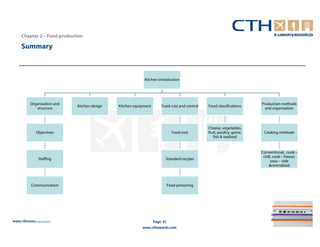
Chapter 2 – Food production

    Summary


                                                          Kitchen introduction


         Organisation and                                                                                            Production methods
                            Kitchen design   Kitchen equipment       Food cost and control   Food classifications
            structure                                                                                                  and organisation


                                                                                             Cheese, vegetables,
            Objectives                                                       Food cost       fruit, poultry, game,    Cooking methods
                                                                                                fish & seafood


                                                                                                                     Conventional, cook –
                                                                                                                      chill, cook – freeze,
             Staffing                                                  Standard recipes
                                                                                                                           sous – vide
                                                                                                                         &centralised


         Communication                                                     Food poisoning


www.cthresources.com                                             Page 91
                                                         www.cthawards.com
Chapters

                       1.   Introduction to food & beverage
                       2.   Food production
                       3.   Purchasing food & beverage
                       4.   Food service delivery
                       5.   Beverages
                       6.   Menu planning
                       7.   Service quality in food & beverage
                       8.   Conference & banqueting


www.cthresources.com                               Page 92
                                              www.cthawards.com
Chapter 3– Purchasing food and beverage

    Objectives


                In this chapter you will learn to :-
                       ● Explain the importance and the process of selecting the right suppliers
                       ● Describe the key standards required when purchasing, receiving, storing
                         and issuing food and beverages
                       ● Recommend the tools required for the effective control of finances and
                         hygiene throughout the procurement and storage process


www.cthresources.com                                        Page 93
                                                       www.cthawards.com
Chapter 3– Purchasing food and beverage

    Departmental goals and structure


                 1.    Departmental goals and structure
                       1.1 Departmental objectives
                       1.2 Factors that impact purchasing
                       1.3 Departmental personnel
                       1. 4 Sample job description: Food and Beverage Manager


www.cthresources.com                                        Page 94
                                                     www.cthawards.com
Chapter 3– Purchasing food and beverage

    Departmental goals and structure


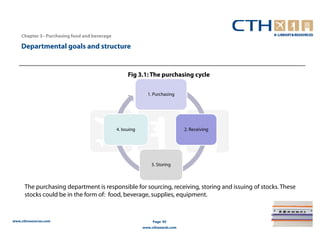
                                                    Fig 3.1: The purchasing cycle

                                                             1. Purchasing


                                              4. Issuing                       2. Receiving


                                                               3. Storing


      The purchasing department is responsible for sourcing, receiving, storing and issuing of stocks. These
      stocks could be in the form of: food, beverage, supplies, equipment.


www.cthresources.com                                            Page 95
                                                           www.cthawards.com
Chapter 3– Purchasing food and beverage

    Departmental goals and structure


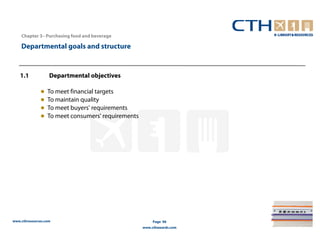
   1.1             Departmental objectives

              ●   To meet financial targets
              ●   To maintain quality
              ●   To meet buyers' requirements
              ●   To meet consumers' requirements


www.cthresources.com                                     Page 96
                                                    www.cthawards.com
Chapter 3– Purchasing food and beverage

    Departmental goals and structure


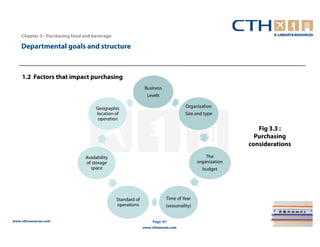
     1.2 Factors that impact purchasing
                                                             Business
                                                              Levels

                                    Geographic                                    Organization
                                    location of                                  Size and type
                                     operation

                                                                                                          Fig 3.3 :
                                                                                                         Purchasing
                                                                                                       considerations
                               Availability                                                 The
                               of storage                                               organization
                                 space                                                    budget


                                              Standard of               Time of Year
                                              operations                (seasonality)


www.cthresources.com                                             Page 97
                                                            www.cthawards.com
Chapter 3– Purchasing food and beverage

    Departmental goals and structure


      1.3 Departmental personnel
     Purchasing department is managed and supervised by the Accounts department . their responsibilities
     are given in the following table.
       Person          Responsibilities
       Purchaser             ● Liaising with departments                          ● Obtaining quotations
                             ● Researching suppliers                              ● Researching market prices
                             ● Finding suppliers                                  ● Negotiating prices
       Receiver              ● Receiving goods                                    ● Dealing with delivery personnel
                             ● Checking goods                                     ● Signing for deliveries
       Store man             ● Data entry of new stocks                           ● Liaising with purchasing, receiving and
                             ● Maintaining of quality of stocks                     department personnel
                             ● Issuing of stocks to departments• Updating stock   ● • Maintaining the hygiene of stocks
                                records                                           ● • Assisting with stock-takes and inventories
       Cost                  ● Observing stock transactions                       ● Identifying weakness in stock control
       controller            ● Conducting impromptu stock –takes                  ● Making recommendations for improved stock
                             ● Checking stock documentation                         control
                                                                                  ● Assisting with stock-takes


www.cthresources.com                                             Page 98
                                                            www.cthawards.com
Chapter 3– Purchasing food and beverage

    Departmental goals and structure


     1.4 Sample job description: Food and Beverage Manager (Skills & duties)
         Skills
               ●       Strong communication skills(verbal ,l listening, writing)
               ●       Innovative
               ●       Proactive and reliable
               ●       Able to work alone and within a team
       Duties
            ● To supervise in all aspects of purchasing food and beverage to ensure quality and
              profitability
            ● To support the Director of Food and Beverage and Executive Chef to order food and
              beverage
            ● To assist in accurate administration of all delivery notes, requisitions and invoices in
              accordance with hotel and company standards
            ● Manage the receiving and inspecting of all food and beverage deliveries
            ● Maintain inventory controls and proper levels, dating and rotation of all food and
              beverage items that are received


www.cthresources.com                                           Page 99
                                                          www.cthawards.com
Chapter 3– Purchasing food and beverage

    Departmental goals and structure


             ● To ensure high standards of work performance, conduct and appearance of himself and his
               departments are met
             ● To maintain healthy inter-departmental relationships
             ● To support the Financial Controller in monthly product line checks
             ● To be responsible for the safe keeping of all keys relating to purchasing and stores
             ● To maintain the highest level of cleanliness, health and safety and security within the delivery
               area, storage area and kitchen
             ● To forecast weekly food and beverage cost figures in conjunction with other departments and
               hotel occupancy
             ● To maintain healthy inter-departmental relationships
             ● To promote awareness of health and safety within the department for associates and guests.
               Example fire alert points, exits, extinguishers, table clips etc.
             ● To attend relevant training courses to aid self-development
             ● Adhere to all current legislation including food safety and health and safety
             ● Attend all food and beverage meetings and morning briefing when necessary
             ● Check all invoices for price fluctuations and take action where necessary

www.cthresources.com                                    Page 100
                                                    www.cthawards.com
Chapter 3– Purchasing food and beverage

    Purchasing


                 2.    Purchasing
                       2.1 Purchasing responsibilities
                       2.2 Capital purchases
                       2.3 Quality control
                       2.4 Selecting suppliers
                       2.5 Financial control
                       2.6 Changes in product cost +/-


www.cthresources.com                                         Page 101
                                                         www.cthawards.com
Chapter 3– Purchasing food and beverage

    Purchasing


        2.1 Purchasing responsibilities

                       ● Liaising with Suppliers
                       ● Liaising with department managers
                       ● Gaining approval
                       ● Obtaining quotes for more expensive items
                       ● Sending orders
                       ● Maintaining records
                       ● Market surveys on food prices


www.cthresources.com                                      Page 102
                                                      www.cthawards.com
Chapter 3– Purchasing food and beverage

    Purchasing


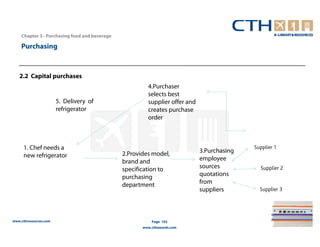
   2.2 Capital purchases
                                                       4.Purchaser
                                                       selects best
                       5. Delivery of                  supplier offer and
                       refrigerator                    creates purchase
                                                       order


     1. Chef needs a                                                                       Supplier 1
                                              2.Provides model,             3.Purchasing
     new refrigerator                                                       employee
                                              brand and
                                              specification to              sources          Supplier 2
                                              purchasing                    quotations
                                              department                    from
                                                                            suppliers        Supplier 3


www.cthresources.com                                     Page 103
                                                     www.cthawards.com
Chapter 3– Purchasing food and beverage

    Purchasing


     2.3 Quality control

          Specifications

          The first step in achieving control in the purchasing of food and beverages is to create a product
          specification. The specification should:
                       ● Set out clearly the standard required for each product
                       ● Ensure mangers set out exact requirements in advance
                       ● Provide the supplier
                       ● Guide the supplier
                       ● Minimise discrepancies on delivery
                       ● Be used when bidding for contracts
                       ● Act as a checking tool on delivery


www.cthresources.com                                        Page 104
                                                        www.cthawards.com
Chapter 3– Purchasing food and beverage

    Purchasing


     2.4 Selecting suppliers
    The following questions needs to be asked when selecting suppliers:
         ● Are they reputable?
         ● Are they certificated?
         ● Can they supply the products that I want at the right quality?
         ● Are their prices competitive?
         ● Will they be consistent?
         ● Which other companies do they serve?
         ● Can they deal with the volume that I want?
         ● What are their credit terms, do their payment terms meet the
         ● criteria of our accounts department?
         ● Will they add value to my product overall?


www.cthresources.com                                 Page 105
                                                 www.cthawards.com
Chapter 3– Purchasing food and beverage

    Purchasing


        2.5 Financial control

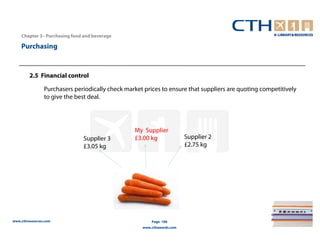
                Purchasers periodically check market prices to ensure that suppliers are quoting competitively
                to give the best deal.


                                                 My Supplier
                              Supplier 3         £3.00 kg               Supplier 2
                              £3.05 kg                                  £2.75 kg


www.cthresources.com                                    Page 106
                                                    www.cthawards.com
Chapter 3– Purchasing food and beverage

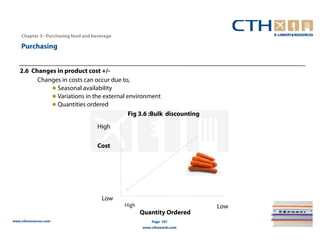
    Purchasing


   2.6 Changes in product cost +/-
         Changes in costs can occur due to,
             ● Seasonal availability
             ● Variations in the external environment
             ● Quantities ordered
                                           Fig 3.6 :Bulk discounting
                                    High

                                    Cost


                                      Low
                                              High                       Low
                                                     Quantity Ordered
www.cthresources.com                                     Page 107
                                                     www.cthawards.com
Chapter 3– Purchasing food and beverage

    Purchasing


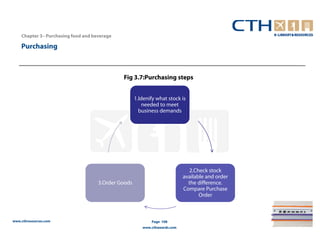
                                              Fig 3.7:Purchasing steps


                                                     1.Idenify what stock is
                                                         needed to meet
                                                       business demands


                                                                              2.Check stock
                                                                            available and order
                                     3.Order Goods                            the difference.
                                                                            Compare Purchase
                                                                                   Order


www.cthresources.com                                        Page 108
                                                        www.cthawards.com
Chapter 3– Purchasing food and beverage

    Receiving


                 3.    Receiving
                       3.1 Equipment
                       3.2 Product checks on receipt of delivery
                       3.3 Delivery temperatures
                       3.4 Meat checks
                       3.5 Beverages
                       3.6 Health and safety tips: receiving area


www.cthresources.com                                       Page 109
                                                       www.cthawards.com
Chapter 3– Purchasing food and beverage

    Receiving


     3.1 Equipment
         In order to carry out all the tasks of a receipt of a delivery , the receiver requires the following
         equipment to be available on the “receiving area” or “loading bay”:

                 ● Scales
                 ● Trolleys
                 ● Thermometer and thermopin
                 ● Sink
                 ● Calculator
                 ● Scissors and box cutters


www.cthresources.com                                      Page 110
                                                      www.cthawards.com
Chapter 3– Purchasing food and beverage

    Receiving


    3.2 Product checks on receipt of delivery
           On the receipt of delivery the following checks should be carried out by the receiver.


                       ● The delivery note matches the purchase order
                       ● The products match any food specifications
                       ● Checks the weight of items against delivery note
                       ● Counts items purchased by unit against delivery note
                       ● Checks prices against purchase order
                       ● Checks expiry dates of items
                       ● Checks temperatures of meats and fresh foods
                       ● Checks for any breakages or damaged items
                       ● Opens any boxes or containers to check inside


www.cthresources.com                                       Page 111
                                                       www.cthawards.com
Chapter 3– Purchasing food and beverage

    Receiving


            3.3 Delivery temperatures


                       ● Most refrigerated items should be received at 41°F or below

                       ● Dry goods are received at room temperature, packaged intact and in good condition

                       ● Frozen products should of course be received frozen

                       ● Signature of the receiving clerk who conforms accuracy of the order

                       ● Company stamp

                       Note: It is also good for the receiver to randomly check the temperature of the delivery
                        vehicles.


www.cthresources.com                                    Page 112
                                                    www.cthawards.com
Chapter 3– Purchasing food and beverage

    Receiving


          3.4 Meat checks

                        ● Check for excess blood seepage
                        ● Ensure no cross contamination has occurred and all meats are separated
                        ● Pork products should be wrapped in dry paper
                        ● Frozen meats should be unthawed
                        ● Poultry should have no strong smell
                        ● Chicken meat should be golden yellow, not white


www.cthresources.com                                  Page 113
                                                  www.cthawards.com
Chapter 3– Purchasing food and beverage

    Receiving


     3.5 Beverages


             Beverage checks include examination:

                       ● For any breakages

                       ● That seals are not broken

                       ● That the vintages are correct

                       ● That the label is in good condition


www.cthresources.com                                           Page 114
                                                         www.cthawards.com
Chapter 3– Purchasing food and beverage

    Receiving


    3.6 Health and safety tips: receiving area

                ● Lift correctly and avoid lifting heavy items

                ● Wash hands frequently

                ● Keep area clear of debris and rubbish

                ● Sweep and mop regularly


www.cthresources.com                                      Page 115
                                                      www.cthawards.com
Chapter 3– Purchasing food and beverage

    Storage


                 4.    Storage
                       4.1 Perishability
                       4.2 Storeroom health tips and good practice


www.cthresources.com                                     Page 116
                                                     www.cthawards.com
Chapter 3– Purchasing food and beverage

    Storage


      After goods are checked-in, stock is transferred into the correct storage facilities and records updated.
      Different types of goods have varying storage temperature requirements, as given below.

      Most establishments have a computerised system whereby all new products received are entered into
      the computer so that accurate stock levels are held.


                       Store                             Temperature oC
                       Dry                               Room temperature
                       Refrigerated                      0 to 5
                       Frozen                            -18 to -24


www.cthresources.com                                   Page 117
                                                   www.cthawards.com
Chapter 3– Purchasing food and beverage

    Storage


    4.1 Perishability
    Storage requirements are based on each type of food item’s perishability.
                                    Fig 3.10: Categorisation of stock Perishability and cost
                                                         Long life

                                          Dried food                         Wines,liquuers,
                                          (spices, canned                    deluxe spirits
                                          drinks,tobacco,fro                 shark's fin
                                          zen food)

                              Low cost                                                         High cost

                                              Fruit,salads,                  Fresh seafood,
                                              Dairy items                    caviar, fresh
                                                                             meats


                                                               Short life
www.cthresources.com                                              Page 118
                                                              www.cthawards.com
Chapter 3– Purchasing food and beverage

    Storage


                       ● A daily ,weekly and monthly cleaning schedule
                       ● Ensure all heavy goods are lifted correctly
                       ● Avoid storing items to high
                       ● Clean any spills as they occur
                       ● Do not store anything on the floor that may cause an
                         obstruction
                       ● Cover dustbins to prevent infestation
                       ● Enforce a pest control schedule
                       ● Store goods in clear well –ventilated containers
                       ● All products should have a label and an expiry date
                       ● All fresh meats stored on lower shelves
                       ● Refrigerate perishable ingredients promptly
                       ● Ensure labels are clear and visible


www.cthresources.com                                        Page 119
                                                        www.cthawards.com
Chapter 3– Purchasing food and beverage

    Issuing


                 5.    Issuing
                       5.1 Secure storage

                       5.2 Internal requisitions

                       5.3 Issuing rationale

                       5.4 Steps in requisitioning

                       5.5 Issuing times

                       5.6 Stock rotation

                       5.7 Stock movement

                       5.8 Reports


www.cthresources.com                                     Page 120
                                                     www.cthawards.com
Chapter 3– Purchasing food and beverage

    Issuing


    5.1 Secure storage

    For control of goods they should be kept in a lockable store room permitting access to only authorized
    personnel.

    5.2 Internal requisitions
                                      Fig3.11 Departments with main stock demands

                                                                 Main
                                                                kitchen


                                               Room
                                                                                     Bar
                                              service
                                                                Stores


                                                  Conference
                                                        And               Mini Bar
                                                  Banqueting
www.cthresources.com                                           Page 121
                                                          www.cthawards.com
Chapter 3– Purchasing food and beverage

    Issuing


    5.3 Issuing rationale
        Departments issues stocks to:
             ● Have the appropriate goods to run their departments
             ● Prevent running out of stocks
             ● Maintain departmental par stock levels

           The stocks are requested by completing an internal department requisition

           The purpose of the requisition form is to:
                ● Have a paper trail in stock movements
                ● Force departments to plan stock requests
                ● Accurately allocate cost expenditure and usage per department
                ● Document individual request and supply
                ● Use as a back-up when discrepancies in stock occur
                ● Act as backup when computer errors occur
                ● Detail consumption of stock items
                ● Be an internal accounting document between stores and the department.
www.cthresources.com                                    Page 122
                                                    www.cthawards.com
Chapter 3– Purchasing food and beverage

    Issuing


    5.4 Steps in requisitioning

                1. Departmental employee identifies what stock is required.
                2. Department employee completes a requisition from detailing
                    date,departmnet,stock and units required.
                3. The requisition form is submitted to stores.
                4. Store person gathers stock items in readiness for collection
                5. If items are not available ,unit adjustments have to be made or substitutes are
                    provided.
                6. Department employee collects stock, and checks that all items and quantities are
                    fulfilled.
                7. Both parties sign to confirm the goods issued.
                8. In most cases-one copy of the requisition form goes to the department, one to
                    stores, one copy to the accounts department.
                9. Store person updates stock records.
                10. Department employee replenishes departmental stock levels.


www.cthresources.com                                   Page 123
                                                   www.cthawards.com
Chapter 3– Purchasing food and beverage

    Issuing


    5.5 Issuing times

      In busy organizations specific times are allocated to different departments for collection of orders

                              Monday          Tuesday              Wednesday      Thursday        Friday


    8.00-9.00 am.             Kitchen         Kitchen              Kitchen        Kitchen         Kitchen

    9.00-10.00 am.            Rest and Bar    Rest and Bar         Rest and Bar   Rest and Bar    Rest and Bar


    11.00 -12.00 am           Banqueting      Banqueting           Banqueting     Banqueting      Banqueting


www.cthresources.com                                    Page 124
                                                   www.cthawards.com
Chapter 3– Purchasing food and beverage

    Issuing


    5.6 Stock rotation

    Stock is rotated and issued on a “FIFO” sysytem.Basically FIFO means using the oldest stock first, which
    reduces wastage.


    5.7 Stock movement

    Bin Cards- a manual system whereby a small card is allocated to each stock item. As stock is added it is
    recorded in the card. As stock is used, the date ,amount of stock, and where the stock went is recorded on the
    card.


www.cthresources.com                                  Page 125
                                                  www.cthawards.com
Chapter 3– Purchasing food and beverage

    Issuing


    5.8 Reports


                 Slow item report                   This report monitors stock items that are not
                                                    being requested by departments. If stock has
                                                    been ordered it should be consumed. This
                                                    information is passed to departments to be used
                                                    in menu planning.
                 Expiry item report                 This report informs departments of stocks that is
                                                    soon to expire. Items past their sell by dates
                                                    cannot be used, therefore it is important to
                                                    manage stocks and ensure consumption or sage
                                                    takes place before expiration. Failure to do so will
                                                    result in financial loss.


www.cthresources.com                              Page 126
                                              www.cthawards.com
Chapter 3– Purchasing food and beverage

    Control


                 6.    Issuing
                       6.1 Inventory

                 6.1.1 Stock –take inventory

                 Stock need to be counted on a monthly basis ,and usually carried out on the last
                 day of the month by personnel from the Stores and Accounting department

                 6.1.2 Why stock-take?

                       ● To have an accurate up to date count of each stock item
                       ● To check the stock corresponds with consumption
                       ● To identify any discrepancies in stock quantities
                       ● To balance actual stock against in and out transfers.


www.cthresources.com                                     Page 127
                                                     www.cthawards.com
Chapter 3– Purchasing food and beverage

    Summary


                                                              Purchasing


                       Structure     Purchasing       Receiving              Storing        Issuing         Control


                       Goals and    Responsibilitie
                                                      Equipment         Temperatures        Rational       Stock takes
                       Objectives         s


                                       Capital         Delivery
                       Personnel                                         Perishability    Requisitions
                                      purchases        checks


                                                      Health and         Health and
                                    Specifications                                       Stock rotations
                                                        safety             safety


                                      Selecting
                                                                                            Reports
                                      suppliers


                                      Financial
                                       control

                                        The
                                     purchasing
www.cthresources.com                                              Page 128
                                       steps
                                                          www.cthawards.com
Chapters

                       1.   Introduction to food & beverage
                       2.   Food production
                       3.   Purchasing food & beverage
                       4.   Food service delivery
                       5.   Beverages
                       6.   Menu planning
                       7.   Service quality in food & beverage
                       8.   Conference & banqueting


www.cthresources.com                              Page 129
                                              www.cthawards.com
Chapter 4 – Food service delivery

    Objectives


                In this chapter you will learn to :-
                       ● Justify the importance of service to food and beverage organizations
                       ● Explain the methods adopted by food and beverage organizations to
                         consistently meet customers’ needs and wants
                       ● Discuss the key and their responsibilities in food and beverage service
                       ● Compare and contrast the different food and beverage service methods


www.cthresources.com                                       Page 130
                                                       www.cthawards.com
Chapter 4 – Food service delivery

    Introduction to service


                 1.    Introduction to service
                       1.1 The service gap
                       1.2 Strategies to achieving good service
                       1.3 Service personnel
                       1.4 Presentation and personal hygiene
                       1.5 Service staff: presentation tips
                       1.6 Structures
                       1.7 Traditional service organization


www.cthresources.com                                          Page 131
                                                        www.cthawards.com
Chapter 4 – Food service delivery

    Introduction to service


     Customers have varying needs and expectations which the provider has to attempt to meet. Giving a
     high stand of service creates many advantages for the customer, the individual staff members and the
     organization as a whole. The advantages are:-
                       The customers            The organization                 The employees
                       A good experience        Less discount                    Employee retention
                       Satisfaction             Happy customers                  Less turnover
                       Customer loyalty         Good reputation                  Recognition
                       Positive word of mouth   Positive image                   Praise and gratitude
                                                Brand growth                     Opportunities to develop
                                                Awards                           Positive moral
                                                Good reviews                     Good work environment and atmosphere

                                                Develop market share
                                                Unique selling points (USP)
                                                Achieve financial targets
                                                Cost reduction
                                                Overall growth
www.cthresources.com                                                 Page 132
                                                                 www.cthawards.com
Chapter 4 – Food service delivery

    Introduction to service


    1.1 The service gap
    Customer satisfaction can be achieved through consistently meeting the customer’s specific needs,
    wants and expectations.
                                                Fig 4.1 The service gap

                                                  Service gap

                       Customer expectation                           Service delivery


                                              Satisfaction achieved

                                                       Gap
                  Customer expectation                                    Service delivery


                                                 Dissatisfaction
www.cthresources.com                                  Page 133
                                                  www.cthawards.com
Chapter 4 – Food service delivery

    Introduction to service


    1.2 Strategies to achieving good services
                                    Fig 4.2 Factors necessary to achieve good service


                                                                Standards
                                                                                  Good
                                                Regular
                                                                                supervisio
                                                 audits                             n


                                        Incentives                                      Internal
                                        & rewards               Strategies
                                                                                         system


                                                  Good
                                                                                 Training
                                                employees
                                                                   Meeting
                                                                  customer
                                                                 needs and
                                                                    wants


www.cthresources.com                                            Page 134
                                                            www.cthawards.com
Chapter 4 – Food service delivery

    Introduction to service


    1.3 Service personnel
    Employees play major part in the service experience. The level of service that customer
    receive will ultimately depend on server's technical skills, personality, experience and the
    team within which they work.
            Qualities of a good food and beverage server are: -
                Good product knowledge
                Punctuality
                Excellent presentation
                Friendly and outgoing personality
                Positive attitude to customers
                Ability to work in a team
                Good memory
                Customer-oriented
                Honesty
                Professional conduct
                Sales-oriented
                Well organized
www.cthresources.com                                    Page 135
                                                    www.cthawards.com
Chapter 4 – Food service delivery

    Introduction to service


     1.4 Presentation and personal hygiene
     One of the most important factor of food and hygiene service is the overall good
     presentation and high standards of hygiene of the service staff.


www.cthresources.com                                 Page 136
                                                 www.cthawards.com
Chapter 4 – Food service delivery

    Introduction to service


     1.5 Service staff: presentation tips
     Positive image must be projected to the customer at all times and in doing so be aware with:
                 Be clean and use deodorants (not strong smelling ones)
                 Aftershaves and perfumes should not be overpowering
                 Hands must be clean at all times with well trimmed nails
                 Men should be clean shaven or with a well trimmed moustache or beard
                 Woman should only wear light make up. If nail varnish is worn it should be clear
                 Large earrings should not be worn
                 Uniform should be clean, starched and well pressed at all times
                 Breath should be fresh smelling
                 Hair should be clean and well groomed. Long hair should be tied back and neat
                 Shoes should be comfortable, safe and well polished
                 Any cuts and burns should be covered with a waterproof dressing
                 Any colds or other possible infections should be reported to the supervisor promptly
                 Hands should be washed with hot water and antibacterial soap immediately after visiting the
                 toilet, smoking, dealing with refuse or eating
                 Staff should avoid touching their face and hair while on duty
                 Jewellery should be kept to a minimum
www.cthresources.com                                    Page 137
                                                    www.cthawards.com
Chapter 4 – Food service delivery

    Introduction to service


     1.6 Structure
     The structure and organization of service personnel vary in each organization. Factors that
     effect the organizational structure include: -
                 Labour budget
                 Size of operation
                 Quality of operation
                 Service methods used
                 Type of cuisine offered
                 Type of customers
                 Menu type
                 Technology available
                 Availability of skilled labour


www.cthresources.com                                  Page 138
                                                  www.cthawards.com
Chapter 4 – Food service delivery

    Introduction to service


    1.7 Traditional service organization


    A traditional, formal service structure within a restaurant is dependent on discipline and tradition, with
    all employees having particular role and responsibilities. Its top-down approach achieves high
    standards and customer satisfaction. Individuals are trained from the bottom-up learning the skills of
    their supervisor before progressing. It is normally found in a fine dining type of food and beverage
    operation, and is illustrated below.


www.cthresources.com                                  Page 139
                                                  www.cthawards.com
Chapter 4 – Food service delivery

    Introduction to service


                                    Fig 4.3 Traditional fine dining restaurant structure
                                                                     Restaurant
                                                                      Manager


                                                                     Headwaiter
                                                                      (Assistant
                                                                     Restaurant
                                                                      Manager)


                                        Station Headwaiter       Station Headwaiter      Sommelier
                                                                 (Section supervisor)


                                           Chef de Rang             Chef de Rang
                                          (Station Waiter)         (Station Waiter)


                                        Demi Chef de Rang        Demi Chef de Rang
                                        (Assistant to station    (Assistant to station
                                               Waiter)                  Waiter)


                                        Commis de Rang
                                           (Trainee)              Commis de Rang
                                                                     (Trainee)

www.cthresources.com                                                Page 140
                                                                www.cthawards.com
Chapter 4 – Food service delivery

    Introduction to service


                            Fig 4.3 Organization chart for a typical small casual restaurant

                                                         Restaurant
                                                          Manager


                                                          Assistant
                                                         Restaurant
                                                          Manager


                                                       Supervisors /
                                                         Captains


                               Waiter/ess
                                                 Host/ess               Cashier       Bar
                               Sommelier


                              Bus Persons

www.cthresources.com                                    Page 141
                                                    www.cthawards.com
Chapter 4 – Food service delivery

    Introduction to service


    The following is a typical job description for a restaurant manager.


www.cthresources.com                                  Page 142
                                                  www.cthawards.com
Chapter 4 – Food service delivery

    Introduction to service


    The key responsibilities for each of the different types of service staff are detailed in the following table.

      Position                  Responsibilities

      Restaurant or             • Checking mise en place and preparation.
      Catering Supervisor       • Checking lay out of service area or restaurant.
                                • Checking reservations and bookings.
                                • Assigning table sections to service staff before shift.
                                •Welcoming and looking after customer during their visit.
                                • Assisting the team where necessary during service.
                                • Communicating with kitchen and other support departments.
                                • Checking customer satisfaction during service.
                                • Maintaining a safe, comfortable and pleasant atmosphere for
                                  customers and employees.
                                •Dealing with any problems or emergencies promptly and efficiently.
                                • Performing any duty paperwork such as POS reports, log book.
                                •Guiding and motivating employees.
                                •Maintaining service standards.
                                •Maximizing sales.

www.cthresources.com                                        Page 143
                                                        www.cthawards.com
Chapter 4 – Food service delivery

    Introduction to service


     Position                Responsibilities

     Host/ess                • Answering the telephone and dealing with enquiries.
                             • Taking reservations.
                             • Welcoming and escorting customers to tables on arrival.
                             • Managing arrivals and staggering service.
                             • Providing general information.
                             • On arrival collecting and safeguarding customers’ belongings such as
                               jackets, hats and umbrellas.
                             • Checking satisfaction throughout the meal.
                             • Informing customers of any forthcoming promotions.
                             • Collecting customer feedback.
                             • Cashiering as required.
                             • Assisting service personnel if required.
                             • Returning customers’ belongings on departure.
                             • Thanking customers and bidding farewell.
                             • Collecting and updating customer information records.


www.cthresources.com                                        Page 144
                                                        www.cthawards.com
Chapter 4 – Food service delivery

    Introduction to service


     Position                Responsibilities

     Waite/ess               • General cleaning of service area.
                             • Completing mise en place.
                             • Taking customers’ orders.
                             • Informing customers about food and beverage products.
                             • Up-selling.
                             • Collecting and serving food and beverages.
                             • Removing empty covers and maintaining customer tables.
                             • Checking satisfaction throughout meal.
                             • Using point of sales to order food and beverage.
                             • Communicating with bar, kitchen and stewarding.
                             • Working in a team.
                             • Reporting any faults.
                             • Reporting any customer concerns.
     Sommelier (wine         • Creating wine lists.
     waiter)                 • Recommending wine and beverages.
                             • Serving wine and beverages.
                             • Maintenance of wine stocks.

www.cthresources.com                                       Page 145
                                                       www.cthawards.com
Chapter 4 – Food service delivery

    Introduction to service


     Position                Responsibilities

     Bus Person              • Mise en place duties.
                             • Run orders to the kitchen.
                             • Taking food from kitchen to service area.
                             • Taking service ware from service area to dish-wash.
                             • Refilling service areas during service with clean crockery, cuties and
                             mise en place.
                             • Taking laundry to the linen room.
                             • Cleaning the still room.


www.cthresources.com                                          Page 146
                                                          www.cthawards.com
Chapter 4 – Food service delivery

    Service methods and descriptions


                2.     Service methods and description
                       2.1 Different service types
                       2.2 Evaluation of different service methods
                       2.3 A guide for staffing ratios for different service methods
                       2.4 Evaluation of different service methods


www.cthresources.com                                       Page 147
                                                       www.cthawards.com
Chapter 4 – Food service delivery

    Service methods and descriptions


    Service methods vary from operation to operation. The type of food and beverage
    method adopted on several factors which included the:-
            ● Size of operation
            ● Objectives of the operation
            ● Quality of the operation
            ● Nature of the menu
            ● Quantity of customers
            ● Budget of the operation
            ● Budget of the customers
            ● Customer needs
            ● Availability of resources


www.cthresources.com                               Page 148
                                               www.cthawards.com
Chapter 4 – Food service delivery

    Service methods and descriptions


     They also differ in relation to the required:-

            ● Quantity of personnel
            ● Skill level of personnel
            ● Level of interaction with the customer
            ● Level of dependency on either the service or food production
            ● Level of involvement by the customer


www.cthresources.com                                      Page 149
                                                      www.cthawards.com
Chapter 4 – Food service delivery

    Service methods and descriptions


      2.1 Different service types
          Table service    The customer is served at a laid table. This is found in many types of
                           restaurants, cafes and in banqueting, including plated service and silver
                           serving.

           Self-service    The customer is required to help them selves from a buffet or counter. It can
                           be found in cafeterias and canteens.

             Assisted      The customer is served part of the meal at the table and is required to obtain
             service       part through self-service from some form of a display or buffet. It's found in
                           "carvery" type operations and is often used for meals such as breakfast in
                           hotels. It may also be used for functions.

          Single point     The customer orders, pays and receives the food and beverages. (at a counter,
             service       at a bar in licensed premises, in a fast food operation or at a vending machine)

           Specialized     The food and drink is taken to where the customer is. This includes tray service in
             service       hospitals and aircraft, trolley service, home delivery, lounge and room service.


www.cthresources.com                                          Page 150
                                                          www.cthawards.com
Chapter 4 – Food service delivery

    Service methods and descriptions


     2.2 Evaluation of different service methods
     Method            Description                              Opportunities                     Challenges
     Plate service     Food is prepared, placed on              • Presentation                    •   Need high quantity and
                       individual plates and delivered to       • Quality                             highly skilled chefs
                       the customers.                           • Portion control                 •   Customers sometimes
                       Uses : Hotel & Independent                                                     have to wait for food
                       Restaurants                                                                    delivery
     Buffet service    Food is prepared in advance. Large       • Can serve large quantities of   • Queuing
                       quantities of food then placed in           people                         •‘All you can eat’ image
                       containers and served from a table       • Customers have choice           • Food presentation can be
                       in the restaurant. Customers either      • Customers are part of the       affected
                       help themselves or are assisted by         process                         •Food can run out
                       either chefs or service staff.           • Fewer staff required            • Food quality can be affected
                       Uses : Conference & Banqueting           • Service staff require less      due to temperature and
                                                                  skills                          mixing of service cutlery
                                                                • Few customer complaints         • Foreign bodies in food
                                                                  due to their decision-making


www.cthresources.com                                            Page 151
                                                            www.cthawards.com
Chapter 4 – Food service delivery

    Service methods and descriptions


     Family /          Food is prepared & placed in                 • Less demands on kitchen    • Food temperature can
     English service   bowls/dishes. Server then transports         • Visual for customers         change
                       to restaurant & it is placed in the          • Customers are in control   • Food distribution can be
                       centre of tables. Customers then help         of quantity and selection     inconsistent
                       themselves by serving the food from          • Does not demand high
                       the bowls onto their empty plates.             skilled service staff
                       Uses : Chinese & Middle Eastern              • Highly convenient for
                       cultures                                       customers
     Silver /          Food is prepared/cooked, placed on           • Highly personalized        • Require very highly skilled
     Russian           hot silver platters/containers. Server         service                      service staff
     service           collects platter using a waiter’s cloth      • Reduces pressure on        • High labour cost
                       & goes to restaurant. Server transfers         kitchen                    •Kitchen loses control in
                       food using a large spoon and fork on                                        relation to plate
                       to the customers plate from the silver                                      presentation
                       platter.                                                                  • For customers service can
                       Uses : Some fine dining, conference &                                       be slow, interruptive &
                       banqueting.                                                                 sometimes dangerous
                                                                                                 • Old fashioned


www.cthresources.com                                             Page 152
                                                          www.cthawards.com
Chapter 4 – Food service delivery

    Service methods and descriptions


            Gueridon or        Food is prepped but not cooked.         • Highly personalized        • High labour cost
            flambe service     Server puts food on a portable            service                    • Not suitable with
                               trolley & transfer into front of        • Visual and aromatic         large numbers.
                               house area. The trolley is placed       • Waiter becomes the
                               next to the customer’s table and           chef and artist
                               the waiter prepares/cooks the           • Entertainment for the
                               food in front of the customer.            customer
                               Then puts the food onto a plate &       • Customer feels more
                               it is placed in front of the               involved in the process
                               customer.
                               Uses : Fine dining restaurant


www.cthresources.com                                        Page 153
                                                        www.cthawards.com
Chapter 4 – Food service delivery

    Service methods and descriptions


     2.3 A guideline for staffing ratios for different service method

      Service method                        Ratio
      Guerdion                              1 waiter : 10 guests
      Silver service                        1 waiter : 20 guests
      Plated service                        1 waiter : 30 guests
      Family service                        1 waiter : 40 guests
      Buffet service                        1 waiter : 50+ guests


www.cthresources.com                                Page 154
                                                www.cthawards.com
Chapter 4 – Food service delivery

    Service methods and descriptions


    2.4 Evaluation of different service methods
     Method            Description                         Opportunities        Challenges

     Tray service      Food is prepared & placed on        • Convenient for     • Food temperature
                       plates/containers and put on          customer as has     can change during
                       trays. All eating utensils &          complete meal       transport
                       accompaniments are also placed
                       on tray. Food is transported for
                       customers.
                       Uses : Room service/ airline
                       catering
     Cafeteria         Guests move along a counter &       • Customers do the   • Customers have to
     service           make their selection. Some            work                queue
                       foods are plated, some prepared     • Promotes other
                       to order. Collect food on tray &      food and
                       pay at cashier.                       beverage items
                       Uses : Sea catering and work
                       cafeterias


www.cthresources.com                                          Page 155
                                                          www.cthawards.com
Chapter 4 – Food service delivery

    Service methods and descriptions


     Drive-thru          Used most in fast food chains            • Highly convenient for         • Food quality can
                         (McDonalds). While in the car              customers as do not have to    deteriorate
                         customer order through a tannoy            leave their car
                         system. The food is then prepared &      • Customers occupies no
                         customer collects it and pays for           table space leaving more
                         food a few minutes later from a             room for other customers
                         window. Customer then drives off
                         with food.
     Vending             Customers input money/card to            • Available 24 hours            • Machine can malfunction
                         vending machine. Customer make           • High control as pre-          • Impersonal
                         request & collect food from                payment is required before    • Limited choice
                         dispatched area. Depending on type         purchase                      • Electricity
                         of machine customer either               • Management data available     • Ongoing maintenance
                         consume immediately or need to             on consumption                • Vandalism
                         heat up in microwave.                      preferences
                         Uses : Employee cafeteria, budget        • No staff required
                         hotels, non-commercial catering          • Low cost
                         establishments                           • Less wastage


www.cthresources.com                                           Page 156
                                                        www.cthawards.com
Chapter 4 – Food service delivery

    Service methods and descriptions


    2.4 Evaluation of different service method

    Cocktail           Hot & cold food snacks are placed on large        • Can cater to large   • Difficult for employees to
                       platter. Waiters collect them and offer               numbers             move around between
                       customers. Used mostly when customers are                                 customers at times
                       standing & no seating is available.
                       Uses : Conference and banquet events, pre-
                       dinner events.
    Home delivery      Food is ordered through telephone to food         • Extends business     • Transport can be
                       service organization. Operators takes the         • Frees-up seat           unpredictable and delays in
                       order & passes it to kitchen. On completion,          capacity              delivery due to traffic
                       kitchen packs food & it’s delivered to                                   • Food temperature and
                       customer at destination on transport.                                      presentation can deteriorate
                       Uses : Fast food chain & ethnic restaurants                                during transport
                                                                                                • Can deter people from
                                                                                                  visiting the food & beverage
                                                                                                  facility directly


www.cthresources.com                                         Page 157
                                                         www.cthawards.com
Chapter 4 – Food service delivery

    Service methods and descriptions


    Take away          Customer visit or telephones food &            • Extends business          • Litter
                       beverages operation and selects food over      • Frees up seat capacity
                       an order counter. Food is prepared and         • Brand extension through
                       packed, customer pays for food in a take-        packaging
                       away container/bag.                            • Sometimes cheaper for
                       Uses : Fast food chain & ethnic restaurants.     customers


www.cthresources.com                                              Page 158
                                                              www.cthawards.com
Chapter 4 – Food service delivery

    The service encounter


                3.     The service encounter


                                    1.                2.                3.
                             Pre service          Service          Post service


www.cthresources.com                               Page 159
                                               www.cthawards.com
Chapter 4 – Food service delivery

    The service encounter


    3.1 Preparation for service (pre-service)
      Mise en place

      Is the preparation in readiness for the start of service. There are different types and quantities of
      mise en place required for different types of food service operation. Examples of mise en place for
      a formal restaurant are:-
                 ● Polishing cutlery and crockery
                 ● Polishing glasses
                 ● Setting table covers
                 ● Preparing the sideboard or station
                 ● Preparing and cutting butters
                 ● Preparing accompaniments
                 ● Preparing ice buckets and stands
                 ● Filling water jugs
                 ● Lining trays
                 ● General cleaning of furniture
                 ● Vacuuming
www.cthresources.com                                   Page 160
                                                   www.cthawards.com
Chapter 4 – Food service delivery

    The service encounter


     Cleaning
     Cleaning and hygiene within the food service area is of utmost importance for customers
     and employees. To achieve a good standard of cleaning clear standards and schedules
     need to be implemented and monitored. Following will give an example of a daily, weekly
     & monthly cleaning tasks:-

      Daily                        Weekly                                      Monthly
      Polish ice buckets           Clean sideboard throughout                  Move sideboards
      Clean service trays          Clean windows and polish shelves            Move sofas and vacuum
      Clean buffets                Clean menus                                 De-scale coffee urns
      Vacuum after each            Polish fixtures
      service
      Brush chairs down            Wipe chair and tables
                                   Polish lamps and lights
www.cthresources.com                                           Page 161
                                                           www.cthawards.com
Chapter 4 – Food service delivery

    The service encounter


     A standard needs to be created to maintain quality and achieve consistency, together with a weekly
     cleaning roster, so staff are fully aware of their responsibilities. A example is :
       Standard               How to clean a table
       Steps                  Methods                                             Health & safety tips
       Remove all objects                                                         Place objects in a safe place
       on small table                                                             away from where people can
                                                                                  trip
       Dust the table         Dust with clean, slightly damp cloth followed       Do not use a chemical
                              by a dry cloth. Dust natural finished wood          cleaner, glass cleaner, brass
                              surfaces with only a dry cloth unless otherwise     polish or cleaner, or furniture
                              instructed. If you use a chemical or polish, wipe   polish unless told to do so.
                              the surface with a soft, clean cloth afterwards.
                              Apply about one cap of polish per small table.
                              Clean all over tops, legs and underneath.
       Put all objects back
       onto small table
       Check positioning

www.cthresources.com                                          Page 162
                                                          www.cthawards.com
Chapter 4 – Food service delivery

    The service encounter


    The following table gives an example weekly cleaning roster:-


     Cleaning roster                    Mon     Tue     Wed    Thursday        Fri     Sat    Sun

     Clean sideboard throughout         Peter

     Clean windows and sills                    Julia

     Wipe menus                                         Fred

     Polish tixtures                                           John

     Wipe chair and table legs                                                 Roelf

     Polish lamps and lights                                                           Suzy

     De-scale coffee urns                                                                     Amira


www.cthresources.com                                           Page 163
                                                           www.cthawards.com
Chapter 4 – Food service delivery

    The service encounter


    Accompaniments
    Examples of accompaniments follow:-


      Accomplishment                                                      Dish or menu item

      Oil and vinegar, vinaigrette, thousand island, Italian              Fresh salad
      dressing, balsamic vinegar or mayonnaise
      Croutons                                                            Soups and some salads
      Parmesan cheese                                                     Minestrone soup and pasta dishes
      Lemon wedges                                                        Fish dishes
      Tabasco sauce                                                       Oysters
      Tartar sauce                                                        Fried fish
      Apple sauce                                                         Roast pork, duck or goose
      Mint sauce or jelly                                                 Roast lamb
      English mustard                                                     Roast beef

www.cthresources.com                                           Page 164
                                                           www.cthawards.com
Chapter 4 – Food service delivery

    The service encounter


    Accompaniments continued …


      Cranberry sauce                                  Roast turkey
      Horseradish sauce                                Roast beef
      Worcestershire sauce                             Irish stew
      Tomato ketchup                                   Grills
      Chutney                                          Curries
      Soy sauce                                        Chinese and some Asian dishes


www.cthresources.com                        Page 165
                                        www.cthawards.com
Chapter 4 – Food service delivery

    The service encounter


    Table set-ups or covers
    If the food service operation is not a buffet or cafeteria-style of restaurant, staff will in most cases set-up
    the tables with a all the equipment required for customers to consume their meal before service. The
    supervisor or manager will check the setting to ensure that they are correct, well placed, clean and
    complete.
                                                A la carte place setting
                                                        Napkin
                                                       Fish knife
                                                       Fish fork
                                                       Side plate
                                                       Side knife
                                                      Water glass
                                                      Wine glass

www.cthresources.com                                    Page 166
                                                    www.cthawards.com
Chapter 4 – Food service delivery

    The service encounter


     Table set-ups or covers continued…
     With an d la crate setting different cutlery are placed depending on what the customer has ordered. For
     example, A soup
     1. Remove the fish knife and fork.
     2. place a steak knife and soup spoon on the right-hand side of the cover.
     3. Place a joint fork on the left-hand side of the cover,

                                             Table d’hote place setting

                               Side plate                        Joint knife
                               Fish knife                        Soup spoon
                               Joint fork                        Fish fork
                               Sweet fork                        Sweet spoon
                               Side knife                        Napkin
                               Water glass                       Wine glass


www.cthresources.com                                  Page 167
                                                  www.cthawards.com
Chapter 4 – Food service delivery

    The service encounter


     Reservation
     When taking a restaurant reservation:
             ● Greet the caller, for example, ‘Good evening, Raffles Seafood Restaurant, Peter
               speaking, how I may help you?’
             ● Take the name of the customer
             ● Confirm the date of reservation
             ● Confirm the time of arrival
             ● Confirm the number of people in the party
             ● Ask if there are any special requests
             ● Take a contact telephone number


www.cthresources.com                                    Page 168
                                                    www.cthawards.com
Chapter 4 – Food service delivery

    The service encounter


     Serving briefing
     Examples of information :
            ● Previous day’s errors and good points
            ● Inspect of uniforms and presentation
            ● allocation of section for the shift ( who is responsible for which tables or sections)
            ● Any guest reservations and specific needs
            ● Sales targets to meet for that particular service
            ● Dishes to promote or up-sell-sales goals
            ● Any information passed down from management


www.cthresources.com                                     Page 169
                                                     www.cthawards.com
Chapter 4 – Food service delivery

    The service encounter


    Essential items for food service personnel
    Front of house food service personnel should be equipped with the following personal items:
            ● Waiter’s friend or wine opener
            ● Pen lighter
            ● Small notebook
            ● Service cloth


www.cthresources.com                                 Page 170
                                                 www.cthawards.com
Chapter 4 – Food service delivery

    Service


                4.     Service
                       4.1 Standard of performance
                       4.2 Food and beverage service basics
                       4.3 Effective communication
                       4.4 Selling
                       4.5 Electronic points of sales (POS)


www.cthresources.com                                      Page 171
                                                      www.cthawards.com
Chapter 4 – Food service delivery

    Service


     To ensure consistency in the delivery of service, establishments set-up procedures for servers to follow. These
     steps are normally referred to as the 'order of service' and detail the tasks to be followed from the time the
     customer arrives to his or her departure.


www.cthresources.com                                    Page 172
                                                    www.cthawards.com
Chapter 4 – Food service delivery

    Service


    4.1 Standard of performance
    Example for standard of performance:
     Steps                              How

     1. Prepare to approach             Gather waiter’s order pad and pen
     customers                          Check if any dishes are not available
                                        Familiarize yourself with any dishes of the day or specials
                                        Collect menus, ensuring they are clean
                                        Check the name of the host before approaching
     2. Approach table                  Approaching the host say ‘Excuse me Mr. Smith may I now take you order?

     3. Take orders                     Take orders by starting with women, then men, then the host last
                                        Collect menus one by one
                                        Repeat orders back to customers for confirmation
     4. Finish                          Thank customer and inform them of time for first course to arrive
                                        Check if they need anything else
                                        Wish them a good evening


www.cthresources.com                                         Page 173
                                                         www.cthawards.com
Chapter 4 – Food service delivery

    Service


    4.2 Food and beverage service basics
         ● Be punctual
         ● Always smile
         ● Know the products that you are serving
         ● Try to accommodate the customer’s needs at all times
         ● Check if you’re not sure!
         ● Do not oversell to customers
         ● Try to use a tray when carrying food and beverages
         ● use the customer’s name at every opportunity
         ● Anticipate customer’s needs and wants
         ● Carryout your duties in an efficient manner
         ● Work harmoniously with your co-workers
         ● Report any customer complaints or concerns to your supervisor promptly
         ● Report any maintenance defects promptly
         ● Ask if you find you need help during your work shift
         ● Be flexible in your approach to work
         ● Communicate any delays to your customers
         ● Respect your supervisor and your co-workers
www.cthresources.com                              Page 174
                                              www.cthawards.com
Chapter 4 – Food service delivery

    Service


    4.3 effective communication

            1. Tone of voice – try to raise and fall your voice as this is more pleasant than a dull
               constant monotone.

            2. Volume – try not to speak too loudly as this is most annoying to customers.
               Speaking too quietly can also make it difficult for customers to hear you properly.
               Try to match your voice volume to the person with whom you are speaking.

            3. Speed – try not to speak fast or too slow.

            4.     Clarity – try not to mumble your words.


www.cthresources.com                                     Page 175
                                                     www.cthawards.com
Chapter 4 – Food service delivery

    Service


     4.4 Selling
     Is a critical part of any food service employee’s job. Effective selling techniques require confidence, ability
     and knowledge.
     Suggested selling techniques :
             ● Recommend aperitifs or drinks before the meal
             ● Provide the wine list
             ● Promote branded drinks where possible
             ● Recommend double measures if appropriate
             ● Recommend dishes that are popular
             ● Describe hoe the food looks on the plate
             ● Recommend appetizers where possible
             ● Recommend items
             ● Provide recommendations on what dishes go together well
             ● Recommend side dishes with main courses
             ● Present menu items on platters where possible such as steak or seafood
             ● Show dessert menu instead of just asking customers want a dessert
             ● Have a trolley to tempt people
www.cthresources.com                                    Page 176
                                                    www.cthawards.com
Chapter 4 – Food service delivery

    Service


    4.5 Electronic points of sales (POS)
     Many large food and beverage operations now feature some kind of POS system. A large proportion of
     the food service employee’s job is operating these terminals.


www.cthresources.com                                Page 177
                                                www.cthawards.com
Chapter 4 – Food service delivery

    Post-service


                5.     Post service


www.cthresources.com                        Page 178
                                        www.cthawards.com
Chapter 4 – Food service delivery

    Post-service


      Following the end of service the food and beverage employees carryout a variety of duties including:
      Servers            General cleaning
                         Organizing of dirty laundry
                         Restocking stations for next shift
                         Creating requisitions for new stock
                         Cashiering
                         Updating customer history records
      Supervisors        Distributing tips or gratuities
                         Printing reports and reconciling sales receipts
                         Completing hand over log in log book
                         Post-service debriefing
      Post-service debriefing includes:
      ● Praise for what worked well
      ● Discussing areas to be improved
      ● Reading out completed customer questionnaires
      ●Shift sales totals performance
www.cthresources.com                                              Page 179

                                                               www.cthawards.com
Chapter 4 – Food service delivery

    Summary


                                                                Food Service


                             Service                          Introduction The
                                                                                                    Service methods
                            personnel                       importance of service


                          Importance of
                                                                                                       Different
                             personal       Pre-service           Service           Post- service
                                                                                                      approaches
                           presentation


                          Organisational
                                           Mise-en- place     Order of service         Duties        Staffing ration
                            structure


                                             Cleaning          Service basics


                                             Briefings          Point of sale


www.cthresources.com                                               Page 180
                                                              www.cthawards.com
Chapters

                       1.   Introduction to food & beverage
                       2.   Food production
                       3.   Purchasing food & beverage
                       4.   Food service delivery
                       5.   Beverages
                       6.   Menu planning
                       7.   Service quality in food & beverage
                       8.   Conference & banqueting


www.cthresources.com                              Page 181
                                              www.cthawards.com
Chapter 5 – Beverages

    Objectives


             In this chapter you will learn to :-
                       ● Explain the critical factors and considerations when designing and organising a bar
                       ● Discuss key bar personnel their responsibilities and organisation
                       ● Identify the different types of beverages used in a bar, their uses, methods of
                         production and service
                       ● Understand the importance of control within bar and discuss a range of methods
                         that can be implemented to maintain control


www.cthresources.com                                        Page 182
                                                        www.cthawards.com
Chapter 5 – Beverages

    Introduction and overview


       1. Introduction and overview
               1.1Types of bar operations
               1.2 Hotel bars
               1.3 Bar personnel
               1.4 The importance of sales


www.cthresources.com                             Page 183
                                             www.cthawards.com
Chapter 5 – Beverages

    Introduction and overview


    1.1 Types of bar operations

            ● Hotel bars
            ● Independently run bars
            ● Public house
            ● Bar chains
            ● Nightclub operations
            ● Wine bars
            ● Employee bars in the work place


www.cthresources.com                                Page 184
                                                www.cthawards.com
Chapter 5 – Beverages

    Introduction and overview


      1.2 Hotel bars

           Independent bar theme   • A bar concept within a hotel. Open residents and non-residents


                                   • The bar supports a restaurant or dining facility where customers can have
            Support/Adjacent bar     aperitifs and appetisers prior to using the restaurant and digestifs after


                                   • This bar would be situated ‘back of house’ and is not visible to customers. The
            Service/Dispense bar     bar acts as a central dispense and serve beverages to service personnel who
                                     place order from different outlets.


          Conference and Banquet   • This bar is located within the conference and banquet area and is in most
                   bar               cases only in operation when event are taking place.


                       Mini bar    • Mini bars are small self-service bars located in customer’s bedroom.


www.cthresources.com                                 Page 185
                                                 www.cthawards.com
Chapter 5 – Beverages

    Introduction and overview


     1.3 Bar personnel

     Staffing within a bar depends on many factors ;

            ● Quality standards
            ● Size of operation
            ● Turnover of operation
            ● Theme or concept
            ● Customer type
            ● Times of operation


www.cthresources.com                                   Page 186
                                                 www.cthawards.com
Chapter 5 – Beverages

    Introduction and overview


                                Fig5.1: A typical bar operation

                                        Head Barperson or
                                          Bar Manager


                                       Assistant Bar Manager


                                               Supervisors


                                Bartender                       Floor Staff

www.cthresources.com                            Page 187
                                            www.cthawards.com
Chapter 5 – Beverages

    Introduction and overview


    The bar is managed by a senior staff member to oversee its running, and the position provides many
    challenges to include:
    General
          ● Meeting goals and targets
          ● Achieving 100% customer satisfaction
          ● Attracting and retaining a skilled team
          ● Minimising wastage
          ● Maximising sales
          ● Maitaining standards
    Specific
          ● A competitive environment
          ● Adhering to the licensing laws
          ● Being constantly innovative
          ● Running promotions
          ● Minimising theft by employees
          ● Strict cash control monitoring
          ● Inventory management
          ● Dealing with intoxicated guests
www.cthresources.com                                  Page 188
                                                  www.cthawards.com
Chapter 5 – Beverages

    Introduction and overview


     Most hotels and bars organise their staffing into;
           ● Bartenders
           ● Floor staff
     Their job roles and responsibilities:

                 Bartenders                                  Floor staff
                 Setting-up bar area for service (mise       Setting-up floor area service (mise
                 en place)                                   en place)
                 Serving customers who visit the bar         Greeting customers who enter the
                 or sit at the bar                           bar
                 Preparing and dispensing drinks to          Taking drinks and food to tale
                 floor staff                                 customers
                 Controlling the beverages                   Serving drinks and food to table
                                                             customers
                 Keeping front and back bar areas            Clearing and resetting tables
                 clean and well presented

www.cthresources.com                                         Page 189
                                                         www.cthawards.com
Chapter 5 – Beverages

    Introduction and overview


     Personal and professional characteristics of good bar staff

                       Personal                                   Professional

                       Friendly                                   Good knowledge of production and
                                                                  service of wines, spirits and cocktails
                       Conversationist                            Awareness of licensing laws relating to
                                                                  the service of alcoholic beverage service
                       Well organised                             Ability to sell

                       Creative                                   Understanding of the correct methods to
                                                                  store and control beverages
                       Efficient-ability to multi-task            To deal with difficult or intoxicated
                                                                  customers
                       Good memory of customers and their         Knowledge of point of sale
                       particular preferences


www.cthresources.com                                         Page 190
                                                         www.cthawards.com
Chapter 5 – Beverages

    Introduction and overview


     1.4 The importance of sales

     Employee sales and sale activities are an integral part of any bar operations. Sales can be achieved
     through many different ways that include
          ● Employing sales-oriented individuals
          ● Training employees on how to sell and up-sell
          ● Encouraging suppliers to provide product knowledge training
          ● Creating sales incentives for employees
          ● Providing quality products that customer want
          ● Displaying eye-catching table ‘tent cards’ and promotional literature
          ● Discount techniques – ‘Happy Hour’
          ● Product promotions
          ● Entertainment – live music, sports and quizzes
          ● Relationship marketing
          ● ‘Get to know your customer’


www.cthresources.com                                  Page 191
                                                  www.cthawards.com
Chapter 5 – Beverages

    Bar design and equipment


     2. Bar design and equipment

                       2.1 Questions and considerations in bar design

                       2.2 Bar equipment, glassware and consumables


www.cthresources.com                                        Page 192
                                                        www.cthawards.com
Chapter 5 – Beverages

    Bar design and equipment


     The layout of a bar depends on the type of operation. Each type of operation presents its own
     limitations and challenges. For example, the poolside bar at a resort hotel will have a special
     refrigeration and sanitation concerns. An airport bar has to emphasis speed and accessibility in its
     layout. The layout of a restaurant bar will need to accommodate the storage requirements of wines and
     champagnes
                                                                                   Kotschevar and Tanke (1996)


www.cthresources.com                                  Page 193
                                                  www.cthawards.com
Chapter 5 – Beverages

    Bar design and equipment


     2.1 Questions and considerations in bar design
      Theme                 •What will be the underpinning theme of the bar? Music, sports or cocktail bar?
      Allocation of space   •How much space you will be required and allocated for customers, employee service and storage?
      Atmosphere            •Do we want to create a quite, loud, relaxing or intimate atmosphere?
      Type of customer      •Who will be the target consumers, business, students, conference delegates, resident or non-residents? What will the
                            business mix be?
      Operating times       •Will it be open for lunch, dinner or all day?
      Budget                •How much do we have to spend on design?
      Table and seating     •Will we use stools, tables, booths or couches and what proportion of each? How is this linked to atmosphere, goals
      arrangements          and revenues?
      Traffic flow          •To ensure that employees can serve efficiently, customers can access products and services easily, minimise
                            customer queuing.
      Employees             •What skills will they need, what products are we serving, how many employees?
      Furnishing            •What quality, colour and material
      Equipment             •What equipment will we need to achieve our goals (TVs, pinball machine. Speakers, bar equipment)
      Entertainment         •How will entertain our customers, live music, DJ, jukebox, dance floor, flaring bartenders?
      Menus                 •What products will be available?
      Financial targets     •How much do we want to achieve?
      and projections


www.cthresources.com                                                             Page 194
                                                                             www.cthawards.com
Chapter 5 – Beverages

    Bar design and equipment


     Other factors to consider in bar design are ergonomics and sales, including:
         ● Sufficient space for customers to move and to get to the bar
         ● Comfortable furniture
         ● Good lighting to display products
         ● Equipment easily accessible for staff
         ● Sufficient amounts of equipment for staff to carry out other duties
         ● Server needs to be able to see customers
         ● Clear price lists


www.cthresources.com                                 Page 195
                                                 www.cthawards.com
Chapter 5 – Beverages

    Bar design and equipment


           2.2 Bar equipment, glassware and consumables

           Most bars are divided and oraganised into two main areas, the ‘front bar’ and the ‘back bar’. The
           front bar is the area that is not visible to the customer and is the main service point for the
           barman.. The back bar is visible to the customer and is the main area for product displays and
           merchandising.

           Bars require different types of equipment for the employees to carry out their job functions
           efficiently. This can be typically categorized into four main areas
                 ● Fixed equipment
                 ● Portable equipment
                 ● Glassware
                 ● Consumables


www.cthresources.com                                    Page 196
                                                    www.cthawards.com
Chapter 5 – Beverages

    Bar design and equipment


    Examples of fixed equipment
                       Refrigerators             Ice machine                     Glass washing machine


                       Sink and running water    Coffee machine                  Bar lighting


                       Point of sales terminal   Draught beer system             Post mix machine


                       Shelving                  mirrors                         Blackboards and signage

     Examples of portable equipment
                        Drinks liquidiser              Cocktail shaker                          Chopping board
                        Ice buckets                    Wine coolers                             A skip
                        Cutting knives                 Strainers                                Ice tongs
                        Dustbins                       Broken glass box                         Juice press
                        Juice containers               Cigar cutter                             Coffee machine
                        Water pitches                  Spirit measures                          Optics
                        Wine baskets                   Selection of glassware                   Service trays
                        Waiter’s friend                Drip trays                               Cigar lighter
www.cthresources.com                                                  Page 197
                                                               www.cthawards.com
Chapter 5 – Beverages

    Bar design and equipment


     Glassware

     Glassware can range in quality, colour, size and shape depending on the operation. In addition, to
     being used for the service of beverages the glassware can also add to the design and decoration of the
     bar.
     Important tips for employees when using glasses include:
          ● Pick up glasses from the base and place holding the stem
          ● Never touch the rim of a full glass
          ● Only carry a safe amount of glasses at any one time
          ● Try to use trays where possible in front of house areas
          ● Ensure you see the right type of glass for the beverage being served
          ● Ensure the glass is clean on the exterior and inside, without any marks or stains
          ● Ensure the glass is in good condition and cannot cause any harm


www.cthresources.com                                 Page 198
                                                 www.cthawards.com
Chapter 5 – Beverages

    Bar design and equipment


     Examples of consumables

      Paper napkins                  Table matches                       Cocktail sticks

      Coasters                       Swizz stick                         Drink umbrellas

      Cleaning materials             straws


       There are also a variety of food items that would be stocked in a bar as accompaniments to
       different beverages, as listed below.

       Olives                        Lemons                              Oranges

       Tabasco sauce                 Cherries                            Limes

       Angostura bitters             Worcestershire sauce                Sugar

       Cream                         Sugar cubes                         Salt

                                     Coconut                             Cucumber
www.cthresources.com                                     Page 199
                                                     www.cthawards.com
Chapter 5 – Beverages

    Beverage service


     3. Beverage service

                       3.1 Pre-service duties – open bar

                       3.2 Post-service – close of bar


www.cthresources.com                                           Page 200
                                                           www.cthawards.com
Chapter 5 – Beverages

    Beverage service


     3.1Pre-services duties – open bar

             ● Collect requisition and beverages from stores
             ● Collect float and guest list
             ● On arriving at the bar turn on equipment, lights, heating, ventilation, and air
               conditioning (HVAC)and music
             ● Clean and prepare tables with tent cards, bud vase and ashtrays
             ● Check tables and chairs are in correct position
             ● Stock sideboards
             ● Collect fresh linen from linen room
             ● Fill bar refrigerators (use first in, first out method)
             ● Prepare garnishes (cut lemons, oranges)
             ● Polish any glassware and re-stock on shelves
             ● Prepare complimentary items (nuts/olives)
             ● Polish any silverware
             ● Check daily food specials
             ● Check handover log book

www.cthresources.com                                     Page 201
                                                     www.cthawards.com
Chapter 5 – Beverages

    Beverage service


     3.2 Post service – close of bar

             ● Cash-up and balance takings
             ● Clean bar area
             ● Complete beverage requisition
             ● Complete log book
             ● Lock refrigerators and secure bar
             ● Remove all garbage
             ● Deposit ditty laundry
             ● Turn off equipment


www.cthresources.com                                   Page 202
                                                   www.cthawards.com
Chapter 5 – Beverages

    Types of beverage, service and production


     4. Types of beverage, service and production

                       4.1 Types of soft drink

                       4.2 Coffee preparation methods

                       4.3 Beers

                       4.4 Spirits

                       4.5 Liqueurs

                       4.6 Cocktails

                       4.7 Wines

                       4.8 Service of Wine

www.cthresources.com                                        Page 203
                                                        www.cthawards.com
Chapter 5 – Beverages

    Types of beverage, service and production


                            Figure 5.5: Classification of beverages


                                                Soft drinks


                                   Wines                          Beers


                                                Beverage
                                                   s


                                  Cocktails                       Spirits


                                                 Liqueurs


www.cthresources.com                              Page 204
                                              www.cthawards.com
Chapter 5 – Beverages

    Types of beverage, service and production


      4.1 Types of soft drinks


                            Examples                                                     service

      Mineral water         Still (eg Evian)                                             Serve chilled, with slice of lemon , tall glass, ice only
                            Sparkling (eg Perrier)                                       on request
      Mixers or sodas       Coke, diet coke, tonic, soda, ginger ale, bitter lemon,      Can be served on their own or as a mixer with
                            tango, sprite, tonic                                         another drink, ie gin and tonic
      Juices                Orange, tomato, cranberry, apple, mango, tomato and          Can be produced in-house or brought-in, serve
                            vegetable                                                    chilled, with or without ice
      Syrups and cordials   Grenadine, lime and orange cordial                           Normally served diluted or as a dash in other
                                                                                         beverages. For example, lager and lime


      Teas                  English breakfast, Earl Grey, Ceylon, Darjeeling, Lap sang   Served hot and can be accompanied with any of the
                            Souchong, Iced, Oolong, Green, Fruit and Herbal              following – hot water, cold milk, sugar, sweetener or
                                                                                         lemon slices


www.cthresources.com                                                Page 205
                                                                www.cthawards.com
Chapter 5 – Beverages

    Types of beverage, service and production


     4.2 Coffee preparation methods
     Coffee type            Explanation

     Filter                 Traditional method of making coffee. Often served with hot or cold milk or cream

     cafetiere              Popular method of making and saving fresh coffee in individual or multi-portion jugs. Often served with hot or
                            cold milk or cream
     Espresso               Traditional short storing black coffee

     Americano              Espresso with added hot water to create regular black coffee

     Cappuccino             Espresso coffee topped with steamed frothed milk, often finished with sprinkling of chocolate

     Café latte             Shot of espresso plus hot milk, with or without foam

     Ice coffee             Chilled regular coffee, sometimes served with milk or simply single espresso topped up with iced cold milk

     Turkish/Egyptian       Intense form of coffee made in special jugs with finely ground coffee

     Decaffeinated          Coffee with caffeine removed

     Instant coffee         Coffee made from processed powder (often freeze dried)


                                                                                Source: lillicrap & Cousins (2006)
www.cthresources.com                                                 Page 206
                                                               www.cthawards.com
Chapter 5 – Beverages

    Types of beverage, service and production


    4.3 Beers
    Most bars stock a good selection of local and international beers, which are served in a selection of ways
    to include kegs (draught), cans or bottles. A ‘draught beer dispensing system’ can be seen in many bars.

                                       Figure 5.6: Draught beer system


                                                                      Source: www.kegworks.com

www.cthresources.com                                  Page 207
                                                  www.cthawards.com
Chapter 5 – Beverages

    Types of beverage, service and production


     Opportunities and challenges of stocking draught beer:
                 Opportunities                                        Challenges

                 Serves large quantities of people                    Development of cellar system

                 Doesn’t requires as much strong as other             Spillage and spoilage
                 methods
                 No bottles or left over storage containers           Difficult to accurately account consumption

                 Environmentally friendly                             Requires regular sanitation and maintenance

                 Fresh                                                Not all brands distribute their beer as draught


                 Customers feel that they are getting value for       Investment in training and monitoring
                 money
                 Good taste                                           Heavy

                                                                      Pilferage can be easy (hard to trace)

                                                                      Short shelf life


www.cthresources.com                                                  Page 208
                                                                  www.cthawards.com
Chapter 5 – Beverages

    Types of beverage, service and production


      Beer classification

                             Example                                   Characteristics                           Service


       lagers                Carlsberg, Fosters, Heineken, San         Made from cold fermented yeast,           Serve chilled 4-7ºC,39-45ºF
                             Miguel, Asahi, Tsingtao                   carbonated, normally light or pale in
                                                                       colour, drier in taste than ales

       Ales                  English bitters, pales                    Top fermented yeasts, stronger than       8-12ºC, 45-54ºF
                                                                       lagers
       Dark beers or stout   Guinness                                  Bitter in taste, made from barley, malt   5-8ºC
                                                                       and hops
       Non/low alcoholic     Barbican, Bud light                       4.7 ABV or less                           Chilled 7ºC, 39-45ºF


www.cthresources.com                                                 Page 209
                                                                 www.cthawards.com
Chapter 5 – Beverages

    Types of beverage, service and production


     4.4 Spirits
     Most spirits feature product variations that differ in taste, alcoholic volume, area of
     production, packaging and quality.
                       Origin              Characteristics                                      Service

       Vodka           Eastern Europe      Clear, distilled from fermented grain, potatoes,     Very chilled (Store in freezer before
                                           molasses, beets, 35-60% ABV                          service), serve neat or mixed
       Rum             Caribbean           Distilled and produced from fermented sugar          Serve chilled, neat or mixed
                                           (molasses) and water. Can be white, golden or dark
                                           in coloure, 37-43% ABV
       Gin             England             Clear grain spirit produced from juniper berries     Serve chilled, neat or mixed


       Tequila         Mexico              Made from agave plant. Coloure ranges from clear     Serve on its own with lemon and salt or
                                           to pale, 38-40ABVProduced from barley, water and     in cocktails
                                           yeast
       whisky          Whisky (Ireland)                                                         Neat or mixed with a mineral or still
                       Whisky (Scotland)                                                        water


www.cthresources.com                                          Page 210
                                                          www.cthawards.com
Chapter 5 – Beverages

    Types of beverage, service and production


     4.5 Liqueurs

     The range of liqueurs available on the market is extensive. These compounded spirits vary in
     coloure, origin and flavour. Production methods can include the use of fruits, spices and spirits. They
     are colorful in appearance and contribute towards the atmosphere to the back bar. They are
     versatile in their uses and can be served on their own, in cocktails and as accompaniments in
     specialty coffees. They have long shelf lives


www.cthresources.com                                  Page 211
                                                  www.cthawards.com
Chapter 5 – Beverages

    Types of beverage, service and production


    The following table provides information on some common liquers:
       Liqueur          Colour              Flavour/Spirit base       Country of origin


       Advocaat         yellow              Egg/sugar/brandy          Holland
       Anisette         clear               Aniseed/neutral spirit    France, Spain, Italy, Holland
       Amaretto         Golden              Almonds                   Italy

       Archers          Clear               Peaches/Schnapps          UK

       Arrack           Clear               Herbs/Sap of palm trees   Java, India, Sri Lanka, Jamaica

       Bailey’s Irish   coffee              Honey/chocolate/cream/w   Ireland
       Cream                                hisky
       Benedictine      Yellow/green        Herbs/brandy              France
       Calvados         Amber               Francappel/brandy         France


       Chartreuse       Green (45% ABV)     Herbs/ palnts/brandy      France
                        Yellow (55% ABV)
       Cherry brandy    Deep red            Cherry/brandy             Denmark

www.cthresources.com                               Page 212
                                               www.cthawards.com
Chapter 5 –Beverages

    Types of beverage, service and production


    Liqueur                 Coloure                  Flavour/Spirit base           Country of origin
    Cointreau               Clear                    Orange/brandy                 France
    Crème de cacao          Dark brown               Chocolate/vanilla/rum         France
    Drambuie                Golden                   Heather/honey/herbs/whisky    Scotland
    Galliano                Golden                   Herbs/berries/flowers/roots   Italy
    Grand marnier           Amber                    Orange/brandy                 France
    kirsch                  Clear                    Cherry/neutral spirit         Alsace
    Kahlua                  Pale chocolate           Coffee/rum                    Mexico
    Malibu                  Clear                    Coconut/white rum             Caribbean
    Sambuca                 Clear                    Liquorice/neutral spirit      Italy
    Southern comfort        Golden                   Peaches/oranges/whiskey       United states
    Tia Maria               brown                    Coffee/rum                    Jamaica


                                                                                     Lillicrap & Cousins (2006)


www.cthresources.com                             Page 213
                                             www.cthawards.com
Chapter 5 – Beverages

    Types of beverage, service and production


     4.6 Cocktails
     The availability in cocktail in bars varies from full cocktail to none. The reason for this is that to
     promote cocktails, establishments need to invest in training an extensive range of beverages,
     special equipment, glassware, accompaniments and time.
     There are hundreds of cocktail receipts and for most establishment to serve all of these would be
     unrealistic. It is for this reason that most hotels tend to train their bar staff to have knowledge in
     the preparation of the ‘main cocktails’ that are normally requested. In situations where other
     more obscure cocktails are requested the bartender can ask customer for information and
     attempt to create the cocktail.
     Restaurant such as TGI Fridays have a full and extensive cocktail list and use this as one of their
     unique selling points to differentiate themselves from their competitors and attract customers.
     Cocktails can be classified into the ways they are made which include:
          ● Shaken
          ● Stirred
          ● Blended
          ● Build
          ● Mixed
          ● layered
www.cthresources.com                                   Page 214
                                                   www.cthawards.com
Chapter 5 – Beverages

    Types of beverage, service and production


     4.7 Wines

     Wines are classifieds as:
         ● Red wine
         ● White wine
         ● Sparkling wine
         ● Dessert wine
         ● Fortified wine

     The main wine producing regions are:
          ● Europe – Italy, France, Germany and Spain
          ● Australia
          ● South Africa
          ● South America
          ● North America


www.cthresources.com                                Page 215
                                                www.cthawards.com
Chapter 5 – Beverages

    Types of beverage, service and production


    Different grape varieties used in wine production

                            White grapes                                                         Red grapes

      Chardonnay                   Ripe melon, fresh, pineapple,          Cabernet Sauvignon            Blackcurrants
                                   tropical fruits, nutty
      Chenin Blanc                 Apples                                 Nebbiolo                      Roses, Prunes, black cherry,
                                                                                                        sloes
      Gewurztraminer               Rose petals, grapefruit, tropical      Merlot                        Plum, damson, blackcurrants
                                   fruits


      Muscat                       Grapes/ rasins                         Pinot Noir                    Strawberries, cherries, plums

      Riesling                     Apricots, peaches, lime,               Syrah/Shiraz                  Raspberries, blackcurrants,
                                   peaches, stony                                                       blackberries
      Sauvignon blanc              Gooseberries, tropical fruits          zinfandel                     Blackberries, bramble, spice


                                                                                         Lillicrap & Cousins (2006)


www.cthresources.com                                               Page 216
                                                           www.cthawards.com
Chapter 5 – Beverages

    Types of beverage, service and production


     Wine terminology
    Ageing             Storing wines in wooded (typically oak) or stainless steel barrels before bottling

    Aroma              The fragrance of a young wine, usually fruity or flowery

    Bouquet            The complex smell of mature wine

    Body               The feel and weight of a wine in the mouth

    Dry                Not sweet

    Vintage            The year a wine’s grapes were harvested and wine making begun

    Aperitif wine      Wine and spirits, added, and sometimes flavored with herbs and spices

    Bordeaux           Wine from the Bordeaux region of France

    Burgundy           Wine from the Burgundy region of France

    Claret             A generic name for a Red Bordeaux wine

    Dessert wine       Sweet wines suitable for drinking with or after dessert

    Sparkling Wine     Wine containing carbon dioxide, which produce bubbles when the wine is poured

www.cthresources.com                                                 Page 217
                                                                www.cthawards.com
Chapter 5 – Beverages

    Types of beverage, service and production


    4.8 Service of wine
    Some hotels of a high standard would employ a Sommelier to assist the selection and stocking of wines.
    A wine sommelier;

            ● Creates wine lists with the manager
            ● Meets with wine suppliers
            ● Organises wine training
            ● Maintains wine stocks
            ● Takes customers wine orders
            ● Recommends wines (wine with foods)
            ● Serves wines
            ● Manages the wine cellar
            ● Develops wine promotions


www.cthresources.com                                Page 218
                                                www.cthawards.com
Chapter 5 – Beverages

    Types of beverage, service and production


     4.8.1 Wine serving procedure
     Steps    White wine                                                         Red wine1
     1.       Collect wine from refrigerator                                     Collect wine from rack or cellar
     2.       Check label that it is the correct wine                            Check label that is the correct wine
     3.       Place in ice bucket and half fill with ice and water               Place in wicker basket and collect side plate and waiter’s cloth
     4.       Place on stand and take next to host’s table                       Place on stand next to host’s table
     5.       Using a waiter’s cloth present the bottle (label facing) for the   Using a waiter’s cloth present the bottle (label facing) for the host to check
              host to check
     6.       Place bottle back in ice bucket and using a ‘waiter’s friend’      Place bottle back in ice bucket and using a ‘waiter’s friend’ remove outer foil
              remove outer foil
     7.       Using waiter’s cloth remove any debris or mould from on top        Using waiter’s cloth remove any debris or mould from on top of cork
              of cork
     8.       Using waiter's friend slowly remove cork and place on table in     Using waiter's friend slowly remove cork and place on table in front of host
              front of host
     9.       Using cloth wipe around the inside of the bottle neck              Using cloth wipe around the inside of the bottle neck


     10.      Offer the host a small taste                                       Offer the host a small taste


     11.      If satisfactory, serve other guests before topping up the host’s   If satisfactory, serve other guests before topping up the host’s glass
              glass
     12       Replace back in ice bucket and top-up glasses when required        Replace back in ice bucket and top-up glasses when required


www.cthresources.com                                                                 Page 219
                                                                                 www.cthawards.com
Chapter 5 – Beverages

    Types of beverage, service and production


         Wine serving temperatures


                                 Degrees Fahrenheit (ºF)           Degrees Centigrade (ºC)

          White and rose                    44-45                              7-13

          Sparkling wines                     45                                7

          Red wines                         60-65                             16-19


www.cthresources.com                                    Page 220
                                                    www.cthawards.com
Chapter 5 – Beverages

    Types of beverage, service and production


    Food servers can assist customers by providing recommendations of wines and how they match best
    with particular menu items.
                 Food                Wine type

                 Cheese              Cabernet Sauvignon, Zinfandel, Pinot Noir

                 Caviar              Champagne

                 Soup                A light styled white or red

                 Roast Chicken       Chardonnay, Sauvignon Blanc

                 Duck                Cabernet Sauvignon, Merlot

                 Fish                Chardonnay, Sauvignon Blanc, Pinot Blanc

                 Prime rib (steak)   Pinot Noir, Cabernet Sauvignon, Merlot

                 Shellfish           Chardonnay, Riesling, Gewurtztraminer

                                                                   Adapted from Kotschevar and Tanke (1996)

www.cthresources.com                                                   Page 221
                                                                   www.cthawards.com
Chapter 5 – Beverages

    Bar control


     5. Bar Control

                       5.1 The importance of bar control

                       5.2 Control tools

                       5.3 Cost considerations in bar management


www.cthresources.com                                           Page 222
                                                           www.cthawards.com
Chapter 5 – Beverages

    Bar control


     5.1 The importance of bar control

             ● Many beverages are perishable
             ● Many beverages are expensive
             ● Beverages are attractive to employees
             ● Bars tend to receive lots of ‘cash’ payments
             ● Bar work is not normally highly paid so cash cam prove to be a temptation to employees
             ● Bar work can attract seasonal and unskilled individuals
             ● Bar stock is difficult to control due to the many variations and combinations of beverages
             ● Over consumption by customers can lead to problems


www.cthresources.com                                    Page 223
                                                    www.cthawards.com
Chapter 5 – Beverages

    Bar control


   5.2 Control tools
        ● Carryout thorough character and reference checks on new employees
        ● Install Close Circuit Television Camera (CCTV) and check tapes regularly, not just when problems
          occur
        ● Set up regular mystery guest visits
        ● Install a POS to assist with billing and control
        ● Carry out daily stock-takes with random beverages
        ● Create standards of performance for all drinks
        ● Empty bottles to be exchanged for full bottles
        ● No friends or family of employees in bar except without prior approval from manager
        ● Only supervisor permitted to carry out voids
        ● Do not allow junior staff to use “No Sale” key
        ● All mistake beverages or dropped bottles to be recorded and kept for inspection
        ● No cash on duty policy for employees
        ● No employee bags to be brought into bar area


www.cthresources.com                                 Page 224
                                                 www.cthawards.com
Chapter 5 – Beverages

    Bar control


    5.2 Control tools continued...
                       ● Tips jar to be lockable
                       ● Managers to change cash drawers regularly throughout the shift
                       ● No drinks to leave the bar without written or electronic order
                       ● No employees to bring empty bottles into bar
                       ● No consumption of alcohol on duty by employees
                       ● Employee cashing-up should not carry out X reading
                       ● All customers consuming to have running bill
                       ● Any entertainment to be pre-approved by manager
                       ● Any ‘out of date’ stock to be kept for managers' approval
                       ● Supervise and manage ‘under’ and ‘over’ pouring practices


www.cthresources.com                                       Page 225
                                                       www.cthawards.com
Chapter 5 – Beverages

    Bar control


    5.3 Cost considerations in bar management

      Increase profits                                                                            Decrease profits


      Buy in bulk to receive better discounts                                                     Buy small and receive few discounts


      Negotiate deals with supplier to receive product discounts                                  Accept all pries from suppliers and fail to bargaining


      Implementing strict controls on receiving and checking                                      Lapse controls on receiving beverage items. On receipt beverages should be checked for
                                                                                                  price, quality, brand, expiry and damage. If these are not checked high cost will occur

      Select the most appropriate storage method to result in longer shelf life                   For example, if champagne is stored too cold it will affect the quality


      Implement ‘first In first out ‘ stock rotation system                                       Old stock must be used and issued first to make sure customers receive the most fresh
                                                                                                  items and to avoid items expiring

      Be aware of product and seasonal price fluctuations in the market and adjust price          Selling prices of beverages are set against product costs. Therefore, if cost prices increase
      accordingly                                                                                 and adjustments to selling prices are not made a loss in profit will occur

      Be aware of ‘slow moving items’ and ‘expiry items’ and implement selling strategies to      Beverage items that will expire and have expired cannot be sold
      avoid high wastage costs.

      Ensure requisitioning is accurate and consistent-to and forms stores and departments        Faulty and bad requisitioning practices will create irregularities in beverage stocks


      To ensure end of month stock-takes are completed and ‘mid-month’ wherever possible          If no stock takes (or inventories) are made hotels or organisations cannot determine if
                                                                                                  beverage stock has go missing


www.cthresources.com                                                                       Page 226
                                                                                   www.cthawards.com
Chapter 5 – Beverages

    Bar control


       Increase profits                                                                         Decrease profits


       To ensure that all beverages sold in outlets are billed                                  Beverages that are issued to the customers and no bill has been made can mean:
                                                                                                1. That the customer has paid but the money has not gone in the till (has gone in the
                                                                                                    server’s pocket!)
                                                                                                2. That the beverage has been served to the customer and no money has been
                                                                                                    received at all, therefore, 100% loss

       To ensure that beverages are costed appropriately to reflect product cost and outlet’s   If wrong or incorrect selling are calculated, the right profit will not be achieved
       sales goals

       To ensure the correct brands are sold on purchase                                        For example, different types of beer are different prices. If a guest wanted a Tsingtao
                                                                                                and a Heineken was served by mistake and the customer was charged for Tsingtao a
                                                                                                loss would be made

       To ensure ‘weights and measures’ and portions are correct and followed at all times      All beverages are costed out per portion, therefore, if a larger measure is given ,money
                                                                                                will be lost

       To ensure that any wastage is recorded and accounted for                                 Broken bottles or faulty beverages must be accounted for and included in the stock-
                                                                                                take reconciliation

       To implement controls to ensure that theft is kept to a minimum                          Checks on employee bags, security camera, random, bar checks, random till checks, etc..


       To set sales incentives to move more beverage stock                                      If no efforts made to increase stock turnover at all times expiry will occur


www.cthresources.com                                                                      Page 227
                                                                                   www.cthawards.com
Chapter 5 – Beverages

    Bar control


      Spillage report form

      If beverages are spilled, a Spillage Report Form should be completed, explaining what happened. The
      bar shift manager should sign the form to show that he is aware of the spillage.
      An example of a spillage report form follows.


www.cthresources.com                                 Page 228
                                                 www.cthawards.com
Chapter 5 – Beverages

    Bar control


      Standard recipe

      Standard recipes are used when mixing drinks to maintain consistency and quality, for example, a
      standard recipe for a gin and tonic:
              Ingredient                 Quantity                       Method

              House gin                  1 Jigger                       •Pour gin into a clean hi-ball glass
                                                                        over ice
              Tonic                      1 Small bottle                 •Add tonic and mix with swizzle
                                                                        stick
              Lime                       Small Slices                   •Place swizzle stick inside drink and
                                                                        add slice of lime
              Swizzle stick              1                              •Serve on tray with a coaster

              Ice cube                   3 pieces                       •Wish the customer an enjoyable
                                                                        drink


www.cthresources.com                                      Page 229
                                                    www.cthawards.com
Chapter 5 – Beverages

    Summary


                                                            Introduction


                                       Bar design and      Preparation for
                            Staffing                                         Beverages     Bar control
                                        organisation           service


                                       Considerations                        Soft drinks


                                       Equipment and
                                                                                Beer
                                         glassware


                                                                               Spirits


                                                                              Liqueurs


                                                                             Cocktails


                                                                               Wins
www.cthresources.com                                        Page 230
                                                        www.cthawards.com
Chapters

                       1.   Introduction to food & beverage
                       2.   Food production
                       3.   Purchasing food & beverage
                       4.   Food service delivery
                       5.   Beverages
                       6.   Menu planning
                       7.   Service quality in food & beverage
                       8.   Conference & banqueting


www.cthresources.com                              Page 231
                                              www.cthawards.com
Chapter 6 – Menu Planning

    Objectives


                In this chapter you will learn to :-
                       ● Explain the importance of the menu within an operation
                       ● List, explain and critique the different types of menus found in operations
                       ● Discuss the factors to be considered when creating menus
                       ● Describe a range of tools for evaluating menus


www.cthresources.com                                        Page 3
                                                       www.cthawards.com
Chapter 6 – Menu Planning

    The importance of the menu


            The menu is central to a food and beverage operation.
                It is the ‘first impression’ of your establishment
                It communicates everything about your type of operation
                It dictates your staffing, organisation, production and service methods
                It drives your image , theme, concept, quality and overall mission
                It is the main ‘sales tool’ for your product
                It differentiates you from your competition
                It can make or break you!


                                                                 www.chaletnarnia.com


www.cthresources.com                                     Page 233
                                                     www.cthawards.com
Chapter 6 – Menu Planning

    Menu styles


                 2.    Menu styles
                       2.1 Courses
                       2.2 Table d’hôte menu
                       2.3 À la carte (ALC) menus
                       2.4 Cyclical menus


www.cthresources.com                                    Page 234
                                                    www.cthawards.com
Chapter 6 – Menu Planning

    Menu styles


    2.1 Courses
    Menus normally consists of three different sections. Some customers will have all three courses, some
    will have just one depending on their time, budget or situation.
                                Characteristics                                Examples
      Appetisers                The first course                               Soups, salads, smaller variations of the main course
                                The taster                                     dishes
                                Smaller portion
                                Can be hot or cold
                                Normally savoury
      Main courses or entrée    Follows the appetiser (not always)             Grills, meats, platters, fish, vegetarian, large salads
                                Larger portion size
                                Savoury
                                Can be hot or cold
                                Must be expensive menu items
      Desserts                  Normally final course                          Ice creams, cakes, gateaux, fruit, cheese
                                Can be small or large in size
                                Sweet or savoury
                                Can be served hot or cols


www.cthresources.com                                            Page 235
                                                           www.cthawards.com
Chapter 6 – Menu Planning

    Menu styles


    Other menus will offer more sections such as:
                       Side orders
                       Snacks or light meals
                       Children’s meal
                       Signature meals

    The variety of sections offered will depend on:
                       The type of menu
                       The type of theme or food

    The main menu formats found in commercial and non-commercial operations are:
                       Table d’ hôte (TDH)
                       À la carte (ALC)
                       Cyclical menus


www.cthresources.com                                   Page 236
                                                   www.cthawards.com
Chapter 6 – Menu Planning

    Menu styles


            2.2 Table d’ hôte menu
            A table d’ hôte is a 'set menu‘ which normally:
            ● Consists of three or more courses
            ● 1, 2 or 3 choices per course
            ● Are in most cases a set, all inclusive price

            TDH menus are mostly available:
            ● At lunchtimes
            ● For themed lunches and dinners (Valentines, Easter, Christmas)
            ● In Conference and Banqueting (choices will be limited depending on quantity of
              people)

            TDH menus are deal for catering to large numbers of people. They are sometimes used
            in restaurant operations during lunch and dinner service. These menus would be
            normally run instead of the operation's full à la carte menu.

www.cthresources.com                                         Page 237
                                                       www.cthawards.com
Chapter 6 – Menu Planning

    Menu styles


     Table d’ hôte (TDH) menus:
        Opportunities for   ●   Less costs overall, labour, purchasing, preparation, training and utilities
        operation           ●   Can run TDH menus during slow demand periods.
                            ●   Requires less chefs to be on duty as there is less food to prepare
                            ●   Can trial out new dishes before putting on full ALC menu
                            ●   Requires less skilled chefs as only a few dishes to concentrate on
                            ●   Requires less service staff due to simplicity
                            ●   Can incorporate slow moving or soon to expire food
                            ●   In some situations senior chef can implement TDH menus when there is a shortage of kitchen staff or skill
                            ●   Can used skilled chefs to perform other functions
        Challenges for
        operation           ● Difficult to compete with ALC choice being provided by other establishments

        Opportunities for   ● Food is served much faster as food is en place
        customer            ● Easier and faster to select as there is less choice
                            ● Appears good value as several courses for one set price

        Challenges for      ● Choice is limited
        customer


www.cthresources.com                                               Page 238
                                                              www.cthawards.com
Chapter 6 – Menu Planning

    Menu styles


     2.3 À la carte (ALC) menus
     À la carte (ALC) menus are found mostly in commercial food and beverage operations. These menus are
     characterised by:
     ● A large selection of options
     ● All menu items are individually priced
     ● Dishes are in most cases cooked to order
     ● Customers can consume several dishes depending on their situation


www.cthresources.com                               Page 239
                                               www.cthawards.com
Chapter 6 – Menu Planning

    Menu styles


    ALC menus - challenges and opportunities
        Opportunities for   ● Attracts customers due to wide choice of dishes
        operation           ● Able to showcase and promote culinary expertise
                            ● Opportunities to increase sales

        Challenges for      ●   Large quantity of dishes requires lots of purchasing, storage, preparation and controlling
        operation           ●   High perishability – difficult to sell during slow demand periods
                            ●   Requires higher quantities of kitchen and service staff
                            ●   Demands higher skilled chefs due to more complexity
                            ●   More training for chefs and service personnel
                            ●   More things to manage therefore more opportunities for error
                            ●   More choice can results in longer wait times and reduction ins eat turnover
                            ●   Higher costs, space, utilities, labour, wastage
                            ●   Greater customer expectations
        Opportunities for   ● Lots of choice
        customer            ● Select according to own particular dietary needs
                            ● Higher quality
        Challenges for      ● Too much choice , difficult to select
        customer            ● Order to delivery times can be longer
                            ● Running costs passed onto customer and, therefore , can be more expensive


www.cthresources.com                                                  Page 240
                                                                 www.cthawards.com
Chapter 6 – Menu Planning

    Menu styles


    2.4 Cyclical menus
    Most commonly found in non-commercial food operations such as schools, hospitals and military
    establishments.
    The menus are pre-planned to meet the needs of the target consumers and are rotated weekly,
    fortnightly or monthly.

    Challenges and opportunities of a cyclical menu:
     Opportunities for operation   ●   Less changes in the menu allows for easier planning
                                   ●   Able to ensure menus are well balanced across the week
                                   ●   Able to buy in bulk and achieve cheaper prices with supplier
                                   ●   Employees become skilled and specialised in the production of particular dishes allowing for greater
                                       competency and efficiency
                                   ●   Less training for employees
                                   ●   Less errors
                                   ●   Food can be prepared in advance and chilled
                                   ●   Less skilled employees required

     Challenges for operation      ● Employees get bored due to lack of scope

     Opportunities for customer    ● Customers get to look forward to particular menus on certain days

     Challenges for customer       ● Customers can get bored

www.cthresources.com                                                      Page 241
                                                                    www.cthawards.com
Chapter 6 – Menu Planning

    Menu considerations


                       3   Menu considerations
                               3.1 The consumers
                               3.2 Trends
                               3.3 Food needs
                               3.4 Operational and business considerations in menu planning
                               3.5 Legislation in menu planning
                               3.6 Menu cover
                               3.7 Flexibility
                               3.8 Terminology
                               3.9 Layout and design
                               3.10 Food
                               3.11 Colour balance
                               3.12 Textures
                               3.13 Wording
                               3.14 Nutritional balance
                               3.15 Ingredient balance
                               3.16 Suppliers

www.cthresources.com                                    Page 242
                                                    www.cthawards.com
Chapter 6 – Menu Planning

    Menu considerations


                                Figure 6.3: Considerations in menu planning
                                                               Priority Concern of
                                                                 Menu Planner


                                       Guests/ consumers           Operation                Food


                                        Likes & dislikes of
                                                                     Costs               Consistency
                                          target market


                                         Socio-economic          Availability of
                                                                                         Portion size
                                             factors              ingredients


                                          Ethnic factors       Equipment needs            Textures


                                                              Skill requirements of
                                       Demographic factors                             Colour balance
                                                                       chefs


                                           Religious           Size of restaurant
                                                                                      Nutritional balance
                                         considerations             (covers)


                                        Concept of value                              Aesthetic balance
                                                               Service method –
                                                               Plated, buffet for
                                                                   example
                                           Food trends                                   Provenance

                                                                Storage facilities
                                         Environmental              available             Suppliers
                                           concerns

                                                               Health & Safety -
                                                                  legislation


                                                                  Competition


                                                                 Environmental
                                                                   legislation


                                                              Design and flow of
                                                                   kitchen


                                                                 Menu cover &
                                                                   design


www.cthresources.com                                                    Page 243
                                                              www.cthawards.com
Chapter 6 – Menu Planning

    Menu considerations


     3.1 The consumers
     Attracting and retaining customers is important. The underpinning goal is to provide a menu that
     your consumers will want, and in order to do so market research should be undertaken with your
     target group.

     Consumers expect:
     ● To see a good variety of dishes on the menu
     ● To receive what is described on the menu
     ● To see descriptions accompany the main dish headings
     ● For the menu item to be available as advertised
     ● To be made aware of any specific ingredients that may cause an allergic reaction, such as nuts

     Food and beverage operators have an obligation to:
     ● Provide good quality ingredients
     ● Be truthful in what they advertise on their menus
     ● Inform customers promptly when items are not available
www.cthresources.com                                 Page 244
                                                 www.cthawards.com
Chapter 6 – Menu Planning

    Menu considerations


               3.2 Trends

                  Vegetarianism       Around 6% of the UK population is vegetarian.


                  Organic food        Consumers increasingly demand food that is healthy, organic and produced
                                      without any artificial addictives.

                  Exotic              Consumers increasingly enjoy more exotic food from areas such as Japan,
                                      China, Thailand and India.


                  Healthier options   Increasing obesity level are leading consumers to be more health conscious.


www.cthresources.com                                         Page 245
                                                         www.cthawards.com
Chapter 6 – Menu Planning

    Menu considerations


     3.3 Food needs
     Although there are basic needs and wants there are also customers with more specific requirements.

               Halal            Caters for members of the Muslim faith; in the food production process the
                                animal or poultry has to be slaughtered in a ritual way known as Zibah.

               Kosher           Kosher food is food that meets Jewish dietary laws, or the laws of Kashrut. Similar
                                to Halal, it has strict rules in the preparation and production stages, where food is
                                supervised by a rabbi. Members of the Jewish faith would not consume items
                                such as pork or seafood and would not mix diary and fruits.
               Vegetarian       Vegetarians would not eat meat, poultry and fish. They eat primarily vegetables,
                                pulses and fruits.


               Vegan            Vegans do not eat meat, eggs, diary products and all other animal-derived
                                ingredients. They eat beans, grains, legumes, vegetables and fruits.


www.cthresources.com                                           Page 246
                                                           www.cthawards.com
Chapter 6 – Menu Planning

    Menu considerations


            3.4 Operational and business considerations in menu planning
            Costs
            Each establishment has a target food cost to be achieved. The food cost drives the pricing
            margins. The cost, preparation and production of the food items selected have to fit in with
            target costs to ensure margins are maintained.


            Cost considerations when planning and creating menus:
                       ● The establishment’s target food cost
                       ● The cost of ingredients
                       ● Food seasonality
                       ● The quantity of food used for each dish (portion)
                       ● Food wastage during production
                       ● Food production methods adopted
www.cthresources.com                                         Page 247
                                                         www.cthawards.com
Chapter 6 – Menu Planning

    Menu considerations


           Availability of ingredients:
           When compiling menus the chef need to take in to consideration the availability of
           ingredients in seasonality and suppliers. If a dish is composed with a particular type of
           vegetable it should be checked that it is available all year round. Food prices fluctuate in and
           out of seasons so it is imperative that food is used that is in season, however as already
           stated seasonality is becoming a thing of the past with many foods being imported but at
           higher costs which impact the chef's budget.


           Equipment needs:
           Some food such as fresh pasta and pizzas require special equipment if made in-house,
           however this can add value to the menu. Many establishments recognise that with
           equipment come space, depreciation, maintenance, training , cleaning and control.


www.cthresources.com                                    Page 248
                                                    www.cthawards.com
Chapter 6 – Menu Planning

    Menu considerations


           Skill requirements of chefs:
           Chefs should be capable of serving the menu. If a sophisticated menu is written it is all well
           and good, but if the chefs do not have the skills to serve them complaints will be made.
           Furthermore the employees will feel de-motivated and become dissatisfied when complaints
           arise. Hence it is best to identify the right type of menu that can be provided. Similarly, if a
           higher level of menu is required investment in new personnel or training should take place.

           Size of food production and food service facilities:
           If the restaurant has a large seating capacity it is important to consider how the kitchen will
           operate when full. If the menu is complex a full restaurant will require large amounts of staff
           and space to meet these needs. If the menu is too complex it will slow up the service time
           when busy. Similarly, if the kitchen is small the space available for food preparation may be
           limited and so having dishes that require lots of preparation space may cause accidents and
           problems. In this case, the preparation should be carried out off-site and finished on site
           where possible. Storage is another consideration in relation to space, if food storage is limited
           menu items should be restricted to reduce storage requirements.

www.cthresources.com                                     Page 249
                                                     www.cthawards.com
Chapter 6 – Menu Planning

    Menu considerations


             Service method:
             Buffet, family, silver service, plated and gueridon restaurant service methods will affect the
             type of food you serve.


             Competition:
             It is important to carry out regular competitor evaluations. Consumers will select one
             competitor over another for different reasons, such as quality, presentation, price, variety,
             ingredients used, promotions, portion and service. It is, therefore, imperative that your
             menu is different and better than your competition. If you differentiate your product you
             will increase your chances of attracting consumers. Be sure to also carry out this analysis
             quarterly as competitors’ menus can change frequently. Also, remember that they are
             probably visiting your establishment as well, evaluating your menu and repositioning
             theirs!


www.cthresources.com                                     Page 250
                                                     www.cthawards.com
Chapter 6 – Menu Planning

    Menu considerations


     3.5 Legislation in menu planning


     The Trade Descriptions Act 1968 is an Act of Parliament of the UK which prevents manufacturers,
     retailers or service industry providers from misleading consumers as to what they are spending their
     money on.
     Other words, commonly used care needs to be taken with:
     ● Fresh salad
     ● Garden vegetables
     ● Homemade desserts


     Another important law is:
     ● The Sale of Goods Act 1979
     ● The Food Standards Agency
www.cthresources.com                                Page 251
                                                www.cthawards.com
Chapter 6 – Menu Planning

    Menu considerations


     3.6 Menu cover
     Menu cover needs to:


     ● be attractive
     ● be eye catching
     ● set the scene
     ● communicate the theme
     ● be cleanable
     ● be replaceable


www.cthresources.com                Page 252
                                www.cthawards.com
Chapter 6 – Menu Planning

    Menu considerations


     3.7 Flexibility
     Menus need to be flexible and adaptive. Internal and external forces can affect the dishes that you offer.
       Change agent                                                  Impact/ Action
       Ingredient prices change due to political and economic        Menu prices need to be amended
       factors
       Food scares such as bird flu and mad cow disease              Consumers will not purchase
                                                                     Remove from menu
                                                                     Replace
       Items wanted due to social changes – red meat, fat            Consumers will not purchase
                                                                     Remove from menu
                                                                     Replace
       Items wanted due to social changes – organic, healthier       Create dishes
       options, exotic food                                          Add to menu
                                                                     Advertise
       Internal; restructuring – change in budget, staffing,         Menu changes
       leadership, theme
       Supplier problems                                             Ingredients not available or too expensive, remove form
                                                                     menu


www.cthresources.com                                                 Page 253
                                                                 www.cthawards.com
Chapter 6 – Menu Planning

    Menu considerations


           3.8 Terminology
           It is important to remember that your menu is an important communication tool. Therefore,
           wherever possible, complex terminology should be avoided. If customers do not understand
           the menu it may deter them from entering the restaurant/ In cases where more obscure
           terminology is used it is important to ensure that the service staff can explain meaning to
           customers.


www.cthresources.com                                  Page 254
                                                  www.cthawards.com
Chapter 6 – Menu Planning

    Menu considerations


      3.9 Layout and design
      Once decided on what dishes will be available the menu needs o be laid out correctly. Nowadays,
      there is a trend for electronic menus. Questions that need to be asked when laying out a menu:
      ● Are all descriptions accurate?              ● Are my sections clear with the right     ● Are my dishes easy to read?
                                                      food in each section
      ● Is the font the correct size?               ● Could I use different colours, bold or   ● Have I fully utilised all the paper space
                                                      underline particular dishes to make        well?
                                                      them stand out?
      ● Does the design fit ion with my target      ● Have we communicated the brand well?     ● If a menu item is not popular will it be
        market?                                                                                  easy to remove?
      ● If prices change, can we amend the prices   ● Is the menu easy to clean?               ● Where will we store the menus
        easily?
      ● Do we have the address, e-mail and          ● Do we have taxes and service charge      ● Is the spelling and grammar correct?
        reservations number on the menu?              information communicated well?
      ● Have we considered guests with particular   ● Have we highlighted any potential        ● Do we need to consider getting menus
        disabilities, blind, visual impairment?       allergies( eg:nuts)?                       translated into another language?


www.cthresources.com                                               Page 255
                                                              www.cthawards.com
Chapter 6 – Menu Planning

    Menu considerations


                3.10 Food
                Consistency:
                To enable consistency of dishes, standard recipes need to be created for each menu item.
                The standard consists of:
                ● Ingredients
                ● Weightings
                ● Preparation and cooking methods
                ● Serving temperatures
                ● Cooking times
                ● Equipment
                ● Health and safety
                ● Costings
                ● Photographs of final presentation
www.cthresources.com                                      Page 256
                                                      www.cthawards.com
Chapter 6 – Menu Planning

    Menu considerations


                 Portion size:
                 Portion sizes are built into the standard recipe. The portion size is decided through
                 consideration of the type of cuisine, time of day, the customer type, menu type and
                 target food margin. Portion sizes are managed through using food production
                 equipment such as ladles, mixers, cooking trays, crockery and glassware. In addition,
                 sometimes items are portioned in units such as ten onion rings or five prawns.


www.cthresources.com                                     Page 257
                                                     www.cthawards.com
Chapter 6 – Menu Planning

    Menu considerations


    3.11 Colour balance
    It is important to consider the colour combination of each dish. Customers should be able to ‘eat with
    their eyes’! If the colours on the plate are well balanced then it will be more appealing to the customers.
    It is also important when creating a table d’hôte menu that colours are balanced between each course.


www.cthresources.com                                  Page 258
                                                  www.cthawards.com
Chapter 6 – Menu Planning

    Menu considerations


     3.12 Textures
     Not only is colour a consideration in dishes but there is also a requirement for a range of textures.
     Textures that are used include smooth, hard, coarse and crunchy and can be created through using
     different cooking methods ingredients, cutting and preparation techniques.


                 An example which features a variety                An example which does not feature a
                            of features:                                   variety of features:


                  •a salad of grilled, sliced chicken                  •A main course of,
                  •raw chopped carrot                                  • braised beef
                  •crispy romaine lettuce,                             • mashed potatoes
                  •bound with a creamy mayonnaise                      • creamed carrots


www.cthresources.com                                        Page 259
                                                        www.cthawards.com
Chapter 6 – Menu Planning

    Menu considerations


     3.13 Wording
     The menu is a sales tool, it is therefore important to make your dishes sound exciting.
     Furthermore, as the dish often cannot be seen before consumption it is key to fully explain and
     communicate the main features of the dish creating a visual picture in the mind of the potential
     consumer.
     Examples of words to encourage purchases:
     ● Tasty                             ● Traditional                            ● Homemade
     ● Chilled                           ● Fresh                                  ● Crunchy
                                         ● Authentic                              ● Creamy
     ● Juicy


www.cthresources.com                                 Page 260
                                                 www.cthawards.com
Chapter 6 – Menu Planning

    Menu considerations


     3.14 Nutritional balance
     When compiling menus it is important to ensure that dishes are produced as nutritiously as possible, with
     a balance throughout the menu of protein, carbohydrates and vitamins. The different nutrients provide
     for the varying functions of the body and so it is important to offer a variety to meet the needs of different
     consumers and diets.


     Trend: Some chained restaurants now inform customers of the calorific information for each dish.


www.cthresources.com                                   Page 261
                                                   www.cthawards.com
Chapter 6 – Menu Planning

    Menu considerations


            3.15 Ingredient balance


            The overall menu and dishes should use a good variety of different ingredients to include:
            ● Vegetables
            ● Fruits
            ● Red meats
            ● White meats
            ● Fish
            ● Pulses
            ● Herbs
            ● Spices


www.cthresources.com                                   Page 262
                                                   www.cthawards.com
Chapter 6 – Menu Planning

    Menu considerations


     3.16 Suppliers
     Your menu is as good as the quality of the ingredients used


     Are there suppliers that can deliver the menu items required?
     Are the suppliers able to consistently meet food specifications?
     Am I using the best supplier to provide food in relation to quality, consistency of delivery and price?
     Is there a back-up supplier should there be any problems?


www.cthresources.com                                   Page 263
                                                   www.cthawards.com
Chapter 6 – Menu Planning

    Menu options


                 4.    Menu options
                       4.1 Coffee shop
                       4.2 Bar or lounge
                       4.3 Executive lounge
                       4.4 Fine dining
                       4.5 Leisure and recreational areas
                       4.6 Employee dining
                       4.7 Conference and Banqueting
                       4.8 Room service department


www.cthresources.com                                        Page 264
                                                      www.cthawards.com
Chapter 6 – Menu Planning

    Menu options


         4.1 Coffee shop
       Menu
       Breakfast       ● Normally consists of hot (English or American) or cold (Continental)
                       ● In large hotels: in most cases breakfast served in buffet style
                       ● In addition an à la carte menu available for the guests who do not require the whole buffet
       Brunch          ● Sometimes offered at weekends between 11 am to 2 pm
                       ● Combination of breakfast and lunch food items
                       ● Can be available as buffet or à la carte
       Lunch           ● Depending on the operation
                       ● Can be served in a variety of ways to include buffet, table d’hôte or a à la carte
       Children        ●   Provided separately in most cases
                       ●   Dishes smaller in portion, cheaper
                       ●   Consists of meals such as mini burgers, pasta, salads and sandwiches
                       ●   In some cases: menus can double up as drawing or colouring menus to occupy children throughout
                           the meal


www.cthresources.com                                                    Page 265
                                                                   www.cthawards.com
Chapter 6 – Menu Planning

    Menu options


         4.1 Coffee shop


       Menu
       Dessert         ● Can be either separate or part of the main menu
                       ● Can also be promoted on buffets, ‘dessert trolleys’ and blackboards
       Afternoon       ● Normally available between 2 – 4 pm
       tea             ● Menu offers sweets, scones, freshly cut sandwiches and a selection of hot teas
       Special or      ● Created for special promotions or calendar events (Valentines, Mother’s day)
       themed          ● In most cases: set menus
       Beverages       ● Drinks can be feature on the main à la carte menu as a separate menu


www.cthresources.com                                                  Page 266
                                                                 www.cthawards.com
Chapter 6 – Menu Planning

    Menu options


     4.2 Bar or lounge

                  Menu
                  Drinks        An extensive drinks menu featuring beers, wines, spirits,
                                liqueurs, cocktails and soft beverages. Depending on
                                type of operation these can be advertised on separate
                                menus if the bar has a particular focus.

                  Bar snacks    Most bars provide food, normally consisting of light
                                snacks eaten to accompany the drinks being served.
                                These can come in the form of finger food, platters to
                                share, sandwiches and salads.


www.cthresources.com                             Page 267
                                             www.cthawards.com
Chapter 6 – Menu Planning

    Menu options


    4.3 Executive lounge

    An executive lounge is an area within a luxury a hotel designated only for customers who stay in
    executive rooms.

                   Menu

                   Food         Executives can enjoy an a la carte breakfast menu, snacks and
                                sandwiches throughout the day and complimentary hot canapés
                                in the evening.


                   Beverage     Complimentary soft drink throughout the day and
                                complimentary beverages at a specified time in the evening.


www.cthresources.com                                    Page 268
                                                    www.cthawards.com
Chapter 6 – Menu Planning

    Menu options


    4.4 Fine dining


                       Menu

                       A` la carte   The menu provides a wide selection of dishes featuring the
                                     restaurant’s particular concept

                       Wine list     A menu offering an extensive range of wines.

                       Cigar         Some hotels feature a humidor with a selection of fine
                                     cigars

                       Specialty     A menu that offers coffee served with liqueurs
                       coffee


www.cthresources.com                                    Page 269
                                                    www.cthawards.com
Chapter 6 – Menu Planning

    Menu options


     4.5 Leisure and recreational areas

     Hotels that provide leisure and recreational facilities may feature a menu to include fresh and vegetable
     juices, waters and energy drinks.


www.cthresources.com                                  Page 270
                                                  www.cthawards.com
Chapter 6 – Menu Planning

    Menu options


     4.6 Employee dining

     Most hotels provide some type of catering for its employees.

     When creating menus for employees the following should be considered.

             ● Demographic of workforce(age, gender)
             ● Job roles(clerical or manual)
             ● HR budget for employee meals
             ● Numbers of employees on duty
             ● Hours of operation of each department
             ● Feeding night staff


www.cthresources.com                                   Page 271
                                                 www.cthawards.com
Chapter 6 – Menu Planning

    Menu options


    4.7 Conference and Banqueting

    When catering for large numbers most departments is quite different from other departments with
    regard to its menu planning.

    When catering for large numbers most departments feature a pre planned set of menus that vary to
    accommodate different budgets.

    The advantages are

            ● Food can be bought in bulk and therefore cheaper prices achieved
            ● Frequently food in this department will be cook-chilled and not all food items are suitable for
              chilling
            ● It allows for specification
            ● It facilitates forecasting
            ● Menus can easily be sent out to customers by e-mail or mail


www.cthresources.com                                    Page 272
                                                    www.cthawards.com
Chapter 6 – Menu Planning

    Menu options


      4.8 Room service department

                 Menus

                 A` la carte menu      The main menu will be advertised either in the
                                       in-room directory of services or nowadays on
                                       the television.

                 Breakfast door menu   These menus are placed in customers’ rooms
                                       and are completed the night before by the
                                       guest. On completion the customers hang them
                                       on their bedroom door knob and they are then
                                       collected by a room service employee.

                 Mini bar              The mini bar menu is a priced list of all items on
                                       sale in the in-room mini bar.


www.cthresources.com                        Page 273
                                        www.cthawards.com
Chapter 6 – Menu Planning

    Menu evaluation and performance


                 5.    Menu evaluation and performance
                       5.1 Management information


www.cthresources.com                                    Page 274
                                                    www.cthawards.com
Chapter 6 – Menu Planning

    Menu evaluation and performance


            After menus have been created and implemented it is important to monitor them in relation to
            customer satisfaction and their financial contribution.

            Customer satisfaction can be monitored through:
              Speaking to customers directly
              Questionnaires
              Mystery guest visits
              Observing customer plates – ‘garbage survey’
              Sales per dish analysis
              Speaking to employees


www.cthresources.com                                  Page 275
                                                  www.cthawards.com
Chapter 6 – Menu Planning

    Menu evaluation and performance


        5.1 Management information
        Menus can also be monitored by examining records from point of sales report.
        The information is provided by:
                Sales per dish
                Profit per dish
        and can be listed by performance indicators as given in the following table.
                  Performance   Definition     Action
                  Stars         High profit    Keep on menu
                                High sales
                  Dogs          Low profit     Remove from menu
                                Low sales
                  Workhorses    Low profit     Amend ingredients, portion or selling price to achieve sales
                                High sales
                  Puzzles       High profit    Position on menu for more visibility, larger or more
                                               colourful font
                                Low sales

www.cthresources.com                                    Page 276
                                                   www.cthawards.com
Chapter 6 – Menu Planning

    Summary


                                                            The importance
                                                             of the menu


                                                                                            Menu
                                Menu style     Menu consideration        Menu options
                                                                                          evaluation


                                Table d’hote      Consumers               Coffee shop


                                 A la carte      The operation           Bar and lounge


                                                                             Executive
                                  Cyclical           Food
                                                                              lounge


                                                       Briefings          Fine Dining


                                                                              Leisure


                                                                             Employee


                                                                         Conference and
                                                                           banqueting


                                                                          Room Service

www.cthresources.com                                          Page 277
                                                       www.cthawards.com
Chapters

                       1.   Introduction to food & beverage
                       2.   Food production
                       3.   Purchasing food & beverage
                       4.   Food service delivery
                       5.   Beverages
                       6.   Menu planning
                       7.   Service quality in food & beverage
                       8.   Conference & banqueting


www.cthresources.com                              Page 278
                                              www.cthawards.com
Chapter 7 – Service quality in food and beverage

    Objectives


                In this chapter you will learn to :-
                       ●    Explain the importance of quality to a food and beverage operation
                       ●    Discuss a range of methods operators can use to improve quality
                       ●    Evaluate a range of approaches to measure and maintain quality


www.cthresources.com                                       Page 279
                                                       www.cthawards.com
Chapter 7 – Service quality in food and beverage

    Introduction to quality


                1.     Introduction to quality
                       1.1   What is quality
                       1.2 Importance of quality
                       1.3 Importance of customer satisfaction


www.cthresources.com                                       Page 280
                                                       www.cthawards.com
Chapter 7 – Service quality in food and beverage

    Introduction to quality


      1.1 What is quality?

      It is difficult to accurately define quality, but in general quality perceptions is based on things such
      as our experiences, our expectations and our particular needs at that time.

       ‘To consistently meet or exceed consumer expectations by providing products and services at prices that
       creates value for customers and profit for the company’.                           Woods & King (2002)

       ‘The totality of features and characteristics of a product or service that bear on its ability to satisfy a stated or implied
       need’                                                               British standards 4778 (1987)

       ‘Freedom from defects’                                                                           Kotler & Brown (2003)

       ‘Delighting the customer by fully meeting their needs and expectations’. These may include performance,
       appearance, availability, delivery, reliability, maintainability, cost effectiveness and price.


www.cthresources.com                                              Page 281
                                                             www.cthawards.com
Chapter 7 – Service quality in food and beverage

    Introduction to quality


      1.2 Importance of quality

                       High quality                                           Low quality
                       Happy customers                                        Unhappy customers
                       Retain customers                                       Lose customers
                       Meet budget                                            Under budget
                       No discounts                                           Discounts
                       Employee gratuities and recognition                    No gratuities and recognition
                       Attract customers                                      Hard to attract customers
                       Positive image                                         Poor image
                       Growth                                                 Decline
                       Retain employees                                       Lose employees
                       Market share                                           Decrease market share
                       Owners satisfied                                       Unsatisfied owners
                       Good public relations                                  Bad public relations
                       Profit                                                 Loss
                       Competitive                                            Not competitive
                       Open                                                   Close


          Wuest as cited kadampully et al. (2001) notes ‘poor service leaves a guest unimpressed, discouraged and unsatisfied’


www.cthresources.com                                                    Page 282
                                                                   www.cthawards.com
Chapter 7 – Service quality in food and beverage

    Introduction to quality


      1.2.1 Quality challenges and issues in hospitality operations

                  Fast production to sale cycle- hard to check quality
                  People factor- hard to standardise
                  Highly perishable product- pressure to sell
                  Complexity- multiple moments of truth
                  Variety of stakeholders, with differing expectations
                  People deliver service and people think differently
                  Perception of quality are highly subjective
                  Future cost of dissatisfied customers
                  Bad news travels faster than good ones
                  100% staff/customer retention is unrealistic probably 80/85% is possibly achievable


www.cthresources.com                                       Page 283
                                                       www.cthawards.com
Chapter 7 – Service quality in food and beverage

    Introduction to quality


      1.3 Importance of customer satisfaction

                  The cost of gaining a new customer is around six times the cost to retain an existing one.
                  A dissatisfied guest will tell ten other people about the complaint.
                  91% of customers who have an unresolved complaint will not return.
                  65% to 85% switchers are dissatisfied guests.
                  Only 4% of dissatisfied guests will complain.


                                                                                      Rowe (1998)


www.cthresources.com                                       Page 284
                                                       www.cthawards.com
Chapter 7 – Service quality in food and beverage

    Quality tools


                2.     Quality tools
                       2.1   Effective leadership
                       2.2 Effective market segmentation
                       2.3 Expectations
                       2.4 2.4 Standards of performance or ‘ standard operating procedures”
                       2.5 Effective human resource management
                       2.6 Training
                       2.7 Quality sourcing
                       2.8 Quality schemes
                       2.9 Service recovery and complaint handling


www.cthresources.com                                       Page 285
                                                       www.cthawards.com
Chapter 7– Service quality in food and beverage

    Quality tools


                                              Figure 7.2: Integrated service quality management

     1.   Determine customer service specification in terms of:
                 Level of service
                 Availability of service
                 standards
                 Reliability of the service
                 Flexibility of the service
     2.   Check the operation is physically capable of supporting the
          service specification at given volume of business


     3.   Check that the service systems and the staff are able
          to deliver to the customer the totality of the service specification
          (Including maintaining the desired service relationship)

     4.   Monitor operational aspects

     5.   Monitor customer satisfaction

     6.   Feed back to original service specification and alter as appropriate


www.cthresources.com                                            Page 286
                                                            www.cthawards.com
Chapter 7– Service quality in food and beverage

    Quality tools


      There are many actions that food and beverage operators can take to improve their service
      quality.
                                    Figure 7.3: Standards for effective service quality


                                                                              Quality
                                                                             sourcing


                                                                                                       Effective
                                                 Effective
                                                                                                        human
                                              leadership and
                                                                                                       resource
                                                supervision
                                                                                                      management


                                                                           Quality tools
                                            Quality
                                                                                                           Standards of
                                         feedback and
                                                                                                           performance
                                          monitoring
                                                                                                              (SOP’s)
                                            systems


                                                        Effective market
                                                         segmentation,
                                                                                            Quality
                                                         meeting their
                                                                                           schemes
                                                        needs, wants and
                                                          expectations


www.cthresources.com                                                        Page 287
                                                                  www.cthawards.com
Chapter 7– Service quality in food and beverage

    Quality tools


      2.1 Effective leadership

      To successfully achieve quality within an organisation it needs to be made clear and driven by the
      person at the top. It is their responsibility to ensure that quality is fabricated in to the entire
      organisation system. This is achieved through researching the target market needs, introducing
      systems of service quality control with an ongoing, strong, quality checking system to monitor and
      evaluate.

      ‘A company must have leaders at the top who are totally committed quality service’
                                                                                Woods & King (2002)

      Wuest as cited in kandampully et al. (2001) ‘management plays a vital role in the delivery of quality
      service’


www.cthresources.com                                      Page 288
                                                      www.cthawards.com
Chapter 7– Service quality in food and beverage

    Quality tools


      2.2 Effective market segmentation

      Its an important part of quality to consistently satisfy customer needs, wants and expectations .
      To establish and maintain needs and wants the following steps are required.


                  Research the target markets needs and wants
                  Create the standard to meet needs and wants
                  Implement the standard
                  Supervise and maintain the standard
                  Evaluate and adjust the standard.


www.cthresources.com                                      Page 289
                                                      www.cthawards.com
Chapter 7– Service quality in food and beverage

    Quality tools


                                     Figure 7.4 The market mixes link to quality

                                                  The Marketing Mix

                                                                           Customer needs and
                                        Product
                                                                                 wants


                                          Price                               Cost to satisfy


                                          Place                            Convenience to buy


                                       Promotion                             Communication
  Source: http://grey-matter.org

www.cthresources.com                                       Page 290
                                                       www.cthawards.com
Chapter 7– Service quality in food and beverage

    Quality tools


     2.3 Expectations

     Linked into needs and wants are expectations. This ensure that you also meet what your customers
     expect to receive from their visits. Expectations vary in relation to the type of the customer and
     situation.
                             Figure 7.5 gap analysis model – customers’ expectations

             Customer expectation                                           Service delivery

                                             Expectations exceeded
             Customer expectation                                           Service delivery

                                             Expectations exceeded
                                           Service performance gap
             Customer expectation                                           Service delivery

                                            Expectations exceeded


www.cthresources.com                                        Page 291
                                                        www.cthawards.com
Chapter 7– Service quality in food and beverage

    2. Quality tools


      2.4 Standards of performance or ‘ standard operating procedures’ ( SOPs)

         ‘Standards of Performance help with consistency because they detail exactly what must be done
         and how it should be done’
                                                                               Ninemieir ( 2000)


       Advantages of performance standards for an operation include:
              Consistency of service
              Guides the employee in their work
              Supervisory tool for employees
              Supervisory tool for evaluating employee performance
              Assists in allocating cost per task accurately


www.cthresources.com                                      Page 292
                                                      www.cthawards.com
Chapter 7– Service quality in food and beverage

    Quality tools


                                    Figure 7.6 the standard process

                                                   Standard                   Implement
                                                    training                   standard


                                       Trial                                              Monitor
                                    standard                                              standard
                                                          Customer
                                                         Expectations


                                         Create                                       Measure
                                        standard                                      standard


                                                                 Adjust
                                                                standard


www.cthresources.com                                               Page 293
                                                               www.cthawards.com
Chapter 7– Service quality in food and beverage

    Quality tools


          Examples of standards in a food and beverage operation are:

                       How to clean cutlery
                       How to take a pre-dinner reservation
                       How to take a table booking over the phone
                       How to complete a charge using a ‘point of sale’ machine
                       How to open wine
                       How to welcome a customer
                       How to deal with complaints


                                                                           Figure 7.6 the standard process
www.cthresources.com                                       Page 294
                                                       www.cthawards.com
Chapter 7– Service quality in food and beverage

    Quality tools


         The following step-by-step guide can help you to deal with customer complaints.
          Step            Standard: how to deal with a complaint
          1               Listen with concern and empathy.
          2               Isolate the guest if possible, so that other customers wont overhear.
          3               Stay calm. Avoid responding with hostility or defensiveness. Never argue with the guest.

          4               Beware of the guests self esteem, take complaint seriously, use guests name frequently, show a
                          personal interest in the problem.

          5               Give the problem complete attention, and don’t insult the guest.

          6               Take notes, write down the key facts.
          7               Provide the guest with options, don’t promise the impossible and exceed you authority.

          8               Set an time frame for the completion of the corrective actions.
          9               Monitor the progress of the corrective action.
          10              Follow up on the complaint even if its dealt with by someone else


         ‘Service standards are only as good as the restaurant performance. Although service policies may
         establish guidelines and performance standards, personnel may not perform adequately’.
                                                           Wuest cited in kandampully et al. (2001)

www.cthresources.com                                                   Page 295
                                                                  www.cthawards.com
Chapter 7– Service quality in food and beverage

    Quality tools


     2.5 Effective human resource management

     ‘Wuest as cited in Kandampully et al. (2001) ‘ Service providers must involve all of their staff in each
     department in an in an effort to provide quality service’
      There is a clear relationship between quality human resource management and the organisation
     achieving quality goals.

     Key goals and objectives
             Recruit the right people
             Keep employees happy
             Retain them


www.cthresources.com                                      Page 296
                                                      www.cthawards.com
Chapter 7– Service quality in food and beverage

    Quality tools


    HR                                        Rationale                             How
    Recruit the right people                  Less complaints                       Job descriptions and job specifications
                                              Less defects                          Match the best candidate with job
                                              Less training                         specification and description
                                              Less risk                             Complete reference checks
                                              Greater customer satisfaction         Paper and pencil tests
                                                                                    Qualified interviewers
                                                                                    Employee trials
                                                                                    Succession planning

                                                                                    Regular training
                                                                                    Regular performance evaluation and
    Keep your employees happy                 Increased job satisfaction            appraisal;
                                              Less absence                          Recognise and reward achievement
                                              Improved team work
                                              Better service to customer            Provide regular social events
                                                                                    Sufficient number of tools to their jobs
                                                                                    effectively
    Retain them                               Stronger team                         Proper work environment
                                              Familiarity with customers’ names     Fair and effective leadership
                                              Awareness of customers individual     Practice empowerment
                                              needs and wants


      ‘More than 65% of customers who will not return do so because of the way they were treated, not because of the product’
                                                                                                        Rowe (1998)
www.cthresources.com                                                 Page 297
                                                                www.cthawards.com
Chapter 7– Service quality in food and beverage

    Quality tools


     2.6 Training
      Benefits to employees                                     •    Prepares employees to do their job
                                                                     effectively
                                                                •    Improves self confidence
                                                                •    Improves motivation and morale
                                                                •    Prepares for promotion
                                                                •    Reduces tension and stress
                                                                •    Provides an opportunity to succeed

                                                                •    Provides high quality service
                                                                •    Provides high quality products
      Benefits to the guest                                     •    Makes the experience more pleasant
                                                                     and enjoyable

                                                                •    Increases productivity
                                                                •    Reduce costs
      Benefits to the operation                                 •    Builds a strong team
                                                                •    Reduces problems and defects
                                                                •    Creates a better image
                                                                •    Increases referrals
                                                                •    Attracts potential employees
www.cthresources.com                                      Page 298      Kavanaaugh & Ninemier (2001)
                                                      www.cthawards.com
Chapter 7– Service quality in food and beverage

    Quality tools


     2.7 Quality sourcing
     It is important that all products sourced, meet the needs of the organisation’s objectives.

                 Products should fit the needs of the target market
                 Should fit the organisation’s financial requirements
                 Meet the desired purchase criteria on arrival
                 Should be better than the competitors

     Examples of sourced products in a food and beverage operation

                 Perishable- food and beverages
                 Non-perishable- linen
                 Equipment- crockery
                 Furniture- tables,
                 Fixtures and fittings- lights

     Tools to achieve this include:
              Purchase specifications
              Ongoing customer research to determine satisfaction
www.cthresources.com                                      Page 299
                                                      www.cthawards.com
Chapter 7– Service quality in food and beverage

    Quality tools


     2.7.1 Sourcing considerations and limitations


                 Budget available
                 Availability of suppliers
                 Seasonality
                 Storage space available


www.cthresources.com                                      Page 300
                                                      www.cthawards.com
Chapter 7– Service quality in food and beverage

    Quality tools


     2.8 Quality schemes

     A quality scheme is scheme that is purchased from an external organisation to improve the standard of
     products and services. The schemes can be challenging but once successful offer many opportunities.

                                          Figure 7.7 Examples of quality schemes


www.cthresources.com                                       Page 301
                                                       www.cthawards.com
Chapter 7– Service quality in food and beverage

    Quality tools


                       Opportunities                               Challenges

                       Higher standards                            Can be expensive!
                       Customer retention                          Difficult for small businesses to afford
                       Reduced complaints                          Can be difficult to achieve
                       Increase in profits
                       Happier employees
                       Aids ‘ self marketing’
                       A competitive advantage
                       A benchmark
                       Independent assessment of quality


www.cthresources.com                                           Page 302
                                                           www.cthawards.com
Chapter 7– Service quality in food and beverage

    Quality tools


    Most quality schemes are multi-dimensional focusing on different elements that works towards
    achieving quality. Schemes vary in cost and depth depending on the size of the operation, their
    objectives and current situation.
    The process normally consists of:

                Application to the quality organisation
                Visit and assessment
                Goal setting
                Regular assessment
                Award
                Ongoing reassessment


www.cthresources.com                                      Page 303
                                                      www.cthawards.com
Chapter 7– Service quality in food and beverage

    Quality tools


                                     Figure 7.8: Key areas of ‘hospitality assured’ quality scheme


                                              The Customer
                Customer Research                                          Business Planning   Operational Planning
                                                Promise


              Customer Satisfaction                                                               Training and
                  Improvement                                                                     Development


                                             Service Delivery                  Standards of          Resources
                  Service Recovery
                                                                               Performance


                                                                                                Source: HCIMA

www.cthresources.com                                            Page 304
                                                           www.cthawards.com
Chapter 7– Service quality in food and beverage

    Quality tools


     2.9 Service recovery and complaint handling

     One of the goals of any organisation is to minimise the number of complaints it receives.
     How ever when complaints do occur:
                 Deal with it appropriately
                 Ensure the customer leaves happy
                 Ensure as on organisation to learn and prevent it from re-occurring.


     Steps for dealing with complaints
                  Taking the complaint seriously
                 Taking the customer to quieter area
                 Listen careful whilst being sympathetic
                 Get all the facts
                 Make notes
                 Appologise sincerely
                 Provide options
                 Use customer name throughout
                 Assess level of complaint
                 Get customers opinion on how it should be solved
                 Thank
                 Follow up
                 Inform manager on complaint
                 Follow up with letter
www.cthresources.com                                                  Page 305
                                                                  www.cthawards.com
Chapter 7– Service quality in food and beverage

    Quality monitoring and measurement


                3.     Quality monitoring and measurement
                       3.1   Internal customer questionnaires
                       3.2 face-to-face feedback
                       3.3 Focus groups
                       3.4 Observation
                       3.5 Critical logs
                       3.6 Management of information
                       3.7 External methods
                       3.8 Secondary data


www.cthresources.com                                      Page 306
                                                      www.cthawards.com
Chapter 7– Service quality in food and beverage

    Quality monitoring and measurement


        When an organisation has implemented quality tools to achieve quality products and services it
        is vital to measure the organisation’s success.
         Leaders committed to quality must make sure that tools are in place to measure their staff’s
        efforts at providing great service to guests.

        Monitoring can be carried out in many ways, whilst one way which it is done is either through
        research conducted internally or externally.

                       Internally                              Externally

                                Customer questionnaires                   Mystery guests
                                Face-to-face feedback                     External surveys
                                Focus groups                              Secondary data
                                Observation
                                Critical log books
                                Management information


www.cthresources.com                                      Page 307
                                                      www.cthawards.com
Chapter 7– Service quality in food and beverage

    Quality monitoring and measurement


        3.1 Internal customer questionnaires

        Customer questionnaires are one of the most frequent research methods adopted by food and
        beverage operations.

        3.1.1 The customer questionnaire process

                                              Create questionnaires

                                              Distribute questionnaires

                                              Collect questionnaires

                                              Process data

                                              Analyse data

                                              Communicate data to departments
www.cthresources.com                                         Page 308
                                                        www.cthawards.com
Chapter 7– Service quality in food and beverage

    Quality monitoring and measurement


        Tool                     How it works                     Advantages                     Disadvantages

        Customer                 Forms are placed on tables                   Easy and                 Low response rate
        questionnaire or         or in bill folds for customers               affordable to            Unhappy
        feedback form            to fill out.                                 create.                  customers have
                                 Required to provide                          Many                     normally left the
                                 feedback on areas such as                    customers                premises by the
                                 service, atmosphere, food                    would prefer to          time the data is
                                 and beverage                                 write than               collected
                                                                              speak out.               Customers don’t
                                                                              Can follow up in         have time to
                                                                              some cases               complete
                                                                              Easy to organise         Bad feedback
                                                                              and evaluate             does not reach
                                                                              feedback.                management


www.cthresources.com                                          Page 309
                                                          www.cthawards.com
Chapter 7– Service quality in food and beverage

    Quality monitoring and measurement


        Questions that should be addressed when preparing a questionnaire:

                       What do we want to find out?
                       Who are we targeting to fill out these?
                       How will we reach them?
                       What questions should we ask?
                       How many questions should we ask?
                       Do we want to collect any other information? For example name, address or should it be
                       anonymous?
                       Do we want them to rate service and products or give real opinion?
                       Where will we distribute or place them?
                       How do we achieve a high response rate?
                       How many do we want each day? What's our target?
                       Who will manage it?
                       How will we communicate the findings to our manager?


www.cthresources.com                                        Page 310
                                                        www.cthawards.com
Chapter 7– Service quality in food and beverage

    Quality monitoring and measurement


     3.2 Face- to-face feedback

     Face-to-face feedback is normally carried out by the waiter or the manager in a rather informal manner.
     The method is quick and cost effective. It is important to frequently check customer satisfaction
     throughout the meal as if they are dissatisfied. Whatever feedback is received must be passed on to
     the relevant manager.

     3.3 Focus groups

     A focus group is s set of people invited to a session by the restaurant or hotel, to gather opinions and
     suggestions. It normally includes individuals that can provide the best, reliable information for the
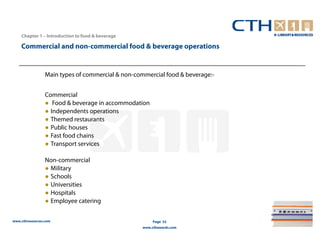
     desired topic. It usually is hosted by the general Manager or an employee of the Sales/marketing
     department, and the meeting is likely to be recorded.


www.cthresources.com                                      Page 311
                                                      www.cthawards.com
Chapter 7– Service quality in food and beverage

    Quality monitoring and measurement


      Aim                                          Focus group members             To research
      To determine satisfaction levels of          Existing restaurant customers   Opinions on likes and dislikes in relation to the:
      customers                                                                    •Menu
                                                                                   •Service
                                                                                   •Design
                                                                                   How the restaurant can improve?

                                                                                   •What is their perception or opinion on the
                                                   Non-customers/competitor        restaurant?
      To increase business of Non-customers        customers/potential customers   •What type of food they like?
      through identifying their opinions, dining                                   •What is important to them when eating out?
      habits and specific needs                                                    •Where do they currently dine out and why?
                                                                                   •What are their favourite dishes on the current menu?
                                                   Customers                       •What new would they like to see o the menu
      To gather opinions on customers to use in                                    •Are the prices reasonable?
      creating a new menu                                                          •Are the portion sizes suitable?
                                                                                   •Do they go to other places for dishes that we don’t
                                                                                   offer?


www.cthresources.com                                               Page 312
                                                               www.cthawards.com
Chapter 7– Service quality in food and beverage

    Quality monitoring and measurement


    3.4 Observation
    Within the organisation there is a wealth of information that can be used to improve quality whilst
    observation is an effective way of doing so.

        Examples                             Potential reason                   Effects
        Employees chatting                   Overstaffed, or poor               Waste
                                             scheduling of resources            High labour cost
                                                                                Bad impression for diners
        Employees rushing around             understaffed                       Customer complaints
                                                                                Discounts
                                                                                Slow service
                                                                                Employee stress
        Queuing at a buffet                  Poor controlling of                Customers become dissatisfied
                                             customer traffic                   Customers arriving go elsewhere
        Empty restaurant during peak         Poor marketing                     Loss of revenue
        time                                 Poor product and service           Poor image
                                             Better competition                 Hard to attract customers


www.cthresources.com                                            Page 313
                                                            www.cthawards.com
Chapter 7– Service quality in food and beverage

    Quality monitoring and measurement


     3.5 Critical logs

     Departmental log books provide information activities which take part within the organisation.
     These log books are found in departments and are a tool for supervisors and managers to
     exchange information between shifts. The logs consists of items such as complaints and issues,
     maintenance defects etc.


     3.6 Management of information

      Information is in most case logged by computers or past records and can be used effectively to
     provide a better service to customers. The following is an example of a restaurant receipt
     (figure 7.9) from a regular, local customer Mr. Bridges.


www.cthresources.com                                      Page 314
                                                      www.cthawards.com
Chapter 7– Service quality in food and beverage

    Quality monitoring and measurement


                                                Jimbaran restaurant at
                                                The Splendid Hotel
                                                Dubai

         Table: 24                          Date: 22.01.08                        Time: 18.47
         Server: Rashid
         No of Covers: 2

         Quantity                           Item                                  Charge
         1                                  Soup                                  20Dhs
         1                                  Caesar salad                          20Dhs
         1                                  Seafood platter                       100Dhs
         1                                  Cheesecake                            30Dhs
         2                                  Coffees                               30Dhs
         1                                  Sincere wine                          80Dhs
                                                                                  280Dhs
         Payment Method                     American Express
         Number                             87664456696xxxxxx
         Customer Name                      John H. Bridges


www.cthresources.com                                              Page 315
                                                              www.cthawards.com
Chapter 7– Service quality in food and beverage

    Quality monitoring and measurement


     3.7 External methods

          Mystery guests or mystery shoppers are employed by companies to visit their
          premises to conduct an evaluation of their products or services. These visits are
          normally contracted out and are carried out but an external professional company


     3.7.1 Mystery guests

                 Meeting with owner or operator to discuss the requirements
                 Mystery guest company creates measurement tool
                 Mystery guest makes reservation like a normal customer
                 Mystery guest carries out visit and audits services and products
                 Completes a formal report and delivers findings


www.cthresources.com                                      Page 316
                                                      www.cthawards.com
Chapter 7– Service quality in food and beverage

    Quality monitoring and measurement


        Advantages                                              Disadvantages
        Unbiased                                                Can be costly
        Conducted by experienced individuals
        Accurate
        Can be used as an development tool
        Employees are unaware of the mystery shopper


      Many large chains use survey results to compare performance between units.


www.cthresources.com                                      Page 317
                                                      www.cthawards.com
Chapter 7– Service quality in food and beverage

    Quality monitoring and measurement


    3.7.2 External surveys

    Professional companies can also be contracted to carry out surveys with members of the public:
             Specific needs and wants
             Likes and dislikes
             Eating and dining preferences
             Dining habits
             Preferred restaurants
             Reasons for eating out

    3.8 Secondary data

    Food beverage operations can also monitor consumer trends to help them cater to needs by viewing
    the following resources
             Academic books and journals
             Industry magazines
             Industry websites
             Industry reports

www.cthresources.com                                      Page 318
                                                      www.cthawards.com
Chapter 7 – Introduction to food & beverage

    Summary


                                                                  The importance
                                                                     of quality


                                                  Quality tools                    Measurement


                                                       Leadership           Internal          External


                                                    Meeting needs,
                                                      wants and          Questionnaires       Mystery guests
                                                     expectations


                                                      Standards of            Face to face
                                                                                              External surveys
                                                      performance              feedback


                                                     Quality human
                                                                             Focus groups
                                                       resources


                                                    Quality sourcing          Observation


                                                    Quality schemes           Critical logs


                                                    Service recovery
                                                                             Management
                                                     and complaint
                                                                             information
                                                       handling


www.cthresources.com                                                       Page 319
                                                                       www.cthawards.com
Chapters

                       1.   Introduction to food & beverage
                       2.   Food production
                       3.   Purchasing food & beverage
                       4.   Food service delivery
                       5.   Beverages
                       6.   Menu planning
                       7.   Service quality in food & beverage
                       8.   Conference & banqueting


www.cthresources.com                              Page 320
                                              www.cthawards.com
Chapter 8 – Conference and banqueting

    Objectives


                In this chapter you will learn to :-
                       ● Describe how the conference and banqueting department is structures
                       ● Explain the stages in the customer inquiry process
                       ● Identify and appraise the tools departmental managers use to maintain
                         standards, minimize expenses and maximize sales


www.cthresources.com                                       Page 321
                                                       www.cthawards.com
Chapter 8 – Conference and banqueting

    Characteristics of conference and banqueting (C&B)


                1.     Characteristics of conference and banqueting (C&B)
                       1.1 Benefits
                       1.2 Challenges
                       1.3 Personnel
                       1.4 Conference and banqueting sales


www.cthresources.com                                     Page 322
                                                     www.cthawards.com
Chapter 8 – Conference and banqueting

    Characteristics of conference and banqueting (C&B)


             ● Very diverse with many different events types
             ● Can be small or large in customer numbers
             ● Pre-planned
             ● Can be profitable
             ● Competitive due to many establishments having large available spaces
             ● Often seasonal
             ● Can be delivered in a variety of locations
             ● Empty space is expensive

                                      Conference                             Banqueting

                                       Formal                                   Relaxed
                                      Seminar                              Religious festivals
                                     Meetings                             Annual work parties
                                    Exhibitions                           Family celebrations
                             Presentations and lectures                Themed dinner and lunches
                                     Workshops                                 Weddings

www.cthresources.com                                   Page 323
                                                   www.cthawards.com
Chapter 8 – Conference and banqueting

    Characteristics of conference and banqueting (C&B)


                                                         Fig 8.1 Event types

                                                                   Forum

                                                Convention                       Seminar


                                    Symposium                                               Retreat


                                                                 Event types


                                     Congress                                              Trade show


                                                Exhibition                        Panel

                                                                  Interview


www.cthresources.com                                             Page 324
                                                             www.cthawards.com
Chapter 8 – Conference and banqueting

    Characteristics of conference and banqueting (C&B)


     Suitable venues to host events include :
             ● Conference centres
             ● Exhibition halls
             ● Hotels
             ● Large restaurants and bars
             ● Community centres
             ● Office cafeterias
             ● Ballrooms
             ● Church has
             ● Sports halls


www.cthresources.com                                Page 325
                                                www.cthawards.com
Chapter 8 – Conference and banqueting

    Characteristics of conference and banqueting (C&B)


    1.1 Benefits

            ● Can better utilize space and assets
            ● Can capitalize on annual events
            ● Can show case facilities
            ● Can receive additional revenue streams
            ● Potential for leads and follow on business
            ● Can attract local business
            ● Can provide better service as all brooked in advance
            ● Can achieve saving through bulk purchasing


www.cthresources.com                                  Page 326
                                                  www.cthawards.com
Chapter 8 – Conference and banqueting

    Characteristics of conference and banqueting (C&B)


     1.2 Challenges

            ● Empty space is cost
            ● Pressure to fill space daily
            ● Competitive
            ● Large quantities of inventory and equipment
            ● Additional storage requirements
            ● Difficult to manage expectations because of large quantities
            ● Large quantities of casual labour


www.cthresources.com                                   Page 327
                                                   www.cthawards.com
Chapter 8 – Conference and banqueting

    Characteristics of conference and banqueting (C&B)


    1.3 Personnel
   Position                                    Responsibilites
   Conference and Banqueting(C&B) manager      Overall management of department
                                               Fully accountable for profitability of department
                                               Promoting department
                                               Recruitment of employees
                                               Attending meetings
                                               Dealing with complaints
                                               Planning and forecasting
                                               Administration
   C&B chef                                    Meeting customers
                                               Discussing menu options
                                               Creating menus
                                               Preparing the food
                                               Seving the food
   C&B Assistant manager & supervisor          Overseeing and manageing events
                                               Training employees
                                               Booking casual staff
                                               Managing stock
                                               Managing customers' expectations
                                               Delivering standards


www.cthresources.com                            Page 328
                                            www.cthawards.com
Chapter 8 – Conference and banqueting

    Characteristics of conference and banqueting (C&B)


   C&B sales manager                           Creaing sales & marketing plan for department
                                               Implimenting plan
                                               Competitor analysis
                                               Managing employees
                                               Motivating employees
                                               Yeild amangement
                                               Training
   C&B sales executive                         Visiting clients and compenies
                                               Making presentations
                                               Showarounds
                                               Following up leads
   Event co-ordinator                          Taking reservations
                                               Creating contacts
                                               Maintain the booking dairy
                                               Banquet event sheets to departments
                                               Billing & deposits
   Waiters                                     Setting-up functions
                                               Mise en place
                                               Serving customers
                                               Dealing with customer enquiries
   Porters                                     Moving furniture
                                               Setting-up furniture and equipment
                                               Assisting waiters
                                               Breaking down rooms
www.cthresources.com                           Cleaning
                                                Page 329
                                            www.cthawards.com
Chapter 8 – Conference and banqueting

    Characteristics of conference and banqueting (C&B)


    1.4 Conference and Banqueting sales
                                                 Fig 8.2 Who are the customers?

                                                                      In-house
                                                                     customers

                                                Internation
                                                                                           Local
                                                     al
                                                                                         businesses
                                                companies


                                                                        C&B
                                              Internal               Department
                                             company
                                                                                              Charities
                                            events and
                                             functions


                                                           Local                   Event
                                                         residents                planners


www.cthresources.com                                              Page 330
                                                              www.cthawards.com
Chapter 8 – Conference and banqueting

    Characteristics of conference and banqueting (C&B)


    1.4 Conference and Banqueting sales continued ...
            Due to the competitive nature of the sector, various techniques have to be employed
            to fill Conference and Banqueting space. Some approaches include :
            ● Employing a sales team
            ● Creating a database of customers
            ● Contacting potential customers
            ● Creating brochures detailing facilities available
            ● Employing an experienced C&B team
            ● Featuring C&B facilities on hotel or establishment’s webpage
            ● Advertising facilities in local media
            ● Sending information and visiting local businesses
            ● Promoting facilities internally in lifts and bedrooms
            ● Creating own events internally


www.cthresources.com                                  Page 331
                                                  www.cthawards.com
Chapter 8 – Conference and banqueting

    The event process


                2.     The event process
                       2.1 Enquiry
                       2.2 The brochure or CD-Rom
                       2.3 The appointment and customer visit
                       2.4 The quotation and contract stage
                       2.5 Food, beverage and service
                       2.6 The event
                       2.7 Room set-up
                       2.8 Equipment
                       2.9 Follow-up and evaluation


www.cthresources.com                                      Page 332
                                                      www.cthawards.com
Chapter 8 – Conference and banqueting

    The event process


                                Fig 8.3 The conference and banqueting process


                                                       1. Enquiry


                             5. Follow up                                       2. Visit


                                            4. Event                  3. Quotation

www.cthresources.com                                       Page 333
                                                       www.cthawards.com
Chapter 8 – Conference and banqueting

    The event process


    2.1 Enquiry
     When customers contact the hotel to make an enquiry:
            ● Thank person for calling
            ● Take down personnel information, name, company, contact number and e-mail
            ● Establish what type of event is required
            ● Establish what date and time is required
            ● Check diary and determine availability

     Trend : Most banqueting diaries are now computerized and are able to provide information to include:
          ● Up-to-date availability of each room
          ● Specifications of each room
          ● Capacities for each room
          ● Past history of company or customer, room preferences and event type
          ● Room coasts based on supply, demand and day
          ● Future availability and usage per room, day and month
          ● Usage per company, event type and room type

www.cthresources.com                                 Page 334
                                                 www.cthawards.com
Chapter 8 – Conference and banqueting

    The event process


    2.2 The brochure or CD-Rom
    To promote the conference and banqueting facilities the sales office send out information
    packs (collateral) to acquaint customers with service available. This includes:
            ● The service team’s roles and responsibilities
            ● Testimonials from customers
            ● Photographs of events
            ● Blue point of room dimensions
            ● Examples of room set-up
            ● People capacity per room
            ● Equipment available
            ● Menus
            ● Packages available
            ● Contact details
            ● Business card of C&B sales person


www.cthresources.com                                    Page 335
                                                    www.cthawards.com
Chapter 8 – Conference and banqueting

    The event process


    2.3 The appointment and customer visit

     If the enquiry is for a large event or a new customer/company the sales assistant will attempt to secure
     an appointment and encourage the customer to visit the hotel to showcase the event facilities. The first
     impression of the customer must be positive. The sales executive should be prepared for the
     appointment in the following ways:
            ● Have a quiet place to discuss the customer’s needs and requirements
            ● Key staff available to discuss particular needs (E.g. a chef should be on hand to offer advice and
              suggestions with menu planning for the event.
            ● It is important to have rooms set-up for display. If a customer is coming to discuss a meeting
              then a meeting room should showcase for the customer what can be expected. You should
              never try to show an empty room to a customer as this may lose you the sale
            ● Have a presentation packs prepared, containing menus, seating layouts, photographs and room
              details
            ● Accommodation for the attendees should be prepared & rooms should be available to display.
            ● Relevant paperwork on hand such as, a customer checklist
            ● It’s important to introduce the person to the employee who will manage their event.

www.cthresources.com                                    Page 336
                                                    www.cthawards.com
Chapter 8 – Conference and banqueting

    The event process


    2.3 The appointment and customer visit continued ...
     During the appointment general information is obtained or confirmed from the customer.
             ● Contact details : (telephone, e-mail, fax, address, direct line)
             ● Date and arrival time
             ● Customer information : numbers and demographics (gender, age, nationality,
               profession)
             ● Customer with any special needs or requirements
             ● Event type : seminar, anniversary party
             ● Room set-up style : (classroom, workshop, round tables)
             ● Food requirements : (menus, meal times, special diets)
             ● Beverage requirement : (during the event, cash bar in the evening)
             ● Equipment requirements
             ● Budget per person
             ● Billing information
             ● Bedroom requirements
             ● Car parking requirements

www.cthresources.com                                  Page 337
                                                  www.cthawards.com
Chapter 8 – Conference and banqueting

    The event process


    2.3 The appointment and customer visit continued...
     Specific needs will be also expected for different events. (E.g. wedding)
             ● Flowers
             ● Speeches
             ● Master of ceremonies
             ● Dance floor
             ● Disk jockey (DJ)
             ● Seating plans


www.cthresources.com                                   Page 338
                                                   www.cthawards.com
Chapter 8 – Conference and banqueting

    The event process


    2.4 The quotation and contract stage
     The customer is sent a proposal detailing all the function’s requirements with pricing. The
     customer would either make changes or sign the paperwork and return it to the hotel. This
     signature creates a confirmed booking and contract between the customer and the
     establishment. The customer pays a deposit to secure the booking depending on the
     contract.
     The banqueting event order
     After the contract has been confirmed C&B sales creates a ‘ Banquet event order’. This is an
     international document to communicate the event’s details to the relevant department.


www.cthresources.com                                  Page 339
                                                  www.cthawards.com
Chapter 8 – Conference and banqueting

    The event process


    2.5 Food, beverage and service
     Food
     In C&B menus are normally table d’hote due to frequency of large numbers. Producing food for
     banqueting events has many advantages. It is shown below:


       Restaurants                                           Events (C&B)
       Large menu                                            Small menu
       Uncertainty about which menu item will be
       selected                                              No uncertainty - all menu items fixed
       Uncertainty about definite numbers that will visit
       restaurant                                      No uncertainty - numbers confirmed
                                                       No uncertainty - customers arrive as
       Uncertainty about what time customers will come organized
       Food wastage after service                      No food wastage


www.cthresources.com                                            Page 340
                                                            www.cthawards.com
Chapter 8 – Conference and banqueting

    The event process


    2.5 Food, beverage and service continued ...
    Beverage
    Beverage requirements varies according to the type of the event. (E.g. conference – tea,
    coffee & mineral water). Bars may be available during the evening for delegates to relax
    and network, and are available in different formats. They can be in a fixed bar or set up in
    another room to ease queuing.
    A cash bar - where each guest pays at the time the drink is served.
    A hosted bar – drinks are charged on a consumption basis. Companies frequently use this
    method & the bill is sent directly to the company after the event. The event organizer signs
    a bill at the end of the event to confirm consumption. If it’s a wedding sometimes the host
    pays a part of the bar bill in advance.
    During a banquet events a table service can be provided whereby customers are offered a
    variety wines, sprits, beers and soft drinks served at the table.


www.cthresources.com                                   Page 341
                                                   www.cthawards.com
Chapter 8 – Conference and banqueting

    The event process


    2.5 Food, beverage and service continued ...

     Service
     A variety of service methods include:
             ● Plated service
             ● Silver service
             ● Buffet service
             ● Family service
             ● Large events will be run using a more formal system where employees follow
               instructions by the head waiter or Maitre d’.


www.cthresources.com                                  Page 342
                                                  www.cthawards.com
Chapter 8 – Conference and banqueting

    The event process


    2.6 The event

     Hotel executives meet weekly discuss forthcoming events on a week by week basis. Each
     department is issued with an event sheet to:

             ● Communicate information
             ● Follow-up on any particular event needs
             ● Address any questions
             ● Resolve any last minute prolems


www.cthresources.com                                     Page 343
                                                  www.cthawards.com
Chapter 8 – Conference and banqueting

    The event process


                                                    Fig 8.7 The event process

                                                               1. Set up
                                                                event

                                                 8.                               2.
                                            Breakdown                          Welcome
                                               event                            guests


                                                                                            3. Run
                                       7.                                                  through
                                   Signature                                                event
                                   and billing                                            details for
                                                                                           the day


                                             6. Check                          4. Brief
                                            satisfaction                        staff

                                                               5. Deliver
                                                                 event


www.cthresources.com                                           Page 344
                                                           www.cthawards.com
Chapter 8 – Conference and banqueting

    The event process


   Step                    Action
                           The team will set up the event in advance of the customer and their guests arriving. (preparing furniture, laying tables,
   1. Set-up event         setting-up coffee stations, registration tables, bars and equipment.
   2. Welcome guests       Sales assistant/staff member managing the event greets the customer on arrival.
   3. Run through events   The C&B employee should check whether there's any last minute changes.
   4. Brief staff          All service staff are briefed on details to include:
                           The company and type of event
                           Chronology of event
                           For the organizer, host and any VIPs to be identified
                           Any special requests
                           Allocation of tables
                           Menu information
                           Standards
                           The event commences are planned. Service staff follow banquet event order and any instruction from event supervisor.
   5. Deliver event        Duties include:
                           Serving food and beverage
                           Dealing with customer requests
                           Monitoring equipment
                           Clearing tables
                           It is checked throughout the event and at the end. Any fedback from the customer is noted and communicated to service
   6. Check satisfaction   and other staff involved.
   7. Billing              Organizer or host signs the bill to agree all consumption and charges. Bill is settled depending on the contract .
   8. Breakdown event      Employees breakdown the event to include :
                           Collapsing furniture
                           Clearing tables
                           Polishing cutlery
                           Cleaning
                           Re-setting for next day's event or sales promotion
www.cthresources.com                                                            Page 345
                                                                          www.cthawards.com
Chapter 8 – Conference and banqueting

    The event process


    2.7 Room set-ups
             U-Shape                                 Classroom                  Banquet


          Hollow square
                                            Lecture or Theater (chairs only)   Horse shoe


www.cthresources.com                                         Page 346
                                                         www.cthawards.com
Chapter 8 – Conference and banqueting

    The event process


     2.7 Room set-ups continued ...


                       Herringbone           Workshop           Circle


www.cthresources.com                            Page 347
                                            www.cthawards.com
Chapter 8 – Conference and banqueting

    The event process


    2.8 Equipment

     Rental advantages
            ● No strong space required
            ● No cleaning and maintenance required
            ● No depreciation
            ● Less management overall
            ● Less risk of theft
            ● No training required
            ● Modern equipment provided

     Trend. C&B is the renting not only of equipment but also crockery. Cutlery, glassware and
     linen. The same advantages apply.


www.cthresources.com                                  Page 348
                                                  www.cthawards.com
Chapter 8 – Conference and banqueting

    The event process


     2.9 Follow-up and evaluation

     A key part of C&B is to monitor customer evaluation after the event has taken place. Any
     feedback received should be communicated to the departments involved and used for
     future planning.


www.cthresources.com                                 Page 349
                                                 www.cthawards.com
Chapter 8 – Conference and banqueting

    Summary


                                                   Conferencing
                                                       and
                                                    Banqueting


                                             The event          Objectives
                                              process          and structure


                                                               Benefits and
                                              Enquiry
                                                                challenges


                                             Quotation
                                                                 Personnel
                                            and contract


                                               Event                Sales


                                             Follow-up


www.cthresources.com                                        Page 350
                                                        www.cthawards.com

Food and beverage_operations

  • 1.
    Food & BeverageOperations May2010 www.cthresources.com 1 Page 1 www.cthawards.com
  • 2.
    Content I. Description II. Learning Outcomes III. Syllabus IV. Assessment V. Chapters 1 - 8 www.cthresources.com Page 2 www.cthawards.com
  • 3.
    Description Description The aim of the Food & Beverage Operations module is to provide students with an understanding of the operational & supervisory aspects of running a food & beverage operation for an international clientele in a range of establishments. To encourage an appreciation of the origins of such systems & to understand the various factors involved in meeting customer needs. Students will gain an understanding of food & beverage & its service in a variety of styles of restaurant & establishments & they will have sufficient knowledge to produce a broad plan for specified food & beverage operations. www.cthresources.com Page 3 www.cthawards.com
  • 4.
    Content I. Description II. Learning Outcomes III. Syllabus IV. Assessment V. Chapters 1 - 8 www.cthresources.com Page 4 www.cthawards.com
  • 5.
    Learning Outcomes Summary of Learning Outcomes On completion of this module, students will be able to: Demonstrate knowledge of the key functional areas of the food & beverage operation Describe the kitchen operation including food production systems, methods of cookery, kitchen layout & commodities Demonstrate the different methods of purchasing & food storage Examine the appropriateness of the different methods of food & beverage service to manage customer expectations Develop & plan menus according to customer requirements Describe the different types & requirements of banqueting functions www.cthresources.com Page 5 www.cthawards.com
  • 6.
    Content I. Description II. Learning Outcomes III. Syllabus IV. Assessment V. Chapters 1 - 8 www.cthresources.com Page 6 www.cthawards.com
  • 7.
    Syllabus – Part1 of 3 Syllabus ● Restaurant concepts & types of outlets; banqueting, fast food, hotel, Introduction to food & industrial, outside catering, institutional, in-flight, restaurant, public beverage operations house & transport catering ● Typical organization structures & job titles in kitchen, restaurant & banqueting departments ● Food production systems including traditional, centralised, cook-chill, Food production cook-freeze & sous vide operations ● The suitability of these systems to the operation. Methods of cookery. Kitchen layout & equipment. Commodities: food & non-food ● The policies & procedures for purchasing of food & non-food items for a hospitality operation Purchasing & storage of ● The use of standard purchasing specifications & other recognised goods standards/brand names when ordering both food & non-food items. ● The correct storage of commodities. The security aspects of storing high value items ● Procedures for the issuing of stock items, including all records kept, & checks on the use of commodities www.cthresources.com Page 7 www.cthawards.com
  • 8.
    Syllabus – Part2 of 3 Syllabus ● Methods of food service, silver service, plate service, buffet, counter Food service systems service, room service, self service, assisted service. Suitability & cost of service styles ● Meeting managing customer expectations. Staff skill levels. Preparation & layout of food & service operations Production & sale of ● Preparation & layout of beverage service, service of alcoholic & non- non-alcoholic & alcoholic beverages & hot beverages alcoholic beverages ● Beverage menu & wine list ● Menu structure & trends Menu planning ● Factors affecting the compilation of menus, menu development ● Catering for customer requirements & trends in modern diets. www.cthresources.com Page 8 www.cthawards.com
  • 9.
    Syllabus – Part3 of 3 Syllabus Providing excellent ● Employee attitude, personal appearance, hygiene practices customer service in food & beverage ● Attentiveness, body language, effective communication, team work, operations attention to detail ● Types of events, planning, organising & costing of an event. Menu & Banqueting & functions service styles ● Health, safety & hygiene considerations. Staffing the event. Evaluation www.cthresources.com Page 9 www.cthawards.com
  • 10.
    Content I. Description II. Learning Outcomes III. Syllabus IV. Assessment V. Chapters 1 - 8 www.cthresources.com Page 10 www.cthawards.com
  • 11.
    Assessment Assessment This module will be assessed via a 2 ½ hour examination, set & marked by CTH. The examination will cover the whole of the assessment criteria in this unit & will take the form of 10 x 2 mark questions & 5 x 4 mark questions in section A (40 marks). Section B will comprise of 5 x 20 mark questions of which candidates must select & answer three (60 marks). CTH is a London based awarding body & the syllabus content will in general reflect this. Any legislation & codes of practice will reflect the international nature of the industry & will not be country specific. International centres may find it advantageous to add local legislation or practice to their teaching but they should be aware that the CTH examination will not assess this local knowledge. www.cthresources.com Page 11 www.cthawards.com
  • 12.
    Content I. Description II. Learning Outcomes III. Syllabus IV. Assessment V. Chapters 1 - 8 www.cthresources.com Page 12 www.cthawards.com
  • 13.
    Chapters 1. Introduction to food & beverage 2. Food production 3. Purchasing food & beverage 4. Food service delivery 5. Beverages 6. Menu planning 7. Service quality in food & beverage 8. Conference & banqueting www.cthresources.com Page 13 www.cthawards.com
  • 14.
    Chapter 1 –Introduction to food & beverage Objectives In this chapter you will learn to :- ● Present the key characteristics, objectives & challenges of the sector ● Detail the diverse structure & scope of the sector ● Explain the complexity of the classifying the sector ● Describe & evaluate the characteristics & aims of a range of different types of food & beverage operations www.cthresources.com Page 14 www.cthawards.com
  • 15.
    Chapter 1 –Introduction to food & beverage Introduction to the food & beverage sector 1. Introduction to the food & beverage sector 1.1 Food & beverage: main objectives & expectations 1.2 Characteristics of the food & beverage sector 1.3 Trends in food & beverage 1.4 Size & structure of the food & beverage industry 1.5 Classification & organisation of the sector: the challenge www.cthresources.com Page 15 www.cthawards.com
  • 16.
    Chapter 1 –Introduction to food & beverage Introduction to the food & beverage sector Fig 1.1 The food & beverage cycle Most food & beverage businesses operate within the cycle & the different stages of the cycle present both challenges & opportunities for operators . 1. Purchasing 8. Consuming 2. Receiving 7. Serving 3. Storing 6. Cooking 4. Issuing 5. Preparing www.cthresources.com Page 16 www.cthawards.com
  • 17.
    Chapter 1 –Introduction to food & beverage Introduction to the food & beverage sector 1.1 Food & beverage: main objectives & expectations Most food & beverage operations aim to provide: - Quality food & beverages A clean, hygienic & safe environment Comfortable & well designed facilities Professional, attentive & friendly service Value for money www.cthresources.com Page 17 www.cthawards.com
  • 18.
    Chapter 1 –Introduction to food & beverage Introduction to the food & beverage sector The main challenges of the hospitality industry & the food sector are:- ● Intangibility – such as ambiance ● Simultaneous production & consumption - where mass production is difficult for it requires large amounts of customers & producers in one placer which would cause environmental, social, cultural & economic problems ● Heterogeneity – where service experience may vary due to different producers & consumers with different needs & requirements ● Consistency – is difficult to achieve due to the intangible element in food & beverage ● Perishability – where unused hospitality services cannot be stored, returned, claimed or resold Ownership – where the consumer only owns a hospitality product only for a certain period of time No guarantees – with little aftercare or service Imitation is easy – with no patents on service processes & easily copied by competitors Seasonality – where staffing & expenses are challenging to many restaurant operators External variables – that impact the running of the business such as political, economic, social, technological, legal & environmental change www.cthresources.com Page 18 www.cthawards.com
  • 19.
    Chapter 1 –Introduction to food & beverage Introduction to the food & beverage sector 1.2 Characteristics of the food & beverage sector Following are the main characteristics:- ● A vital part of everyday life ● Major contributor to the national economy ● Highly fragmented & complex ● Creates employment ● Encourages entrepreneurship ● Promotes diversity through many different food concepts & cuisines ● Fuels innovation ● Local multiplier using many other peripheral services ● Consumer led ● Competitive ● An opportunity to enjoy the company of friends, family & colleagues ● Fulfils basic needs (see Fig 1.2) www.cthresources.com Page 19 www.cthawards.com
  • 20.
    Chapter 1 –Introduction to food & beverage Introduction to the food & beverage sector Fig 1.2 Maslow’s Hierarchy of Needs Food is a basic need for everyday life Self - actualization Self Esteem Love & belonging Safety needs Physiological needs www.cthresources.com Page 20 www.cthawards.com
  • 21.
    Chapter 1 –Introduction to food & beverage Introduction to the food & beverage sector 1.3 Trends in food & beverage Following are some key trends in the UK:- ● Guests become more sophisticated ● More emphasis on food safety & sanitation ● More casual/less formal & theme restaurants ● Increase in ethnic restaurants & ethnic food ● Growth in chains –all cuisines ● Increase in convenience food ● Increase in coffee chains – coffee culture ● Increased take out meals & home meal replacement ● Outsourcing outlets in hotels – co-branding ● More focus on healthier eating ● Increase in organic food consumption, food sustainability & provenance www.cthresources.com Page 21 www.cthawards.com
  • 22.
    Chapter 1 –Introduction to food & beverage Introduction to the food & beverage sector 1.4 Size & structure of the food & beverage industry Fig 1.3 The United Kingdom Food Service Industry (2006) www.cthresources.com Page 22 www.cthawards.com
  • 23.
    Chapter 1 –Introduction to food & beverage Introduction to the food & beverage sector 1.5 Classification & organisation of the sector: the challenge The food & beverage sector is extremely diverse & fragmented that the size & scope of the industry creates a challenge when attempting to organise & classify it. It has many subsectors. Following are the classification approaches & options:- ● Commercial & non-commercial ● Size ● Ownership ● Star rating or quality ● Service method ● Food or beverage ● Concept or theme ● Revenue or turnover ● Location ● Meal time or meal period ● Customer type ● Cuisine ● Awards & schemes www.cthresources.com Page 23 www.cthawards.com
  • 24.
    Chapter 1 –Introduction to food & beverage Introduction to the food & beverage sector Fig 1.4 Classification of food & beverage Food & Beverage outlets Non Commercial Commercial General Restricted Institutional Employee market market catering catering Travel In-house Hotels Schools catering catering Restaurants University Contract Clubs & snack bars catering caterer Institutional Fast food & The military & employee take away services catering Function & event Prisons catering www.cthresources.com Page 24 www.cthawards.com
  • 25.
    Chapter 1 –Introduction to food & beverage Introduction to the food & beverage sector Variety of food & beverage operations Ethnic restaurants Ethnic chains Educational Institutions Shopping malls, (Chinese, Japanese, (Wagamama, Bombay Transport (rail, air & (schools, colleges, airports, food counters French, Malaysian, Bicycle Yo Sushi, marine) universities) Caribbean) Nandos) Restaurants (bistros, Welfare catering brasseries, coffee shops, Supermarkets – food hospitals, healthcare, cafeterias, wine bars, Employee dining Outside catering retail ( food to go) prisons, military public houses, roadside restaurants) Themed restaurants Private clubs Street vendors Fine dining (Hard Rock Café, Planet Cafes & sandwich bars Hollywood) Fast food chains Accommodation (hotels, Leisure (museums, Conference centres Takeaway (kiosks, fish & (McDonalds, Subway motels, guest houses, theme parks, theatres, chips, snack bars) KFC, Wendy’s) hostels) cinemas) www.cthresources.com Page 25 www.cthawards.com
  • 26.
    Chapter 1 –Introduction to food & beverage Management options in food and beverage: main approaches 2. Management options in food & beverage: main approaches 2.1 Self – operated 2.2 Franchise agreement 2.3 Management contracting 2.4 Outsourcing www.cthresources.com Page 26 www.cthawards.com
  • 27.
    Chapter 1 –Introduction to food & beverage Management options in food and beverage: main approaches 2.1 Self-operated The owner or organisation manages the operation themselves. It could be a small, large or a franchised situation 2.2 Franchise agreement Ninemeier (2000) explains: ‘ With a franchise, the franchisee (the owner of the facility) pays fees to the franchisor (or franchise company) in exchange for the right to use the name, building design, and business methods of the franchisor. Furthermore, the franchisee must agree to maintain the franchisor’s business & quality standards’. www.cthresources.com Page 27 www.cthawards.com
  • 28.
    Chapter 1 –Introduction to food & beverage Management options in food and beverage: main approaches Figure 1.5 Evaluation of Franchise agreement: Franchiser & Franchisee (Mc Donalds) www.cthresources.com Page 28 www.cthawards.com
  • 29.
    Chapter 1 –Introduction to food & beverage Management options in food and beverage: main approaches 2.3 Management contracting When an owner or operator of an establishment employs or contracts specialised hospitality or food & beverage service company to manage the whole or part of the operation. This could b don either in a hotel or in a non-commercial institution, for example a university Figure 1.6: Management contracting analysis www.cthresources.com Page 29 www.cthawards.com
  • 30.
    Chapter 1 –Introduction to food & beverage Management options in food and beverage: main approaches 2.4 Outsourcing Increasingly, hotels are realising that hotel-run restaurants are in some cases unprofitable due to many residents opting to dine at known branded outlets. Therefore, a new & emerging trend is where the hotel forms a partnership with a restaurant/coffee chain/bar brand that would operate from a designated area within the hotel. Fig 1.7 Food & beverage outsourcing in hotels (Starbucks) http://www.litchfieldbeach.com www.cthresources.com Page 30 www.cthawards.com
  • 31.
    Chapter 1 –Introduction to food & beverage Commercial and non-commercial food & beverage operations 3. Commercial and non-commercial food & beverage operations 3.1 Food & beverage in accommodation 3.2 Food & beverage services in hotels 3.3 Independent restaurants (small/medium enterprise – SME) 3.4 Ethnic restaurants 3.5 Themed restaurants 3.6 Public houses or licensed premises 3.7 Chained restaurants & bars 3.8 Food & beverage in transportation 3.9 Non-commercial food & beverage 3.10 Characteristics of non-commercial operations www.cthresources.com Page 31 www.cthawards.com
  • 32.
    Chapter 1 –Introduction to food & beverage Commercial and non-commercial food & beverage operations Main types of commercial & non-commercial food & beverage:- Commercial ● Food & beverage in accommodation ● Independents operations ● Themed restaurants ● Public houses ● Fast food chains ● Transport services Non-commercial ● Military ● Schools ● Universities ● Hospitals ● Employee catering www.cthresources.com Page 32 www.cthawards.com
  • 33.
    Chapter 1 –Introduction to food & beverage Commercial and non-commercial food & beverage operations 3.1 Food & beverage in accommodation Can vary depending on location specific areas, size, ownership, location, goals, customer & quality. Coffee shop, Fine dining restaurant/s, Specialty restaurant, Bar, Coffee 5-star hotels lounge/pastry counter, Conference & banqueting, Outside catering, 24- hour full room service menu, Executive lounge food & beverage services, In room guest amenities, Mini bar, Nightclub, karaoke, cigar room, pool café, delicatessen, Employee dining Coffee shop, Specialty restaurant, Bar & lounge, Room service (limited 4-star hotels throughout the night), Guest amenities, Conference & banqueting, Mini bar, Employee dining Budget hotels Breakfast buffet, Bar, Vending machines, Employee dining Bed & breakfast Breakfast, Limited set menu available at set times on request Hostel Snack bar, Vending, Food prepared on request to take away www.cthresources.com Page 33 www.cthawards.com
  • 34.
    Chapter 1 –Introduction to food & beverage Commercial and non-commercial food & beverage operations Fig 1.8 The food & beverage structure within a 4-star hotel Food & Beverage Manager Assistant food & Executive Chef Beverage Manager Food and Beverage Sous Chef coordinator Conference and Restaurant Coffee shop Chief Steward Bar Manager Banqueting Manager Manager Manager Conference and Room service Restaurant Team Bar Team Banqueting and Mini Bar Kitchen team Team Manager Room Service team www.cthresources.com Page 34 www.cthawards.com
  • 35.
    Chapter 1 –Introduction to food & beverage Commercial and non-commercial food & beverage operations 3.2 Food & beverage services in hotels Most hotels operate multiple food & beverage outlets. Outlets, products and services offered are subject to change from property to property. The outlets could be:- ● Coffee shop ● Restaurant ● Fine dining ● Bar ● Lounge ● Executive lounge ● Conferencing & banqueting ● Outside catering ● Room service ● Mini bar ● Guest amenities ● Employee dining www.cthresources.com Page 35 www.cthawards.com
  • 36.
    Chapter 1 –Introduction to food & beverage Commercial and non-commercial food & beverage operations 3.3 Independent restaurants An independent restaurant is an individual trading entity, and in most cases the unit is managed by the owner. The restaurants could be themed ethnic, have a variety of service methods such as self-service, cafeteria, take-away, sit down or drive-through. They rely heavily on passing trade and word of mouth advertising. Almost 70% are often dynamic & varied. As the team is much smaller, many of the positions overlap. Fig 1.13 Typical organisational chart of a small independent food & beverage organisation Restaurant Manager/ Owner Assistant food & Restaurant Beverage Supervisors Manager Kitchen Team Restaurant Team Bar Supervisor Kitchen Porters Cleaners www.cthresources.com Page 36 www.cthawards.com
  • 37.
    Chapter 1 –Introduction to food & beverage Commercial and non-commercial food & beverage operations An independent restaurant is an individual trading entity, and in most cases the unit is managed by the owner. The restaurants could be themed ethnic, have a variety of service methods such as self-service, cafeteria, take-away, sit down or drive-through. They rely heavily on passing trade and word of mouth advertising. Almost 70% are often dynamic & varied. As the team is much smaller, many of the positions overlap. Fig 1.13 Typical organisational chart of a small independent food & beverage organisation www.cthresources.com Page 37 www.cthawards.com
  • 38.
    Chapter 1 –Introduction to food & beverage Commercial and non-commercial food & beverage operations 3.4 Ethnic restraints These type of restaurants can be part of a chain but also independent in nature. Manage by owners and operated around a central theme such as Chinese, Japanese and Middle Eastern. 3.5 Themed restaurants These type of restaurants are operations that have a central theme throughout such as music, entertainment or sport for example. For a example the Hard Rock Cafe. 3.6 Public houses or licensed premises Public houses (‘pubs’) offer comfortable, relaxing environments for groups or individuals can get together to enjoy beverages. Beverages are the main products but they offer great verity of foods due to declining beverage sales. They outsource their kitchen to chef entrepreneurs and the growth in gastro pubs. www.cthresources.com Page 38 www.cthawards.com
  • 39.
    Chapter 1 –Introduction to food & beverage Commercial and non-commercial food & beverage operations 3.7 Chain restaurants and bars Key characteristics of chain restaurants ● Several units operating in different locations. ● Can be national, regional or global ● Operations normally duplicated and featured the same design, menus and operations in each unit. ● Good infrastructure and support networks – training and purchasing for example. ● Provide consistency and standardisation to customers. ● Centralised purchasing and distribution networks. ● Operations are normally themed around a central concept. ● Service systems can vary from take-away, drive thru, dine in, causal or fine dining. ● The operations can be owned by a parent company, a franchise or private owners. www.cthresources.com Page 39 www.cthawards.com
  • 40.
    Chapter 1 –Introduction to food & beverage Commercial and non-commercial food & beverage operations 3.8 Food and beverage in transportation Range from cafeteria-style snacks on short routes to fine dining on cruise lines. Sea Normally transfer large quantities in short period of time. Range from purchased snack on budget airlines or gourmet set menus for first- class passengers. The food is mass produced and prepared off-site. The on-board Air catering is normally contracted out to a specialist cater. Beverage can be range from trolley to full. Range from fine dining to trolley service. Provide on-board kiosk where customers can purchase a basic selection of hot and cold food and beverages. Another Rail common method is an on-board trolley service, move from carriage to carriage. Fine dining is offered in first-class long journeys. 3.9 Non-commercial food and beverage Main focus is on providing nutritious food and beverages but the primary mission is not to sell food and beverages. www.cthresources.com Page 40 www.cthawards.com
  • 41.
    Chapter 1 –Introduction to food & beverage Commercial and non-commercial food & beverage operations 3.10 Characteristics of non-commercial operations ● Non-commercial institutions hire commercial food service management(contract) companies from outside to manage food service in their institutions. ● Commercial food service management companies exist to make profit. ● They carry out fully the food and service responsibilities for the institutions under contract. ● The institution or workplace can free itself from the day-to-day concern of managing food service operations. ● They are professional food service companies. ● These operations are planned to keep the expenses/ costs low; they are budget-oriented. ● They are part of properties that exist for reasons other than the service of food and beverages, which is only supportive. ● Competition is limited as the service is provided in a private, closed environment. ● Normally large scale, delivered at particular times of day. ● Business levels are quite predictable making it easier for production and planning. ● Emphasis is not placed on nutrition. www.cthresources.com Page 41 www.cthawards.com
  • 42.
    Chapter 1 –Introduction to food & beverage Summary Introduction to food and beverage Objectives, Challenges and characteristics Food and beverage classifications and types Management options Commercial Non commercial operations operations Hotel food and Military beverage Independent Schools operations Ethnic, themed and chain University operations Transport Employee catering www.cthresources.com Page 42 www.cthawards.com
  • 43.
    Chapters 1. Introduction to food & beverage 2. Food production 3. Purchasing food & beverage 4. Food service delivery 5. Beverages 6. Menu planning 7. Service quality in food & beverage 8. Conference & banqueting www.cthresources.com Page 43 www.cthawards.com
  • 44.
    Chapter 2 –Food production Objectives In this chapter you will learn to :- ● Explain kitchen organization and the responsibilities of key personnel employed ● Describe and appraise the different food production methods ● Identify the main food groups and commodities ● Describe the main considerations in kitchen designs ● Discuss the importance of achieving food cost ● Explain the importance of food hygiene and control www.cthresources.com Page 44 www.cthawards.com
  • 45.
    Chapter 2 –Food production Kitchen introduction 1. Kitchen introduction 1.1 Communication 1.2 Kitchen chef characteristics 1.3 Staffing and responsibilities 1.4 Kitchen organization 1.5 Partie system analysis 1.6 The stewarding department www.cthresources.com Page 45 www.cthawards.com
  • 46.
    Chapter 2 –Food production Kitchen introduction Fig 2.1 Main objectives of the kitchen department To provide safe meals for all consumers To prepare food To provide in the time quality meals expected, to for all avoid customer consumers waiting To meet or To prepare the exceed the food right quantity of needs of food organization’s Kitchen target market Objectives To create To utilize food menus that will stocks in the both attract and best way retain possible customers To achieve monthly To minimize financial food stock wastages targets www.cthresources.com Page 46 www.cthawards.com
  • 47.
    Chapter 2 –Food production Kitchen introduction Most kitchens will be managed by an Executive or Head Chef. Their responsibilities can be, Fig 2.2 Executive Chef job description www.cthresources.com Page 47 www.cthawards.com
  • 48.
    Chapter 2 –Food production Kitchen introduction 1.1 Communication Fig 2.3 Executive Chef communication Purchasing & Stores Competitors Department Bar Genaeral Customers Manager's office External Suppliers Room service Housekeeping EXECUTIVE Accounts CHEF department Sales and Marketing Human Resources Stewarding Front office & Reception Conference & Banqueting Restaurant www.cthresources.com Page 48 www.cthawards.com
  • 49.
    Chapter 2 –Food production Kitchen introduction 1.2 Kitchen chef characteristics 1.2.1Qualities of a good chef Ability to work under pressure Ability to multi task Creative Consistent Good palate Ability to work in a team 1.2.2 Challenges for a chef Fast paced and hot work environment Many stakeholders Risk of food poisoning In most cases a high level of competition High perishability of stock items Frequently changeable external environment (i.e. food trends or scares) Unsociable work www.cthresources.com Page 49 www.cthawards.com
  • 50.
    Chapter 2 –Food production Kitchen introduction 1.2.3 Opportunities for a chef Be creative and showcase skills Satisfy customers Acquire and pass on skills Meet lots of interesting people Learn and sample a wide variety of different food Travel Obtain awards for culinary expertise 1.2.4 Chef presentation Appearance – trimmed hair, clean hair, hair tied back if long, neatly shaven, no earrings on males, studded earrings only for women Accessories – wristwatch, maximum two rings, body piercings or tattoos should not be visible, no visible necklaces Trousers – pin striped, clean, well pressed Shoes – slip resistant, in good repair www.cthresources.com Page 50 www.cthawards.com
  • 51.
    Chapter 2 –Food production Kitchen introduction 1.3 Staffing and responsibilities The organizational structure of a kitchen will depend on a number of factors including : - Size and kitchen space available Quantity of food output (demand) Number of food outlets to cater Sophistication and type of menu Equipment requirement Location where production is taking place (in kitchen or outsourced) Service methods (Buffets, plated) www.cthresources.com Page 51 www.cthawards.com
  • 52.
    Chapter 2 –Food production Kitchen introduction 1.4 Kitchen organization “Partie system” is a method of kitchen organization which is formal, structured brigade and in most cases, only found in high quality kitchens and restaurants. Fig 2.4 The ‘Partie’ system Executive Chef Sous Chef Chef Tournant Chef de partie Chef de partie Chef de partie Chef de partie Chef de partie Grade Manager Saucier Poissonier Patiser Entremetier Demi Chef de Demi Chef de Demi Chef de Demi Chef de Demi Chef de Partie Grade Partie partie Partie Partie Poissonier Partie Patiser Manager Saucier Entremetier Commis Grade Commis Commis Commis Saucier Commis Patiser Manager Poissonier Entremetier www.cthresources.com Page 52 www.cthawards.com
  • 53.
    Chapter 2 –Food production Kitchen introduction Role Responsibilities Sous Chef Assistant to the executive chef, deputies in his/her absence Chef Tournant Covers each section as and when required – has the skills and knowledge to cover all sections Chef Grade Manager Responsible for the preparation of all cold savoury foods Chef Saucier Responsible for all sauteed items Chef Poissonnier Preparation and cooking of all fish dishes Chef Patissier Preparation of desserts and pastries Chef Entremetier Preparation of all vegetables, soups and hot appetisers www.cthresources.com Page 53 www.cthawards.com
  • 54.
    Chapter 2 –Food production Kitchen introduction 1.5 Partie system analysis Advantages Disadvantages Chefs specialize in a particular section of a Although chefs specialize, they only focus on kitchen one section of the kitchen as opposed to learning a wide range of skills in more conventional kitchen systems. Each section has a support infrastructure to Staff can be ideal when particular section of the avoid any weaknesses kitchen are not busy Chef have a clear route f or progression Can be expensive for the organization due to the large numbers of staff required Customers receives quality meals Chefs becomes bored Kitchen managers are able to allocate responsibility and accountability to the various sections Kitchen managers are able to detect and monitor problems more easily www.cthresources.com Page 54 www.cthawards.com
  • 55.
    Chapter 2 –Food production Kitchen introduction Many kitchens now provide chefs with opportunities to work and rotate in other sections of the kitchen. The benefits of this for the organization: - Chefs become multi skilled and therefore more flexible Job satisfaction is more greater due to acquiring a more divers skill set Labour cost are more streamlined due to better utilization of labour www.cthresources.com Page 55 www.cthawards.com
  • 56.
    Chapter 2 –Food production Kitchen introduction 1.6 The stewarding department Stewarding is a sub department of the kitchen and it’s staffing requirements for a large operation are detailed below: - Fig 2.5 Basic Stewarding organization chart in a large kitchen Chief Steward Assistant Chief Steward Kitchen Kitchen Kitchen Kitchen Kitchen Porter Porter Porter Porter Porter www.cthresources.com Page 56 www.cthawards.com
  • 57.
    Chapter 2 –Food production Kitchen introduction Position Responsibilities Chief Steward and assistant • Report to Executive Chef and Food and Beverage Manager • Supervise team of porters • Schedule work of Porters • Create cleaning standards • manage and control equipment stores (in/out) •Responsible for the maintenance of hygiene within kitchen • Control of kitchen chemicals (COSHH) • Co-ordinate booking of any maintenance of kitchen cleaning contractors or casual staff • Responsible for inventory and maintenance of kitchen cleaning equipments Kitchen Porters • Carry out day-to-day cleaning of the kitchen • Operate the dishwasher machine • Clean kitchen equipment after use • Empty dustbins • Periodically sweep and mop floors • Clean kitchen work tops www.cthresources.com Page 57 www.cthawards.com
  • 58.
    Chapter 2 –Food production Kitchen design and planning considerations 2. Kitchen design and planning considerations When planning a kitchen there are many factors to consider. Each design element must work together, to create smooth running kitchen operation, and include control, safety, business yield and employee satisfaction. Poor planning often lead to, Wasted capacity Poor stock rotation Employee accidents Low employee motivation Slow production and output Risk of food poisoning www.cthresources.com Page 58 www.cthawards.com
  • 59.
    Chapter 2 –Food production Kitchen design and planning considerations Figure 2.6 Kitchen design considerations Maximum Standards of Work flow of Production POS Systems Space available Output organisation employees efficiency Heating, Service Environmental Utilisation of Communication HACCP ventilation and methods of regulations space with services requirements air conditioning restaurants Legislation- Efficient Equ8ipment Supervision by Employees Menu types communication Gas & Electricity requirements managers working space between chefs ratios Health and Storage Drainage & safety of Production Control of stock Refuse disposal requirements plumbing employees & methods (bulk & section) customers Restaurant Allocation of preparation Ergonomics Task Lighting cleaning space area www.cthresources.com Page 59 www.cthawards.com
  • 60.
    Chapter 2 –Food production Production methods and organisation 3. Production methods and organisation 3.1 Production methods 3.2 The conventional food production method 3.3 The sous-vide method of food production (vacuum cooking) 3.4 Sous-vide - evaluation 3.5 Cook-chill method of food production 3.6 Cook-freeze method of food production 3.7 The central distribution method of food production www.cthresources.com Page 60 www.cthawards.com
  • 61.
    Chapter 2 –Food production Production methods and organisation And efficient kitchen is where the chefs prepare and cook food in minimal time whilst maintaining a very high standard. This could be achieved through a methodical and economical method of working by, Ensuring all kitchen equipment is up to standard and ready to use. E.g.: A sharp Source: http//www.luxuryhomedesign.blogspot.com knife over a blunt one at all times. Using electrical equipment for appropriate and worth while purposes, for instances a potato peeler for 4 portions of potatoes which is likely to take more time in putting the machine to use than the time taken to peel potatoes it self is unworthy. Working systematically as possible The kitchen crew holding right postures in order to avoid fatigue and so forth. E.g. when standing for ;long periods of times standing correctly with weight evenly on both legs. www.cthresources.com Page 61 www.cthawards.com
  • 62.
    Chapter 2 –Food production Production methods and organisation Ensuring all necessary equipment is ready and usable at the start of each working session. Positioning all work tops, sinks, stores, and refrigerators within easy reach to eliminate unnecessary movements of chefs. Storing all ingredients as close to the practical work area, starting from most frequently used items close at hand. Preparing the mise en place thoroughly to ensure the follow-on of a smooth and efficient service. Following a clear and continuous work plan, opposed to a haphazard one. E.g. preparing those dishes first which demands more time to prepare. Source: Caterer & Hotelkeeper www.cthresources.com Page 62 www.cthawards.com
  • 63.
    Chapter 2 –Food production Production methods and organisation 3.1 Production methods Food production is differing methods of preparing, cooking and serving food to produce meals to the customer. Food Preparation Cooking Holding Regeneration Presentation Fresh Weigh/Measure Blanch Chill Regithermic Bain-marie Fresh cooked clear/open Warm Sous-vide Microwave Service flats Fresh Chop/cut Simmer Freeze Convection Plates Prepared Combine/mix Boil Tray Traditional Trays Canned Blend Steam Hot Vending Fresh Shape/coat Grill Cupboard Buffet Chilled Form Sauté Cold Trolley Vacuum Brown Cupboard Dishes Dehydrated Bake Smoked Roast Salted Broil Crystallised Fry Acidified Microwave Pasteurized Bottled UHT Foods in Process Output www.cthresources.com Page 63 www.cthawards.com
  • 64.
    Chapter 2 –Food production Production methods and organisation 3.1.1 Key considerations in food production Food hygiene Quality raw materials Foods should be stored properly Appropriate preparation for each food item Minimised wastage Employees should comply with handling regulations Foods should be cooked to proper temperatures Methods differ in relation to: Actual location where food is produced Total time from preparation to service Staff numbers required Level of hygiene and control Quantity of food produced www.cthresources.com Page 64 www.cthawards.com
  • 65.
    Chapter 2 –Food production Production methods and organisation Figure 2.7 Food production methods Conventional Cook- chill Cook-freeze Food Production Methods Centralised Sous-vide distribution www.cthresources.com Page 65 www.cthawards.com
  • 66.
    Chapter 2 –Food production Production methods and organisation 3.2 The conventional food production method The conventional method is used in most kitchen establishments and follows the process as shown in figure 2.8. Figure 2.8 Conventional food production process Refrigeration Preparation Ordered Goods in to Freezing (Mise en from Cooking Serving kitchen Dry Store place) customer www.cthresources.com Page 66 www.cthawards.com
  • 67.
    Chapter 2 –Food production Production methods and organisation Food as given in the table below can be cooked in variety of methods during the food production process. Method Explanation Baking Cooked in dry heat, in the oven Blanching Dipping the food in to boiling water or oil for a short time Boiling Cooked in a boiling or rapidly simmering liquid Braising Browned in small amount of fat, then cooked slowly in a small amount of liquid Boiling Cooked by direct heat from above or below Fried Cooked in fat or oil Deep fried Cooked in enough fat to cover the food Grilled Cooked on a grill, over direct heat Poaching Cooked in a liquid , just below boiling point (simmering) Roasting Cooked uncovered, usually by in oven by dry heat Sautéing Browned or cooked in a small amount hot fat or oil Steaming Cooked in steam with or without pressure Stewing Simmering slowly in enough liquid to cover the food Adapted from cichy & wise (1999) www.cthresources.com Page 67 www.cthawards.com
  • 68.
    Chapter 2 –Food production Production methods and organisation 3.3 The sous-vide method of food production (vacuum cooking) Figure2.9 Sous vide process Portioned in to plastic pouches and Food is Sealed arranged vacuum Customer pouches Re- Pouch is on plate Goods in Prepared Cooked packed orders placed in heated cut open and meals boiling served water Chilled and refrigerated www.cthresources.com Page 68 www.cthawards.com
  • 69.
    Chapter 2 –Food production Production methods and organisation 3.4 Sous – vide - evaluation Advantages Disadvantages Pouches retain freshness Capital investment in equipment During re-heating juices are retained in and storage pouch and not lost Not as fresh as conventional Individual pouches are labeled for easy method stock rotation Not able to adjust to customer There is less risk of cross contamination requirements during storage due to sealed pouches Not all foods suitable for sous- and labeling vide method Less wastage as foods is used only when Negative stigma attached(Boil in ordered the bag!) Food can be produced and accurately portioned Chef does not need to be present for reheating and finishing stage Pouched can be frozen to extend life Inexpensive regeneration www.cthresources.com Page 69 www.cthawards.com
  • 70.
    Chapter 2 –Food production Production methods and organisation 3.5 Cook-chill method of food production Cook chill is a catering system based on normal preparation and cooking of food followed by rapid chilling and storage. In controlled low temperature conditions above freezing point, subsequently reheating prior to consumption. The chilled food is regenerated in finishing kitchens which require low capital investment and minimum staff. All most any food can be cook chilled provided that the correct methods are used. Foskett et al. ( 2004) Figure 2.11 The cook- chill process Goods in to Preparing and Portioning Packaging Blast chilling Re-heating Consumption kitchen store cooking www.cthresources.com Page 70 www.cthawards.com
  • 71.
    Chapter 2 –Food production Production methods and organisation 3.6 Cook freeze method of food production The method is similar to cook-chill apart from refrigeration temperatures . Figure 2.12 The cook- freeze process Preparing Blast Blast Goods in Re-heating Serving and cooking freezing thawing www.cthresources.com Page 71 www.cthawards.com
  • 72.
    Chapter 2 –Food production Production methods and organisation 3.7 The central distribution method of food production Centralised food production is when food is produced in bulk-off site. The method is frequently adopted by large chains who are looking to outsource all or part of their food production. source;:http//www.stangard-online.net www.cthresources.com Page 72 www.cthawards.com
  • 73.
    Chapter 2 –Food production Production methods and organisation Advantages Disadvantages CPU is specialised in food production Pass control to another company Due to bulk production costs, prices are Potential delays in delivery to operation cheaper for buyers High levels of hygiene during production Figure 2.11 The cook- freeze process Central CPU delivers Hotel or Operation production food to hotel Food is Food is restaurant stores food in Consumers unit (CPU) Blast chilling or other thawed and reheated and creates dish refrigeration order food produces hospitality en place served specification or freezers food off site operation www.cthresources.com Page 73 www.cthawards.com
  • 74.
    Chapter 2 –Food production Food classifications 4. Food classifications There are many different types and varieties of food. One way of organising ingredients is to categorise them into particular groups of families. Few of food are detailed below. www.cthresources.com Page 74 www.cthawards.com
  • 75.
    Chapter 2 –Food production Food classifications 4.1 Cheese Semi-hard Soft Blue Gouda Camembert Dolcelatte Edam Brie Stilton Emmenthal Mozzarella Roquefort 4.2 Vegetables Root Leaf Brassicas Shoot Fruit Bulb Squash Pods Spinach Cauliflower Fennel Avocado Garlic Cucumber Corn Turnip Lettuce Brussels sprouts Asparagus Aubergine Onion Zucchini Bean sprouts Radish Chicory Broccoli Artichoke Peppers Shallot Pumpkin Peas Potato Beet Celery Tomato Marrow Okra www.cthresources.com Page 75 www.cthawards.com
  • 76.
    Chapter 2 –Food production Food classifications 4.3 Fruits Berries Citrus Tropical Other Blackberry Lime Guava Apples Raspberry Orange Mango Melon Blueberry Lemon Papaya Bananas 4.4 Fish Freshwater Seawater Trout Mullet Ecl Mackerel Carp Snapper Salmon Cod www.cthresources.com Page 76 www.cthawards.com
  • 77.
    Chapter 2 –Food production Food classifications 4.5 Seafood Crustaceans Mollusc Lobster Octopus Shrimp Oyster Crab Mussel 4.6 Poultry and game Poultry Feathered game Furred game Chicken Woodcock Rabbit Capon Quail Hare Goose Partridge Turkey www.cthresources.com Page 77 www.cthawards.com
  • 78.
    Chapter 2 –Food production Food cost and control 5. Food cost and control 5.1 Food cost 5.2 Benefits of food cost for an organisation 5.3 How to achieve food cost targets? www.cthresources.com Page 78 www.cthawards.com
  • 79.
    Chapter 2 –Food production Food cost and control To ensure food is prepared to ‘optimum condition’, the following factors must be implemented to ensure a quality product. Dish Purchase specifications Qualified chefs specifications (standard recipes) HACCP Functioning Batch implementation equipment cooking Good supervision www.cthresources.com Page 79 www.cthawards.com
  • 80.
    Chapter 2 –Food production Food cost and control 5.1 Food cost Food cost is the percentage of total restaurant sales spent on the food product, It is normally around 28·30% as an industry guideline and can be considered as a performance measure for kitchen managers. Food cost can be calculated as: Total cost of food consumption / total food sales x100% When there are more than one outlet (such as in a large hotel), the internal requisitioning system assists in keeping track of food consumption for each outlet. www.cthresources.com Page 80 www.cthawards.com
  • 81.
    Chapter 2 –Food production Food cost and control 5.2 Benefits of food cost for an organisation Fig 2.14 Benefits of food cost Target for the Executive Chef Measurement of An industry Food cost performance benchmark Overall assessments of food management cycle Some organisations with food operations provide incentives for Executive Chefs if food coast targets are achieved. www.cthresources.com Page 81 www.cthawards.com
  • 82.
    Chapter 2 –Food production Food cost and control 5.3 How to achieve food cost targets? Fig 2.15 Key considerations for achievement of food cost target No meals leave the kitchen Qualified employees avoid Monitor food prices for Monitor refrigerator Demonstrate first in first out unless posted through POS errors fluctuations temperatures (FIFO) roattion system system All management meals Discourage employees Monthly and mid monthly Slow moving items utilised Lockable fridges through POS system picking food in kitchen food stock takes Remove poor selling items Good security procedures in Minimise food wastage, Only prepare what is Have and adhere to dish from menu monitor ‘Sales place utilise food fully needed specifications for each dish Mix’ Cook and serve foods Employees eat employee correctly – avoid customer Store goods correctly DO not let foods spoil! Incorrect costing and pricing food returns and complaints www.cthresources.com Page 82 www.cthawards.com
  • 83.
    Chapter 2 –Food production Food poisoning 6. Food poisoning 6.1 Main types of food poisoning 6.2 Hazard Analysis Critical Control Point (HACCP) www.cthresources.com Page 83 www.cthawards.com
  • 84.
    Chapter 2 –Food production Food poisoning 6.1 Main types of food poisoning Salmonella Staphylococcus Clostridium Listeria www.cthresources.com Page 84 www.cthawards.com
  • 85.
    Chapter 2 –Food production Food poisoning Figure 2.16: Impacts of food poisoning for a food & beverage operation Loss of business Employee turnover Illness to and loss of customer employme nt Food Poisoning Fines and impact Poor penalties ‘unclean’ from image authorities Possible Bad closure by publicity authorities www.cthresources.com Page 85 www.cthawards.com
  • 86.
    Chapter 2 –Food production Food poisoning Figure 2.17: Ways in which to minimize a food positioning outbreak Implement Food hygiene Risk assessment Correct thawing Frequent hand HACCP training washing Pay particular Keep foods Clean equipment Always cover and Do not leave food attention when outside the between use label foods hanging around dealing with danger zone- in kitchen eggs, pork and between 40F poultry (4.4C) and 140 F (60C) Food should be Discard old food No pets or vermin Uncooked, raw Leftover food to cooked (pest control) meats should be thoroughly thoroughly always be stored cooked on lower shelves Wash vegetables After preparation Serve hot food Serve cold food Sick employees and food of food, keep hot cold should be sent thoroughly refrigerated until home cooking or serving Do not cross Keep buns covered Food should be Clean kitchen surface contaminate thoroughly destroyed frequently before cooking www.cthresources.com Page 86 www.cthawards.com
  • 87.
    Chapter 2 –Food production Food poisoning 6.2 Hazard analysis Critical Control Point (HACCP) The HACCP system entails identifying potential risks during the food cycle and production stage and implementing controls to reduce those risks. This includes implementing regular checking systems and maintaining good records. www.cthresources.com Page 87 www.cthawards.com
  • 88.
    Chapter 2 –Food production Food poisoning Figure 2.18: The HACCP food control process Analyse Hazards Identification of CCPs (Critical Control Points) CCP prevention measures Monitoring of CCP Prevention Measures CCP not met HACCP and CCP Log www.cthresources.com Page 88 www.cthawards.com
  • 89.
    Chapter 2 –Food production Kitchen equipment 7. Kitchen equipment Large commercial kitchens have a wide selection of equipment to assist staff in their varying roles. www.cthresources.com Page 89 www.cthawards.com
  • 90.
    Chapter 2 –Food production Food poisoning Considerations when purchasing equipment Can we afford it? Can we get spare parts? Who requires training? Will it be easy to use? Guarantees Warrantees Will it add value? What is the company support if it breaks down? Where is the best location for this equipment? What training is required? What is the procedure for cleaning? Instructions for use? How long will it last? Who else has purchased one- testimonials? What are the safety risks (risk assessments)? Has it been safety approved? www.cthresources.com Page 90 www.cthawards.com
  • 91.
    Chapter 2 –Food production Summary Kitchen introduction Organisation and Production methods Kitchen design Kitchen equipment Food cost and control Food classifications structure and organisation Cheese, vegetables, Objectives Food cost fruit, poultry, game, Cooking methods fish & seafood Conventional, cook – chill, cook – freeze, Staffing Standard recipes sous – vide &centralised Communication Food poisoning www.cthresources.com Page 91 www.cthawards.com
  • 92.
    Chapters 1. Introduction to food & beverage 2. Food production 3. Purchasing food & beverage 4. Food service delivery 5. Beverages 6. Menu planning 7. Service quality in food & beverage 8. Conference & banqueting www.cthresources.com Page 92 www.cthawards.com
  • 93.
    Chapter 3– Purchasingfood and beverage Objectives In this chapter you will learn to :- ● Explain the importance and the process of selecting the right suppliers ● Describe the key standards required when purchasing, receiving, storing and issuing food and beverages ● Recommend the tools required for the effective control of finances and hygiene throughout the procurement and storage process www.cthresources.com Page 93 www.cthawards.com
  • 94.
    Chapter 3– Purchasingfood and beverage Departmental goals and structure 1. Departmental goals and structure 1.1 Departmental objectives 1.2 Factors that impact purchasing 1.3 Departmental personnel 1. 4 Sample job description: Food and Beverage Manager www.cthresources.com Page 94 www.cthawards.com
  • 95.
    Chapter 3– Purchasingfood and beverage Departmental goals and structure Fig 3.1: The purchasing cycle 1. Purchasing 4. Issuing 2. Receiving 3. Storing The purchasing department is responsible for sourcing, receiving, storing and issuing of stocks. These stocks could be in the form of: food, beverage, supplies, equipment. www.cthresources.com Page 95 www.cthawards.com
  • 96.
    Chapter 3– Purchasingfood and beverage Departmental goals and structure 1.1 Departmental objectives ● To meet financial targets ● To maintain quality ● To meet buyers' requirements ● To meet consumers' requirements www.cthresources.com Page 96 www.cthawards.com
  • 97.
    Chapter 3– Purchasingfood and beverage Departmental goals and structure 1.2 Factors that impact purchasing Business Levels Geographic Organization location of Size and type operation Fig 3.3 : Purchasing considerations Availability The of storage organization space budget Standard of Time of Year operations (seasonality) www.cthresources.com Page 97 www.cthawards.com
  • 98.
    Chapter 3– Purchasingfood and beverage Departmental goals and structure 1.3 Departmental personnel Purchasing department is managed and supervised by the Accounts department . their responsibilities are given in the following table. Person Responsibilities Purchaser ● Liaising with departments ● Obtaining quotations ● Researching suppliers ● Researching market prices ● Finding suppliers ● Negotiating prices Receiver ● Receiving goods ● Dealing with delivery personnel ● Checking goods ● Signing for deliveries Store man ● Data entry of new stocks ● Liaising with purchasing, receiving and ● Maintaining of quality of stocks department personnel ● Issuing of stocks to departments• Updating stock ● • Maintaining the hygiene of stocks records ● • Assisting with stock-takes and inventories Cost ● Observing stock transactions ● Identifying weakness in stock control controller ● Conducting impromptu stock –takes ● Making recommendations for improved stock ● Checking stock documentation control ● Assisting with stock-takes www.cthresources.com Page 98 www.cthawards.com
  • 99.
    Chapter 3– Purchasingfood and beverage Departmental goals and structure 1.4 Sample job description: Food and Beverage Manager (Skills & duties) Skills ● Strong communication skills(verbal ,l listening, writing) ● Innovative ● Proactive and reliable ● Able to work alone and within a team Duties ● To supervise in all aspects of purchasing food and beverage to ensure quality and profitability ● To support the Director of Food and Beverage and Executive Chef to order food and beverage ● To assist in accurate administration of all delivery notes, requisitions and invoices in accordance with hotel and company standards ● Manage the receiving and inspecting of all food and beverage deliveries ● Maintain inventory controls and proper levels, dating and rotation of all food and beverage items that are received www.cthresources.com Page 99 www.cthawards.com
  • 100.
    Chapter 3– Purchasingfood and beverage Departmental goals and structure ● To ensure high standards of work performance, conduct and appearance of himself and his departments are met ● To maintain healthy inter-departmental relationships ● To support the Financial Controller in monthly product line checks ● To be responsible for the safe keeping of all keys relating to purchasing and stores ● To maintain the highest level of cleanliness, health and safety and security within the delivery area, storage area and kitchen ● To forecast weekly food and beverage cost figures in conjunction with other departments and hotel occupancy ● To maintain healthy inter-departmental relationships ● To promote awareness of health and safety within the department for associates and guests. Example fire alert points, exits, extinguishers, table clips etc. ● To attend relevant training courses to aid self-development ● Adhere to all current legislation including food safety and health and safety ● Attend all food and beverage meetings and morning briefing when necessary ● Check all invoices for price fluctuations and take action where necessary www.cthresources.com Page 100 www.cthawards.com
  • 101.
    Chapter 3– Purchasingfood and beverage Purchasing 2. Purchasing 2.1 Purchasing responsibilities 2.2 Capital purchases 2.3 Quality control 2.4 Selecting suppliers 2.5 Financial control 2.6 Changes in product cost +/- www.cthresources.com Page 101 www.cthawards.com
  • 102.
    Chapter 3– Purchasingfood and beverage Purchasing 2.1 Purchasing responsibilities ● Liaising with Suppliers ● Liaising with department managers ● Gaining approval ● Obtaining quotes for more expensive items ● Sending orders ● Maintaining records ● Market surveys on food prices www.cthresources.com Page 102 www.cthawards.com
  • 103.
    Chapter 3– Purchasingfood and beverage Purchasing 2.2 Capital purchases 4.Purchaser selects best 5. Delivery of supplier offer and refrigerator creates purchase order 1. Chef needs a Supplier 1 2.Provides model, 3.Purchasing new refrigerator employee brand and specification to sources Supplier 2 purchasing quotations department from suppliers Supplier 3 www.cthresources.com Page 103 www.cthawards.com
  • 104.
    Chapter 3– Purchasingfood and beverage Purchasing 2.3 Quality control Specifications The first step in achieving control in the purchasing of food and beverages is to create a product specification. The specification should: ● Set out clearly the standard required for each product ● Ensure mangers set out exact requirements in advance ● Provide the supplier ● Guide the supplier ● Minimise discrepancies on delivery ● Be used when bidding for contracts ● Act as a checking tool on delivery www.cthresources.com Page 104 www.cthawards.com
  • 105.
    Chapter 3– Purchasingfood and beverage Purchasing 2.4 Selecting suppliers The following questions needs to be asked when selecting suppliers: ● Are they reputable? ● Are they certificated? ● Can they supply the products that I want at the right quality? ● Are their prices competitive? ● Will they be consistent? ● Which other companies do they serve? ● Can they deal with the volume that I want? ● What are their credit terms, do their payment terms meet the ● criteria of our accounts department? ● Will they add value to my product overall? www.cthresources.com Page 105 www.cthawards.com
  • 106.
    Chapter 3– Purchasingfood and beverage Purchasing 2.5 Financial control Purchasers periodically check market prices to ensure that suppliers are quoting competitively to give the best deal. My Supplier Supplier 3 £3.00 kg Supplier 2 £3.05 kg £2.75 kg www.cthresources.com Page 106 www.cthawards.com
  • 107.
    Chapter 3– Purchasingfood and beverage Purchasing 2.6 Changes in product cost +/- Changes in costs can occur due to, ● Seasonal availability ● Variations in the external environment ● Quantities ordered Fig 3.6 :Bulk discounting High Cost Low High Low Quantity Ordered www.cthresources.com Page 107 www.cthawards.com
  • 108.
    Chapter 3– Purchasingfood and beverage Purchasing Fig 3.7:Purchasing steps 1.Idenify what stock is needed to meet business demands 2.Check stock available and order 3.Order Goods the difference. Compare Purchase Order www.cthresources.com Page 108 www.cthawards.com
  • 109.
    Chapter 3– Purchasingfood and beverage Receiving 3. Receiving 3.1 Equipment 3.2 Product checks on receipt of delivery 3.3 Delivery temperatures 3.4 Meat checks 3.5 Beverages 3.6 Health and safety tips: receiving area www.cthresources.com Page 109 www.cthawards.com
  • 110.
    Chapter 3– Purchasingfood and beverage Receiving 3.1 Equipment In order to carry out all the tasks of a receipt of a delivery , the receiver requires the following equipment to be available on the “receiving area” or “loading bay”: ● Scales ● Trolleys ● Thermometer and thermopin ● Sink ● Calculator ● Scissors and box cutters www.cthresources.com Page 110 www.cthawards.com
  • 111.
    Chapter 3– Purchasingfood and beverage Receiving 3.2 Product checks on receipt of delivery On the receipt of delivery the following checks should be carried out by the receiver. ● The delivery note matches the purchase order ● The products match any food specifications ● Checks the weight of items against delivery note ● Counts items purchased by unit against delivery note ● Checks prices against purchase order ● Checks expiry dates of items ● Checks temperatures of meats and fresh foods ● Checks for any breakages or damaged items ● Opens any boxes or containers to check inside www.cthresources.com Page 111 www.cthawards.com
  • 112.
    Chapter 3– Purchasingfood and beverage Receiving 3.3 Delivery temperatures ● Most refrigerated items should be received at 41°F or below ● Dry goods are received at room temperature, packaged intact and in good condition ● Frozen products should of course be received frozen ● Signature of the receiving clerk who conforms accuracy of the order ● Company stamp Note: It is also good for the receiver to randomly check the temperature of the delivery vehicles. www.cthresources.com Page 112 www.cthawards.com
  • 113.
    Chapter 3– Purchasingfood and beverage Receiving 3.4 Meat checks ● Check for excess blood seepage ● Ensure no cross contamination has occurred and all meats are separated ● Pork products should be wrapped in dry paper ● Frozen meats should be unthawed ● Poultry should have no strong smell ● Chicken meat should be golden yellow, not white www.cthresources.com Page 113 www.cthawards.com
  • 114.
    Chapter 3– Purchasingfood and beverage Receiving 3.5 Beverages Beverage checks include examination: ● For any breakages ● That seals are not broken ● That the vintages are correct ● That the label is in good condition www.cthresources.com Page 114 www.cthawards.com
  • 115.
    Chapter 3– Purchasingfood and beverage Receiving 3.6 Health and safety tips: receiving area ● Lift correctly and avoid lifting heavy items ● Wash hands frequently ● Keep area clear of debris and rubbish ● Sweep and mop regularly www.cthresources.com Page 115 www.cthawards.com
  • 116.
    Chapter 3– Purchasingfood and beverage Storage 4. Storage 4.1 Perishability 4.2 Storeroom health tips and good practice www.cthresources.com Page 116 www.cthawards.com
  • 117.
    Chapter 3– Purchasingfood and beverage Storage After goods are checked-in, stock is transferred into the correct storage facilities and records updated. Different types of goods have varying storage temperature requirements, as given below. Most establishments have a computerised system whereby all new products received are entered into the computer so that accurate stock levels are held. Store Temperature oC Dry Room temperature Refrigerated 0 to 5 Frozen -18 to -24 www.cthresources.com Page 117 www.cthawards.com
  • 118.
    Chapter 3– Purchasingfood and beverage Storage 4.1 Perishability Storage requirements are based on each type of food item’s perishability. Fig 3.10: Categorisation of stock Perishability and cost Long life Dried food Wines,liquuers, (spices, canned deluxe spirits drinks,tobacco,fro shark's fin zen food) Low cost High cost Fruit,salads, Fresh seafood, Dairy items caviar, fresh meats Short life www.cthresources.com Page 118 www.cthawards.com
  • 119.
    Chapter 3– Purchasingfood and beverage Storage ● A daily ,weekly and monthly cleaning schedule ● Ensure all heavy goods are lifted correctly ● Avoid storing items to high ● Clean any spills as they occur ● Do not store anything on the floor that may cause an obstruction ● Cover dustbins to prevent infestation ● Enforce a pest control schedule ● Store goods in clear well –ventilated containers ● All products should have a label and an expiry date ● All fresh meats stored on lower shelves ● Refrigerate perishable ingredients promptly ● Ensure labels are clear and visible www.cthresources.com Page 119 www.cthawards.com
  • 120.
    Chapter 3– Purchasingfood and beverage Issuing 5. Issuing 5.1 Secure storage 5.2 Internal requisitions 5.3 Issuing rationale 5.4 Steps in requisitioning 5.5 Issuing times 5.6 Stock rotation 5.7 Stock movement 5.8 Reports www.cthresources.com Page 120 www.cthawards.com
  • 121.
    Chapter 3– Purchasingfood and beverage Issuing 5.1 Secure storage For control of goods they should be kept in a lockable store room permitting access to only authorized personnel. 5.2 Internal requisitions Fig3.11 Departments with main stock demands Main kitchen Room Bar service Stores Conference And Mini Bar Banqueting www.cthresources.com Page 121 www.cthawards.com
  • 122.
    Chapter 3– Purchasingfood and beverage Issuing 5.3 Issuing rationale Departments issues stocks to: ● Have the appropriate goods to run their departments ● Prevent running out of stocks ● Maintain departmental par stock levels The stocks are requested by completing an internal department requisition The purpose of the requisition form is to: ● Have a paper trail in stock movements ● Force departments to plan stock requests ● Accurately allocate cost expenditure and usage per department ● Document individual request and supply ● Use as a back-up when discrepancies in stock occur ● Act as backup when computer errors occur ● Detail consumption of stock items ● Be an internal accounting document between stores and the department. www.cthresources.com Page 122 www.cthawards.com
  • 123.
    Chapter 3– Purchasingfood and beverage Issuing 5.4 Steps in requisitioning 1. Departmental employee identifies what stock is required. 2. Department employee completes a requisition from detailing date,departmnet,stock and units required. 3. The requisition form is submitted to stores. 4. Store person gathers stock items in readiness for collection 5. If items are not available ,unit adjustments have to be made or substitutes are provided. 6. Department employee collects stock, and checks that all items and quantities are fulfilled. 7. Both parties sign to confirm the goods issued. 8. In most cases-one copy of the requisition form goes to the department, one to stores, one copy to the accounts department. 9. Store person updates stock records. 10. Department employee replenishes departmental stock levels. www.cthresources.com Page 123 www.cthawards.com
  • 124.
    Chapter 3– Purchasingfood and beverage Issuing 5.5 Issuing times In busy organizations specific times are allocated to different departments for collection of orders Monday Tuesday Wednesday Thursday Friday 8.00-9.00 am. Kitchen Kitchen Kitchen Kitchen Kitchen 9.00-10.00 am. Rest and Bar Rest and Bar Rest and Bar Rest and Bar Rest and Bar 11.00 -12.00 am Banqueting Banqueting Banqueting Banqueting Banqueting www.cthresources.com Page 124 www.cthawards.com
  • 125.
    Chapter 3– Purchasingfood and beverage Issuing 5.6 Stock rotation Stock is rotated and issued on a “FIFO” sysytem.Basically FIFO means using the oldest stock first, which reduces wastage. 5.7 Stock movement Bin Cards- a manual system whereby a small card is allocated to each stock item. As stock is added it is recorded in the card. As stock is used, the date ,amount of stock, and where the stock went is recorded on the card. www.cthresources.com Page 125 www.cthawards.com
  • 126.
    Chapter 3– Purchasingfood and beverage Issuing 5.8 Reports Slow item report This report monitors stock items that are not being requested by departments. If stock has been ordered it should be consumed. This information is passed to departments to be used in menu planning. Expiry item report This report informs departments of stocks that is soon to expire. Items past their sell by dates cannot be used, therefore it is important to manage stocks and ensure consumption or sage takes place before expiration. Failure to do so will result in financial loss. www.cthresources.com Page 126 www.cthawards.com
  • 127.
    Chapter 3– Purchasingfood and beverage Control 6. Issuing 6.1 Inventory 6.1.1 Stock –take inventory Stock need to be counted on a monthly basis ,and usually carried out on the last day of the month by personnel from the Stores and Accounting department 6.1.2 Why stock-take? ● To have an accurate up to date count of each stock item ● To check the stock corresponds with consumption ● To identify any discrepancies in stock quantities ● To balance actual stock against in and out transfers. www.cthresources.com Page 127 www.cthawards.com
  • 128.
    Chapter 3– Purchasingfood and beverage Summary Purchasing Structure Purchasing Receiving Storing Issuing Control Goals and Responsibilitie Equipment Temperatures Rational Stock takes Objectives s Capital Delivery Personnel Perishability Requisitions purchases checks Health and Health and Specifications Stock rotations safety safety Selecting Reports suppliers Financial control The purchasing www.cthresources.com Page 128 steps www.cthawards.com
  • 129.
    Chapters 1. Introduction to food & beverage 2. Food production 3. Purchasing food & beverage 4. Food service delivery 5. Beverages 6. Menu planning 7. Service quality in food & beverage 8. Conference & banqueting www.cthresources.com Page 129 www.cthawards.com
  • 130.
    Chapter 4 –Food service delivery Objectives In this chapter you will learn to :- ● Justify the importance of service to food and beverage organizations ● Explain the methods adopted by food and beverage organizations to consistently meet customers’ needs and wants ● Discuss the key and their responsibilities in food and beverage service ● Compare and contrast the different food and beverage service methods www.cthresources.com Page 130 www.cthawards.com
  • 131.
    Chapter 4 –Food service delivery Introduction to service 1. Introduction to service 1.1 The service gap 1.2 Strategies to achieving good service 1.3 Service personnel 1.4 Presentation and personal hygiene 1.5 Service staff: presentation tips 1.6 Structures 1.7 Traditional service organization www.cthresources.com Page 131 www.cthawards.com
  • 132.
    Chapter 4 –Food service delivery Introduction to service Customers have varying needs and expectations which the provider has to attempt to meet. Giving a high stand of service creates many advantages for the customer, the individual staff members and the organization as a whole. The advantages are:- The customers The organization The employees A good experience Less discount Employee retention Satisfaction Happy customers Less turnover Customer loyalty Good reputation Recognition Positive word of mouth Positive image Praise and gratitude Brand growth Opportunities to develop Awards Positive moral Good reviews Good work environment and atmosphere Develop market share Unique selling points (USP) Achieve financial targets Cost reduction Overall growth www.cthresources.com Page 132 www.cthawards.com
  • 133.
    Chapter 4 –Food service delivery Introduction to service 1.1 The service gap Customer satisfaction can be achieved through consistently meeting the customer’s specific needs, wants and expectations. Fig 4.1 The service gap Service gap Customer expectation Service delivery Satisfaction achieved Gap Customer expectation Service delivery Dissatisfaction www.cthresources.com Page 133 www.cthawards.com
  • 134.
    Chapter 4 –Food service delivery Introduction to service 1.2 Strategies to achieving good services Fig 4.2 Factors necessary to achieve good service Standards Good Regular supervisio audits n Incentives Internal & rewards Strategies system Good Training employees Meeting customer needs and wants www.cthresources.com Page 134 www.cthawards.com
  • 135.
    Chapter 4 –Food service delivery Introduction to service 1.3 Service personnel Employees play major part in the service experience. The level of service that customer receive will ultimately depend on server's technical skills, personality, experience and the team within which they work. Qualities of a good food and beverage server are: - Good product knowledge Punctuality Excellent presentation Friendly and outgoing personality Positive attitude to customers Ability to work in a team Good memory Customer-oriented Honesty Professional conduct Sales-oriented Well organized www.cthresources.com Page 135 www.cthawards.com
  • 136.
    Chapter 4 –Food service delivery Introduction to service 1.4 Presentation and personal hygiene One of the most important factor of food and hygiene service is the overall good presentation and high standards of hygiene of the service staff. www.cthresources.com Page 136 www.cthawards.com
  • 137.
    Chapter 4 –Food service delivery Introduction to service 1.5 Service staff: presentation tips Positive image must be projected to the customer at all times and in doing so be aware with: Be clean and use deodorants (not strong smelling ones) Aftershaves and perfumes should not be overpowering Hands must be clean at all times with well trimmed nails Men should be clean shaven or with a well trimmed moustache or beard Woman should only wear light make up. If nail varnish is worn it should be clear Large earrings should not be worn Uniform should be clean, starched and well pressed at all times Breath should be fresh smelling Hair should be clean and well groomed. Long hair should be tied back and neat Shoes should be comfortable, safe and well polished Any cuts and burns should be covered with a waterproof dressing Any colds or other possible infections should be reported to the supervisor promptly Hands should be washed with hot water and antibacterial soap immediately after visiting the toilet, smoking, dealing with refuse or eating Staff should avoid touching their face and hair while on duty Jewellery should be kept to a minimum www.cthresources.com Page 137 www.cthawards.com
  • 138.
    Chapter 4 –Food service delivery Introduction to service 1.6 Structure The structure and organization of service personnel vary in each organization. Factors that effect the organizational structure include: - Labour budget Size of operation Quality of operation Service methods used Type of cuisine offered Type of customers Menu type Technology available Availability of skilled labour www.cthresources.com Page 138 www.cthawards.com
  • 139.
    Chapter 4 –Food service delivery Introduction to service 1.7 Traditional service organization A traditional, formal service structure within a restaurant is dependent on discipline and tradition, with all employees having particular role and responsibilities. Its top-down approach achieves high standards and customer satisfaction. Individuals are trained from the bottom-up learning the skills of their supervisor before progressing. It is normally found in a fine dining type of food and beverage operation, and is illustrated below. www.cthresources.com Page 139 www.cthawards.com
  • 140.
    Chapter 4 –Food service delivery Introduction to service Fig 4.3 Traditional fine dining restaurant structure Restaurant Manager Headwaiter (Assistant Restaurant Manager) Station Headwaiter Station Headwaiter Sommelier (Section supervisor) Chef de Rang Chef de Rang (Station Waiter) (Station Waiter) Demi Chef de Rang Demi Chef de Rang (Assistant to station (Assistant to station Waiter) Waiter) Commis de Rang (Trainee) Commis de Rang (Trainee) www.cthresources.com Page 140 www.cthawards.com
  • 141.
    Chapter 4 –Food service delivery Introduction to service Fig 4.3 Organization chart for a typical small casual restaurant Restaurant Manager Assistant Restaurant Manager Supervisors / Captains Waiter/ess Host/ess Cashier Bar Sommelier Bus Persons www.cthresources.com Page 141 www.cthawards.com
  • 142.
    Chapter 4 –Food service delivery Introduction to service The following is a typical job description for a restaurant manager. www.cthresources.com Page 142 www.cthawards.com
  • 143.
    Chapter 4 –Food service delivery Introduction to service The key responsibilities for each of the different types of service staff are detailed in the following table. Position Responsibilities Restaurant or • Checking mise en place and preparation. Catering Supervisor • Checking lay out of service area or restaurant. • Checking reservations and bookings. • Assigning table sections to service staff before shift. •Welcoming and looking after customer during their visit. • Assisting the team where necessary during service. • Communicating with kitchen and other support departments. • Checking customer satisfaction during service. • Maintaining a safe, comfortable and pleasant atmosphere for customers and employees. •Dealing with any problems or emergencies promptly and efficiently. • Performing any duty paperwork such as POS reports, log book. •Guiding and motivating employees. •Maintaining service standards. •Maximizing sales. www.cthresources.com Page 143 www.cthawards.com
  • 144.
    Chapter 4 –Food service delivery Introduction to service Position Responsibilities Host/ess • Answering the telephone and dealing with enquiries. • Taking reservations. • Welcoming and escorting customers to tables on arrival. • Managing arrivals and staggering service. • Providing general information. • On arrival collecting and safeguarding customers’ belongings such as jackets, hats and umbrellas. • Checking satisfaction throughout the meal. • Informing customers of any forthcoming promotions. • Collecting customer feedback. • Cashiering as required. • Assisting service personnel if required. • Returning customers’ belongings on departure. • Thanking customers and bidding farewell. • Collecting and updating customer information records. www.cthresources.com Page 144 www.cthawards.com
  • 145.
    Chapter 4 –Food service delivery Introduction to service Position Responsibilities Waite/ess • General cleaning of service area. • Completing mise en place. • Taking customers’ orders. • Informing customers about food and beverage products. • Up-selling. • Collecting and serving food and beverages. • Removing empty covers and maintaining customer tables. • Checking satisfaction throughout meal. • Using point of sales to order food and beverage. • Communicating with bar, kitchen and stewarding. • Working in a team. • Reporting any faults. • Reporting any customer concerns. Sommelier (wine • Creating wine lists. waiter) • Recommending wine and beverages. • Serving wine and beverages. • Maintenance of wine stocks. www.cthresources.com Page 145 www.cthawards.com
  • 146.
    Chapter 4 –Food service delivery Introduction to service Position Responsibilities Bus Person • Mise en place duties. • Run orders to the kitchen. • Taking food from kitchen to service area. • Taking service ware from service area to dish-wash. • Refilling service areas during service with clean crockery, cuties and mise en place. • Taking laundry to the linen room. • Cleaning the still room. www.cthresources.com Page 146 www.cthawards.com
  • 147.
    Chapter 4 –Food service delivery Service methods and descriptions 2. Service methods and description 2.1 Different service types 2.2 Evaluation of different service methods 2.3 A guide for staffing ratios for different service methods 2.4 Evaluation of different service methods www.cthresources.com Page 147 www.cthawards.com
  • 148.
    Chapter 4 –Food service delivery Service methods and descriptions Service methods vary from operation to operation. The type of food and beverage method adopted on several factors which included the:- ● Size of operation ● Objectives of the operation ● Quality of the operation ● Nature of the menu ● Quantity of customers ● Budget of the operation ● Budget of the customers ● Customer needs ● Availability of resources www.cthresources.com Page 148 www.cthawards.com
  • 149.
    Chapter 4 –Food service delivery Service methods and descriptions They also differ in relation to the required:- ● Quantity of personnel ● Skill level of personnel ● Level of interaction with the customer ● Level of dependency on either the service or food production ● Level of involvement by the customer www.cthresources.com Page 149 www.cthawards.com
  • 150.
    Chapter 4 –Food service delivery Service methods and descriptions 2.1 Different service types Table service The customer is served at a laid table. This is found in many types of restaurants, cafes and in banqueting, including plated service and silver serving. Self-service The customer is required to help them selves from a buffet or counter. It can be found in cafeterias and canteens. Assisted The customer is served part of the meal at the table and is required to obtain service part through self-service from some form of a display or buffet. It's found in "carvery" type operations and is often used for meals such as breakfast in hotels. It may also be used for functions. Single point The customer orders, pays and receives the food and beverages. (at a counter, service at a bar in licensed premises, in a fast food operation or at a vending machine) Specialized The food and drink is taken to where the customer is. This includes tray service in service hospitals and aircraft, trolley service, home delivery, lounge and room service. www.cthresources.com Page 150 www.cthawards.com
  • 151.
    Chapter 4 –Food service delivery Service methods and descriptions 2.2 Evaluation of different service methods Method Description Opportunities Challenges Plate service Food is prepared, placed on • Presentation • Need high quantity and individual plates and delivered to • Quality highly skilled chefs the customers. • Portion control • Customers sometimes Uses : Hotel & Independent have to wait for food Restaurants delivery Buffet service Food is prepared in advance. Large • Can serve large quantities of • Queuing quantities of food then placed in people •‘All you can eat’ image containers and served from a table • Customers have choice • Food presentation can be in the restaurant. Customers either • Customers are part of the affected help themselves or are assisted by process •Food can run out either chefs or service staff. • Fewer staff required • Food quality can be affected Uses : Conference & Banqueting • Service staff require less due to temperature and skills mixing of service cutlery • Few customer complaints • Foreign bodies in food due to their decision-making www.cthresources.com Page 151 www.cthawards.com
  • 152.
    Chapter 4 –Food service delivery Service methods and descriptions Family / Food is prepared & placed in • Less demands on kitchen • Food temperature can English service bowls/dishes. Server then transports • Visual for customers change to restaurant & it is placed in the • Customers are in control • Food distribution can be centre of tables. Customers then help of quantity and selection inconsistent themselves by serving the food from • Does not demand high the bowls onto their empty plates. skilled service staff Uses : Chinese & Middle Eastern • Highly convenient for cultures customers Silver / Food is prepared/cooked, placed on • Highly personalized • Require very highly skilled Russian hot silver platters/containers. Server service service staff service collects platter using a waiter’s cloth • Reduces pressure on • High labour cost & goes to restaurant. Server transfers kitchen •Kitchen loses control in food using a large spoon and fork on relation to plate to the customers plate from the silver presentation platter. • For customers service can Uses : Some fine dining, conference & be slow, interruptive & banqueting. sometimes dangerous • Old fashioned www.cthresources.com Page 152 www.cthawards.com
  • 153.
    Chapter 4 –Food service delivery Service methods and descriptions Gueridon or Food is prepped but not cooked. • Highly personalized • High labour cost flambe service Server puts food on a portable service • Not suitable with trolley & transfer into front of • Visual and aromatic large numbers. house area. The trolley is placed • Waiter becomes the next to the customer’s table and chef and artist the waiter prepares/cooks the • Entertainment for the food in front of the customer. customer Then puts the food onto a plate & • Customer feels more it is placed in front of the involved in the process customer. Uses : Fine dining restaurant www.cthresources.com Page 153 www.cthawards.com
  • 154.
    Chapter 4 –Food service delivery Service methods and descriptions 2.3 A guideline for staffing ratios for different service method Service method Ratio Guerdion 1 waiter : 10 guests Silver service 1 waiter : 20 guests Plated service 1 waiter : 30 guests Family service 1 waiter : 40 guests Buffet service 1 waiter : 50+ guests www.cthresources.com Page 154 www.cthawards.com
  • 155.
    Chapter 4 –Food service delivery Service methods and descriptions 2.4 Evaluation of different service methods Method Description Opportunities Challenges Tray service Food is prepared & placed on • Convenient for • Food temperature plates/containers and put on customer as has can change during trays. All eating utensils & complete meal transport accompaniments are also placed on tray. Food is transported for customers. Uses : Room service/ airline catering Cafeteria Guests move along a counter & • Customers do the • Customers have to service make their selection. Some work queue foods are plated, some prepared • Promotes other to order. Collect food on tray & food and pay at cashier. beverage items Uses : Sea catering and work cafeterias www.cthresources.com Page 155 www.cthawards.com
  • 156.
    Chapter 4 –Food service delivery Service methods and descriptions Drive-thru Used most in fast food chains • Highly convenient for • Food quality can (McDonalds). While in the car customers as do not have to deteriorate customer order through a tannoy leave their car system. The food is then prepared & • Customers occupies no customer collects it and pays for table space leaving more food a few minutes later from a room for other customers window. Customer then drives off with food. Vending Customers input money/card to • Available 24 hours • Machine can malfunction vending machine. Customer make • High control as pre- • Impersonal request & collect food from payment is required before • Limited choice dispatched area. Depending on type purchase • Electricity of machine customer either • Management data available • Ongoing maintenance consume immediately or need to on consumption • Vandalism heat up in microwave. preferences Uses : Employee cafeteria, budget • No staff required hotels, non-commercial catering • Low cost establishments • Less wastage www.cthresources.com Page 156 www.cthawards.com
  • 157.
    Chapter 4 –Food service delivery Service methods and descriptions 2.4 Evaluation of different service method Cocktail Hot & cold food snacks are placed on large • Can cater to large • Difficult for employees to platter. Waiters collect them and offer numbers move around between customers. Used mostly when customers are customers at times standing & no seating is available. Uses : Conference and banquet events, pre- dinner events. Home delivery Food is ordered through telephone to food • Extends business • Transport can be service organization. Operators takes the • Frees-up seat unpredictable and delays in order & passes it to kitchen. On completion, capacity delivery due to traffic kitchen packs food & it’s delivered to • Food temperature and customer at destination on transport. presentation can deteriorate Uses : Fast food chain & ethnic restaurants during transport • Can deter people from visiting the food & beverage facility directly www.cthresources.com Page 157 www.cthawards.com
  • 158.
    Chapter 4 –Food service delivery Service methods and descriptions Take away Customer visit or telephones food & • Extends business • Litter beverages operation and selects food over • Frees up seat capacity an order counter. Food is prepared and • Brand extension through packed, customer pays for food in a take- packaging away container/bag. • Sometimes cheaper for Uses : Fast food chain & ethnic restaurants. customers www.cthresources.com Page 158 www.cthawards.com
  • 159.
    Chapter 4 –Food service delivery The service encounter 3. The service encounter 1. 2. 3. Pre service Service Post service www.cthresources.com Page 159 www.cthawards.com
  • 160.
    Chapter 4 –Food service delivery The service encounter 3.1 Preparation for service (pre-service) Mise en place Is the preparation in readiness for the start of service. There are different types and quantities of mise en place required for different types of food service operation. Examples of mise en place for a formal restaurant are:- ● Polishing cutlery and crockery ● Polishing glasses ● Setting table covers ● Preparing the sideboard or station ● Preparing and cutting butters ● Preparing accompaniments ● Preparing ice buckets and stands ● Filling water jugs ● Lining trays ● General cleaning of furniture ● Vacuuming www.cthresources.com Page 160 www.cthawards.com
  • 161.
    Chapter 4 –Food service delivery The service encounter Cleaning Cleaning and hygiene within the food service area is of utmost importance for customers and employees. To achieve a good standard of cleaning clear standards and schedules need to be implemented and monitored. Following will give an example of a daily, weekly & monthly cleaning tasks:- Daily Weekly Monthly Polish ice buckets Clean sideboard throughout Move sideboards Clean service trays Clean windows and polish shelves Move sofas and vacuum Clean buffets Clean menus De-scale coffee urns Vacuum after each Polish fixtures service Brush chairs down Wipe chair and tables Polish lamps and lights www.cthresources.com Page 161 www.cthawards.com
  • 162.
    Chapter 4 –Food service delivery The service encounter A standard needs to be created to maintain quality and achieve consistency, together with a weekly cleaning roster, so staff are fully aware of their responsibilities. A example is : Standard How to clean a table Steps Methods Health & safety tips Remove all objects Place objects in a safe place on small table away from where people can trip Dust the table Dust with clean, slightly damp cloth followed Do not use a chemical by a dry cloth. Dust natural finished wood cleaner, glass cleaner, brass surfaces with only a dry cloth unless otherwise polish or cleaner, or furniture instructed. If you use a chemical or polish, wipe polish unless told to do so. the surface with a soft, clean cloth afterwards. Apply about one cap of polish per small table. Clean all over tops, legs and underneath. Put all objects back onto small table Check positioning www.cthresources.com Page 162 www.cthawards.com
  • 163.
    Chapter 4 –Food service delivery The service encounter The following table gives an example weekly cleaning roster:- Cleaning roster Mon Tue Wed Thursday Fri Sat Sun Clean sideboard throughout Peter Clean windows and sills Julia Wipe menus Fred Polish tixtures John Wipe chair and table legs Roelf Polish lamps and lights Suzy De-scale coffee urns Amira www.cthresources.com Page 163 www.cthawards.com
  • 164.
    Chapter 4 –Food service delivery The service encounter Accompaniments Examples of accompaniments follow:- Accomplishment Dish or menu item Oil and vinegar, vinaigrette, thousand island, Italian Fresh salad dressing, balsamic vinegar or mayonnaise Croutons Soups and some salads Parmesan cheese Minestrone soup and pasta dishes Lemon wedges Fish dishes Tabasco sauce Oysters Tartar sauce Fried fish Apple sauce Roast pork, duck or goose Mint sauce or jelly Roast lamb English mustard Roast beef www.cthresources.com Page 164 www.cthawards.com
  • 165.
    Chapter 4 –Food service delivery The service encounter Accompaniments continued … Cranberry sauce Roast turkey Horseradish sauce Roast beef Worcestershire sauce Irish stew Tomato ketchup Grills Chutney Curries Soy sauce Chinese and some Asian dishes www.cthresources.com Page 165 www.cthawards.com
  • 166.
    Chapter 4 –Food service delivery The service encounter Table set-ups or covers If the food service operation is not a buffet or cafeteria-style of restaurant, staff will in most cases set-up the tables with a all the equipment required for customers to consume their meal before service. The supervisor or manager will check the setting to ensure that they are correct, well placed, clean and complete. A la carte place setting Napkin Fish knife Fish fork Side plate Side knife Water glass Wine glass www.cthresources.com Page 166 www.cthawards.com
  • 167.
    Chapter 4 –Food service delivery The service encounter Table set-ups or covers continued… With an d la crate setting different cutlery are placed depending on what the customer has ordered. For example, A soup 1. Remove the fish knife and fork. 2. place a steak knife and soup spoon on the right-hand side of the cover. 3. Place a joint fork on the left-hand side of the cover, Table d’hote place setting Side plate Joint knife Fish knife Soup spoon Joint fork Fish fork Sweet fork Sweet spoon Side knife Napkin Water glass Wine glass www.cthresources.com Page 167 www.cthawards.com
  • 168.
    Chapter 4 –Food service delivery The service encounter Reservation When taking a restaurant reservation: ● Greet the caller, for example, ‘Good evening, Raffles Seafood Restaurant, Peter speaking, how I may help you?’ ● Take the name of the customer ● Confirm the date of reservation ● Confirm the time of arrival ● Confirm the number of people in the party ● Ask if there are any special requests ● Take a contact telephone number www.cthresources.com Page 168 www.cthawards.com
  • 169.
    Chapter 4 –Food service delivery The service encounter Serving briefing Examples of information : ● Previous day’s errors and good points ● Inspect of uniforms and presentation ● allocation of section for the shift ( who is responsible for which tables or sections) ● Any guest reservations and specific needs ● Sales targets to meet for that particular service ● Dishes to promote or up-sell-sales goals ● Any information passed down from management www.cthresources.com Page 169 www.cthawards.com
  • 170.
    Chapter 4 –Food service delivery The service encounter Essential items for food service personnel Front of house food service personnel should be equipped with the following personal items: ● Waiter’s friend or wine opener ● Pen lighter ● Small notebook ● Service cloth www.cthresources.com Page 170 www.cthawards.com
  • 171.
    Chapter 4 –Food service delivery Service 4. Service 4.1 Standard of performance 4.2 Food and beverage service basics 4.3 Effective communication 4.4 Selling 4.5 Electronic points of sales (POS) www.cthresources.com Page 171 www.cthawards.com
  • 172.
    Chapter 4 –Food service delivery Service To ensure consistency in the delivery of service, establishments set-up procedures for servers to follow. These steps are normally referred to as the 'order of service' and detail the tasks to be followed from the time the customer arrives to his or her departure. www.cthresources.com Page 172 www.cthawards.com
  • 173.
    Chapter 4 –Food service delivery Service 4.1 Standard of performance Example for standard of performance: Steps How 1. Prepare to approach Gather waiter’s order pad and pen customers Check if any dishes are not available Familiarize yourself with any dishes of the day or specials Collect menus, ensuring they are clean Check the name of the host before approaching 2. Approach table Approaching the host say ‘Excuse me Mr. Smith may I now take you order? 3. Take orders Take orders by starting with women, then men, then the host last Collect menus one by one Repeat orders back to customers for confirmation 4. Finish Thank customer and inform them of time for first course to arrive Check if they need anything else Wish them a good evening www.cthresources.com Page 173 www.cthawards.com
  • 174.
    Chapter 4 –Food service delivery Service 4.2 Food and beverage service basics ● Be punctual ● Always smile ● Know the products that you are serving ● Try to accommodate the customer’s needs at all times ● Check if you’re not sure! ● Do not oversell to customers ● Try to use a tray when carrying food and beverages ● use the customer’s name at every opportunity ● Anticipate customer’s needs and wants ● Carryout your duties in an efficient manner ● Work harmoniously with your co-workers ● Report any customer complaints or concerns to your supervisor promptly ● Report any maintenance defects promptly ● Ask if you find you need help during your work shift ● Be flexible in your approach to work ● Communicate any delays to your customers ● Respect your supervisor and your co-workers www.cthresources.com Page 174 www.cthawards.com
  • 175.
    Chapter 4 –Food service delivery Service 4.3 effective communication 1. Tone of voice – try to raise and fall your voice as this is more pleasant than a dull constant monotone. 2. Volume – try not to speak too loudly as this is most annoying to customers. Speaking too quietly can also make it difficult for customers to hear you properly. Try to match your voice volume to the person with whom you are speaking. 3. Speed – try not to speak fast or too slow. 4. Clarity – try not to mumble your words. www.cthresources.com Page 175 www.cthawards.com
  • 176.
    Chapter 4 –Food service delivery Service 4.4 Selling Is a critical part of any food service employee’s job. Effective selling techniques require confidence, ability and knowledge. Suggested selling techniques : ● Recommend aperitifs or drinks before the meal ● Provide the wine list ● Promote branded drinks where possible ● Recommend double measures if appropriate ● Recommend dishes that are popular ● Describe hoe the food looks on the plate ● Recommend appetizers where possible ● Recommend items ● Provide recommendations on what dishes go together well ● Recommend side dishes with main courses ● Present menu items on platters where possible such as steak or seafood ● Show dessert menu instead of just asking customers want a dessert ● Have a trolley to tempt people www.cthresources.com Page 176 www.cthawards.com
  • 177.
    Chapter 4 –Food service delivery Service 4.5 Electronic points of sales (POS) Many large food and beverage operations now feature some kind of POS system. A large proportion of the food service employee’s job is operating these terminals. www.cthresources.com Page 177 www.cthawards.com
  • 178.
    Chapter 4 –Food service delivery Post-service 5. Post service www.cthresources.com Page 178 www.cthawards.com
  • 179.
    Chapter 4 –Food service delivery Post-service Following the end of service the food and beverage employees carryout a variety of duties including: Servers General cleaning Organizing of dirty laundry Restocking stations for next shift Creating requisitions for new stock Cashiering Updating customer history records Supervisors Distributing tips or gratuities Printing reports and reconciling sales receipts Completing hand over log in log book Post-service debriefing Post-service debriefing includes: ● Praise for what worked well ● Discussing areas to be improved ● Reading out completed customer questionnaires ●Shift sales totals performance www.cthresources.com Page 179 www.cthawards.com
  • 180.
    Chapter 4 –Food service delivery Summary Food Service Service Introduction The Service methods personnel importance of service Importance of Different personal Pre-service Service Post- service approaches presentation Organisational Mise-en- place Order of service Duties Staffing ration structure Cleaning Service basics Briefings Point of sale www.cthresources.com Page 180 www.cthawards.com
  • 181.
    Chapters 1. Introduction to food & beverage 2. Food production 3. Purchasing food & beverage 4. Food service delivery 5. Beverages 6. Menu planning 7. Service quality in food & beverage 8. Conference & banqueting www.cthresources.com Page 181 www.cthawards.com
  • 182.
    Chapter 5 –Beverages Objectives In this chapter you will learn to :- ● Explain the critical factors and considerations when designing and organising a bar ● Discuss key bar personnel their responsibilities and organisation ● Identify the different types of beverages used in a bar, their uses, methods of production and service ● Understand the importance of control within bar and discuss a range of methods that can be implemented to maintain control www.cthresources.com Page 182 www.cthawards.com
  • 183.
    Chapter 5 –Beverages Introduction and overview 1. Introduction and overview 1.1Types of bar operations 1.2 Hotel bars 1.3 Bar personnel 1.4 The importance of sales www.cthresources.com Page 183 www.cthawards.com
  • 184.
    Chapter 5 –Beverages Introduction and overview 1.1 Types of bar operations ● Hotel bars ● Independently run bars ● Public house ● Bar chains ● Nightclub operations ● Wine bars ● Employee bars in the work place www.cthresources.com Page 184 www.cthawards.com
  • 185.
    Chapter 5 –Beverages Introduction and overview 1.2 Hotel bars Independent bar theme • A bar concept within a hotel. Open residents and non-residents • The bar supports a restaurant or dining facility where customers can have Support/Adjacent bar aperitifs and appetisers prior to using the restaurant and digestifs after • This bar would be situated ‘back of house’ and is not visible to customers. The Service/Dispense bar bar acts as a central dispense and serve beverages to service personnel who place order from different outlets. Conference and Banquet • This bar is located within the conference and banquet area and is in most bar cases only in operation when event are taking place. Mini bar • Mini bars are small self-service bars located in customer’s bedroom. www.cthresources.com Page 185 www.cthawards.com
  • 186.
    Chapter 5 –Beverages Introduction and overview 1.3 Bar personnel Staffing within a bar depends on many factors ; ● Quality standards ● Size of operation ● Turnover of operation ● Theme or concept ● Customer type ● Times of operation www.cthresources.com Page 186 www.cthawards.com
  • 187.
    Chapter 5 –Beverages Introduction and overview Fig5.1: A typical bar operation Head Barperson or Bar Manager Assistant Bar Manager Supervisors Bartender Floor Staff www.cthresources.com Page 187 www.cthawards.com
  • 188.
    Chapter 5 –Beverages Introduction and overview The bar is managed by a senior staff member to oversee its running, and the position provides many challenges to include: General ● Meeting goals and targets ● Achieving 100% customer satisfaction ● Attracting and retaining a skilled team ● Minimising wastage ● Maximising sales ● Maitaining standards Specific ● A competitive environment ● Adhering to the licensing laws ● Being constantly innovative ● Running promotions ● Minimising theft by employees ● Strict cash control monitoring ● Inventory management ● Dealing with intoxicated guests www.cthresources.com Page 188 www.cthawards.com
  • 189.
    Chapter 5 –Beverages Introduction and overview Most hotels and bars organise their staffing into; ● Bartenders ● Floor staff Their job roles and responsibilities: Bartenders Floor staff Setting-up bar area for service (mise Setting-up floor area service (mise en place) en place) Serving customers who visit the bar Greeting customers who enter the or sit at the bar bar Preparing and dispensing drinks to Taking drinks and food to tale floor staff customers Controlling the beverages Serving drinks and food to table customers Keeping front and back bar areas Clearing and resetting tables clean and well presented www.cthresources.com Page 189 www.cthawards.com
  • 190.
    Chapter 5 –Beverages Introduction and overview Personal and professional characteristics of good bar staff Personal Professional Friendly Good knowledge of production and service of wines, spirits and cocktails Conversationist Awareness of licensing laws relating to the service of alcoholic beverage service Well organised Ability to sell Creative Understanding of the correct methods to store and control beverages Efficient-ability to multi-task To deal with difficult or intoxicated customers Good memory of customers and their Knowledge of point of sale particular preferences www.cthresources.com Page 190 www.cthawards.com
  • 191.
    Chapter 5 –Beverages Introduction and overview 1.4 The importance of sales Employee sales and sale activities are an integral part of any bar operations. Sales can be achieved through many different ways that include ● Employing sales-oriented individuals ● Training employees on how to sell and up-sell ● Encouraging suppliers to provide product knowledge training ● Creating sales incentives for employees ● Providing quality products that customer want ● Displaying eye-catching table ‘tent cards’ and promotional literature ● Discount techniques – ‘Happy Hour’ ● Product promotions ● Entertainment – live music, sports and quizzes ● Relationship marketing ● ‘Get to know your customer’ www.cthresources.com Page 191 www.cthawards.com
  • 192.
    Chapter 5 –Beverages Bar design and equipment 2. Bar design and equipment 2.1 Questions and considerations in bar design 2.2 Bar equipment, glassware and consumables www.cthresources.com Page 192 www.cthawards.com
  • 193.
    Chapter 5 –Beverages Bar design and equipment The layout of a bar depends on the type of operation. Each type of operation presents its own limitations and challenges. For example, the poolside bar at a resort hotel will have a special refrigeration and sanitation concerns. An airport bar has to emphasis speed and accessibility in its layout. The layout of a restaurant bar will need to accommodate the storage requirements of wines and champagnes Kotschevar and Tanke (1996) www.cthresources.com Page 193 www.cthawards.com
  • 194.
    Chapter 5 –Beverages Bar design and equipment 2.1 Questions and considerations in bar design Theme •What will be the underpinning theme of the bar? Music, sports or cocktail bar? Allocation of space •How much space you will be required and allocated for customers, employee service and storage? Atmosphere •Do we want to create a quite, loud, relaxing or intimate atmosphere? Type of customer •Who will be the target consumers, business, students, conference delegates, resident or non-residents? What will the business mix be? Operating times •Will it be open for lunch, dinner or all day? Budget •How much do we have to spend on design? Table and seating •Will we use stools, tables, booths or couches and what proportion of each? How is this linked to atmosphere, goals arrangements and revenues? Traffic flow •To ensure that employees can serve efficiently, customers can access products and services easily, minimise customer queuing. Employees •What skills will they need, what products are we serving, how many employees? Furnishing •What quality, colour and material Equipment •What equipment will we need to achieve our goals (TVs, pinball machine. Speakers, bar equipment) Entertainment •How will entertain our customers, live music, DJ, jukebox, dance floor, flaring bartenders? Menus •What products will be available? Financial targets •How much do we want to achieve? and projections www.cthresources.com Page 194 www.cthawards.com
  • 195.
    Chapter 5 –Beverages Bar design and equipment Other factors to consider in bar design are ergonomics and sales, including: ● Sufficient space for customers to move and to get to the bar ● Comfortable furniture ● Good lighting to display products ● Equipment easily accessible for staff ● Sufficient amounts of equipment for staff to carry out other duties ● Server needs to be able to see customers ● Clear price lists www.cthresources.com Page 195 www.cthawards.com
  • 196.
    Chapter 5 –Beverages Bar design and equipment 2.2 Bar equipment, glassware and consumables Most bars are divided and oraganised into two main areas, the ‘front bar’ and the ‘back bar’. The front bar is the area that is not visible to the customer and is the main service point for the barman.. The back bar is visible to the customer and is the main area for product displays and merchandising. Bars require different types of equipment for the employees to carry out their job functions efficiently. This can be typically categorized into four main areas ● Fixed equipment ● Portable equipment ● Glassware ● Consumables www.cthresources.com Page 196 www.cthawards.com
  • 197.
    Chapter 5 –Beverages Bar design and equipment Examples of fixed equipment Refrigerators Ice machine Glass washing machine Sink and running water Coffee machine Bar lighting Point of sales terminal Draught beer system Post mix machine Shelving mirrors Blackboards and signage Examples of portable equipment Drinks liquidiser Cocktail shaker Chopping board Ice buckets Wine coolers A skip Cutting knives Strainers Ice tongs Dustbins Broken glass box Juice press Juice containers Cigar cutter Coffee machine Water pitches Spirit measures Optics Wine baskets Selection of glassware Service trays Waiter’s friend Drip trays Cigar lighter www.cthresources.com Page 197 www.cthawards.com
  • 198.
    Chapter 5 –Beverages Bar design and equipment Glassware Glassware can range in quality, colour, size and shape depending on the operation. In addition, to being used for the service of beverages the glassware can also add to the design and decoration of the bar. Important tips for employees when using glasses include: ● Pick up glasses from the base and place holding the stem ● Never touch the rim of a full glass ● Only carry a safe amount of glasses at any one time ● Try to use trays where possible in front of house areas ● Ensure you see the right type of glass for the beverage being served ● Ensure the glass is clean on the exterior and inside, without any marks or stains ● Ensure the glass is in good condition and cannot cause any harm www.cthresources.com Page 198 www.cthawards.com
  • 199.
    Chapter 5 –Beverages Bar design and equipment Examples of consumables Paper napkins Table matches Cocktail sticks Coasters Swizz stick Drink umbrellas Cleaning materials straws There are also a variety of food items that would be stocked in a bar as accompaniments to different beverages, as listed below. Olives Lemons Oranges Tabasco sauce Cherries Limes Angostura bitters Worcestershire sauce Sugar Cream Sugar cubes Salt Coconut Cucumber www.cthresources.com Page 199 www.cthawards.com
  • 200.
    Chapter 5 –Beverages Beverage service 3. Beverage service 3.1 Pre-service duties – open bar 3.2 Post-service – close of bar www.cthresources.com Page 200 www.cthawards.com
  • 201.
    Chapter 5 –Beverages Beverage service 3.1Pre-services duties – open bar ● Collect requisition and beverages from stores ● Collect float and guest list ● On arriving at the bar turn on equipment, lights, heating, ventilation, and air conditioning (HVAC)and music ● Clean and prepare tables with tent cards, bud vase and ashtrays ● Check tables and chairs are in correct position ● Stock sideboards ● Collect fresh linen from linen room ● Fill bar refrigerators (use first in, first out method) ● Prepare garnishes (cut lemons, oranges) ● Polish any glassware and re-stock on shelves ● Prepare complimentary items (nuts/olives) ● Polish any silverware ● Check daily food specials ● Check handover log book www.cthresources.com Page 201 www.cthawards.com
  • 202.
    Chapter 5 –Beverages Beverage service 3.2 Post service – close of bar ● Cash-up and balance takings ● Clean bar area ● Complete beverage requisition ● Complete log book ● Lock refrigerators and secure bar ● Remove all garbage ● Deposit ditty laundry ● Turn off equipment www.cthresources.com Page 202 www.cthawards.com
  • 203.
    Chapter 5 –Beverages Types of beverage, service and production 4. Types of beverage, service and production 4.1 Types of soft drink 4.2 Coffee preparation methods 4.3 Beers 4.4 Spirits 4.5 Liqueurs 4.6 Cocktails 4.7 Wines 4.8 Service of Wine www.cthresources.com Page 203 www.cthawards.com
  • 204.
    Chapter 5 –Beverages Types of beverage, service and production Figure 5.5: Classification of beverages Soft drinks Wines Beers Beverage s Cocktails Spirits Liqueurs www.cthresources.com Page 204 www.cthawards.com
  • 205.
    Chapter 5 –Beverages Types of beverage, service and production 4.1 Types of soft drinks Examples service Mineral water Still (eg Evian) Serve chilled, with slice of lemon , tall glass, ice only Sparkling (eg Perrier) on request Mixers or sodas Coke, diet coke, tonic, soda, ginger ale, bitter lemon, Can be served on their own or as a mixer with tango, sprite, tonic another drink, ie gin and tonic Juices Orange, tomato, cranberry, apple, mango, tomato and Can be produced in-house or brought-in, serve vegetable chilled, with or without ice Syrups and cordials Grenadine, lime and orange cordial Normally served diluted or as a dash in other beverages. For example, lager and lime Teas English breakfast, Earl Grey, Ceylon, Darjeeling, Lap sang Served hot and can be accompanied with any of the Souchong, Iced, Oolong, Green, Fruit and Herbal following – hot water, cold milk, sugar, sweetener or lemon slices www.cthresources.com Page 205 www.cthawards.com
  • 206.
    Chapter 5 –Beverages Types of beverage, service and production 4.2 Coffee preparation methods Coffee type Explanation Filter Traditional method of making coffee. Often served with hot or cold milk or cream cafetiere Popular method of making and saving fresh coffee in individual or multi-portion jugs. Often served with hot or cold milk or cream Espresso Traditional short storing black coffee Americano Espresso with added hot water to create regular black coffee Cappuccino Espresso coffee topped with steamed frothed milk, often finished with sprinkling of chocolate Café latte Shot of espresso plus hot milk, with or without foam Ice coffee Chilled regular coffee, sometimes served with milk or simply single espresso topped up with iced cold milk Turkish/Egyptian Intense form of coffee made in special jugs with finely ground coffee Decaffeinated Coffee with caffeine removed Instant coffee Coffee made from processed powder (often freeze dried) Source: lillicrap & Cousins (2006) www.cthresources.com Page 206 www.cthawards.com
  • 207.
    Chapter 5 –Beverages Types of beverage, service and production 4.3 Beers Most bars stock a good selection of local and international beers, which are served in a selection of ways to include kegs (draught), cans or bottles. A ‘draught beer dispensing system’ can be seen in many bars. Figure 5.6: Draught beer system Source: www.kegworks.com www.cthresources.com Page 207 www.cthawards.com
  • 208.
    Chapter 5 –Beverages Types of beverage, service and production Opportunities and challenges of stocking draught beer: Opportunities Challenges Serves large quantities of people Development of cellar system Doesn’t requires as much strong as other Spillage and spoilage methods No bottles or left over storage containers Difficult to accurately account consumption Environmentally friendly Requires regular sanitation and maintenance Fresh Not all brands distribute their beer as draught Customers feel that they are getting value for Investment in training and monitoring money Good taste Heavy Pilferage can be easy (hard to trace) Short shelf life www.cthresources.com Page 208 www.cthawards.com
  • 209.
    Chapter 5 –Beverages Types of beverage, service and production Beer classification Example Characteristics Service lagers Carlsberg, Fosters, Heineken, San Made from cold fermented yeast, Serve chilled 4-7ºC,39-45ºF Miguel, Asahi, Tsingtao carbonated, normally light or pale in colour, drier in taste than ales Ales English bitters, pales Top fermented yeasts, stronger than 8-12ºC, 45-54ºF lagers Dark beers or stout Guinness Bitter in taste, made from barley, malt 5-8ºC and hops Non/low alcoholic Barbican, Bud light 4.7 ABV or less Chilled 7ºC, 39-45ºF www.cthresources.com Page 209 www.cthawards.com
  • 210.
    Chapter 5 –Beverages Types of beverage, service and production 4.4 Spirits Most spirits feature product variations that differ in taste, alcoholic volume, area of production, packaging and quality. Origin Characteristics Service Vodka Eastern Europe Clear, distilled from fermented grain, potatoes, Very chilled (Store in freezer before molasses, beets, 35-60% ABV service), serve neat or mixed Rum Caribbean Distilled and produced from fermented sugar Serve chilled, neat or mixed (molasses) and water. Can be white, golden or dark in coloure, 37-43% ABV Gin England Clear grain spirit produced from juniper berries Serve chilled, neat or mixed Tequila Mexico Made from agave plant. Coloure ranges from clear Serve on its own with lemon and salt or to pale, 38-40ABVProduced from barley, water and in cocktails yeast whisky Whisky (Ireland) Neat or mixed with a mineral or still Whisky (Scotland) water www.cthresources.com Page 210 www.cthawards.com
  • 211.
    Chapter 5 –Beverages Types of beverage, service and production 4.5 Liqueurs The range of liqueurs available on the market is extensive. These compounded spirits vary in coloure, origin and flavour. Production methods can include the use of fruits, spices and spirits. They are colorful in appearance and contribute towards the atmosphere to the back bar. They are versatile in their uses and can be served on their own, in cocktails and as accompaniments in specialty coffees. They have long shelf lives www.cthresources.com Page 211 www.cthawards.com
  • 212.
    Chapter 5 –Beverages Types of beverage, service and production The following table provides information on some common liquers: Liqueur Colour Flavour/Spirit base Country of origin Advocaat yellow Egg/sugar/brandy Holland Anisette clear Aniseed/neutral spirit France, Spain, Italy, Holland Amaretto Golden Almonds Italy Archers Clear Peaches/Schnapps UK Arrack Clear Herbs/Sap of palm trees Java, India, Sri Lanka, Jamaica Bailey’s Irish coffee Honey/chocolate/cream/w Ireland Cream hisky Benedictine Yellow/green Herbs/brandy France Calvados Amber Francappel/brandy France Chartreuse Green (45% ABV) Herbs/ palnts/brandy France Yellow (55% ABV) Cherry brandy Deep red Cherry/brandy Denmark www.cthresources.com Page 212 www.cthawards.com
  • 213.
    Chapter 5 –Beverages Types of beverage, service and production Liqueur Coloure Flavour/Spirit base Country of origin Cointreau Clear Orange/brandy France Crème de cacao Dark brown Chocolate/vanilla/rum France Drambuie Golden Heather/honey/herbs/whisky Scotland Galliano Golden Herbs/berries/flowers/roots Italy Grand marnier Amber Orange/brandy France kirsch Clear Cherry/neutral spirit Alsace Kahlua Pale chocolate Coffee/rum Mexico Malibu Clear Coconut/white rum Caribbean Sambuca Clear Liquorice/neutral spirit Italy Southern comfort Golden Peaches/oranges/whiskey United states Tia Maria brown Coffee/rum Jamaica Lillicrap & Cousins (2006) www.cthresources.com Page 213 www.cthawards.com
  • 214.
    Chapter 5 –Beverages Types of beverage, service and production 4.6 Cocktails The availability in cocktail in bars varies from full cocktail to none. The reason for this is that to promote cocktails, establishments need to invest in training an extensive range of beverages, special equipment, glassware, accompaniments and time. There are hundreds of cocktail receipts and for most establishment to serve all of these would be unrealistic. It is for this reason that most hotels tend to train their bar staff to have knowledge in the preparation of the ‘main cocktails’ that are normally requested. In situations where other more obscure cocktails are requested the bartender can ask customer for information and attempt to create the cocktail. Restaurant such as TGI Fridays have a full and extensive cocktail list and use this as one of their unique selling points to differentiate themselves from their competitors and attract customers. Cocktails can be classified into the ways they are made which include: ● Shaken ● Stirred ● Blended ● Build ● Mixed ● layered www.cthresources.com Page 214 www.cthawards.com
  • 215.
    Chapter 5 –Beverages Types of beverage, service and production 4.7 Wines Wines are classifieds as: ● Red wine ● White wine ● Sparkling wine ● Dessert wine ● Fortified wine The main wine producing regions are: ● Europe – Italy, France, Germany and Spain ● Australia ● South Africa ● South America ● North America www.cthresources.com Page 215 www.cthawards.com
  • 216.
    Chapter 5 –Beverages Types of beverage, service and production Different grape varieties used in wine production White grapes Red grapes Chardonnay Ripe melon, fresh, pineapple, Cabernet Sauvignon Blackcurrants tropical fruits, nutty Chenin Blanc Apples Nebbiolo Roses, Prunes, black cherry, sloes Gewurztraminer Rose petals, grapefruit, tropical Merlot Plum, damson, blackcurrants fruits Muscat Grapes/ rasins Pinot Noir Strawberries, cherries, plums Riesling Apricots, peaches, lime, Syrah/Shiraz Raspberries, blackcurrants, peaches, stony blackberries Sauvignon blanc Gooseberries, tropical fruits zinfandel Blackberries, bramble, spice Lillicrap & Cousins (2006) www.cthresources.com Page 216 www.cthawards.com
  • 217.
    Chapter 5 –Beverages Types of beverage, service and production Wine terminology Ageing Storing wines in wooded (typically oak) or stainless steel barrels before bottling Aroma The fragrance of a young wine, usually fruity or flowery Bouquet The complex smell of mature wine Body The feel and weight of a wine in the mouth Dry Not sweet Vintage The year a wine’s grapes were harvested and wine making begun Aperitif wine Wine and spirits, added, and sometimes flavored with herbs and spices Bordeaux Wine from the Bordeaux region of France Burgundy Wine from the Burgundy region of France Claret A generic name for a Red Bordeaux wine Dessert wine Sweet wines suitable for drinking with or after dessert Sparkling Wine Wine containing carbon dioxide, which produce bubbles when the wine is poured www.cthresources.com Page 217 www.cthawards.com
  • 218.
    Chapter 5 –Beverages Types of beverage, service and production 4.8 Service of wine Some hotels of a high standard would employ a Sommelier to assist the selection and stocking of wines. A wine sommelier; ● Creates wine lists with the manager ● Meets with wine suppliers ● Organises wine training ● Maintains wine stocks ● Takes customers wine orders ● Recommends wines (wine with foods) ● Serves wines ● Manages the wine cellar ● Develops wine promotions www.cthresources.com Page 218 www.cthawards.com
  • 219.
    Chapter 5 –Beverages Types of beverage, service and production 4.8.1 Wine serving procedure Steps White wine Red wine1 1. Collect wine from refrigerator Collect wine from rack or cellar 2. Check label that it is the correct wine Check label that is the correct wine 3. Place in ice bucket and half fill with ice and water Place in wicker basket and collect side plate and waiter’s cloth 4. Place on stand and take next to host’s table Place on stand next to host’s table 5. Using a waiter’s cloth present the bottle (label facing) for the Using a waiter’s cloth present the bottle (label facing) for the host to check host to check 6. Place bottle back in ice bucket and using a ‘waiter’s friend’ Place bottle back in ice bucket and using a ‘waiter’s friend’ remove outer foil remove outer foil 7. Using waiter’s cloth remove any debris or mould from on top Using waiter’s cloth remove any debris or mould from on top of cork of cork 8. Using waiter's friend slowly remove cork and place on table in Using waiter's friend slowly remove cork and place on table in front of host front of host 9. Using cloth wipe around the inside of the bottle neck Using cloth wipe around the inside of the bottle neck 10. Offer the host a small taste Offer the host a small taste 11. If satisfactory, serve other guests before topping up the host’s If satisfactory, serve other guests before topping up the host’s glass glass 12 Replace back in ice bucket and top-up glasses when required Replace back in ice bucket and top-up glasses when required www.cthresources.com Page 219 www.cthawards.com
  • 220.
    Chapter 5 –Beverages Types of beverage, service and production Wine serving temperatures Degrees Fahrenheit (ºF) Degrees Centigrade (ºC) White and rose 44-45 7-13 Sparkling wines 45 7 Red wines 60-65 16-19 www.cthresources.com Page 220 www.cthawards.com
  • 221.
    Chapter 5 –Beverages Types of beverage, service and production Food servers can assist customers by providing recommendations of wines and how they match best with particular menu items. Food Wine type Cheese Cabernet Sauvignon, Zinfandel, Pinot Noir Caviar Champagne Soup A light styled white or red Roast Chicken Chardonnay, Sauvignon Blanc Duck Cabernet Sauvignon, Merlot Fish Chardonnay, Sauvignon Blanc, Pinot Blanc Prime rib (steak) Pinot Noir, Cabernet Sauvignon, Merlot Shellfish Chardonnay, Riesling, Gewurtztraminer Adapted from Kotschevar and Tanke (1996) www.cthresources.com Page 221 www.cthawards.com
  • 222.
    Chapter 5 –Beverages Bar control 5. Bar Control 5.1 The importance of bar control 5.2 Control tools 5.3 Cost considerations in bar management www.cthresources.com Page 222 www.cthawards.com
  • 223.
    Chapter 5 –Beverages Bar control 5.1 The importance of bar control ● Many beverages are perishable ● Many beverages are expensive ● Beverages are attractive to employees ● Bars tend to receive lots of ‘cash’ payments ● Bar work is not normally highly paid so cash cam prove to be a temptation to employees ● Bar work can attract seasonal and unskilled individuals ● Bar stock is difficult to control due to the many variations and combinations of beverages ● Over consumption by customers can lead to problems www.cthresources.com Page 223 www.cthawards.com
  • 224.
    Chapter 5 –Beverages Bar control 5.2 Control tools ● Carryout thorough character and reference checks on new employees ● Install Close Circuit Television Camera (CCTV) and check tapes regularly, not just when problems occur ● Set up regular mystery guest visits ● Install a POS to assist with billing and control ● Carry out daily stock-takes with random beverages ● Create standards of performance for all drinks ● Empty bottles to be exchanged for full bottles ● No friends or family of employees in bar except without prior approval from manager ● Only supervisor permitted to carry out voids ● Do not allow junior staff to use “No Sale” key ● All mistake beverages or dropped bottles to be recorded and kept for inspection ● No cash on duty policy for employees ● No employee bags to be brought into bar area www.cthresources.com Page 224 www.cthawards.com
  • 225.
    Chapter 5 –Beverages Bar control 5.2 Control tools continued... ● Tips jar to be lockable ● Managers to change cash drawers regularly throughout the shift ● No drinks to leave the bar without written or electronic order ● No employees to bring empty bottles into bar ● No consumption of alcohol on duty by employees ● Employee cashing-up should not carry out X reading ● All customers consuming to have running bill ● Any entertainment to be pre-approved by manager ● Any ‘out of date’ stock to be kept for managers' approval ● Supervise and manage ‘under’ and ‘over’ pouring practices www.cthresources.com Page 225 www.cthawards.com
  • 226.
    Chapter 5 –Beverages Bar control 5.3 Cost considerations in bar management Increase profits Decrease profits Buy in bulk to receive better discounts Buy small and receive few discounts Negotiate deals with supplier to receive product discounts Accept all pries from suppliers and fail to bargaining Implementing strict controls on receiving and checking Lapse controls on receiving beverage items. On receipt beverages should be checked for price, quality, brand, expiry and damage. If these are not checked high cost will occur Select the most appropriate storage method to result in longer shelf life For example, if champagne is stored too cold it will affect the quality Implement ‘first In first out ‘ stock rotation system Old stock must be used and issued first to make sure customers receive the most fresh items and to avoid items expiring Be aware of product and seasonal price fluctuations in the market and adjust price Selling prices of beverages are set against product costs. Therefore, if cost prices increase accordingly and adjustments to selling prices are not made a loss in profit will occur Be aware of ‘slow moving items’ and ‘expiry items’ and implement selling strategies to Beverage items that will expire and have expired cannot be sold avoid high wastage costs. Ensure requisitioning is accurate and consistent-to and forms stores and departments Faulty and bad requisitioning practices will create irregularities in beverage stocks To ensure end of month stock-takes are completed and ‘mid-month’ wherever possible If no stock takes (or inventories) are made hotels or organisations cannot determine if beverage stock has go missing www.cthresources.com Page 226 www.cthawards.com
  • 227.
    Chapter 5 –Beverages Bar control Increase profits Decrease profits To ensure that all beverages sold in outlets are billed Beverages that are issued to the customers and no bill has been made can mean: 1. That the customer has paid but the money has not gone in the till (has gone in the server’s pocket!) 2. That the beverage has been served to the customer and no money has been received at all, therefore, 100% loss To ensure that beverages are costed appropriately to reflect product cost and outlet’s If wrong or incorrect selling are calculated, the right profit will not be achieved sales goals To ensure the correct brands are sold on purchase For example, different types of beer are different prices. If a guest wanted a Tsingtao and a Heineken was served by mistake and the customer was charged for Tsingtao a loss would be made To ensure ‘weights and measures’ and portions are correct and followed at all times All beverages are costed out per portion, therefore, if a larger measure is given ,money will be lost To ensure that any wastage is recorded and accounted for Broken bottles or faulty beverages must be accounted for and included in the stock- take reconciliation To implement controls to ensure that theft is kept to a minimum Checks on employee bags, security camera, random, bar checks, random till checks, etc.. To set sales incentives to move more beverage stock If no efforts made to increase stock turnover at all times expiry will occur www.cthresources.com Page 227 www.cthawards.com
  • 228.
    Chapter 5 –Beverages Bar control Spillage report form If beverages are spilled, a Spillage Report Form should be completed, explaining what happened. The bar shift manager should sign the form to show that he is aware of the spillage. An example of a spillage report form follows. www.cthresources.com Page 228 www.cthawards.com
  • 229.
    Chapter 5 –Beverages Bar control Standard recipe Standard recipes are used when mixing drinks to maintain consistency and quality, for example, a standard recipe for a gin and tonic: Ingredient Quantity Method House gin 1 Jigger •Pour gin into a clean hi-ball glass over ice Tonic 1 Small bottle •Add tonic and mix with swizzle stick Lime Small Slices •Place swizzle stick inside drink and add slice of lime Swizzle stick 1 •Serve on tray with a coaster Ice cube 3 pieces •Wish the customer an enjoyable drink www.cthresources.com Page 229 www.cthawards.com
  • 230.
    Chapter 5 –Beverages Summary Introduction Bar design and Preparation for Staffing Beverages Bar control organisation service Considerations Soft drinks Equipment and Beer glassware Spirits Liqueurs Cocktails Wins www.cthresources.com Page 230 www.cthawards.com
  • 231.
    Chapters 1. Introduction to food & beverage 2. Food production 3. Purchasing food & beverage 4. Food service delivery 5. Beverages 6. Menu planning 7. Service quality in food & beverage 8. Conference & banqueting www.cthresources.com Page 231 www.cthawards.com
  • 232.
    Chapter 6 –Menu Planning Objectives In this chapter you will learn to :- ● Explain the importance of the menu within an operation ● List, explain and critique the different types of menus found in operations ● Discuss the factors to be considered when creating menus ● Describe a range of tools for evaluating menus www.cthresources.com Page 3 www.cthawards.com
  • 233.
    Chapter 6 –Menu Planning The importance of the menu The menu is central to a food and beverage operation. It is the ‘first impression’ of your establishment It communicates everything about your type of operation It dictates your staffing, organisation, production and service methods It drives your image , theme, concept, quality and overall mission It is the main ‘sales tool’ for your product It differentiates you from your competition It can make or break you! www.chaletnarnia.com www.cthresources.com Page 233 www.cthawards.com
  • 234.
    Chapter 6 –Menu Planning Menu styles 2. Menu styles 2.1 Courses 2.2 Table d’hôte menu 2.3 À la carte (ALC) menus 2.4 Cyclical menus www.cthresources.com Page 234 www.cthawards.com
  • 235.
    Chapter 6 –Menu Planning Menu styles 2.1 Courses Menus normally consists of three different sections. Some customers will have all three courses, some will have just one depending on their time, budget or situation. Characteristics Examples Appetisers The first course Soups, salads, smaller variations of the main course The taster dishes Smaller portion Can be hot or cold Normally savoury Main courses or entrée Follows the appetiser (not always) Grills, meats, platters, fish, vegetarian, large salads Larger portion size Savoury Can be hot or cold Must be expensive menu items Desserts Normally final course Ice creams, cakes, gateaux, fruit, cheese Can be small or large in size Sweet or savoury Can be served hot or cols www.cthresources.com Page 235 www.cthawards.com
  • 236.
    Chapter 6 –Menu Planning Menu styles Other menus will offer more sections such as: Side orders Snacks or light meals Children’s meal Signature meals The variety of sections offered will depend on: The type of menu The type of theme or food The main menu formats found in commercial and non-commercial operations are: Table d’ hôte (TDH) À la carte (ALC) Cyclical menus www.cthresources.com Page 236 www.cthawards.com
  • 237.
    Chapter 6 –Menu Planning Menu styles 2.2 Table d’ hôte menu A table d’ hôte is a 'set menu‘ which normally: ● Consists of three or more courses ● 1, 2 or 3 choices per course ● Are in most cases a set, all inclusive price TDH menus are mostly available: ● At lunchtimes ● For themed lunches and dinners (Valentines, Easter, Christmas) ● In Conference and Banqueting (choices will be limited depending on quantity of people) TDH menus are deal for catering to large numbers of people. They are sometimes used in restaurant operations during lunch and dinner service. These menus would be normally run instead of the operation's full à la carte menu. www.cthresources.com Page 237 www.cthawards.com
  • 238.
    Chapter 6 –Menu Planning Menu styles Table d’ hôte (TDH) menus: Opportunities for ● Less costs overall, labour, purchasing, preparation, training and utilities operation ● Can run TDH menus during slow demand periods. ● Requires less chefs to be on duty as there is less food to prepare ● Can trial out new dishes before putting on full ALC menu ● Requires less skilled chefs as only a few dishes to concentrate on ● Requires less service staff due to simplicity ● Can incorporate slow moving or soon to expire food ● In some situations senior chef can implement TDH menus when there is a shortage of kitchen staff or skill ● Can used skilled chefs to perform other functions Challenges for operation ● Difficult to compete with ALC choice being provided by other establishments Opportunities for ● Food is served much faster as food is en place customer ● Easier and faster to select as there is less choice ● Appears good value as several courses for one set price Challenges for ● Choice is limited customer www.cthresources.com Page 238 www.cthawards.com
  • 239.
    Chapter 6 –Menu Planning Menu styles 2.3 À la carte (ALC) menus À la carte (ALC) menus are found mostly in commercial food and beverage operations. These menus are characterised by: ● A large selection of options ● All menu items are individually priced ● Dishes are in most cases cooked to order ● Customers can consume several dishes depending on their situation www.cthresources.com Page 239 www.cthawards.com
  • 240.
    Chapter 6 –Menu Planning Menu styles ALC menus - challenges and opportunities Opportunities for ● Attracts customers due to wide choice of dishes operation ● Able to showcase and promote culinary expertise ● Opportunities to increase sales Challenges for ● Large quantity of dishes requires lots of purchasing, storage, preparation and controlling operation ● High perishability – difficult to sell during slow demand periods ● Requires higher quantities of kitchen and service staff ● Demands higher skilled chefs due to more complexity ● More training for chefs and service personnel ● More things to manage therefore more opportunities for error ● More choice can results in longer wait times and reduction ins eat turnover ● Higher costs, space, utilities, labour, wastage ● Greater customer expectations Opportunities for ● Lots of choice customer ● Select according to own particular dietary needs ● Higher quality Challenges for ● Too much choice , difficult to select customer ● Order to delivery times can be longer ● Running costs passed onto customer and, therefore , can be more expensive www.cthresources.com Page 240 www.cthawards.com
  • 241.
    Chapter 6 –Menu Planning Menu styles 2.4 Cyclical menus Most commonly found in non-commercial food operations such as schools, hospitals and military establishments. The menus are pre-planned to meet the needs of the target consumers and are rotated weekly, fortnightly or monthly. Challenges and opportunities of a cyclical menu: Opportunities for operation ● Less changes in the menu allows for easier planning ● Able to ensure menus are well balanced across the week ● Able to buy in bulk and achieve cheaper prices with supplier ● Employees become skilled and specialised in the production of particular dishes allowing for greater competency and efficiency ● Less training for employees ● Less errors ● Food can be prepared in advance and chilled ● Less skilled employees required Challenges for operation ● Employees get bored due to lack of scope Opportunities for customer ● Customers get to look forward to particular menus on certain days Challenges for customer ● Customers can get bored www.cthresources.com Page 241 www.cthawards.com
  • 242.
    Chapter 6 –Menu Planning Menu considerations 3 Menu considerations 3.1 The consumers 3.2 Trends 3.3 Food needs 3.4 Operational and business considerations in menu planning 3.5 Legislation in menu planning 3.6 Menu cover 3.7 Flexibility 3.8 Terminology 3.9 Layout and design 3.10 Food 3.11 Colour balance 3.12 Textures 3.13 Wording 3.14 Nutritional balance 3.15 Ingredient balance 3.16 Suppliers www.cthresources.com Page 242 www.cthawards.com
  • 243.
    Chapter 6 –Menu Planning Menu considerations Figure 6.3: Considerations in menu planning Priority Concern of Menu Planner Guests/ consumers Operation Food Likes & dislikes of Costs Consistency target market Socio-economic Availability of Portion size factors ingredients Ethnic factors Equipment needs Textures Skill requirements of Demographic factors Colour balance chefs Religious Size of restaurant Nutritional balance considerations (covers) Concept of value Aesthetic balance Service method – Plated, buffet for example Food trends Provenance Storage facilities Environmental available Suppliers concerns Health & Safety - legislation Competition Environmental legislation Design and flow of kitchen Menu cover & design www.cthresources.com Page 243 www.cthawards.com
  • 244.
    Chapter 6 –Menu Planning Menu considerations 3.1 The consumers Attracting and retaining customers is important. The underpinning goal is to provide a menu that your consumers will want, and in order to do so market research should be undertaken with your target group. Consumers expect: ● To see a good variety of dishes on the menu ● To receive what is described on the menu ● To see descriptions accompany the main dish headings ● For the menu item to be available as advertised ● To be made aware of any specific ingredients that may cause an allergic reaction, such as nuts Food and beverage operators have an obligation to: ● Provide good quality ingredients ● Be truthful in what they advertise on their menus ● Inform customers promptly when items are not available www.cthresources.com Page 244 www.cthawards.com
  • 245.
    Chapter 6 –Menu Planning Menu considerations 3.2 Trends Vegetarianism Around 6% of the UK population is vegetarian. Organic food Consumers increasingly demand food that is healthy, organic and produced without any artificial addictives. Exotic Consumers increasingly enjoy more exotic food from areas such as Japan, China, Thailand and India. Healthier options Increasing obesity level are leading consumers to be more health conscious. www.cthresources.com Page 245 www.cthawards.com
  • 246.
    Chapter 6 –Menu Planning Menu considerations 3.3 Food needs Although there are basic needs and wants there are also customers with more specific requirements. Halal Caters for members of the Muslim faith; in the food production process the animal or poultry has to be slaughtered in a ritual way known as Zibah. Kosher Kosher food is food that meets Jewish dietary laws, or the laws of Kashrut. Similar to Halal, it has strict rules in the preparation and production stages, where food is supervised by a rabbi. Members of the Jewish faith would not consume items such as pork or seafood and would not mix diary and fruits. Vegetarian Vegetarians would not eat meat, poultry and fish. They eat primarily vegetables, pulses and fruits. Vegan Vegans do not eat meat, eggs, diary products and all other animal-derived ingredients. They eat beans, grains, legumes, vegetables and fruits. www.cthresources.com Page 246 www.cthawards.com
  • 247.
    Chapter 6 –Menu Planning Menu considerations 3.4 Operational and business considerations in menu planning Costs Each establishment has a target food cost to be achieved. The food cost drives the pricing margins. The cost, preparation and production of the food items selected have to fit in with target costs to ensure margins are maintained. Cost considerations when planning and creating menus: ● The establishment’s target food cost ● The cost of ingredients ● Food seasonality ● The quantity of food used for each dish (portion) ● Food wastage during production ● Food production methods adopted www.cthresources.com Page 247 www.cthawards.com
  • 248.
    Chapter 6 –Menu Planning Menu considerations Availability of ingredients: When compiling menus the chef need to take in to consideration the availability of ingredients in seasonality and suppliers. If a dish is composed with a particular type of vegetable it should be checked that it is available all year round. Food prices fluctuate in and out of seasons so it is imperative that food is used that is in season, however as already stated seasonality is becoming a thing of the past with many foods being imported but at higher costs which impact the chef's budget. Equipment needs: Some food such as fresh pasta and pizzas require special equipment if made in-house, however this can add value to the menu. Many establishments recognise that with equipment come space, depreciation, maintenance, training , cleaning and control. www.cthresources.com Page 248 www.cthawards.com
  • 249.
    Chapter 6 –Menu Planning Menu considerations Skill requirements of chefs: Chefs should be capable of serving the menu. If a sophisticated menu is written it is all well and good, but if the chefs do not have the skills to serve them complaints will be made. Furthermore the employees will feel de-motivated and become dissatisfied when complaints arise. Hence it is best to identify the right type of menu that can be provided. Similarly, if a higher level of menu is required investment in new personnel or training should take place. Size of food production and food service facilities: If the restaurant has a large seating capacity it is important to consider how the kitchen will operate when full. If the menu is complex a full restaurant will require large amounts of staff and space to meet these needs. If the menu is too complex it will slow up the service time when busy. Similarly, if the kitchen is small the space available for food preparation may be limited and so having dishes that require lots of preparation space may cause accidents and problems. In this case, the preparation should be carried out off-site and finished on site where possible. Storage is another consideration in relation to space, if food storage is limited menu items should be restricted to reduce storage requirements. www.cthresources.com Page 249 www.cthawards.com
  • 250.
    Chapter 6 –Menu Planning Menu considerations Service method: Buffet, family, silver service, plated and gueridon restaurant service methods will affect the type of food you serve. Competition: It is important to carry out regular competitor evaluations. Consumers will select one competitor over another for different reasons, such as quality, presentation, price, variety, ingredients used, promotions, portion and service. It is, therefore, imperative that your menu is different and better than your competition. If you differentiate your product you will increase your chances of attracting consumers. Be sure to also carry out this analysis quarterly as competitors’ menus can change frequently. Also, remember that they are probably visiting your establishment as well, evaluating your menu and repositioning theirs! www.cthresources.com Page 250 www.cthawards.com
  • 251.
    Chapter 6 –Menu Planning Menu considerations 3.5 Legislation in menu planning The Trade Descriptions Act 1968 is an Act of Parliament of the UK which prevents manufacturers, retailers or service industry providers from misleading consumers as to what they are spending their money on. Other words, commonly used care needs to be taken with: ● Fresh salad ● Garden vegetables ● Homemade desserts Another important law is: ● The Sale of Goods Act 1979 ● The Food Standards Agency www.cthresources.com Page 251 www.cthawards.com
  • 252.
    Chapter 6 –Menu Planning Menu considerations 3.6 Menu cover Menu cover needs to: ● be attractive ● be eye catching ● set the scene ● communicate the theme ● be cleanable ● be replaceable www.cthresources.com Page 252 www.cthawards.com
  • 253.
    Chapter 6 –Menu Planning Menu considerations 3.7 Flexibility Menus need to be flexible and adaptive. Internal and external forces can affect the dishes that you offer. Change agent Impact/ Action Ingredient prices change due to political and economic Menu prices need to be amended factors Food scares such as bird flu and mad cow disease Consumers will not purchase Remove from menu Replace Items wanted due to social changes – red meat, fat Consumers will not purchase Remove from menu Replace Items wanted due to social changes – organic, healthier Create dishes options, exotic food Add to menu Advertise Internal; restructuring – change in budget, staffing, Menu changes leadership, theme Supplier problems Ingredients not available or too expensive, remove form menu www.cthresources.com Page 253 www.cthawards.com
  • 254.
    Chapter 6 –Menu Planning Menu considerations 3.8 Terminology It is important to remember that your menu is an important communication tool. Therefore, wherever possible, complex terminology should be avoided. If customers do not understand the menu it may deter them from entering the restaurant/ In cases where more obscure terminology is used it is important to ensure that the service staff can explain meaning to customers. www.cthresources.com Page 254 www.cthawards.com
  • 255.
    Chapter 6 –Menu Planning Menu considerations 3.9 Layout and design Once decided on what dishes will be available the menu needs o be laid out correctly. Nowadays, there is a trend for electronic menus. Questions that need to be asked when laying out a menu: ● Are all descriptions accurate? ● Are my sections clear with the right ● Are my dishes easy to read? food in each section ● Is the font the correct size? ● Could I use different colours, bold or ● Have I fully utilised all the paper space underline particular dishes to make well? them stand out? ● Does the design fit ion with my target ● Have we communicated the brand well? ● If a menu item is not popular will it be market? easy to remove? ● If prices change, can we amend the prices ● Is the menu easy to clean? ● Where will we store the menus easily? ● Do we have the address, e-mail and ● Do we have taxes and service charge ● Is the spelling and grammar correct? reservations number on the menu? information communicated well? ● Have we considered guests with particular ● Have we highlighted any potential ● Do we need to consider getting menus disabilities, blind, visual impairment? allergies( eg:nuts)? translated into another language? www.cthresources.com Page 255 www.cthawards.com
  • 256.
    Chapter 6 –Menu Planning Menu considerations 3.10 Food Consistency: To enable consistency of dishes, standard recipes need to be created for each menu item. The standard consists of: ● Ingredients ● Weightings ● Preparation and cooking methods ● Serving temperatures ● Cooking times ● Equipment ● Health and safety ● Costings ● Photographs of final presentation www.cthresources.com Page 256 www.cthawards.com
  • 257.
    Chapter 6 –Menu Planning Menu considerations Portion size: Portion sizes are built into the standard recipe. The portion size is decided through consideration of the type of cuisine, time of day, the customer type, menu type and target food margin. Portion sizes are managed through using food production equipment such as ladles, mixers, cooking trays, crockery and glassware. In addition, sometimes items are portioned in units such as ten onion rings or five prawns. www.cthresources.com Page 257 www.cthawards.com
  • 258.
    Chapter 6 –Menu Planning Menu considerations 3.11 Colour balance It is important to consider the colour combination of each dish. Customers should be able to ‘eat with their eyes’! If the colours on the plate are well balanced then it will be more appealing to the customers. It is also important when creating a table d’hôte menu that colours are balanced between each course. www.cthresources.com Page 258 www.cthawards.com
  • 259.
    Chapter 6 –Menu Planning Menu considerations 3.12 Textures Not only is colour a consideration in dishes but there is also a requirement for a range of textures. Textures that are used include smooth, hard, coarse and crunchy and can be created through using different cooking methods ingredients, cutting and preparation techniques. An example which features a variety An example which does not feature a of features: variety of features: •a salad of grilled, sliced chicken •A main course of, •raw chopped carrot • braised beef •crispy romaine lettuce, • mashed potatoes •bound with a creamy mayonnaise • creamed carrots www.cthresources.com Page 259 www.cthawards.com
  • 260.
    Chapter 6 –Menu Planning Menu considerations 3.13 Wording The menu is a sales tool, it is therefore important to make your dishes sound exciting. Furthermore, as the dish often cannot be seen before consumption it is key to fully explain and communicate the main features of the dish creating a visual picture in the mind of the potential consumer. Examples of words to encourage purchases: ● Tasty ● Traditional ● Homemade ● Chilled ● Fresh ● Crunchy ● Authentic ● Creamy ● Juicy www.cthresources.com Page 260 www.cthawards.com
  • 261.
    Chapter 6 –Menu Planning Menu considerations 3.14 Nutritional balance When compiling menus it is important to ensure that dishes are produced as nutritiously as possible, with a balance throughout the menu of protein, carbohydrates and vitamins. The different nutrients provide for the varying functions of the body and so it is important to offer a variety to meet the needs of different consumers and diets. Trend: Some chained restaurants now inform customers of the calorific information for each dish. www.cthresources.com Page 261 www.cthawards.com
  • 262.
    Chapter 6 –Menu Planning Menu considerations 3.15 Ingredient balance The overall menu and dishes should use a good variety of different ingredients to include: ● Vegetables ● Fruits ● Red meats ● White meats ● Fish ● Pulses ● Herbs ● Spices www.cthresources.com Page 262 www.cthawards.com
  • 263.
    Chapter 6 –Menu Planning Menu considerations 3.16 Suppliers Your menu is as good as the quality of the ingredients used Are there suppliers that can deliver the menu items required? Are the suppliers able to consistently meet food specifications? Am I using the best supplier to provide food in relation to quality, consistency of delivery and price? Is there a back-up supplier should there be any problems? www.cthresources.com Page 263 www.cthawards.com
  • 264.
    Chapter 6 –Menu Planning Menu options 4. Menu options 4.1 Coffee shop 4.2 Bar or lounge 4.3 Executive lounge 4.4 Fine dining 4.5 Leisure and recreational areas 4.6 Employee dining 4.7 Conference and Banqueting 4.8 Room service department www.cthresources.com Page 264 www.cthawards.com
  • 265.
    Chapter 6 –Menu Planning Menu options 4.1 Coffee shop Menu Breakfast ● Normally consists of hot (English or American) or cold (Continental) ● In large hotels: in most cases breakfast served in buffet style ● In addition an à la carte menu available for the guests who do not require the whole buffet Brunch ● Sometimes offered at weekends between 11 am to 2 pm ● Combination of breakfast and lunch food items ● Can be available as buffet or à la carte Lunch ● Depending on the operation ● Can be served in a variety of ways to include buffet, table d’hôte or a à la carte Children ● Provided separately in most cases ● Dishes smaller in portion, cheaper ● Consists of meals such as mini burgers, pasta, salads and sandwiches ● In some cases: menus can double up as drawing or colouring menus to occupy children throughout the meal www.cthresources.com Page 265 www.cthawards.com
  • 266.
    Chapter 6 –Menu Planning Menu options 4.1 Coffee shop Menu Dessert ● Can be either separate or part of the main menu ● Can also be promoted on buffets, ‘dessert trolleys’ and blackboards Afternoon ● Normally available between 2 – 4 pm tea ● Menu offers sweets, scones, freshly cut sandwiches and a selection of hot teas Special or ● Created for special promotions or calendar events (Valentines, Mother’s day) themed ● In most cases: set menus Beverages ● Drinks can be feature on the main à la carte menu as a separate menu www.cthresources.com Page 266 www.cthawards.com
  • 267.
    Chapter 6 –Menu Planning Menu options 4.2 Bar or lounge Menu Drinks An extensive drinks menu featuring beers, wines, spirits, liqueurs, cocktails and soft beverages. Depending on type of operation these can be advertised on separate menus if the bar has a particular focus. Bar snacks Most bars provide food, normally consisting of light snacks eaten to accompany the drinks being served. These can come in the form of finger food, platters to share, sandwiches and salads. www.cthresources.com Page 267 www.cthawards.com
  • 268.
    Chapter 6 –Menu Planning Menu options 4.3 Executive lounge An executive lounge is an area within a luxury a hotel designated only for customers who stay in executive rooms. Menu Food Executives can enjoy an a la carte breakfast menu, snacks and sandwiches throughout the day and complimentary hot canapés in the evening. Beverage Complimentary soft drink throughout the day and complimentary beverages at a specified time in the evening. www.cthresources.com Page 268 www.cthawards.com
  • 269.
    Chapter 6 –Menu Planning Menu options 4.4 Fine dining Menu A` la carte The menu provides a wide selection of dishes featuring the restaurant’s particular concept Wine list A menu offering an extensive range of wines. Cigar Some hotels feature a humidor with a selection of fine cigars Specialty A menu that offers coffee served with liqueurs coffee www.cthresources.com Page 269 www.cthawards.com
  • 270.
    Chapter 6 –Menu Planning Menu options 4.5 Leisure and recreational areas Hotels that provide leisure and recreational facilities may feature a menu to include fresh and vegetable juices, waters and energy drinks. www.cthresources.com Page 270 www.cthawards.com
  • 271.
    Chapter 6 –Menu Planning Menu options 4.6 Employee dining Most hotels provide some type of catering for its employees. When creating menus for employees the following should be considered. ● Demographic of workforce(age, gender) ● Job roles(clerical or manual) ● HR budget for employee meals ● Numbers of employees on duty ● Hours of operation of each department ● Feeding night staff www.cthresources.com Page 271 www.cthawards.com
  • 272.
    Chapter 6 –Menu Planning Menu options 4.7 Conference and Banqueting When catering for large numbers most departments is quite different from other departments with regard to its menu planning. When catering for large numbers most departments feature a pre planned set of menus that vary to accommodate different budgets. The advantages are ● Food can be bought in bulk and therefore cheaper prices achieved ● Frequently food in this department will be cook-chilled and not all food items are suitable for chilling ● It allows for specification ● It facilitates forecasting ● Menus can easily be sent out to customers by e-mail or mail www.cthresources.com Page 272 www.cthawards.com
  • 273.
    Chapter 6 –Menu Planning Menu options 4.8 Room service department Menus A` la carte menu The main menu will be advertised either in the in-room directory of services or nowadays on the television. Breakfast door menu These menus are placed in customers’ rooms and are completed the night before by the guest. On completion the customers hang them on their bedroom door knob and they are then collected by a room service employee. Mini bar The mini bar menu is a priced list of all items on sale in the in-room mini bar. www.cthresources.com Page 273 www.cthawards.com
  • 274.
    Chapter 6 –Menu Planning Menu evaluation and performance 5. Menu evaluation and performance 5.1 Management information www.cthresources.com Page 274 www.cthawards.com
  • 275.
    Chapter 6 –Menu Planning Menu evaluation and performance After menus have been created and implemented it is important to monitor them in relation to customer satisfaction and their financial contribution. Customer satisfaction can be monitored through: Speaking to customers directly Questionnaires Mystery guest visits Observing customer plates – ‘garbage survey’ Sales per dish analysis Speaking to employees www.cthresources.com Page 275 www.cthawards.com
  • 276.
    Chapter 6 –Menu Planning Menu evaluation and performance 5.1 Management information Menus can also be monitored by examining records from point of sales report. The information is provided by: Sales per dish Profit per dish and can be listed by performance indicators as given in the following table. Performance Definition Action Stars High profit Keep on menu High sales Dogs Low profit Remove from menu Low sales Workhorses Low profit Amend ingredients, portion or selling price to achieve sales High sales Puzzles High profit Position on menu for more visibility, larger or more colourful font Low sales www.cthresources.com Page 276 www.cthawards.com
  • 277.
    Chapter 6 –Menu Planning Summary The importance of the menu Menu Menu style Menu consideration Menu options evaluation Table d’hote Consumers Coffee shop A la carte The operation Bar and lounge Executive Cyclical Food lounge Briefings Fine Dining Leisure Employee Conference and banqueting Room Service www.cthresources.com Page 277 www.cthawards.com
  • 278.
    Chapters 1. Introduction to food & beverage 2. Food production 3. Purchasing food & beverage 4. Food service delivery 5. Beverages 6. Menu planning 7. Service quality in food & beverage 8. Conference & banqueting www.cthresources.com Page 278 www.cthawards.com
  • 279.
    Chapter 7 –Service quality in food and beverage Objectives In this chapter you will learn to :- ● Explain the importance of quality to a food and beverage operation ● Discuss a range of methods operators can use to improve quality ● Evaluate a range of approaches to measure and maintain quality www.cthresources.com Page 279 www.cthawards.com
  • 280.
    Chapter 7 –Service quality in food and beverage Introduction to quality 1. Introduction to quality 1.1 What is quality 1.2 Importance of quality 1.3 Importance of customer satisfaction www.cthresources.com Page 280 www.cthawards.com
  • 281.
    Chapter 7 –Service quality in food and beverage Introduction to quality 1.1 What is quality? It is difficult to accurately define quality, but in general quality perceptions is based on things such as our experiences, our expectations and our particular needs at that time. ‘To consistently meet or exceed consumer expectations by providing products and services at prices that creates value for customers and profit for the company’. Woods & King (2002) ‘The totality of features and characteristics of a product or service that bear on its ability to satisfy a stated or implied need’ British standards 4778 (1987) ‘Freedom from defects’ Kotler & Brown (2003) ‘Delighting the customer by fully meeting their needs and expectations’. These may include performance, appearance, availability, delivery, reliability, maintainability, cost effectiveness and price. www.cthresources.com Page 281 www.cthawards.com
  • 282.
    Chapter 7 –Service quality in food and beverage Introduction to quality 1.2 Importance of quality High quality Low quality Happy customers Unhappy customers Retain customers Lose customers Meet budget Under budget No discounts Discounts Employee gratuities and recognition No gratuities and recognition Attract customers Hard to attract customers Positive image Poor image Growth Decline Retain employees Lose employees Market share Decrease market share Owners satisfied Unsatisfied owners Good public relations Bad public relations Profit Loss Competitive Not competitive Open Close Wuest as cited kadampully et al. (2001) notes ‘poor service leaves a guest unimpressed, discouraged and unsatisfied’ www.cthresources.com Page 282 www.cthawards.com
  • 283.
    Chapter 7 –Service quality in food and beverage Introduction to quality 1.2.1 Quality challenges and issues in hospitality operations Fast production to sale cycle- hard to check quality People factor- hard to standardise Highly perishable product- pressure to sell Complexity- multiple moments of truth Variety of stakeholders, with differing expectations People deliver service and people think differently Perception of quality are highly subjective Future cost of dissatisfied customers Bad news travels faster than good ones 100% staff/customer retention is unrealistic probably 80/85% is possibly achievable www.cthresources.com Page 283 www.cthawards.com
  • 284.
    Chapter 7 –Service quality in food and beverage Introduction to quality 1.3 Importance of customer satisfaction The cost of gaining a new customer is around six times the cost to retain an existing one. A dissatisfied guest will tell ten other people about the complaint. 91% of customers who have an unresolved complaint will not return. 65% to 85% switchers are dissatisfied guests. Only 4% of dissatisfied guests will complain. Rowe (1998) www.cthresources.com Page 284 www.cthawards.com
  • 285.
    Chapter 7 –Service quality in food and beverage Quality tools 2. Quality tools 2.1 Effective leadership 2.2 Effective market segmentation 2.3 Expectations 2.4 2.4 Standards of performance or ‘ standard operating procedures” 2.5 Effective human resource management 2.6 Training 2.7 Quality sourcing 2.8 Quality schemes 2.9 Service recovery and complaint handling www.cthresources.com Page 285 www.cthawards.com
  • 286.
    Chapter 7– Servicequality in food and beverage Quality tools Figure 7.2: Integrated service quality management 1. Determine customer service specification in terms of: Level of service Availability of service standards Reliability of the service Flexibility of the service 2. Check the operation is physically capable of supporting the service specification at given volume of business 3. Check that the service systems and the staff are able to deliver to the customer the totality of the service specification (Including maintaining the desired service relationship) 4. Monitor operational aspects 5. Monitor customer satisfaction 6. Feed back to original service specification and alter as appropriate www.cthresources.com Page 286 www.cthawards.com
  • 287.
    Chapter 7– Servicequality in food and beverage Quality tools There are many actions that food and beverage operators can take to improve their service quality. Figure 7.3: Standards for effective service quality Quality sourcing Effective Effective human leadership and resource supervision management Quality tools Quality Standards of feedback and performance monitoring (SOP’s) systems Effective market segmentation, Quality meeting their schemes needs, wants and expectations www.cthresources.com Page 287 www.cthawards.com
  • 288.
    Chapter 7– Servicequality in food and beverage Quality tools 2.1 Effective leadership To successfully achieve quality within an organisation it needs to be made clear and driven by the person at the top. It is their responsibility to ensure that quality is fabricated in to the entire organisation system. This is achieved through researching the target market needs, introducing systems of service quality control with an ongoing, strong, quality checking system to monitor and evaluate. ‘A company must have leaders at the top who are totally committed quality service’ Woods & King (2002) Wuest as cited in kandampully et al. (2001) ‘management plays a vital role in the delivery of quality service’ www.cthresources.com Page 288 www.cthawards.com
  • 289.
    Chapter 7– Servicequality in food and beverage Quality tools 2.2 Effective market segmentation Its an important part of quality to consistently satisfy customer needs, wants and expectations . To establish and maintain needs and wants the following steps are required. Research the target markets needs and wants Create the standard to meet needs and wants Implement the standard Supervise and maintain the standard Evaluate and adjust the standard. www.cthresources.com Page 289 www.cthawards.com
  • 290.
    Chapter 7– Servicequality in food and beverage Quality tools Figure 7.4 The market mixes link to quality The Marketing Mix Customer needs and Product wants Price Cost to satisfy Place Convenience to buy Promotion Communication Source: http://grey-matter.org www.cthresources.com Page 290 www.cthawards.com
  • 291.
    Chapter 7– Servicequality in food and beverage Quality tools 2.3 Expectations Linked into needs and wants are expectations. This ensure that you also meet what your customers expect to receive from their visits. Expectations vary in relation to the type of the customer and situation. Figure 7.5 gap analysis model – customers’ expectations Customer expectation Service delivery Expectations exceeded Customer expectation Service delivery Expectations exceeded Service performance gap Customer expectation Service delivery Expectations exceeded www.cthresources.com Page 291 www.cthawards.com
  • 292.
    Chapter 7– Servicequality in food and beverage 2. Quality tools 2.4 Standards of performance or ‘ standard operating procedures’ ( SOPs) ‘Standards of Performance help with consistency because they detail exactly what must be done and how it should be done’ Ninemieir ( 2000) Advantages of performance standards for an operation include: Consistency of service Guides the employee in their work Supervisory tool for employees Supervisory tool for evaluating employee performance Assists in allocating cost per task accurately www.cthresources.com Page 292 www.cthawards.com
  • 293.
    Chapter 7– Servicequality in food and beverage Quality tools Figure 7.6 the standard process Standard Implement training standard Trial Monitor standard standard Customer Expectations Create Measure standard standard Adjust standard www.cthresources.com Page 293 www.cthawards.com
  • 294.
    Chapter 7– Servicequality in food and beverage Quality tools Examples of standards in a food and beverage operation are: How to clean cutlery How to take a pre-dinner reservation How to take a table booking over the phone How to complete a charge using a ‘point of sale’ machine How to open wine How to welcome a customer How to deal with complaints Figure 7.6 the standard process www.cthresources.com Page 294 www.cthawards.com
  • 295.
    Chapter 7– Servicequality in food and beverage Quality tools The following step-by-step guide can help you to deal with customer complaints. Step Standard: how to deal with a complaint 1 Listen with concern and empathy. 2 Isolate the guest if possible, so that other customers wont overhear. 3 Stay calm. Avoid responding with hostility or defensiveness. Never argue with the guest. 4 Beware of the guests self esteem, take complaint seriously, use guests name frequently, show a personal interest in the problem. 5 Give the problem complete attention, and don’t insult the guest. 6 Take notes, write down the key facts. 7 Provide the guest with options, don’t promise the impossible and exceed you authority. 8 Set an time frame for the completion of the corrective actions. 9 Monitor the progress of the corrective action. 10 Follow up on the complaint even if its dealt with by someone else ‘Service standards are only as good as the restaurant performance. Although service policies may establish guidelines and performance standards, personnel may not perform adequately’. Wuest cited in kandampully et al. (2001) www.cthresources.com Page 295 www.cthawards.com
  • 296.
    Chapter 7– Servicequality in food and beverage Quality tools 2.5 Effective human resource management ‘Wuest as cited in Kandampully et al. (2001) ‘ Service providers must involve all of their staff in each department in an in an effort to provide quality service’ There is a clear relationship between quality human resource management and the organisation achieving quality goals. Key goals and objectives Recruit the right people Keep employees happy Retain them www.cthresources.com Page 296 www.cthawards.com
  • 297.
    Chapter 7– Servicequality in food and beverage Quality tools HR Rationale How Recruit the right people Less complaints Job descriptions and job specifications Less defects Match the best candidate with job Less training specification and description Less risk Complete reference checks Greater customer satisfaction Paper and pencil tests Qualified interviewers Employee trials Succession planning Regular training Regular performance evaluation and Keep your employees happy Increased job satisfaction appraisal; Less absence Recognise and reward achievement Improved team work Better service to customer Provide regular social events Sufficient number of tools to their jobs effectively Retain them Stronger team Proper work environment Familiarity with customers’ names Fair and effective leadership Awareness of customers individual Practice empowerment needs and wants ‘More than 65% of customers who will not return do so because of the way they were treated, not because of the product’ Rowe (1998) www.cthresources.com Page 297 www.cthawards.com
  • 298.
    Chapter 7– Servicequality in food and beverage Quality tools 2.6 Training Benefits to employees • Prepares employees to do their job effectively • Improves self confidence • Improves motivation and morale • Prepares for promotion • Reduces tension and stress • Provides an opportunity to succeed • Provides high quality service • Provides high quality products Benefits to the guest • Makes the experience more pleasant and enjoyable • Increases productivity • Reduce costs Benefits to the operation • Builds a strong team • Reduces problems and defects • Creates a better image • Increases referrals • Attracts potential employees www.cthresources.com Page 298 Kavanaaugh & Ninemier (2001) www.cthawards.com
  • 299.
    Chapter 7– Servicequality in food and beverage Quality tools 2.7 Quality sourcing It is important that all products sourced, meet the needs of the organisation’s objectives. Products should fit the needs of the target market Should fit the organisation’s financial requirements Meet the desired purchase criteria on arrival Should be better than the competitors Examples of sourced products in a food and beverage operation Perishable- food and beverages Non-perishable- linen Equipment- crockery Furniture- tables, Fixtures and fittings- lights Tools to achieve this include: Purchase specifications Ongoing customer research to determine satisfaction www.cthresources.com Page 299 www.cthawards.com
  • 300.
    Chapter 7– Servicequality in food and beverage Quality tools 2.7.1 Sourcing considerations and limitations Budget available Availability of suppliers Seasonality Storage space available www.cthresources.com Page 300 www.cthawards.com
  • 301.
    Chapter 7– Servicequality in food and beverage Quality tools 2.8 Quality schemes A quality scheme is scheme that is purchased from an external organisation to improve the standard of products and services. The schemes can be challenging but once successful offer many opportunities. Figure 7.7 Examples of quality schemes www.cthresources.com Page 301 www.cthawards.com
  • 302.
    Chapter 7– Servicequality in food and beverage Quality tools Opportunities Challenges Higher standards Can be expensive! Customer retention Difficult for small businesses to afford Reduced complaints Can be difficult to achieve Increase in profits Happier employees Aids ‘ self marketing’ A competitive advantage A benchmark Independent assessment of quality www.cthresources.com Page 302 www.cthawards.com
  • 303.
    Chapter 7– Servicequality in food and beverage Quality tools Most quality schemes are multi-dimensional focusing on different elements that works towards achieving quality. Schemes vary in cost and depth depending on the size of the operation, their objectives and current situation. The process normally consists of: Application to the quality organisation Visit and assessment Goal setting Regular assessment Award Ongoing reassessment www.cthresources.com Page 303 www.cthawards.com
  • 304.
    Chapter 7– Servicequality in food and beverage Quality tools Figure 7.8: Key areas of ‘hospitality assured’ quality scheme The Customer Customer Research Business Planning Operational Planning Promise Customer Satisfaction Training and Improvement Development Service Delivery Standards of Resources Service Recovery Performance Source: HCIMA www.cthresources.com Page 304 www.cthawards.com
  • 305.
    Chapter 7– Servicequality in food and beverage Quality tools 2.9 Service recovery and complaint handling One of the goals of any organisation is to minimise the number of complaints it receives. How ever when complaints do occur: Deal with it appropriately Ensure the customer leaves happy Ensure as on organisation to learn and prevent it from re-occurring. Steps for dealing with complaints Taking the complaint seriously Taking the customer to quieter area Listen careful whilst being sympathetic Get all the facts Make notes Appologise sincerely Provide options Use customer name throughout Assess level of complaint Get customers opinion on how it should be solved Thank Follow up Inform manager on complaint Follow up with letter www.cthresources.com Page 305 www.cthawards.com
  • 306.
    Chapter 7– Servicequality in food and beverage Quality monitoring and measurement 3. Quality monitoring and measurement 3.1 Internal customer questionnaires 3.2 face-to-face feedback 3.3 Focus groups 3.4 Observation 3.5 Critical logs 3.6 Management of information 3.7 External methods 3.8 Secondary data www.cthresources.com Page 306 www.cthawards.com
  • 307.
    Chapter 7– Servicequality in food and beverage Quality monitoring and measurement When an organisation has implemented quality tools to achieve quality products and services it is vital to measure the organisation’s success. Leaders committed to quality must make sure that tools are in place to measure their staff’s efforts at providing great service to guests. Monitoring can be carried out in many ways, whilst one way which it is done is either through research conducted internally or externally. Internally Externally Customer questionnaires Mystery guests Face-to-face feedback External surveys Focus groups Secondary data Observation Critical log books Management information www.cthresources.com Page 307 www.cthawards.com
  • 308.
    Chapter 7– Servicequality in food and beverage Quality monitoring and measurement 3.1 Internal customer questionnaires Customer questionnaires are one of the most frequent research methods adopted by food and beverage operations. 3.1.1 The customer questionnaire process Create questionnaires Distribute questionnaires Collect questionnaires Process data Analyse data Communicate data to departments www.cthresources.com Page 308 www.cthawards.com
  • 309.
    Chapter 7– Servicequality in food and beverage Quality monitoring and measurement Tool How it works Advantages Disadvantages Customer Forms are placed on tables Easy and Low response rate questionnaire or or in bill folds for customers affordable to Unhappy feedback form to fill out. create. customers have Required to provide Many normally left the feedback on areas such as customers premises by the service, atmosphere, food would prefer to time the data is and beverage write than collected speak out. Customers don’t Can follow up in have time to some cases complete Easy to organise Bad feedback and evaluate does not reach feedback. management www.cthresources.com Page 309 www.cthawards.com
  • 310.
    Chapter 7– Servicequality in food and beverage Quality monitoring and measurement Questions that should be addressed when preparing a questionnaire: What do we want to find out? Who are we targeting to fill out these? How will we reach them? What questions should we ask? How many questions should we ask? Do we want to collect any other information? For example name, address or should it be anonymous? Do we want them to rate service and products or give real opinion? Where will we distribute or place them? How do we achieve a high response rate? How many do we want each day? What's our target? Who will manage it? How will we communicate the findings to our manager? www.cthresources.com Page 310 www.cthawards.com
  • 311.
    Chapter 7– Servicequality in food and beverage Quality monitoring and measurement 3.2 Face- to-face feedback Face-to-face feedback is normally carried out by the waiter or the manager in a rather informal manner. The method is quick and cost effective. It is important to frequently check customer satisfaction throughout the meal as if they are dissatisfied. Whatever feedback is received must be passed on to the relevant manager. 3.3 Focus groups A focus group is s set of people invited to a session by the restaurant or hotel, to gather opinions and suggestions. It normally includes individuals that can provide the best, reliable information for the desired topic. It usually is hosted by the general Manager or an employee of the Sales/marketing department, and the meeting is likely to be recorded. www.cthresources.com Page 311 www.cthawards.com
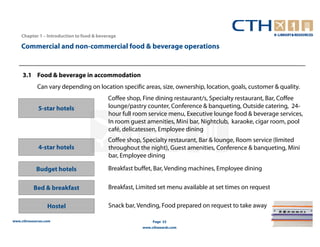
  • 312.
    Chapter 7– Servicequality in food and beverage Quality monitoring and measurement Aim Focus group members To research To determine satisfaction levels of Existing restaurant customers Opinions on likes and dislikes in relation to the: customers •Menu •Service •Design How the restaurant can improve? •What is their perception or opinion on the Non-customers/competitor restaurant? To increase business of Non-customers customers/potential customers •What type of food they like? through identifying their opinions, dining •What is important to them when eating out? habits and specific needs •Where do they currently dine out and why? •What are their favourite dishes on the current menu? Customers •What new would they like to see o the menu To gather opinions on customers to use in •Are the prices reasonable? creating a new menu •Are the portion sizes suitable? •Do they go to other places for dishes that we don’t offer? www.cthresources.com Page 312 www.cthawards.com
  • 313.
    Chapter 7– Servicequality in food and beverage Quality monitoring and measurement 3.4 Observation Within the organisation there is a wealth of information that can be used to improve quality whilst observation is an effective way of doing so. Examples Potential reason Effects Employees chatting Overstaffed, or poor Waste scheduling of resources High labour cost Bad impression for diners Employees rushing around understaffed Customer complaints Discounts Slow service Employee stress Queuing at a buffet Poor controlling of Customers become dissatisfied customer traffic Customers arriving go elsewhere Empty restaurant during peak Poor marketing Loss of revenue time Poor product and service Poor image Better competition Hard to attract customers www.cthresources.com Page 313 www.cthawards.com
  • 314.
    Chapter 7– Servicequality in food and beverage Quality monitoring and measurement 3.5 Critical logs Departmental log books provide information activities which take part within the organisation. These log books are found in departments and are a tool for supervisors and managers to exchange information between shifts. The logs consists of items such as complaints and issues, maintenance defects etc. 3.6 Management of information Information is in most case logged by computers or past records and can be used effectively to provide a better service to customers. The following is an example of a restaurant receipt (figure 7.9) from a regular, local customer Mr. Bridges. www.cthresources.com Page 314 www.cthawards.com
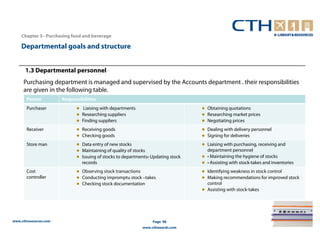
  • 315.
    Chapter 7– Servicequality in food and beverage Quality monitoring and measurement Jimbaran restaurant at The Splendid Hotel Dubai Table: 24 Date: 22.01.08 Time: 18.47 Server: Rashid No of Covers: 2 Quantity Item Charge 1 Soup 20Dhs 1 Caesar salad 20Dhs 1 Seafood platter 100Dhs 1 Cheesecake 30Dhs 2 Coffees 30Dhs 1 Sincere wine 80Dhs 280Dhs Payment Method American Express Number 87664456696xxxxxx Customer Name John H. Bridges www.cthresources.com Page 315 www.cthawards.com
  • 316.
    Chapter 7– Servicequality in food and beverage Quality monitoring and measurement 3.7 External methods Mystery guests or mystery shoppers are employed by companies to visit their premises to conduct an evaluation of their products or services. These visits are normally contracted out and are carried out but an external professional company 3.7.1 Mystery guests Meeting with owner or operator to discuss the requirements Mystery guest company creates measurement tool Mystery guest makes reservation like a normal customer Mystery guest carries out visit and audits services and products Completes a formal report and delivers findings www.cthresources.com Page 316 www.cthawards.com
  • 317.
    Chapter 7– Servicequality in food and beverage Quality monitoring and measurement Advantages Disadvantages Unbiased Can be costly Conducted by experienced individuals Accurate Can be used as an development tool Employees are unaware of the mystery shopper Many large chains use survey results to compare performance between units. www.cthresources.com Page 317 www.cthawards.com
  • 318.
    Chapter 7– Servicequality in food and beverage Quality monitoring and measurement 3.7.2 External surveys Professional companies can also be contracted to carry out surveys with members of the public: Specific needs and wants Likes and dislikes Eating and dining preferences Dining habits Preferred restaurants Reasons for eating out 3.8 Secondary data Food beverage operations can also monitor consumer trends to help them cater to needs by viewing the following resources Academic books and journals Industry magazines Industry websites Industry reports www.cthresources.com Page 318 www.cthawards.com
  • 319.
    Chapter 7 –Introduction to food & beverage Summary The importance of quality Quality tools Measurement Leadership Internal External Meeting needs, wants and Questionnaires Mystery guests expectations Standards of Face to face External surveys performance feedback Quality human Focus groups resources Quality sourcing Observation Quality schemes Critical logs Service recovery Management and complaint information handling www.cthresources.com Page 319 www.cthawards.com
  • 320.
    Chapters 1. Introduction to food & beverage 2. Food production 3. Purchasing food & beverage 4. Food service delivery 5. Beverages 6. Menu planning 7. Service quality in food & beverage 8. Conference & banqueting www.cthresources.com Page 320 www.cthawards.com
  • 321.
    Chapter 8 –Conference and banqueting Objectives In this chapter you will learn to :- ● Describe how the conference and banqueting department is structures ● Explain the stages in the customer inquiry process ● Identify and appraise the tools departmental managers use to maintain standards, minimize expenses and maximize sales www.cthresources.com Page 321 www.cthawards.com
  • 322.
    Chapter 8 –Conference and banqueting Characteristics of conference and banqueting (C&B) 1. Characteristics of conference and banqueting (C&B) 1.1 Benefits 1.2 Challenges 1.3 Personnel 1.4 Conference and banqueting sales www.cthresources.com Page 322 www.cthawards.com
  • 323.
    Chapter 8 –Conference and banqueting Characteristics of conference and banqueting (C&B) ● Very diverse with many different events types ● Can be small or large in customer numbers ● Pre-planned ● Can be profitable ● Competitive due to many establishments having large available spaces ● Often seasonal ● Can be delivered in a variety of locations ● Empty space is expensive Conference Banqueting Formal Relaxed Seminar Religious festivals Meetings Annual work parties Exhibitions Family celebrations Presentations and lectures Themed dinner and lunches Workshops Weddings www.cthresources.com Page 323 www.cthawards.com
  • 324.
    Chapter 8 –Conference and banqueting Characteristics of conference and banqueting (C&B) Fig 8.1 Event types Forum Convention Seminar Symposium Retreat Event types Congress Trade show Exhibition Panel Interview www.cthresources.com Page 324 www.cthawards.com
  • 325.
    Chapter 8 –Conference and banqueting Characteristics of conference and banqueting (C&B) Suitable venues to host events include : ● Conference centres ● Exhibition halls ● Hotels ● Large restaurants and bars ● Community centres ● Office cafeterias ● Ballrooms ● Church has ● Sports halls www.cthresources.com Page 325 www.cthawards.com
  • 326.
    Chapter 8 –Conference and banqueting Characteristics of conference and banqueting (C&B) 1.1 Benefits ● Can better utilize space and assets ● Can capitalize on annual events ● Can show case facilities ● Can receive additional revenue streams ● Potential for leads and follow on business ● Can attract local business ● Can provide better service as all brooked in advance ● Can achieve saving through bulk purchasing www.cthresources.com Page 326 www.cthawards.com
  • 327.
    Chapter 8 –Conference and banqueting Characteristics of conference and banqueting (C&B) 1.2 Challenges ● Empty space is cost ● Pressure to fill space daily ● Competitive ● Large quantities of inventory and equipment ● Additional storage requirements ● Difficult to manage expectations because of large quantities ● Large quantities of casual labour www.cthresources.com Page 327 www.cthawards.com
  • 328.
    Chapter 8 –Conference and banqueting Characteristics of conference and banqueting (C&B) 1.3 Personnel Position Responsibilites Conference and Banqueting(C&B) manager Overall management of department Fully accountable for profitability of department Promoting department Recruitment of employees Attending meetings Dealing with complaints Planning and forecasting Administration C&B chef Meeting customers Discussing menu options Creating menus Preparing the food Seving the food C&B Assistant manager & supervisor Overseeing and manageing events Training employees Booking casual staff Managing stock Managing customers' expectations Delivering standards www.cthresources.com Page 328 www.cthawards.com
  • 329.
    Chapter 8 –Conference and banqueting Characteristics of conference and banqueting (C&B) C&B sales manager Creaing sales & marketing plan for department Implimenting plan Competitor analysis Managing employees Motivating employees Yeild amangement Training C&B sales executive Visiting clients and compenies Making presentations Showarounds Following up leads Event co-ordinator Taking reservations Creating contacts Maintain the booking dairy Banquet event sheets to departments Billing & deposits Waiters Setting-up functions Mise en place Serving customers Dealing with customer enquiries Porters Moving furniture Setting-up furniture and equipment Assisting waiters Breaking down rooms www.cthresources.com Cleaning Page 329 www.cthawards.com
  • 330.
    Chapter 8 –Conference and banqueting Characteristics of conference and banqueting (C&B) 1.4 Conference and Banqueting sales Fig 8.2 Who are the customers? In-house customers Internation Local al businesses companies C&B Internal Department company Charities events and functions Local Event residents planners www.cthresources.com Page 330 www.cthawards.com
  • 331.
    Chapter 8 –Conference and banqueting Characteristics of conference and banqueting (C&B) 1.4 Conference and Banqueting sales continued ... Due to the competitive nature of the sector, various techniques have to be employed to fill Conference and Banqueting space. Some approaches include : ● Employing a sales team ● Creating a database of customers ● Contacting potential customers ● Creating brochures detailing facilities available ● Employing an experienced C&B team ● Featuring C&B facilities on hotel or establishment’s webpage ● Advertising facilities in local media ● Sending information and visiting local businesses ● Promoting facilities internally in lifts and bedrooms ● Creating own events internally www.cthresources.com Page 331 www.cthawards.com
  • 332.
    Chapter 8 –Conference and banqueting The event process 2. The event process 2.1 Enquiry 2.2 The brochure or CD-Rom 2.3 The appointment and customer visit 2.4 The quotation and contract stage 2.5 Food, beverage and service 2.6 The event 2.7 Room set-up 2.8 Equipment 2.9 Follow-up and evaluation www.cthresources.com Page 332 www.cthawards.com
  • 333.
    Chapter 8 –Conference and banqueting The event process Fig 8.3 The conference and banqueting process 1. Enquiry 5. Follow up 2. Visit 4. Event 3. Quotation www.cthresources.com Page 333 www.cthawards.com
  • 334.
    Chapter 8 –Conference and banqueting The event process 2.1 Enquiry When customers contact the hotel to make an enquiry: ● Thank person for calling ● Take down personnel information, name, company, contact number and e-mail ● Establish what type of event is required ● Establish what date and time is required ● Check diary and determine availability Trend : Most banqueting diaries are now computerized and are able to provide information to include: ● Up-to-date availability of each room ● Specifications of each room ● Capacities for each room ● Past history of company or customer, room preferences and event type ● Room coasts based on supply, demand and day ● Future availability and usage per room, day and month ● Usage per company, event type and room type www.cthresources.com Page 334 www.cthawards.com
  • 335.
    Chapter 8 –Conference and banqueting The event process 2.2 The brochure or CD-Rom To promote the conference and banqueting facilities the sales office send out information packs (collateral) to acquaint customers with service available. This includes: ● The service team’s roles and responsibilities ● Testimonials from customers ● Photographs of events ● Blue point of room dimensions ● Examples of room set-up ● People capacity per room ● Equipment available ● Menus ● Packages available ● Contact details ● Business card of C&B sales person www.cthresources.com Page 335 www.cthawards.com
  • 336.
    Chapter 8 –Conference and banqueting The event process 2.3 The appointment and customer visit If the enquiry is for a large event or a new customer/company the sales assistant will attempt to secure an appointment and encourage the customer to visit the hotel to showcase the event facilities. The first impression of the customer must be positive. The sales executive should be prepared for the appointment in the following ways: ● Have a quiet place to discuss the customer’s needs and requirements ● Key staff available to discuss particular needs (E.g. a chef should be on hand to offer advice and suggestions with menu planning for the event. ● It is important to have rooms set-up for display. If a customer is coming to discuss a meeting then a meeting room should showcase for the customer what can be expected. You should never try to show an empty room to a customer as this may lose you the sale ● Have a presentation packs prepared, containing menus, seating layouts, photographs and room details ● Accommodation for the attendees should be prepared & rooms should be available to display. ● Relevant paperwork on hand such as, a customer checklist ● It’s important to introduce the person to the employee who will manage their event. www.cthresources.com Page 336 www.cthawards.com
  • 337.
    Chapter 8 –Conference and banqueting The event process 2.3 The appointment and customer visit continued ... During the appointment general information is obtained or confirmed from the customer. ● Contact details : (telephone, e-mail, fax, address, direct line) ● Date and arrival time ● Customer information : numbers and demographics (gender, age, nationality, profession) ● Customer with any special needs or requirements ● Event type : seminar, anniversary party ● Room set-up style : (classroom, workshop, round tables) ● Food requirements : (menus, meal times, special diets) ● Beverage requirement : (during the event, cash bar in the evening) ● Equipment requirements ● Budget per person ● Billing information ● Bedroom requirements ● Car parking requirements www.cthresources.com Page 337 www.cthawards.com
  • 338.
    Chapter 8 –Conference and banqueting The event process 2.3 The appointment and customer visit continued... Specific needs will be also expected for different events. (E.g. wedding) ● Flowers ● Speeches ● Master of ceremonies ● Dance floor ● Disk jockey (DJ) ● Seating plans www.cthresources.com Page 338 www.cthawards.com
  • 339.
    Chapter 8 –Conference and banqueting The event process 2.4 The quotation and contract stage The customer is sent a proposal detailing all the function’s requirements with pricing. The customer would either make changes or sign the paperwork and return it to the hotel. This signature creates a confirmed booking and contract between the customer and the establishment. The customer pays a deposit to secure the booking depending on the contract. The banqueting event order After the contract has been confirmed C&B sales creates a ‘ Banquet event order’. This is an international document to communicate the event’s details to the relevant department. www.cthresources.com Page 339 www.cthawards.com
  • 340.
    Chapter 8 –Conference and banqueting The event process 2.5 Food, beverage and service Food In C&B menus are normally table d’hote due to frequency of large numbers. Producing food for banqueting events has many advantages. It is shown below: Restaurants Events (C&B) Large menu Small menu Uncertainty about which menu item will be selected No uncertainty - all menu items fixed Uncertainty about definite numbers that will visit restaurant No uncertainty - numbers confirmed No uncertainty - customers arrive as Uncertainty about what time customers will come organized Food wastage after service No food wastage www.cthresources.com Page 340 www.cthawards.com
  • 341.
    Chapter 8 –Conference and banqueting The event process 2.5 Food, beverage and service continued ... Beverage Beverage requirements varies according to the type of the event. (E.g. conference – tea, coffee & mineral water). Bars may be available during the evening for delegates to relax and network, and are available in different formats. They can be in a fixed bar or set up in another room to ease queuing. A cash bar - where each guest pays at the time the drink is served. A hosted bar – drinks are charged on a consumption basis. Companies frequently use this method & the bill is sent directly to the company after the event. The event organizer signs a bill at the end of the event to confirm consumption. If it’s a wedding sometimes the host pays a part of the bar bill in advance. During a banquet events a table service can be provided whereby customers are offered a variety wines, sprits, beers and soft drinks served at the table. www.cthresources.com Page 341 www.cthawards.com
  • 342.
    Chapter 8 –Conference and banqueting The event process 2.5 Food, beverage and service continued ... Service A variety of service methods include: ● Plated service ● Silver service ● Buffet service ● Family service ● Large events will be run using a more formal system where employees follow instructions by the head waiter or Maitre d’. www.cthresources.com Page 342 www.cthawards.com
  • 343.
    Chapter 8 –Conference and banqueting The event process 2.6 The event Hotel executives meet weekly discuss forthcoming events on a week by week basis. Each department is issued with an event sheet to: ● Communicate information ● Follow-up on any particular event needs ● Address any questions ● Resolve any last minute prolems www.cthresources.com Page 343 www.cthawards.com
  • 344.
    Chapter 8 –Conference and banqueting The event process Fig 8.7 The event process 1. Set up event 8. 2. Breakdown Welcome event guests 3. Run 7. through Signature event and billing details for the day 6. Check 4. Brief satisfaction staff 5. Deliver event www.cthresources.com Page 344 www.cthawards.com
  • 345.
    Chapter 8 –Conference and banqueting The event process Step Action The team will set up the event in advance of the customer and their guests arriving. (preparing furniture, laying tables, 1. Set-up event setting-up coffee stations, registration tables, bars and equipment. 2. Welcome guests Sales assistant/staff member managing the event greets the customer on arrival. 3. Run through events The C&B employee should check whether there's any last minute changes. 4. Brief staff All service staff are briefed on details to include: The company and type of event Chronology of event For the organizer, host and any VIPs to be identified Any special requests Allocation of tables Menu information Standards The event commences are planned. Service staff follow banquet event order and any instruction from event supervisor. 5. Deliver event Duties include: Serving food and beverage Dealing with customer requests Monitoring equipment Clearing tables It is checked throughout the event and at the end. Any fedback from the customer is noted and communicated to service 6. Check satisfaction and other staff involved. 7. Billing Organizer or host signs the bill to agree all consumption and charges. Bill is settled depending on the contract . 8. Breakdown event Employees breakdown the event to include : Collapsing furniture Clearing tables Polishing cutlery Cleaning Re-setting for next day's event or sales promotion www.cthresources.com Page 345 www.cthawards.com
  • 346.
    Chapter 8 –Conference and banqueting The event process 2.7 Room set-ups U-Shape Classroom Banquet Hollow square Lecture or Theater (chairs only) Horse shoe www.cthresources.com Page 346 www.cthawards.com
  • 347.
    Chapter 8 –Conference and banqueting The event process 2.7 Room set-ups continued ... Herringbone Workshop Circle www.cthresources.com Page 347 www.cthawards.com
  • 348.
    Chapter 8 –Conference and banqueting The event process 2.8 Equipment Rental advantages ● No strong space required ● No cleaning and maintenance required ● No depreciation ● Less management overall ● Less risk of theft ● No training required ● Modern equipment provided Trend. C&B is the renting not only of equipment but also crockery. Cutlery, glassware and linen. The same advantages apply. www.cthresources.com Page 348 www.cthawards.com
  • 349.
    Chapter 8 –Conference and banqueting The event process 2.9 Follow-up and evaluation A key part of C&B is to monitor customer evaluation after the event has taken place. Any feedback received should be communicated to the departments involved and used for future planning. www.cthresources.com Page 349 www.cthawards.com
  • 350.
    Chapter 8 –Conference and banqueting Summary Conferencing and Banqueting The event Objectives process and structure Benefits and Enquiry challenges Quotation Personnel and contract Event Sales Follow-up www.cthresources.com Page 350 www.cthawards.com