Chapter 5

Managing the Market
for MICE industry


               E-mail: tpavit@hotmail.com
                            081-082- 1
                          . 081-082-7273
Objectives
1.   understand the contemporary Thailand marketing environment in
     which MICE industry professionals must operate
2.   identify customer needs inherent to both corporate and
     association conference organisers in choosing a MICE destination
     or venue
3.   determine how market segmentation, product positioning and
     product differentiation apply to the marketing efforts of various
     service providers within the Australian MICE industry
4.   understand the overall marketing relationship and orientation of
     primary and secondary service providers to identified level I and
     level II decision makers
5.   appreciate how the issues of business objectives, capacity and
     demand, price and marketing mix apply to select primary and
     secondary service providers in the Thailand MICE industry
6.   evaluate how relationship marketing can be conducted between
     select service providers and MICE decision makers
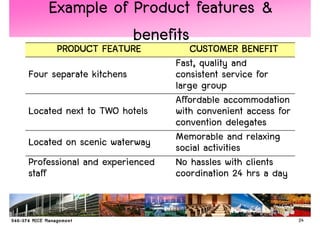
                                                                         2
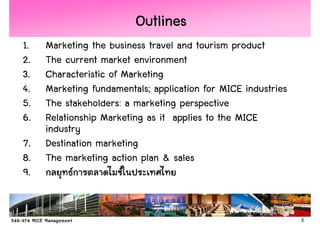
Outlines
1.   Marketing the business travel and tourism product
2.   The current market environment
3.   Characteristic of Marketing
4.   Marketing fundamentals; application for MICE industries
5.   The stakeholders: a marketing perspective
6.   Relationship Marketing as it applies to the MICE
     industry
7.   Destination marketing
8.   The marketing action plan & sales
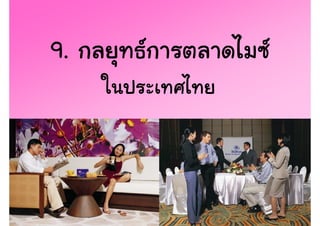
9.


                                                               3
Introduction
• This chapter discusses contemporary services marketing issues as
  they relate to the convention and meetings industry in Thailand. It
  assumes that students will have an understanding of marketing
  principles as they apply to service industries.
• Factors affecting the current conventions and meetings marketing
  environment are outlined. The interface between the major
  stakeholders, their potential customers and the marketing
  distribution system is examined, including the methods by which the
  main providers of the MICE service or product market their
  activities to the key convention or meeting decision - makers.
• Finally the chapter explores the concept of relationship marketing
  as it relates to the convention and meeting industry organisations.


                                                                        4
What is Marketing?
“ Marketing is that function of event management that
  can help keep in touch with the event’s participants
  and visitors (consumers), read their needs and
  motivations, develop products that meet these needs,
  and build a communication program which express
  the event’s purpose and objectives


                                                         5
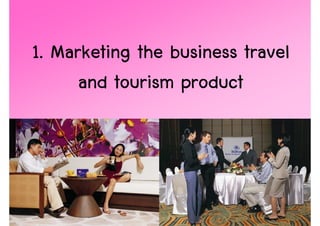
1. Marketing the business travel
      and tourism product


                                   6
Marketing the business travel and tourism product
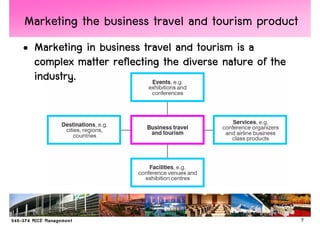
• Marketing in business travel and tourism is a
  complex matter reflecting the diverse nature of the
  industry.
  industry.


                                                        7
2. The current market
     environment


                        8
The current market environment
• Primary MICE industry service
  providers (Stakeholders) in Thailand,
  such as five-star hotels, resort, CVBs,
  and purpose-built convention and
  exhibition centers have faced increase
  completion.
• MICE events, large and small, are being
  booked in shorter lead times (i.e. within
  2 weeks). This may be due somewhat to
  technological advances such as greater
  use of e-mail and Internet.


                                              9
The current market environment
• The use of advance technology offers
  both benefits and many pitfalls for
  marketers. On the one hand, such
  accessible technology is facilitating the
  dissemination of product information
  more effectively and easily.
• Customers are becoming more
  conscious of their product and service
  options in purchasing a venue and site.


                                              10
The current market environment
• Talking about these issues influencing the MICE
  industries, e.g.
   1. “Political policies & commitment made by the
       Political”:
       Political
      government resulting the MICE business strengthening;
      other confidential indices e.g. safety, investment, etc.
   2.“Economic environment MICE industries generally
       Economic environment”:
      relate to the levels of industrial development & the well
      beings of the people at local, national, regional &
      international levels.


                                                                  11
The current market environment
3 “Societal issues norms, psychographics or lifestyle-related
    Societal issues”:
   attributes, environmental awareness and other societal
   issues have influenced the ways of MICE industries
   operations & marketing
4. “Legal or regulatory issues
    Legal               issues”:regulatory implications might
   include; immigration practices, tax or vat applications, local
   legal and other relevant regulatory that MICE operators
   are to follow.


                                                                    12
3. Characteristics of
     marketing


                        13
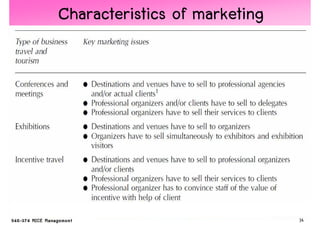
Characteristics of marketing


                               14
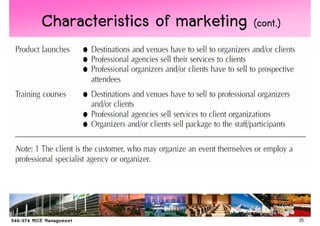
Characteristics of marketing (cont.)


                                       15
4. Marketing fundamentals;
application for MICE industries


                                  16
Marketing fundamentals; application for MICE industries

1.   Market segmentation
2.   Product & service positioning
3.   Product differentiation
4.   Product features & benefits
5.   The marketing mix
6.   Promotional or communication channels


                                                          17
1. Market segmentation
• Market segmentation involves grouping
  potential customers within a market in such a
  way that their response to the service
  provider's marketing efforts will be about the
  same.


                                                   18
1. Market segmentation
• The MICE industry is segmented in to
     1. Meetings (Small and Large)
     2. Incentive Groups
     3. Convention Groups
     4. Product Lunches (Exhibitions)


                                         19
1. Market segmentation
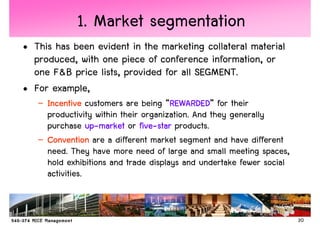
• This has been evident in the marketing collateral material
  produced, with one piece of conference information, or
  one F&B price lists, provided for all SEGMENT.
• For example,
   – Incentive customers are being “REWARDED for their
                                      REWARDED”
                                      REWARDED
     productivity within their organization. And they generally
     purchase up-market or five-star products.
                 up-          five-
   – Convention are a different market segment and have different
     need. They have more need of large and small meeting spaces,
     hold exhibitions and trade displays and undertake fewer social
     activities.


                                                                      20
2. Product & service positioning
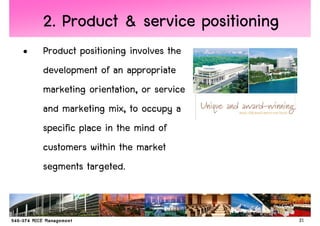
•   Product positioning involves the
    development of an appropriate
    marketing orientation, or service
    and marketing mix, to occupy a
    specific place in the mind of
    customers within the market
    segments targeted.


                                        21
3. Product differentiation
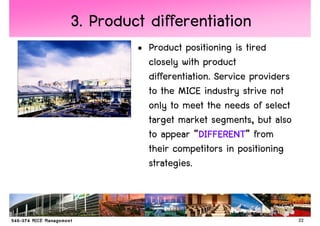
         • Product positioning is tired
           closely with product
           differentiation. Service providers
           to the MICE industry strive not
           only to meet the needs of select
           target market segments, but also
           to appear “DIFFERENT from
                        DIFFERENT”
                        DIFFERENT
           their competitors in positioning
           strategies.


                                                22
4. Product features & benefits
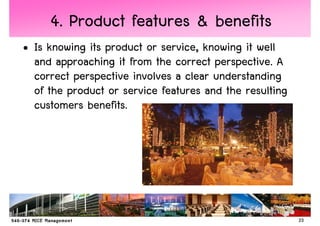
• Is knowing its product or service, knowing it well
  and approaching it from the correct perspective. A
  correct perspective involves a clear understanding
  of the product or service features and the resulting
  customers benefits.


                                                         23
Example of Product features &
               benefits
      PRODUCT FEATURE             CUSTOMER BENEFIT
                               Fast, quality and
Four separate kitchens         consistent service for
                               large group
                               Affordable accommodation
Located next to TWO hotels     with convenient access for
                               convention delegates
Located on scenic waterway     Memorable and relaxing
                               social activities
Professional and experienced   No hassles with clients
staff                          coordination 24 hrs a day


                                                            24
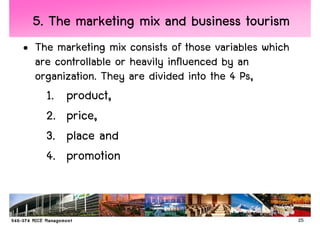
5. The marketing mix and business tourism
• The marketing mix consists of those variables which
  are controllable or heavily influenced by an
  organization. They are divided into the 4 Ps,
    1.   product,
    2.   price,
    3.   place and
    4.   promotion


                                                        25
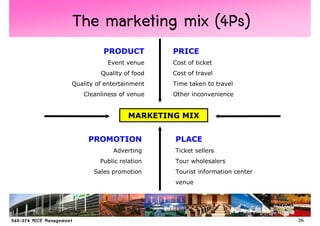
The marketing mix (4Ps)
          PRODUCT          PRICE
           Event venue     Cost of ticket
         Quality of food   Cost of travel
Quality of entertainment   Time taken to travel
   Cleanliness of venue    Other inconvenience


                   MARKETING MIX


     PROMOTION             PLACE
             Adverting     Ticket sellers
         Public relation   Tour wholesalers
       Sales promotion     Tourist information center
                           venue


                                                        26
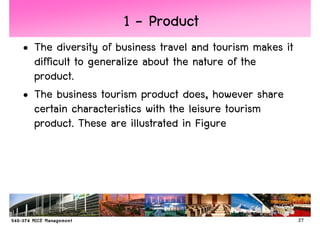
1 - Product
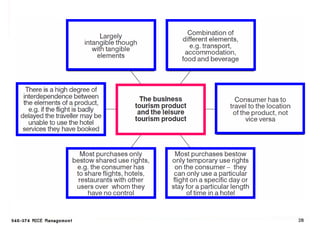
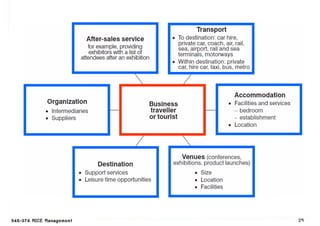
• The diversity of business travel and tourism makes it
  difficult to generalize about the nature of the
  product.
• The business tourism product does, however share
  certain characteristics with the leisure tourism
  product. These are illustrated in Figure


                                                          27
28
29
1 - Product
• Like leisure tourism it could also be argued that
  business travel and tourism is not a
• product, but rather an experience. The nature of
  this experience will reflect, for example:
      1. the elements of the product
      2. the ambience of the destination and the venue
      3. the personality and experience of the business
         traveller.


                                                          30
2 - Price
• The value consumers place on the event experience
  and are prepared to pay.
• This value determined by the strength of the need
  the leisure experience satisfies and alternative
  leisure experience offered by other events and other
  leisure service providers.


                                                         31
3 - Place
• Place or distribution is concerned with how business
  travellers or tourists actually purchase the products
  they need. There are several dimensions to this:
    1. Customers can buy whole packages such as an
       incentive travel package or individual elements such
       as air tickets, venues and accommodation.
    2. Customers can purchase products directly or make
       use of the services of specialist intermediaries


                                                              32
4 - Promotion
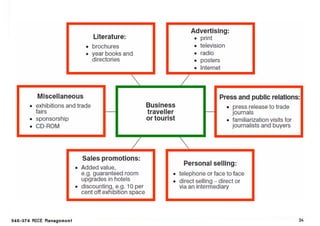
• To many people, promotion is synonymous with
  marketing; it is the visual face of marketing.
  However, promotion is simply one element of the
  marketing mix, fulfilling the function of making
  potential customers want to purchase a particular
  product. Figure shows the different methods of
  promotion.


                                                      33
34
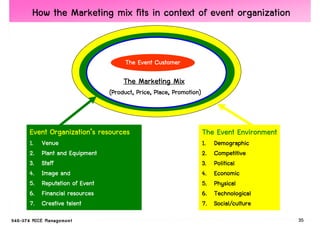
How the Marketing mix fits in context of event organization


                                The Event Customer

                                The Marketing Mix
                           (Product, Price, Place, Promotion)


      Organization’
Event Organization’s resources                                  The Event Environment
1.   Venue                                                      1.   Demographic
2.   Plant and Equipment                                        2.   Competitive
3.   Staff                                                      3.   Political
4.   Image and                                                  4.   Economic
5.   Reputation of Event                                        5.   Physical
6.   Financial resources                                        6.   Technological
7.   Creative talent                                            7.   Social/culture
                                                                                        35
6. Promotional or communication
               channels
• Now all that is necessary is to communicate those
  benefits successfully to the target customers or
  decision makers
   – Professional marketer can communicate benefits through
     a range of communication channels:
      1. Collateral material            2. Advertising
      3. Publicity and Public relations 4. Direct marketing
      5. Direct Sales                   6. Sales Promotion


                                                              36
5. The stakeholders:
a marketing perspective


                          37
The stakeholders: a marketing perspective
1. Overview of the distribution
   system
2. Level one: decision makers
3. Level two: decision makers
4. Primary service providers
5. Secondary service providers


                                        38
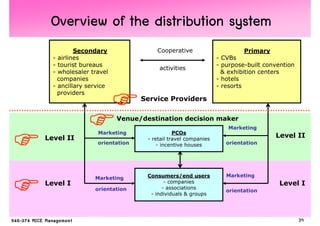
Overview of the distribution system
          Secondary                Cooperative                       Primary
  - airlines                                                - CVBs
  - tourist bureaus                                         - purpose-built convention
                                    activities
  - wholesaler travel                                         & exhibition centers
    companies                                               - hotels
  - ancillary service                                       - resorts
    providers
                               Service Providers

                        Venue/destination decision maker
                                                                Marketing
                 Marketing                 PCOs
Level II                        - retail travel companies
                                                                               Level II
                 orientation        - incentive houses         orientation


                Marketing       Consumers/end users            Marketing
Level I                                - companies                              Level I
                orientation           - associations
                                                               orientation
                                 - individuals & groups


                                                                                         39
Level one: Decision makers
•   Level one decision makers are an end user of
    MICE products and services; they generally are
    divided into:
     1. “Associations”; may be small and local; national and
         Associations”
        international
     2. “Companies”; profit-oriented organizations who might
         Companies”
        prefer to organizer either internal, external or
        in/external activities
     3. “Individuals & groups”; e.g. wedding, group parties,
                        groups”
        etc.


                                                               40
Level two: Decision makers
•   Those who have been authorized or contacted by
    the level one decision makers in arranging &
    managing MICE events, there are:
     1. Professional Conference or Congress Organizers or
        PCOs
     2. Retail travel operations
     3. Incentive houses; are companies whose business
        objectives is to increase productivity from their client’s
        employees through a variety of motivational and other
        reward measures


                                                                     41
Primary service providers
• Hotels & resorts offering MICE facilities & services
• Convention & visitors bureaus; trying to provide
  “one-stop-service” including:
   –   The price & availability of venues
   –   The arrangement of site inspection
   –   The preparation of bid documentation
   –   Special events & theme ideas
   –   Pre- and post-event tour options
• Purpose-built convention & exhibition centers

                                                         42
Secondary service providers
• Airlines, e.g. the campaign of Star Alliance’ s MICE
  Promotions
• Tourist bureaus, e.g. TAT
• Wholesale travel operations
• Ancillary service providers; they provide tours and
  transportation, tour escorts and guides, sporting
  activities, theme parties, flowers, speakers,
  entertainments, AV equipment and all parts of that go
  together to make up the whole event


                                                          43
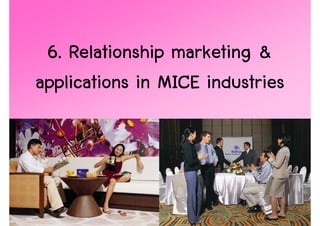
6. Relationship marketing &
applications in MICE industries


                                  44
Relationship marketing & applications in MICE industries
• It is an important for primary service providers to
  target their marketing efforts effectively toward
  those decision makers deemed to return the highest
  benefits.
• Therefore, the focus is on building good
  relationships, which will in turn generate profitable
  transactions.


                                                          45
Relationship marketing & applications in MICE
                    industries
• Five different levels of marketing relationships that
  can be applied to the MICE industries (Kotler, 1996)
   1. “Basic”; the service provider sells the service & product
       Basic”
      but does not conduct any post-sales follow-up with the
      customer
   2. “Reactive”; the service provider provides products &
        Reactive”
      services and encourages the customer to call if they
      have any questions
   3. “Accountable”; the service provider follows up after the
        Accountable”
      sale to solicit service delivery and product quality
      feedback


                                                                  46
Relationship marketing & applications in MICE
                    industries
4. “Pro-active”; the service provider follows up with
    Pro-active”
   the customer on a regular basis to obtain consistent
   product or service feedback
5. “Partnership”; the service provider works
     Partnership”
   continuously with the customer and with other
   customers to discover ways to deliver better value


                                                          47
7. Destination marketing


                           48
Destination marketing
• Is a strategy that is particularly utilized by service
  providers in the MICE industry
• Destination can be defined as places with some form of
  actual or perceived boundaries, physical, political or
  market-created; e.g. entire country, region, province,
  island, etc.
• To create customer or decision maker’s mind a single
  image or brand awareness of destination
• Figure out competitive advantages; e.g. natural resources,
  industry professional, capital & infrastructure, etc.


                                                               49
8. The marketing action plan


                               50
The marketing action plan
Steps in developing the marketing action plan include:
   1. Conduct situation or SWOT analysis
   2. Product destination factor endowment profile/feature
        and benefit analysis
   3. Select target & segment (level I & II decision makers)
   4. Conduct market research
   5. Produce positioning and marketing mix strategies
   6. Design market & sales action plan


                                                               51
9.


     52
Meetings & Incentives

1.
2.
         –
             –
3.
     •
     •
     •


                                     53
Conventions
1.
2.

3.

4.     PCO


                   54
Exhibitions
1.


2.
3.
4.


                   55
Summary
• Marketing in the MICE industry has increased in
  importance over the last two decades as the industry has
  developed. MICE service providers face increased
  competition at a time when customer expectations and
  product knowledge are increasing.
• All MICE customers are not alike, and to market
  effectively, service providers need to aware of the
  distinct differences that exist between the market
  segments and to understand the specific needs of each of
  these market segments.


                                                             56
Summary
• Once MICE service providers have chosen which market
  segments they wish to target, they must position their
  product accordingly. To be successful, they also need to
  differentiate their product from the competition.
• The stakeholders in the MICE industry are many and
  varied, so marketing efforts need to be highly focused
  and directed. Two levels of decision makers can be
  identified, to whom primary and secondary service
  providers directs their marketing efforts.


                                                             57

Chapter 5 managing marketing for mice industry

  • 1.
    Chapter 5 Managing theMarket for MICE industry E-mail: tpavit@hotmail.com 081-082- 1 . 081-082-7273
  • 2.
    Objectives 1. understand the contemporary Thailand marketing environment in which MICE industry professionals must operate 2. identify customer needs inherent to both corporate and association conference organisers in choosing a MICE destination or venue 3. determine how market segmentation, product positioning and product differentiation apply to the marketing efforts of various service providers within the Australian MICE industry 4. understand the overall marketing relationship and orientation of primary and secondary service providers to identified level I and level II decision makers 5. appreciate how the issues of business objectives, capacity and demand, price and marketing mix apply to select primary and secondary service providers in the Thailand MICE industry 6. evaluate how relationship marketing can be conducted between select service providers and MICE decision makers 2
  • 3.
    Outlines 1. Marketing the business travel and tourism product 2. The current market environment 3. Characteristic of Marketing 4. Marketing fundamentals; application for MICE industries 5. The stakeholders: a marketing perspective 6. Relationship Marketing as it applies to the MICE industry 7. Destination marketing 8. The marketing action plan & sales 9. 3
  • 4.
    Introduction • This chapterdiscusses contemporary services marketing issues as they relate to the convention and meetings industry in Thailand. It assumes that students will have an understanding of marketing principles as they apply to service industries. • Factors affecting the current conventions and meetings marketing environment are outlined. The interface between the major stakeholders, their potential customers and the marketing distribution system is examined, including the methods by which the main providers of the MICE service or product market their activities to the key convention or meeting decision - makers. • Finally the chapter explores the concept of relationship marketing as it relates to the convention and meeting industry organisations. 4
  • 5.
    What is Marketing? “Marketing is that function of event management that can help keep in touch with the event’s participants and visitors (consumers), read their needs and motivations, develop products that meet these needs, and build a communication program which express the event’s purpose and objectives 5
  • 6.
    1. Marketing thebusiness travel and tourism product 6
  • 7.
    Marketing the businesstravel and tourism product • Marketing in business travel and tourism is a complex matter reflecting the diverse nature of the industry. industry. 7
  • 8.
    2. The currentmarket environment 8
  • 9.
    The current marketenvironment • Primary MICE industry service providers (Stakeholders) in Thailand, such as five-star hotels, resort, CVBs, and purpose-built convention and exhibition centers have faced increase completion. • MICE events, large and small, are being booked in shorter lead times (i.e. within 2 weeks). This may be due somewhat to technological advances such as greater use of e-mail and Internet. 9
  • 10.
    The current marketenvironment • The use of advance technology offers both benefits and many pitfalls for marketers. On the one hand, such accessible technology is facilitating the dissemination of product information more effectively and easily. • Customers are becoming more conscious of their product and service options in purchasing a venue and site. 10
  • 11.
    The current marketenvironment • Talking about these issues influencing the MICE industries, e.g. 1. “Political policies & commitment made by the Political”: Political government resulting the MICE business strengthening; other confidential indices e.g. safety, investment, etc. 2.“Economic environment MICE industries generally Economic environment”: relate to the levels of industrial development & the well beings of the people at local, national, regional & international levels. 11
  • 12.
    The current marketenvironment 3 “Societal issues norms, psychographics or lifestyle-related Societal issues”: attributes, environmental awareness and other societal issues have influenced the ways of MICE industries operations & marketing 4. “Legal or regulatory issues Legal issues”:regulatory implications might include; immigration practices, tax or vat applications, local legal and other relevant regulatory that MICE operators are to follow. 12
  • 13.
  • 14.
  • 15.
  • 16.
  • 17.
    Marketing fundamentals; applicationfor MICE industries 1. Market segmentation 2. Product & service positioning 3. Product differentiation 4. Product features & benefits 5. The marketing mix 6. Promotional or communication channels 17
  • 18.
    1. Market segmentation •Market segmentation involves grouping potential customers within a market in such a way that their response to the service provider's marketing efforts will be about the same. 18
  • 19.
    1. Market segmentation •The MICE industry is segmented in to 1. Meetings (Small and Large) 2. Incentive Groups 3. Convention Groups 4. Product Lunches (Exhibitions) 19
  • 20.
    1. Market segmentation •This has been evident in the marketing collateral material produced, with one piece of conference information, or one F&B price lists, provided for all SEGMENT. • For example, – Incentive customers are being “REWARDED for their REWARDED” REWARDED productivity within their organization. And they generally purchase up-market or five-star products. up- five- – Convention are a different market segment and have different need. They have more need of large and small meeting spaces, hold exhibitions and trade displays and undertake fewer social activities. 20
  • 21.
    2. Product &service positioning • Product positioning involves the development of an appropriate marketing orientation, or service and marketing mix, to occupy a specific place in the mind of customers within the market segments targeted. 21
  • 22.
    3. Product differentiation • Product positioning is tired closely with product differentiation. Service providers to the MICE industry strive not only to meet the needs of select target market segments, but also to appear “DIFFERENT from DIFFERENT” DIFFERENT their competitors in positioning strategies. 22
  • 23.
    4. Product features& benefits • Is knowing its product or service, knowing it well and approaching it from the correct perspective. A correct perspective involves a clear understanding of the product or service features and the resulting customers benefits. 23
  • 24.
    Example of Productfeatures & benefits PRODUCT FEATURE CUSTOMER BENEFIT Fast, quality and Four separate kitchens consistent service for large group Affordable accommodation Located next to TWO hotels with convenient access for convention delegates Located on scenic waterway Memorable and relaxing social activities Professional and experienced No hassles with clients staff coordination 24 hrs a day 24
  • 25.
    5. The marketingmix and business tourism • The marketing mix consists of those variables which are controllable or heavily influenced by an organization. They are divided into the 4 Ps, 1. product, 2. price, 3. place and 4. promotion 25
  • 26.
    The marketing mix(4Ps) PRODUCT PRICE Event venue Cost of ticket Quality of food Cost of travel Quality of entertainment Time taken to travel Cleanliness of venue Other inconvenience MARKETING MIX PROMOTION PLACE Adverting Ticket sellers Public relation Tour wholesalers Sales promotion Tourist information center venue 26
  • 27.
    1 - Product •The diversity of business travel and tourism makes it difficult to generalize about the nature of the product. • The business tourism product does, however share certain characteristics with the leisure tourism product. These are illustrated in Figure 27
  • 28.
  • 29.
  • 30.
    1 - Product •Like leisure tourism it could also be argued that business travel and tourism is not a • product, but rather an experience. The nature of this experience will reflect, for example: 1. the elements of the product 2. the ambience of the destination and the venue 3. the personality and experience of the business traveller. 30
  • 31.
    2 - Price •The value consumers place on the event experience and are prepared to pay. • This value determined by the strength of the need the leisure experience satisfies and alternative leisure experience offered by other events and other leisure service providers. 31
  • 32.
    3 - Place •Place or distribution is concerned with how business travellers or tourists actually purchase the products they need. There are several dimensions to this: 1. Customers can buy whole packages such as an incentive travel package or individual elements such as air tickets, venues and accommodation. 2. Customers can purchase products directly or make use of the services of specialist intermediaries 32
  • 33.
    4 - Promotion •To many people, promotion is synonymous with marketing; it is the visual face of marketing. However, promotion is simply one element of the marketing mix, fulfilling the function of making potential customers want to purchase a particular product. Figure shows the different methods of promotion. 33
  • 34.
  • 35.
    How the Marketingmix fits in context of event organization The Event Customer The Marketing Mix (Product, Price, Place, Promotion) Organization’ Event Organization’s resources The Event Environment 1. Venue 1. Demographic 2. Plant and Equipment 2. Competitive 3. Staff 3. Political 4. Image and 4. Economic 5. Reputation of Event 5. Physical 6. Financial resources 6. Technological 7. Creative talent 7. Social/culture 35
  • 36.
    6. Promotional orcommunication channels • Now all that is necessary is to communicate those benefits successfully to the target customers or decision makers – Professional marketer can communicate benefits through a range of communication channels: 1. Collateral material 2. Advertising 3. Publicity and Public relations 4. Direct marketing 5. Direct Sales 6. Sales Promotion 36
  • 37.
    5. The stakeholders: amarketing perspective 37
  • 38.
    The stakeholders: amarketing perspective 1. Overview of the distribution system 2. Level one: decision makers 3. Level two: decision makers 4. Primary service providers 5. Secondary service providers 38
  • 39.
    Overview of thedistribution system Secondary Cooperative Primary - airlines - CVBs - tourist bureaus - purpose-built convention activities - wholesaler travel & exhibition centers companies - hotels - ancillary service - resorts providers Service Providers Venue/destination decision maker Marketing Marketing PCOs Level II - retail travel companies Level II orientation - incentive houses orientation Marketing Consumers/end users Marketing Level I - companies Level I orientation - associations orientation - individuals & groups 39
  • 40.
    Level one: Decisionmakers • Level one decision makers are an end user of MICE products and services; they generally are divided into: 1. “Associations”; may be small and local; national and Associations” international 2. “Companies”; profit-oriented organizations who might Companies” prefer to organizer either internal, external or in/external activities 3. “Individuals & groups”; e.g. wedding, group parties, groups” etc. 40
  • 41.
    Level two: Decisionmakers • Those who have been authorized or contacted by the level one decision makers in arranging & managing MICE events, there are: 1. Professional Conference or Congress Organizers or PCOs 2. Retail travel operations 3. Incentive houses; are companies whose business objectives is to increase productivity from their client’s employees through a variety of motivational and other reward measures 41
  • 42.
    Primary service providers •Hotels & resorts offering MICE facilities & services • Convention & visitors bureaus; trying to provide “one-stop-service” including: – The price & availability of venues – The arrangement of site inspection – The preparation of bid documentation – Special events & theme ideas – Pre- and post-event tour options • Purpose-built convention & exhibition centers 42
  • 43.
    Secondary service providers •Airlines, e.g. the campaign of Star Alliance’ s MICE Promotions • Tourist bureaus, e.g. TAT • Wholesale travel operations • Ancillary service providers; they provide tours and transportation, tour escorts and guides, sporting activities, theme parties, flowers, speakers, entertainments, AV equipment and all parts of that go together to make up the whole event 43
  • 44.
    6. Relationship marketing& applications in MICE industries 44
  • 45.
    Relationship marketing &applications in MICE industries • It is an important for primary service providers to target their marketing efforts effectively toward those decision makers deemed to return the highest benefits. • Therefore, the focus is on building good relationships, which will in turn generate profitable transactions. 45
  • 46.
    Relationship marketing &applications in MICE industries • Five different levels of marketing relationships that can be applied to the MICE industries (Kotler, 1996) 1. “Basic”; the service provider sells the service & product Basic” but does not conduct any post-sales follow-up with the customer 2. “Reactive”; the service provider provides products & Reactive” services and encourages the customer to call if they have any questions 3. “Accountable”; the service provider follows up after the Accountable” sale to solicit service delivery and product quality feedback 46
  • 47.
    Relationship marketing &applications in MICE industries 4. “Pro-active”; the service provider follows up with Pro-active” the customer on a regular basis to obtain consistent product or service feedback 5. “Partnership”; the service provider works Partnership” continuously with the customer and with other customers to discover ways to deliver better value 47
  • 48.
  • 49.
    Destination marketing • Isa strategy that is particularly utilized by service providers in the MICE industry • Destination can be defined as places with some form of actual or perceived boundaries, physical, political or market-created; e.g. entire country, region, province, island, etc. • To create customer or decision maker’s mind a single image or brand awareness of destination • Figure out competitive advantages; e.g. natural resources, industry professional, capital & infrastructure, etc. 49
  • 50.
    8. The marketingaction plan 50
  • 51.
    The marketing actionplan Steps in developing the marketing action plan include: 1. Conduct situation or SWOT analysis 2. Product destination factor endowment profile/feature and benefit analysis 3. Select target & segment (level I & II decision makers) 4. Conduct market research 5. Produce positioning and marketing mix strategies 6. Design market & sales action plan 51
  • 52.
    9. 52
  • 53.
    Meetings & Incentives 1. 2. – – 3. • • • 53
  • 54.
  • 55.
  • 56.
    Summary • Marketing inthe MICE industry has increased in importance over the last two decades as the industry has developed. MICE service providers face increased competition at a time when customer expectations and product knowledge are increasing. • All MICE customers are not alike, and to market effectively, service providers need to aware of the distinct differences that exist between the market segments and to understand the specific needs of each of these market segments. 56
  • 57.
    Summary • Once MICEservice providers have chosen which market segments they wish to target, they must position their product accordingly. To be successful, they also need to differentiate their product from the competition. • The stakeholders in the MICE industry are many and varied, so marketing efforts need to be highly focused and directed. Two levels of decision makers can be identified, to whom primary and secondary service providers directs their marketing efforts. 57