S u b j e c t : B - 2 0 1 ( D )
Pedagogy of English
M . B . G . P . G . C o l l e g e , H a l d w a n i
Presented To:
Dr. Shubhra P. Kandpal
Presented By:
Pragya Pandey
B.Ed (Semester 2)
Constructivist
Approach
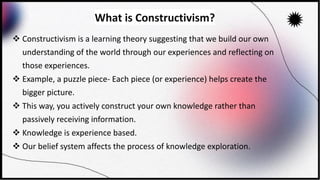
❖ Constructivism is a learning theory suggesting that we build our own
understanding of the world through our experiences and reflecting on
those experiences.
❖ Example, a puzzle piece- Each piece (or experience) helps create the
bigger picture.
❖ This way, you actively construct your own knowledge rather than
passively receiving information.
❖ Knowledge is experience based.
❖ Our belief system affects the process of knowledge exploration.
What is Constructivism?
➢Constructivist philosophers were influenced by:
Socrates, Heraclitus, Emanual Kant, John Dewey, Jean
Piaget, J. S. Bruner, Lev Vygotsky.
➢Father of Constructivism- Jean Piaget
C h a r a c t e r i s t i c s
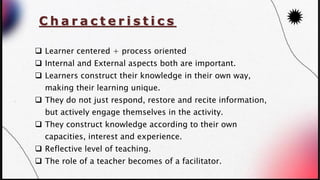
❑ Learner centered + process oriented
❑ Internal and External aspects both are important.
❑ Learners construct their knowledge in their own way,
making their learning unique.
❑ They do not just respond, restore and recite information,
but actively engage themselves in the activity.
❑ They construct knowledge according to their own
capacities, interest and experience.
❑ Reflective level of teaching.
❑ The role of a teacher becomes of a facilitator.
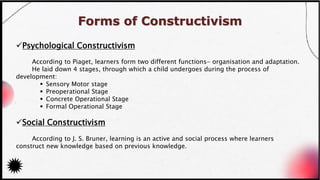
Forms of Constructivism
✓Psychological Constructivism
According to Piaget, learners form two different functions- organisation and adaptation.
He laid down 4 stages, through which a child undergoes during the process of
development:
▪ Sensory Motor stage
▪ Preoperational Stage
▪ Concrete Operational Stage
▪ Formal Operational Stage
✓Social Constructivism
According to J. S. Bruner, learning is an active and social process where learners
construct new knowledge based on previous knowledge.
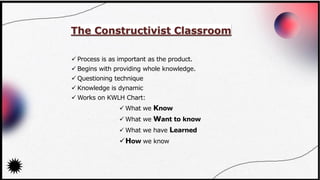
The Constructivist Classroom
✓ Process is as important as the product.
✓ Begins with providing whole knowledge.
✓ Questioning technique
✓ Knowledge is dynamic
✓ Works on KWLH Chart:
✓ What we Know
✓ What we Want to know
✓ What we have Learned
✓How we know
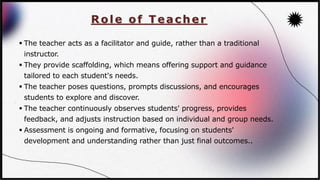
Role of Teacher
▪ The teacher acts as a facilitator and guide, rather than a traditional
instructor.
▪ They provide scaffolding, which means offering support and guidance
tailored to each student's needs.
▪ The teacher poses questions, prompts discussions, and encourages
students to explore and discover.
▪ The teacher continuously observes students' progress, provides
feedback, and adjusts instruction based on individual and group needs.
▪ Assessment is ongoing and formative, focusing on students'
development and understanding rather than just final outcomes..
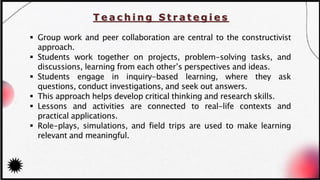
T e a c h i n g S t r a t e g i e s
▪ Group work and peer collaboration are central to the constructivist
approach.
▪ Students work together on projects, problem-solving tasks, and
discussions, learning from each other’s perspectives and ideas.
▪ Students engage in inquiry-based learning, where they ask
questions, conduct investigations, and seek out answers.
▪ This approach helps develop critical thinking and research skills.
▪ Lessons and activities are connected to real-life contexts and
practical applications.
▪ Role-plays, simulations, and field trips are used to make learning
relevant and meaningful.
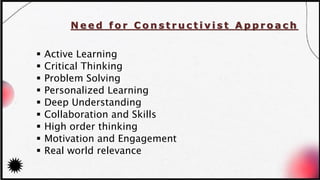
N e e d f o r C o n s t r u c t i v i s t A p p r o a c h
▪ Active Learning
▪ Critical Thinking
▪ Problem Solving
▪ Personalized Learning
▪ Deep Understanding
▪ Collaboration and Skills
▪ High order thinking
▪ Motivation and Engagement
▪ Real world relevance
T h a n k
Y o u

Constructivism approach for B.Ed sty.pdf

  • 1.
    S u bj e c t : B - 2 0 1 ( D ) Pedagogy of English M . B . G . P . G . C o l l e g e , H a l d w a n i Presented To: Dr. Shubhra P. Kandpal Presented By: Pragya Pandey B.Ed (Semester 2)
  • 2.
  • 3.
    ❖ Constructivism isa learning theory suggesting that we build our own understanding of the world through our experiences and reflecting on those experiences. ❖ Example, a puzzle piece- Each piece (or experience) helps create the bigger picture. ❖ This way, you actively construct your own knowledge rather than passively receiving information. ❖ Knowledge is experience based. ❖ Our belief system affects the process of knowledge exploration. What is Constructivism?
  • 4.
    ➢Constructivist philosophers wereinfluenced by: Socrates, Heraclitus, Emanual Kant, John Dewey, Jean Piaget, J. S. Bruner, Lev Vygotsky. ➢Father of Constructivism- Jean Piaget
  • 5.
    C h ar a c t e r i s t i c s ❑ Learner centered + process oriented ❑ Internal and External aspects both are important. ❑ Learners construct their knowledge in their own way, making their learning unique. ❑ They do not just respond, restore and recite information, but actively engage themselves in the activity. ❑ They construct knowledge according to their own capacities, interest and experience. ❑ Reflective level of teaching. ❑ The role of a teacher becomes of a facilitator.
  • 6.
    Forms of Constructivism ✓PsychologicalConstructivism According to Piaget, learners form two different functions- organisation and adaptation. He laid down 4 stages, through which a child undergoes during the process of development: ▪ Sensory Motor stage ▪ Preoperational Stage ▪ Concrete Operational Stage ▪ Formal Operational Stage ✓Social Constructivism According to J. S. Bruner, learning is an active and social process where learners construct new knowledge based on previous knowledge.
  • 7.
    The Constructivist Classroom ✓Process is as important as the product. ✓ Begins with providing whole knowledge. ✓ Questioning technique ✓ Knowledge is dynamic ✓ Works on KWLH Chart: ✓ What we Know ✓ What we Want to know ✓ What we have Learned ✓How we know
  • 8.
    Role of Teacher ▪The teacher acts as a facilitator and guide, rather than a traditional instructor. ▪ They provide scaffolding, which means offering support and guidance tailored to each student's needs. ▪ The teacher poses questions, prompts discussions, and encourages students to explore and discover. ▪ The teacher continuously observes students' progress, provides feedback, and adjusts instruction based on individual and group needs. ▪ Assessment is ongoing and formative, focusing on students' development and understanding rather than just final outcomes..
  • 9.
    T e ac h i n g S t r a t e g i e s ▪ Group work and peer collaboration are central to the constructivist approach. ▪ Students work together on projects, problem-solving tasks, and discussions, learning from each other’s perspectives and ideas. ▪ Students engage in inquiry-based learning, where they ask questions, conduct investigations, and seek out answers. ▪ This approach helps develop critical thinking and research skills. ▪ Lessons and activities are connected to real-life contexts and practical applications. ▪ Role-plays, simulations, and field trips are used to make learning relevant and meaningful.
  • 10.
    N e ed f o r C o n s t r u c t i v i s t A p p r o a c h ▪ Active Learning ▪ Critical Thinking ▪ Problem Solving ▪ Personalized Learning ▪ Deep Understanding ▪ Collaboration and Skills ▪ High order thinking ▪ Motivation and Engagement ▪ Real world relevance
  • 11.
    T h an k Y o u