GOVERNMENT ENGINEERING COLLEGE
BHARUCH
SUBJECT:- P.S.O.C.
TOPIC:-LOAD FREQUENCY CONTROL OF TWO AREA
Submitted by:-
Enroll. No. :- 140140109081
Name:- RUCHIKA A. PATEL
ELECTRICAL DEPARTMENT (8TH
SEM)
Contents
Introduction
 Reasons for constant frequency
 Various modelings used in LPC Generator
model Load model Prime mover model
Governor model
 Automatic Generation Control (AGC)
AGC of Two Area System
Introduction
 In an electric power system, Load Frequency
Control (LFC) is a system to maintain
reasonably uniform frequency, to divide the
load between the generators, and to control
the tie- line interchange schedules.
 The change in frequency is sensed when the
rotor angle ∂ is changed.
 The error signals are transformed into real
power command signal, which is sent to
prime mover to call for an increment in the
torque.
 The prime mover then brings change in the
generator output by an amount which will
change the values of within the specified
tolerance.
Reasons for constant
frequency
 The speed of the alternating current motors depends on
the frequency of the power supply. There are situations
where speed consistency is expected to be of high
order.
 The accuracy of the electric clocks are dependent on
the frequency of the supply.
 If the normal frequency is 50 Hertz and the system
frequency falls below 47.5 Hertz or goes up above 52.5
Hertz then the blades of the turbine are likely to get
damaged so as to prevent the stalling of the generator .
 Due to the subnormal frequency operation the blast of
the ID and FD fans in the power stations get reduced
and thereby reduce the generation power in the thermal
plants.
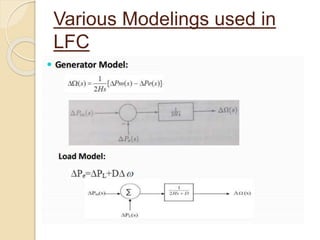
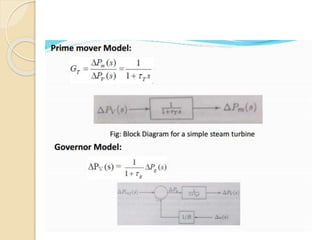
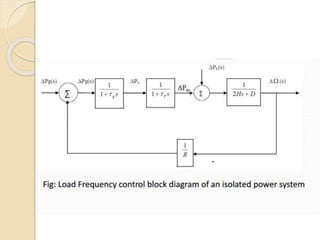
Various Modelings used in
LFC
Automatic Generation Control
 Sometimes, load on the system is increased suddenly then
the turbine speed drops before the governor can adjust the
input of the steam to the new load.
 As the change in the value of speed diminishes, the error
signal becomes smaller and the position of the governor
get closer to the point required to maintain the constant
speed.
 One way to restore the speed or frequency to its nominal
value is to add an integrator on the way.
 As the load of the system changes continuously the
generation is adjusted automatically to restore the
frequency to the nominal value. This scheme is known as
automatic generation control.
 In an interconnected system consisting of several pools,
the role of the AGC is to divide the load among the system,
stations and generators so as to achieve maximum
economy and reasonably uniform frequency.
AGC of a Two- Area System
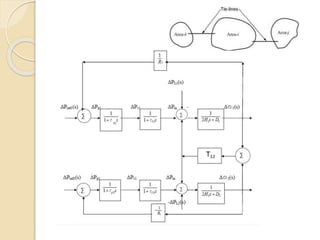
 Now a days in most of the cases, a
group of generators are closely
coupled internally and swing in unison.
 These generator turbines tend to
have the same response
characteristics and such a group of
generators are said to be coherent.
 The LFC loop represent the whole
system and the group is called the
control group.
THANK YOU

load frequency control of two area

  • 1.
    GOVERNMENT ENGINEERING COLLEGE BHARUCH SUBJECT:-P.S.O.C. TOPIC:-LOAD FREQUENCY CONTROL OF TWO AREA Submitted by:- Enroll. No. :- 140140109081 Name:- RUCHIKA A. PATEL ELECTRICAL DEPARTMENT (8TH SEM)
  • 2.
    Contents Introduction  Reasons forconstant frequency  Various modelings used in LPC Generator model Load model Prime mover model Governor model  Automatic Generation Control (AGC) AGC of Two Area System
  • 3.
    Introduction  In anelectric power system, Load Frequency Control (LFC) is a system to maintain reasonably uniform frequency, to divide the load between the generators, and to control the tie- line interchange schedules.  The change in frequency is sensed when the rotor angle ∂ is changed.  The error signals are transformed into real power command signal, which is sent to prime mover to call for an increment in the torque.  The prime mover then brings change in the generator output by an amount which will change the values of within the specified tolerance.
  • 4.
    Reasons for constant frequency The speed of the alternating current motors depends on the frequency of the power supply. There are situations where speed consistency is expected to be of high order.  The accuracy of the electric clocks are dependent on the frequency of the supply.  If the normal frequency is 50 Hertz and the system frequency falls below 47.5 Hertz or goes up above 52.5 Hertz then the blades of the turbine are likely to get damaged so as to prevent the stalling of the generator .  Due to the subnormal frequency operation the blast of the ID and FD fans in the power stations get reduced and thereby reduce the generation power in the thermal plants.
  • 5.
  • 8.
    Automatic Generation Control Sometimes, load on the system is increased suddenly then the turbine speed drops before the governor can adjust the input of the steam to the new load.  As the change in the value of speed diminishes, the error signal becomes smaller and the position of the governor get closer to the point required to maintain the constant speed.  One way to restore the speed or frequency to its nominal value is to add an integrator on the way.  As the load of the system changes continuously the generation is adjusted automatically to restore the frequency to the nominal value. This scheme is known as automatic generation control.  In an interconnected system consisting of several pools, the role of the AGC is to divide the load among the system, stations and generators so as to achieve maximum economy and reasonably uniform frequency.
  • 9.
    AGC of aTwo- Area System  Now a days in most of the cases, a group of generators are closely coupled internally and swing in unison.  These generator turbines tend to have the same response characteristics and such a group of generators are said to be coherent.  The LFC loop represent the whole system and the group is called the control group.
  • 11.