DEPARTMENT OF BUSINESS ADMINISTRATION,
UTKAL UNIVERSITY,
BHUBANESWAR,ODISHA, INDIA.
 WHAT IS CONTROLLING?
 FEATURES OF CONTROL
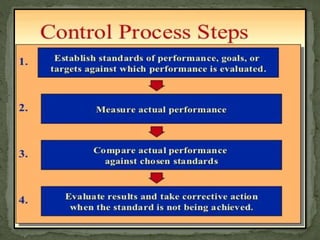
 CONTROL PROCESS-
 STEPS
 TYPES OF CONTROL
 EXAMPLES
 BIBLIOGRAPHY
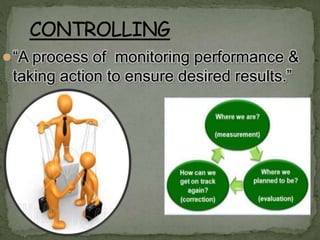
 “A process of monitoring performance &
taking action to ensure desired results.”
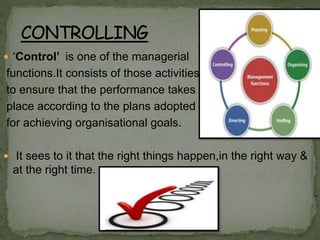
 ‘Control’ is one of the managerial
functions.It consists of those activities
to ensure that the performance takes
place according to the plans adopted
for achieving organisational goals.
 It sees to it that the right things happen,in the right way &
at the right time.
 1.MANAGERIAL FUNCTION- Control is one of the
managerial functions. Each manager has to perform control
action in the organisation.
 2.FORWARD LOOKING- Managers suggest corrective actions
for the future period,where past performance acts as a base.
 3.CONTINUOUS ACTIVITY- Control will have to be
regularly exercised.Managerial control follows a definite pattern
on a continuous basis.
 4.CONTROL IS RELATED TO PLANNING- Control cannot
be exercised without planning.First,planning has to be done &
whenever there is a deviation,then corrective measures are taken
immediately.So,planning provides a base for controlling.
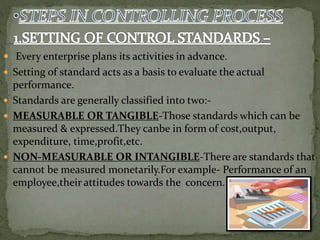
 Every enterprise plans its activities in advance.
 Setting of standard acts as a basis to evaluate the actual
performance.
 Standards are generally classified into two:-
 MEASURABLE OR TANGIBLE-Those standards which can be
measured & expressed.They canbe in form of cost,output,
expenditure, time,profit,etc.
 NON-MEASURABLE OR INTANGIBLE-There are standards that
cannot be measured monetarily.For example- Performance of an
employee,their attitudes towards the concern.
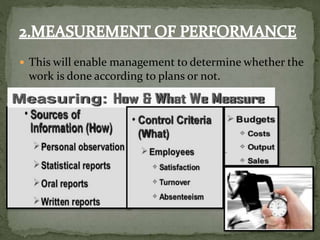
 This will enable management to determine whether the
work is done according to plans or not.
 The purpose of comparison between actual and standard
performance is-(a)to find out deviations & (b)to determine
reasons for such deviations.
 Managers evaluate whether & to what extent performance
deviates from the standards of performance.
 There are certain variations within the prescribed limits,but if
the deviations are above the limit,then
it needs urgent action.The managers
are required to analyse the causes and
rectify the weak areas.This is known as
‘Management by Exception’.
 www.slideshare.net
 www.tatamcgrawhill.com
 www.himpub.com
BOOKS-
 Principles of Business Management
(Kalyani Publishers)
 Organisation Structure & Design
(Himalaya Publishing House)
Controlling-Management Functions-Organisation Structure & Process

Controlling-Management Functions-Organisation Structure & Process

  • 1.
    DEPARTMENT OF BUSINESSADMINISTRATION, UTKAL UNIVERSITY, BHUBANESWAR,ODISHA, INDIA.
  • 2.
     WHAT ISCONTROLLING?  FEATURES OF CONTROL  CONTROL PROCESS-  STEPS  TYPES OF CONTROL  EXAMPLES  BIBLIOGRAPHY
  • 3.
     “A processof monitoring performance & taking action to ensure desired results.”
  • 4.
     ‘Control’ isone of the managerial functions.It consists of those activities to ensure that the performance takes place according to the plans adopted for achieving organisational goals.  It sees to it that the right things happen,in the right way & at the right time.
  • 5.
     1.MANAGERIAL FUNCTION-Control is one of the managerial functions. Each manager has to perform control action in the organisation.  2.FORWARD LOOKING- Managers suggest corrective actions for the future period,where past performance acts as a base.  3.CONTINUOUS ACTIVITY- Control will have to be regularly exercised.Managerial control follows a definite pattern on a continuous basis.  4.CONTROL IS RELATED TO PLANNING- Control cannot be exercised without planning.First,planning has to be done & whenever there is a deviation,then corrective measures are taken immediately.So,planning provides a base for controlling.
  • 8.
     Every enterpriseplans its activities in advance.  Setting of standard acts as a basis to evaluate the actual performance.  Standards are generally classified into two:-  MEASURABLE OR TANGIBLE-Those standards which can be measured & expressed.They canbe in form of cost,output, expenditure, time,profit,etc.  NON-MEASURABLE OR INTANGIBLE-There are standards that cannot be measured monetarily.For example- Performance of an employee,their attitudes towards the concern.
  • 9.
     This willenable management to determine whether the work is done according to plans or not.
  • 10.
     The purposeof comparison between actual and standard performance is-(a)to find out deviations & (b)to determine reasons for such deviations.  Managers evaluate whether & to what extent performance deviates from the standards of performance.  There are certain variations within the prescribed limits,but if the deviations are above the limit,then it needs urgent action.The managers are required to analyse the causes and rectify the weak areas.This is known as ‘Management by Exception’.
  • 19.
     www.slideshare.net  www.tatamcgrawhill.com www.himpub.com BOOKS-  Principles of Business Management (Kalyani Publishers)  Organisation Structure & Design (Himalaya Publishing House)