Damaris Escobar
           2012
   1. Purposive Domain - this category
    establishes the type of ESP, for what purpose.

   2. Setting - the time and place.

   3. Interaction - the roles in which the
    participants will find themselves in terms of
    status, age group, social relationships etc.
   4.  Instrumentality       a.    medium      of
    communication.

   5. Dialect - the dialects the student will
    have to understand and produce.

   6. Target level - level of linguistic
    proficiency, different skills may be different.
   7. Communicative event - what the
    learner will have to do with English.

    8. Communicative key - the manner in
    which communication needs to be
    carried out.
If we now apply this to our specific
situation and look at the communicative
event category in more detail, for social
science students in higher education we
find the following:
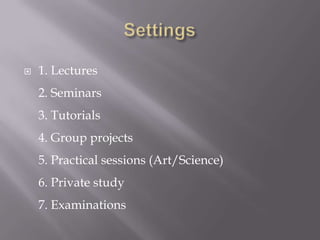
   1. Lectures
    2. Seminars
    3. Tutorials
    4. Group projects
    5. Practical sessions (Art/Science)
    6. Private study
    7. Examinations
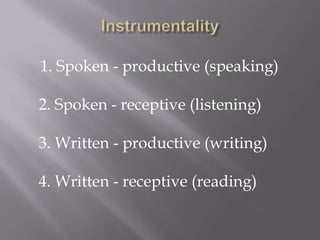
1. Spoken - productive (speaking)

2. Spoken - receptive (listening)

3. Written - productive (writing)

4. Written - receptive (reading)
 Theactivities in which the
students would use English
    in each of the above
          settings
   Specification of syllabus content by focusing on
    micro-skills

   Specification by focusing on micro-functions
    (consist of short utterances (usually one
    sentence). They are used to inquire about or
    impart factual information, opinion, emotions,
    advice, greetings, etc.

   Specification by focusing on linguistic forms (A
    meaningful unit of language, such as an affix, a
    word, a phrase, or a sentence)
   Purpose
   Medium/mode/channel of communication.
   Sociolinguistic aspects
   Linguistics
   Pragmatics.
   1 Davies criticizes the lack of consistency and
    that in this model it is shown no transparent
    links to syllabus design

   2 CSD (communicative syllabus design) is
    about needs alone.

   3 Needs are private demands are public.

   Hawkey criticizes Munby’s failure to produce
    a teaching/learning syllabus.
THANKS
   FOR
  YOUR
ATTENTION

  • 1.
  • 3.
    1. Purposive Domain - this category establishes the type of ESP, for what purpose.  2. Setting - the time and place.  3. Interaction - the roles in which the participants will find themselves in terms of status, age group, social relationships etc.
  • 4.
    4. Instrumentality a. medium of communication.  5. Dialect - the dialects the student will have to understand and produce.  6. Target level - level of linguistic proficiency, different skills may be different.
  • 5.
    7. Communicative event - what the learner will have to do with English.  8. Communicative key - the manner in which communication needs to be carried out.
  • 6.
    If we nowapply this to our specific situation and look at the communicative event category in more detail, for social science students in higher education we find the following:
  • 7.
    1. Lectures 2. Seminars 3. Tutorials 4. Group projects 5. Practical sessions (Art/Science) 6. Private study 7. Examinations
  • 8.
    1. Spoken -productive (speaking) 2. Spoken - receptive (listening) 3. Written - productive (writing) 4. Written - receptive (reading)
  • 9.
     Theactivities inwhich the students would use English in each of the above settings
  • 10.
    Specification of syllabus content by focusing on micro-skills  Specification by focusing on micro-functions (consist of short utterances (usually one sentence). They are used to inquire about or impart factual information, opinion, emotions, advice, greetings, etc.  Specification by focusing on linguistic forms (A meaningful unit of language, such as an affix, a word, a phrase, or a sentence)
  • 11.
    Purpose  Medium/mode/channel of communication.  Sociolinguistic aspects  Linguistics  Pragmatics.
  • 12.
    1 Davies criticizes the lack of consistency and that in this model it is shown no transparent links to syllabus design  2 CSD (communicative syllabus design) is about needs alone.  3 Needs are private demands are public.  Hawkey criticizes Munby’s failure to produce a teaching/learning syllabus.
  • 13.
    THANKS FOR YOUR ATTENTION